
Life, 1917-08-23 · page 18 of 40
Life — August 23, 1917 — page 18: what you’re looking at
What you’re looking at
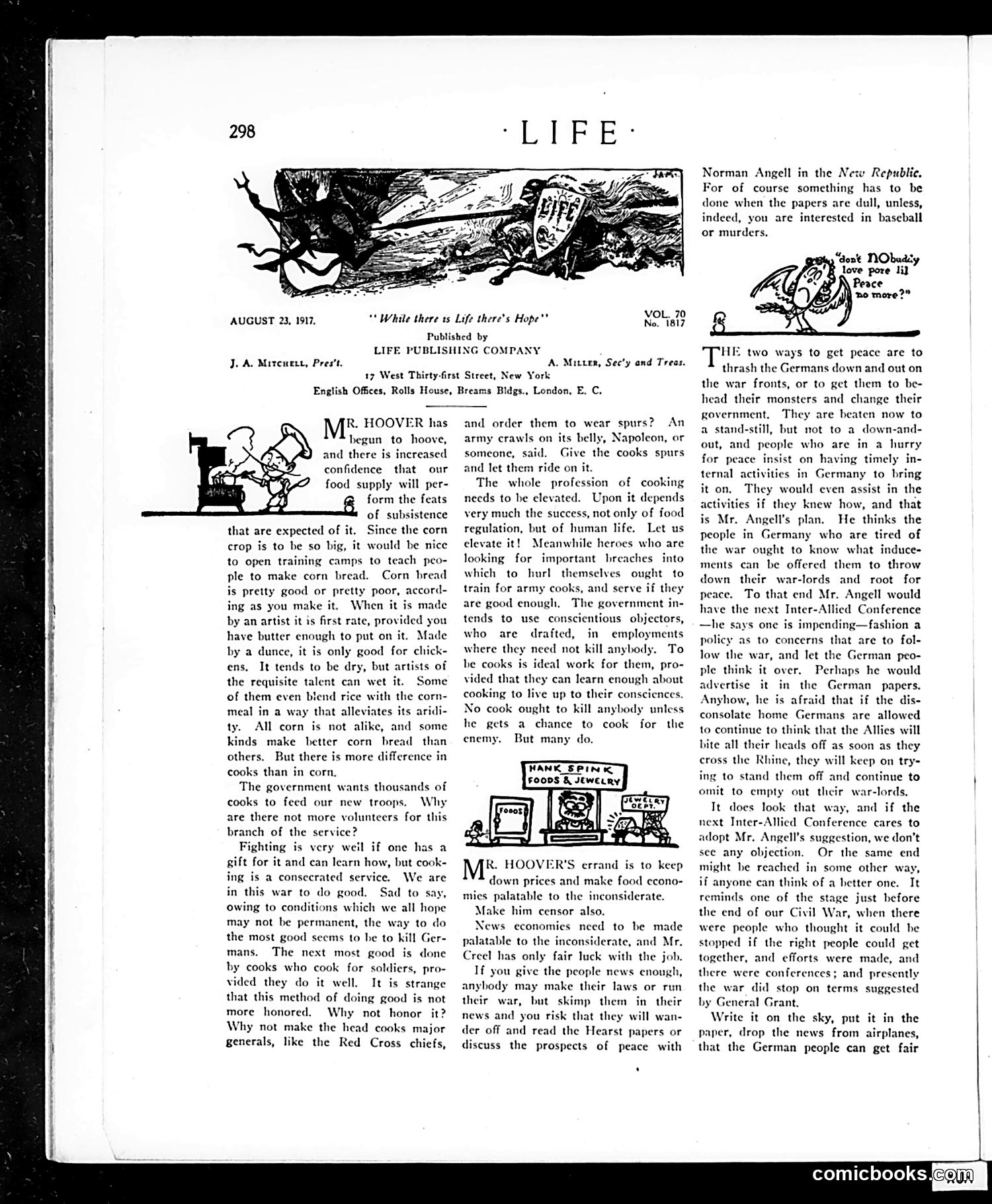
This page satirizes American home-front efforts during World War I, particularly food rationing under Herbert Hoover's direction. The main text argues that cooking for soldiers is as important as combat—"an army crawls on its belly"—and proposes elevating head cooks to major general rank with military honors. The cartoon (top left) appears to depict figures struggling with or promoting corn bread production, supporting the article's theme about utilizing the corn crop for soldier rations. The satire critiques both food management and news censorship: George Creel (head of wartime propaganda) is mentioned as struggling to make "news economies palatable to the inconsiderate" public. The piece implies that if people lack adequate information, they'll turn to Hearst papers (William Randolph Hearst, known for sensationalism) or discuss peace proposals by Norman Angell instead of supporting the war effort. The underlying point mocks how wartime requires dignifying unglamorous work while managing public opinion through controlled information.
📄 Transcribed text from this page (OCR, searchable)
Machine-transcribed from the original scan — historical spelling and the odd misread are preserved.
SS eS RE j ' t | 298 AUGUST 23, 1917, “* While there ts Life there's Hope" vot. 70 Published by LIFE PUBLISHING COMPANY J. A. Mircurtt, Pres’t. A. Mittrr, Sec’y and Treas. 17 West Thirty-first Street, New York English Offices, Rolls House, Breams Bldgs., London, E. C. R. HOOVER has begun to hoove, and there is increased confidence that our food supply will per- form the feats of subsistence that are expected of it. Since the corn crop is to be so big, it would be nice to open training camps to teach peo- ple to make corn bread. Corn bread is pretty good or pretty poor, accord- ing as you make it. When it is made by an artist it is first rate, provided you have butter cnough to put on Made by a dunce, it is only good for chick- ens, It tends to be dry, but artists the requisite talent can wet it. Some of them even blend rice with the corn- meal in a way that alleviates its aridi- ty. All corn is not alike, and some kinds make better corn bread than others. But there is more difference in cooks than in corn, The government wants thousands of cooks to feed our new troops. Why are there not more volunteers for this branch of the service? Fighting is very weil if one has a gift for it and can learn how, but cook- ing is a consecrated service. We are in this war to do good. Sad to owing to conditions which we all hope may not be permanent, the way to do the most good seems to be to kill Ger- mans. The next most good is done by cooks who cook for soldiers, pro- vided they do it well. It is strange that this method of doing good is not more honored. Why not honor it? Why not make the head cooks major generals, like the Red Cross chiefs, and order them to wear spurs? An army crawls on its belly, Napoleon, or someone, said. Give the cooks spurs and let them ride on i The whole profession of cooking needs to he elevated. Upon it depends very much the success, not only of food regulation, but of human life. Let us elevate it! Meanwhile heroes who are looking for important breaches into which to hurl themselves ought to train for army cooks, and serve if they are good enough, The government in- tends to use conscientious objectors, who are drafted, in employments where they need not kill anybody. To he cooks is ideal work for them, pro- vided that they can learn enough about cooking to live up to their consciences. No cook ought to kill anybody untess he gets a chance to cook for the enemy. But many do. WANK SPIN Foops & Jtwecry R. HOOVER'S errand is to keep down prices and make food econo- mies palatable to the inconsiderate. Make him censor also. News economies need to be made palatable to the inconsiderate, and Mr. Creel has only fair luck with the job. If you give the people news enough, anybody may make their laws or run their war, but skimp them in their news and you risk that they will wan- der off and read the Hearst papers or discuss the prospects of peace with Norman Angell in the } Republic. For of course something has to be done when the papers are dull, unless, indeed, you are interested in baseball or murders. “dont NObualy B love pore li} HE two ways to get peace are to thrash the Germans down and out on the war fronts, or to get them to be- head their monsters and change their government, They are beaten now to a stand-still, but not to a down-and- out, and people who are in a hurry for peace insist on having timely in- ternal activities in Germany to bring it on, They would even assist in the activities if they knew how, and that is Mr. Angell’s plan. He thinks the people in Germany who are tired of the war ought to know what induce- ments can be offered them to throw down their war-lords and root for peace. To that end Mr. Angell would have the next Inter-Allied Conference —he says one is impending—fashion a policy as to concerns that are to fol- low the war, and let the German peo- ple think it over. Perhaps he would advertise it in the German papers. Anyhow, he is afraid that if the dis- consolate home Germans are allowed to continue to think that the Allies will bite all their heads off as soon as they cross the Rhine, they will keep on try- ing to stand them off and continue to omit to empty out their war-lords. Tt does look that way, and if the next Inter-Allied Conference cares to adopt Mr, Angell’s suggestion, we don’t see any objection. Or the same end might be reached in some other way, if anyone can think of a better one. It reminds one of the stage just before the end of our C War, when there were people who thought it could be stopped if the right people could get together, and efforts were made, and there were conferences; and presently the war did stop on terms suggested by General Grant. Write it on the sky, put it in the paper, drop the news from airplanes, that the German people can get fair comicbooks