
Life, 1917-08-23 · page 13 of 40
Life — August 23, 1917 — page 13: what you’re looking at
What you’re looking at
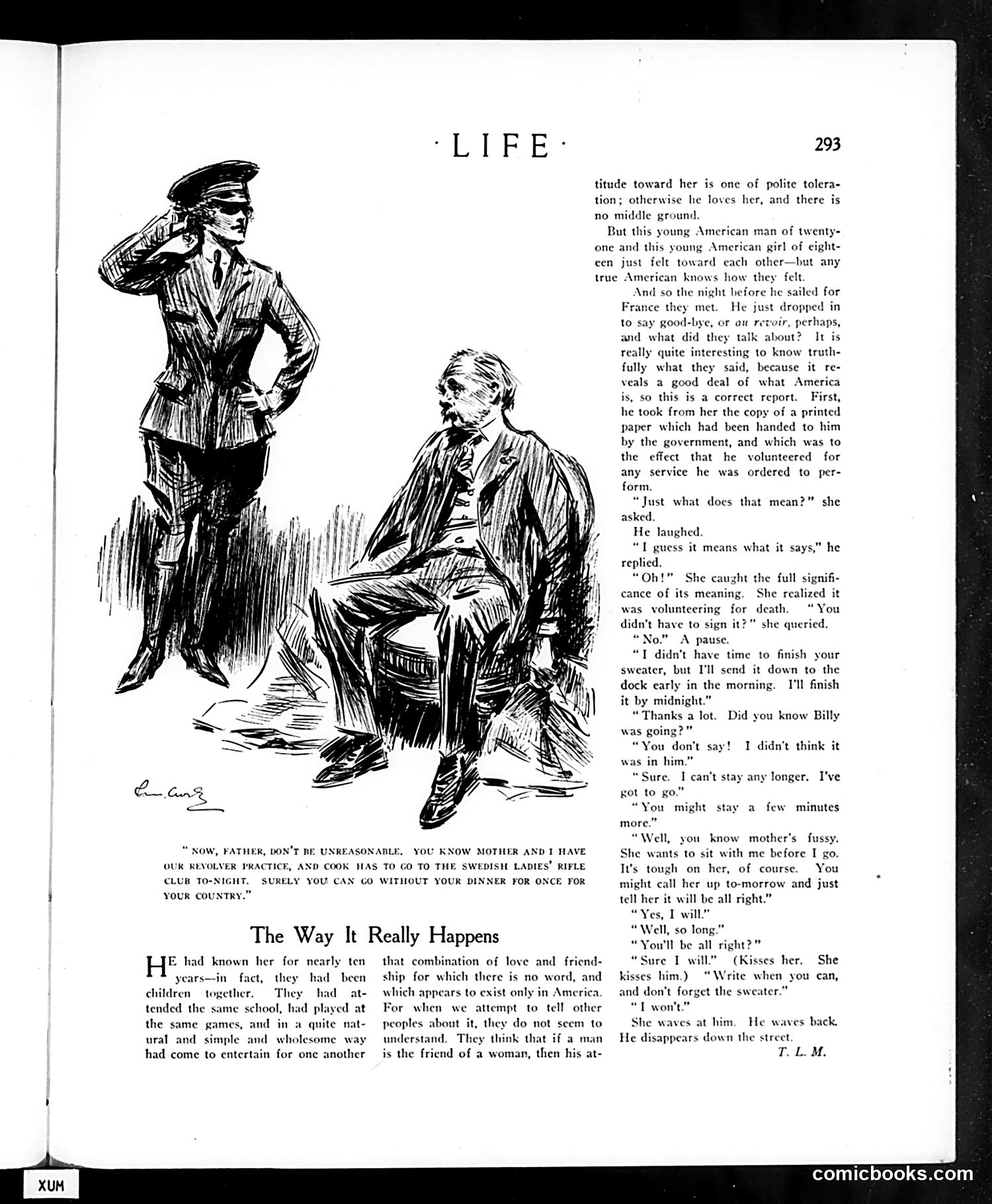
This illustration depicts a conversation between a young woman and an older man, likely her father. The narrative addresses American courtship customs and gender expectations of the early 20th century. The story reveals the couple's farewell before the young man sails to France—apparently to enlist or serve in military capacity. The father's quoted dialogue emphasizes masculine duty and self-sacrifice ("you know mother and I have our revolver practice...cook has to go to the Swedish Ladies' Rifle Club"). The satire mocks how American men romanticize military service while women must manage domestic anxieties. The young woman's pragmatism—insisting on finishing a sweater before he leaves—contrasts with the patriotic drama surrounding his departure, highlighting the disconnect between heroic ideals and daily reality.
📄 Transcribed text from this page (OCR, searchable)
Machine-transcribed from the original scan — historical spelling and the odd misread are preserved.
“ NOW, FATHER, DON'T BE UNREASONABLE, YOU KNOW MOTHER AND I ITAVE She wants to sit with me before I go. OUR REVOLVER PRACTICE, AND COOK HAS TO GO TO THE SWEDISH LADIES’ RIFLE It’s tough on her, of course. You CLUB TO-NIGHT, SURELY YOU CAN GO WITHOUT YOUR DINNER FOR ONCE FOR might call her up to-morrow and just . YOUR COUNTRY.” The Way It Really Happens a eat ee E had known her for nearly ten n fact, they had been her. = They had at- tended the same school, had played at the same games, and in a quite nat- ural and simple and wholesome way had come to entertain for one another years— children t “LIFE: 293 titude toward her is one of polite tolera- tion; otherwise he loves her, and there is no middle ground. But this young American man of twenty- one and this young American girl of eight cen just felt toward each other—but any true American knows how they felt And so the night before he sailed for France they met. He just dropped in to say good-bye, or au revoir, perhaps, and what did they talk about? It is really quite interesting to know truth- fully what they said, because it re- veals a good deal of what America is, so this is a correct report. First, he took from her the copy of a printed paper which had been handed to him by the government, and which was to the effect that he volunteered for any service he was ordered to per- form. “Just what does that mean?” she asked. He laughed. “T guess it means what it says,” he replied. “Oh!” She caught the full signifi- cance of its meaning. She realized it was volunteering for death, “You didn’t have to sign it?" she queried. “No.” A pause. “T didn’t have time to finish your sweater, but I'll send it down to the dock early in the morning. I'll finish it by midnight.” “Thanks a lot. Did you know Billy was going “You don't s was in him.” “Sure. I can't stay any longer, I’ve got to go.” “You might stay a few minutes I didn’t think it more.” “Well, you know mother's fussy. tell her it will be all right.” “Yes, I will.” that combination of love and friend- “Sure I will (Kisses her. She ship for which there is no word, and _ kisses him.) Write when you can, which appears to exist only in America. and don't forget the sweater.” For when we attempt to tell other “T won't peoples about it, they do not seem to She waves at him. He waves back. understand. They think that if a man He disappears down the street is the friend of a woman, then his at- T. LM. comicbooks.com