
A complete issue · 40 pages · 1917
Life — July 26, 1917
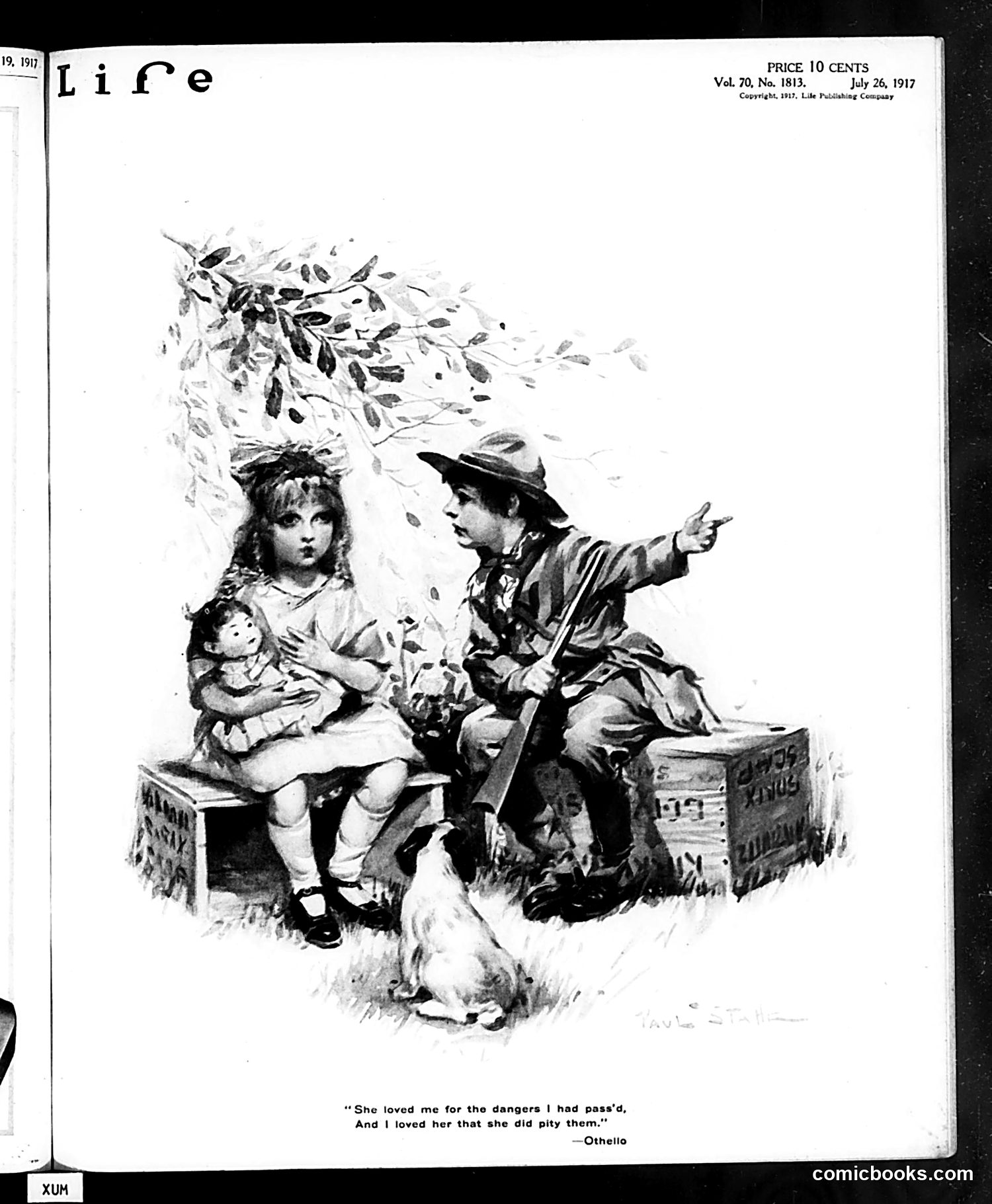
This *Life* magazine cover from July 26, 1917 illustrates a quote from Shakespeare's *Othello*: "She loved me for the dangers I had pass'd, / And I loved her that she did pity them." The image depicts a romantic scene between a young woman holding a doll and a soldier in military uniform, seated together beneath a tree with falling leaves. A small dog is present at their feet. The satire appears to target wartime romance—specifically the sentimental attachment women supposedly developed toward soldiers based on their military service and perceived bravery. The juxtaposition of the woman's childlike doll with the soldier suggests commentary on naive or superficial romantic attraction during WWI, when America had recently entered the conflict. The Shakespeare reference adds literary irony to the domestic scene.
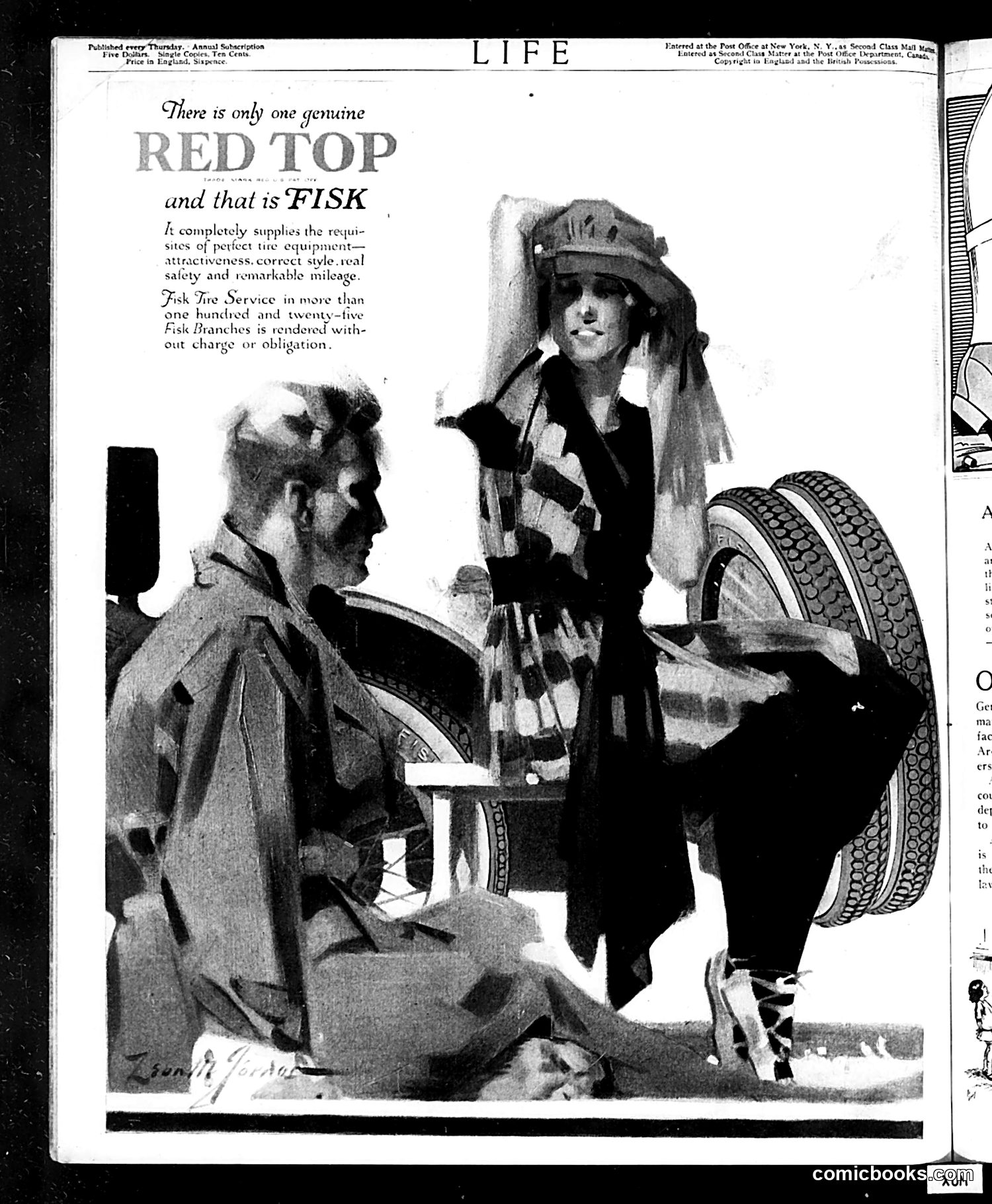
This page is primarily a **Fisk Tire advertisement**, not political satire. The headline "There is only one genuine RED TOP and that is FISK" promotes the tire brand's distinctive red-topped rubber products. The image shows a man and woman posing with an automobile and Fisk tires. The "Red Top" branding refers to the tire's visual design feature—a red stripe or marking on the tire sidewall that distinguished Fisk products from competitors. The text emphasizes Fisk's tire service network ("more than one hundred and twenty-five Fisk Branches") and claims about quality and safety. This is straightforward commercial advertising typical of Life magazine's revenue model, using an attractive couple and automotive imagery to sell automobile products to early 20th-century consumers.
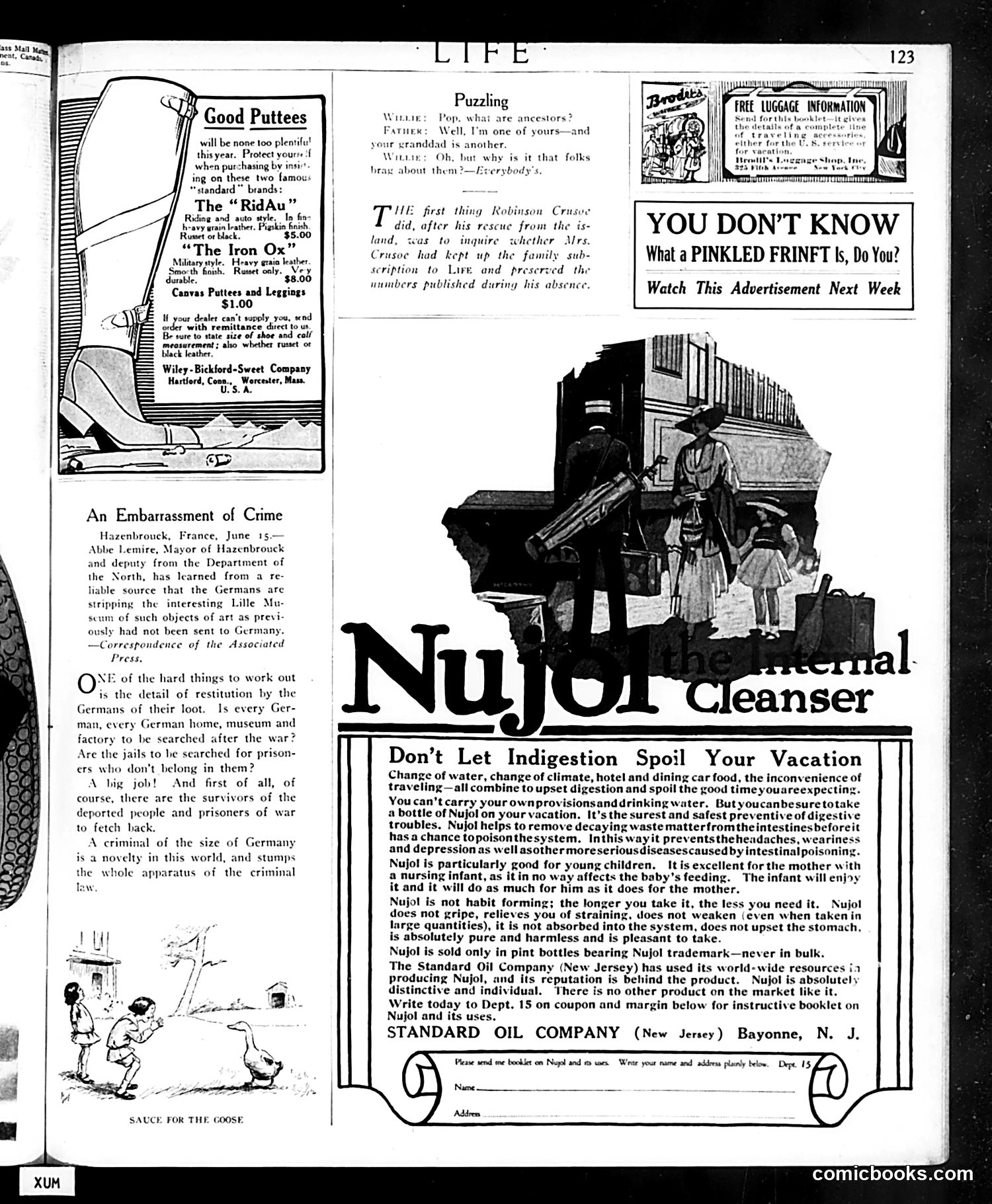
This page is primarily **advertising content** rather than political satire. The dominant feature is a large Nujol laxative advertisement emphasizing digestive health during travel—a common concern for early 20th-century vacationers. The left side contains product advertisements for leather goods ("Good Puttees," "The RidAu") and a brief article titled "An Embarrassment of Crime" referencing post-WWI concerns about German art repatriation and prisoners of war. A small cartoon labeled "Sauce for the Goose" appears at bottom, though its specific satirical meaning is unclear from this image alone. A teaser advertisement promises revelation of "What a PICKLED FRINF is" in the next week's issue—a marketing device to encourage repeat readership.
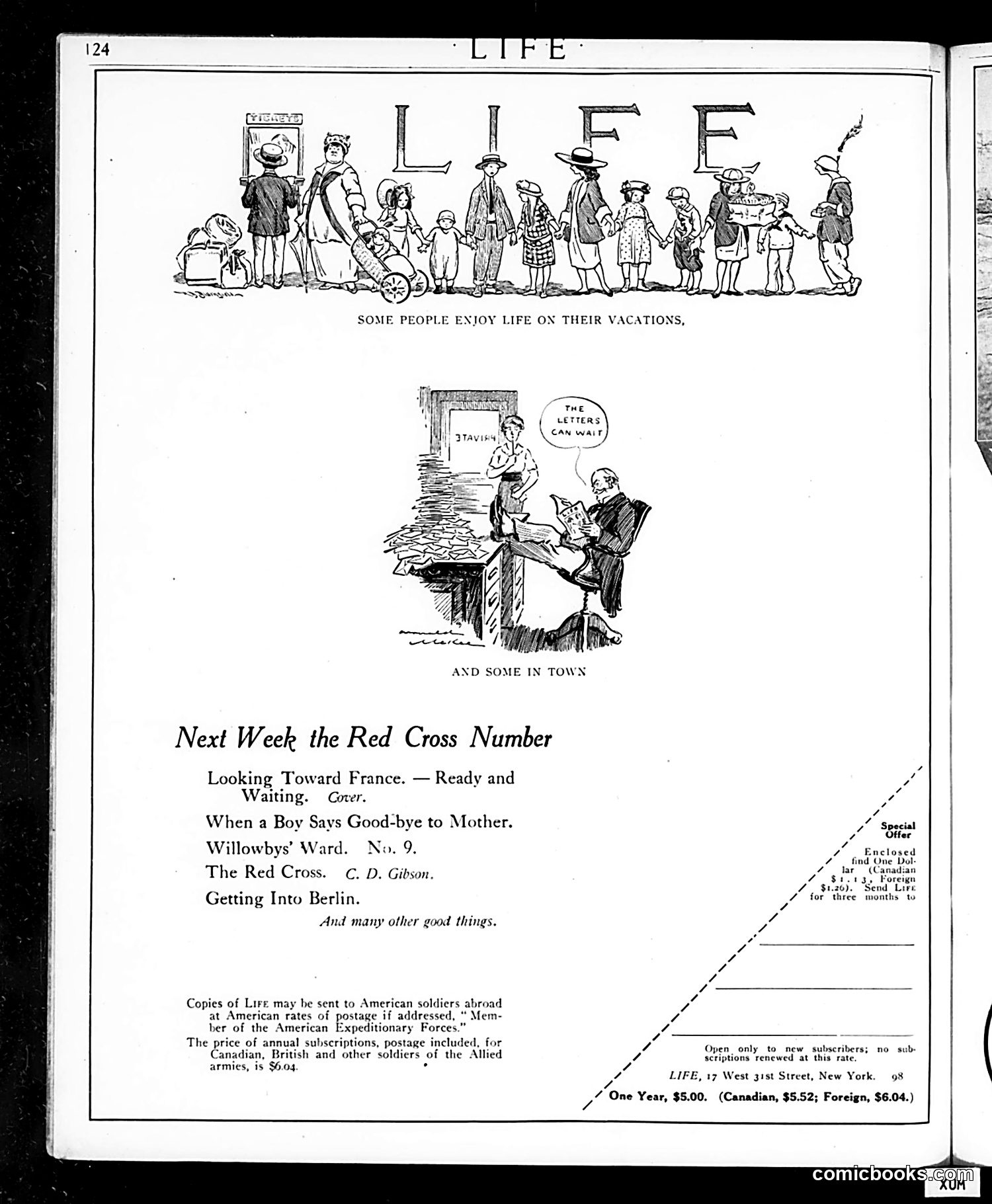
This page contains two satirical cartoons contrasting vacation experiences during what appears to be World War I era (based on references to France and Berlin). **Top cartoon**: The word "LIFE" is spelled out using people on vacation—families with luggage, children, and leisure activities, illustrating carefree holiday enjoyment. **Bottom cartoon**: Shows the contrast—a man at a desk drowning in mail and correspondence, labeled "TAXIED," with another figure saying "THE LETTERS CAN WAIT!" The satire: while some enjoy vacations abroad, those remaining in town are buried in accumulated business correspondence. The page announces next week's Red Cross–themed issue, supporting WWI relief efforts. The overall message critiques the leisure gap between vacationing wealthy people and those managing responsibilities at home.
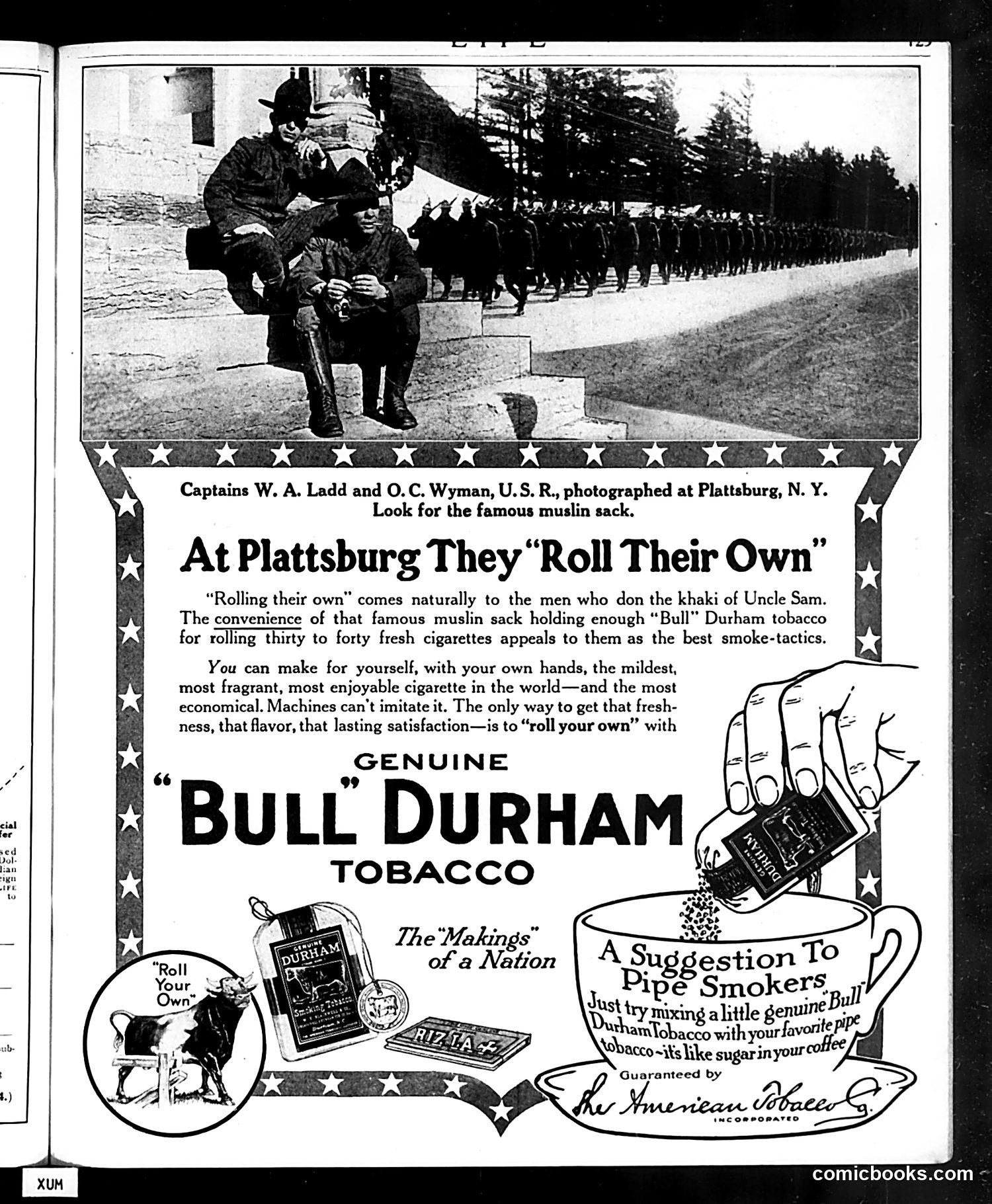
This is primarily a **Bull Durham tobacco advertisement**, not political satire. The page shows a photograph of two U.S. Army officers (Captains W.A. Ladd and O.C. Wyman) at Plattsburg, New York, with soldiers marching in formation behind them. The ad exploits the military context by claiming Bull Durham's "muslin sack" allows soldiers to roll their own cigarettes conveniently. The phrase "Roll Their Own" is both a literal description of hand-rolling cigarettes and patriotic messaging linking the product to military service. The text includes a "suggestion to pipe smokers" to mix Bull Durham tobacco into their pipes. The bull logo and various product images are displayed throughout. This represents **wartime marketing** leveraging military imagery and patriotism to sell tobacco products to soldiers and the public.
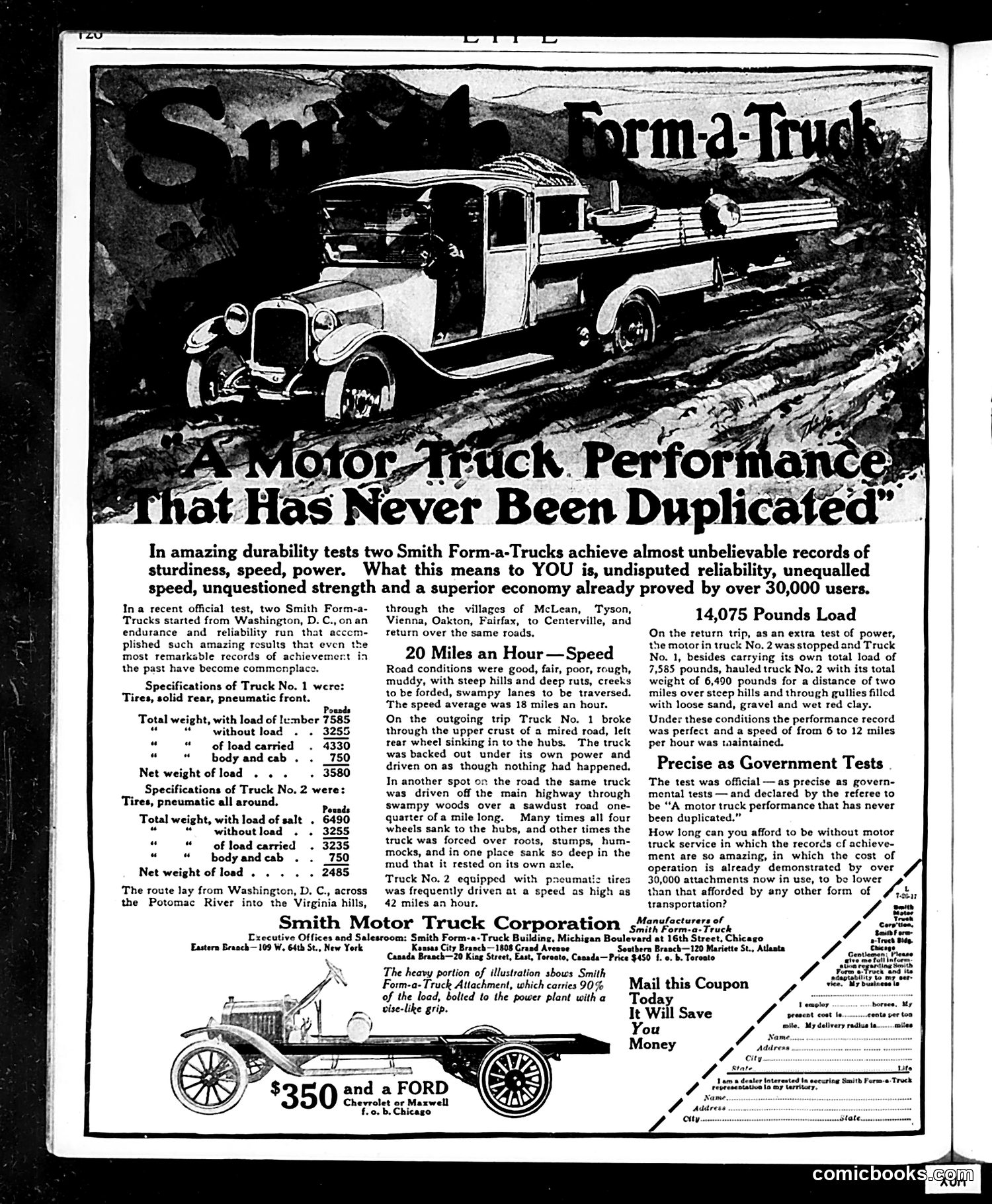
This page is primarily a **commercial advertisement**, not political satire. It promotes Smith Motor Truck Corporation's "Form-a-Truck" vehicles. The ad emphasizes the truck's durability through documented performance tests—two vehicles traveled from Washington, D.C. to various Virginia locations, achieving records for speed, load capacity, and reliability. Specific metrics are highlighted: one truck carried 14,075 pounds; another averaged 20 miles per hour over difficult terrain. The advertisement appeals to practical business owners by claiming "undisputed reliability, unequalled speed" and noting over 30,000 existing users. A mail-in coupon offers information to interested buyers. The page also features a smaller vintage truck illustration with pricing ($350 for a Ford or similar model attachment). This reflects early 20th-century commercial truck marketing emphasizing real-world performance proof.
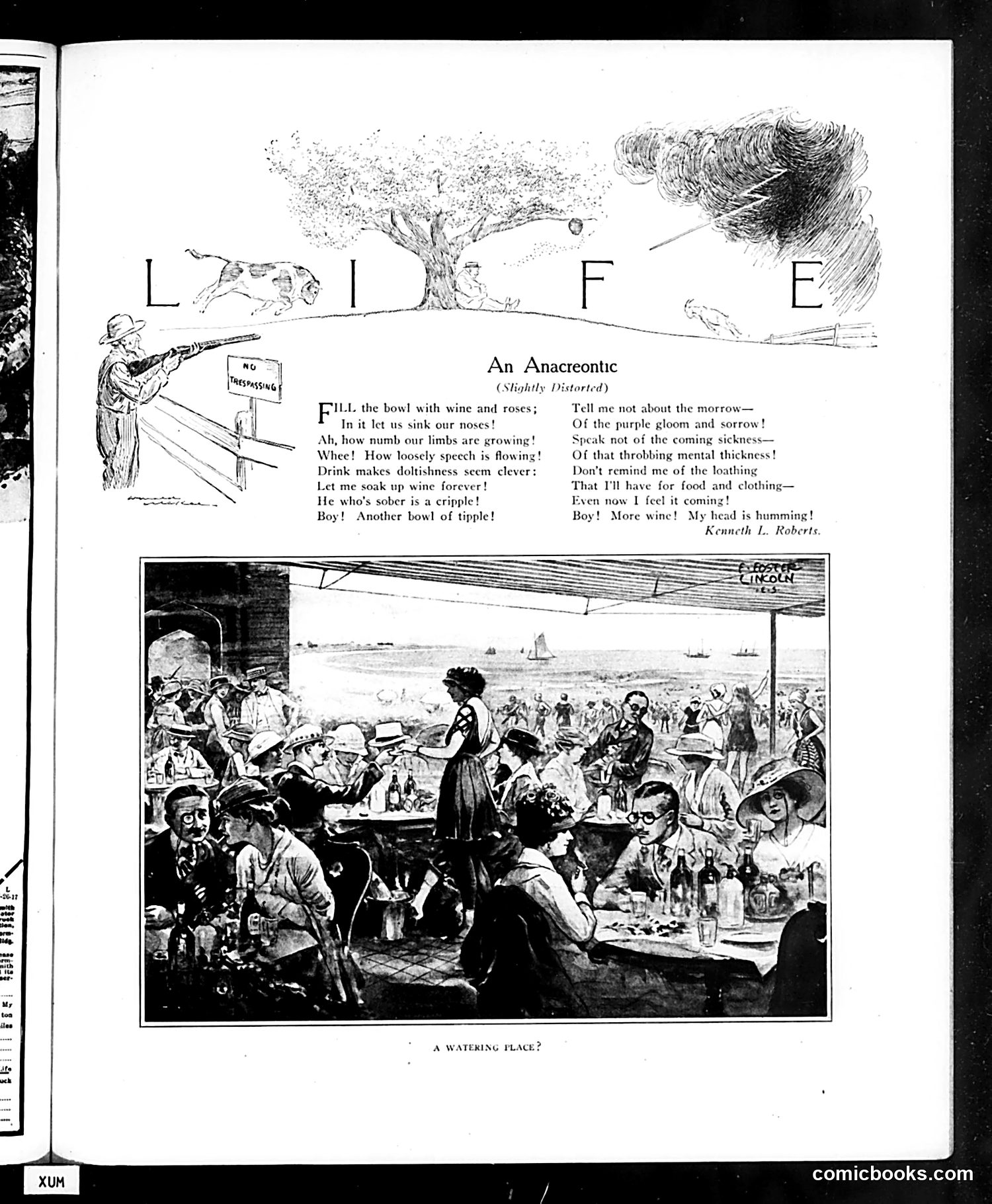
This page contains two distinct items: **Top: "An Anacreontc" Poem** A humorous poem attributed to Kenneth L. Roberts, featuring a drunk speaker celebrating wine and intoxication. The illustration shows a man shooting at a sign labeled "PROHIBITION"—a direct satirical reference to the Prohibition era (when alcohol was banned in America). The poem mocks sobriety and celebrates drinking, making it anti-Prohibition satire. **Bottom: "A Watering Place?"** A detailed illustration depicting a crowded beach or seaside gathering where alcohol consumption appears rampant despite Prohibition. The ironic caption suggests this public gathering is a "watering place"—a pun meaning both a place where animals drink water and an illegal speakeasy or drinking establishment. The satire critiques how Prohibition was widely ignored in public.
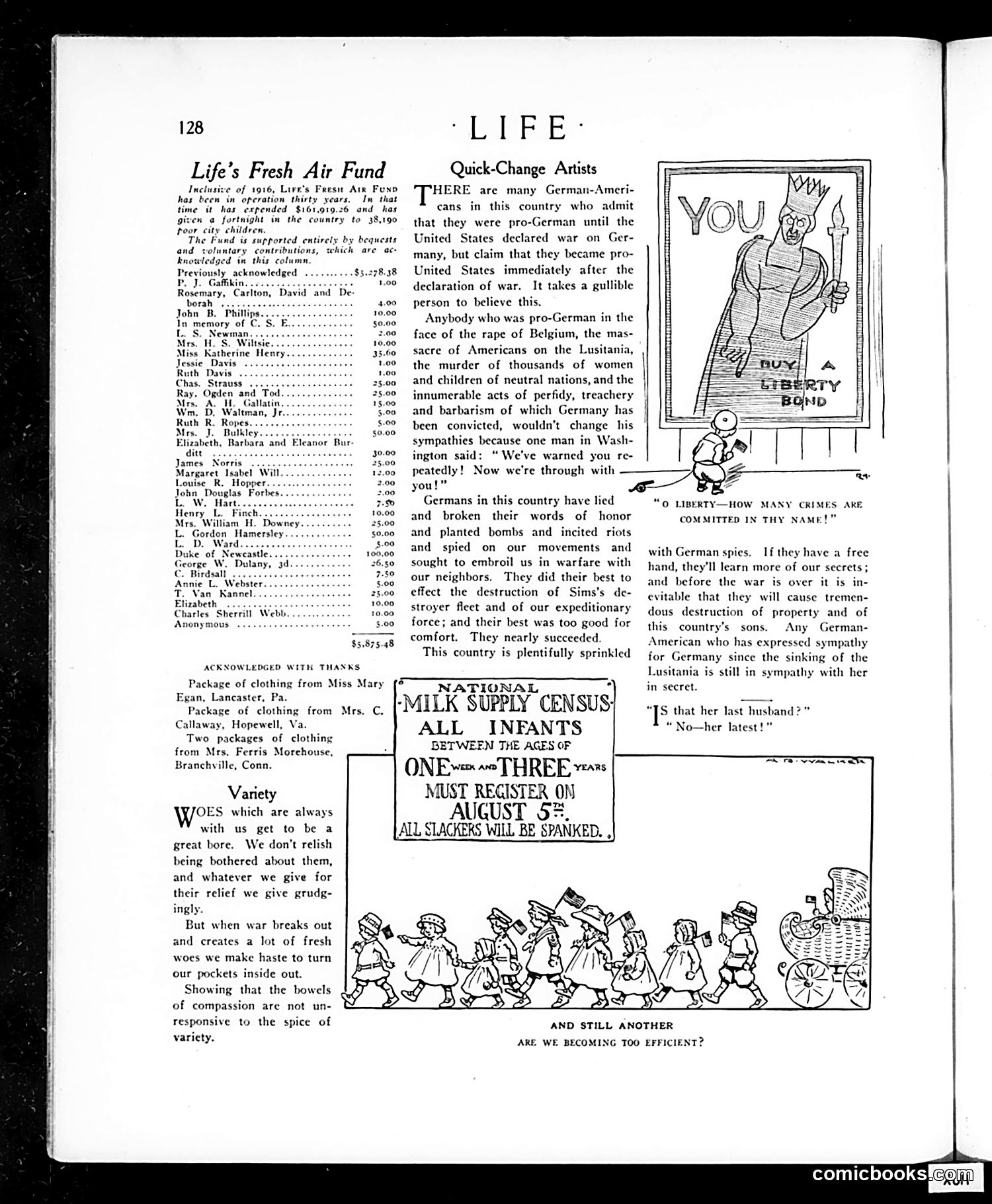
This page contains two distinct pieces of WWI-era satire: **"Quick-Change Artists"** (main article with illustration): The text attacks German-Americans who claimed to have suddenly become pro-American after the U.S. declared war on Germany. The article sarcastically dismisses their claimed conversion, arguing that Germans who supported Belgium's invasion and the Lusitania sinking couldn't genuinely change their sympathies overnight. The cartoon depicts a caricatured figure (representing Germany or pro-German sentiment) being stabbed by Lady Liberty, illustrating the article's point about incompatible loyalties. **Lower illustrations**: Include a government notice about registering infants for a milk supply census, and a cartoon showing children with a baby carriage, captioned about becoming "too efficient"—likely satirizing wartime bureaucratic expansion. The page reflects American suspicion of German-American loyalty during WWI.
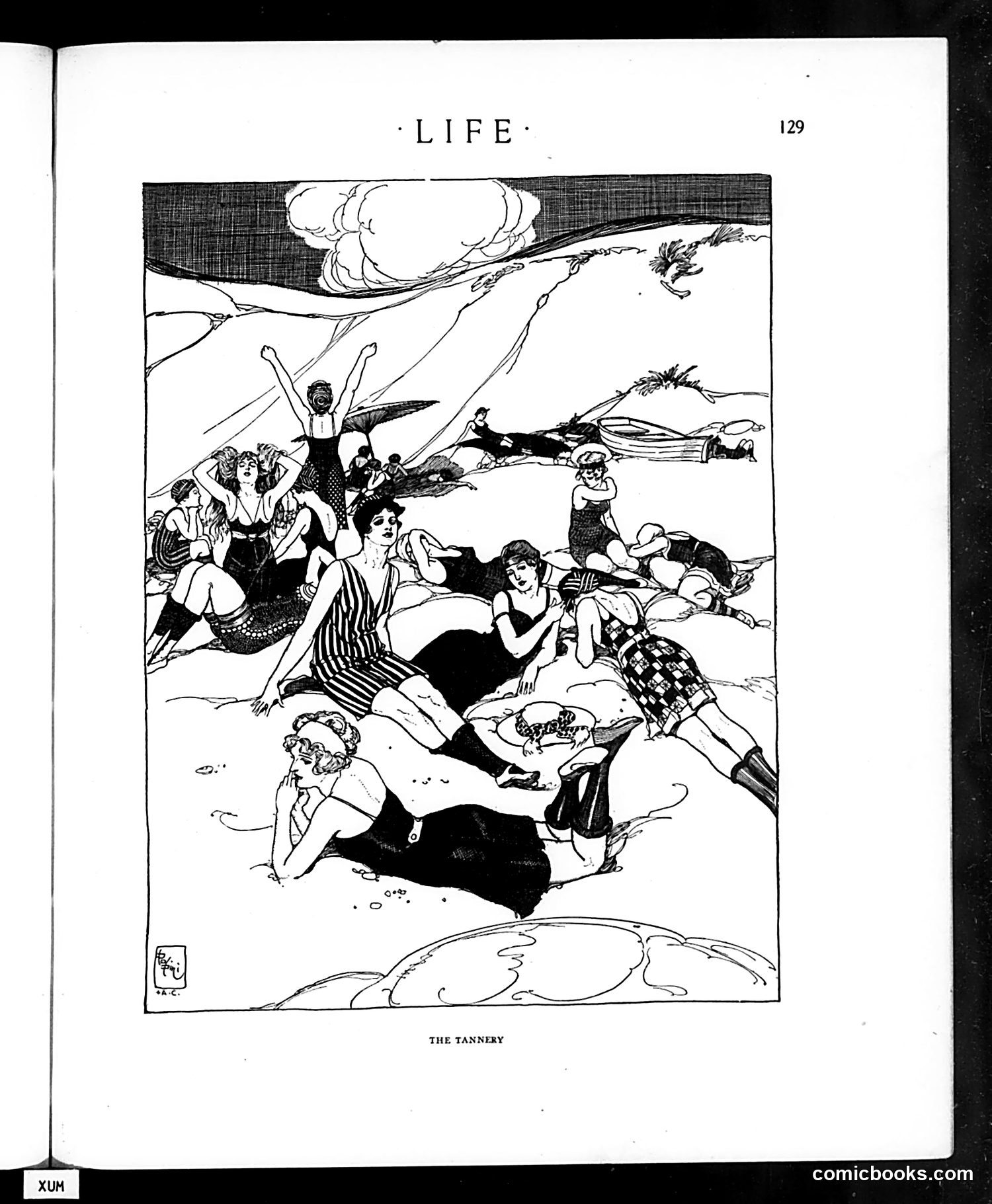
This cartoon depicts a beach scene titled "The Tannery," satirizing early 20th-century beach culture and sunbathing habits. Multiple figures are shown lounging on sand in various states of undress, appearing to sunbathe intensely—hence the "tannery" metaphor comparing their skin-darkening to leather tanning. The satire likely mocks the contemporary obsession with acquiring tanned skin as a status symbol and leisure indicator. The crowded, somewhat chaotic composition suggests both the popularity of beach culture and perhaps the undignified spectacle of modern recreational bathing. The exaggerated poses and variety of swimming attire reflect period attitudes toward public beach behavior and fashion.
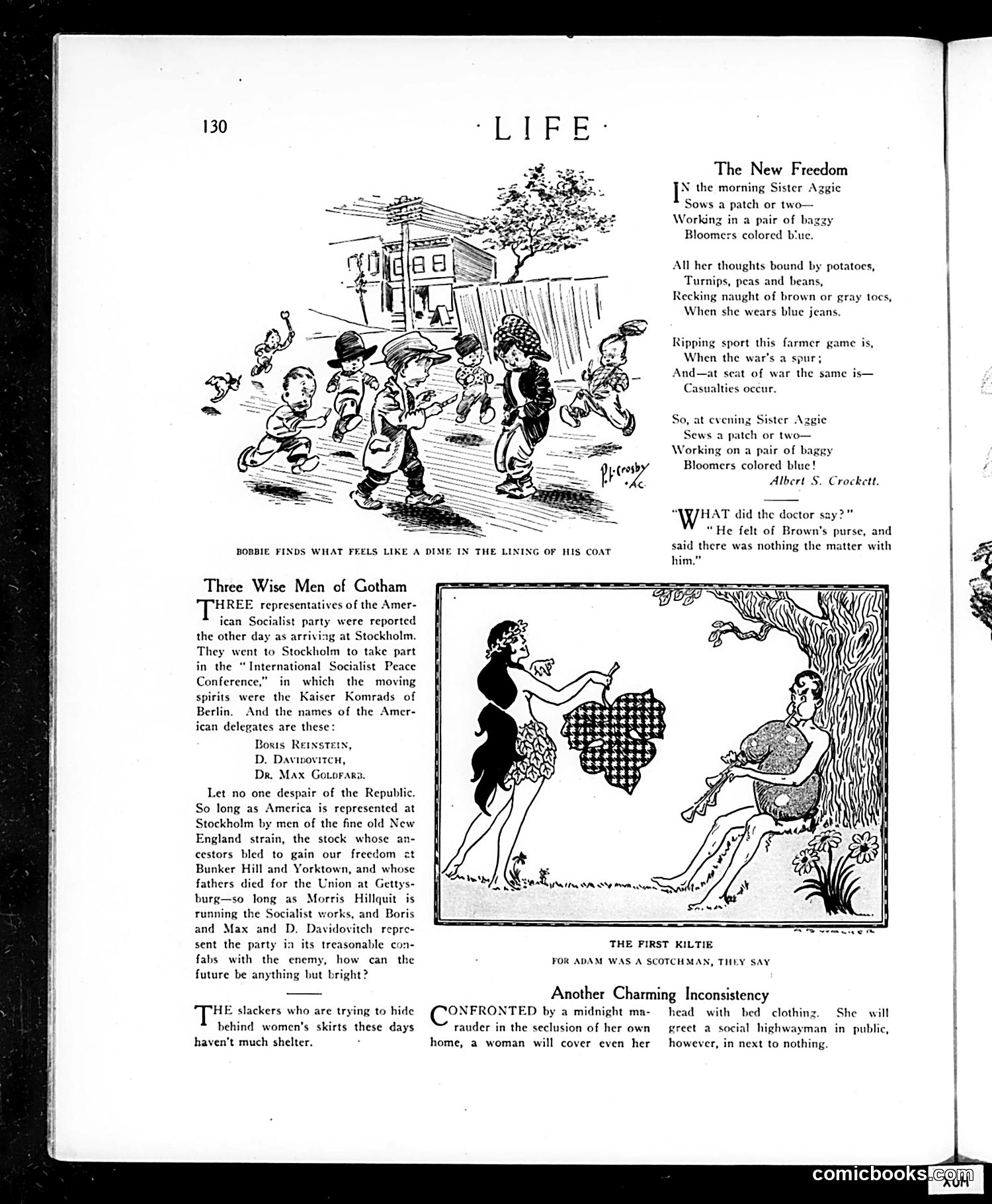
This page contains several satirical pieces on American politics and social issues: **"Three Wise Men of Gotham"** mocks American Socialist Party delegates attending a Stockholm peace conference, naming them as Boris Reinstein, D. Davidovitch, and Dr. Max Goldberg. The satire questions whether these men—described as descendants of New England stock—can represent America's future while being associated with Socialist causes. **"The New Freedom"** poem by Albert S. Crockett satirizes Sister Aggie's wartime domestic labor (farming, sewing) while men face war casualties, highlighting the irony of women's limited "freedom." **"The First Kiltie"** is a crude joke about Scottish heritage and clothing. The overall tone reflects anti-Socialist sentiment and gender-role commentary typical of WWI-era American satire.
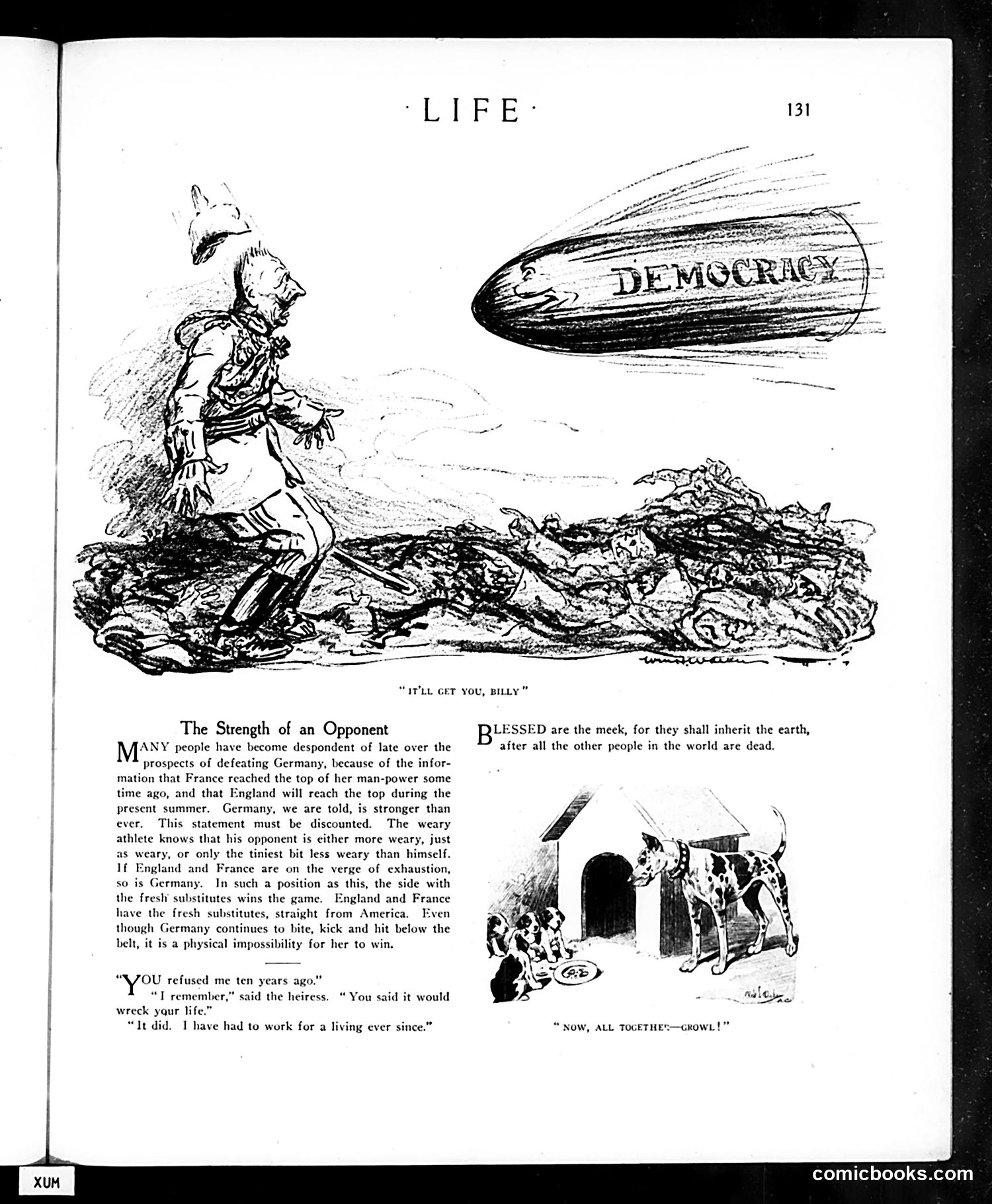
This page from *Life* magazine contains WWI-era political commentary. The main cartoon depicts a skeletal soldier figure labeled "Democracy" as a weapon—a bomb or missile aimed at an opponent. The accompanying text argues that despite Germany and France both being exhausted, England and France will prevail because they can access fresh American reinforcements, while Germany cannot. The lower cartoon shows a domestic scene with the caption "Now, all together—growl!" The page also includes a dialogue about a woman who refused marriage ten years prior, claiming it would "wreck your life"—commentary on changing social attitudes. The overall theme suggests American intervention as democracy's ultimate weapon against Central Powers exhaustion.
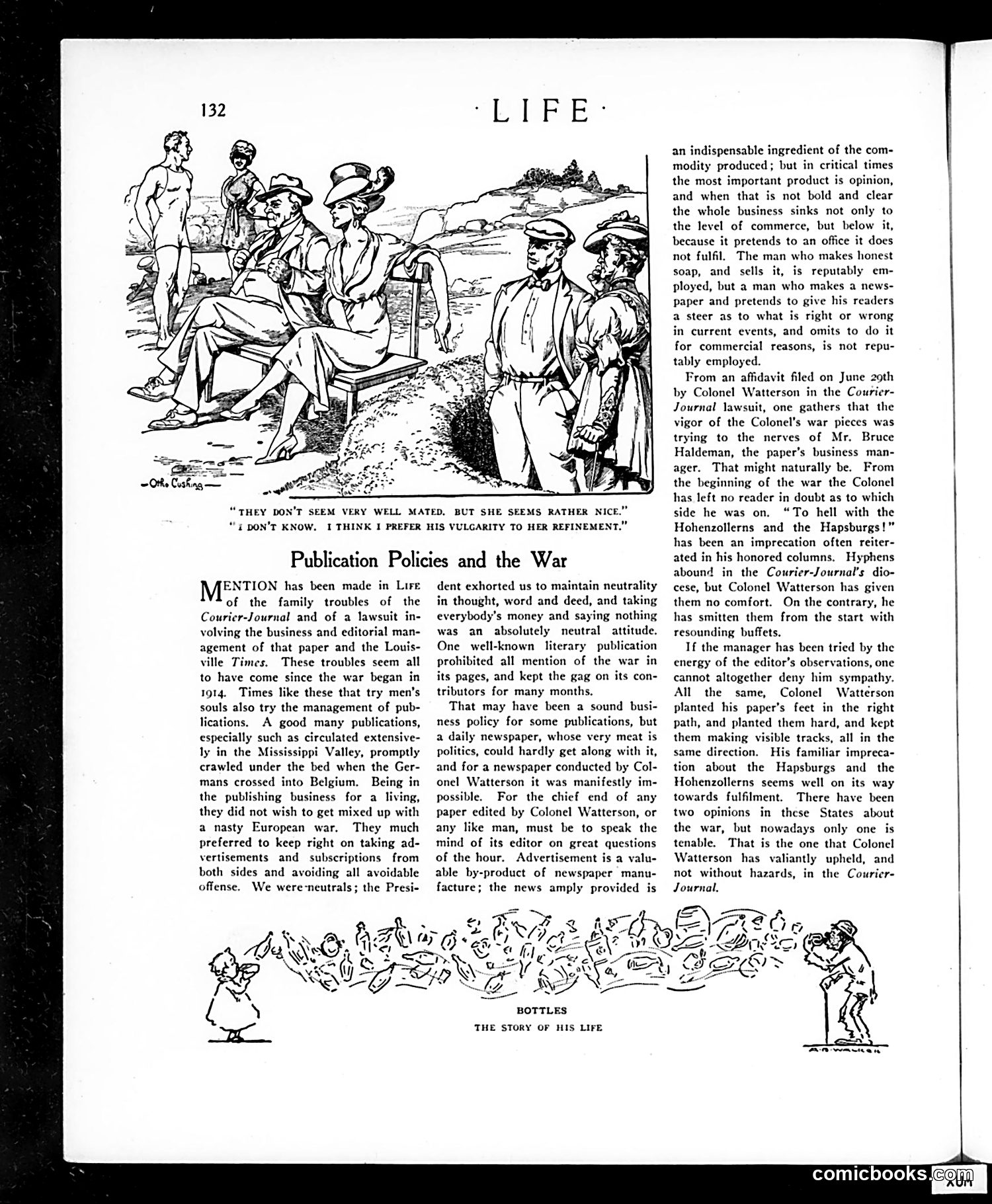
**The Main Cartoon** depicts a group of people (likely soldiers or civilians during WWI) with the caption suggesting a woman is "rather nice" despite lacking refinement—a mild social satire about class and manners. **The Article "Publication Policies and the War"** discusses tensions between newspapers' editorial independence and wartime pressures. It specifically references Colonel Watterson's *Courier-Journal* and the *Louisville Times*, criticizing how some publications avoided war coverage to maintain neutrality while others faced pressure to support the war effort. The piece argues newspapers must balance commercial interests with editorial integrity—that avoiding controversial opinions (like editorial positions on the war) while claiming neutrality is itself a compromised position. This reflects early WWI-era debates about press freedom versus patriotic duty.
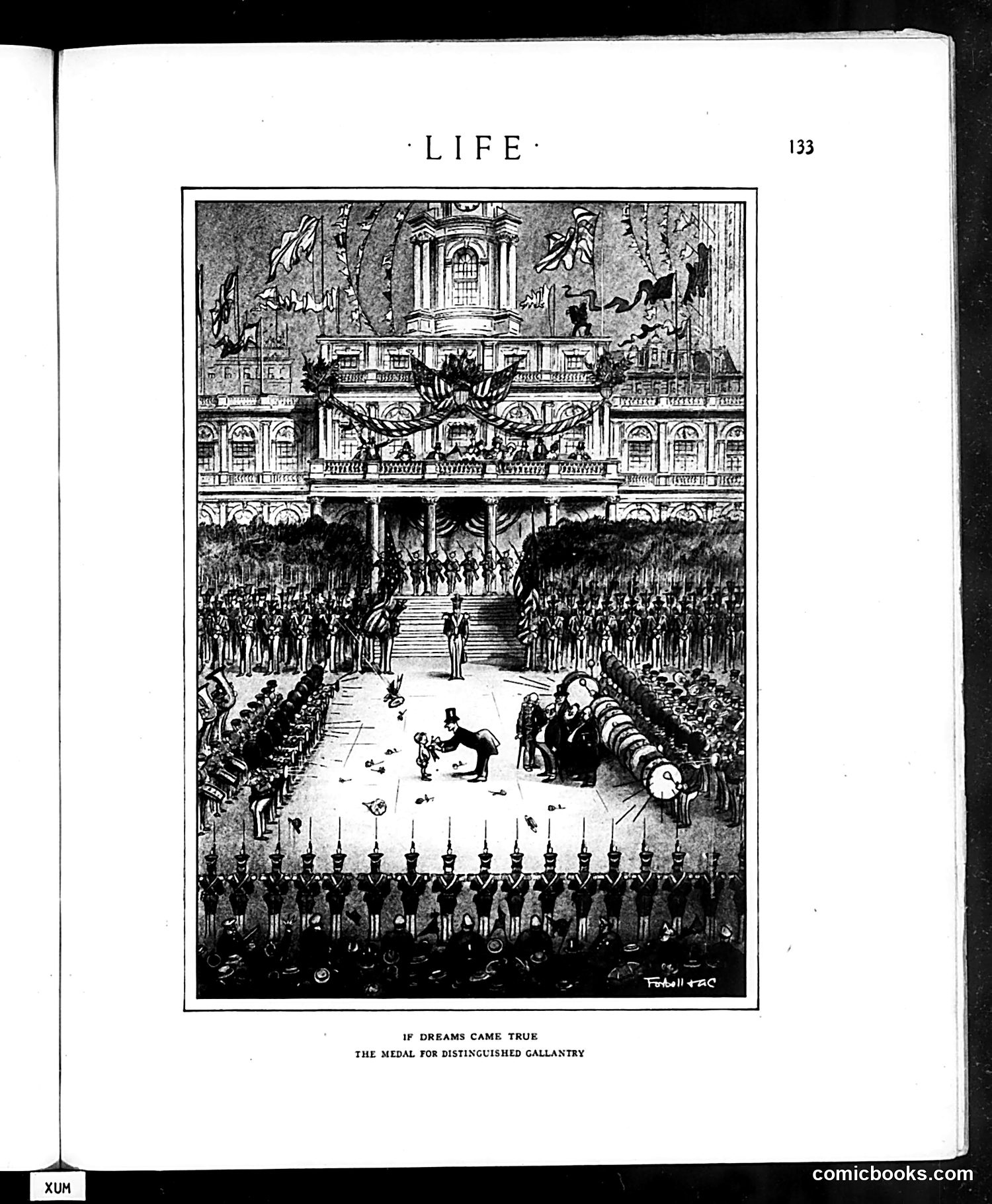
This satirical illustration depicts a grand civic ceremony where a figure receives military honors before a massive crowd and ornate government building. The caption's ironic title suggests this is a fantasy scenario about awarding a "Medal for Distinguished Gallantry." The artwork appears to mock either false patriotism, undeserved military honors, or possibly corrupt award-giving ceremonies. The elaborate pageantry—with flags, uniformed soldiers, and monumental architecture—contrasts with the satirical framing, suggesting the artist critiques inflated ceremony around questionable merit. Without additional publication context or artist attribution clarity, the specific target remains unclear, though it likely comments on military bureaucracy or political corruption in early 20th-century America.
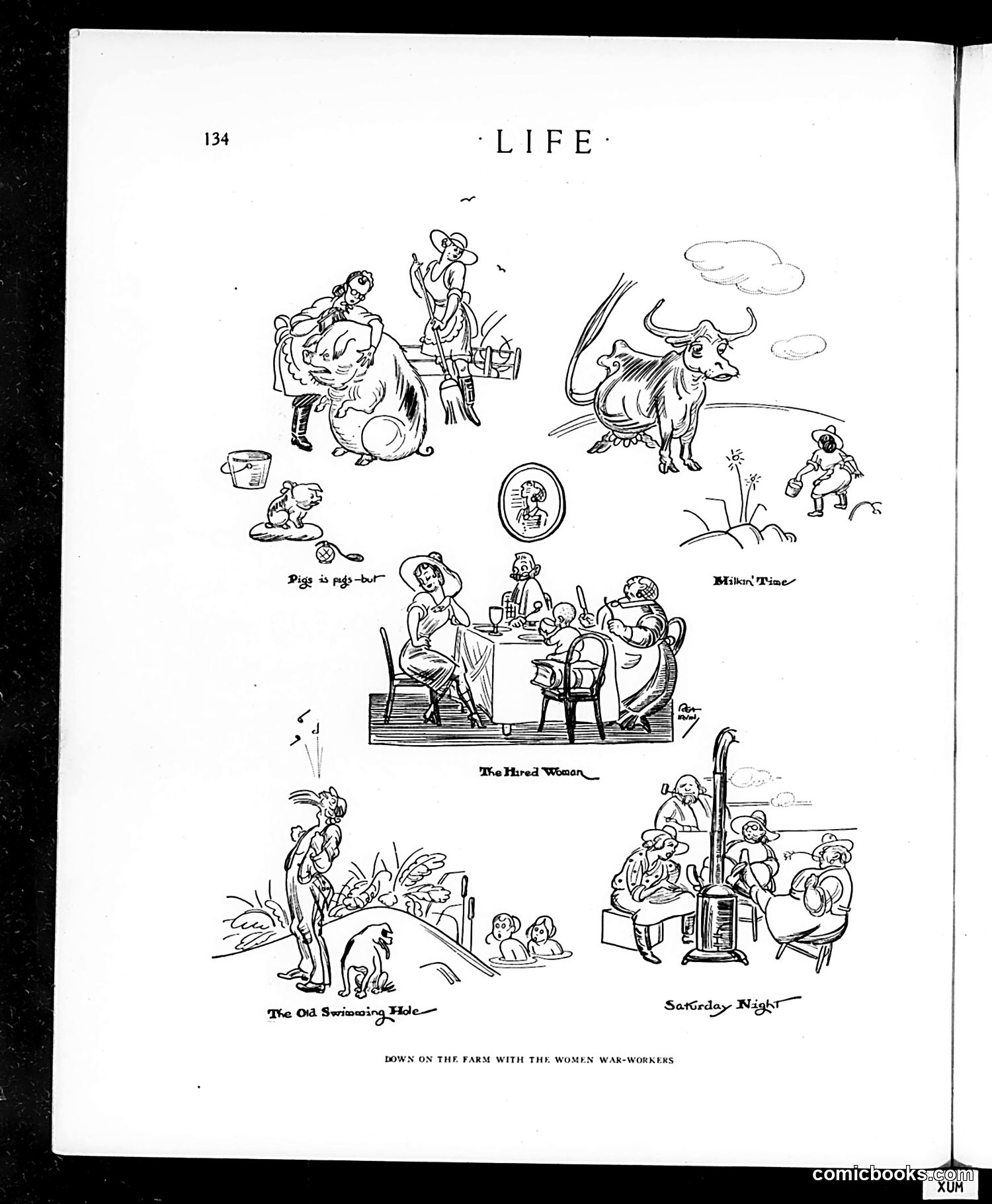
This page illustrates "Down on the Farm with the Women War-Workers" — likely from WWI era when women entered agricultural labor due to male conscription. The six vignettes humorously depict various farm activities: - **"Pigs is Pigs"**: Woman struggling with livestock - **"Milkin' Time"**: Dairy work - **"The Hired Woman"**: Women dining together (perhaps contrasting their newfound social roles) - **"The Old Swimming Hole"**: Recreation/leisure - **"Saturday Night"**: Social gathering with a heating stove The satire gently mocks women attempting unfamiliar farm labor while celebrating their wartime contributions. The cartoonish style emphasizes the physical comedy of urban or inexperienced women managing rural tasks — a common contemporary theme celebrating women's expanded wartime roles while maintaining lighthearted, somewhat condescending humor about their capabilities.
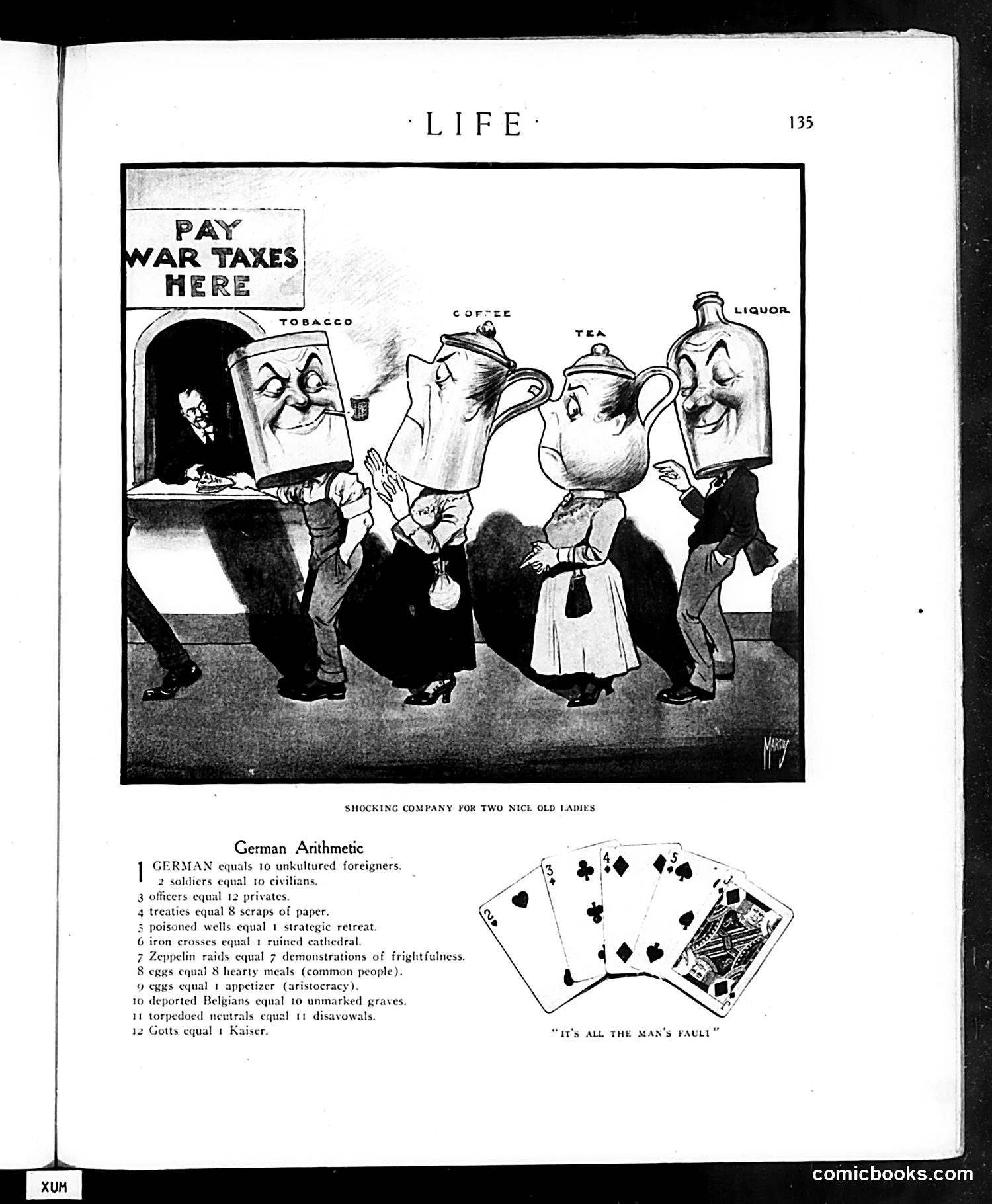
This is a WWI-era satirical page from *Life* magazine. The top cartoon depicts personified bottles of Tobacco, Coffee, Tea, and Liquor—luxuries subject to war taxes—lined up at a "Pay War Taxes Here" window, where a grim tax collector waits. The caption "Shocking Company for Two Nice Old Ladies" suggests these were considered vices, particularly unsuitable companions for respectable women. Below is "German Arithmetic," a darkly humorous list equating German military actions with civilian casualties and destruction (e.g., "Zeppelin raids equal 2 demonstrations of frightfulness," "Deported Belgians equal 10 unmarked graves"). The playing cards labeled "It's All the Man's Fault" appear unrelated satirical commentary. Together, these reflect American wartime sentiment and anti-German propaganda.
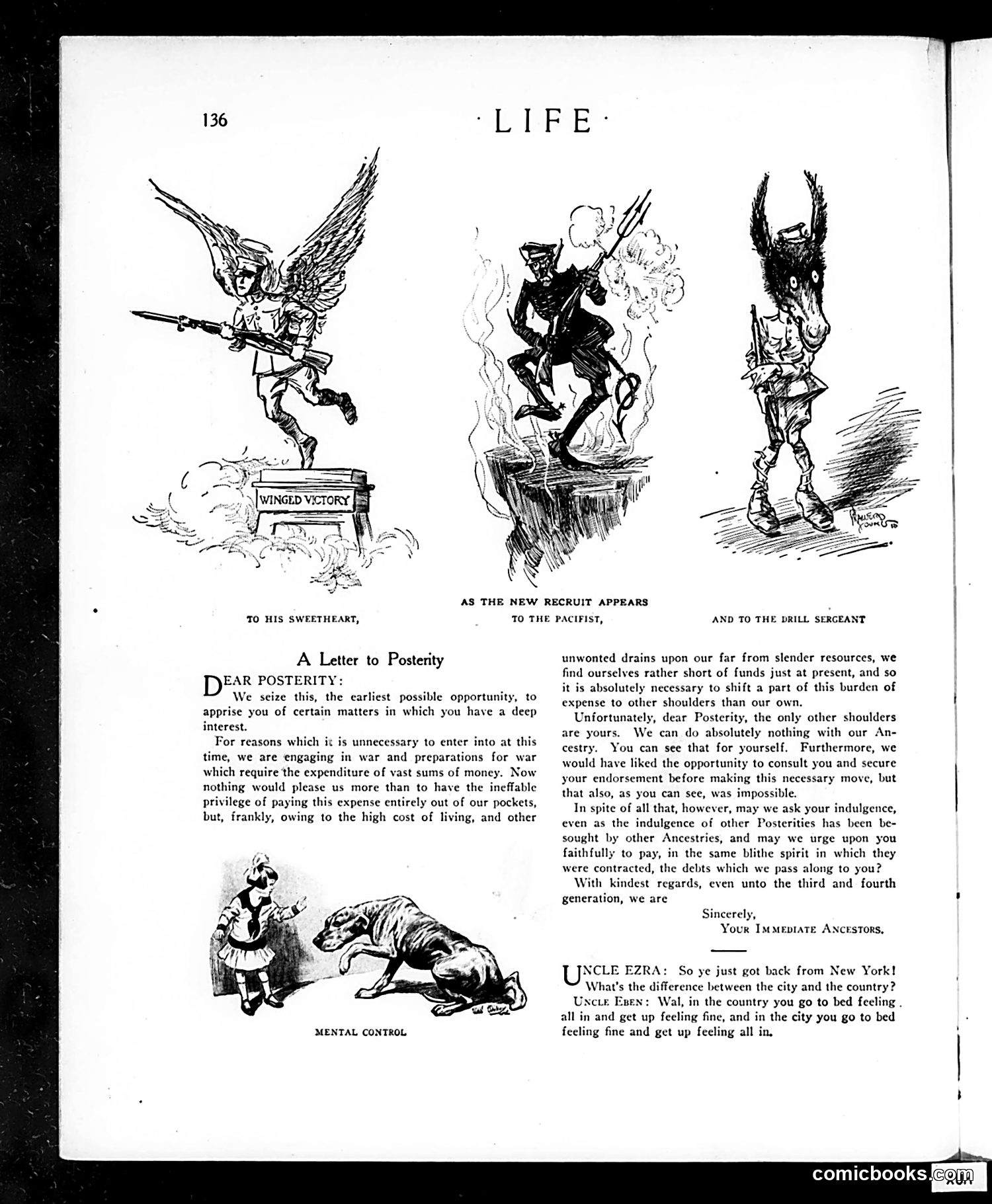
This Life magazine page satirizes WWI-era American attitudes toward debt and sacrifice. The top three cartoons depict how new military recruits appear differently to various observers: to sweethearts as angelic victory figures, to pacifists as demonic tempters, and to drill sergeants as disciplinary subjects. This mocks the competing narratives surrounding military service. The main text, "A Letter to Posterity," is scathing satire. The current generation addresses future generations, essentially apologizing for passing war debts to them while admitting they cannot/will not pay these expenses themselves. The tone is mockingly formal and shameless—they acknowledge the debt is unfair but expect posterity to pay "in the same blithe spirit" as past generations did. The bottom cartoon labeled "Mental Control" appears to show someone training/controlling another, likely commenting on propaganda or governmental persuasion regarding the war effort. The Uncle Ezra dialogue makes a simpler joke about exhaustion differences between urban and rural life, offering light relief amid heavier wartime commentary.
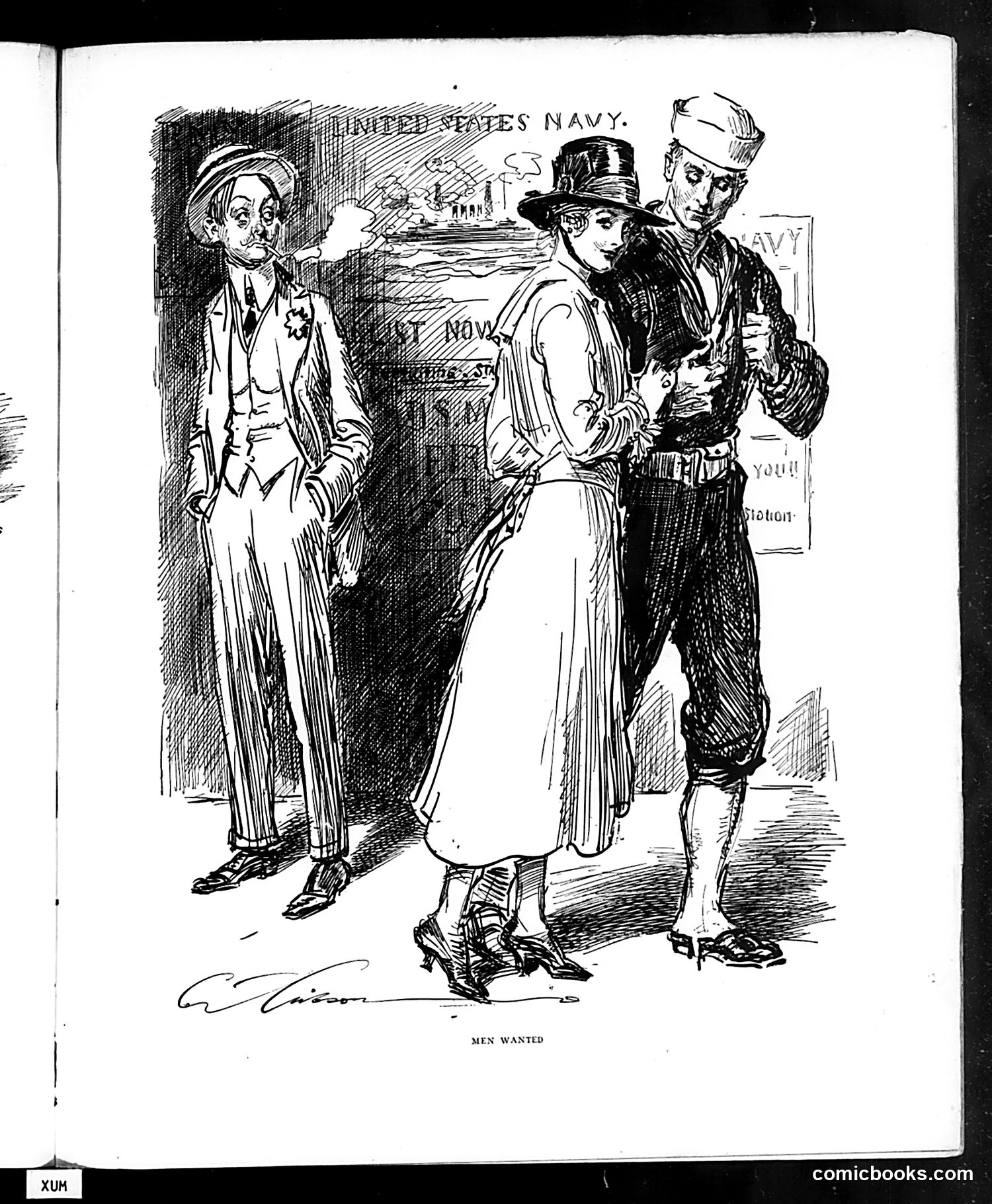
This is a satirical recruitment cartoon for the U.S. Navy. The illustration shows four figures: a gaunt, worried civilian man on the left, two women in the center (one in a dress, one in a hat), and a robust, well-fed naval officer on the right in uniform. The satire contrasts the civilian man's thin, anxious appearance with the officer's healthy, vigorous physique—suggesting that Navy service transforms men physically and provides security. The presence of women appears designed to appeal to male vanity or suggest improved social standing. The caption "Men Wanted" directly states this is a recruitment appeal. This likely dates to a period of naval expansion, possibly pre-World War I or during WWI, when the Navy actively recruited. The cartoon uses humor and masculine aspiration to encourage enlistment.
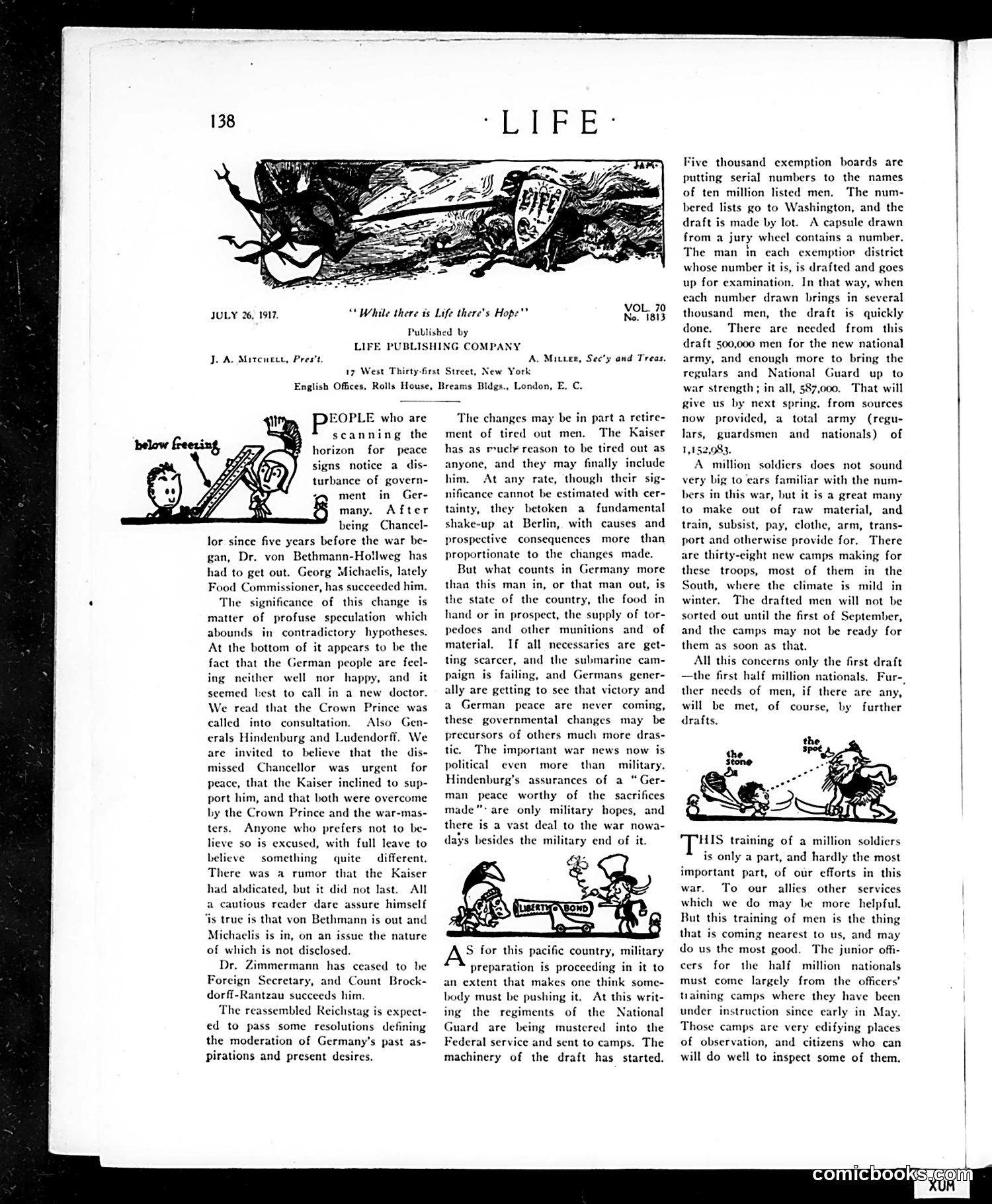
This page discusses recent German political changes during World War I. Chancellor von Bethmann-Hollweg has been replaced by Georg Michaelis, and Foreign Secretary Zimmermann by Count Brockdorff-Rantzau. The article speculates on causes: the German public's unhappiness, food shortages, failing submarine campaigns, and growing certainty that German victory is impossible. The author suggests these governmental changes may herald more dramatic upheaval if conditions worsen. The cartoons (specific figures unclear in reproduction) appear to satirize German leadership instability during wartime. The right column shifts focus to American military preparation: the newly implemented draft lottery system is explained, with 500,000 men needed for the new national army. The implicit contrast suggests American military organization proceeds systematically while German government destabilizes—a pointed commentary on relative wartime stability and morale.
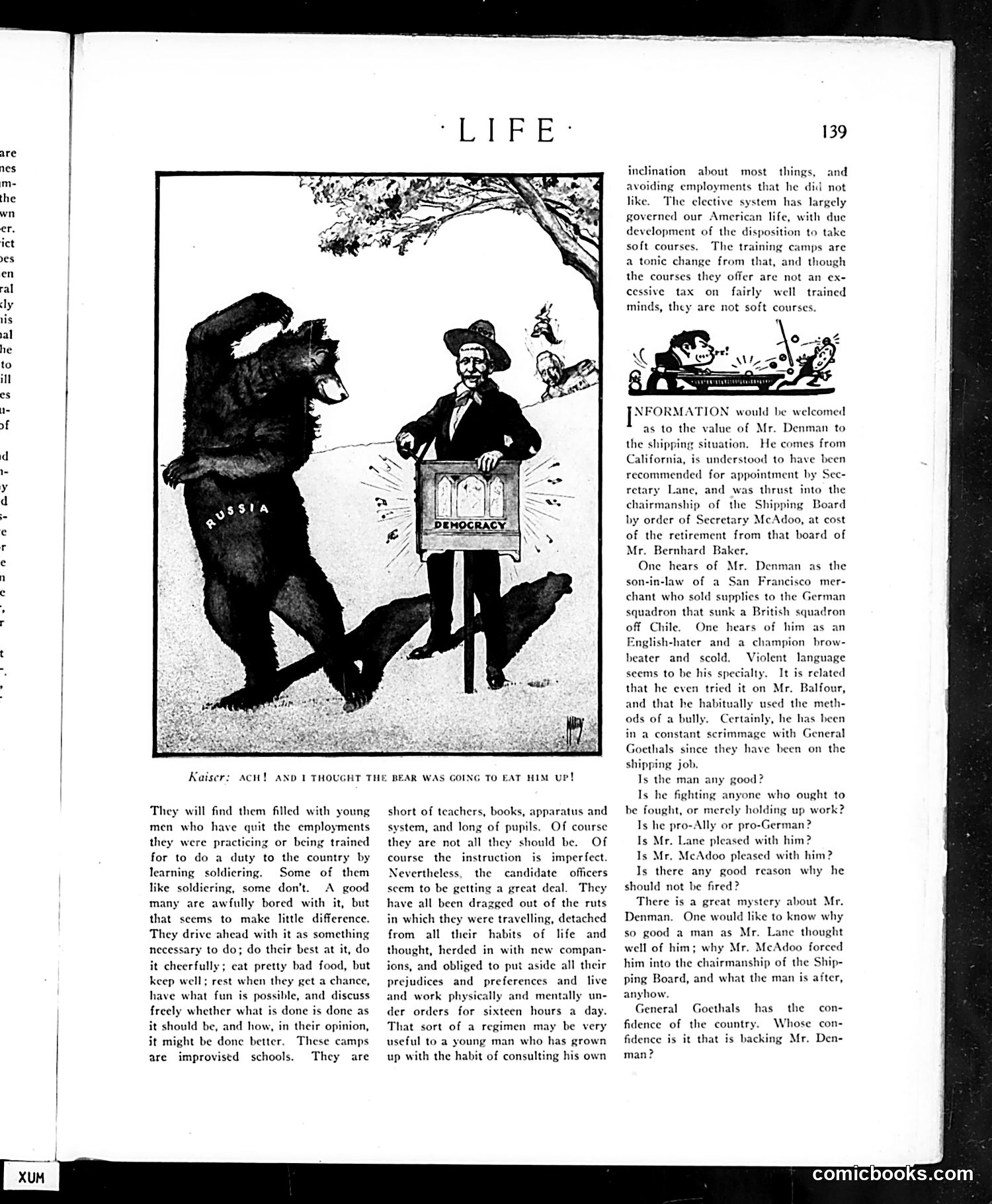
This Life magazine cartoon satirizes German-American relations during World War I. The image depicts the German Kaiser watching a man holding a "Democracy" box being threatened by a bear labeled "Russia." The Kaiser's caption—"Ach! and I thought the bear was going to eat him up!"—expresses the Kaiser's disappointment that democracy (represented by the box-holder) survives despite Russian aggression. The cartoon reflects anxieties about Russia's internal instability during WWI and suggests the Kaiser hoped Russian military pressure would destroy American democratic institutions. The accompanying article criticizes Mr. Denman, head of the U.S. Shipping Board, questioning his competence and his alleged pro-German sympathies (notably his family's commercial ties to Germany). The piece suggests Denman is undermining America's war effort and lacks the confidence inspiring leadership of figures like General Goethals.
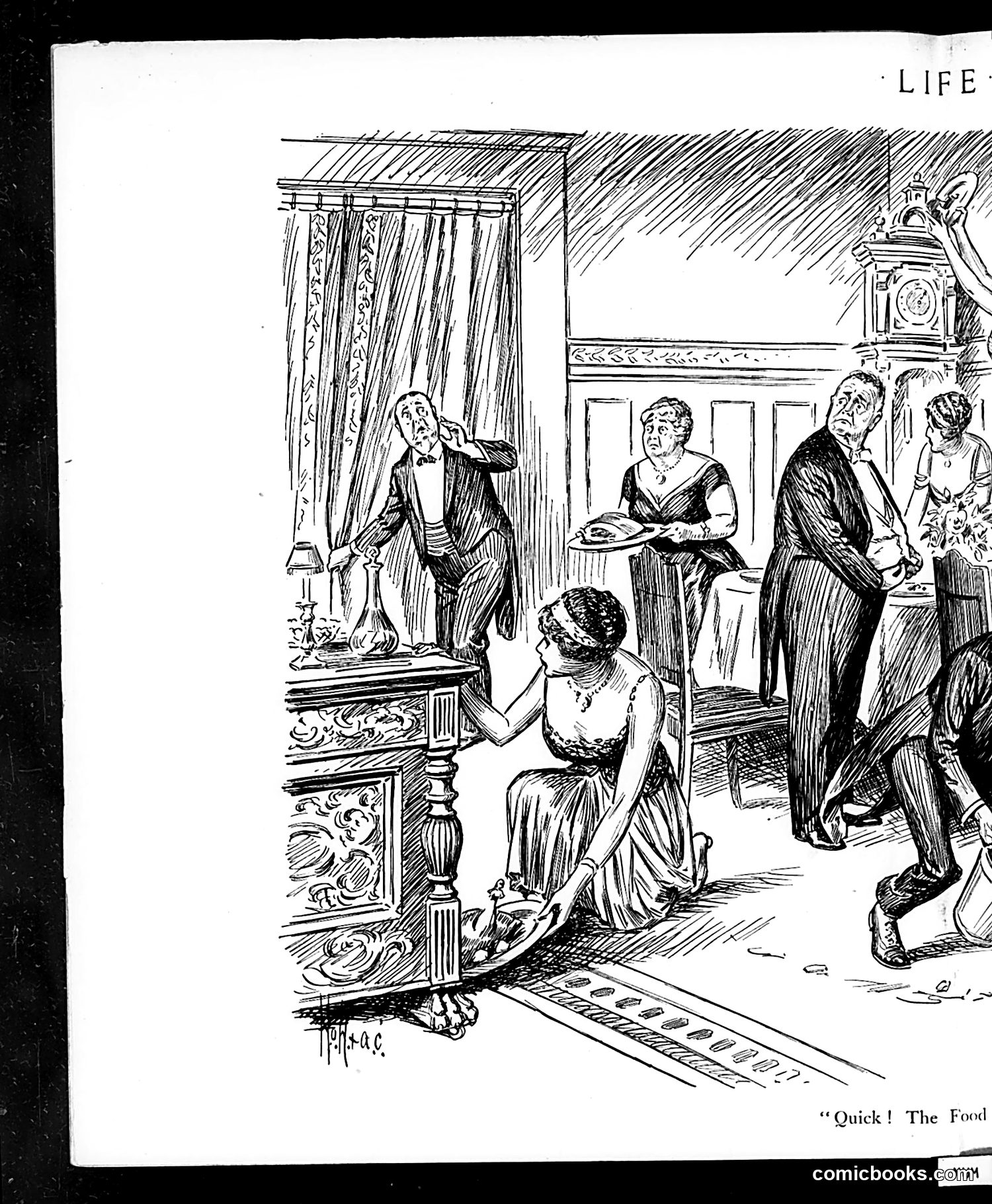
This *Life* magazine cartoon depicts a formal dinner party where a woman kneels before a man standing by the mantelpiece, while other guests in evening dress converse in the background. The caption reads "Quick! The Food—" The satire appears to mock upper-class dinner etiquette and social pretension. The woman's kneeling posture suggests urgent, almost desperate behavior, contrasting sharply with the formal setting and well-dressed attendees. The incomplete caption "Quick! The Food—" implies she's alerting others to some culinary emergency or mishap during the meal service. The cartoon likely satirizes the tension between maintaining proper social decorum at fashionable gatherings and the chaos that can erupt over practical concerns like food service—a commentary on the artificial nature of high-society social rituals.
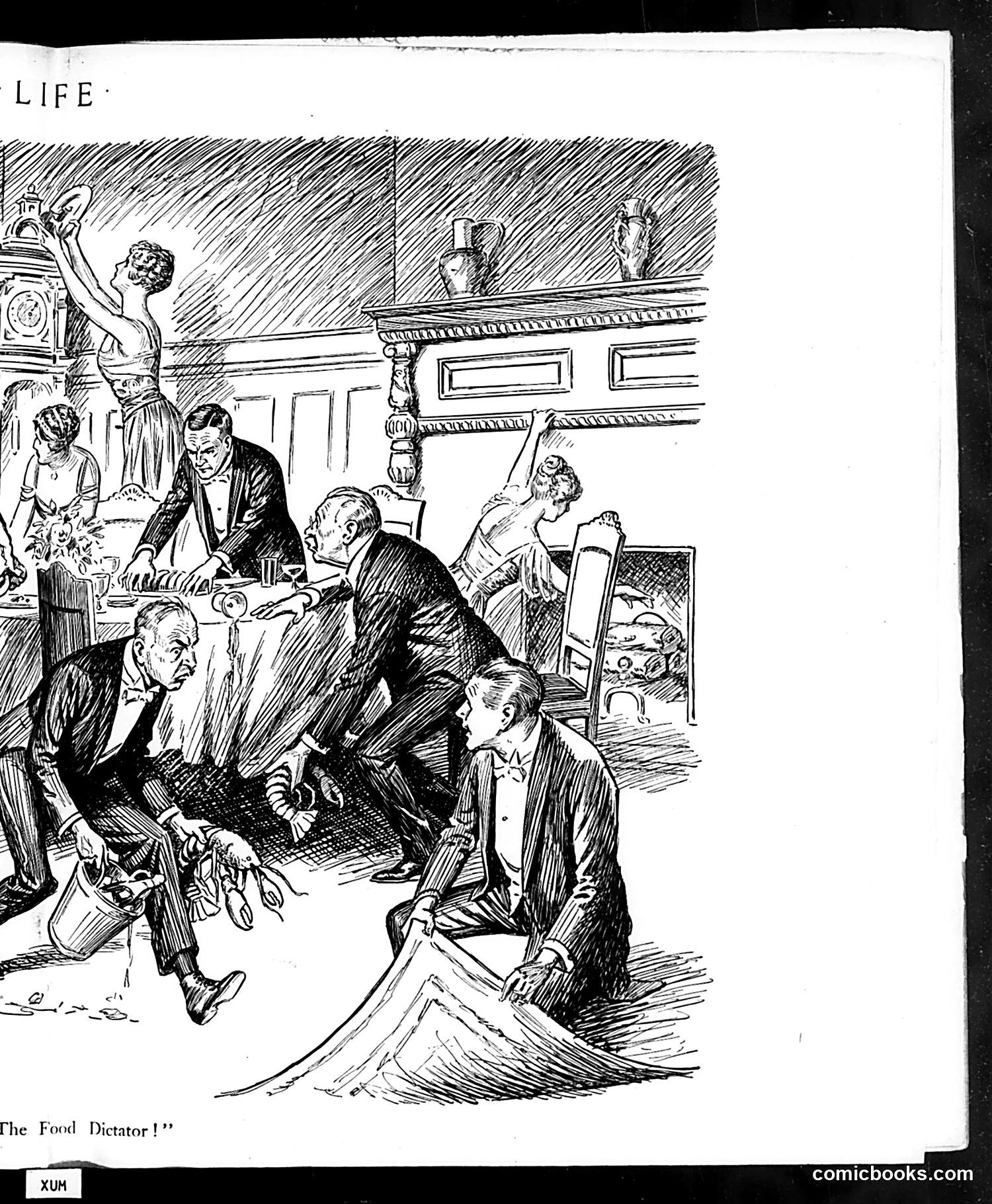
This satirical cartoon depicts an elegant formal dinner where a commanding figure (likely representing a government food official or regulator) dominates the proceedings. The title's sarcastic reference to a "Food Dictator" suggests criticism of governmental control over food distribution or rationing—probably during wartime or economic crisis. The composition shows wealthy diners in formal attire being overseen or controlled by an authoritative presence, implying that even the privileged elite must submit to state food mandates. The ornate setting contrasts sharply with the theme of governmental restriction, satirizing how food rationing or control affects all social classes. Without a specific date visible, the exact historical context remains unclear, though the style suggests early-to-mid 20th century.
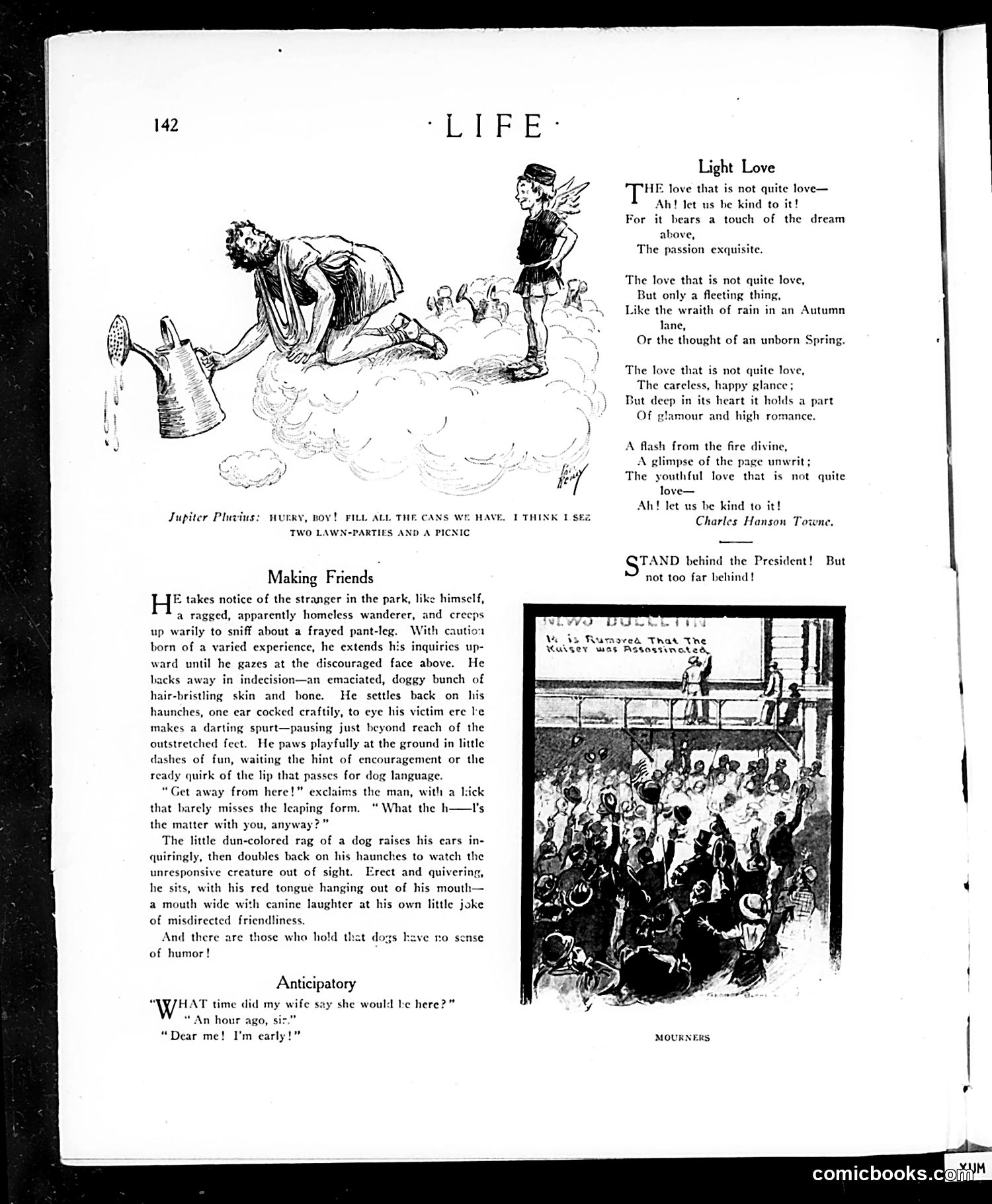
This page contains three distinct pieces of early 20th-century satire: **"Light Love"** is a sentimental poem by Charles Hanson Towne about romantic attraction that falls short of deep love—fleeting, dreamlike affection. The accompanying illustration shows Jupiter Pluvius (the Roman rain god) watering lawn parties and a picnic, a whimsical visual pun on the poem's themes. **"Making Friends"** humorously depicts a homeless man's encounter with a stray dog in a park. The satire targets human coldness: the man rudely rejects the dog's friendly advances, while the dog finds amusement in the rejection itself. The implicit critique suggests humans lack the dog's good humor and capacity for kindness toward society's unfortunates. **"Anticipatory"** is a brief domestic joke: a husband anxiously asks when his wife will arrive, then realizes he's actually early—reversing typical gender stereotypes about punctuality. The page reflects Life's blend of sentimental verse, social observation, and gentle domestic humor typical of early-to-mid 20th-century American magazine satire.
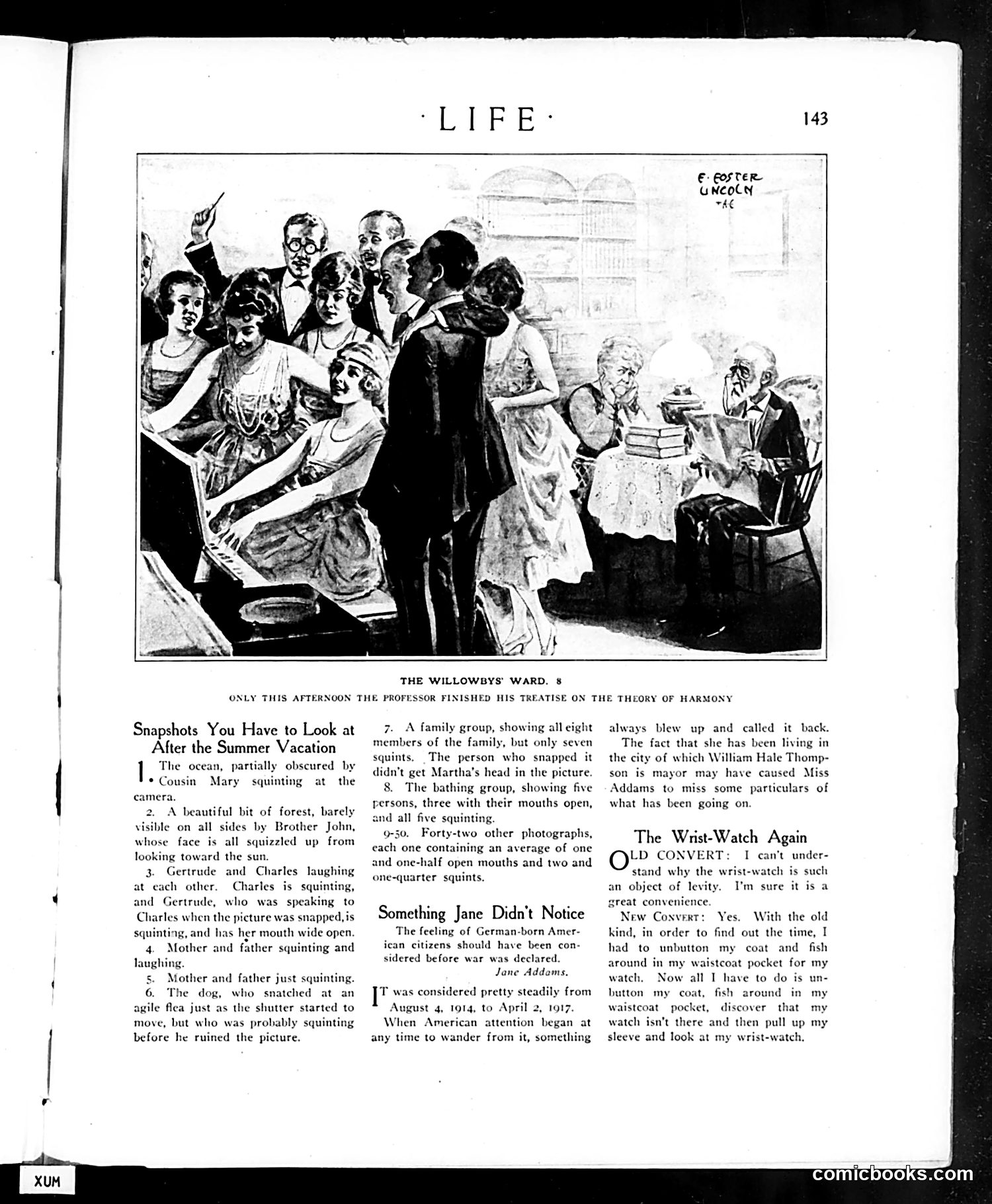
The top illustration, "The Willowbys' Ward," satirizes amateur vacation photography—a relatable social phenomenon of the era. It mocks the ubiquitous problem of squinting subjects and poorly-composed snapshots that travelers inflicted on friends after summer trips. The numbered captions humorously catalog the predictable failures: obscured scenery, people squinting from sun glare, and compositional errors like cutting off heads. Below, "Something Jane Didn't Notice" references Jane Addams, the famous progressive reformer, sardonically suggesting her focus on German-American concerns between 1914-1917 caused her to overlook American political developments—likely alluding to Mayor William Hale Thompson's controversial leadership in Chicago during the war period. "The Wrist-Watch Again" humorously critiques the new-fangled wrist-watch as impractical compared to pocket watches, despite its supposed convenience. The joke hinges on the irony that accessing a wrist-watch still requires unbuttoning one's coat and searching—making it no more efficient than the old method.
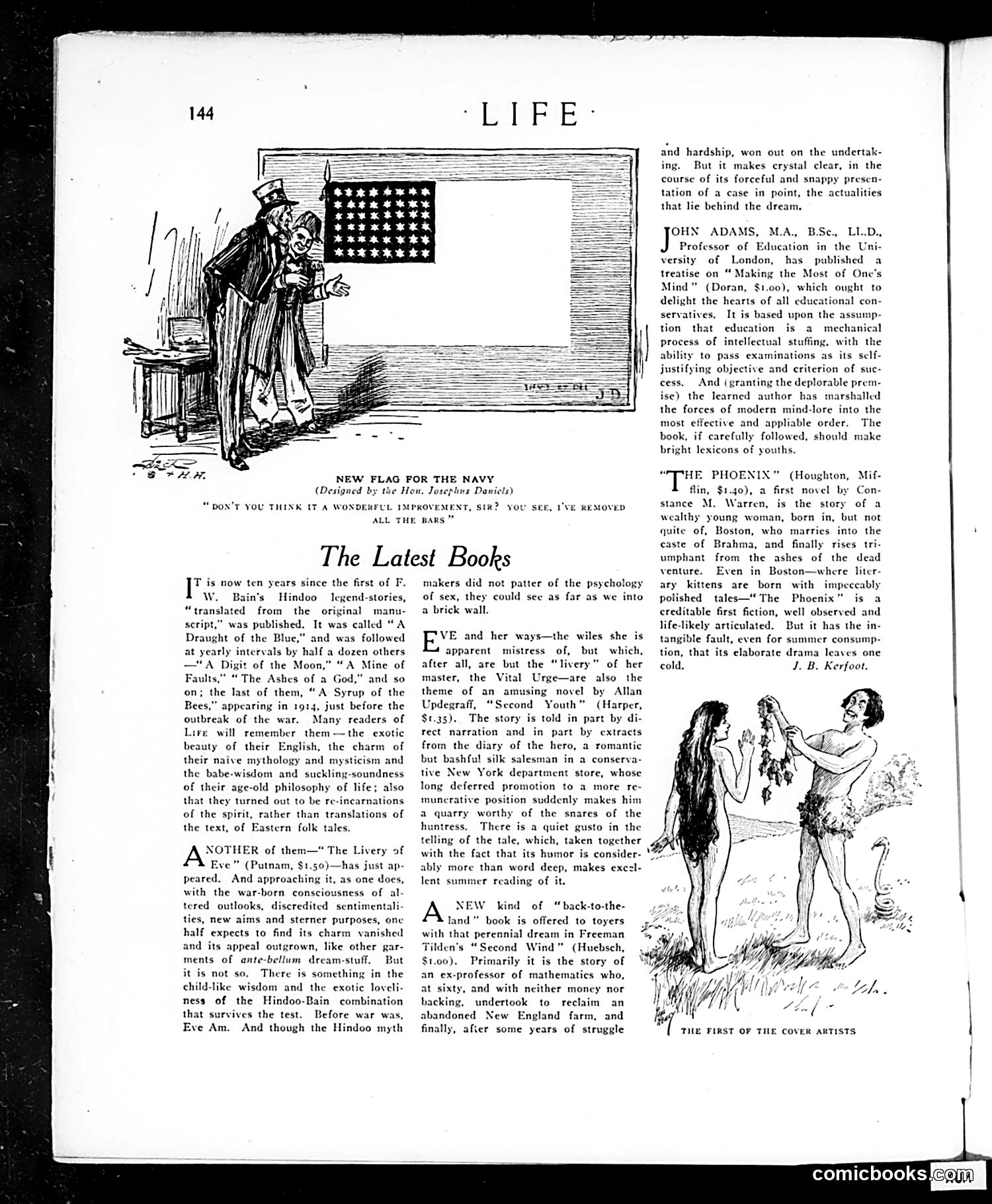
This cartoon satirizes Secretary of the Navy Josephus Daniels' administrative changes. The figure on the left (representing Daniels) displays a naval flag to a superior officer, proudly announcing he has "removed all the bars"—a double meaning playing on both the literal removal of stripes from the flag design AND suggesting the elimination of officers' rank insignia or naval regulations. The joke targets Daniels as an overzealous reformer making questionable "improvements" to military tradition. The officer's skeptical response ("Don't you think it a wonderful improvement, sir?") suggests the cartoon questions whether such changes strengthen or weaken the Navy. This reflects period criticism of Daniels' tenure (1913-1921) for his controversial modernization efforts and social policies, which naval traditionalists resisted.
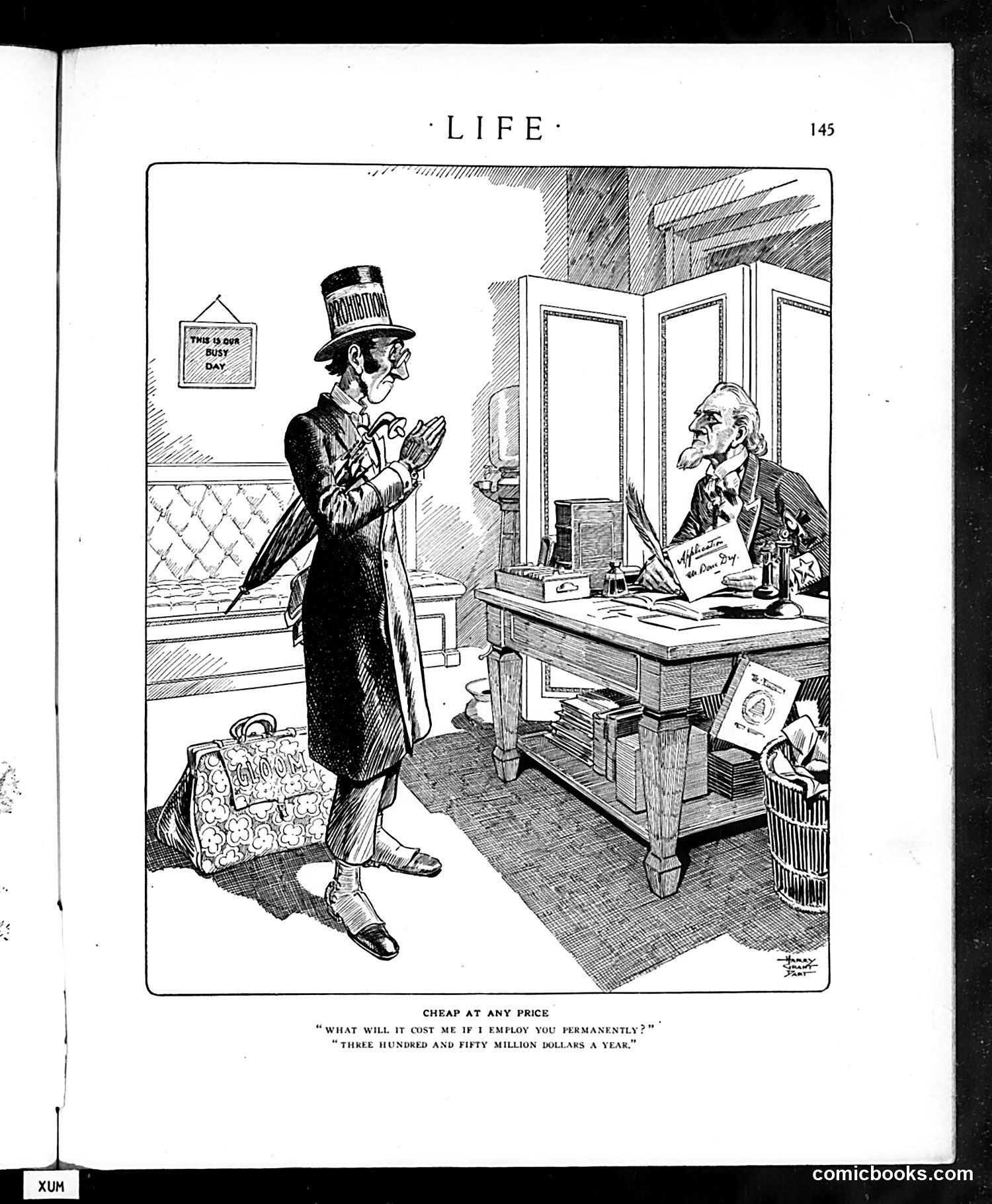
This cartoon satirizes an expensive government employee or official. A well-dressed man in a top hat marked "Prohibition" stands before a desk official, carrying a suitcase labeled "Saloon." The office sign reads "This is our busy day." The joke: the prospective employer asks what permanent employment will cost, and the answer is an absurdly high "$350 million a year"—a massive sum suggesting the Prohibition official's true expense to the nation. The satire critiques Prohibition enforcement as wastefully expensive and ineffective (the "Saloon" suitcase implies illegal alcohol still flourishes). The cartoon mocks both the cost of enforcing Prohibition and its apparent futility during the Prohibition era.
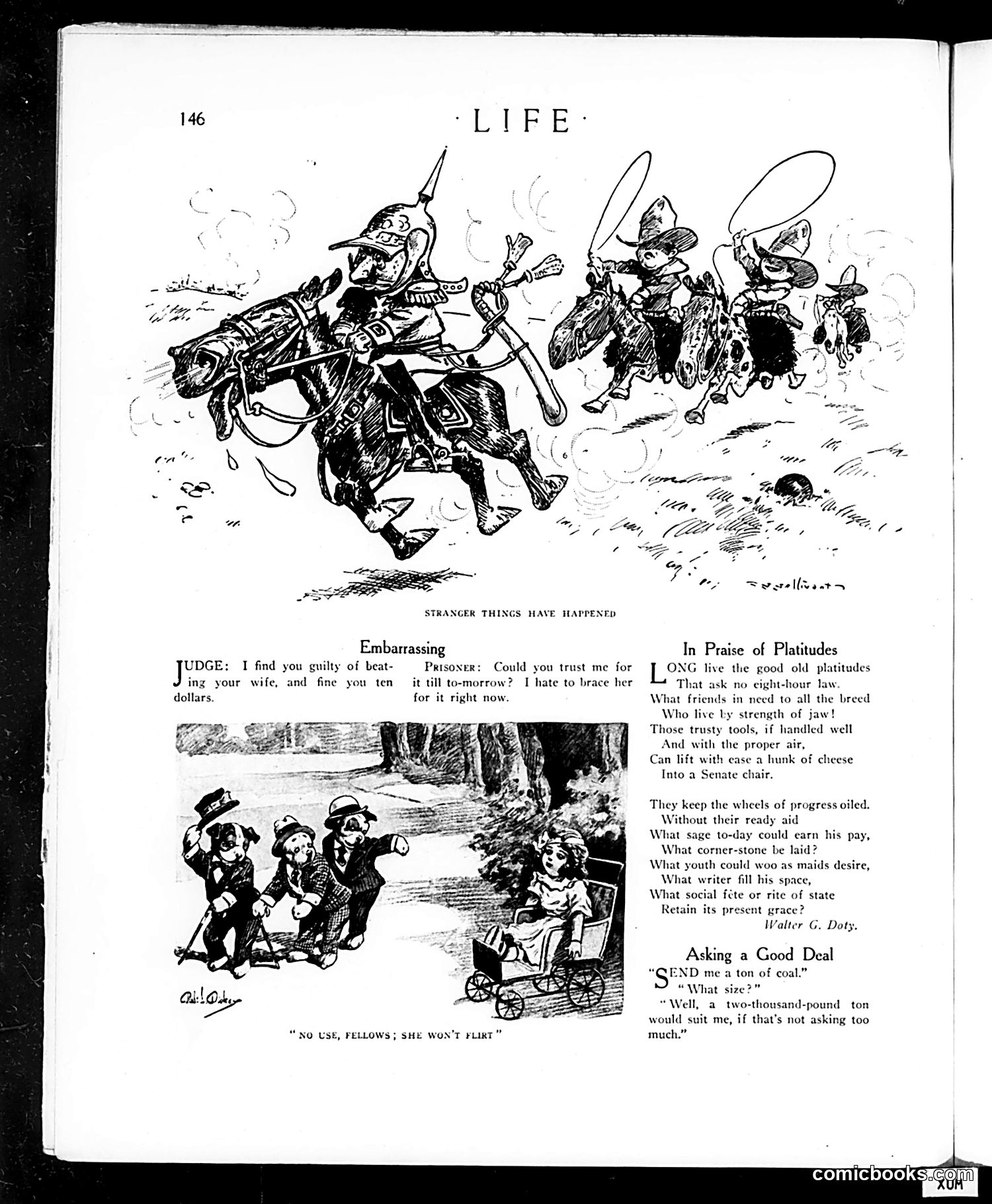
**Top Cartoon ("Stranger Things Have Happened"):** A Prussian military officer on horseback leads troops wielding whips and sabers against civilians. This depicts German militarism and violence, likely referencing World War I-era tensions or aftermath. **Middle Cartoon ("No Use, Fellows; She Won't Flirt"):** A judge sentences a man to ten dollars for beating his wife. The prisoner asks for a delay, claiming he "hates to brace her for it right now." The satire mocks lenient domestic violence sentencing and male entitlement—the trivial fine and casual attitude toward spousal abuse. **"In Praise of Platitudes":** A poem by Walter G. Doty satirizing empty rhetoric used by politicians and public figures to avoid meaningful action (like the "eight-hour law"), suggesting platitudes substitute for substantive progress. **"Asking a Good Deal":** A brief humorous exchange about ordering coal, where someone asks for a "two-thousand-pound ton"—playing on confusion about weight measurements and modest requests disguised as excessive ones. The page collectively critiques institutional indifference to violence, political hypocrisy, and social absurdity.
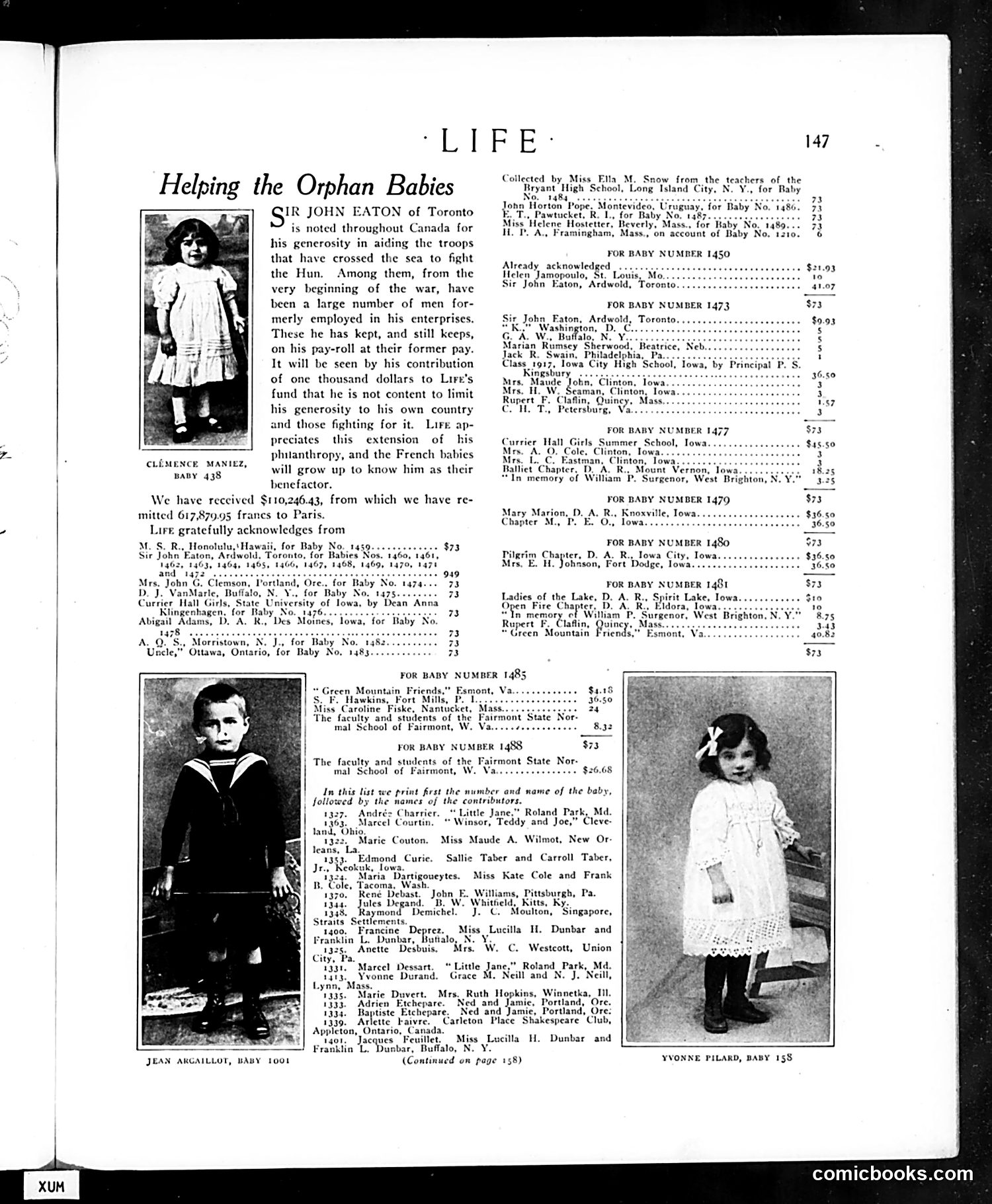
This is not a cartoon or satire—it's a fundraising feature for *Life* magazine's charitable cause: a French orphan welfare program. The page documents donations to support French babies displaced or orphaned by World War I (underway at the magazine's 1915-1917 publication date). Three infant photos are featured alongside the article about Sir John Eaton, a Toronto philanthropist who donated substantially. The bulk of the page lists contributors and the specific orphan babies they sponsored, each identified by number. The "joke" or appeal is implicit: readers can directly fund individual children's care, transforming abstract wartime suffering into personal responsibility. The text shows *Life* collected over $110,000 and forwarded nearly $618,000 francs to Paris—making this a sophisticated early direct-mail campaign masquerading as journalism. The humanitarian framing reflected progressive attitudes toward charity during the Great War era.
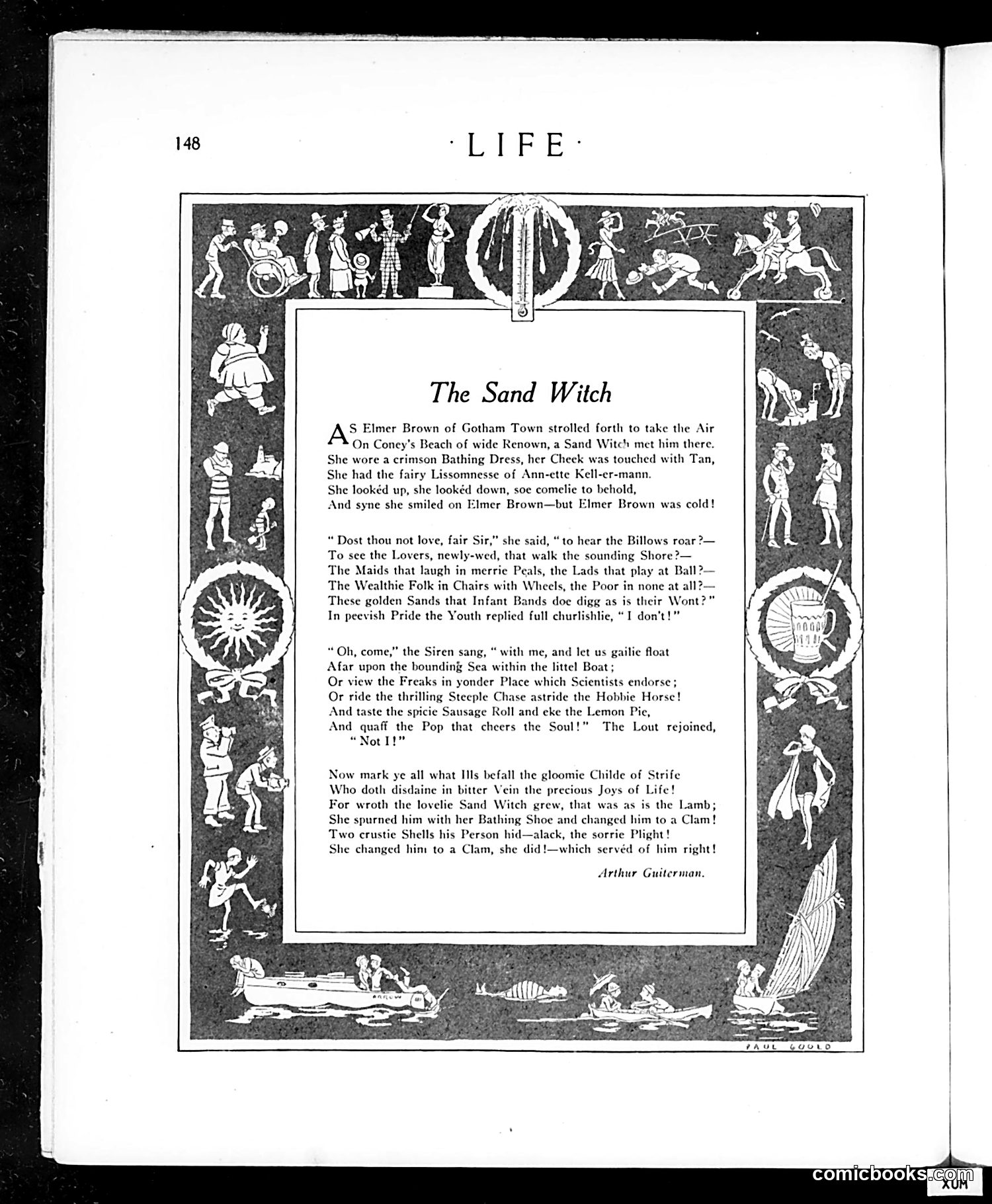
This is a whimsical cautionary poem by Arthur Guiterman, illustrated with decorative borders showing beach scenes and activities. The narrative is a fairy-tale morality lesson in mock-archaic language: **The Story:** A young man named Elmer Brown encounters an attractive woman at Coney Beach who embodies the joys of life—beaches, romance, amusements, food, leisure activities. He responds with indifference and refuses her invitations with "I don't!" and "Not I!" As punishment for his joyless, ungrateful attitude, she transforms him into a clam—a creature permanently closed off from life's pleasures. **The Point:** This is satirical commentary on killjoy attitudes and emotional coldness. The "Sand Witch" (a pun on "Sandwich") represents vitality and life's simple pleasures. Elmer's curmudgeonly rejection serves as gentle mockery of those who refuse to embrace happiness. The poem uses mock-serious, antiquated language to humorously convey a sincere message about appreciating life's offerings.
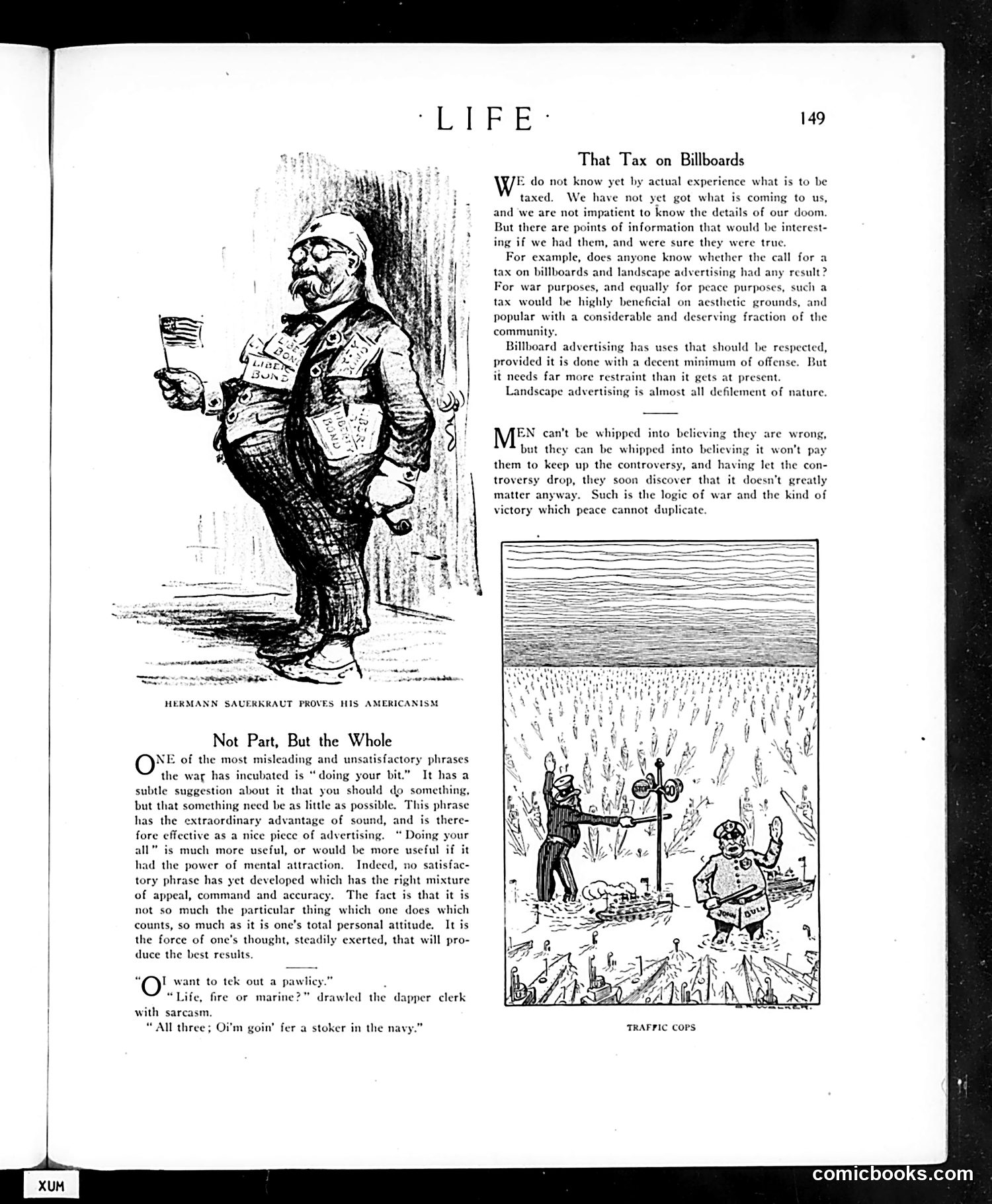
**Top Cartoon**: "Hermann Sauerkraut Proves His Americanism" depicts a German-American figure holding an American flag. The name "Sauerkraut" is a ethnic slur; this likely satirizes German-Americans during WWI, when suspicion of their loyalty was widespread. The figure's exaggerated patriotic display suggests ironic commentary on how such groups had to perform excessive Americanism to counter wartime prejudice. **"That Tax on Billboards"** argues for taxing billboard and landscape advertising, calling billboard ads acceptable but landscape advertising "almost all defilement of nature"—an early environmental/aesthetic concern. **"Not Part, But the Whole"** critiques the wartime phrase "doing your bit," arguing people should commit fully ("all") rather than minimally. The dialogue joke mocks an Irish immigrant's insurance policy choices, using dialect humor typical of the era. **"Traffic Cops"** cartoon (bottom right) is unclear without fuller context.
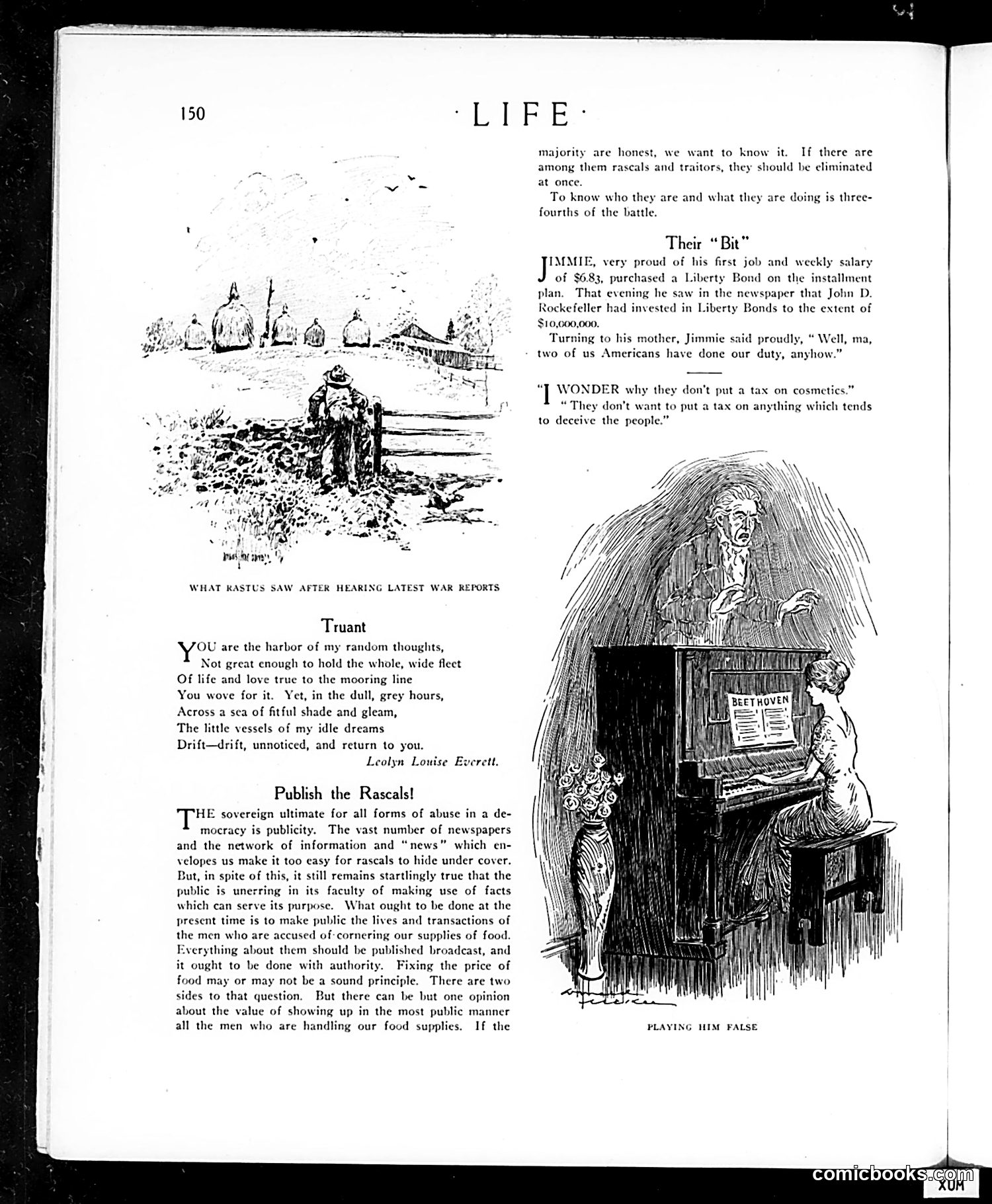
This page contains WWI-era commentary on food supply profiteering and patriotic sacrifice. The main illustrated cartoon ("What Rastus Saw After Hearing Latest War Reports") depicts an African American man's anxious reaction to war news—likely showing social anxiety about the conflict's impact. The "Publish the Rascals!" section argues for public exposure of food speculators and price-fixers hoarding supplies—a major scandal during WWI. The text demands transparency in identifying those profiting from food scarcity. "Their 'Bit'" offers gentle satire: young Jimmie proudly buys a small Liberty Bond (war loan) on his $6.83 weekly salary, then learns Rockefeller invested $10 million in the same bonds. The joke critiques wealth inequality—both participate in the war effort, but vastly unequally. The cosmetics tax joke mocks government hypocrisy: taxing deceptive products contradicts allowing deceptive wartime messaging. All three pieces reflect 1917-1918 American concerns: war profiteering, sacrifice inequality, and government credibility.
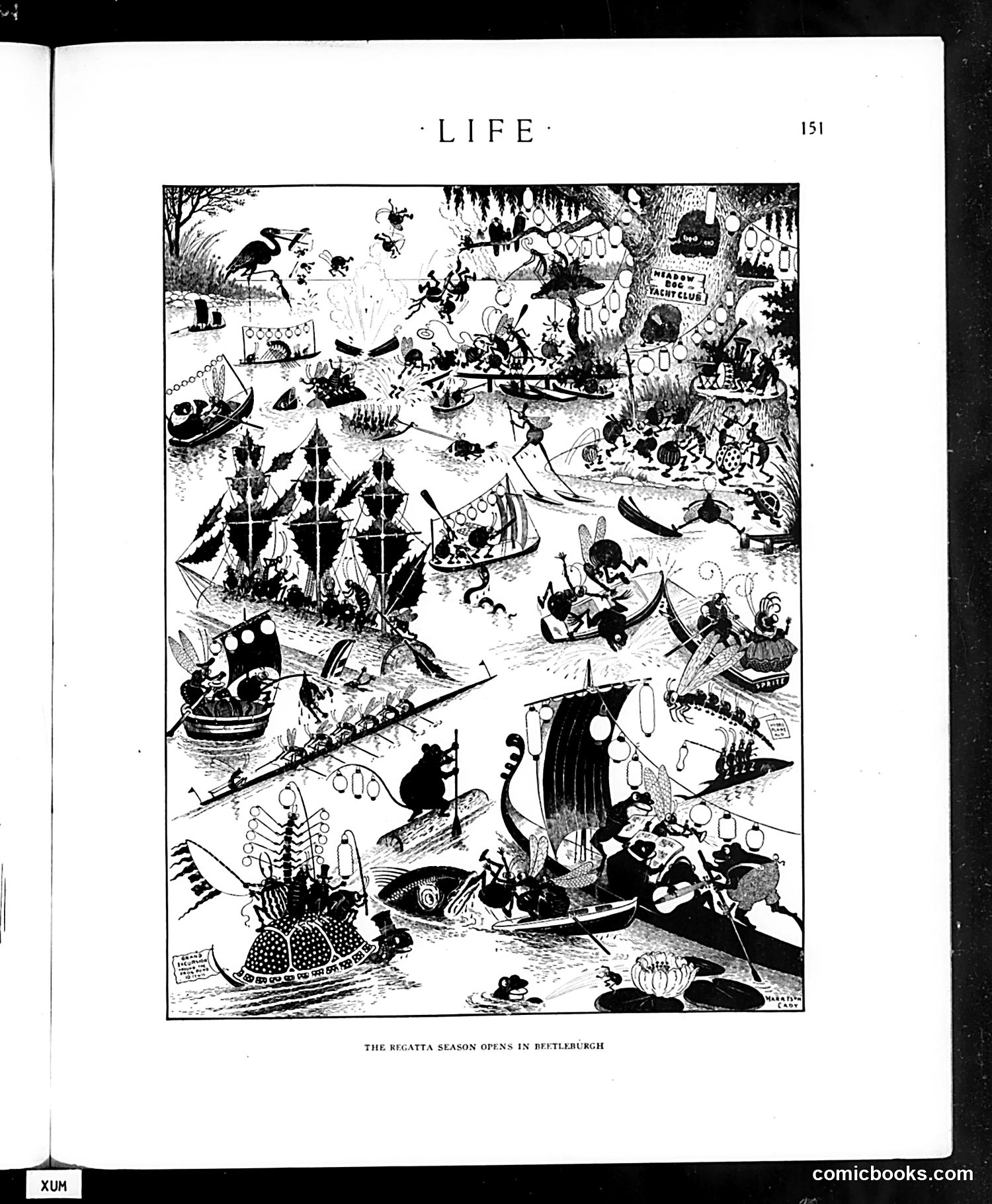
This is a satirical illustration depicting "Beetleburgh," an anthropomorphic insect society opening its regatta (boat racing) season. The cartoon presents an elaborate aquatic carnival populated entirely by beetles, bugs, and other insects engaged in various nautical activities—rowing, sailing, and spectating. The satire appears to mock human society by replacing people with insects, a common technique in early 20th-century comics to create absurdist humor. The detailed scene includes miniature vessels, spectator areas, and festive atmosphere, mirroring actual regatta celebrations of the era. The anthropomorphization—depicting insects as organized, leisure-pursuing creatures—creates humorous commentary on human pretension and social rituals. Without additional context about "Beetleburgh," the precise satirical target remains unclear, though it likely ridicules contemporary social customs or leisure activities through this imaginative insect-world parallel.
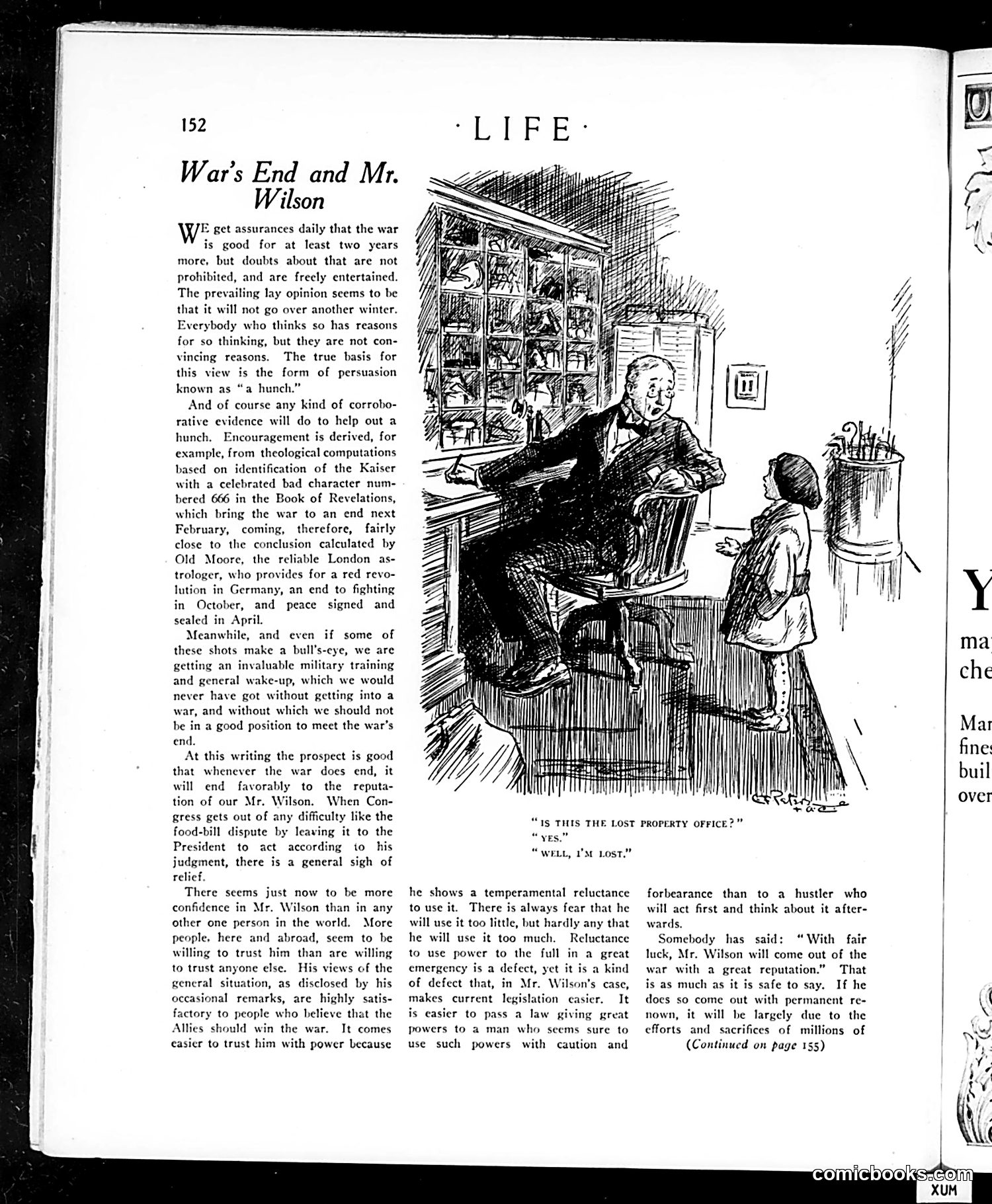
This *Life* magazine article discusses public confidence in President Woodrow Wilson during World War I, paired with a cartoon illustrating the piece's themes. **The Cartoon:** Shows a man (representing Wilson or a government official) at a desk labeled "Lost Property Office," speaking to a child who says "Well, I'm lost." The joke plays on the double meaning—the child is literally lost seeking the lost property office, a visual pun about confusion and misdirection. **The Article's Context:** Written during WWI (references to ongoing war, peace predictions for early 1918), the piece argues that Americans have unusual confidence in Wilson personally, more than any other leader. The author suggests this confidence stems partly from Wilson's *reluctance* to exercise power—people trust him because he seems cautious rather than aggressive. The piece notes Wilson is handling major decisions (like food-bill disputes) while Congress delegates authority to him. **The Satire's Point:** The "lost property" cartoon likely satirizes the contradiction the article explores: Americans are placing enormous faith in Wilson's leadership while he appears hesitant or uncertain about wielding power—a potentially dangerous position in wartime.
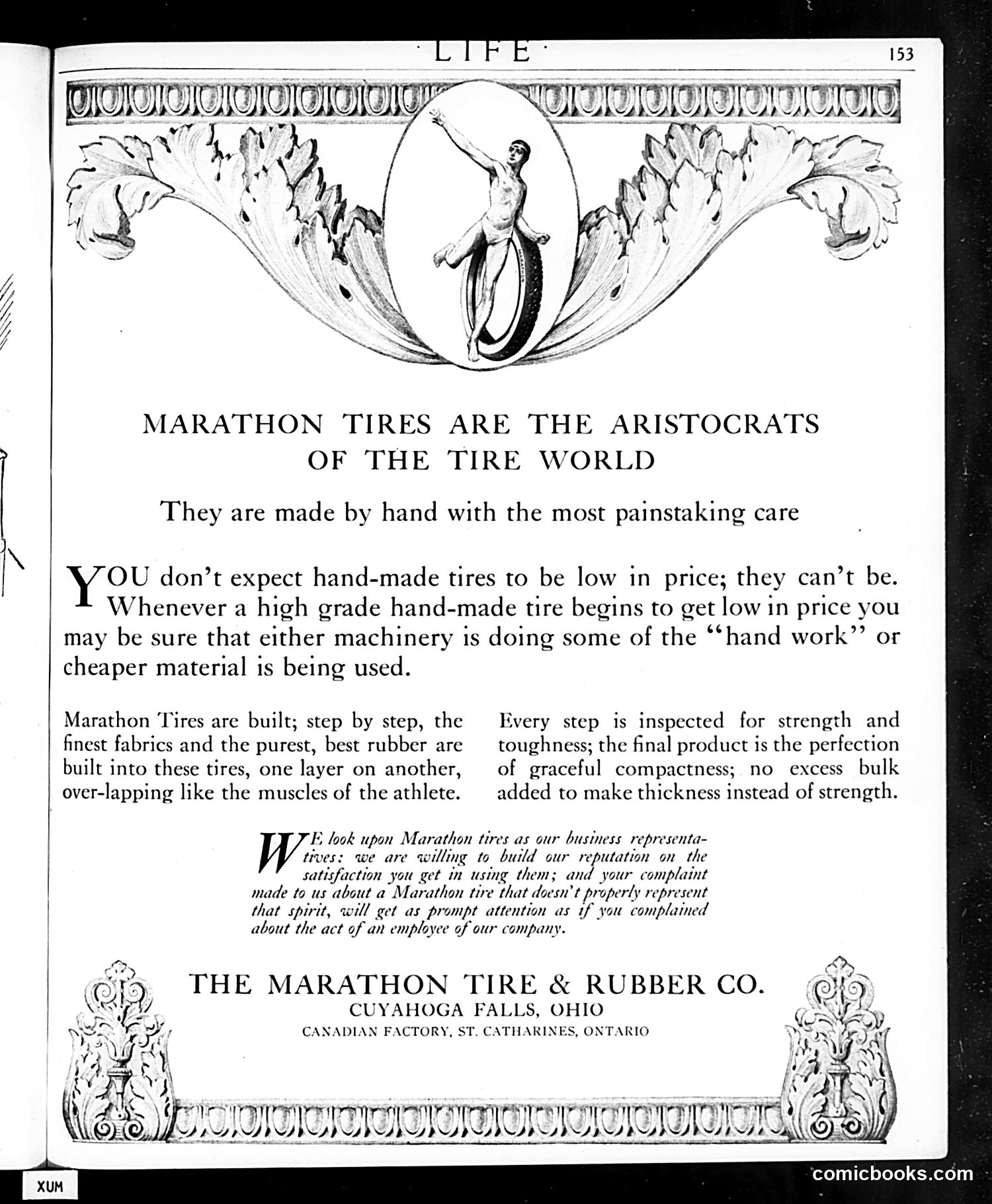
This is **not a political cartoon or satire**, but rather a full-page advertisement for Marathon Tire & Rubber Co. (based in Cuyahoga Falls, Ohio, with a Canadian factory). The decorative illustration at top shows a classical male figure in an oval frame, evoking luxury and quality—reinforcing the brand's claim to be "aristocrats of the tire world." The ad's central argument targets early-20th-century consumer skepticism: it acknowledges that hand-made products *should* be expensive, implying that cheap "hand-made" tires are fraudulent (using machinery or inferior materials instead). Marathon positions itself as genuinely premium—built layer-by-layer with careful inspection, emphasizing strength through quality rather than bulk. The italicized statement near the bottom emphasizes customer service and company reputation, treating customer complaints seriously—a notable selling point when manufacturing quality was inconsistent and consumer protections minimal. This represents period advertising strategy: appealing to class consciousness and quality-awareness during the early automotive tire market.
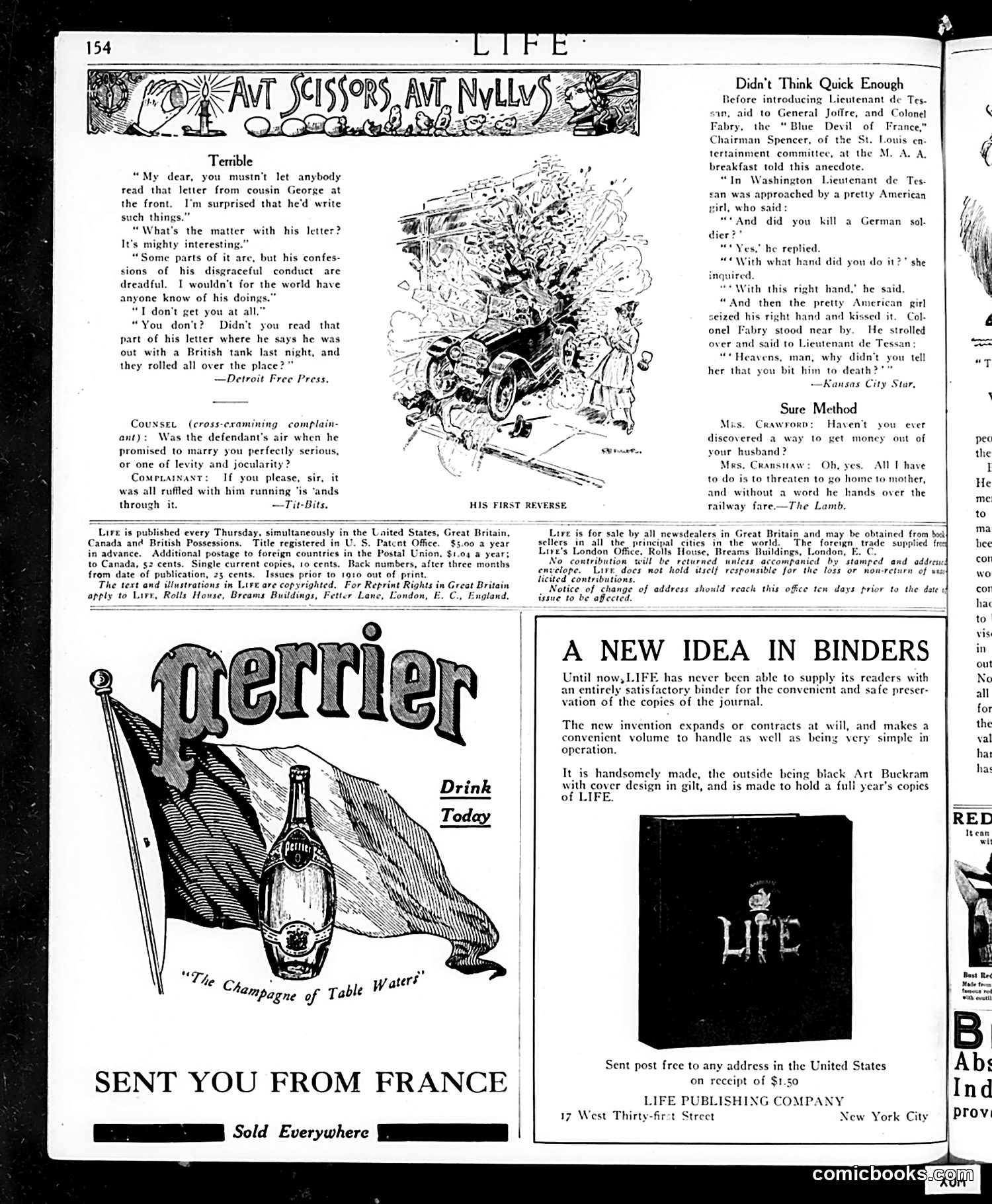
This page contains three humor pieces and advertisements typical of Life's satirical content: **"Terrible" (top left):** A domestic comedy where a wife worries her cousin's letter from WWI front describes "disgraceful conduct"—but the husband reveals the scandalous detail is merely that the cousin rode in a British tank that "rolled all over the place." The joke mocks wartime anxieties and the gap between expected military horrors and mundane realities. **"Sure Method" (right column):** A brief marital joke where a wife threatens to leave for her mother to extract money from her husband, who quickly provides railway fare. It's a light satire on domestic economics. **Perrier & Life Binder Advertisements:** The page includes a French beverage ad and promotes Life's new binder system for storing yearly magazine copies—standard early 20th-century magazine marketing. The overall tone reflects Life's role as a humor magazine mixing domestic comedies, wartime observations (given WWI context), and reader services.
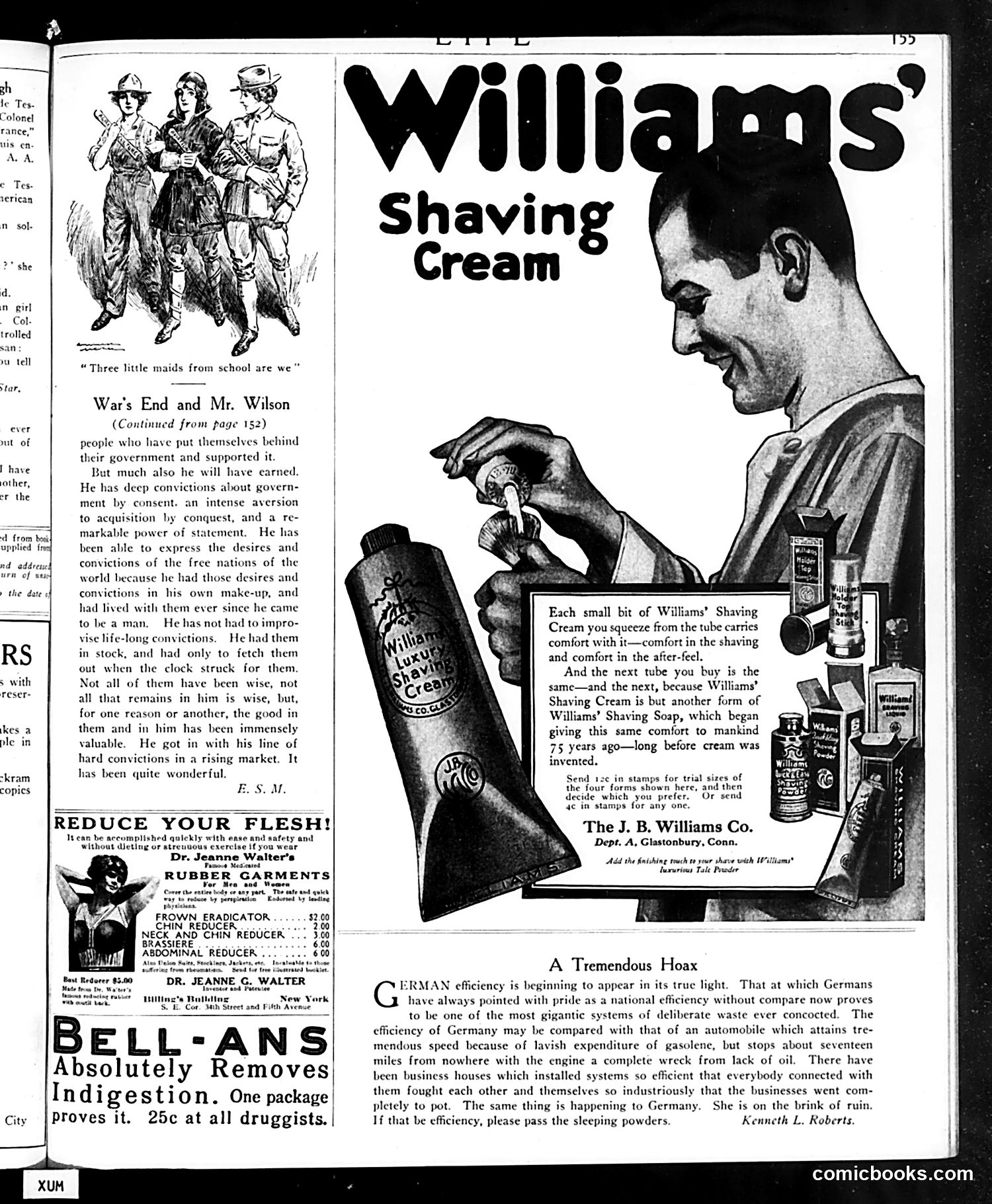
This page contains **advertising and political commentary**, not a cartoon. The main article, "War's End and Mr. Wilson" (continued from page 152), praises President Woodrow Wilson's character and convictions regarding government by consent rather than conquest—relevant to post-WWI peace negotiations. Below that, Kenneth L. Roberts's essay "A Tremendous Hoax" **satirizes German efficiency**. Roberts argues that Germany's vaunted industrial efficiency is actually wasteful and destructive—comparing it to a car that runs fast but burns out its engine. He claims German systems were so rigidly efficient that businesses and the military destroyed themselves through internal conflict, leaving Germany "on the brink of ruin." This reflects American post-war sentiment: mocking German militarism while crediting Wilson's democratic principles with victory. The surrounding **advertisements** (rubber garments, indigestion remedies, shaving cream) are typical commercial content of the era, unrelated to the political messaging.
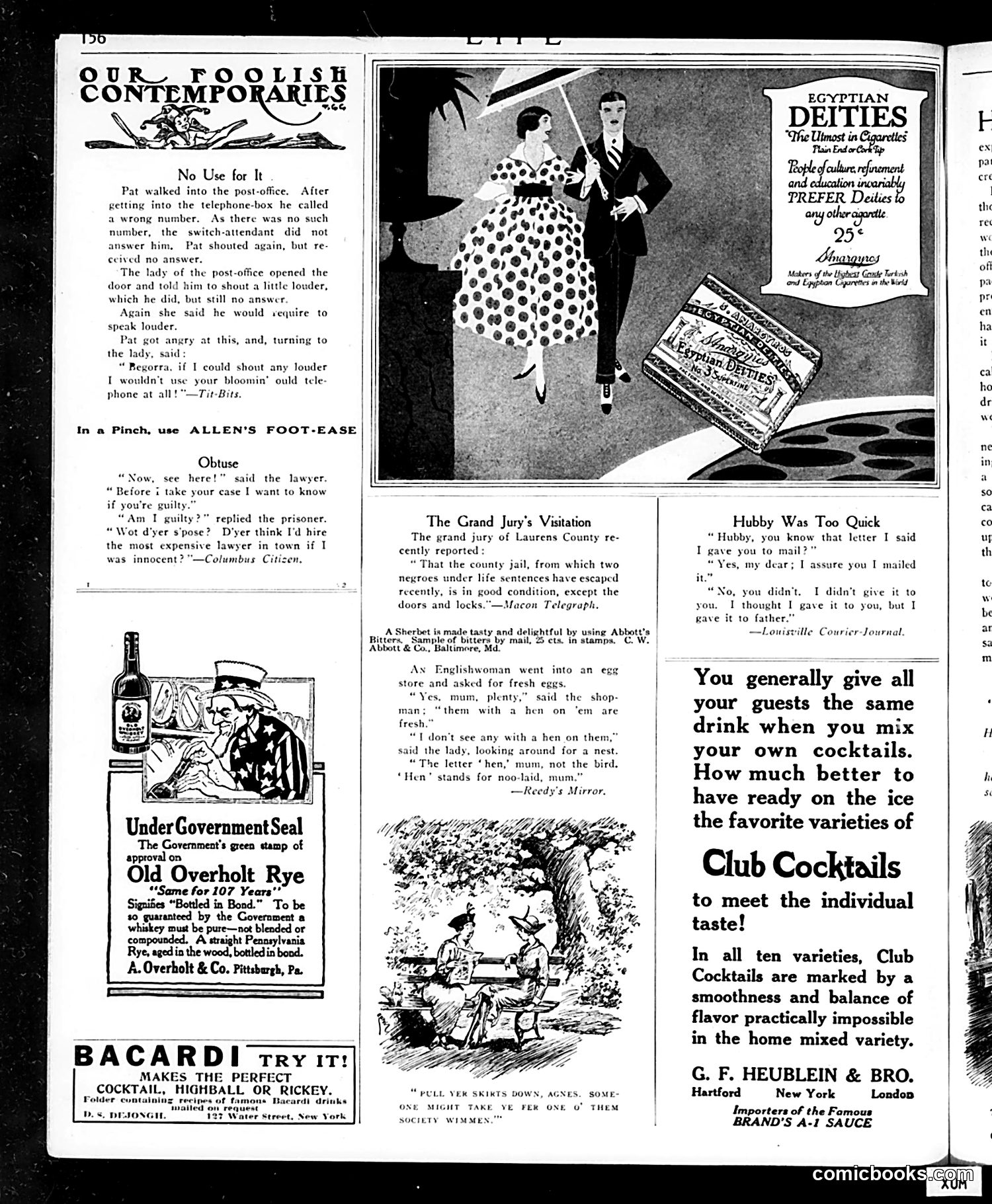
This page consists primarily of **humorous anecdotes and advertisements** rather than political cartoons. The main content includes short jokes satirizing everyday situations: - **"No Use for It"**: An Irish immigrant (indicated by "Begorra") becomes frustrated trying to use a telephone at the post office—a commentary on early telephone technology's unreliability and the absurdity of the medium itself. - **"Obtuse"**: A prisoner's logic that hiring an expensive lawyer proves guilt rather than innocence—satirizing the legal system's perverse incentives. - **"The Grand Jury's Visitation"**: Dark humor about a county jail in "good condition, except the doors and locks"—mocking the incompetence of officials who allowed prisoners to escape yet reported everything fine. The remaining content is **advertising** (Old Overholt Rye whiskey, Bacardi, Club Cocktails, Egyptian Deities candy) interspersed with minor jokes about telephones, eggs, and domestic life. The page reflects early-20th-century American humor: dialect comedy, bureaucratic incompetence, and emerging consumer culture.
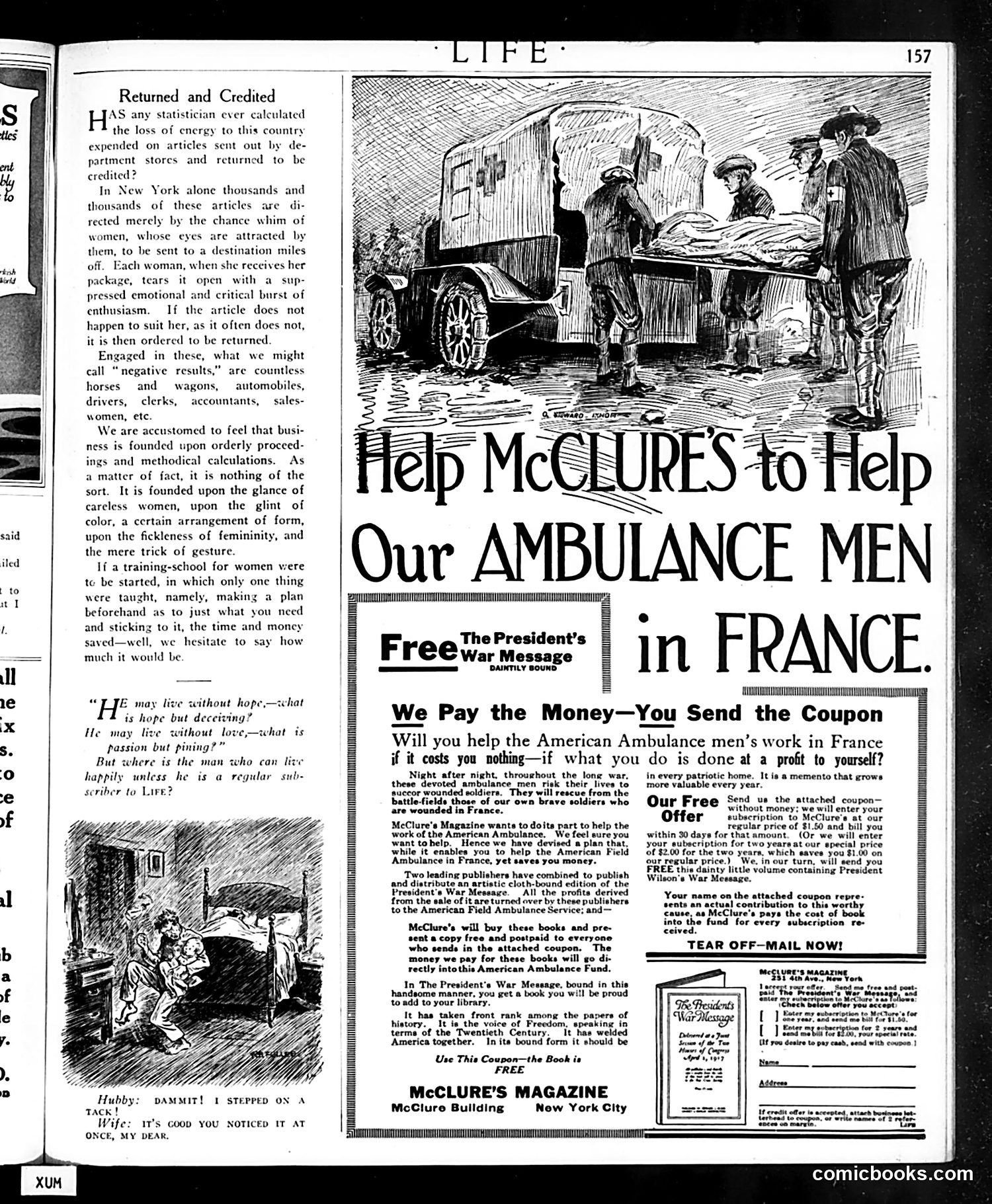
This page combines satirical editorial content with a WWI-era fundraising advertisement. **The Editorial Satire (left side):** "Returned and Credited" mocks women's shopping habits, arguing that department store returns waste enormous resources (transportation, labor, goods). The author criticizes women for impulsive purchases based on superficial attraction rather than actual need, suggesting they lack planning skills. A small cartoon illustrates the point with a couple—the husband has stepped on a tack, which the wife only notices because she's preoccupied. This reinforces the stereotype of careless, inattentive femininity. **The Advertisement (right side):** Promotes subscriptions to McClure's Magazine as a fundraiser for the American Ambulance Service in France (WWI relief work). The pitch claims subscribers pay nothing extra—McClure's covers the cost by redirecting publisher profits to the ambulance fund. Readers receive a bound edition of President Wilson's War Message as incentive. The juxtaposition is notable: a page criticizing women's frivolousness directly precedes an appeal to patriotic generosity, likely targeting those same magazine readers.
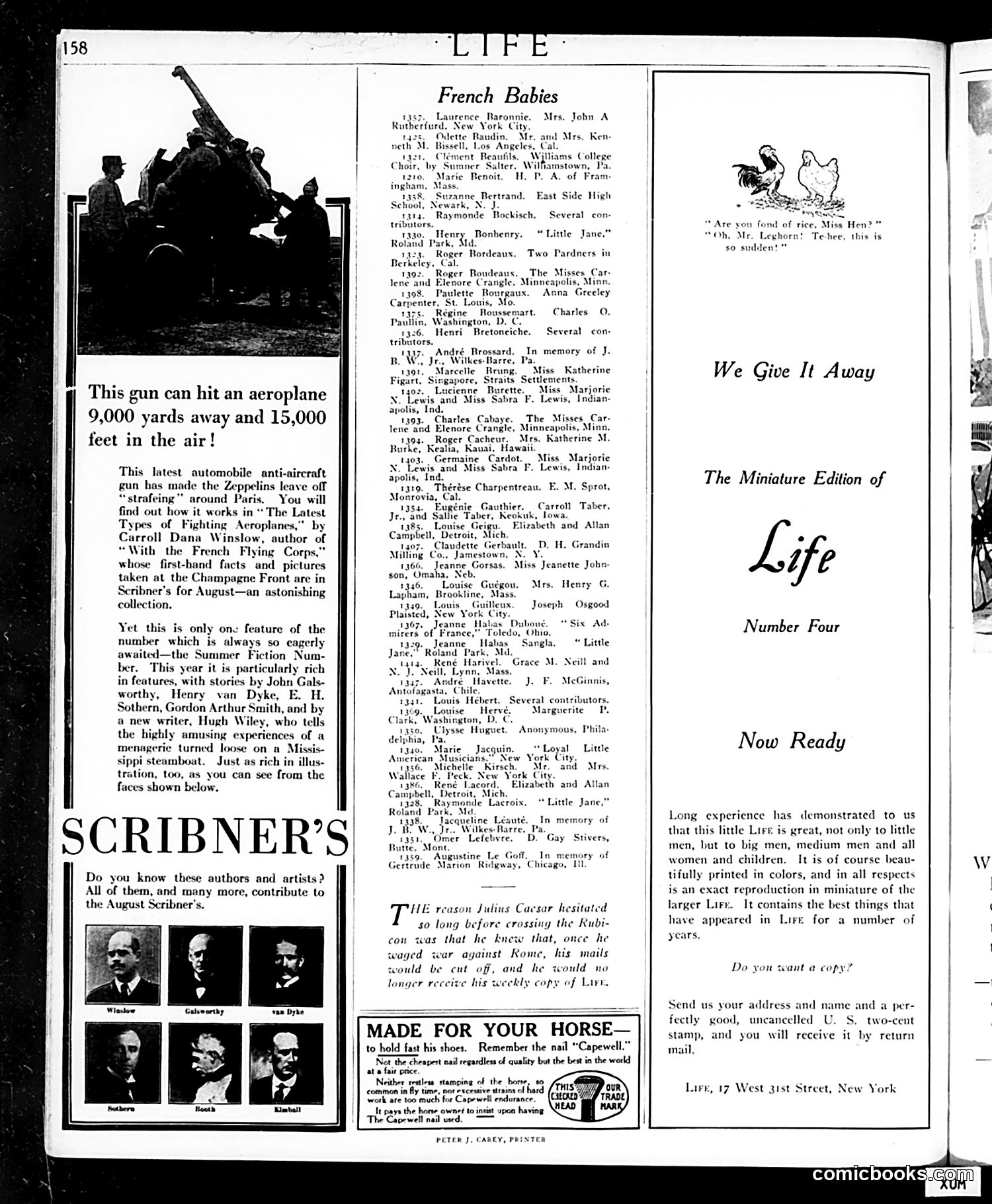
This page from Life magazine (appears to be early 20th century, likely WWI-era based on references) combines editorial content with advertisements. **Main Content:** The left side features an anti-aircraft gun capable of hitting aircraft at 9,000 yards and 15,000 feet altitude—a notable military innovation. This ties to an article by Carroll Dana Winslow about "Fighting Aeroplanes" in Scribner's magazine, promoting their August issue featuring WWI frontline reporting from the Champagne Front. **Satirical Elements:** The small cartoon on the right shows a flirting couple—a hen and rooster—with dialogue ("Are you fond of rice, Miss Hen?" / "Oh, Mr. Leghorn! Te-hee, this is so sudden!"), which is lighthearted wordplay using chicken references for romantic banter. **Right Column:** Advertises a miniature edition of *Life* magazine itself. The page essentially promotes both serious war reporting and the publication's varied content, mixing military hardware information with humorous illustrations and self-promotion.
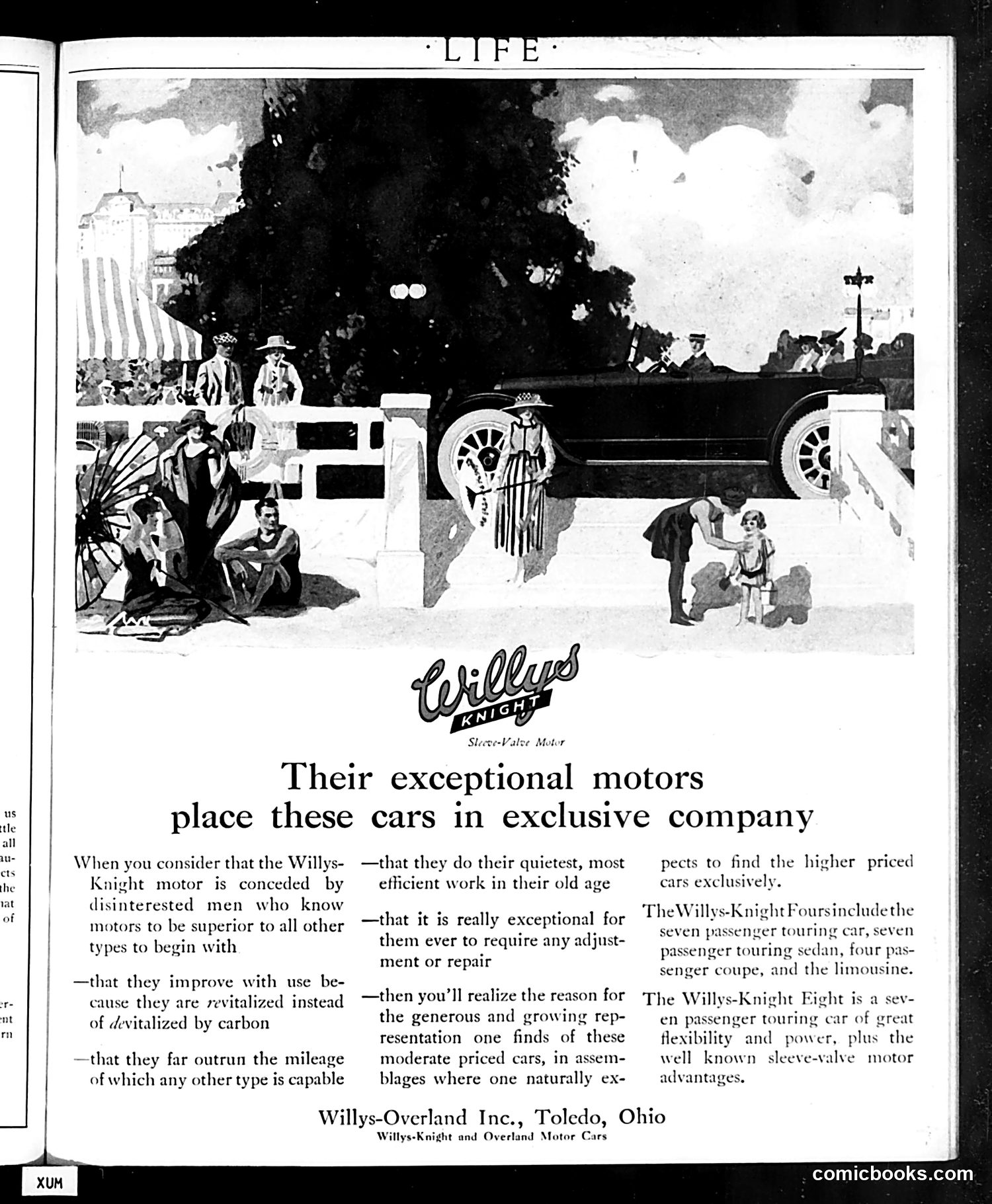
This is primarily **automobile advertising**, not political satire. The page promotes Willys-Knight cars from Willys-Overland Inc. The illustration depicts a social scene where elegantly dressed people gather around automobiles beneath a large tree, suggesting wealth and leisure. The advertisement's argument is that Willys-Knight motors are mechanically superior—they improve with age, require minimal maintenance, and deliver mileage comparable to much more expensive cars. The satirical *implication* (rather than explicit joke) is social commentary: the ad suggests that Willys-Knight's exceptional engineering allows middle-class buyers to own cars "in exclusive company" with the wealthy. The illustration shows diverse social classes mingling around these automobiles, hinting that superior mechanics democratize luxury—you needn't be rich to own a car that performs like one. This reflects 1920s American optimism about industrialization and upward mobility through technology, though it's primarily sales messaging rather than editorial satire.
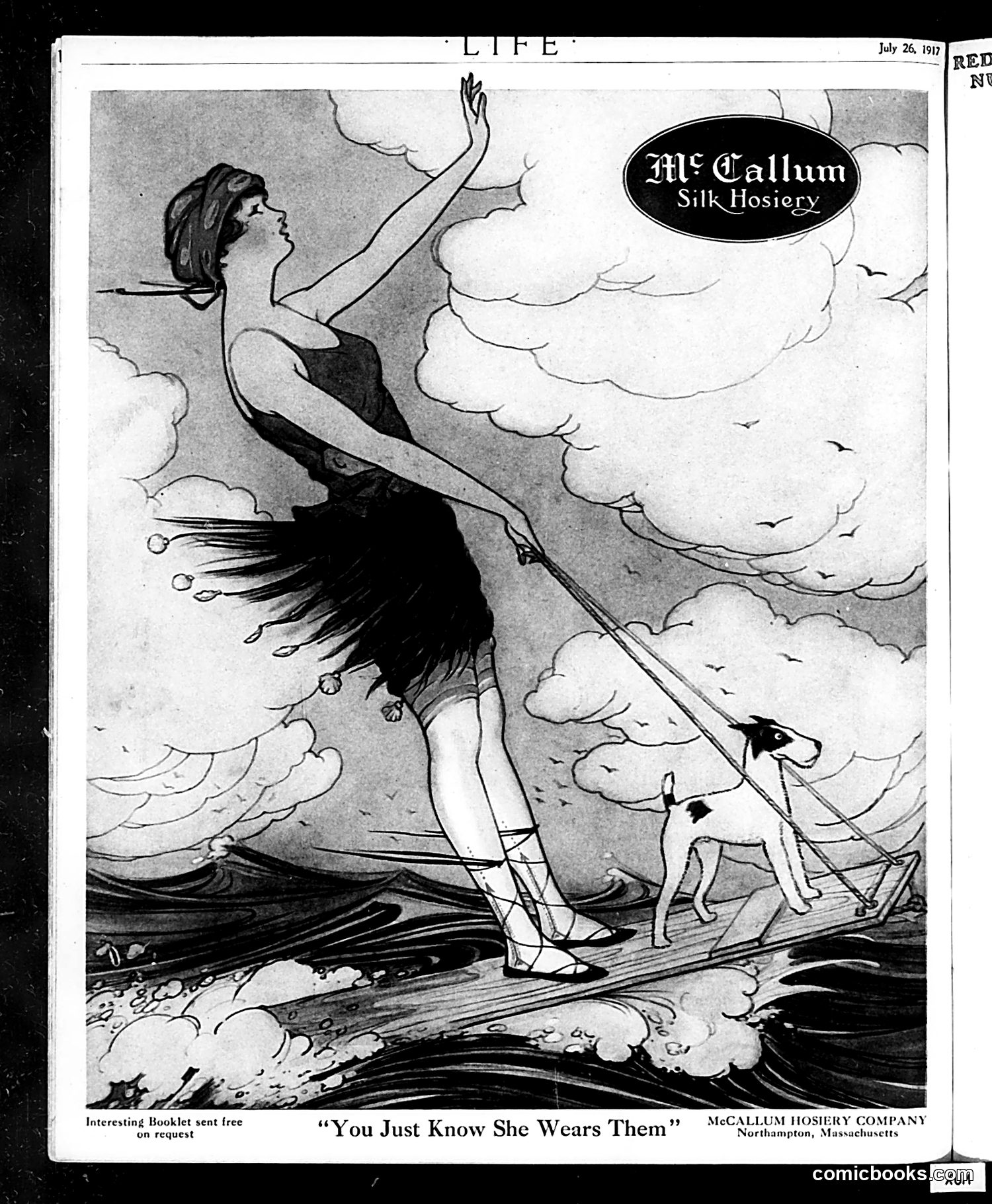
This is a **silk hosiery advertisement** for McCallum Hosiery Company (Northampton, Massachusetts), not political satire. The image depicts a fashionable woman in 1917 attire, playfully pulling a small dog on a leash while standing among clouds. The woman's legs are prominently displayed—the advertisement's focal point—showcasing the silk stockings being promoted. The slogan "You Just Know She Wears Them" is a marketing appeal suggesting that well-dressed, elegant women naturally wear McCallum silk hosiery. The whimsical cloud setting and the woman's confident pose emphasize luxury and sophistication. The advertisement uses aspirational imagery typical of the era: by wearing these stockings, presumably women could project the same elegance and refinement as the illustrated figure. This represents early-20th-century advertising's common practice of linking consumer products to lifestyle and social status.