
Life, 1917-07-26 · page 24 of 40
Life — July 26, 1917 — page 24: what you’re looking at
What you’re looking at
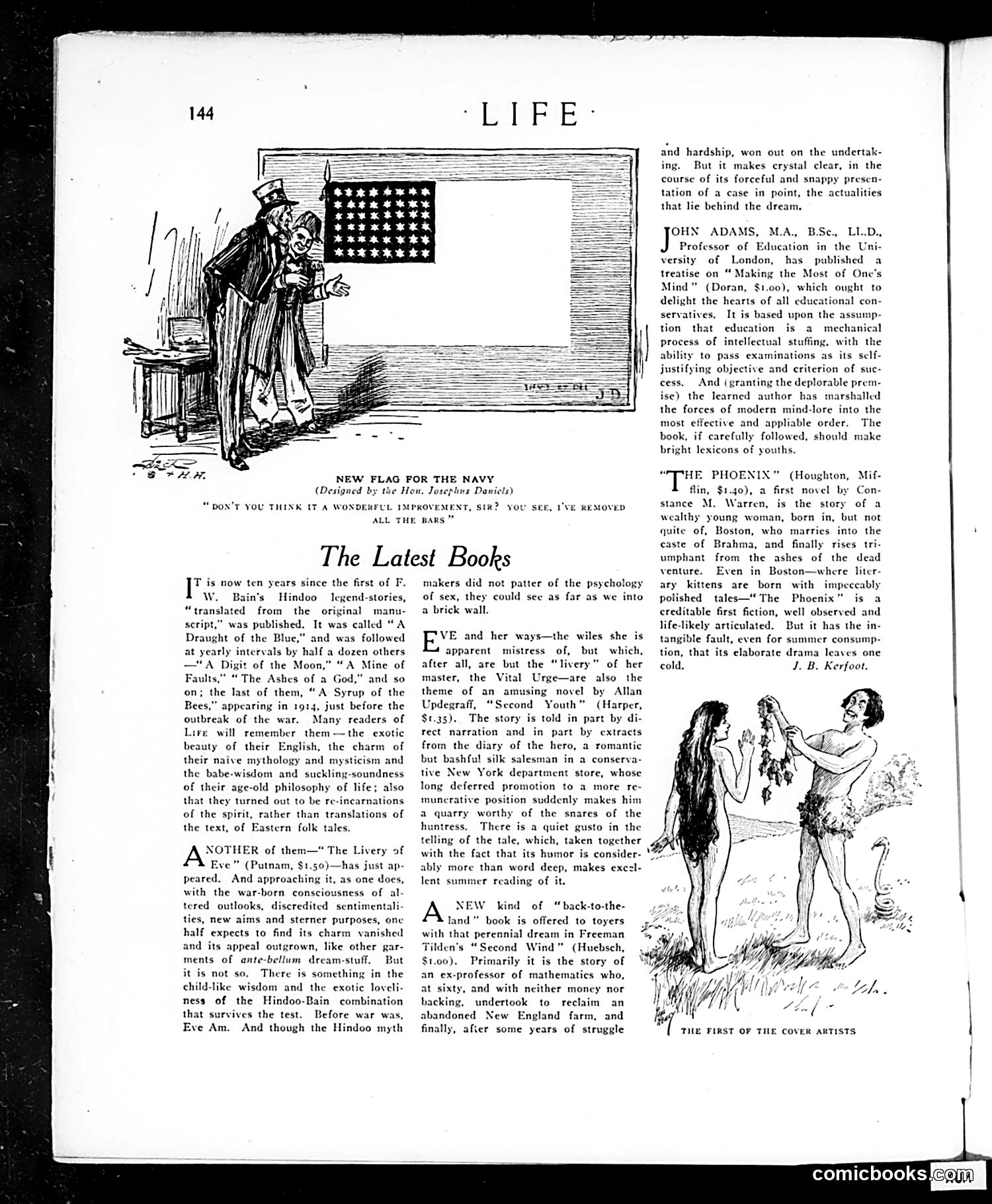
This cartoon satirizes Secretary of the Navy Josephus Daniels' administrative changes. The figure on the left (representing Daniels) displays a naval flag to a superior officer, proudly announcing he has "removed all the bars"—a double meaning playing on both the literal removal of stripes from the flag design AND suggesting the elimination of officers' rank insignia or naval regulations. The joke targets Daniels as an overzealous reformer making questionable "improvements" to military tradition. The officer's skeptical response ("Don't you think it a wonderful improvement, sir?") suggests the cartoon questions whether such changes strengthen or weaken the Navy. This reflects period criticism of Daniels' tenure (1913-1921) for his controversial modernization efforts and social policies, which naval traditionalists resisted.
📄 Transcribed text from this page (OCR, searchable)
Machine-transcribed from the original scan — historical spelling and the odd misread are preserved.
wea KEE KERKKEEE (Designed “DON'T YOU THINK IT A WONDERFUL IMPROVEMENT, SIR? Yo! NEW FLAG FOR THE NAVY ie Hon, Josephus Daniels) SEE, I'VE REMOVED ALL THE BARS” The Latest Books r is now ten years since the first of F. W. Bain’s Hindoo legend-stories, “translated from the original manu- ” was published. It was called “A Draught of the Blue,” and was followed at yearly intervals by half a dozen others “A Digit of the Moon,” “A Mine of Faults," “The Ashes of a God,” and so on; the last of them, “A Syrup of the Bees,” appearing in 1914, just before the outbreak of the war. Many readers of Lire them —the exotic beauty of their English, the charm of their naive mythology and mysticism and the babe-wisdom and suckling-soundness of their age-old philosophy of life; also that they turned out to be r nations of the spirit, rather than translations of the text, of Eastern folk tales. NOTHER of them— The Livery of Eve” (Putnam, $1.50)—has just ap- peared. And approaching it, as one does, with the war-born consciousness of al- tered outlooks, discredited sentimentali- ties, new aims and sterner purposes, onc half expects to find its charm vanished and its appeal outgrown, like other gar- ments of ante-bellum dream-stuff. But it is not so, There is something in the child-like wisdom and the exotic loveli- ness of the Hindoo-Bain combination that survives the test. Before war was, Eve Am. And though the Hindoo myth will remember makers did not patter of the psychology of sex, they could see as far as we into a brick wall. VE and her ways—the wiles she is apparent mistress of, but which, after all, are but the “livery” of her master, the Vital Urge—are also the theme of an amusing novel by Allan Updegraff, “Second Youth” (Harper, $1.35). The story is told in part by di- rect narration and in part by extracts from the diary of the hero, a romantic but bashful silk salesman in a conserva- tive New York department store, whose long deferred promotion to a more re- munerative position suddenly makes him a quarry worthy of the snares of the huntress. There is a quiet gusto in the telling of the tale, which, taken together with the fact that its humor is consider- ably more than word deep, makes exc2l- lent summer reading of it. A NEW kind of “back-to-the- land" book is offered to toyers with that perennial dream in Freeman Tilden’s “Second Wind" (Huebsch, $1.00). Primarily it is the story of and hardship, won out on the undertak- But it makes crystal clear, in the course of its forceful and snappy presen- tation of a case in point, the actualities that lie behind the dream. OHN ADAMS, M.A. J Professor of Educat of London, ha published treatise on “ Making the Most of One's Mind” (Doran, $1.00), which ought to delight the hearts of all educational con- servatives, It is based upon the assump- tion that education process of intellectua ability to pass ex justifying objective and criteri cess. And (granting the deplorable prem- ise) the learned author has marshalled the forces of modern mind-lore into the most effective and appliable order. The book. if carefully followed, should make bright lexicons of youths. ing. versity its self- n of suc- minations “THE PHOENIX” (Houghton, Mif- flin, $1.40), a first novel by Con- stance M. Warren, is the story of a wealthy young woman, born in, but not of, Boston, who marries into the caste of Brahma, and finally rises tri- quite umphant from the ashes of the dead venture. Even in Boston—where liter- ary kittens are born with impeccably polished tales— The Phoenix” is a creditable first fiction, well observed and life-likely articulated. But it has the in- tangible fault, even for summer consump- tion, that its elaborate drama leaves one J. B. Kerfoot. cold. an ex-professor of mathematics who, at sixty, and with neither money nor backing, undertook to reclaim an abandoned New England farm, and finally, afier some years of struggle TILE FIRST OF TILE COVER ARTISTS comicbooks Gaiam