
Life, 1917-07-26 · page 18 of 40
Life — July 26, 1917 — page 18: what you’re looking at
What you’re looking at
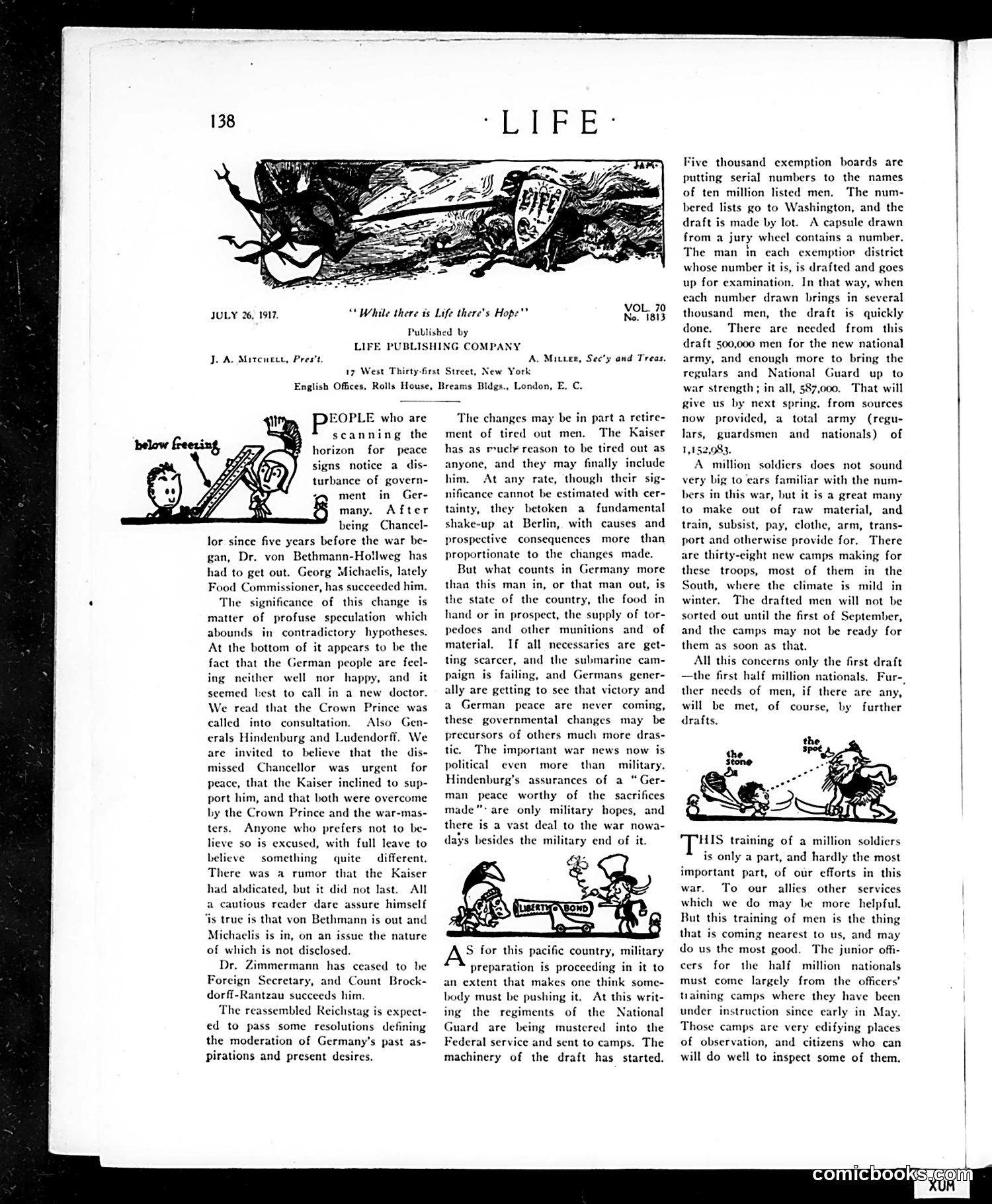
This page discusses recent German political changes during World War I. Chancellor von Bethmann-Hollweg has been replaced by Georg Michaelis, and Foreign Secretary Zimmermann by Count Brockdorff-Rantzau. The article speculates on causes: the German public's unhappiness, food shortages, failing submarine campaigns, and growing certainty that German victory is impossible. The author suggests these governmental changes may herald more dramatic upheaval if conditions worsen. The cartoons (specific figures unclear in reproduction) appear to satirize German leadership instability during wartime. The right column shifts focus to American military preparation: the newly implemented draft lottery system is explained, with 500,000 men needed for the new national army. The implicit contrast suggests American military organization proceeds systematically while German government destabilizes—a pointed commentary on relative wartime stability and morale.
📄 Transcribed text from this page (OCR, searchable)
Machine-transcribed from the original scan — historical spelling and the odd misread are preserved.
JULY 26, 1917, VOL. 70 “While there is Life there's Hope" NOG Published by LIFE PUBLISHING COMPANY J. A. Miteneee, Pres't A. Miter, Sec'y and Treas. 17 West Thirty-first Street, New York English Offices, Rolls House, Bream PLE who are scanning the horizon for peace signs notice a dis- turbance of govern- ment in’ Ger- many. After being Chancel- lor since five years before the war be- gan, Dr. von Bethmann-Hollweg has had to get out. Georg Michaelis, lately Food Commissioner, has succeeded him. The significance of this change matter of profuse speculation which abounds in contradictory hypotheses. At the bottom of it appears to be the fact that the German people are feel- ing neither well nor happy, and it seemed best to call in a new doctor. We read that the Crown Prince was called into consultation, Also Gen- erals Hindenburg and Ludendorff. We are invited to believe that the dis- missed Chancellor was urgent for peace, that the Kaiser inclined to sup- port him, and that both were overcome ly the Crown Prince and the war-mas- ters. Anyone who prefers not to be- lieve so is excused, with full leave to Lelieve something quite different. There was a rumor that the Kais had abdicated, but it did not last. All a cautious reader dare assure himself ‘is true is that von Bethmann is out and Michaelis is in, on an issue the nature of which is not disclosed. Dr. Zimmermann has ceased to be Foreign Secretary, and Count Brock- dorff-Rantzau succeeds him. The reassembled Reichstag is expect- ed to pass some resolutions defining the moderation of Germany’s past as- pirations and present desires. a Bldgs., London, E. C. The changes may be in part a retire- ment of tired out men. The Kaiser has as muclr reason to be tired out as anyone, and they may finally include him. At any rate, though their sig- nificance cannot be estimated with cer- tainty, they betoken a fundamental shake-up at Berlin, with causes and prospective consequences more than proportionate to the changes made. But what counts in Germany more than this man in, or that man out, is the state of the country, the food in hand or in prospect, the supply of tor- pedoes and other munitions and of material. If all necessaries are get- ting scarcer, and the submarine cam- paign is failing, and Germans gener- ally are getting to see that victory and a German peace are never coming, these governmental changes may be precursors of others much more dras- tic. The important war news now is political more than military. even Hindenburg’s assurances of a “Ger- man peace worthy of the sacrifices made”* are only military hopes, and there is a vast deal to the war nowa- days besides the military end of it. A for this pacific country, military preparation is proceeding in it to an extent that make: body must be pushing it. At this writ- ing the regiments of the National Guard are being mustered into the Federal service and sent to camps. The machinery of the draft has started. one think some- Five thousand exemption boards are putting serial numbers to the names of ten million listed men, The num- bered lists go to Washington, and the draft is made by lot. A capsule drawn from a jury wheel contains a number. The man in cach exemption district whose number it is, is drafted and goes up for examination. In that way, when cach number drawn brings in several thousand men, the draft is quickly done. There are needed from this draft 500,000 men for the new national army, and enough more to bring the regulars and National Guard up to war strength ; in all, 587,000, That will give us by next spring. from sources now provided, a total army (regu- lars, guardsmen and nationals) of 1,152,983. A million soldiers does not sound very big to cars familiar with the num- bers in this war, but it is a great many to make out of raw material, and train, subsist, pay, clothe, arm, trans- port and otherwise provide for. There are thirty-eight new camps making for these troops, most of them in the South, where the climate is mild in winter. The drafted men will not be sorted out until the first of September, and the camps may not be ready for them as soon as that. All this concerns only the first draft —the first half million nationals. Fur-, ther needs of men, if there are any, will be met, of course, by further drafts. THs training of a million soldiers only a part, and hardly the most important part, of our efforts in this war. To our allies other services which we do may be more helpful. But this training of men is the thing that is coming nearest to us, and may do us the most good. The junior offi- cers for the half million nationals must come largely from the officers’ training camps where they have been under instruction since early in May. Those camps are very edifying places of observation, and citizens who can will do well to inspect some of them.