
Life, 1917-07-26 · page 12 of 40
Life — July 26, 1917 — page 12: what you’re looking at
What you’re looking at
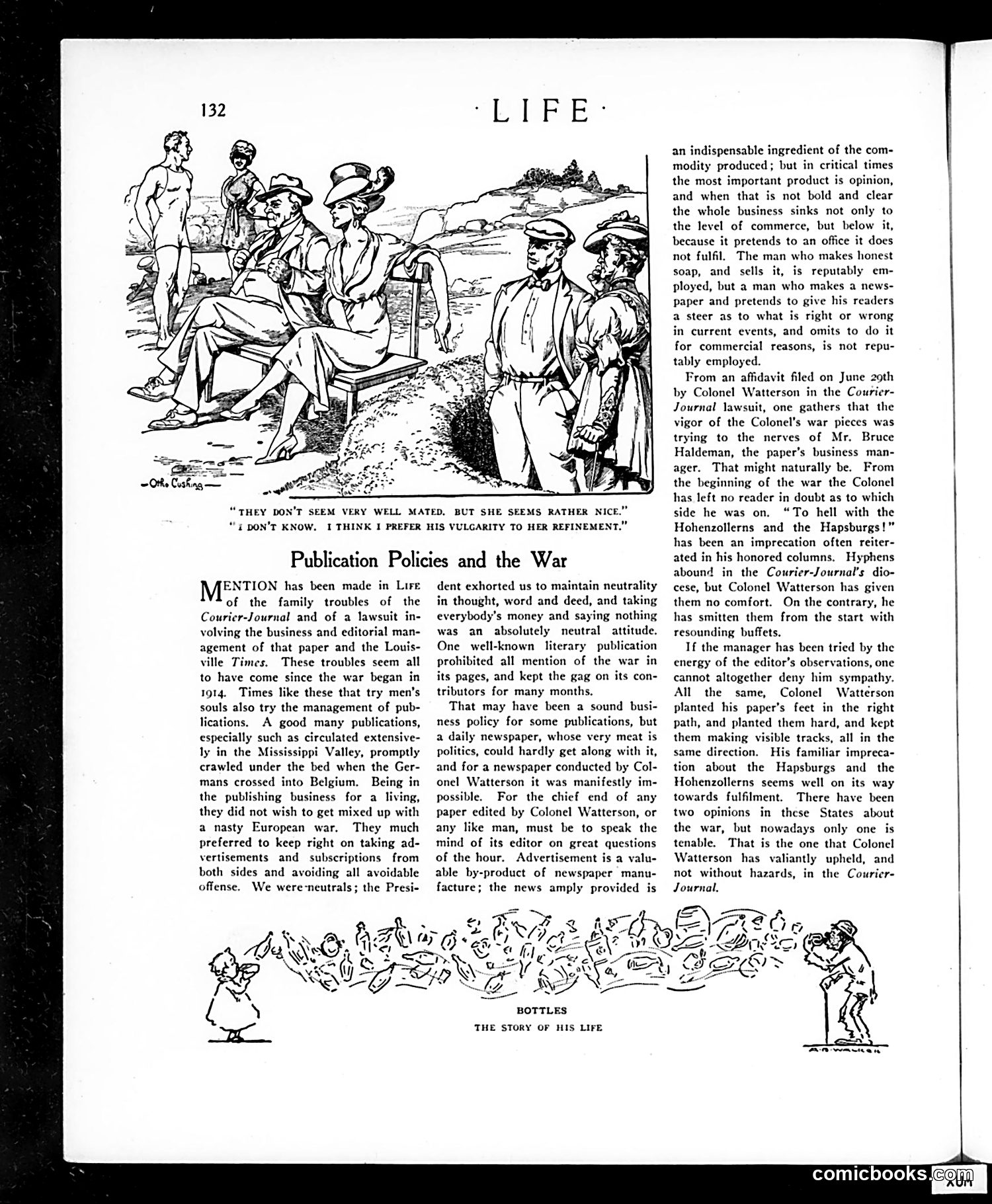
**The Main Cartoon** depicts a group of people (likely soldiers or civilians during WWI) with the caption suggesting a woman is "rather nice" despite lacking refinement—a mild social satire about class and manners. **The Article "Publication Policies and the War"** discusses tensions between newspapers' editorial independence and wartime pressures. It specifically references Colonel Watterson's *Courier-Journal* and the *Louisville Times*, criticizing how some publications avoided war coverage to maintain neutrality while others faced pressure to support the war effort. The piece argues newspapers must balance commercial interests with editorial integrity—that avoiding controversial opinions (like editorial positions on the war) while claiming neutrality is itself a compromised position. This reflects early WWI-era debates about press freedom versus patriotic duty.
📄 Transcribed text from this page (OCR, searchable)
Machine-transcribed from the original scan — historical spelling and the odd misread are preserved.
“THEY DON'T SEEM VERY WELL MATED, BUT SHE SEEMS RATHER NICE.” “i DON'T KNOW. I THINK I PREFER HIS VULGARITY TO HER REFINEMENT.” Publication Policies and the War ENTION has been made in Lire of the family troubles of the Courier-Journal and of a lawsuit in- volving the business and editorial man- agement of that paper and the Louis- ville Times. These troubles seem all to have come since the war began in 1914. Times like these that try men’s souls also try the management of pub- lications. A good many publications, especially such as circulated extensive- ly in the Mississippi Valley, promptly crawled under the bed when the Ger- mans crossed into Belgium. Being in the publishing business for a living, they did not wish to get mixed up with a nasty European war. They much preferred to keep right on taking ad- vertisements and subscriptions from both sides and avoiding all avoidable offense. We were-neutrals; the Presi- dent exhorted us to maintain neutrality in thought, word and deed, and taking everybody’s money and saying nothing was an absolutely neutral attitude. One well-known literary publication prohibited all mention of the war in its pages, and kept the gag on its con- tributors for many months. That may have been a sound busi- ness policy for some publications, but a daily newspaper, whose very meat is politics, could hardly get along with it, and for a newspaper conducted by Col- onel Watterson it was manifestly im- possible. For the chief end of any paper edited by Colonel Watterson, or any like man, must be to speak the mind of its editor on great questions of the hour. Advertisement is a valu- able by-product of newspaper manu- facture; the news amply provided is BOTTLES THE STORY OF HIS LIFE an indispensable ingredient of the com- modity produced; but in critical times the most important product is opinion, and when that is not bold and clear the whole business sinks not only to the level of commerce, but below it, because it pretends to an office it does not fulfil, The man who makes honest soap, and sells it, is reputably em- ployed, but a man who makes a news- paper and pretends to give his readers a steer as to what is right or wrong in current events, and omits to do it for commercial reasons, is not repu- tably employed. From an affidavit filed on June 20th by Colonel Watterson in the Courier- Journal lawsuit, one gathers that the vigor of the Colonel’s war pieces was trying to the nerves of Mr. Bruce Haldeman, the paper’s business man- ager. That might naturally be. From the beginning of the war the Colonel has left no reader in doubt as to which side he was on. “To hell with the Hohenzollerns and the Hapsburgs!” has been an imprecation often reiter- ated in his honored columns. Hyphens abound in the Courier-Journal’s dio- cese, but Colonel Watterson has given them no comfort. On the contrary, he has smitten them from the start with resounding buffets. If the manager has been tried by the energy of the editor’s observations, one cannot altogether deny him sympathy. All the same, Colonel Watterson planted his paper’s feet in the right path, and planted them hard, and kept them making visible tracks, all in the same direction. His familiar impreca- tion about the Hapsburgs and the Hohenzollerns seems well on its way towards fulfilment. There have been two opinions in these States about the war, but nowadays only one is tenable. That is the one that Colonel Watterson has valiantly upheld, and not without hazards, in the Courier- Journal, NS 3 4 Pa Oo ree 3 Vv LB - SH DAD, iS ue a 2° = EV PGE Pos “CPR & Qe) SPSS BY ee Ne A, SS, xx) i MONEY Big LE a ee =| comicbooks Garg