
Life, 1917-07-26 · page 32 of 40
Life — July 26, 1917 — page 32: what you’re looking at
What you’re looking at
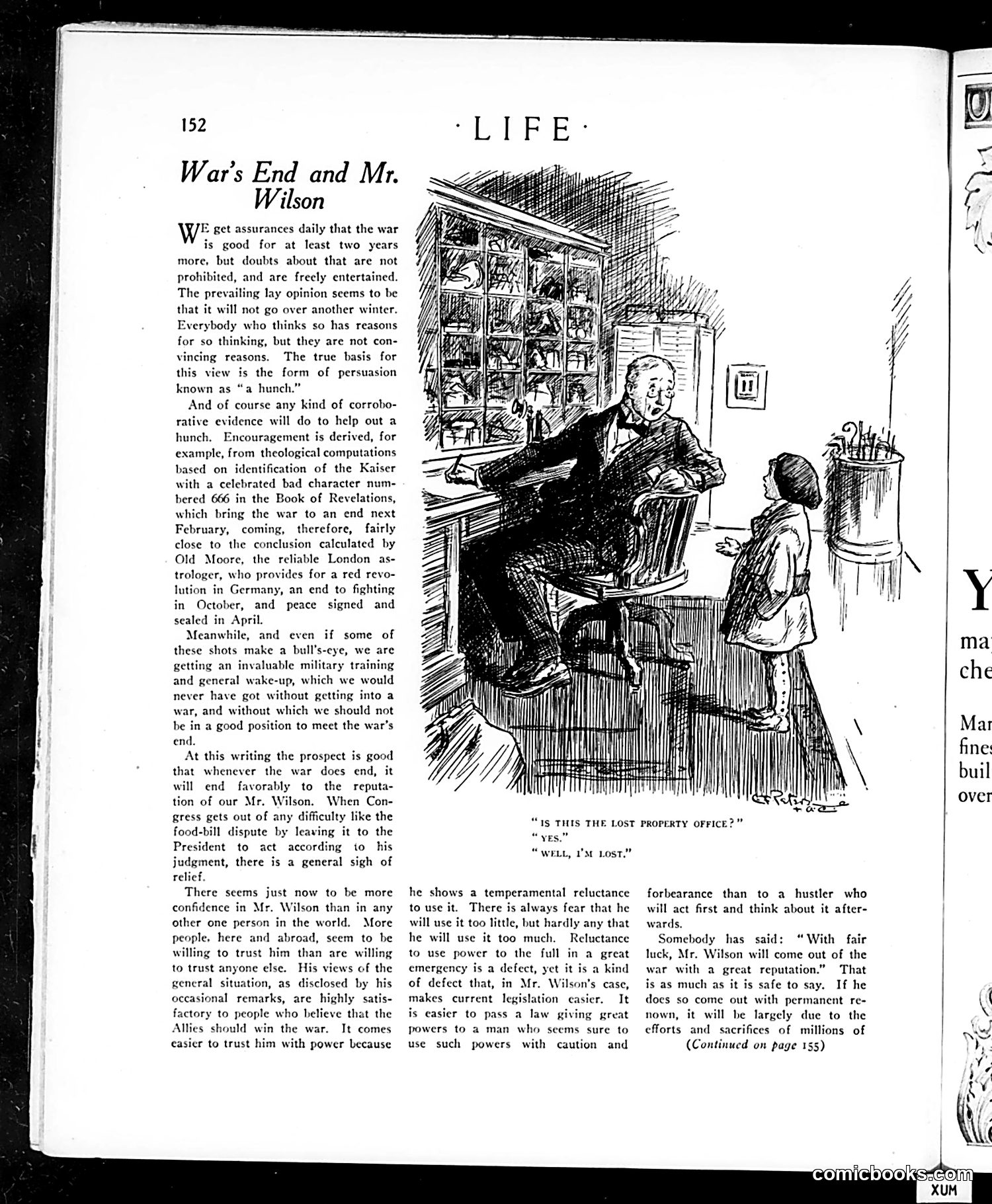
This *Life* magazine article discusses public confidence in President Woodrow Wilson during World War I, paired with a cartoon illustrating the piece's themes. **The Cartoon:** Shows a man (representing Wilson or a government official) at a desk labeled "Lost Property Office," speaking to a child who says "Well, I'm lost." The joke plays on the double meaning—the child is literally lost seeking the lost property office, a visual pun about confusion and misdirection. **The Article's Context:** Written during WWI (references to ongoing war, peace predictions for early 1918), the piece argues that Americans have unusual confidence in Wilson personally, more than any other leader. The author suggests this confidence stems partly from Wilson's *reluctance* to exercise power—people trust him because he seems cautious rather than aggressive. The piece notes Wilson is handling major decisions (like food-bill disputes) while Congress delegates authority to him. **The Satire's Point:** The "lost property" cartoon likely satirizes the contradiction the article explores: Americans are placing enormous faith in Wilson's leadership while he appears hesitant or uncertain about wielding power—a potentially dangerous position in wartime.
📄 Transcribed text from this page (OCR, searchable)
Machine-transcribed from the original scan — historical spelling and the odd misread are preserved.
152 War’s End and Mr. Wilson E get assurances daily that the war is good for at least two years more, but doubts about that are not prohibited, and are freely entertained. The prevailing lay opinion seems to be that it will not go over another winter. Everybody who thinks so has reasons for so thinking, but they are not con- vincing reasons. The true basis for this view is the form of persuasion known as “a hunch.” And of course any kind of corrobo- rative evidence will do to help out a hunch, Encouragement is derived, for example, from theological computations based on identification of the Kaiser with a celebrated bad character num- bered 666 in the Book of Revelations, which bring the war to an end next. February, coming, therefore, fairly close to the conclusion calculated by Old Moore, the reliable London as- trologer, who provides for a red revo- lution in Germany, an end to fighting in October, and peace signed and sealed in April. Meanwhile, and even if some of these shots make a bull’s-eye, we are getting an invaluable military training and general wake-up, which we would never have got without getting into a war, and without which we should not be in a good position to meet the war’s end. At this writing the prospect is good that whenever the war does end, it will end favorably to the reputa- tion of our Mr. Wilson. When Con- gress gets out of any difficulty like the food-bill dispute by leaving it to the President to act according to his judgment, there is a general sigh of relief There seems just now to be more confidence in Mr. Wilson than in any other one person in the world. More people, here and abroad, seem to be willing to trust him than are willing to trust anyone else. His views of the general situation, as disclosed by his occasional remarks, are highly satis- factory to people who believe that the Allies should win the war. It comes easier to trust him with power because \ | aI ROPERTY OFFICE?” “Is THIS THE LOST Pi “WELL, I'M Lost.” he shows a temperamental reluctance to use it. There is always fear that he will use it too little, but hardly any that he will use it too much. Reluctance to use power to the full in a great emergency is a defect, yet it is a kind of defect that, in Mr. Wilson's case, makes current legislation easier. It is easier to pass a law giving great powers to a man who seems sure to use such powers with caution and forbearance than to a hustler who will act first and think about it after- wards. Somebody has said: “With fair luck, Mr. Wilson will come out of the war with a great reputation.” That is as much as it is safe to say. If he does so come out with permanent re- nown, it will be largely due to the efforts and sacrifices of millions of (Continued on page 155)