
A complete issue · 46 pages · 1917
Life — May 10, 1917
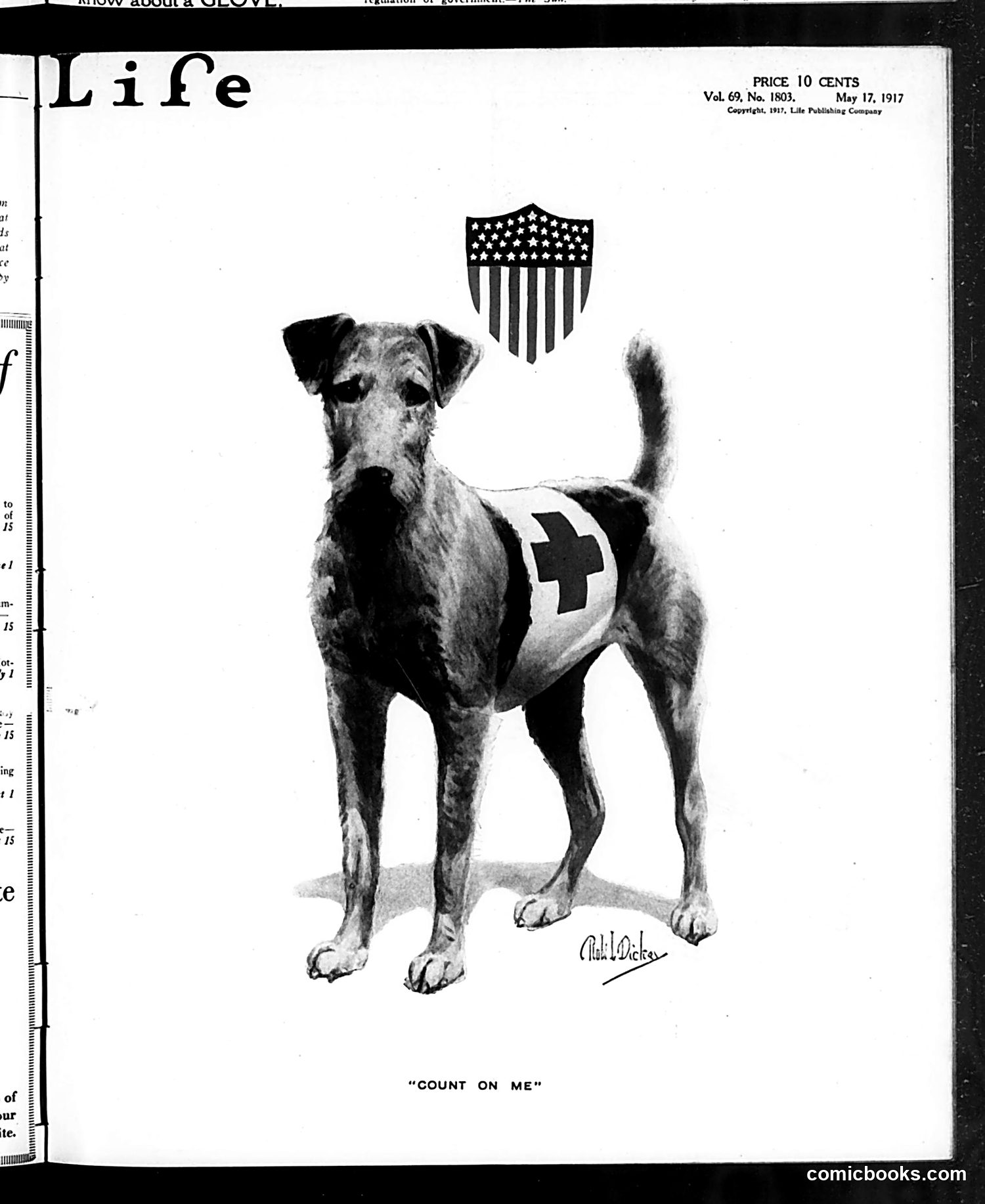
This cartoon depicts a dog wearing a Red Cross armband, standing beneath an American shield, with the caption "Count on Me." Published just weeks after America's entry into World War I (April 1917), this image represents the American public's mobilization for the war effort. The dog symbolizes American loyalty and readiness to serve. The Red Cross imagery references humanitarian relief and medical support for the war. The shield represents American national identity and protection. The cartoon's message is patriotic encouragement—even animals are "counted on" to support the national cause. This reflects the broad civilian mobilization propaganda of early American involvement in WWI, appealing to citizens' sense of duty and collective responsibility for the war effort.
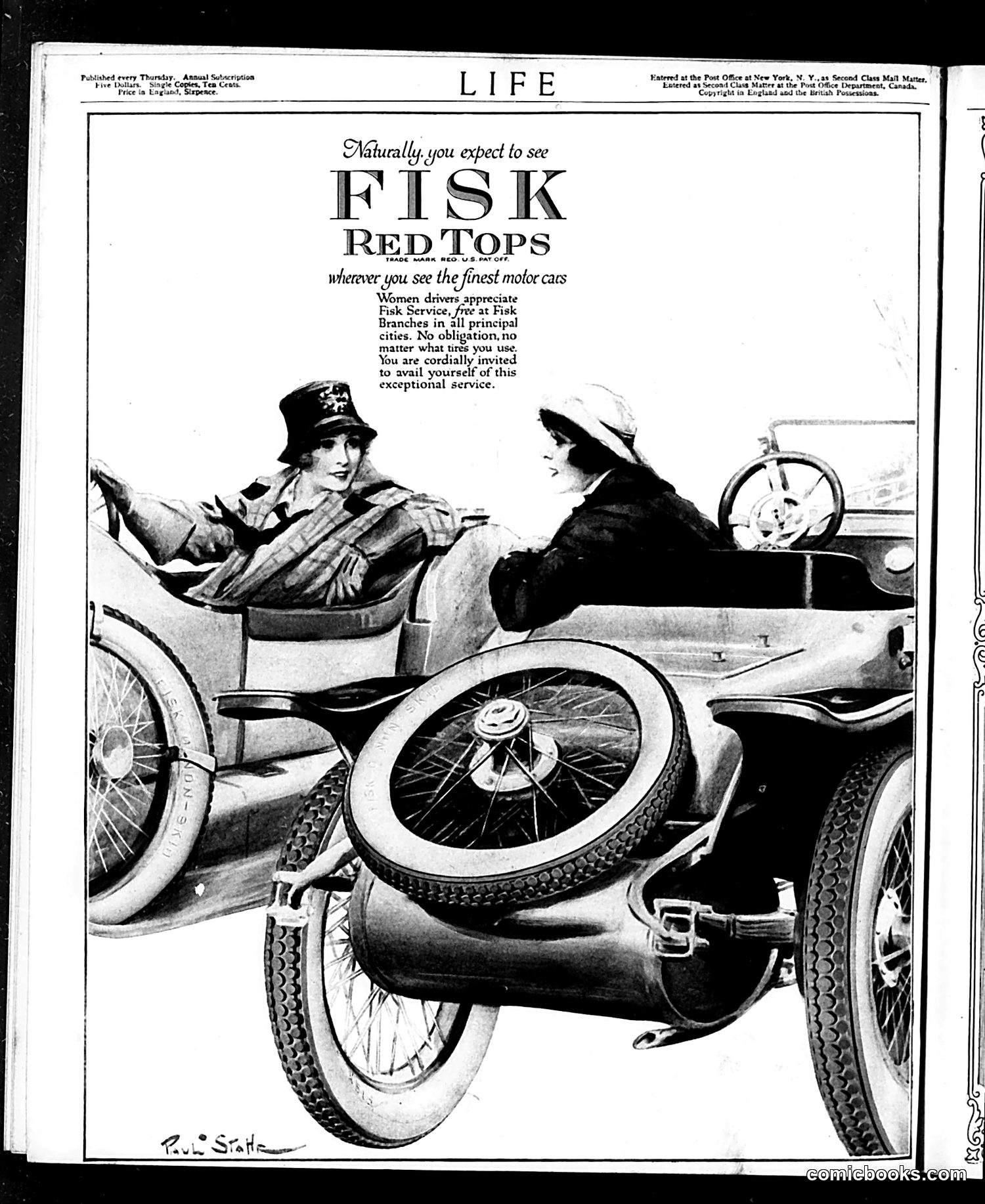
This is primarily a **Fisk automobile advertisement** disguised as editorial content in *Life* magazine. The ad promotes "Fisk Red Tops" tires and Fisk's motor car service. The satire targets **women drivers** of the era. Two fashionably-dressed women are shown in early automobiles with prominent, eye-catching tires. The ad's text sarcastically suggests women drivers will naturally appreciate Fisk's service—implying women were unreliable drivers who would frequently need roadside assistance. The joke plays on 1910s-1920s gender anxieties: newly mobile women challenging traditional roles. By offering "free" service "no obligation," the ad patronizingly positions women drivers as incompetent, needing constant help. The stylish illustration masks the underlying sexism—the advertisement assumes female motorists couldn't manage their vehicles independently.
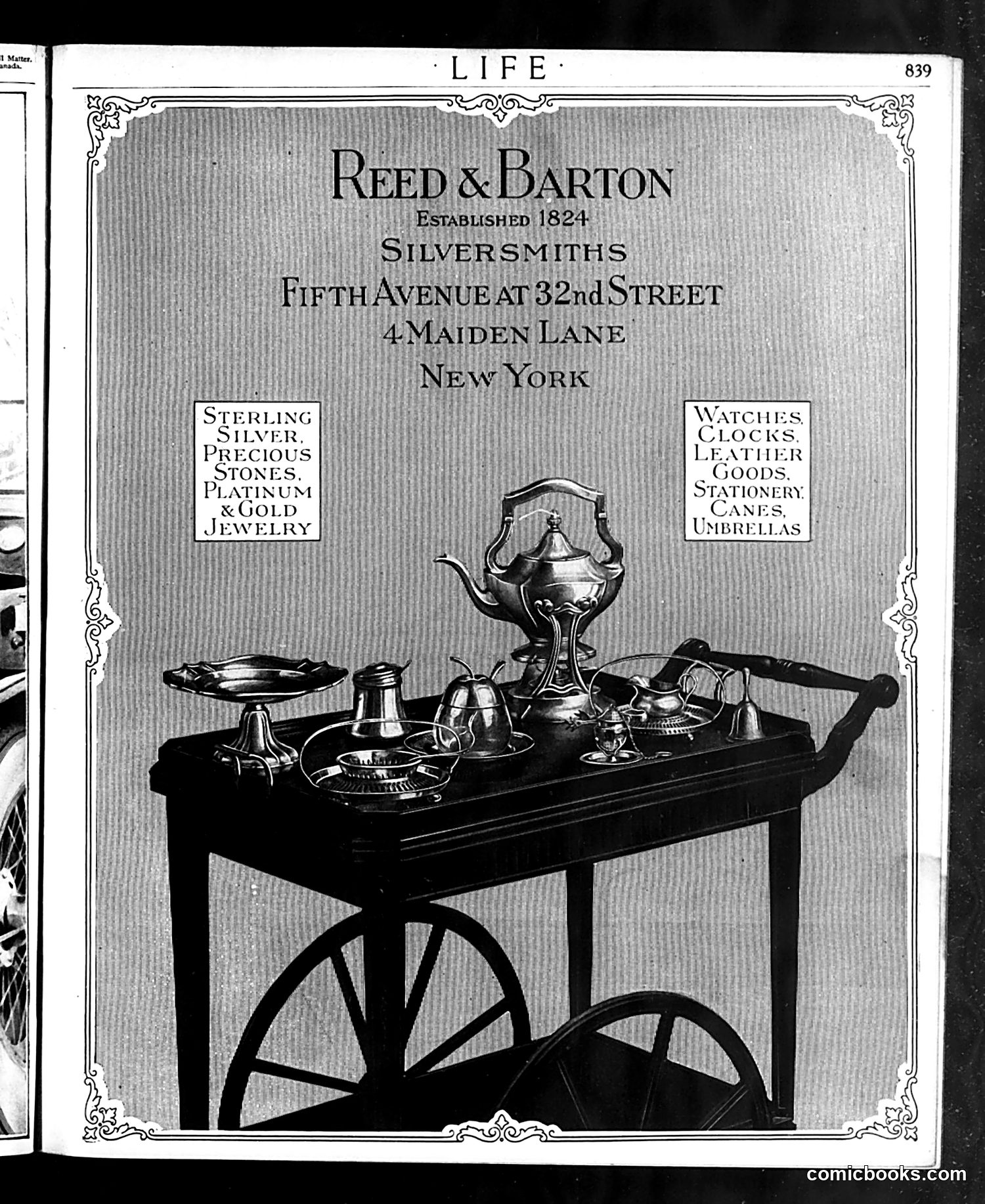
This is a **full-page advertisement**, not a political cartoon. It promotes **Reed & Barton**, a silversmiths company established in 1824, with two New York locations listed (Fifth Avenue at 32nd Street and 4 Maiden Lane). The image features an elegant table display of their merchandise: sterling silver items, precious stones, platinum and gold jewelry on the left; watches, clocks, leather goods, stationery, canes, and umbrellas on the right. The ornate table with large wheels suggests a merchant's display cart or showroom setup. This is **pure commercial messaging**—typical of Life magazine's advertising revenue model. There is no satire or political commentary present. The decorative border and refined aesthetics appeal to wealthy consumers as aspirational luxury goods.
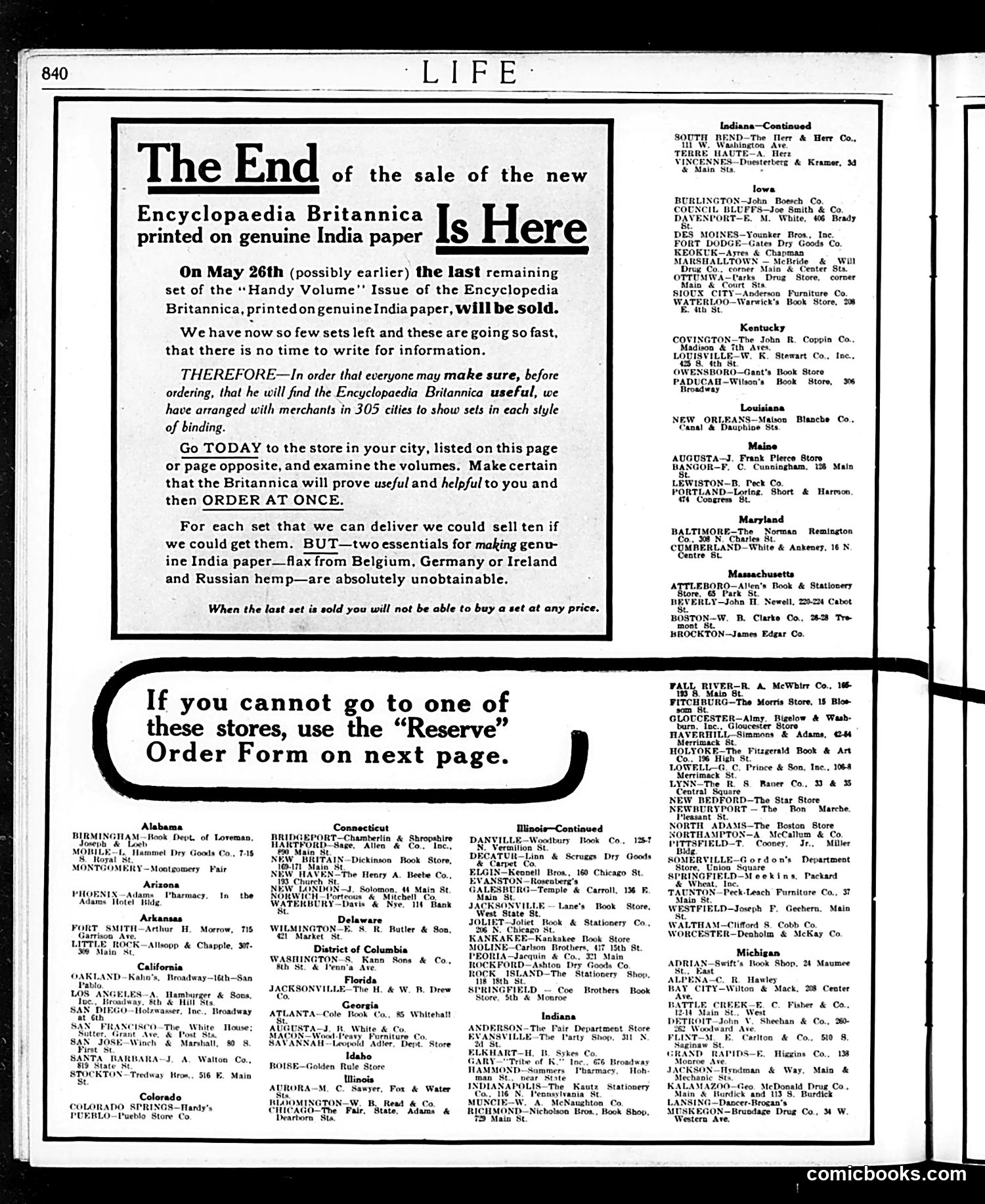
This page is primarily **advertising, not political satire**. It announces the final sale of the Encyclopaedia Britannica's "Handy Volume" issue, printed on genuine India paper. The advertisement emphasizes urgency—the last sets are nearly sold out and will be gone by May 26th. It explains that genuine India paper requires materials (flax from Belgium, Germany, Ireland, and Russian hemp) that are "absolutely unobtainable," making future printings impossible. The bulk of the page lists retailers across America where readers can purchase the encyclopedia. There is no political cartoon, caricature, or satirical commentary—just a straightforward (if somewhat dramatic) sales pitch leveraging scarcity and unavailable materials to drive immediate purchases.
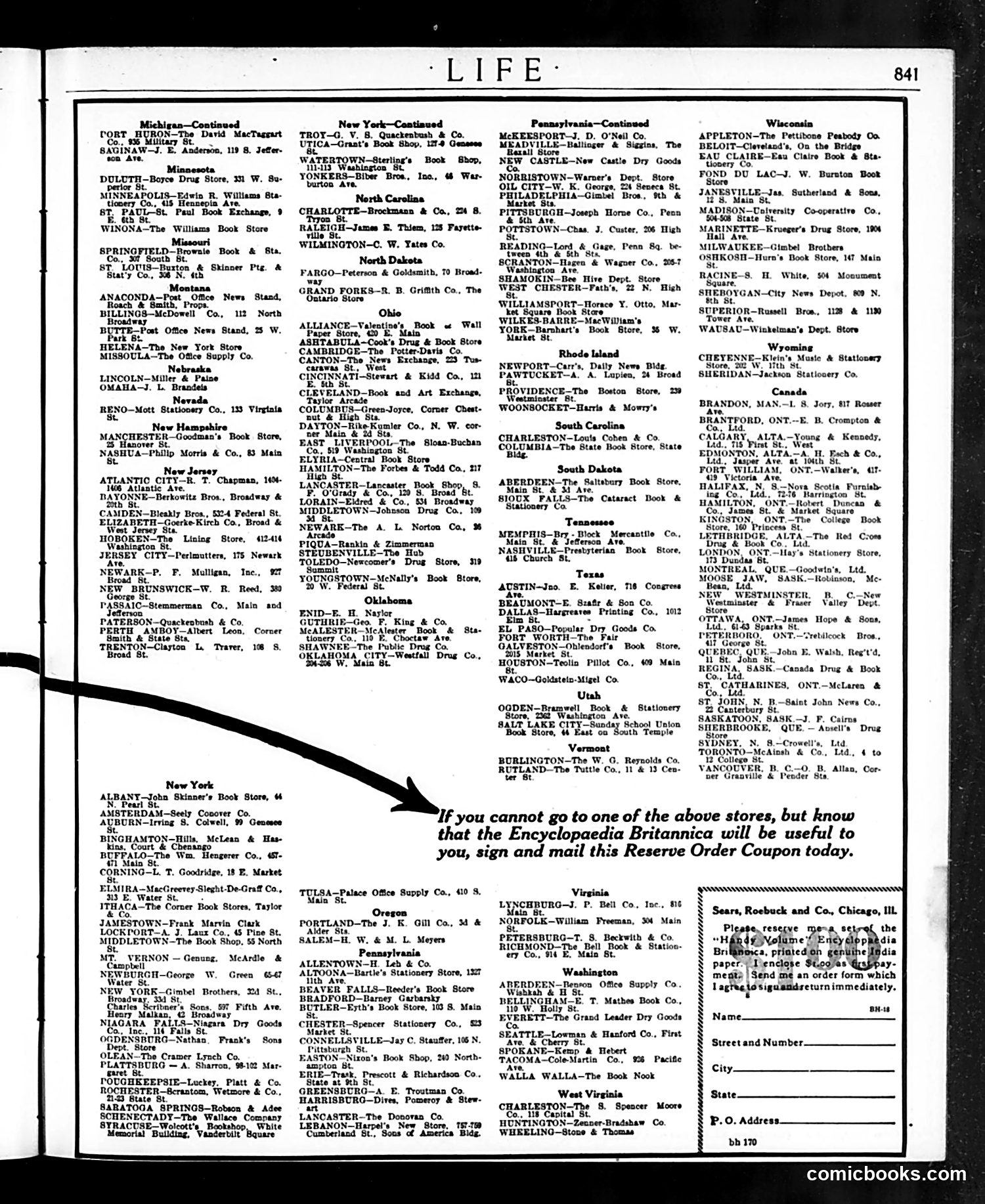
This page is primarily a **directory listing of bookstores across the United States and Canada** where readers could purchase Encyclopedia Britannica. It's not a political cartoon or satirical content. The only editorial element is a centered notice stating: "If you cannot go to one of the above stores, but know that the Encyclopaedia Britannica will be useful to you, sign and mail this Reserve Order Coupon today." Below this is a mail-in coupon for Sears, Roebuck and Co. (Chicago, IL) allowing readers to reserve the Encyclopedia Britannica by post if local retailers weren't accessible. This represents **direct-marketing advertising from the early-to-mid 20th century**, when mail-order and retail distribution networks were crucial for reaching dispersed American audiences. The page reflects an era before widespread chain bookstores or online shopping.
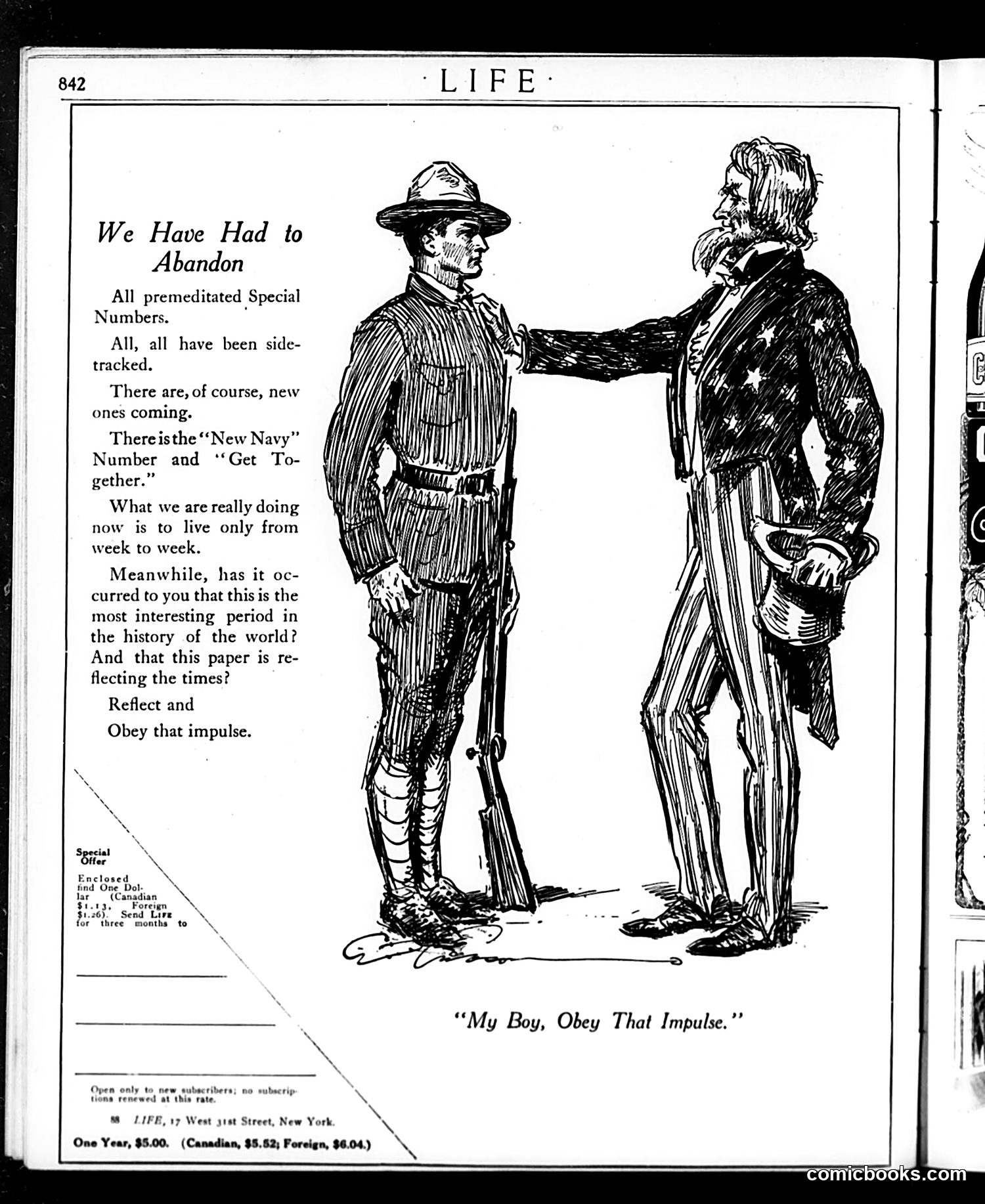
This appears to be a WWI-era LIFE magazine page (page 842) addressing publication challenges during wartime. The editorial text "We Have Had to Abandon" explains that LIFE has discontinued pre-planned special issues and sidetracked regular content to focus on current events. It emphasizes this is "the most interesting period in the history of the world" and urges readers to "Reflect and Obey that impulse"—essentially asking them to stay engaged with urgent wartime news. The illustration shows two figures in military dress: one appears to be a young soldier, the other an older authority figure (possibly representing editorial leadership or patriotic duty) placing a hand on the soldier's shoulder with the caption "My Boy, Obey That Impulse." The message conflates magazine reading with patriotic duty during the war.
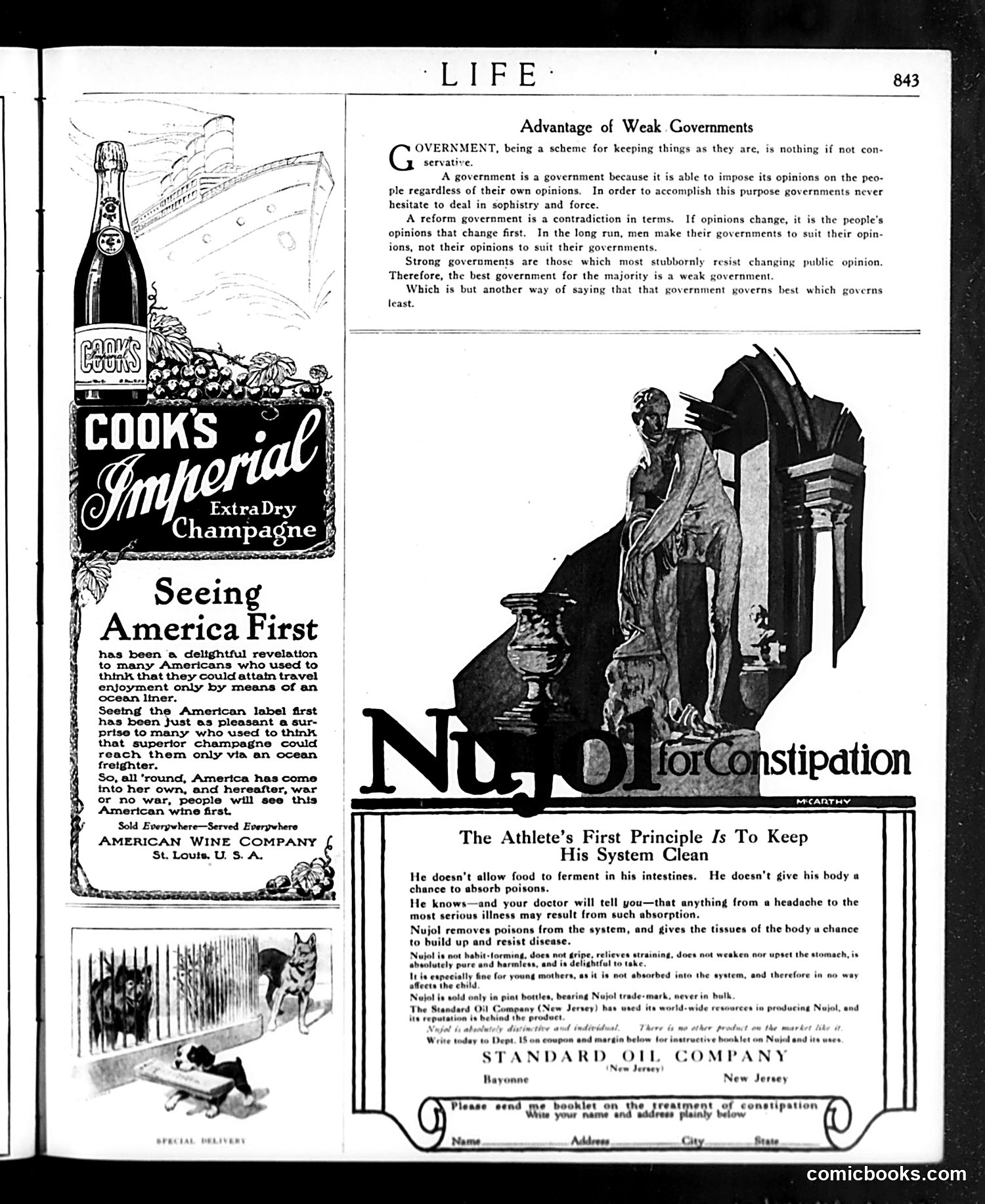
This page contains an essay titled "Advantage of Weak Governments" arguing that governments responsive to changing public opinion are preferable to rigid ones—a political commentary on democratic governance versus authoritarianism. The advertisements include Cook's Imperial Champagne (emphasizing American wine production, likely reflecting post-Prohibition nationalism) and a Nujol laxative ad featuring a classical statue figure labeled "Nl" for constipation. The Nujol ad uses pseudo-medical language and athletic virtue messaging to market the product, while a coupon at bottom invites readers to request informational materials. A small illustration shows a German Shepherd dog, labeled "Special Delivery," likely a humorous filler illustration. The page is primarily commercial and advisory rather than satirical.
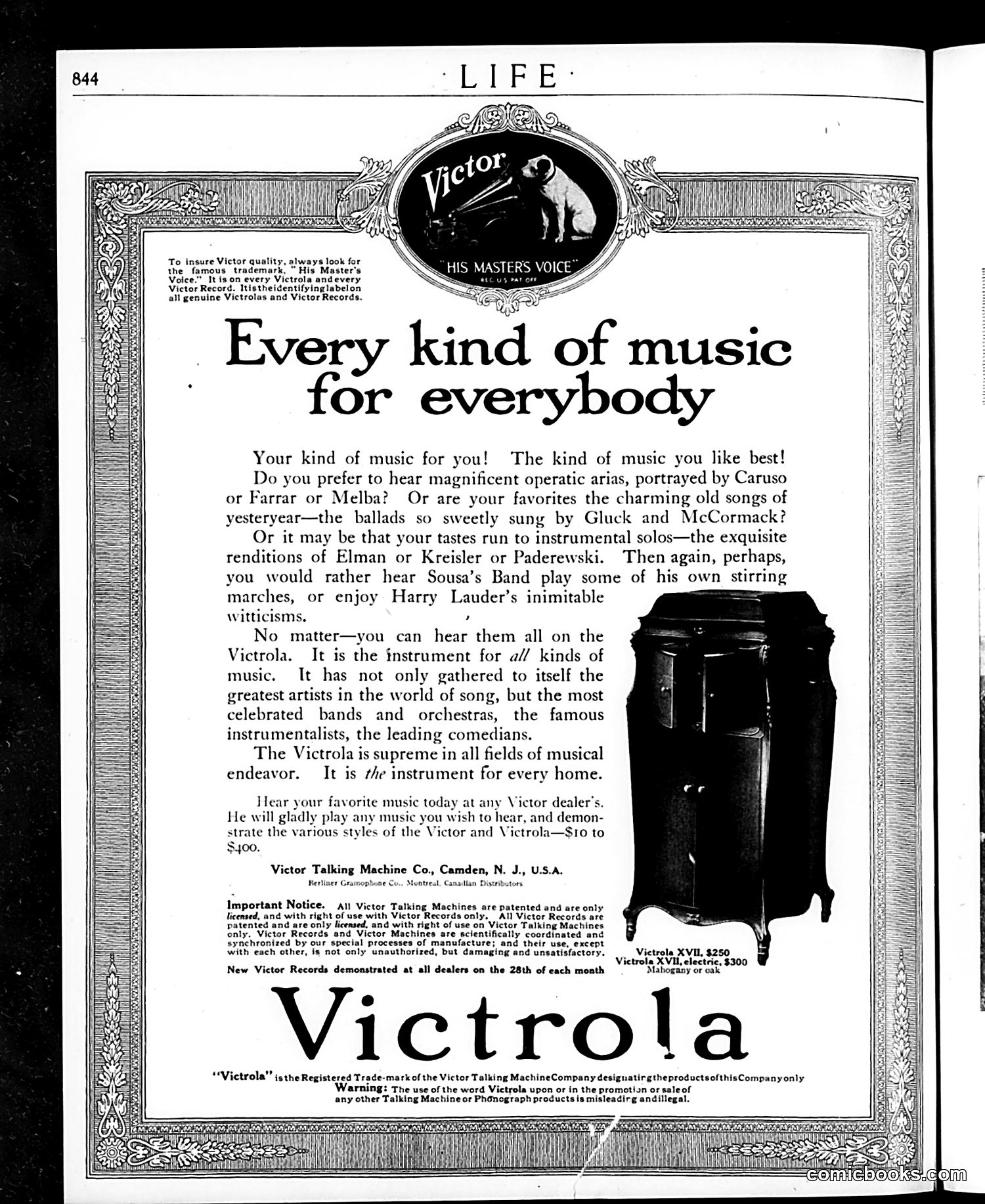
This is **not a cartoon or satirical content**—it is a **full-page advertisement** for the Victrola phonograph, published in *Life* magazine. The ad promotes the Victrola as a universal music player capable of reproducing "every kind of music for everybody." It references specific famous performers of the era (Caruso, Farrar, Melba, Gluck, McCormack, Sousa, Elman, Kreisler, Paderewski, and Harry Lauder) to demonstrate the device's range. The text emphasizes that the Victrola is "the instrument for all kinds of music" and "supreme in all fields of musical endeavor." An image of the wooden cabinet-style player appears on the right, priced between $10 to $100 depending on the model. This represents early 20th-century consumer marketing, positioning a new technology as an essential household item for diverse musical tastes.
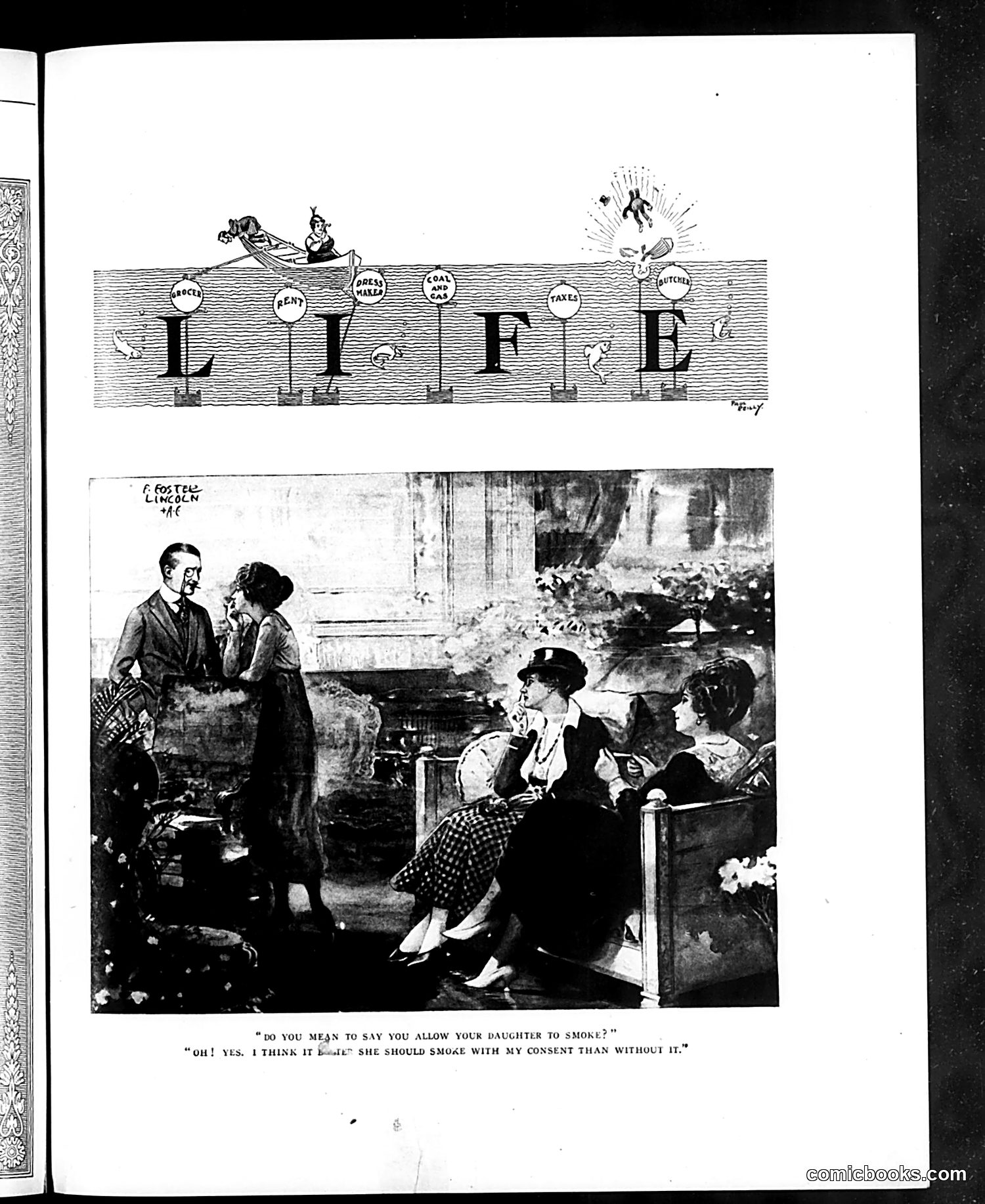
This page contains two distinct pieces: **Top: "LIFE" Illustration** An artistic diagram spelling out "LIFE" using large letters as structural supports, with small figures climbing and working around them. Various labels appear in circular callouts above each letter (though specific text is difficult to read). This appears to be a metaphorical illustration about life's foundational elements or stages. **Bottom: Cartoon by C. Foster Lincoln** A domestic scene showing a father confronting his daughter about smoking. The caption reads: "Do you mean to say you allow your daughter to smoke?" / "Oh! Yes. I think it better she should smoke with my consent than without it." This satirizes contemporary debates about parental authority and generational values—specifically parental permissiveness versus strict control—a common early 20th-century social concern about modern youth independence.
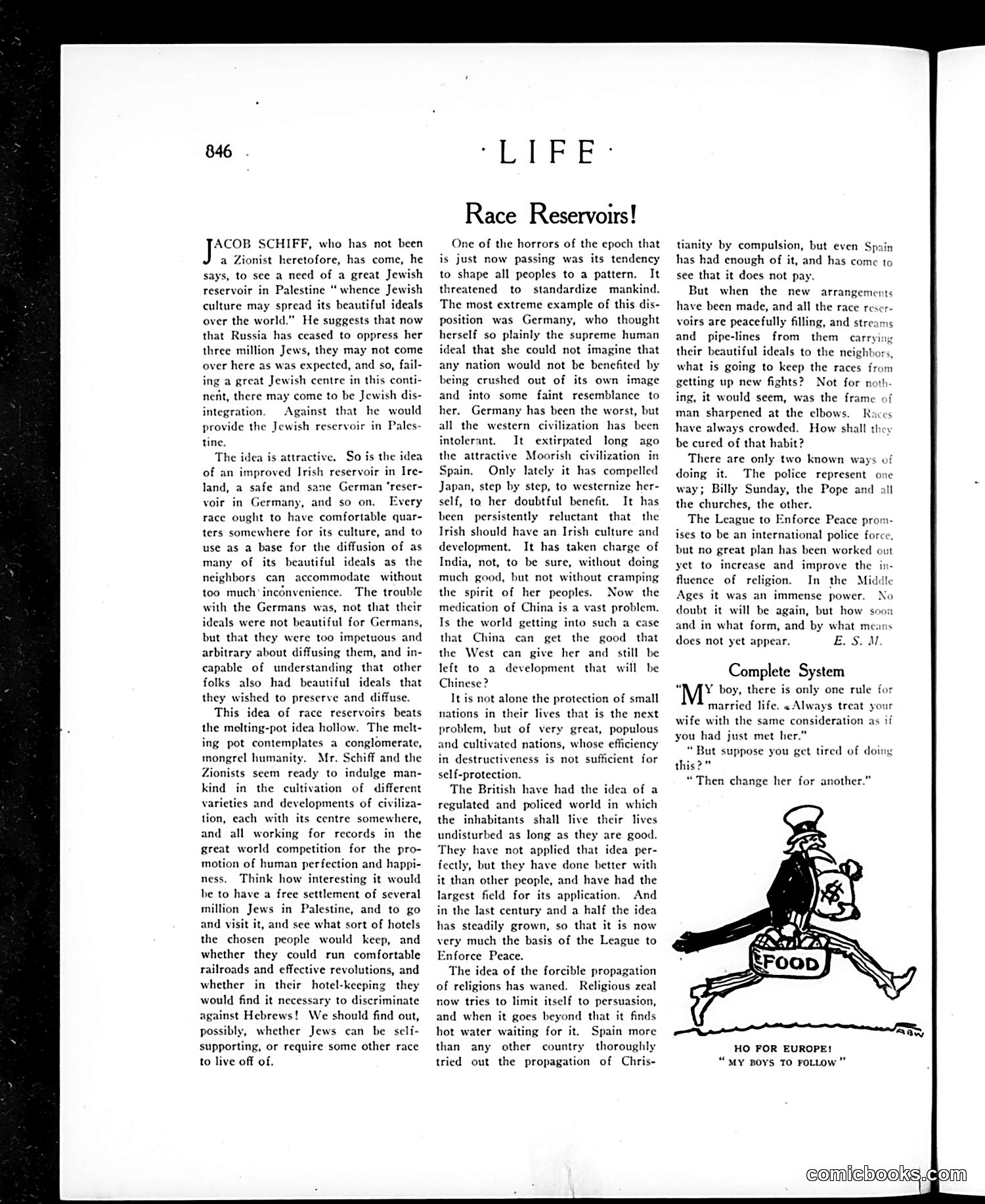
The page contains two separate articles. The left column discusses Jacob Schiff's proposal for a Jewish reservoir in Palestine to spread Jewish culture—a Zionist idea. The article critiques how different nations (Germany, Spain, China, Japan) have attempted to impose their civilizations on others, calling this approach problematic. The right side features a cartoon titled "HO FOR EUROPE! 'MY BOYS TO FOLLOW'" depicting a skeletal figure labeled "FOOD" wielding a club. This appears to be a post-WWI commentary on famine and starvation in Europe, personified as a destructive force following the war. The cartoon suggests Europe's suffering would continue to proliferate like children. Both pieces reflect early 20th-century anxieties about geopolitics and humanitarian crises.
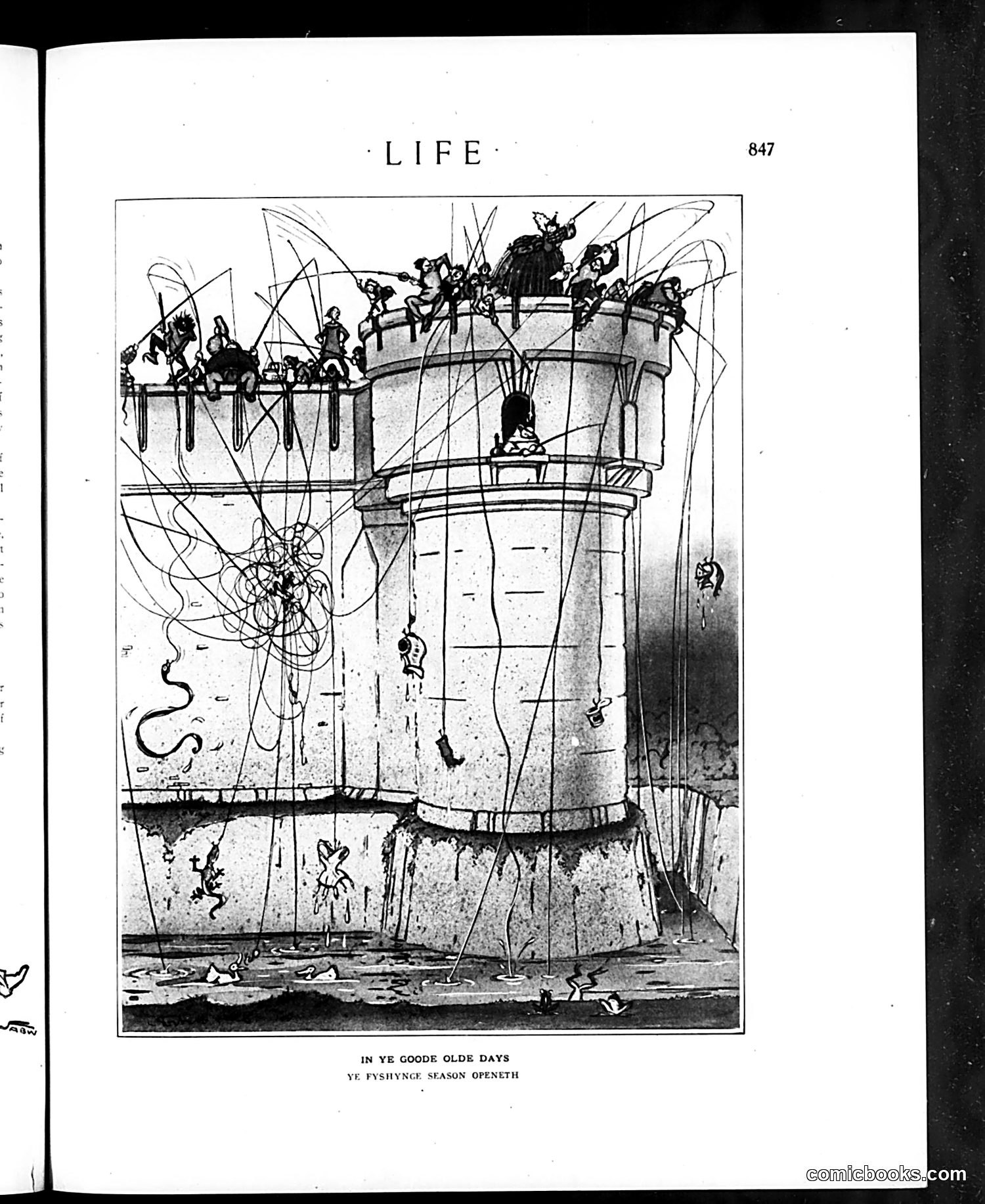
This is a satirical cartoon titled "In Ye Goode Olde Days / Ye Fyshynge Season Openeth." The image depicts a tower-like structure packed with people at the top, with numerous fishing lines dangling down from multiple levels. The style parodies medieval or colonial-era language ("ye goode olde days"), suggesting nostalgic commentary. The satire appears to mock overcrowding and competitive fishing—likely commenting on social conditions of the era when this Life magazine was published. The chaotic tangle of fishing lines and crowded platform suggest inefficiency, danger, or absurdity of mass participation in an activity meant for leisure. Without the publication date visible, the specific historical reference remains unclear, but the cartoon's humor relies on exaggerating fishing as a crowded, complicated modern phenomenon rather than a peaceful pastime.
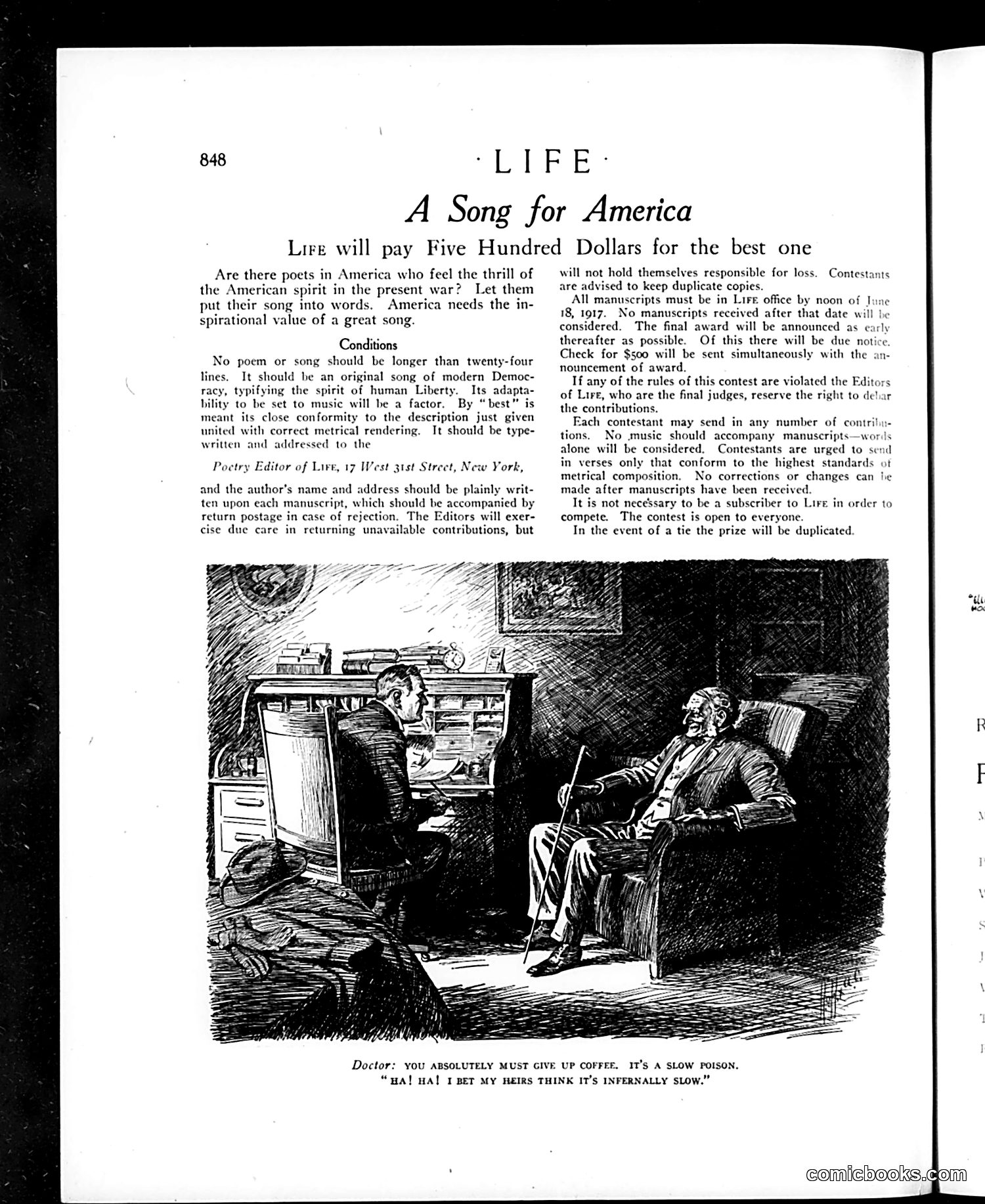
This page announces a $500 poetry contest. Life is soliciting patriotic verses about American ideals and democracy during what appears to be World War I era (the deadline is June 18, 1917). The cartoon below depicts a doctor lecturing a patient about health, with the doctor saying coffee is "a slow poison" and the patient joking it's "internally slow." This is likely satirizing contemporary medical claims about coffee's dangers—a common health debate in the early 1900s. The cartoon uses humor to mock both exaggerated medical warnings and people's stubborn resistance to heeding them. The overall page blends patriotic appeals with domestic humor typical of Life's satirical approach.
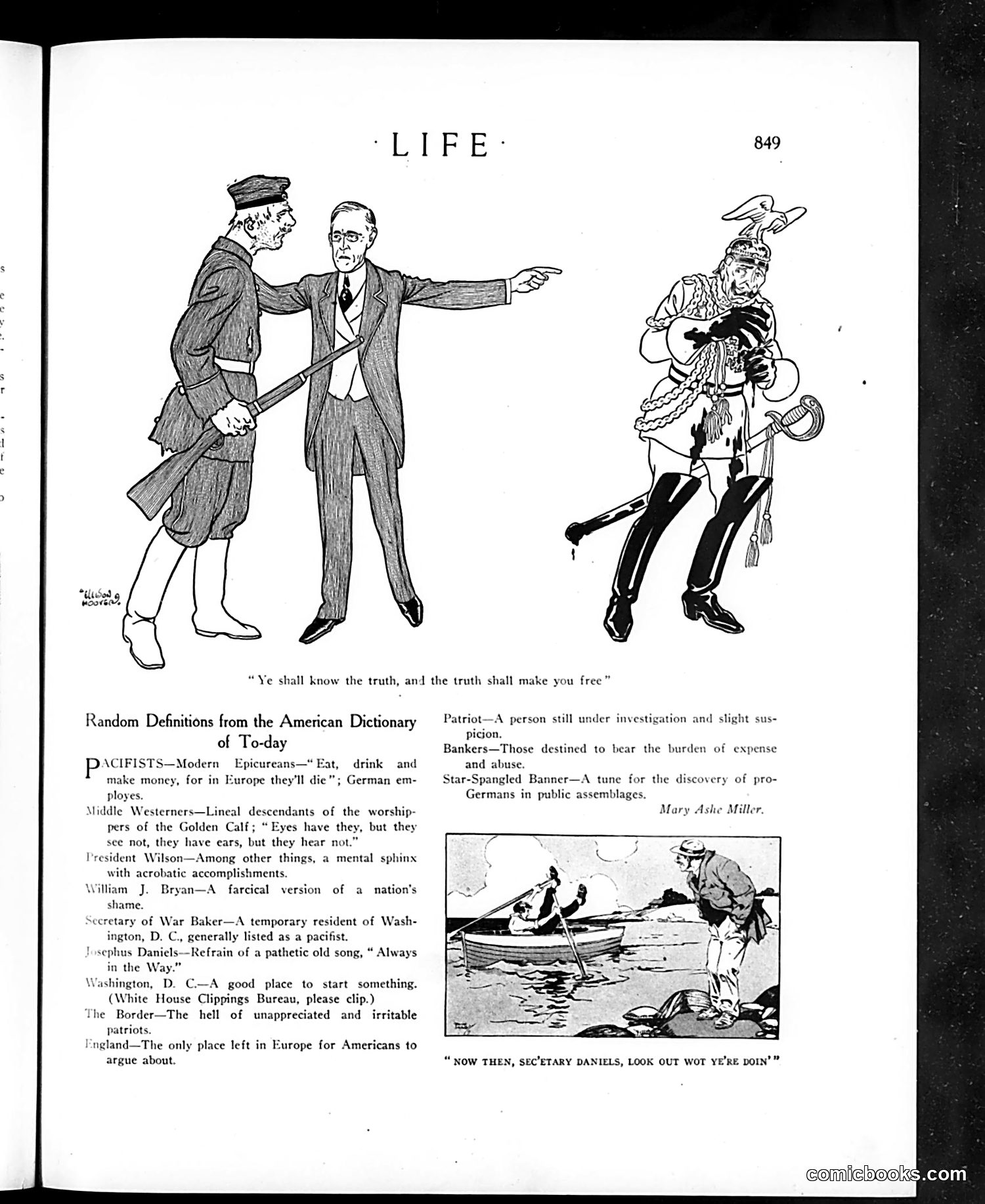
The top cartoon illustrates the quote "Ye shall know the truth, and the truth shall make you free." A well-dressed man (appears to be a government official or authority figure) points while instructing a uniformed officer holding a rifle. On the right, a decorated military or government official carries various symbolic items (appears to be propaganda or deceptive materials), suggesting the gap between stated ideals and actual practice. Below are "Random Definitions from the American Dictionary of To-day"—satirical commentary on contemporary figures and institutions including pacifists, "Middle Westerners," President Wilson, Secretary of War Baker, and references to Washington D.C. politics. The bottom cartoon shows a fisherman with the caption "Now then, Secretary Daniels, look out wot ye're doin'!"—likely mocking Secretary of the Navy Josephus Daniels.
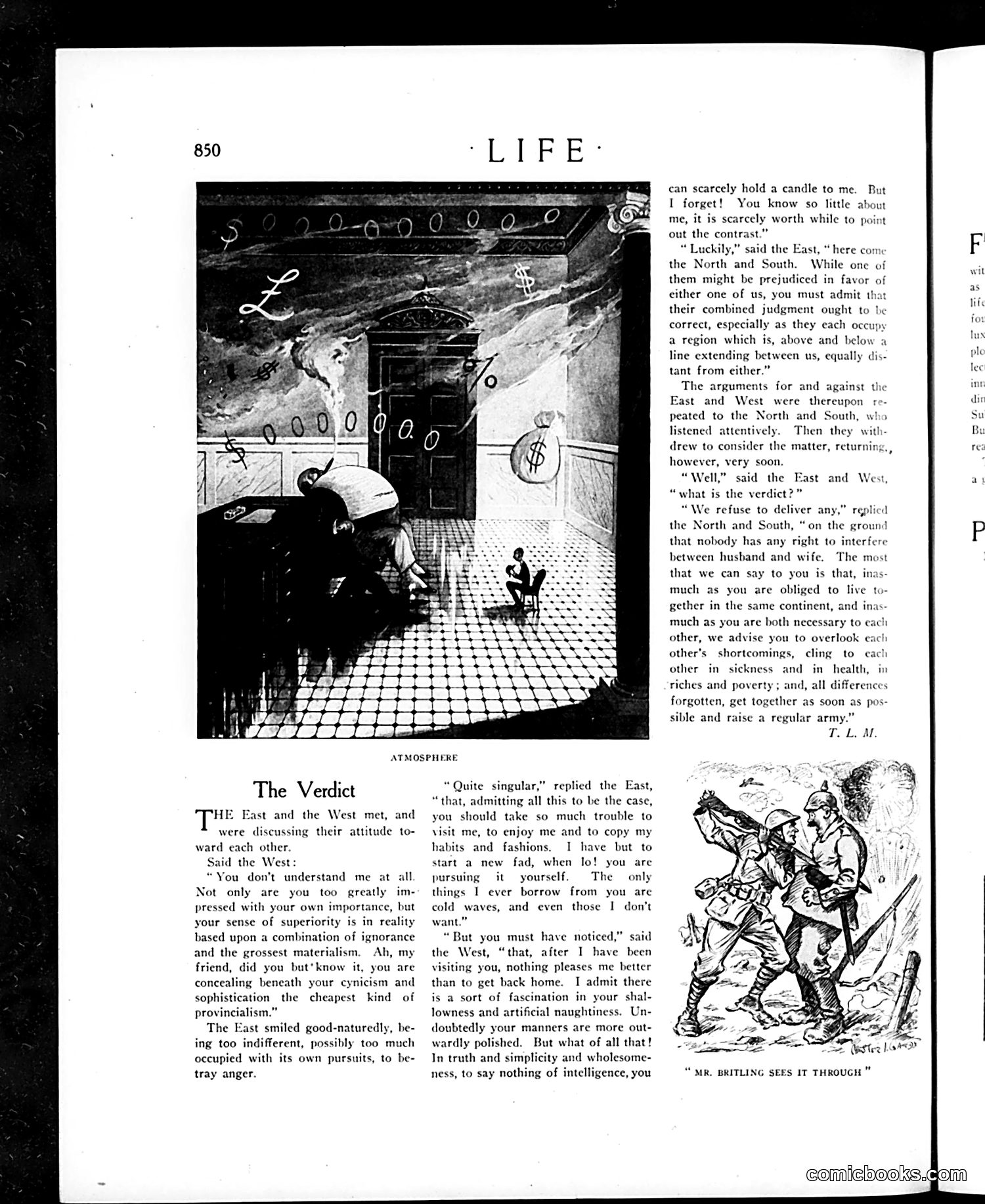
This page presents a satirical allegorical debate between personified East and West regions (likely representing American geographical/cultural divisions). The two parties argue over marital discord, with the North and South initially mediating. The central illustration shows a domestic interior with symbolic figures, labeled "ATMOSPHERE." The East accuses the West of materialism and provincialism; the West counters that the East's sophistication masks arrogance and sterility. Their verdict: despite mutual criticism, they acknowledge necessary interdependence and advise reconciliation, recommending they "get together as soon as possible and raise a regular army." The satire critiques regional American rivalries while suggesting unity is essential, possibly referencing pre-WWI or wartime solidarity concerns. The illustration credited to T.L.M. supports this commentary through visual metaphor.
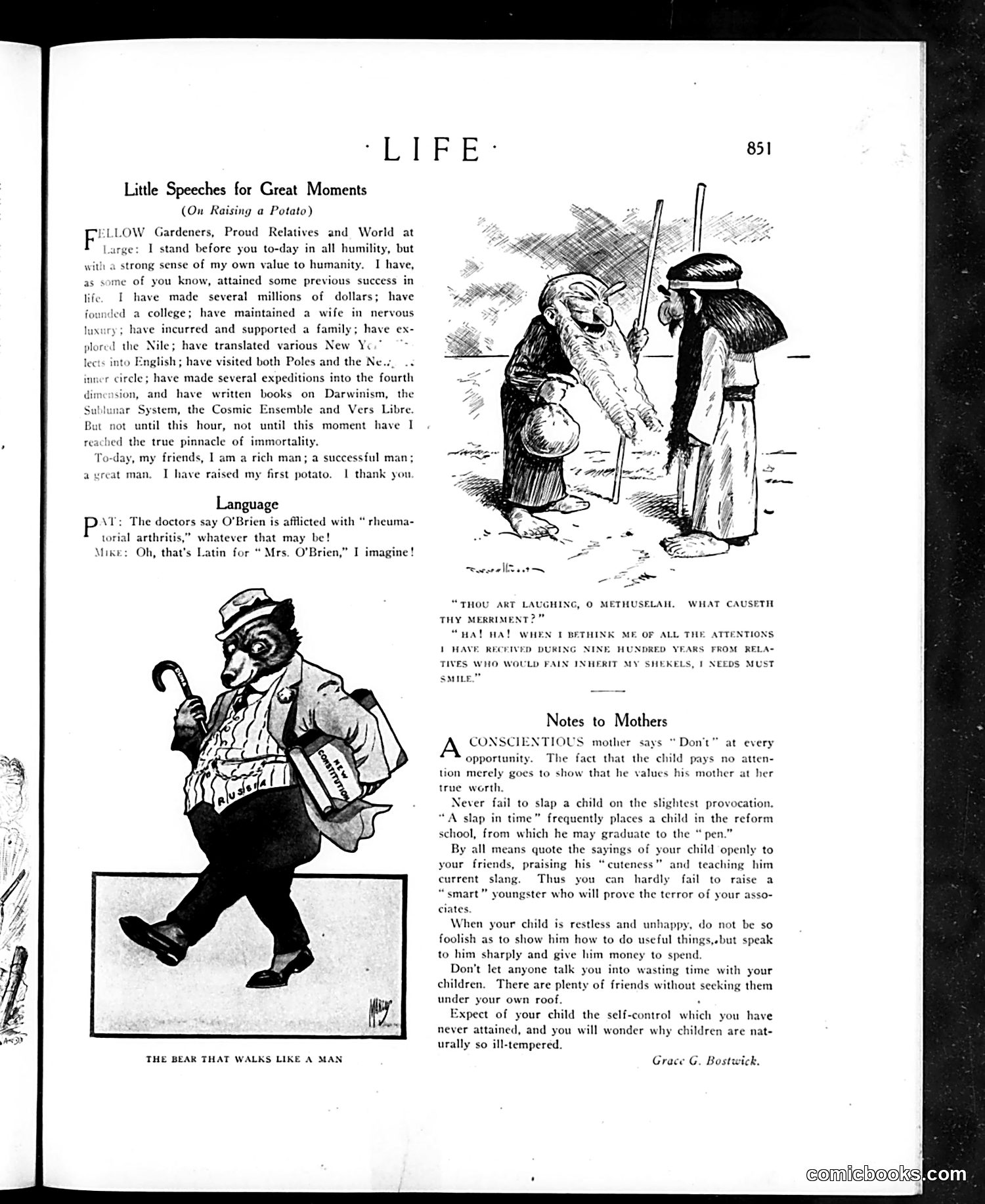
This page contains humor about social pretension and parenting advice from the early 20th century. **"Little Speeches for Great Moments"** mocks a self-important man boasting about his accomplishments (millions of dollars, founding a college, world travel, scientific work) before finally revealing his one genuine achievement: raising a potato. The satire targets wealthy people who inflate their importance. **"The Bear That Walks Like a Man"** cartoon depicts a well-dressed character in a suit and hat—an anthropomorphic bear presented as absurdly human. **"Notes to Mothers"** offers period-typical parenting advice emphasizing strict discipline: don't praise children excessively, occasionally slap them for misbehavior, quote sayings to friends to shame them into obedience, and expect emotional self-control. The tone reflects early 1900s attitudes toward child-rearing that would seem harsh by modern standards.
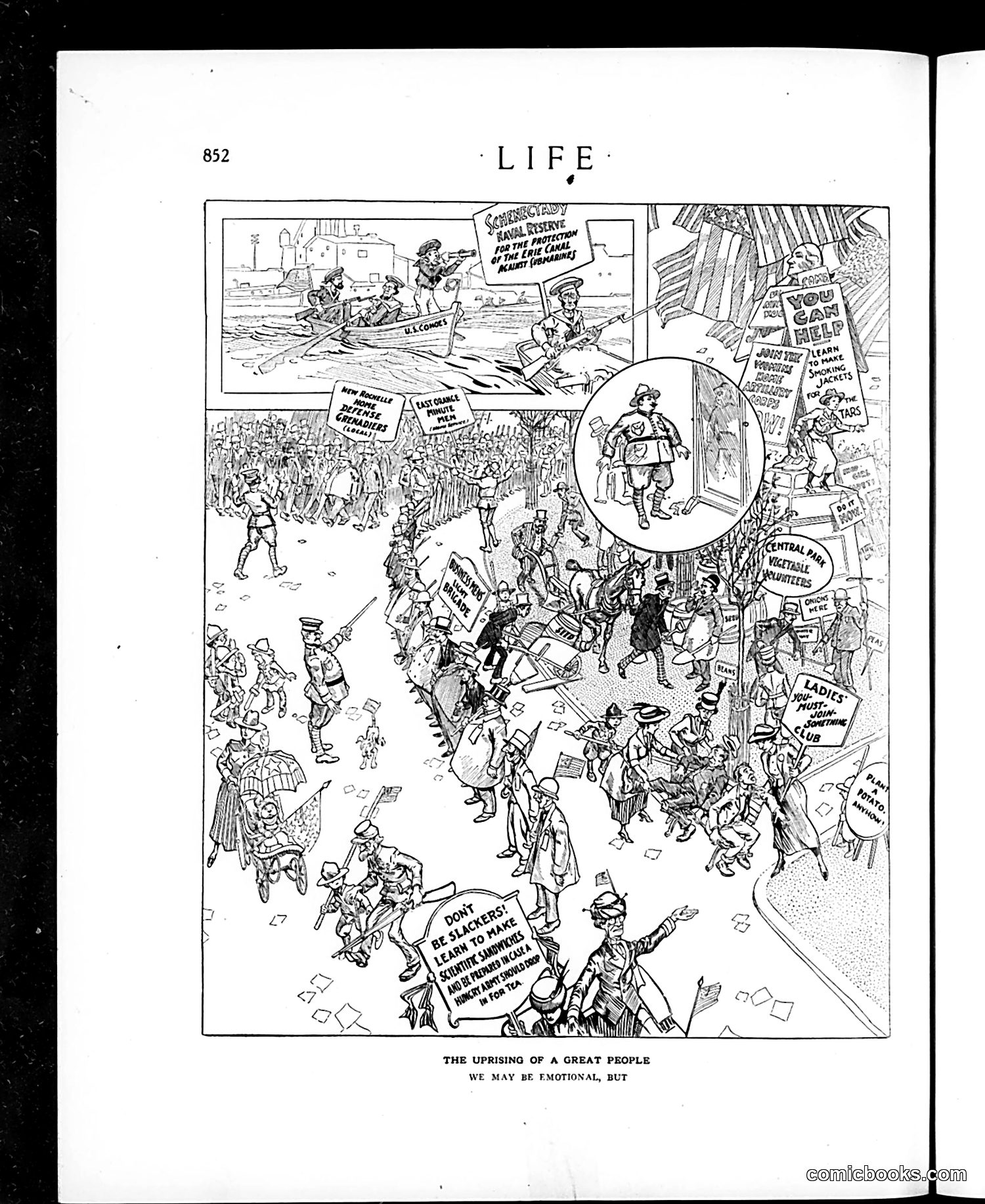
This satirical cartoon depicts a chaotic street scene titled "The Uprising of a Great People," suggesting a public demonstration or social movement. The large crowd carries various protest signs addressing social issues—visible references include naval reserves, life insurance, vegetable quartets, and ladies' clubs. A magnified circular inset shows a figure entering a doorway, possibly representing a political or social leader being confronted by the masses. The caption "We may be emotional, but" (incomplete on this page) suggests ironic commentary on public sentiment during a period of social activism. The densely packed, energetic crowd and numerous competing signs indicate satirical treatment of grassroots organizing or public opinion. Without the complete caption or publication date visible, the specific historical event remains unclear, but this appears to mock either progressive-era activism or wartime public mobilization circa early-to-mid 20th century.
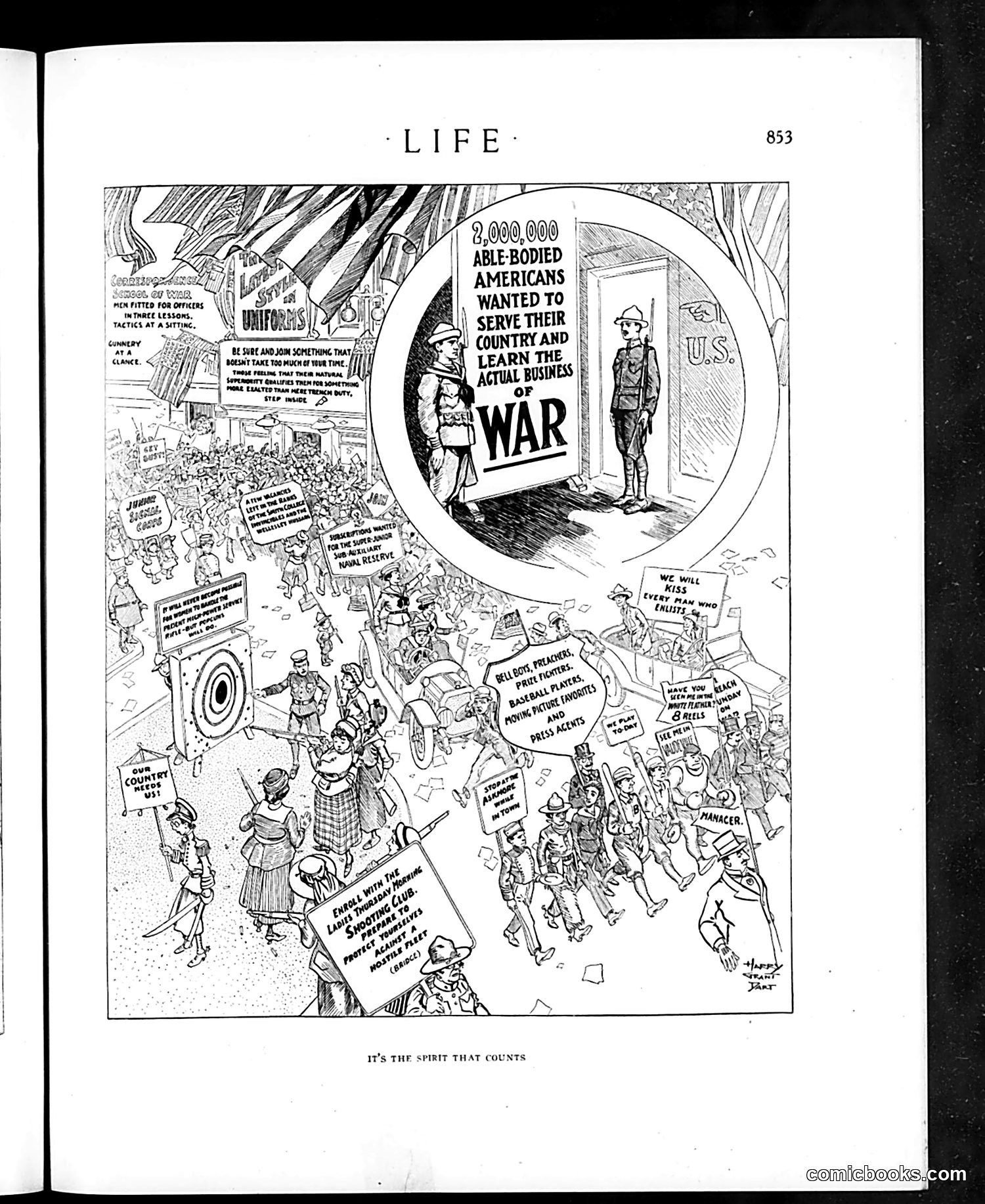
This WWI-era Life magazine cartoon satirizes American war recruitment and public mobilization. The central circular image shows a soldier representing the stated goal: getting 2,000,000 able-bodied Americans to enlist and "learn the actual business of WAR." The surrounding chaotic street scene depicts various civilian groups—women, children, workers, and profiteers—all pursuing their own agendas. Speech bubbles show different constituencies making demands (military leaders, farmers, business interests, press agents) rather than unified patriotic support. The satire's point, emphasized by the caption "IT'S THE SPIRIT THAT COUNTS," is ironic: while the government seeks unified national commitment to war, the cartoon shows competing special interests and civilian priorities fragmenting that spirit. The contrast between the idealistic soldier poster and the messy, self-interested crowd below critiques whether Americans actually share genuine patriotic purpose or merely pursue individual advantage during wartime.
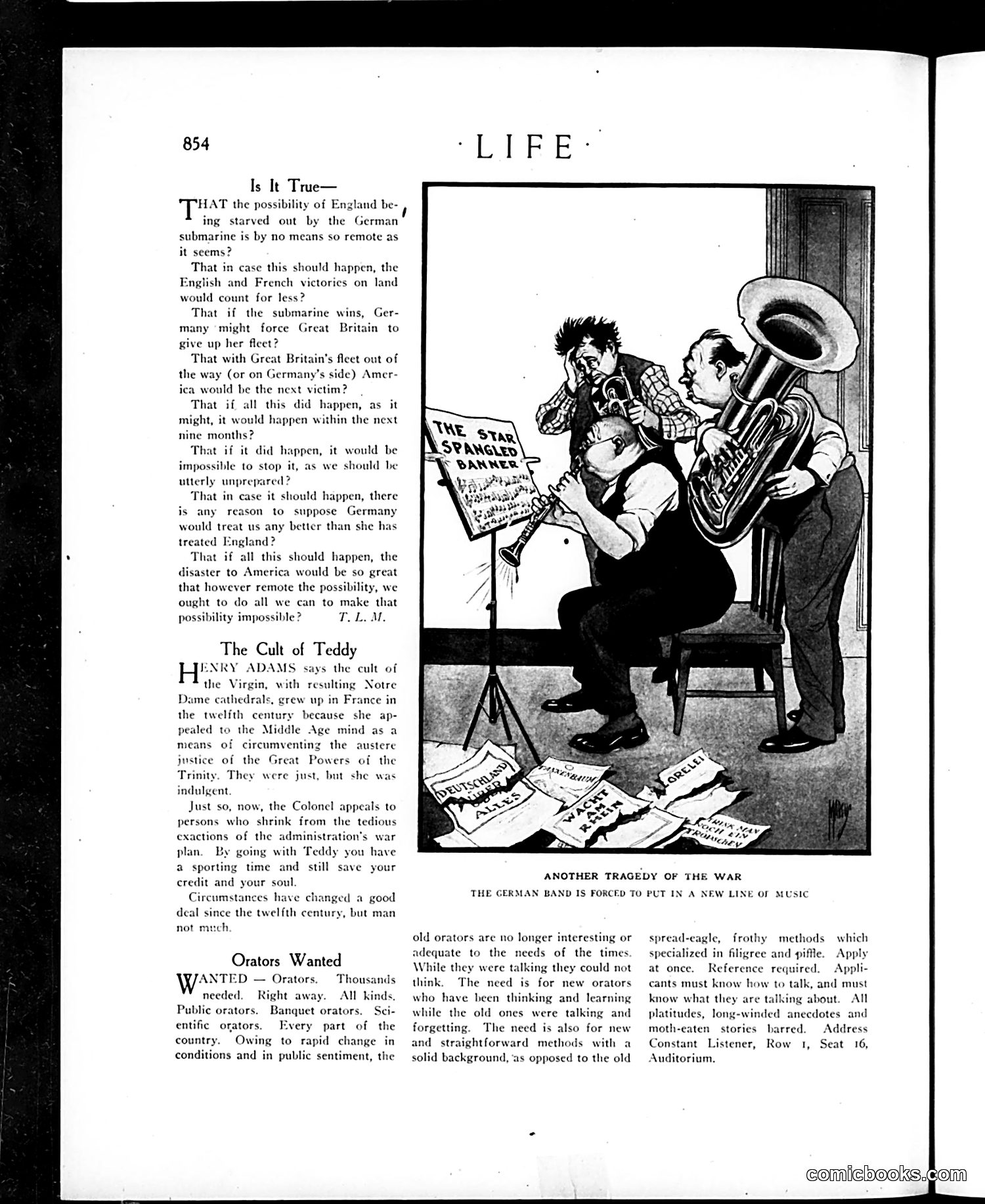
This Life magazine page (circa WWI era) contains three distinct pieces: **"Is It True—"** presents a chain of anxious "what-ifs" about German U-boats starving Britain into surrender, potentially forcing Britain's fleet to Germany and leaving America vulnerable. The rhetorical questions escalate to argue Americans should prepare defensively—this reflects genuine WWI anxieties about submarine warfare. **The cartoon** satirizes Theodore Roosevelt ("the Colonel") as a cult figure. It shows him as a charismatic alternative to the Wilson administration's serious war mobilization efforts. The comparison to medieval devotion to the Virgin Mary suggests Roosevelt offers emotional comfort and "sporting" adventure rather than disciplined sacrifice—allowing supporters to feel patriotic without genuine commitment. **"Orators Wanted"** criticizes old-style bombastic public speakers as obsolete. The piece calls for new orators trained in clear thinking and straightforward communication, contrasting this with outdated "spread-eagle" patriotic rhetoric. This likely references frustration with both pro-war propaganda and pacifist oratory during WWI debates. The page reflects American society divided over war preparedness and leadership.
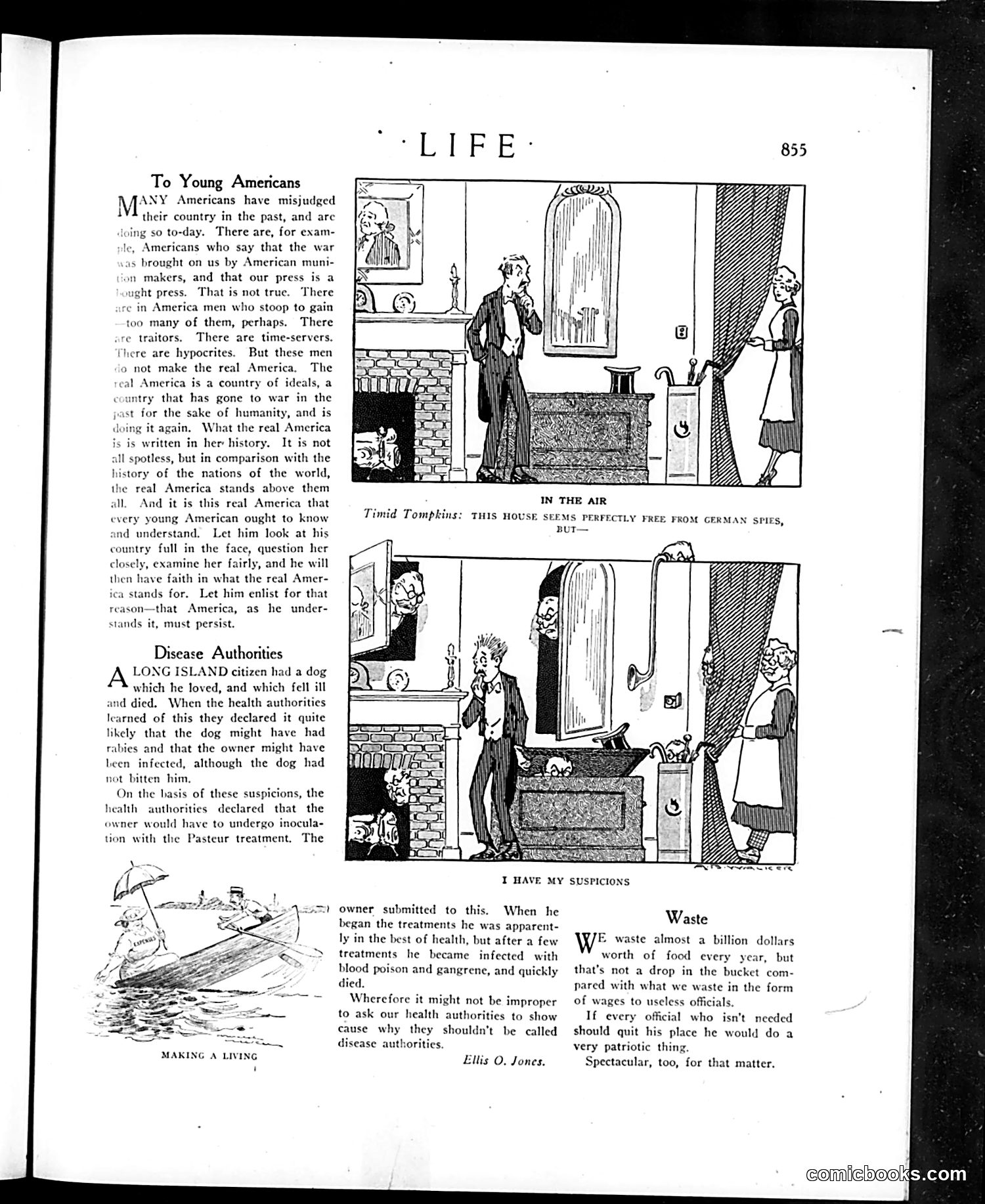
This page contains three separate satirical pieces from wartime America (appears to be WWI-era, given references to "the war" and German spies). **"To Young Americans"** argues that despite America having flaws—traitors, hypocrites, time-servers—young men should understand and defend the "real America" of ideals. **"Disease Authorities"** (with accompanying comics) satirizes government overreach: a Long Island man's dog dies; health officials force him to undergo rabies treatment despite no bite occurring. The treatment itself causes blood poisoning and kills him. The author (Ellis O. Jones) sarcastically suggests these "health authorities" should be called "disease authorities" instead. **The cartoon "In the Air"** depicts a housewife suspicious of a visitor, worrying about German spies—reflecting wartime paranoia about enemy infiltration on the home front. **"Waste"** criticizes government inefficiency, arguing that eliminating unnecessary bureaucratic positions would be more patriotic than food conservation efforts. The page reflects typical WWI-era American concerns: national loyalty, government competence, and civilian security anxieties.
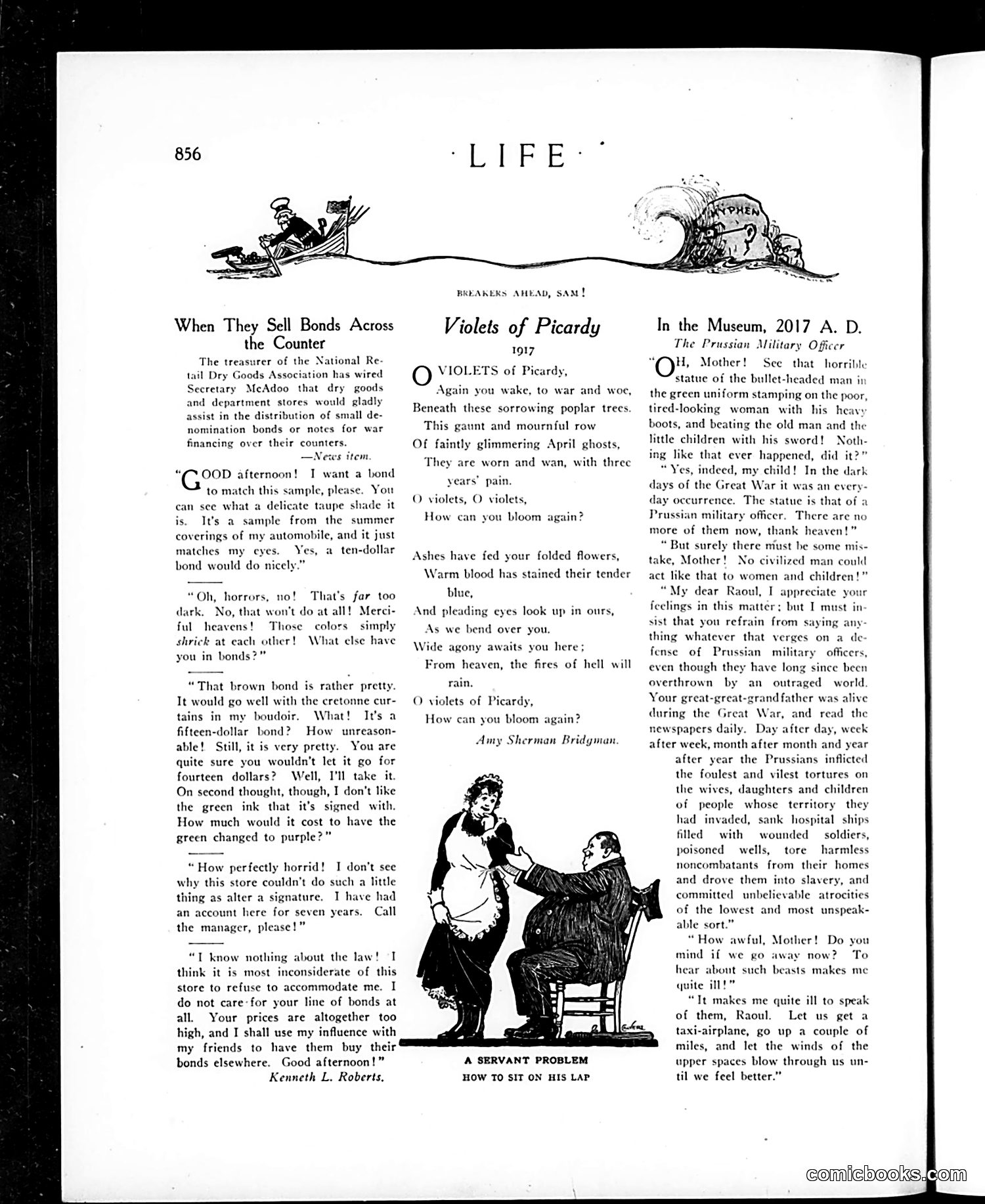
**Left cartoon** ("When They Sell Bonds"): Satirizes frivolous wartime bond-purchasing. A vain female customer treats war bonds like fabric swatches, obsessing over colors matching her automobile upholstery and complaining about prices and signatures. The joke mocks citizens who won't sacrifice during WWI, treating national financing as a fashion concern. **Right section** ("Violets of Picardy"): A sentimental poem mourning the destruction of the Picardy region in France during WWI trench warfare. "Violets" symbolize innocence destroyed by three years of brutal conflict. **Bottom-right dialogue** (2017 A.D. museum scene): Projects forward to future generations viewing a statue of a Prussian officer. A mother educates her son about documented German atrocities—poisoning wells, sinking hospital ships, enslaving civilians—to justify why such monuments exist and why Prussian militarism deserves permanent condemnation. This frames German wartime conduct as historically documented brutality. Context: Published as the U.S. entered WWI, the page contrasts American consumer selfishness with European suffering and German war crimes.
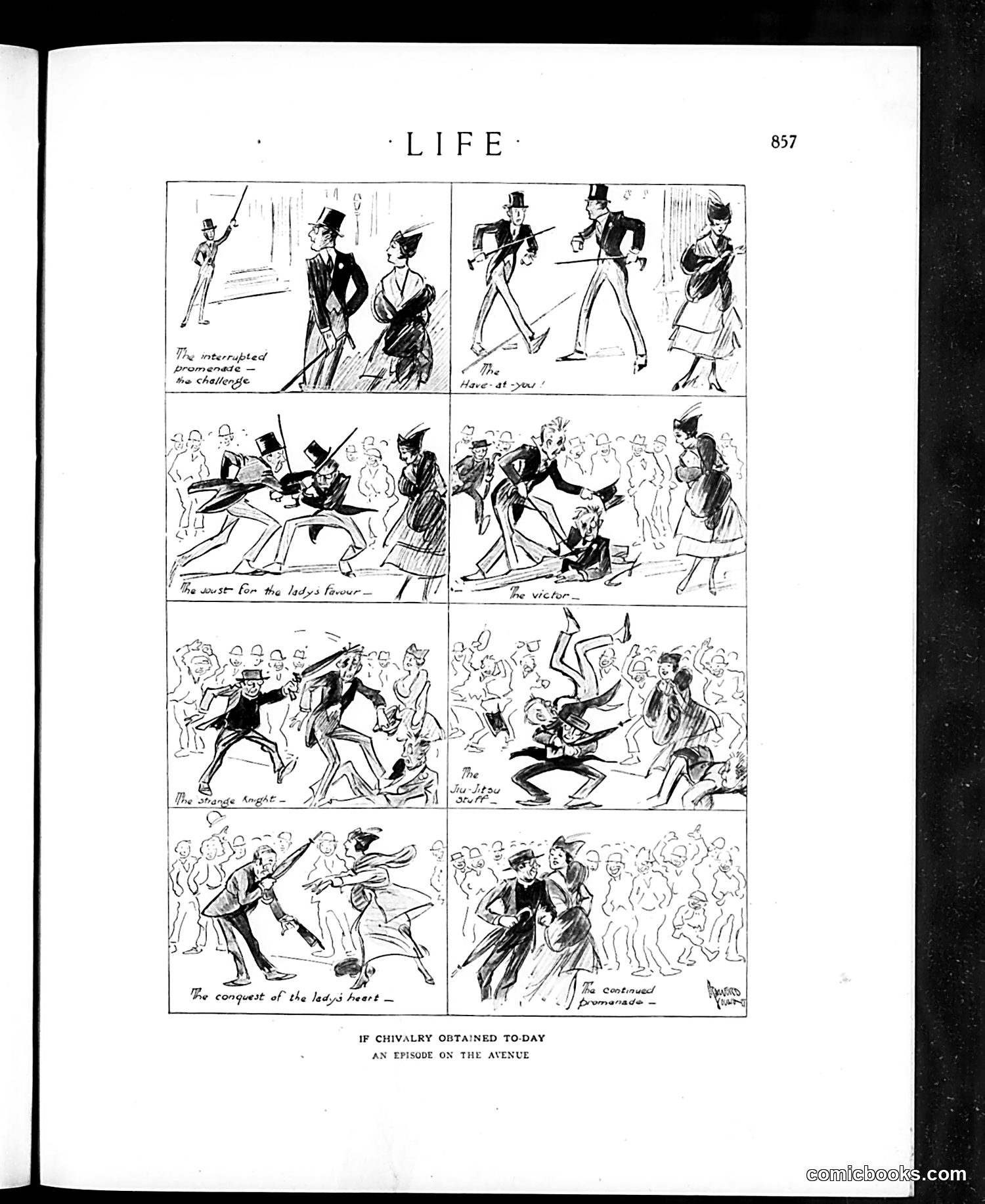
This satirical comic strip depicts what modern chivalry might look like if gentlemen still practiced elaborate courtship rituals on city streets. The sequence shows: 1. **The Setup**: A man interrupts a woman's walk with an exaggerated formal challenge 2. **The Contest**: Escalating physical combat between the suitor and woman, watched by crowds 3. **The Outcome**: The man "wins" through martial prowess rather than charm The satire mocks outdated notions of chivalry and masculine courtship by literalizing medieval "conquest" metaphors. By showing a violent street duel as acceptable romance, the cartoon critiques both romanticized chivalry and the aggressive male behavior it normalized. The title "If Chivalry Obtained To-Day" suggests this is how absurdly anachronistic such courtship would appear to modern (early 20th-century) audiences.
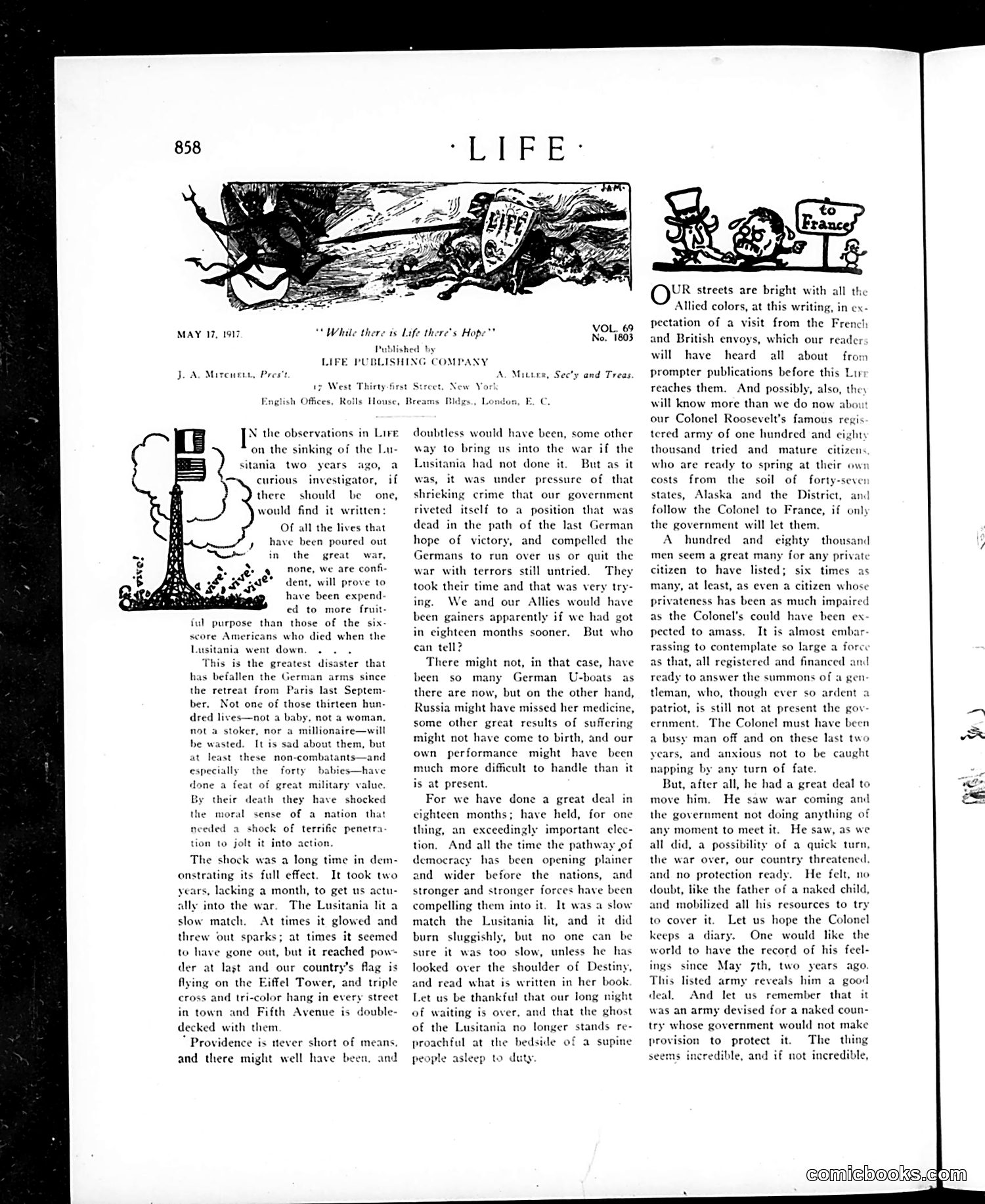
This page discusses the sinking of the RMS *Lusitania* (1915), using it to explain America's entry into World War I two years later. The author argues the ship's destruction—killing 1,298 people, including 128 Americans—was a "greatest disaster" for Germany because it shocked American public opinion, eventually forcing the U.S. government into action against Germany. The cartoon (top left) appears to show the *Lusitania* sinking with the caption "While there is Life there's Hope," ironically contrasting the ship's name with its destruction. The satire criticizes Germany's U-boat warfare as a strategic blunder: the moral outrage it generated proved more militarily valuable to the Allies than the actual lives lost. The author suggests divine providence worked through tragedy to mobilize American democracy toward entering the war.
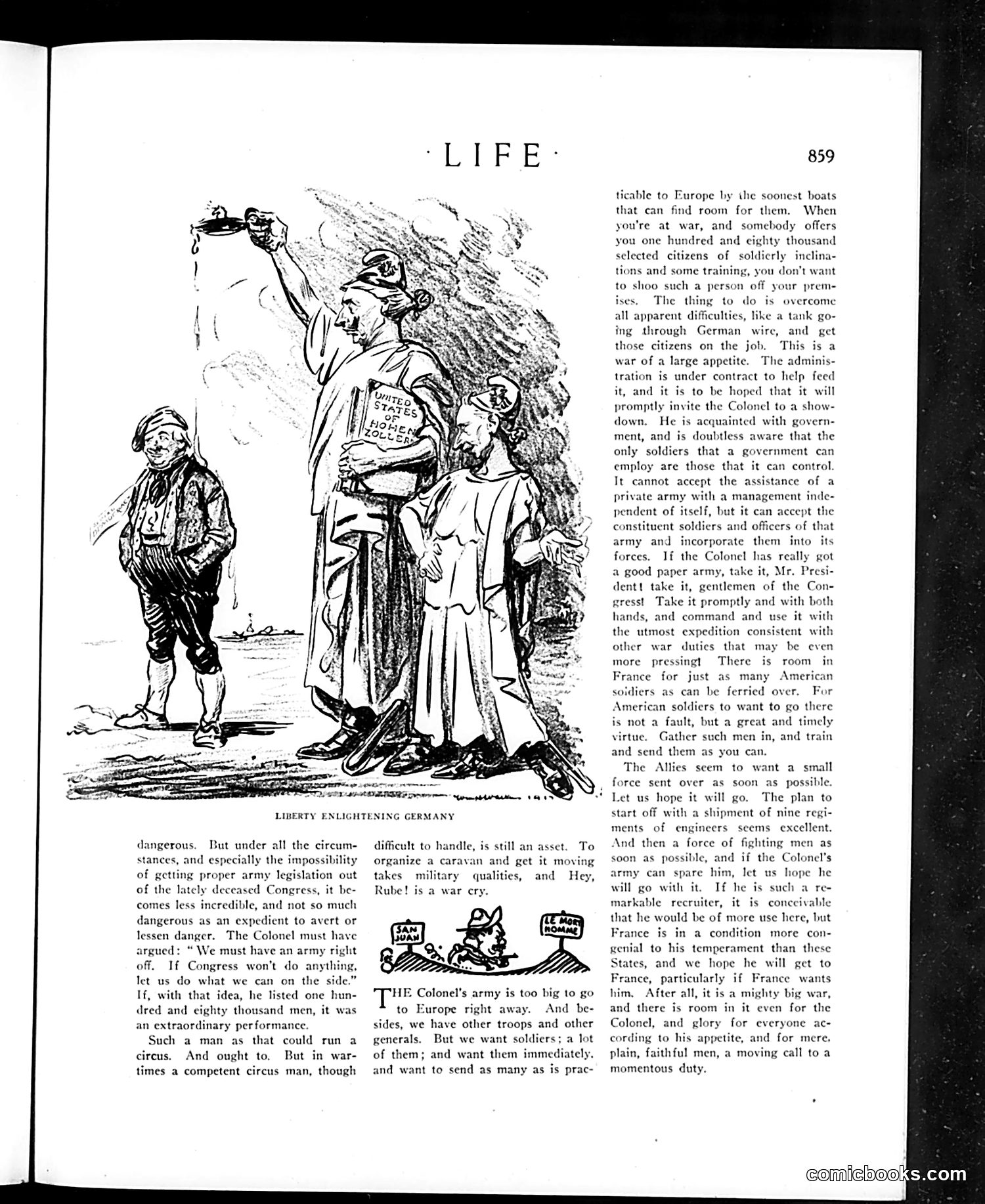
This 1917 editorial cartoon satirizes Colonel Theodore Roosevelt's attempt to raise a private volunteer army for WWI service in France. The image shows Lady Liberty (the Statue of Liberty figure) "enlightening" or instructing a German soldier, with a smaller American soldier observing. The accompanying text debates accepting Roosevelt's unauthorized 180,000-man force into the official military. The author argues pragmatically: while Roosevelt's independent army-building is legally problematic and constitutionally improper, America's urgent need for soldiers makes this expedient acceptable—IF the government incorporates these men into regular forces under official control rather than allowing Roosevelt to command a private force. The satire mocks Roosevelt's ambition while acknowledging his recruiting talent, ultimately endorsing using his men for the war effort. The cartoon's title ironically suggests Lady Liberty must "enlighten" even German-aligned forces about proper military procedure.
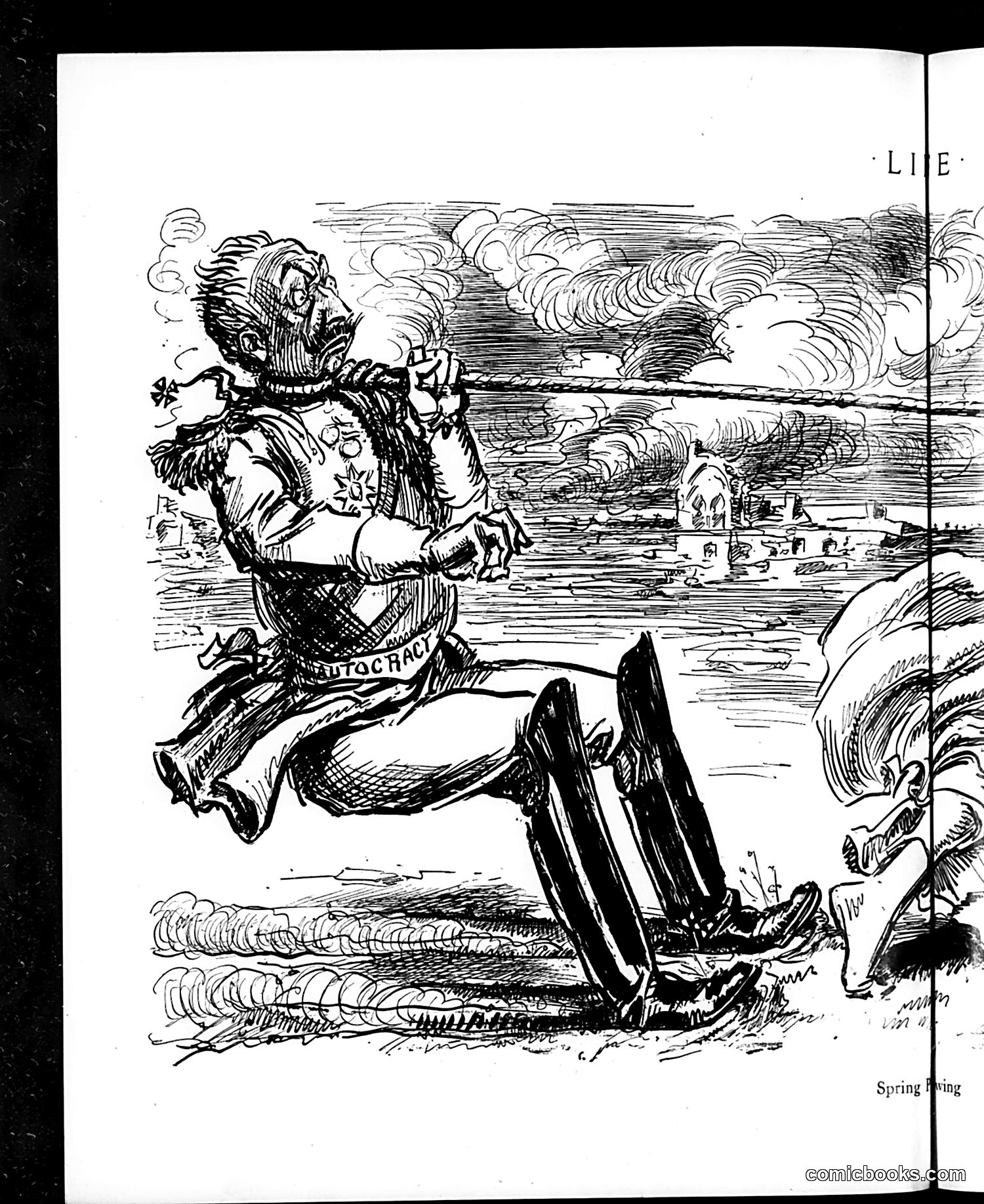
This political cartoon depicts a rotund, well-dressed figure labeled "AUTOCRACY" literally being launched into the air by a spring mechanism. The figure appears to be an allegorical representation of authoritarian government systems. The "Spring" device suggests sudden, forceful removal or overthrow—likely referencing revolutionary or reform movements of the era when Life magazine was publishing satirical commentary. The coastal landscape with structures in the background may represent a specific nation or context, though it's unclear which conflict this references without additional publication date information. The satire appears to celebrate the violent expulsion or collapse of autocratic rule, presenting it as inevitable and somewhat comedic. This reflects Life's generally progressive editorial stance on political systems.
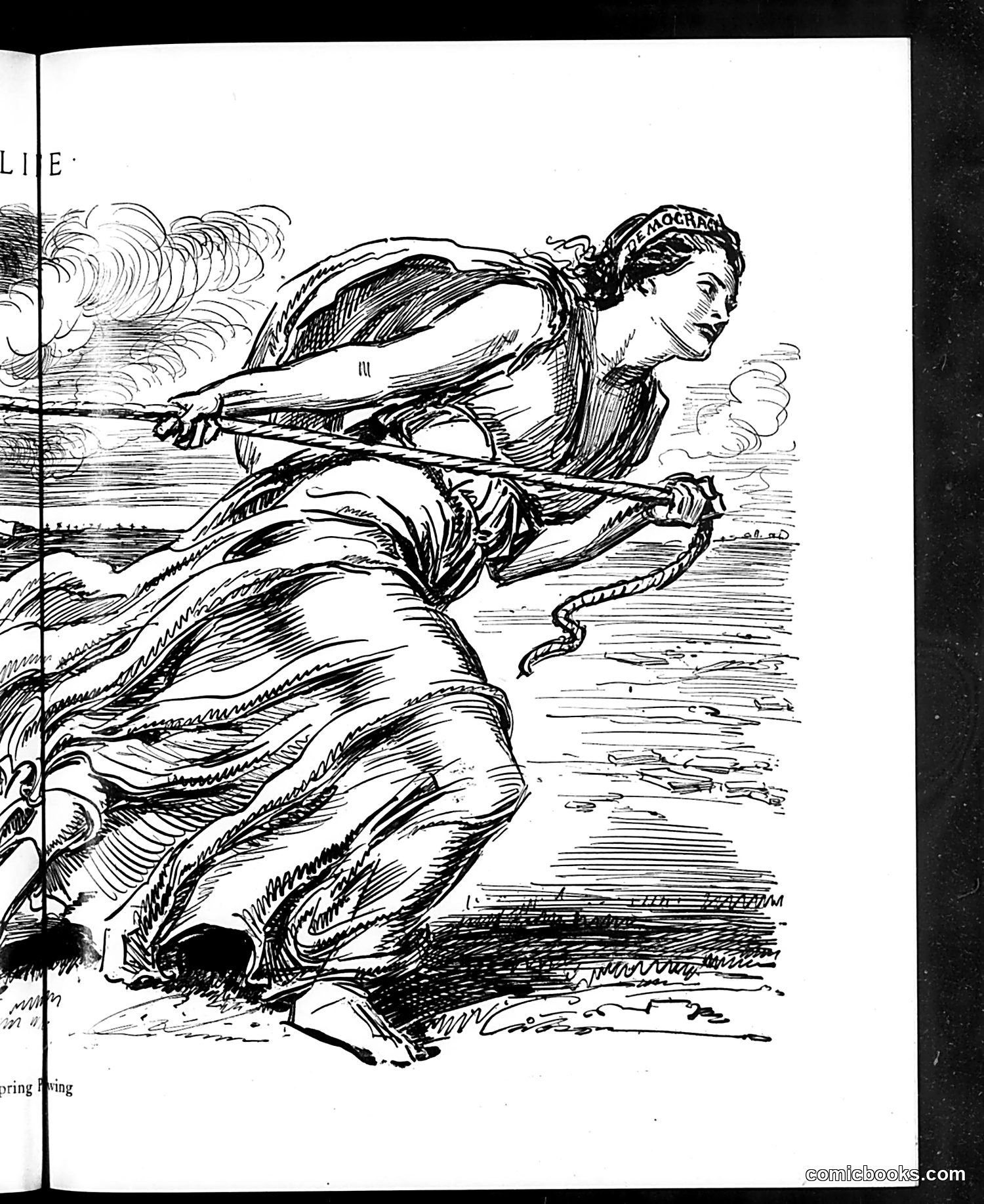
This appears to be a satirical engraving from *Life* magazine depicting a female allegorical figure (likely representing Britain or Liberty, suggested by her tiara/crown) in dynamic motion, struggling against or grappling with a serpent. The woman's vigorous pose and flowing classical drapery suggest resistance or defiance. The snake likely symbolizes a threat or enemy—possibly representing a political adversary or dangerous ideology. The energetic, theatrical style is typical of late 19th-century American political satire. However, **without a visible caption, headline, or date on this page, I cannot definitively identify the specific historical event, conflict, or political figure this references.** The OCR text is too corrupted to provide context. The cartoon's exact meaning requires additional documentation from the magazine issue.
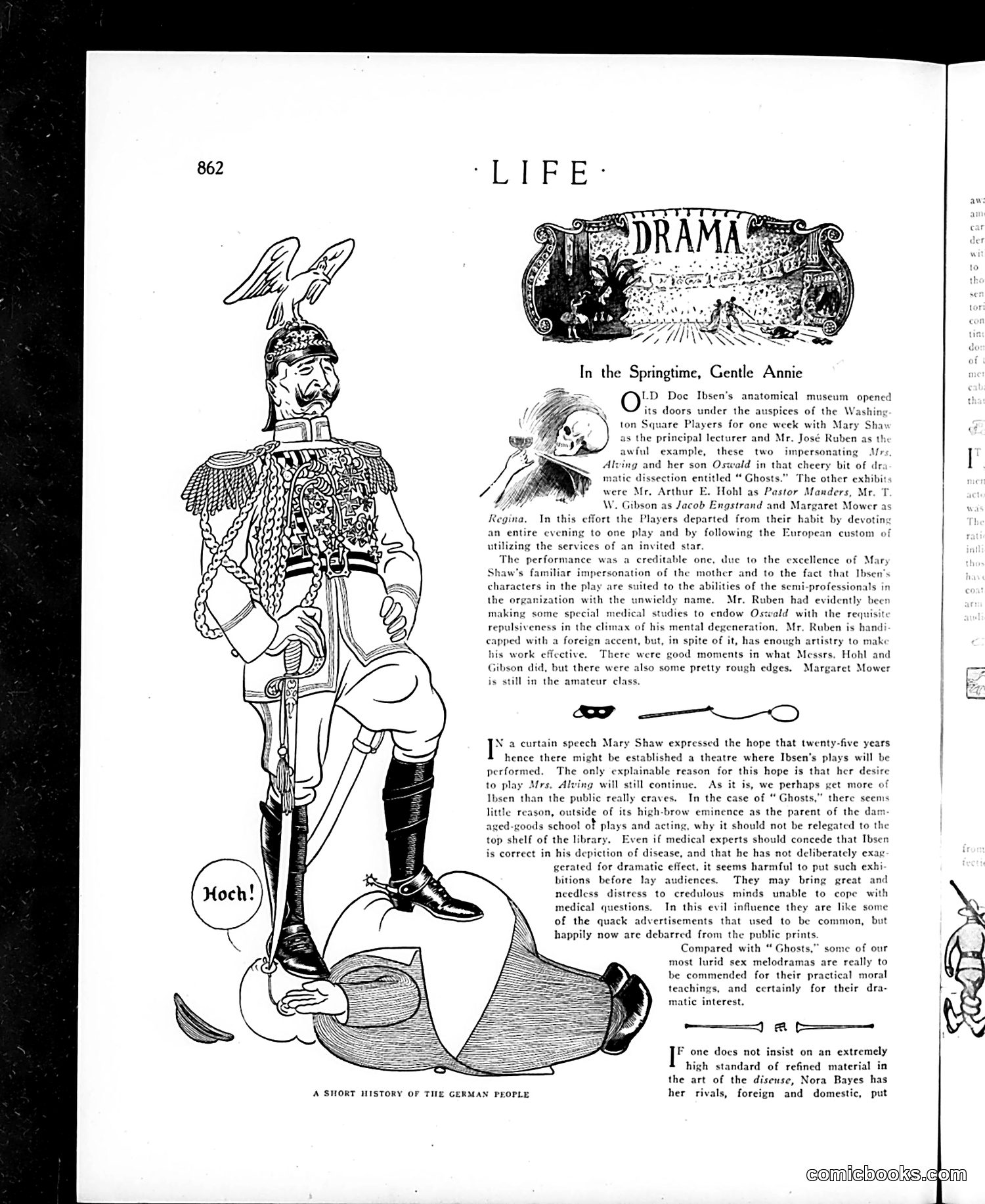
This page critiques a 1910s Washington Square Players production of Henrik Ibsen's *Ghosts*, directed by Mary Shaw. The left illustration—captioned "A Short History of the German People"—is a satirical caricature depicting a Prussian military officer in elaborate uniform declaring "Hoch!" (German for "cheers"), standing atop what appears to be a chamber pot. This is political satire mocking German militarism and imperial pretension. The drama review itself is skeptical of the production and Ibsen's play. The critic argues that while Mary Shaw performed well, *Ghosts*—with its depiction of hereditary syphilis and mental degeneration—is potentially harmful to general audiences. The reviewer questions whether such disturbing medical subject matter belongs on stage for "lay audiences" rather than relegated to libraries, comparing it unfavorably to even "lurid sex melodramas" which at least offer moral instruction. The tone reflects early 20th-century anxiety about whether realistic drama depicting disease and inherited affliction is appropriate public entertainment.
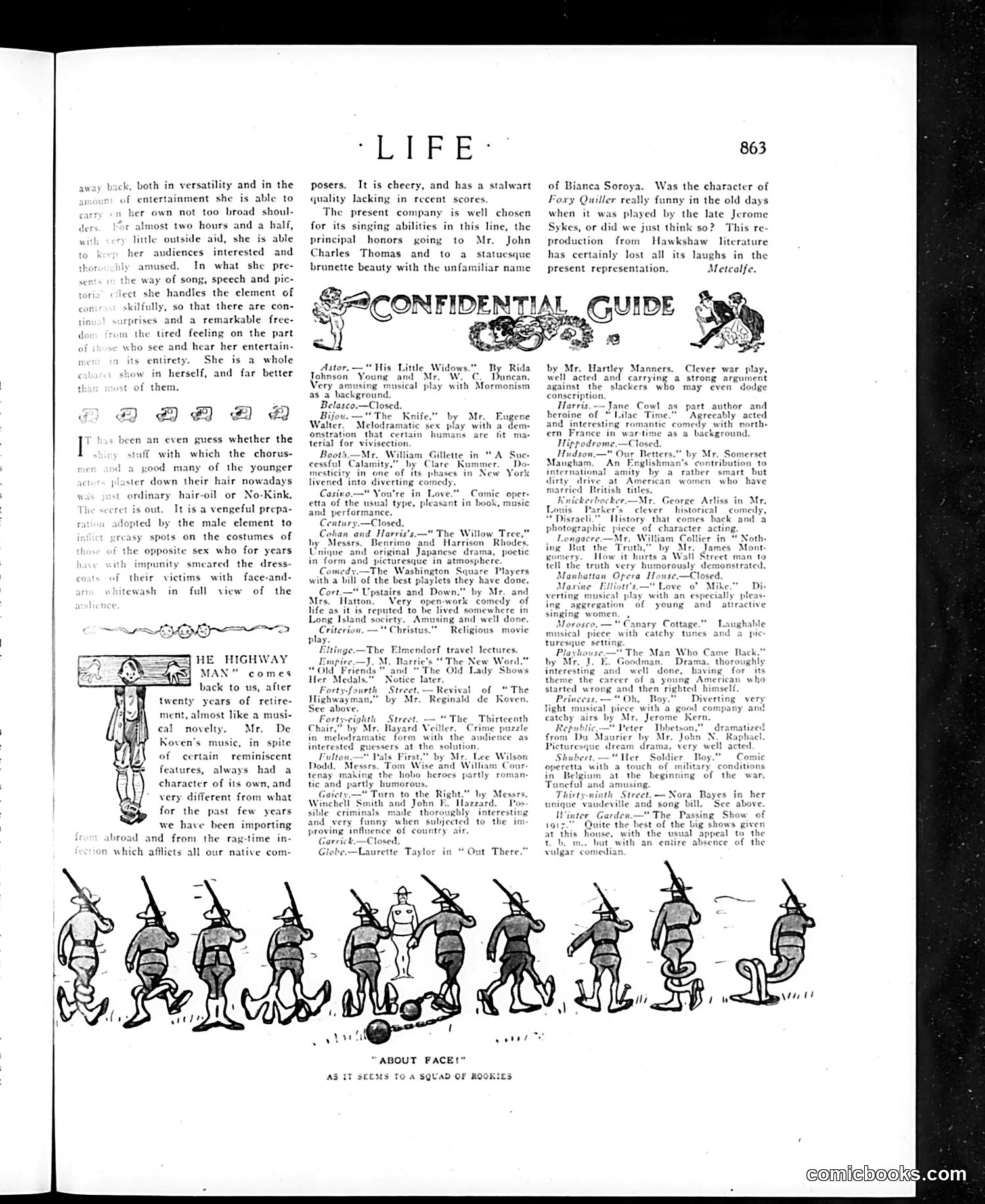
This page from *Life* magazine consists primarily of theater reviews and advertisements rather than political cartoons. The main visual content is a humorous illustration captioned **"About Face! As It Seems to a Squad of Rookies"**—a cartoon showing military recruits in formation, viewed from behind, appearing disorganized or poorly trained. The caption suggests satire about inexperienced soldiers ("rookies"), likely referencing World War I military training. The joke appears to be that these new recruits look awkward or comical when drilling, viewing them from a recruiter's or officer's perspective. The bulk of the page reviews theatrical productions, mentioning performers like John Charles Thomas and Jane Cowl. One review mentions a war play with "a strong argument against the slackers," referencing those avoiding military service—a contemporary concern during WWI. The content reflects wartime American culture, emphasizing entertainment while subtly addressing military service obligations.
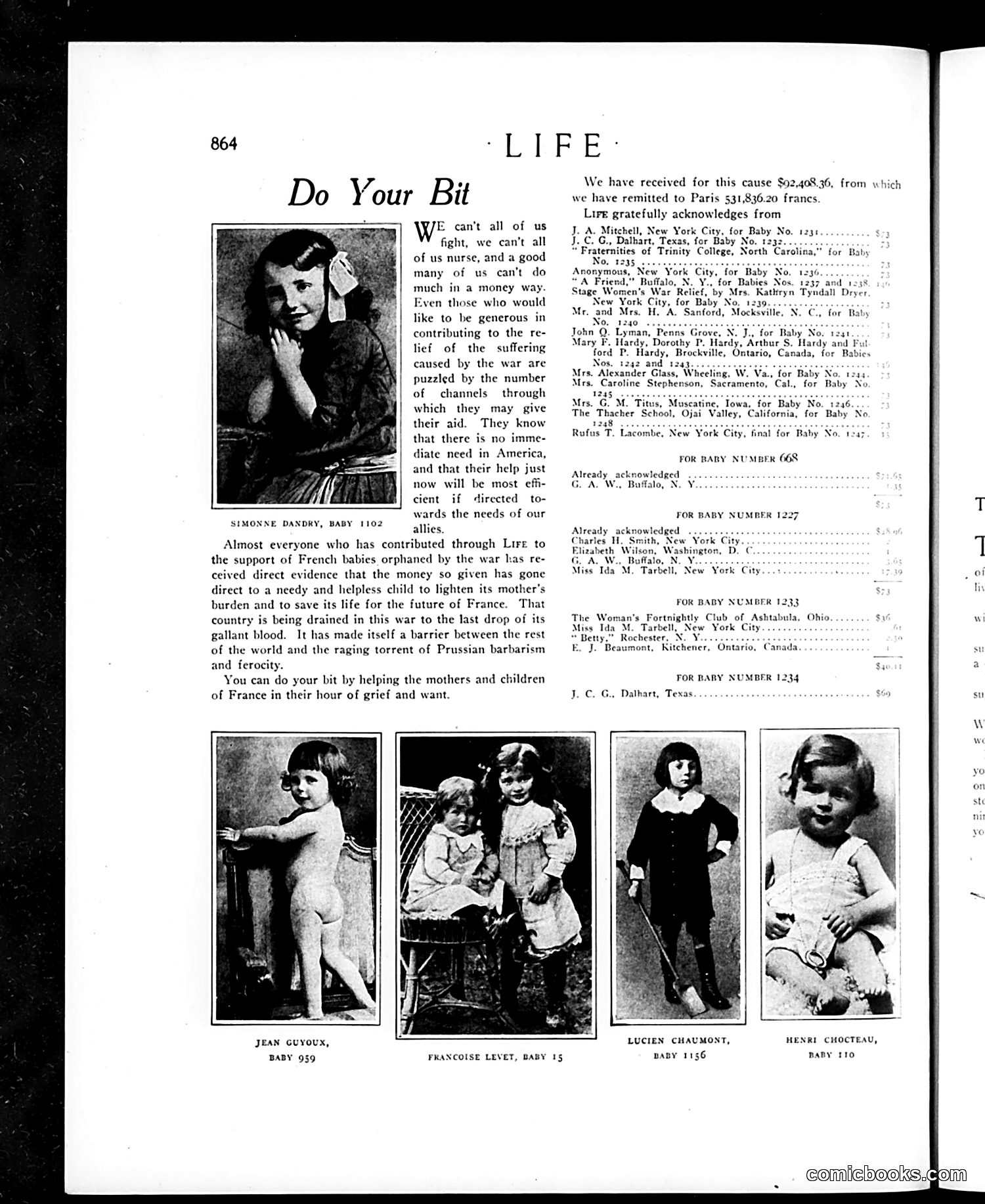
This page documents Life magazine's fundraising effort to support French children orphaned by World War I. The main article argues that while Americans cannot all fight or serve as nurses, they can contribute money efficiently through Life's organized relief channel. The accompanying photographs show actual French orphans being aided—identified by name and number (Baby 1102, Baby 959, etc.)—to provide donors tangible evidence their contributions reach real children. The list of donors demonstrates the campaign's success, recording over $92,000 collected and remitted to Paris. The satire is implicit: Life positions itself as the *most efficient* conduit for charity, contrasting "puzzled" donors confused by multiple relief organizations. The campaign leverages patriotic duty ("Do Your Bit"), emotional appeal (orphan photographs), and proof of accountability (detailed donor lists) to solicit contributions for America's French ally during the Great War.
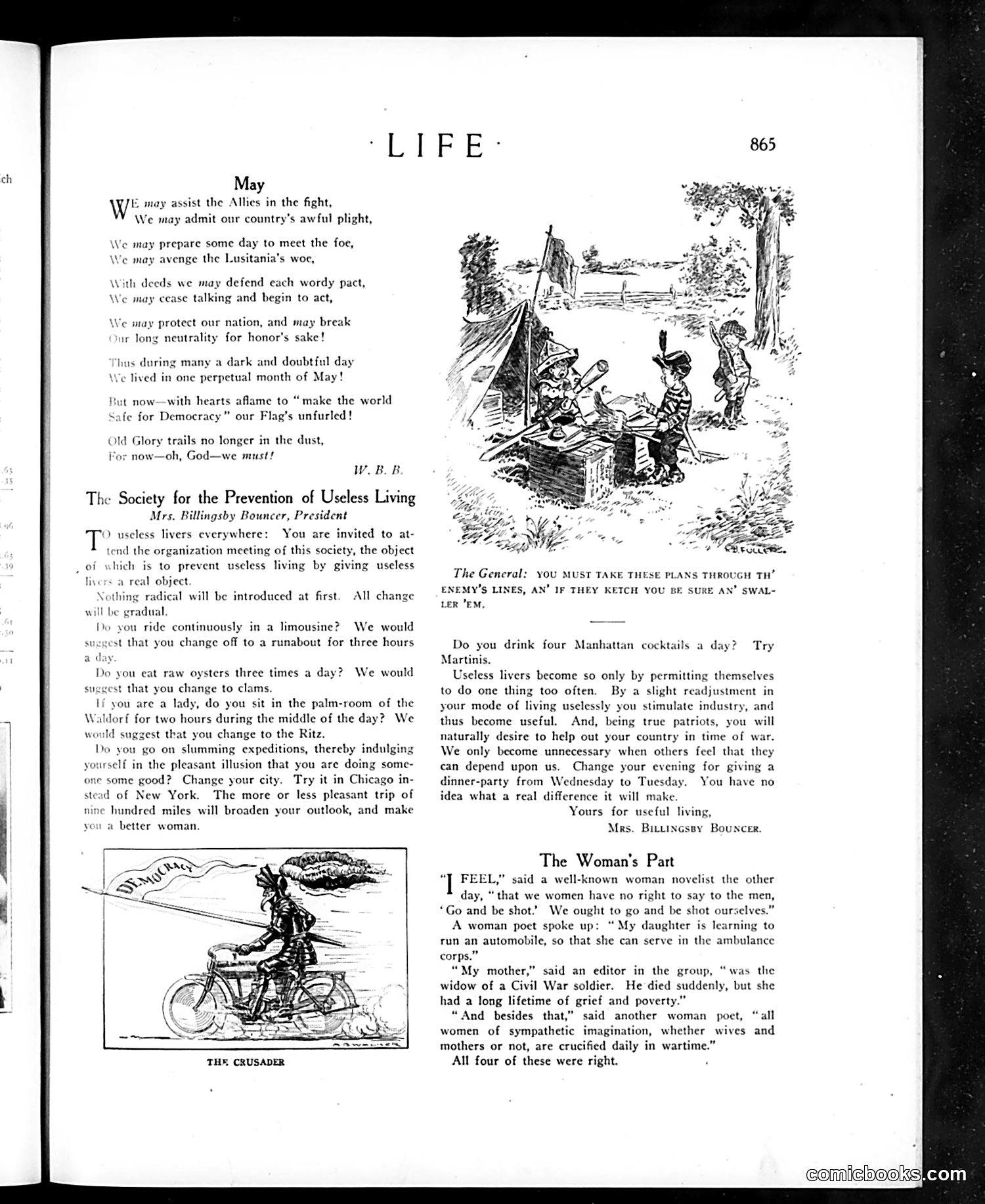
This satirical page addresses American entry into World War I, likely from 1917. **"May" poem** (top left): Uses wordplay on the month to mock America's prolonged hesitation before joining the Allies. It catalogs possible justifications (avenging the *Lusitania*, defending democracy) while criticizing endless delay—"we lived in one perpetual month of May." The shift to "now—we must!" marks America's actual commitment to war. **"Society for the Prevention of Useless Living"**: Satirizes wealthy Americans' excess consumption through absurdist advice. Mrs. Bouncer suggests minor lifestyle adjustments (switching cocktails, changing where one dines) as patriotic wartime sacrifice. The satire mocks the trivial "contributions" of the leisure class versus actual wartime sacrifice. **Illustrations**: "The Crusader" (bicycle rider with sword) and the General's scene suggest military commitment contrasting the civilians above. **"The Woman's Part"** (bottom): Addresses women's wartime roles—ambulance driving, nursing, emotional suffering—acknowledging their contributions beyond combat.
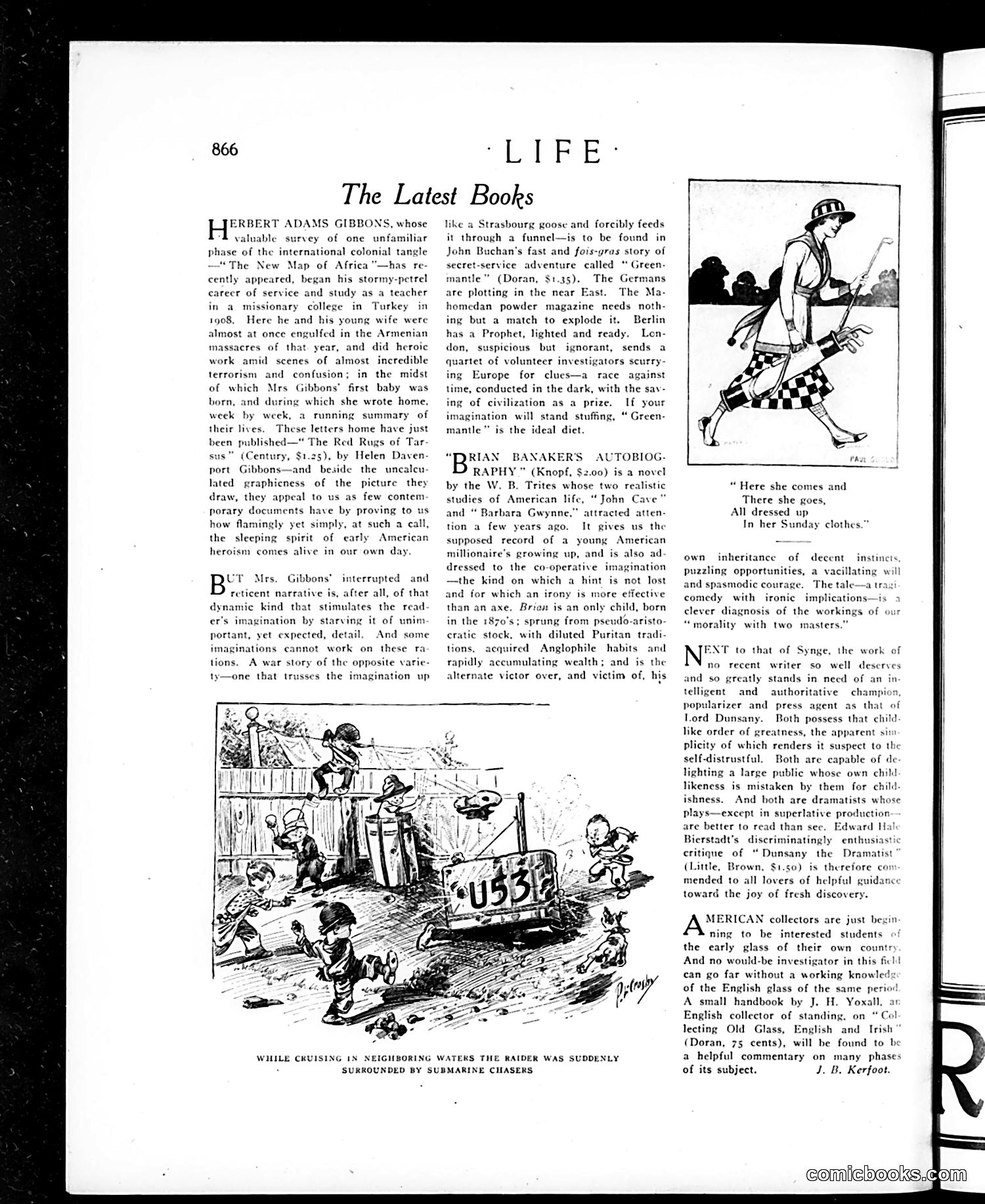
This is a book review section from *Life* magazine discussing recent literary releases. The lower illustration depicts a WWI naval scene: a submarine raider ("U-53" visible on the vessel) being surrounded by American submarine chasers. This references the real USS U-53, a German U-boat that surfaced near Newport, Rhode Island in October 1916, causing public alarm before America entered the war. The reviews discuss three books: Herbert Adams Gibbons' letters from the Armenian massacres (1908), John Buchan's espionage thriller "Greenmantle" (set during WWI with German plots in the Middle East), and W.B. Trites' novel about an American millionaire. The upper right illustration shows a woman in fashionable Sunday dress—likely satirizing contemporary fashion or gender roles. The cartoon's caption jokes about naval danger, fitting the wartime anxiety permeating the page's literary selections, which focus on conflict, espionage, and historical trauma.
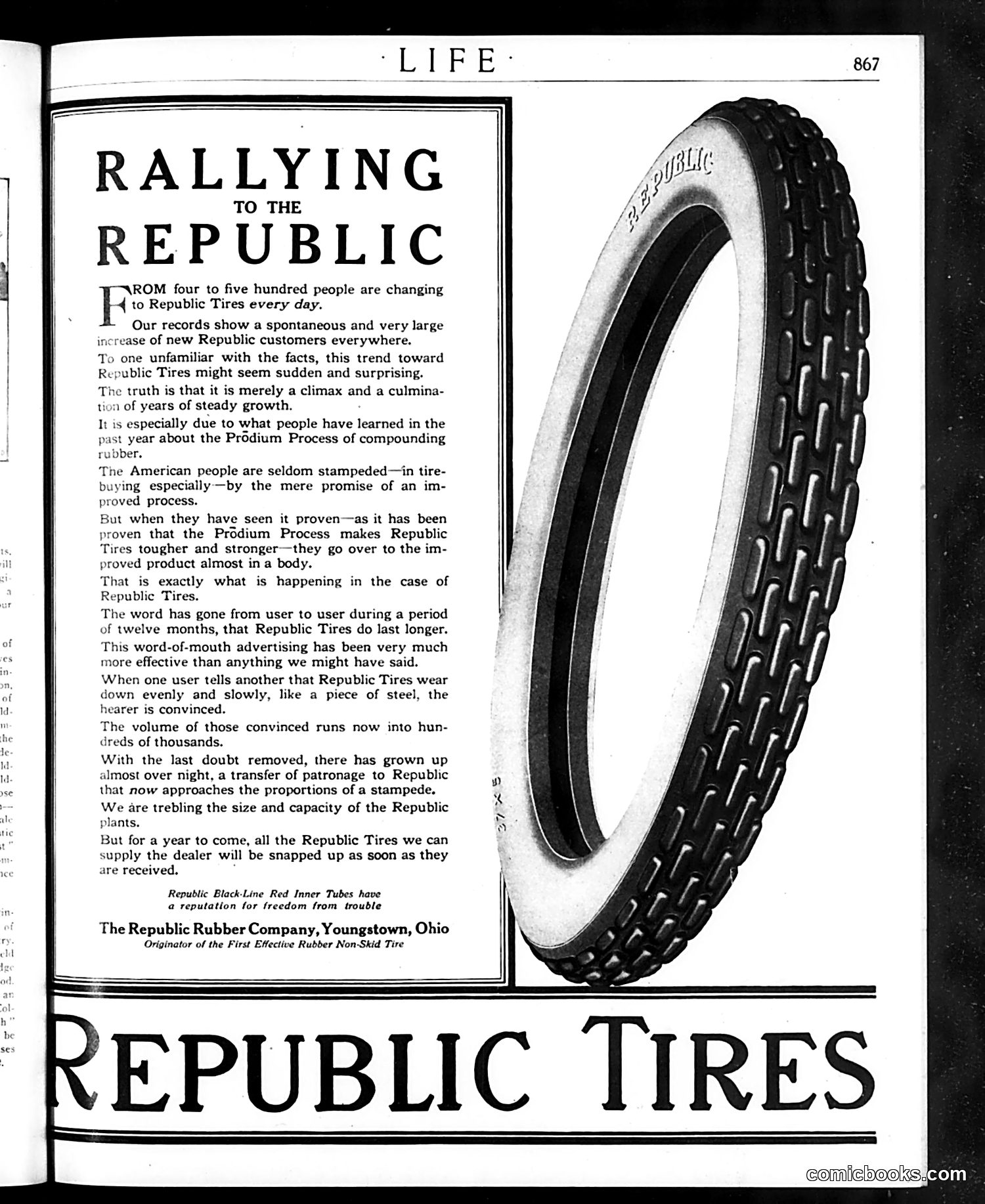
This is **not a political cartoon** but rather a **vintage advertisement** for Republic Tires, published in *Life* magazine (page 867). The page promotes Republic Tires' rapid market growth, claiming 400-500 daily converts. The ad emphasizes the "Prodium Process" of rubber compounding as the reason for superiority—tires wear "evenly and slowly, like a piece of steel." The key marketing strategy described is **word-of-mouth advertising**: satisfied customers convincing others of the product's durability, which the company claims is more persuasive than paid promotion. The large tire illustration on the right displays the product's "Black-Line Red Inner Tubes." The company, based in Youngstown, Ohio, claims such demand that supply cannot meet it for the coming year. **For modern readers**: This exemplifies early 20th-century advertising emphasizing technical innovation and consumer testimonials as selling points—a formula still used today, though the language and claims feel quaint by contemporary standards.
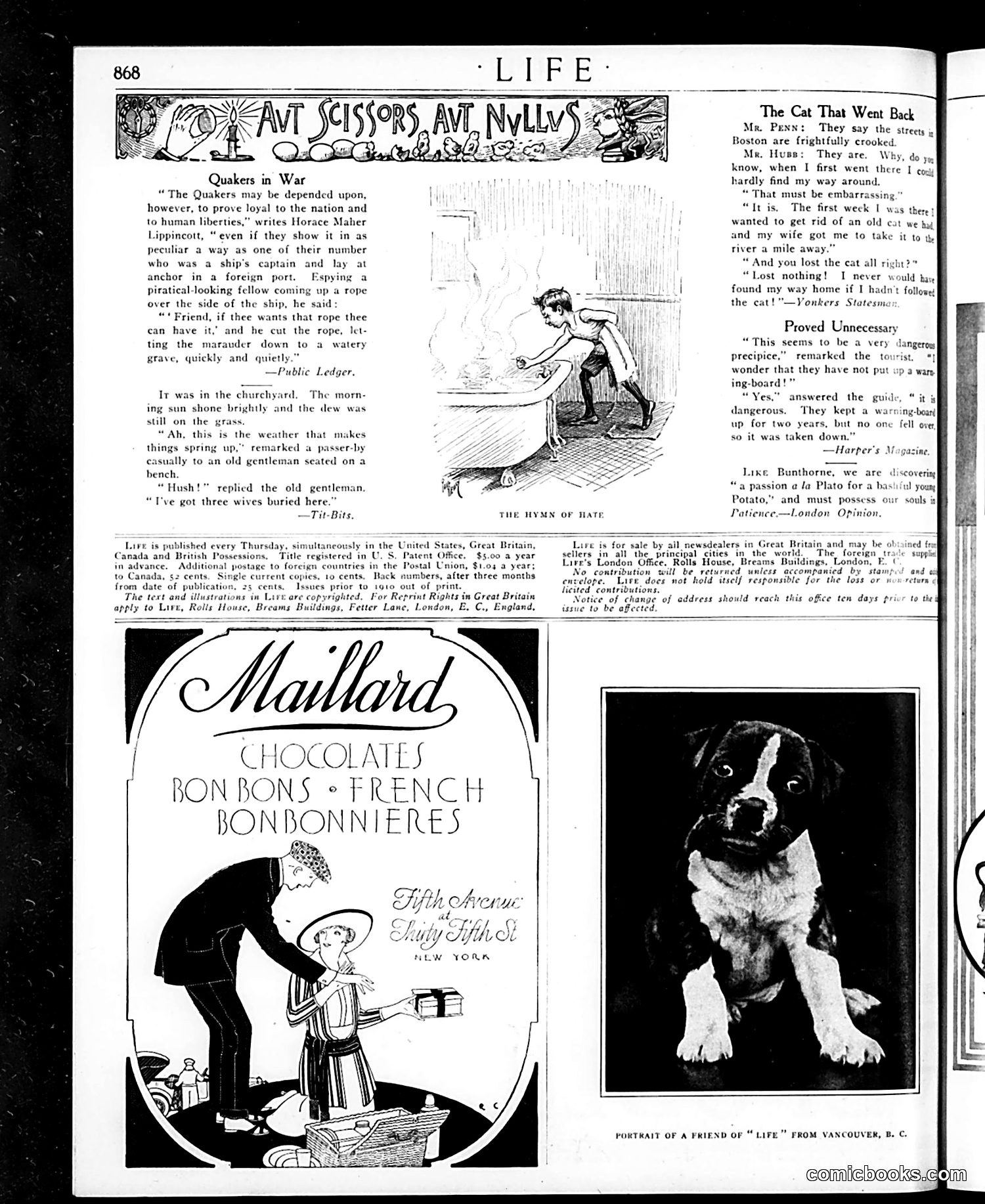
This page from *Life* magazine contains several brief humor pieces and advertisements typical of early 20th-century satirical journalism. **Main Content:** The page features four short jokes/anecdotes: 1. **"Quakers in War"** — a historical anecdote praising Quaker pacifists' patriotism, ironically told through a story of a Quaker ship captain who cuts a rope to drown an intruder "quickly and quietly." 2. **"The Cat That Went Back"** — a joke about Boston's confusing street layout where a man lost in the city only found his way home by following a cat he'd abandoned. 3. **"The Hymn of Hate"** — a brief churchyard joke about an old man with three buried wives. 4. **"Proved Unnecessary"** — a tourist anecdote about a dangerous cliff where warning signs were removed after nobody fell. **Advertisements:** The page includes a Maillard Chocolates advertisement featuring a man giving candy to a child, and a portrait photograph of a dog labeled as "a friend of Life from Vancouver, B.C." The humor relies on irony, wordplay, and everyday absurdity rather than specific political references.
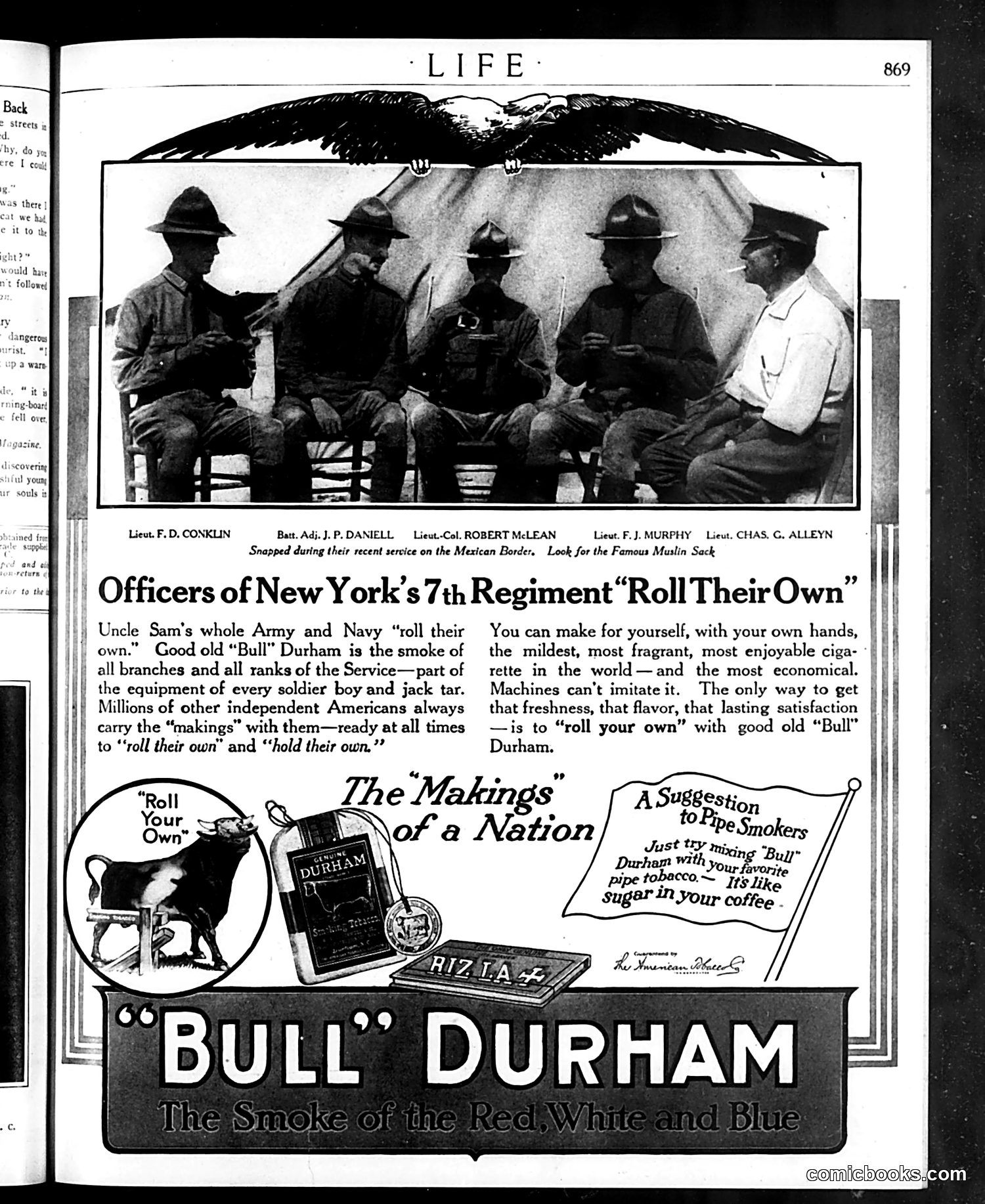
This is primarily a **tobacco advertisement**, not political satire. It features five named officers from New York's 7th Regiment, photographed during Mexican Border service (likely 1916-1917). The ad leverages their military authority to promote "Bull" Durham rolling tobacco. The phrase **"roll their own"** is a double entendre—literally about hand-rolling cigarettes, but also evoking self-reliance and American independence. The text claims soldiers and "independent Americans" carry Durham tobacco as essential equipment, equating smoking with patriotic self-sufficiency. The smaller panels promote Durham for pipe tobacco and cigarettes. This represents **early 20th-century tobacco marketing**, when such products were widely advertised without health warnings, often using military or masculine imagery to build credibility and appeal. The specific reference to the Mexican Border suggests timing when U.S. military operations were topical and could be leveraged for commercial purposes.
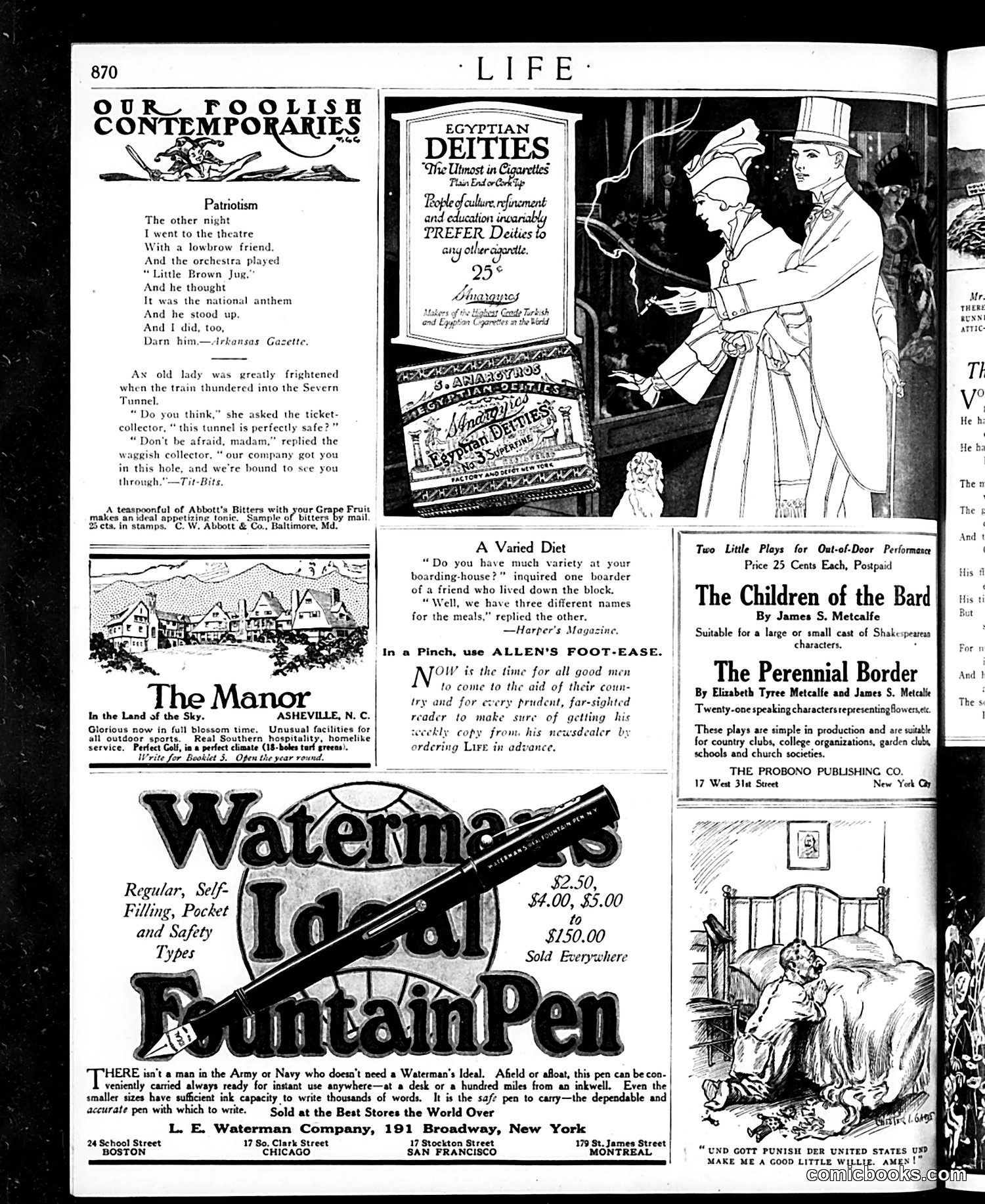
This page mixes satirical humor with period advertising (circa 1910s-1920s). The main content is **"Our Foolish Contemporaries,"** a humor column featuring three anecdotes: 1. **"Patriotism"**: A man mistakes "Little Brown Jug" (a folk song) for the national anthem and stands during an orchestra performance. The satire mocks both blind patriotism and easily-confused "lowbrow" audiences. 2. **The Severn Tunnel joke**: A passenger fears train safety; a ticket collector quips they'll "see you through"—dark humor about the company's dubious reliability. 3. **Boarding house "variety"**: A landlord claims menu diversity but only changes the *names* of meals, not the actual food—satirizing cheap boarding houses and false advertising. The page also contains period advertisements (Waterman's Fountain Pens, Egyptian Deities cigarettes, Allen's Foot-Ease) and notices for small theatrical productions. The satirical content reflects early 20th-century concerns: naive patriotism, consumer deception, and working-class experiences.
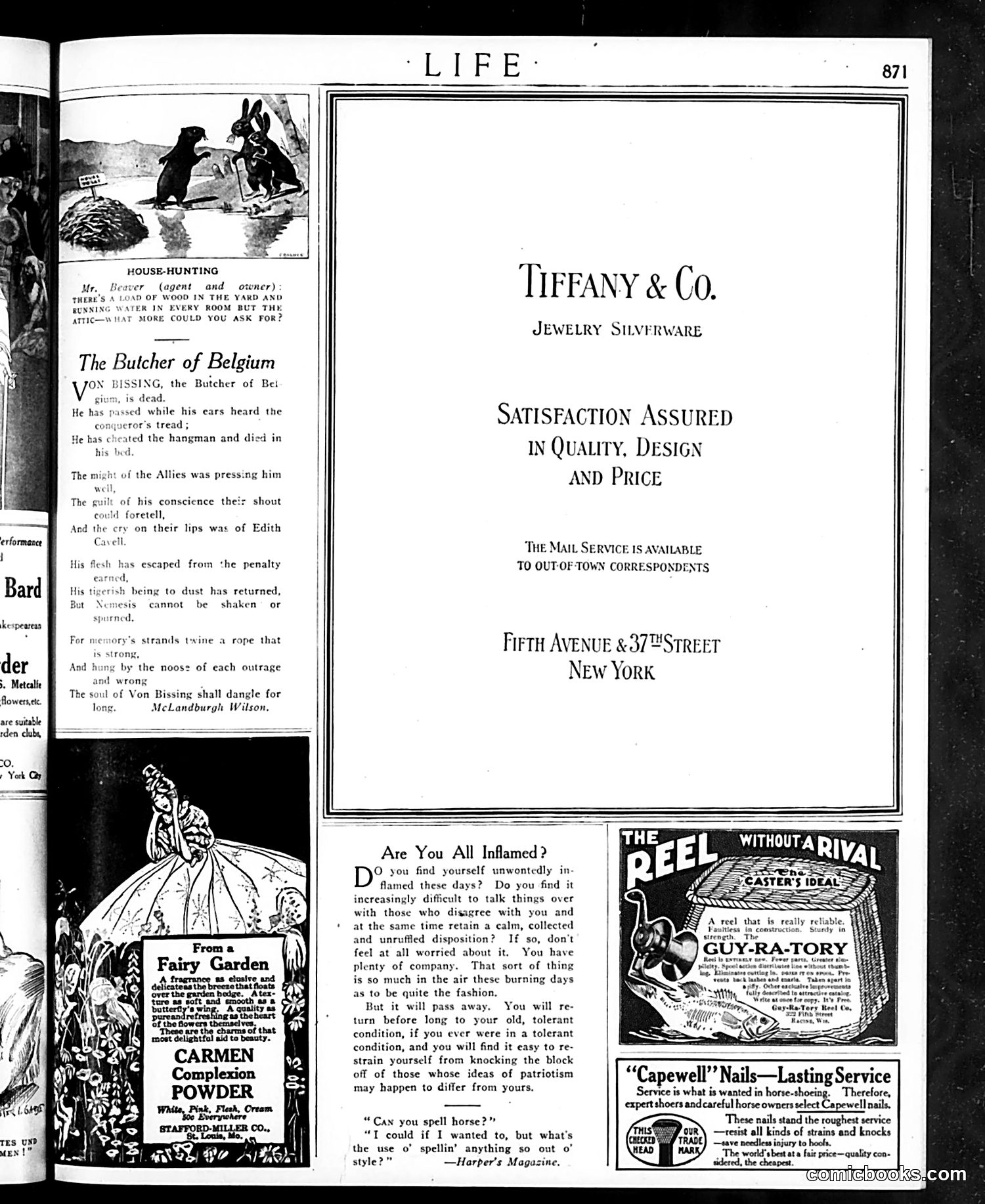
This page from *Life* magazine contains primarily **advertisements and editorial content** rather than political cartoons. The main article is "The Butcher of Belgium," a poem by McLandburgh Wilson mourning the death of **Von Bissing**, the German military governor of occupied Belgium during World War I. The piece references **Edith Cavell**, the British nurse executed by Germans in 1915—a war atrocity that shocked Allied public opinion. The poem uses violent imagery ("dangle," "noose") to suggest Von Bissing's guilt and that justice (Nemesis) will pursue him beyond death. The accompanying section "Are You All Inflamed?" discusses wartime emotional tensions—how disagreements over patriotism cause heated arguments among Americans, predicting this will pass once the war ends. The remaining content is **commercial advertising** for Tiffany & Co., Capewell nails, and Carmel complexion powder, interspersed with minor humorous items ("Can you spell horse?"). The page reflects 1918 American wartime sentiment: anti-German feeling, valorization of Allied sacrifice, and concern about domestic social friction during the conflict.
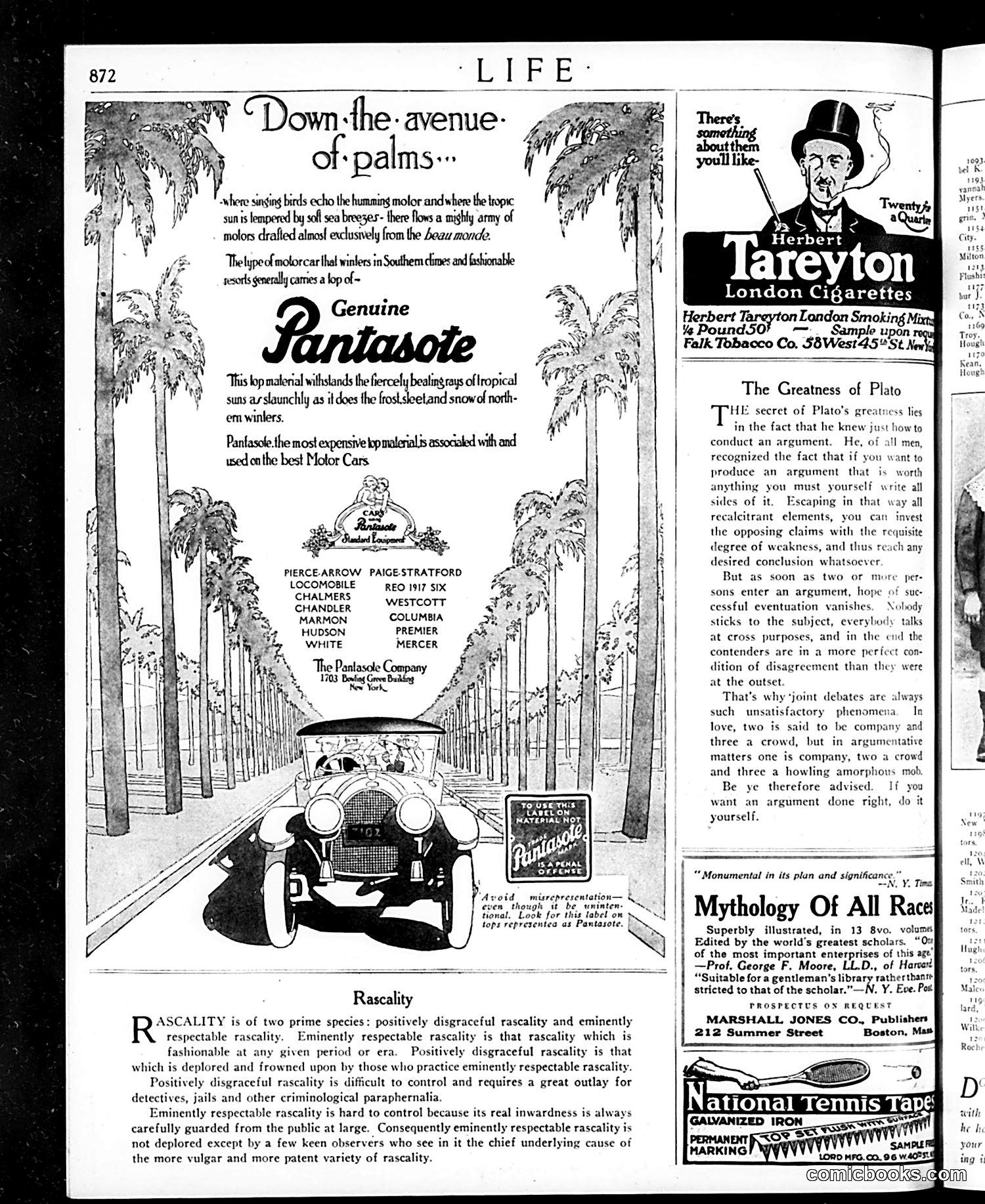
This page contains two distinct satirical pieces: **1. The Pantasote Advertisement (Left)** A luxury car advertisement disguised as editorial content, celebrating expensive automobiles cruising down palm-lined avenues in fashionable winter resorts. The copy lists prestigious car brands (Pierce-Arrow, Locomobile, Marmon, etc.), emphasizing that wealthy owners select Pantasote—an expensive convertible top material. The satire is implicit: Life presents this consumerist display of wealth and leisure as noteworthy social commentary on the wealthy's seasonal migration to resort destinations. **2. "Rascality" Essay (Bottom)** A satirical piece distinguishing between "positively disgraceful rascality" (criminal behavior requiring police control) and "eminently respectable rascality" (socially acceptable dishonesty among the wealthy, carefully hidden from public view). The essay argues that the latter—the respectable crime of the upper classes—causes more societal damage than vulgar criminality, yet escapes scrutiny. This critiques how wealthy wrongdoing remains invisible while poor crime receives harsh punishment. The page exemplifies *Life*'s mocking tone toward American class distinctions and hypocrisy.
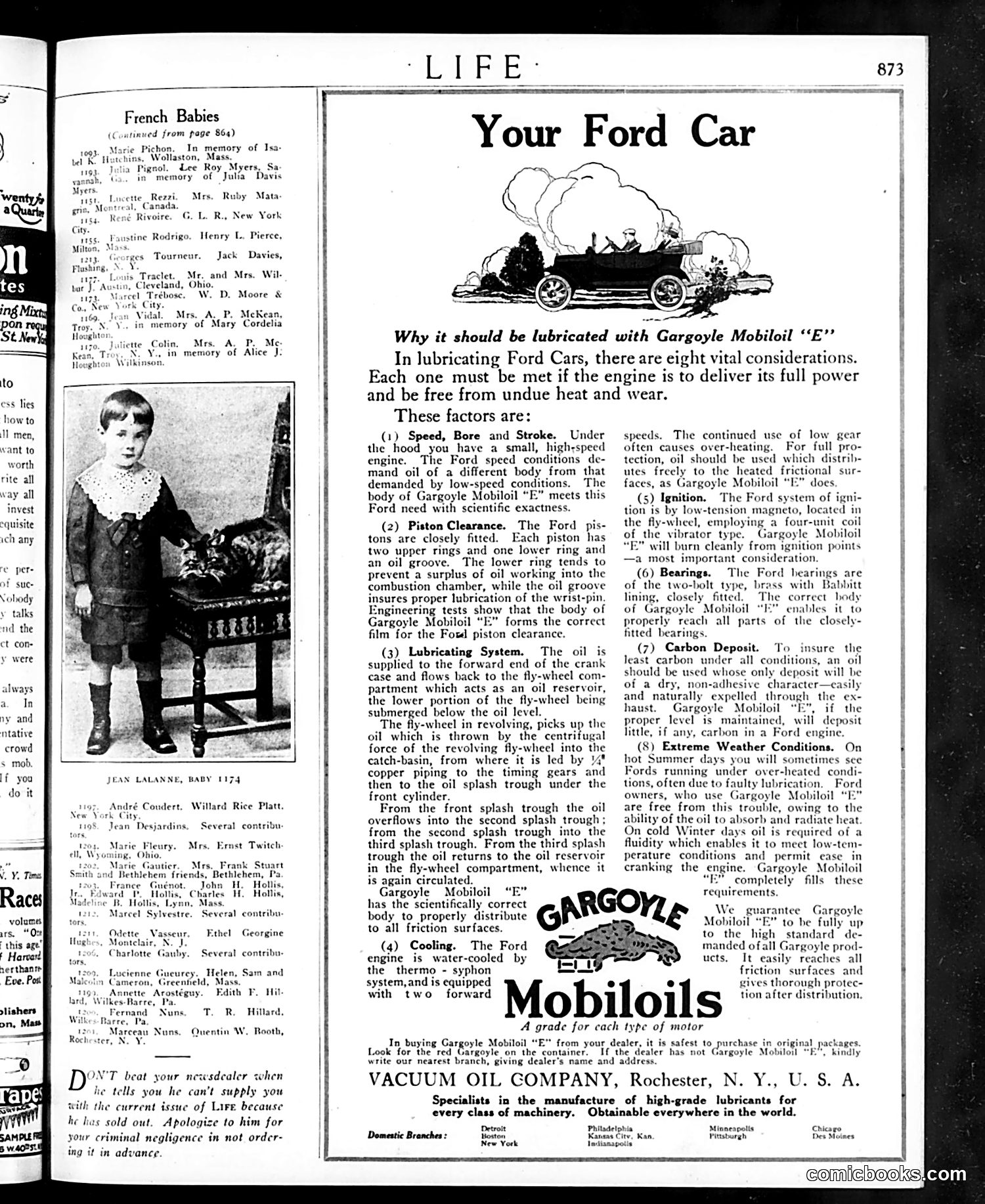
This page is **primarily a full-page advertisement** for Gargoyle Mobiloil "E" lubricating oil, not satire or political content. The left column contains what appears to be a memorial or tribute section titled "French Babies" listing names and contributors—likely a charitable fundraising feature common to Life magazine during the early 20th century. The advertisement's central image shows a Ford automobile with passengers, illustrating the product's target market. The text provides eight technical reasons why Ford owners should use Gargoyle Mobiloil "E" specifically: piston clearance, lubrication system design, cooling efficiency, ignition requirements, bearing specifications, carbon deposits, and extreme weather conditions. This represents period automotive marketing that emphasized **scientific precision and engineering specifications**—a sales strategy reflecting 1920s consumer culture's growing interest in mechanical details and product quality claims. The Vacuum Oil Company's Rochester, New York address appears at the bottom.
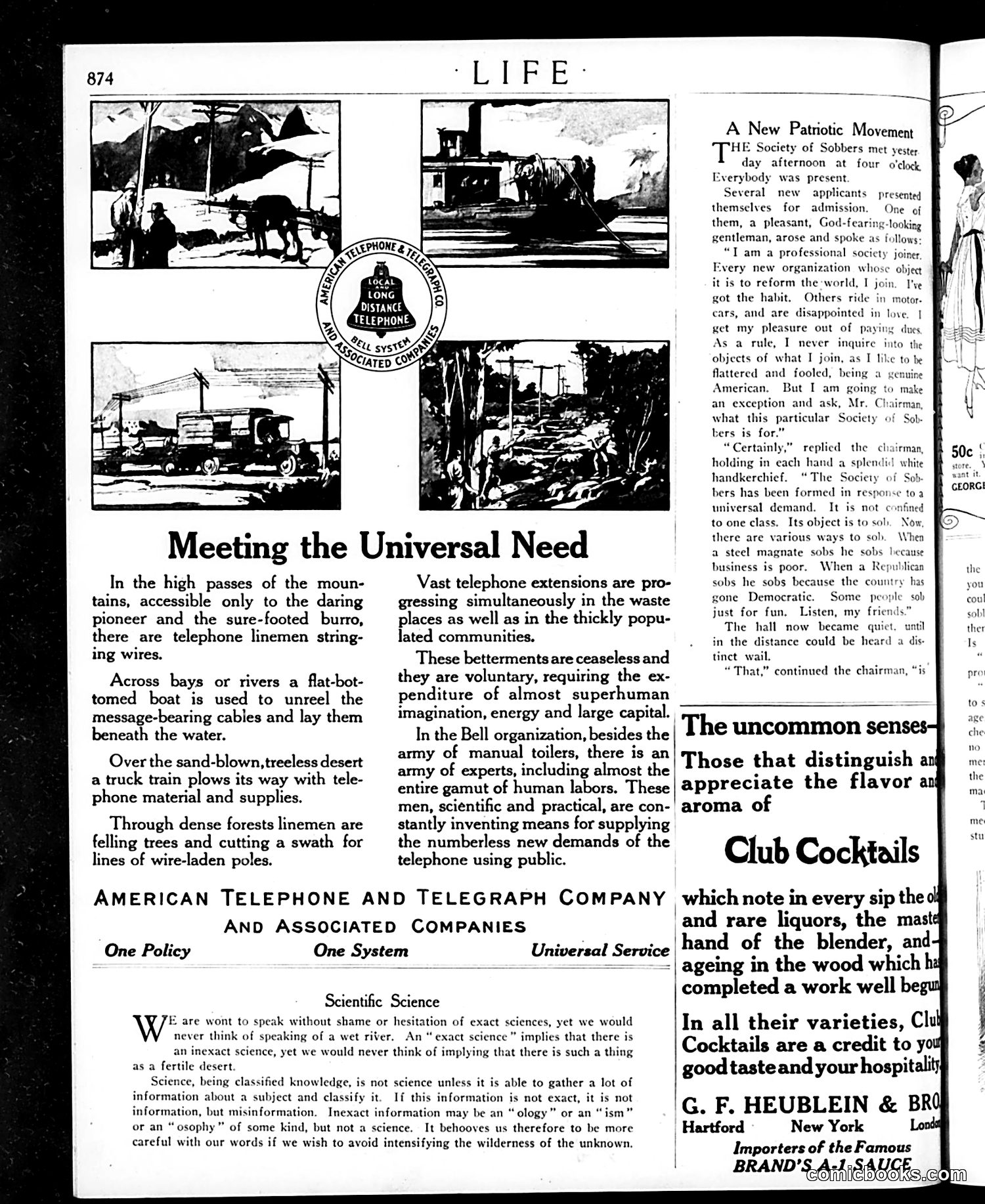
This page contains a humorous short story mocking society joiners and reform movements. A man admits to joining every organization claiming to "reform the world" without caring what they actually do—he simply enjoys paying dues and feeling morally superior. He joins the "Society of Sobers" and asks what it's for. The chairman explains that "sobbing" (crying/lamenting) is universal: wealthy businessmen sob about poor business; Republicans sob that the country turned Democratic; people sob "just for fun." **The joke**: The satirist ridicules Americans' enthusiasm for joining civic organizations and reform societies without understanding their purpose, and mocks the vague self-improvement culture. The "Society of Sobers" is absurdist—essentially a club for complaining—exposing the emptiness of many contemporary reform movements. The page also features a straightforward AT&T advertisement about telephone infrastructure expansion into remote areas, plus a cocktail advertisement—no political satire there.
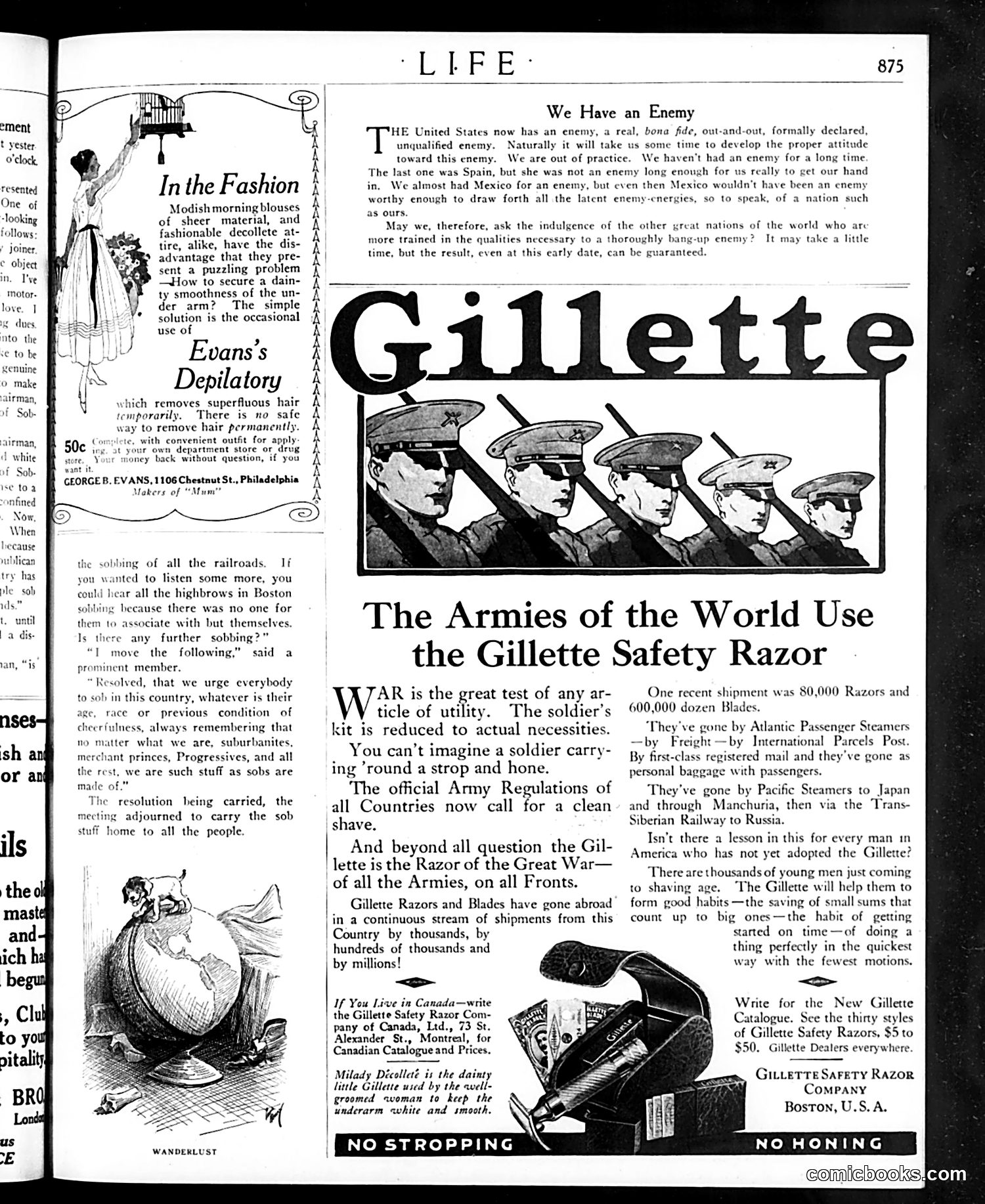
This 1917 *Life* magazine page combines patriotic messaging with advertising during World War I (the U.S. entered in April 1917). **The Main Article ("We Have an Enemy"):** A satirical editorial announcing America's formal declaration of war, likely against Germany. The humor lies in acknowledging that Americans haven't fought a major enemy in decades—Spain (1898) was brief, and Mexico never quite happened—so the nation needs practice developing proper "enemy-energies." This reflects genuine uncertainty about American war readiness. **The Gillette Advertisement:** The large ad capitalizes on patriotism by claiming armies worldwide use Gillette Safety Razors. It emphasizes that 80,000 razors and 600,000 blades have shipped overseas by various means. The advertisement strategically links consumer product adoption to military necessity and national pride, encouraging American men to use Gillette razors as soldiers do. **The Fashion Section:** An unrelated advertisement for hair removal product, typical of magazine filler. The page exemplifies wartime advertising's patriotic appeal, using national mobilization to market consumer goods.
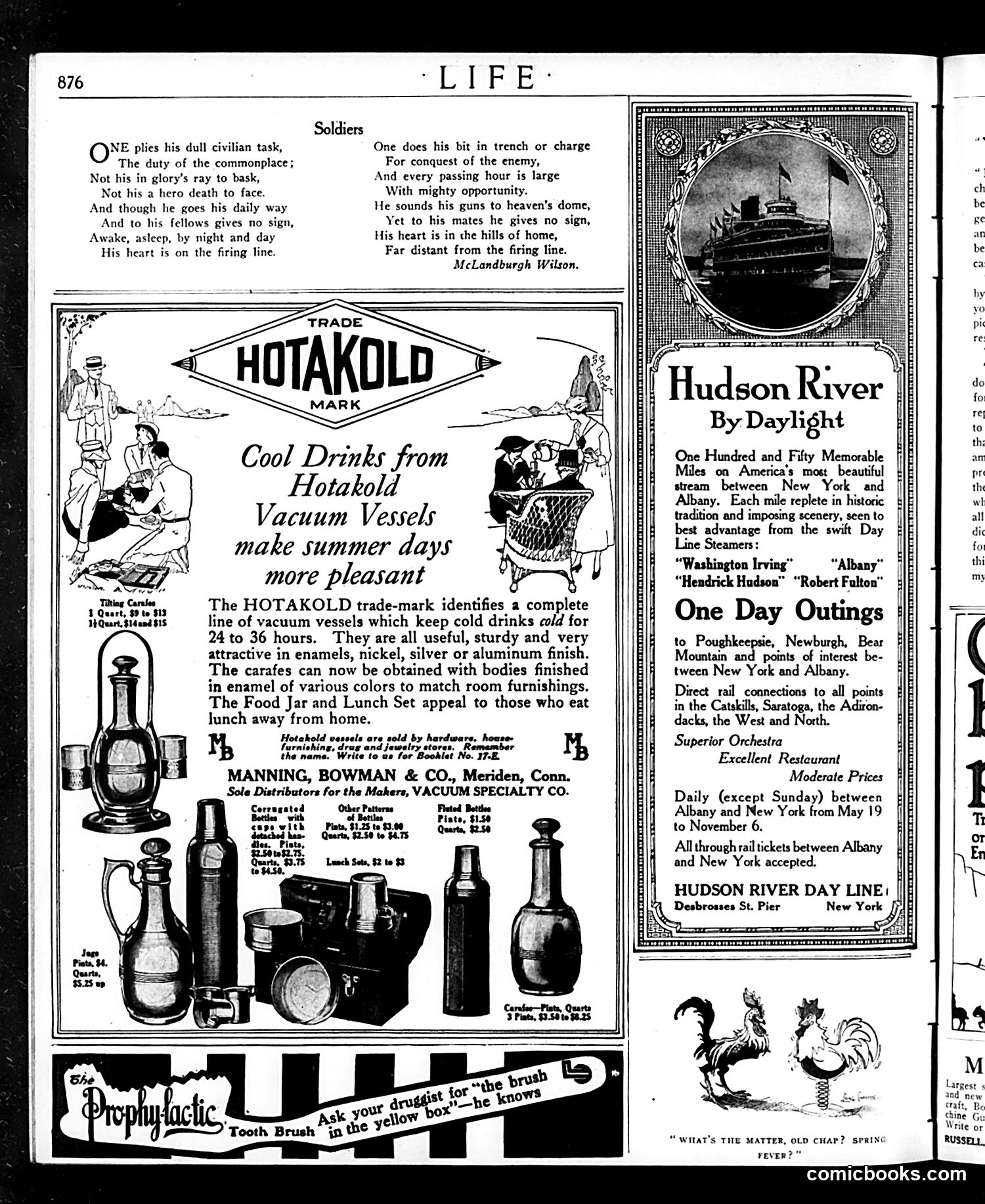
**The Poetry ("Soldiers"):** Two contrasting verses by McLandburgh Wilson celebrate different forms of wartime service. The first honors the overlooked civilian worker performing unglamorous duty "with heart on the firing line" despite no recognition. The second praises the soldier in active combat who endlessly pursues victory. Both emphasize hidden courage and duty—reflecting WWI-era messaging about civilian sacrifice being as noble as military service. **Advertisements:** The page is primarily commercial, featuring Hotakold vacuum vessels (keeping summer drinks cold) and Hudson River Day Line steamship excursions between New York and Albany. These appeal to peacetime leisure—a notable juxtaposition against the patriotic war poetry above, suggesting American life balancing military concerns with consumer normalcy. **The Cartoon:** A small illustration at bottom shows roosters with the caption "What's the matter, old chap? Spring fever?"—a lighthearted domestic joke unrelated to the war content, typical of Life's mixed editorial approach.
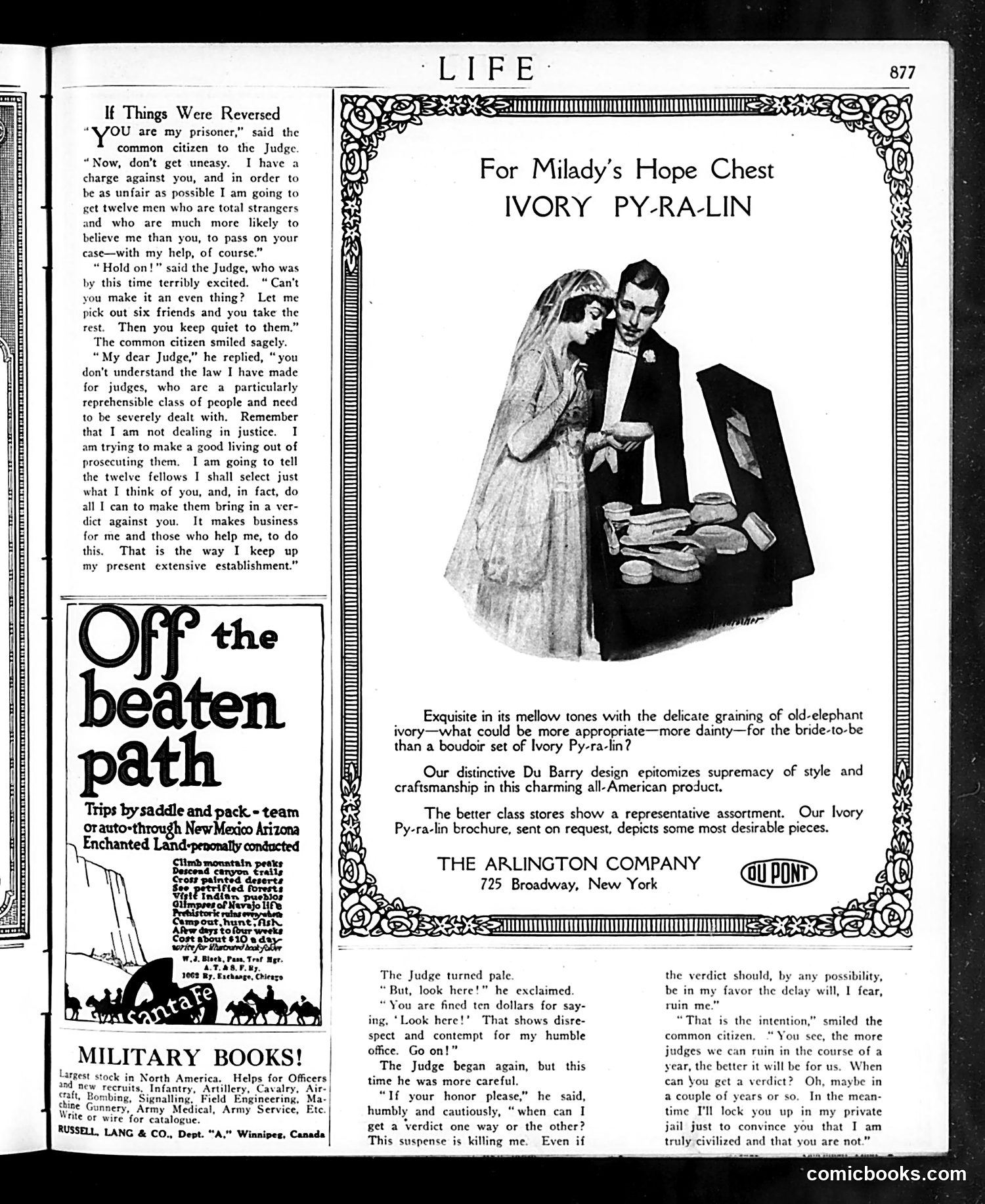
This satirical piece inverts the justice system to critique judicial corruption and bias. A common citizen becomes prosecutor, reversing roles with a Judge who becomes the accused. The satire exposes how judges allegedly: - Stack juries with biased strangers rather than impartial jurors - Use the courtroom to generate income through prosecutions - Manipulate proceedings ("do all I can to make them bring in a verdict against you") - Abuse power through arbitrary fines and delays The Judge's desperate protests highlight the injustice of a rigged system. The citizen's candid admission—"I am not dealing in justice. I am trying to make a good living out of prosecuting them"—reveals the real motivation: profit over fairness. By reversing roles, Life magazine lampoons judicial corruption of the era, suggesting judges operated as self-interested operators rather than impartial arbiters. The humor works by making the injustice obvious when applied to someone with power.
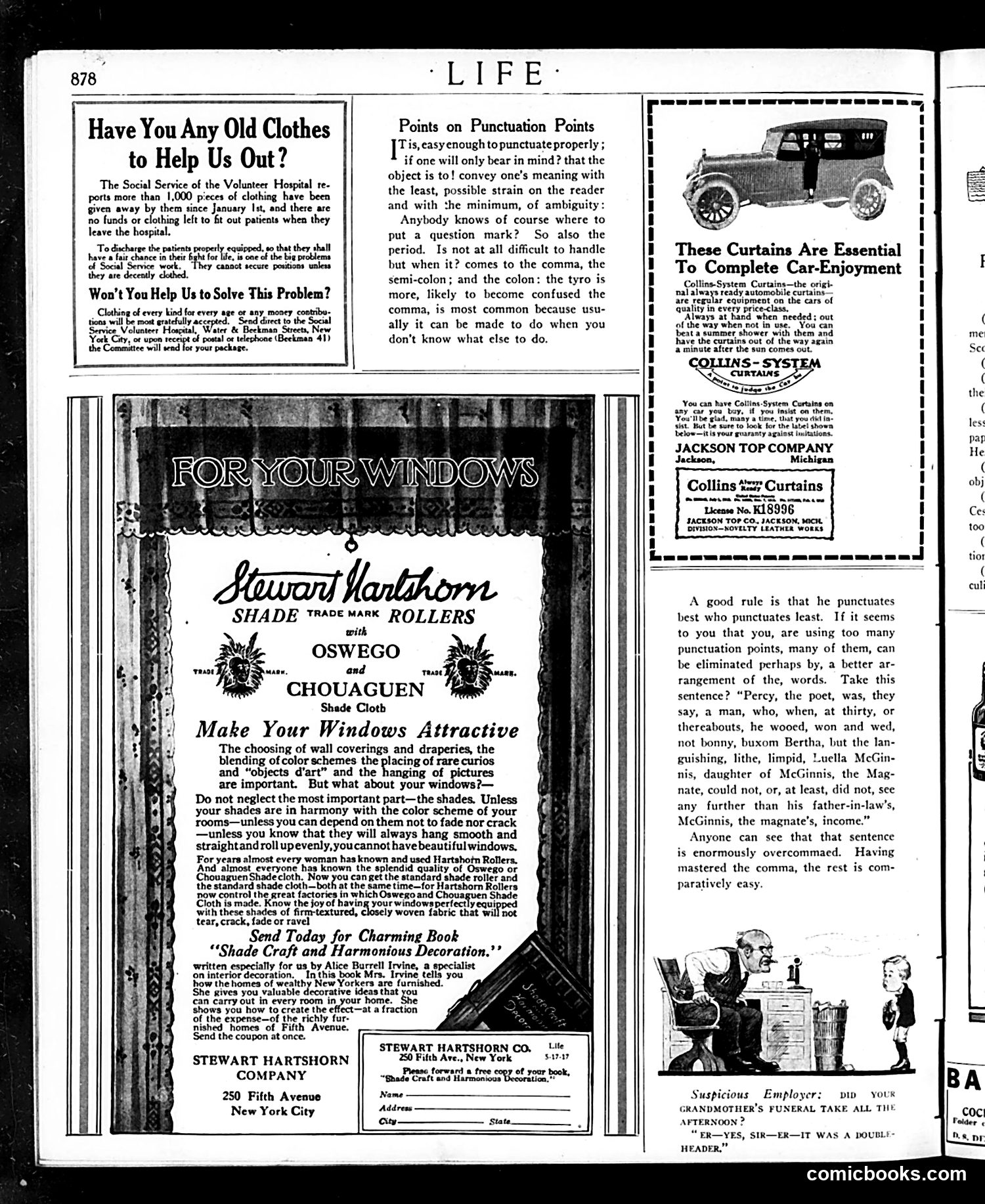
This page is primarily **advertising and advice columns** rather than political satire. The main elements are: **Left side**: A charity appeal from the Volunteer Hospital's Social Service requesting old clothing donations for discharged patients lacking funds. This reflects early-20th-century philanthropic concerns about patient welfare. **Center**: A large advertisement for Stewart Hartshorn shade rollers with Oswego/Chouaguen cloth, promoting window treatments as essential home décor. **Right side**: An advertisement for Collins-System automobile curtains, positioning them as necessary car accessories. **Upper right**: A brief column on "Points on Punctuation," offering grammar advice with humorous examples of over-punctuated sentences—satirizing overzealous punctuation rather than commenting on politics or society. **Lower right**: A small cartoon showing a suspicious employer questioning an older man about taking his grandmother's funeral afternoon off—gentle workplace humor. The page reflects 1910s-20s consumer culture, charitable concerns, and educational content typical of Life magazine's format.
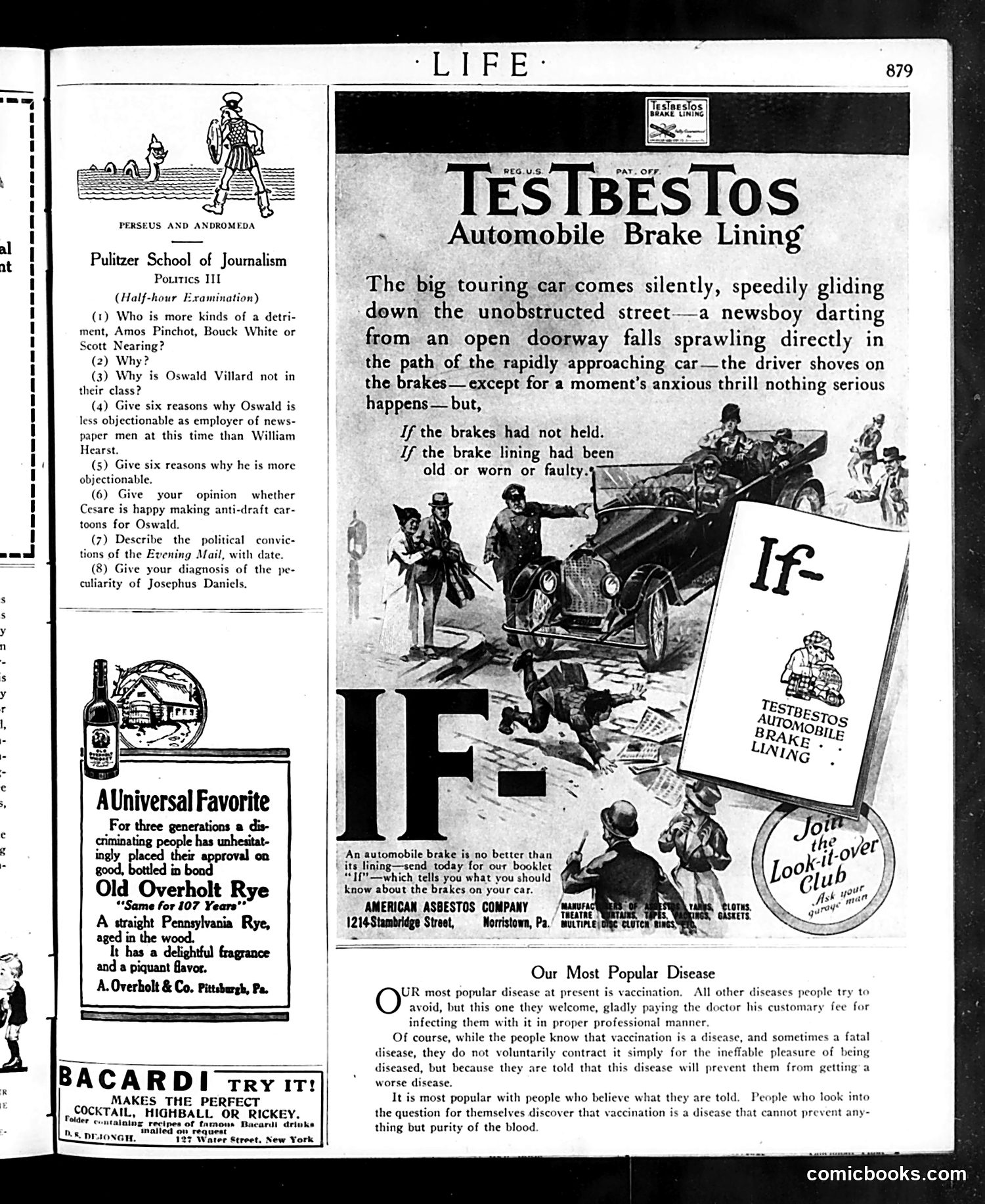
This page combines educational content with period advertising and social commentary. **Main Content:** The large advertisement for Testbestos automobile brake lining uses a dramatic scenario—a newsboy nearly struck by a car—to illustrate product importance. The "If" structure emphasizes that brake failure could be catastrophic, creating urgency for quality brake linings. **Educational Section:** The left column presents exam questions for a Pulitzer School of Journalism politics course, referencing contemporary figures like Amos Pinchot and William Hearst, suggesting debates about media ethics and employer conduct. **Social Commentary:** The essay "Our Most Popular Disease" critiques vaccination skepticism and blind acceptance of authority. It satirizes people who distrust vaccines while praising those who question claims independently—reflecting early-20th-century anti-vaccination sentiment and highlighting credulity regarding "purity of the blood." **Period Advertising:** Includes whiskey and cocktail ads typical of pre-Prohibition content. The page reflects Life's satirical mission: mixing consumer messaging with intellectual critique of public attitudes and media institutions.
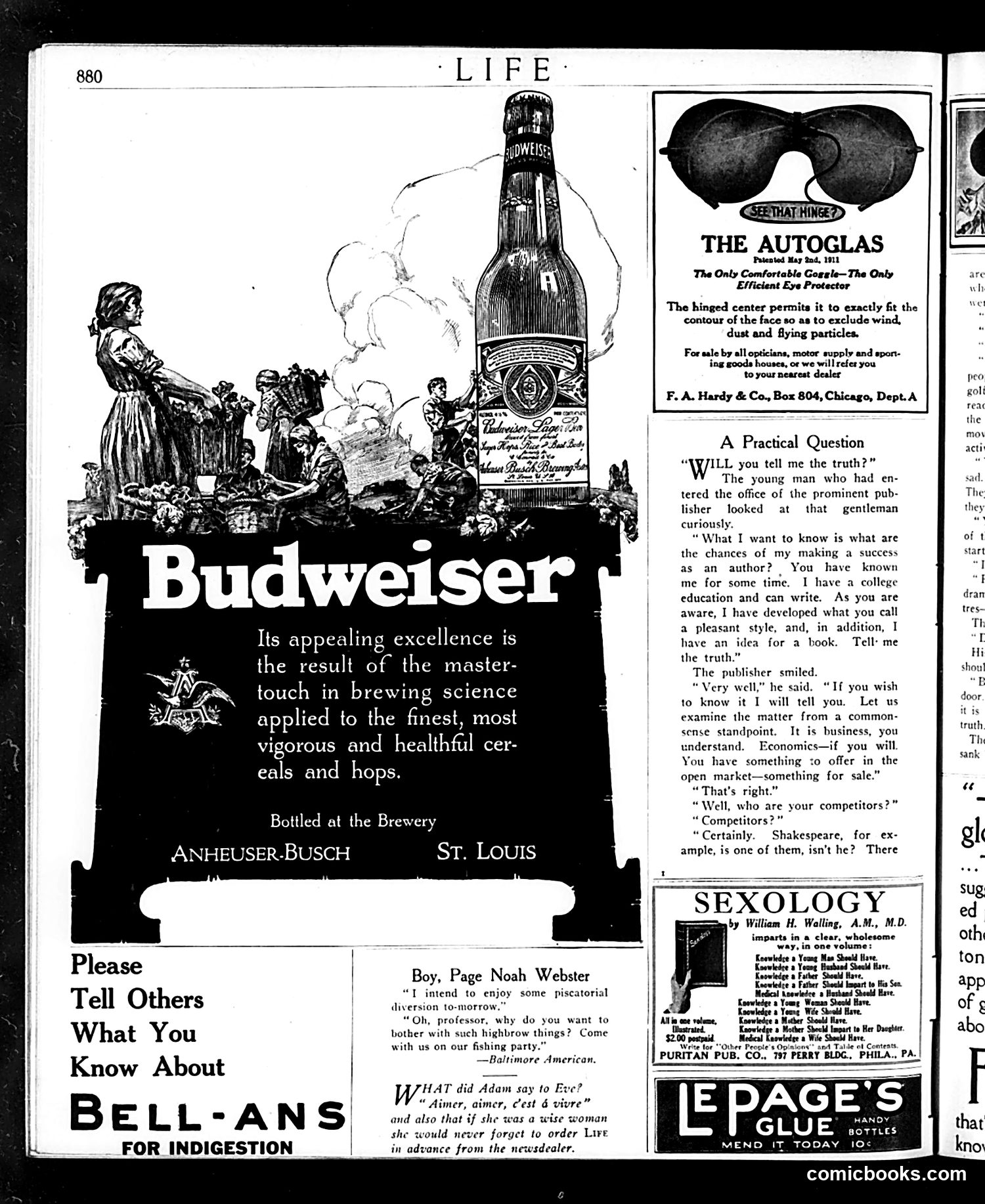
This page consists primarily of **advertisements** rather than editorial cartoons. The main content includes: **Budweiser ad** (dominant left side): A decorative illustration of a large beer bottle surrounded by cherubic figures, emphasizing "master-touch in brewing science" and finest ingredients. **"A Practical Question"** (center): A short humorous dialogue where a young aspiring author asks a publisher about his chances of success. The publisher's joke: Shakespeare is his competitor in the open market—a witty deflation suggesting the impossibility of competing with literary giants. The humor relies on the author's naive optimism meeting commercial reality. **Supporting advertisements** include Bell-Ans antacid, Autoglas motorist goggles, Sexology book, and LePage's Glue. The page reflects early 20th-century concerns (automobile safety, digestive complaints) and publishing industry skepticism toward amateur writers. There is **no political cartoon** per se; the satire is confined to the brief dialogue mocking romantic notions about literary success.
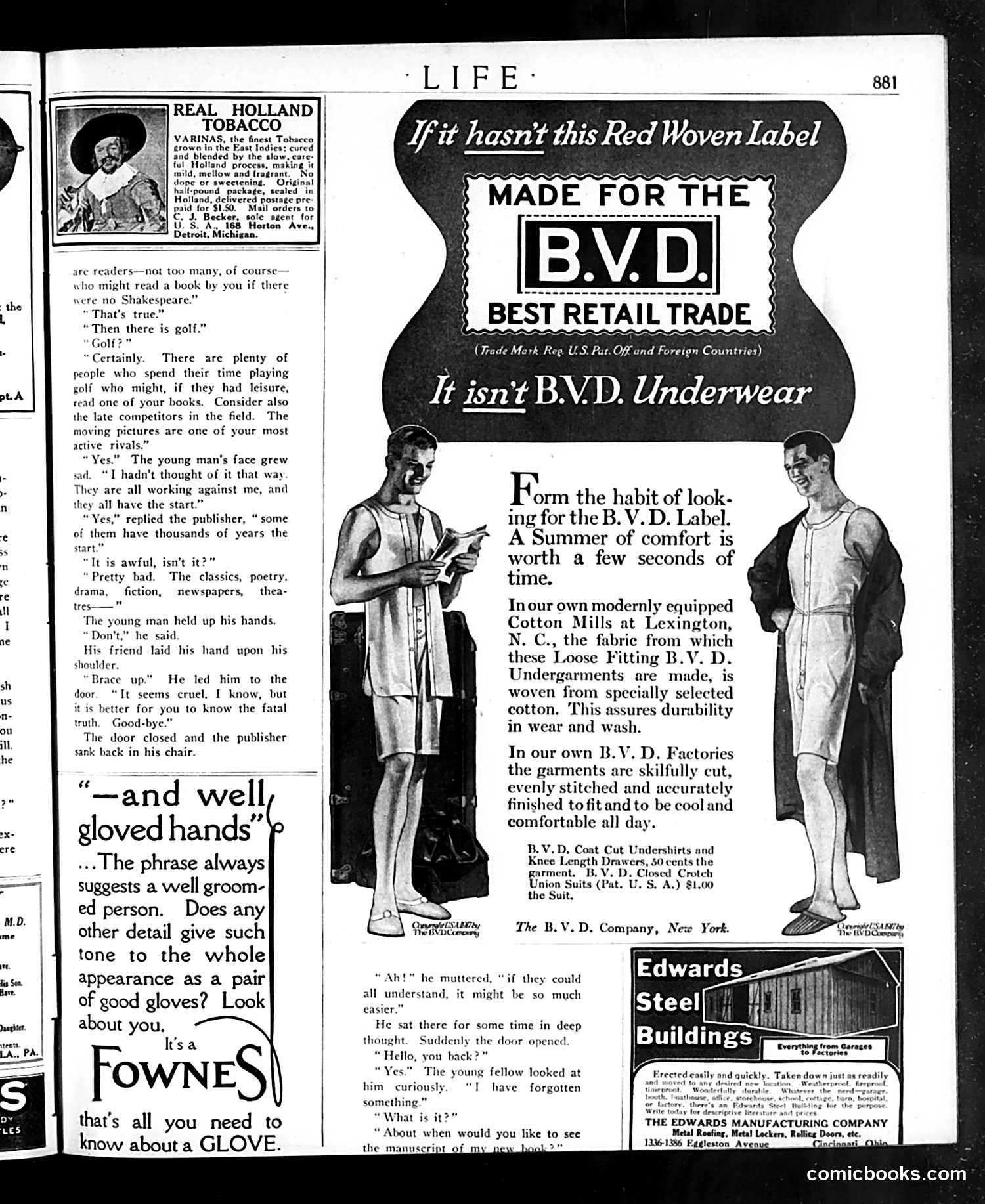
This page contains primarily **advertisements**, not political cartoons. The main content is a narrative dialogue between a young author and a publisher discussing the challenges of getting published. **The narrative's point:** The publisher discourages the young writer by listing competitors for readers' leisure time—Shakespeare, golf, moving pictures (cinema), and classics. He cynically suggests these rivals have "thousands of years the start," implying the new author cannot compete. **Social context for modern readers:** This reflects early 20th-century anxieties about mass entertainment fragmenting the reading audience. Moving pictures were then a relatively new threat to literature's cultural dominance. The dialogue satirizes publishers' defeatist attitudes toward new writers while acknowledging entertainment's proliferation. **Advertisements:** The page features three ads—Real Holland Tobacco, Fownes Gloves (emphasizing grooming), B.V.D. Underwear (with illustrations of men in undergarments), and Edwards Steel Buildings. These are straightforward product promotions typical of Life magazine's advertising model.
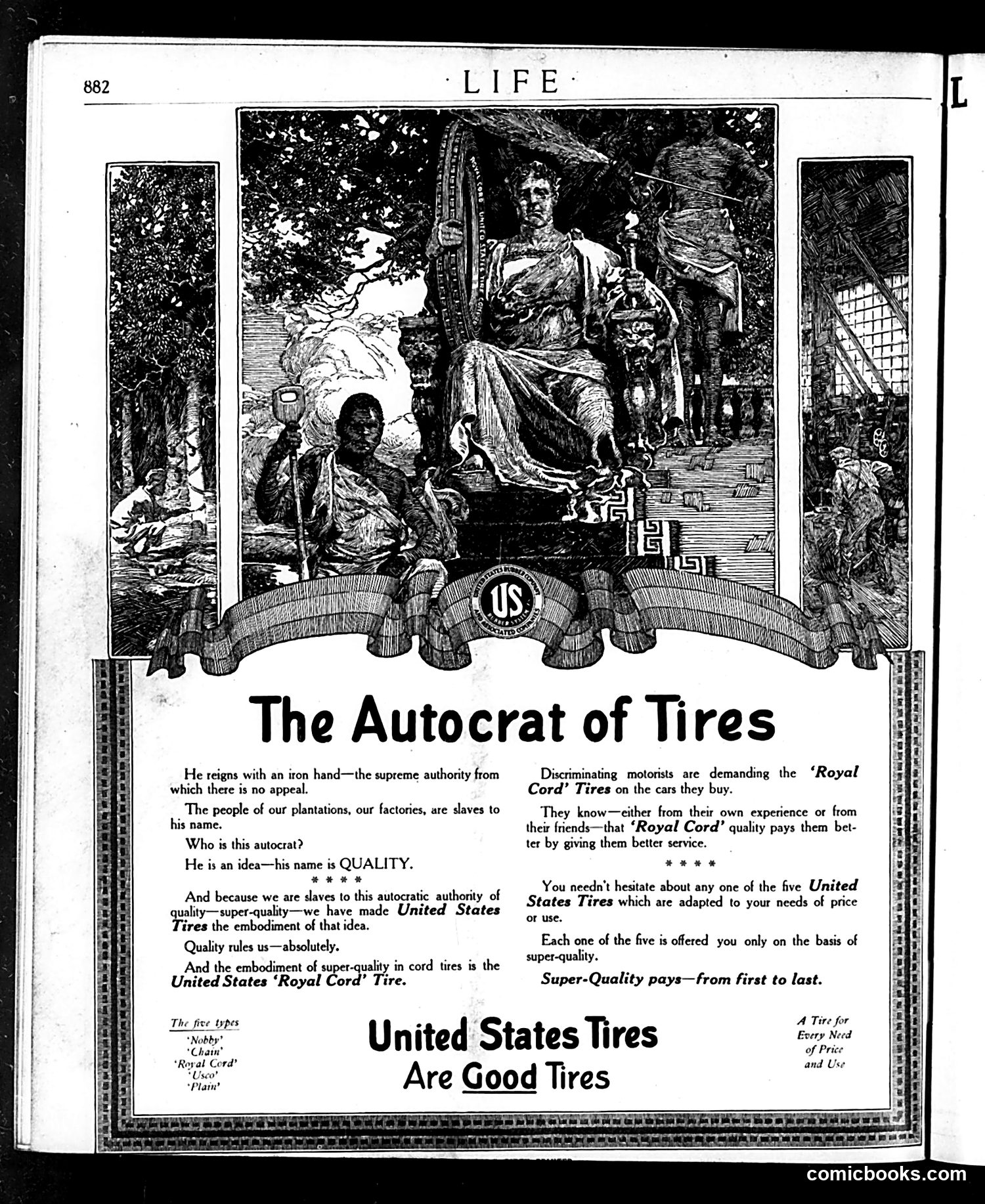
This is a **tire advertisement**, not political satire. United States Tires uses mock-grandiose language to sell their products. The central image depicts a classical female figure (representing "Quality") as an absolute monarch ruling over workers and factories—a deliberate metaphor presented as noble rather than critical. The text playfully calls Quality an "autocrat" with "iron hand" to which consumers are "slaves," but frames this as aspirational: people *want* to be governed by this authority because it guarantees superior tires. The ad targets "discriminating motorists" seeking the premium "Royal Cord" line, claiming quality justifies price. The five tire types mentioned ("Chain," "Royal Cord," etc.) suit different budgets while maintaining the "super-quality" promise. The classical, allegorical imagery and elaborate border design reflect early 20th-century advertising aesthetics. The "autocrat" conceit is clever wordplay rather than commentary—inverting tyranny into a selling point. For modern readers, the paternalistic tone (quality *ruling* consumers) reflects era-typical corporate messaging.