
Life, 1917-05-10 · page 30 of 46
Life — May 10, 1917 — page 30: what you’re looking at
What you’re looking at
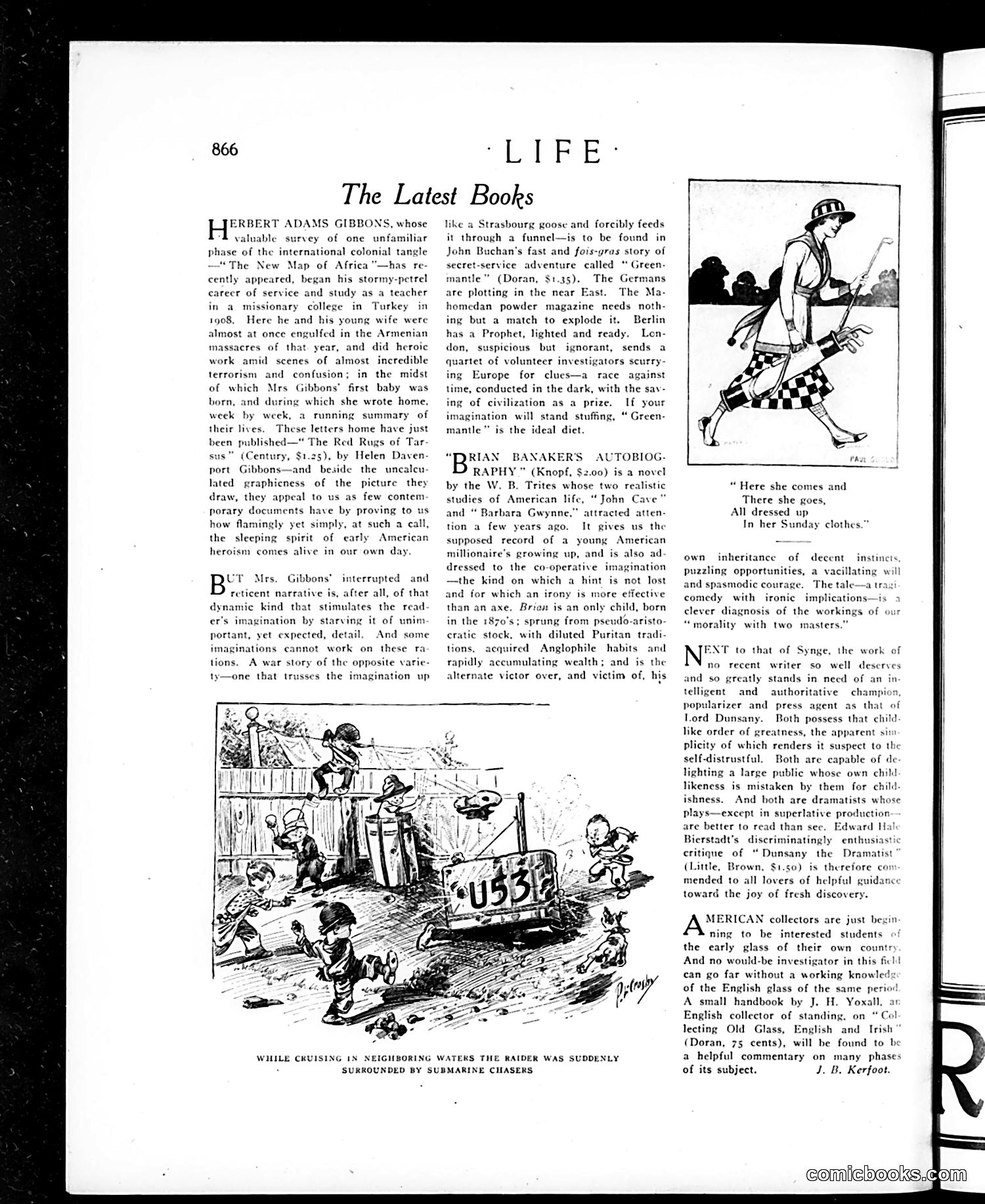
This is a book review section from *Life* magazine discussing recent literary releases. The lower illustration depicts a WWI naval scene: a submarine raider ("U-53" visible on the vessel) being surrounded by American submarine chasers. This references the real USS U-53, a German U-boat that surfaced near Newport, Rhode Island in October 1916, causing public alarm before America entered the war. The reviews discuss three books: Herbert Adams Gibbons' letters from the Armenian massacres (1908), John Buchan's espionage thriller "Greenmantle" (set during WWI with German plots in the Middle East), and W.B. Trites' novel about an American millionaire. The upper right illustration shows a woman in fashionable Sunday dress—likely satirizing contemporary fashion or gender roles. The cartoon's caption jokes about naval danger, fitting the wartime anxiety permeating the page's literary selections, which focus on conflict, espionage, and historical trauma.
📄 Transcribed text from this page (OCR, searchable)
Machine-transcribed from the original scan — historical spelling and the odd misread are preserved.
“LR E - The Latest Books RBERT ADAMS GIBBONS, whose valuable survey of one unfamiliar ¢ of the international colonial tangle The New Map of Africa"—has re- cently appeared, began his stormy-petrel study as a teacher in a college in Turkey in 1908. Here he and his young wife were almost at once engulfed in the Armenian massacres of that. year, did heroic work amid scenes of almost incredible terrorism and confusion; in the midst of which Mrs Gibbons’ first baby was born, and during which she wrote home, week by running summary of their lives, These letters home have just been published—" The Red Rugs of Tar (Centu Gibbons. career of service a missionary and week, a sus” $1.25), by Helen Daven -and beside the uncalcu lated graphicness of the picture they draw, they appeal to us as few contem porary documents have by proving to how flamingly yet simply, at such a call, the sleeping of early Ameri heroism comes alive in our own day. port spirit UT Mrs. Gibbons’ interrupted and reticent narrative is, after all, of that dynamic kind that stimulates the read er's imagination by starving it of unim portant, yet expected, detail And some work on these ra A war story of the opposite varie- ty—one that trusses the imagination up imaginations cannot tions. like a Strasbourg goose and forcibly feeds it through a funnel—is to be found in John Buchan's fast and fois-gras story of secret-service adventure called “ Green mantle” (Doran, $1.35). The Germans are plotting in the near East. The Ma- homedan powder magazine needs noth- ing but a match to explode it. Berlin has a Prophet, lighted and ready. Lor don, suspicious but ignorant, sends a quartet of volunteer investigators scurry- ing Europe for clues—a race against time, conducted in the dark, with the sav- ing of civilization as a prize. If your will stand stuffing, “ Green- is the ideal diet. imagination mantle” “DRIAN BANAKER'S AUTOBIOG- RAPHY ” (Knopf, $2.00) is a novel by the W. B. Trites whose two realistic studies of American life, “John Cave and “ Barbara Gwynne,” attracted atten- tion a few years ago. It supposed record of a young American millionaire’s growing up, and is also ad gives us the dressed to the co-operative imagination —the kind on which a hint and for which an irony is more effective than an axe, Brian is an only child, born in the 1870's; sprung from pseudo-aristo cratic with diluted Puritan tradi acquired Anglophile habits. ; rapidly accumulating wealth; and is the alternate victor over, and victim of, his is not lost tions, WHILE CRUISING 1N NEIGHBORING WATERS THE RAIDER WAS SUDDENLY SURROUNDED BY SUBMARINE CHASERS “ Here she comes and There she goes, All dressed up In her Sunday clothes.” decent — instincts a vacillating will The tale—a tras implications—i own inheritance of puzzling opportunities, and spasmodic coura comedy with clever diagnosis of the workings of our ironic “morality with two masters.” N T to that of Synge, the work of no recent writer so well and so greatly stands in need of telligent and authoritative ch popularizer and press agent as that of Lord Dunsany. Both possess that chi like order of greatness, the apy plicity of which renders it suspect to the self-distrustful. Both are capable of de lighting a large public whose own child likeness is mistaken by them for child ishness. And hoth are dramatists whose plays—except in superlative production are better to read than sec, Edward Hal Bierstadt's discriminatingly enthusiastic critique of “Dunsany the (Little, Brown, $1.50) is therefore cov mended to all lovers of helpful guidance toward the joy of fresh discovery. deserves an in rent sin Dramatist MERICAN collectors are just begin ning to be interested the early glass of their own countr And no would-be investigator in this ficl! can go far without a working knowled of the English glass of the same perio’ A small handbook by J. H. Yoxall, ar English collector of standing, on “C lecting Old Glass, English and (Doran, 75 cents), will be found to bi a helpful commentary on many phases of its subject. J. B. Kerfoot. students Trish comichooks.com