
Life, 1917-05-10 · page 20 of 46
Life — May 10, 1917 — page 20: what you’re looking at
What you’re looking at
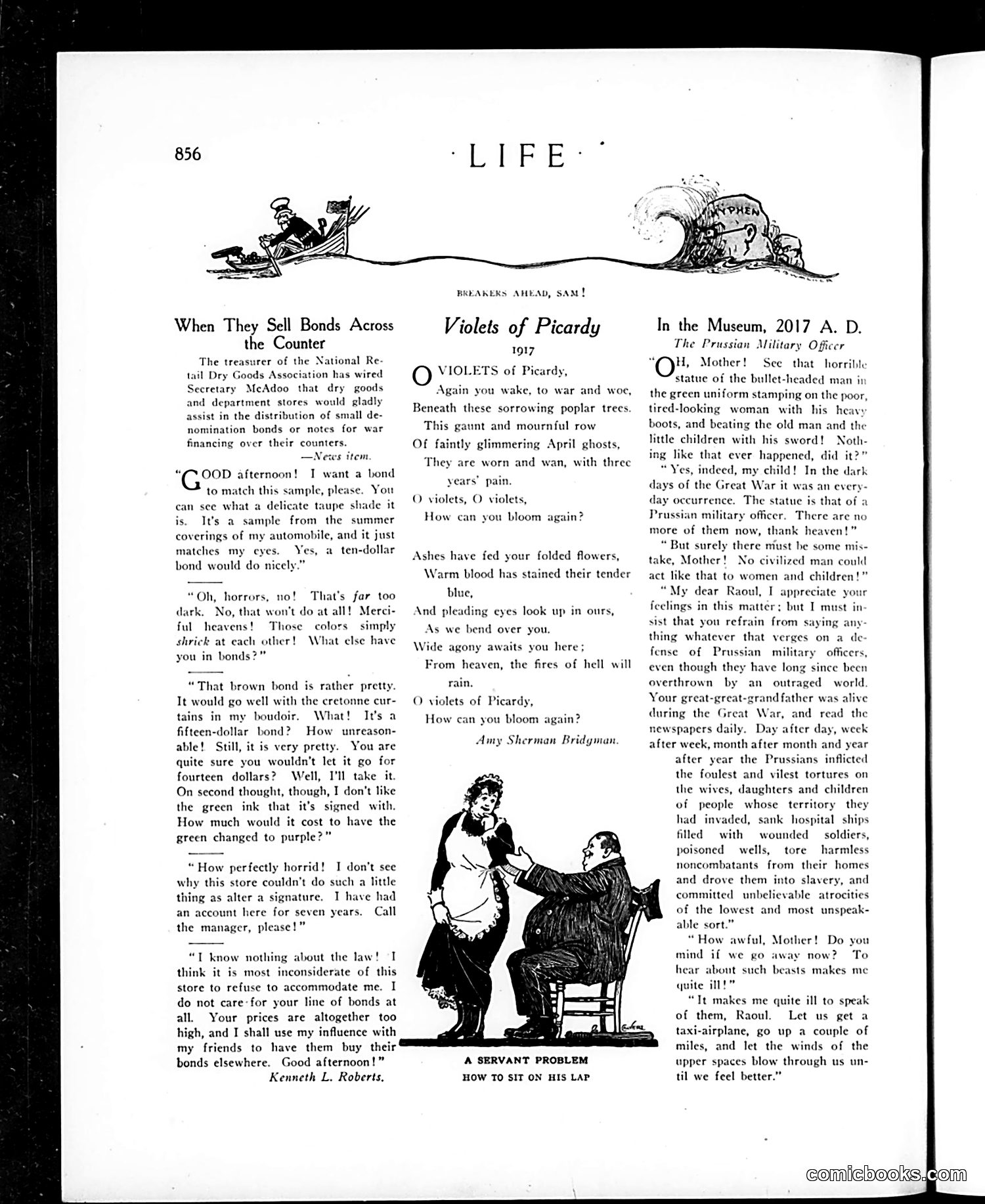
**Left cartoon** ("When They Sell Bonds"): Satirizes frivolous wartime bond-purchasing. A vain female customer treats war bonds like fabric swatches, obsessing over colors matching her automobile upholstery and complaining about prices and signatures. The joke mocks citizens who won't sacrifice during WWI, treating national financing as a fashion concern. **Right section** ("Violets of Picardy"): A sentimental poem mourning the destruction of the Picardy region in France during WWI trench warfare. "Violets" symbolize innocence destroyed by three years of brutal conflict. **Bottom-right dialogue** (2017 A.D. museum scene): Projects forward to future generations viewing a statue of a Prussian officer. A mother educates her son about documented German atrocities—poisoning wells, sinking hospital ships, enslaving civilians—to justify why such monuments exist and why Prussian militarism deserves permanent condemnation. This frames German wartime conduct as historically documented brutality. Context: Published as the U.S. entered WWI, the page contrasts American consumer selfishness with European suffering and German war crimes.
📄 Transcribed text from this page (OCR, searchable)
Machine-transcribed from the original scan — historical spelling and the odd misread are preserved.
When They Sell Bonds Across the Counter The treasurer of the National Re tail Dry Goods Asso n has wired Secretary McAdoo that dry goods and department stores would gladly assist in the distribution of small de- nomination bonds or notes for war financing over their counters. item 7G oor afternoon! I want a bond to match this sample, please. You an see what a delicate taupe shade it is. It's a sample from the summer coverings of my automobile, and it just matches my eyes. Yes, a ten-dollar bond would do nicely.” “Oh, horrors, no! That's far too dark. No, that won't do at all! Merci ful heavens! Those colors simply shrick at cach other! What else have you in bonds? “That brown bond is rather pretty. It would go well with the cretonne cur- tains in my boudoir, What! It’s a fifteen-dollar bond? How unreason- able! Still, it is very pretty. You are quite sure you wouldn't let it go for fourteen dollars? Well, I'll take it. On second thought, though, I don’t like the green ink that it’s signed with. How much would it cost to have the green changed to purple?” How perfectly horrid! I don't see why this store couldn't do such a little thing as alter a signature. I have had an account here for seven rs. Call the manager, please!” “T know nothing about the law! | think it is most inconsiderate of this store to refuse to accommodate me. I do not care:for your line of bonds at all. Your prices are altogether too high, and I shall use my influence with my friends to have them buy their bonds elsewhere. Good afternoon!” Kenneth L. Roberts, BREAKERS AHEAD, SAM! Violets of Picardy 1917 O VIOL S of Picardy, Again you wake, to war and woe, Beneath these sorrowing poplar trees. This gaunt and mournful row Of faintly glimmering April ghosts, They are worn and wan, with three years’ pain. © violets, O violets, How can you bloom again? Ashes have fed your folded flowers, Warm blood has stained their tender blue, And pleading eyes look up in ours, As we bend over you. Wide agony awaits you here; From heaven, the fires of hell will rain, O violets of Picardy, How can you bloom again? crman Bridgman. A SERVANT PROBLEM HOW TO SIT ON HIS LAP In the Museum, 2017 A. D. The Prussian Military Oficer * H, Mother! See that horrible statue of the bullet-headed man ir the green uniform stamping on the poor, tired-looking woman with his heavy boots, and beating the old man and the little children with his sword! Noth- ing like that ever happened, did it?” “Yes, indeed, my child! In the dark days of the Great War it was an every- day occurrence. The statue is that of a Prussian military officer. There are no more of them now, thank heaven!” “But surely there must be some mis- take, Mother! No civilized man could act like that to women and children!” “My dear Raoul, I appreciate your feelings in this matter; but I must i sist that you refrain from saying any- thing whatever that verges on a de fense of Prussian military officers, even though they have long since been overthrown by an outraged world Your great-great-grand father was alive during the Great War, and read the newspapers daily. Day after day, week after week, month after month and year after year the Prussians inflicted the foulest and vilest tortures on the wives, daughters and children of people whose territory they had invaded, sank hospital ships filled with wounded _ soldiers, poisoned wells, tore harmless noncombatants from their homes and drove them into slavery, and committed unbelievable atrocities of the lowest and most unspeak- able sort.” “How awful, Mother! Do you mind if we go away now? To hear ut such beasts makes me quite ill!” “Tt makes me quite ill to speak of them, Raoul. Let us get a taxi-airplane, go up a couple of miles, and let the winds of the upper spaces blow through us un- til we feel better.” Onn