
Life, 1917-05-10 · page 29 of 46
Life — May 10, 1917 — page 29: what you’re looking at
What you’re looking at
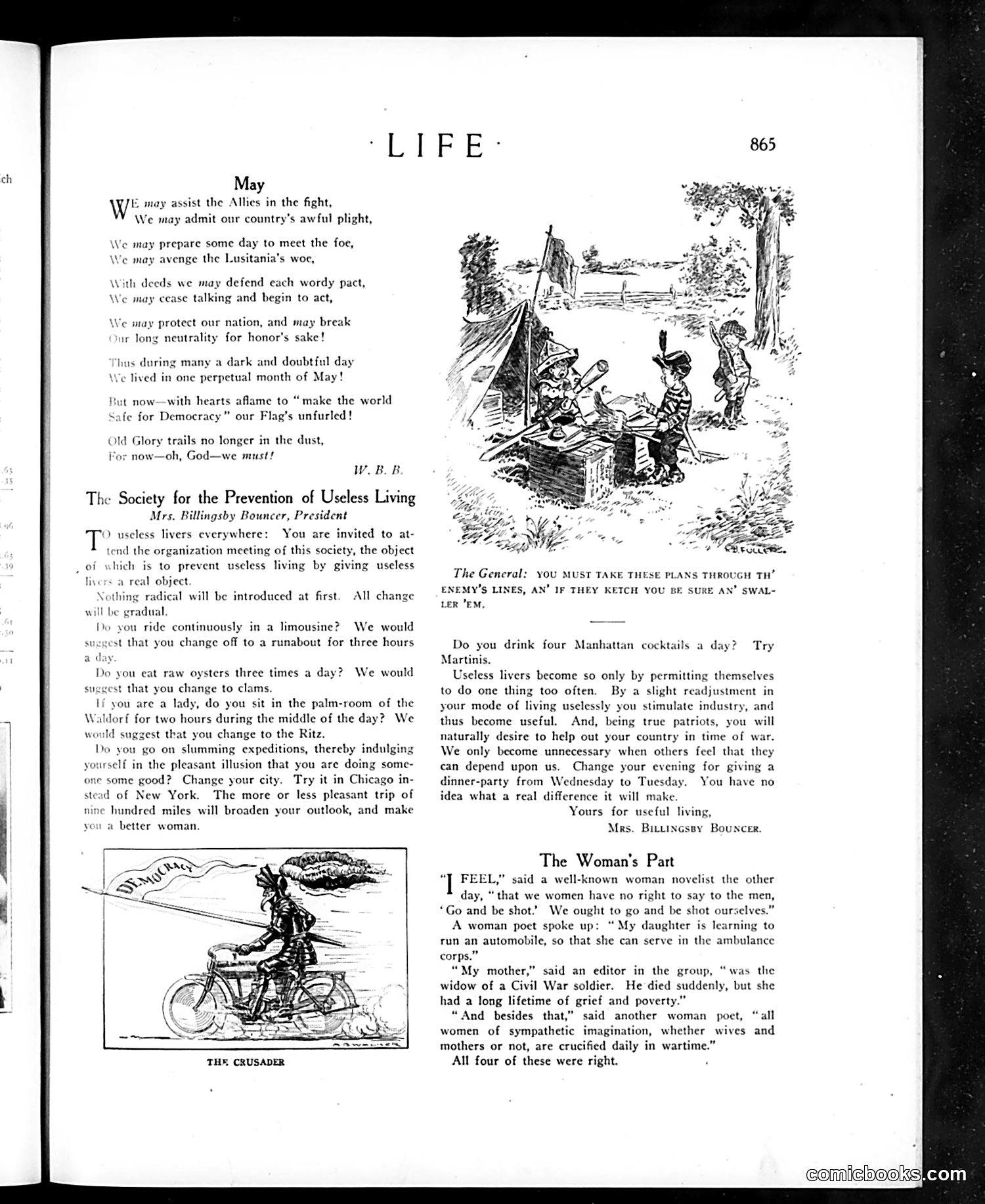
This satirical page addresses American entry into World War I, likely from 1917. **"May" poem** (top left): Uses wordplay on the month to mock America's prolonged hesitation before joining the Allies. It catalogs possible justifications (avenging the *Lusitania*, defending democracy) while criticizing endless delay—"we lived in one perpetual month of May." The shift to "now—we must!" marks America's actual commitment to war. **"Society for the Prevention of Useless Living"**: Satirizes wealthy Americans' excess consumption through absurdist advice. Mrs. Bouncer suggests minor lifestyle adjustments (switching cocktails, changing where one dines) as patriotic wartime sacrifice. The satire mocks the trivial "contributions" of the leisure class versus actual wartime sacrifice. **Illustrations**: "The Crusader" (bicycle rider with sword) and the General's scene suggest military commitment contrasting the civilians above. **"The Woman's Part"** (bottom): Addresses women's wartime roles—ambulance driving, nursing, emotional suffering—acknowledging their contributions beyond combat.
📄 Transcribed text from this page (OCR, searchable)
Machine-transcribed from the original scan — historical spelling and the odd misread are preserved.
May W may assist the Allies in the fight, We may admit our country’s awful plight, \Ve may prepare some day to meet the foe, We may avenge the Lusitania’s woe, With deeds we may defend each wordy pact, We may cease talking and begin to act, We may protect our nation, and may break ir Jong neutrality for honor's sake! hus during many a dark and doubtful day \We lived in one perpetual month of May! Rut now—with hearts aflame to “make the world Safe for Democracy” our Flag’s unfurled! Old Glory trails no longer in the dust, For now—oh, God—we must! W.B. B. The Society for the Prevention of Useless Living Mrs. Billingsby Bouncer, President T° useless livers everywhere: You are invited to at- tend the organization meeting of this society, the object _ of which is to prevent uscless living by giving uscless livers a real object Nothing radical will be introduced at first. All change will be gradual. No you ride continuously in a limousine? We would suggest that you change off to a runabout for three hours a day Do you eat raw oysters three times a day? We would suggest that you change to clams. If you are a lady, do you sit in the palm-room of the Waldorf for two hours during the middle of the d We would suggest that you change to the Ritz. Do you go on slumming expeditions, thereby indulging yourself in the pleasant illusion that you are doing some- one some good? Change your city. Try it in Chicago in- stead of New York. The more or less pleasant trip of ne hundred miles will broaden your outlook, and make a better woman. THR CRUSADER The General: you MUST TAKE THESE PLANS THROUGH TH’ ENEMY’S LINES, AN’ IF THEY KETCH YOU BE SURI LER EM, Do you drink four Manhattan cocktails a day? Try Martinis, Useless livers become so only by permitting themselves to do one thing too often. By a slight readjustment in your mode of living uselessly you stimulate industry, and thus become useful. And, being true patriots, you will naturally desire to help out your country in time of war. We only become unnecessary when others feel that they can depend upon us. Change your evening for giving a dinner-party from Wednesday to Tuesday. You have no idea what a real difference it will make. Yours for useful living, Mrs. Bittincssy Bouncer. The Woman's Part “| FEEL,” said a well-known woman novelist the other day, “that we women have no right to say to the men, ‘Go and be shot.’ We ought to go and be shot ourselves.” A woman poet spoke up: “My daughter is learning to run an automobile, so that she can serve in the ambulance corps.” My mother,” said an editor in the group, “was the widow of a Civil War soldier. He died suddenly, but she had a long lifetime of grief and poverty.” “And besides that,” said another woman poet, “all women of sympathetic imagination, whether wives and mothers or not, are crucified daily in wartime.” All four of these were right. comichooks .com