
Life, 1917-05-10 · page 22 of 46
Life — May 10, 1917 — page 22: what you’re looking at
What you’re looking at
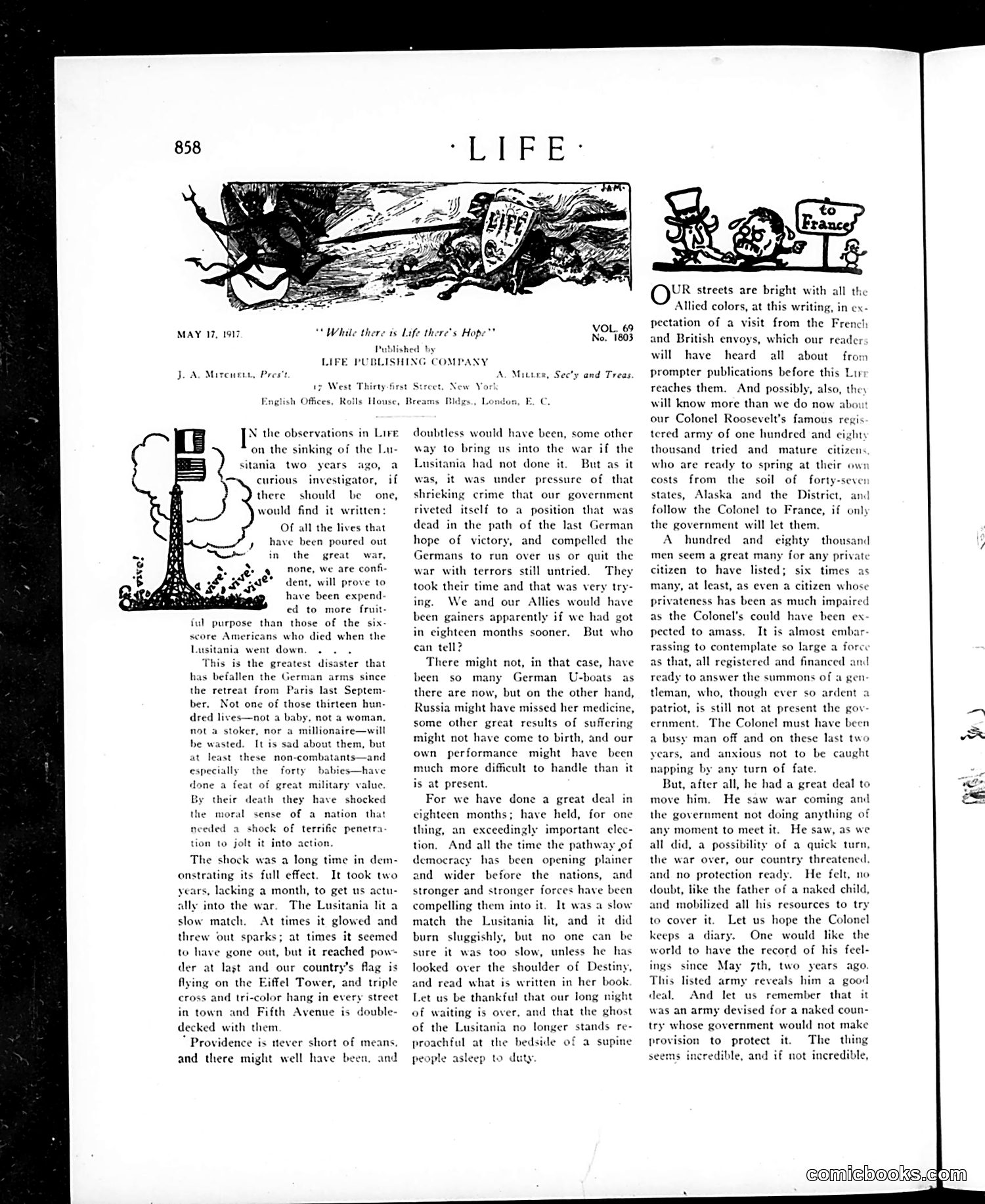
This page discusses the sinking of the RMS *Lusitania* (1915), using it to explain America's entry into World War I two years later. The author argues the ship's destruction—killing 1,298 people, including 128 Americans—was a "greatest disaster" for Germany because it shocked American public opinion, eventually forcing the U.S. government into action against Germany. The cartoon (top left) appears to show the *Lusitania* sinking with the caption "While there is Life there's Hope," ironically contrasting the ship's name with its destruction. The satire criticizes Germany's U-boat warfare as a strategic blunder: the moral outrage it generated proved more militarily valuable to the Allies than the actual lives lost. The author suggests divine providence worked through tragedy to mobilize American democracy toward entering the war.
📄 Transcribed text from this page (OCR, searchable)
Machine-transcribed from the original scan — historical spelling and the odd misread are preserved.
MAY 17, 1917 “While there ts Life there's He VOL. 69 No, 1803 Published by LIFE ty West Thirty English Offices, Rolls House, Breams Bldgs., the observations in Lire king of the Lu- years on the si sitania two ago, a curious investigator, if there would find it written: Of all the lives that have been poured out in the grea war, none, we are confi- should be one, dent, will prove to have been expend ed to more fruit- ial purpose than those of the six- score Americans who died when the Lusitania we This is the greatest disaster that has befallen the German arms since the retreat from Paris last Septem- ber, Not one of those thirteen hun- dred lives—not a baby, not a woman. down, 2... not a stoker, nor a millionaire—will It is sad about them, but these non-combatants—and forty be wasted. at least done a feat of great military value. they have shocked their death sense of a nation th needed a shock of terrific penetra tion to jolt it into action. the moral The shock was a long time in dem- onstrating its full effect. It took two years, lacking a month, to get us actu- ally into the war. The Lusitania lit a At times it glowed and threw out sparks; at times it seemed to have gone out, but it reached pow der at last and our country’s flag is flying on the Eiffel Tower, and triple cross and tri-color hang in every street in town and Fifth Avenue is double- decked with them * Providence is ttever short of means, and there might well have been, and slow match. inst Stree PUBLISHING COMPANY A. Miturs, New York ty and Treas doubtless would have been, some other way to bring us into the war if the Lusitania had not done it. But as it was, it under that shrieking crime that our government riveted itself to a position that was dead in the path of the last German hope of victory, and compelled the Germans to run over us or quit the war with terrors still untried. They took their time and that was very try We and our Allies would have ners apparently if we had got But who was pressure of ing. been in eighteen months sooner. can tell? There might not, in that case, have been so many German U-bo: there are now, but on the other ha Russia might have missed her medicine, some other great results of suffering might not have come to birth, and our own performance might have been much more difficult to handle than it is at present. For we have done a great deal in eighteen months; have held, for one thing, an exceedingly important elec- tion. And all the time the pathway of democracy has been opening plainer and wider before the nations, and stronger and stronger forces have been compelling them into it. It was a slow match the Lusitania lit, and it did burn sluggishly, but no one can be sure it was too slow, unless he has looked over the shoulder of Destiny, and read what is written in her book. Let us be thankful that our long night of waiting is over, and that the ghost of the Lusitania no longer stands re- proachfal at the bedside of a supine people asleep to duty UR streets are bright with all the Allied colors, at this writing, in ex- pectation of a visit from the Frencl: and Br which our reader will heard all about prompter publications before this Lir reaches them. And possibly, also, they will know more than we do now about our Colonel Roosevelt’s famous regis tered army of one hundred and thousand tried and mature who are ready to spring at their ow: costs from the soil of forty-sever Alaska and the District, and follow the Colonel to France, if only the government will let them. A hundred and eighty thousand men seem a great many for any private citizen to have listed; sis many, at least, as even a citizen whose privateness has been as much impaired as the Colonel's could have by pected to amass. rassing to contemplate so large a force as that, all registered and financed and ready to answer the summons of a gen ish envoy have from ghty citizens states, times as en ex It is almost embar tleman, who, though ever so ardent patriot, is still not at present the gov ernment. The Colonel must have been a busy man off and on these last two year nd anxious not to be caught napping by any turn of fate. But, after all, he had a great deal to move him. He saw war coming and the government not doing anything of any moment to meet it. He saw, a all did, a possibility of a quick turn, the war over, our country threatened. and no protection ready. He felt, no doubt, like the father of a naked child, and mobilized all his resources to try to cover it. Let us hope the Colonel keeps a diary, One would like the world to have the record of his feel- ings since May 7th, two years ago. This listed army reveals him a good deal. And let us remember that it was an army devised for a naked coun- try whose government would not make provision to protect it. The thing s incredible, and if not incredible, s we comichooks.com