
Life, 1917-05-10 · page 14 of 46
Life — May 10, 1917 — page 14: what you’re looking at
What you’re looking at
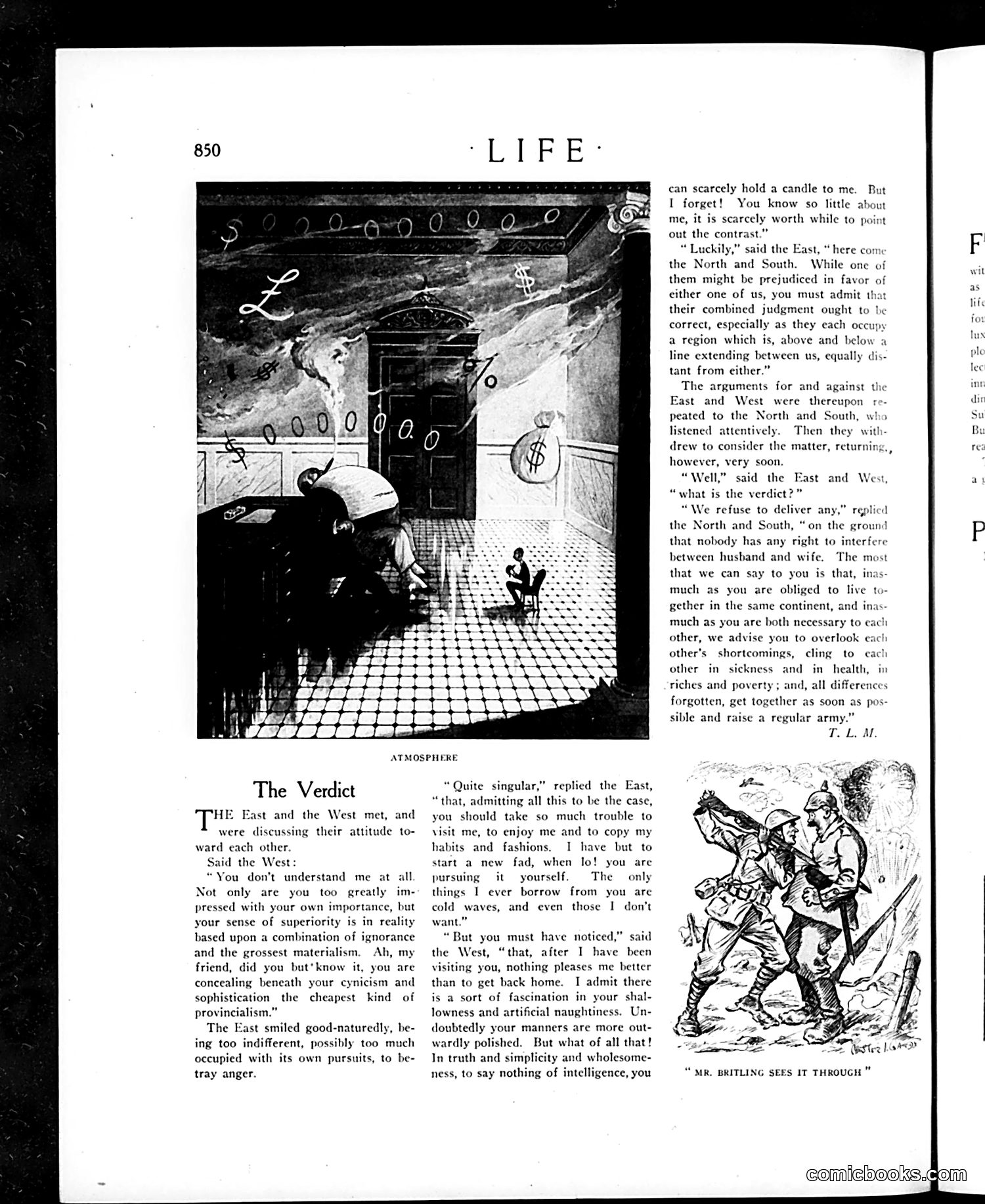
This page presents a satirical allegorical debate between personified East and West regions (likely representing American geographical/cultural divisions). The two parties argue over marital discord, with the North and South initially mediating. The central illustration shows a domestic interior with symbolic figures, labeled "ATMOSPHERE." The East accuses the West of materialism and provincialism; the West counters that the East's sophistication masks arrogance and sterility. Their verdict: despite mutual criticism, they acknowledge necessary interdependence and advise reconciliation, recommending they "get together as soon as possible and raise a regular army." The satire critiques regional American rivalries while suggesting unity is essential, possibly referencing pre-WWI or wartime solidarity concerns. The illustration credited to T.L.M. supports this commentary through visual metaphor.
📄 Transcribed text from this page (OCR, searchable)
Machine-transcribed from the original scan — historical spelling and the odd misread are preserved.
ATMOSPHERE The Verdict HE East and the West met, and were discussing their attitude to- ward each other. Said the West: “You don’t understand me at all Not only are you too greatly im- pressed with your own importance, but your sense of superiority is in reality based upon a combination of ignorance and the grossest materialism. Ah, my friend, did you but*know it, you are concealing beneath your cynicism and sophistication the cheapest kind of provincialism.” The East smiled good-naturedly, be- ing too indifferent, possibly too much occupied with its own pursuits, to be- tray anger. “Quite singular,” replied the East, “that, admitting all this to be the case, you should take so much trouble to visit me, to enjoy me and to copy my habits and fashions. I have but to start a new fad, when lo! you are pursuing it yourself. The — only things 1 ever borrow from you are cold waves, and even those I don’t want.” “But you must have noticed,” said the West, “that, after I have been visiting you, nothing pleases me better than to get back home. I admit there is a sort of fascination in your shal- lowness and artificial naughtiness. Un- doubtedly your manners are more out- wardly polished. But what of all that! In truth and simplicity and wholesome- ness, to say nothing of intelligence, you can scarcely hold a candle to me. But I forget! You know so little about me, it is scarcely worth while to point out the contrast.” “Luckily,” said the East, “here c the North and South. While one of them might be prejudiced in favor of either one of us, you must admit their combined judgment ought to be correct, especially as they each occu a region which is, above and belc line extending between us, equally dis- tant from either.” The arguments for and against the East and West were thereupon re- peated to the North and South, who listened attentively. Then they wit! drew to consider the matter, returni however, very soon. “Well,” said the East and West, “what is the verdict? “We refuse to deliver any,” replicd the North and South, “on the ground that nobody has any right to interfere between husband and wife. The most that we can say to y uu is that, in; much as you are obliged to live gether in the same continent, and in. much as you are both necessary to each other, we advise you to overlook eacl: other's shortcomings, cling to cach other in sickness and in health, in riches and poverty ; and, all differences forgotten, get together as soon as pos- sible and raise a regular army. T. L. M. “MR, BRITLING SEES IT THROUGH ” comichooks.gqom