
A complete issue · 32 pages · 1916
Life — July 27, 1916
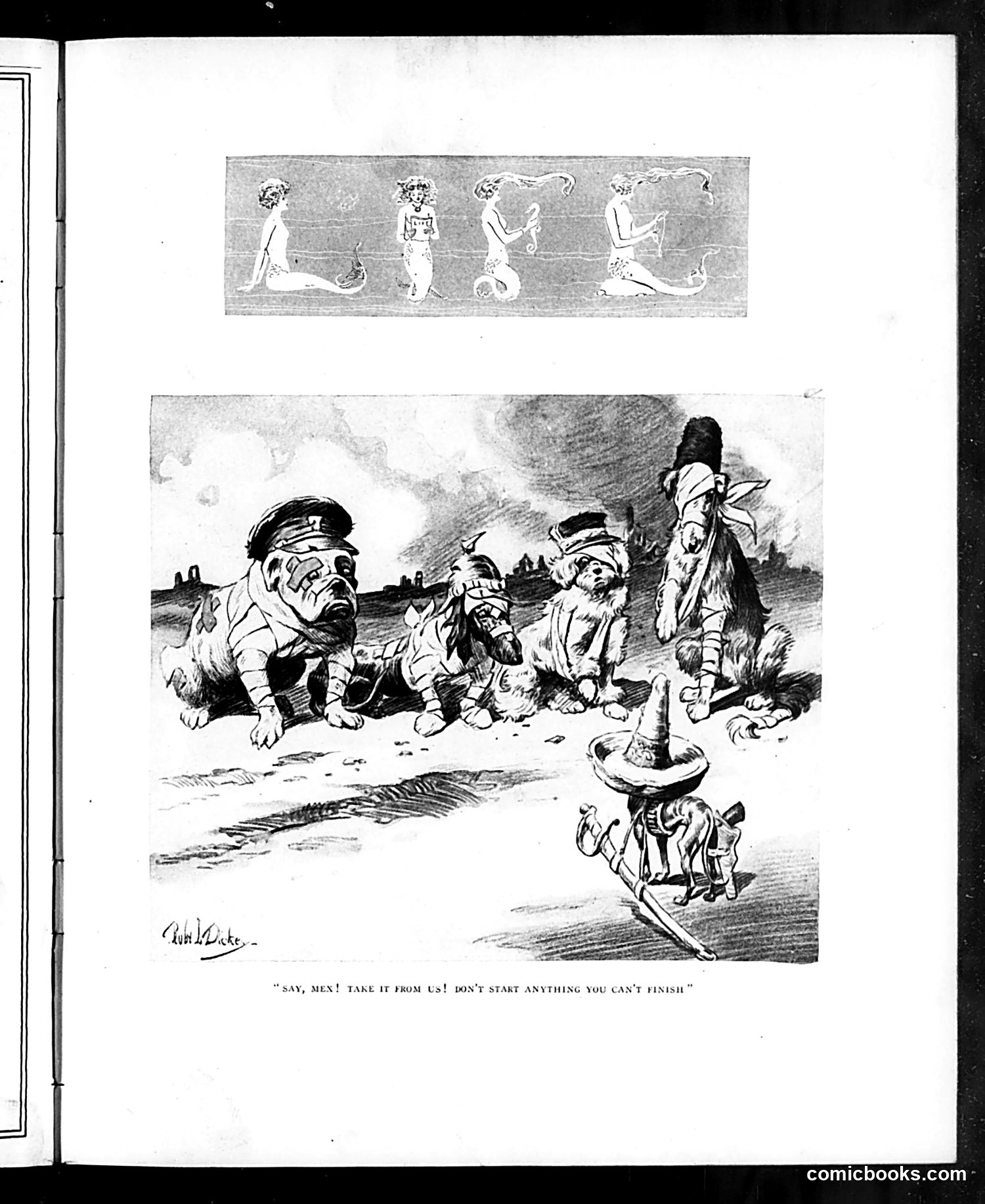
The main cartoon depicts anthropomorphized dogs in military attire on a battlefield, with one small figure (labeled "Mexico") approaching them with what appears to be a sword or weapon. The caption reads: "SAY, MEX! TAKE IT FROM US! DON'T START ANYTHING YOU CAN'T FINISH." This is political satire warning Mexico against military conflict, likely referencing tensions during the Mexican Revolution or U.S.-Mexico border disputes of the early 1900s. The dogs represent the United States (or Allied powers), depicted as tough soldiers advising Mexico not to engage in warfare it cannot win. The cartoonist (signed "Cesare") uses animal caricature—a common Life magazine technique—to satirize international relations through crude, menacing humor typical of the era's imperialist attitudes.
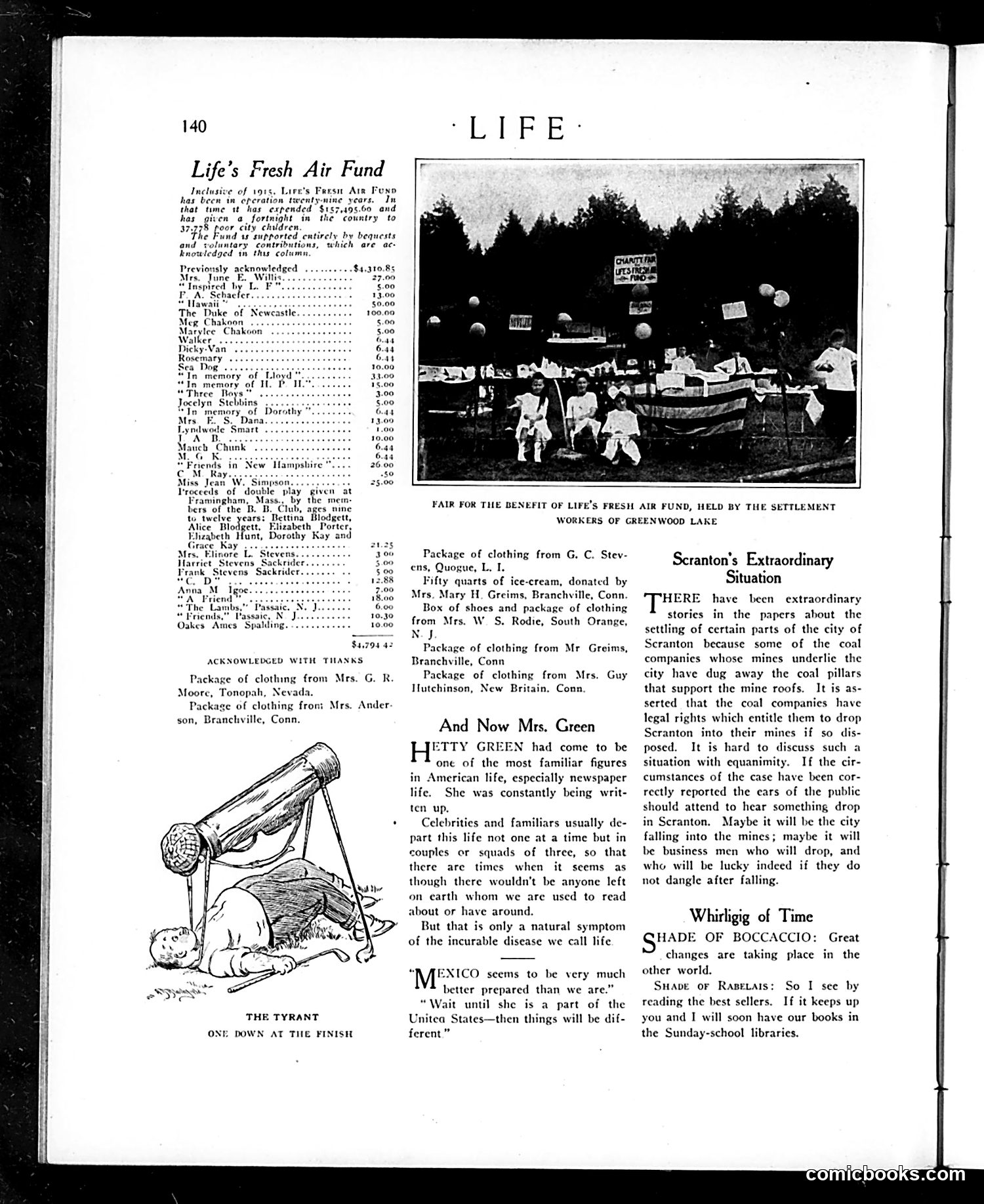
**"The Tyrant: One Down at the Finish"** This political cartoon depicts a military general or authoritarian leader defeated, shown prostrate beneath a large cannon. The figure appears to represent a deposed dictator or military ruler, with the cannon symbolizing the force that brought about his downfall. The title suggests a satisfying conclusion to tyrannical rule. Without additional context from the magazine's date, I cannot identify the specific historical figure or event referenced. However, the cartoon clearly celebrates the overthrow of authoritarian government through military/revolutionary action—a common theme in Life's satirical commentary on international politics during the early-to-mid twentieth century. The page also contains fundraising information for Life's Fresh Air Fund, unrelated to the political satire.
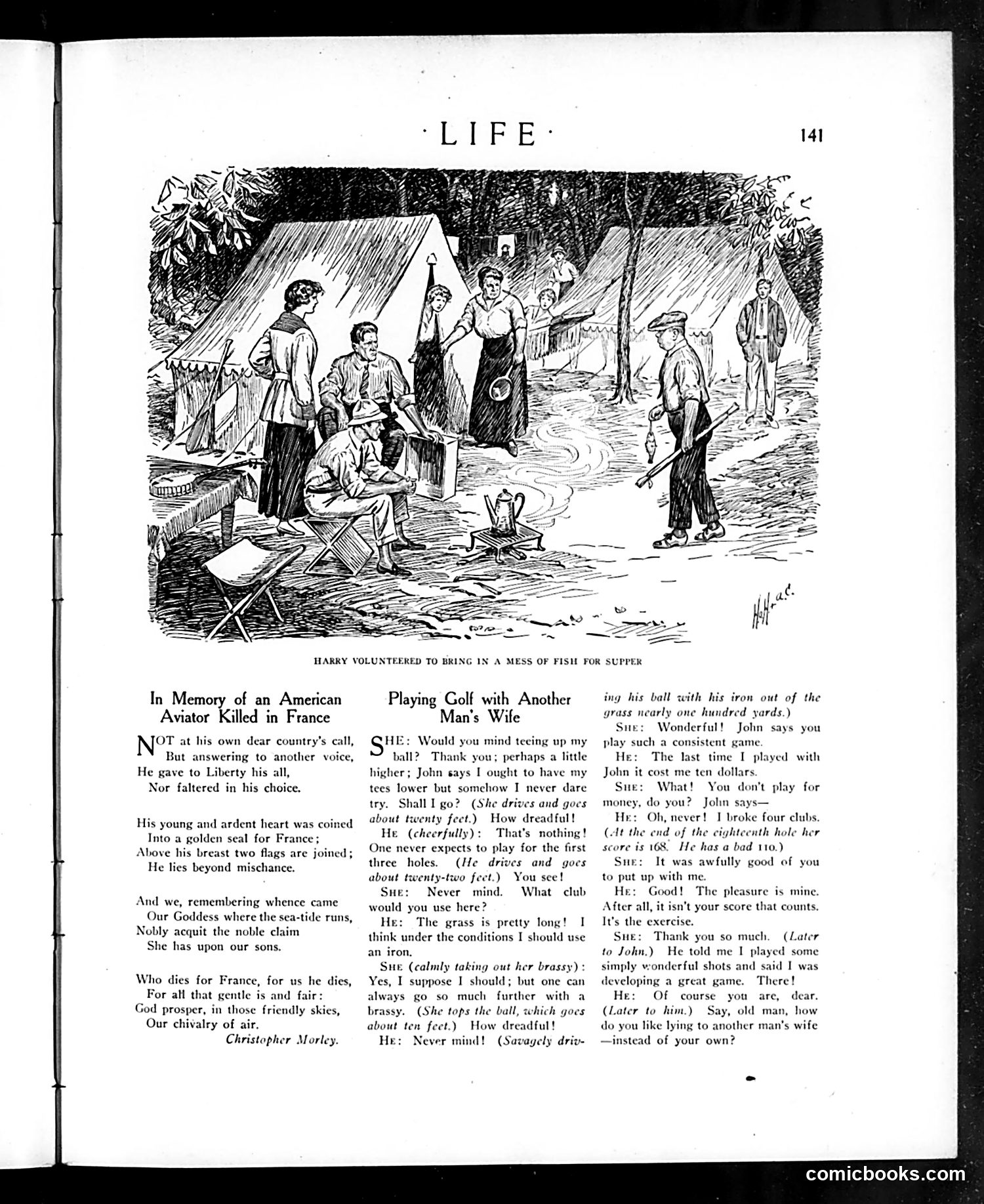
This page contains two distinct pieces: **Top illustration:** A camping scene captioned "Harry volunteered to bring in a mess of fish for supper." The sketch shows a man at a campsite with multiple tents and people. The humor appears to be a domestic comedy setup—likely Harry overcommitted to providing food but may fail to deliver. **Bottom content:** A poem titled "In Memory of an American Aviator Killed in France" by Christopher Morley, honoring a pilot who died in World War I. This is serious, patriotic verse about sacrifice. **Right column:** A humorous dialogue titled "Playing Golf with Another Man's Wife," depicting a couple's banter about golf etiquette and performance. The wife playfully needles the husband about his golfing abilities while they play. The page mixes lighthearted domestic humor with solemn wartime remembrance—typical of Life magazine's satirical but patriotic approach during the WWI era.
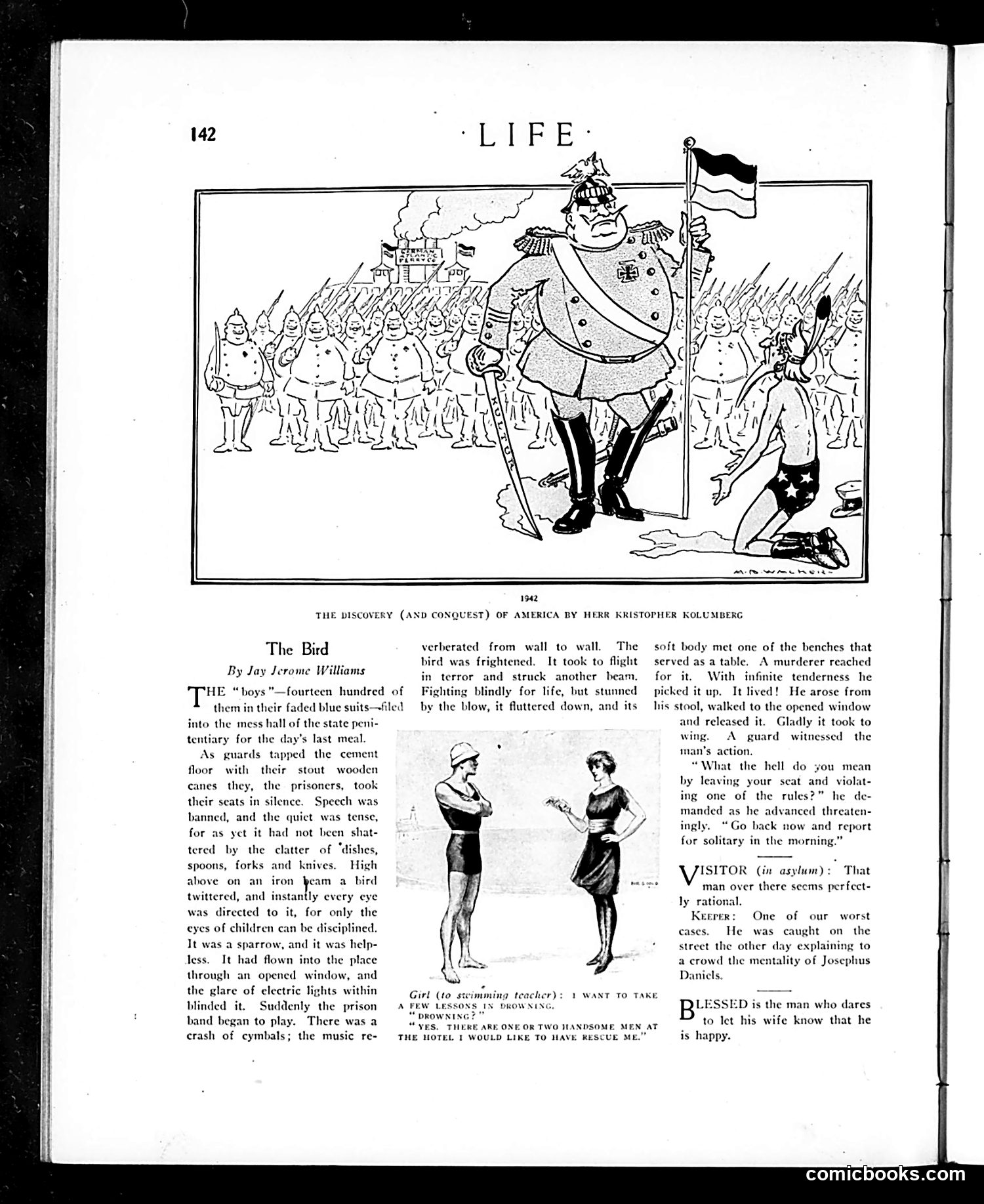
The top cartoon satirizes German militarism, specifically Kaiser Wilhelm II. The caption identifies it as "The Discovery (and Conquest) of America by Herr Kristopher Kolumberg" — a mocking reference combining Columbus with a German name. The exaggerated military figure with an enormous belly, elaborate uniform, and sword represents Prussian military swagger and imperial ambition. The soldiers with bayonets in the background emphasize militaristic aggression. This appears to be American satirical commentary on German imperialism and expansionism, likely from World War I era, using historical parody to critique contemporary German military pretensions and their threat to democratic values represented by the American context.
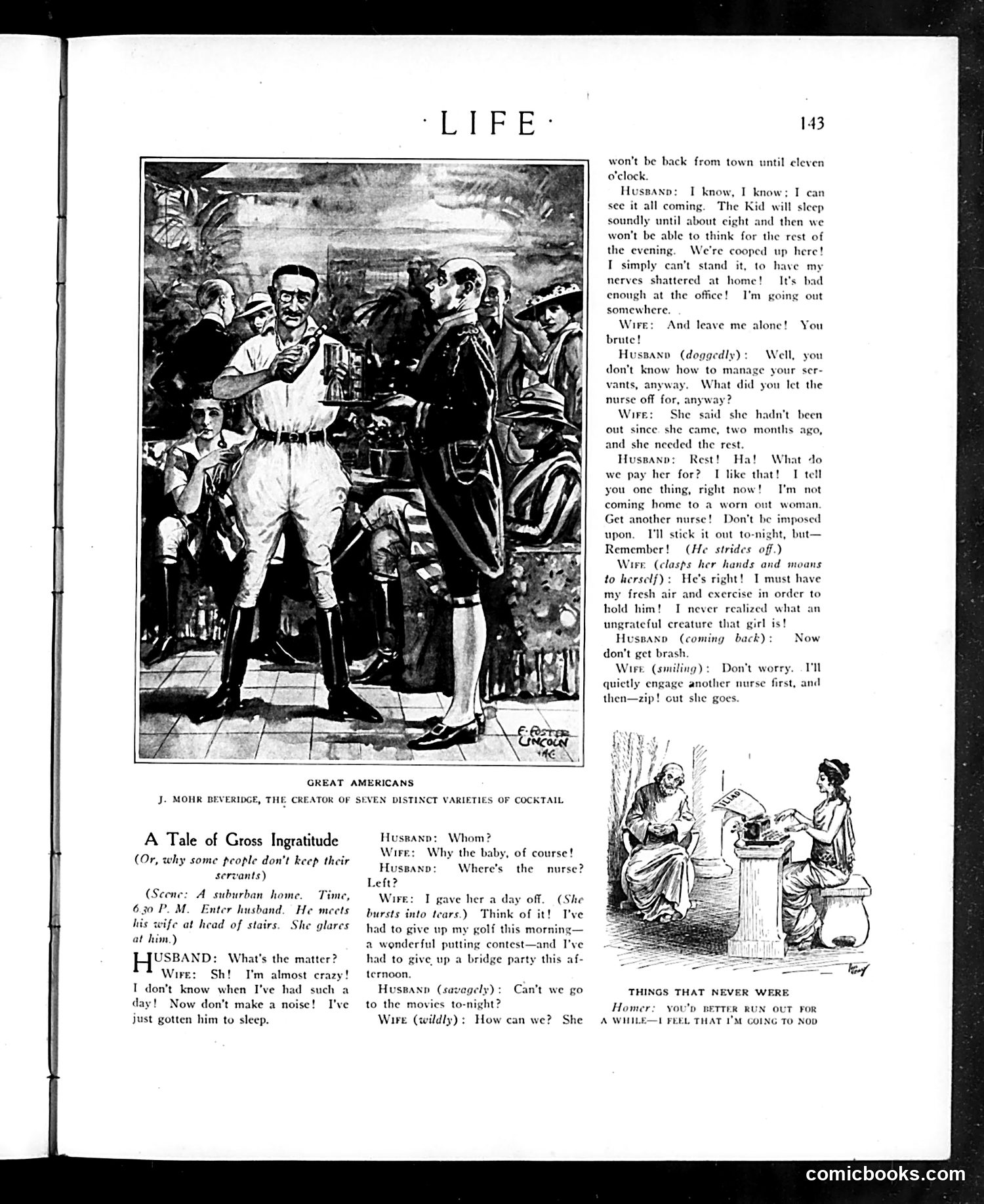
**Main Cartoon: "A Tale of Gross Ingratitude"** This depicts a domestic conflict between husband and wife over household staff management. The husband, returning home to find chaos and noise from their baby, discovers his wife has given the nurse a day off. He's furious she sacrificed social activities (golf, bridge party) to care for the child herself, viewing this as incompetence in "managing servants." **The Satire's Point:** The joke targets wealthy households' dependence on hired help and the husband's entitled expectation that his wife shouldn't personally handle childcare—that's servants' work. His indignation that she'd neglect her social obligations to mind her own child reflects early-20th-century upper-class attitudes about domestic labor and gender roles. **Secondary Cartoon: "Things That Never Were"** A brief companion piece mocking similar domestic absurdities.
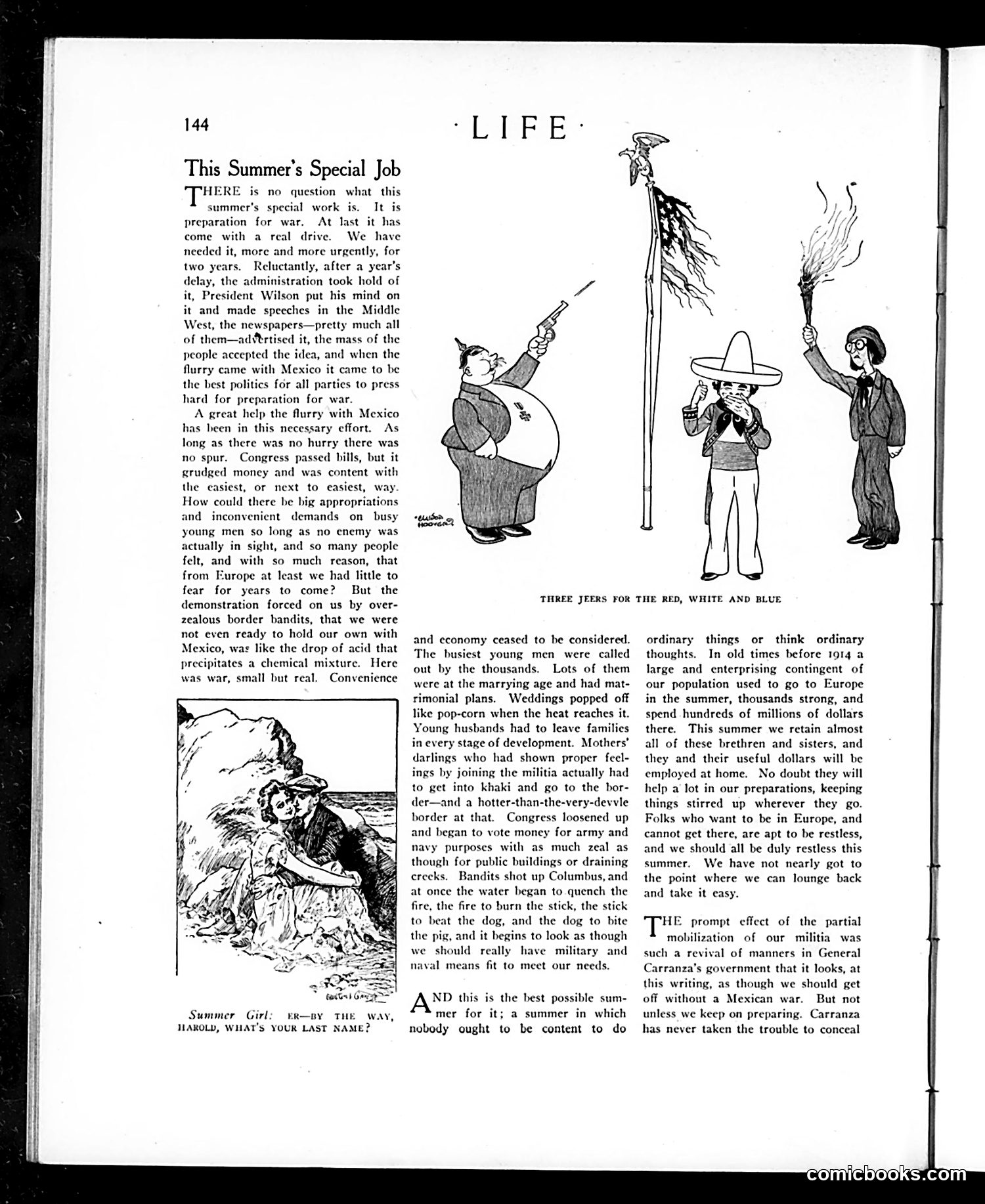
This page satirizes American military preparation during the Mexican border crisis (around 1911-1917). The article discusses mobilizing young men for potential war rather than civilian summer work. The cartoon "Three Jeers for the Red, White and Blue" shows three figures mocking patriotic service—likely representing different social perspectives on mandatory military duty. The illustration captioned "Summer Girl: Er—by the way, Harold, what's your last name?" depicts a young woman encountering a soldier, satirizing how military mobilization disrupted normal civilian life and courtship. The text argues that while border tensions justified military preparation, Congress reluctantly funded these efforts, and the disruption affected young men's marriages, family life, and normal economic activity—framing summer 1917 military service as necessary but socially disruptive.
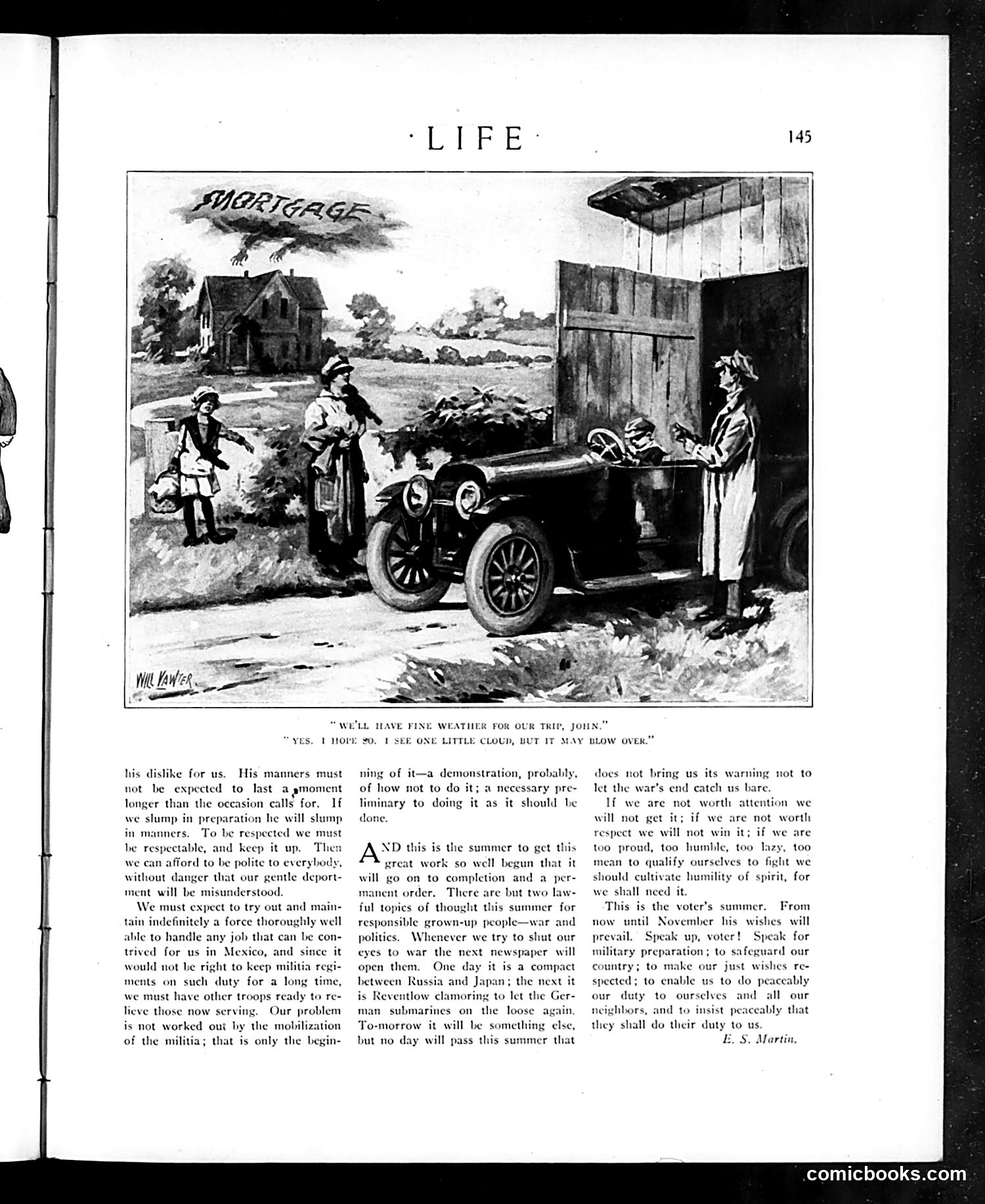
The cartoon depicts a rural family encountering an automobile at a farm. The caption reads: "We'll have fine weather for our trip, John" / "Yes, I hope so. I see one little cloud, but it may blow over." The humor relies on early-20th-century anxieties about automobiles. The "cloud" the farmer references is literally the dark automobile—a new, unfamiliar technology that disrupts traditional rural life. The joke equates the car with weather concerns, treating it as an unpredictable, potentially threatening force of nature. The accompanying text discusses summer preparation for potential war and maintaining civic duty, suggesting this *Life* issue addresses both modernization concerns and pre-WWI military readiness. The cartoon satirizes rural Americans' wariness toward industrial progress and automobiles specifically.
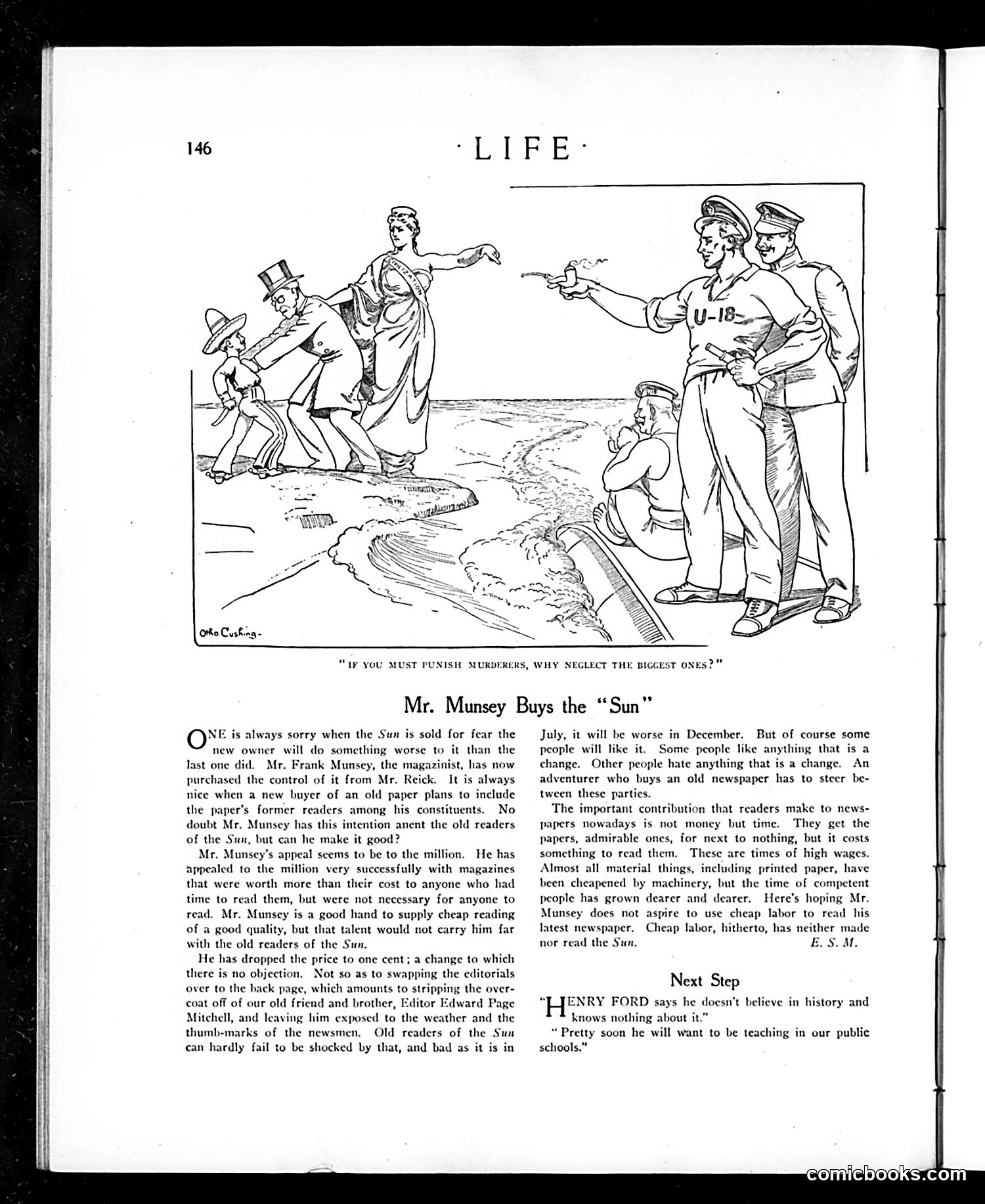
This cartoon satirizes Frank Munsey's 1916 purchase of the *New York Sun* newspaper. The illustration shows Munsey (top left, in formal dress) presenting the acquisition to military/naval officers (labeled "U-18," referencing German submarines). The caption "IF YOU MUST PUNISH MURDERERS, WHY NEGLECT THE BIGGEST ONES?" suggests the cartoon equates Munsey's control of the press with serious harm—comparing newspaper monopolization to wartime violence. The accompanying text criticizes Munsey for reducing the *Sun's* price to one cent and stripping its quality to chase cheap circulation over substantive journalism. The satire argues that consolidating newspaper ownership under profit-driven management damages public discourse more seriously than acknowledged crimes.
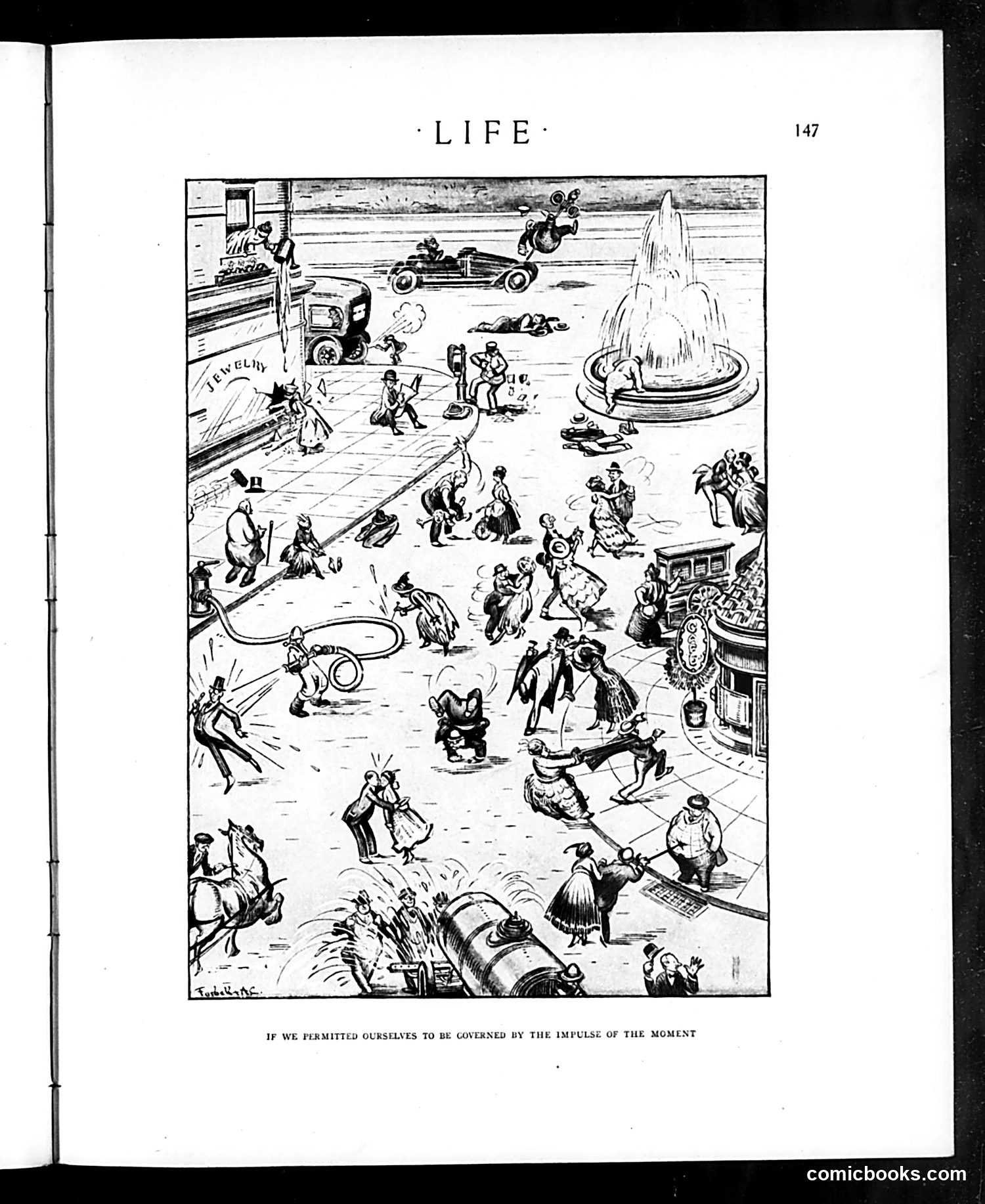
This is a single satirical illustration captioned "IF WE PERMITTED OURSELVES TO BE GOVERNED BY THE IMPULSE OF THE MOMENT." The cartoon depicts a chaotic public square or amusement park where people abandon all restraint and social order. Visible chaos includes: a fountain spraying wildly, racing vehicles, people fighting and falling, someone using a lasso, gambling or gaming, children playing unsupervised, and general pandemonium. A jewelry store and decorated building suggest commercial areas amid the disorder. The satire warns that without self-discipline and rational governance, society would descend into immediate gratification and anarchy. This reflects early-20th-century anxieties about impulse control, civilization's fragility, and social responsibility—a common theme in Life's moral commentary on modern society.
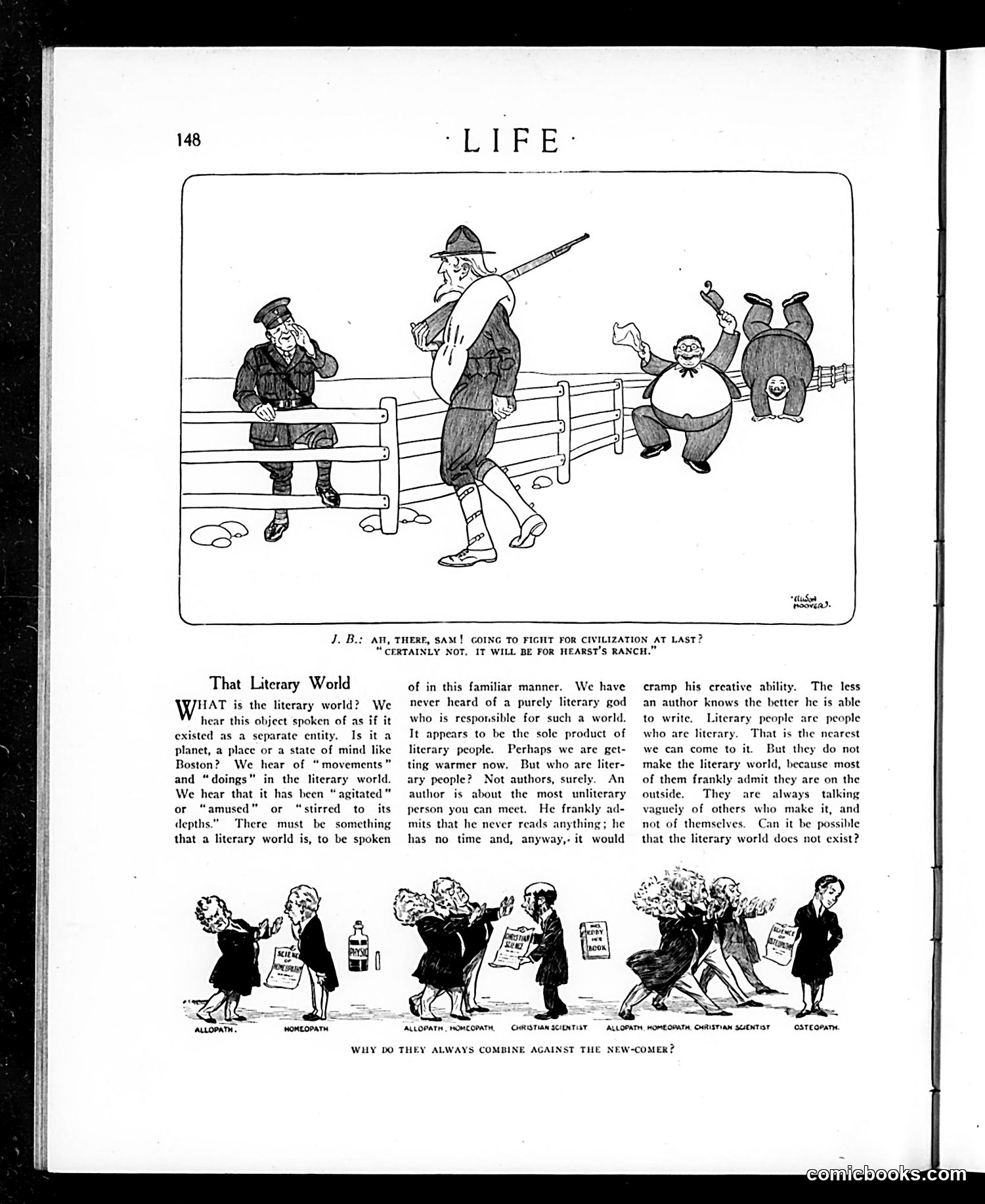
**Top Cartoon:** A soldier with a rifle confronts three armed figures at a fence, labeled with dialogue about fighting "for civilization" and "Hearst's Ranch." This appears to satirize William Randolph Hearst's influential media empire and perhaps his political interventions or pro-war stance. **Article "That Literary World":** Discusses how authors and literary figures exist somewhat outside normal society, are rarely read by ordinary people, and remain detached from practical matters. The piece argues that the literary world paradoxically depends on people who rarely engage with literature. **Bottom Cartoon:** Six figures labeled with various medical/alternative practitioners (allopath, homeopath, Christian scientist, osteopath, etc.) are shown combining against a newcomer. This satirizes professional groups uniting against competition or innovation in their fields.
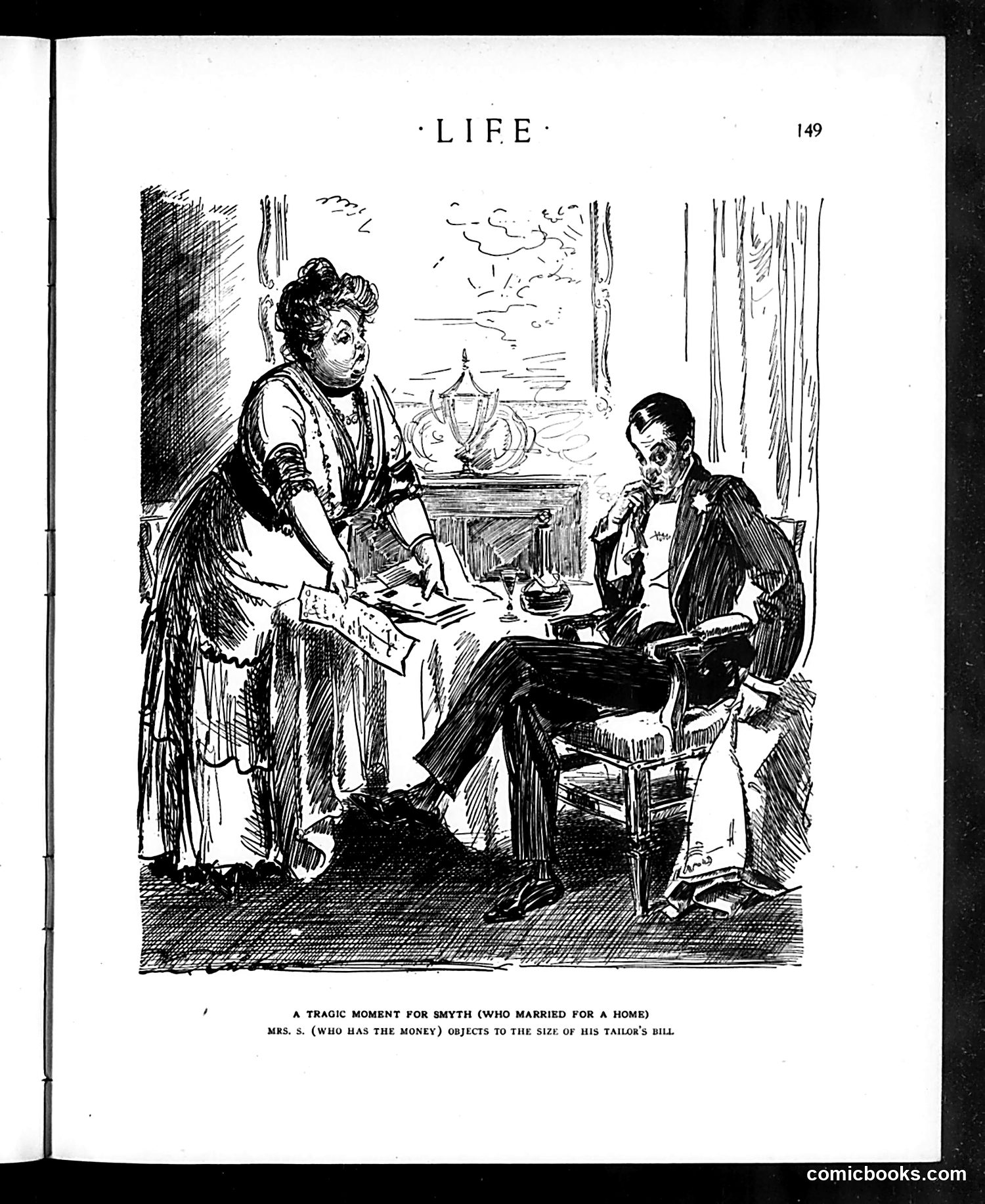
This is a single-panel satirical cartoon titled "A Tragic Moment for Smyth (Who Married for a Home)" showing a domestic scene where Mrs. S. (identified as having the money) objects to the size of her tailor's bill while her husband Smyth sits uncomfortably nearby. The satire targets marriages of convenience based on financial disparity. Smyth married a wealthy woman expecting security, but the cartoon mocks his awkward position—he's now subject to his wife's scrutiny over household expenses. The "tragic moment" is his emasculation: a man dependent on his wife's wealth, unable to make independent financial decisions. This reflects early-20th-century anxieties about gender roles and economic power within marriage, satirizing both gold-digging husbands and women's growing financial control.
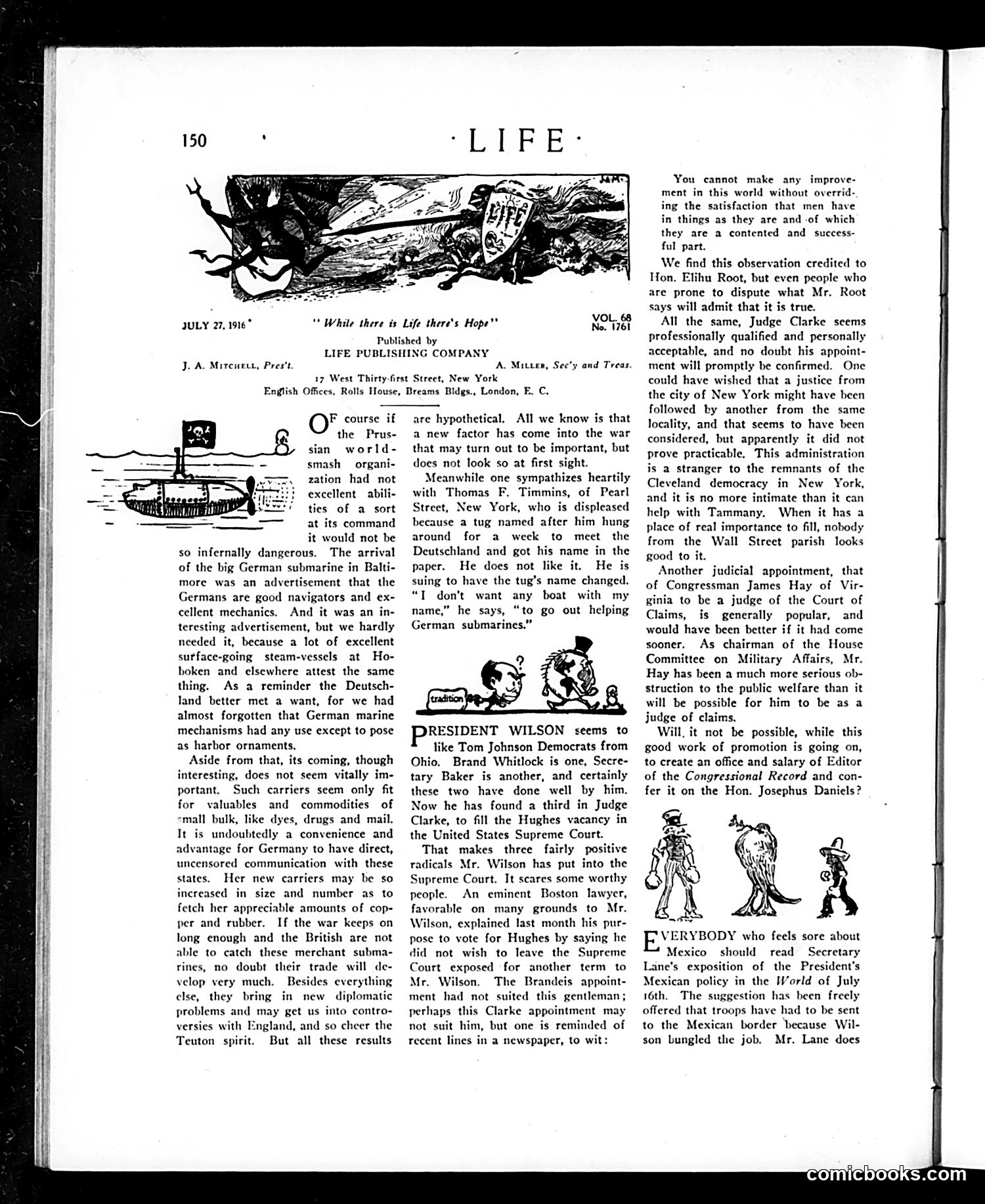
This July 27, 1916 *Life* page discusses President Wilson's judicial appointments, particularly Judge Clarke for the Supreme Court vacancy. The text critiques the appointment as politically motivated—Clarke is identified as a "Tom Johnson Democrat from Ohio," with the article noting Wilson filled the vacancy with someone from the same political faction rather than a truly neutral jurist. The cartoon (top left) depicts a German submarine in Baltimore harbor, satirizing how Germany's naval warfare posed practical threats to American shipping and commerce, making theoretical political debates seem trivial by comparison. The small illustrated figures at bottom appear to be generic satirical characters commenting on the appointments discussed above, though their specific identities aren't clearly labeled.
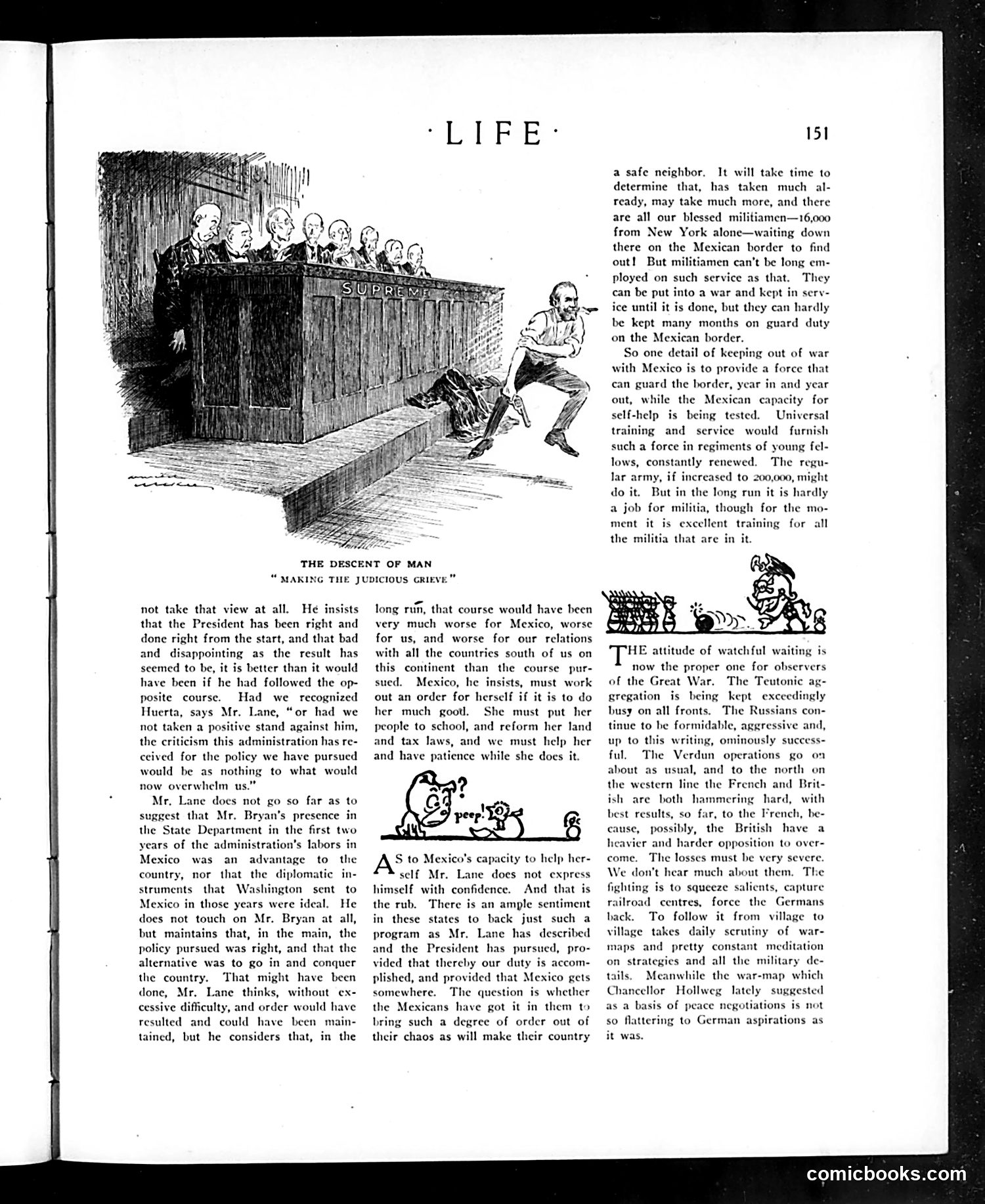
This editorial cartoon satirizes a legal proceeding (labeled "SUPREME" on the bench), depicting judges presiding while a figure below appears to be performing an exaggerated, undignified stance—suggesting the "descent of man" through loss of judicial dignity or improper court conduct. The accompanying text discusses U.S. policy toward Mexico, debating whether President Wilson and State Department official Lane acted appropriately in Mexican affairs. The piece defends their diplomatic approach, arguing it was preferable to military intervention. The cartoons' title mockingly invokes Shakespeare's phrase about debasement, implying that questionable legal or political decisions represent a fall from proper standards of conduct and judgment.
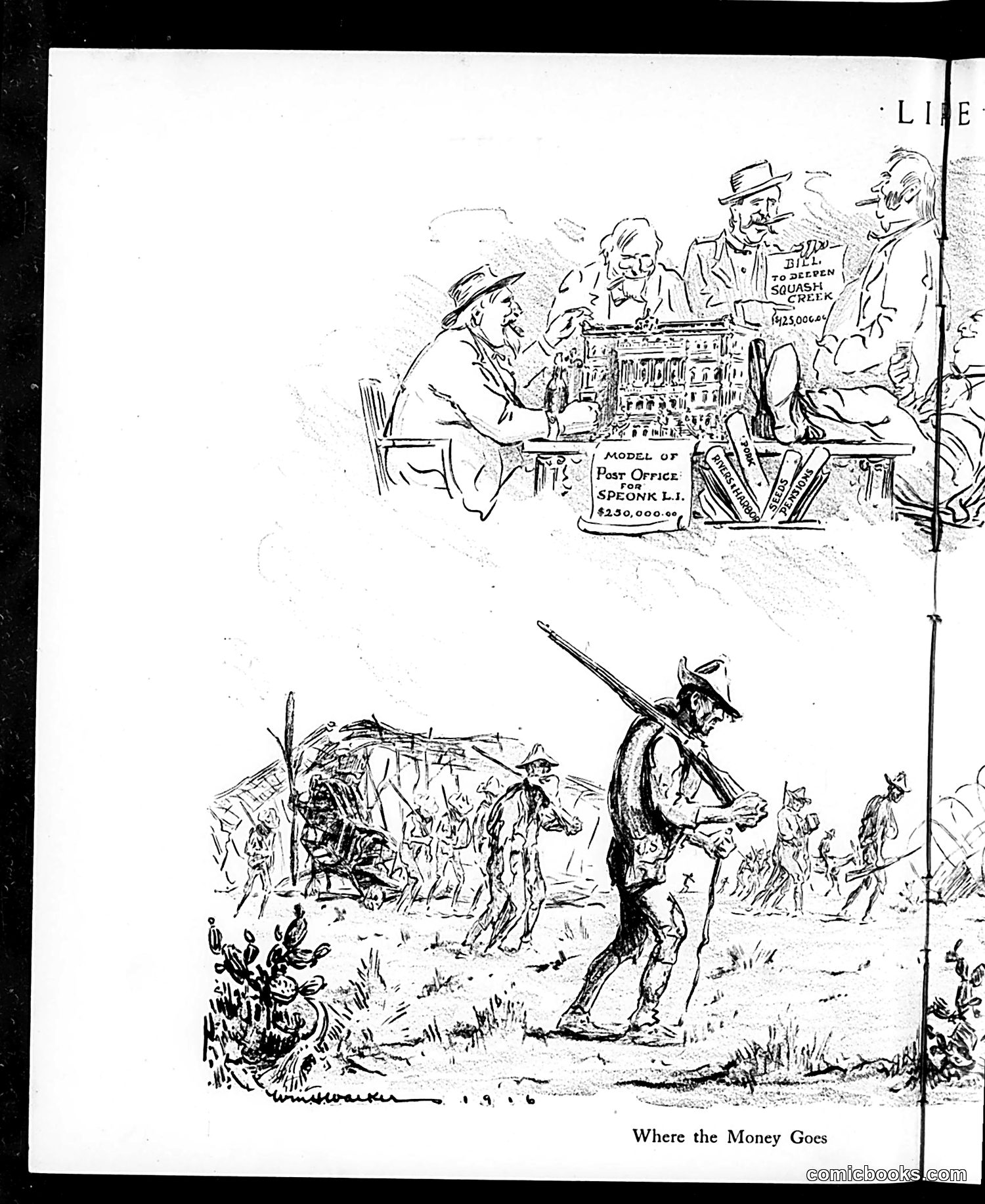
This two-panel cartoon critiques government spending, likely from the early 1900s based on style. **Top panel:** Shows men in suits examining an architectural model labeled "Model of Post Office for Speonk L.I. $230,000.00." This appears to satirize excessive government expenditure on a post office for what was presumably a small, insignificant location (Speonk, Long Island). The men's expressions suggest awareness of the absurd cost. **Bottom panel:** Contrasts this with a frontier scene showing rough frontiersmen and soldiers in harsh conditions, with the caption "Where the Money Goes." The satire's point: Government lavishly funds unnecessary civic projects while underfunding essential frontier defense and military operations. The cartoon criticizes misplaced priorities in public spending—luxury infrastructure versus genuine national needs.
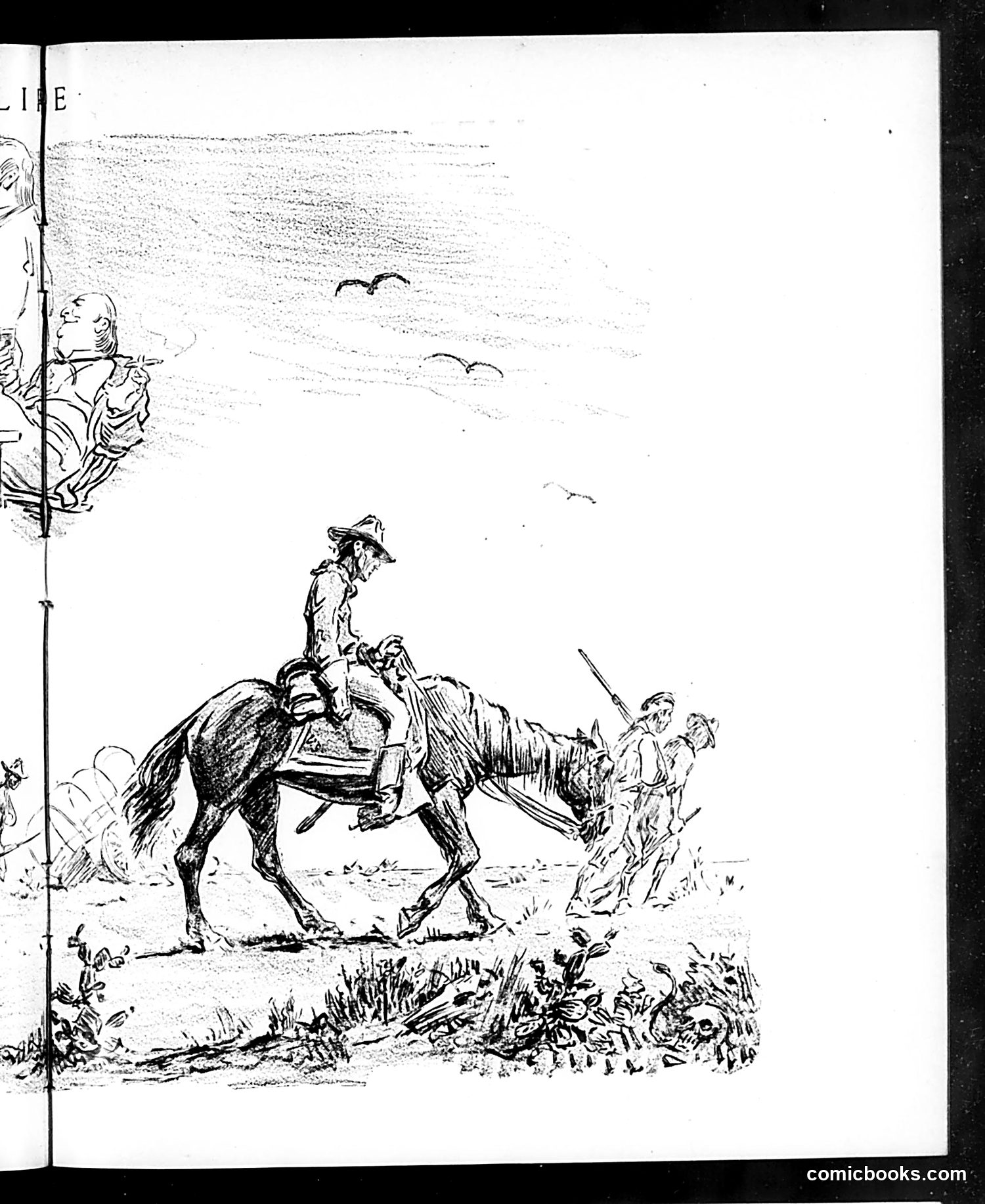
This page shows a detailed ink sketch of a man on horseback, wearing what appears to be period military or colonial dress with a hat. He's mounted on a horse in profile, with other figures visible in the background. The scene suggests movement or travel across terrain with grass and vegetation sketched at ground level. Without visible caption text or other identifying markers on this particular page image, I cannot definitively identify which specific political figure or historical event is being satirized, or what the cartoon's point of commentary is meant to be. The artistic style and composition suggest this is illustrative rather than purely satirical commentary. To provide accurate historical context and explain the satire's meaning, I would need visible OCR text or captions that currently don't appear legible in this image.
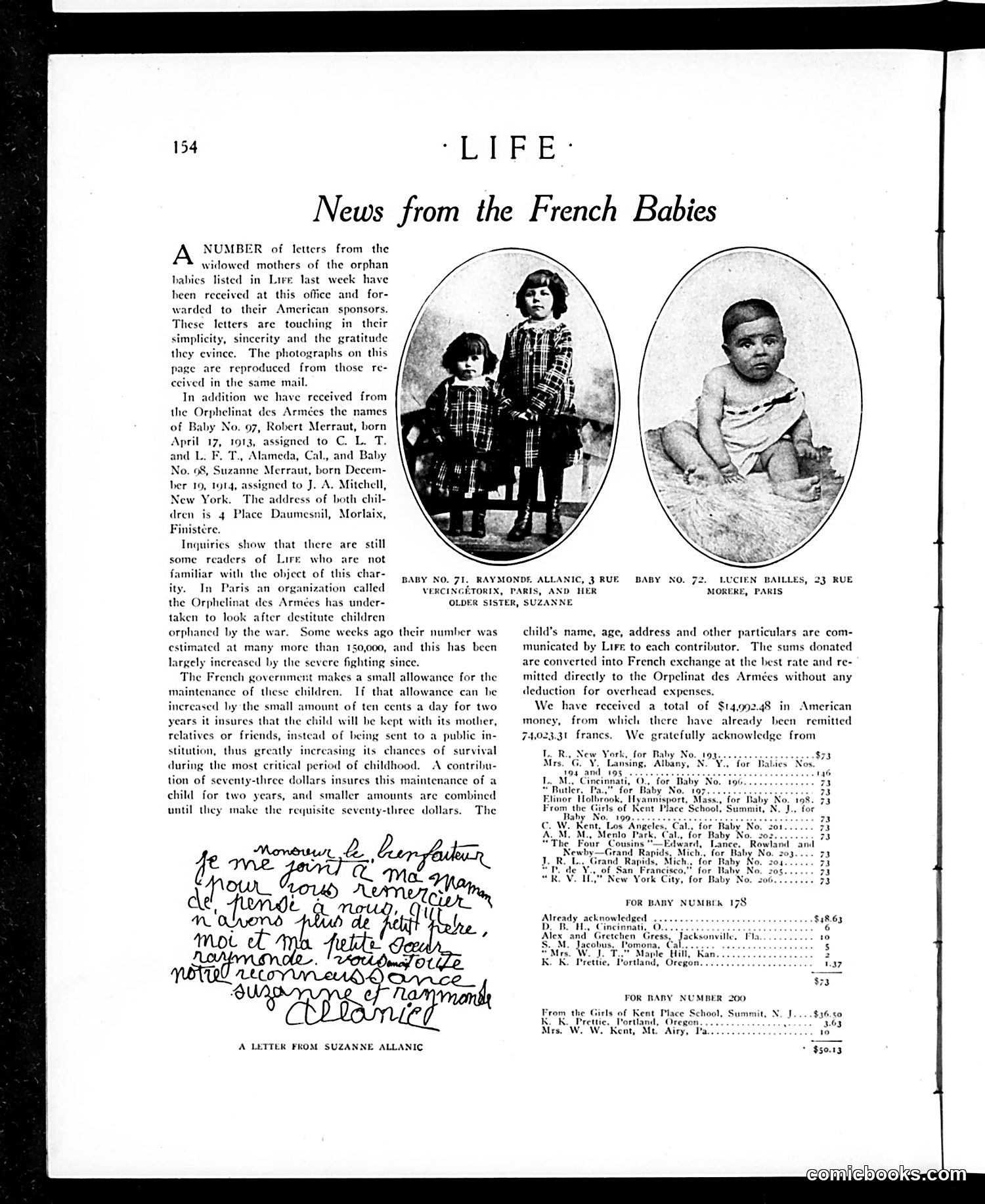
This page describes a WWI-era charity program called the "Orphelinat des Armées" (Army Orphanage) operating in Paris. Life magazine solicited American sponsors to support French war orphans—children left destitute after the fighting. The text explains the mechanics: sponsors could contribute $73 to support one child for two years, keeping them with family rather than in institutions. Smaller donations were pooled. The magazine printed photographs of specific orphans and letters from their mothers to humanize the cause and inspire giving. The handwritten letter from Suzanne Allanic (visible on the left) appears to be a grateful thank-you note from a mother receiving aid. By December 1914, Life reports collecting over $14,000 and distributing nearly 74,000 francs directly to the organization. The page functions as both charity appeal and progress report, listing donors' contributions to demonstrate the program's success.
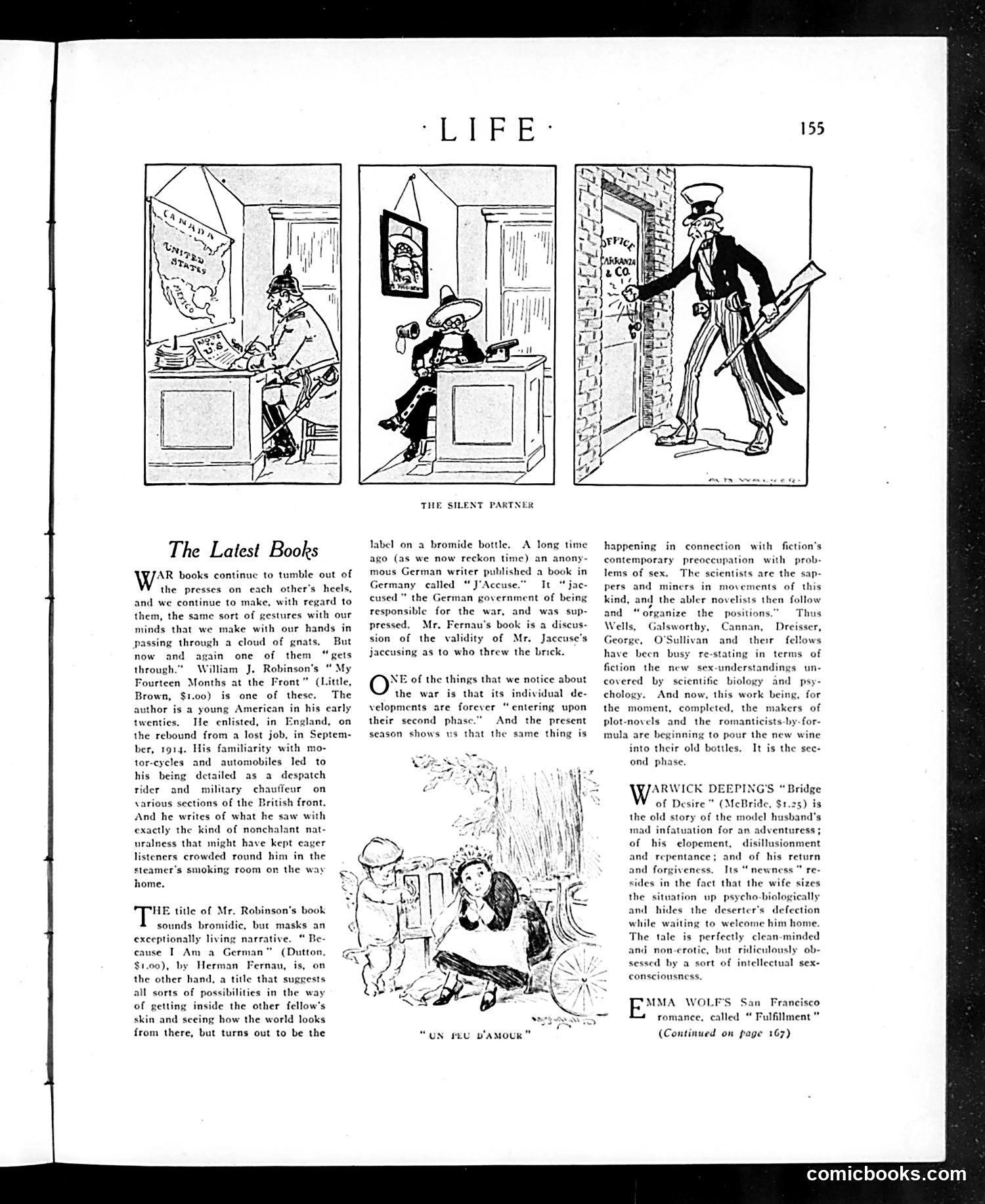
This page reviews recent war-related and romance novels, featuring three cartoon panels titled "The Silent Partner" at the top. The cartoons appear to satirize romantic or domestic situations—likely illustrating themes from the books discussed. The first panel shows a woman at a desk with papers (possibly a U.S. government office, based on visible signage); the second depicts a small figure at a desk; the third shows Uncle Sam as a tall patriotic figure gesturing dismissively. The joke likely plays on the phrase "silent partner"—suggesting either that women are overlooked contributors to the war effort, or that Uncle Sam/America is an unseen force influencing personal relationships during wartime. The text discusses how war-related fiction is evolving into a "second phase," with novelists now exploring sex and psychology using scientific frameworks. The reviews criticize contemporary authors for pouring "new wine into old bottles"—recycling traditional romantic plots with superficial pseudo-scientific dressing about sexuality and psychology.
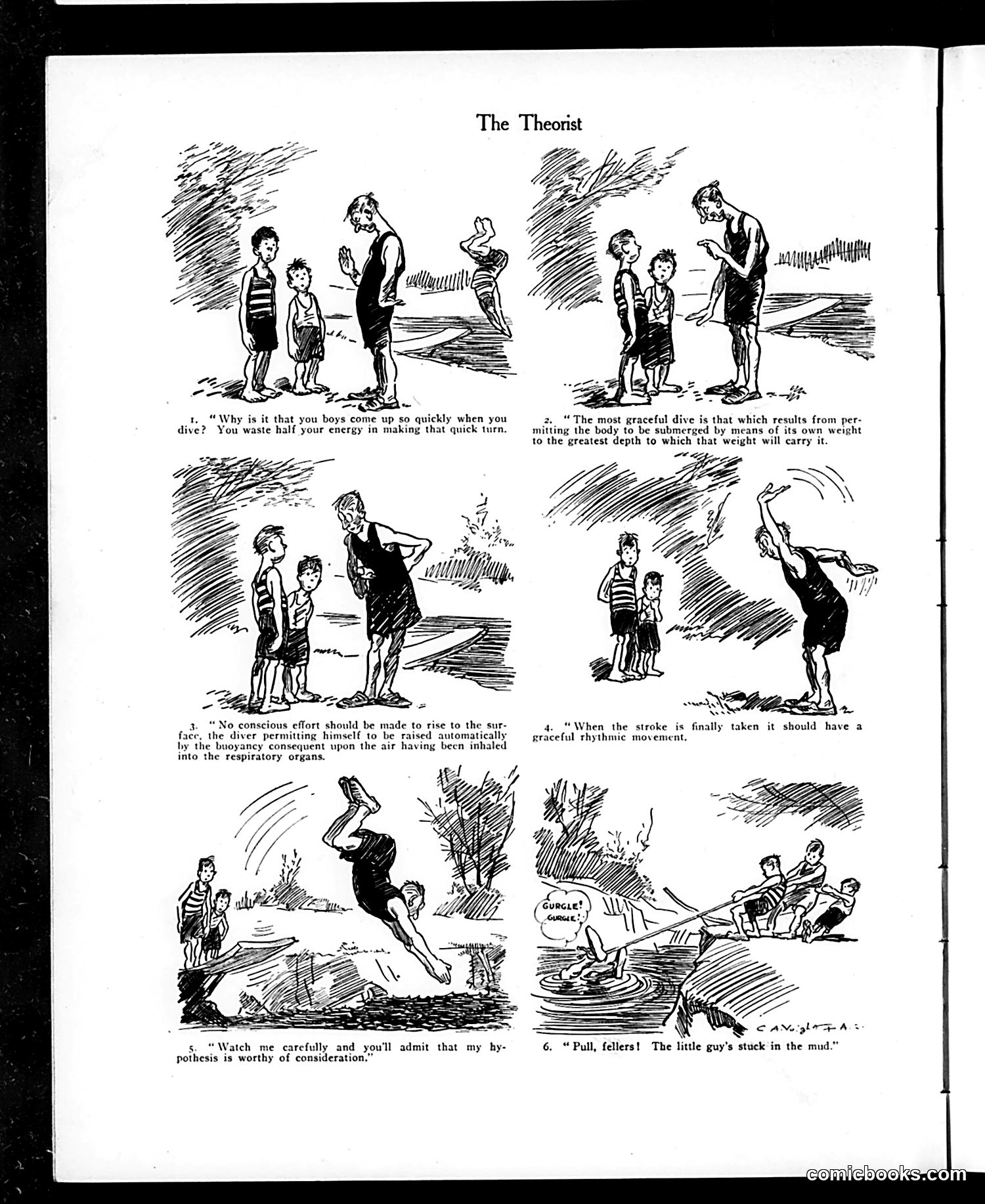
This comic mocks an adult who lectures children on swimming and diving theory while demonstrating spectacularly poor practical results. The "theorist" delivers pseudo-scientific explanations for diving technique—discussing buoyancy, weight displacement, and "graceful rhythmic movement"—using elaborate, pretentious language. Panels 1-4 show him pontificating while the children listen. Panel 5 depicts his actual demonstration: he performs an awkward, ungainly dive. Panel 6 reveals the outcome: he's stuck in mud, requiring rescue, while the practical children simply play in the water. The satire targets armchair experts and academics who over-complicate simple physical activities through theory, producing laughably inferior results compared to intuitive, hands-on practice. The children represent common sense; the theorist represents pedantic incompetence dressed in intellectual language. The humor lies in the gap between his pompous explanation and his humiliating failure.
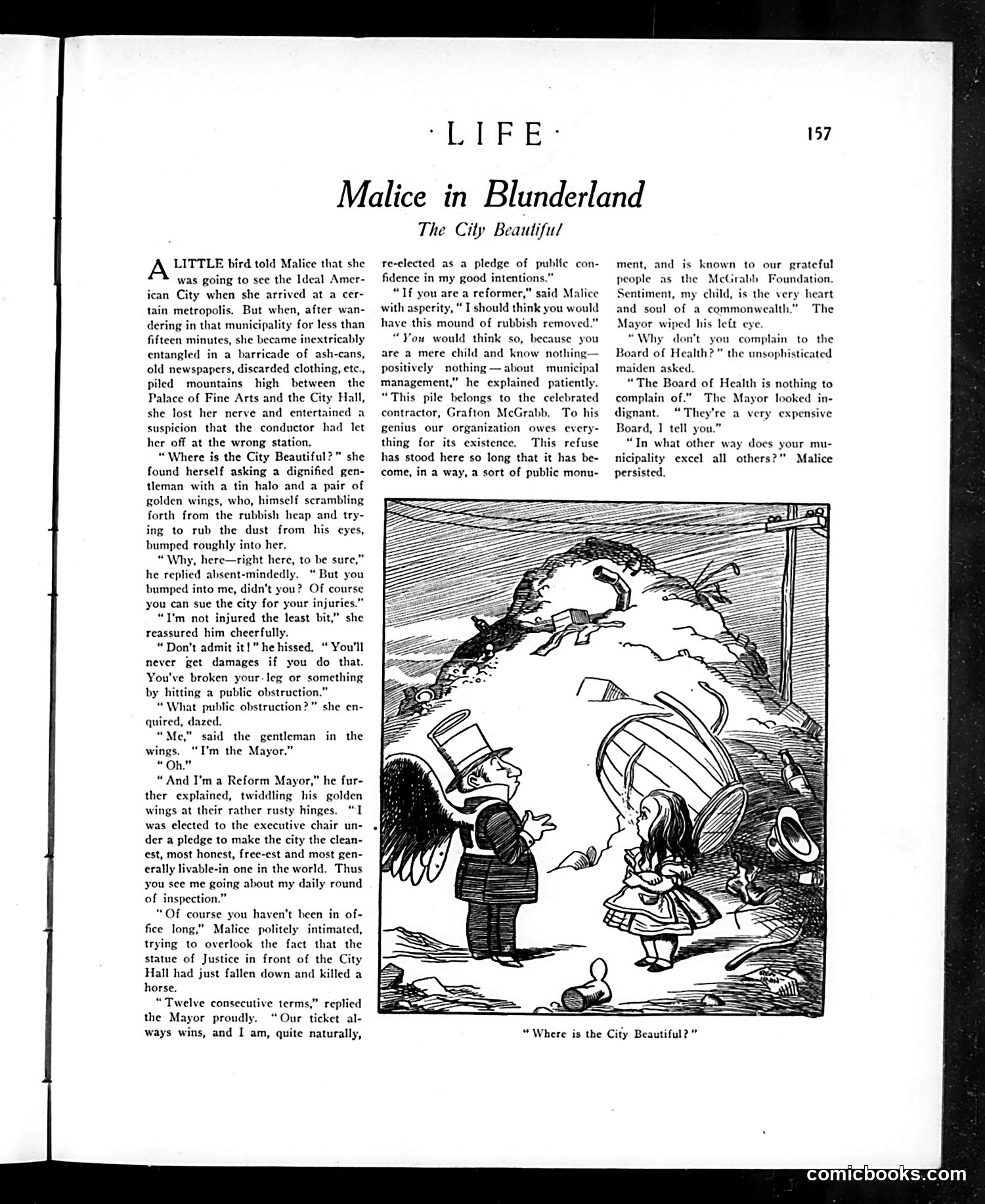
This satirical piece mocks corrupt municipal governance and empty political reform promises. The Mayor character—identifiable by his tin halo and golden wings—represents a hypocritical "reform" politician who claims twelve consecutive terms while the city remains filthy and dysfunctional. The satire targets: **Political corruption**: The Mayor protects contractor Grafton McGrabb's refuse pile, renaming it a "foundation" to avoid removal—exposing how political machines shelter corrupt contractors. **False reform**: Despite pledging to make the city "cleanest, most honest," the Mayor oversees crumbling infrastructure (a fallen Justice statue kills a horse) and an ineffective, "expensive" Board of Health. **Citizen naïveté**: The character "Malice" represents the innocent public, easily confused by bureaucratic doublespeak and institutional inertia. The illustration shows the Mayor and a small girl amid scattered trash, barrels, and debris—visual evidence contradicting his rhetoric about the "City Beautiful." The piece satirizes turn-of-century American municipal politics, where reform candidates often proved as corrupt as their predecessors once elected.
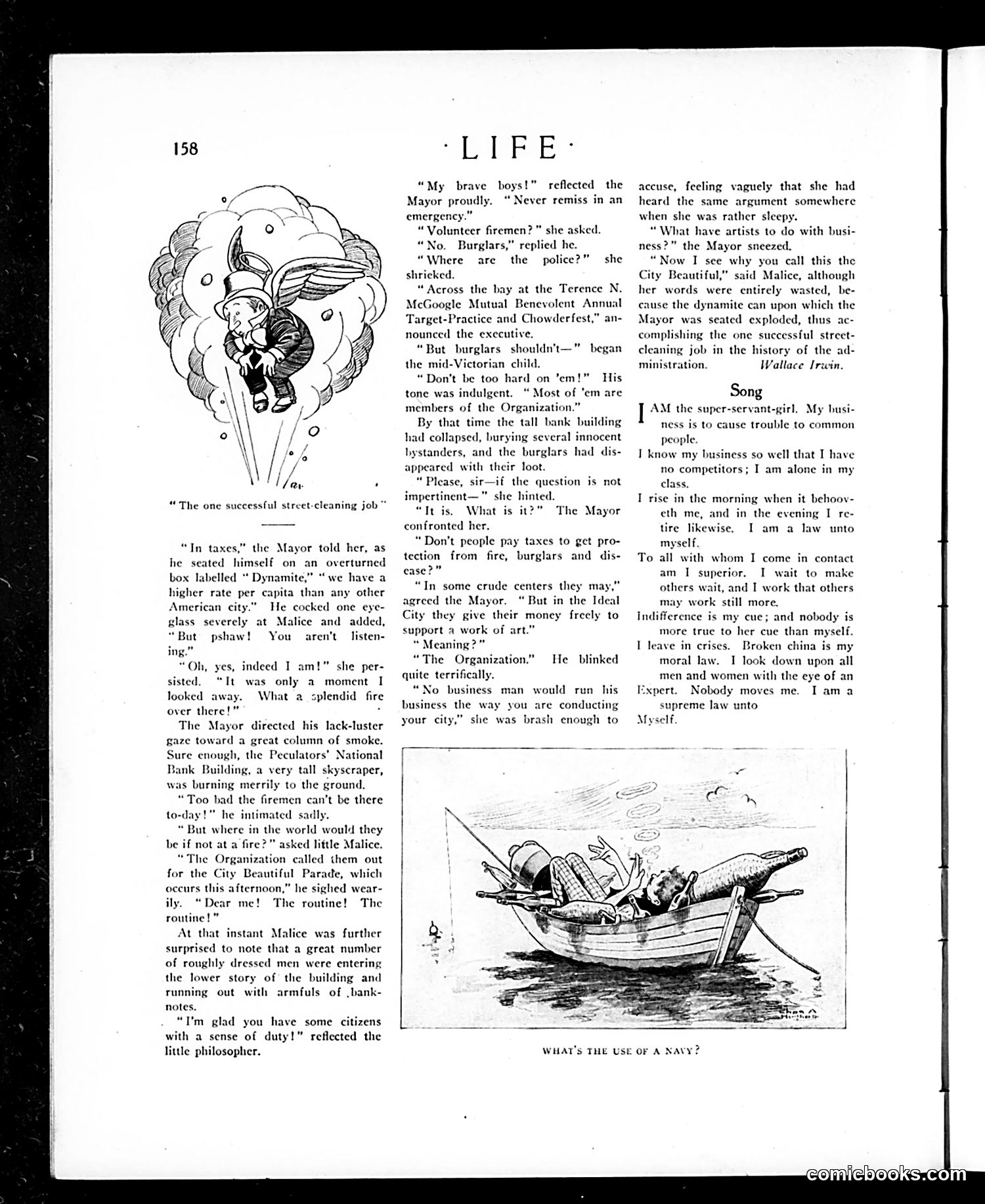
This satirical piece mocks municipal corruption and mismanagement, likely from the Progressive Era (early 1900s). The dialogue depicts a naive child ("little Malice") exposing absurd contradictions in a Mayor's administration. **The Setup:** While a bank building burns, firefighters are absent at a "City Beautiful Parade." Simultaneously, burglars openly steal from the bank. The Mayor defends this chaos by claiming the burglars are "members of the Organization"—implying they're politically connected operatives. **The Satire:** The joke targets: - Political machines that prioritize pageantry ("City Beautiful") over essential services - Corrupt officials who tolerate crime in exchange for organizational loyalty - The absurdity of taxing citizens for protection they don't receive **The Climax:** A dynamite box (labeled, ironically) beneath the Mayor explodes, killing him—the "one successful street-cleaning job" of his administration. The cartoon above depicts this explosion. The bottom illustration about a navy appears unrelated to the main text, suggesting page layout from the magazine's miscellaneous content.
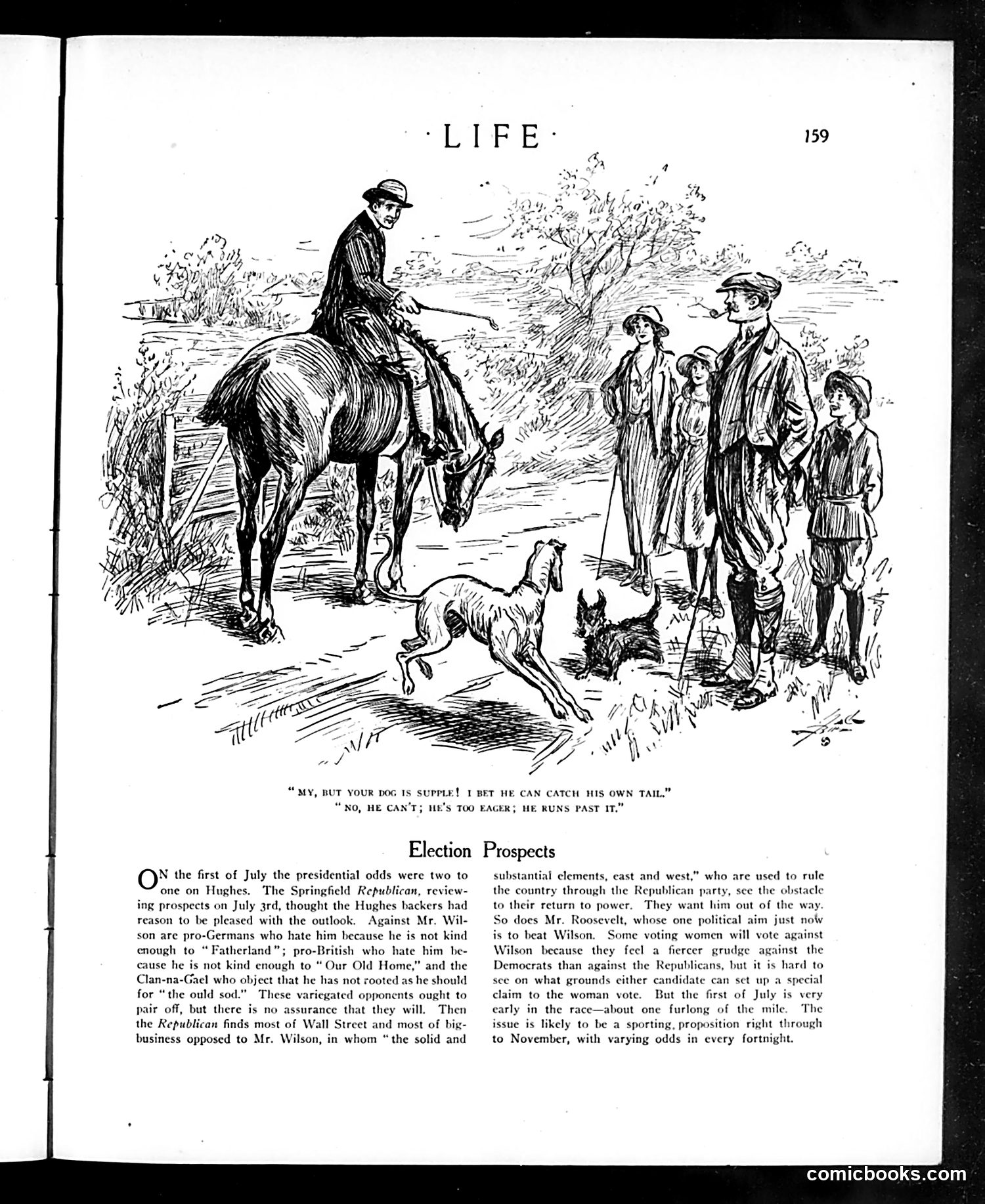
This page satirizes the 1912 presidential election between incumbent Woodrow Wilson and challenger Charles Evans Hughes. The cartoon's caption metaphor—a dog too eager to catch its own tail—represents the fragmented opposition to Wilson. The text explains that while Wilson faced diverse opponents (pro-Germans, pro-British, Irish-American groups opposed to his policies, and Wall Street business interests), these groups failed to unite effectively against him. The satire suggests their contradictory grievances worked against each other, like a dog chasing itself uselessly. The illustration shows a well-dressed man on horseback observing a family group with dogs—likely representing the scattered, quarrelsome nature of Wilson's opposition. The article notes some voting women opposed Wilson but for inconsistent reasons, adding to the chaotic election landscape heading toward November.
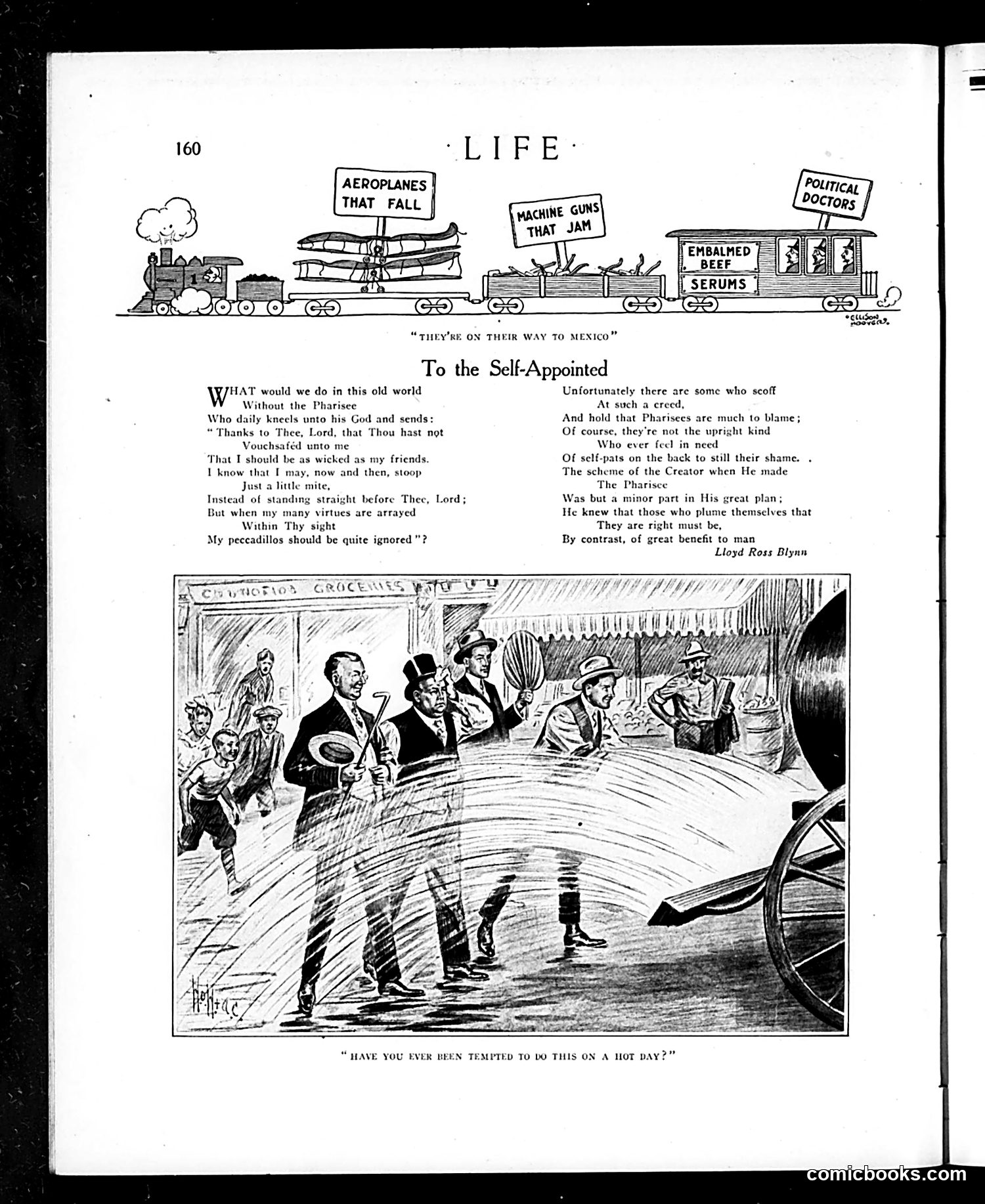
**Top Cartoon:** A satirical train carries societal problems to Mexico: a locomotive labeled "Pharisee," followed cars with "Aeroplanes That Fall," "Machine Guns That Jam," "Embalmed Beef," "Political Doctors," and "Serums." The caption "They're on their way to Mexico" suggests America is exporting its failures and defective products to Mexico—a jab at both American quality and imperialist attitudes toward the neighboring nation. **Poem:** "To the Self-Appointed" by Lloyd Ross Blynn critiques self-righteous "Pharisees"—people who publicly congratulate themselves for virtue while privately harboring flaws. The poem uses biblical language (Pharisee as hypocrite) to mock sanctimonious moralists who judge others harshly while excusing themselves. **Lower Cartoon:** Depicts well-dressed men at a fancy grocery store watching street urchins cool themselves in a water puddle during hot weather, asking "Have you ever been tempted to do this on a hot day?" The satire mocks wealthy people's class blindness—they're amused by children's simple pleasures rather than concerned about poverty.
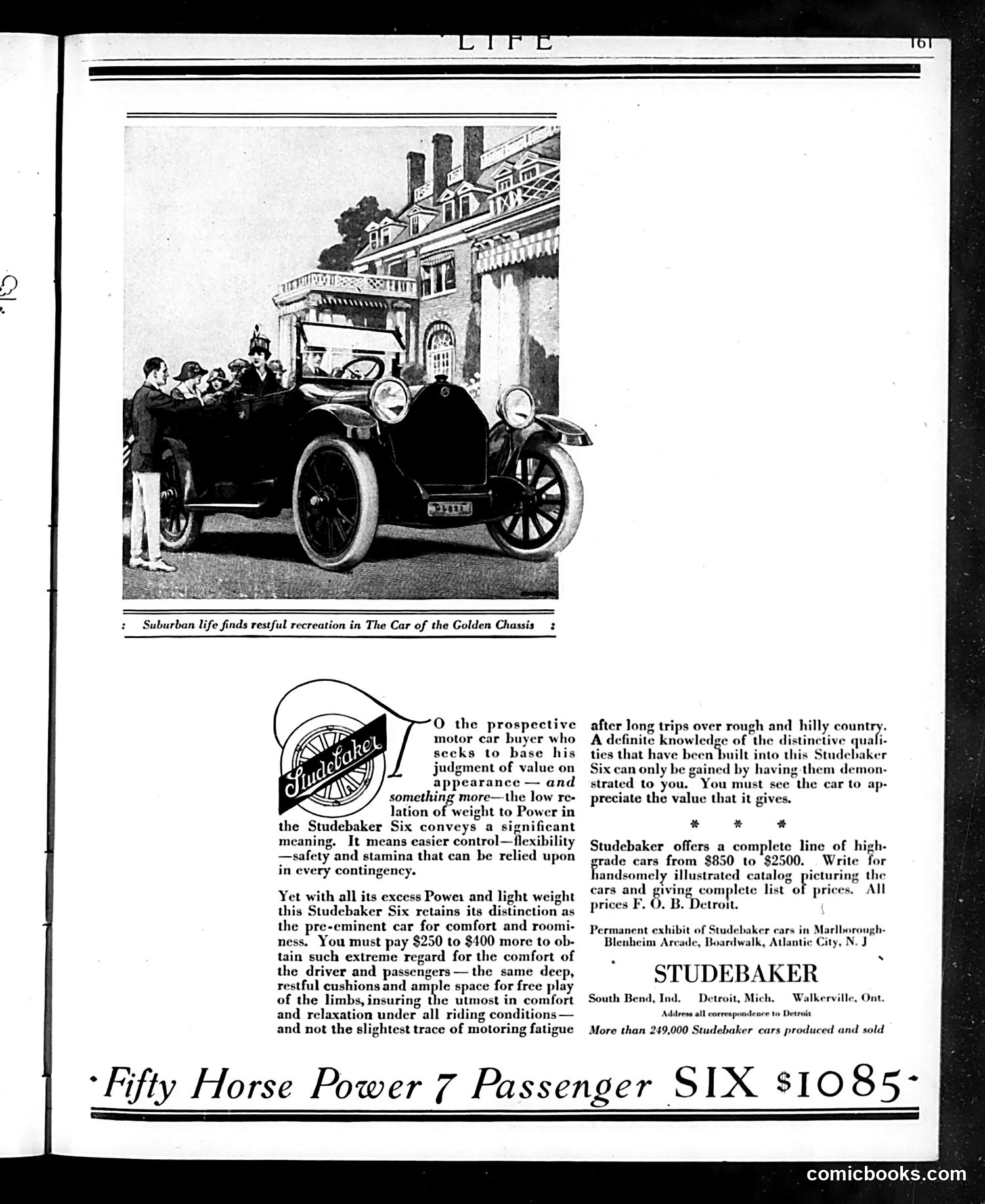
This is primarily a **Studebaker automobile advertisement**, not political satire. The page promotes the Studebaker Six luxury car to prospective buyers. The image shows well-dressed passengers in an early 1900s automobile parked before an elegant mansion—depicting the aspirational lifestyle the car represents. The accompanying text appeals to buyers seeking quality: it emphasizes the car's "low relation of weight to Power," comfort features, and safety while justifying the $1,085 price tag by claiming competitors charge $250-$400 more for equivalent comfort. The phrase "Car of the Golden Chassis" and reference to "Suburban life finds restful recreation" suggest marketing to middle-to-upper-class Americans seeking leisure and prestige through automobile ownership. The text boasts "more than 249,000 Studebaker cars produced and sold," emphasizing market dominance. This reflects the early auto industry's targeting of affluent consumers and the automobile's role as a status symbol in early 20th-century American society.
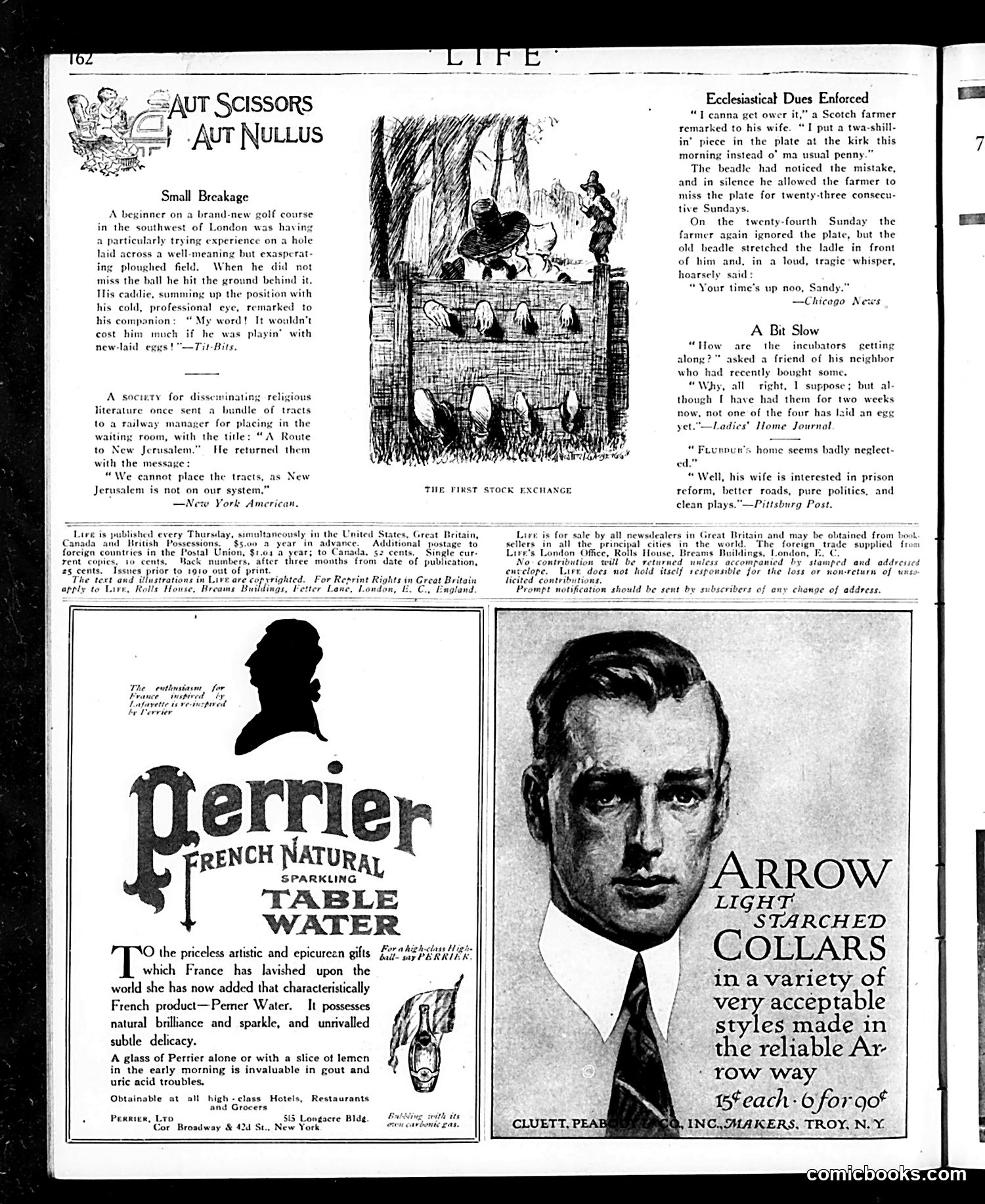
This page from *Life* magazine contains three humorous short anecdotes and advertisements. **The "Small Breakage" and "A Route to New Jerusalem" items** are brief jokes about incompetence: a golf beginner's poor play, and a religious tract society unable to deliver materials to a non-existent location—satirizing bureaucratic absurdity. **"Ecclesiastical Dues Enforced"** satirizes Scottish Presbyterian practice. A farmer deliberately gives a smaller donation (a two-shilling piece instead of his usual penny—note the reversal), but the church beadle coerces repayment by literally extending the collection plate directly in front of him after three weeks, humorously illustrating institutional pressure to maintain donations. **"A Bit Slow"** jokes about a man's new incubators failing to produce eggs after two weeks—mocking naive expectation of immediate results. The remainder of the page consists of advertisements for Perrier water and Arrow collars, standard for period magazines. No political figures or cartoons appear here; the humor is observational and domestic.
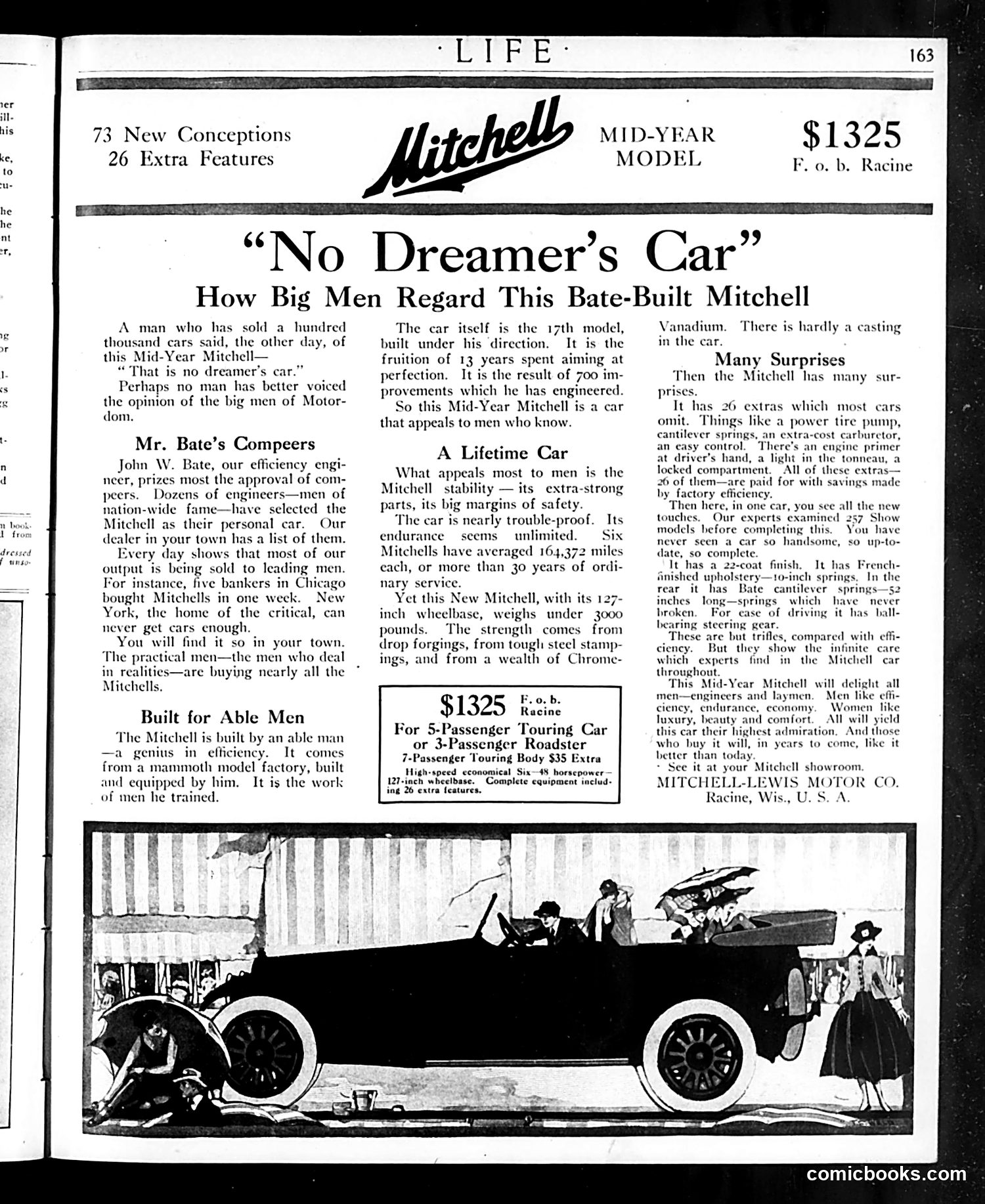
This is primarily a **automobile advertisement**, not political satire. It promotes the Mitchell mid-year model ($1,325, made in Racine, Wisconsin) to a 1910s-era audience. The page's rhetorical strategy targets "big men" and practical businessmen—bankers, engineers, efficiency experts—rather than dreamers or aesthetes. The phrase "No Dreamer's Car" establishes the pitch: this is a serious, utilitarian vehicle for serious men who value reliability and engineering over frivolous features. The advertisement emphasizes: - Engineering credibility (John W. Bate, the designer) - Durability (cars averaging 164,000+ miles) - Practical features (26 extras included) - Efficiency and strength over flashiness The illustration shows the car in cross-section with various social types examining it—working-class and upper-class figures alike—suggesting broad appeal despite the "serious men" marketing language. This is **period advertising strategy**: appeal to masculine rationality and professional identity rather than luxury or style.
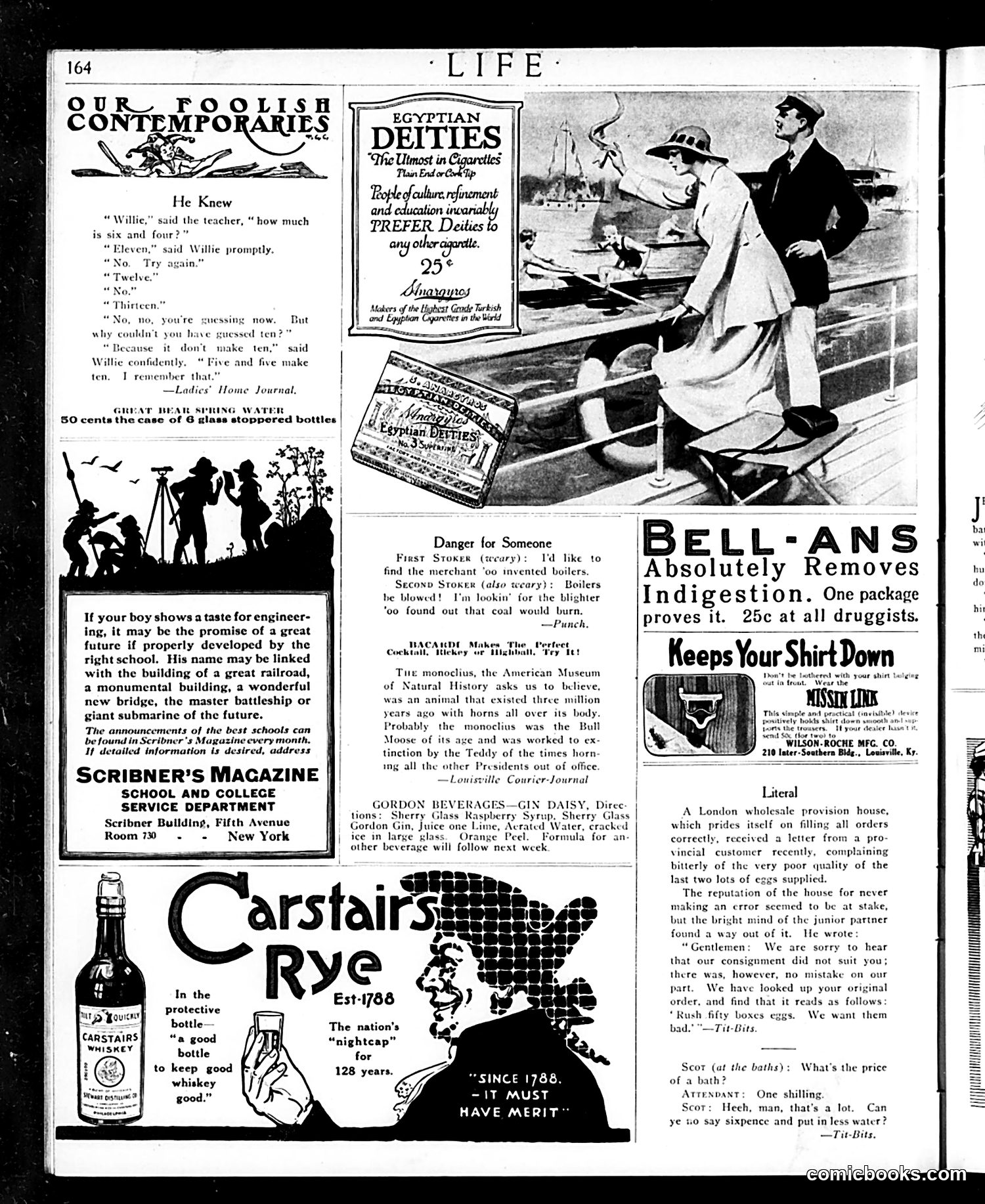
This page mixes humor columns with period advertising. The main content includes: **"He Knew"**: A children's joke about a student (Willie) who guesses arithmetic answers correctly by accident rather than understanding—satirizing rote memorization in education. **"Danger for Someone"**: A *Punch* magazine joke where workers debate who deserves blame for boiler explosions—the inventor of boilers or whoever discovered coal burns. It's dark workplace humor about industrial accidents. **"The Monoclius"**: A *Louisville Courier-Journal* piece mocking Theodore Roosevelt, suggesting he hunted the prehistoric monoclius (a three-million-year-old horned creature) into extinction, outlasting previous presidents' hunting achievements. It's satire about Roosevelt's famous big-game hunting. **"Literal"** and **"Scot"**: Brief anecdotes about misunderstandings—one about rushed eggs, another about a Scotsman haggling over bath costs. The advertisements (Egyptian Deities cigarettes, Bell-Ans antacid, Carstairs whiskey) are standard period product pitches.
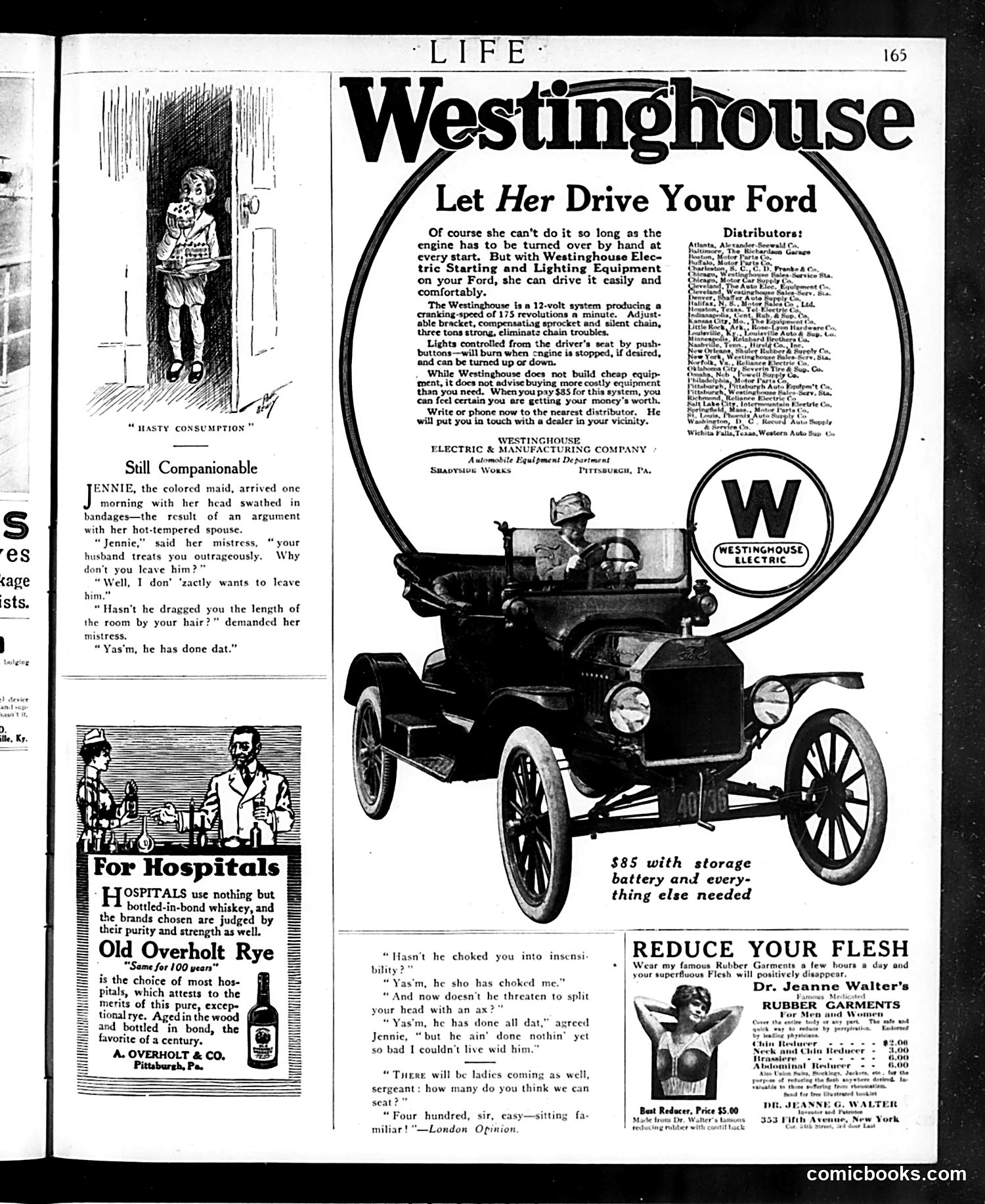
This page contains three distinct elements: **Main Advertisement**: Westinghouse Electric promotes electric starting systems for Ford automobiles, positioning the technology as enabling women ("Let Her Drive Your Ford") to operate vehicles without manual hand-cranking. The pitch emphasizes safety and ease for female drivers. **Cartoon Story ("Still Companionable")**: A satirical dialogue between a white mistress and her Black maid named Jennie, who arrives injured. The "joke" relies on a deeply offensive racial stereotype: Jennie remains loyal to her abusive husband despite repeated violence (dragging by hair, choking, threats). The humor—by the magazine's intent—comes from portraying her acceptance of domestic abuse as comedic resignation. This reflects the era's racist attitudes normalizing violence against Black women. **Secondary Ads**: Old Overholt Rye whiskey and Dr. Jeanne Walter's weight-reduction treatment. The page exemplifies early 20th-century *Life* magazine's casual racism and sexism. While the car advertisement addressed "modern" female independence, the cartoon simultaneously mocked Black women's supposed contentment with brutality—a deeply troubling juxtaposition reflecting the period's contradictory attitudes toward gender and race.
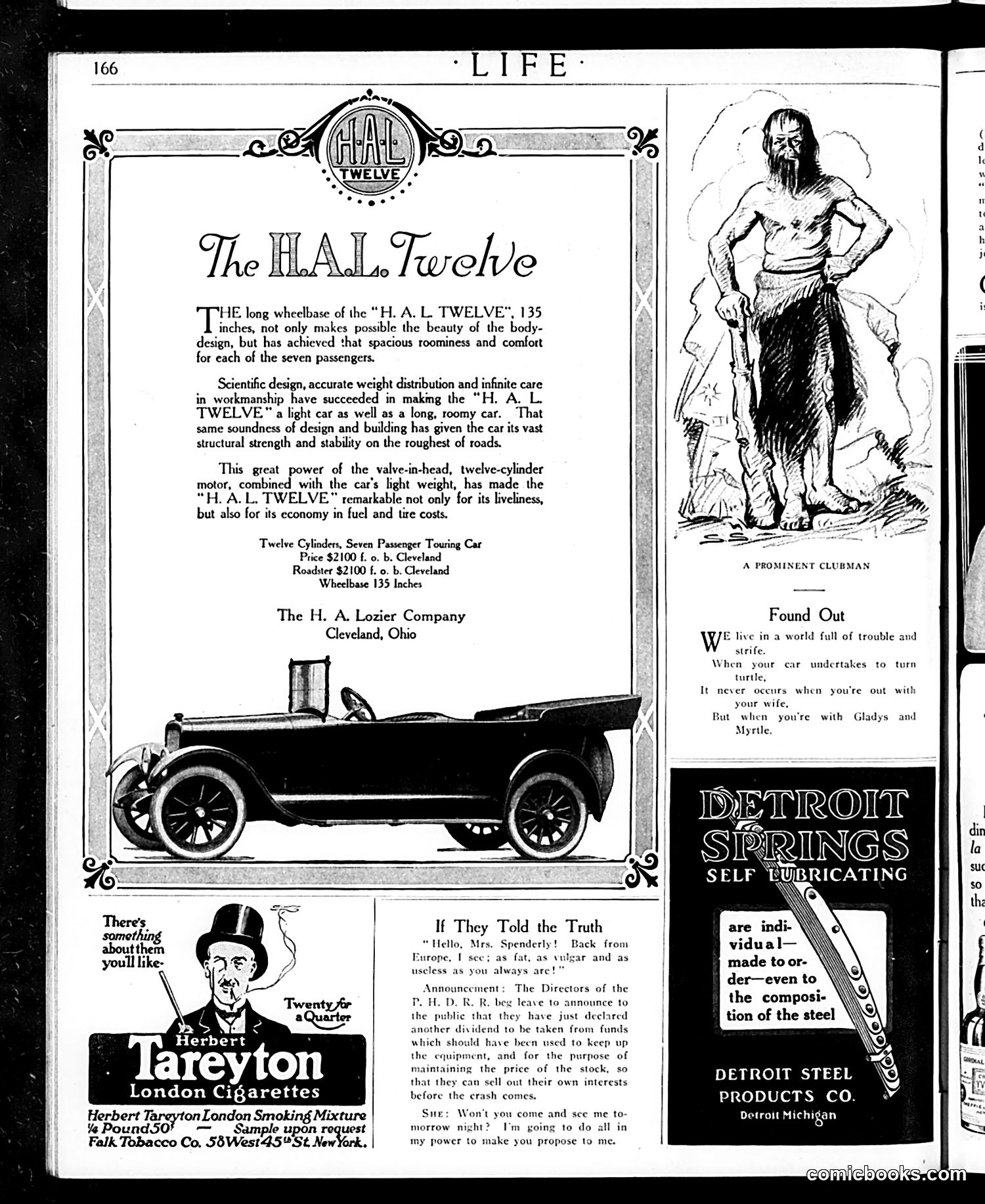
This page is primarily **advertising** for the H.A. Lozier automobile company, showcasing their "Twelve" model with technical specifications and pricing ($2,100). The satirical content appears in the small cartoons: **"Found Out"** mocks marital infidelity—a car that breaks down conveniently *only* when the driver is with his wife, never when he's with other women (Gladys and Myrtle), suggesting he uses the car for affairs. **"If They Told the Truth"** is sharper social commentary. It depicts corporate directors cynically announcing they're paying dividends from equipment maintenance funds to artificially prop up stock prices so they can sell their own shares before an economic collapse—appearing to reference financial manipulation and the anticipated crash (likely the 1920 recession). The "Mrs. Spenderly" character represents wealthy idle society. The Herbert Tareyton cigarettes ad uses a top-hatted gentleman, typical period advertising imagery. These vignettes satirize both personal moral hypocrisy and corporate fraud—common Life magazine targets.
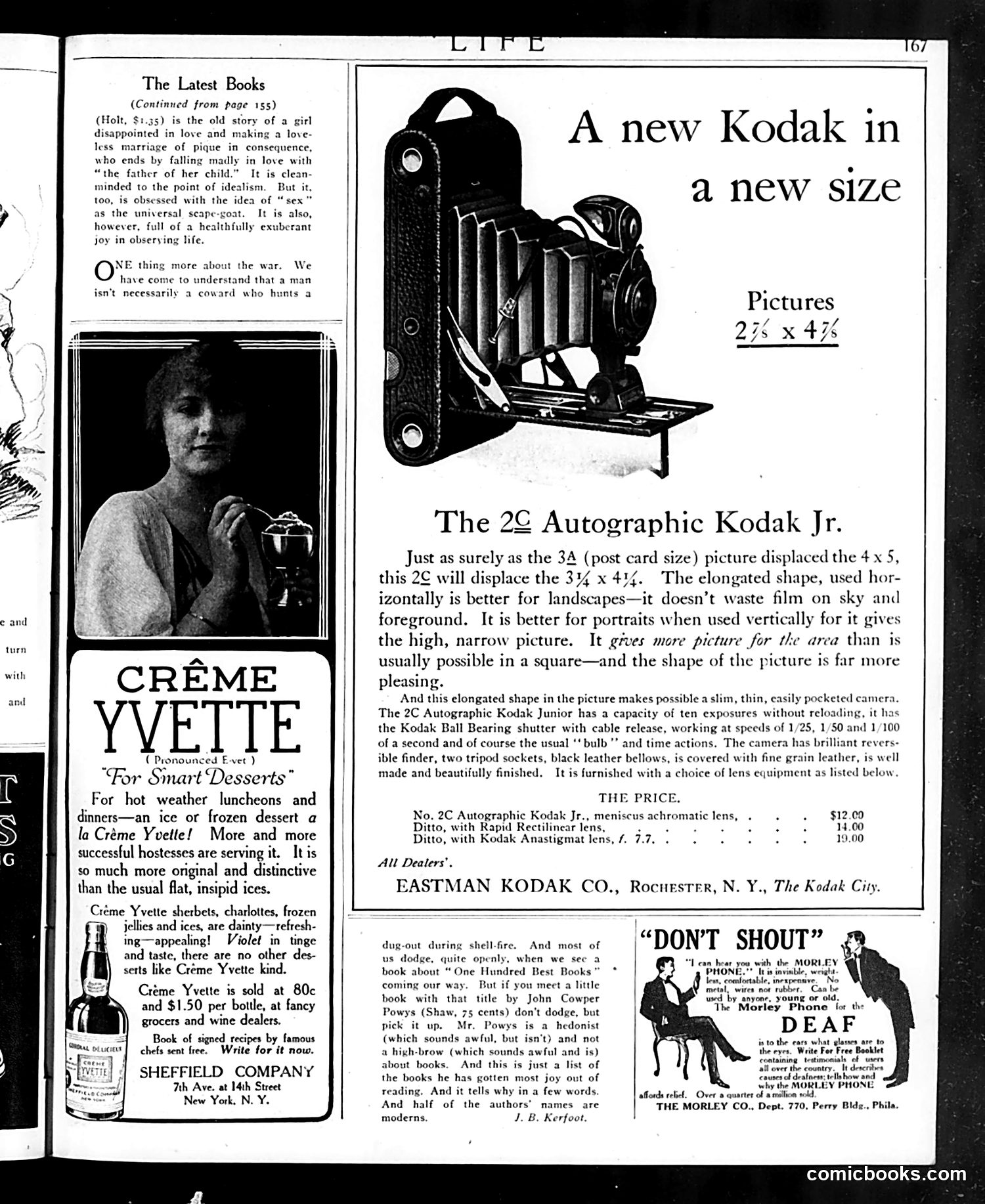
This page is primarily **advertising** with a small book review section. The main content includes: **Book Review (top left):** A brief critical discussion of recent novels, including commentary on how modern literature obsesses over "sex as the universal scapegoat." The reviewer notes that hunting during wartime doesn't necessarily indicate cowardice—a reference to World War I combat debates. **Advertisements:** - **Crème Yvette** (left): A dessert product marketed to "smart" hostesses as more distinctive than ordinary ices - **Kodak 2C Autographic Jr. Camera** (center/right): Promoting a new elongated film format (2⅞ x 4⅜ inches) as superior to previous square formats for landscapes and portraits - **Morley Phone** (bottom right): A telephone device for the deaf, emphasizing accessibility There are **no political cartoons** on this page. The content reflects early 20th-century consumer culture and wartime social attitudes, with advertising targeting middle-to-upper-class readers.
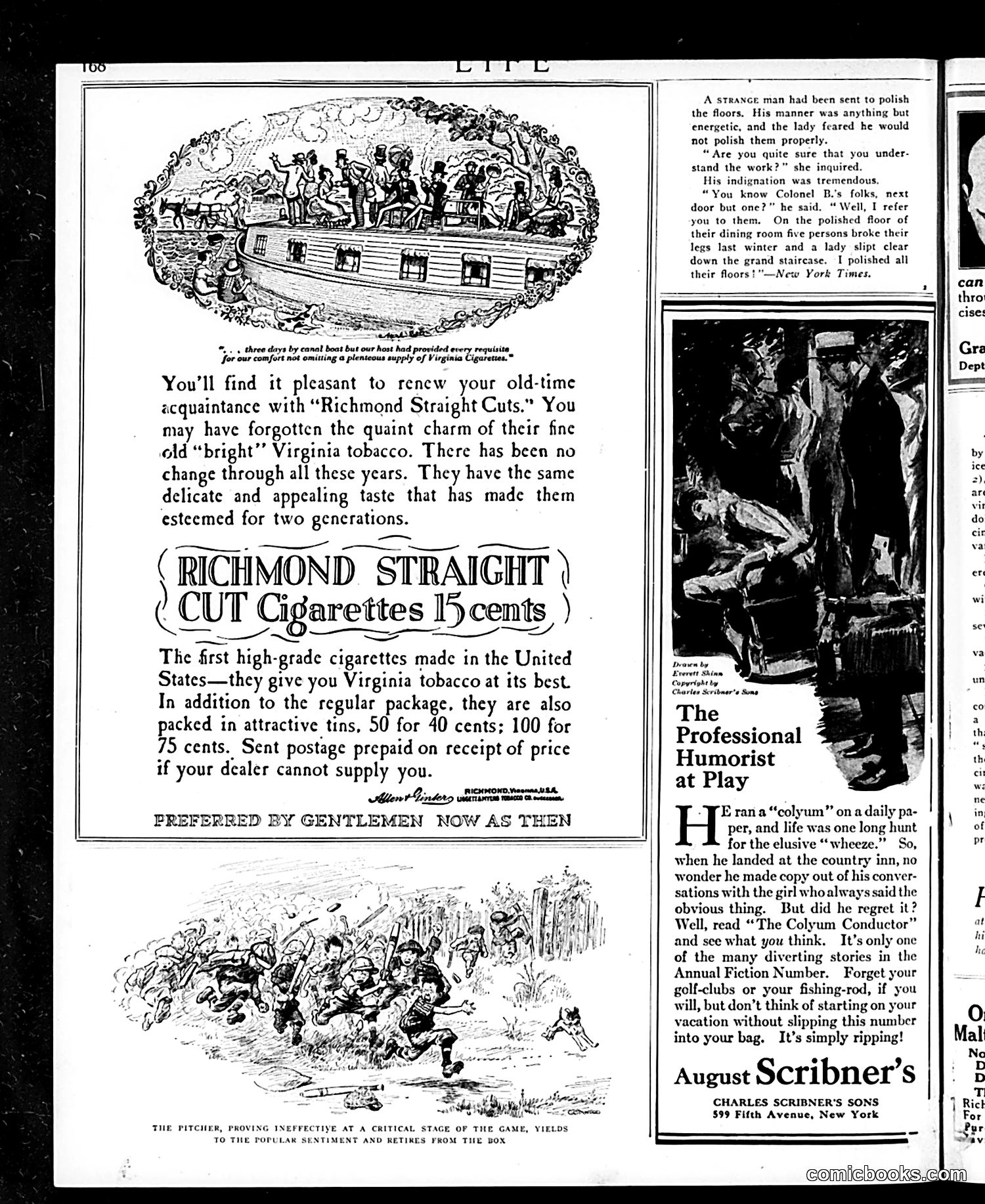
This page is primarily **advertising and promotional content** rather than political satire. The main advertisement promotes **Richmond Straight Cut Cigarettes** (15 cents), emphasizing their Virginia tobacco heritage and appeal to gentlemen. The accompanying illustration shows a canal boat scene, referencing a humorous anecdote about providing cigarettes during leisure travel. Below is a **baseball cartoon** captioned "The Pitcher, Proving Ineffective at a Critical Stage of the Game, Yields to the Popular Sentiment and Retires from the Box"—a straightforward sports joke about a failing pitcher being pulled from the game. The right column features **two humor items**: a brief anecdote from the *New York Times* about a floor polisher's boastful credentials, and an advertisement for *Scribner's* magazine's "Annual Fiction Number," promoting a story titled "The Colyum Conductor" about a newspaper columnist finding humor in everyday conversations. The page reflects early 20th-century American consumer culture and periodical advertising rather than political commentary.
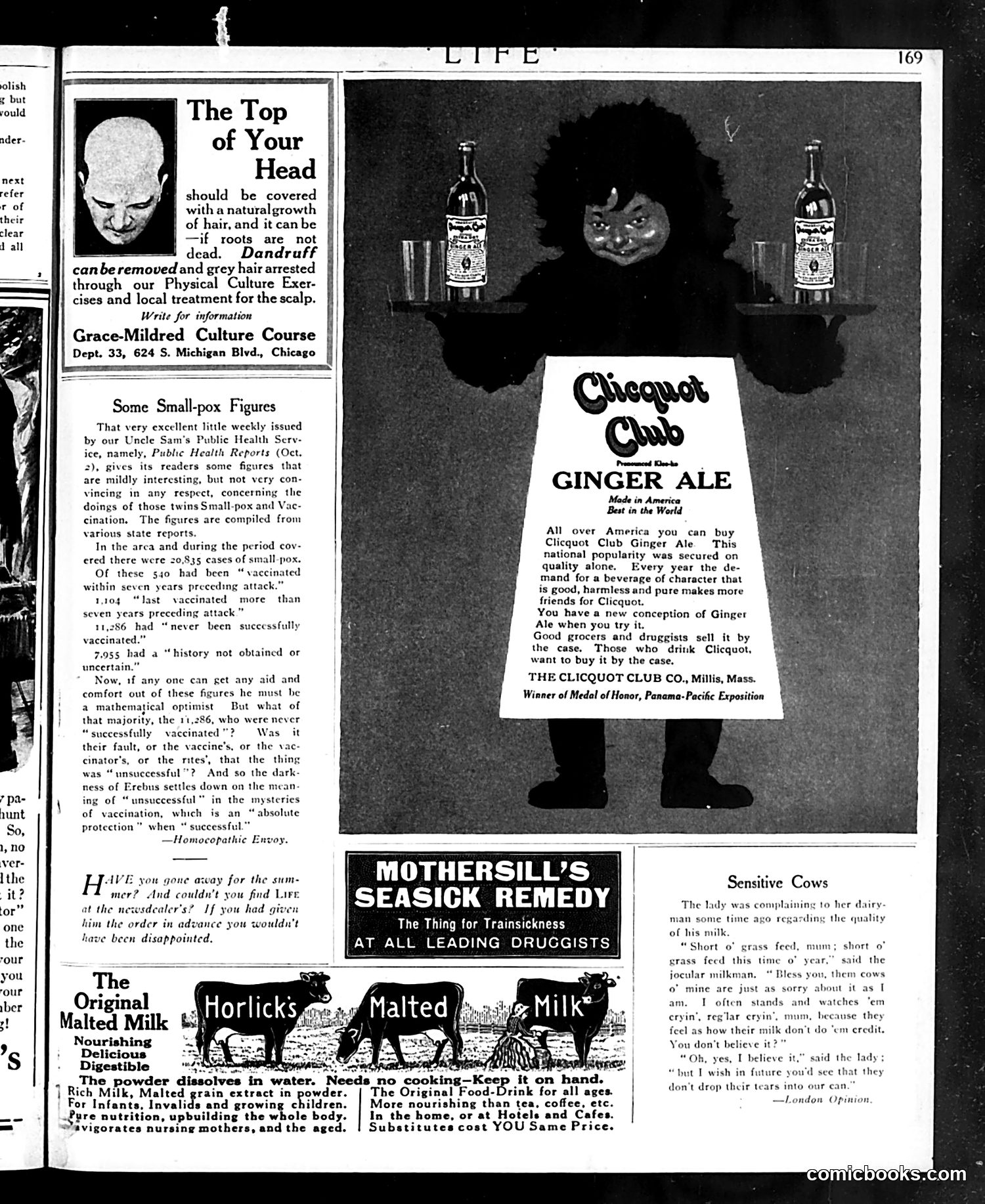
This page is **primarily advertisements** interspersed with brief editorial commentary. The satirical content is minimal: **Main Items:** 1. **"The Top of Your Head"** — Advertisement for the Grace-Mildred Culture Course promoting hair growth treatments and dandruff removal through physical exercise. 2. **"Some Small-pox Figures"** — Brief editorial commentary (labeled as satire by the Homeopathic Envoy attribution) mocking vaccination statistics. It presents confusing data about smallpox cases and vaccination outcomes, sarcastically suggesting the figures offer no clear proof of vaccination's effectiveness—appearing to critique both vaccination skeptics and the unclear public health reporting of the era. 3. **Clicquot Club Ginger Ale advertisement** — Standard product promotion claiming national popularity based on quality. 4. **"Sensitive Cows"** — Humorous short anecdote about a milkman explaining his cows cry because they're distressed about the quality of their milk during poor feed season. 5. **Product advertisements** — Mothersill's Seasick Remedy and Horlick's Malted Milk. The page reflects early 20th-century advertising and light social humor rather than political satire.
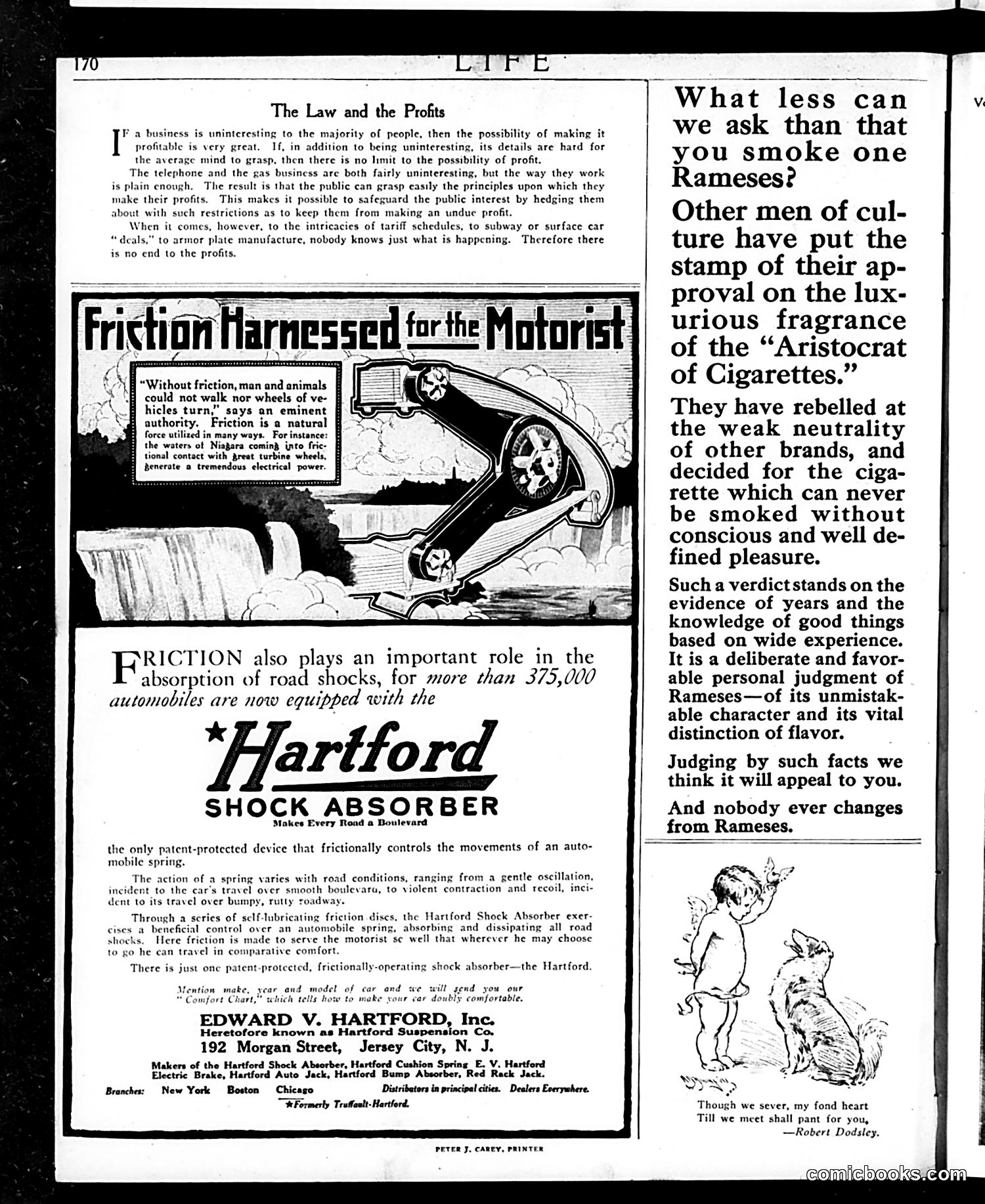
This page contains two distinct elements: **editorial commentary and advertisements**. **"The Law and the Profits"** is satirical commentary on regulatory capture. The argument: businesses operating in easily-understood industries (telephone, gas) face public scrutiny and profit limits, while industries with deliberately obscure mechanics (tariff schedules, subway deals, armor manufacture) escape regulation because the average person cannot grasp how they actually function. The implicit critique is that complexity becomes a tool for profiteering at public expense. **The cartoons and ads** are commercial rather than satirical. "Friction Harnessed for the Motorist" promotes Hartford Shock Absorbers, using pseudo-scientific explanation of friction's utility. The Rameses cigarette advertisement employs pretentious appeals to "culture" and "refined pleasure," marketing cigarettes as a status symbol for discriminating gentlemen—typical early 20th-century tobacco advertising that equated smoking with sophistication and social standing.