
Life, 1916-07-27 · page 13 of 32
Life — July 27, 1916 — page 13: what you’re looking at
What you’re looking at
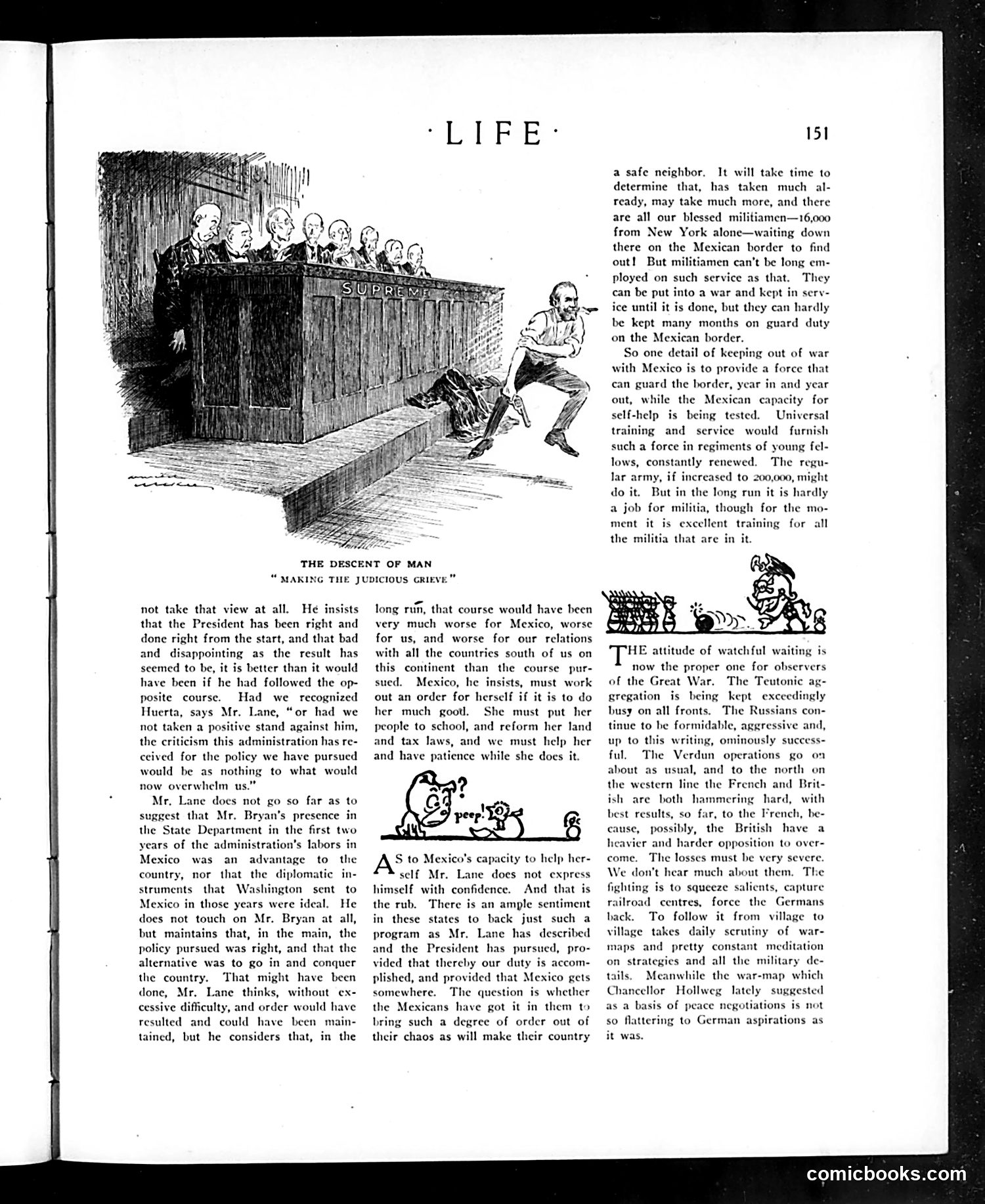
This editorial cartoon satirizes a legal proceeding (labeled "SUPREME" on the bench), depicting judges presiding while a figure below appears to be performing an exaggerated, undignified stance—suggesting the "descent of man" through loss of judicial dignity or improper court conduct. The accompanying text discusses U.S. policy toward Mexico, debating whether President Wilson and State Department official Lane acted appropriately in Mexican affairs. The piece defends their diplomatic approach, arguing it was preferable to military intervention. The cartoons' title mockingly invokes Shakespeare's phrase about debasement, implying that questionable legal or political decisions represent a fall from proper standards of conduct and judgment.
📄 Transcribed text from this page (OCR, searchable)
Machine-transcribed from the original scan — historical spelling and the odd misread are preserved.
THE DESCENT OF MAN “MAKING THE JUDICIOUS GRIEVE” not take that view at all. He insists that the President has been right and done right from the start, and that bad and disappointing as the result has seemed to be, it is better than it would have been if he had followed the op- posite course. Had we recognized Huerta, says Mr. Lane, “or had we not taken a positive stand against him, the criticism this administration has re- ceived for the policy we have pursued would be as nothing to what would now overwhelm us.” Mr, Lane does not go so far as to suggest that Mr. Bryan's presence in the State Department in the first two years of the administration’s labors in Mexico was an advantage to the country, nor that the diplomatic in- struments that Washington sent to Mexico in those years were ideal. He does not touch on Mr. Bryan at all, but maintains that, in the main, the policy pursued was right, and that the alternative was to go in and conquer the country, That might have been done, Mr. Lane thinks, without ex- ive difficulty, and order would ¢ resulted and could ha been main- tained, but he considers that, in the long ruin, that course would have been very much worse for Mexico, worse for us, and worse for our relations with all the countries south of us on this continent than the course pur- sued. Mexico, he insists, must work out an order for herself if it is to do her much goot. She must put her people to school, and reform her land and tax laws, and we must help her and have patience while she does it. S to Mexico's capacity to help her- self Mr. Lane does not express himself with confidence. And that is the rub. There is an ample sentiment in these states to back just such a program as Mr, Lane has described and the President has pursued, pro- vided that thereby our duty is accom- plished, and provided that Mexico gets somewhere. The question is whether the Mexicans have got it in them to bring such a degree of order out of their chaos as will make their country 151 a safe neighbor. It will take time to determine that, has taken much al- ready, may take much more, and there are all our blessed militiamen—16,000 from New York alone—waiting down there on the Mexican border to find out! But militiamen can’t be long em- ployed on such service as that. They can be put into a war and kept in serv- ice until it is done, but they can hardly be kept many months on guard duty on the Mexican border. So one detail of keeping out of war with Mexico is to provide a force that can guard the border, year in and year out, while the Mexican capacity for self-help is being tested. Universal training would furnish such a force in regiments of young fel- lows, constantly renewed. The regu- lar army, if increased to 200,000, might do it. But in the long run it is hardly a job for militia, though for the mo- ment it is excellent training for all the militia that are in it. and service HE attitude of watchful waiting is now the proper one for observers of the Great War. The Teutonic ag- gregation is being kept exceedingly busy on all fronts. The Russians con- tinue to he formidable, aggressive and, up to this writing, ominously success- ful. The Verdun operations go on about as usual, and to the north on the western line the French and Brit- ish are both hammering hard, with best results, so far, to the French, be- ause, possibly, the British have a heavier and harder opposition to over- come. The losses must be very severe. We don’t hear much about them. The fighting is to squeeze salients, capture railroad centres, force the Germans back. To follow it from village to village takes daily scrutiny of maps and pretty constant meditation on strategies and all the military de- ils. Meanwhile the war-map which Chancellor Hollweg lately suggested as a basis of peace negotiations is not so flattering to German aspirations as it was. comicbooks.com