
Life, 1916-07-27 · page 6 of 32
Life — July 27, 1916 — page 6: what you’re looking at
What you’re looking at
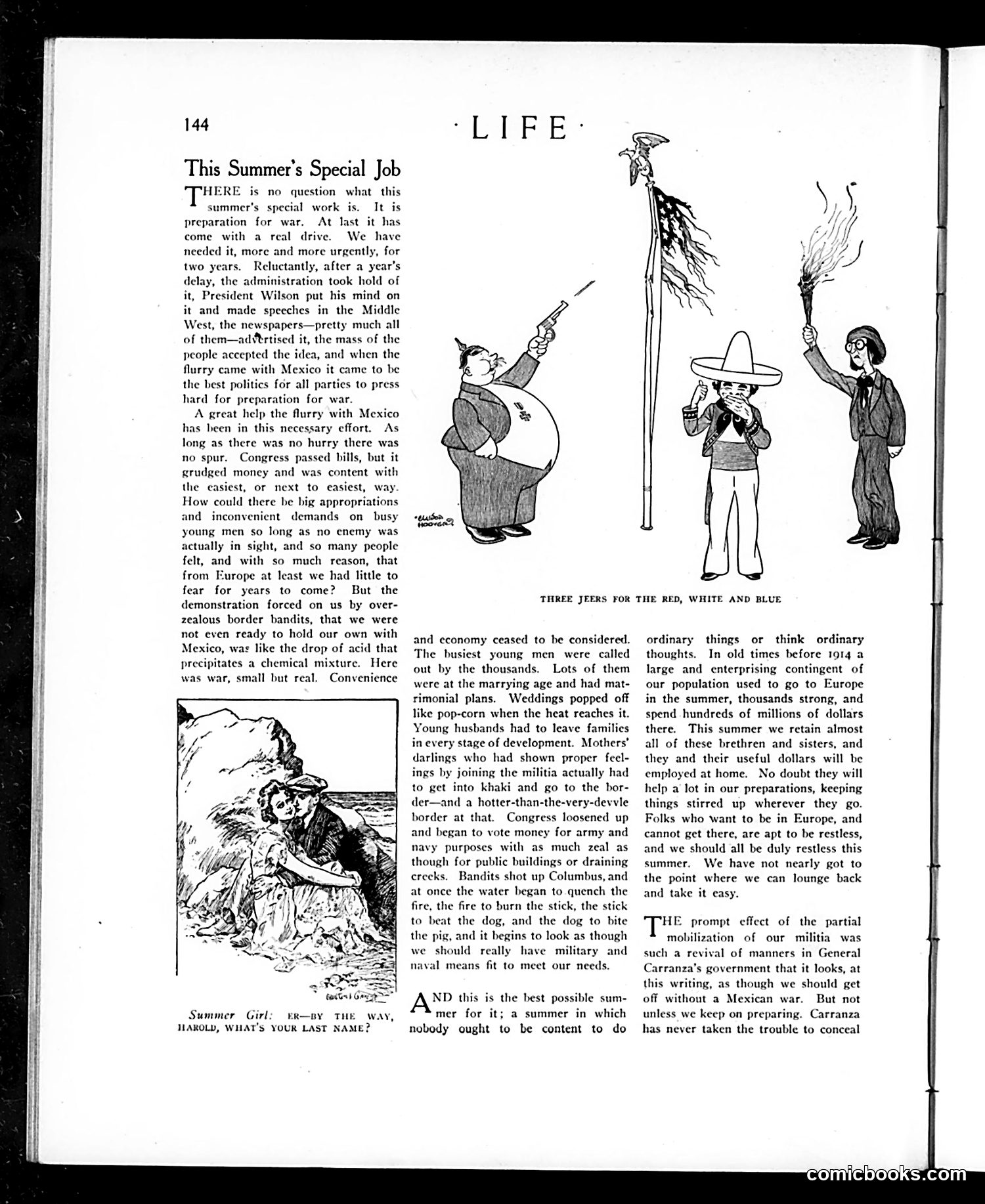
This page satirizes American military preparation during the Mexican border crisis (around 1911-1917). The article discusses mobilizing young men for potential war rather than civilian summer work. The cartoon "Three Jeers for the Red, White and Blue" shows three figures mocking patriotic service—likely representing different social perspectives on mandatory military duty. The illustration captioned "Summer Girl: Er—by the way, Harold, what's your last name?" depicts a young woman encountering a soldier, satirizing how military mobilization disrupted normal civilian life and courtship. The text argues that while border tensions justified military preparation, Congress reluctantly funded these efforts, and the disruption affected young men's marriages, family life, and normal economic activity—framing summer 1917 military service as necessary but socially disruptive.
📄 Transcribed text from this page (OCR, searchable)
Machine-transcribed from the original scan — historical spelling and the odd misread are preserved.
144 This Summer's Special Job HERE is no question what this summer's special work is. It is preparation for war. At last it has come with a real drive. We have needed it, more and more urgently, for two years. Reluctantly, after a year’s delay, the administration took hold of it, President Wilson put his mind on it and made speeches in the Middle West, the newspapers—pretty much all of them—advtrtised it, the mass of the people accepted the idea, and when the flurry came with Mexico it came to be the best politics for all parties to press hard for preparation for war. A great help the flurry with Mexico has been in this necessary effort. As long as there was no hurry there was no spur. Congress passed bills, but it grudged money and was content with the casiest, or next to easiest, way. How could there he hig appropriations d inconvenient demands on busy young men so long as no enemy was actually in sight, and so many people felt, and with so much reason, that from Europe at least we had little to fear for years to come? But the demonstration forced on us by over- zealous border bandits, that we were not even ready to hold our own with Mexico, was like the drop of acid that precipitates a chemical mixture. Here was war, small but real. Convenience Summer Girl: eR—py THE Way, HAROLD, WHAT'S YOUR LAST NAME? THREE JEERS FOR THE RED, WHITE AND BLUE and economy ceased to be considered. The busiest young men were called out by the thousands. Lots of them were at the marrying age and had mat- rimonial plans. Weddings popped off like pop-corn when the heat reaches it. Young husbands had to leave families in every stage of development. Mothers’ darlings who had shown proper fecl- ings by joining the militia actually had to get into khaki and go to the bor- der—and a hotter-than-the-very-devvle border at that. Congress loosened up and began to vote money for army and navy purposes with as much zeal as though for public buildings or draining creeks. Bandits shot up Columbus, and at once the water began to quench the fire, the fire to burn the stick, the stick to beat the dog, and the dog to bite the pig, and it begins to look as though we should really have military and naval means fit to meet our needs. A D this is the best possible sum- mer for it; a summer in which nobody ought to be content to do ordinary things or think ordinary thoughts. In old times before 1914 a large and enterprising contingent of our population used to go to Europe in the summer, thousands strong, and spend hundreds of millions of dollars there. This summer we retain almost all of these brethren and sisters, and they and their useful dollars will be employed at home. No doubt they will help a lot in our preparations, keeping things stirred up wherever they go. Folks who want to be in Europe, and cannot get there, are apt to be restless, and we should all be duly restless this summer. We have not nearly got to the point where we can lounge back and take it easy. HE prompt effect of the partial mobilization of our militia was such a revival of manners in General Carranza’s government that it looks, at this writing, as though we should get off without a Mexican war. But not unless we keep on preparing. Carranza has never taken the trouble to conceal