
Life, 1916-07-27 · page 20 of 32
Life — July 27, 1916 — page 20: what you’re looking at
What you’re looking at
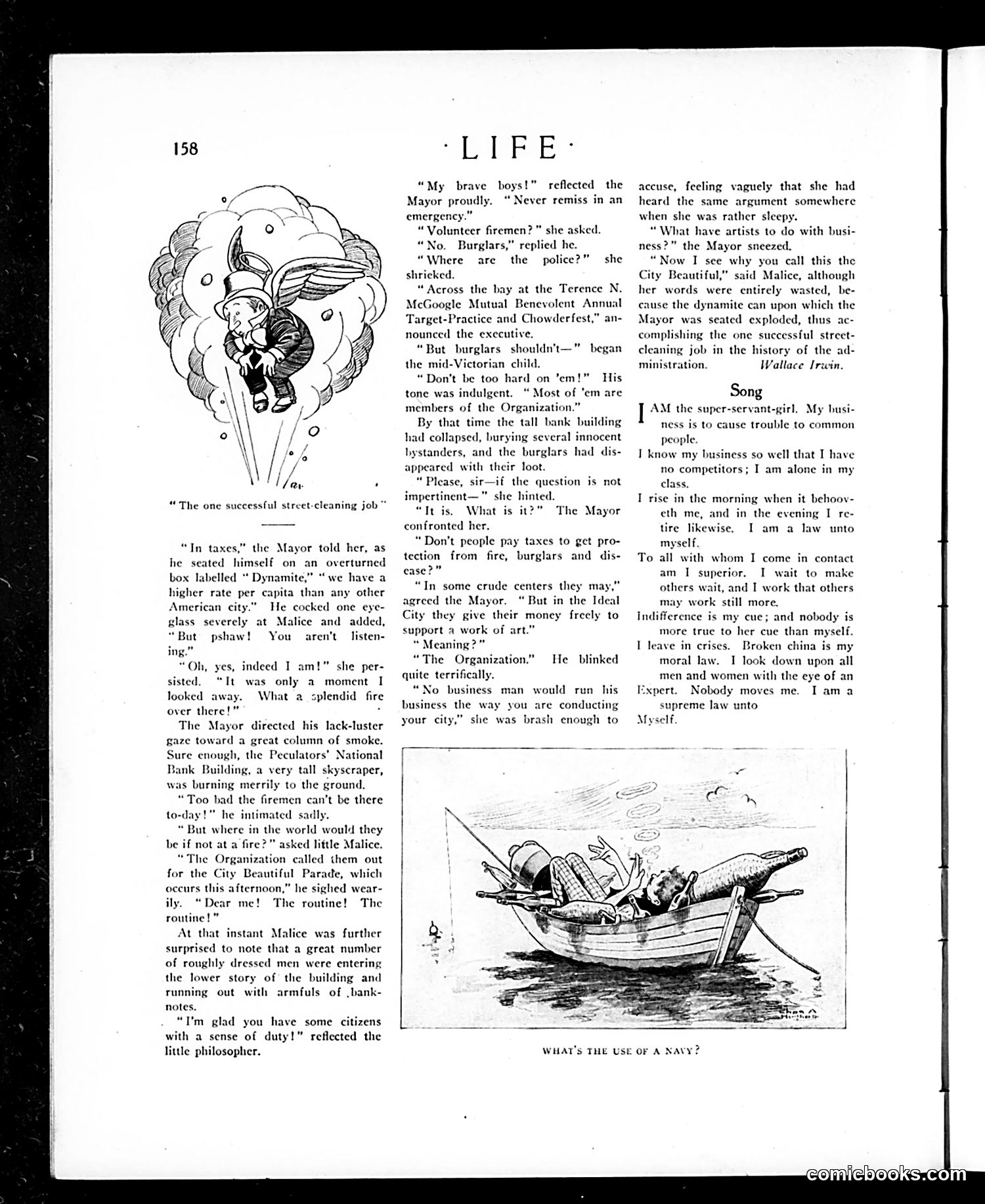
This satirical piece mocks municipal corruption and mismanagement, likely from the Progressive Era (early 1900s). The dialogue depicts a naive child ("little Malice") exposing absurd contradictions in a Mayor's administration. **The Setup:** While a bank building burns, firefighters are absent at a "City Beautiful Parade." Simultaneously, burglars openly steal from the bank. The Mayor defends this chaos by claiming the burglars are "members of the Organization"—implying they're politically connected operatives. **The Satire:** The joke targets: - Political machines that prioritize pageantry ("City Beautiful") over essential services - Corrupt officials who tolerate crime in exchange for organizational loyalty - The absurdity of taxing citizens for protection they don't receive **The Climax:** A dynamite box (labeled, ironically) beneath the Mayor explodes, killing him—the "one successful street-cleaning job" of his administration. The cartoon above depicts this explosion. The bottom illustration about a navy appears unrelated to the main text, suggesting page layout from the magazine's miscellaneous content.
📄 Transcribed text from this page (OCR, searchable)
Machine-transcribed from the original scan — historical spelling and the odd misread are preserved.
“The one successful street-cleaning job” “In taxes,” the Mayor told her, as he seated himself on an overturned box labelled “ Dynamite,” “we have a higher rate per capita than any other American city." He cocked one eye- glass severely at Malice and added, “But You aren't listen- ing.” Oh, yes, indeed I am!” she per- sisted, “It was only a moment I looked away. What a splendid fire over there!" : The Mayor directed his lack-luster gaze toward a great column of smoke. Sure enough, the Peculators’ National Bank Building, a very tall skyscraper, was burning merrily to the ground, “Too bad the firemen can’t be there to-day!" he intimated sadly. But where in the world would they be if not at a fire?" asked little Malice. “The Organization called them out for the City Beautiful Parade, which afternoon,” he sighed wear- The routine! The pshaw! occurs this ily. “Dear me! routine!” At that instant Malice was further surprised to note that a great number of roughly dressed men were entering the lower story of the building and running out with armfuls of ,bank- notes. “I'm glad you have some citizens with a sense of duty!” reflected the little philosopher. “IE ERE * boys!” reflected the Never remiss in an “My brave Mayor proudly. emergency.” “Volunteer firemen?” she asked. No. Burglars,” replied he. police? Where the she shricked. “Across the bay at the Terence N. McGoogle Mutual Benevolent Annual Target-Practice and Chowderfest,” an- nounced the executive, “But burglars shouldn't— the mid-Victorian child. “Don't be too hard on ’em!” His tone was indulgent. “ Most of 'em are members of the Organization.” By that time the tall bank building had collapsed, burying several innocent »ystanders, and the burglars had dis- appeared with their loot. Please, sir—if the question is not impertinent—" she hinted. “Tris. Wi is it? confronted her, “Don’t people pay taxes to get pro- tection from fire, burglars and dis- case?” “In some crude centers they may,” agreed the Mayor. “ But in the Ideal ity they give their money freely to support a work of art.” “ Meaning?” “The Organization.” quite terrifically. “No business man would run his business the way you are conducting your city,” she was brash enough to are began The Mayor He blinked accuse, feeling vaguely that she had heard the same argument somewhere when she was rather sleepy “What have artists to do with busi- ness?” the Mayor sneezed. “Now I see why you call this the City Beautiful,” said Malice, although her words were entirely wasted, be- cause the dynamite can upon which the Mayor was seated exploded, thus ac- complishing the one successful street- cleaning job in the history of the ad- ministration. Wallace Irwin. Song AM the super-servant-girl. My busi- ness is to cause trouble to common people. I know my business so well that I have no competitors; I am alone in my class. I rise in the morning when it behoov- eth me, and in the evening I re- tire likewise. I am a law unto myself. all with whom I come in contact am I superior. I wait to make others wait, and I work that others may work still more. Indifference is my cue; and nobody i more true to her cue than myself. I leave in crises. Broken china is my moral law. I look down upon all men and women with the eye of an pert. Nobody moves me. I am a supreme law unto Myself. WHAT'S THE USE OF A NAVY?