
A complete issue · 44 pages · 1916
Life — March 9, 1916
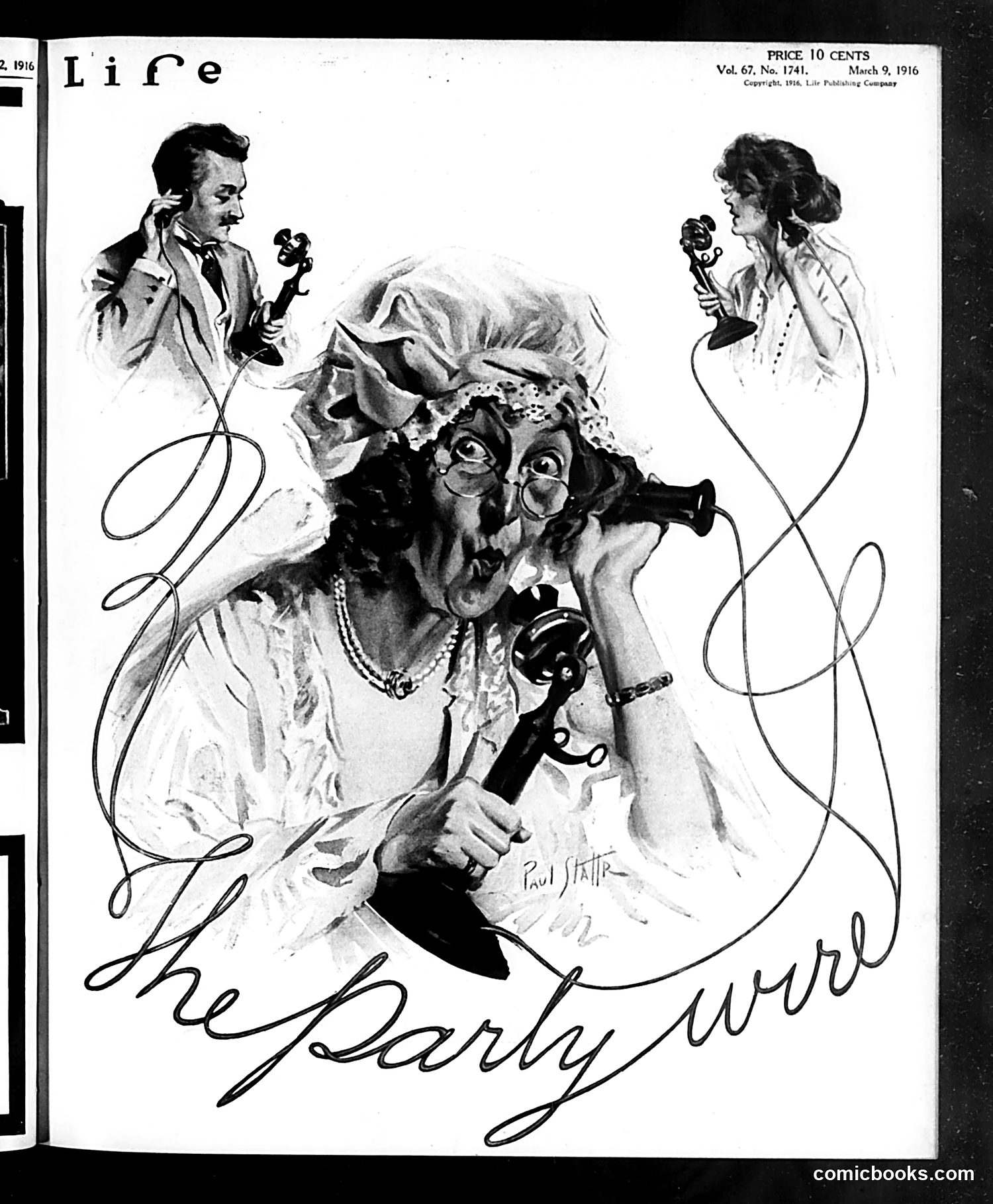
This cartoon by Paul Stäffer satirizes early telephone communication technology. The central figure is a woman with exaggerated features wearing old-fashioned dress and large glasses, holding an early telephone receiver. Two men on either side hold old-style telephone handsets connected by tangled wires. The satire appears to mock the cumbersome, unreliable nature of primitive telephone systems—the chaotic wire arrangement suggests poor connections and technical dysfunction. The woman's wild-eyed, distressed expression emphasizes the frustration users experienced with early telephony. The title "The Early Wire" references both the literal telephone wires and puns on "early" technology mishaps, poking fun at the limitations of this then-modern communication innovation before telephone systems became more reliable and user-friendly.
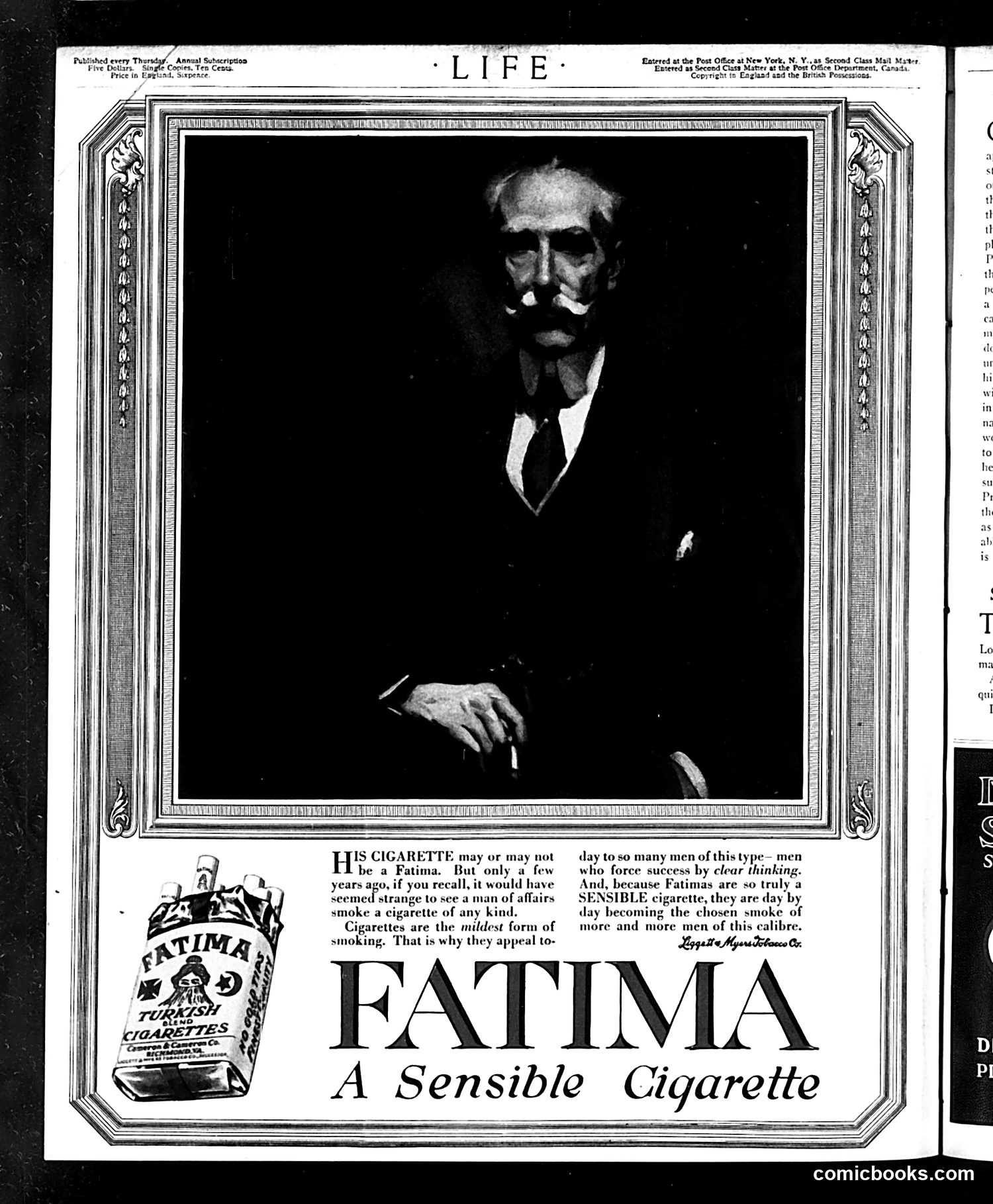
This page is primarily a **cigarette advertisement for Fatima brand**, not political satire. The ad features a formal portrait photograph of a distinguished gentleman with a prominent mustache, smoking a cigarette, styled as a portrait of someone important or successful. The advertisement's text argues that cigarettes appeal to men of "clear thinking" and "caliber," claiming Fatima is a "sensible cigarette" for successful businessmen. The ad uses the gentleman's refined appearance to associate the product with success and sophistication. This represents typical **early 20th-century tobacco marketing**, which frequently used aspirational imagery and pseudo-scientific claims about cigarette "sensibility" to attract affluent consumers. The approach exploits social status anxiety rather than conveying factual product information.

This page is primarily **advertising**, not satire or political commentary. The dominant content is a large advertisement for **Pennsylvania Oilproof Vacuum Cup Tires**, emphasizing their durability (6,000-mile guarantee), safety features, and superior quality. The visual shows an oversized tire with its distinctive treaded pattern looming over delivery trucks. A smaller ad below promotes **Detroit Springs** self-lubricating products by Detroit Steel Products Co., highlighting industrial manufacturing quality. The left column contains brief **"Society Notes in Our Town"** — personal announcements about local engagements and returns from trips, typical of period magazine lifestyle sections. The page reflects early 20th-century American commercial culture, with manufacturers competing on durability and safety guarantees to consumers increasingly purchasing automobiles and industrial equipment.
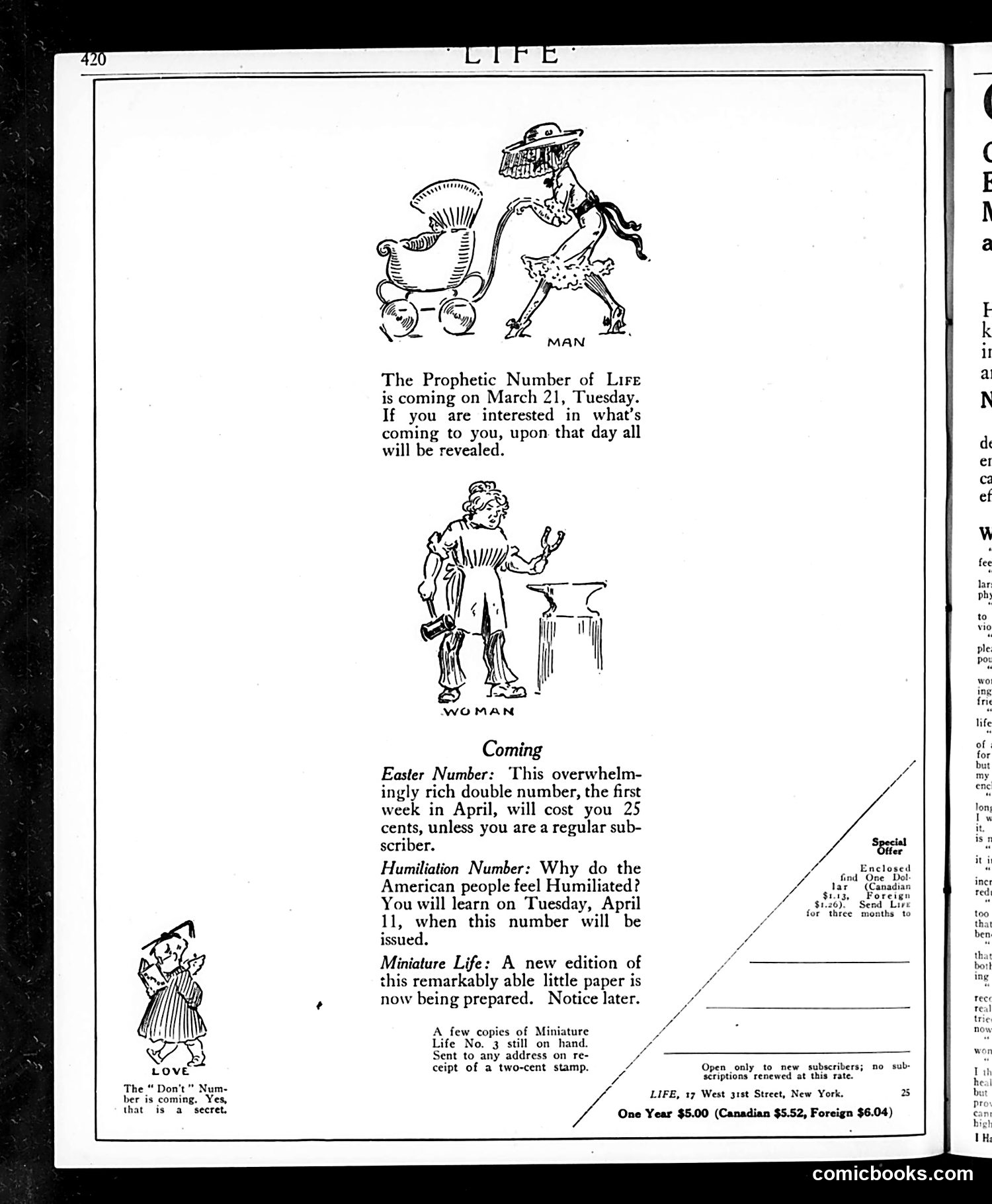
This page is primarily **advertising and promotion** for Life magazine's upcoming issues, not political satire. The content announces three forthcoming special issues: 1. **"Prophetic Number"** (March 21) - promises to reveal readers' futures 2. **Easter Number** (early April) - described as a "rich double number" costing 25 cents 3. **Humiliation Number** (April 11) - poses the question "Why do the American people feel humiliated?" suggesting contemporary national concerns The illustrations show generic figures labeled "Man," "Woman," and "Love" as decorative elements. The page includes a "Special Offer" subscription box at bottom right. The "Humiliation Number" reference suggests this page dates from a period of American national crisis or embarrassment, though the specific historical context isn't clear from this excerpt alone.
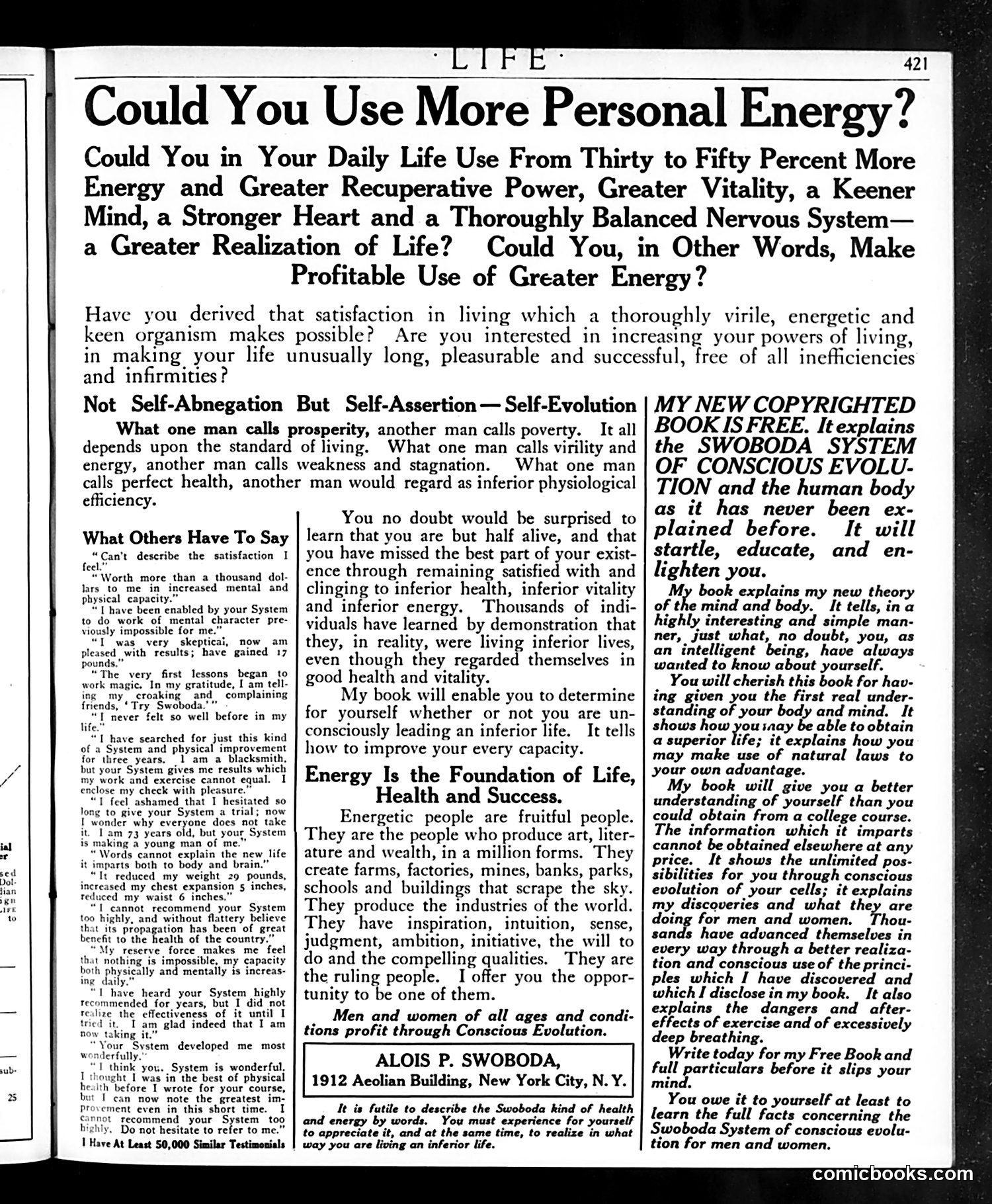
This page is **not a cartoon or satire**, but rather **advertising disguised as editorial content**—a common practice in early 20th-century magazines. The entire page promotes the "Swoboda System of Conscious Evolution," a health/self-improvement product offered by Alois P. Swoboda in New York City. The left column contains fabricated testimonials claiming the system increased mental capacity, physical strength, and vitality. The right column is Swoboda's direct pitch, offering a free book promising to unlock untapped human energy and potential. This reflects the era's wellness boom: pseudoscientific self-help schemes marketed through magazines to readers seeking better health and success. The breathless promises—"30 to 50 percent more energy"—are typical of unregulated health advertising from this period.
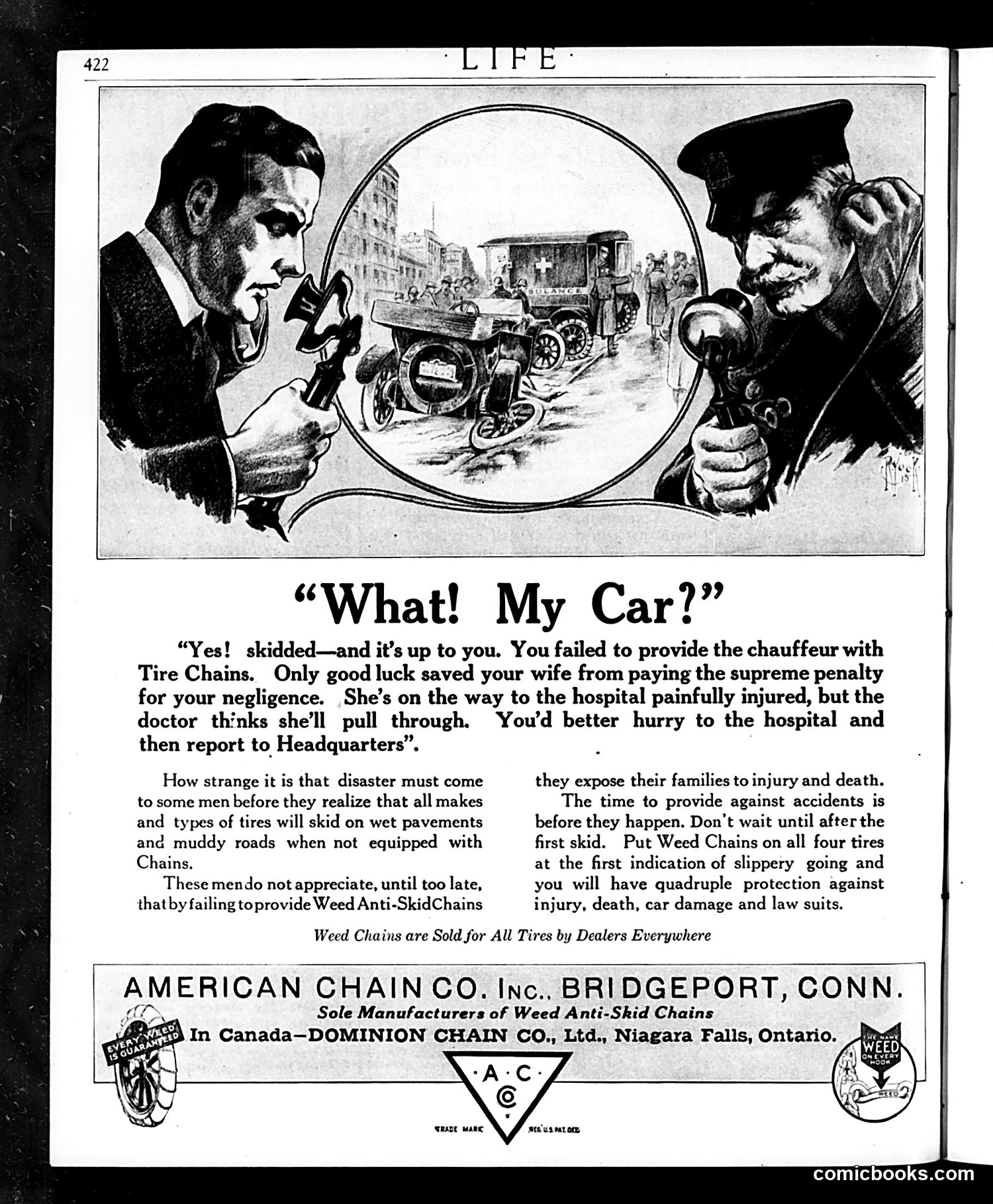
This is primarily a **Weed Anti-Skid Chains advertisement** disguised as editorial content, a common early-20th-century marketing tactic. The "cartoon" depicts two men in hats examining a crystal ball showing a car accident scene with a vehicle skidding on wet pavement. The dramatic narrative blames the car owner for negligence—specifically for failing to equip his chauffeur with tire chains, resulting in an accident that injured his wife. The message exploits contemporary anxieties about automobiles (still relatively new and dangerous) to promote Weed Chains as essential safety equipment. The moral lesson—that accidents are preventable through proper preparation—is designed to shame readers into purchasing the product. The ad emphasizes liability and legal consequences alongside personal injury, making a business case for the chains' purchase.
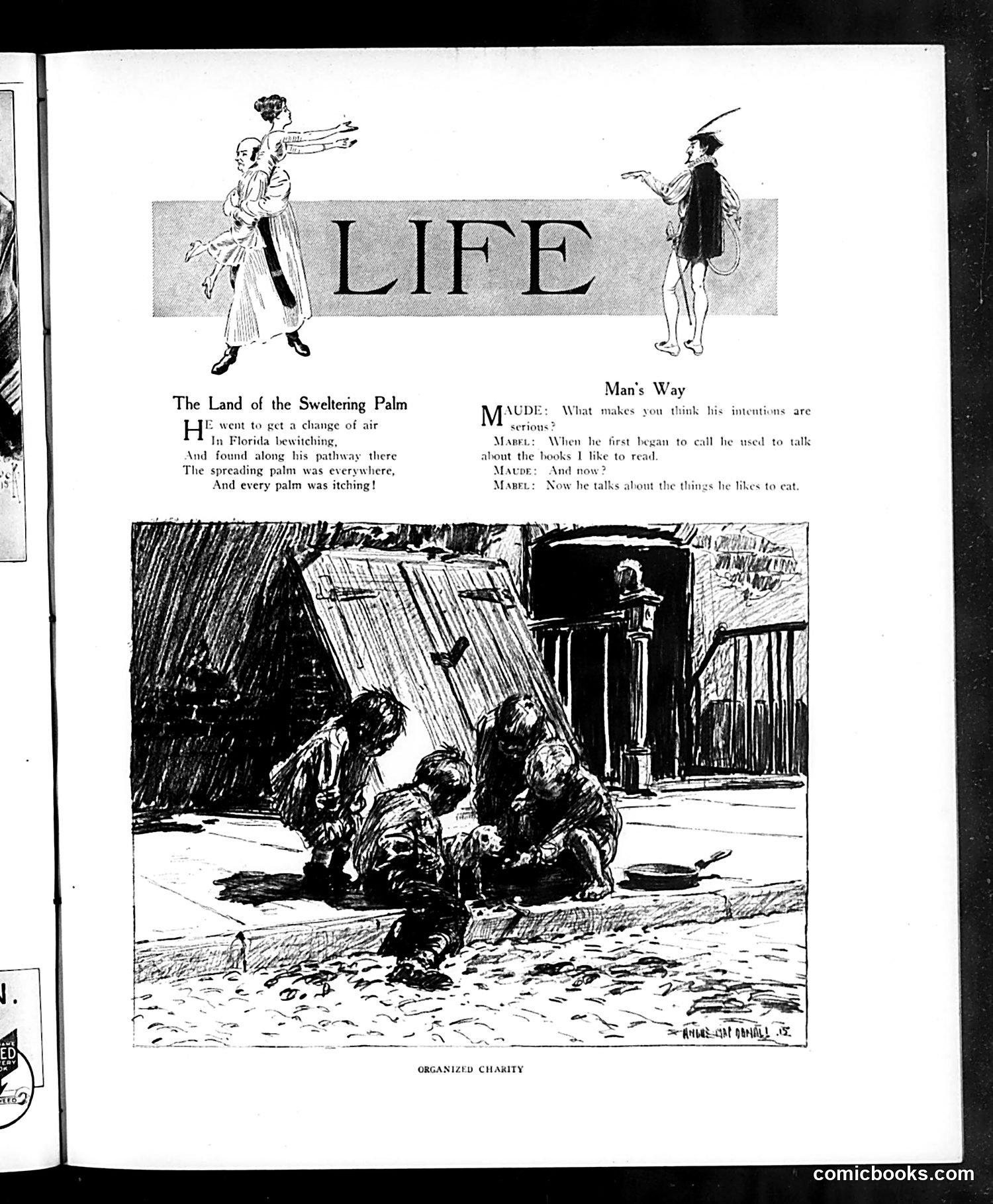
This page contains two satirical pieces: **"The Land of the Sweltering Palm"** (left) mocks Florida tourism with a poem about a man seeking relief who finds only itching palms everywhere—a double entendre suggesting both literal palm trees and people's hands itching for money. **"Man's Way"** (right) is a dialogue between Maud and Mabel satirizing changing male priorities. The joke tracks how a man's interests shift: he initially discusses books he likes to read, then shifts to food preferences—suggesting men are becoming less intellectual and more focused on physical appetites. **"Organized Charity"** (bottom illustration) depicts impoverished figures receiving handouts, likely critiquing the efficacy or implementation of charitable relief systems of the era. The page reflects early 20th-century concerns about consumerism, gender dynamics, and poverty management.
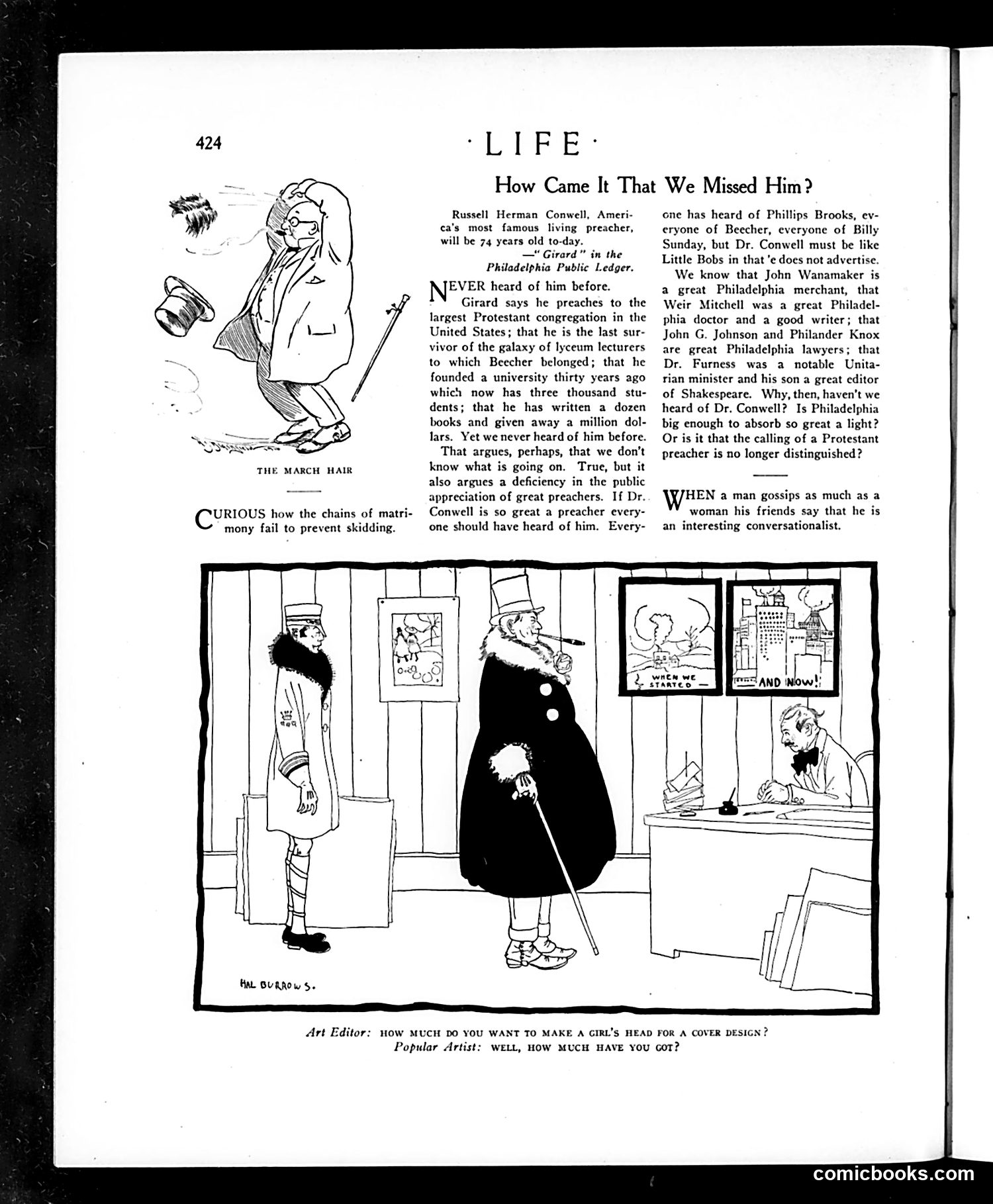
This page contains an article titled "How Came It That We Missed Him?" about Russell Herman Conwell, described as "America's most famous living preacher" at age 74. The article notes that despite his prominence—founding a university with 3,000 students, writing a dozen books, giving away a million dollars—few have heard of him. It questions why Philadelphia, home to famous merchants, doctors, and lawyers, hasn't promoted this notable Unitarian minister. The cartoon below depicts two well-dressed figures (likely representing Art Editor and Popular Artist) in what appears to be an office, discussing cover design costs—satirizing the gap between artistic ambition and practical budgets. The small illustration titled "The March Hair" appears separately, unrelated to the main content.
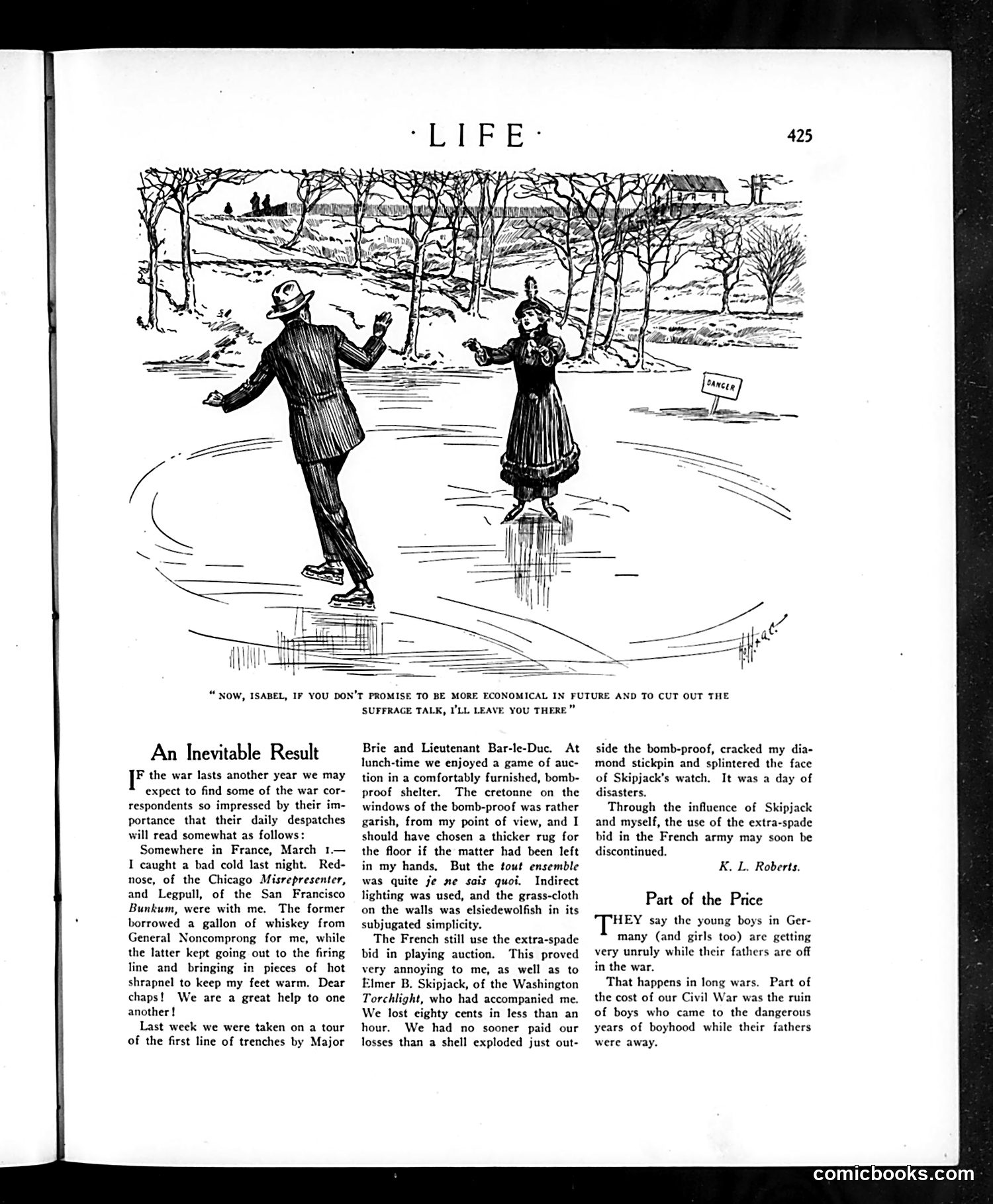
This cartoon depicts a man ice-skating attempting to help a woman maintain balance. The caption reads: "Now, Isabel, if you don't promise to be more economical in future and to cut out the suffrage talk, I'll leave you there." **The Satire:** This is anti-suffrage propaganda. The man uses the pretense of helping the woman on ice as leverage to demand she abandon both financial independence and women's suffrage advocacy. The cartoon frames women's rights and economic autonomy as burdensome "talk" that men must suppress through control. **Context:** This appears from Life magazine's early 20th-century period, when suffrage was actively debated in America. The joke relies on portraying women's political engagement as a personal annoyance to be bargained away, rather than a legitimate rights movement—a common anti-suffrage rhetorical strategy of the era.
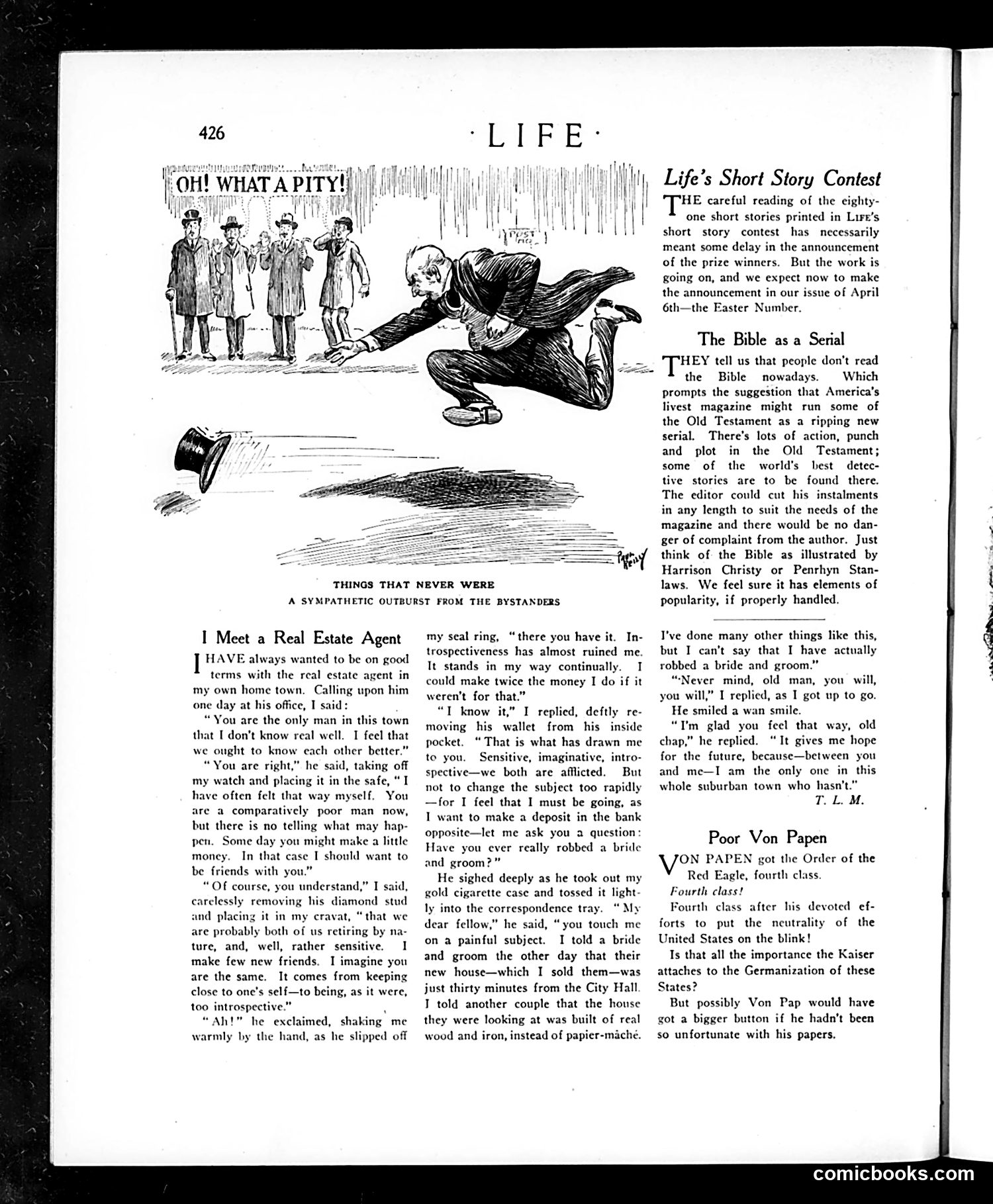
The cartoon titled "Oh! What a Pity!" depicts a man diving or falling horizontally while four observers stand behind him. A top hat lies on the ground. The caption reads "Things That Never Were: A Sympathetic Outburst from the Bystanders." The joke appears to satirize social hypocrisy: the bystanders express sympathy for the man's misfortune (his fall/loss of status, symbolized by the fallen hat), yet their exaggerated concern is hollow—they're merely performing appropriate social responses while witnessing his humiliation. The accompanying article "I Met a Real Estate Agent" describes a story about financial desperation and ethical compromise. The page addresses Life's short story contest and discusses serializing biblical narratives. The overall tone suggests satire about American social pretense and financial anxiety during an unspecified historical period.
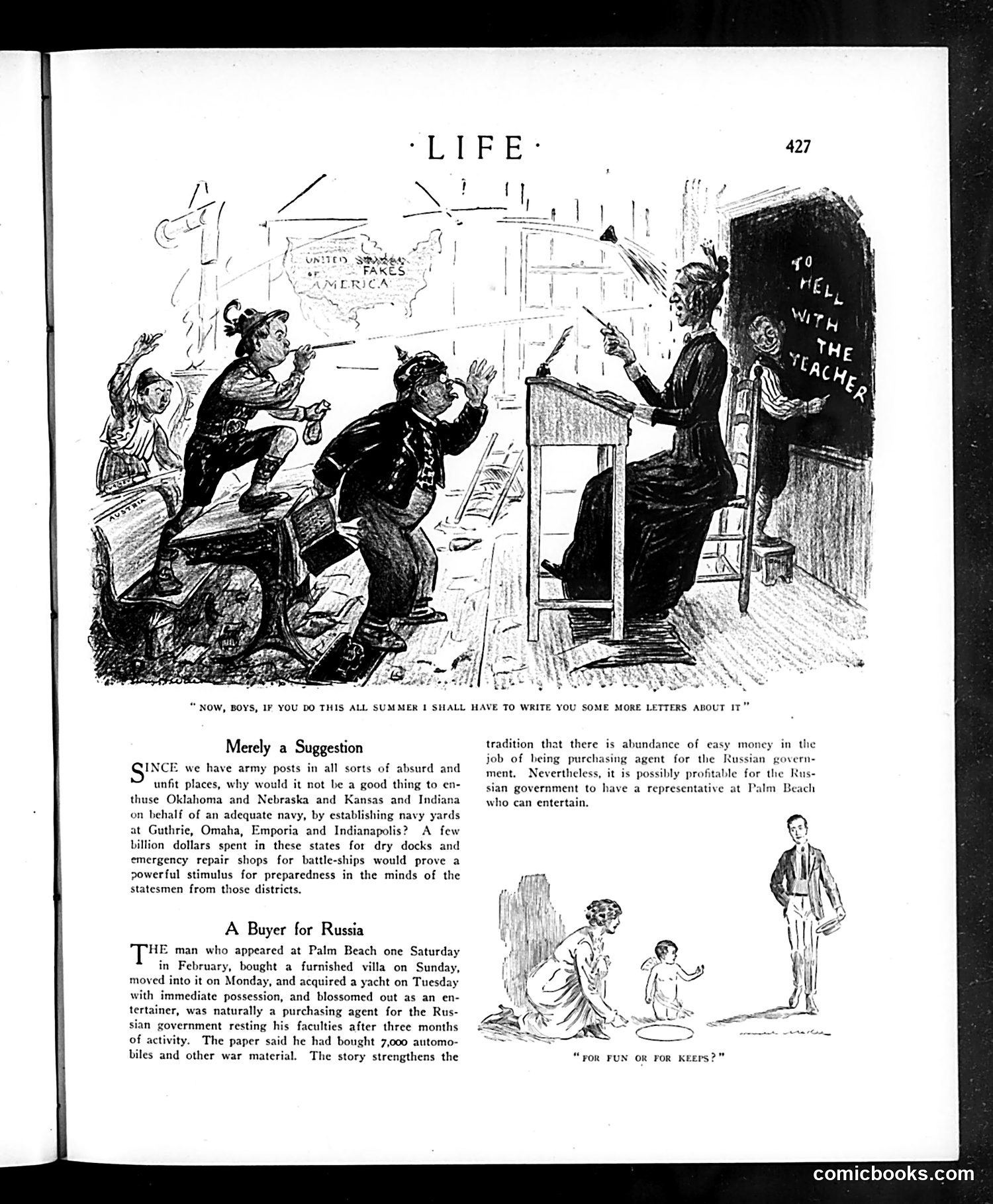
The top cartoon satirizes American military preparedness during what appears to be the World War I era. A teacher (labeled "To Hell With The Teacher") threatens students with extra letters about their summer behavior—a joke about punishment and authority. The articles below discuss two absurd scenarios: establishing naval yards in landlocked states (Oklahoma, Nebraska, Kansas, Indiana) to supposedly boost military readiness, and a man who rapidly purchased a Russian villa, yacht, and claimed to represent the Russian government as a purchasing agent—acquiring 7,000 automobiles and war material in three months. Both pieces mock wasteful government spending, fraudulent business schemes, and post-war profiteering. The smaller cartoon ("For Fun or for Keeps?") appears unrelated domestic humor.
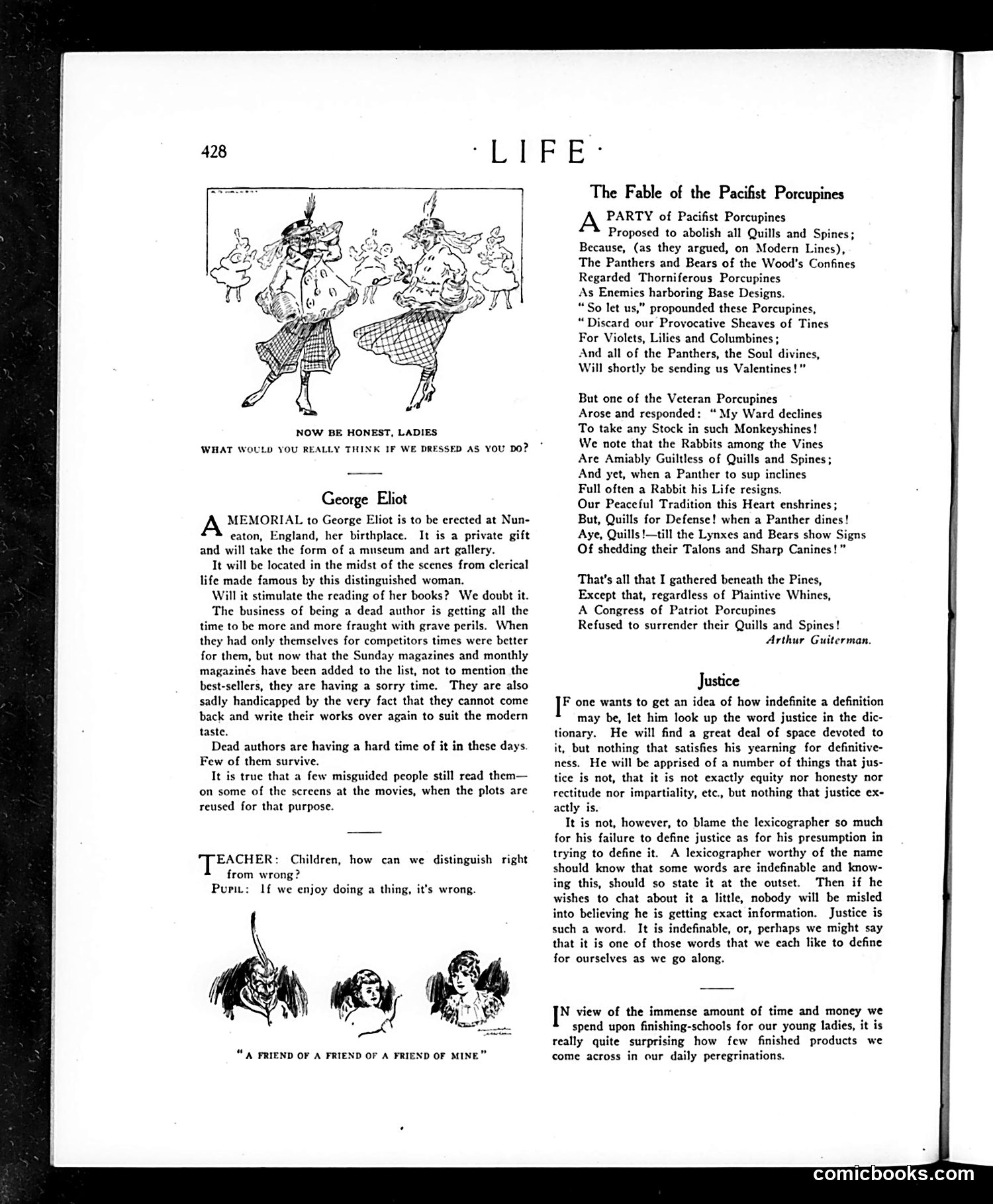
This page from *Life* magazine contains three distinct pieces of satire: 1. **"The Fable of the Pacific Porcupines"** (top): A poem by Arthur Guiterman mocking pacifists who proposed abolishing quills and spines as defense. The porcupines represent peace advocates; the satire suggests their disarmament proposals are naïve—animals need their defensive tools. 2. **George Eliot Memorial** (middle-left): Commentary on a planned museum dedicated to the deceased female author. The piece critiques how dead authors' popularity fades while magazines and publishers struggle to adapt to modern taste. 3. **"Justice"** (right): A philosophical essay arguing that "justice" is indefinable—like many abstract concepts, it resists exact lexicographical definition, though we intuitively understand it. The humor relies on wordplay and social observation rather than visual caricature.
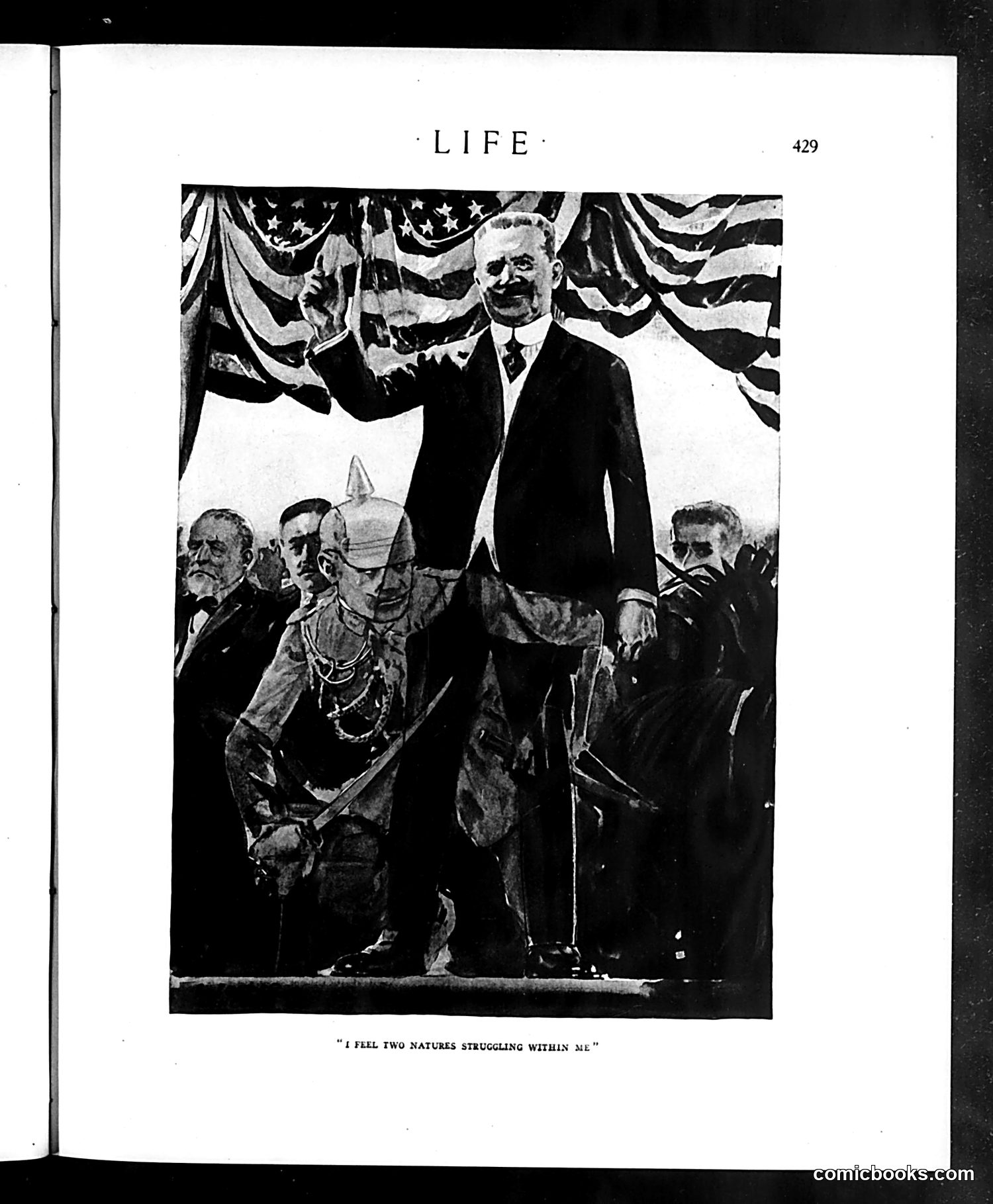
This is page 429 from *Life* magazine, featuring a political cartoon titled "I Feel Two Natures Struggling Within Me." The image depicts a tall man in a business suit standing prominently, flanked by military figures in uniform (appearing to include German imperial military dress with spiked helmets). American flags with bunting decorate the background. The caption's phrase—"two natures struggling within me"—suggests internal conflict. This appears to be satirizing American political or business leadership during a period of international tension, likely referencing World War I era conflicts between American neutrality/pacifism and pro-military or pro-war sentiment. The contrast between civilian businessman attire and surrounding military figures emphasizes this tension between commercial and martial interests competing for influence over American policy.
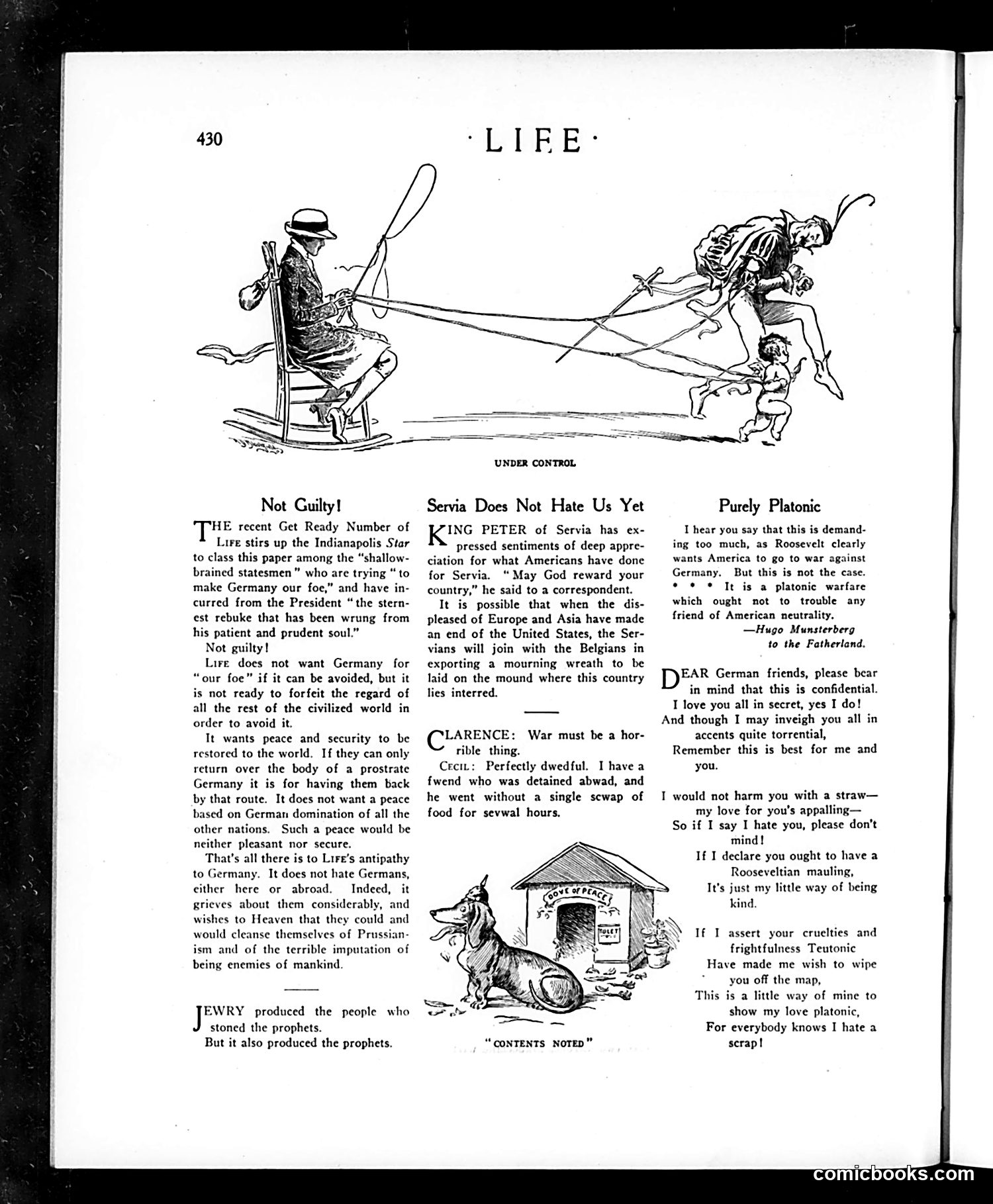
**Main Cartoon ("Under Control"):** The illustration depicts a man in a rocking chair controlling two figures (a woman and cherub) with strings like puppets. This satirizes American political/social control during what appears to be the World War I era. **Text Commentary:** The three opinion pieces debate American neutrality and Germany: - **"Not Guilty!"** argues Life shouldn't blame Germany, asserting Germany wants peace and that the U.S. shouldn't support other nations against it. - **"Servia Does Not Hate Us Yet"** references King Peter of Serbia expressing appreciation for American support, suggesting America may be drawn into European conflicts. - **"Purely Platonic"** claims America's involvement would be non-combative—purely ideological support. The page satirizes American isolationist arguments while hinting at inevitable entanglement in European war.
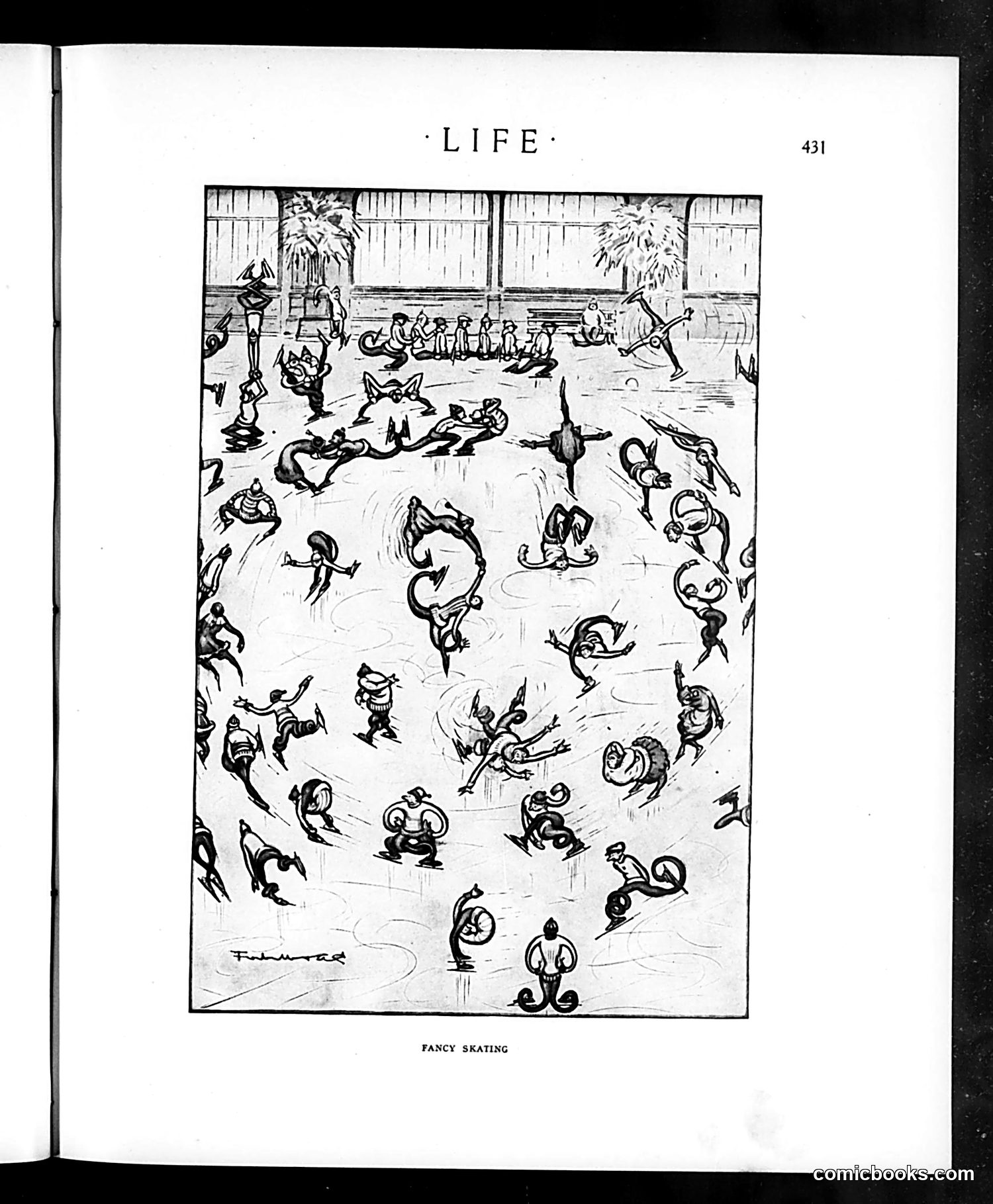
This cartoon depicts a crowded ice skating rink viewed from above. The title "Fancy Skating" appears to be satirical—rather than showing graceful, skilled skaters, the image shows numerous people falling, tumbling, and struggling on the ice in chaotic, undignified positions. Some figures are upside-down, others are sprawled flat, and a few maintain their footing while chaos erupts around them. The joke critiques people who attempt "fancy" or showy skating beyond their actual ability, resulting in comical disaster. It's a humorous commentary on pretension and overconfidence—the gap between aspiration and competence. The cartoonist (signed "Frucher") uses the overhead perspective to maximize the visual comedy of mass failure on ice.
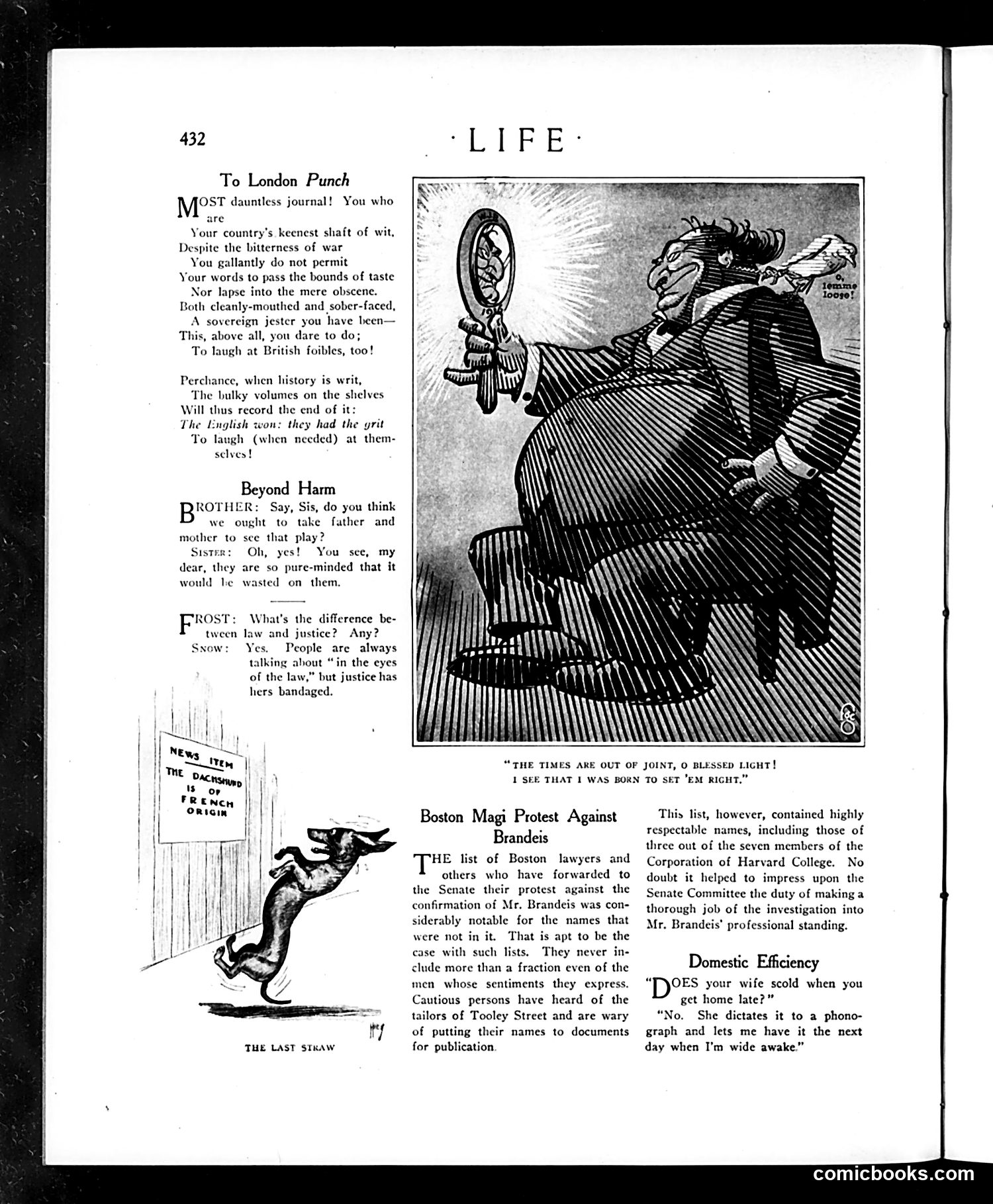
This page contains multiple satirical pieces from WWI-era America: **"To London Punch"**: A tribute poem praising the British satirical magazine *Punch* for maintaining wit and tasteful humor despite wartime bitterness, suggesting that England's ability to laugh at itself demonstrates national character. **"Beyond Harm"** and **"Frost"**: Quick joke exchanges mocking the naïveté of the pure-minded and playing on legal concepts (justice being "blindfolded"). **"The Last Straw"**: A political cartoon showing a camel buckling under accumulated burden—a visual metaphor for reaching one's breaking point. **"Boston Magi Protest Against Brandeis"**: Commentary on Boston lawyers' petition against Louis Brandeis's Supreme Court confirmation. The article notes that the prestigious signatories (including Harvard Corporation members) carried symbolic weight, while cautious opponents avoided public association—referencing "tailors of Tooley Street," an old phrase meaning common people speaking beyond their expertise. **"Domestic Efficiency"**: A brief domestic humor piece about a wife who records her complaints for her husband to hear when fully awake.
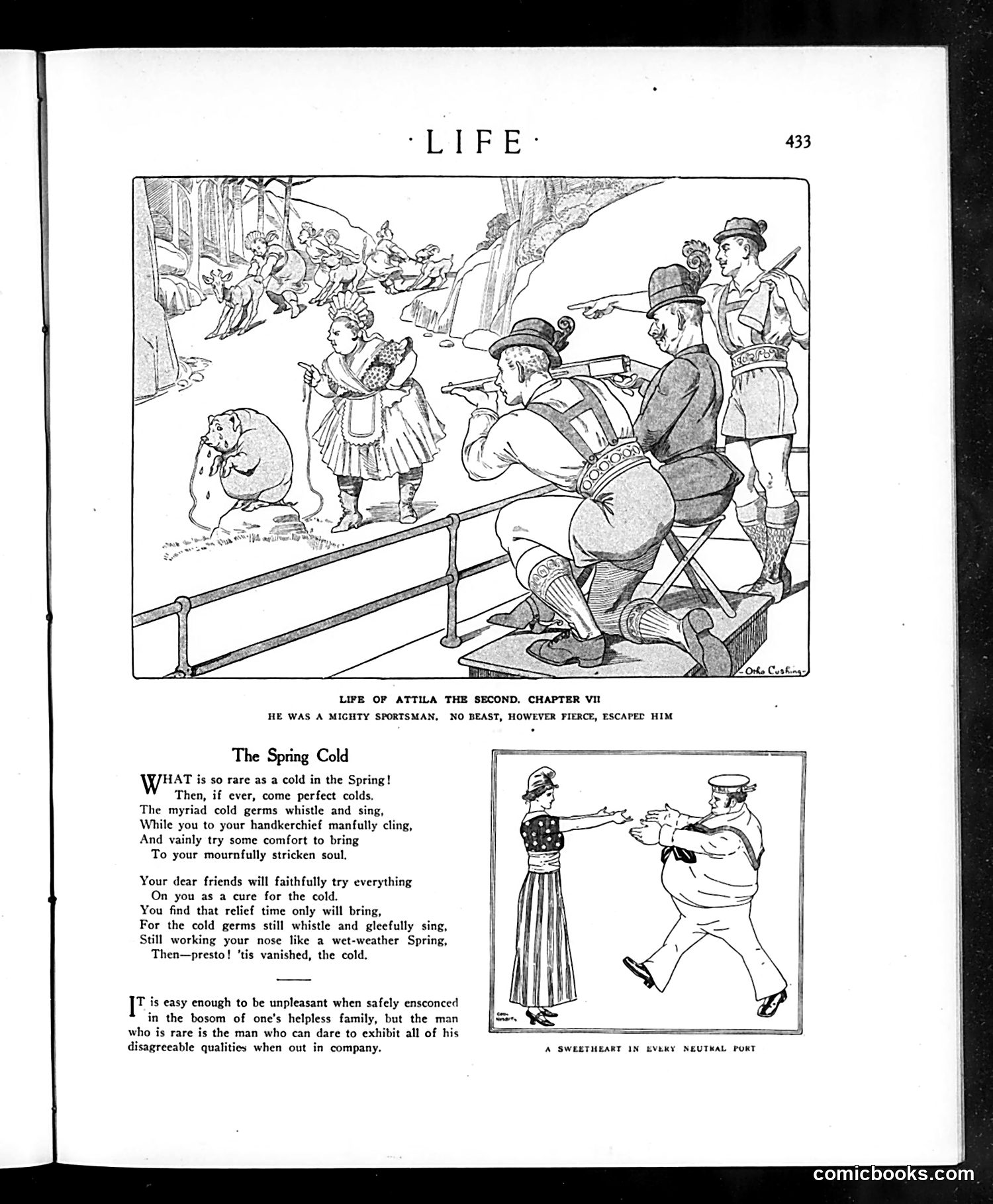
**Top Cartoon:** "Life of Attila the Second, Chapter VII" depicts hunting or sport-shooting. The caption's reference to "Attila" (the destructive Hun leader) sarcastically mocks someone as a "mighty sportsman" who conquers all beasts. This appears to be satirizing an individual's hunting prowess or violent temperament, though the specific person is unclear without additional context. **"The Spring Cold" Poem:** A humorous verse about seasonal colds, describing the misery of spring illness—whistling germs, nose-blowing, and well-meaning but ineffective home remedies from friends. It's light comic verse about universal human experience. **Bottom Cartoon:** "A Sweetheart in Every Neutral Port" shows a man in sailor/military uniform dancing with a woman while another woman gestures at him. This jokes about soldiers or sailors maintaining romantic relationships in multiple ports, suggesting infidelity or promiscuity under the guise of wartime mobility. The "neutral port" reference likely alludes to WWI-era naval matters. The page blends satire, humor, and social commentary typical of early 20th-century LIFE magazine.
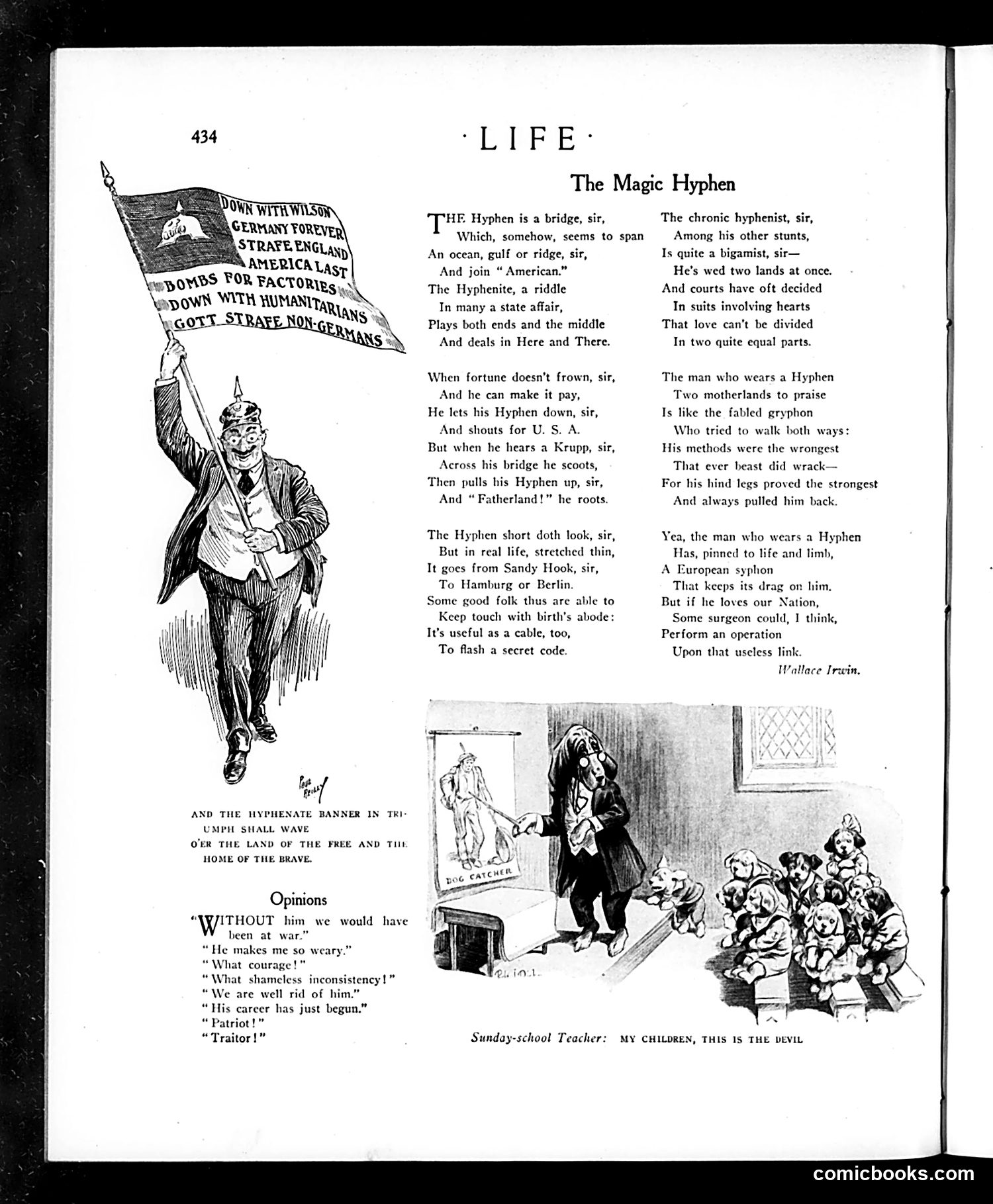
This page satirizes "hyphenated Americans"—immigrants or their descendants who maintained cultural ties to their homeland while living in America (German-Americans, Irish-Americans, etc.). The cartoon's German soldier waving a flag represents this divided allegiance. The poem attacks those who "play both ends" of the hyphen: praising America when profitable, but cheering for their "Fatherland" (Germany) when hearing about German industrialists like Krupp. The satire compares hyphenated citizens to a mythical creature trying to walk two directions simultaneously, ultimately pulled backward. The final jab suggests such divided loyalty is demonic—the Sunday-school teacher identifies the hyphenate as "the devil." This reflects WWI-era American anxiety about German-American loyalty, particularly as the U.S. contemplated entering the war against Germany. The piece argues true patriotism requires singular national commitment, not straddling two nations.
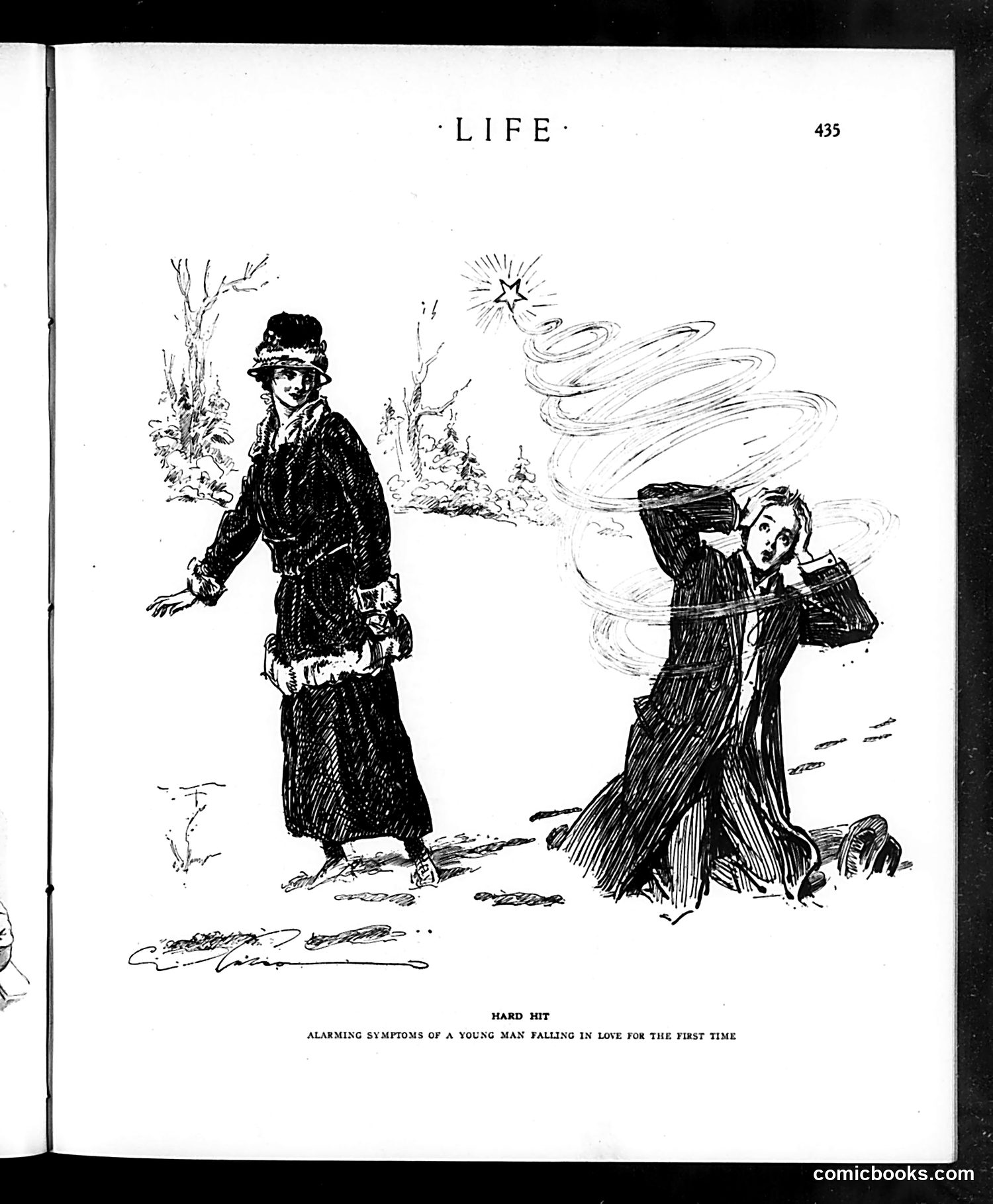
This cartoon satirizes the physical and emotional upheaval of first love. The title "Alarming Symptoms of a Young Man Falling in Love for the First Time" frames romantic infatuation as a medical emergency. The left figure—composed and dressed formally—represents rational detachment or an observer. The right figure, disheveled and windswept with an exaggerated expression, depicts the young man "hard hit" by love's effects. The swirling lines around him suggest dizziness, confusion, or being swept away emotionally. The barren winter landscape emphasizes emotional desolation. The cartoon uses physical comedy and exaggeration to mock how dramatically love transforms a man's demeanor and stability—a common theme in early-20th-century American humor about romantic vulnerability.
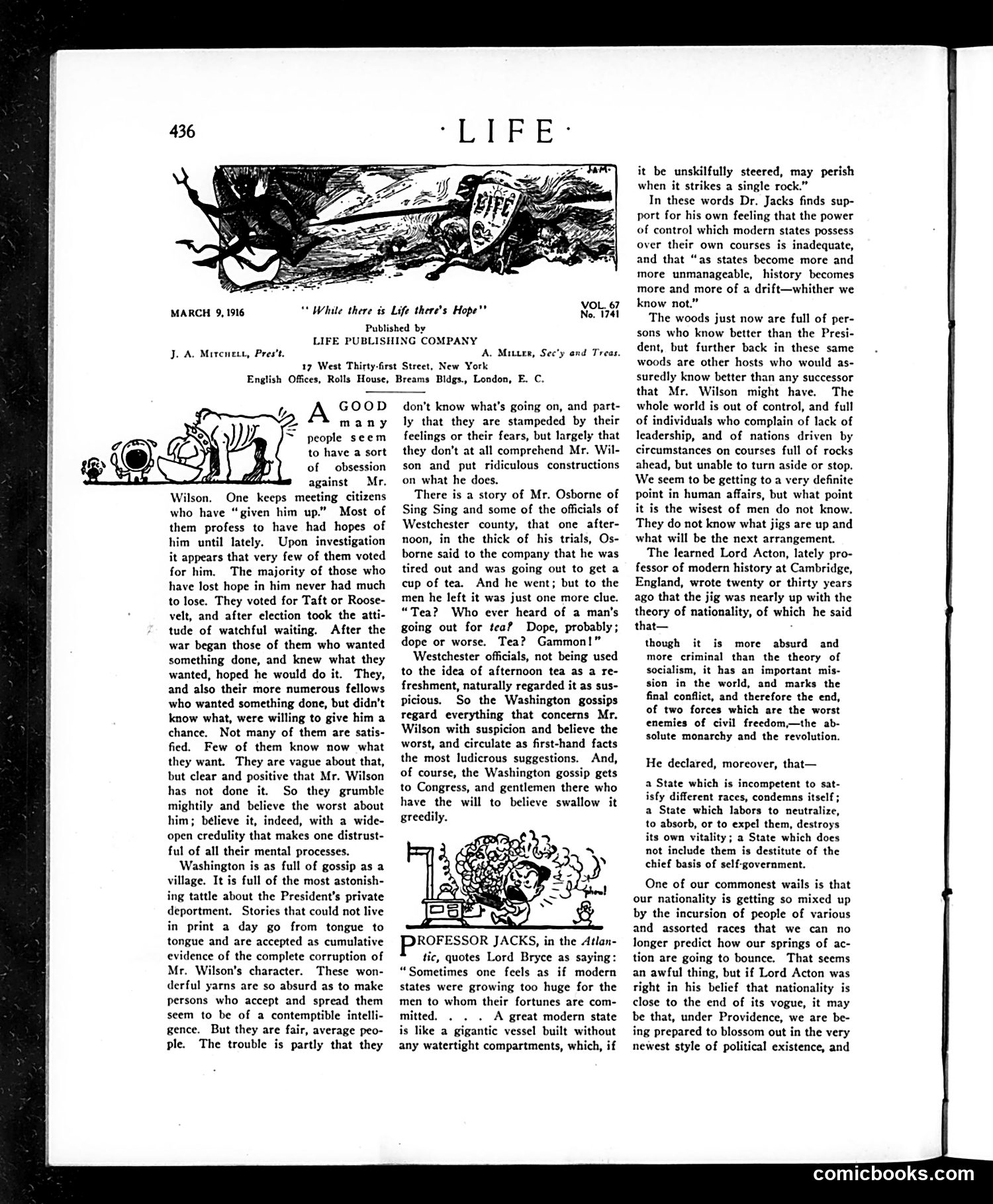
This page contains satirical commentary on President Woodrow Wilson's unpopularity, particularly among those who had previously supported other candidates (Taft, Roosevelt). The main article mocks Washington gossip culture, using an anecdote about Sing Sing prison official Osborne: when he mentioned getting tea, suspicious officials interpreted it as evidence of drug use—simply because they didn't understand the practice. The satire suggests Wilson critics similarly misinterpret his actions through ignorance and prejudice rather than understanding his actual policies. The page includes a Professor Jacks quote (via Lord Bryce) comparing modern states to unsteerable ships without compartments, suggesting nations have lost control of their own destiny—contextualizing contemporary anxieties about governmental competence and America's direction during WWI's early years. The cartoon at the top (unclear in detail) appears decorative to this editorial message attacking Wilson's detractors as credulous and intellectually undiscerning.
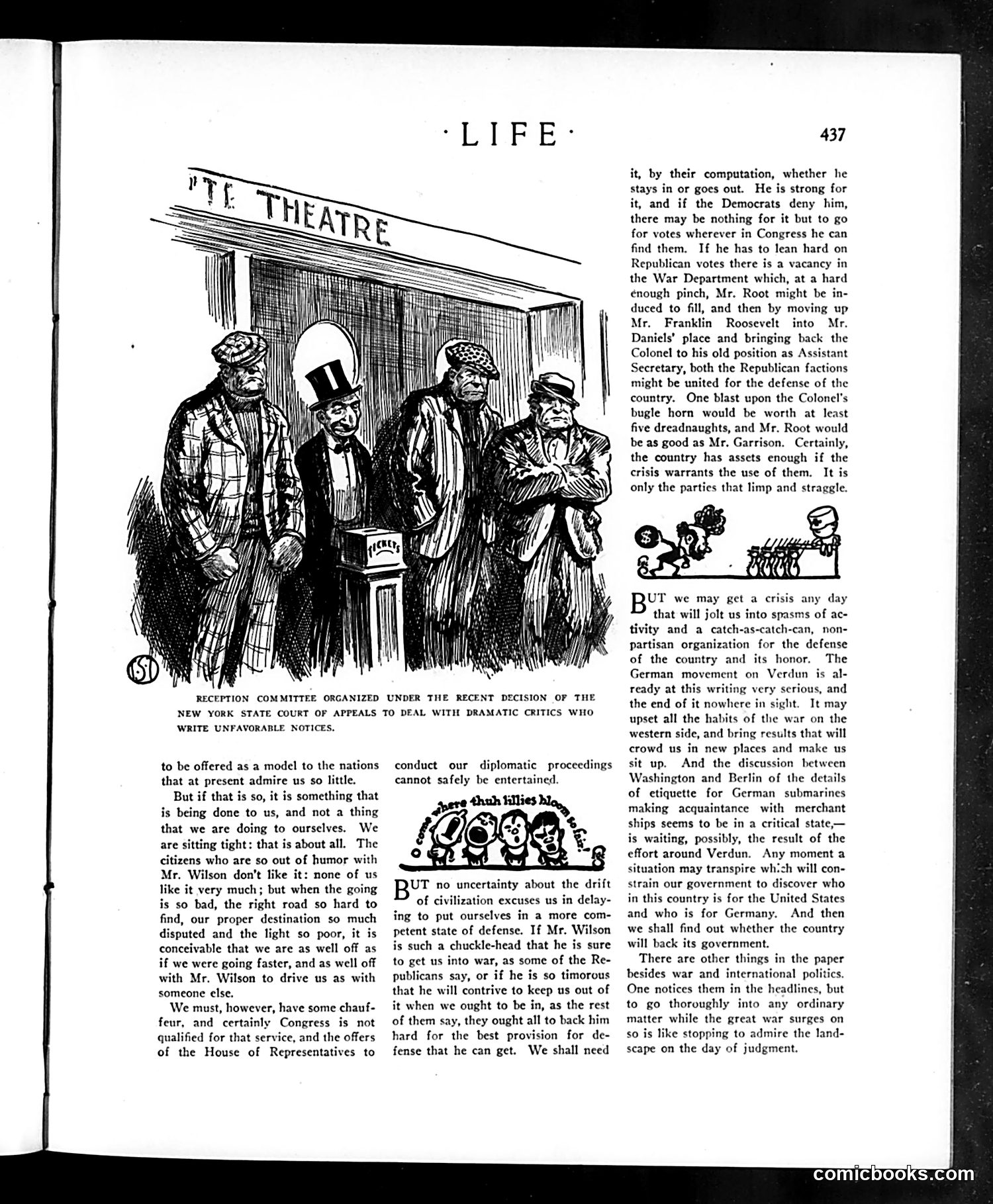
This 1916 *Life* magazine page satirizes a New York court decision allowing dramatic critics to be sued for unfavorable theater reviews. The cartoon depicts a "reception committee"—thugs in formal attire—positioned outside a theater to intimidate critics, suggesting that legal liability for negative reviews creates a chilling effect on free speech and invites violence against press freedom. The accompanying editorial argues that while President Wilson's leadership is imperfect, partisan bickering over defense preparedness is dangerous. With World War I raging in Europe (the Verdun offensive is mentioned), the author urges Republicans to support military readiness regardless of which party holds power, even suggesting former Secretary of War Elihu Root's involvement could unite factions. The piece criticizes Americans' distraction with trivial matters while war looms.
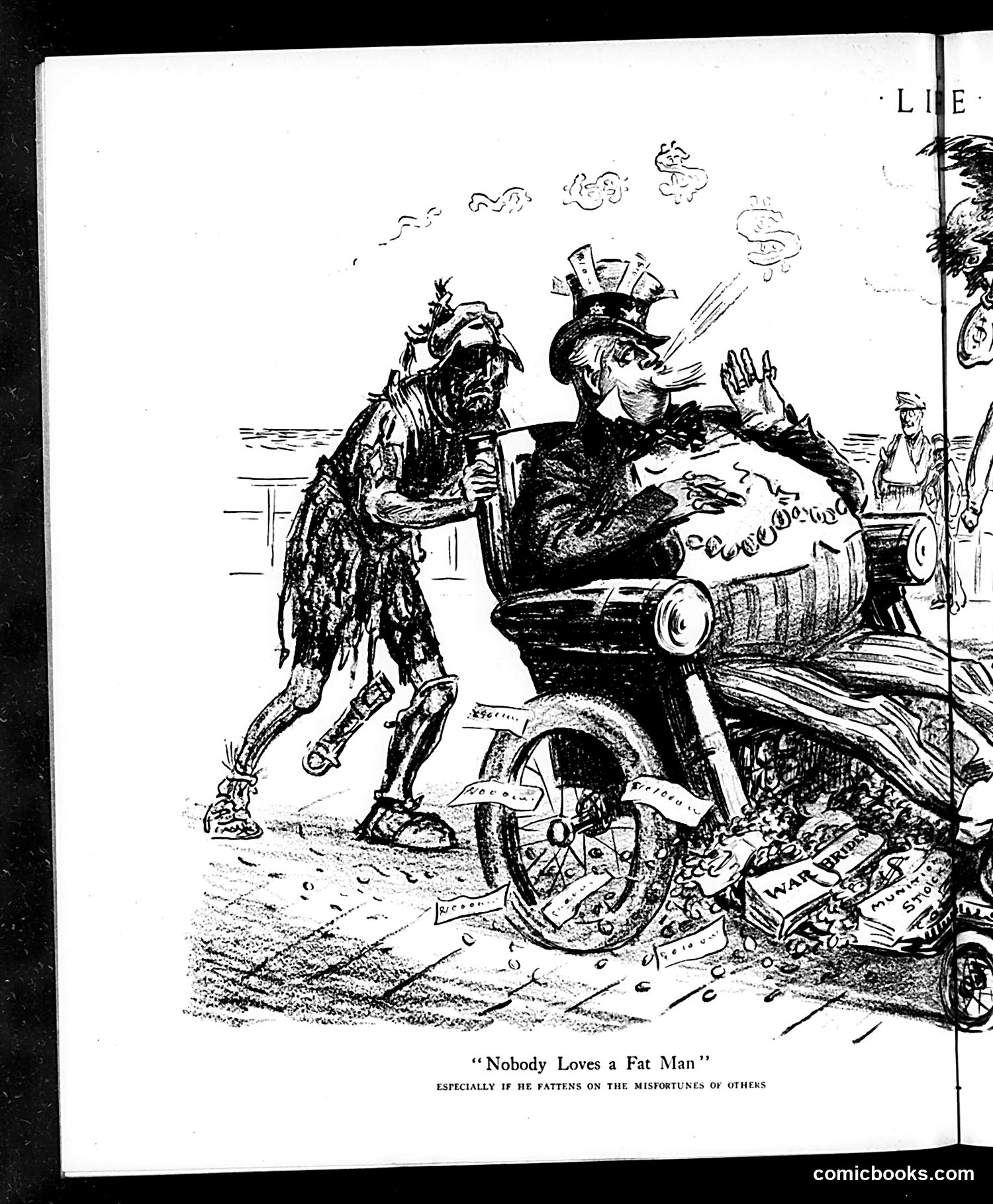
This political cartoon depicts a well-fed figure in formal dress (top hat and suit) riding in an automobile, while a ragged, impoverished person stands beside the vehicle. The subtitle clarifies the satire: "Especially if he fattens on the misfortunes of others." The cartoon criticizes wealthy individuals—likely businessmen or profiteers—who accumulate riches while ordinary people suffer hardship. The contrast between the portly, well-dressed driver and the desperate figure outside suggests exploitation: the rich grow fat (literally depicted) through others' economic misery. References to "war" and "stocks" visible on papers scattered around suggest this targets wartime profiteering or financial speculation that harms the poor. The satire condemns the moral bankruptcy of those who prosper from others' suffering.
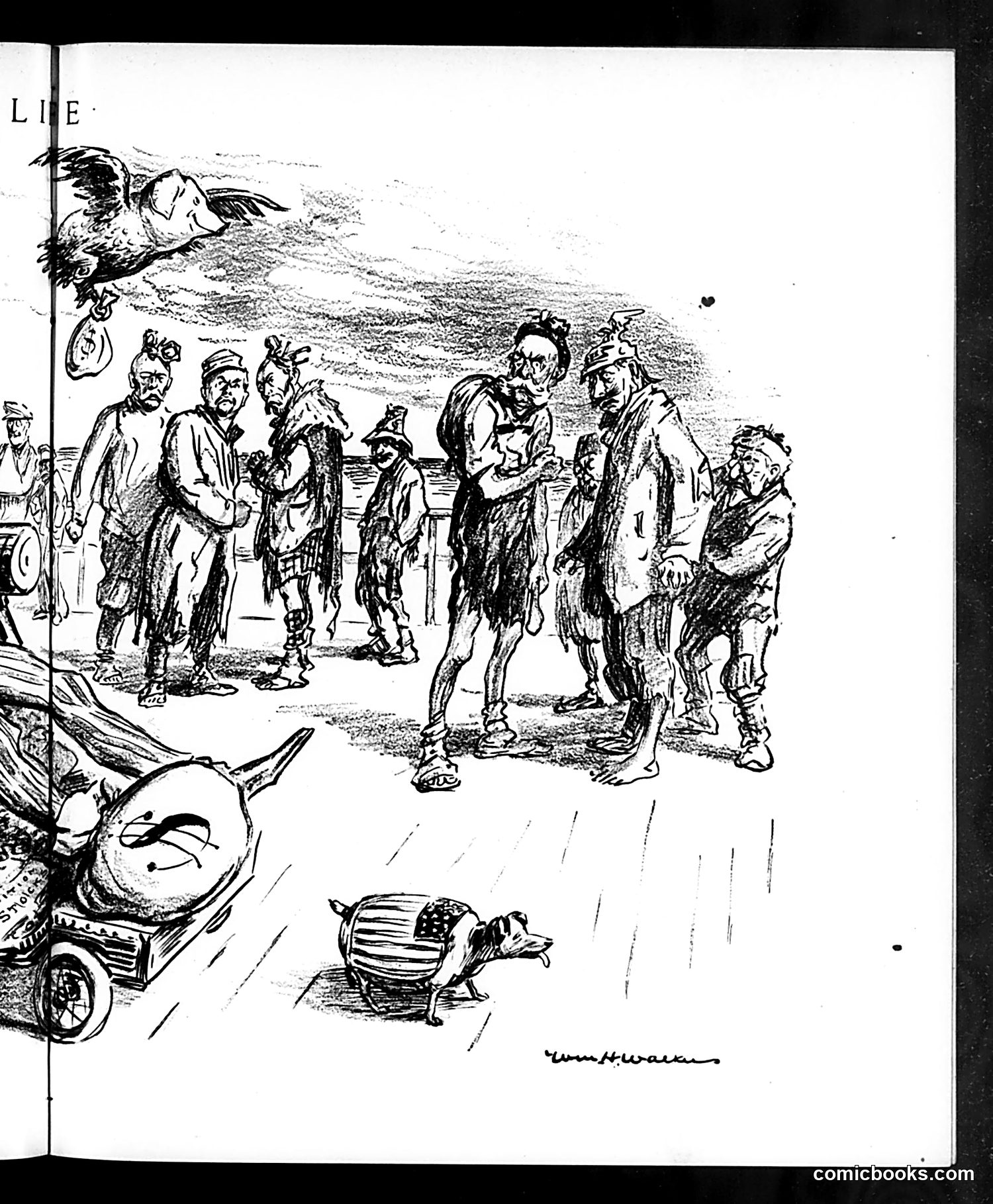
This appears to be a satirical cartoon depicting a military or colonial scene. A group of figures in military/official dress stand on what looks like a beach or landing area, while a pig wearing a barrel or container is positioned prominently in the foreground—seemingly the focus of their attention. The cartoon likely satirizes a specific historical military expedition, invasion, or colonial encounter. The absurd prominence given to the pig suggests mockery of either the mission's importance or the officials involved treating a trivial matter as significant. Without clearer text or date information, the specific historical reference remains unclear. The style and composition suggest early-to-mid 20th century American satirical commentary on military or diplomatic affairs, but the particular event being ridiculed cannot be definitively identified from the image alone.
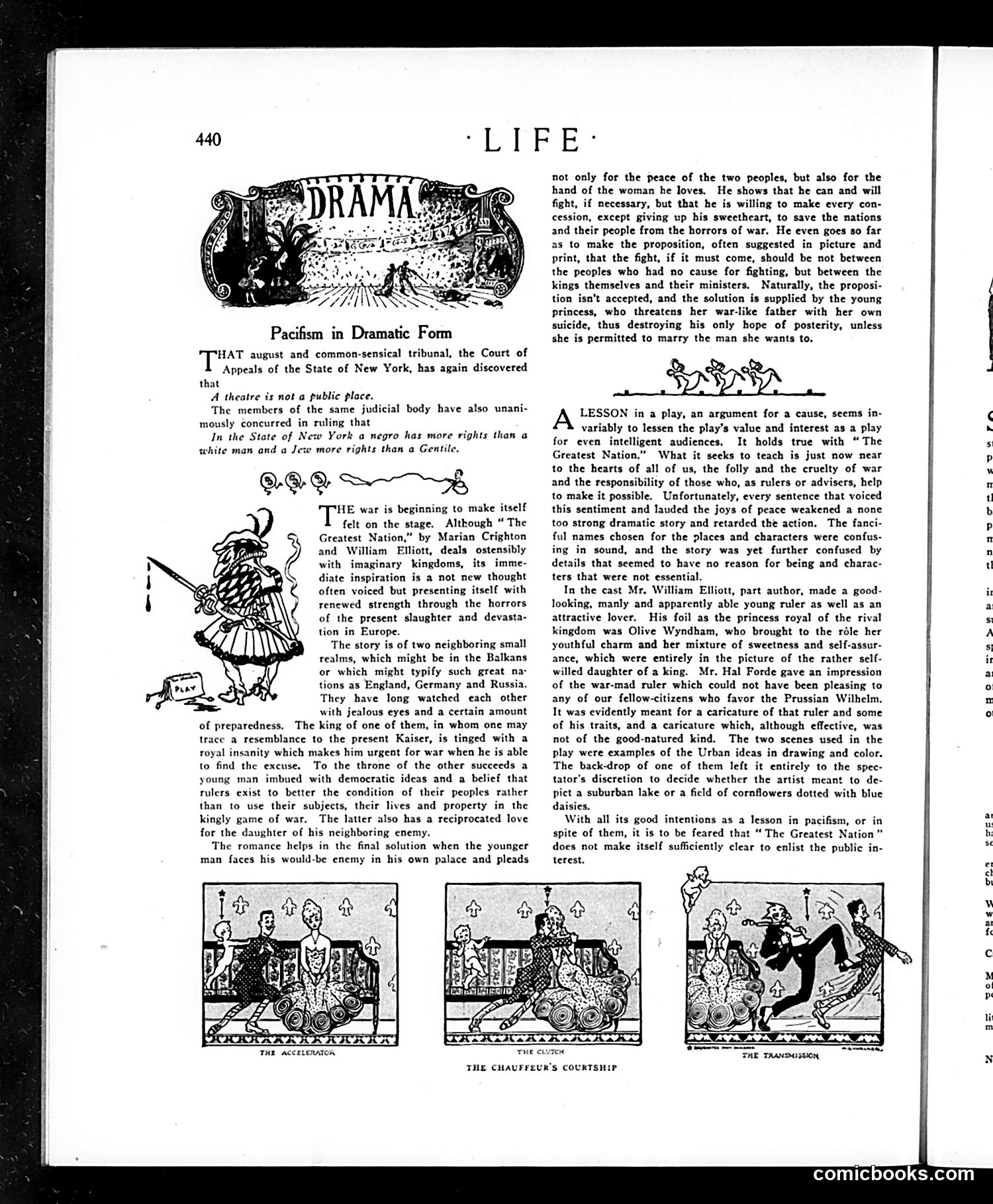
This page reviews a stage play called "The Greatest Nation," critiquing how it uses drama to argue for pacifism during World War I. The play depicts two neighboring kingdoms (standing in for European powers like England, Germany, and Russia) on the brink of war. The satirical target appears to be **the play's heavy-handed moralizing**. Life argues that inserting pacifist lessons undermines the drama's artistic power, even when the message—opposing war's folly and rulers' responsibility—resonates with contemporary audiences. The review criticizes awkward character names and unnecessary details that confuse rather than clarify the anti-war argument. The opening section mocks a New York court ruling that "a theatre is not a public place," sarcastically noting this judicial decision paradoxically grants racial and religious minorities greater protections than white gentiles—suggesting the court's reasoning is absurd. The three illustrated panels at bottom appear to depict scenes from the play, showing court interactions and romance, though details are unclear from reproduction quality.
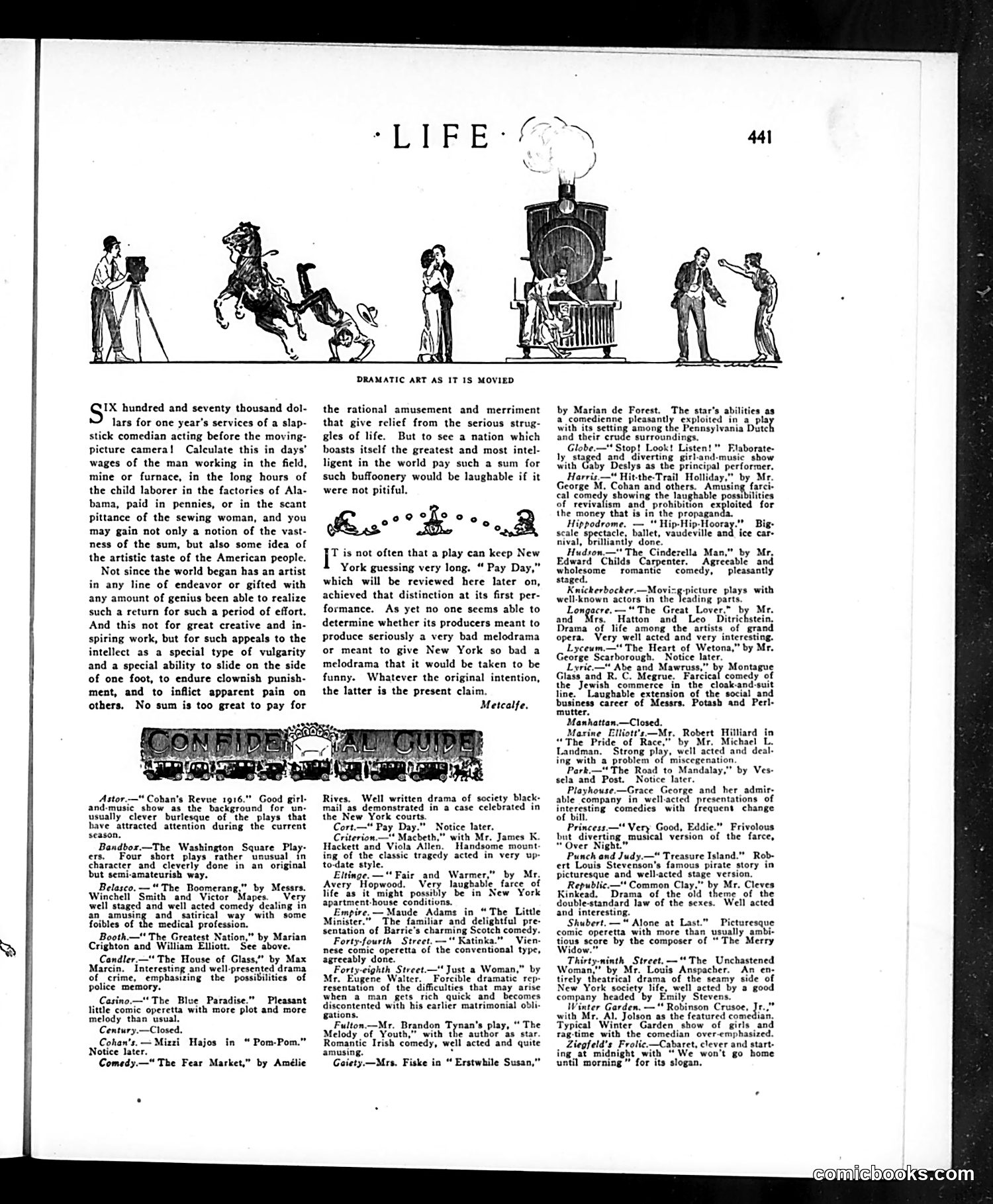
This page critiques American culture's misplaced values through commentary on theatrical entertainment. The top illustration depicts "Dramatic Art as It is Movied"—showing various performance styles from serious drama to slapstick. The main editorial attack focuses on a slapstick comedian earning $670,000 annually for film work—an astronomical sum when contrasted with wages of factory workers, miners, and seamstresses earning pennies. The satire argues this reveals America's artistic bankruptcy: a nation claiming to be "the greatest and most intelligent in the world" rewards "buffoonery" and physical comedy ("a special ability to slide on the side of one foot") over genuine creative work. The piece questions whether this reflects American taste or American priorities, suggesting the disparity is "pitiful" rather than merely laughable. The remaining text reviews current Broadway productions, treating theatrical entertainment more seriously than the lucrative film industry.
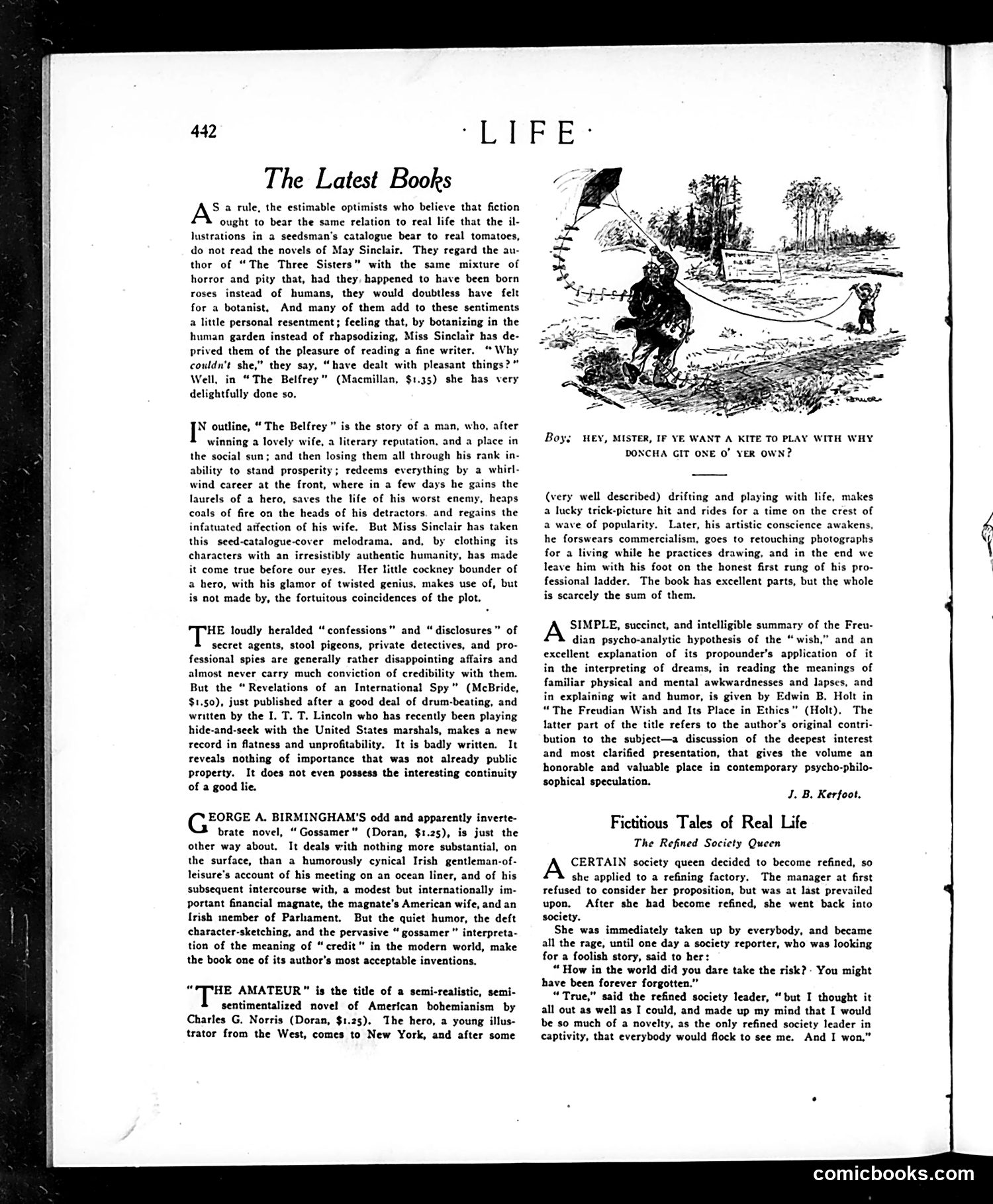
This is a literary review section from *Life* magazine featuring book critiques and a cartoon illustration. The cartoon depicts two boys with a kite, with the caption "HEY, MISTER, IF YE WANT A KITE TO PLAY WITH WHY DONCHA GIT ONE O' YER OWN?" The reviews discuss contemporary novels including May Sinclair's "The Belfrey," a spy memoir titled "Revelations of an International Spy," and works by George A. Birmingham and Charles G. Norris. The critics evaluate whether fiction should reflect "real life" realistically or provide escapist entertainment—debating whether readers prefer authentic character development or pleasant, melodramatic narratives. The cartoon's meaning is unclear from context alone; it may illustrate themes of independence or self-reliance referenced in the accompanying reviews, or represent broader social commentary about American individualism and self-improvement—common satirical themes in early 20th-century *Life* magazine.
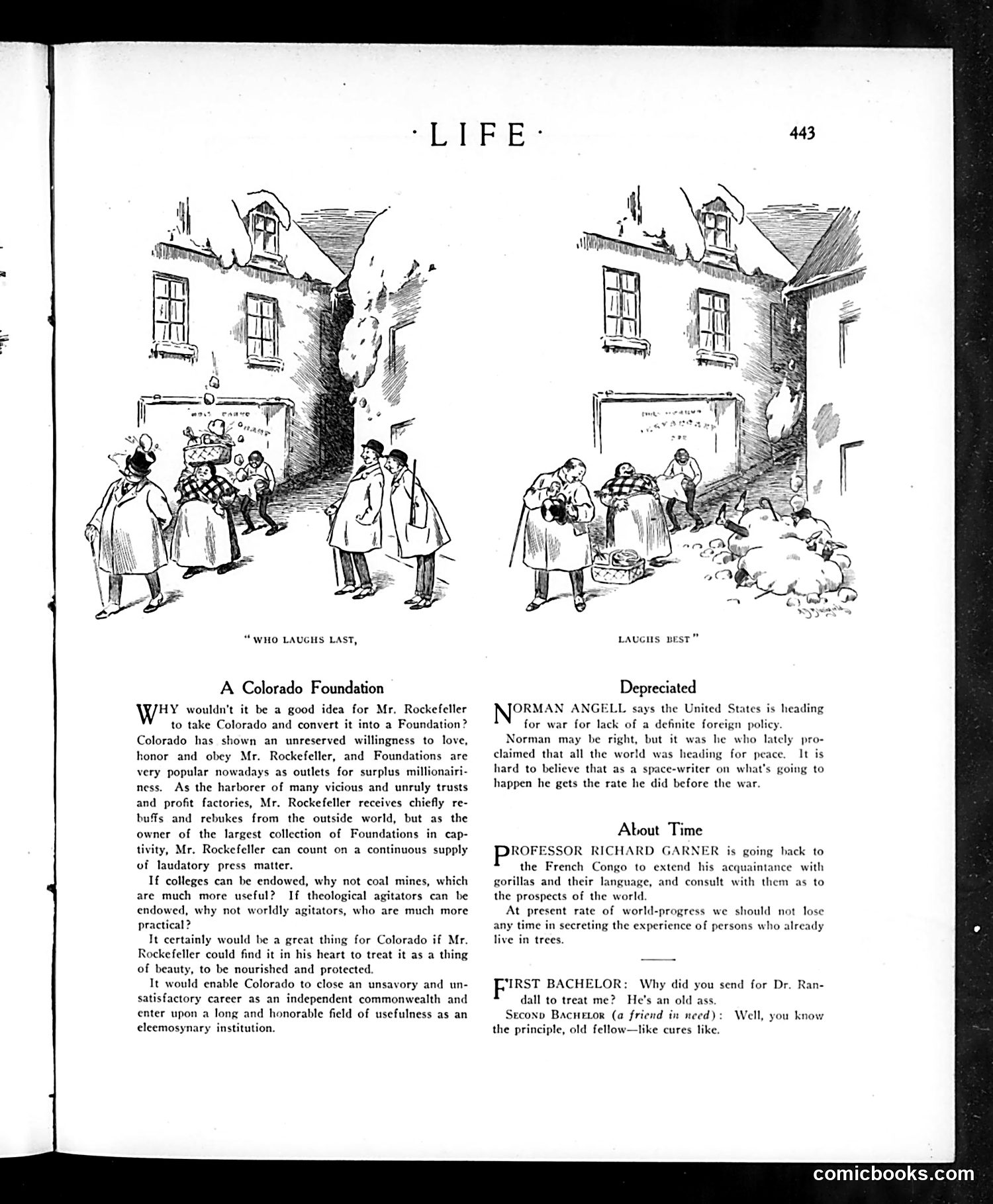
This page contains three distinct satirical pieces targeting wealthy industrialists and public figures of the era. **"A Colorado Foundation"** mocks John D. Rockefeller's extensive philanthropic foundation network. The cartoon shows Colorado citizens reverently approaching Rockefeller. The satire suggests that instead of treating Colorado as an independent state, it should become another Rockefeller "Foundation"—implying that his charitable institutions, while earning public praise, primarily serve his reputation laundering. The piece sarcastically questions why coal mines aren't endowed like colleges, and mockingly suggests Colorado would benefit from becoming a perpetual charity case under Rockefeller's control. **"Depreciated"** criticizes Norman Angell, a peace advocate who previously proclaimed universal peace was imminent, now warns of impending war. The satire ridicules his credibility as a forecaster. **"About Time"** jokes that Professor Richard Garner should consult with gorillas about world prospects—implying humans have become less rational than primates. The final joke plays on medical homeopathy ("like cures like").
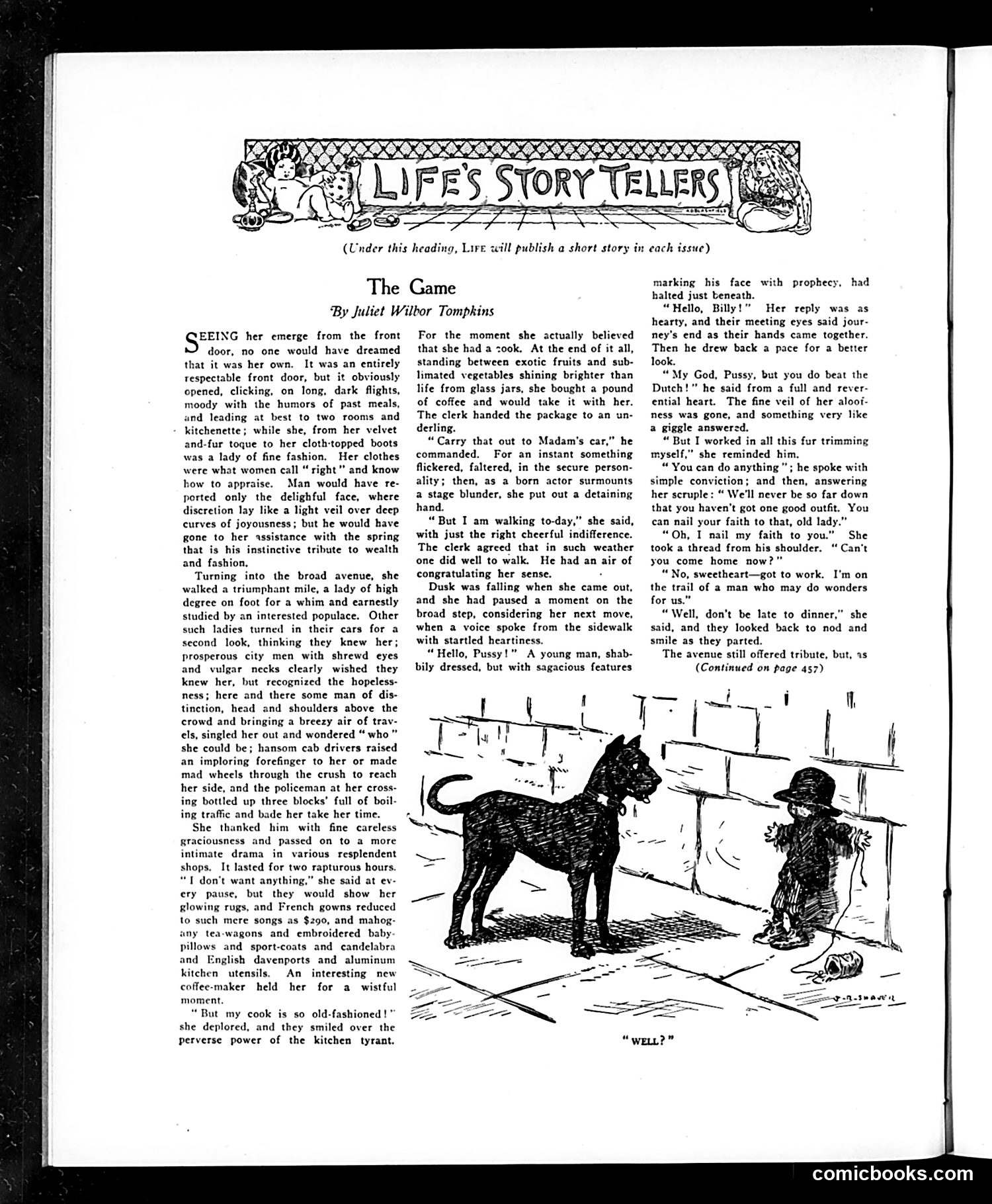
This is a short story (not a political cartoon) about a woman maintaining an elaborate social fiction. The narrative describes a fashionably dressed woman emerging from a shabby apartment, then spending her day performing wealth: she's admired on the street, browsed expensive shops without buying (except coffee), and invented a "car" and "cook" to maintain appearances. The twist comes at dusk when a young man named Billy recognizes her and greets her familiarly as "Pussy." Their genuine reunion—with his shocked admiration at her successful performance—reveals the story's point: she has been "playing the game" of appearing wealthy through careful presentation, though she lives modestly. The social satire targets early 20th-century class pretense and the performative nature of respectability, where appearance and "the right" presentation matter more than actual wealth. The illustration shows Billy and Pussy meeting, with her still carrying the coffee she bought—a small, real purchase amid her day of elaborate theatrical performance.
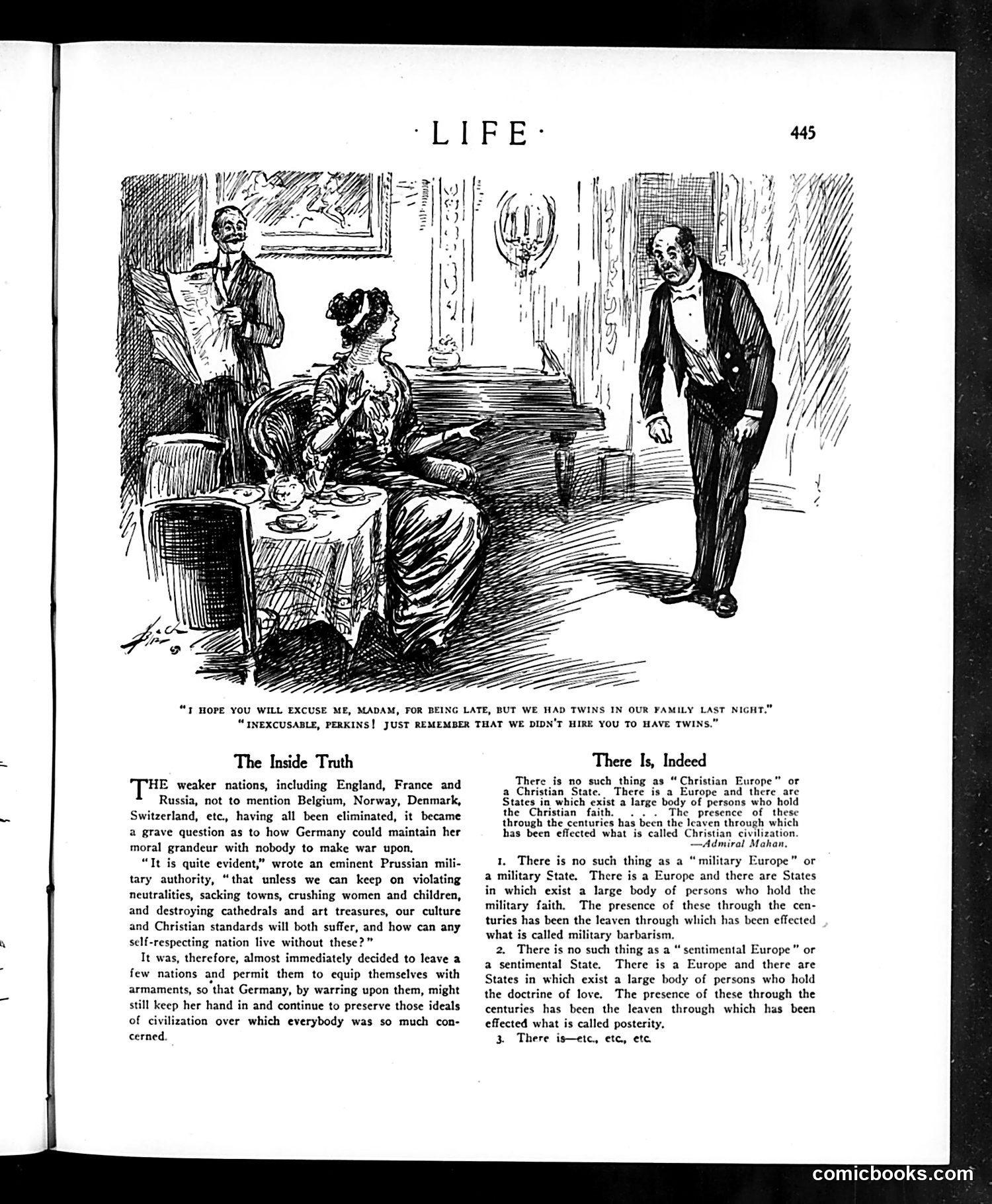
**The Cartoon (top):** A domestic servant ("Perkins") apologizes for lateness, explaining he had twins born in his family overnight. His employer responds that this is "inexcusable" because they didn't hire him to have twins. The joke satirizes rigid, callous upper-class employers who view servants as existing solely for work, with no personal lives or human needs. **The Articles (below):** Written during World War I, these pieces mock German militarism through ironic commentary. "The Inside Truth" sarcastically describes Prussian logic: Germany needs weaker nations to war upon to maintain cultural standards—if enemies are eliminated, Germany must deliberately leave some intact to keep fighting. "There Is, Indeed" (attributing views to Admiral Mahan) inverts German reasoning: just as "Christian Europe" means Europe *with* Christians in it, "military Europe" means Europe *infected with* militarism—a "leaven" producing barbarism, not civilization. The satire attacks Germany's claimed moral superiority while waging aggressive war. **Context:** This reflects American skepticism toward German justifications for WWI aggression.
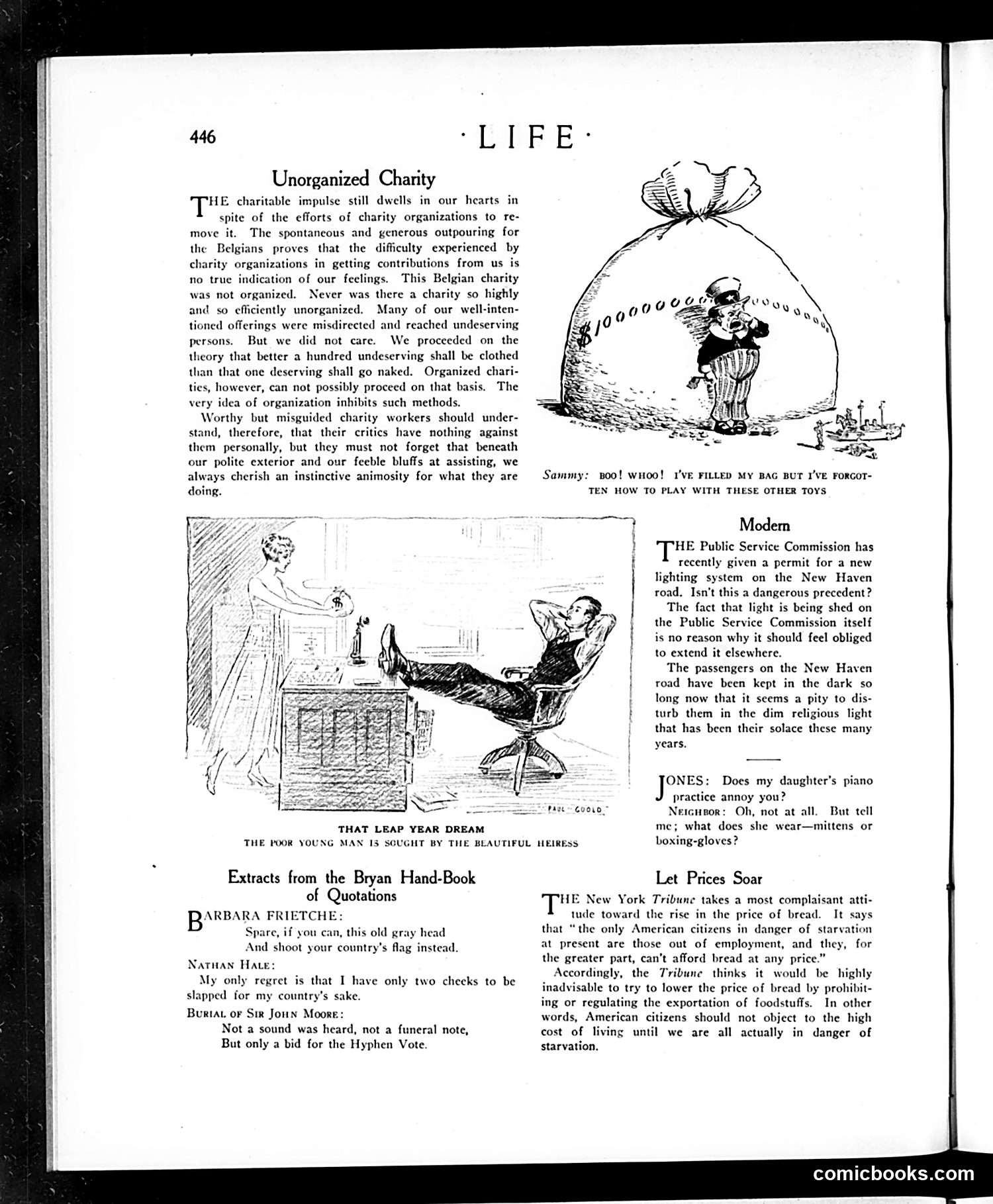
This page contains several distinct satirical pieces critiquing American institutions and attitudes circa 1910s-1920s: **"Unorganized Charity"** argues that spontaneous giving to Belgian war relief (WWI context) proved more generous than organized charity efforts, despite inefficiency. The text mocks formal charity organizations' restrictive methods versus public impulse. **Political cartoon "That Leap Year Dream"** satirizes gender role reversal—a woman pursues a man during leap year (when tradition permitted female courtship), depicted as a fantasy of social inversion. **"Extracts from the Bryan Hand-Book"** parodies William Jennings Bryan quotations, mocking patriotic rhetoric. The "Hyphen Vote" reference likely attacks immigrant voting blocs. **"Modern" sections** satirize: - The Public Service Commission's selective transparency - A piano teacher's indirect complaint about practice noise - The *New York Tribune's* callous stance on bread prices, suggesting only the unemployed need worry about starvation—a critique of editorial indifference to working-class suffering during economic hardship.
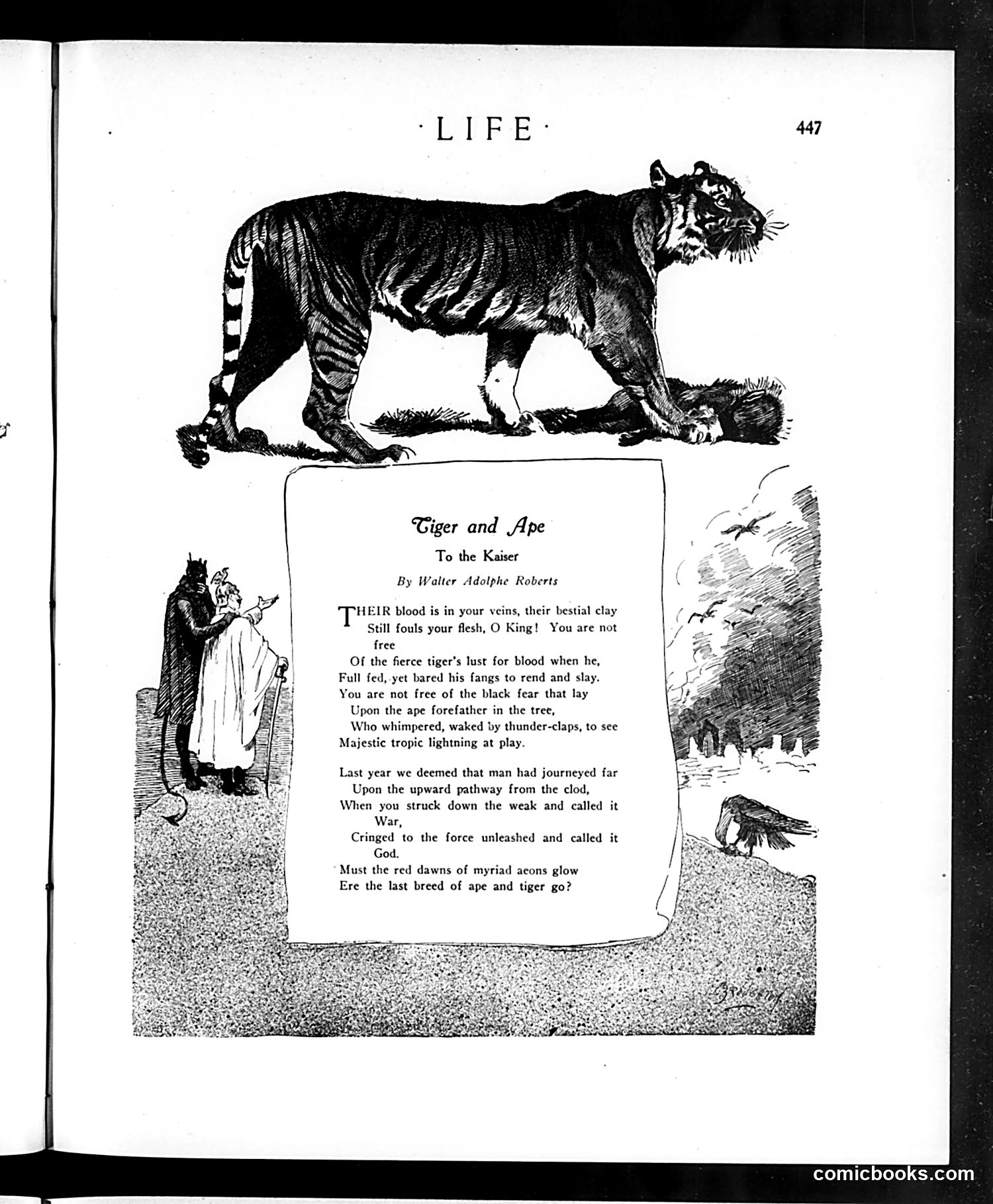
This is a satirical poem by Walter Adolphe Roberts attacking Kaiser Wilhelm II of Germany, published during or shortly after World War I. The verse uses evolutionary imagery to argue that the Kaiser represents humanity's bestial, uncivilized nature—specifically the primal instincts of tigers (bloodlust) and apes (primitive fear). The satire's point: despite claims of civilization and progress, the Kaiser's actions—striking down weaker nations and calling it "War," then invoking God to justify brutal force—prove that humans remain enslaved to animalistic impulses. The poem questions whether humanity will ever truly evolve beyond these base instincts. The accompanying illustrations (a tiger at top, an ape figure, and landscape vignettes) reinforce this animal/primitive symbolism. This represents typical WWI-era American propaganda criticism of German leadership.
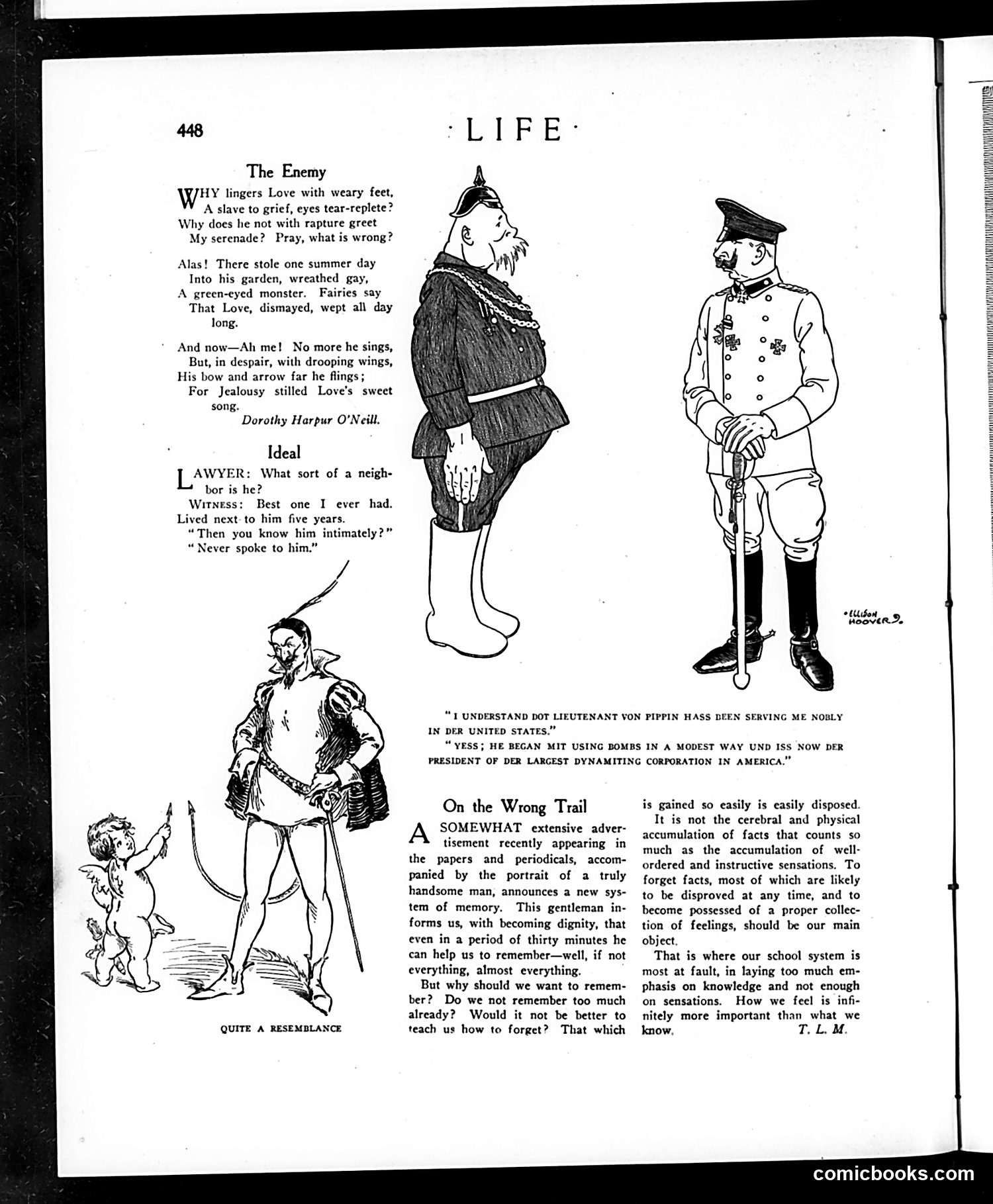
This page contains three satirical pieces reflecting early 20th-century concerns: **"The Enemy"** is a romantic poem about jealousy destroying love—standard sentimental fare with an illustration of cupid versus a jealous figure. **"Ideal"** is a brief joke about an ideal neighbor: someone you lived next to for five years but never spoke to. This satirizes American social isolation and the preference for non-involvement. **"On the Wrong Trail"** critiques a memory-improvement advertisement. The author argues schools and society wrongly emphasize memorizing facts over cultivating proper feelings and sensations. This reflects early 20th-century debates about education philosophy—whether rote learning or emotional/experiential development mattered more. The German-accented dialogue about "Lieutenant Von Pippin" appears to reference German immigrant involvement in American industry, possibly satirizing wartime anxieties about foreign nationals.
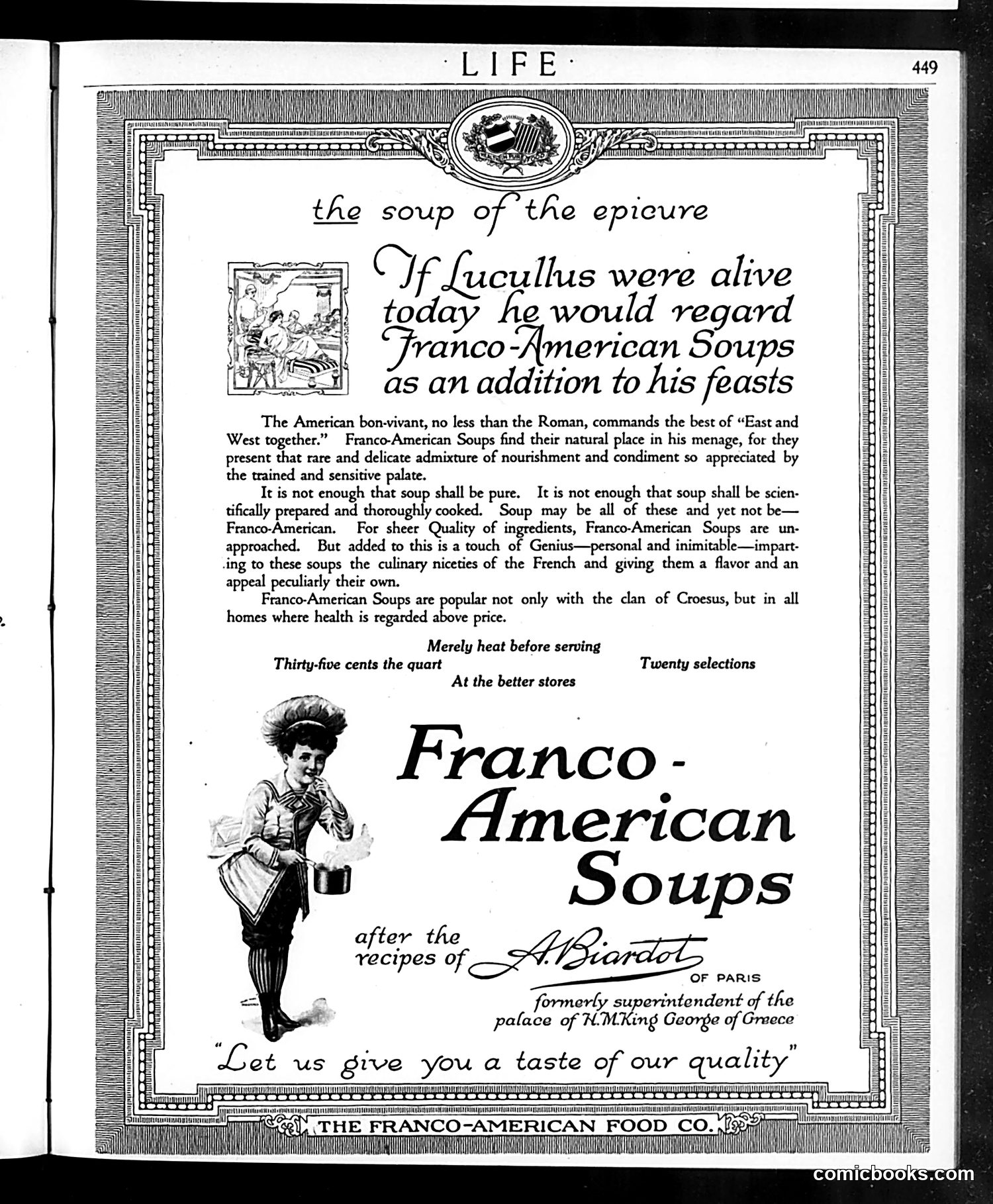
This is a full-page advertisement, not a political cartoon. It promotes Franco-American Soups by invoking **Lucullus**, a famous Roman general and epicurean known for lavish feasts—establishing an aspirational classical reference. The ad claims these soups represent refined taste suitable for wealthy Americans ("the American bon-vivant"). The illustration shows a fashionable woman carrying a soup pot, embodying elegance and domestic sophistication. The recipe credit to "A. Biardot, formerly superintendent of the palace of H.M King George of Greece" adds prestige through European royal association. The copywriting emphasizes that quality requires more than purity and cooking—it requires French "Genius" and culinary sophistication. The price (35 cents per quart) and availability ("at the better stores") targets middle to upper-class consumers aspiring to cultured taste. The satire is subtle: the ad subtly mocks American social climbing by equating canned soup with Roman feasts and European royalty.
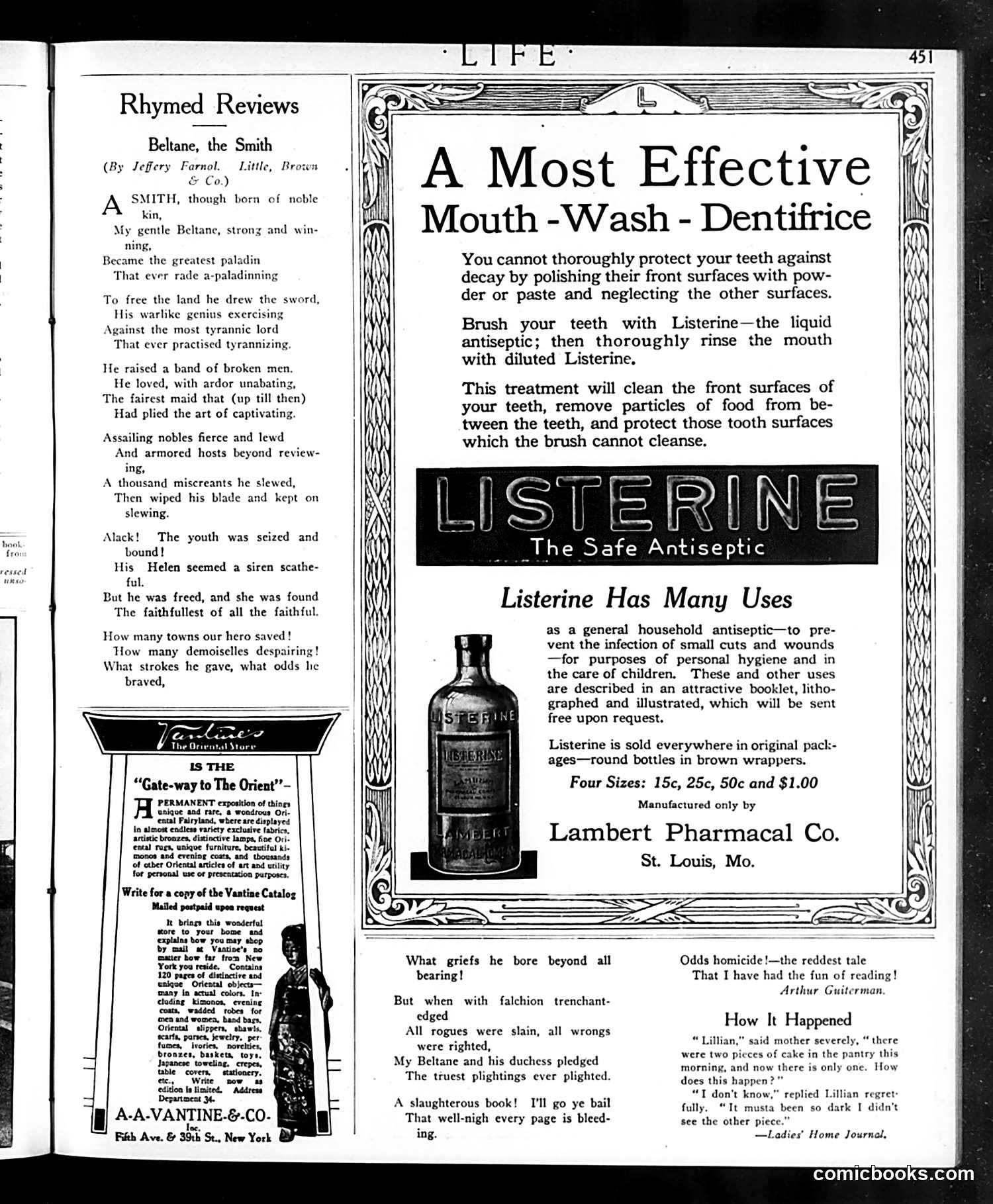
This page contains a **rhymed book review** rather than a political cartoon. The review, titled "Beltane, the Smith," is a humorous mock-heroic poem satirizing overwrought medieval romance fiction. The reviewer (appearing to be Arthur Guiterman, based on the byline) ridicules the genre through exaggerated rhyming couplets about a generic knight-hero who slays villains, rescues maidens, and performs predictable noble deeds. The final quip—"That well-nigh every page is bleeding"—suggests the book relies on gratuitous violence for dramatic effect. The page is otherwise dominated by **product advertisements** for Listerine mouthwash and A.A. Vantine's Oriental goods, typical of Life magazine's revenue model. A small humor piece, "How It Happened," uses a child's implausible excuse about darkness to create a mild joke about dishonesty. No political satire or specific historical figures are present on this page.
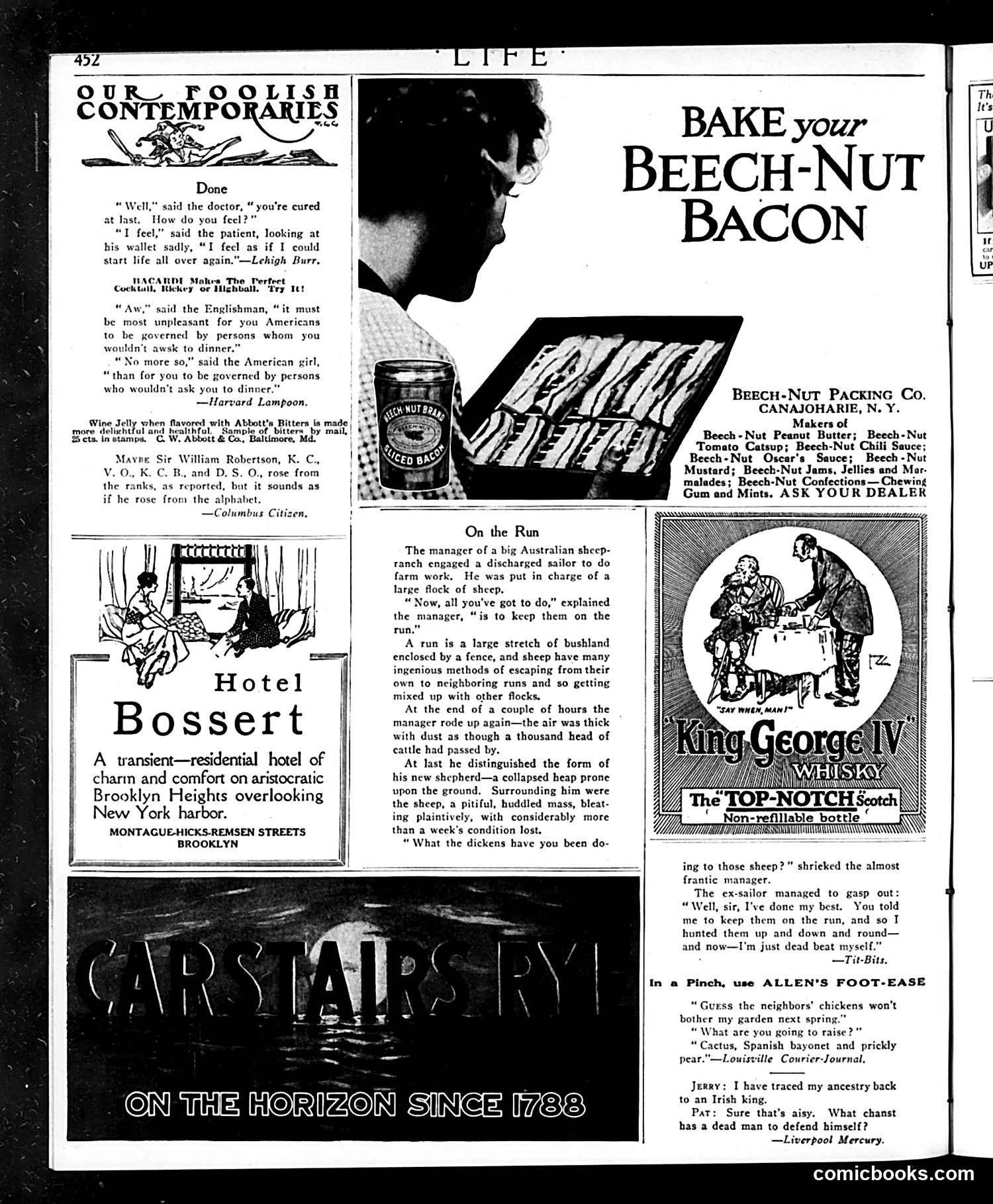
This page is primarily **advertising with interspersed humor**. The cartoons and jokes are light social satire typical of early 20th-century American humor: 1. **"Our Foolish Contemporaries"** section presents three brief jokes mocking various groups—a patient relieved to be cured (but broke), an Englishman and American girl trading barbs about governance and dinner invitations (reflecting Anglo-American social tensions), and a dig at Sir William Robertson for rising through military ranks (K.C., V.O., etc.), suggesting alphabet soup rather than merit. 2. **"On the Run"** is a humorous anecdote about a discharged sailor hired to manage Australian sheep who takes "keep them on the run" literally, exhausting both himself and the flock through constant chasing—a joke about misunderstanding instructions. 3. Minor jokes at bottom mock gardening optimism and Irish ancestry claims. The bulk of the page features **advertisements** for Beech-Nut food products, Hotel Bossert in Brooklyn, King George IV whisky, and Allen's Foot-Ease—typical commercial content supporting the magazine.
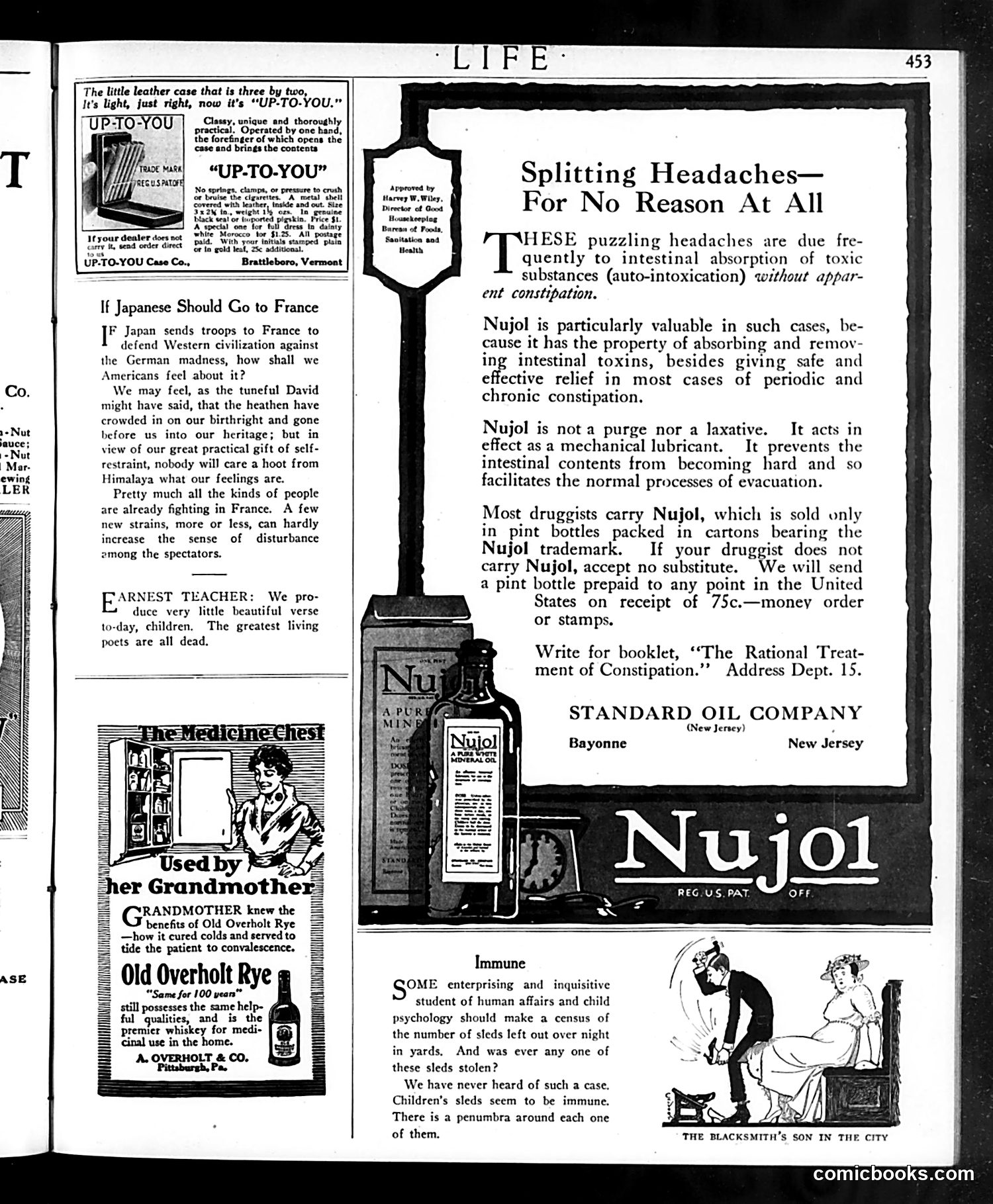
This page (453) is primarily **advertising**, with brief editorial commentary interspersed. The main advertisements are: 1. **UP-TO-YOU Case Co.** — A leather case product 2. **Nujol** (Standard Oil Company) — A mineral oil laxative marketed to treat "splitting headaches" caused by intestinal auto-intoxication and constipation 3. **Old Overholt Rye** — Whiskey marketed for medicinal/medicinal home use The editorial content includes: - A brief political commentary on Japan potentially sending troops to France during WWI, suggesting Americans wouldn't mind despite nationalist sentiments - An "Ernest Teacher" quote about modern poets being dead - A humorous short essay titled "Immune" about children's sleds never being stolen, implying some protective social force surrounds them The cartoon illustration ("The Blacksmith's Son in the City") shows a man visiting a woman indoors—likely a rural-to-urban social commentary, though context is limited. The page reflects early 20th-century advertising practices promoting patent medicines and remedies for common ailments.
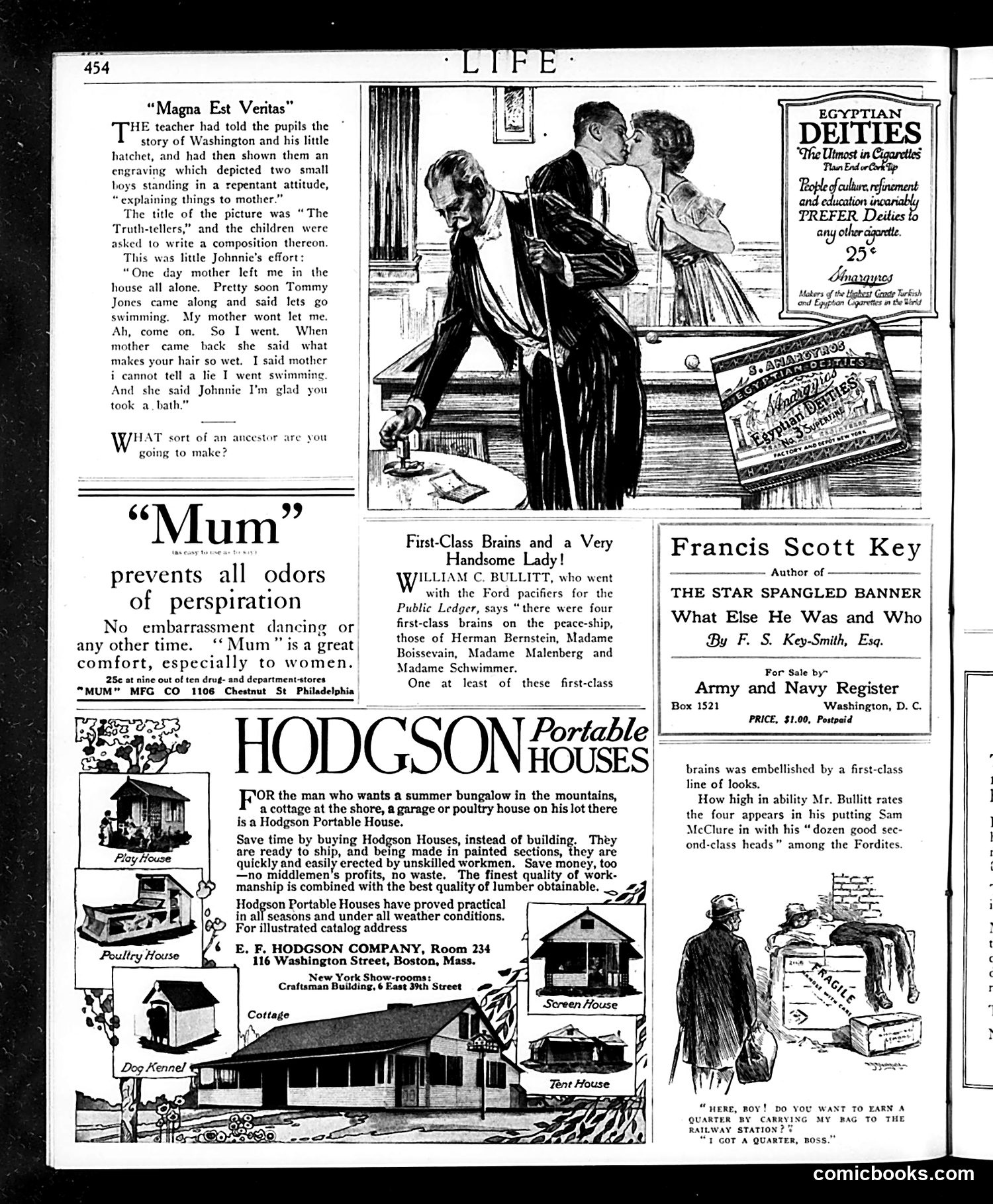
This page contains several distinct pieces of content: **Main Cartoon ("The Truth-tellers"):** A satirical piece about a child's essay on honesty. Young Johnnie recounts how his mother asked why his hair was wet. Following the Washington/hatchet moral lesson, he confesses to swimming—but his mother's response ("I'm glad you took a bath") reveals the joke: she misses his actual transgression entirely. The satire mocks how moral lessons about truthfulness can backfire when adults don't actually listen. **Ford Peace Ship Reference:** A brief item about William C. Bullitt's account of the Ford pacifist peace mission, which mentions four "first-class brains" aboard (including women like Madame Schwimmer). The satire appears to mock the intellectual pretensions of the peace delegation. **Advertisements:** The page is largely filled with period ads for "Mum" deodorant, Hodgson portable houses, and books by Francis Scott Key (author). **Bottom cartoon:** A brief sketch about a boy negotiating payment for carrying luggage—appears to satirize child labor or economic desperation.
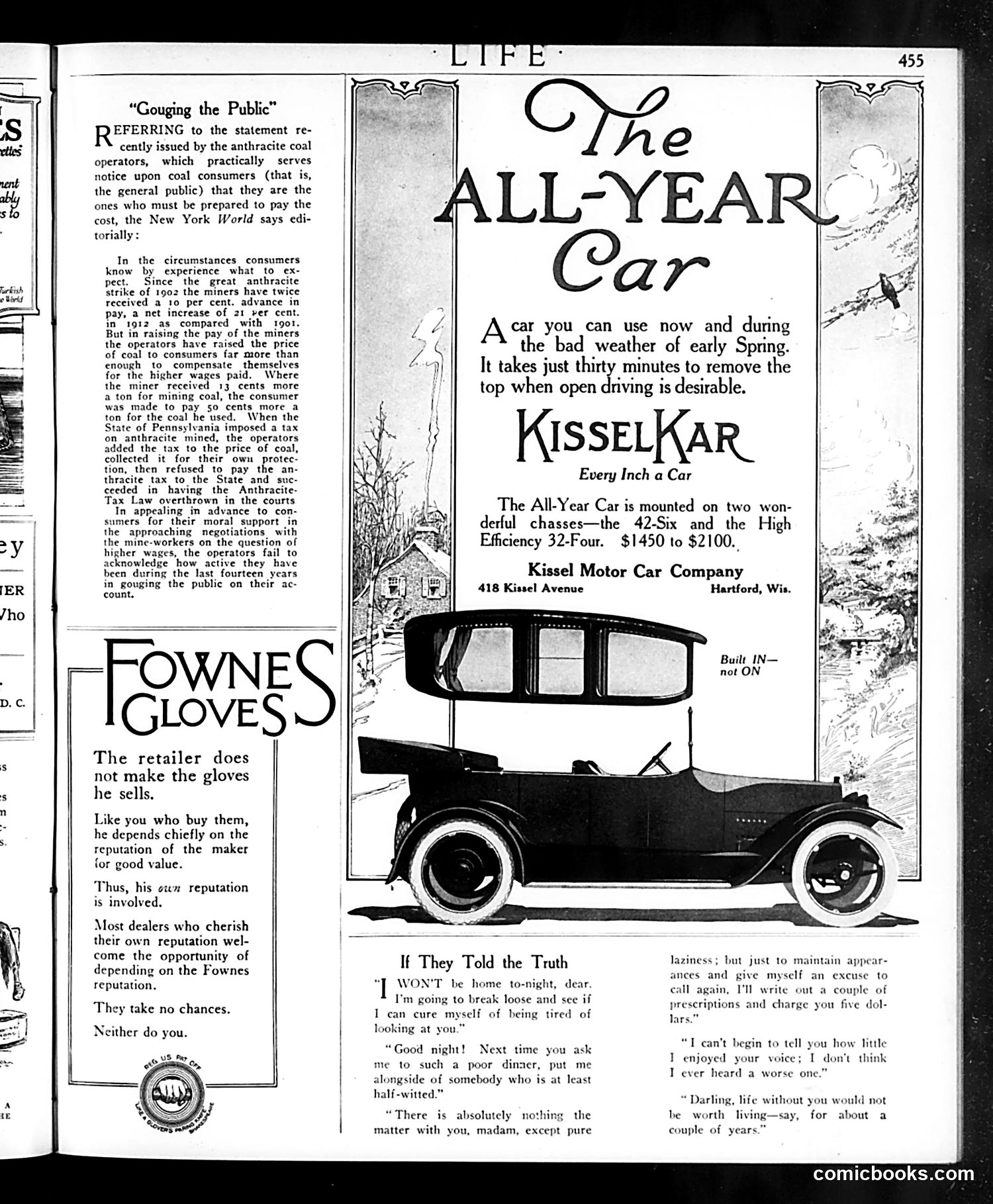
This page contains two distinct elements: **Left side:** An editorial piece titled "Gouging the Public" criticizes anthracite coal operators for price-gouging consumers. It references the 1902 anthracite strike and argues that while miners received wage increases (10% twice, 21% total by 1912), operators passed far larger costs to consumers—miners got 13 cents more per ton, but consumers paid 50 cents more. The editorial accuses operators of hypocritically appealing for public support in wage negotiations while having systematically overcharged the public for fourteen years. **Right side:** Advertisements for Fownes Gloves and Kissel Motor Cars—the latter promoting an "All-Year Car" with a removable top for spring weather, priced $1,450-$2,100. **Bottom:** A satirical piece titled "If They Told the Truth" presents brutally honest (and insulting) statements spouses and doctors might make if candor replaced social convention—a commentary on hypocrisy in everyday relationships.
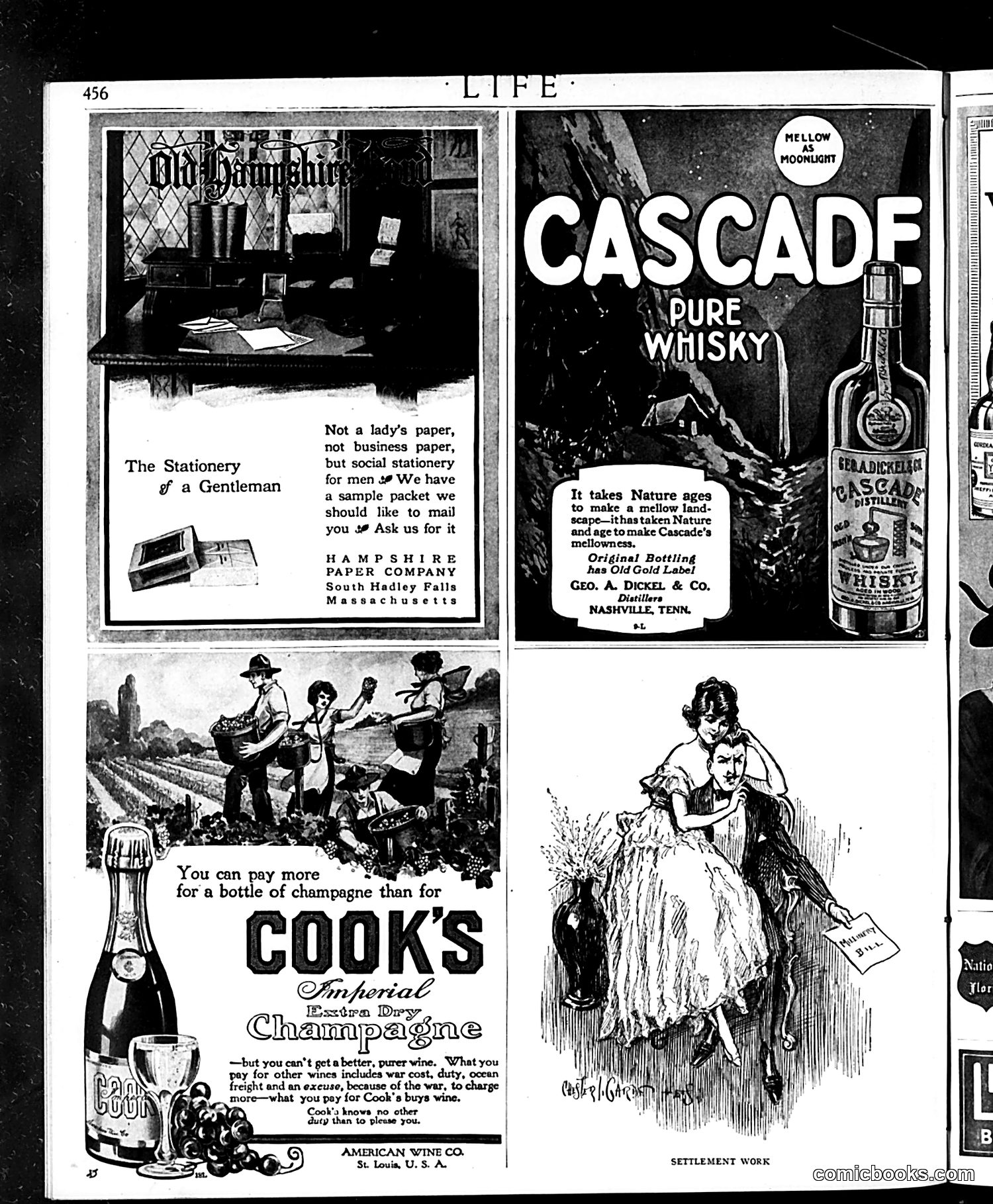
This is primarily an **advertising page** from Life magazine, not a satirical cartoon page. It contains four separate advertisements: 1. **Hampshire Paper Company** — sells gentlemen's stationery, positioning their product as sophisticated social correspondence material. 2. **Cascade Pure Whisky** — emphasizes the product's age and quality, with a Scottish Highland landscape illustration. 3. **Cook's Champagne** — uses a wartime economic argument: other wines include war costs and duties, but Cook's offers pure wine at better value. This references **WWI-era price inflation and import taxes**, making the pitch that Cook's domestic champagne avoids these surcharges. 4. **Settlement Work** — an illustrated vignette (bottom right) showing what appears to be domestic or social welfare assistance, though context is minimal. The page reflects early 20th-century consumer messaging and wartime economic concerns rather than political satire. The ads target male consumers with luxury goods while acknowledging post-war financial pressures.
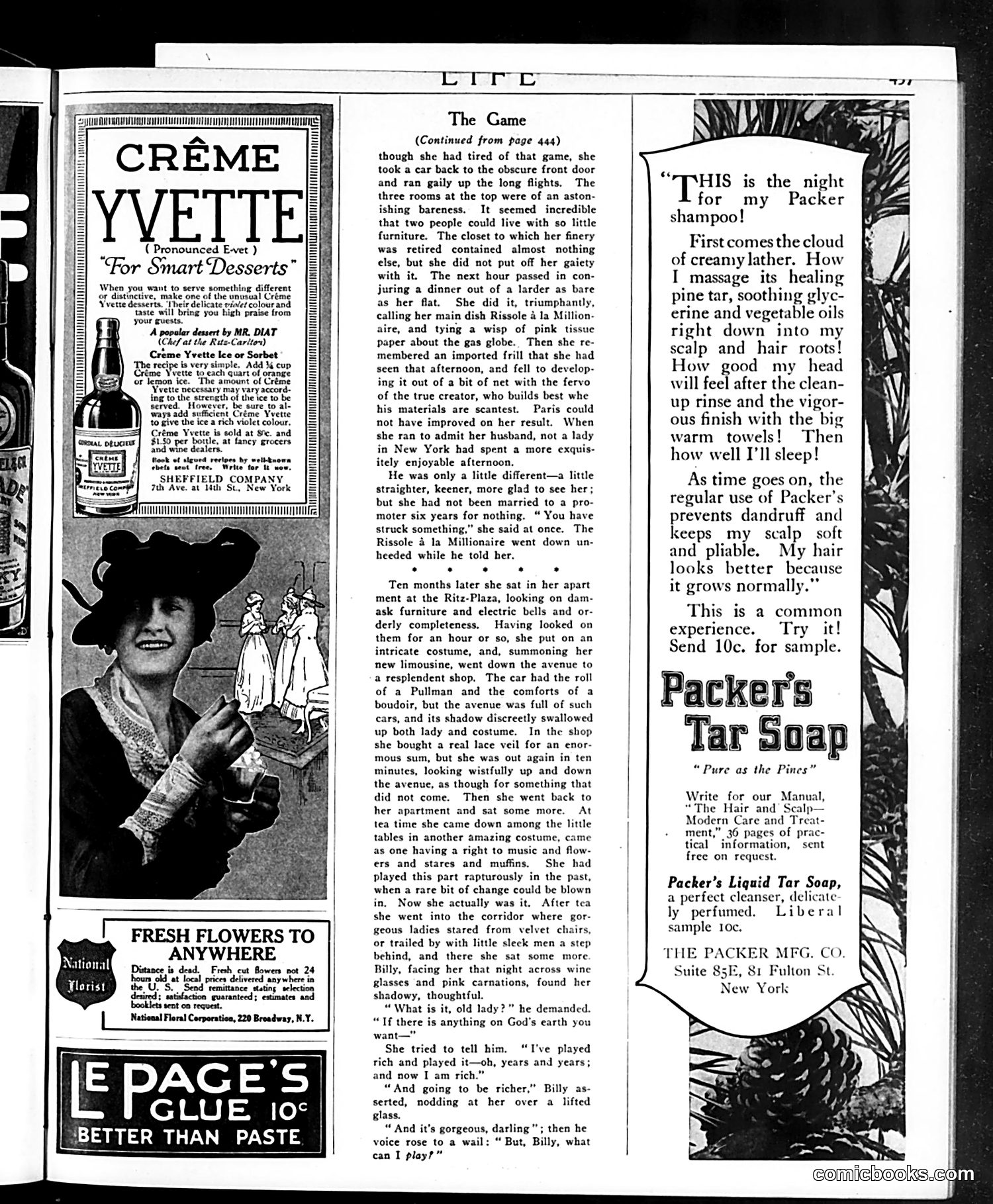
This page is primarily **advertising and serialized fiction**, not political satire. The top-left features a liqueur ad for **Crème Yvette**, a violet-colored dessert ingredient, with a photo of a woman in an elaborate hat—typical luxury product marketing of the era. The center contains "**The Game**," a serialized short story (continued from page 444) about a woman whose circumstances dramatically improve. She progresses from a bare apartment where she creatively entertains on nothing, to living at the prestigious Ritz-Plaza with a limousine. The narrative explores her emotional response to newfound wealth—she appears hollow despite material success, unable to recapture the satisfaction she felt when creating beauty from scarcity. The right side advertises **Parker's Tar Soap**, claiming to prevent dandruff and promote healthy hair. The bottom-left promotes **Le Page's Glue** and **National Florist** services. **No political cartoons or satire appear here.** This is a typical 1920s Life magazine page mixing consumer advertising with entertainment content.
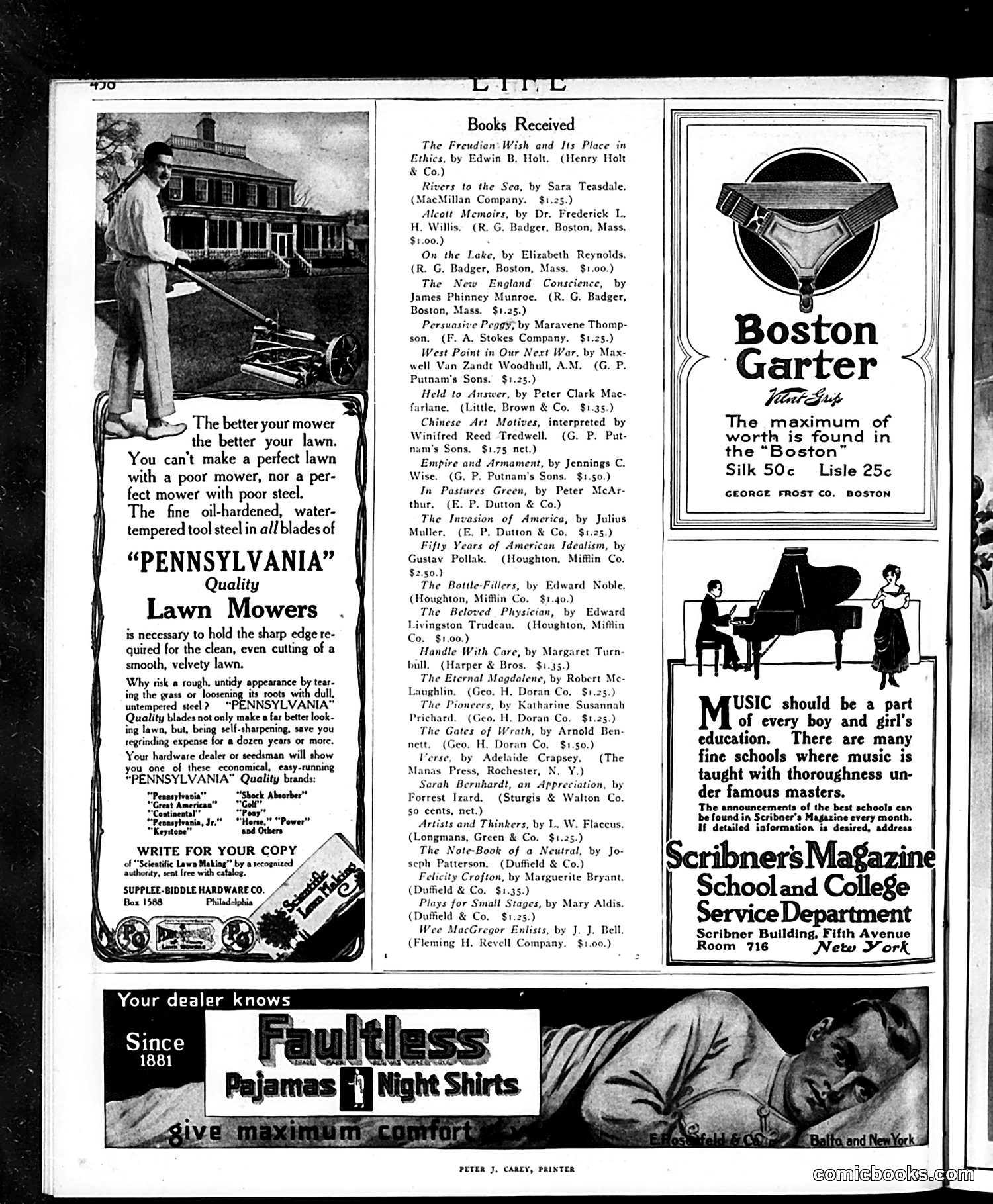
This page is primarily **advertising and book reviews**, not political satire. The main content consists of: 1. **Pennsylvania Quality Lawn Mowers advertisement** (left): A pitch emphasizing superior steel quality for clean lawn cutting. The image shows a man using a Pennsylvania mower, with copy arguing that poor equipment produces poor results—a straightforward product endorsement with no satirical intent. 2. **"Books Received" section** (center): A straightforward listing of newly published books with titles, authors, publishers, and prices. These appear to be serious literary and intellectual works (Freud, poetry, history, biography). 3. **Boston Garter advertisement** (right): Promoting silk hosiery. 4. **Scribner's Magazine advertisement** (lower right): Promoting music education and school announcements. 5. **Faultless Pajamas advertisement** (bottom): A product endorsement. The page contains **no political cartoons or satirical commentary**—it's a typical early 20th-century magazine page mixing commercial advertisements with literary notices.
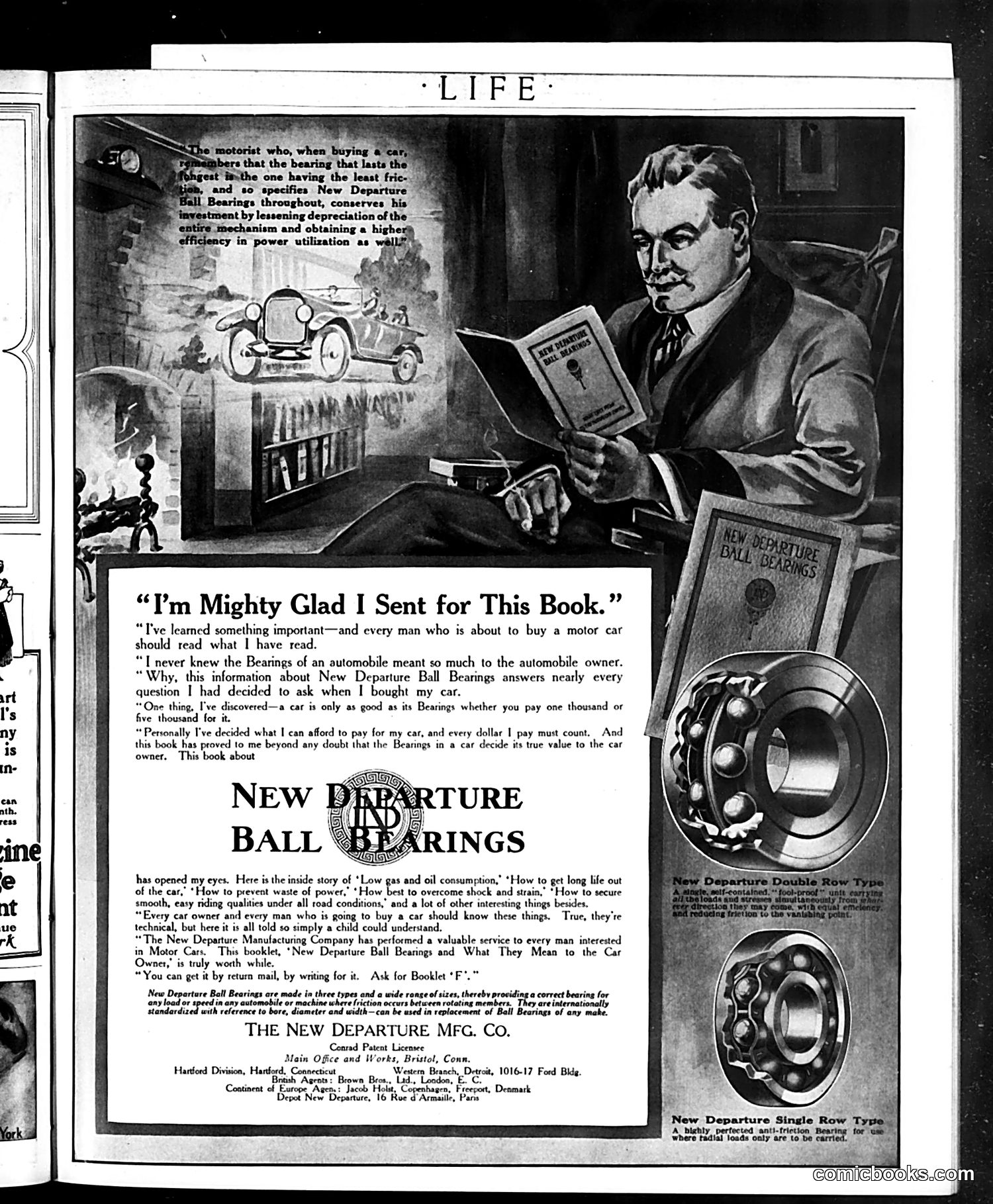
This is primarily a **product advertisement**, not political satire. It promotes New Departure Ball Bearings for automobiles. The page features a testimonial-style ad with an illustrated man reading a promotional booklet about ball bearings. The "joke" or selling point is that an ordinary car buyer has discovered—through the company's free booklet—that ball bearings are far more important to a vehicle's value and performance than he previously realized. The satire is gentle and self-directed: the man admits his ignorance ("I never knew the Bearings of an automobile meant so much") and expresses gratitude for learning something "important." This was a common early-20th-century advertising approach—using mock-humble testimonials to suggest that readers too should educate themselves about technical specifications. The multiple bearing diagrams on the right demonstrate the product's engineering. This is fundamentally a technical/industrial advertisement masquerading as lighthearted consumer education.
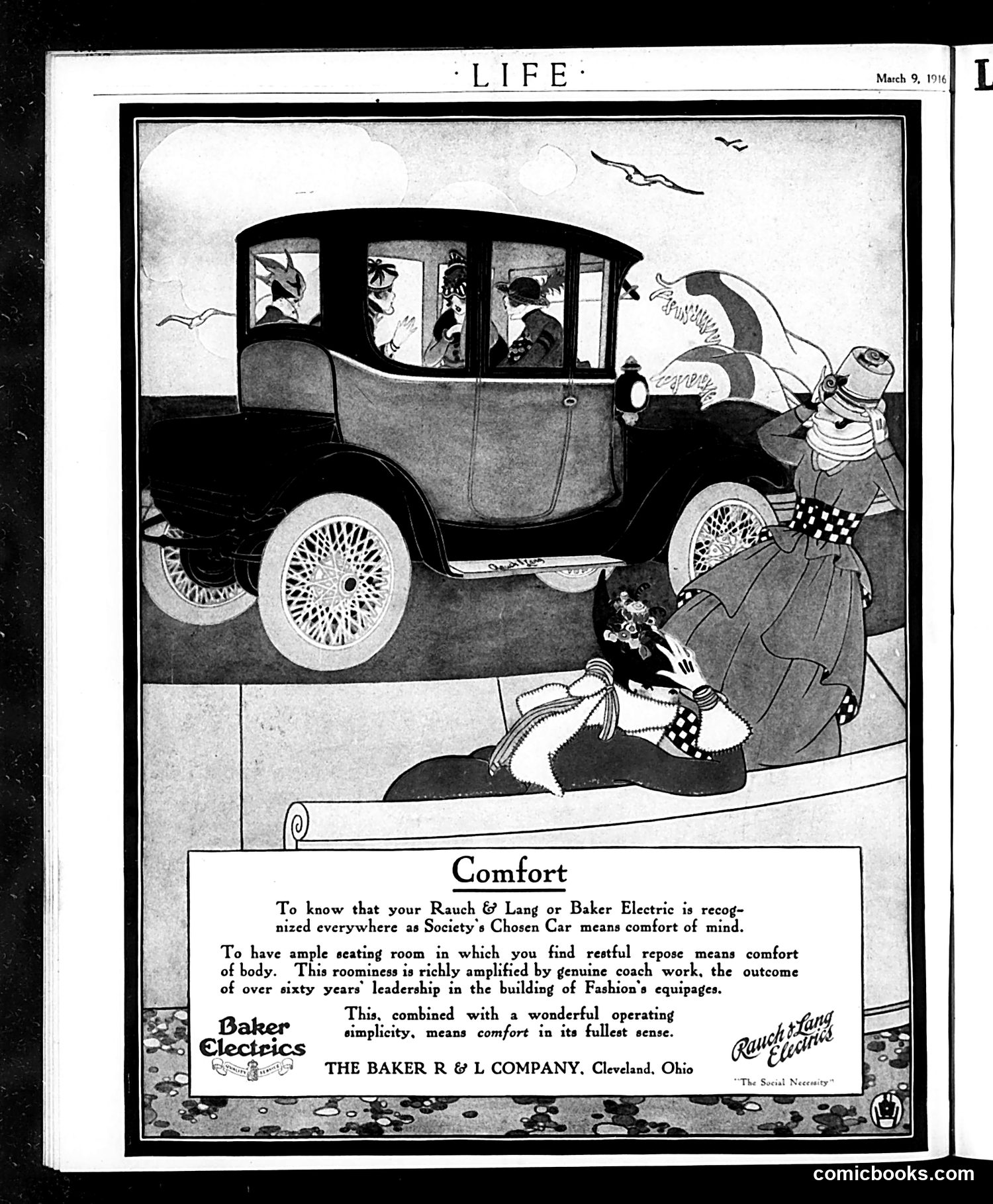
This is primarily a **automobile advertisement**, not political satire. It appeared in *Life* magazine on March 9, 1916. The image shows a fashionable woman in an elaborate feathered hat reclining contentedly while observing a Baker Electric automobile. The ad emphasizes "comfort" through spacious seating and refined coach construction. The well-dressed passengers visible in the car's windows represent the vehicle's appeal to "Society's Chosen." The satire is **gentle social commentary**: the languorous, leisurely pose of the woman—seemingly exhausted from the effort of mere observation—gently mocks the pretensions of wealthy consumers who equate luxury automobiles with social status and refined leisure. The exaggerated comfort rhetoric ("comfort in its fullest sense") humorously suggests that early-20th-century electric vehicles represented the ultimate in upper-class indulgence. No specific historical figures or political events are referenced; this targets general consumer culture and class aspiration.