
Life, 1916-03-09 · page 26 of 44
Life — March 9, 1916 — page 26: what you’re looking at
What you’re looking at
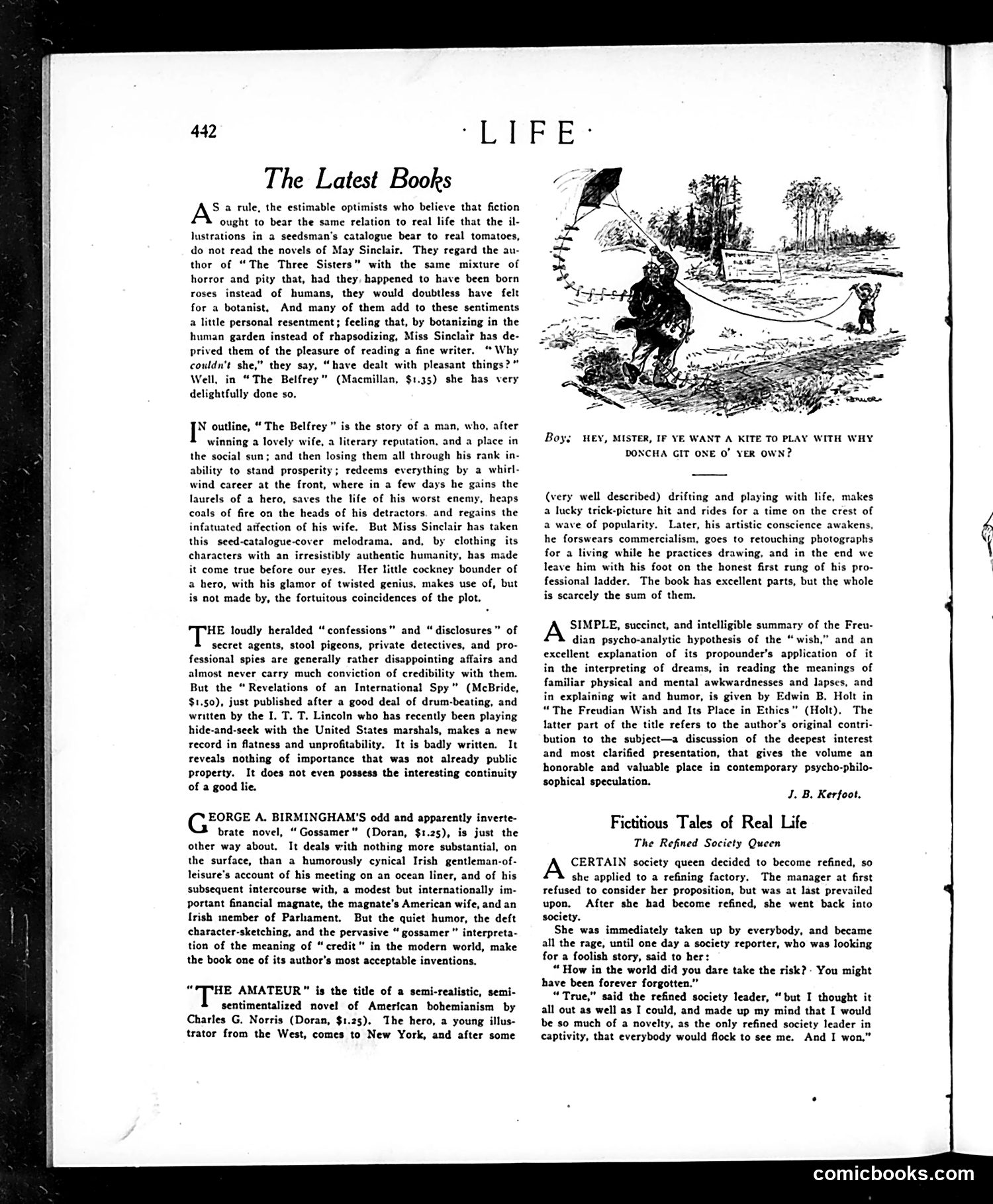
This is a literary review section from *Life* magazine featuring book critiques and a cartoon illustration. The cartoon depicts two boys with a kite, with the caption "HEY, MISTER, IF YE WANT A KITE TO PLAY WITH WHY DONCHA GIT ONE O' YER OWN?" The reviews discuss contemporary novels including May Sinclair's "The Belfrey," a spy memoir titled "Revelations of an International Spy," and works by George A. Birmingham and Charles G. Norris. The critics evaluate whether fiction should reflect "real life" realistically or provide escapist entertainment—debating whether readers prefer authentic character development or pleasant, melodramatic narratives. The cartoon's meaning is unclear from context alone; it may illustrate themes of independence or self-reliance referenced in the accompanying reviews, or represent broader social commentary about American individualism and self-improvement—common satirical themes in early 20th-century *Life* magazine.
📄 Transcribed text from this page (OCR, searchable)
Machine-transcribed from the original scan — historical spelling and the odd misread are preserved.
“LUPFE~ The Latest Books S a rule, the estimable optimists who believe that fiction ought to bear the same relation to real life that the il- lustrations in a seedsman’s catalogue bear to real tomatoes, do not read the novels of May Sinclair. They regard the au- thor of “The Three Sisters” with the same mixture of horror and pity that, had they, happened to have been born roses instead of humans, they would doubtless have felt for a botanist, And many of them add to these se: ents a little personal resentment; feeling that, by botanizing in the human garden instead of rhapsodizing, Miss Sinclair has de- prived them of the pleasure of reading a fine writer. “ Why couldn't she,” they say, “have dealt with pleasant things?” Well, in “The Belfrey” (Macmillan, $1.35) she has very delightfully done so. N outline, “The Belfrey” is the story of a man, who, after winning a lovely wife, a literary reputation, and a place in the social sun; and then losing them all through his rank in- ability to stand prosperity; redeems everything by a whirl- wind career at the front, where in a few days he gains the laurels of a hero, saves the life of his worst enemy, heaps coals of fire on the heads of his detractors. and regains the infatuated affection of his wife. But Miss Sinclair has taken this seed-catalogue-cover melodrama, and, by clothing its characters with an irresistibly authentic humanity, has made it come true before our eyes. Her little cockney bounder of a hero, with his glamor of twisted genius, makes use of, but is not made by, the fortuitous coincidences of the plot. 'HE loudly heralded “confessions” and “ disclosures” of secret agents, stool pigeons, private detectives, and pro- fessional spies are generally rather disappointing affairs and almost never carry much conviction of credibility with them. But the “Revelations of an International Spy” (McBride, $1.50), just published after a good deal of drum-beating, and written by the I. T. T. Lincoln who has recently been playing hide-and-seek with the United States marshals, makes a new record in flatness and unprofitability. It is badly written. It reveals nothing of importance that was not already public Property. It does not even possess the interesting continuity of a good lie. EORGE A. BIRMINGHAM’S odd and apparently inverte- brate novel, “Gossamer” (Doran, $1.25), is just the other way about. It deals vith nothing more substantial, on the surface, than a humorously cynical Irish gentleman-of- leisure’s account of his meeting on an ocean liner, and of his subsequent intercourse with, a modest but internationally im- Portant financial magnate, the magnate’s American wife, and an {rish member of Parhament. But the quiet humor, the deft character-sketching, and the pervasive “ gossamer” interpreta- tion of the meaning of “credit” in the modern world, make the book one of its author's most acceptable inventions. " HE AMATEUR” is the title of a semi-realistic, semi- sentimentalized novel of American bohemianism by Charles G. Norris (Doran, $1.25). The hero, a young illus- trator from the West, comes to New York, and after some HEY, MISTER, IF YE WANT A KITE TO PLAY WITH WHY DONCHA GIT ONE 0° YER OWN? Boys (very well described) drifting and playing with life, makes a lucky trick-picture hit and rides for a time on the crest of a wave of popularity. Later, his artistic conscience awakens, he forswears commercialism, goes to retouching photographs for a living while he practices drawing, and in the end we leave him with his foot on the honest first rung of his pro- fessional ladder. The book has excellent parts, but the whole is scarcely the sum of them. SIMPLE, succinct, and intelligible summary of the Freu- dian psycho-analytic hypothesis of the “wish,” and an excellent explanation of its propounder’s application of it in the interpreting of dreams, in reading the meanings of familiar physical and mental awkwardnesses and lapses, and in explaining wit and humor, is given by Edwin B. Holt in “The Freudian Wish and Its Place in Ethics” (Holt), The latter part of the title refers to the author's original contri- bution to the subject—a discussion of the deepest interest and most clarified presentation, that gives the volume an honorable and valuable place in contemporary psycho-philo- sophical speculation. J.B. Kerfoot. Fictitious Tales of Real Life The Refined Society Queen CERTAIN society queen decided to become refined, so she applied to a refining factory. The manager at first refused to consider her proposition, but was at last prevailed upon, After she had become refined, she went back into society. She was immediately taken up by everybody, and became all the rage, until one day a society reporter, who was looking for a foolish story, said to her: “ How in the world did you dare take the risk? You might have been forever forgotten.” “True,” said the refined society leader, “but I thought it all out as well as I could, and made up my mind that I would be so much of a novelty, as the only refined society leader in captivity, that everybody would flock to see me. And I won.” comicbooks.com