
Life, 1916-03-09 · page 24 of 44
Life — March 9, 1916 — page 24: what you’re looking at
What you’re looking at
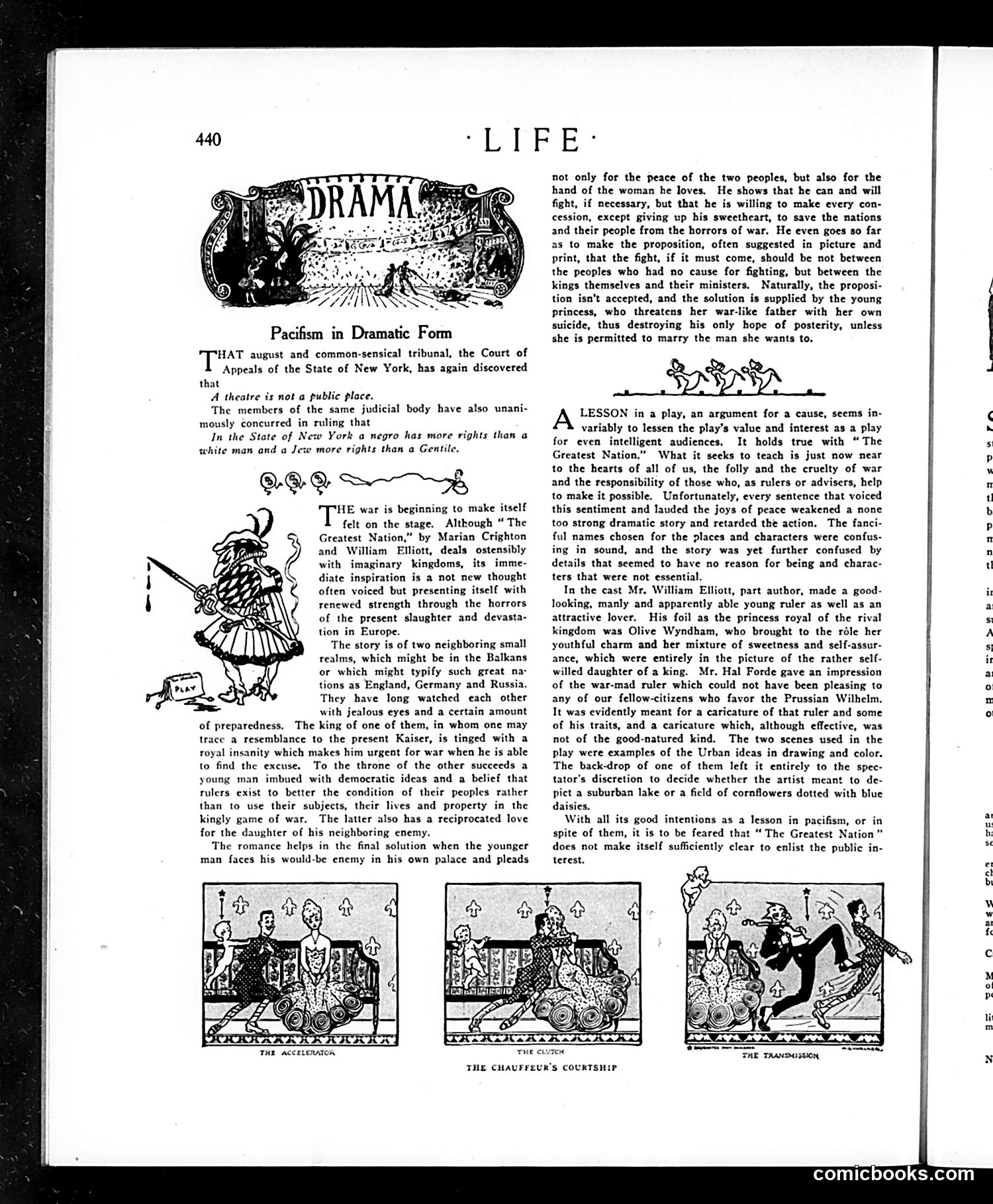
This page reviews a stage play called "The Greatest Nation," critiquing how it uses drama to argue for pacifism during World War I. The play depicts two neighboring kingdoms (standing in for European powers like England, Germany, and Russia) on the brink of war. The satirical target appears to be **the play's heavy-handed moralizing**. Life argues that inserting pacifist lessons undermines the drama's artistic power, even when the message—opposing war's folly and rulers' responsibility—resonates with contemporary audiences. The review criticizes awkward character names and unnecessary details that confuse rather than clarify the anti-war argument. The opening section mocks a New York court ruling that "a theatre is not a public place," sarcastically noting this judicial decision paradoxically grants racial and religious minorities greater protections than white gentiles—suggesting the court's reasoning is absurd. The three illustrated panels at bottom appear to depict scenes from the play, showing court interactions and romance, though details are unclear from reproduction quality.
📄 Transcribed text from this page (OCR, searchable)
Machine-transcribed from the original scan — historical spelling and the odd misread are preserved.
‘LUFE* Pacifism in Dramatic Form 1 Figo august and common-sensical tribunal, the Court of Appeals of the State of New York, has again discovered that A theatre is not a public place. The members of the same judicial body have also unani- mously concurred in ruling that In the State of New York a negro has more rights than a white man and a Jew more rights than a Gentile. VOY SHH HE war is beginning to make itself felt on the stage. Although “ The Greatest Nation,” by Marian Crighton and William Elliott, deals ostensibly with imaginary kingdoms, its imme- jiate inspiration is a not new thought often voiced but presenting itself with renewed strength through the horrors of the present slaughter and devasta- tion in Europe. The story is of two neighboring small realms, which might be in the Balkans or which might typify such great na- tions as England, Germany and Russia. They have long watched each other with jealous eyes and a certain amount of preparedness. The king of one of them, in whom one may trace a resemblance to the present Kaiser, is tinged with a royal insanity which makes him urgent for war when he is able to find the excuse. To the throne of the other succeeds a young man imbued with democratic ideas and a belief that rulers exist to better the condition of their peoples rather than to use their subjects, their lives and property in the kingly game of war, The latter also has a reciprocated love for the daughter of his neighboring enemy. The romance helps in the final solution when the younger man faces his would-be enemy in his own palace and pleads not only for the peace of the two peoples, but also for the hand of the woman he loves. He shows that he can and will fight, if necessary, but that he is willing to make every con- cession, except giving up his sweetheart, to save the nations and their people from the horrors of war. He even goes so far as to make the proposition, often suggested in picture and print, that the fight, if it must come, should be not between the peoples who had no cause for fighting, but between the kings themselves and their ministers. Naturally, the proposi- tion isn’t accepted, and the solution is supplied by the young ‘incess, who threatens her war-like father with her own suicide, thus destroying his only hope of posterity, unless she is permitted to marry the man she wants to. sn LESSON in a play, an argument for a cause, seems in- variably to lessen the play’s value and interest as a play for even intelligent audiences. It holds true with “The Greatest Nation.” What it seeks to teach is just now near to the hearts of all of us, the folly and the cruelty of war and the responsibility of those who, as rulers or advisers, help to make it possible. Unfortunately, every sentence that voiced this sentiment and lauded the joys of peace weakened a none too strong dramatic story and retarded the action, The fanci- ful names chosen for the places and characters were confus- ing in sound, and the story was yet further confused by details that seemed to have no reason for being and charac- ters that were not essential. In the cast Mr. William Elliott, part author, made a good- looking, manly and apparently able young ruler as well as an attractive lover. His foil as the princess royal of the rival kingdom was Olive Wyndham, who brought to the rdle her youthful charm and her mixture of sweetness and self-assur- ance, which were entirely in the picture of the rather self- willed daughter of a king. Mr. Hal Forde gave an impression of the war-mad ruler which could not have been pleasing to any of our fellow-citizens who favor the Prussian Wilhelm. It was evidently meant for a caricature of that ruler and some of his traits, and a caricature which, although effective, was not of the good-natured kind. The two scenes used in the play were examples of the Urban ideas in drawing and color. The back-drop of one of them left it entirely to the spec- tator's discretion to decide whether the artist meant to de- pict a suburban lake or a ficld of cornflowers dotted with blue daisies. With all its good intentions as a lesson in pacifism, or in spite of them, it is to be feared that “The Greatest Nation” does not make itself sufficiently clear to enlist the public in- terest. THE ACCELERATOR THE CLUTON THE TRANS SSION THE CHAUFFEUR'S COURTSHIP comicbooks.com