
Life, 1916-03-09 · page 20 of 44
Life — March 9, 1916 — page 20: what you’re looking at
What you’re looking at
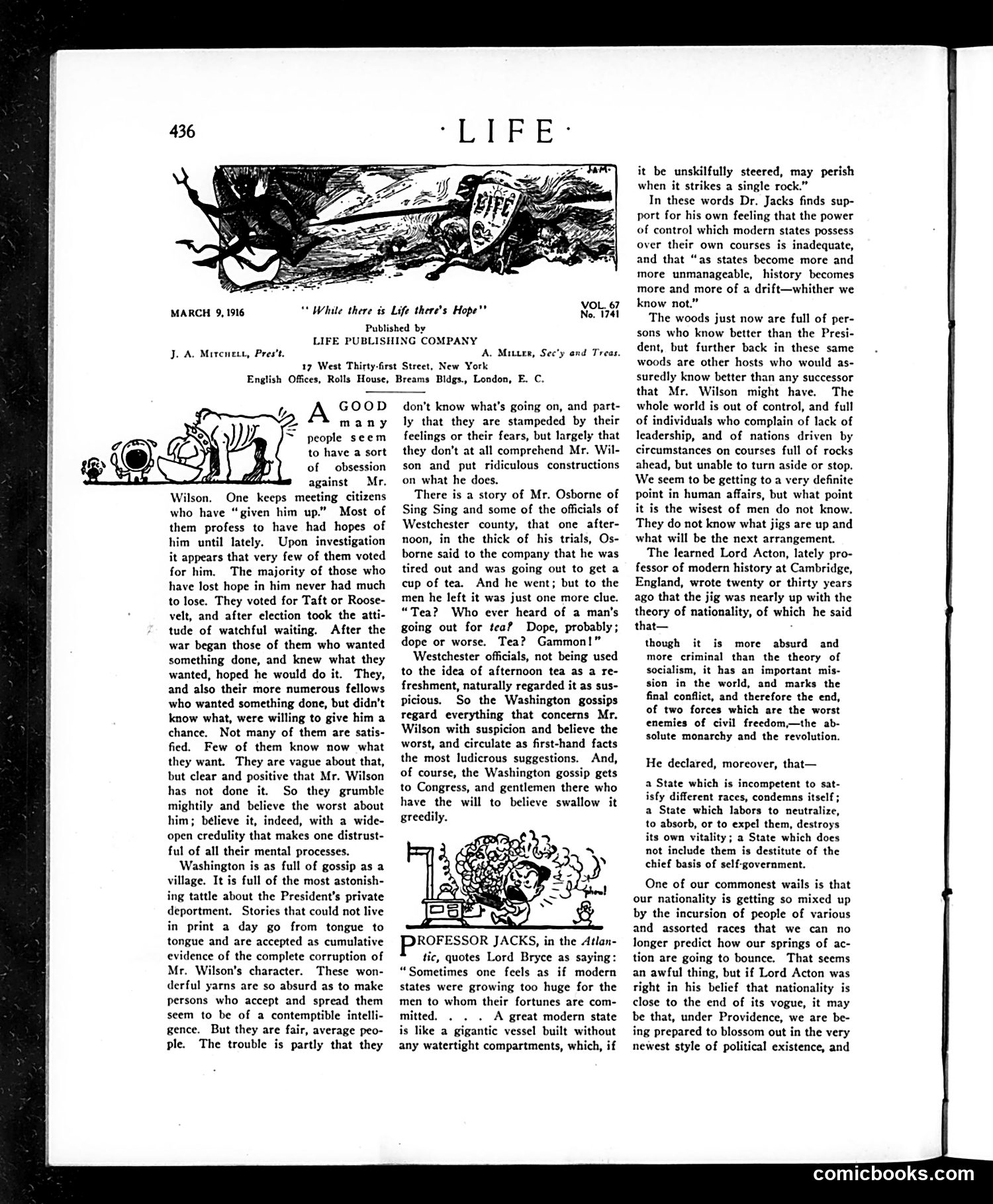
This page contains satirical commentary on President Woodrow Wilson's unpopularity, particularly among those who had previously supported other candidates (Taft, Roosevelt). The main article mocks Washington gossip culture, using an anecdote about Sing Sing prison official Osborne: when he mentioned getting tea, suspicious officials interpreted it as evidence of drug use—simply because they didn't understand the practice. The satire suggests Wilson critics similarly misinterpret his actions through ignorance and prejudice rather than understanding his actual policies. The page includes a Professor Jacks quote (via Lord Bryce) comparing modern states to unsteerable ships without compartments, suggesting nations have lost control of their own destiny—contextualizing contemporary anxieties about governmental competence and America's direction during WWI's early years. The cartoon at the top (unclear in detail) appears decorative to this editorial message attacking Wilson's detractors as credulous and intellectually undiscerning.
📄 Transcribed text from this page (OCR, searchable)
Machine-transcribed from the original scan — historical spelling and the odd misread are preserved.
MARCH 9, 1916 ‘* While there is Life there's Hope"’ No. 1741 Published by LIFE PUBLISHING COMPANY J. A. Mircnett, Pres‘t. A GOOD many people seem to have a sort of obsession against Mr. Wilson. One keeps meeting citizens who have “given him up.” Most of them profess to have had hopes of him until lately. Upon investigation it appears that very few of them voted for him. The majority of those who have lost hope in him never had much to lose. They voted for Taft or Roose- velt, and after election took the atti- tude of watchful waiting. After the war began those of them who wanted something done, and knew what they wanted, hoped he would do it. They, and also their more numerous fellows who wanted something done, but didn’t know what, were willing to give him a chance. Not many of them are satis- fied. Few of them know now what they want. They are vague about that, but clear and positive that Mr. Wilson has not done it. So they grumble mightily and believe the worst about him; bélieve it, indeed, with a wide- open credulity that makes one distrust- ful of all their mental processes. Washington is as full of gossip as a village. It is full of the most astonish- ing tattle about the President's private deportment. Stories that could not live in print a day go from tongue to tongue and are accepted as cumulative evidence of the complete corruption of Mr. Wilson's character. These won- derful yarns are so absurd as to make persons who accept and spread them seem to be of a contemptible intelli- gence. But they are fair, average peo- ple. The trouble is partly that they A. Miture, Sec'y and Treas. 17 West Thirty-first Street, New York English Offices, Rolls House, Breams Bldgs, London, E. C. don’t know what's going on, and part- ly that they are stampeded by their feelings or their fears, but largely that they don’t at all comprehend Mr. Wil- son and put ridiculous constructions on what he does. There is a story of Mr. Osborne of Sing Sing and some of the officials of Westchester county, that one after- noon, in the thick of his trials, Os- borne said to the company that he was tired out and was going out to get a cup of tea. And he went; but to the men he left it was just one more clue. “Tea? Who ever heard of a man's going out for tea? Dope, probably; dope or worse. Tea? Gammon!” Westchester officials, not being used to the idea of afternoon tea as a re- freshment, naturally regarded it as sus- picious. So the Washington gossips regard everything that concerns Mr. Wilson with suspicion and believe the worst, and circulate as first-hand facts the most ludicrous suggestions. And, of course, the Washington gossip gets to Congress, and gentlemen there who have the will to believe swallow it greedily. ROFESSOR JACKS, in the Atlan- tic, quotes Lord Bryce as saying: “Sometimes one feels as if modern states were growing too huge for the men to whom their fortunes are com- mitted. . . . A great modern state is like a gigantic vessel built without any watertight compartments, which, if it be unskilfully steered, may perish when it strikes a single rock.” In these words Dr. Jacks finds sup- port for his own feeling that the power of control which modern states possess over their own courses is inadequate, and that “as states become more and more unmanageable, history becomes more and more of a drift—whither we know not.” The woods just now are full of per- sons who know better than the Presi- dent, but further back in these same woods are other hosts who would as- suredly know better than any successor that Mr. Wilson might have. The whole world is out of control, and full of individuals who complain of lack of leadership, and of nations driven by circumstances on courses full of rocks ahead, but unable to turn aside or stop. We seem to be getting to a very definite point in human affairs, but what point it is the wisest of men do not know. They do not know what jigs are up and what will be the next arrangement. The learned Lord Acton, lately pro- fessor of modern history at Cambridge, England, wrote twenty or thirty years ago that the jig was nearly up with the theory of nationality, of which he said that— though it is more absurd and more criminal than the theory of socialism, it has an important mis- sion in the world, and marks the final conflict, and therefore the end, of two forces which are the worst enemies of civil freedom —the ab- solute monarchy and the revolution. He declared, moreover, that— a State which is incompetent to sat- isfy different races, condemns itself; a State which labors to neutralize, to absorb, or to expel them, destroys its own vitality; a State which does not include them is destitute of the chief basis of self-government. One of our commonest wails is that our nationality is getting so mixed up by the incursion of people of various and assorted races that we can no longer predict how our springs of ac- tion are going to bounce. That seems an awful thing, but if Lord Acton was right in his belief that nationality is close to the end of its vogue, it may be that, under Providence, we are be- ing prepared to blossom out in the very newest style of political existence, and comicbooks.com