
Life, 1916-03-09 · page 21 of 44
Life — March 9, 1916 — page 21: what you’re looking at
What you’re looking at
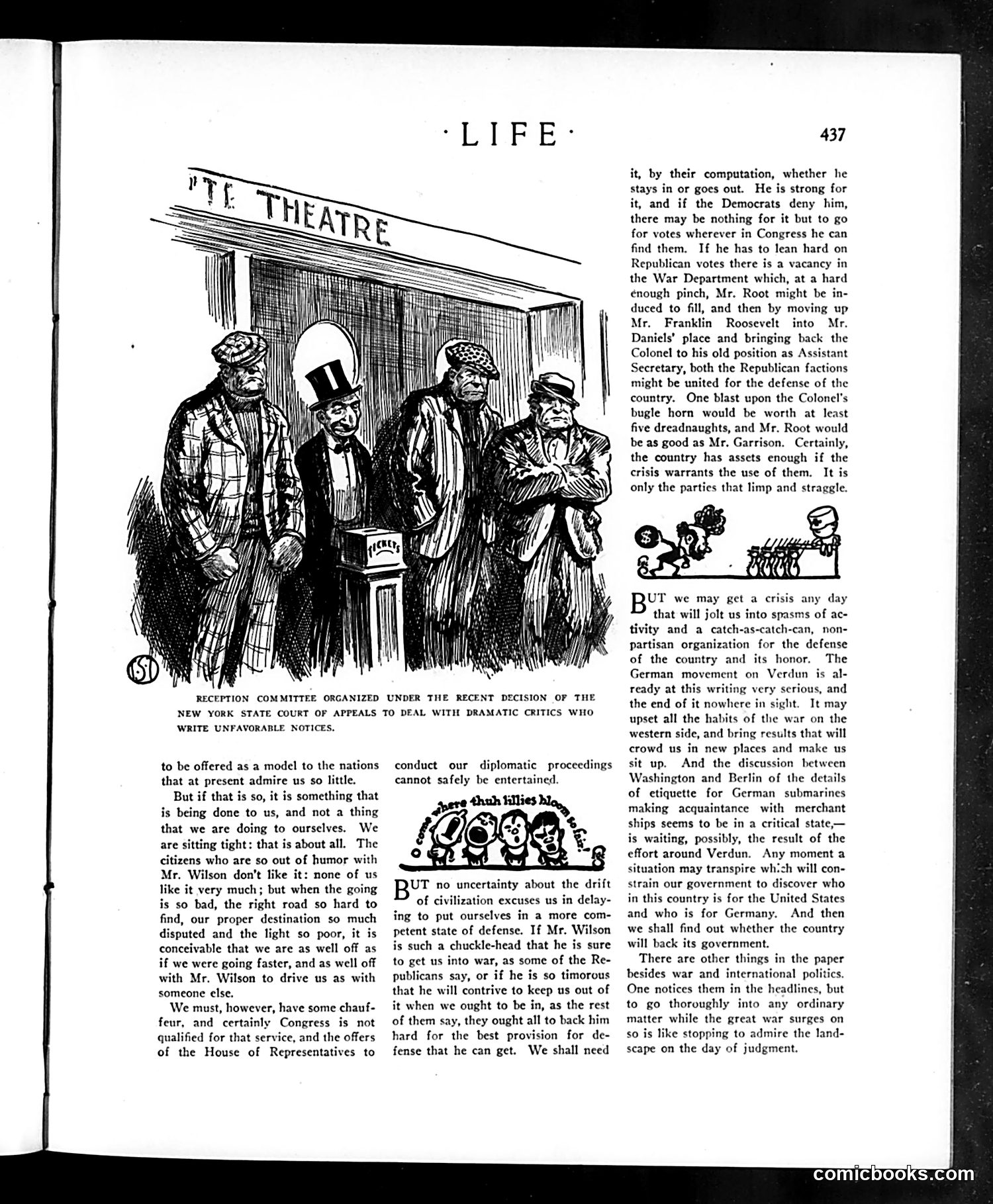
This 1916 *Life* magazine page satirizes a New York court decision allowing dramatic critics to be sued for unfavorable theater reviews. The cartoon depicts a "reception committee"—thugs in formal attire—positioned outside a theater to intimidate critics, suggesting that legal liability for negative reviews creates a chilling effect on free speech and invites violence against press freedom. The accompanying editorial argues that while President Wilson's leadership is imperfect, partisan bickering over defense preparedness is dangerous. With World War I raging in Europe (the Verdun offensive is mentioned), the author urges Republicans to support military readiness regardless of which party holds power, even suggesting former Secretary of War Elihu Root's involvement could unite factions. The piece criticizes Americans' distraction with trivial matters while war looms.
📄 Transcribed text from this page (OCR, searchable)
Machine-transcribed from the original scan — historical spelling and the odd misread are preserved.
RECEPTION COMMITTEE ORGANIZED UNDER THE RECENT DECISION OF THE NEW YORK STATE COURT OF APPEALS TO DEAL WITH DRAMATIC CRITICS WHO WRITE UNFAVORABLE NOTICES. to be offered as a model to the nations that at present admire us so little. But if that is so, it is something that is being done to us, and not a thing that we are doing to ourselves. We are sitting tight: that is about all. The citizens who are so out of humor with Mr. Wilson don’t like it: none of us like it very much; but when the going is so bad, the right road so hard to find, our proper destination so much disputed and the light so poor, it is conceivable that we are as well off as if we were going faster, and as well off with Mr. Wilson to drive us as with someone else, We must, however, have some chauf- feur, and certainly Congress is not qualified for that service, and the offers of the House of Representatives to conduct our diplomatic proceedings cannot safely be entertained. Bt no uncertainty about the drift of civilization excuses us in delay- ing to put ourselves in a more com- petent state of defense. If Mr. Wilson is such a chuckle-head that he is sure to get us into war, as some of the Re- publicans say, or if he is so timorous that he will contrive to keep us out of it when we ought to be in, as the rest of them say, they ought all to back him hard for the best provision for de- fense that he can get. We shall need 437 it, by their computation, whether he stays in or goes out. He is strong for it, and if the Democrats deny him, there may be nothing for it but to go for votes wherever in Congress he can find them. If he has to lean hard on Republican votes there is a vacancy in the War Department which, at a hard énough pinch, Mr. Root might be in- duced to fill, and then by moving up Mr. Franklin Roosevelt into Mr. Daniels’ place and bringing back the Colonel to his old position as Assistant Secretary, both the Republican factions might be united for the defense of the country. One blast upon the Colonel's bugle horn would be worth at least five dreadnaughts, and Mr. Root would be as good as Mr. Garrison. Certainly, the country has assets enough if the crisis warrants the use of them. It is only the parties that limp and straggle. UT we may get a crisis any day that will jolt us into spasms of ac- tivity and a catch-as-catch-can, non- partisan organization for the defense of the country and its honor, The German movement on Verdun is al- ready at this writing very serious, and the end of it nowhere in sight. It may upset all the habits of the war on the western side, and bring results that will crowd us in new places and make us sit up. And the discussion between Washington and Berlin of the details of etiquette for German submarines making acquaintance with merchant ships seems to be in a critical state,— is waiting, possibly, the result of the effort around Verdun. Any moment a situation may transpire whch will con- strain our government to discover who in this country is for the United States and who is for Germany. And then we shall find out whether the country will back its government. There are other things in the paper besides war and international politics. One notices them in the headlines, but to go thoroughly into any ordinary matter while the great war surges on so is like stopping to admire the land- scape on the day of judgment. comicbooks.com