
Life, 1916-03-09 · page 32 of 44
Life — March 9, 1916 — page 32: what you’re looking at
What you’re looking at
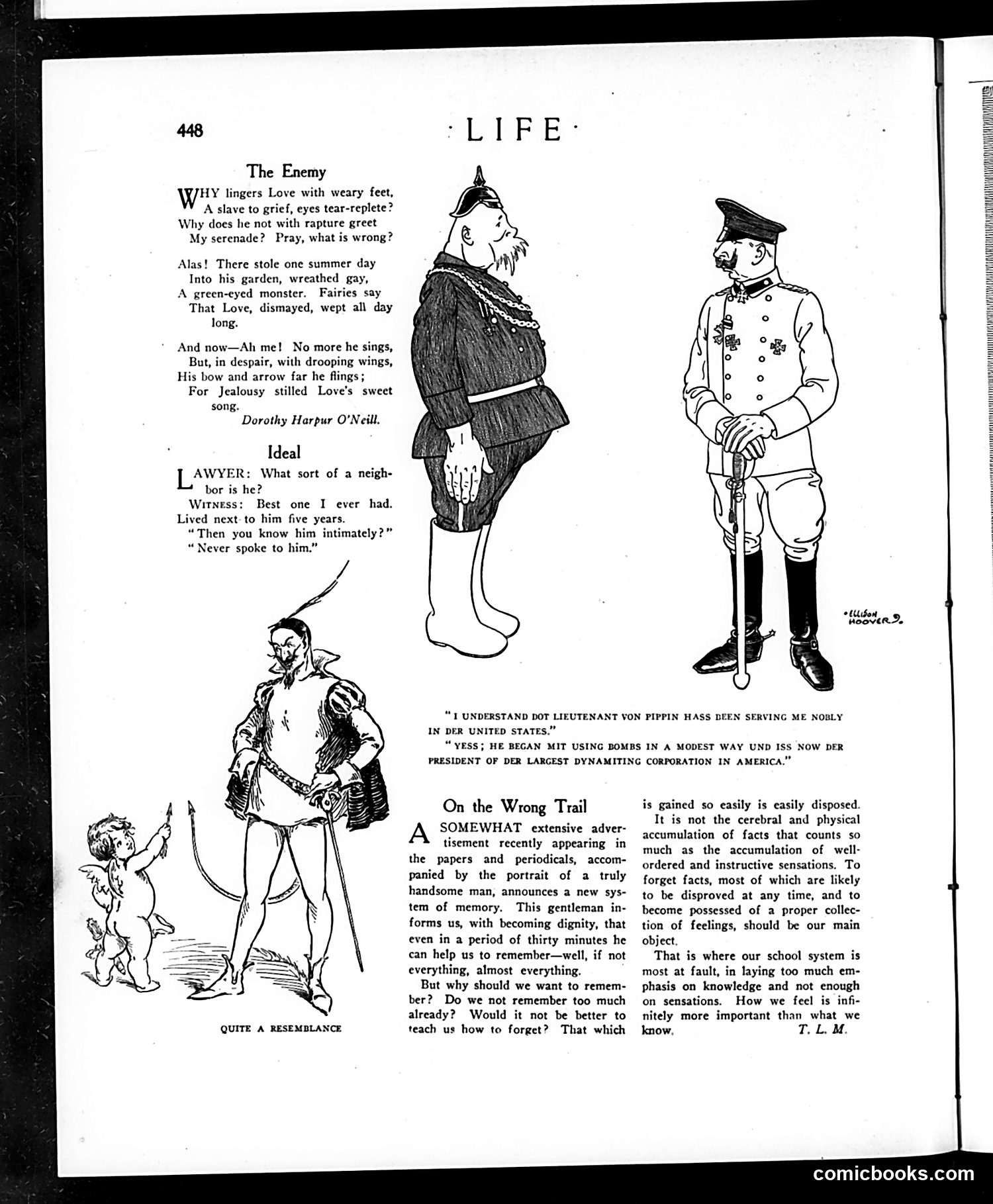
This page contains three satirical pieces reflecting early 20th-century concerns: **"The Enemy"** is a romantic poem about jealousy destroying love—standard sentimental fare with an illustration of cupid versus a jealous figure. **"Ideal"** is a brief joke about an ideal neighbor: someone you lived next to for five years but never spoke to. This satirizes American social isolation and the preference for non-involvement. **"On the Wrong Trail"** critiques a memory-improvement advertisement. The author argues schools and society wrongly emphasize memorizing facts over cultivating proper feelings and sensations. This reflects early 20th-century debates about education philosophy—whether rote learning or emotional/experiential development mattered more. The German-accented dialogue about "Lieutenant Von Pippin" appears to reference German immigrant involvement in American industry, possibly satirizing wartime anxieties about foreign nationals.
📄 Transcribed text from this page (OCR, searchable)
Machine-transcribed from the original scan — historical spelling and the odd misread are preserved.
448 The Enemy HY lingers Love with weary feet, A slave to grief, eyes tear-replete? Why does he not with rapture greet My serenade? Pray, what is wrong? Alas! There stole one summer day Into his garden, wreathed gay, A green-eyed monster. Fairies say That Love, dismayed, wept all day long. And now—Ah me! No more he sings, But, in despair, with drooping wings, His bow and arrow far he flings; For Jealousy stilled Love's sweet song. Dorothy Harpur O'Neill. Ideal AWYER: What sort of a neigh- bor is he? Witness: Best one I ever had. Lived next. to him five years. “Then you know him intimately?” “Never spoke to him.” QUITE A RESEMBLANCE “LT UNDERSTAND DOT LIEUTENANT VON PIPPIN HASS DEEN SERVING ME NOBLY IN DER UNITED STATES.” “YESS; HE BEGAN MIT USING BOMBS IN A MODEST WAY UND ISS NOW DER PRESIDENT OF DER LARGEST DYNAMITING CORPORATION IN AMERICA. On the Wrong Trail SOMEWHAT extensive adver- tisement recently appearing in the papers and periodicals, accom- panied by the portrait of a truly handsome man, announces a new sys- tem of memory. This gentleman in- forms us, with becoming dignity, that even in a period of thirty minutes he can help us to remember—well, if not everything, almost everything. But why should we want to remem- ber? Do we not remember too much already? Would it not be better to teach us how to forget? That which is gained so easily is easily disposed. It is not the cerebral and physical accumulation of facts that counts so much as the accumulation of well- ordered and instructive sensations. To forget facts, most of which are likely to be disproved at any time, and to become possessed of a proper collec- tion of feelings, should be our main object. That is where our school system is most at fault, in laying too much em- phasis on knowledge and not enough on sensations. How we feel is infi- nitely more important than what we know, T. L. M. comicbooks.com