
Life, 1916-03-09 · page 25 of 44
Life — March 9, 1916 — page 25: what you’re looking at
What you’re looking at
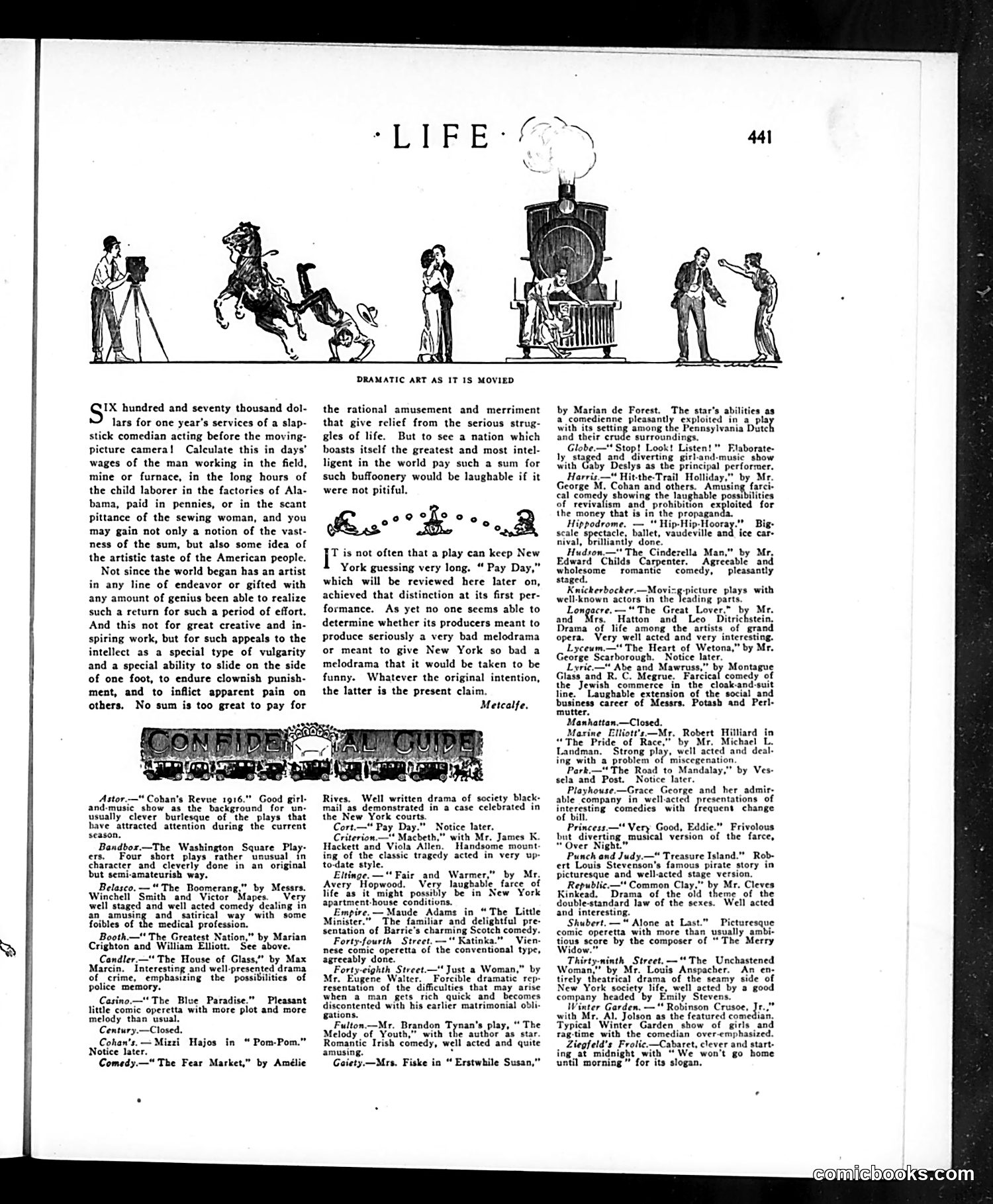
This page critiques American culture's misplaced values through commentary on theatrical entertainment. The top illustration depicts "Dramatic Art as It is Movied"—showing various performance styles from serious drama to slapstick. The main editorial attack focuses on a slapstick comedian earning $670,000 annually for film work—an astronomical sum when contrasted with wages of factory workers, miners, and seamstresses earning pennies. The satire argues this reveals America's artistic bankruptcy: a nation claiming to be "the greatest and most intelligent in the world" rewards "buffoonery" and physical comedy ("a special ability to slide on the side of one foot") over genuine creative work. The piece questions whether this reflects American taste or American priorities, suggesting the disparity is "pitiful" rather than merely laughable. The remaining text reviews current Broadway productions, treating theatrical entertainment more seriously than the lucrative film industry.
📄 Transcribed text from this page (OCR, searchable)
Machine-transcribed from the original scan — historical spelling and the odd misread are preserved.
IX hundred and seventy thousand dol- lars for one year’s services of a slap- stick comedian acting before the moving- Picture camera! Calculate this in days’ wages of the man working in the field, mine or furnace, in the long hours of the child laborer in the factories of Ala- bama, paid in pennies, or in the scant pittance of the sewing woman, and you may gain not only a notion of the vast- ness of the sum, but also some idea of the artistic taste of the American people. Not since the world began has an artist in any line of endeavor or gifted with any amount of genius been able to realize such a return for such a period of effort. And this not for great creative and in- spiring work, but for such appeals to the intellect as a special type of vulgarity and a special ability to slide on the side of one foot, to endure clownish punish- ment, and to inflict apparent pain on No sum is too great to pay for Astor.—" Cohan’s Revue 1916." Good girl- and-music show as the background for un- usually clever burlesque of the plays that have attracted attention during the current season, Bandbox.—The Washington Square Play- ers. Four short plays rather unusual, in character and cleverly done in an original but semi-amateurish way. Belasco. —“ The Boomerang,” by Messrs. Winchell Smith and Victor Mapes. Very well staged and well acted comedy dealing in an amusing and satirical way with some foibles of the medical profession. Booth.—"' The Greatest Nation,” by Marian Crighton and William Elliott. See above. Candler. —"" The House of Glass,” by Max Marcin. interesting and well-presented drama of erime, emphastting the possibilities of police memory. Casino.—" The Blue Paradise.” Pleasant little comic operetta with more plot and more melody than usual, Century.—Closed. Cohen's, — Mizxi Notice later. Comedy.— The Fear Market,” by Amélie Hajos in “ Pom-Pom.” DRAMATIC ART AS IT 1S MOVIED the rational amusement and merriment that give relief from the serious strug- gles of life. But to see a nation which boasts itself the greatest and most intel- ligent in the world pay such a sum for such buffoonery would be laughable if it were not pitiful. T is not often that a play can keep New York guessing very long. “ Pay Day,” which will be reviewed here later on, achieved that distinction at its first per- formance, As yet no one seems able to determine whether its producers meant to produce seriously a very bad melodrama or meant to give New York so bad a melodrama that it would be taken to be funny. Whatever the original intention, the latter is the present claim. Metcalfe. Rives, Well written drama of society black mail_as demonstrated in a case celebrated in the New York courts. Notice later. with Mr. James K. Hackett and V Handsome mount ing of the classic tragedy acted in very up- to-date style. Eltinge. —“* Fair and Warmer,” by Mr. Avery Hopwood. Very laughable farce of life as it might possibly be in New York apartment-house conditions. Empire, — Maude Adams in “The Little Minister.” The familiar and delightful pre- sentation of Barrie's charming Scotch comedy. Forty-fourth Street. —“* Katinka.” Vien- nese comic operetta of the conventional type, agreeably done. Forty-eighth Street.—* Just a Woman,” by Mr. Eugene Walter. Forcible dramatic rep- resentation of the difficulties that may arise when a man gets rich quick and becomes discontented with his earlier matrimonial obli- gations. Fulton.—Mr. Brandon Tynan’s play, “ The Melody of Youth,” with the author as star Romantic Irish comedy, well acted and quite amusing. Goiety.—Mrs. Fiske in “ Erstwhile Susan,” by Marian de Forest. The star's abilities as a comedienne pleasantly exploited in a pla with its setting among the Pennsylvania Dutel and their crude surroundings, Globe.—"* Stop! Look! Listen! Elaborate: ly ‘staged and diverting girl-and-music show with Gaby Deslys as the principal performer. George cal comedy showing the laughable poss: of revivalism and prohibition expl the money that is in the propagan Hippodrome. — “ Hip-Hip-Hooray.” Big scale spectacle, ballet, vaudeville and ice car nival, brilliantly done. Hudson.—" The. Cinderella Man,” by Mr, Edward Childs Carpenter. Agreeable and wholesome romantic comedy, pleasantly staged. Knickerbocker well-known actor Longacre. — and Mrs, Hatton and Leo Ditrichstein, Drama of life among the “artists, of grand opera. Very well acted and very interesting. Lyceum.— The Heart of Wetona,” by Mr. George Scarborough. Notice later. Abe and Mawruss,” by Montague R.C. Megrue. Farcical comedy of the Jewish ‘commerce in the cloak: line.” Laughable extension of the social and business career of Messrs. Potash and Perl- mutter. Manhatten.—Closed. Marine Eltiott's—Mr. Robert Hilliard in “The Pride of Race,” by Mr. Michael L. Landman. Strong play, well acted and deal- ing with a problem of miscegenation. Park.—" The Road to Mandalay,” by Ves- sela and Post. Notice later. Playhouse—Grace George and her admir- able company in well.acted presentations of interesting comedies with frequent change of bill. Princess—" Very Good, Eddie.” Frivolous but diverting, musical version of the farce, “Over Night.” Punch and Judy.—" Treasure Island.” Rob- ert Louis Stevenson's famous pirate story in picturesque and well-acted stage version, Republic" Common Clay. by Mr. Cleves Kinkead. Drama of the old theme of the double-standard law of the sexes. Well acted and interesting. Shubert. —* Alone at Last.” Picturesque comic operetta with more than usually ambi- tious score by the composer of “The Merry Widow.” Thirty-ninth Street. —“ The Unchastened Woman,” by Mr, Louis Anspacher. An en- tirely theatrical drama of the seamy side of New York society life, well acted by a good company headed by Emily Stevens. Winter Garden. —* Robinson Crusoe, with Mr. Al, Jolson as the featured comedian, Typical show of girls and ragtime with the comedian over-emphasized. Ziegfeld’s Frolic.—Cabaret, clever and start- ing at midnight with “We won't go home until morning” for its slogan. Movixg-picture plays with in the leading par ¢ Great. Lover.” by Mr. st