
A complete issue · 40 pages · 1914
Life — July 30, 1914
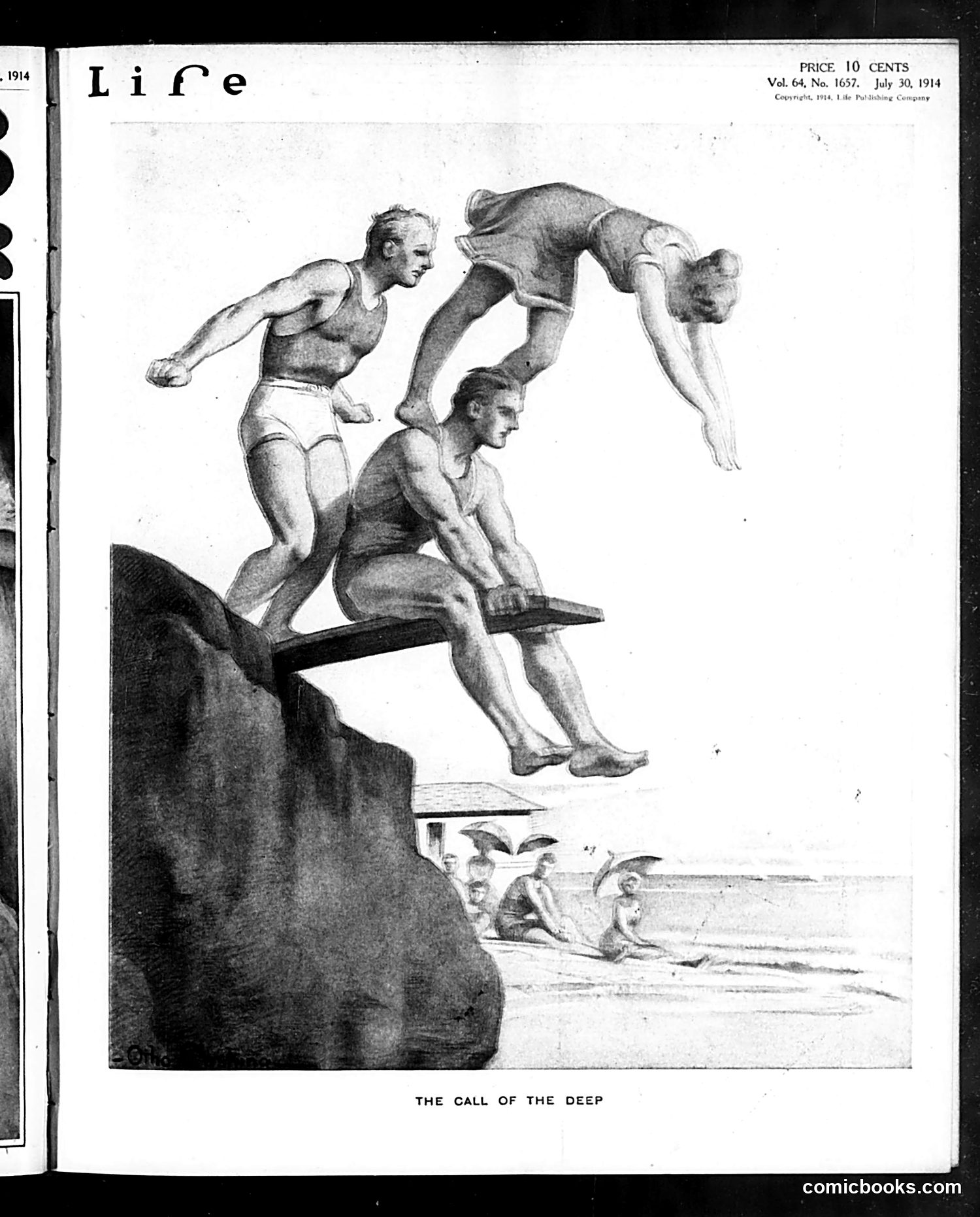
This satirical cartoon depicts diving figures leaping from a cliff into water below, titled "The Call of the Deep." Given the publication date of July 30, 1914—just weeks after Austria-Hungary's declaration of war against Serbia (July 28)—this appears to be dark political satire about nations being drawn into World War I. The figures plunging downward likely represent European powers succumbing to the "call" of military conflict, metaphorically diving into the destructive depths of war. The composition suggests a fatal attraction or lemming-like compulsion pulling nations into combat. This reflects contemporary American anxiety about the rapidly escalating European conflict that would eventually draw the U.S. into the war three years later.
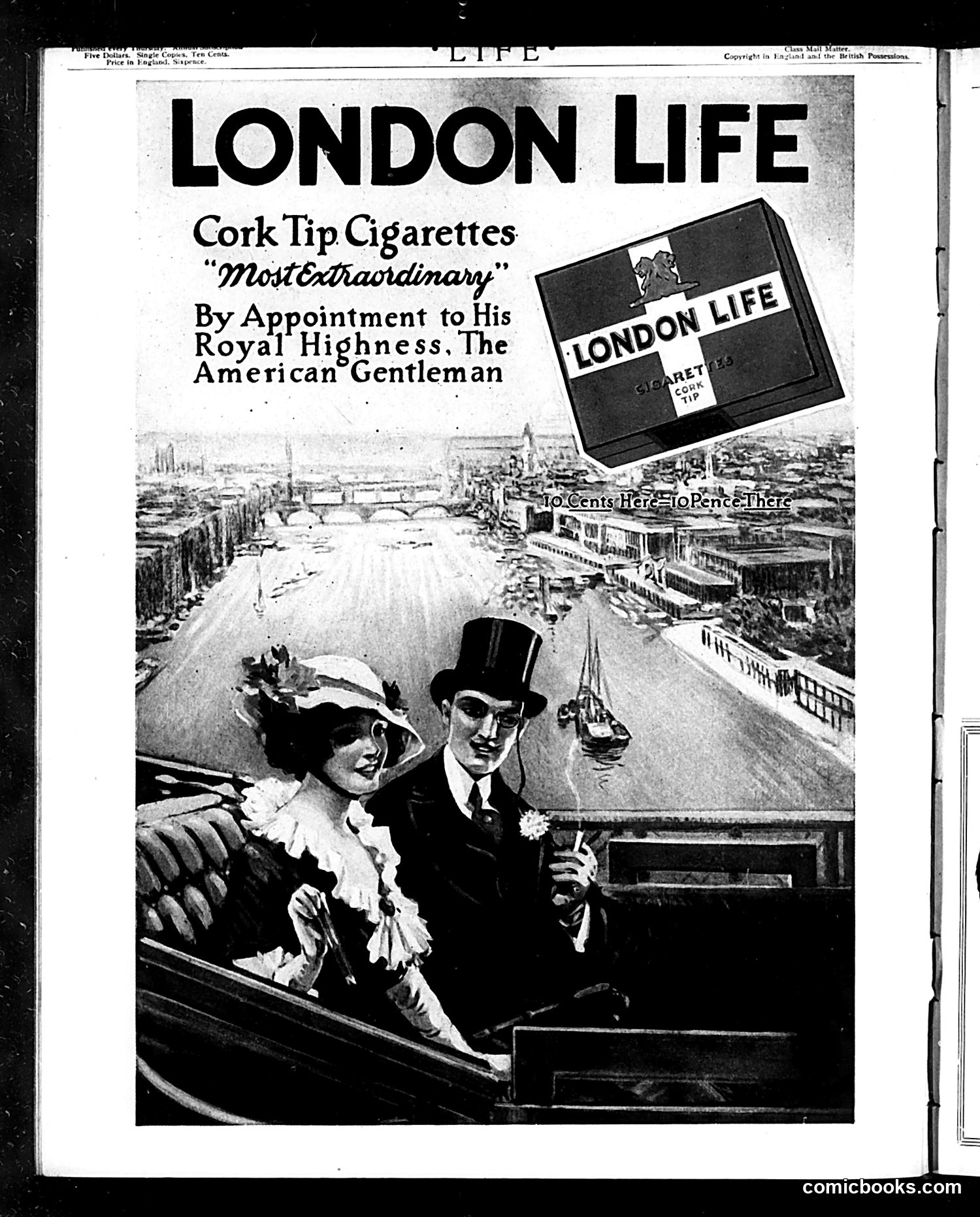
This is primarily an **advertisement**, not political satire. It promotes London Life cork-tip cigarettes with the tagline "Most Extraordinary" and claims the product holds "By Appointment to His Royal Highness. The American Gentleman." The image depicts an elegantly dressed couple in a motorboat on the Thames, with London landmarks visible behind them. The man wears a top hat and monocle; the woman wears fashionable period attire with a decorative hat. The advertisement plays on **aspirational marketing**: associating the cigarettes with British royalty, upper-class sophistication, and leisure activities. The price ("10 Cents Here—10 Pence There") suggests international distribution. The "American Gentleman" reference targets American consumers by implying the product carries prestigious British approval—a common early 20th-century advertising strategy appealing to American affluence and Anglophilia.
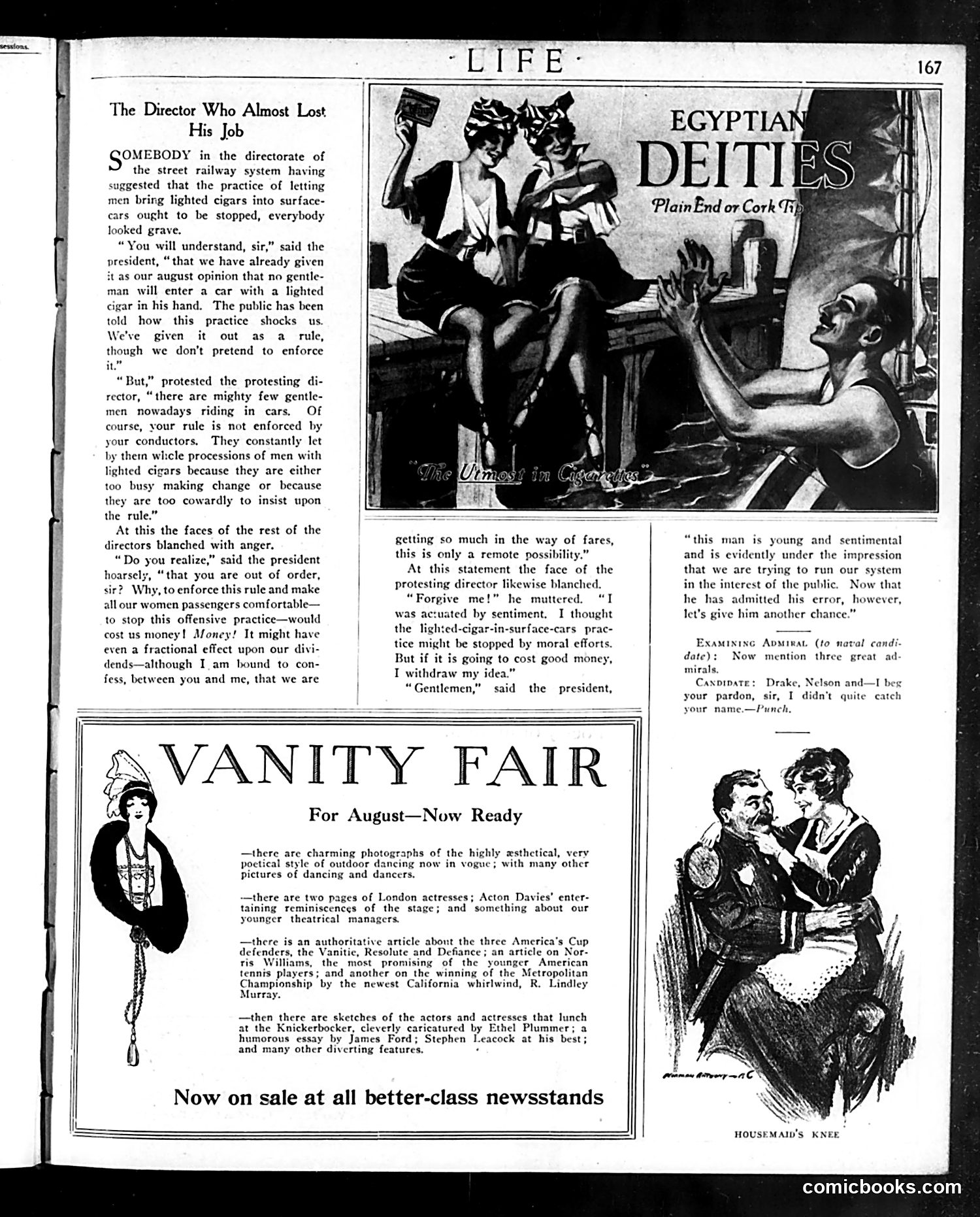
**Main Article: "The Director Who Almost Lost His Job"** This satirizes a street railway director who proposed allowing men with lit cigars on surface cars. After public outcry, the president defended the rule as unenforced but existing. A protesting director argues it's impractical—gentlemen don't ride cars much, and conductors won't enforce it anyway. The president ultimately withdraws the proposal, calling it sentiment-driven but agreeing to abandon it. The satire targets corporate management ineffectiveness: proposing rules that can't be enforced, then backing down to public pressure despite defending them as merely "advisory." **Right side** features Egyptian cigarette advertising and a sketch titled "Housemaid's Knee." **Bottom** is a Vanity Fair advertisement for its August issue, available at newsstands.
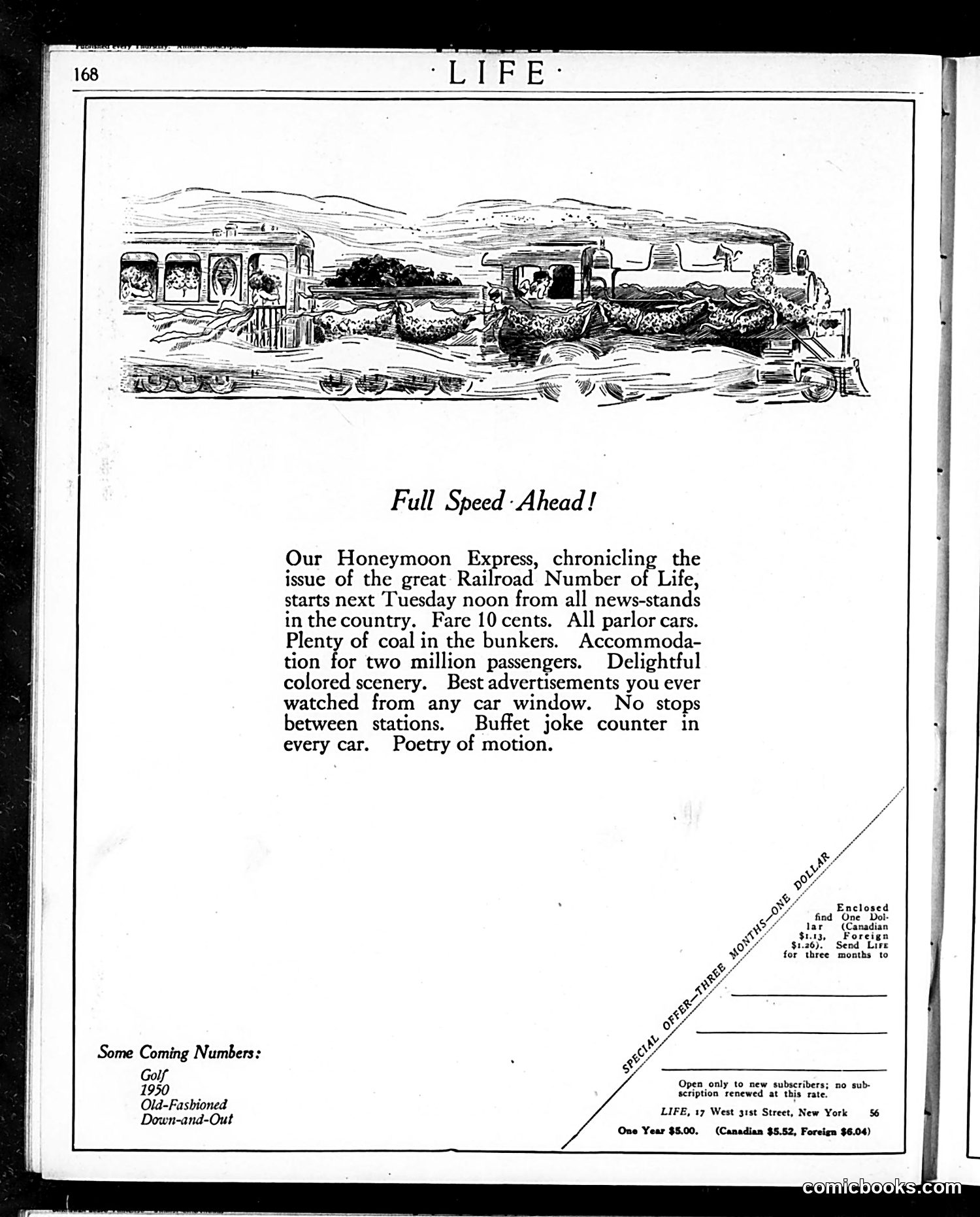
This page is primarily **advertising** rather than political satire. It promotes Life magazine's upcoming "Honeymoon Express" issue, described as "the great Railroad Number of Life." The illustration shows a streamlined passenger train in motion. The ad emphasizes luxurious travel amenities: parlor cars, coal-heated bunkers, capacity for two million passengers, scenic views, advertisements visible from windows, no station stops, and buffet service. The phrase "Poetry of motion" and "Full Speed Ahead!" celebrate modern railroad technology and speed—values central to 1920s American optimism about industrial progress. The coming attractions listed (Golf, 1920, Old-Fashioned, Down-and-Out) suggest varied editorial content. The subscription offer ($5 yearly) indicates this is a magazine promotion targeting new readers.
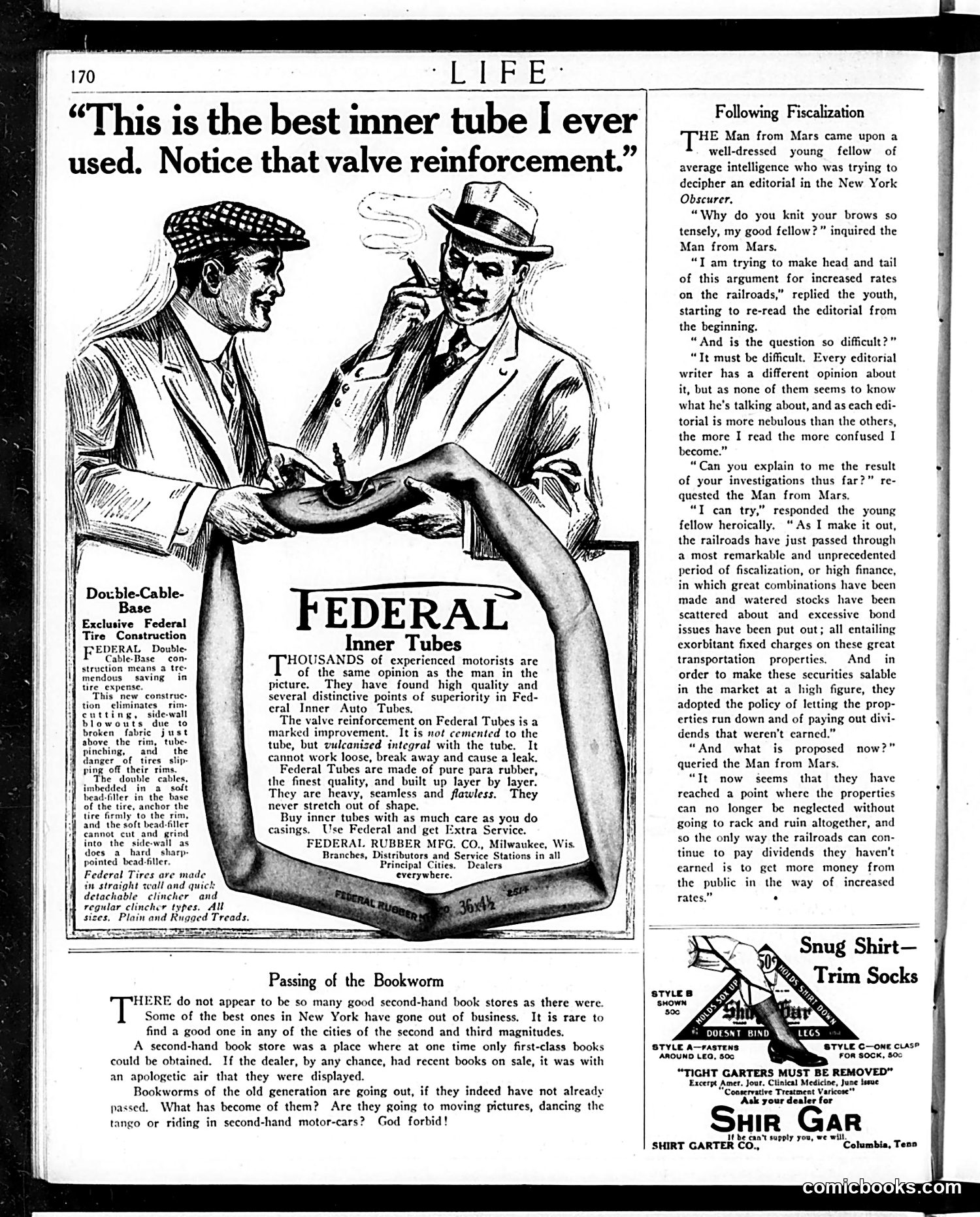
The main content features a Federal inner tube advertisement using a humorous sales pitch. Two men in early 20th-century dress examine an inner tube, with one praising its "valve reinforcement." The ad emphasizes Federal tubes' superior construction and durability compared to competitors. The right column contains "Following Fiscalization"—a satirical dialogue between a Man from Mars and a young New York Observer about railroad editorial disputes. The Mars visitor struggles to understand why different editorial writers contradict each other on railroad rate increases, highlighting the absurdity of conflicting expert opinions on complex economic policy. The "Passing of the Bookworm" section laments the disappearance of quality used bookstores, suggesting cultural decline. The page is primarily commercial advertising mixed with light satirical commentary on journalism and commerce.
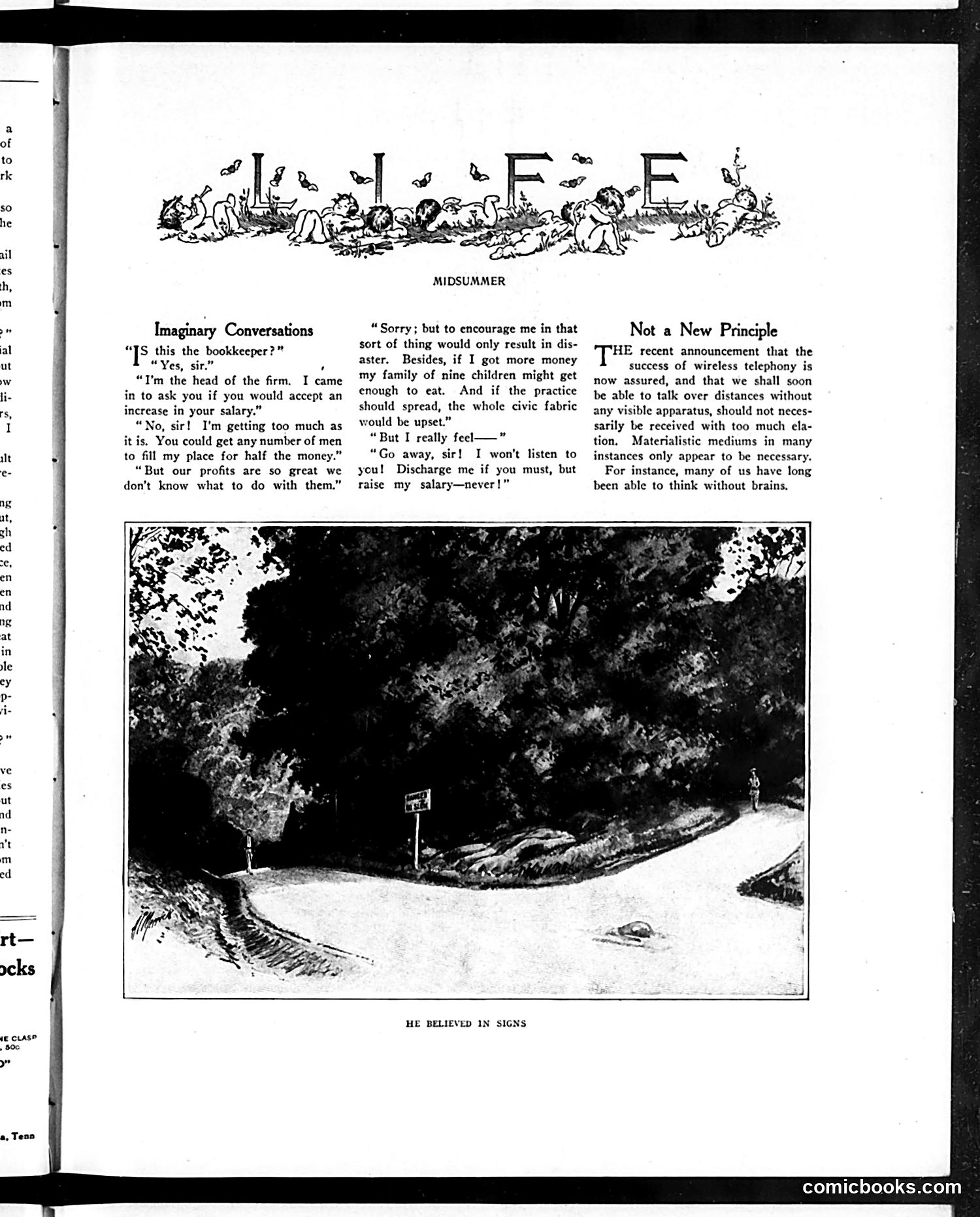
This page contains three separate pieces: 1. **"Imaginary Conversations"** - A humorous dialogue between a boss and bookkeeper about salary increases, playing on workplace dynamics and economic concerns of the era. 2. **"Not a New Principle"** - An editorial commentary skeptical of recent wireless telephony announcements, suggesting such "miraculous" technologies don't require mysticism—implying skepticism toward overhyped technological claims. 3. **"He Believed in Signs"** - A cartoon illustration showing a road with trees and a directional sign. The humor appears to reference someone taking road signs literally or relying too heavily on signage for navigation—likely satirizing gullibility or blind obedience to instructions without independent thought. The page represents typical turn-of-century American satirical humor targeting workplace absurdities, technological hype, and human folly.
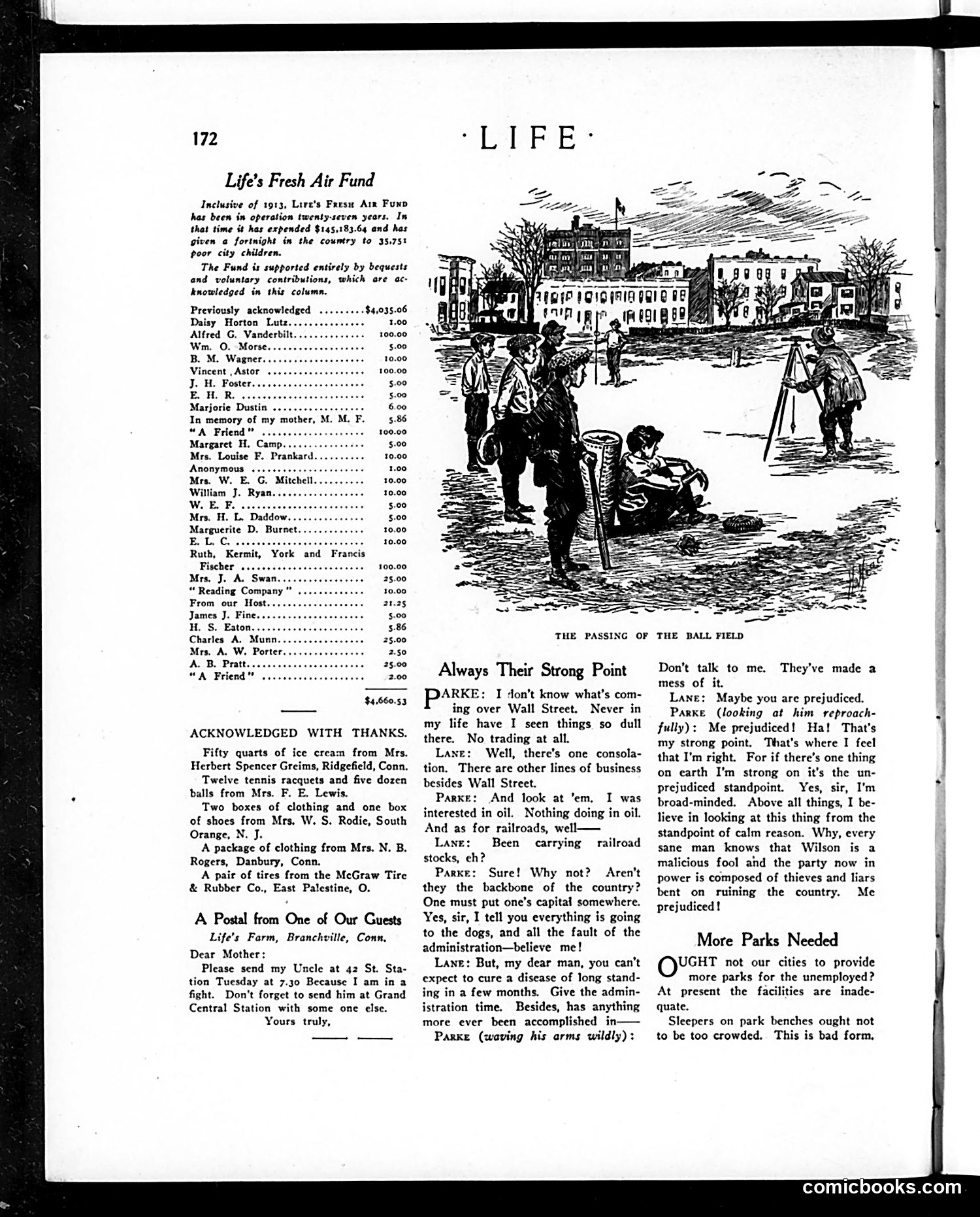
This page contains two distinct pieces: **Left side:** A fundraising appeal for Life's Fresh Air Fund (established 1913), which provides outdoor recreation for poor city children. It lists monetary contributions from readers. **Right side:** A satirical dialogue cartoon titled "Always Their Strong Point" between characters named Parker and Lake, debating Wall Street's role in American finance and railroad investment. Parker defends Wall Street as essential to capitalism, while Lake criticizes it as composed of "thieves and liars." Below this is an editorial piece titled "More Parks Needed," arguing cities should provide more recreational facilities for unemployed people, with complaints that park benches are overcrowded. The page reflects Depression-era concerns about poverty, unemployment, and whether capitalist institutions serve public welfare.
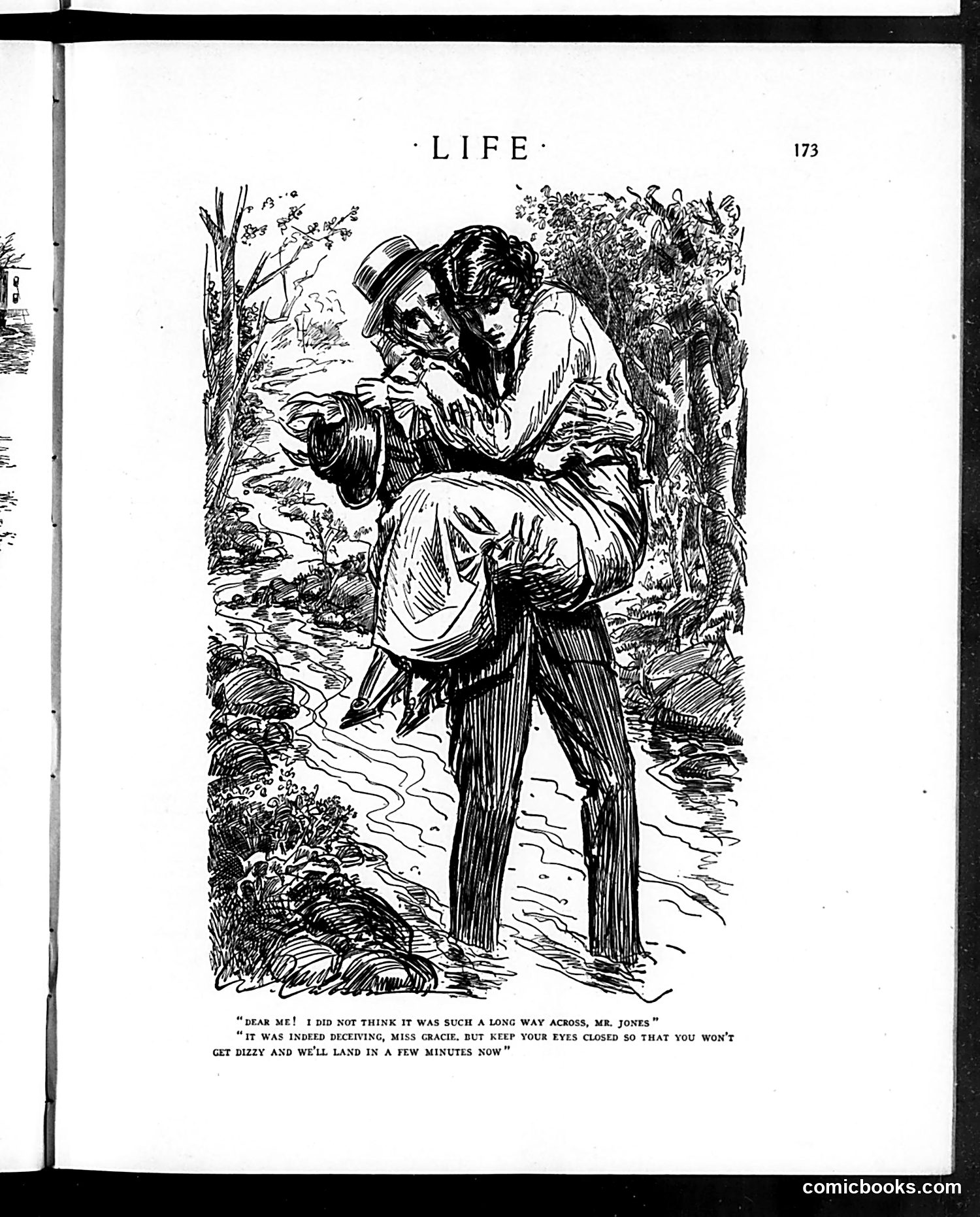
This page features a romantic illustration depicting a man carrying a woman across what appears to be a stream or water hazard in a natural setting. The dialogue reveals the scenario's humor: the man (Mr. Jones) has deceived his companion (Miss Gracie) about the distance across, telling her to keep her eyes closed to avoid dizziness during their crossing. The satire targets courtship dynamics and masculine deception—the man uses a practical excuse (preventing dizziness) as cover for what appears to be either showing off his strength or taking advantage of her trust. This reflects early 20th-century satirical commentary on gender relations, where men's tricks to impress or manipulate women were treated as comedic fodder for Life's sophisticated audience.
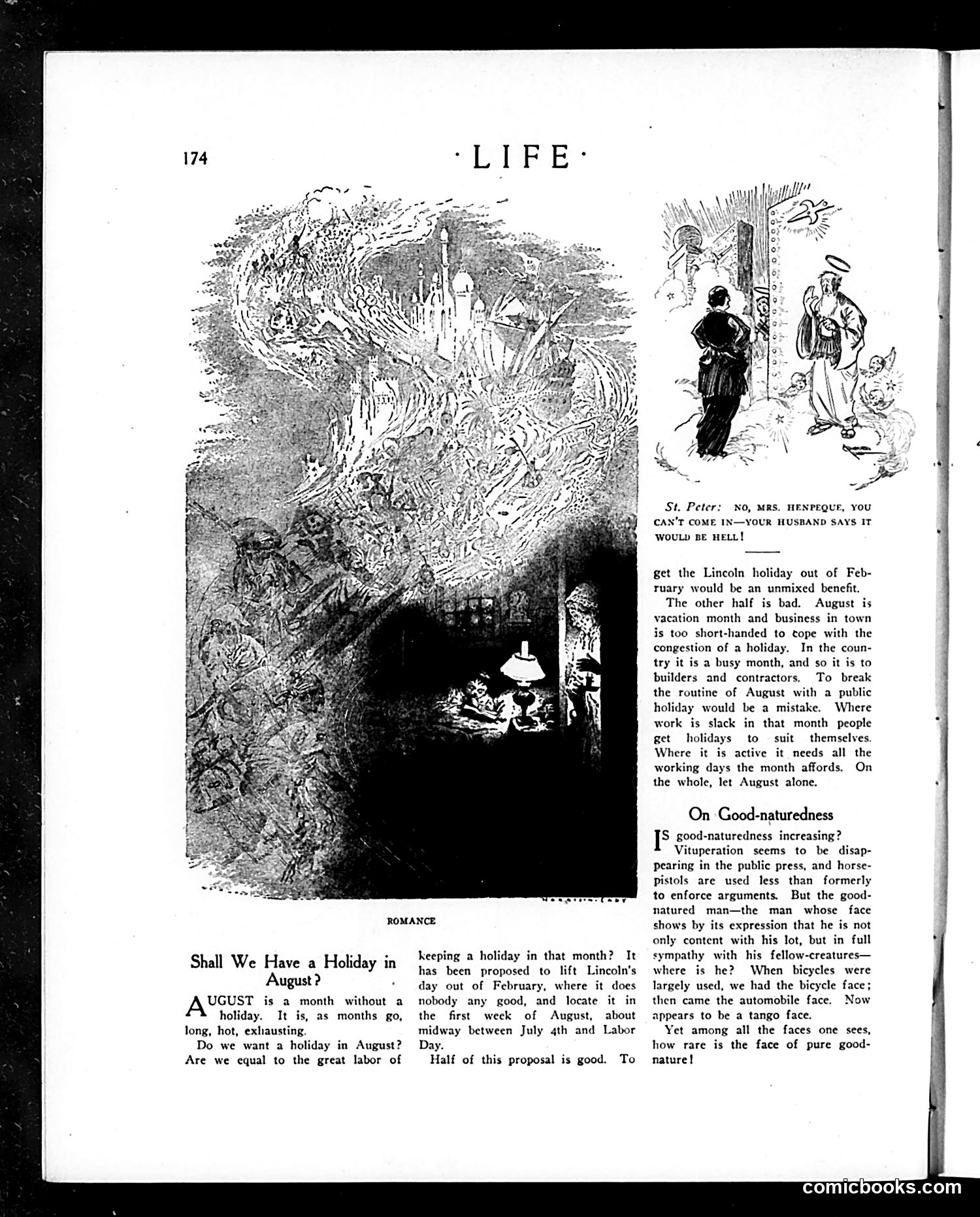
This page contains an article debating whether to establish a public holiday in August, comparable to Labor Day in July. The text proposes moving Lincoln's birthday from February to early August as a compromise solution. The accompanying cartoon (labeled "Romance") shows a domestic scene where a woman at a doorway tells a man: "No, Mrs. Henfoque, you can't come in—your husband says it would be hell!" The joke satirizes married life—suggesting husbands want to avoid their wives, making a holiday (presumably for family time together) unappealing. The cartoon humorously undermines the article's earnest vacation proposal by implying domestic discord makes extended time together undesirable.
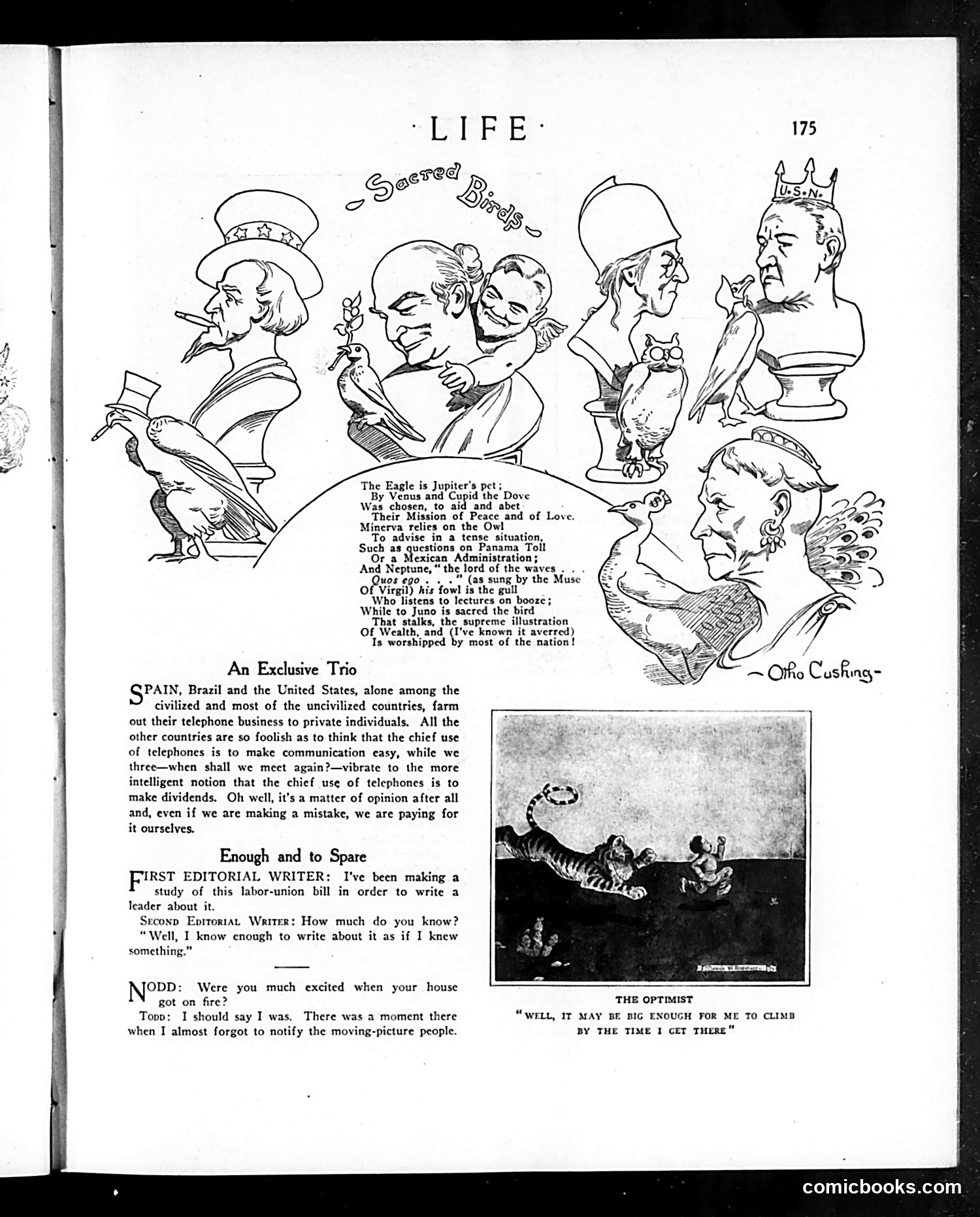
The top cartoon by Otho Cushing satirizes world leaders' advisory roles, depicting caricatured figures (appearing to represent various national leaders) as animals or animal-headed advisors to Jupiter. The accompanying poem suggests these advisors—including references to "the Eagle," "Neptune," and "Vulture"—represent different nations offering counsel on international matters like the Panama Toll question. Below, a section titled "An Exclusive Trio" jokes that Spain, Brazil, and the United States uniquely permit private telephone use by their leaders—criticizing other nations' chief executives for only using phones for official communication. A separate joke exchange mocks a newspaper writer's superficial knowledge, while "The Optimist" cartoon shows a tiger with prey, captioned with dark humor about timing and effort.
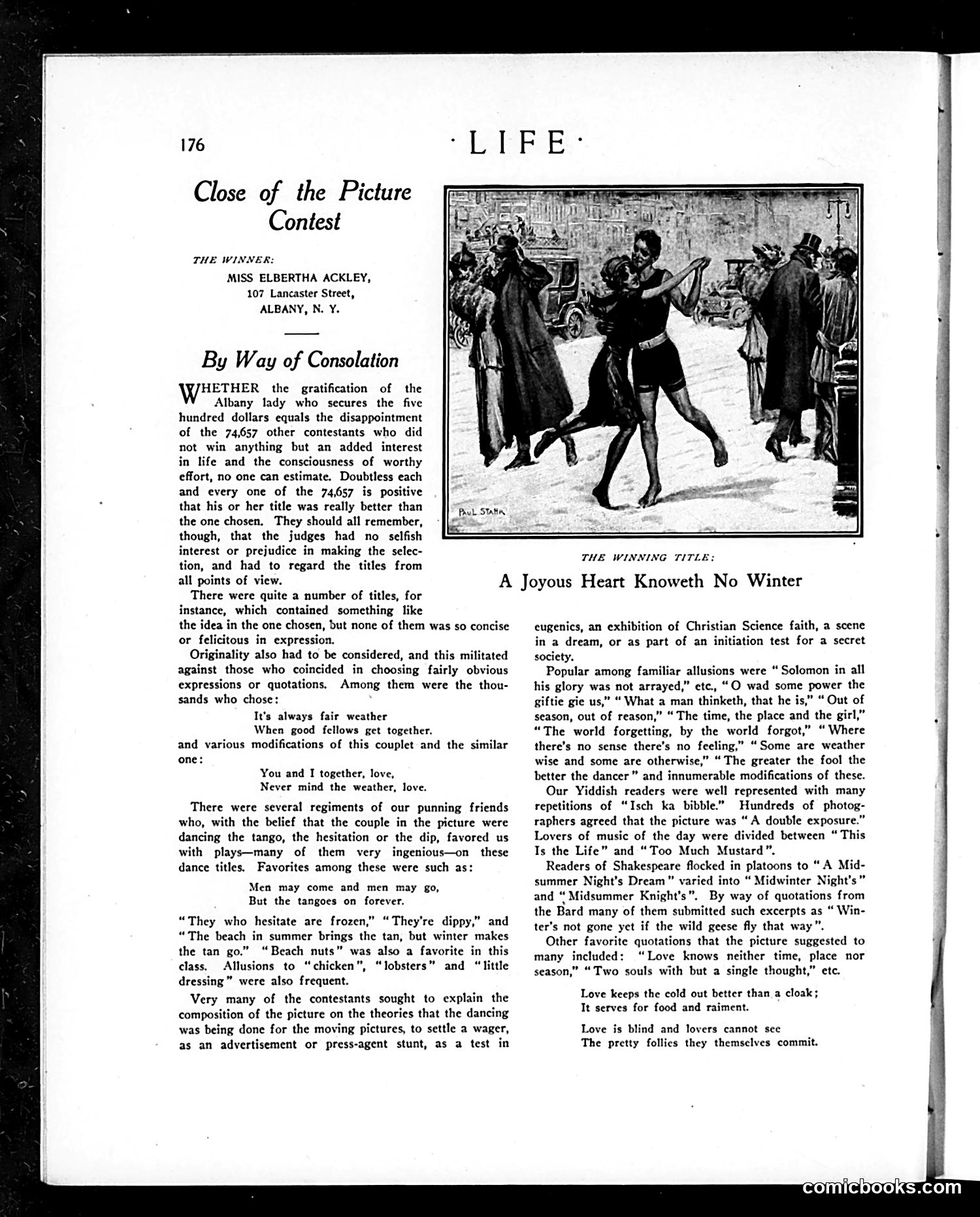
This page documents the winner of Life magazine's "Picture Contest." The winning image, titled "A Joyous Heart Knoweth No Winter," depicts a couple dancing in a snowy street while onlookers watch. The text explains that among 74,657 contest entries, judges selected this title for its conciseness and felicitous expression. The judges, notably, are praised for having "no selfish interest" in their selection process. The page then catalogs alternative titles contestants submitted, many drawing on literary and cultural allusions—Shakespeare references, proverbs, and common expressions about love and weather. This demonstrates how 1910s-era readers engaged with sentimental imagery through familiar quotations and aphorisms, using shared cultural knowledge to interpret domestic scenes of romance and joy.
This page from *Life* magazine (page 177) consists primarily of **text content, not cartoons**. It contains humorous poetry and social commentary about dancing and winter activities, with literary quotations sprinkled throughout. The main satirical point targets the **dancing craze of the 1920s**, mocking how obsessed society has become with dancing at all hours—"dinner and breakfast and tea"—and in inappropriate conditions like winter. The text humorously suggests this dancing mania rivals serious ailments ("Like death, it claims all seasons"). References include Shakespeare and other literary figures used ironically to comment on modern frivolity. The page concludes with a certificate from "Certified Public Accountants" regarding a *Life* picture-title contest, lending mock-official authority to the magazine's earlier satirical observations. The humor relies on **exaggeration and juxtaposition** of high literary culture against lowbrow popular obsessions.
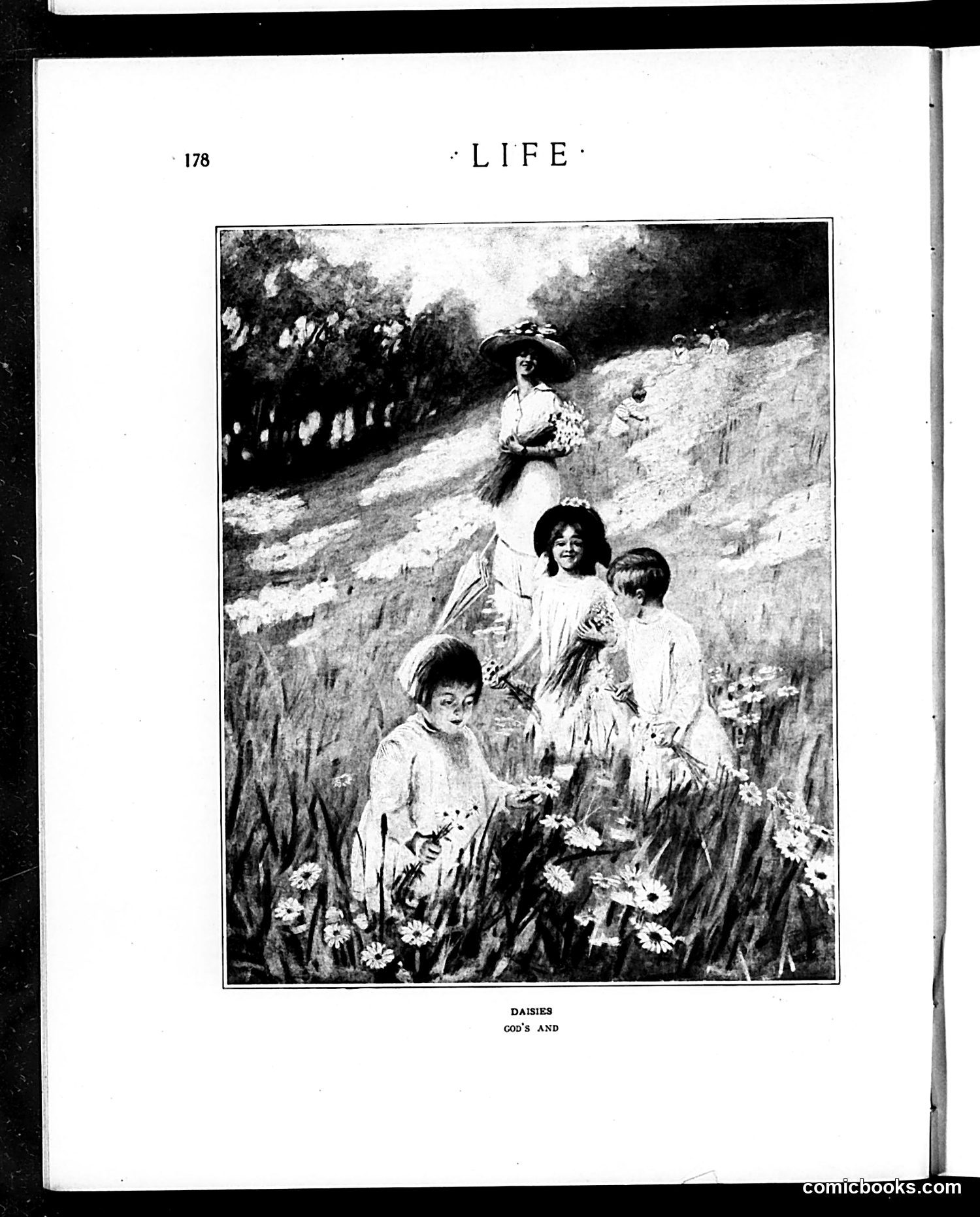
This page from *Life* magazine (page 178) features an illustration titled "Daisies—God's and" (the title appears incomplete). The image shows women and children in a pastoral field of daisies, with figures in white dresses arranged on a hillside among wildflowers and trees. The illustration appears to be a romantic or sentimental artistic piece rather than political satire. Without the complete caption or surrounding context, the exact satirical point remains unclear. The phrase "God's and" suggests a comparison between natural daisies and something man-made, possibly referencing a commercial product or artificial goods—a common *Life* magazine theme mocking consumer culture or industrial society versus nature's beauty. The pastoral, idealized scene likely contrasts with the incomplete caption's implicit critique.
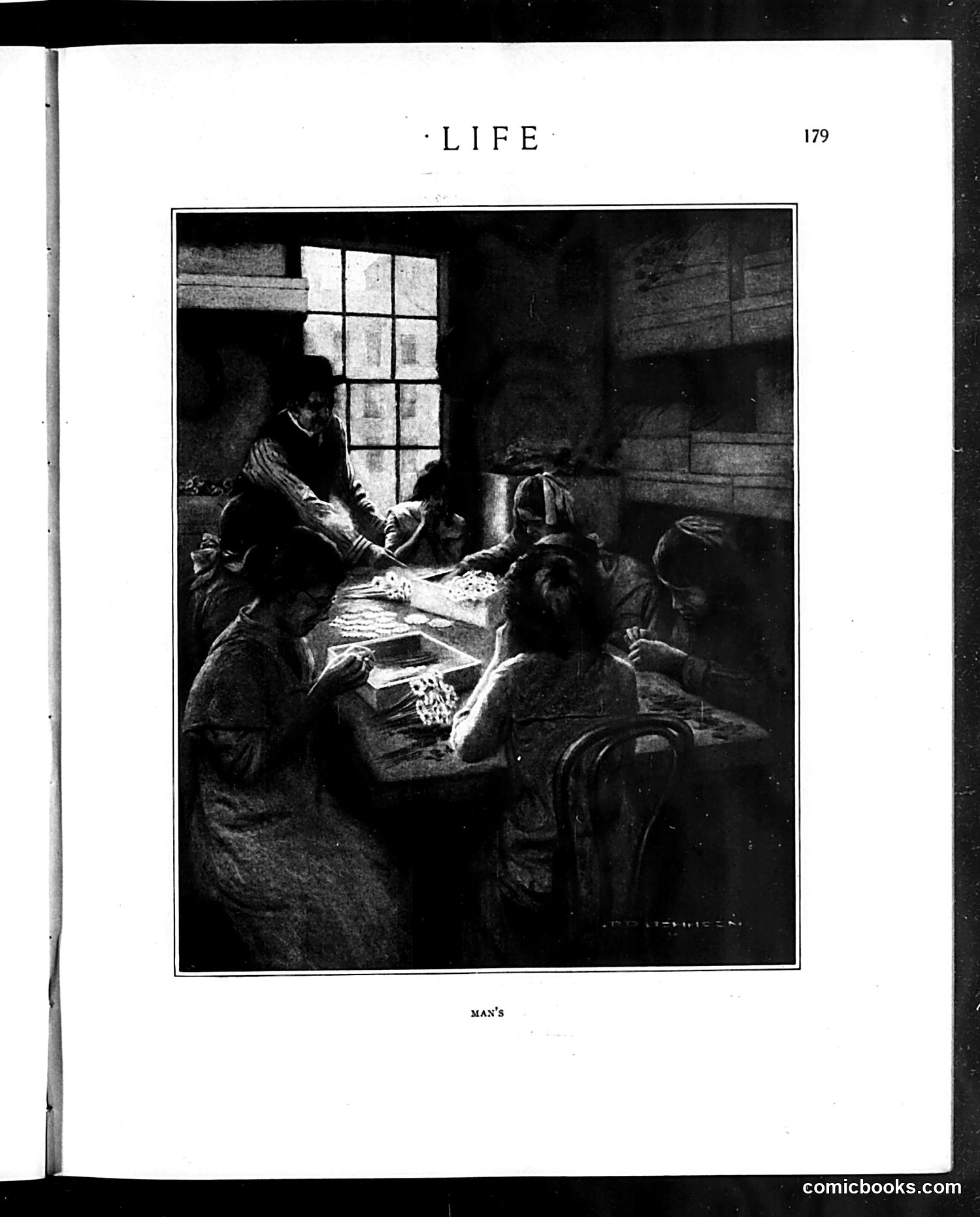
This page from Life magazine features a dark, dramatic illustration titled "MAN'S" depicting what appears to be a domestic or working-class interior scene. Multiple figures are gathered around a table in shadowy conditions, with a barred window providing the only light source. The image conveys hardship and confinement—the barred window suggests either poverty, imprisonment, or institutional conditions. The figures' hunched postures and the sparse setting emphasize struggle or desperation. Without additional context or clearer OCR text, the specific satirical target remains unclear. The illustration likely critiques social conditions, labor practices, or living standards of the era, but the exact political point or which historical moment it references cannot be determined from this page alone.
This page celebrates Mexican General Victoriano Huerta's recent resignation from power. The main text praises Huerta for his dignified departure, noting that both he and President Wilson gained public respect through their "opposite positions" on whether he should leave office. The satirical point targets Secretary of the Navy Josephus Daniels, who advocated cutting off alcohol to reform moral habits. Life mocks this theory by noting that Huerta—despite allegedly consuming "several gallons of hard liquor a day"—maintained composure and effectiveness, thus disproving the idea that habits determine character. The piece also discusses Mexico's political instability, expressing cautious optimism about the Constitutionalists' prospects while identifying Pancho Villa as the real force behind any potential stable government. Wilson's "watchful waiting" policy toward Mexico is discussed with measured skepticism.
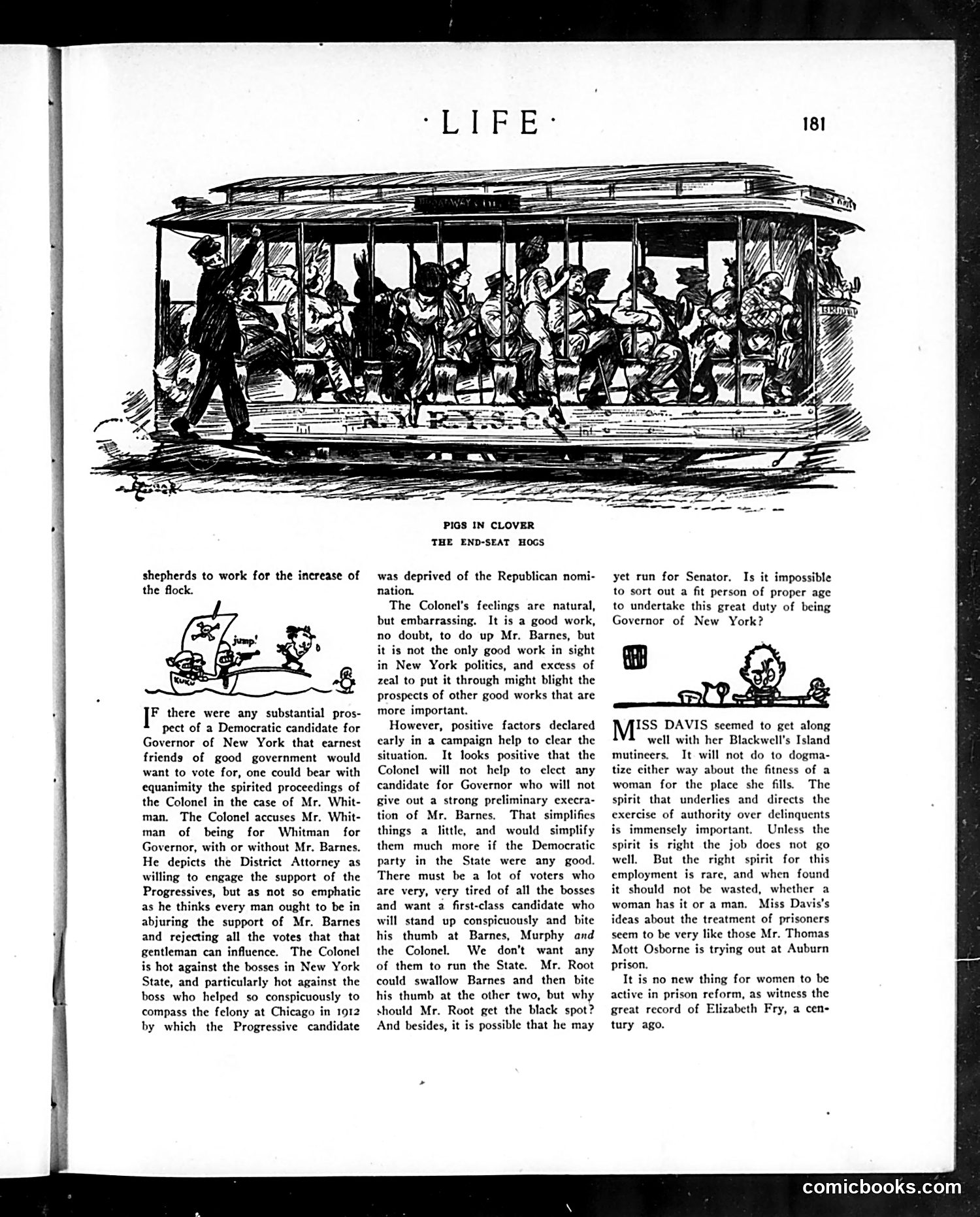
The main cartoon, titled "Pigs in Clover: The End-Seat Hogs," depicts a crowded streetcar—a visual metaphor for New York politics overcrowded with self-interested politicians jostling for position. The accompanying text discusses Colonel Theodore Roosevelt's conflict with New York political bosses, particularly William Barnes, over the gubernatorial race. The writer criticizes Roosevelt's obsessive focus on attacking Barnes, arguing this zeal may undermine other important political goals. The satire suggests all these politicians—Roosevelt, Barnes, and others—are essentially "hogs" fighting for seats of power rather than serving the public interest. The page also briefly covers Miss Davis's work at Blackwell's Island prison, comparing her reformist approach favorably to Thomas Mott Osborne's prison reform efforts at Auburn, suggesting women have historically contributed meaningfully to progressive causes like prison reform.
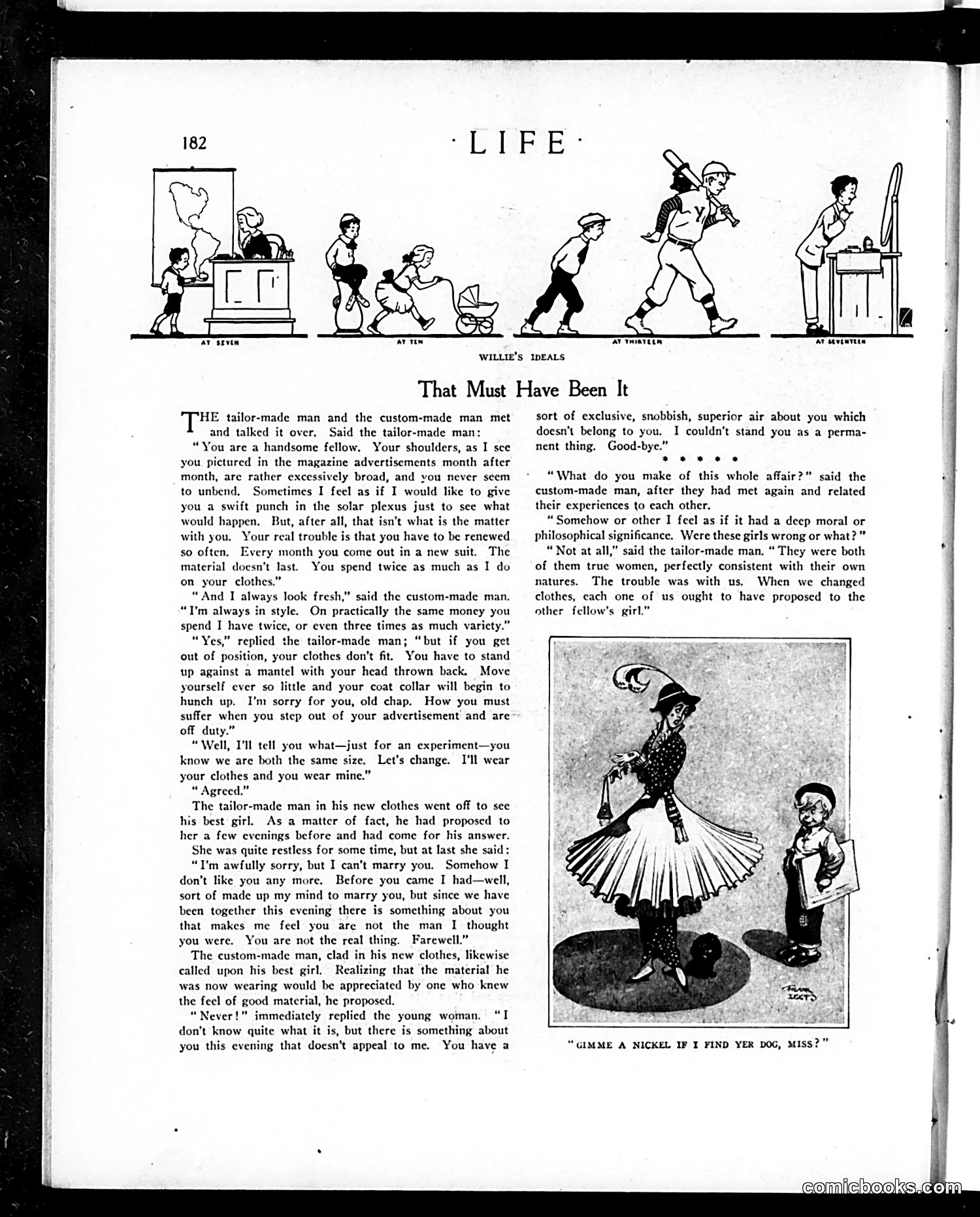
This page contains a satirical story titled "That Must Have Been It," part of a series called "Willie's Ideals." The narrative contrasts two male archetypes: the "tailor-made man" (representing ready-made, mass-produced conformity) and the "custom-made man" (representing individualized luxury). The story's joke: when these men swap clothes, each becomes unattractive to women—not because of physical appearance, but because their clothing fundamentally changes how they present themselves. The tailor-made man in expensive custom clothes loses his authenticity, while the custom-made man in ordinary clothes loses his sophisticated air. The moral punchline suggests women are attracted to men whose *genuine nature* matches their *appearance*—that authenticity matters more than material status. It's social satire about early 20th-century class consciousness, advertising culture, and masculine identity, suggesting that both mass-market conformity and snobbish pretension are equally unappealing when inauthentic.
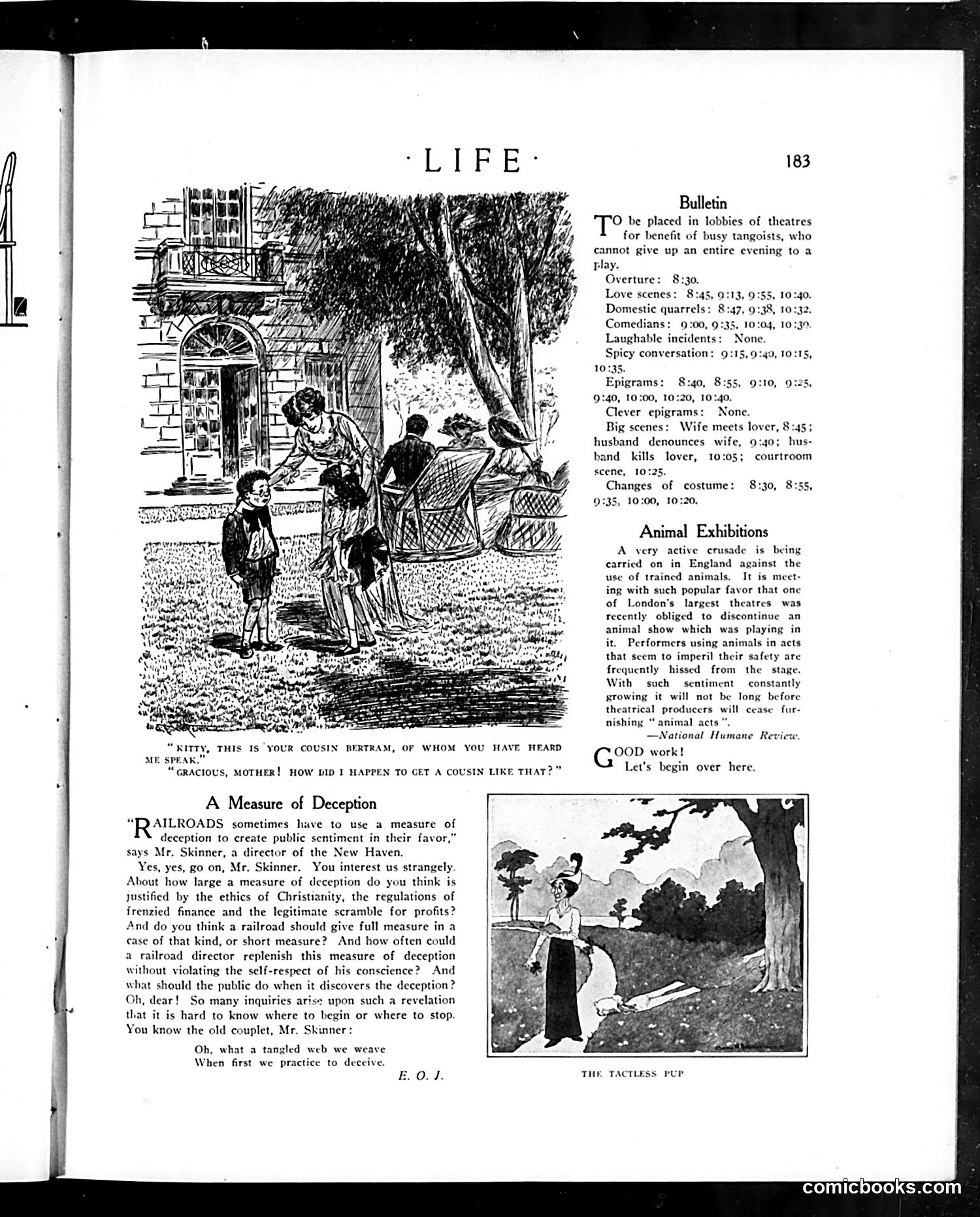
This *Life* magazine page (page 183) contains three satirical pieces: **"Bulletin"** mocks theatergoers obsessed with the "tango" (a trendy dance craze of the era) by creating a playbill listing only the brief dramatic moments worth watching—suggesting tango enthusiasts care only about excitement, not art. **"Animal Exhibitions"** reports on England's anti-animal-cruelty campaign gaining momentum, predicting theatrical producers will abandon animal acts due to public pressure and humane sentiment. **"A Measure of Deception"** attacks railroad executive Mr. Skinner (New Haven Railroad) who publicly admitted railroads use deception to manipulate public opinion. The satirist sardonically questions whether deception is ethically justified by "Christianity" and "frenzied finance" (reckless capitalism), then quotes the old moral adage about tangled webs from practicing deception—scorching corporate dishonesty.
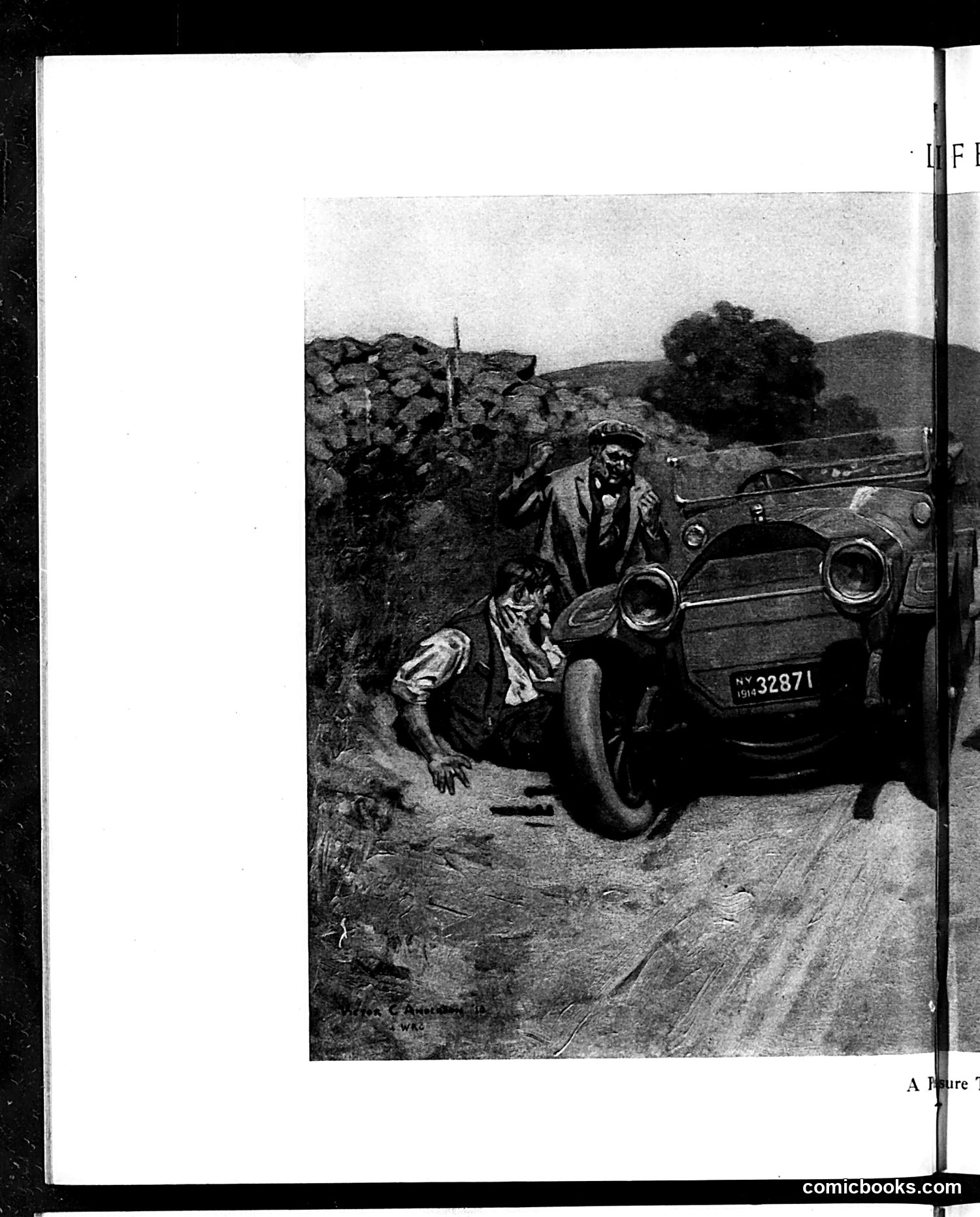
This black and white photograph shows two figures beside an early automobile (bearing a 1914 New York license plate) on a rural road. The image appears to be documentary rather than satirical carving. One figure reclines against the car's wheel in an exaggerated pose of exhaustion or distress, while another stands nearby. The rocky, hilly landscape suggests difficult terrain. Without clearer OCR text or identifying captions, the specific satirical point remains unclear—it may reference automobile travel hardships, labor conditions, or road conditions of the era, but I cannot definitively identify the figures or their intended meaning from the visual information alone.
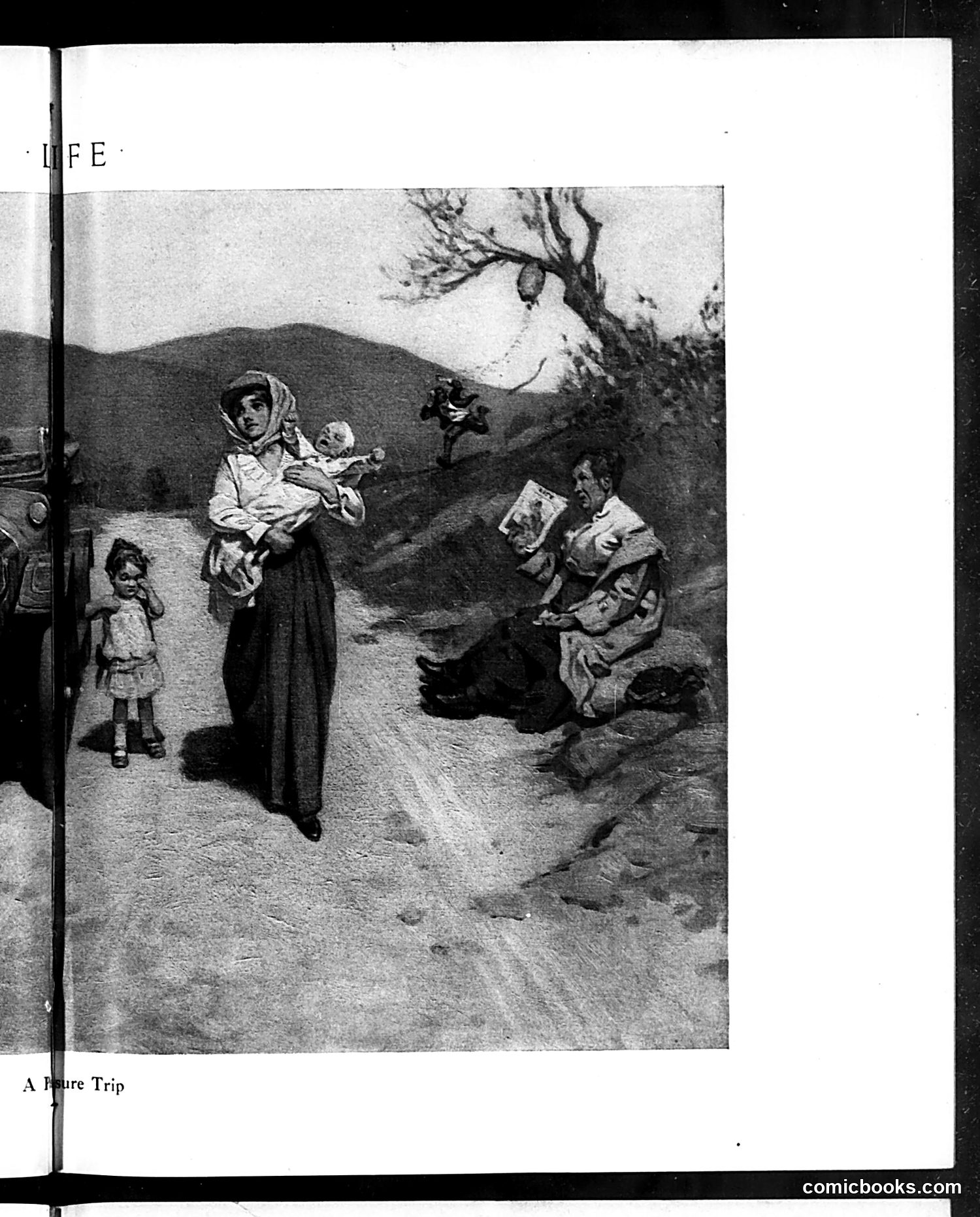
This satirical illustration depicts a family outing in what appears to be a rural or mountainous landscape. The image shows several figures—a woman with a headscarf holding a child, a small child, and a seated figure holding what appears to be reading material—positioned near gnarled tree branches and hills in the background. The caption "A Pleasure Trip" suggests irony: the scene portrays ordinary people in modest circumstances on an excursion, likely commenting on working-class or immigrant leisure activities. The sparse, somewhat barren landscape and the figures' clothing suggest economic hardship or cultural displacement. Without clearer OCR text or additional context, the specific satirical target remains unclear, though it appears to mock contemporary social conditions or attitudes toward lower-class recreation during the early 20th century.
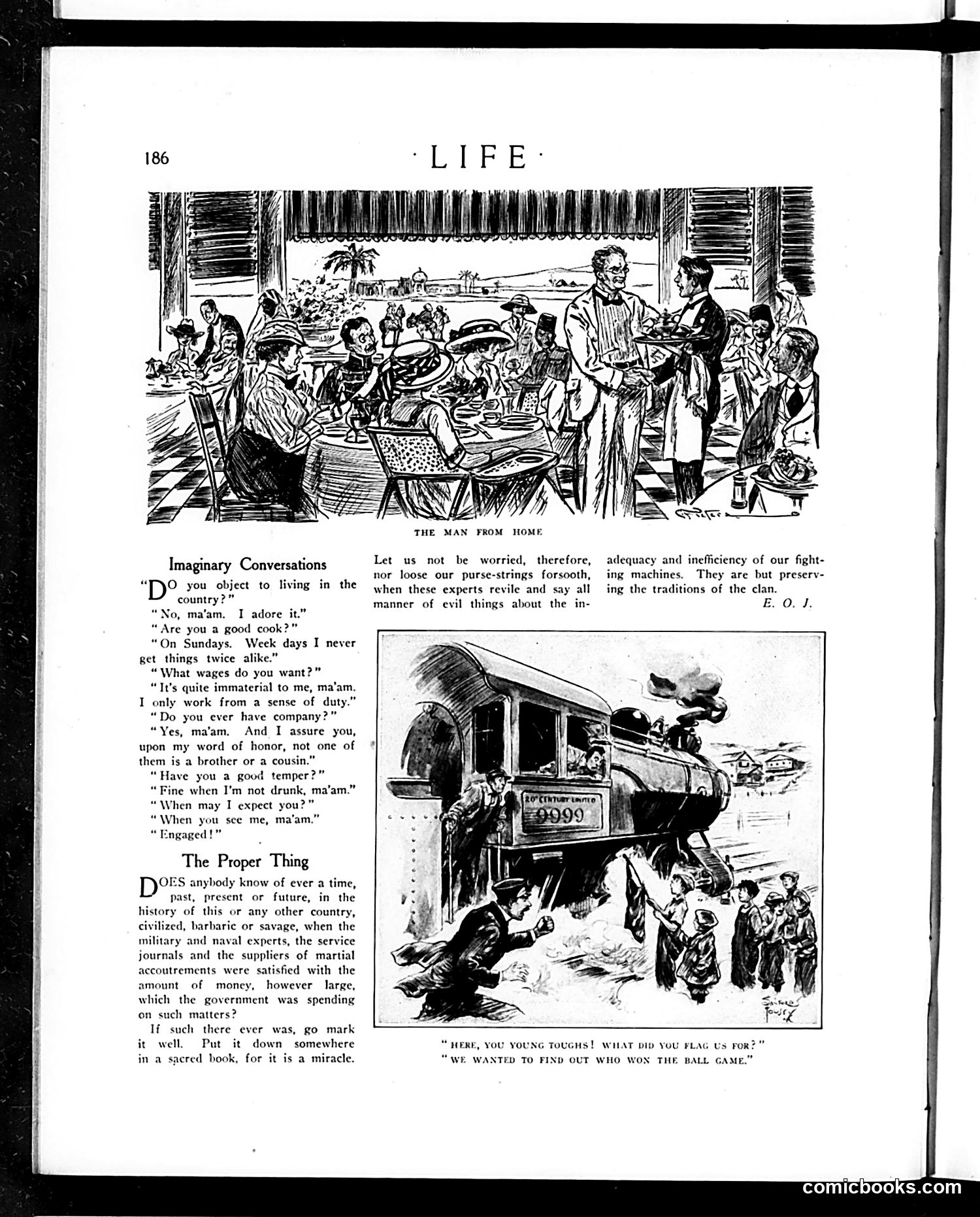
**"Imaginary Conversations"** satirizes domestic servant hiring. The dialogue presents an absurdly evasive job applicant who gives contradictory or troubling answers—claiming to adore country living while being an unreliable cook, working only from "duty," admitting to drinking, and refusing to specify arrival times. The humor lies in the employer's desperation, culminating in "Engaged!"—suggesting even this disaster of a hire gets the job. **"The Proper Thing"** criticizes military-industrial complaints. The piece mocks military experts and defense suppliers who perpetually claim insufficient government funding, regardless of actual spending. The author (E.O.J.) suggests this chronic dissatisfaction is merely tradition, urging readers not to worry about their complaints. **The cartoon** shows a massive military truck stopped by children asking what game won the ball game—a contrast between massive defense machinery and innocent civilian curiosity, likely critiquing militarization's prominence in society.
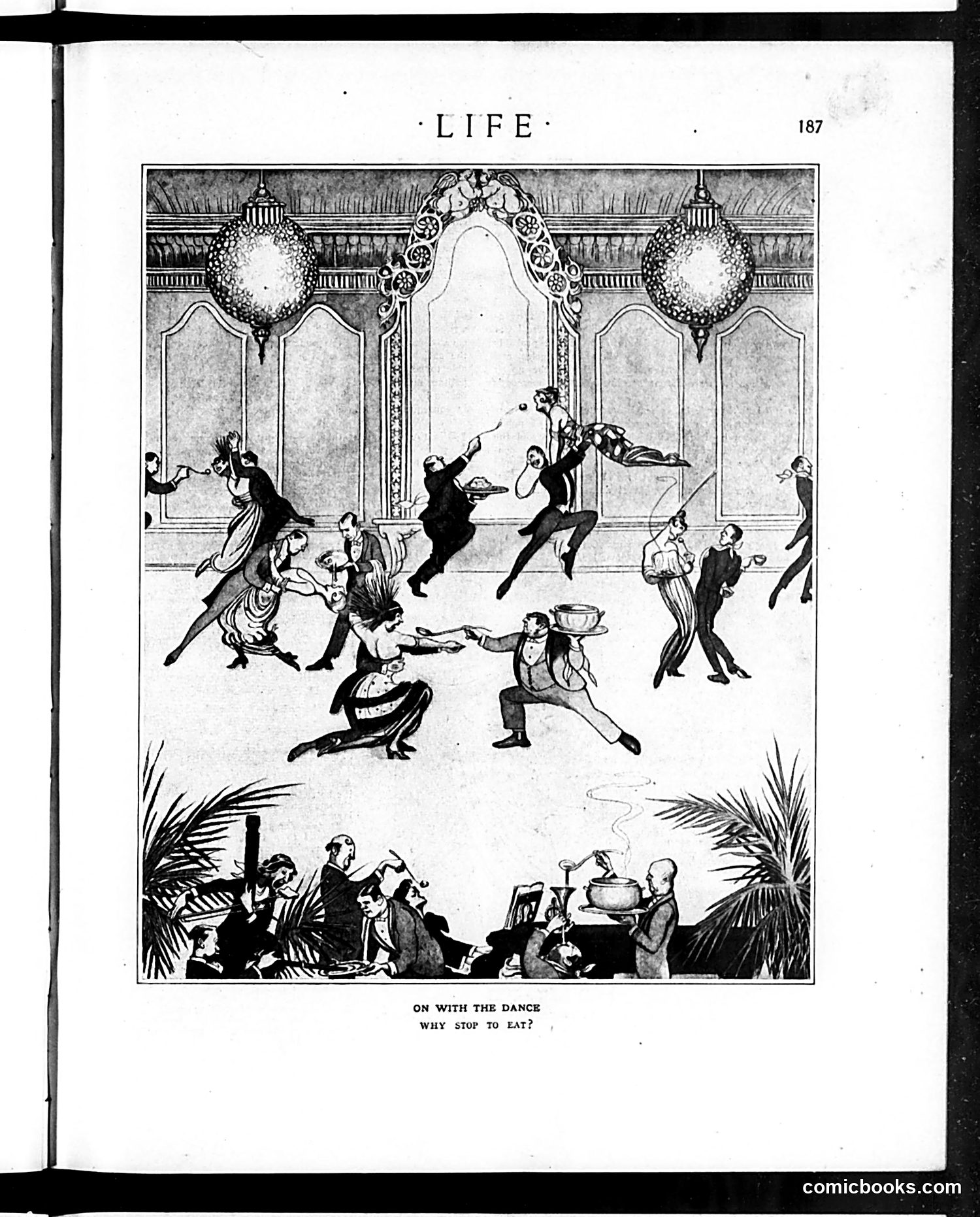
This satirical illustration depicts a lavish party in full swing, with elegantly dressed guests dancing energetically in a grand ballroom decorated with ornate columns and hanging sphere lights. In the foreground, a band or orchestra performs while seated guests enjoy food and refreshments. The caption's rhetorical question—"Why stop to eat?"—appears to mock the priorities of the wealthy elite during what was likely an era of economic disparity or hardship (the image's style suggests early-to-mid 20th century). The satire suggests that the privileged classes were so absorbed in frivolous entertainment and pleasure that basic needs like eating seemed like unwelcome interruptions. This critiques excessive indulgence and disconnection from reality among the upper classes.
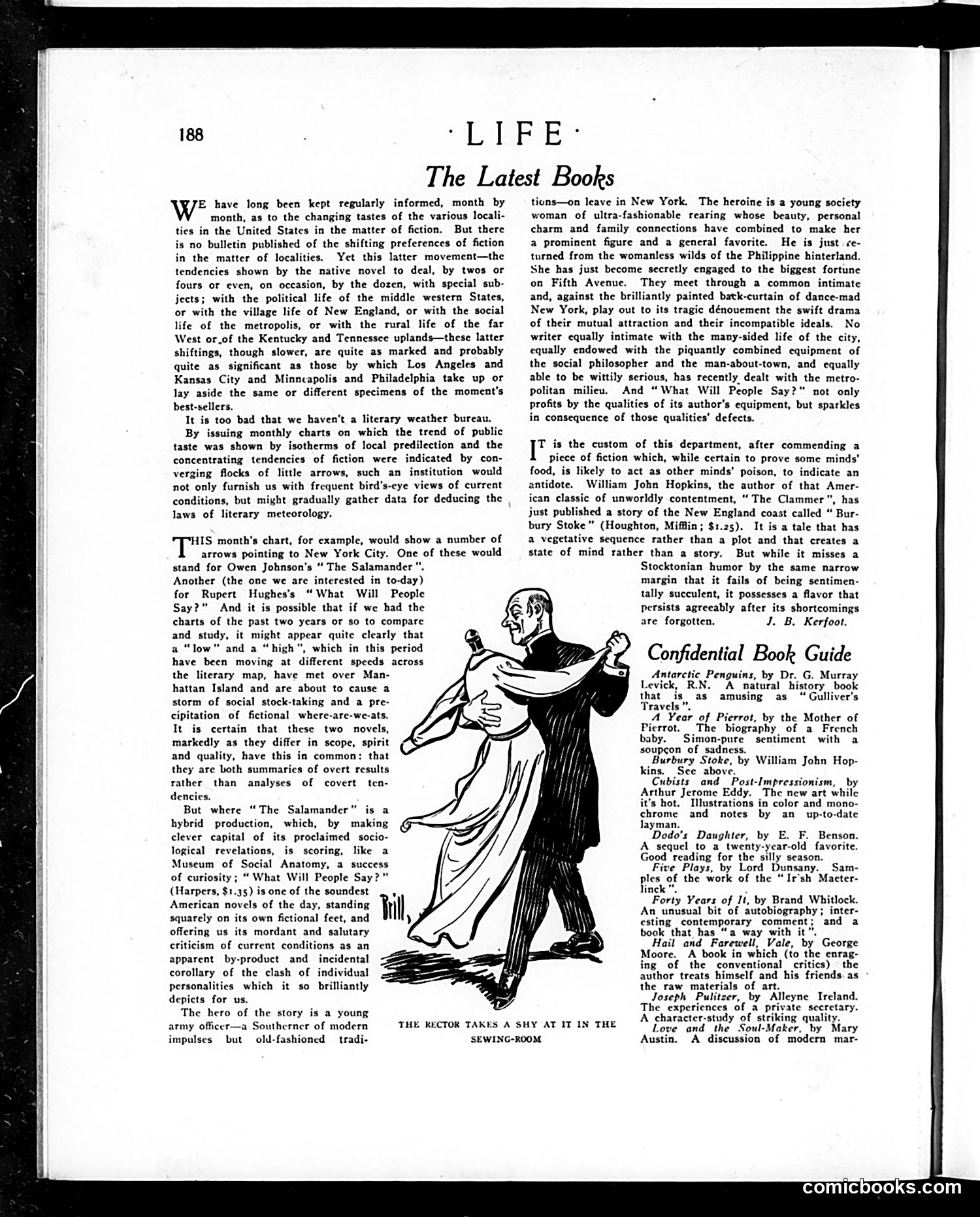
This page from *Life* magazine reviews contemporary fiction, particularly Rupert Hughes's novel *"What Will People Say?"* The central cartoon depicts a clergyman (identifiable by his collar) being playfully swung by a woman in a sewing room—illustrating the book's theme of social scandal and impropriety in high society. The satire targets early-20th-century New York society's obsession with appearances and propriety. Hughes's novel examines "overt results rather than analyses of covert tendencies"—meaning it explores what society *does* versus what it *thinks*. The story itself involves a young army officer and a society woman engaged to a wealthy man, whose mutual attraction creates scandal. The broader point: *Life* uses literary criticism to mock the rigid social conventions and moral hypocrisies of the wealthy Manhattan elite, who carefully guard reputations while engaging in morally questionable behavior. The playful cartoon emphasizes how shocking such behavior appears to respectable society.
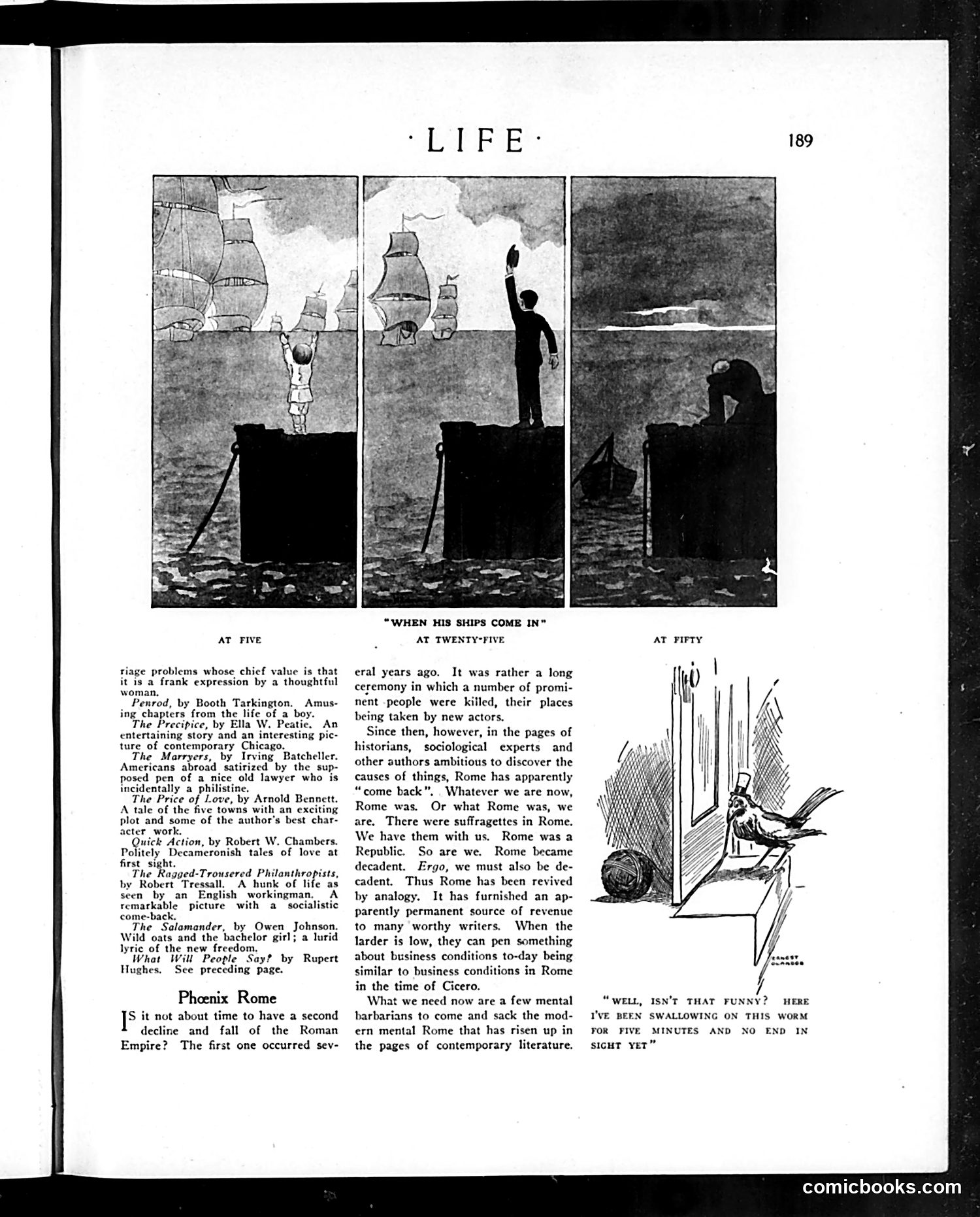
This three-panel cartoon uses maritime imagery to satirize human ambition and the passage of time. Each panel shows a figure gazing hopefully at ships on the horizon—labeled "At Five," "At Twenty-Five," and "At Fifty"—suggesting the common expression "waiting for one's ships to come in" (anticipating future wealth or success). The progression darkens with age: the young child waves enthusiastically; the young adult stands expectantly; the older figure appears hunched and weary. The joke critiques how people perpetually postpone gratification, always waiting for future success rather than living in the present. It's a commentary on American materialism and deferred dreams. The accompanying text's "Phoenix Rome" essay reinforces similar themes about cyclical decline, suggesting modern society—like Rome—may be destined for repetitive patterns of hope and disappointment.
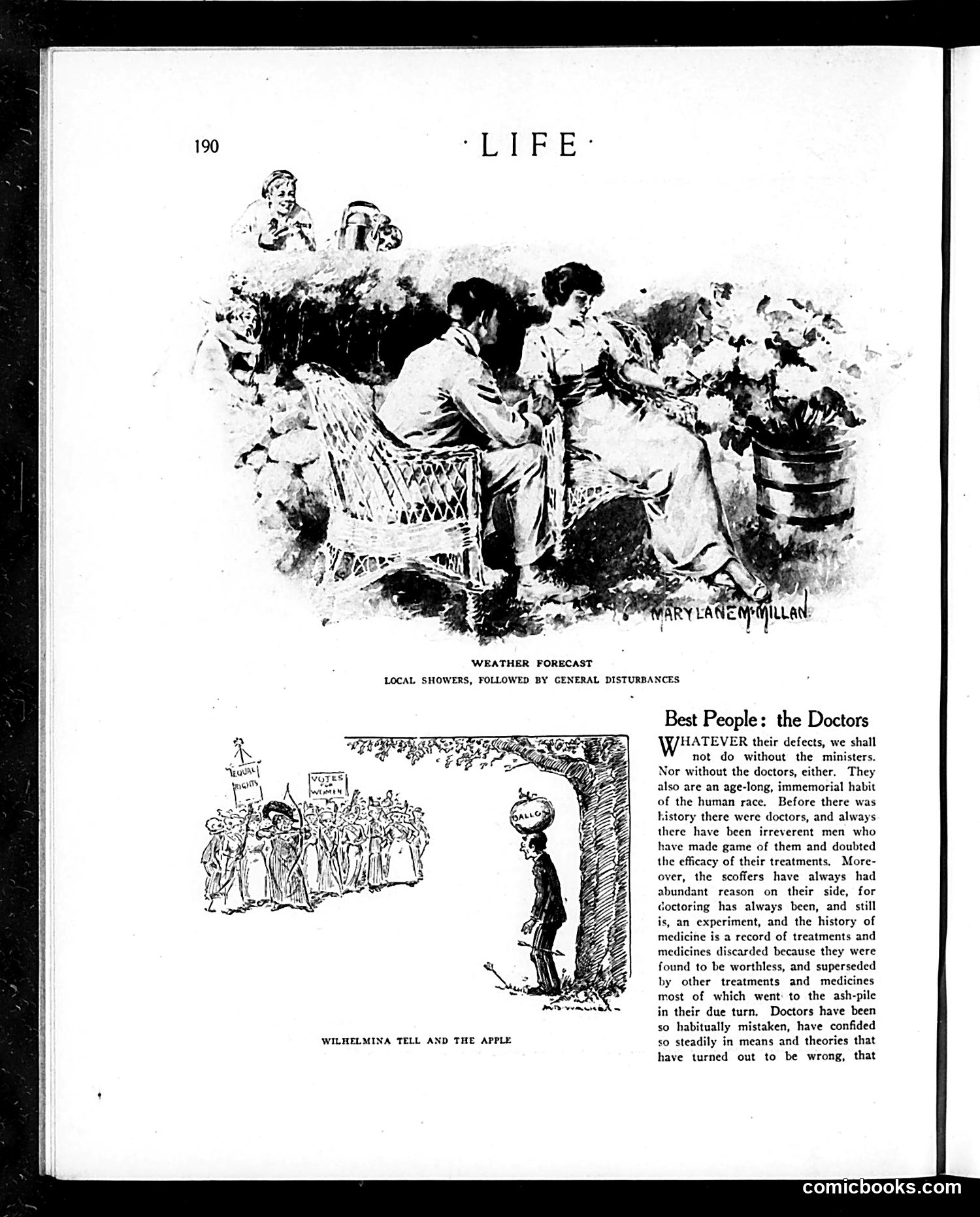
This page satirizes the medical profession through both cartoon and essay. The top illustration by Mary Lanem Millan depicts a domestic scene with the caption "Weather Forecast: Local Showers, Followed by General Disturbances"—likely a humorous visual pun about doctors causing domestic upheaval. The essay "Best People: the Doctors" is more pointed satire. It argues that while doctors are an ancient and necessary profession, they've consistently been wrong throughout history. The text catalogs medicine's failures: treatments discarded as worthless, theories proven false, medicines abandoned for ash-piles of obsolescence. Doctors are portrayed as "habitually mistaken," confidently promoting theories that repeatedly fail. The lower cartoon, "Wilhelmina Tell and the Apple," appears to reference the William Tell legend, likely suggesting doctors are as reckless and dangerous as shooting apples off someone's head—an act of foolish risk. The satire targets medical incompetence and misplaced professional confidence during an era when medical science was genuinely experimental and unreliable.
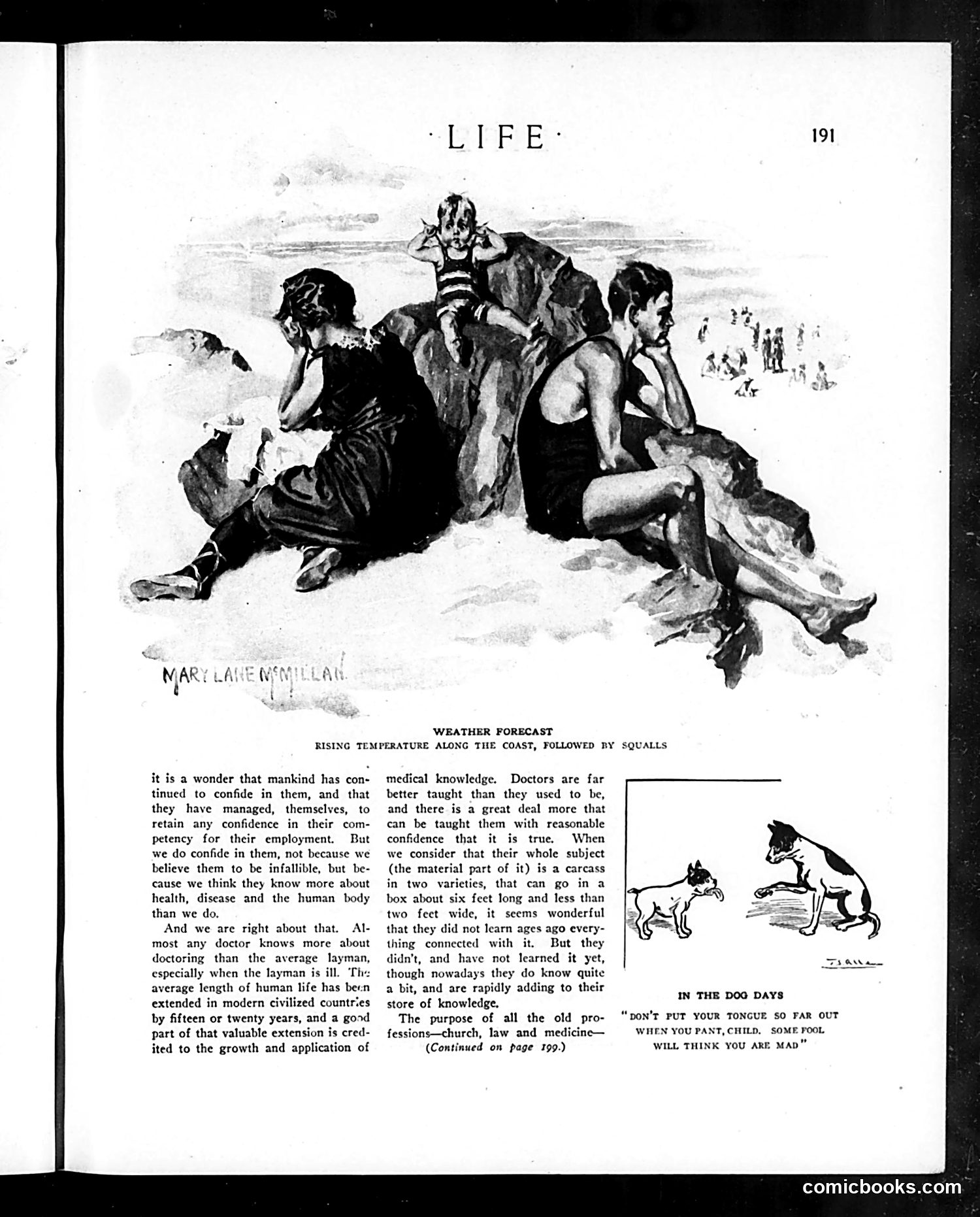
**Main Illustration (Top):** "Weather Forecast: Rising Temperature Along the Coast, Followed by Squalls" depicts women in bathing attire on a beach. The title is a double entendre—the "squalls" (storms) refer both to weather and to the women's discomfort or complaints, playing on period stereotypes about women's emotional volatility. The artist is Marlaine McMillan. **Small Comic (Bottom Right):** "In the Dog Days" shows a child with tongue extended while panting. The caption warns against this behavior, joking that onlookers might think the child is "mad" (rabid). The humor relies on conflating childish behavior with animal behavior during summer heat. **Text (Left Column):** A serious essay praising doctors' growing medical knowledge and competence, contrasting modern advances with historical ignorance. The page juxtaposes satirical commentary on gender and behavior with earnest professional respect—typical of *Life* magazine's mixed editorial approach.
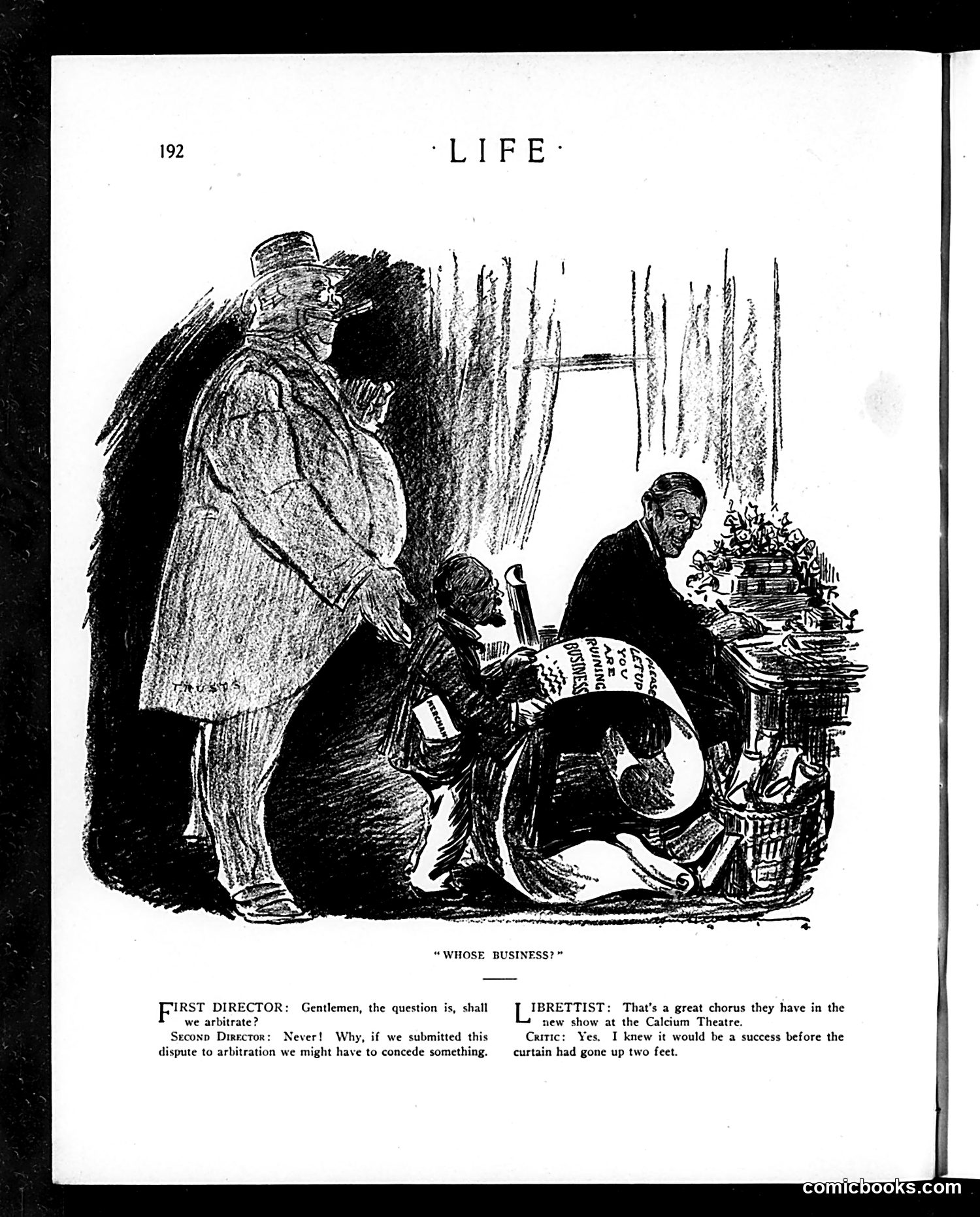
This cartoon satirizes theatrical producers' resistance to arbitration. Two film directors debate whether to submit a dispute to arbitration, with the Second Director arguing against it because arbitration might force them to concede something—suggesting producers' stubborn unwillingness to compromise fairly. Simultaneously, a librarian and critic chat about a show at the "Calcium Theatre" (likely a real venue), praising its chorus. The critic's claim of knowing success "before the curtain had gone up two feet" mocks critics' pretentious certainty and snap judgments. The page title "Whose Business?" questions whether theatrical disputes are industry insiders' exclusive domain or subject to fair arbitration. The juxtaposition critiques both producer obstinacy and critical pomposity in early 20th-century theater.
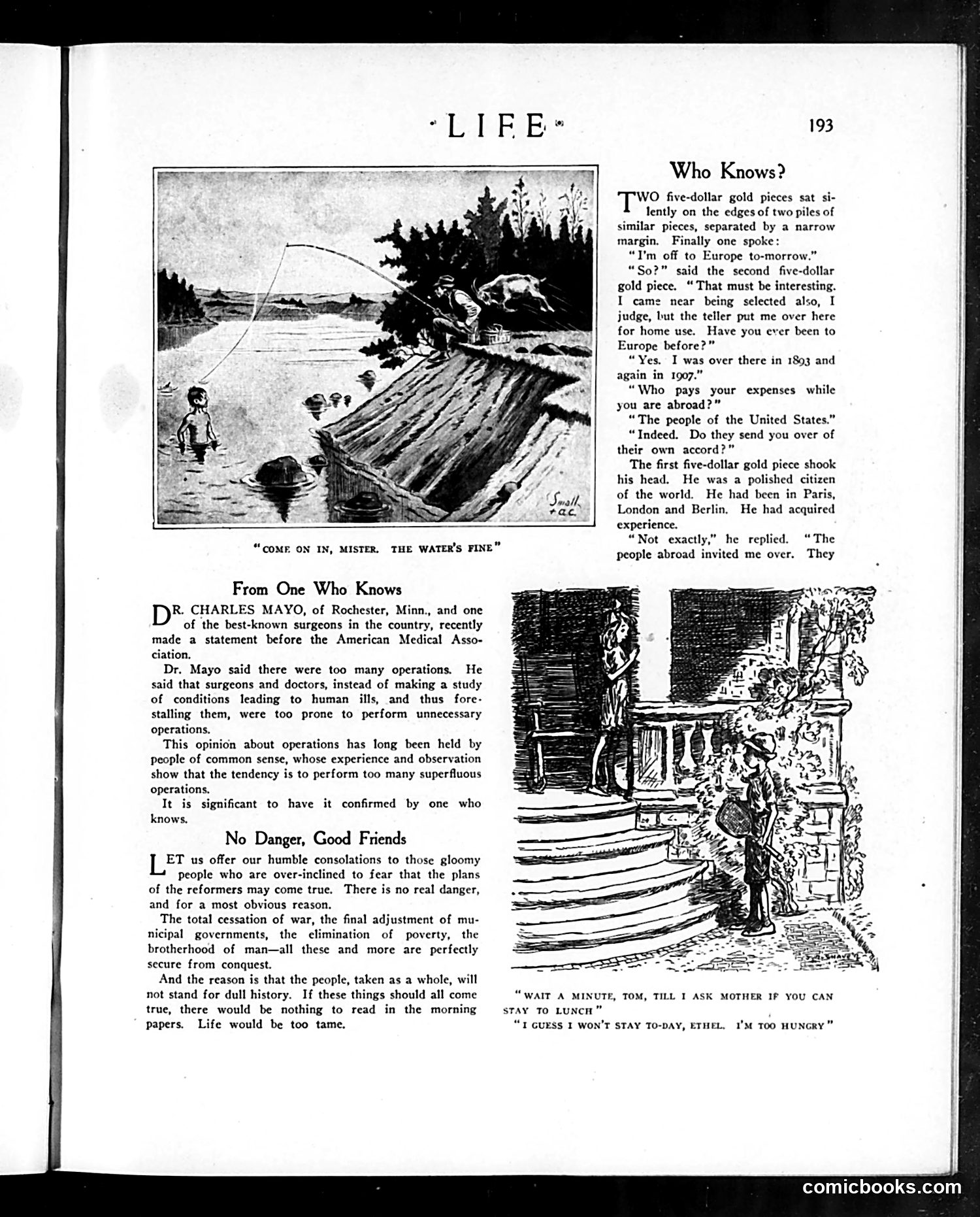
The top cartoon is a personified dialogue between two five-dollar gold coins. One coin, having traveled to Europe in 1893 and 1907, explains that American currency circulates abroad because "the people abroad invited me over"—a satirical critique of American foreign expenditure and interventionism. The coin claims foreigners request American money and involvement, but this is clearly ironic: the piece suggests Americans are being manipulated into funding European affairs under the pretense of being "invited." The broader page critiques excessive American military/diplomatic spending by satirizing the notion that other nations eagerly solicit U.S. financial support. The humor relies on readers understanding early-20th-century debates about American isolationism versus foreign engagement and costly overseas commitments.
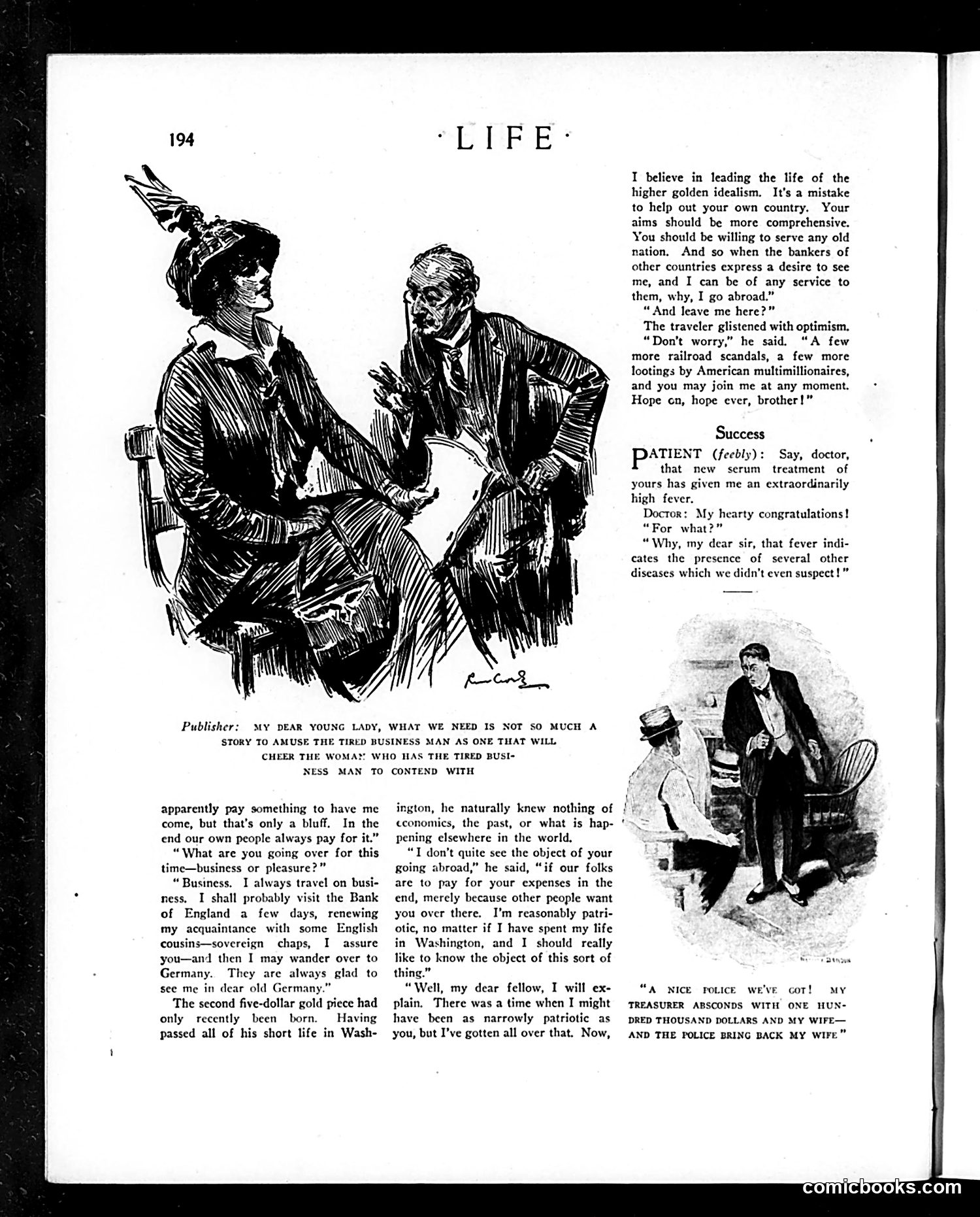
This page contains satirical commentary on American wealth and corruption circa early 1900s. **Main cartoon (top):** A wealthy traveler justifies frequent foreign trips by claiming "higher golden idealism" and service to international bankers. The satire targets wealthy Americans who abandon their country while claiming patriotism, often while benefiting from financial scandals. He cynically tells his female companion she can join him once "railroad scandals" and "lootings by American multimillionaires" have sufficiently impoverished her—dark humor about rampant corporate corruption. **"Success" cartoon (bottom):** A doctor congratulates a feverish patient, explaining the fever indicates *multiple* undiscovered diseases. This satirizes medical overdiagnosis and quackery, mocking physicians who treat symptoms rather than root causes or who profit from expanding disease definitions. Both pieces critique turn-of-century American society: unchecked wealthy elites fleeing accountability and dubious professional practices exploiting the public. The "five-dollar gold piece" reference appears to be metaphorical currency symbolizing new wealth.
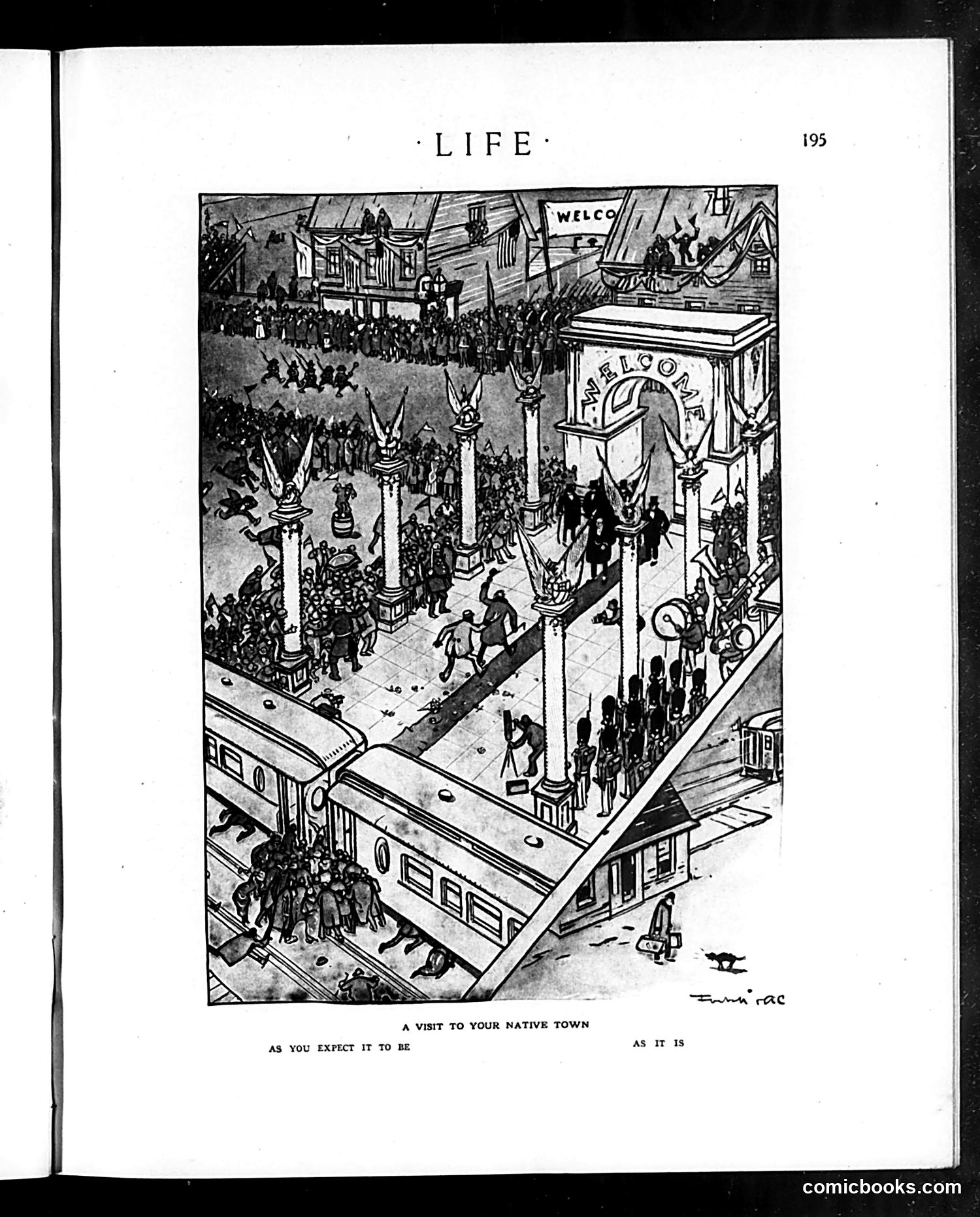
This is a satirical cartoon titled "A Visit to Your Native Town: As You Expect It to Be / As It Is," presenting a split comparison of homecoming expectations versus reality. The left side depicts an idealized fantasy: an ornate, grand welcoming ceremony with elaborate decorative arches, ceremonial columns topped with torch-bearing urns, large crowds, and formal pageantry—suggesting nostalgic, romanticized memories of one's hometown. The right side shows the actual reality: the same location rendered mundane and ordinary, with modest commercial buildings, ordinary pedestrians going about daily business, and no special celebration. The joke satirizes the gap between sentimental memory and prosaic reality—people often recall their hometowns as more impressive than they actually are. This reflects a common early-to-mid 20th-century theme about American small-town life and the deflating experience of returning home as an adult.
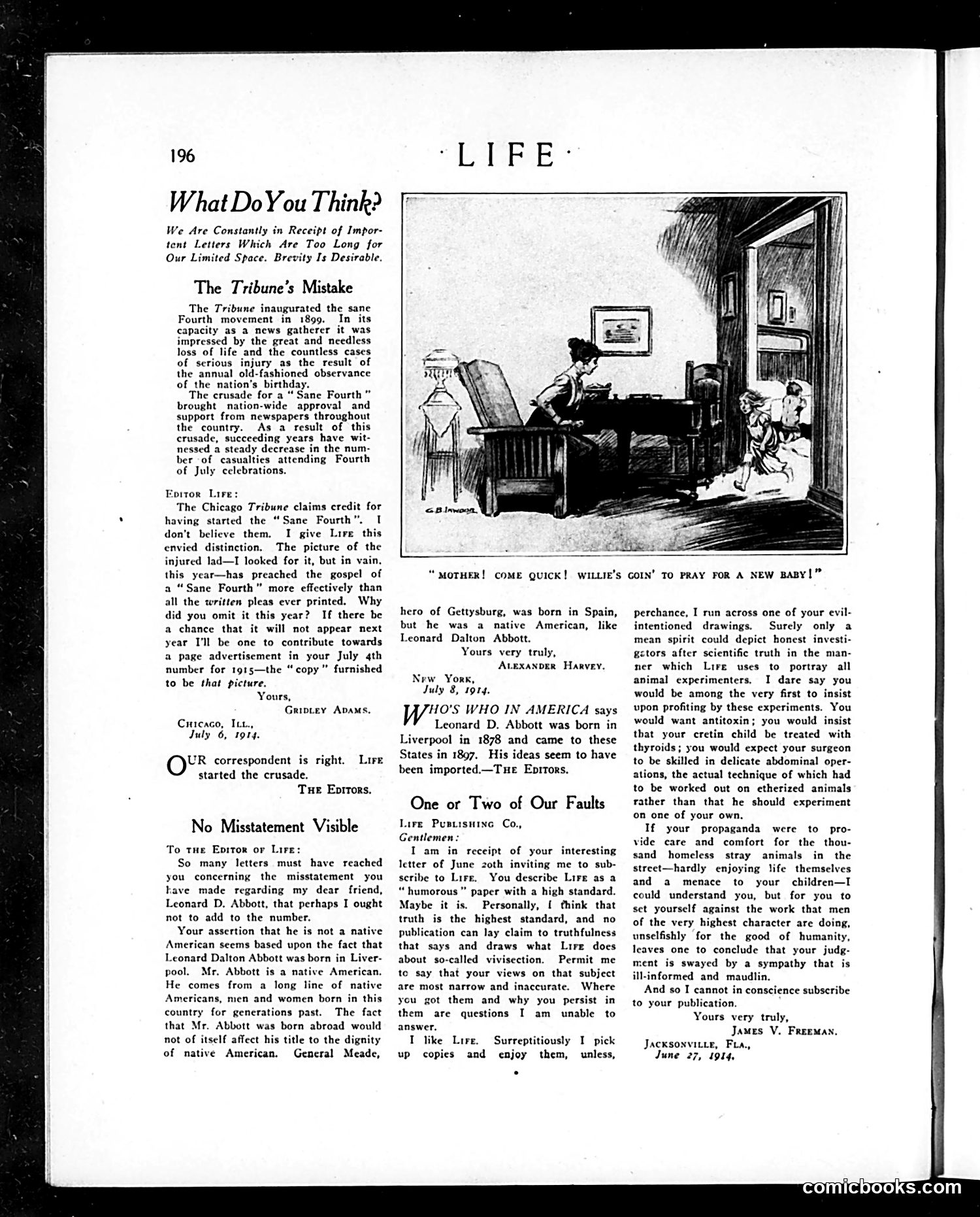
This "Letters to the Editor" page showcases reader responses to Life's editorial positions and satirical content. **Main cartoon:** Shows a child praying for "a new baby," likely referencing Life's campaign for a "Sane Fourth of July"—a crusade against dangerous Independence Day celebrations that caused numerous injuries and deaths. The implicit dark humor: the child prays for a replacement sibling lost to Fourth of July accidents. **Letter disputes:** - One writer credits Life (not the Chicago Tribune) with originating the "Sane Fourth" movement and praises Life's graphic depictions of injured children as effective advocacy. - Another defends Leonard D. Abbott's status as a "native American" despite his British birth, citing General Meade as precedent. - A third attacks Life's anti-vivisection cartoons as unfair to legitimate medical researchers, accusing the magazine of depicting scientists dishonestly while readers benefit from animal-tested medicines. These letters reveal Life's role as both **satirist and social reformer**, with readers debating the ethics of using graphic imagery and exaggeration for social causes.
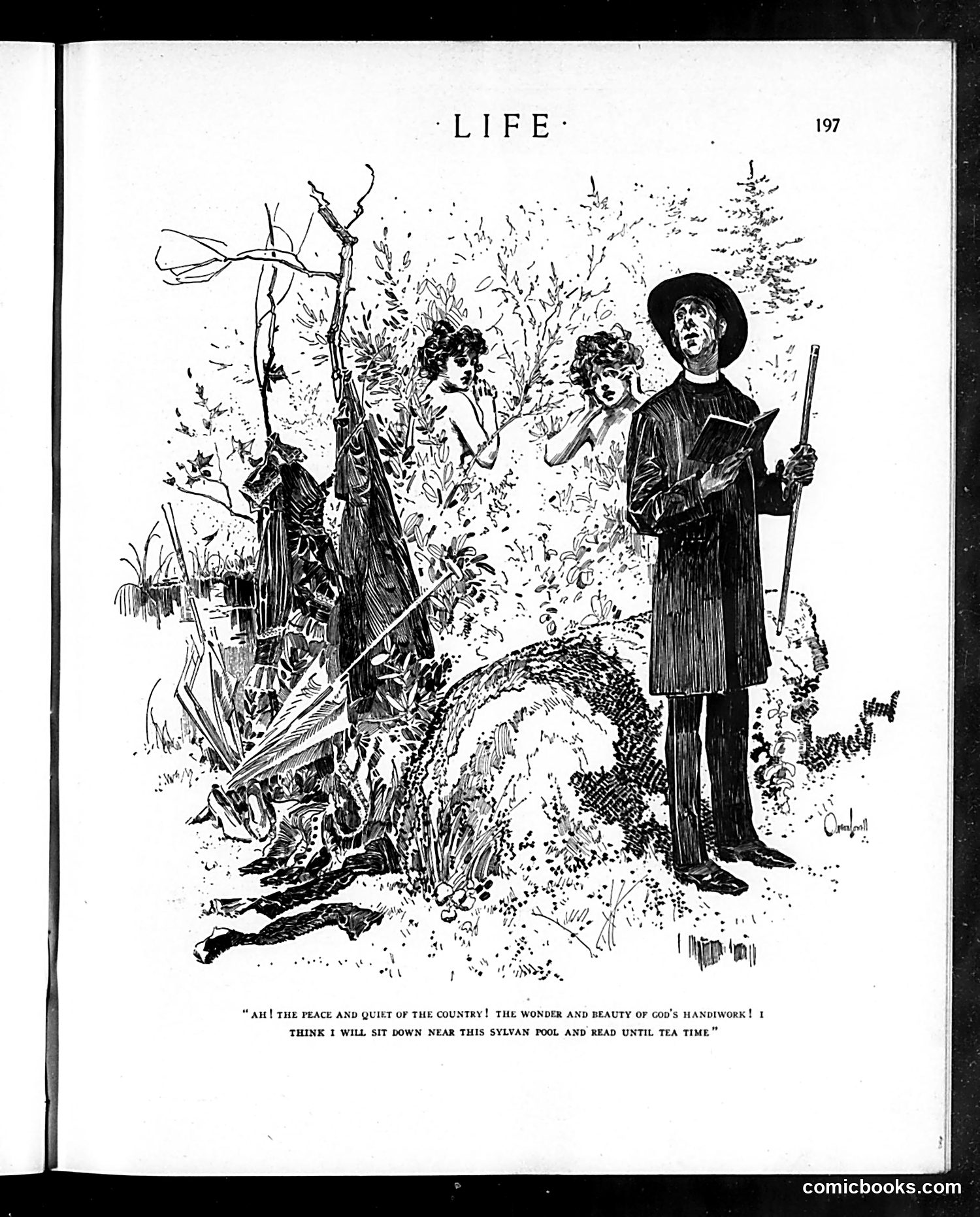
This appears to be an early 20th-century satirical cartoon mocking urban dwellers' romanticized vision of nature. The man in the hat and coat represents a city person seeking "peace and quiet" in the countryside, yet he's surrounded by industrial destruction—dead trees, polluted ground, and what appears to be environmental devastation. The satire targets the disconnect between middle-class aspirations for pastoral escape and the reality of industrialization's environmental damage. The character's oblivious monologue about "God's handiwork" and "sylvan pools" contrasts sharply with the blighted landscape, suggesting either willful ignorance or the magazine's critique of how industrialization was destroying nature while people romanticized it. The specific political context remains unclear without the publication date, though this reflects broader Progressive Era concerns about conservation and industrial pollution.
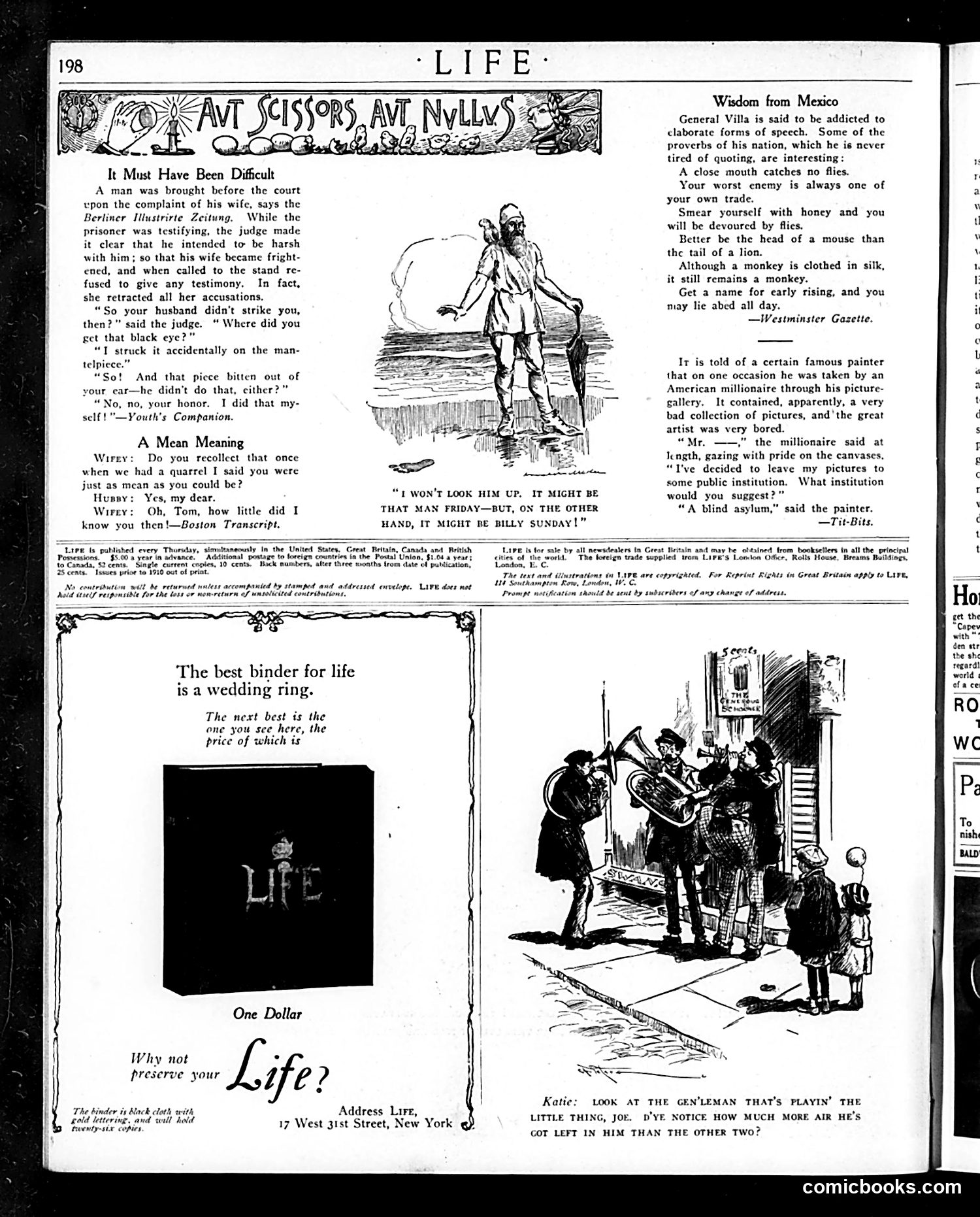
This page from *Life* magazine contains several short humor pieces typical of early 20th-century satirical journalism: **"It Must Have Been Difficult"** mocks a domestic dispute where a wife, intimidated by the judge's harsh manner toward her husband, recants her accusations of abuse—claiming her black eye and bitten ear were self-inflicted accidents. The joke targets both marital dysfunction and judicial intimidation. **"A Mean Meaning"** is a brief domestic joke about a husband misunderstanding his wife's past criticism. **The "Man Friday" cartoon** references the reference character from *Robinson Crusoe*, joking that finding an unknown man could be either a helpful servant ("Man Friday") or the famous evangelist Billy Sunday—implying Sunday's public presence made him instantly recognizable. **"Wisdom from Mexico"** attributes folk proverbs to General Villa, likely Pancho Villa, the Mexican revolutionary leader. This reflects contemporary American interest in Mexican affairs during the Mexican Revolution period. The remaining content includes advertisement for a *Life* binder and an unrelated caption about musicians.
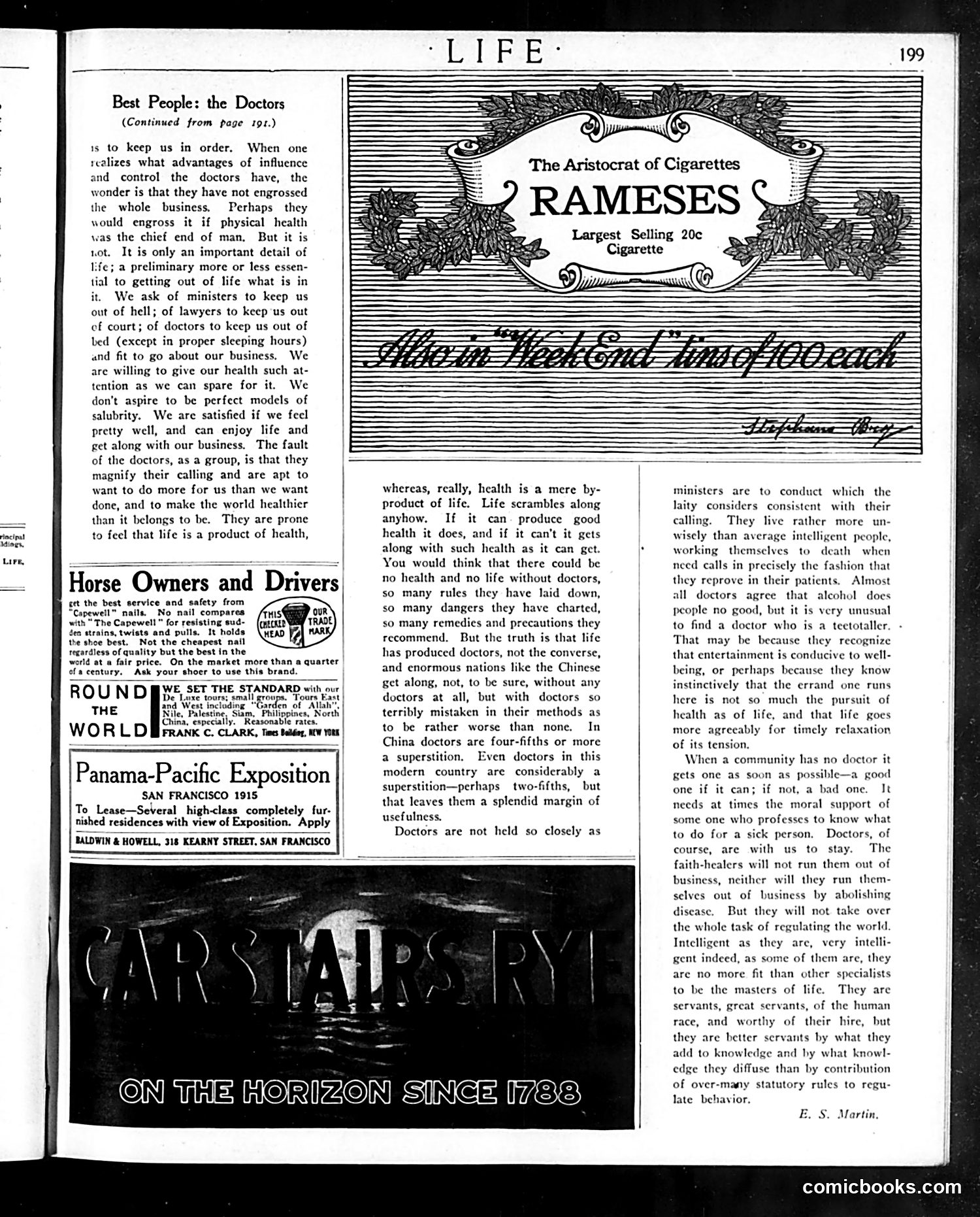
This page combines a satirical editorial essay on doctors with period advertisements and a cigarette ad. **Main Content:** The essay "Best People: the Doctors" (continued) argues that doctors overestimate health's importance. The author contends life naturally produces doctors, not vice versa—citing Chinese civilization's success despite viewing doctors as "superstition." The piece mocks physicians for being sanctimonious about health rules they themselves violate (drinking alcohol despite warning patients against it). The satire suggests doctors magnify their calling's importance when people actually prioritize living fully over perfect health. **Advertisements:** Rameses cigarettes ("Aristocrat of Cigarettes"), Capewell nails, Roundby world tours, and Panama-Pacific Exposition housing occupy the remaining space—typical early 1915 commercial content. **Point:** The satire critiques medical paternalism and physician hypocrisy—a common Progressive Era complaint that professionals overreach their authority while failing to practice their own standards.
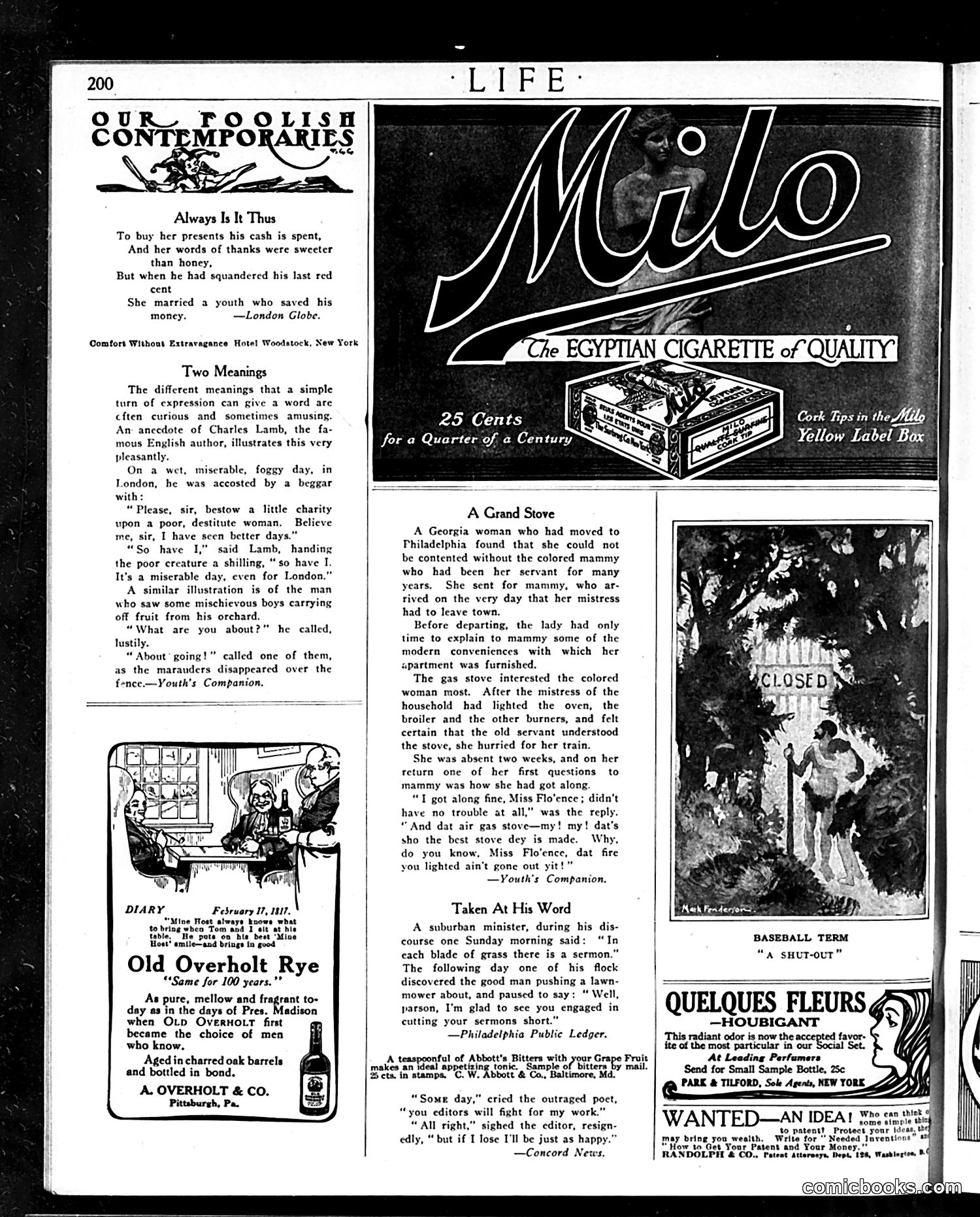
This page from *Life* magazine (early 20th century) contains several humorous anecdotes and advertisements rather than political cartoons. **"Always Is It Thus"** satirizes the transactional nature of courtship—a man spends lavishly on a woman who thanks him sweetly, but once his money runs out, she marries a thrifty man instead. The joke critiques both female materialism and male foolishness in romantic pursuit. **"Two Meanings"** presents wordplay humor, including an anecdote about author Charles Lamb making a pun with a beggar ("I've seen better days" too, given the miserable weather), and boys fleeing an orchard while shouting "About going!" **"A Grand Stove"** humorously describes a Georgia woman's formerly enslaved servant who, left alone with a gas stove, never turns it off—misunderstanding the technology. The humor relies on period racial stereotypes about Black servants' unfamiliarity with modern conveniences. **"Taken At His Word"** jokes about a minister who mentions grass blades contain sermons; a parishioner later catches him with a lawnmower, quipping he's "cutting your sermons short." The page is primarily advertisements (Old Overholt Rye whiskey, Milo cigarettes, perfume).
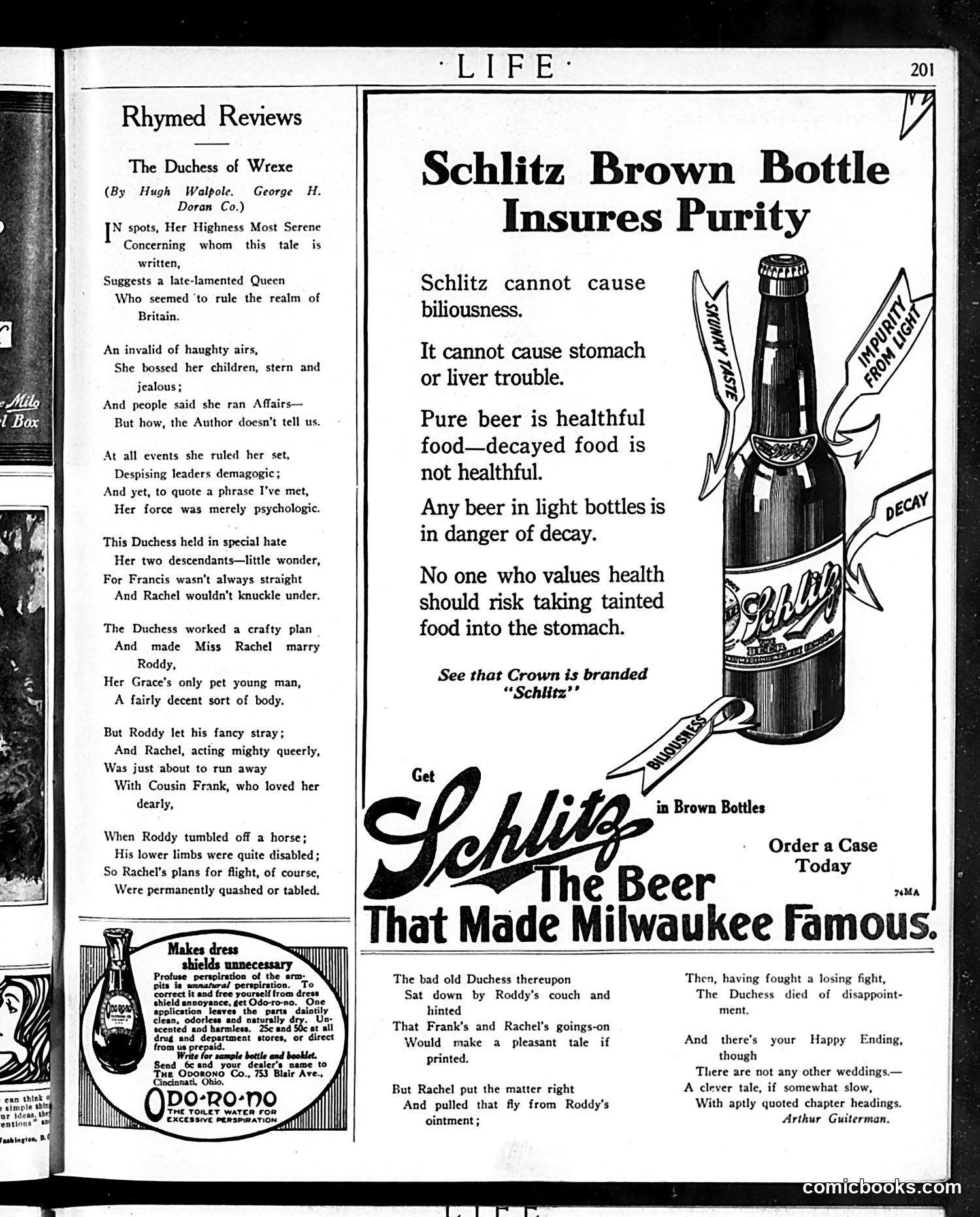
This page contains a **book review in verse** (left) and a **beer advertisement** (right), typical of early 20th-century Life magazine content. **The Review:** Arthur Guiterman satirizes Hugh Walpole's novel *The Duchess of Wrexe*. The poem mocks the plot's melodrama—an imperious dowager duchess manipulates her descendants' romantic lives. When the dissolute grandson is crippled in a horse accident, it conveniently prevents the heroine Rachel from eloping with her lover. Guiterman's dry summary suggests the novel is contrived ("clever tale, if somewhat slow") with heavy-handed moralizing. **The Advertisement:** Schlitz beer uses pseudo-scientific health claims typical of pre-Prohibition era marketing. It asserts that pure beer is "healthful food" while warning that light bottles allow decay. The brown bottle's opaque glass supposedly ensures purity—a genuine technical advantage presented as a moral superiority claim. Together, the page reflects 1920s American consumer culture: literature reviewed for entertainment value, commercial products marketed with dubious health assertions.
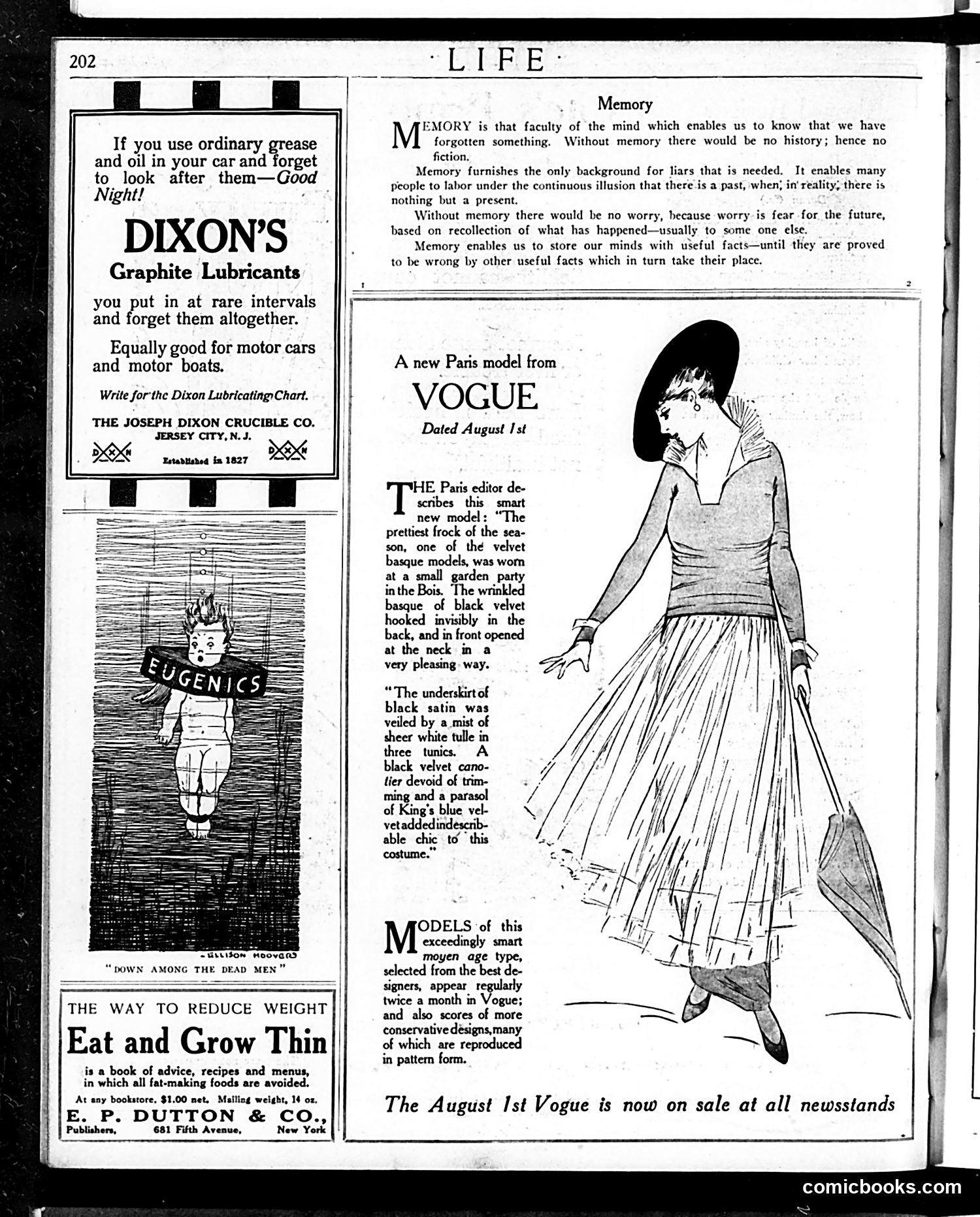
This page combines a philosophical essay on memory with fashion advertising and product promotions—typical of Life's mixed-content format. **Main Content:** The "Memory" essay presents satirical observations about human nature: memory enables liars, prevents worry (since we forget bad experiences), and constantly updates itself as new facts replace old beliefs. It's light philosophy with a cynical edge about human nature and self-deception. **Advertisements:** - **Dixon's Graphite Lubricants**: A straightforward product ad for car/boat maintenance - **Vogue Fashion**: Describes an haute couture dress from a Paris garden party, featuring velvet basque styling—typical aspirational fashion coverage - **"Eat and Grow Thin"**: A diet book advertisement, reflecting 1920s-era weight-loss trends - **Eugenics image**: The figure labeled "Down Among the Dead Men" appears to reference eugenics pseudoscience, reflecting troubling contemporary attitudes The page reflects 1920s American consumer culture, fashion obsession, and commercial values mixed with the period's darker scientific enthusiasms.
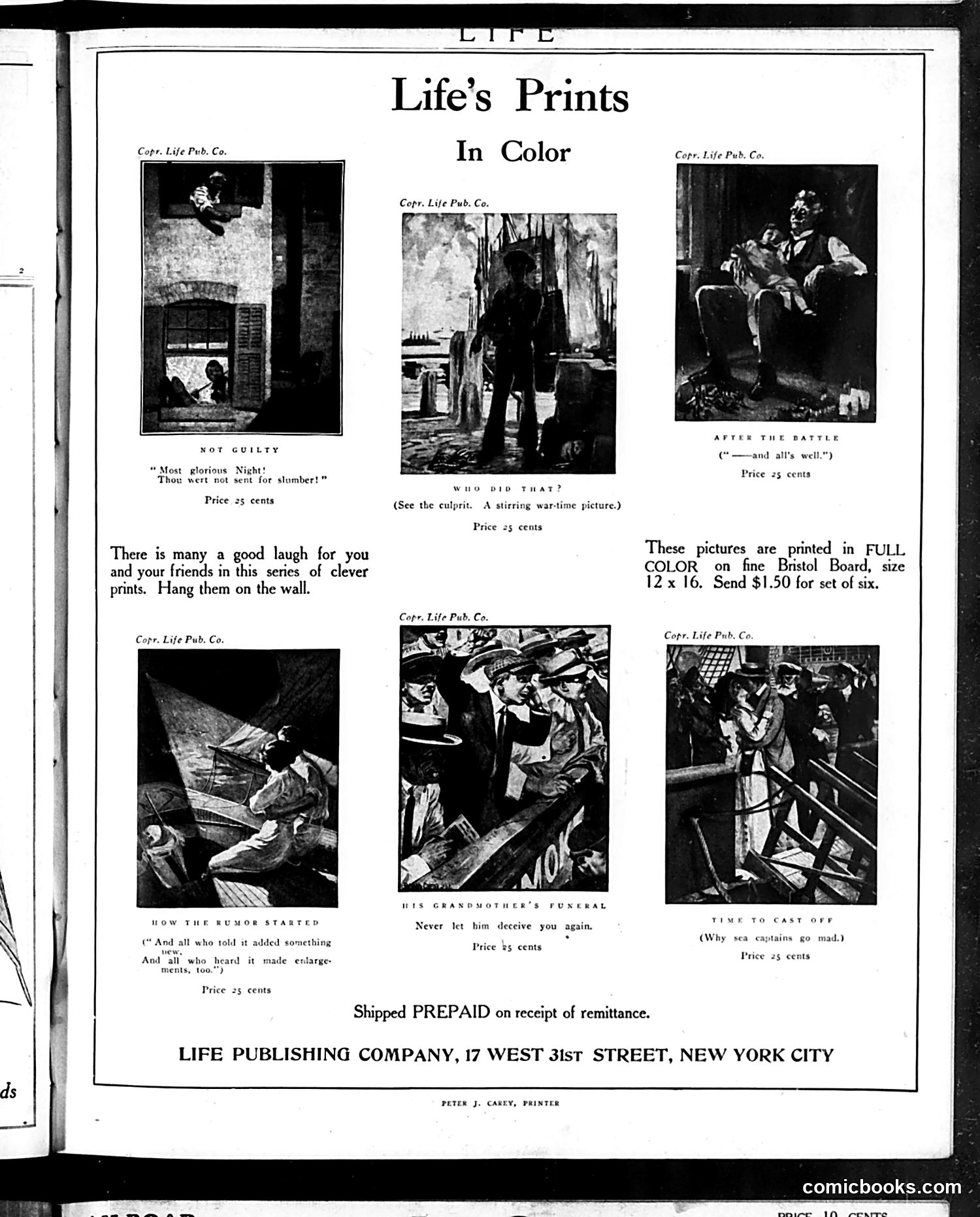
This is primarily an **advertisement for colored prints** from Life Publishing Company, priced at 25 cents each or $1.50 for a set of six. The page showcases six humorous prints on various themes: The titles suggest comedic domestic and social situations: "Not Guilty" (a couple caught), "Who Did That?" (wartime scene), "After the Battle," "How the Rumor Started," "His Grandmother's Funeral," and "Time to Cast Off" (involving sea captains). The print quality and subject matter indicate these were meant as affordable wall decorations for middle-class homes. References to "war-time" suggest publication during or near a major conflict (likely WWI era). The humor appears to target universal domestic mishaps and social embarrassments rather than specific political figures. This is fundamentally a **retail advertisement**, not political satire—Life magazine also functioned as a commercial print publisher selling illustrated humor to consumers.
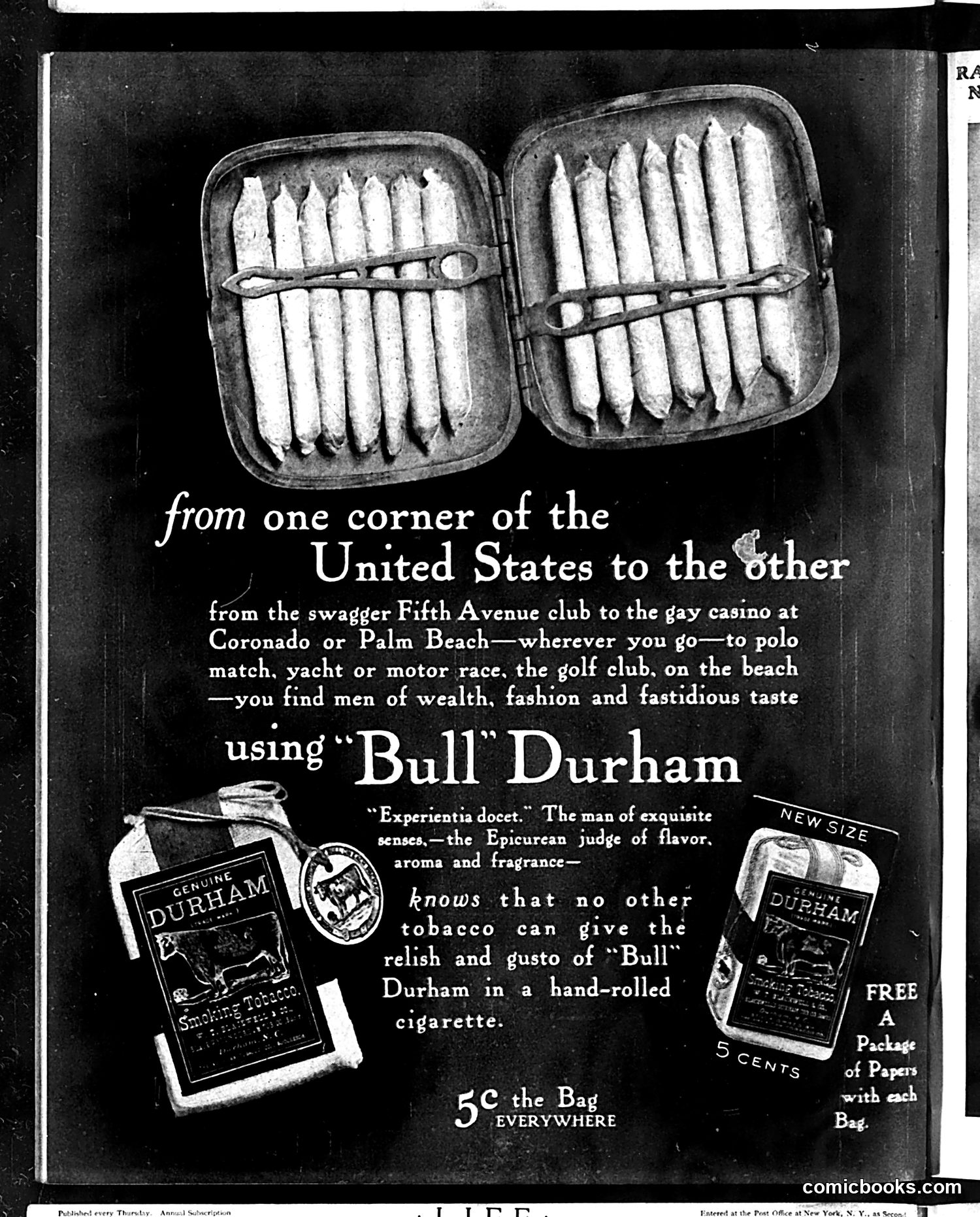
This is a **tobacco advertisement**, not political satire. It promotes Bull Durham smoking tobacco to wealthy, fashionable men across America—from exclusive Fifth Avenue clubs to resort destinations like Palm Beach and Coronado. The ad uses aspirational messaging, claiming that men of "exquisite senses" and refined taste choose Bull Durham for hand-rolled cigarettes. The Latin phrase "Experientia docet" (experience teaches) appeals to sophisticated judgment. The top image shows two containers of loose tobacco with rolling papers, emphasizing the product's portability for the leisure class. The advertisement cost 5 cents per bag and included free rolling papers. This reflects early 20th-century marketing that associated tobacco consumption with wealth, sophistication, and social status—messaging that would be illegal in modern advertising.