
Life, 1914-07-30 · page 25 of 40
Life — July 30, 1914 — page 25: what you’re looking at
What you’re looking at
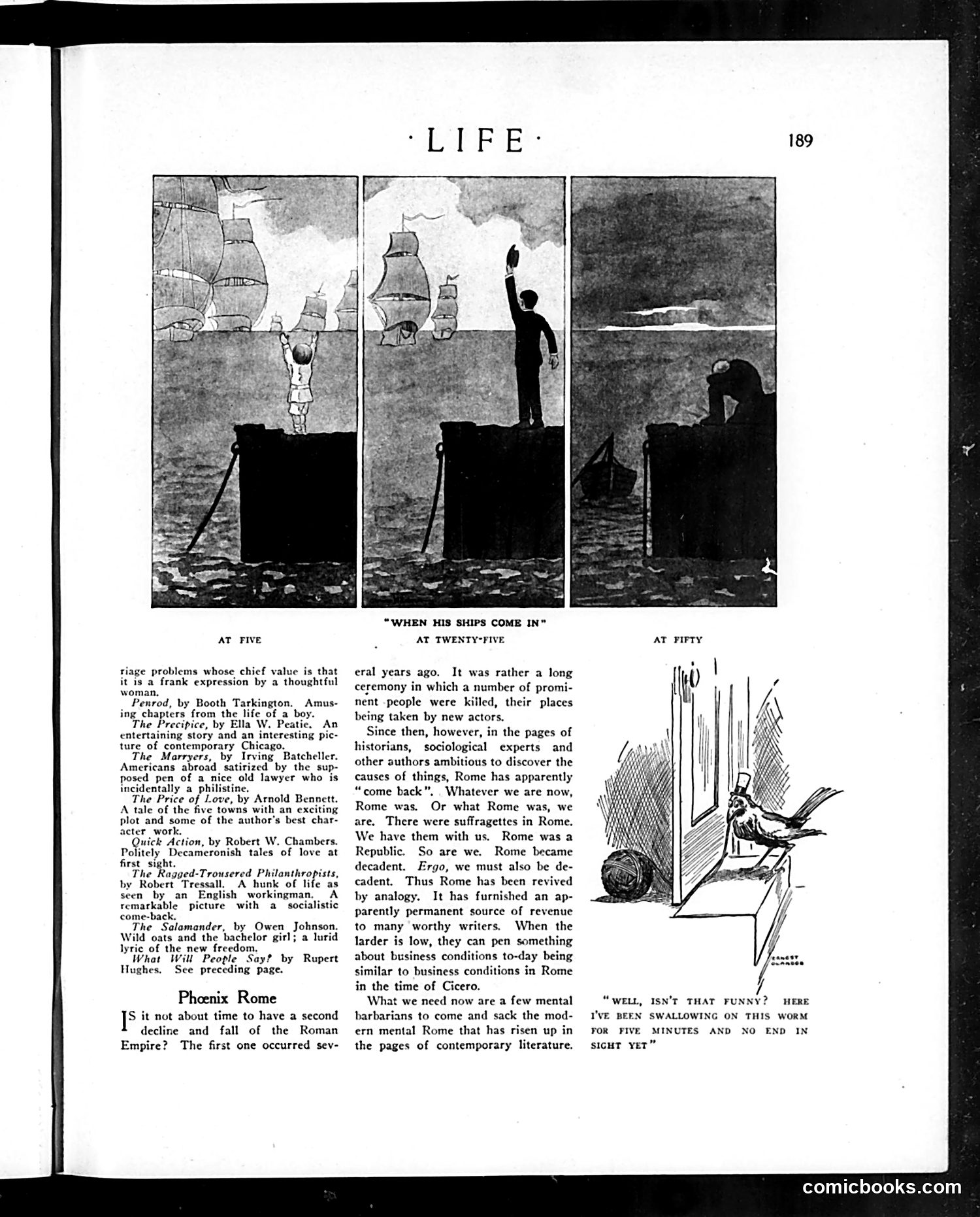
This three-panel cartoon uses maritime imagery to satirize human ambition and the passage of time. Each panel shows a figure gazing hopefully at ships on the horizon—labeled "At Five," "At Twenty-Five," and "At Fifty"—suggesting the common expression "waiting for one's ships to come in" (anticipating future wealth or success). The progression darkens with age: the young child waves enthusiastically; the young adult stands expectantly; the older figure appears hunched and weary. The joke critiques how people perpetually postpone gratification, always waiting for future success rather than living in the present. It's a commentary on American materialism and deferred dreams. The accompanying text's "Phoenix Rome" essay reinforces similar themes about cyclical decline, suggesting modern society—like Rome—may be destined for repetitive patterns of hope and disappointment.
📄 Transcribed text from this page (OCR, searchable)
Machine-transcribed from the original scan — historical spelling and the odd misread are preserved.
AT FIVE iage problems whose chief value is that it is a frank expression by a thoughtful woman, Penrod, by Booth Tarkington. Amus- ing chapters from the life of a boy. The Precipice, by Ella W. Peatie. An entertaining story and an interesting pic- ture of contemporary Chicago. The Marryers, by Irving Batcheller. Americans abroad satirized by the sup- posed pen of a nice old lawyer who is incidentally a philistine, The Price of Love, by Arnold Bennett. A tale of the five towns with an exciting plot and some of the author's best char- acter work, Quick Action, by Robert W. Chambers. Politely Decameronish tales of love at first sight. The Ragged-Trousered Philanthropists, by Robert Tressall, A hunk of life as seen by an English workingman. A remarkable picture with a socialistic come-back. The Salamander, by Owen Johnson. Wild oats and the bachelor girl; a lurid lyric of the new freedom, What Will People Say? by Rupert Hughes, See preceding page. Phoenix Rome S it not about time to have a second decline and fall of the Roman Empire? The first one occurred sev- “WHEN HIS SHIPS COME IN” AT TWENTY-FIVE eral years ago. It was rather a long ceremony in which a number of promi- nent -people were killed, their places being taken by new actors. Since then, however, in the pages of historians, sociological experts and other authors ambitious to discover the causes of things, Rome has apparently “come back”. Whatever we are now, Rome was. Or what Rome was, we are, There were suffragettes in Rome. We have them with us. Rome was a Republic. So are we. Rome became decadent. Ergo, we must also be de- cadent. Thus Rome has been revived by analogy. It has furnished an ap- parently permanent source of revenue to many worthy writers, When the larder is low, they can pen something about business conditions to-day being similar to business conditions in Rome in the time of Cicero. What we need now are a few mental barbarians to come and sack the mod- ern mental Rome that has risen up in the pages of contemporary literature. “WELL, ISN'T THAT FUNNY? HERE I'VE BEEN SWALLOWING ON THIS WoRM FOR FIVE MINUTES AND NO END IN SIGHT YET” comicbooks.com