
Life, 1914-07-30 · page 12 of 40
Life — July 30, 1914 — page 12: what you’re looking at
What you’re looking at
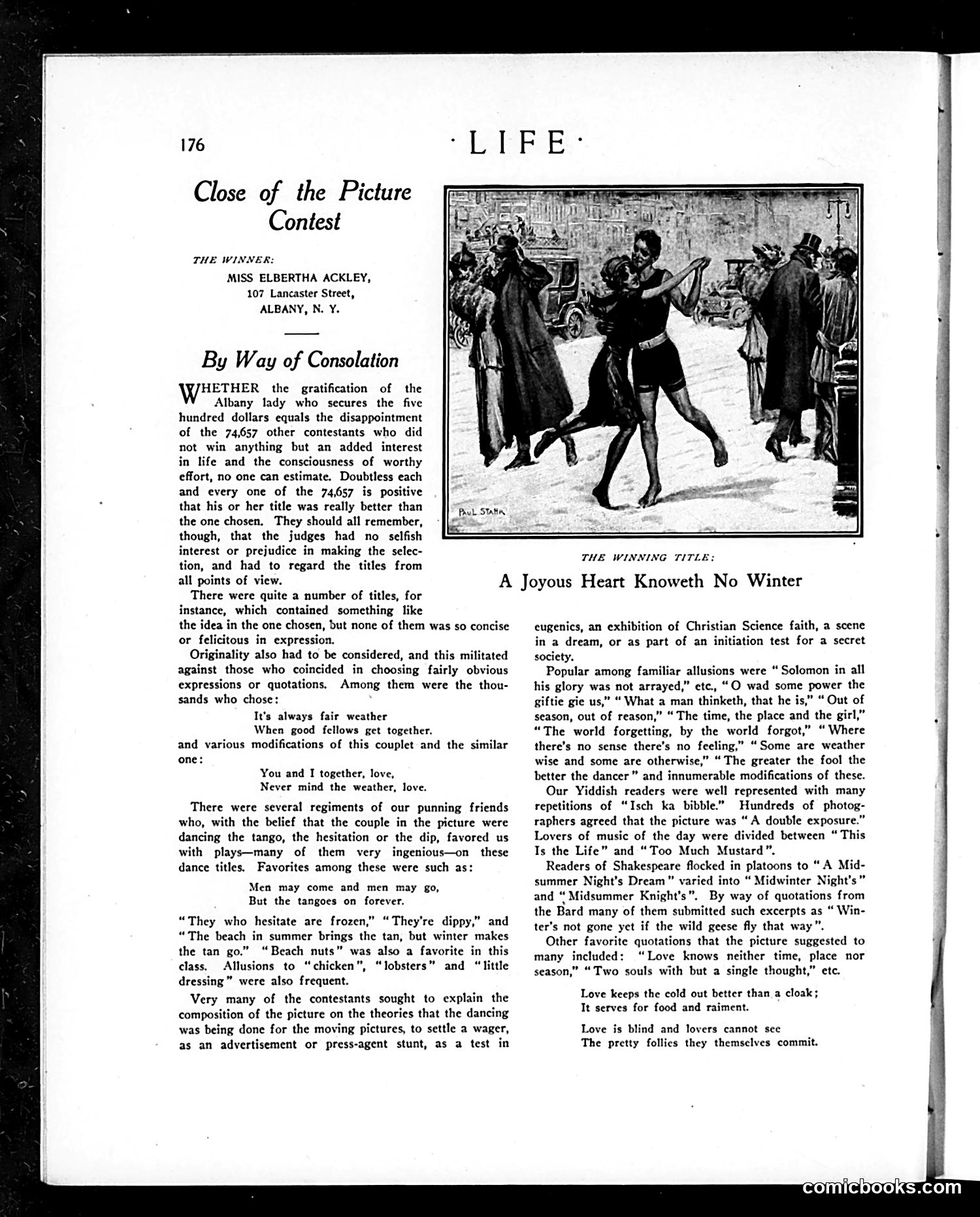
This page documents the winner of Life magazine's "Picture Contest." The winning image, titled "A Joyous Heart Knoweth No Winter," depicts a couple dancing in a snowy street while onlookers watch. The text explains that among 74,657 contest entries, judges selected this title for its conciseness and felicitous expression. The judges, notably, are praised for having "no selfish interest" in their selection process. The page then catalogs alternative titles contestants submitted, many drawing on literary and cultural allusions—Shakespeare references, proverbs, and common expressions about love and weather. This demonstrates how 1910s-era readers engaged with sentimental imagery through familiar quotations and aphorisms, using shared cultural knowledge to interpret domestic scenes of romance and joy.
📄 Transcribed text from this page (OCR, searchable)
Machine-transcribed from the original scan — historical spelling and the odd misread are preserved.
176 Close of the Picture Contest THE WINNER: MISS ELBERTHA ACKLEY, 107 Lancaster Street, ALBANY, N. Y. By Way of Consolation HETHER the gratification of the Albany lady who secures the five hundred dollars equals the disappointment of the 74,657 other contestants who did not win anything but an added interest in life and the consciousness of worthy effort, no one can estimate. Doubtless each and every one of the 74,657 is positive that his or her title was really better than the one chosen. They should all remember, though, that the judges had no selfish interest or prejudice in making the selec- tion, and had to regard the titles from all points of view. There were quite a number of titles, for instance, which contained something like the idea in the one chosen, but none of them was so concise or felicitous in expression, Originality also had to be considered, and this militated against those who coincided in choosing fairly obvious expressions or quotations. Among them were the thou- sands who chose: It's always fair weather When good fellows get together. and various modifications of this couplet and the similar one: Paul STAR’ You and I together, love, Never mind the weather, love. There were several regiments of our punning friends who, with the belief that the couple in the picture were dancing the tango, the hesitation or the dip, favored us with plays—many of them very ingenious—on these dance titles, Favorites among these were such as: Men may come and men may go, But the tangoes on forever. “They who hesitate are frozen,” “They're dippy,” and “The beach in summer brings the tan, but winter makes the tan go.” “Beach nuts” was also a favorite in this class. Allusions to “chicken”, “lobsters” and “little dressing” were also frequent. Very many of the contestants sought to explain the composition of the picture on the theories that the dancing was being done for the moving pictures, to settle a wager, as an advertisement or press-agent stunt, as a test in THE WINNING TITLE: A Joyous Heart Knoweth No Winter eugenics, an exhibition of Christian Science faith, a scene in a dream, or as part of an initiation test for a secret society. Popular among familiar allusions were “Solomon in all his glory was not arrayed,” etc., “O wad some power the giftie gie us,” “ What a man thinketh, that he is,” “ Out of season, out of reason,” “The time, the place and the girl,” “The world forgetting, by the world forgot,” “ Where there’s no sense there's no feeling,” “Some are weather wise and some are otherwise,” “The greater the fool the better the dancer” and innumerable modifications of these. Our Yiddish readers were well represented with many repetitions of “Isch ka bibble.” Hundreds of photog- raphers agreed that the picture was “A double exposure.” Lovers of music of the day were divided between “ This Is the Life” and “Too Much Mustard”. Readers of Shakespeare flocked in platoons to “A Mid- summer Night’s Dream” varied into “ Midwinter Night's” and “ Midsummer Knight's”. By way of quotations from the Bard many of them submitted such excerpts as “ Win- ter’s not gone yet if the wild geese fly that way”. Other favorite quotations that the picture suggested to many included: “Love knows neither time, place nor season,” “Two souls with but a single thought,” etc. Love keeps the cold out better than a cloak; It serves for food and raiment. Love is blind and lovers cannot sec The pretty follics they themselves commit.