
Life, 1914-07-30 · page 24 of 40
Life — July 30, 1914 — page 24: what you’re looking at
What you’re looking at
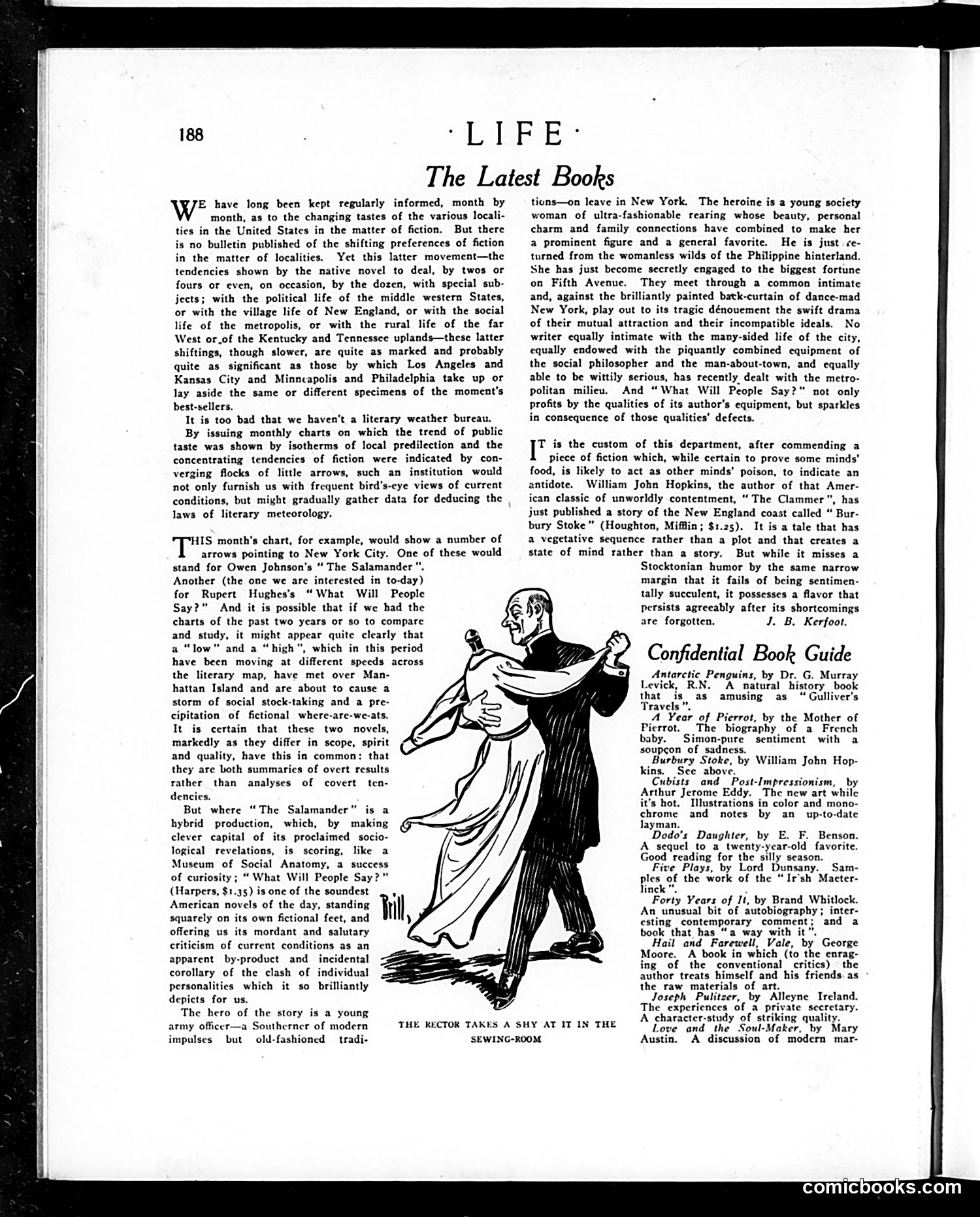
This page from *Life* magazine reviews contemporary fiction, particularly Rupert Hughes's novel *"What Will People Say?"* The central cartoon depicts a clergyman (identifiable by his collar) being playfully swung by a woman in a sewing room—illustrating the book's theme of social scandal and impropriety in high society. The satire targets early-20th-century New York society's obsession with appearances and propriety. Hughes's novel examines "overt results rather than analyses of covert tendencies"—meaning it explores what society *does* versus what it *thinks*. The story itself involves a young army officer and a society woman engaged to a wealthy man, whose mutual attraction creates scandal. The broader point: *Life* uses literary criticism to mock the rigid social conventions and moral hypocrisies of the wealthy Manhattan elite, who carefully guard reputations while engaging in morally questionable behavior. The playful cartoon emphasizes how shocking such behavior appears to respectable society.
📄 Transcribed text from this page (OCR, searchable)
Machine-transcribed from the original scan — historical spelling and the odd misread are preserved.
“3 GRE The Latest Books E have long been kept regularly informed, month by month, as to the changing tastes of the various locali- in the ited States in the matter of fiction. But there is no bulletin published of the shifting preferences of fiction in the matter of localities. Yet this latter movement—the tendencies shown by the native novel to deal, by twos or fours or even, on occasion, by the dozen, with special sub- jects; with the political life of the middle western States, or with the village life of New England, or with the social life of the metropolis, or with the rural life of the far West or.of the Kentucky and Tennessee uplands—these latter shiftings, though slower, are quite as marked and probably quite as significant as those by which Los Angeles and Kansas City and Minneapolis and Philadelphia take up or lay aside the same or different specimens of the moment's best-sellers. It is too bad that we haven't a literary weather bureau. By issuing monthly charts on which the trend of public taste was shown by isotherms of local predilection and the concentrating tendencies of fiction were indicated by con- verging flocks of little arrows, such an institution would not only furnish us with frequent bird's-eye views of current conditions, but might gradually gather data for deducing the | laws of literary meteorology. 41S month's chart, for example, would show a number of arrows pointing to New York City. One of these would stand for Owen Johnson's “ The Salamander". Another (the one we are interested in to-day) for Rupert Hughes's “What Will People Say?” And it is possible that if we had the charts of the past two years or so to compare and study, it might appear quite clearly that a “low” and a “high”, which in this period have been moving at different speeds across the literary map, have met over Man- hattan Island and are about to cause a storm of social stock-taking and a pre- cipitation of fictional where-are-we-ats. It is certain that these two novels, markedly as they differ in scope, spirit and quality, have this in common: that they are both summarics of overt results rather than analyses of covert ten- dencies. But where “The Salamander” is a hybrid production, which, by making clever capital of its proclaimed socio- logical revelations, is scoring, like a Museum of Social Anatomy, a success of curiosity What Will People Say?” (Harpers, $1.35) is one of the soundest. , American novels of the day, standing Hill squarely on its own fictional feet, and y offering us its mordant and salutary criticism of current conditions as an apparent by-product and incidental corollary of the clash of individual personalities which it so brilliantly depicts for us. The hero of the story is a young tions—on leave in New York. The heroine is a young society woman of ultra-fashionable rearing whose beauty, personal charm and family connections have combined to make her a prominent figure and a general favorite. He is just ce- turned from the womanless wilds of the Philippine hinterland. She has just become secretly engaged to the biggest fortune on Fifth Avenue. They meet through a common intimate and, against the brilliantly painted batk-curtain of dance-mad New York, play out to its tragic dénouement the swift drama of their mutual attraction and their incompatible ideals. No writer equally intimate with the many-sided life of the city, equally endowed with the piquantly combined equipment of the social philosopher and the man-about-town, and equally able to be wittily serious, has recently dealt with the metro- politan milieu. And “What Will People Say?” not only profits by the qualities of its author’s equipment, but sparkles in consequence of those qualities’ defects. T is the custom of this department, after commending a piece of fiction which, while certain to prove some minds’ food, is likely to act as other minds’ poison, to indicate an antidote. William John Hopkins, the author of that Amer- ican classic of unworldly contentment, “ The Clammer”, has just published a story of the New England coast called “ Bur- bury Stoke" (Houghton, Mifflin; $1.25). It is a tale that has a vegetative sequence rather than a plot and that creates a state of mind rather than a story. But while it misses a Stocktonian humor by the same narrow margin that it fails of being sentimen- tally succulent, it possesses a flavor that persists agreeably after its shortcomings are forgotten. J. B. Kerfoot. Confidential Book Guide Antarctic Penguins, by Dr. G. Murray Levick, R.N. A natural history book that is) as amusing as Travels”. A Year of Pierrot, by the Mother of Pierrot. The biography of a French baby. Simon-pure sentiment soupcon of sadness. Burbury Stoke, by William John Hop- kins. See above. Cubists and Post-Impressionism, by Arthur Jerome Eddy. The new art while it's hot. Illustrations in color and mono- chrome and notes by an up-to-date layman. Dodo's Daughter, by E. F. Benson. A sequel to a twenty-year-old favorite. Good reading for the silly season. Five Plays, by Lord Dunsany. Sam- ples of the work of the “Ir'sh Maeter- linck ". Forty Years of It, by Brand Whitlock. An unusual bit of autobiography ; inter- esting contemporary comment id book that has “a way with it”. Hail and Farewell, Vale, by George Moore. A book in which (to the enrag- ing of the conventional critics) the author treats himself and his friends. as the raw materials of art. Joseph Pulitzer, by Alleyne Ireland. The experiences of a private secretary. A character-study of striking quality. “ Gulliver's with a army officer—a Southerner of modern impulses but old-fashioned — tradi- THE RECTOR TAKES A SHY AT IT IN THE SEWING-ROOM Love and the Soul-Maker, by Mary Austin, A discussion of modern mar- comicbooks.com