
Life, 1914-07-30 · page 18 of 40
Life — July 30, 1914 — page 18: what you’re looking at
What you’re looking at
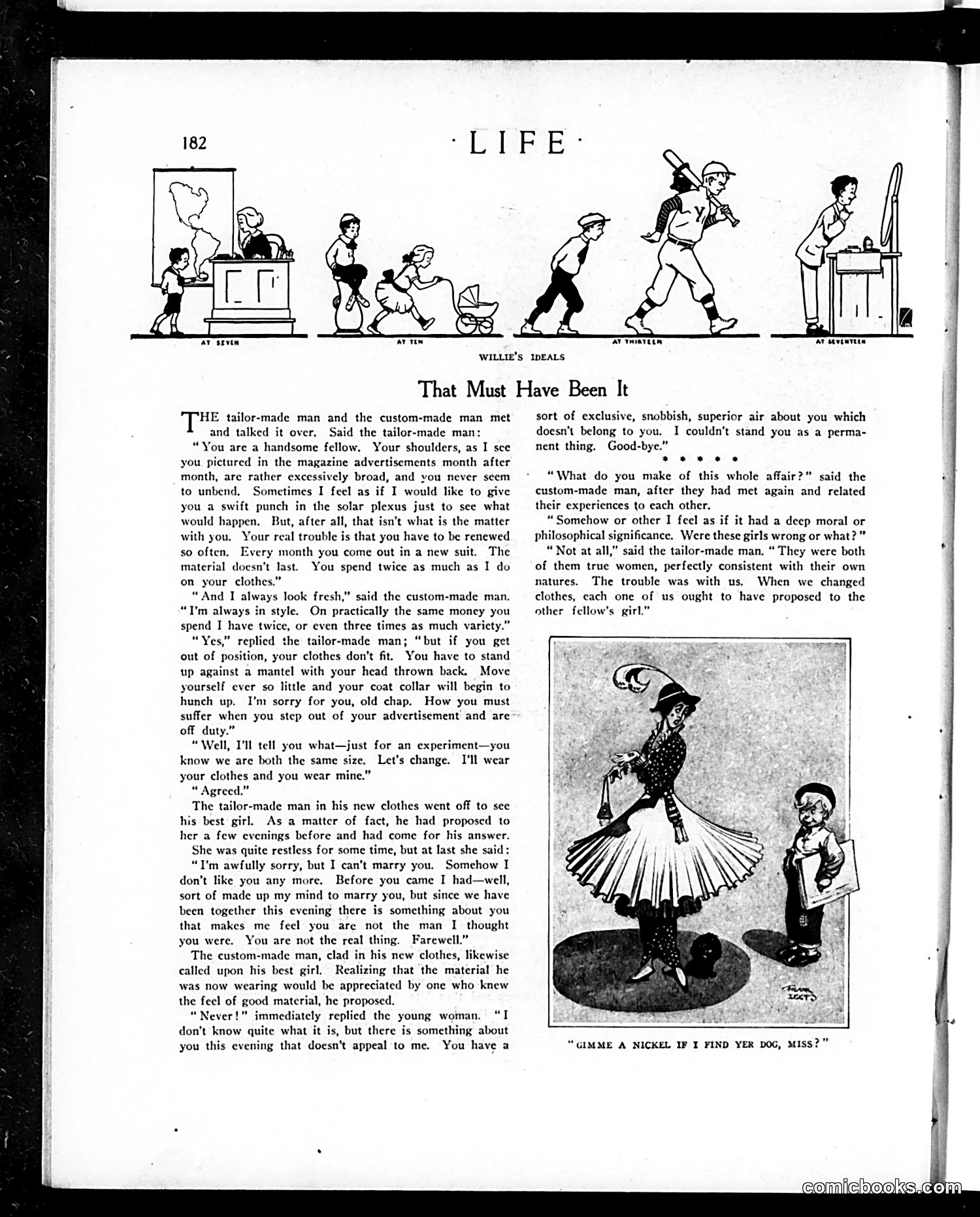
This page contains a satirical story titled "That Must Have Been It," part of a series called "Willie's Ideals." The narrative contrasts two male archetypes: the "tailor-made man" (representing ready-made, mass-produced conformity) and the "custom-made man" (representing individualized luxury). The story's joke: when these men swap clothes, each becomes unattractive to women—not because of physical appearance, but because their clothing fundamentally changes how they present themselves. The tailor-made man in expensive custom clothes loses his authenticity, while the custom-made man in ordinary clothes loses his sophisticated air. The moral punchline suggests women are attracted to men whose *genuine nature* matches their *appearance*—that authenticity matters more than material status. It's social satire about early 20th-century class consciousness, advertising culture, and masculine identity, suggesting that both mass-market conformity and snobbish pretension are equally unappealing when inauthentic.
📄 Transcribed text from this page (OCR, searchable)
Machine-transcribed from the original scan — historical spelling and the odd misread are preserved.
AY seven AT THuntten ‘AT eavewrere WILLIE'S IDEALS That Must Have Been It HE tailor-made man and the custom-made man met nd talked it over. Said the tailor-made man: uu are a handsome fellow. Your shoulders, as I sce you pictured in the magazine advertisements month after month, are rather excessively broad, and you never seem to unbend, Sometimes I feel as if I would like to give you a swift punch in the solar plexus just to see what would happen, But, after all, that isn’t what is the matter with you. Your real trouble is that you have to be renewed y month you come out in a new suit. The You spend twice as much as I do so often, E material doesn’t last. on your clothe: “And I always look fresh,” said the custom-made man. I'm always in style. On practically the same money you spend I have twice, or even three times as much varicty.” “Yes,” replied the tailor-made man; “but if you get out of position, your clothes don’t fit. You have to stand up against a mantel with your head thrown back. Move yourself ever so little and your coat collar will begin to hunch up. I’m sorry for you, old chap. How you must suffer when you step out of your advertisement and are off duty.” “Well, I'll tell you what—just for an experiment—you know we are both the same size, Let's change. I'll wear your clothes and you wear mine.” “ Agreed.” The tailor-made man in his new clothes went off to sce his best girl, As a matter of fact, he had proposed to her a few evenings before and had come for his answer. She was quite restless for some time, but at last she said: “I'm awfully sorry, but I can't marry you. Somehow I don’t like you any more. Before you came I had—well, sort of made up my mind to marry you, but since we have been together this evening there is something about you that makes me feel you are not the man I thought you were. You are not the real thing. Farewell.” The custom-made man, clad in his new clothes, likewise called upon his best girl. Realizing that the material he was now wearing would be appreciated by one who knew the feel of good material, he proposed. “Never!” immediately replied the young woman. “I don’t know quite what it is, but there is something about you this evening that doesn't appeal to me. You have a sort of exclusive, snobbish, superior air about you which doesn’t belong to you, I couldn't stand you as a perma- nent thing. Good-bye.” se eee “What do you make of this whole affair?” said the custom-made man, after they had met again and related their experiences to each other, “Somehow or other I feel as if it had a deep moral or philosophical significance. Were these girls wrong or what?” “Not at all,” said the tailor-made man. “ They were both of them true women, perfectly consistent with their own natures. The trouble was with us. When we changed clothes, cach one of us ought to have proposed to the other fellow’s girl.” “GIMME A NICKEL IF I FIND YER DOG, MISS?”