
Life, 1914-07-30 · page 17 of 40
Life — July 30, 1914 — page 17: what you’re looking at
What you’re looking at
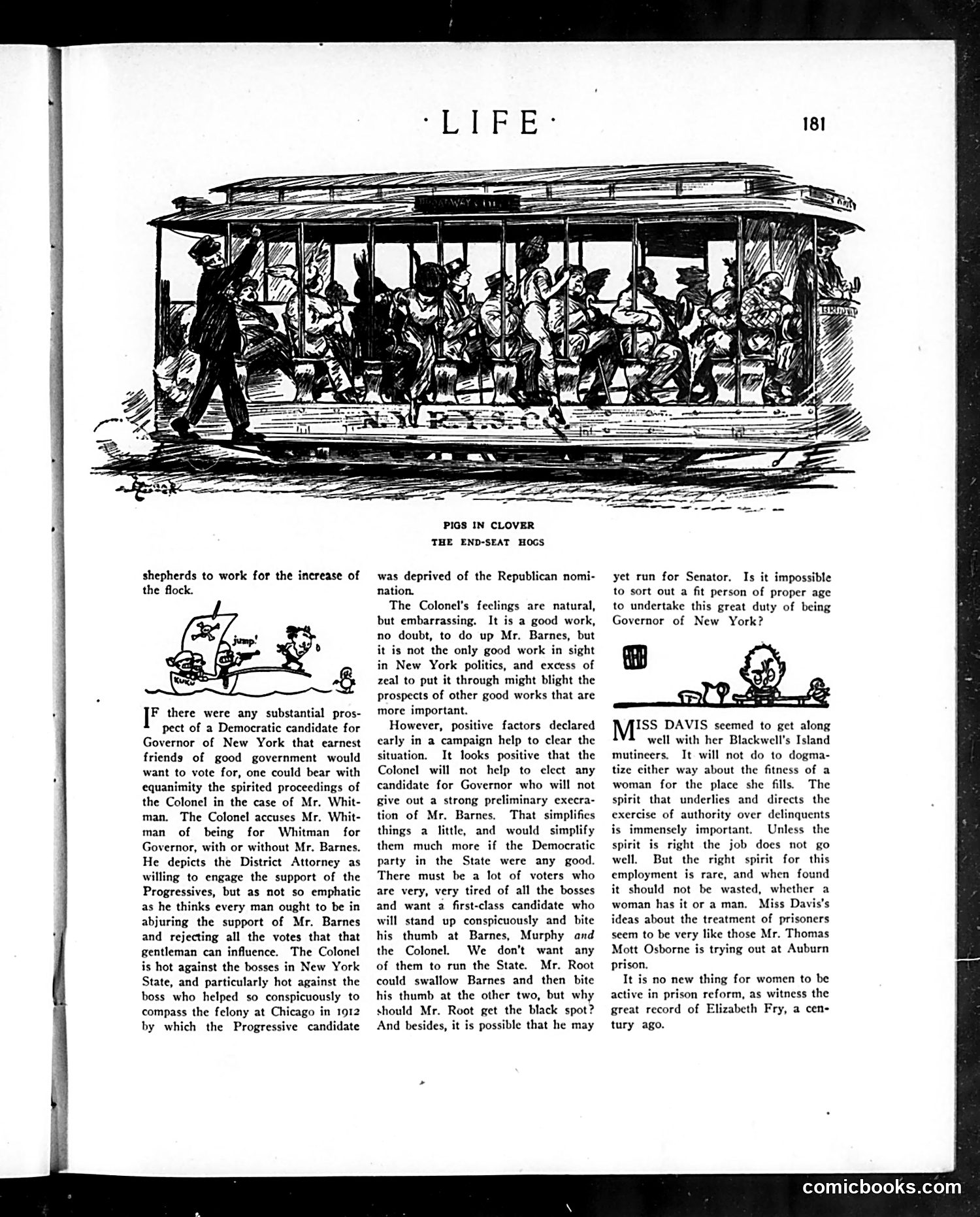
The main cartoon, titled "Pigs in Clover: The End-Seat Hogs," depicts a crowded streetcar—a visual metaphor for New York politics overcrowded with self-interested politicians jostling for position. The accompanying text discusses Colonel Theodore Roosevelt's conflict with New York political bosses, particularly William Barnes, over the gubernatorial race. The writer criticizes Roosevelt's obsessive focus on attacking Barnes, arguing this zeal may undermine other important political goals. The satire suggests all these politicians—Roosevelt, Barnes, and others—are essentially "hogs" fighting for seats of power rather than serving the public interest. The page also briefly covers Miss Davis's work at Blackwell's Island prison, comparing her reformist approach favorably to Thomas Mott Osborne's prison reform efforts at Auburn, suggesting women have historically contributed meaningfully to progressive causes like prison reform.
📄 Transcribed text from this page (OCR, searchable)
Machine-transcribed from the original scan — historical spelling and the odd misread are preserved.
Le See tas sit shepherds to work for the increase of the flock. F there were any substantial pros- pect of a Democratic candidate for Governor of New York that earnest friends of good government would want to vote for, one could bear with equanimity the spirited proceedings of the Colonel in the case of Mr. Whit- man. The Colonel accuses Mr. Whit- man of being for Whitman for Governor, with or without Mr. Barnes. He depicts the District Attorney as willing to engage the support of the Progressives, but as not so emphatic as he thinks every man ought to be in abjuring the support of Mr. Barnes and rejecting all the votes that that gentleman can influence. The Colonel is hot against the bosses in New York State, and particularly hot against the boss who helped so conspicuously to compass the felony at Chicago in 1912 by which the Progressive candidate PIGS IN CLOVER THE END-SEAT HOGS was deprived of the Republican nomi- nation. The Colonel’s feelings are natural, but embarrassing. It is a good work, no doubt, to do up Mr. Barnes, but it is not the only good work in sight in New York politics, and excess of zeal to put it through might blight the prospects of other good works that are more important. However, positive factors declared early in a campaign help to clear the situation. It looks positive that the Colonel will not help to elect any candidate for Governor who will not give out a strong preliminary execra- tion of Mr. Barnes, That simplifies things a little, and would simplify them much more if the Democratic party in the State were any good. There must be a lot of voters who are very, very tired of all the bosses and want a first-class candidate who will stand up conspicuously and bite his thumb at Barnes, Murphy and the Colonel. We don’t want any of them to run the State. Mr. Root could swallow Barnes and then bite his thumb at the other two, but why should Mr. Root get the black spot? And besides, it is possible that he may yet run for Senator. Is it impossible to sort out a fit person of proper age to undertake this great duty of being Governor of New York? ISS DAVIS seemed to get along well with her Blackwell's Island mutineers. It will not do to dogma- tize either way about the fitness of a woman for the place she fills. The spirit that underlies and directs the exercise of authority over delinquents is immensely important. Unless the spirit is right the job does not go well. But the right spirit for this employment is rare, and when found it should not be wasted, whether a woman has it or a man. Miss Davis's ideas about the treatment of prisoners seem to be very like those Mr. Thomas Mott Osborne is trying out at Auburn prison. It is no new thing for women to be active in prison reform, as witness the great record of Elizabeth Fry, a cen- tury ago. comicbooks.com