
A complete issue · 44 pages · 1914
Life — April 30, 1914
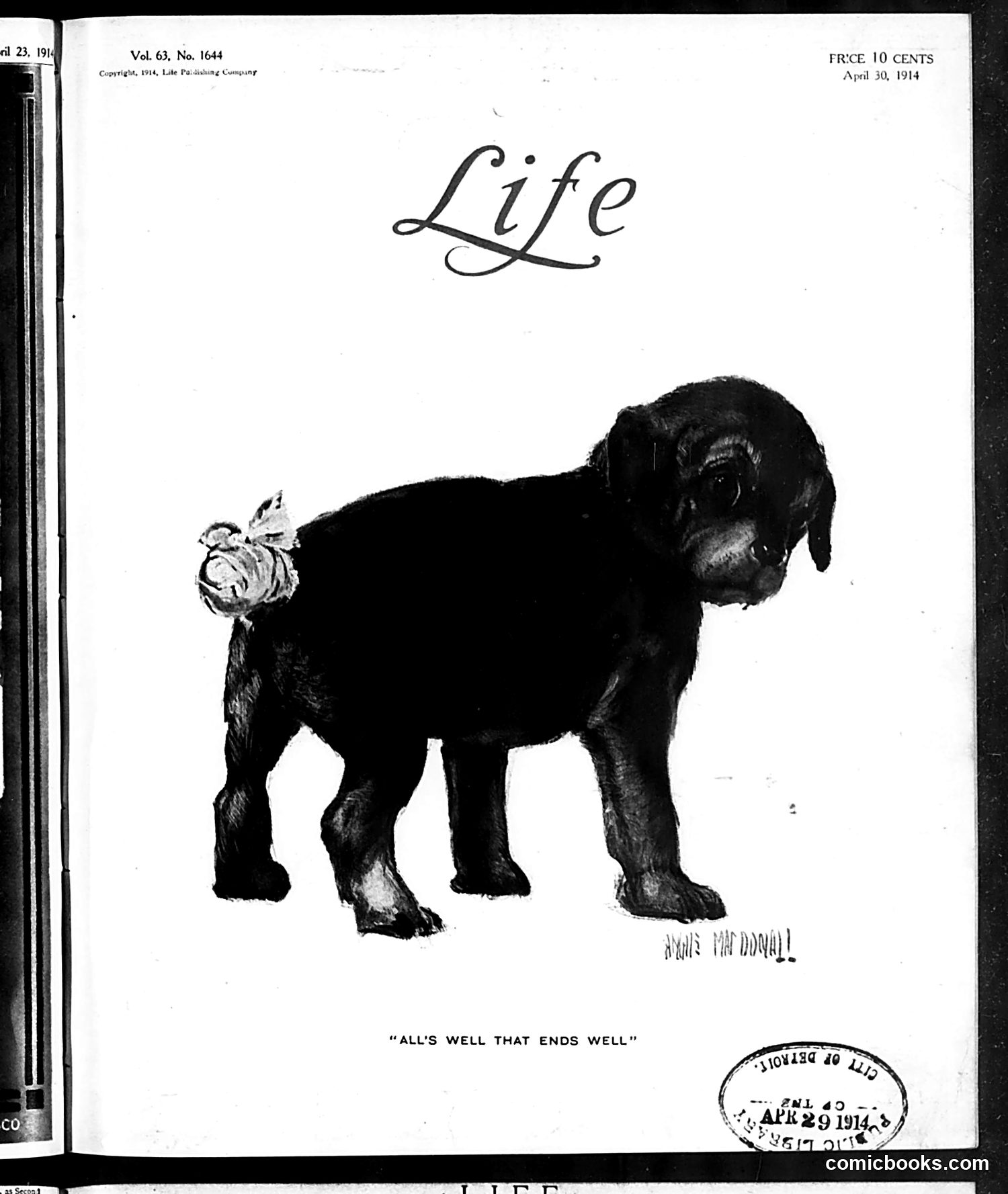
This is the cover of *Life* magazine from April 1914, featuring a dark dog holding a rose in its mouth beneath the caption "ALL'S WELL THAT ENDS WELL." The image appears to be a political cartoon using the dog as a metaphor, though the specific reference is unclear without additional context. The dog's elegant pose with the rose suggests either reconciliation or a favorable resolution to some contemporary dispute or conflict. The Shakespeare reference in the caption implies matters have concluded satisfactorily. Without knowing which specific 1914 political or social events *Life* was commenting on, I cannot definitively identify what situation this satirizes, though the hopeful tone suggests commentary on a resolved controversy or diplomatic matter.
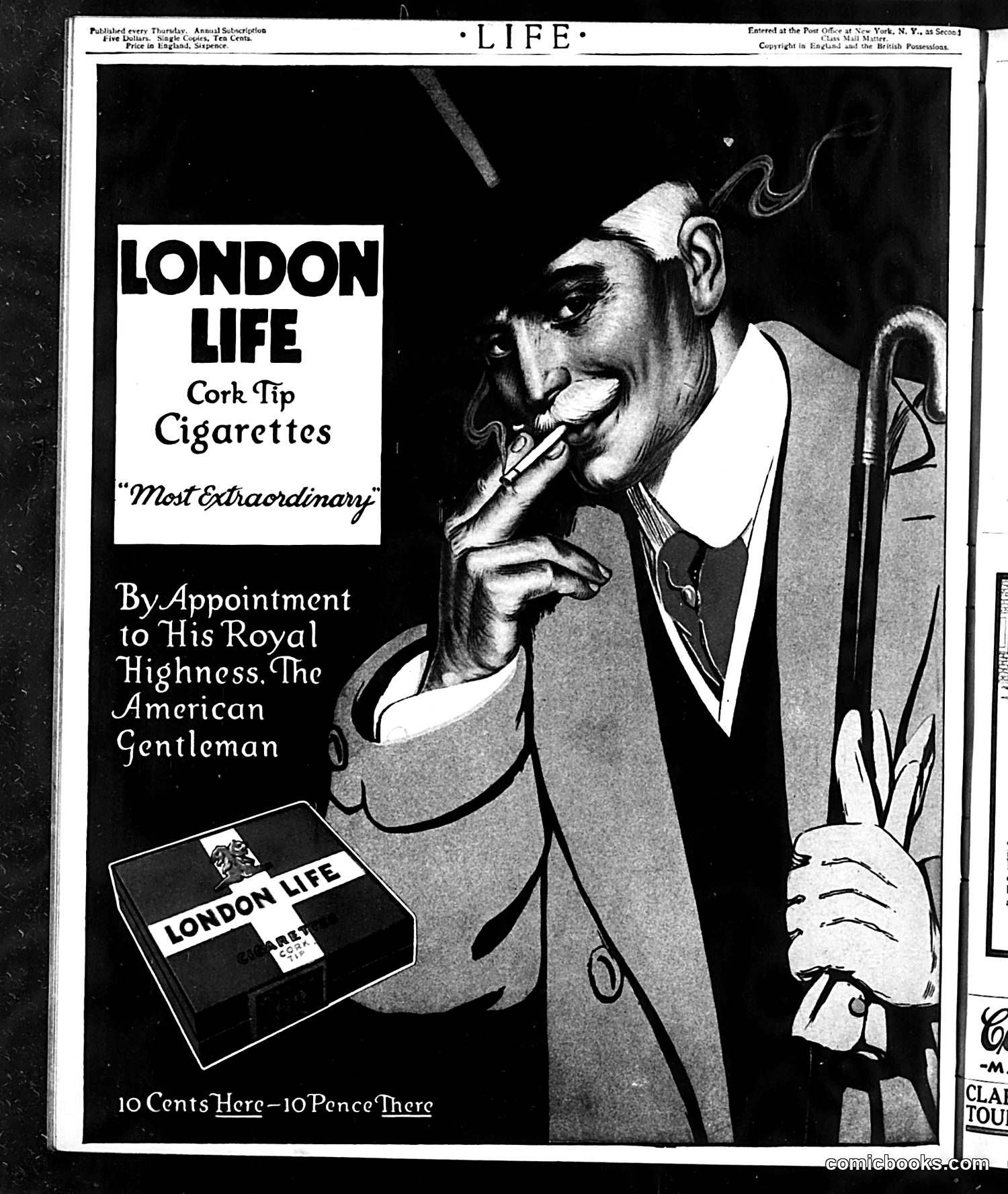
This page is primarily a **cigarette advertisement** for "London Life" brand cork-tip cigarettes, not political satire. The illustration depicts a caricatured male figure—appearing to be a stereotypical "American Gentleman"—smoking a cigarette. The exaggerated facial features and theatrical dress (top hat, monocle, formal attire) suggest satire of pretentious American wealth or fashion. The ad's tagline claims the product is "By Appointment to His Royal Highness," a marketing strategy that invokes British aristocratic prestige to appeal to American consumers seeking status symbols. This reflects early 20th-century American admiration for British refinement. The pricing ("10 Cents Here—10 Pence There") indicates transatlantic distribution. The humor derives from the absurdity of positioning a mass-market cigarette as a luxury good for the social elite.
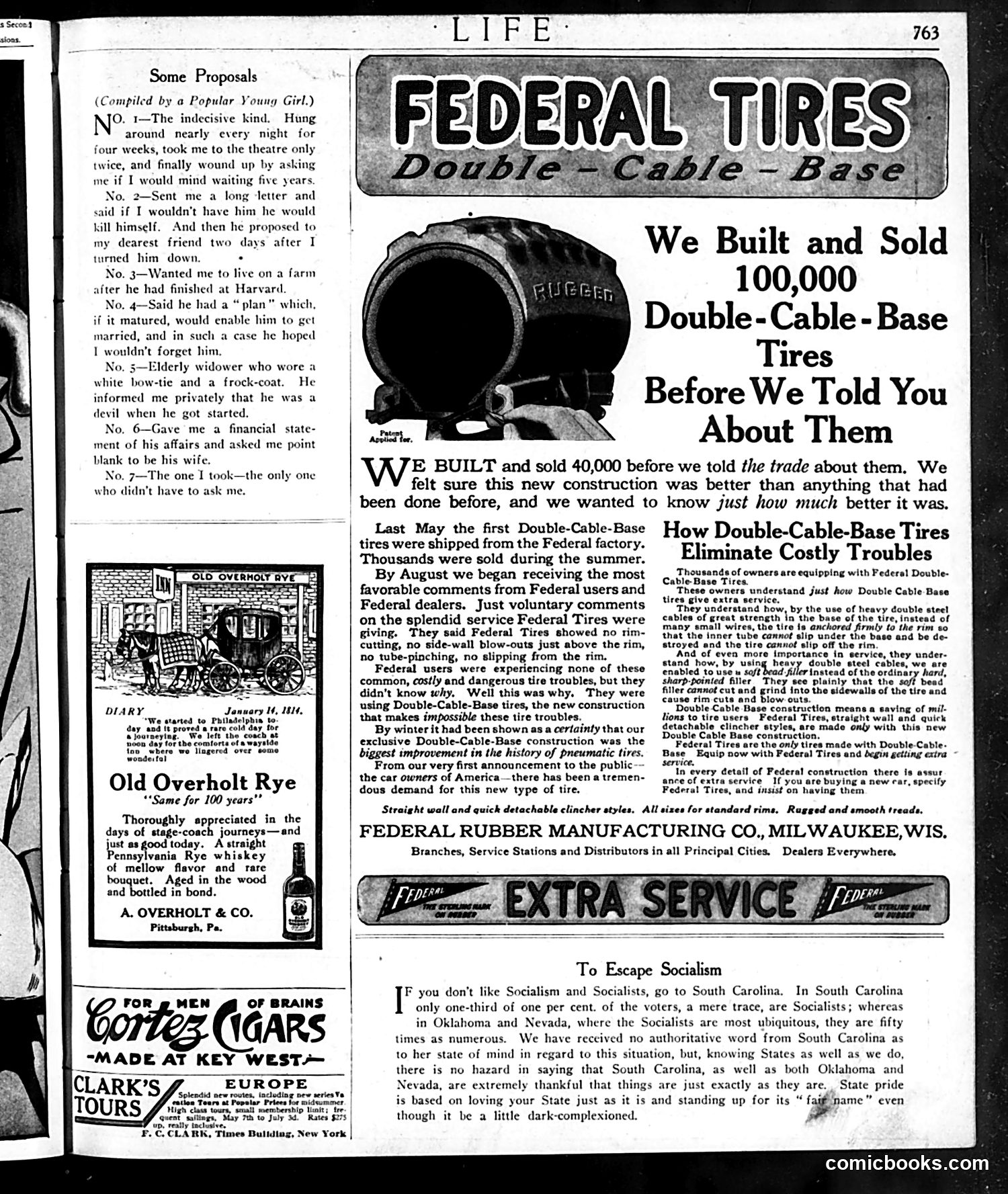
This page is primarily **advertising and light social commentary**, not political satire. The dominant content is a Federal Tires advertisement promoting their "Double-Cable-Base" tire construction, claiming 100,000 units sold before public announcement. The ad emphasizes durability and addresses tire troubles common to the era. The left column contains "Some Proposals (Compiled by a Popular Young Girl)"—humorous relationship rejections from suitors, presented as satirical commentary on courtship customs. These are lighthearted rather than politically pointed. Additional advertisements include Old Overholt Rye whiskey, Cortez Cigars, and Clark's European Tours. The bottom includes a brief political note about socialism in South Carolina versus Oklahoma and Nevada, but it's minor content on the page. Overall: **a commercial publication page with modest social humor**, not significant political cartooning.
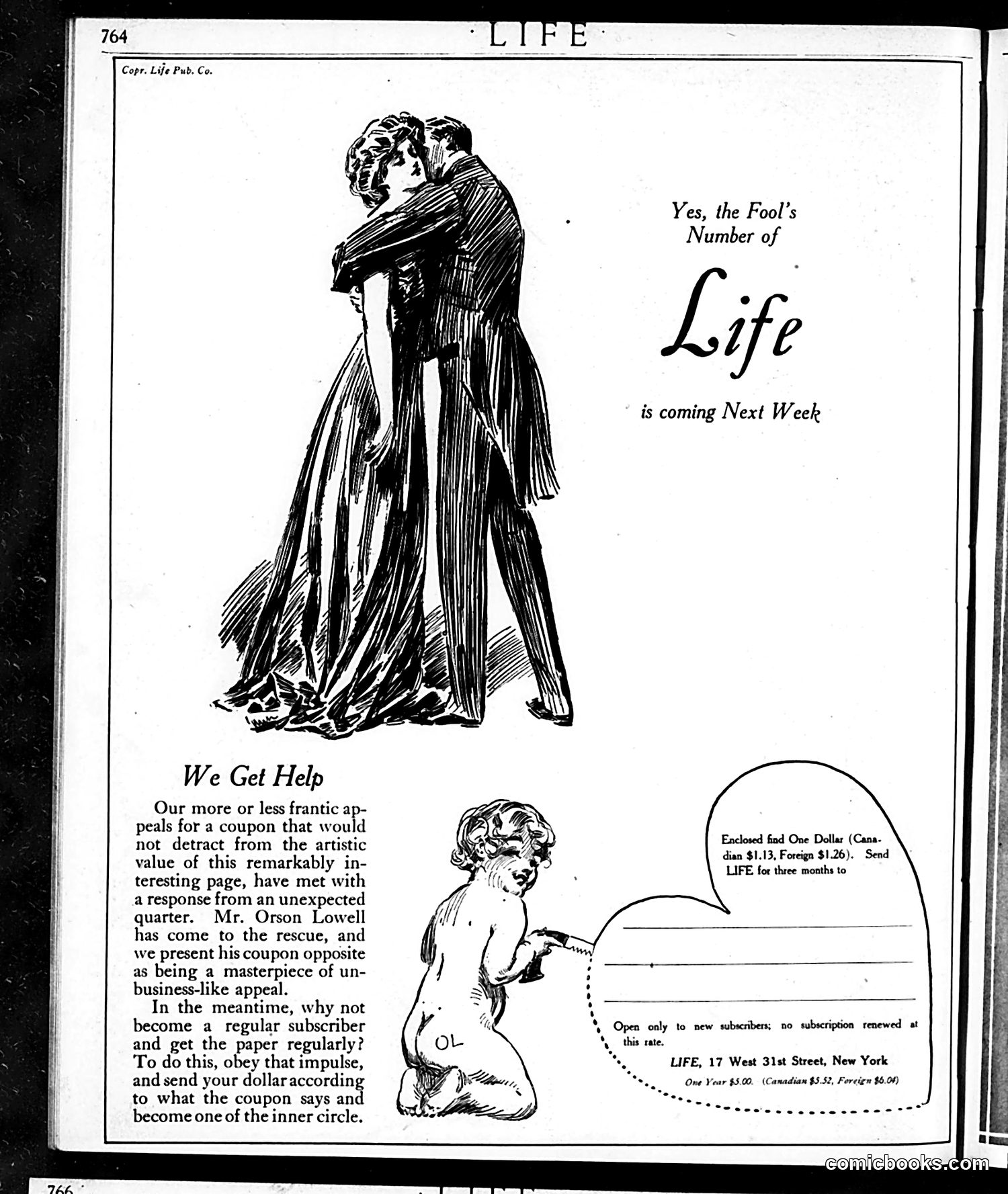
This page is primarily a **subscription advertisement for Life magazine**, disguised as editorial content. The top illustration shows a romantic couple (likely referencing popular romantic fiction or theater of the era), accompanying the teaser "Yes, the Fool's Number of Life is coming Next Week." The lower section uses humor to pitch subscriptions. A cherub labeled "OL" (possibly Life's mascot) sits with a coupon, addressing readers who've requested a subscription discount. The text acknowledges their "frantic appeals" for a coupon and presents one here, claiming it represents "business-like appeal." The actual offer: one dollar (Canadian $1.13, Foreign $1.25) for three months' subscription to Life—but only for new subscribers. This is essentially **advertorial content**: mixing editorial/satirical humor with direct sales pitch to boost Life's circulation.
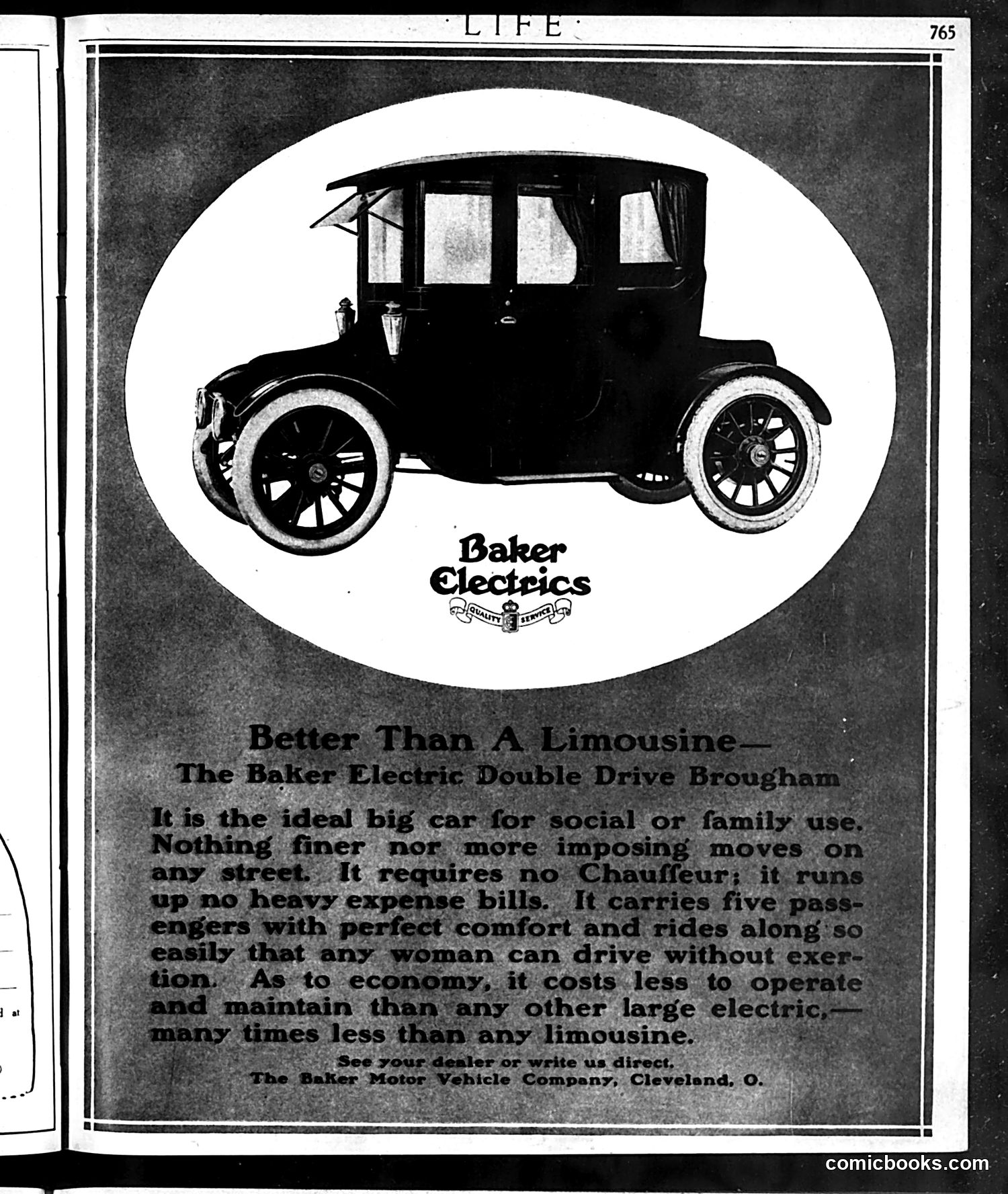
This is a straightforward automobile advertisement, not satire or political commentary. The page promotes the Baker Electric Double Drive Brougham, marketed as superior to limousines for wealthy families and social use. The ad's pitch emphasizes practical advantages: no chauffeur needed (women can drive it easily), lower operating costs than limousines, and five-passenger capacity with comfort. It appeals to early-20th-century car buyers by highlighting the electric vehicle's reliability and economy. The "Better Than A Limousine" headline positions the Baker as a status symbol requiring less expense and maintenance. This reflects the era when electric cars competed seriously with gasoline vehicles before gasoline ultimately dominated. The Baker Motor Vehicle Company was based in Cleveland, Ohio.
This is a **full-page advertisement**, not satire or a political cartoon. The White Company, an Ohio automobile manufacturer, is promoting White cars as superior long-term investments that retain value. The ad's main argument: White cars appear rarely on the used-car market because owners keep them rather than trade them in—supposedly evidence of their quality and durability. The company contrasts this favorably against competitors' cars, which are "built to be traded" and quickly become worthless. The pitch targets buyers seeking economical, reliable vehicles that won't require frequent replacement. This reflects 1920s automotive marketing emphasizing durability and lifetime value—concepts quite different from modern planned obsolescence or trade-in cycles.
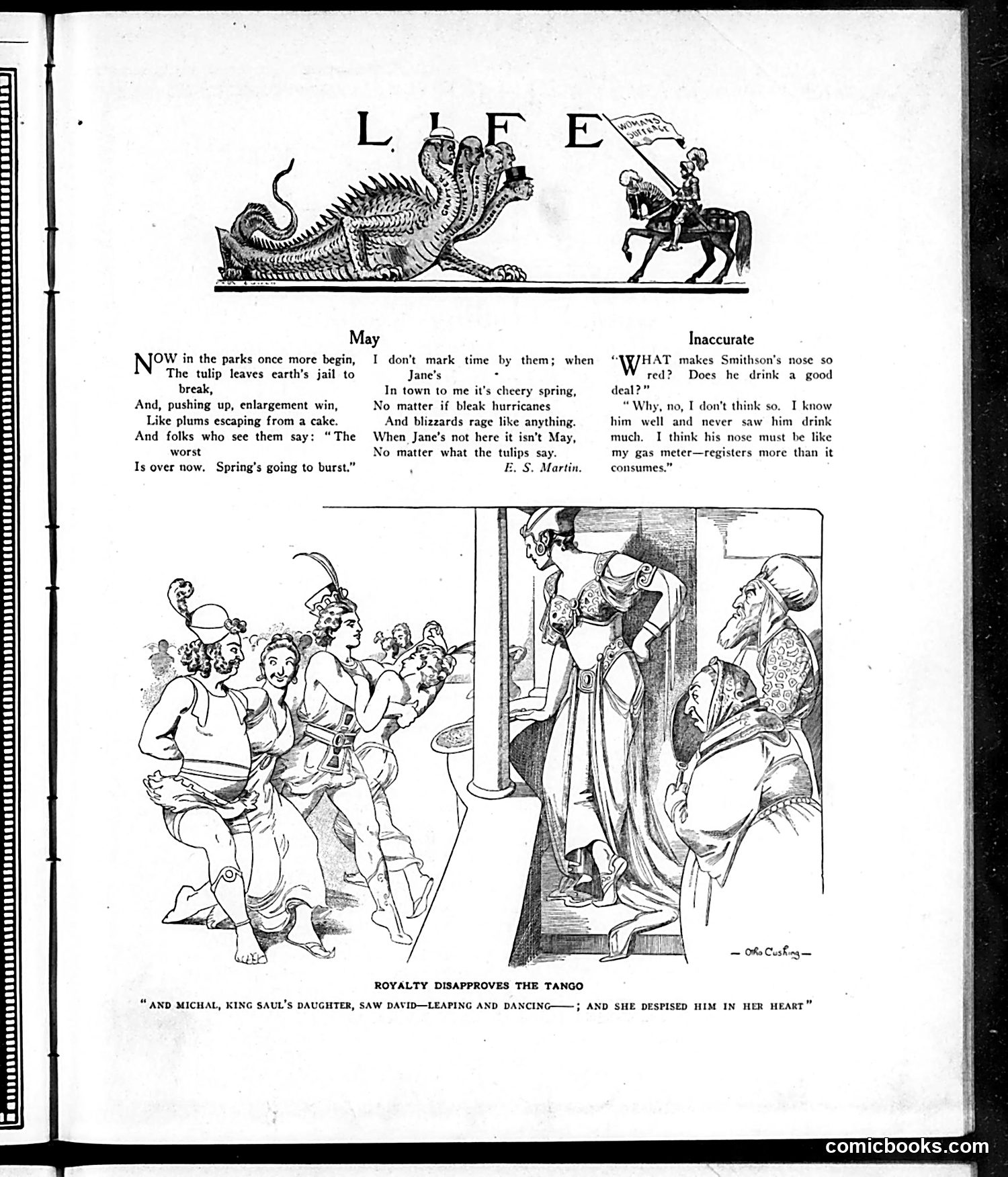
This page features satirical poetry and illustrations about May and courtship. The top section includes two poems—one celebrating spring's arrival ("NOW in the parks once more bein / The tulip leaves earth's jail to break"), and another titled "Inaccurate" mocking a man who drinks heavily despite claims otherwise. The main illustration below, captioned "ROYALTY DISAPPROVES THE TANGO," depicts a biblical or classical scene where a king's daughter observes David dancing and "despised him in her heart." This references the historical account from 1 Samuel, but adapts it to satirize contemporary concerns about the tango—a then-scandalous dance considered morally questionable by respectable society. The joke equates David's undignified dancing with the tango's disreputable status among the elite.
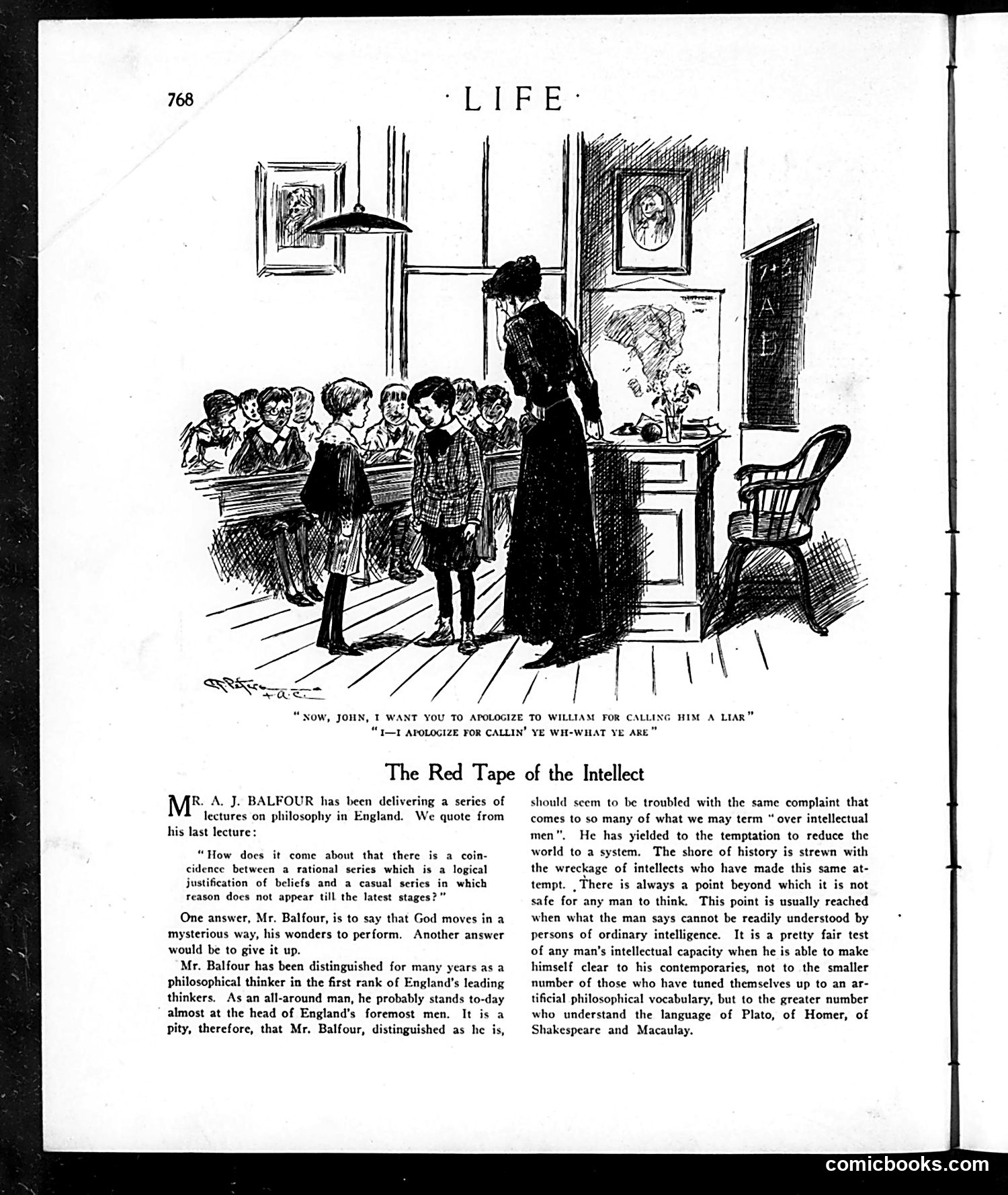
The cartoon shows a schoolteacher addressing two students, with one child forced to apologize to another for calling him a liar. The caption reads: "Now, John, I want you to apologize to William for calling him a liar" / "I—I apologize for callin' ye wh-what ye are." The accompanying article critiques philosopher R.A.J. Balfour's lectures, satirizing intellectual over-systemization. The satire suggests that rigid philosophical thinking—forcing logical justification where none fits reality—mirrors the absurdity of the schoolroom scene: enforcing formal rules that contradict observable truth. The "red tape" metaphor refers to bureaucratic formalism that stifles honest observation and common sense, suggesting intellectuals complicate simple matters through excessive abstraction.
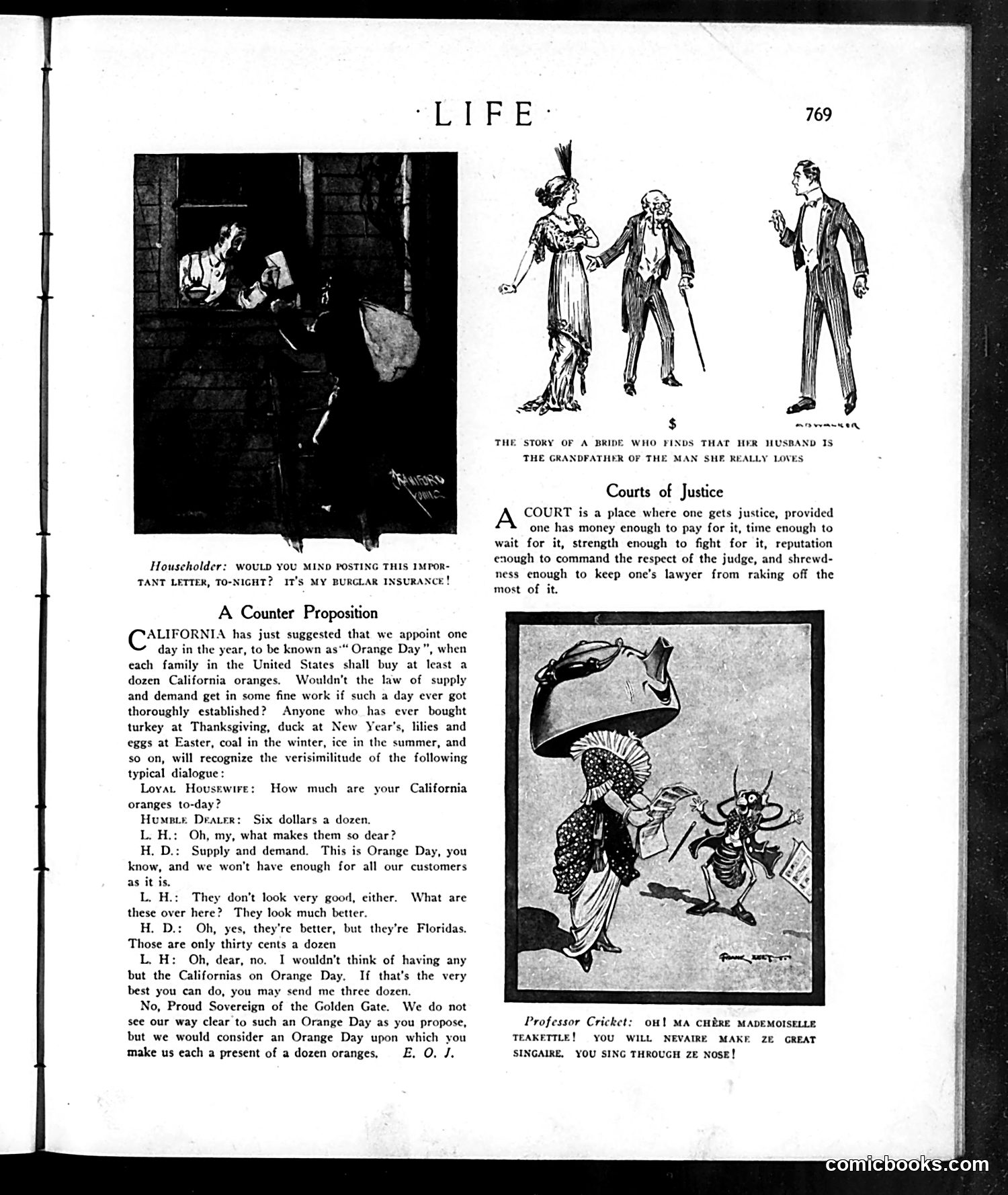
This page contains two distinct pieces of satire: **"A Counter Proposition"** presents a dialogue between a "Loyal Housewife" and a "Humble Dealer" about California oranges on a proposed "Orange Day." The satire mocks supply-and-demand economics: the dealer explains why oranges would be expensive (limited supply on that day), while the housewife insists on buying only California oranges regardless. The joke critiques both rigid consumer preferences and economic naiveté—the housewife wants to support California producers but doesn't grasp that mandatory single-day purchasing would create scarcity and inflation. **"Courts of Justice"** is an opening section defining courtrooms as places requiring patience, resources, and shrewd legal representation. The illustration (lower right) shows "Professor Cricket" addressing a French mademoiselle about singing through one's nose—likely a musical or accent-based joke.
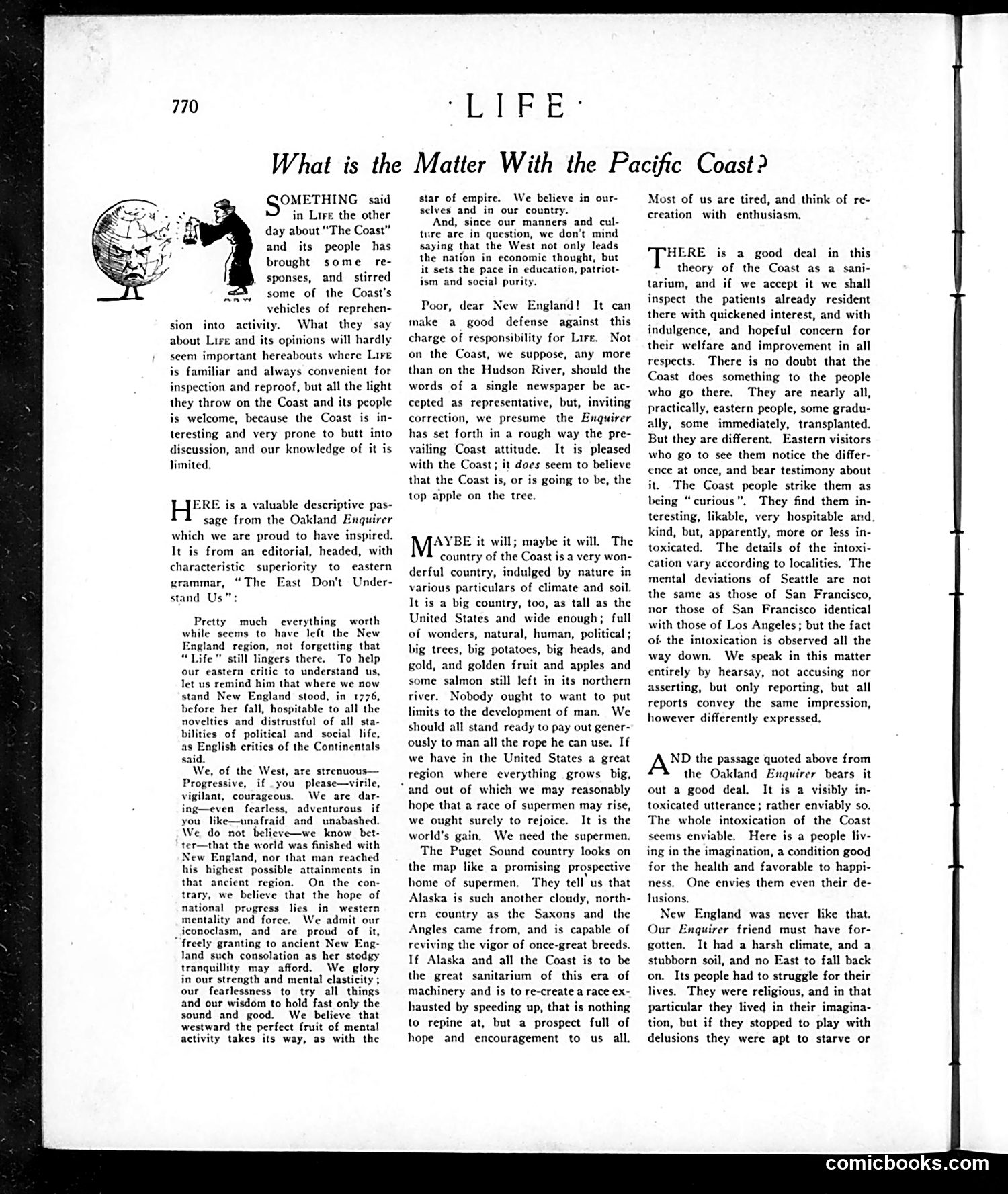
This page contains editorial commentary rather than political cartoon. The illustration shows a figure examining a globe, symbolizing scrutiny of the Pacific Coast region. The article defends the Pacific Coast against criticism, likely from Eastern publications like the *Enquirer*. The author acknowledges coastal residents are "curious" and sometimes "intoxicated" in their imaginative schemes, but argues this reflects youthful ambition rather than fundamental flaws. The piece compares the Coast favorably to New England, suggesting Eastern critics underestimate Western potential. It references Alaska and the Puget Sound as promising developments, presenting Western expansion as beneficial national progress rather than reckless speculation. The tone is defensive yet boastful—typical of regional rivalry between East and West during America's expansion period.
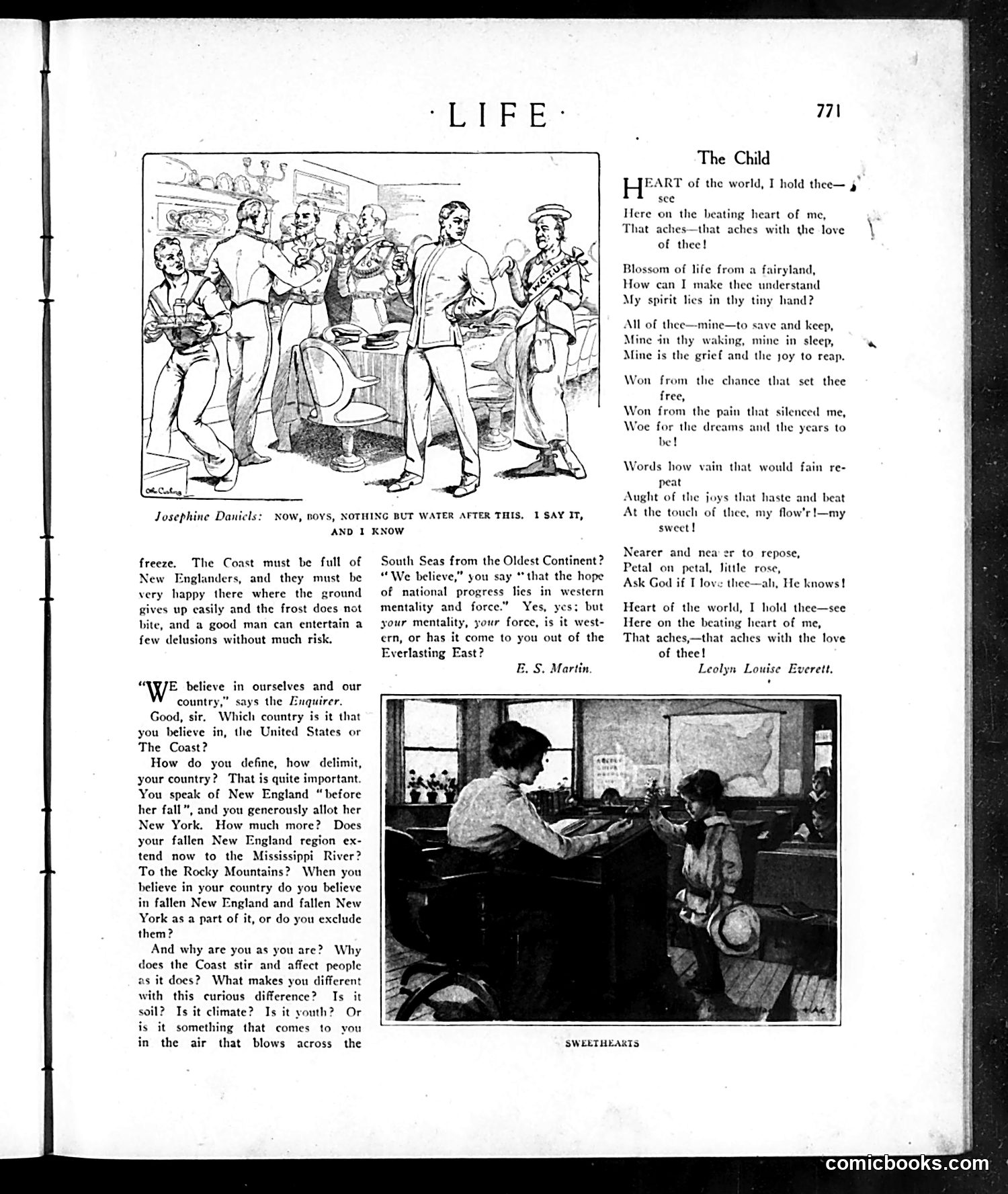
The top illustration depicts a group of men in what appears to be a ship's cabin or quarters, with the caption attributing dialogue to "Josephine Daniels." The sketch satirizes a naval or maritime setting, though the specific political reference is unclear without additional context. Below this, a lengthy prose section quotes the *Enquirer* challenging regional identity—specifically debating whether one's allegiance lies with New England, New York, the Coast, or the broader nation. This appears to address early 20th-century American regionalism and questions of national versus local loyalty. The bottom photograph labeled "Sweethearts" shows two figures in an intimate moment, likely illustrating social commentary on courtship or relationships of the era.
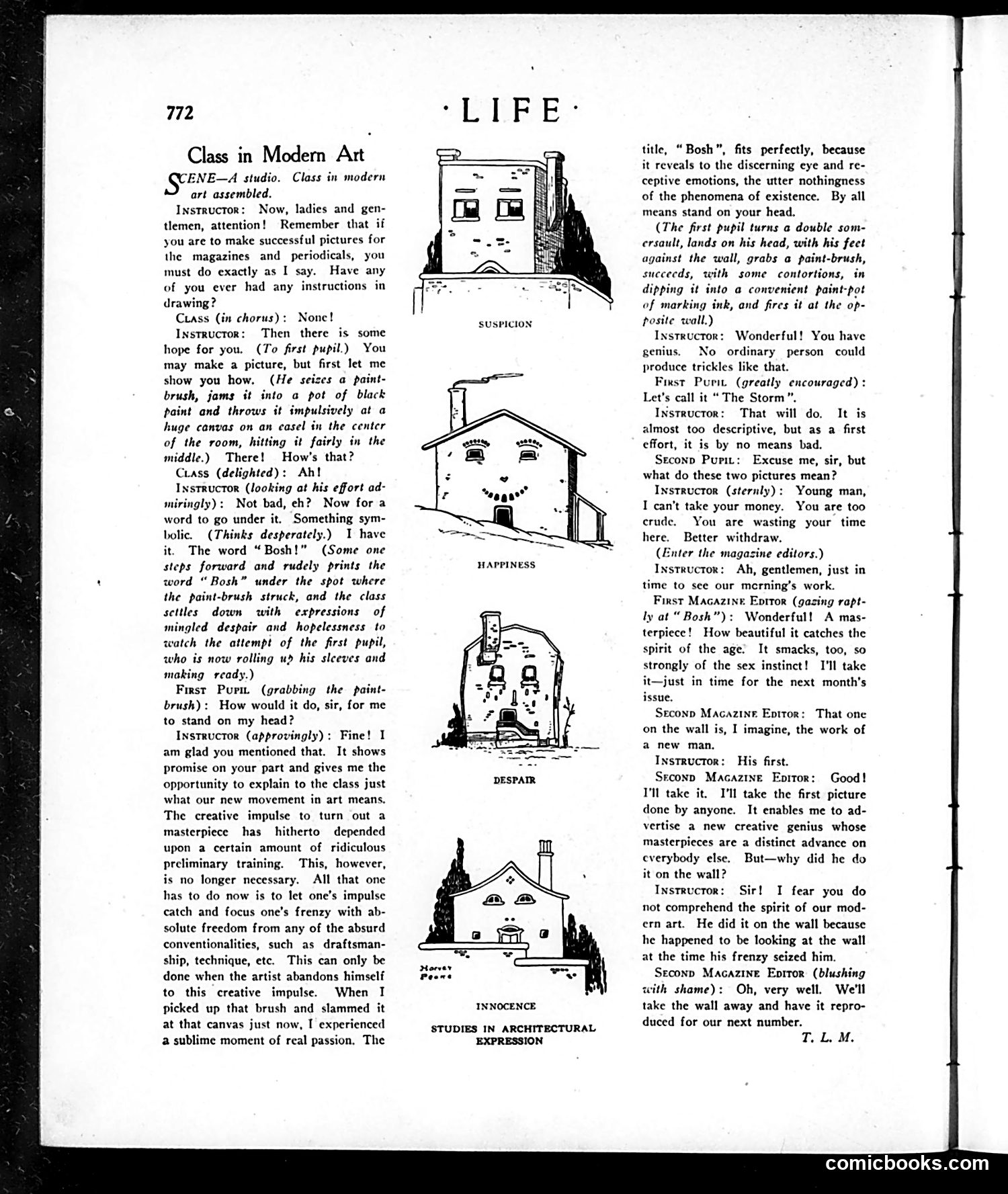
This page satirizes early modernism's abstract art movement through a classroom dialogue. An instructor teaches "students" (the magazine's readers) that modern art requires no technical skill—just raw impulse and freedom from "absurd conventions, such as craftsmanship, technique, etc." The simple house drawings labeled "Suspicion," "Happiness," "Despair," and "Innocence" exemplify the joke: crude architectural sketches presented as profound artistic expression. The satire peaks when magazine editors praise the first amateur drawing as a "masterpiece," then demand its removal from the wall—exposing how arbitrarily the art world treats modernist work. The piece mocks both abstract art's rejection of traditional training and the pretentious critical establishment that elevates such work, suggesting the emperor has no clothes.
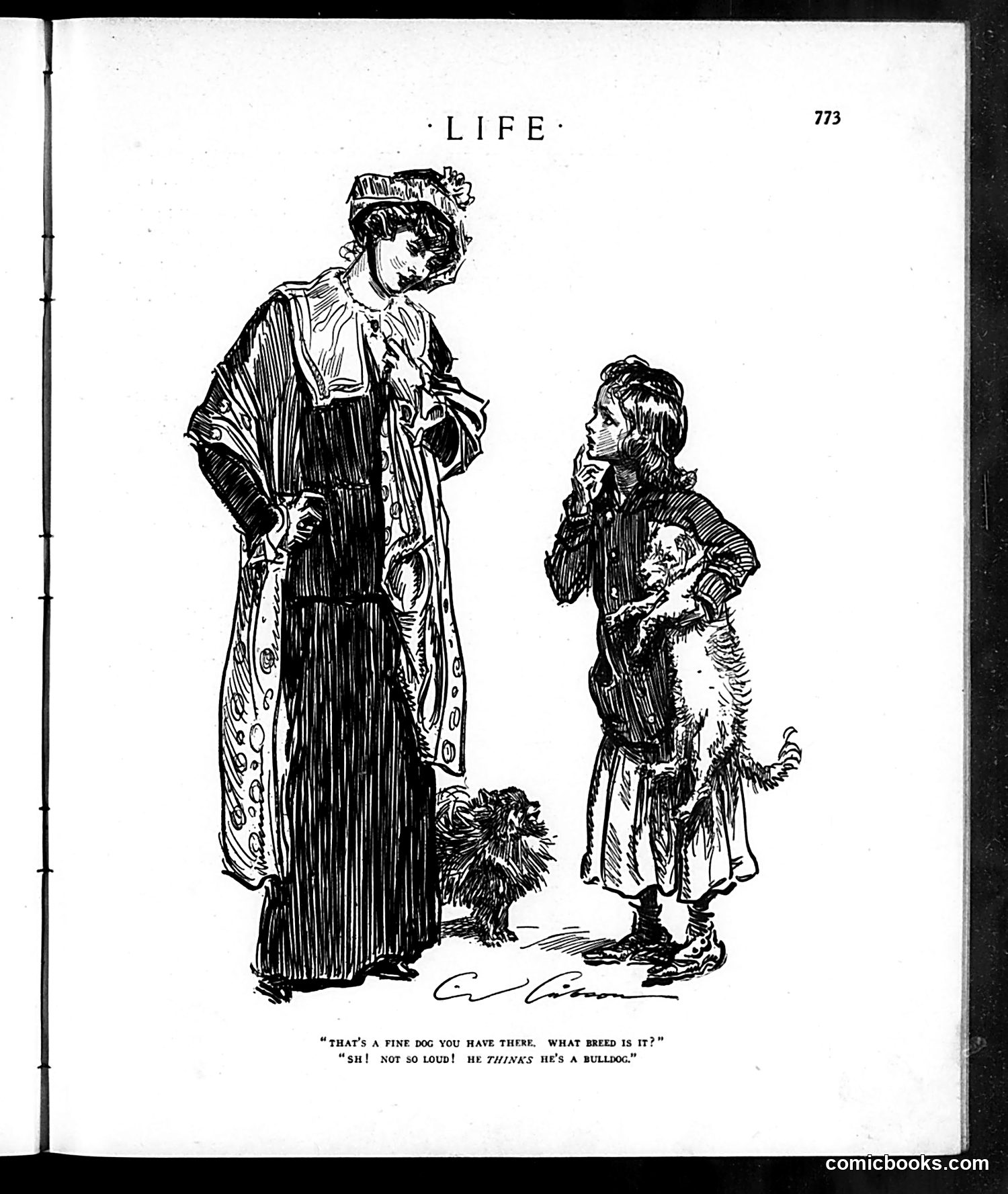
This is a single-panel cartoon from *Life* magazine (page 773) depicting a social interaction between an elegantly dressed woman and a young child with a small dog. The woman asks about the dog's breed, and the child responds that it's "not so loud" but "thinks he's a bulldog"—suggesting the small dog has an outsized, aggressive personality despite its diminutive size. The humor appears to satirize the gap between appearance and self-perception: the dog's delusion about its own importance mirrors human pretension. The child's frank response—and the woman's fashionable attire contrasting with the modest dog—emphasizes the absurdity of the dog's misplaced confidence. This reflects early 20th-century satirical humor about social pretension and self-aggrandizement.
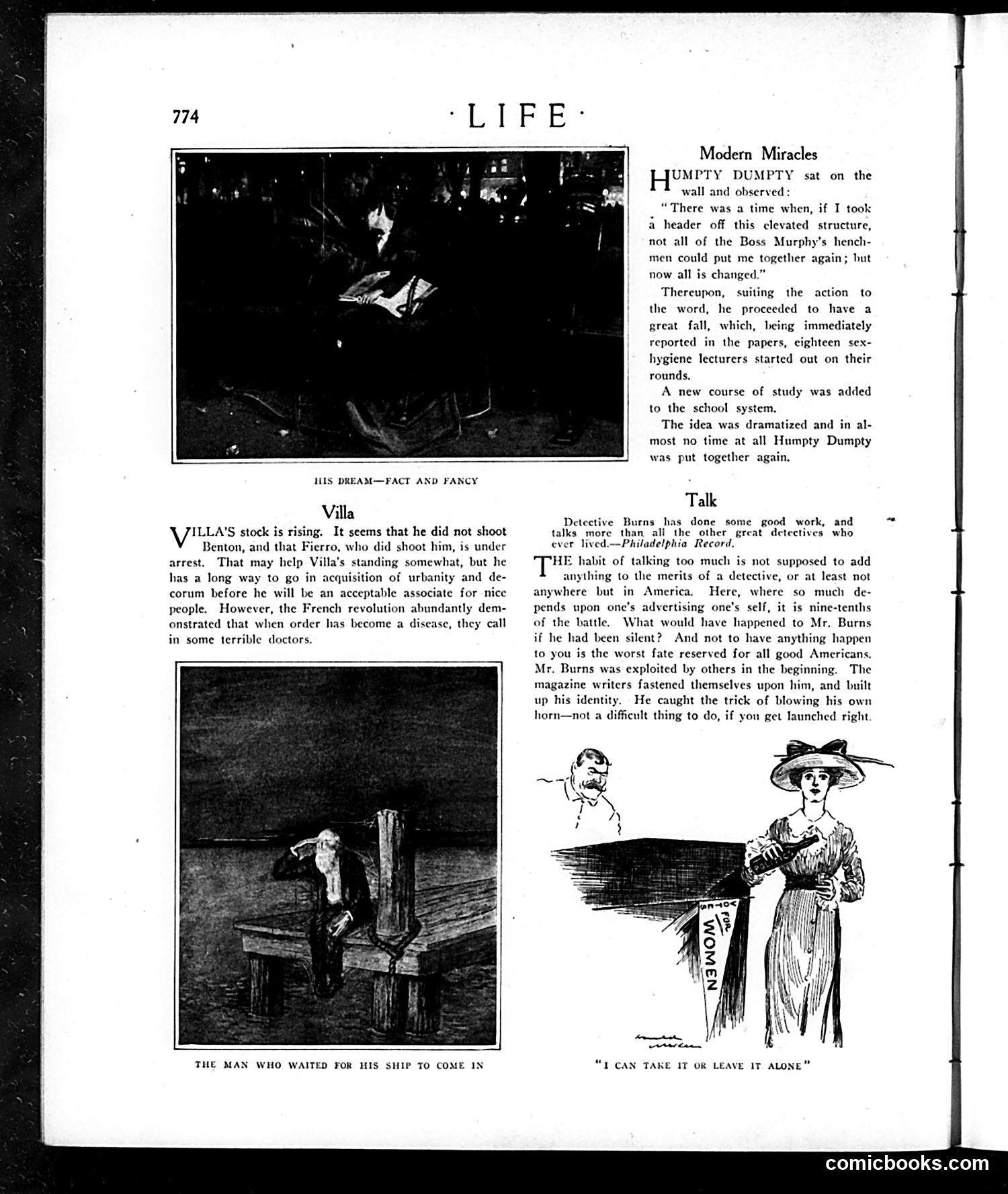
This Life magazine page contains two satirical sections: **"Modern Miracles"** (top): A humorous riff on Humpty Dumpty, suggesting that even if the nursery-rhyme egg had a catastrophic fall at "Boss Murphy's" (likely referring to a political figure), modern science could reconstruct him. The satire mocks both the fragility of authority figures and society's faith in new expertise—eighteen hygiene lecturers supposedly started making rounds based on Humpty's accident. **"Villa" and "Talk"** (bottom): The Villa section discusses someone named Denton and references Villa (unclear which figure). The "Talk" section critiques Detective Burns, praising his silent method of police work. It contrasts American detectives who talk too much with Burns's effective silence, suggesting chattiness undermines investigative success. The cartoon illustrates a woman literally silencing a man's boasting about himself.
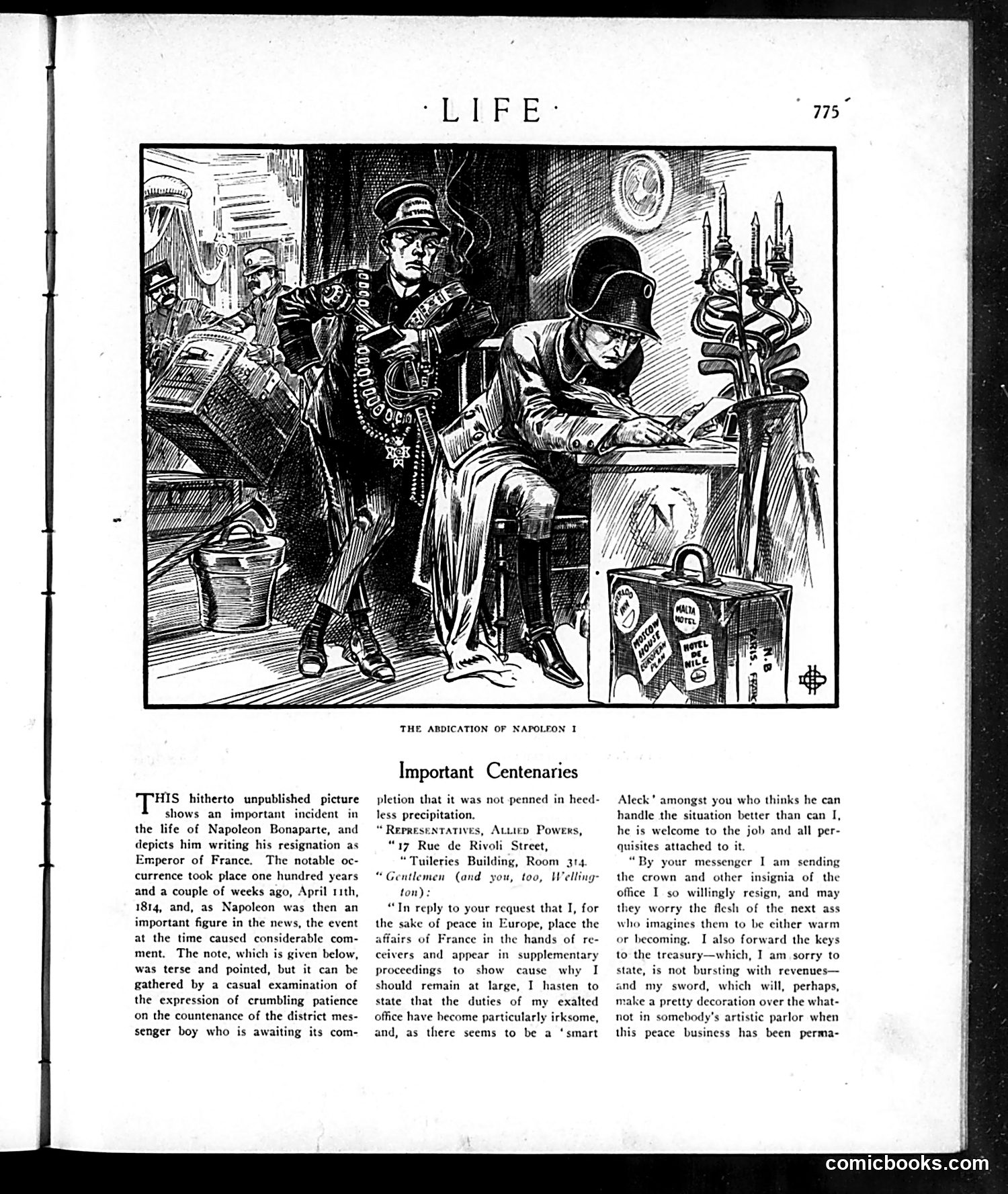
This is a satirical cartoon commemorating the centennial of Napoleon's 1814 abdication. The image depicts Napoleon resignedly writing his abdication letter to the Allied Powers, while a messenger boy impatiently waits. The satire lies in the mock-formal letter itself. Life presents Napoleon's resignation in colloquial, sardonic 1910s American language rather than formal diplomatic prose. He complains the job has become "irksome," welcomes whoever thinks they can do better, and dismissively refers to France's treasury as "not bursting with revenues." The humor targets both Napoleon's deflated pride and the absurdity of framing a monumental historical event in casually modern terms. The patient-but-exasperated messenger boy watching this elaborate resignation adds comic visual irony—he just wants the letter finished. This reflects Life magazine's typical approach: using historical moments as vehicles for contemporary wit and deflating pretension.
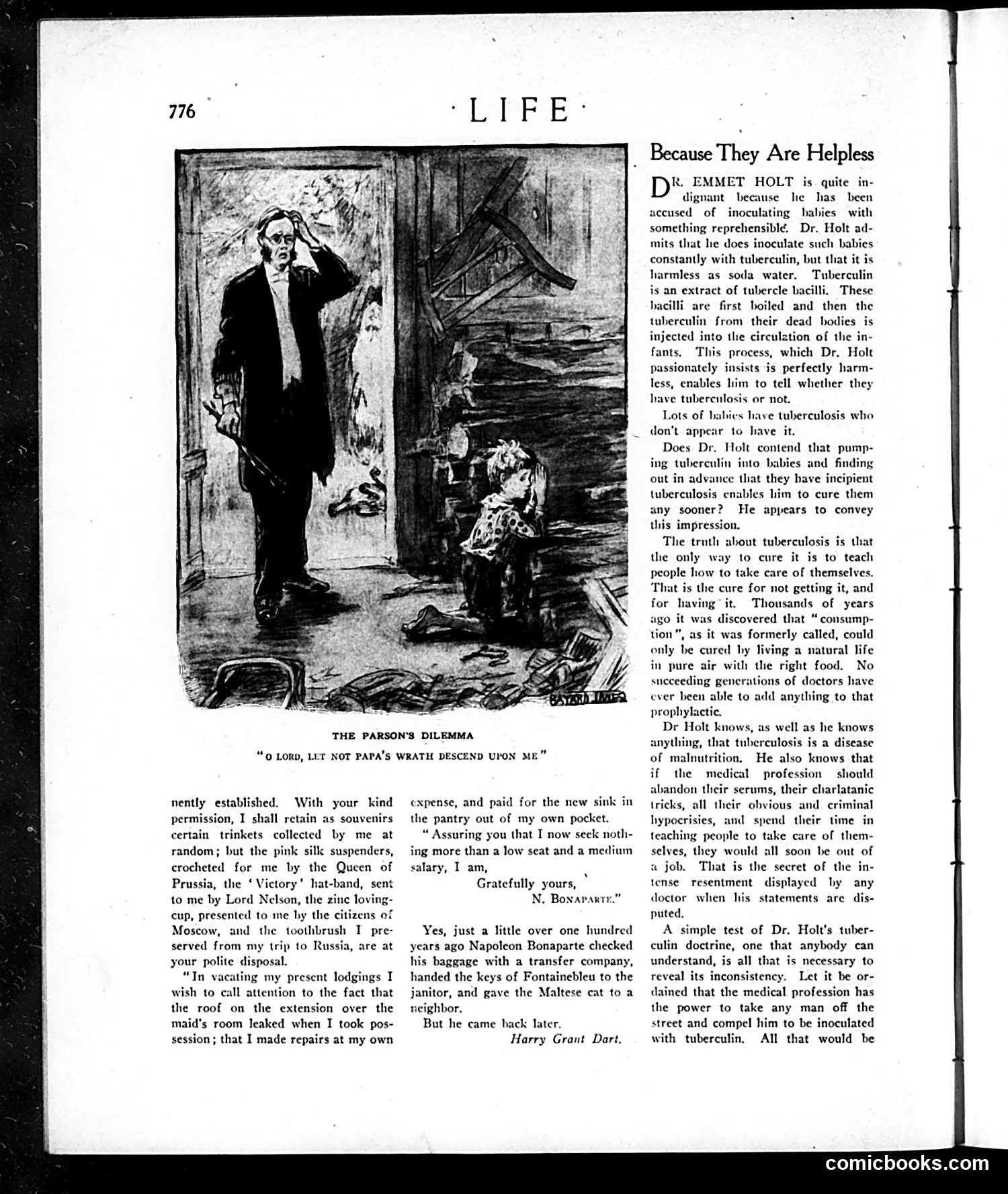
This Life magazine page contains two distinct satirical pieces: **"The Parson's Dilemma"** (cartoon): A clergyman nervously prays while evicting a tenant. The accompanying text parodies Napoleon Bonaparte's deferential letter while vacating lodgings—a darkly comic comparison suggesting that even the most powerful figures must submit to landlords' authority. The satire mocks the inherent powerlessness of those below in the social hierarchy. **"Because They Are Helpless"** (editorial essay): A scathing critique of Dr. Emmet Holt's tuberculin inoculation program for infants. Life argues that Holt's testing serves the medical profession's financial interests rather than patients' health. The essay contends tuberculosis stems from malnutrition and poor living conditions—curable only through proper care and hygiene—not medical intervention. Life sardonically suggests doctors resist acknowledging this because prevention would eliminate their professional necessity. Both pieces target institutional power wielded over the vulnerable: landlords over tenants, doctors over helpless infants.
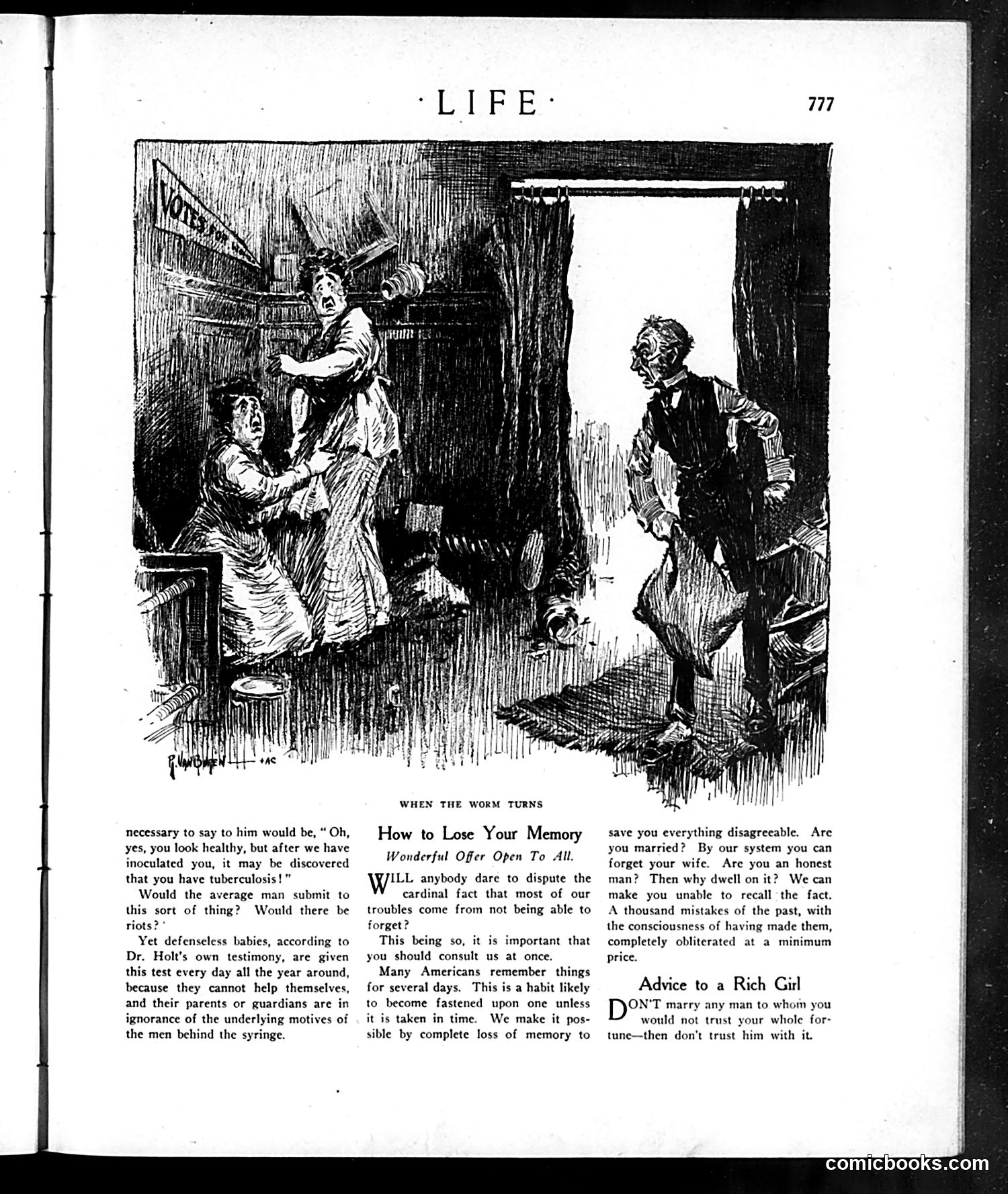
## The Cartoon ("When the Worm Turns") The illustration depicts a confrontation between a well-dressed man (appearing to be a doctor or medical authority) and an angry working-class man who has entered his office, while a woman cowers nearby. The "worm turns" references the proverb about even the meekest eventually rebelling. ## The Satire's Target The accompanying text attacks involuntary medical testing on infants, specifically tuberculosis inoculation. It argues that while adult men would rightfully refuse such procedures, defenseless babies are tested "every day all the year around" because parents are kept ignorant of "the underlying motives of the men behind the syringe." The cartoon illustrates this injustice finally sparking public outrage. ## Additional Content The page includes two satirical fake advertisements: "How to Lose Your Memory" (mocking desire to escape uncomfortable truths) and "Advice to a Rich Girl" (cynically suggesting financial trust reflects marital trust). The overall theme critiques medical paternalism and the powerlessness of both children and working-class families against institutional authority.
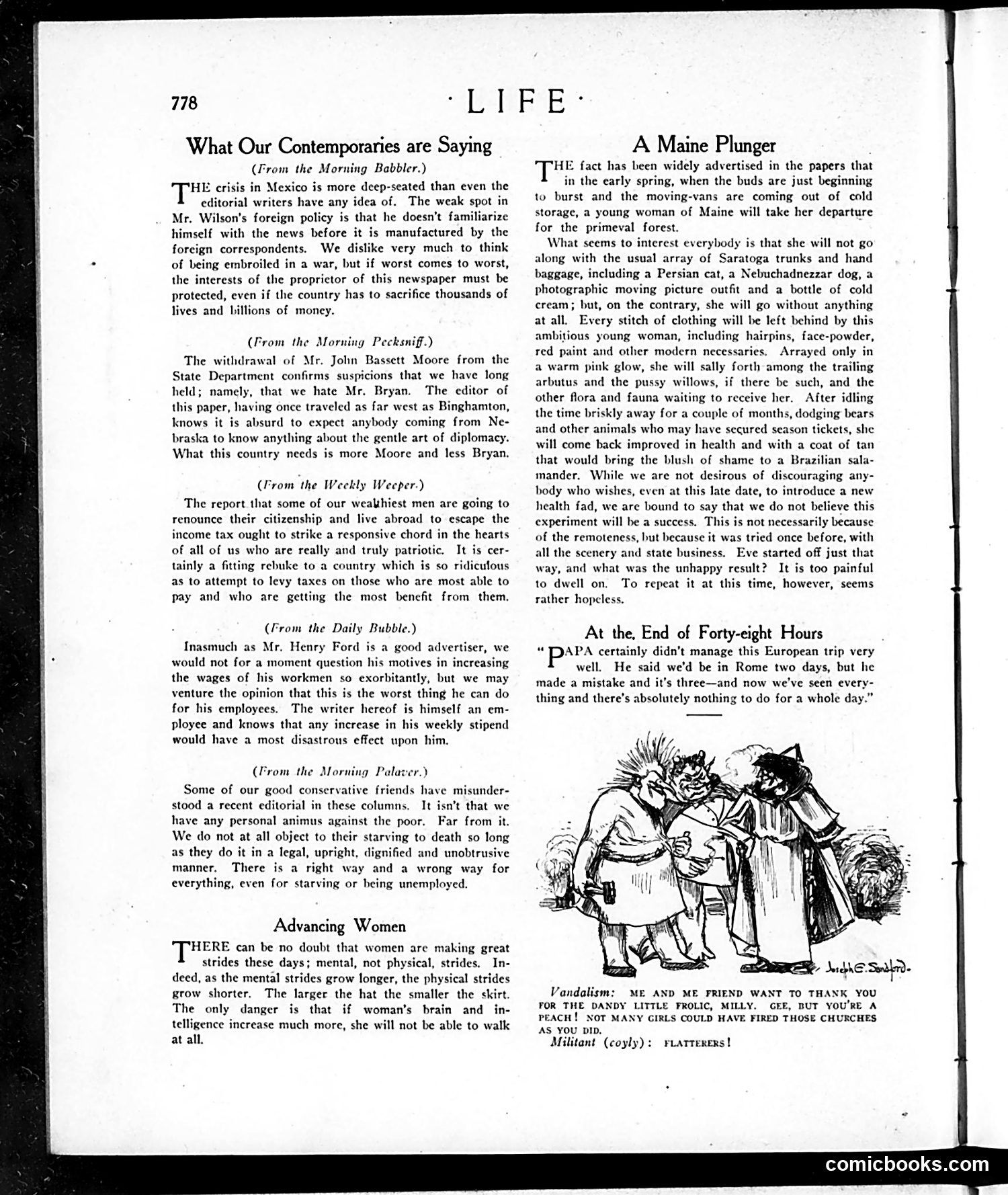
This *Life* magazine page from the early 1900s contains satirical commentary mocking various newspapers and social attitudes of the era. **"What Our Contemporaries Are Saying"** features fake newspaper quotes ridiculing editorial hypocrisy: papers that claim patriotism while protecting wealthy interests, dismiss William Jennings Bryan as unsophisticated, mock income taxes on the rich, praise Henry Ford's wage increases while claiming they harm workers, and express indifference to poverty if conducted "legally." **"Advancing Women"** satirizes opposition to women's suffrage and education—the joke being that if women's intelligence grows much larger, their physical strides (skirt lengths) shrink so much they won't walk at all. **"A Maine Plunger"** describes a woman planning a wilderness trip without conventional luggage or clothing, wearing only a "warm pink glow"—likely satirizing both the back-to-nature movement and sensationalist newspaper coverage of such stories. The cartoon illustration depicts two disheveled figures, apparently the subjects of gossip or scandal.
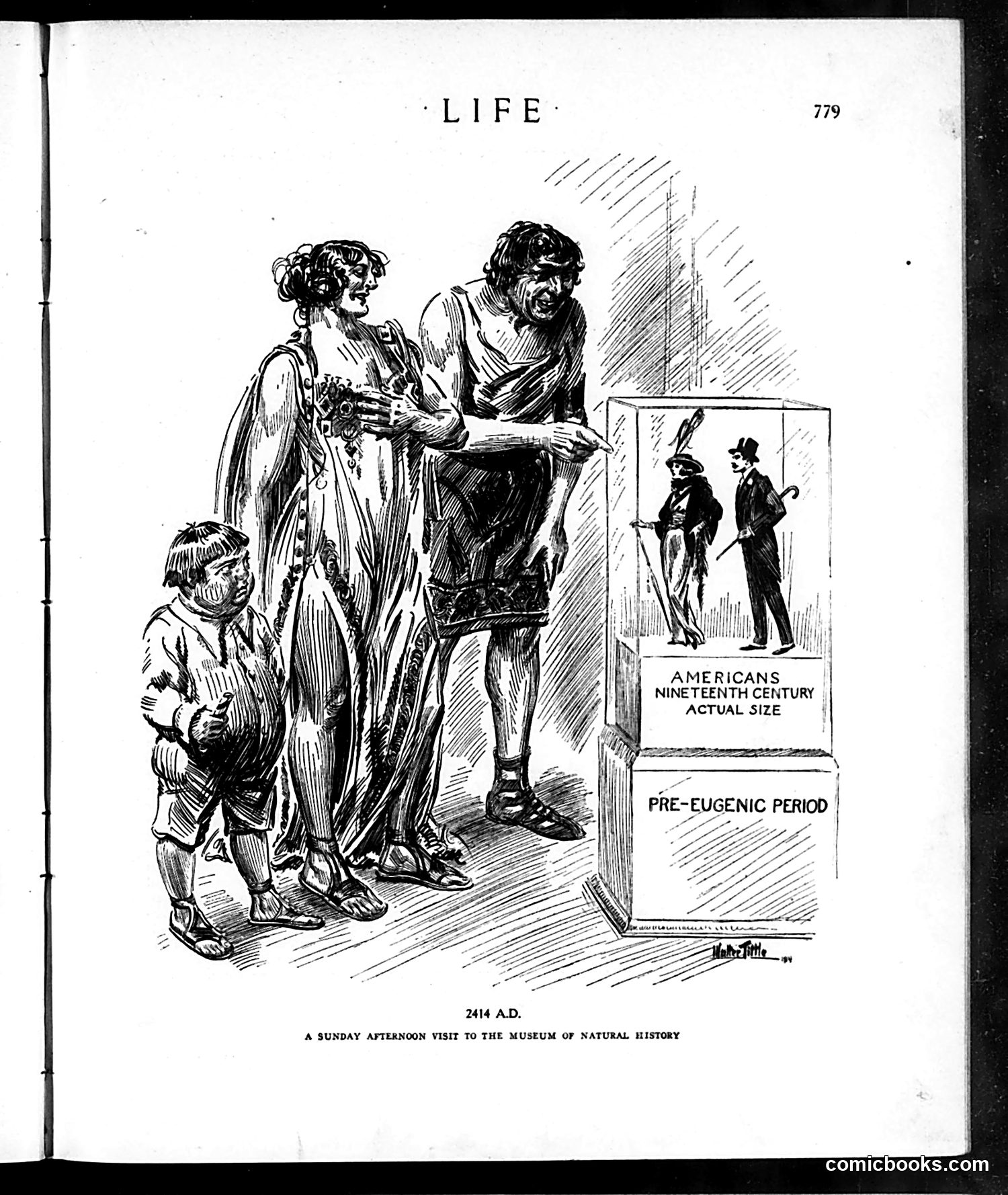
This cartoon satirizes early 20th-century eugenics ideology. The image depicts a family visiting a museum in the year 2414 A.D., where they view a display labeled "Americans Nineteenth Century Actual Size" showing tiny figures from the "Pre-Eugenic Period." The joke targets eugenic pseudoscience—the belief that selective breeding would improve humanity. The cartoon suggests that by 2414, through eugenic practices, Americans will have grown dramatically taller, making 19th-century Americans appear diminutive by comparison. This represents satirical critique of eugenics rather than endorsement. Life magazine used humor to mock the pseudoscientific pretensions of the eugenic movement, which was gaining influence in early 20th-century America. The exaggeration emphasizes how absurd eugenic claims about human "improvement" actually were.
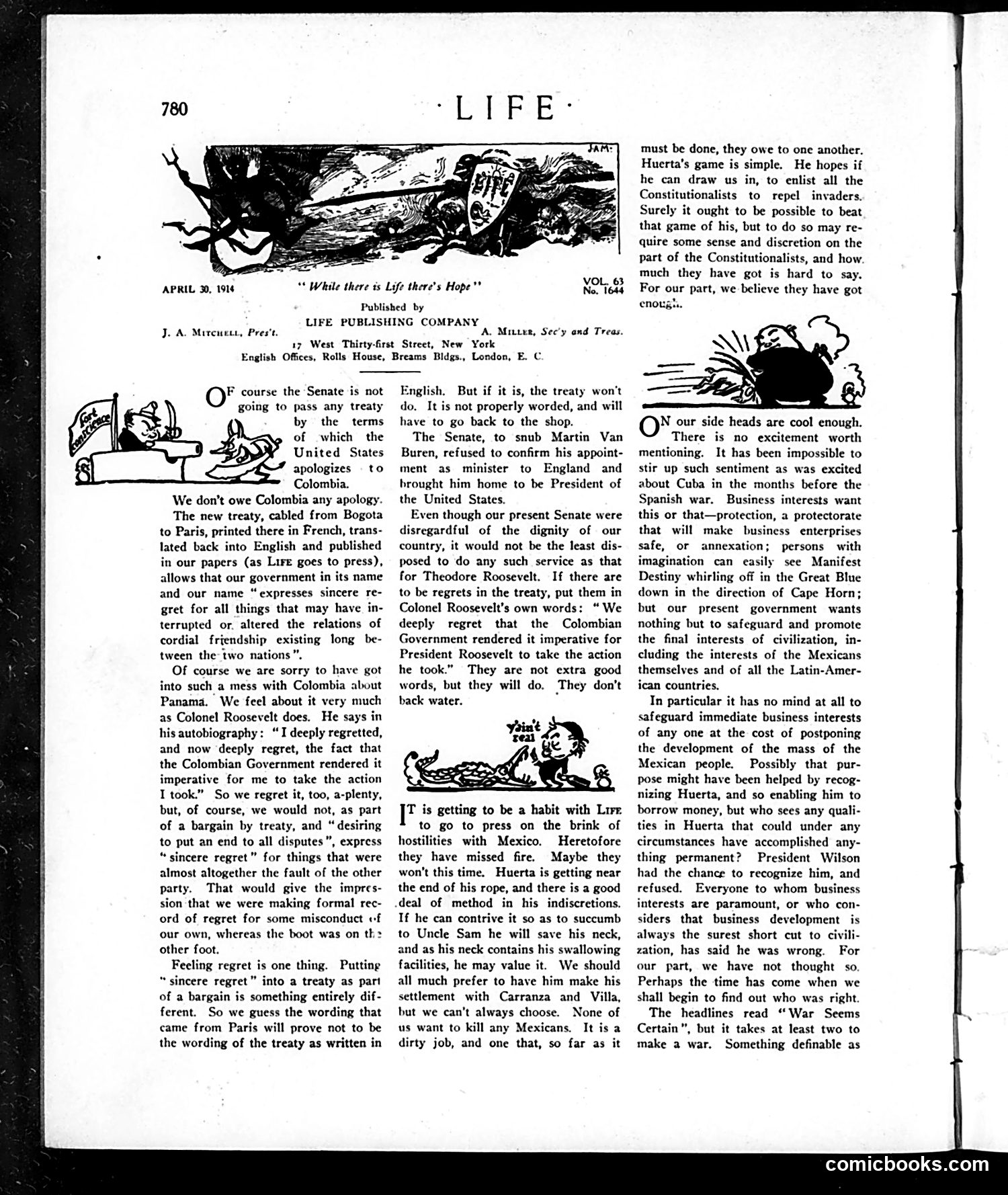
This page discusses two diplomatic crises: **Colombia Treaty**: The U.S. Senate debates whether to ratify a treaty with Colombia that includes "sincere regret" language over the 1903 Panama separation. The article argues Americans shouldn't formally apologize via treaty for actions taken under President Theodore Roosevelt, though personal regret is acceptable. It references the Senate's historical rejection of Martin Van Buren's appointment to snub him, suggesting they won't easily confirm controversial appointments. **Mexico Crisis**: Life notes it regularly goes to press amid threats of war with Mexico under President Huerta. The satire suggests Huerta deliberately provokes the U.S. to draw them into conflict, hoping to unite Mexican Constitutionalists against American "invasion." The editorial dismisses public excitement, claiming Americans remain level-headed about potential military intervention. Both sections reflect pre-World War I American diplomatic tensions and imperialist assumptions about regional conflicts.
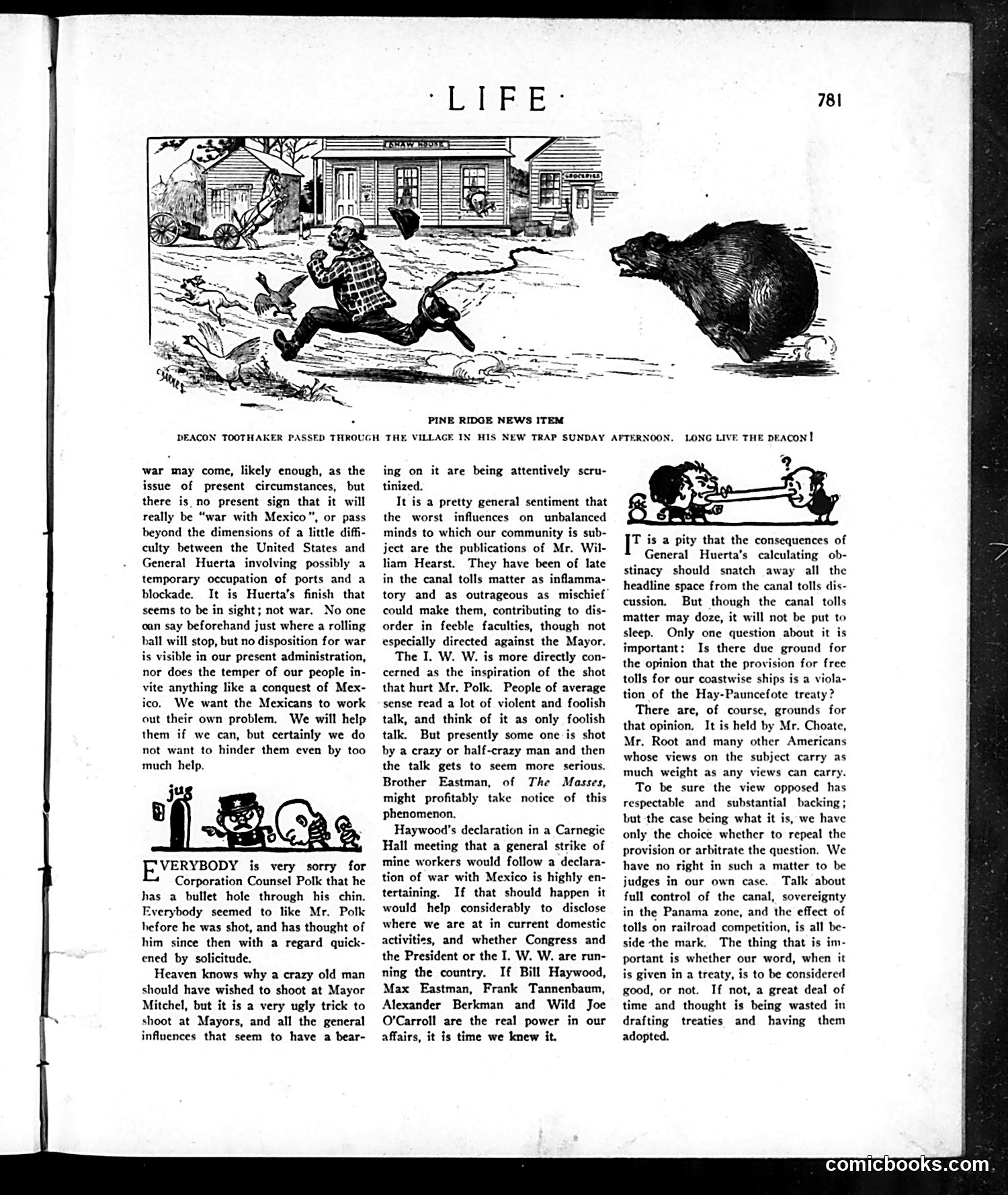
This page contains editorial commentary on several contemporaneous issues, likely from 1914: **Mexico Crisis**: The editors discuss potential war with Mexico under General Huerta, downplaying its likelihood while criticizing Huerta's political obstinacy. **Shooting of Corporation Counsel Polk**: The editors blame radical publications—specifically William Hearst's newspapers and *The Masses* magazine—for inflaming "unbalanced minds" that led to violence against city officials. They name radical figures: Bill Haywood, Max Eastman, Frank Tannenbaum, Alexander Berkman, and "Wild Joe O'Carroll," suggesting these labor activists and their inflammatory rhetoric bear responsibility for inspiring the attack. **Panama Canal Tolls Dispute**: A separate controversy about whether free tolls for American ships violates the Hay-Pauncefote treaty. The "Pine Ridge News Item" and Deacon Toothaker cartoon appear to be lighter rural humor, unrelated to these serious political debates. The page reflects Progressive Era anxieties about radical labor movements, media responsibility, and American imperialism.
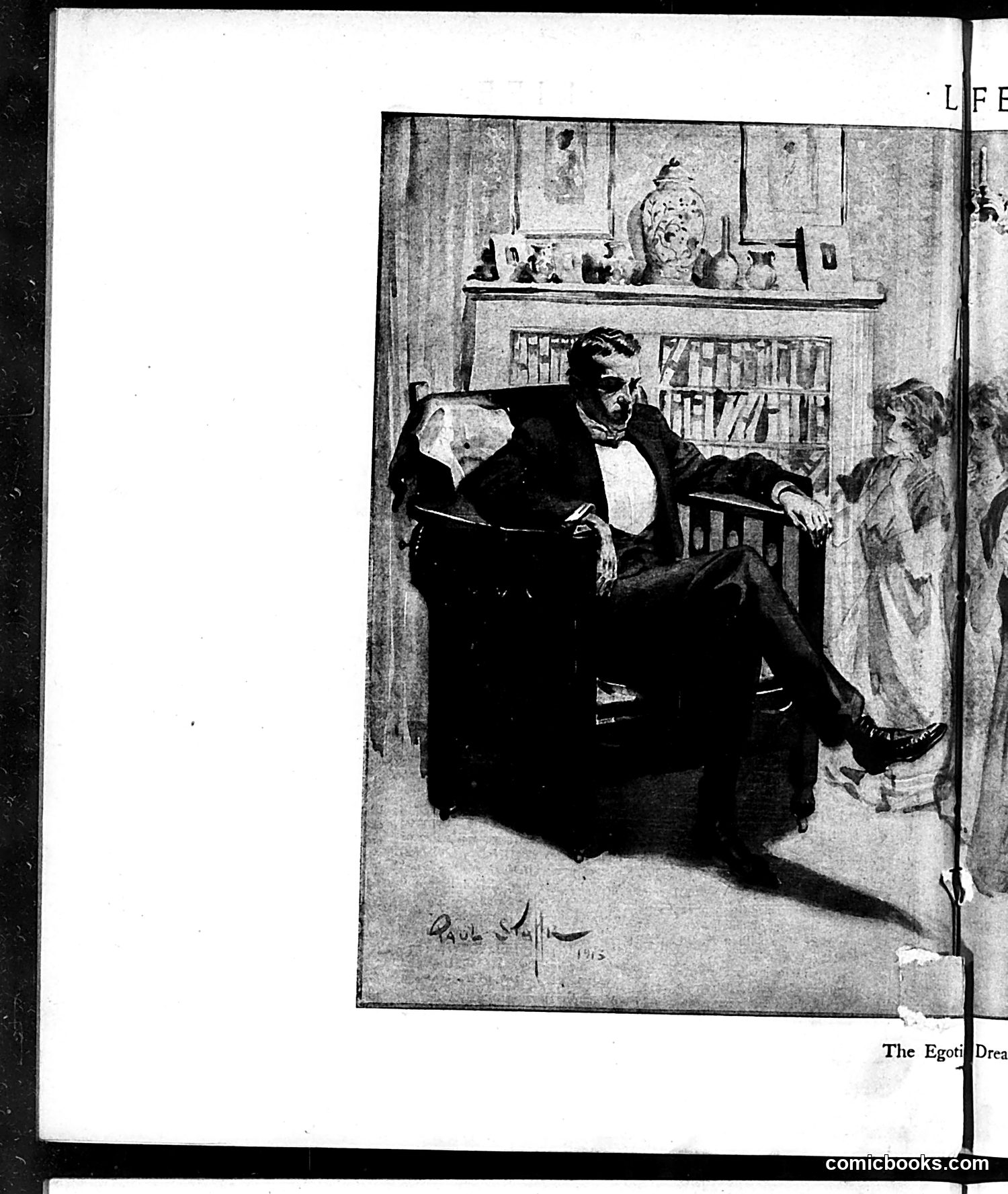
This illustration, signed by Paul Salle and dated 1915, depicts a well-dressed man in formal evening attire reclining in an armchair in what appears to be a refined study or library (with bookshelves visible). Two women attend to him—one behind the chair and one to the side—suggesting he is being pampered or admired. The satire appears to mock male vanity and self-importance. The title "The Egotist's Dream" suggests this scene represents an imaginary fantasy where the man is the center of female attention and comfort. The cartoon likely critiques the self-absorbed attitudes of wealthy or elite men of the era who expected deference and admiration, particularly from women. The refined domestic setting emphasizes how such egotism was enabled by upper-class social conventions of the period.
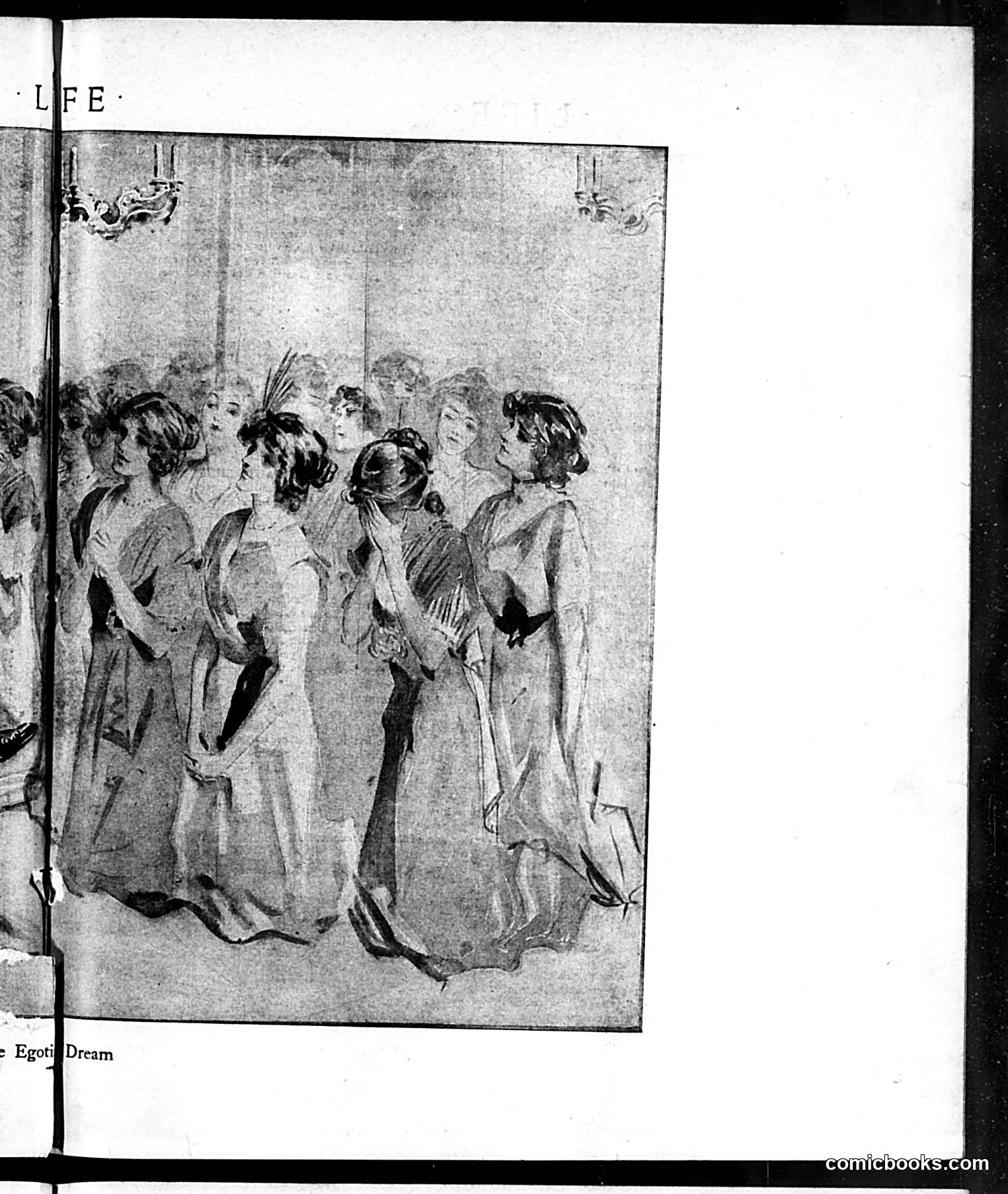
This satirical illustration depicts five women in early 20th-century dress gazing upward in apparent admiration or rapture. The caption "Egotistical Dream" suggests the image mocks vanity and self-absorption. The women's postures and expressions—heads tilted back, seemingly transfixed—parody excessive narcissism. The artwork likely critiques either a specific public figure's self-importance or more broadly satirizes societal vanity, possibly targeting fashionable women of the era. The formal clothing and refined setting suggest these are society ladies rather than working-class figures, implying the satire targets upper-class pretension. Without additional context about the specific issue of *Life* magazine, the exact target remains unclear, but the core message concerns the ridiculousness of egocentric behavior.
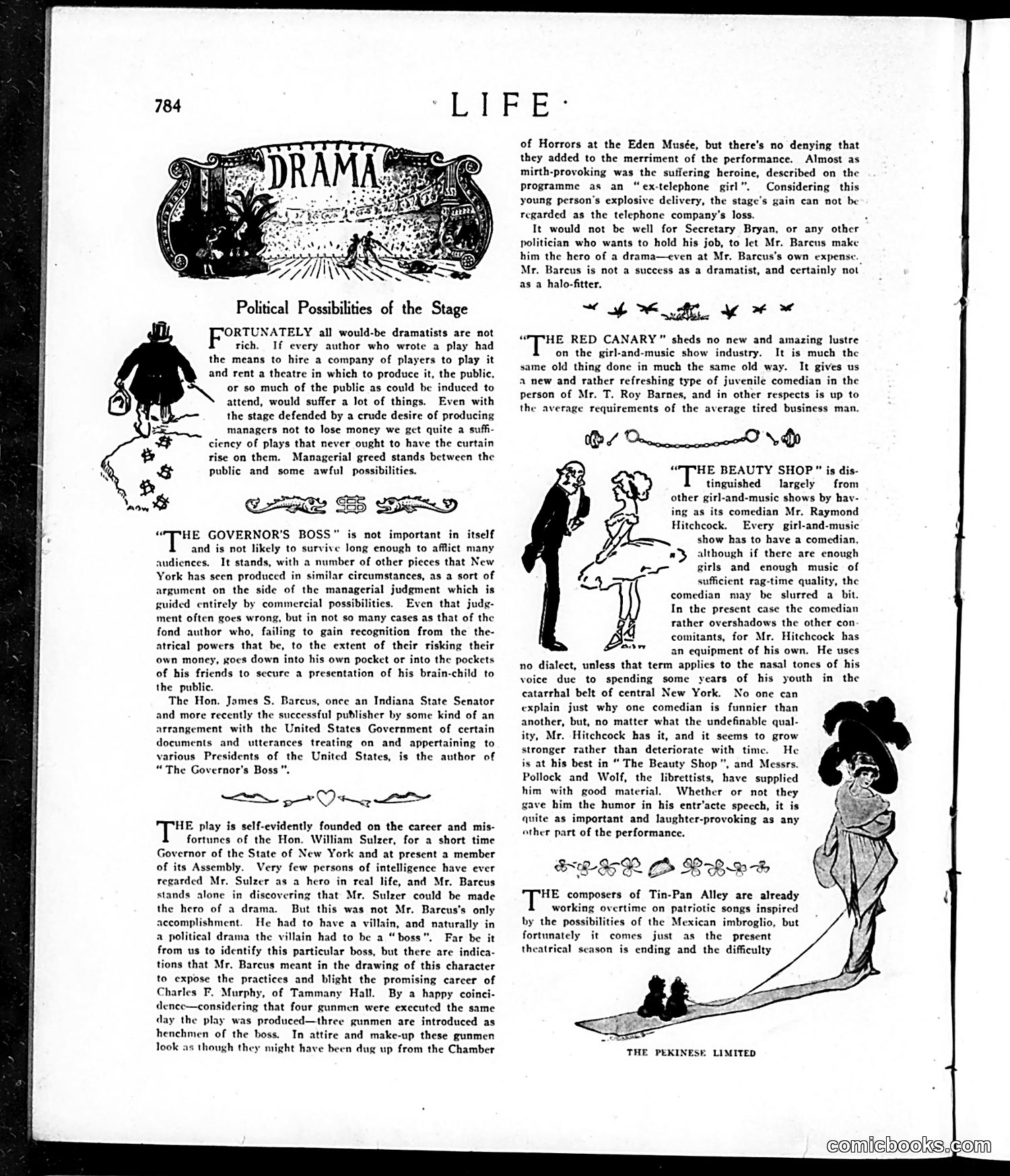
This page reviews theatrical productions with sharp political commentary. The main target is "The Governor's Boss," a play by James S. Barcus (former Indiana State Senator and publisher) based on Governor William Sulzer's career. The critic mocks Barcus's attempt to portray Sulzer—whom "very few persons of intelligence" regarded as heroic—as a dramatic protagonist. More pointedly, the play's villain appears designed to expose Charles F. Murphy of Tammany Hall, the Democratic political machine. The review notes three gunmen serve as the boss's henchmen, their appearances grotesquely drawn from the "Chamber of Horrors at the Eden Musée." The satire suggests Barcus is incompetent as a dramatist and particularly poor at "halo-fitter"—making villains (or heroes) seem noble. The critic warns politicians like Secretary Bryan against letting Barcus dramatize their lives. The page also briefly reviews lighter shows like "The Red Canary" and "The Beauty Shop," offering less biting critique.
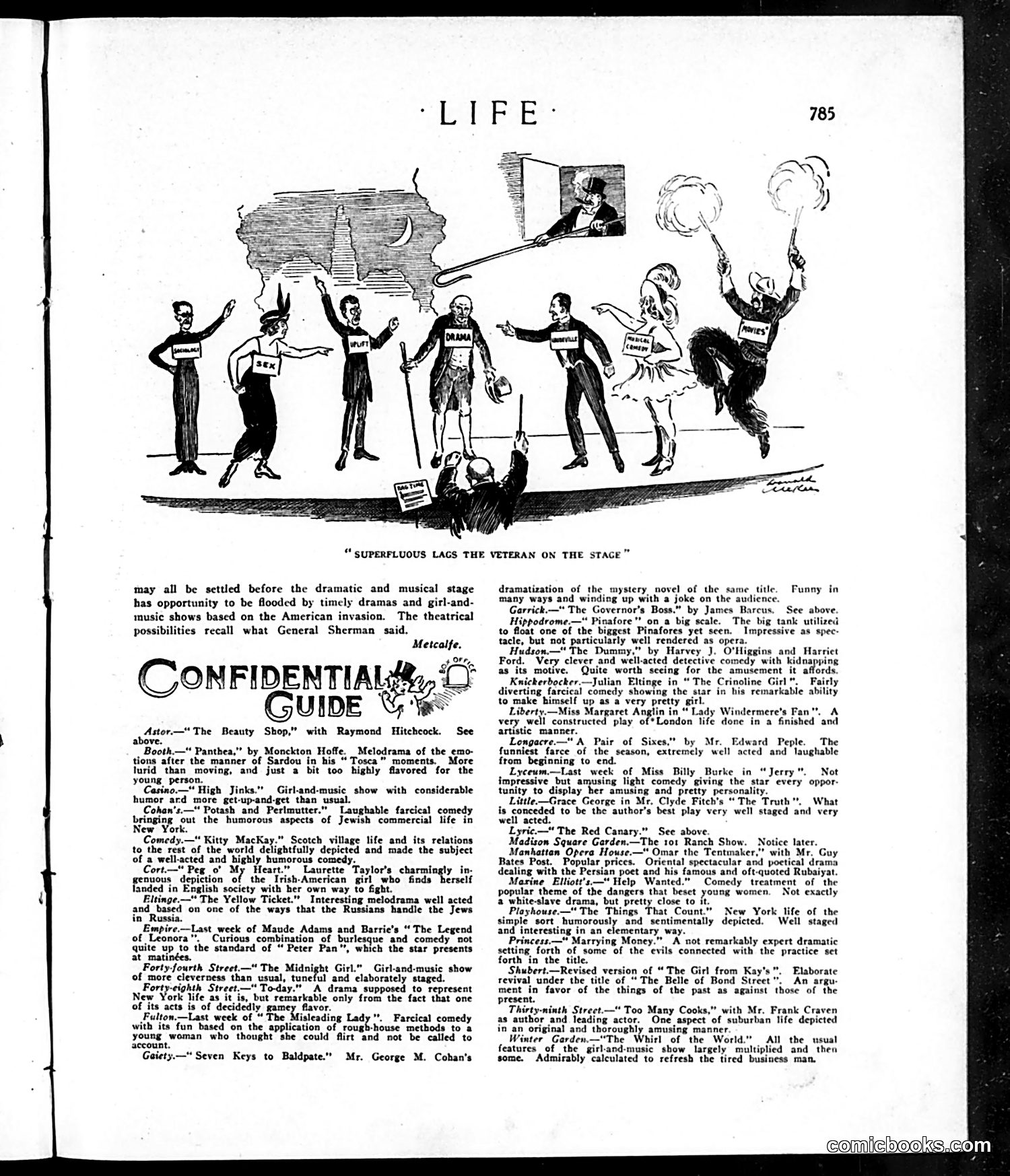
The cartoon's caption quotes Shakespeare ("Superfluous lags the veteran on the stage"), satirizing Broadway's flood of hastily-produced plays about the American military invasion—likely referring to World War I preparations or recent military involvement. The image shows performers in theatrical costumes labeled with show titles, suggesting producers are churning out superficial entertainment rather than quality drama. The caricatured figures appear to represent generic theatrical types rather than specific individuals. The accompanying "Confidential Guide" reviews Broadway shows, establishing context: producers are capitalizing on patriotic fervor by rushing invasion-themed productions to stage before better dramatic works arrive. The satirist (cartoonist Metcalfe) suggests this commercial opportunism is artistically lazy—echoing General Sherman's famous criticism of war itself. The satire targets theatrical producers' cynical exploitation of current events for profit, prioritizing speed and novelty over artistic merit.
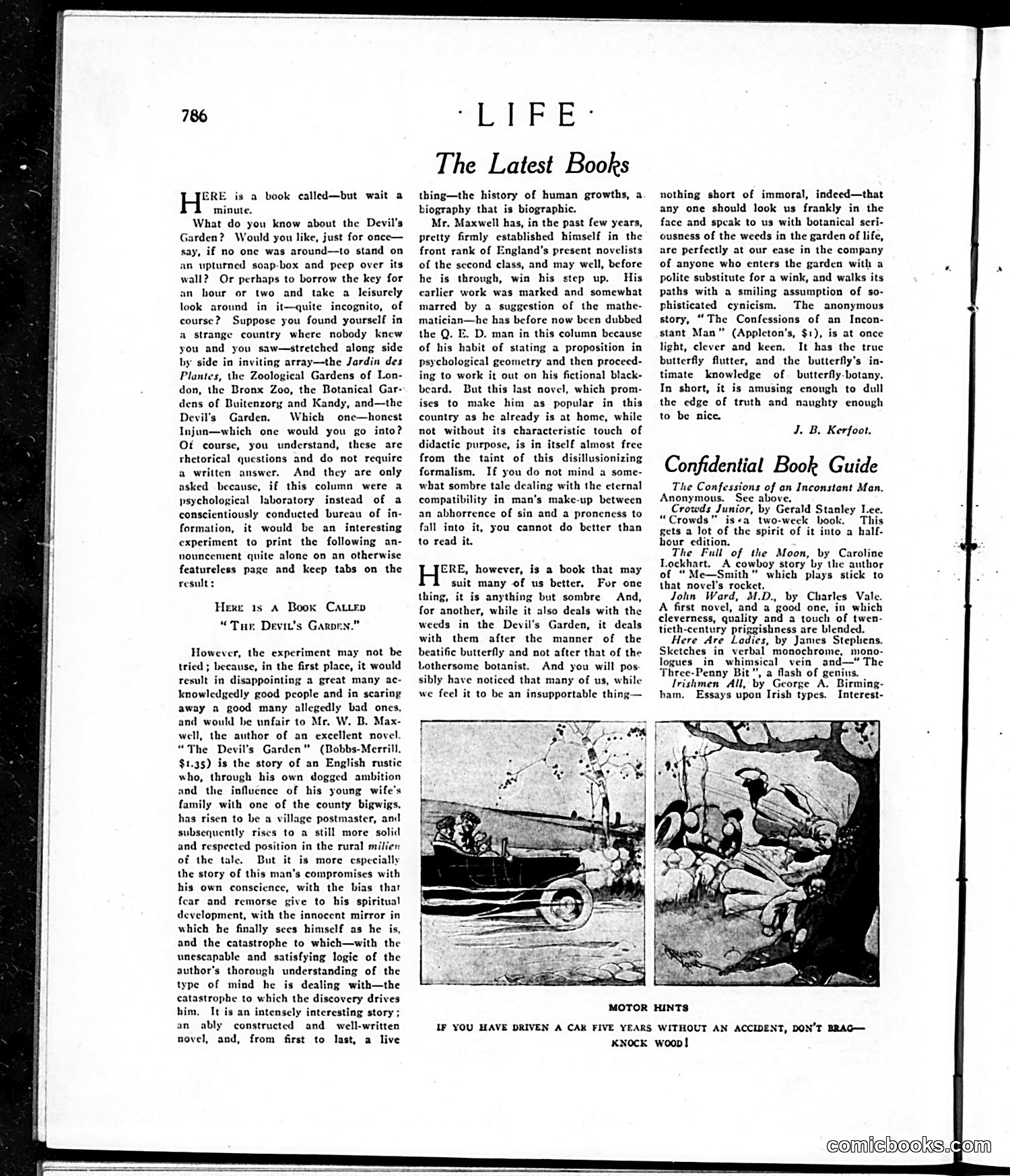
This page contains book reviews from *Life* magazine, not political cartoons. The main content reviews W.B. Maxwell's novel *"The Devil's Garden,"* discussing its themes of moral compromise and spiritual development in an English village postmaster's life. The opening uses satirical rhetoric—asking readers if they'd peek into a "Devil's Garden" alongside famous botanical attractions—as a rhetorical hook to discuss the novel's examination of human temptation and conscience. The small photographs labeled "MOTOR HINTS" at the bottom show vintage automobiles with a humorous safety caption: "If you have driven a car five years without an accident, don't brag—knock wood!" This is primarily a literary review page with light automotive humor, not political satire. The "Devil's Garden" metaphor is literary rather than political—exploring personal morality rather than social commentary.
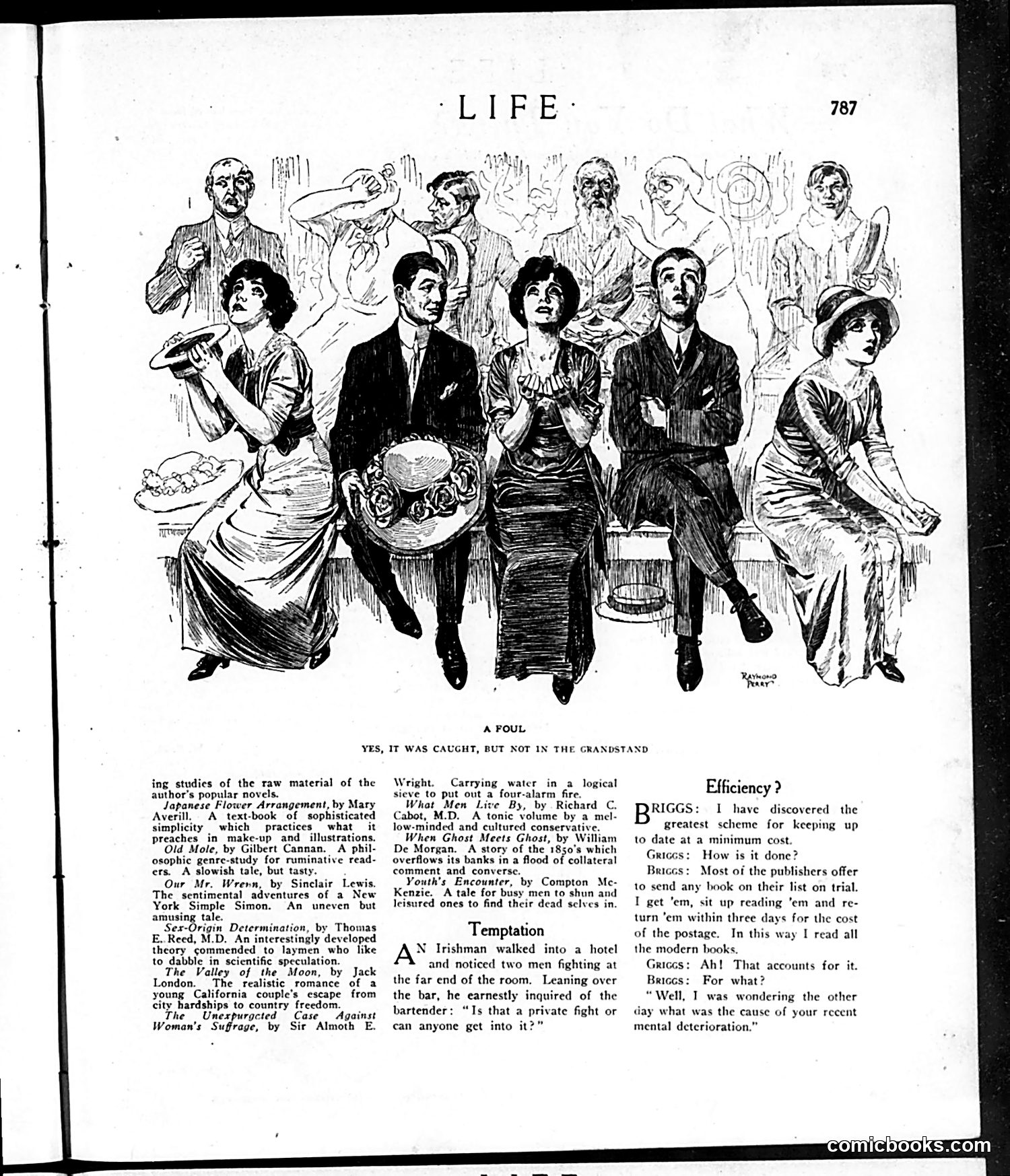
This page contains two satirical humor pieces from *Life* magazine: **"A Foul"** (top cartoon): The title and caption "Yes, it was caught, but not in the grandstand" suggest a joke about baseball—likely playing on the double meaning of "foul" (a baseball term and a moral transgression). The sketch shows five well-dressed people seated together, with figures in background, but the cartoon's specific meaning is unclear without additional context about what event or scandal it references. **"Temptation"** and **"Efficiency?"** (bottom text): These are brief humorous anecdotes. The first is an Irish immigrant joke playing on miscommunication—a man asks if a fight is "private" or open to participation. The second satirizes modern efficiency: a man brags about reading new books "free" by exploiting publishers' trial policies, while his friend notes this intellectual shortcut has caused his mental decline. The page mostly showcases book reviews in the left column, mixing literature criticism with these comic interludes typical of *Life*'s format.
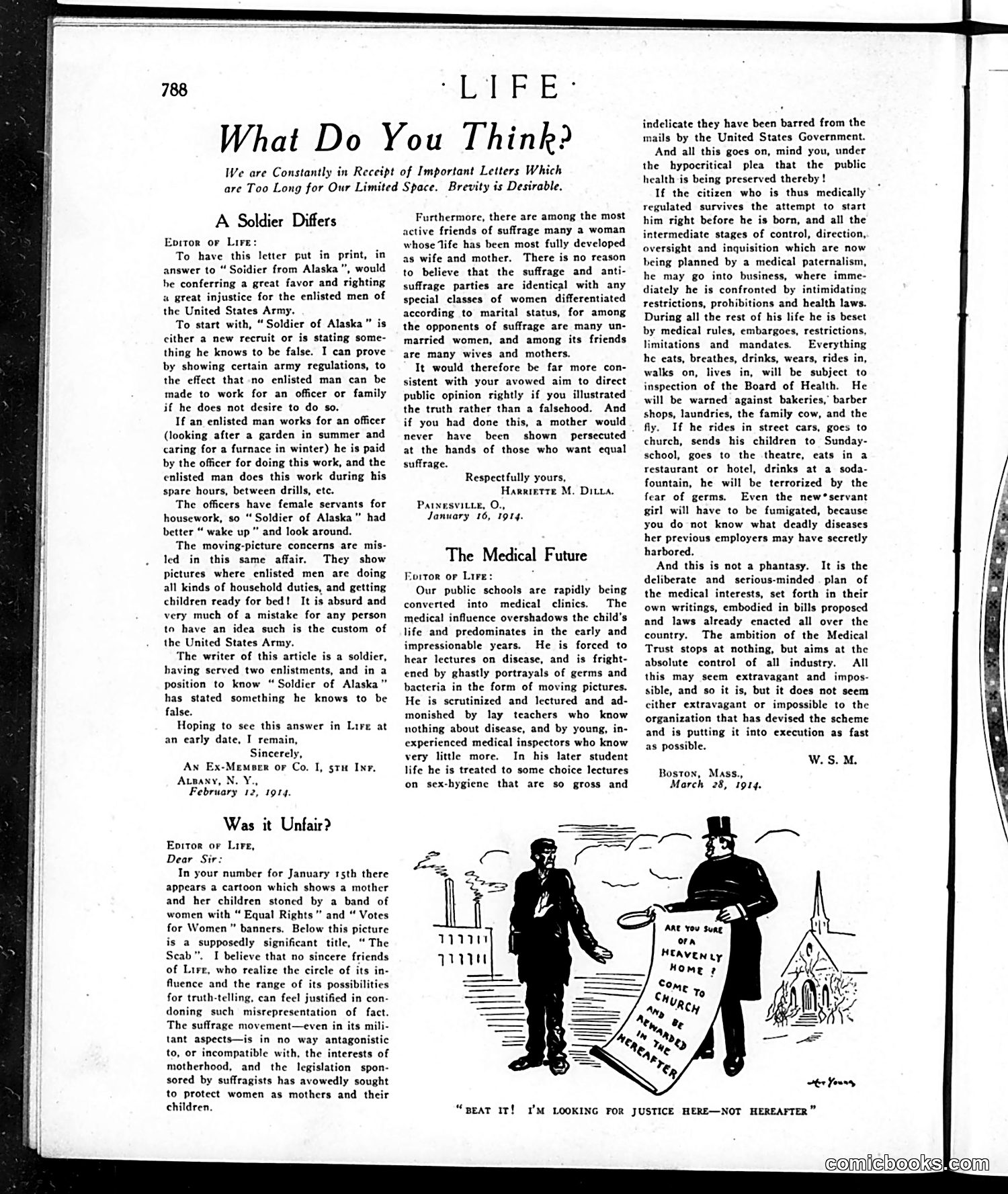
This page features reader letters debating three contentious issues of the era: **"A Soldier Differs"**: A military serviceman defends enlisted men against allegations (apparently from a previous "Soldier from Alaska" letter) that they performed unpaid domestic labor for officers. He cites regulations proving soldiers cannot be compelled to work without compensation. **"Was it Unfair?"** responds to an earlier cartoon titled "The Scab" (not visible here) depicting suffragettes stoning a mother. The letter-writer condemns this as misrepresenting the women's suffrage movement, arguing suffragists actively supported mothers' interests and included many wives and mothers among their supporters. She demands *Life* illustrate truth rather than propaganda against equal voting rights. **"The Medical Future"**: A writer criticizes schools converting into "medical clinics," claiming excessive medical lectures and germ-focused imagery frighten children unnecessarily. These letters reflect 1914 America's fierce debates over military labor practices, women's suffrage (then unresolved), and public health authority—all contentious social divisions of the Progressive Era.
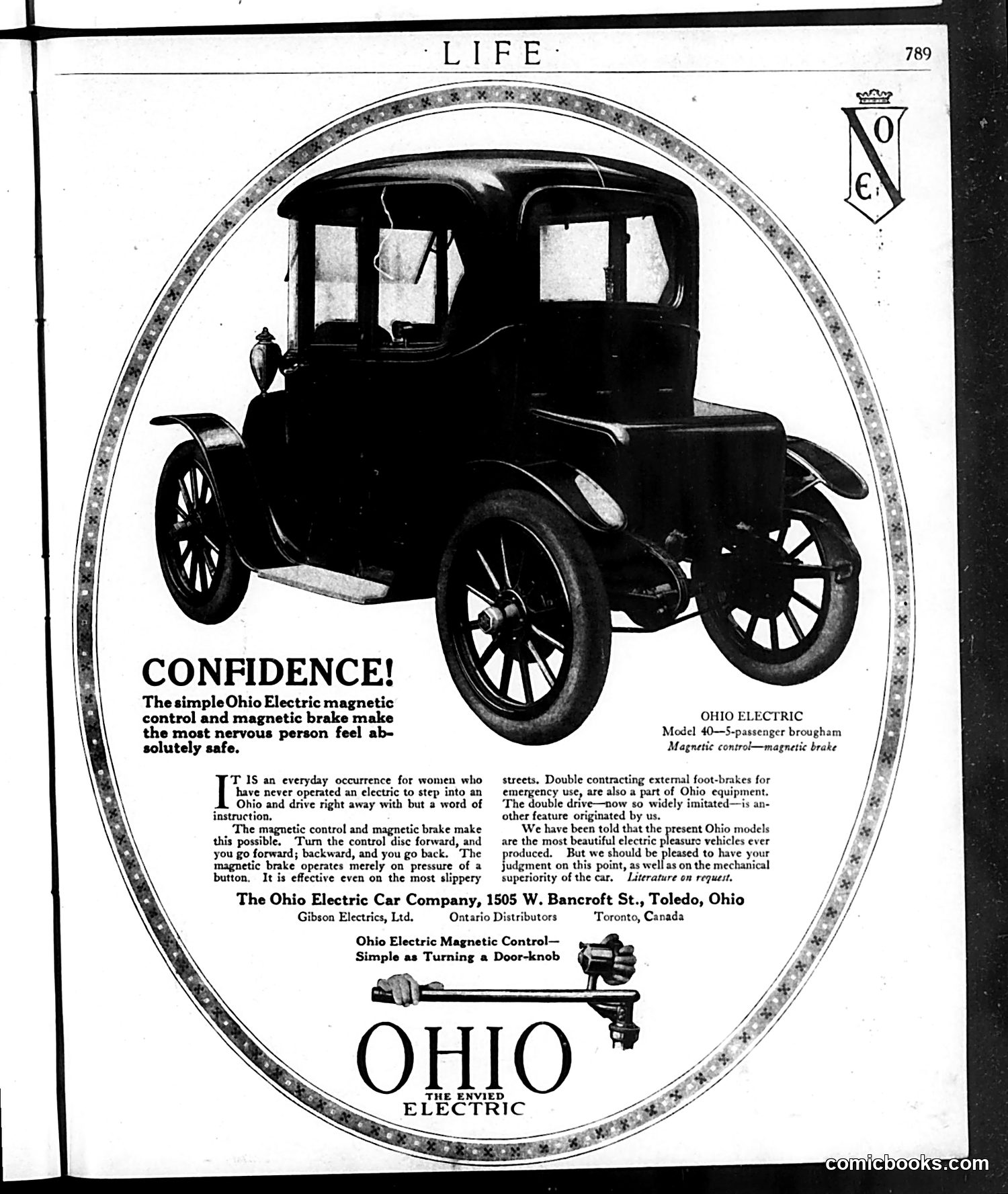
This is a **vintage automobile advertisement**, not a political cartoon. It promotes the Ohio Electric Car Company's Model 40 brougham—an early electric vehicle. The ad's pitch targets **women drivers**, emphasizing ease of operation through "magnetic control and magnetic brake" systems requiring only simple forward/backward disc turning—compared to a doorknob's simplicity. This reflects early 1900s assumptions that women needed reassurance about automotive complexity. The headline "CONFIDENCE!" and opening phrase about "the most nervous person" reveal gender stereotypes of the era: women were presumed mechanically incompetent and anxious. The ad positions the Ohio Electric as so user-friendly that even inexperienced female drivers could operate it safely with minimal instruction. Notably, electric cars competed with gasoline vehicles before internal combustion engines dominated. The ad emphasizes the Ohio Electric's beauty, safety features (double brakes), and superior engineering as selling points to affluent customers—particularly women who could afford such vehicles.
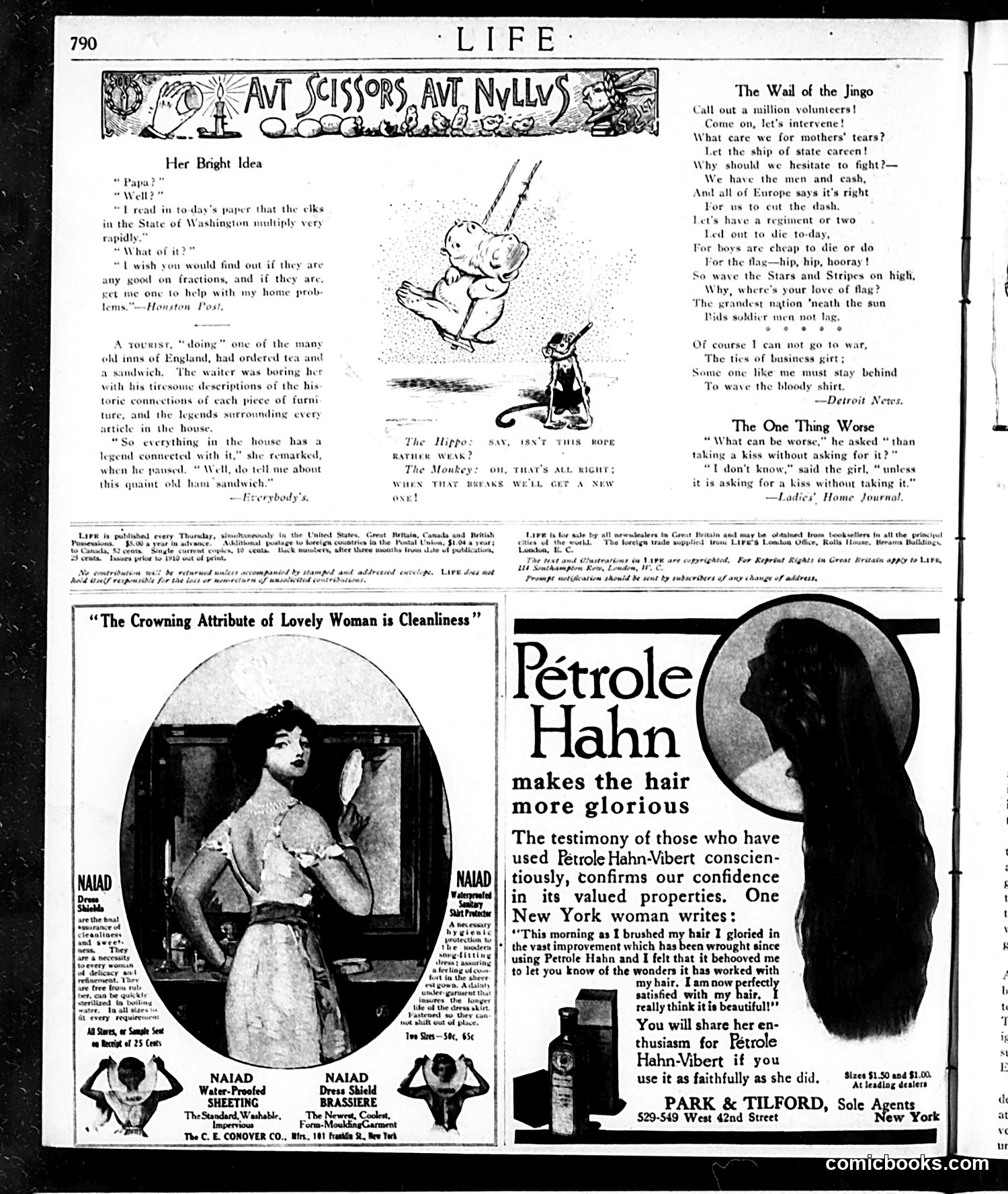
The main cartoon "The Wail of the Jingo" satirizes American interventionists advocating military involvement (likely WWI-era). A figure labeled "The Hippo" represents jingoistic enthusiasm for war—calling for volunteers, dismissing mothers' tears, and glorifying military sacrifice with patriotic rhetoric ("wave the Stars and Stripes on high"). The satire critiques how war-mongers romanticize conflict while others stay safely behind, juxtaposing rhetorical fervor against the actual cost in lives. The smaller joke about "The One Thing Worse" offers social commentary on courtship etiquette regarding unwanted physical intimacy. The page also contains period product advertisements (Nadiad hygiene products, Pétrole Hahn hair treatment) typical of Life's revenue model, featuring the era's conventions of beauty advertising and claims of women's products improving appearance.
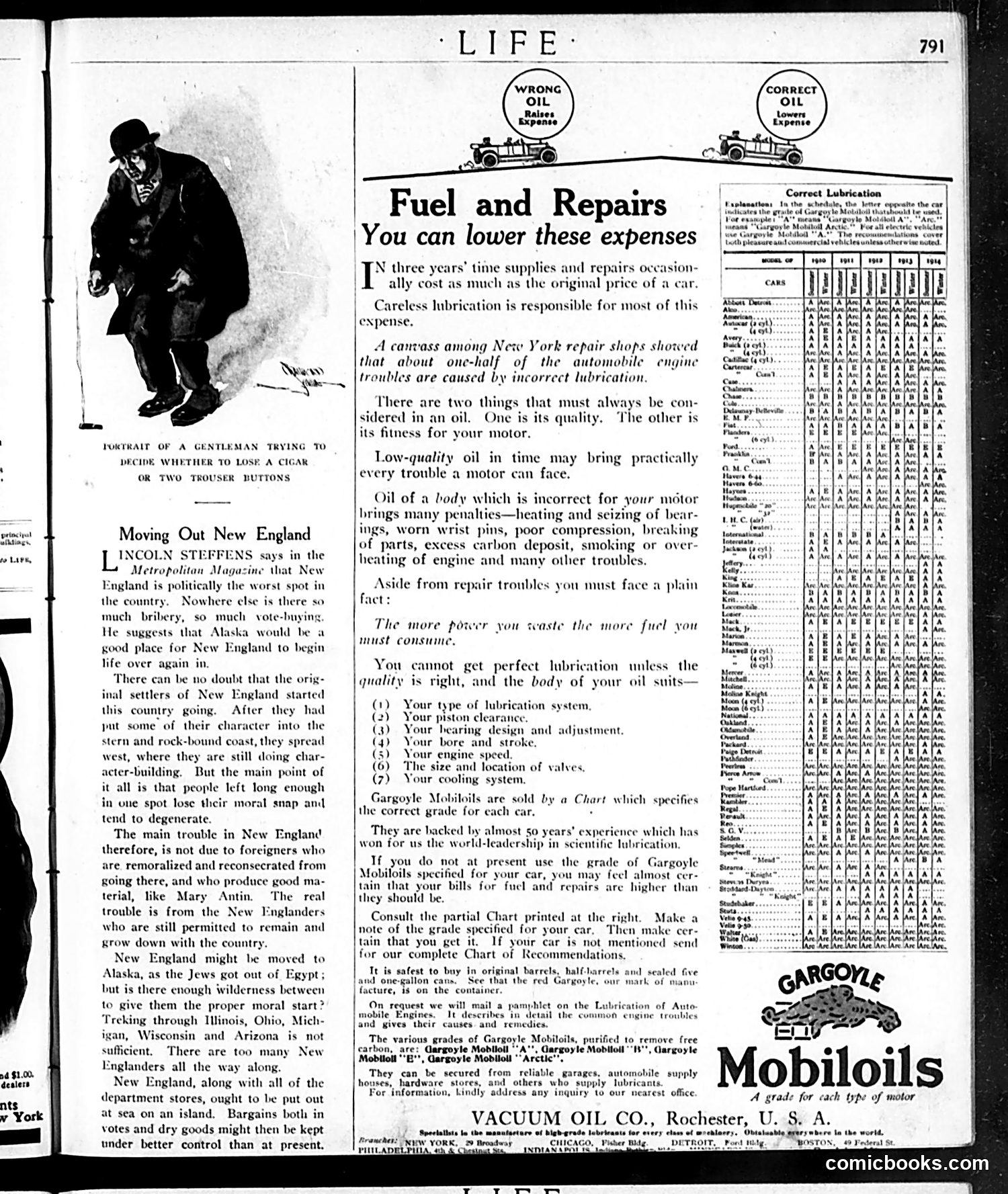
This page contains two distinct elements: **political satire and automotive advertising**. ## The Cartoon The top-left illustration—"Portrait of a Gentleman Trying to Decide Whether to Lose a Cigar or Two Trouser Buttons"—is a visual joke about economic hardship. A well-dressed man must choose between two luxuries (a cigar) and basic necessities (trouser buttons), suggesting financial strain where even small choices carry weight. ## The Political Commentary Below, Lincoln Steffens argues New England is politically corrupt due to *old residents*, not immigrants. He sarcastically suggests exiling New England like the Exodus from Egypt, proposing the region suffers moral decay from staying too long in one place—a critique of entrenched political machines and vote-buying among established citizens. ## The Advertisement The right two-thirds is a **Gargoyle Mobiloils advertisement** promoting proper motor oil selection to reduce fuel and repair costs—a practical consumer concern in the early automotive era when engine maintenance directly impacted owners' wallets. The juxtaposition creates unintentional irony: political corruption discussion alongside advice for prudent consumer spending.
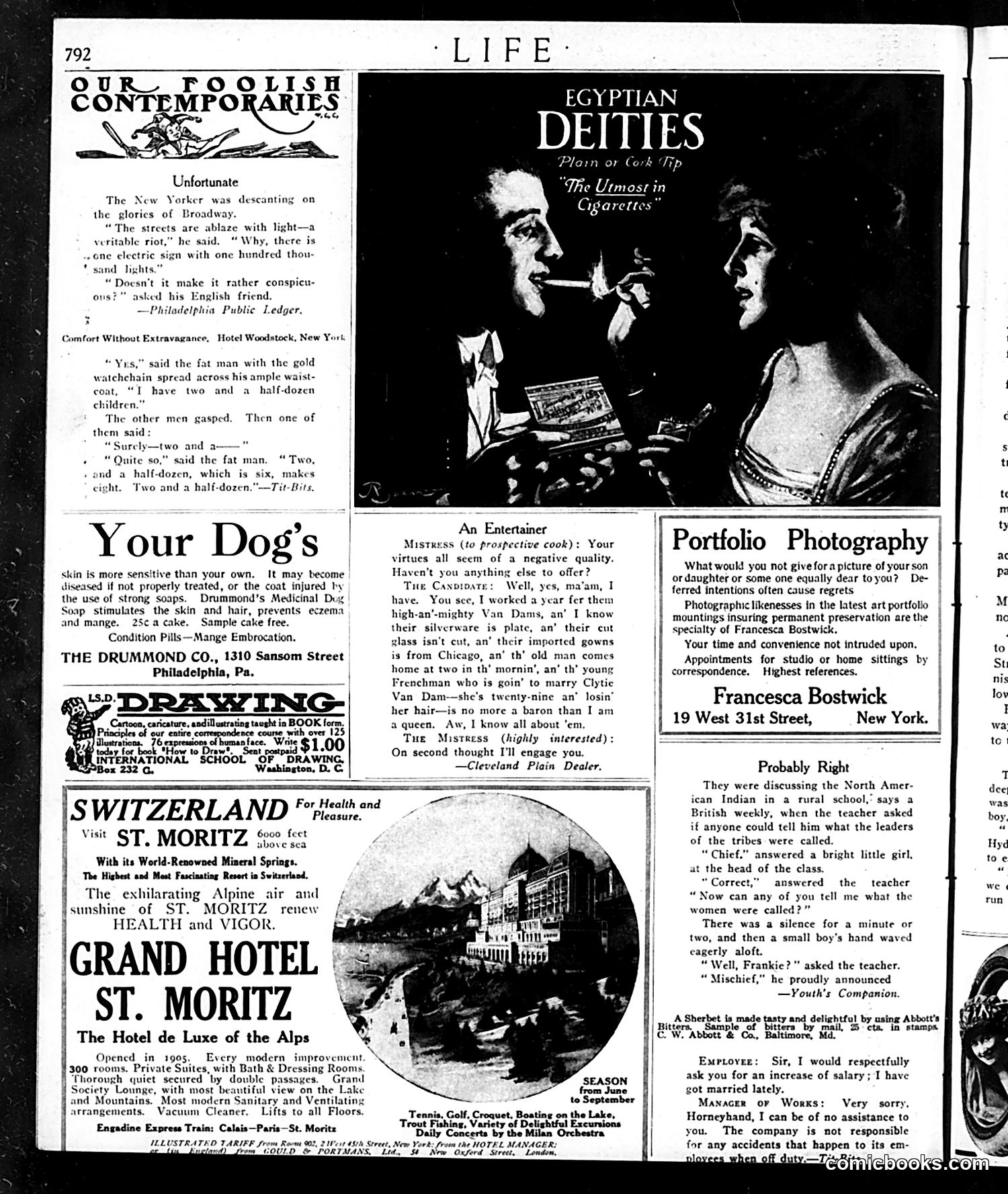
This page is primarily **advertisements and brief humorous anecdotes** rather than political cartoons. The main content includes: **"Unfortunate"** – A joke about a New Yorker bragging to an English friend about Broadway's electric signs. The humor targets American excess and conspicuousness versus British restraint. **"Comfort Without Extravagance"** – A math joke where a fat man claims to have "two and a half-dozen children," confusing his listeners until he explains this equals six (two + half-dozen). The humor mocks either his arithmetic or the listeners' confusion. **"Probably Right"** – A schoolroom joke where students are asked what Native American tribe leaders and women are called. A girl answers "Chief"; when asked about women, a boy presumably answers "Squaw" (the text cuts off). The page otherwise contains **period advertisements** for dog soap, Swiss hotels, cigarettes, and photography services—typical of 1910s Life magazine's mix of satirical content and commercial revenue. No major political figures or events are referenced.
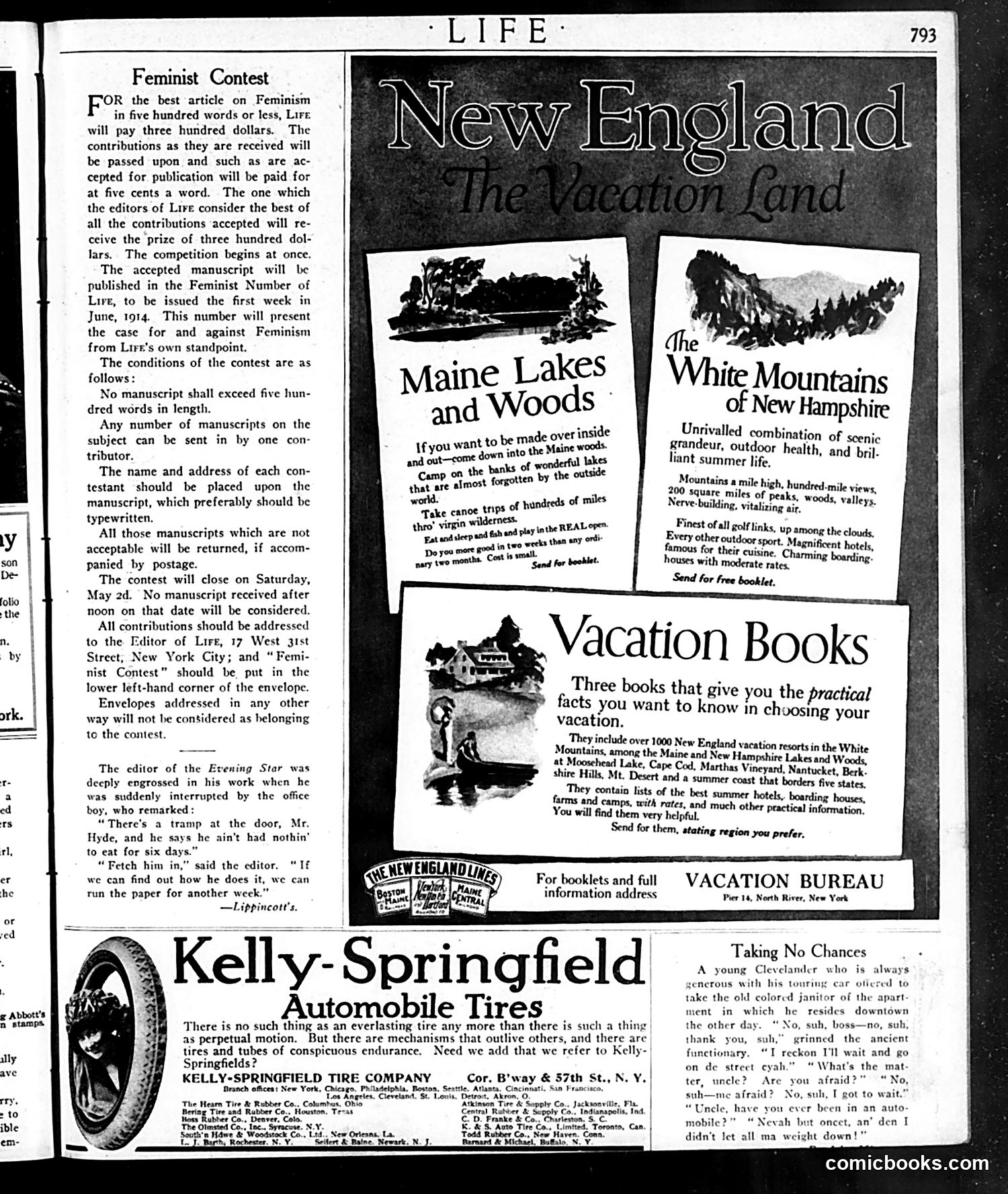
This page is primarily **advertising and editorial content** rather than political satire. The main elements are: **Feminist Contest**: Life magazine announces a writing competition offering $300 for the best 500-word article on feminism, to be published in a special "Feminist Number" (June 1914). This reflects early 20th-century debate over women's rights. **Anecdote**: A brief joke about an *Evening Star* editor hiring a tramp, quipping they'll "run the paper for another week" on whatever budget the tramp survives on—satirizing newspaper cost-cutting. **Advertisements**: The bulk is tourism promotion for New England (Maine Lakes, White Mountains) and Kelly-Springfield automobile tires. **Historical context**: The 1914 date places this during the suffrage movement era. Life's sponsorship of feminist debate suggests the magazine engaged contemporary social questions, though whether supportively or satirically isn't entirely clear from the text alone.
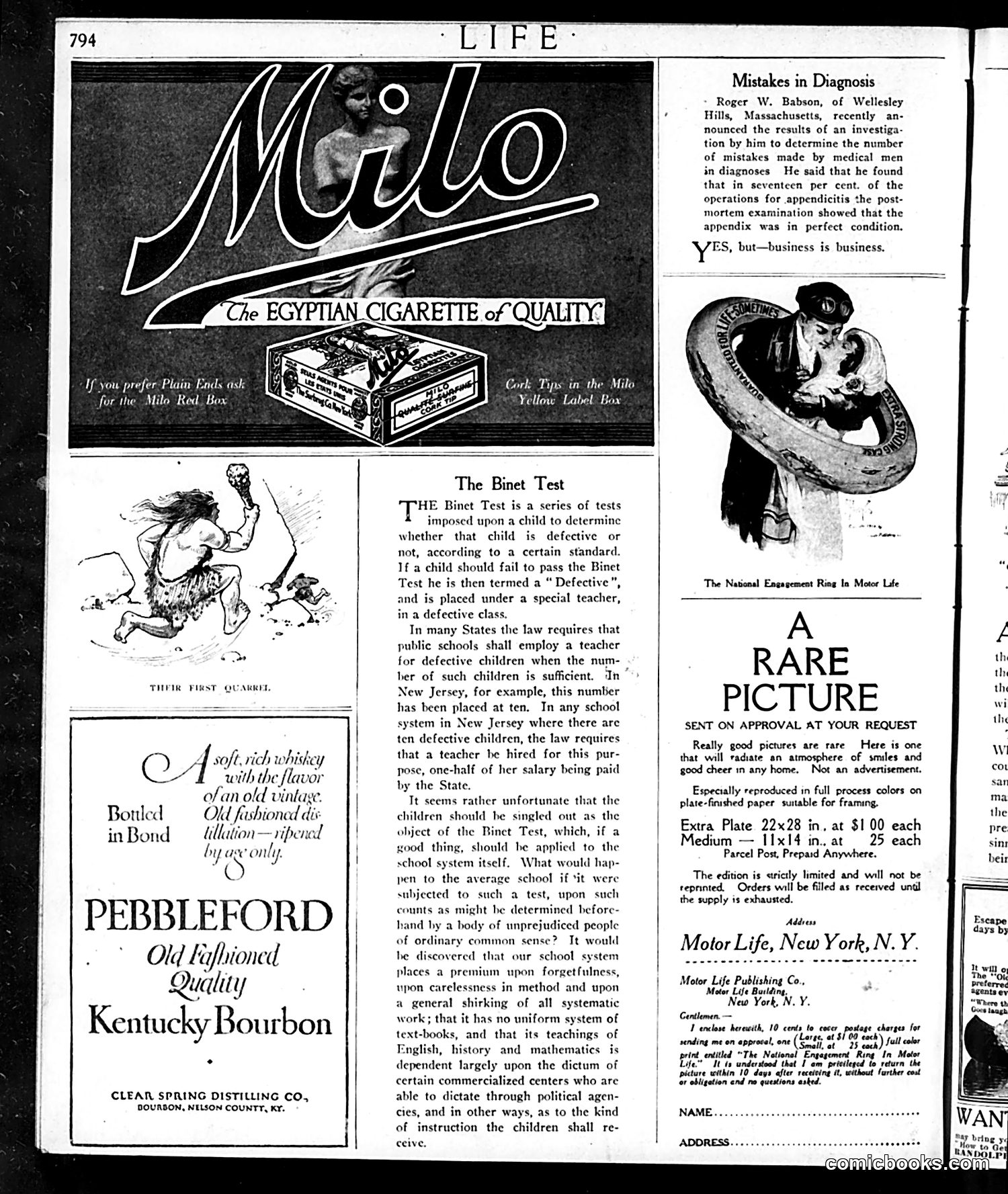
This page mixes advertising with social commentary. The main satirical article, "The Binet Test," critiques the application of intelligence testing to schoolchildren while leaving the school system itself unexamined. **The Satire:** The author argues that if the Binet Test—used to identify "defective" children for special classes—were applied to schools themselves, the institutions would fail. The piece attacks the education system for prioritizing rote memorization over systematic thinking, lacking uniform curricula, and being controlled by commercialized interests rather than sound pedagogy. The closing quip "Yes, but—business is business" exposes the hypocrisy: we test children but protect profitable educational structures. **Context:** This reflects early-20th-century debates over eugenics-influenced testing and standardized education. The cartoon "Their First Quarrel" (left) appears to illustrate childhood conflict, supporting the Binet discussion. **Advertising:** Milo cigarettes, Pebbleford bourbon, and Motor Life magazine fill remaining space—typical period advertising.
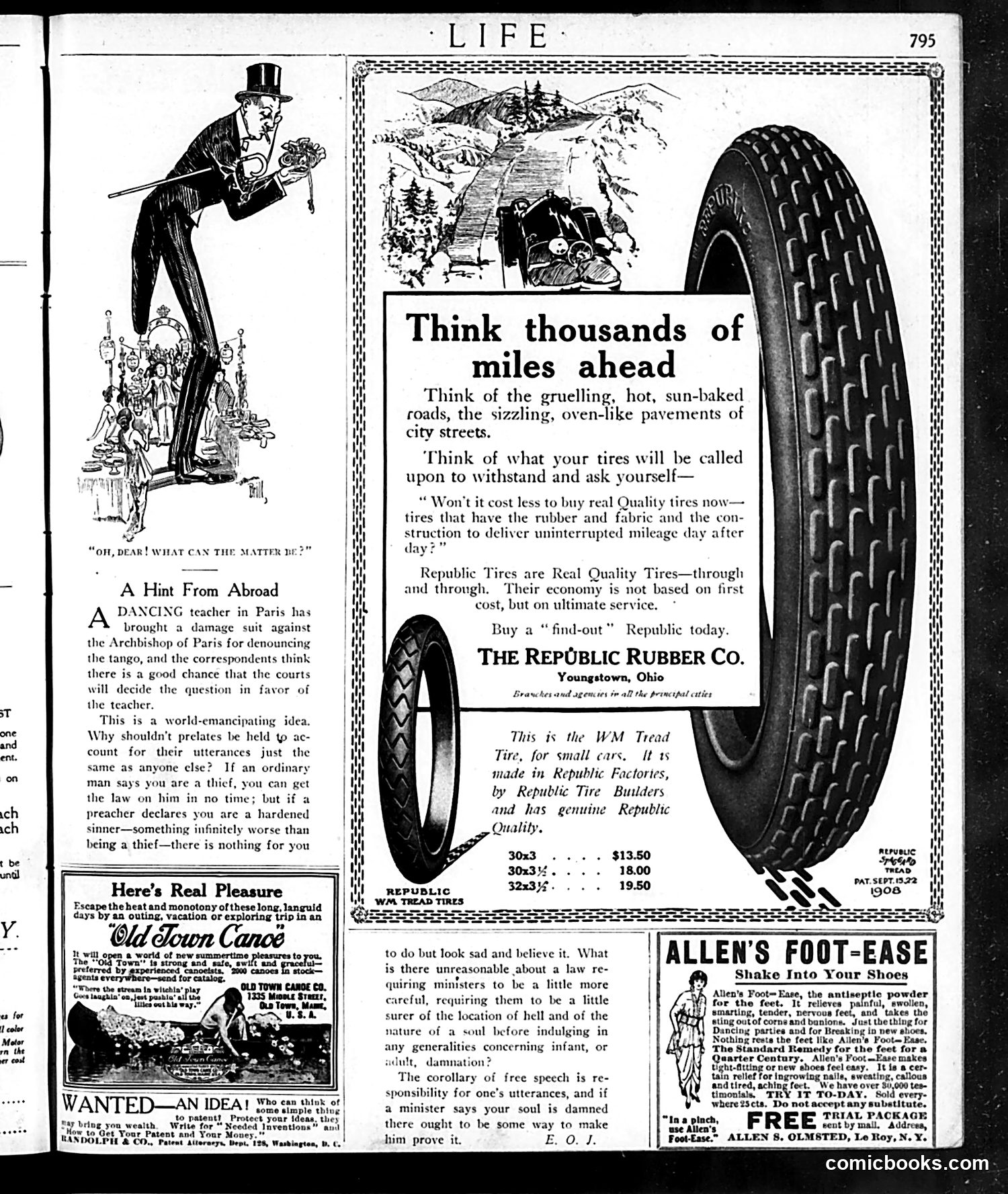
This page primarily features **advertisements** rather than political cartoons, though it opens with satirical commentary. **"A Hint From Abroad"** discusses a Paris lawsuit where a dancing teacher sued the Archbishop for denouncing the tango. The satire argues that religious figures should face legal accountability for their public statements—just as ordinary people can be sued for slander. If a preacher calls someone a "hardened sinner," the text argues, there should be legal recourse, not merely accepting it as truth. This reflects early 20th-century tension between religious authority and emerging notions of free speech accountability. The remainder comprises period advertisements: Republic Rubber tires, Old Town Canoes, Allen's Foot-Ease powder, and a patent services solicitation. The tire ad emphasizes durability for long-distance travel on poor roads—reflecting automotive concerns of the era. The "Wanted—An Idea" section seeks inventions, typical of Life's regular features.
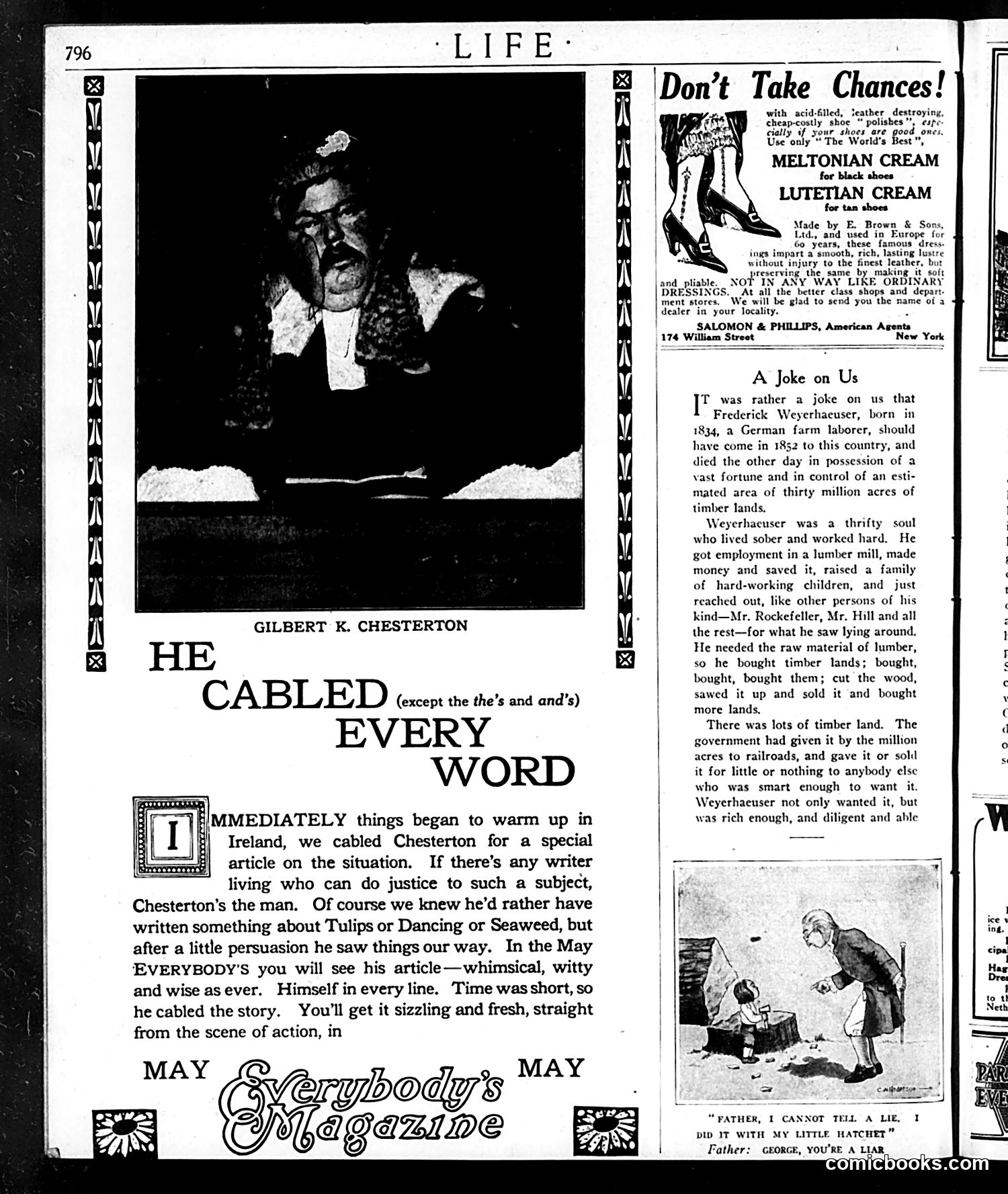
This article satirizes the enormous wealth amassed by Frederick Weyerhaeuser, a German immigrant who became a timber magnate controlling thirty million acres. The piece uses ironic tone to expose what the author sees as unfair land acquisition: Weyerhaeuser simply "reached out" for timber resources "lying around," much like Rockefeller and J.J. Hill. The satire targets government generosity—public lands distributed cheaply to railroads and private citizens willing to exploit them. The accompanying cartoon of the child with Washington's hatchet (George Washington's famous cherry tree legend) reinforces the irony: the "honest" immigrant narrative masks aggressive accumulation of public resources. The article's central point: Weyerhaeuser's success wasn't exceptional virtue but rather shrewd opportunism capitalizing on government-subsidized natural wealth, challenging the Gilded Age myth that great fortunes reward only hard work and thrift.
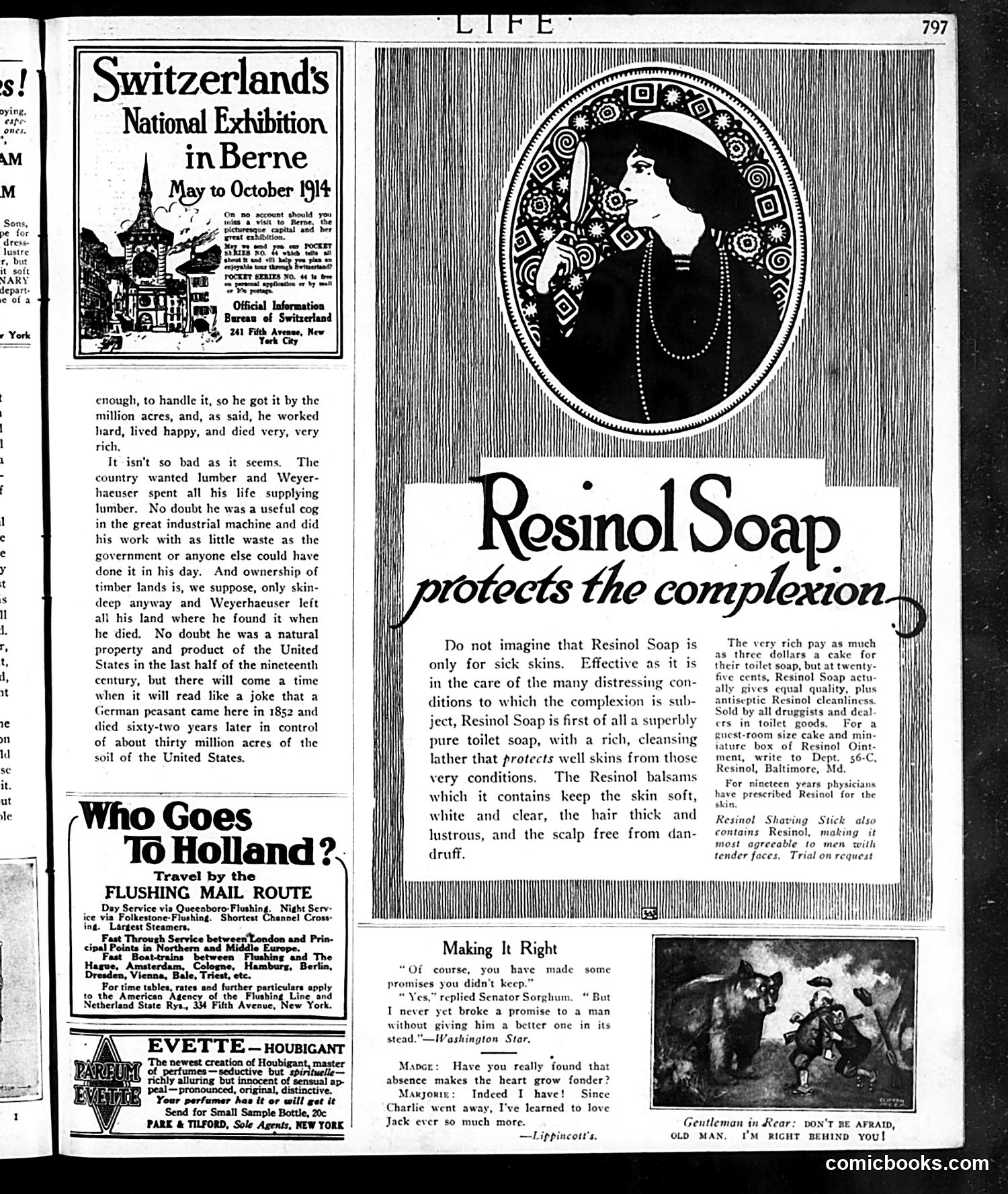
This page is primarily **advertising**, not political satire. The dominant content is a Resinol Soap advertisement featuring an art deco-style portrait of a woman, claiming the product "protects the complexion" and treats various skin conditions. The ad argues that while wealthy people pay three dollars for premium soaps, Resinol offers equal quality at twenty-five cents. Secondary content includes: - A **Switzerland National Exhibition advertisement** (Berne, May-October 1914) - Travel advertisements for the **Flushing Mail Route** and other services - **Three brief humorous anecdotes** at page bottom, including jokes about broken political promises and romantic absence The small cartoon labeled "Gentleman in Rear" shows a figure reassuring someone ahead: "Don't be afraid, old man, I'm right behind you!"—likely a mild joke about moral support or following someone's lead. The page reflects 1914 consumer culture and early 20th-century advertising strategies, with minimal satirical content.
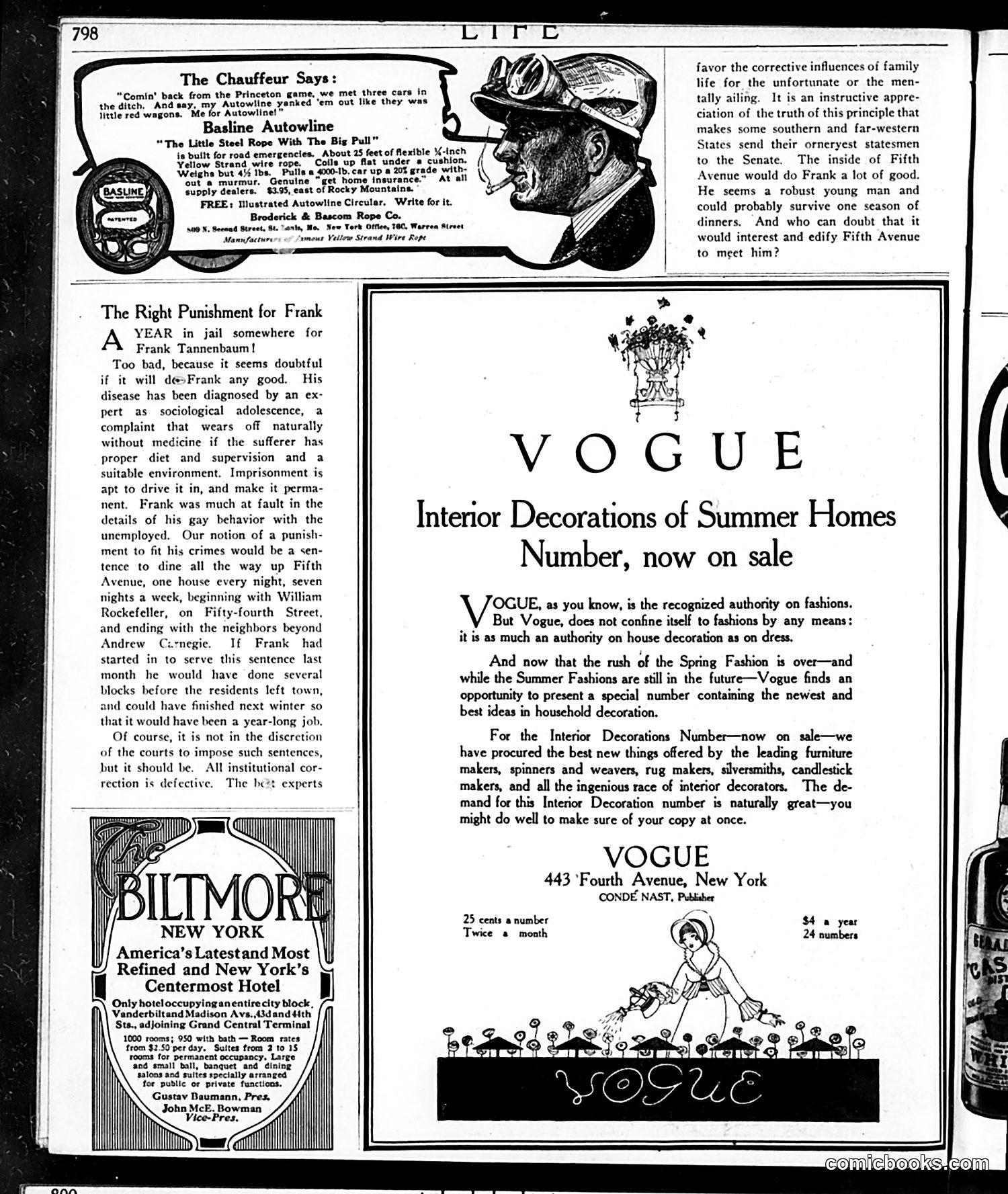
This page contains satirical commentary on Frank Tannenbaum, likely a wealthy socialite or prominent figure who faced legal trouble. The article mockingly proposes an alternative punishment: forcing him to dine nightly up Fifth Avenue, starting with William Rockefeller and ending near Andrew Carnegie's mansion—essentially subjecting him to enforced high-society dinners as rehabilitation. The satire critiques both Tannenbaum's behavior ("gay behavior with the unemployed") and the ineffectiveness of imprisonment for wealthy offenders. By suggesting social embarrassment among the wealthy elite as punishment, Life ridicules both Tannenbaum's conduct and the idea that dinner-party circuit socializing constitutes meaningful correction. The remaining page content is primarily advertising: an Autowline rope product testimonial and Vogue magazine's announcement of its Interior Decorations issue, with a Biltmore Hotel advertisement—typical commercial content filling magazine space.
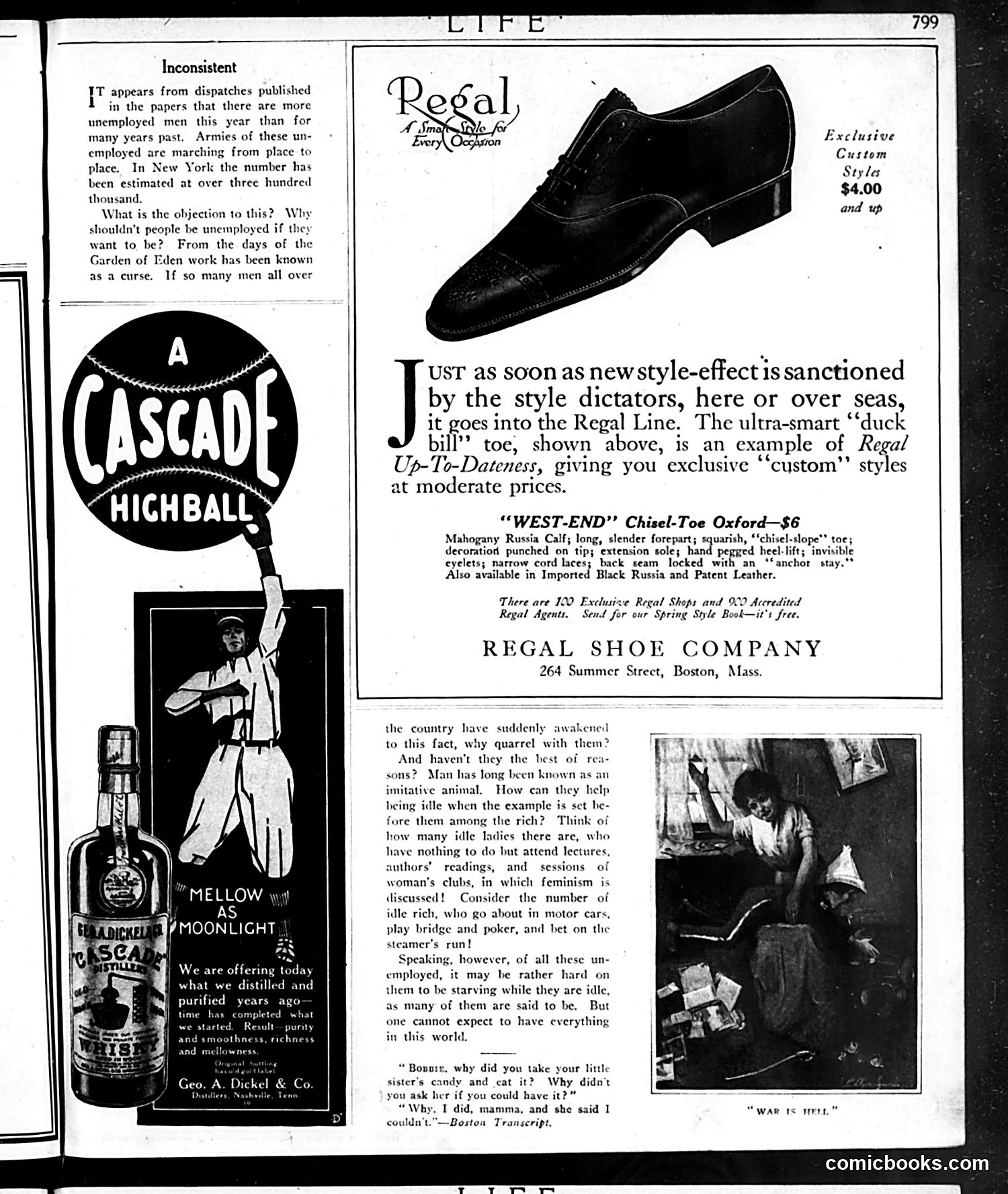
The left column contains a **satirical critique of unemployment and class inequality**. The author sarcastically argues that if work is a "curse" (referencing the Biblical Garden of Eden), why should anyone object to mass unemployment? The piece then exposes the hypocrisy: wealthy idle people—ladies attending lectures and "idle rich" playing cards and betting—face no criticism for not working, yet unemployed poor men are condemned for the same idleness. The point is that society applies different moral standards based on class: idleness is acceptable for the rich but shameful for the poor. The "Bonnie" anecdote at bottom reinforces childhood innocence and honesty, providing tonal contrast. The right side contains **product advertisements** (Regal shoes, Cascade Highball whiskey) unrelated to the satire's social commentary.
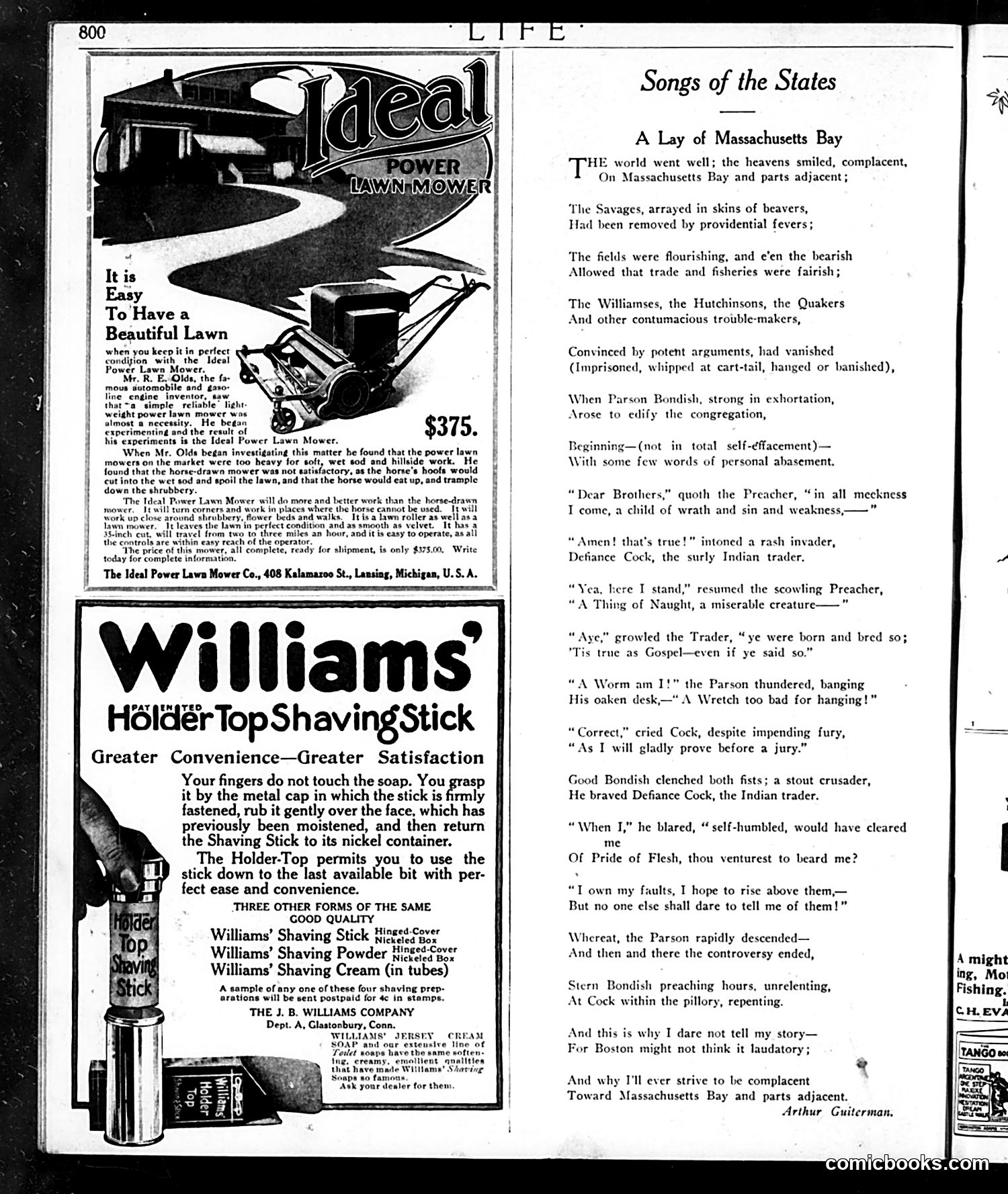
This page contains **two advertisements** (Ideal Power Lawn Mower at $375; Williams' Shaving Stick) and a **humorous satirical poem** titled "A Lay of Massachusetts Bay." The poem satirizes Puritan hypocrisy in early Massachusetts. It describes how colonists eliminated Native Americans ("removed by providential fevers"), suppressed religious dissidents (Williamses, Hutchinsons, Quakers—"imprisoned, whipped at cart-tail, hanged or banished"), and established order. The satire peaks in a confrontation between Parson Bondish (representing sanctimonious Puritan clergy) and "Defiance Cock" (an Indian trader). The Parson performs exaggerated self-abasement—calling himself a "worm" unworthy of hanging—but when Cock agrees and offers to prove it "before a jury," the Parson becomes enraged and attacks him. The joke: the Parson's performative humility is fraudulent; his actual pride and violence betray the hypocrisy underlying Puritan moral superiority. This mocks religious sanctimony masking brutality toward Indigenous peoples and dissenters.
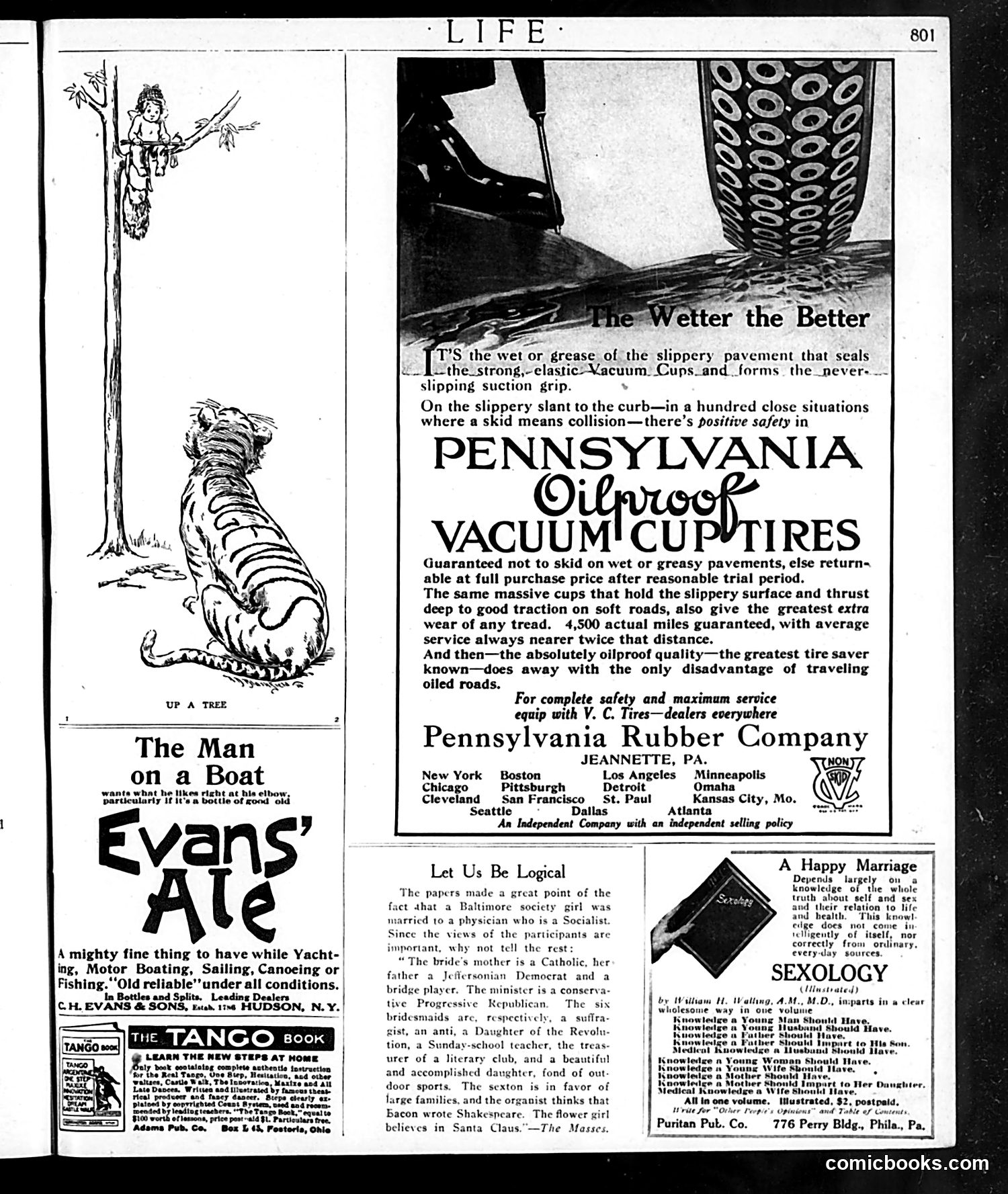
This page is primarily **advertising**, with a small satirical piece. **Main Advertisement:** Pennsylvania Oilproof Vacuum Cup Tires dominate the upper right, promoting superior traction on wet pavement through suction-cup technology. The ad targets safety-conscious drivers with guaranteed mileage claims. **Left Column Cartoon:** "The Man on a Boat" humorously illustrates a sailor clinging to a mast during rough conditions, advertising Evans' Ale as "reliable under all conditions"—a play on the sailor's precarious situation. **Satirical Piece - "Let Us Be Logical":** This mocks society's obsession with social status. It describes a Baltimore society wedding where the bride, groom, and wedding party represent wildly contradictory political and social positions (Catholic/Democrat, suffragist/anti-suffragist, etc.). The joke: such ideological diversity among close family reveals how arbitrary and superficial these social divisions are. The final absurd detail—the flower girl believing in Santa Claus—undercuts the pretentious tone, suggesting the wedding's social drama masks simple human diversity.
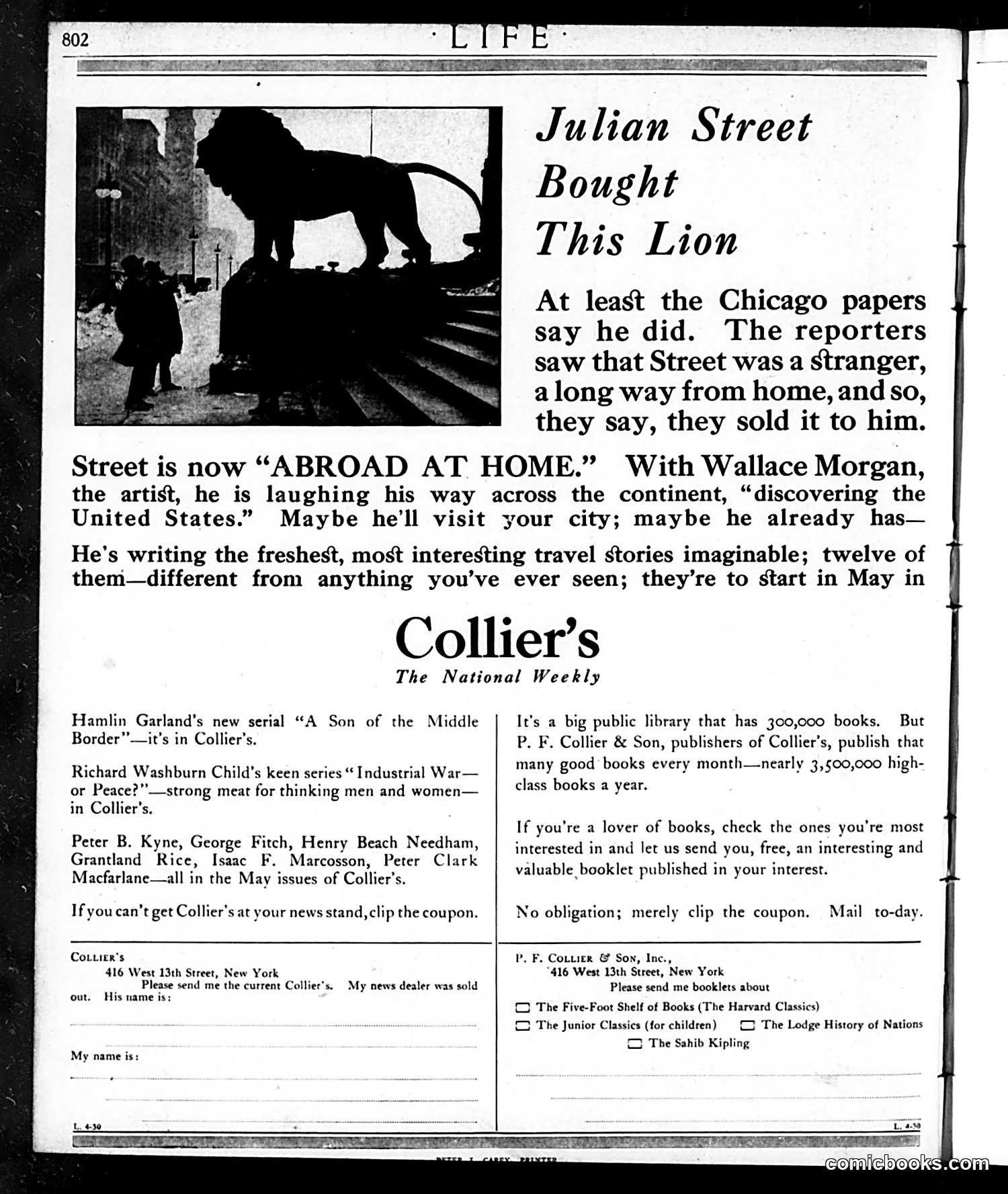
This is primarily advertising for *Collier's* magazine, but the top section contains the satire. Travel writer **Julian Street** apparently purchased a lion while traveling, and Chicago newspapers reported the story. The *Life* satire suggests Street was a gullible outsider ("a stranger, a long way from home") whom reporters deliberately duped into buying the animal as a prank—playing on the stereotype of the naive Eastern visitor. The accompanying illustration by **Wallace Morgan** shows Street with the lion, presumably "discovering the United States" in his travel series. The joke's edge is that Street's travel stories, promoted as fresh and authentic American observation, may actually stem from embarrassing incidents where he was the mark of local trickery. The satire mocks both tourist credulity and the reliability of travel journalism.
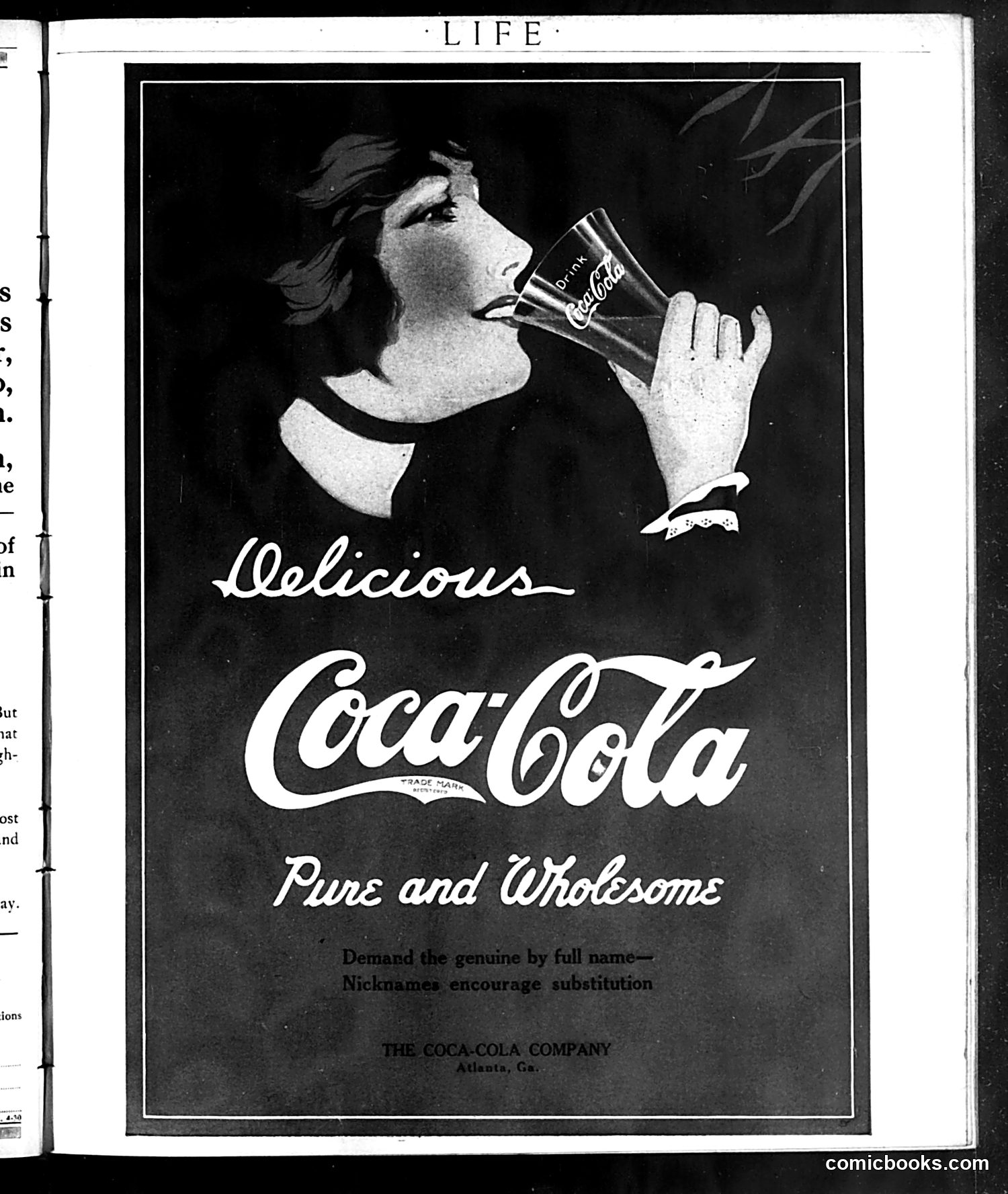
This is a **Coca-Cola advertisement**, not political satire. The image shows a woman in profile drinking from a Coca-Cola bottle, with the tagline "delicious" and "Pure and Wholesome." The ad includes a notice: "Demand the genuine by full name—Nicknames encourage substitution," warning consumers against accepting imitations or generic substitutes. This reflects early 20th-century marketing concerns about brand protection and counterfeit products. The "pure and wholesome" claim was common advertising language of the era, though modern readers should note this predates meaningful FDA regulation of such claims. The ad ran in *Life* magazine, which published both satirical content and paid advertisements.
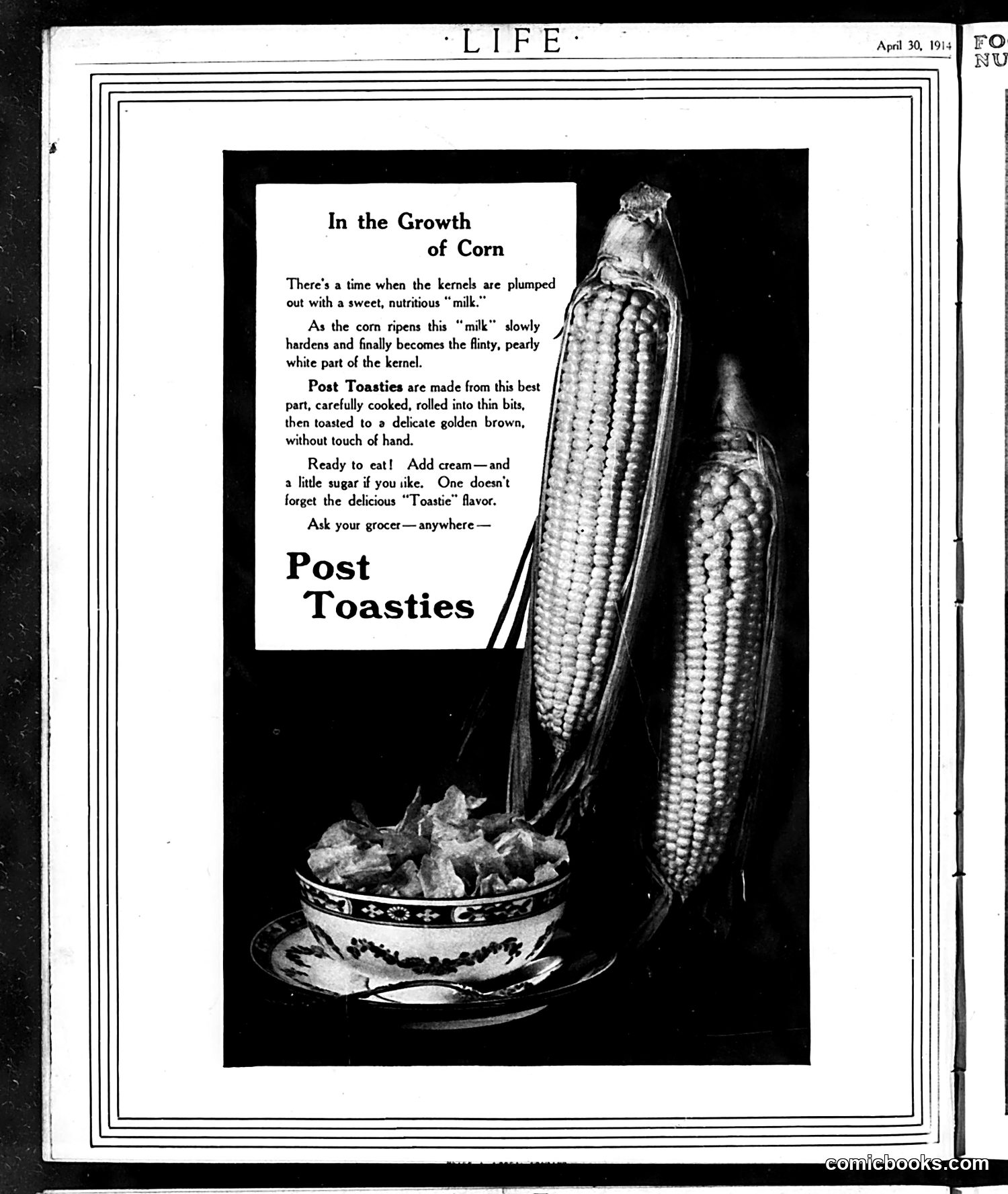
This is a **product advertisement**, not political satire. It's a full-page ad for Post Toasties cereal from the April 30, 1914 issue of Life magazine. The ad uses educational language about corn growth to market breakfast cereal. It explains that Post Toasties are made from corn kernels at their "milk" stage—when they contain natural sweetness—before hardening into mature kernels. The kernels are then cooked, formed into thin pieces, and toasted golden brown. The imagery shows fresh ears of corn alongside a decorative bowl of the finished cereal product, emphasizing naturalness and wholesomeness. The ad encourages consumers to "add cream—and a little sugar if you like" and directs them to ask their grocer. This represents typical early-20th-century advertising strategy: using scientific/agricultural explanations to legitimize mass-produced breakfast foods as natural and nutritious.