
Life, 1914-04-30 · page 20 of 44
Life — April 30, 1914 — page 20: what you’re looking at
What you’re looking at
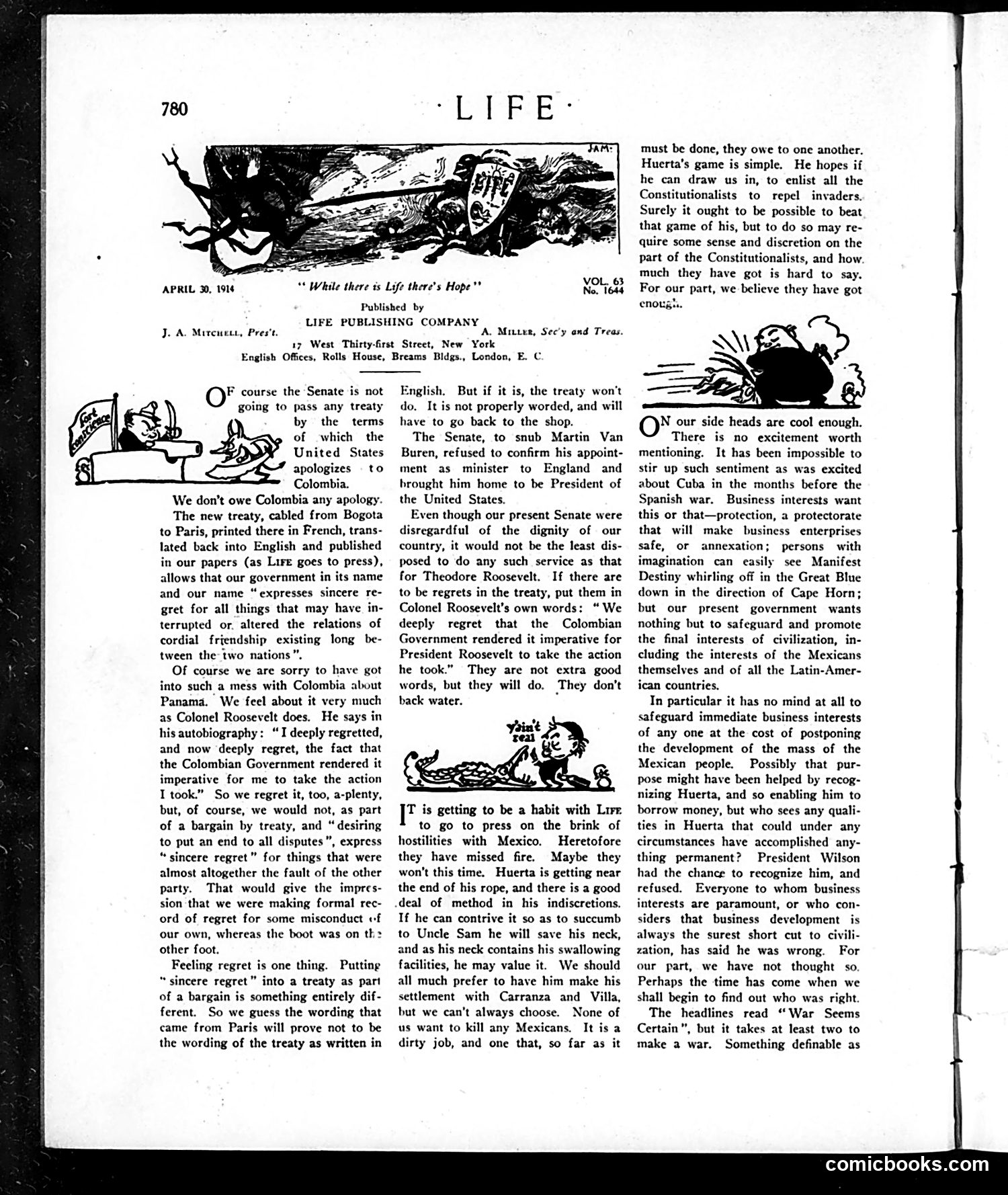
This page discusses two diplomatic crises: **Colombia Treaty**: The U.S. Senate debates whether to ratify a treaty with Colombia that includes "sincere regret" language over the 1903 Panama separation. The article argues Americans shouldn't formally apologize via treaty for actions taken under President Theodore Roosevelt, though personal regret is acceptable. It references the Senate's historical rejection of Martin Van Buren's appointment to snub him, suggesting they won't easily confirm controversial appointments. **Mexico Crisis**: Life notes it regularly goes to press amid threats of war with Mexico under President Huerta. The satire suggests Huerta deliberately provokes the U.S. to draw them into conflict, hoping to unite Mexican Constitutionalists against American "invasion." The editorial dismisses public excitement, claiming Americans remain level-headed about potential military intervention. Both sections reflect pre-World War I American diplomatic tensions and imperialist assumptions about regional conflicts.
📄 Transcribed text from this page (OCR, searchable)
Machine-transcribed from the original scan — historical spelling and the odd misread are preserved.
APRIL 30, 191¢ “* While there ts Life there's Hope"* Published by LIFE PUBLISHING COMPANY J. A. Mircueet, Pres’t. F course the Senate is not going to pass any treaty by the terms of which the United States apologizes to Colombia. We don’t owe Colombia any apology. The new treaty, cabled from Bogota to Paris, printed there in French, trans- lated back into English and published in our papers (as Lire goes to press), allows that our government in its name and our name “expresses sincere re- gret for all things that may have in- terrupted or. altered the relations of cordial friendship existing long be- tween the two nations”. Of course we are sorry to have got into such a mess with Colombia about Panama. We feel about it very much as Colonel Roosevelt does. He says in his autobiography: “I deeply regretted, and now deeply regret, the fact that the Colombian Government rendered it imperative for me to take the action T took.” So we regret it, too, a-plenty, but, of course, we would not, as part of a bargain by treaty, and “desiring to put an end to all disputes”, express “sincere regret” for things that were almost altogether the fault of the other party. That would give the impres- sion that we were making formal rec- ord of regret for some misconduct of our own, whereas the boot was on th: other foot. Feeling regret is one thing. Putting “ sincere regret” into a treaty as part of a bargain is something entirely dif- ferent. So we guess the wording that came from Paris will prove not to be the wording of the treaty as written in A. Mites, Sec’y and Treas. 17 West Thirty-first Street, New York English Offices, Rolls House, Breams Bldgs., London, E. C. English. But if it is, the treaty won't do. It is not properly worded, and will have to go back to the shop. The Senate, to snub Martin Van Buren, refused to confirm his appoint- ment as minister to England and brought him home to be President of the United States. Even though our present Senate were disregardful of the dignity of our country, it would not be the least dis- posed to do any such service as that for Theodore Roosevelt. If there are to be regrets in the treaty, put them in Colonel Roosevelt’s own words: “We deeply regret that the Colombian Government rendered it imperative for President Roosevelt to take the action he took.” They are not extra good words, but they will do. They don’t back water. cr is getting to be a habit with Lire to go to press on the brink of hostilities with Mexico. Heretofore they have missed fire. Maybe they won't this time. Huerta is getting near the end of his rope, and there is a good deal of method in his indiscretions. If he can contrive it so as to succumb to Uncle Sam he will save his neck, and as his neck contains his swallowing facilities, he may value it. We should all much prefer to have him make his settlement with Carranza and Villa, but we can’t always choose. None of us want to kill any Mexicans. It is a dirty job, and one that, so far as it must be done, they owe to one another. Huerta’s game is simple. He hopes if he can draw us in, to enlist all the Constitutionalists to repel invaders. Surely it ought to be possible to beat that game of his, but to do so may re- quire some sense and discretion on the part of the Constitutionalists, and how. much they have got is hard to say. For our part, we believe they have got Oo” our side heads are cool enough. There is no excitement worth mentioning. It has been impossible to stir up such sentiment as was excited about Cuba in the months before the Spanish war. Business interests want this or that—protection, a protectorate that will make business enterprises safe, or annexation; persons with imagination can easily see Manifest Destiny whirling off in the Great Blue down in the direction of Cape Horn; but our present government wants nothing but to safeguard and promote the final interests of civilization, in- cluding the interests of the Mexicans themselves and of all the Latin-Amer- ican countries. In particular it has no mind at all to safeguard immediate business interests of any one at the cost of postponing the development of the mass of the Mexican people. Possibly that pur- pose might have been helped by recog- nizing Huerta, and so enabling him to borrow money, but who sees any quali- ties in Huerta that could under any circumstances have accomplished any- thing permanent? President Wilson had the chance to recognize him, and refused. Everyone to whom business interests are paramount, or who con- siders that business development is always the surest short cut to civili- zation, has said he was wrong. For our part, we have not thought so. Perhaps the time has come when we shall begin to find out who was right. The headlines read ‘War Seems Certain", but it takes at least two to make a war. Something definable as comicbooks.com