
Life, 1914-04-30 · page 24 of 44
Life — April 30, 1914 — page 24: what you’re looking at
What you’re looking at
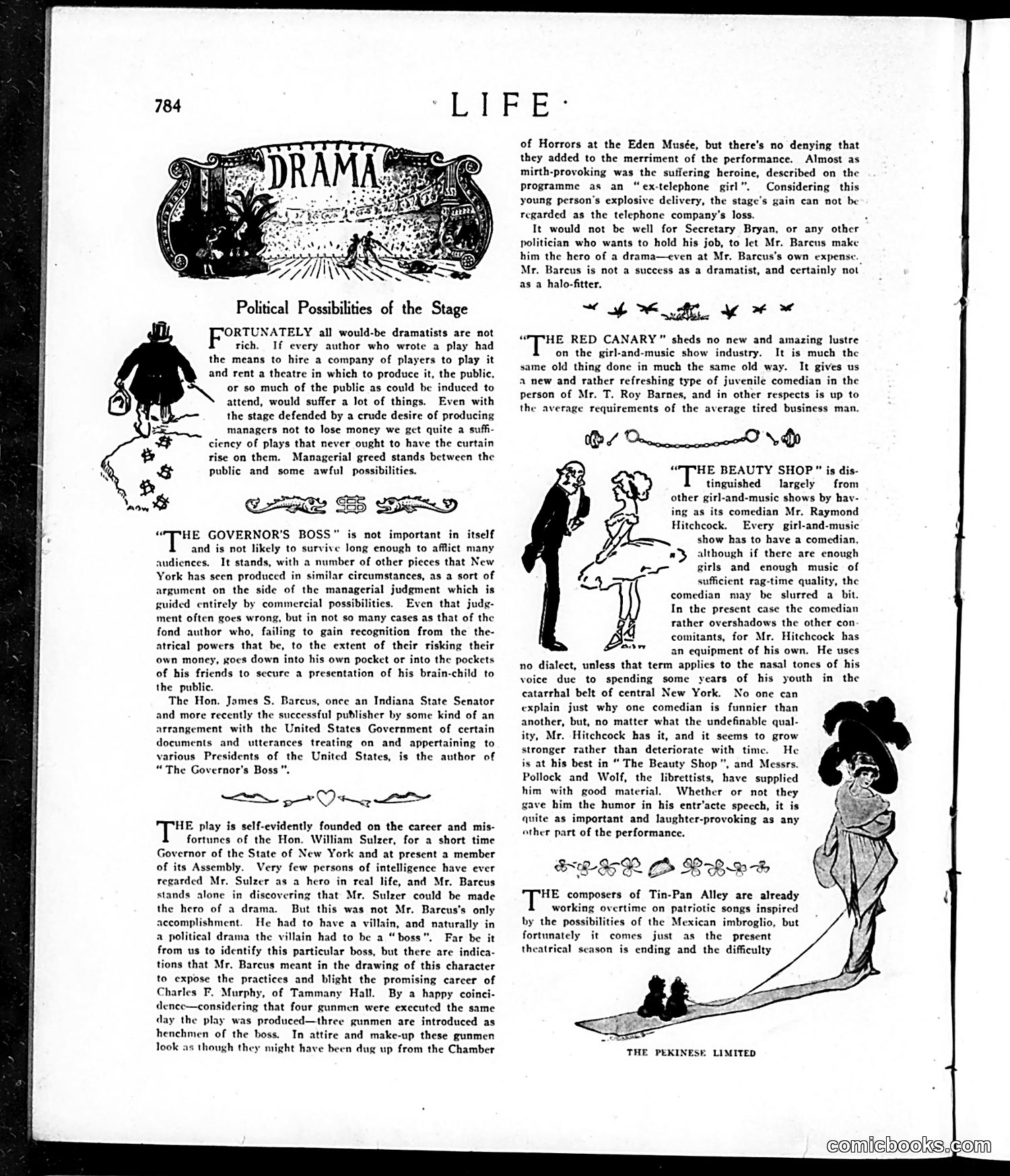
This page reviews theatrical productions with sharp political commentary. The main target is "The Governor's Boss," a play by James S. Barcus (former Indiana State Senator and publisher) based on Governor William Sulzer's career. The critic mocks Barcus's attempt to portray Sulzer—whom "very few persons of intelligence" regarded as heroic—as a dramatic protagonist. More pointedly, the play's villain appears designed to expose Charles F. Murphy of Tammany Hall, the Democratic political machine. The review notes three gunmen serve as the boss's henchmen, their appearances grotesquely drawn from the "Chamber of Horrors at the Eden Musée." The satire suggests Barcus is incompetent as a dramatist and particularly poor at "halo-fitter"—making villains (or heroes) seem noble. The critic warns politicians like Secretary Bryan against letting Barcus dramatize their lives. The page also briefly reviews lighter shows like "The Red Canary" and "The Beauty Shop," offering less biting critique.
📄 Transcribed text from this page (OCR, searchable)
Machine-transcribed from the original scan — historical spelling and the odd misread are preserved.
UL RES Political Possibilities of the Stage ORTUNATELY all would-be dramatists are not rich. If every author who wrote a play had the means to hire a company of players to play it and rent a theatre in which to produce it, the public, or so much of the public as could be induced to attend, would suffer a lot of things. Even with the stage defended by a crude desire of producing managers not to lose money we get quite a suffi- ciency of plays that never ought to have the curtain rise on them. Managerial greed stands between the public and some awful possibilities. “PPHE GOVERNOR'S BOSS” is not important in itself and is not likely to survive long enough to afflict many audiences. It stands, with a number of other pieces that New York has seen produced in similar circumstances, as a sort of argument on the side of the managerial judgment which is guided entirely by commercial possibilities. Even that judg- ment often goes wrong, but in not so many cases as that of the fond author who, failing to gain recognition from the the- atrical powers that be, to the extent of their risking their own money, goes down into his own pocket or into the pockets of his friends to secure a presentation of his brain-child to the public. The Hon. James S. Barcus, once an Indiana State Senator and more recently the successful publisher by some kind of an arrangement with the United States Government of certain documents and utterances treating on and appertaining to various Presidents of the United States, is the author of “The Governor's Boss". Se, C(O HE play is self-evidently founded on the career and mis- fortunes of the Hon. William Sulzer, for a short time Governor of the State of New York and at present a member of its Assembly. Very few persons of intelligence have ever regarded Mr, Sulzer as a hero in real life, and Mr. Barcus stands alone in discovering that Mr. Sulzer could be made the hero of a drama. But this was not Mr. Barcus’s only accomplishment. He had to have a villain, and naturally in a political drama the villain had to be a “boss”. Far be it from us to identify this particular boss, but there are indica- tions that Mr. Barcus meant in the drawing of this character to expose the practices and blight the promising carcer of Charles F. Murphy, of Tammany Hall. By a happy coinci- dencc—considering that four gunmen were executed the same day the play was produced—three gunmen are introduced as henchmen of the boss. In attire and make-up these gunmen look as though they might have been dug up from the Chamber of Horrors at the Eden Musée, but there's no denying that they added to the merriment of the performance. Almost as mirth-provoking was the suffering heroine, described on the Programme as an “ex-telephone girl”. Considering this young person's explosive delivery, the stage’s gain can not be regarded as the telephone company’s loss. . It would not be well for Secretary Bryan, or any other politician who wants to hold his job, to let Mr. Barcus make him the hero of a drama—even at Mr. Barcus’s own expense. Mr. Barcus is not a success as a dramatist, and certainly not as a halo-fitter. “of KL yo “"THE RED CANARY” sheds no new and amazing lustre on the girl-and-music show industry. It is much the same old thing done in much the same old way. It gives us a new and rather refreshing type of juvenile comedian in the person of Mr. T. Roy Barnes, and in other respects is up to the average requirements of the average tired business man, Pf Onn cocoeD Nap HE BEAUTY SHOP” is dis- tinguished largely from other girl-and-music shows by hav- ing as its comedian Mr, Raymond Hitchcock. Every girl-and-music show has to have a comedian, > although if there are enough girls and enough music of sufficient rag-time quality, the comedian may be slurred a bit. In the present case the comedian rather overshadows the other con comitants, for Mr. Hitchcock has an equipment of his own. He uses no dialect, unless that term applics to the nasal tones of his voice due to spending some years of his youth in the catarrhal belt of central New York. No one can explain just why one comedian is funnier than another, but, no matter what the undefinable qual- ity, Mr. Hitchcock has it, and it seems to grow stronger rather than deteriorate with time. He is at his best in “ The Beauty Shop”, and Messrs. Pollock and Wolf, the librettists, have supplied him with good material. Whether or not they gave him the humor in his entr’acte specch, it is quite as important and laughter-provoking as any other part of the performance. HE composers of Tin-Pan Alley are already working overtime on patriotic songs inspired by the possibilities of the Mexican imbroglio, but fortunately it comes just as the present theatrical season is ending and the difficulty al ~~ THE PEKINESE LIMITED comichooks.com