
Life, 1914-04-30 · page 10 of 44
Life — April 30, 1914 — page 10: what you’re looking at
What you’re looking at
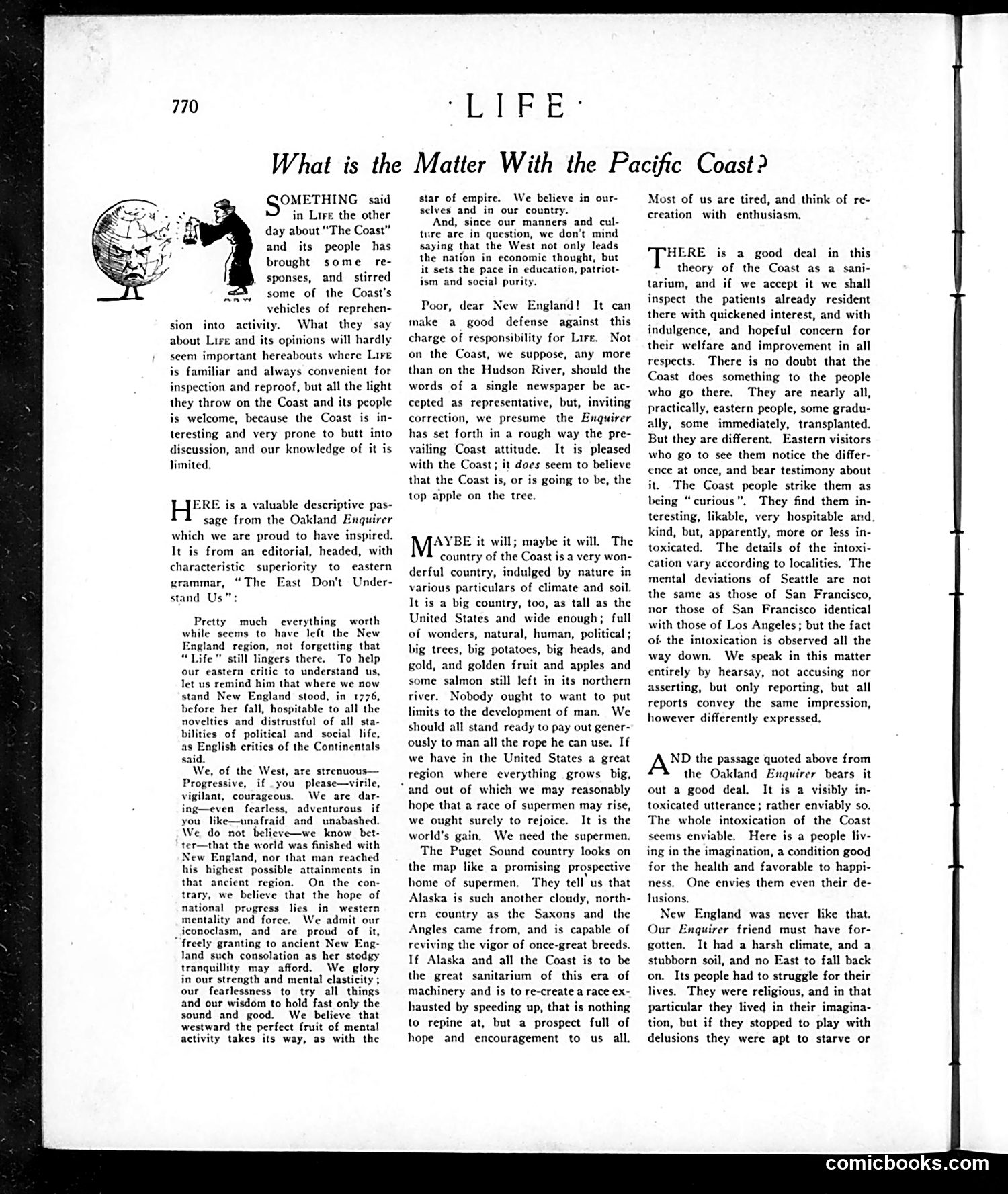
This page contains editorial commentary rather than political cartoon. The illustration shows a figure examining a globe, symbolizing scrutiny of the Pacific Coast region. The article defends the Pacific Coast against criticism, likely from Eastern publications like the *Enquirer*. The author acknowledges coastal residents are "curious" and sometimes "intoxicated" in their imaginative schemes, but argues this reflects youthful ambition rather than fundamental flaws. The piece compares the Coast favorably to New England, suggesting Eastern critics underestimate Western potential. It references Alaska and the Puget Sound as promising developments, presenting Western expansion as beneficial national progress rather than reckless speculation. The tone is defensive yet boastful—typical of regional rivalry between East and West during America's expansion period.
📄 Transcribed text from this page (OCR, searchable)
Machine-transcribed from the original scan — historical spelling and the odd misread are preserved.
ge L3G es ag What is the Matter With the Pacific Coast? OMETHING said in Lire the other day about “The Coast” and its people has brought some re- sponses, and stirred some of the Coast's vehicles of reprehen- sion into activity. What they say about Lire and its opinions will hardly seem important hereabouts where Lire is familiar and always convenient for inspection and reproof, but all the light they throw on the Coast and its people is welcome, because the Coast is in- teresting and very prone to butt into discussion, and our knowledge of it is limited. ERE is a valuable descriptive pas- sage from the Oakland Enquirer which we are proud to have inspired. It is from an editorial, headed, with characteristic superiority to eastern grammar, “The East Don't Under- stand Us”: Pretty much everything worth while seems to have left the New England region, not forgetting that “Life” still lingers there. To help our eastern critic to understand us, let us remind him that where we now stand New England stood, in 1776, before her fall, hospitable to all the novelties and distrustful of all sta- bilities of political and social life, as English critics of the Continentals said, We, of the West, are strenuous— Progressive, if you please—virile, vigilant, courageous. We are dar- ing—even fearless, adventurous if you like—unafraid and unabashed. We do not believe—we know bet- ter—that the world was finished with New England, nor that man reached his highest possible attainments in that ancient region. On the con- trary, we believe that the hope of national progress lies in western mentality and force. We admit our _iconoclasm, and are proud of it, freely granting to ancient New Eng- land such consolation as her stodgy tranquillity may afford. We glory in our strength and mental elasticity ; our fearlessness to try all things and our wisdom to hold fast only the sound and good. We believe that westward the perfect fruit of mental activity takes its way, as with the star of empire. We believe in our- selves and in our country. And, since our manners and cul- ture are in question, we don’t mind saying that the West not only leads the nation in economic thought, but it sets the pace in education, patriot- ism and social purity. Poor, dear New England! It can make a good defense against this charge of responsibility for Lire. Not on the Coast, we suppose, any more than on the Hudson River, should the words of a single newspaper be ac- cepted as representative, but, inviting correction, we presume the Enquirer has set forth in a rough way the pre- vailing Coast attitude. It is pleased with the Coast; it does seem to believe that the Coast is, or is going to be, the top apple on the tree. M*Y2= it will; maybe it will. The country of the Coast is a very won- derful country, indulged by nature in various particulars of climate and soil. It is a big country, too, as tall as the United States and wide enough; full of wonders, natural, human, political ; big trees, big potatoes, big heads, and gold, and golden fruit and apples and some salmon still left in its northern river. Nobody ought to want to put limits to the development of man. We should all stand ready to pay out gener- ously to man all the rope he can use. If we have in the United States a great region where everything grows big, “and out of which we may reasonably hope that a race of supermen may rise, we ought surely to rejoice. It is the world’s gain. We need the supermen. The Puget Sound country looks on the map like a promising prospective home of supermen. They tell us that Alaska is such another cloudy, north- ern country as the Saxons and the Angles came from, and is capable of reviving the vigor of once-great breeds. If Alaska and all the Coast is to be the great sanitarium of this era of machinery and is to re-create a race ex- hausted by speeding up, that is nothing to repine at, but a prospect full of hope and encouragement to us all. Most of us are tired, and think of re- creation with enthusiasm. HERE is a good deal in this theory of the Coast as a sani- tarium, and if we accept it we shall inspect the patients already resident there with quickened interest, and with indulgence, and hopeful concern for their welfare and improvement in all respects. There is no doubt that the Coast does something to the people who go there. They are nearly all, practically, eastern people, some gradu- ally, some immediately, transplanted. But they are different. Eastern visitors who go to see them notice the differ- ence at once, and bear testimony about it. The Coast people strike them as being “curious”. They find them in- teresting, likable, very hospitable and. kind, but, apparently, more or less in- toxicated. The details of the intoxi- cation vary according to localities. The mental deviations of Seattle are not the same as those of San Francisco, nor those of San Francisco identical with those of Los Angeles; but the fact of. the intoxication is observed all the way down. We speak in this matter entirely by hearsay, not accusing nor asserting, but only reporting, but all reports convey the same impression, however differently expressed, A®? the passage quoted above from the Oakland Enquirer bears it out a good deal. It is a visibly in- toxicated utterance; rather enviably so. The whole intoxication of the Coast seems enviable. Here is a people liv- ing in the imagination, a condition good for the health and favorable to happi- ness. One envies them even their de- lusions. New England was never like that. Our Enquirer friend must have for- gotten. It had a harsh climate, and a stubborn soil, and no East to fall back on. Its people had to struggle for their lives. They were religious, and in that particular they lived in their imagina- tion, but if they stopped to play with delusions they were apt to starve or comicbooks.com