
Life, 1914-04-30 · page 26 of 44
Life — April 30, 1914 — page 26: what you’re looking at
What you’re looking at
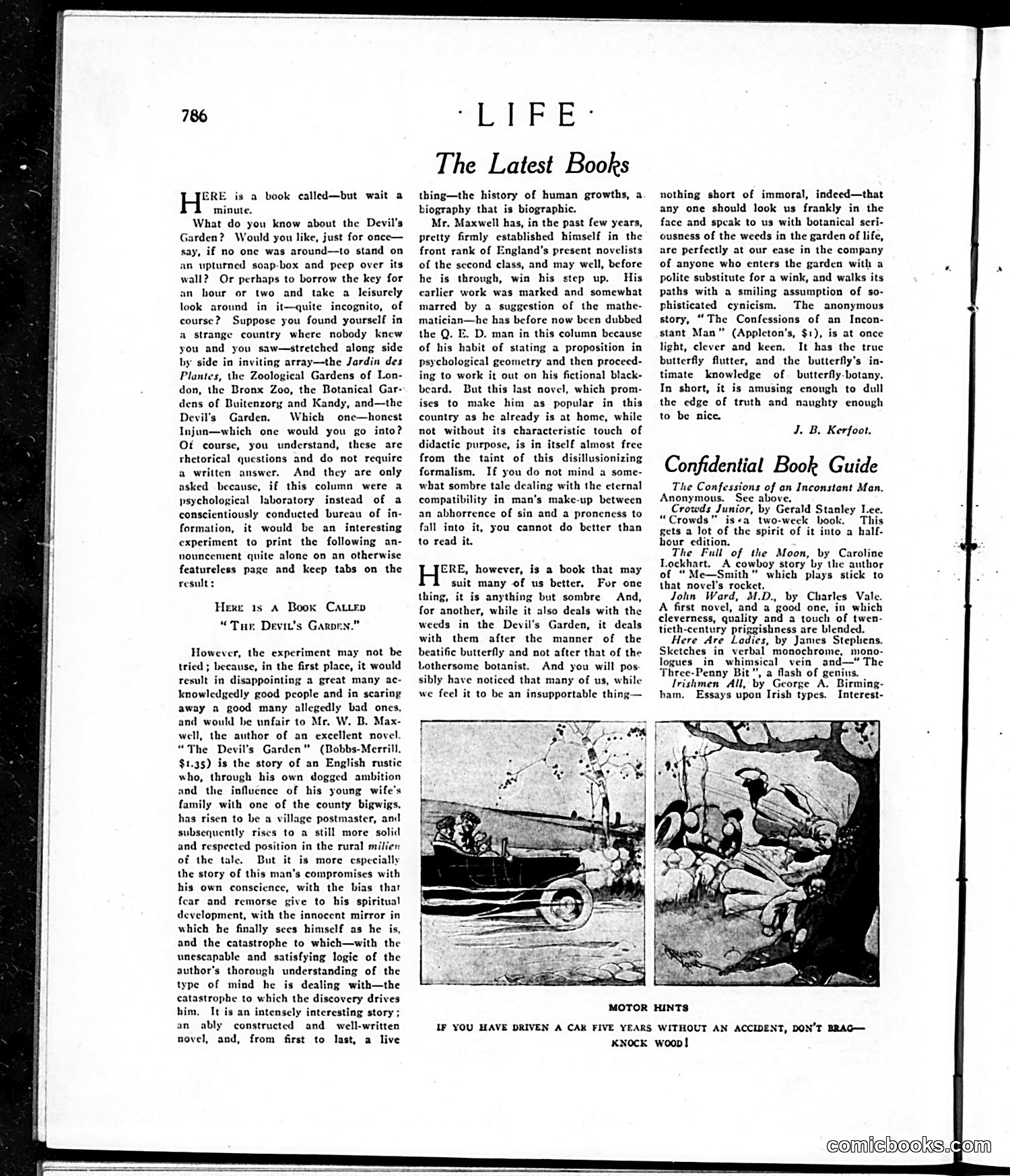
This page contains book reviews from *Life* magazine, not political cartoons. The main content reviews W.B. Maxwell's novel *"The Devil's Garden,"* discussing its themes of moral compromise and spiritual development in an English village postmaster's life. The opening uses satirical rhetoric—asking readers if they'd peek into a "Devil's Garden" alongside famous botanical attractions—as a rhetorical hook to discuss the novel's examination of human temptation and conscience. The small photographs labeled "MOTOR HINTS" at the bottom show vintage automobiles with a humorous safety caption: "If you have driven a car five years without an accident, don't brag—knock wood!" This is primarily a literary review page with light automotive humor, not political satire. The "Devil's Garden" metaphor is literary rather than political—exploring personal morality rather than social commentary.
📄 Transcribed text from this page (OCR, searchable)
Machine-transcribed from the original scan — historical spelling and the odd misread are preserved.
ERE is a book called—but wait a minute. What do you know about the Devil's Garden? Would you like, just for once— say, if no one was around—to stand on an upturned soap-box and peep over its wall? Or perhaps to borrow the key for an hour or two and take a leisurely look around in it—quite incognito, of course? Suppose you found yourself in a strange country where nobody knew you and you saw—stretched along side by side in inviting array—the Jardin des Plantes, the Zoological Gardens of Lon- don, the Bronx Zoo, the Botanical Gar- dens of Buitenzory and Kandy, and—the Devil's. Garden. Which one—honest Injun—which one would you go into? Of course, you understand, these are rhetorical questions and do not require a written answer. And they are only asked because, if this column were a psychological laboratory instead of a conscientiously conducted bureau of in- formation, it would be an interesting experiment to print the following an- nouncement quite alone on an otherwise featureless page and keep tabs on the result: Here 1s A Book Cattrp “Tur. Devit's Garvey.” However, the experiment may not be tried ; because, in the first place, it would result in disappointing a great many ac- knowledgedly good people and in scaring away a good many allegedly bad ones, and would be unfair to Mr. W. B. Max- well, the author of an excellent novel. “The Devil's Garden” (Bobbs-Merrill, $1.35) is the story of an English rustic who, through his own dogged ambition and the influence of his young wife's family with one of the county bigwigs. has risen to be a village postmaster, and subsequently riscs to a still more solid and respected position in the rural milien of the tale. But it is more especially the story of this man’s compromises with his own conscience, with the bias that fear and remorse give to his spiritual development, with the innocent mirror in which he finally sces himself as he is, and the catastrophe to which—with the unescapable and satisfying logic of the author's thorough understanding of the type of mind he is dealing with—the catastrophe to which the discovery drives him. It is an intensely interesting story ; an ably constructed and well-written novel, and, from first to last, a live LIFE The Latest Books thing—the history of human growths, a biography that is biographic. Mr. Maxwell has, in the past few years, pretty firmly established himself in the front rank of England's present novelists of the second class, and may well, before he is through, win his step up. His carlier work was marked and somewhat marred by a suggestion of the mathe- matician—he has before now been dubbed the Q. E. D. man in this column because of his habit of stating a proposition in psychological geometry and then proceed- ing to work it out on his fictional black- beard. But this last novel, which prom- ises to make him as popular in this country as he already is at home, while not without its characteristic touch of didactic purpose, is in itself almost free from the taint of this disillusionizing formalism. If you do not mind a some- what sombre tale dealing with the eternal compatibility in man’s make-up between an abhorrence of sin and a proneness to fall into it, you cannot do better than to read it. ERE, however, is a book that may suit many of us better, For one thing, it is anything but sombre And, for another, while it also deals with the weeds in the Devil’s Garden, it deals with them after the manner of the beatific butterfly and not after that of the Lothersome botanist. And you will pos. sibly have noticed that many of us, while we feel it to be an insupportable thing— nothing short of immoral, indeed—that any one should look us frankly in the face and spcak to us with botanical seri- ousness of the weeds in the garden of life, are perfectly at our ease in the company of anyone who enters the garden with a polite substitute for a wink, and walks its paths with a smiling assumption of so- phisticated cynicism, The anonymous story, “The Confessions of an Incon- stant Man” (Appleton’s, $1), is at once light, clever and keen, It has the truc butterfly flutter, and the butterfly’s in- timate knowledge of butterfly-botany. In short, it is amusing enough to dull the edge of truth and naughty enough to be nice, J. B. Kerfoot. Confidential Book Guide The Confessions of an Inconstant Man. Anonymous. See above, Crowds Junior, by Gerald Stanley Lee. “Crowds” is¢a two-week book. This gets a lot of the spirit of it into a half- hour edition. The Full of the Moon, by Caroline Lockhart. A cowboy story by the author of “Me—Smith” which plays stick to that novel's rocket. John Ward, M.D., by Charles Vale. A first novel, and a good one, in which cleverness, quality and a touch of twen- ticth-century priggishness are blended. Here Are Ladies, by James Stephens. Sketches in verbal monochrome, mono- logues_ in whimsical vein and—* The Three-Penny Bit”, a flash of genius. Irishmen All, by George A. Birming- ham. Essays upon Irish types. Interest- MOTOR HINTS IF YOU HAVE DRIVEN A CAR FIVE YEARS WITHOUT AN ACCIDENT, DON’T BRAG— KNOCK woop! comichooks.qom