
Life, 1914-04-30 · page 28 of 44
Life — April 30, 1914 — page 28: what you’re looking at
What you’re looking at
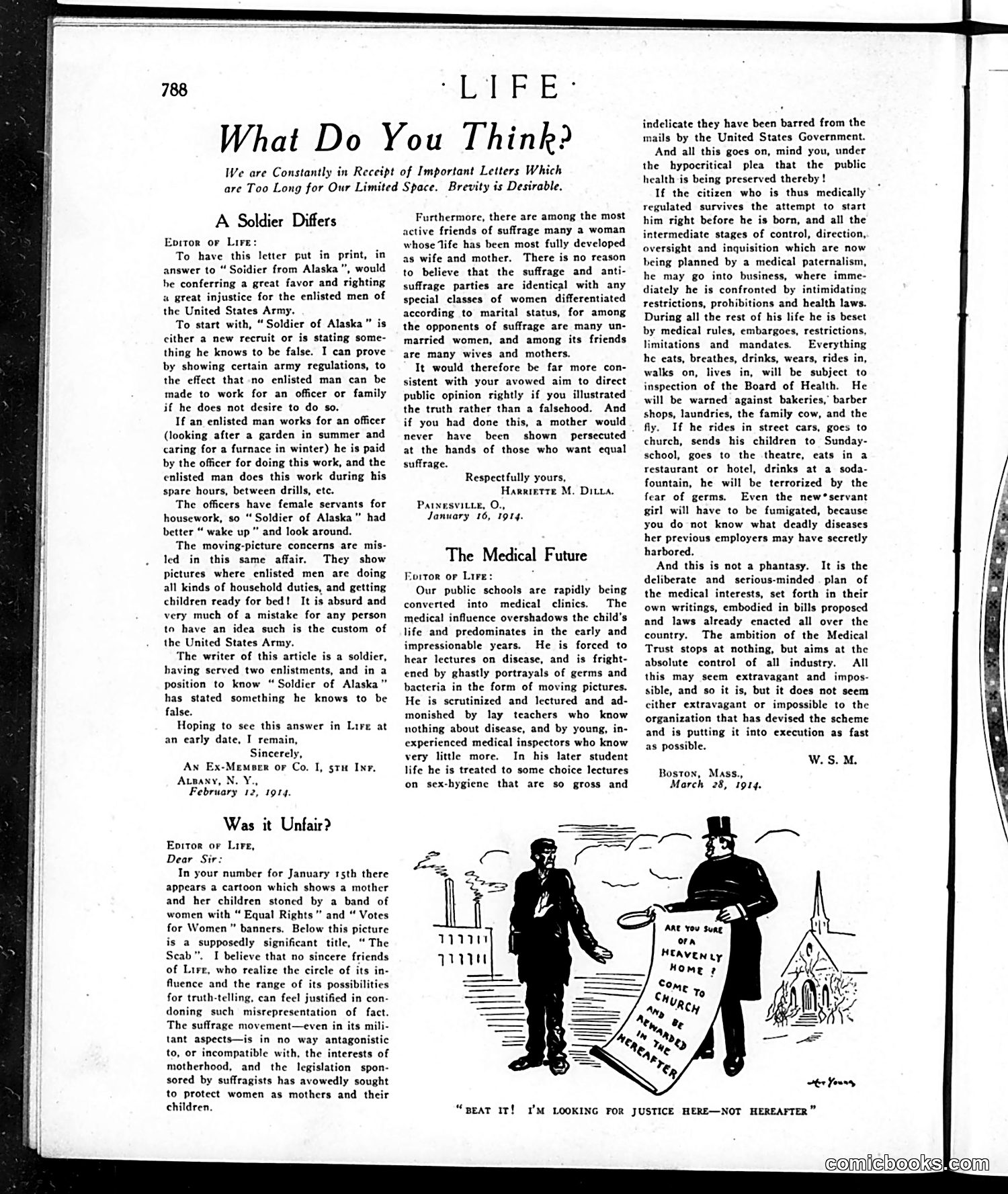
This page features reader letters debating three contentious issues of the era: **"A Soldier Differs"**: A military serviceman defends enlisted men against allegations (apparently from a previous "Soldier from Alaska" letter) that they performed unpaid domestic labor for officers. He cites regulations proving soldiers cannot be compelled to work without compensation. **"Was it Unfair?"** responds to an earlier cartoon titled "The Scab" (not visible here) depicting suffragettes stoning a mother. The letter-writer condemns this as misrepresenting the women's suffrage movement, arguing suffragists actively supported mothers' interests and included many wives and mothers among their supporters. She demands *Life* illustrate truth rather than propaganda against equal voting rights. **"The Medical Future"**: A writer criticizes schools converting into "medical clinics," claiming excessive medical lectures and germ-focused imagery frighten children unnecessarily. These letters reflect 1914 America's fierce debates over military labor practices, women's suffrage (then unresolved), and public health authority—all contentious social divisions of the Progressive Era.
📄 Transcribed text from this page (OCR, searchable)
Machine-transcribed from the original scan — historical spelling and the odd misread are preserved.
Shu Raee What Do You Think? We are Constantly in Receipt of Important Letters Which are Too Long for Our Limited Space. Brevity is Desirable, A Soldier Differs Eprtor oF Lire: To have this letter put in print, in answer to “ Soidier from Alaska”, would he conferring a great favor and righting a great injustice for the enlisted men of the United States Army. To start with, “Soldier of Alaska” is cither a new recruit or is stating some- thing he knows to be false. I can prove by showing certain army regulations, to the effect that no enlisted man can be made to work for an officer or family if he does not desire to do so. If an enlisted man works for an officer (looking after a garden in summer and caring for a furnace in winter) he is paid by the officer for doing this work, and the enlisted man does this work during his spare hours, between drills, etc. The officers have female servants for housework, so “Soldier of Alaska” had better “ wake up” and look around. The moving-picture concerns are mis- led in this same affair. They show pictures where enlisted men are doing all kinds of household duties, and getting children ready for bed! It is absurd and very much of a mistake for any person to have an idea such is the custom of the United States Army. The writer of this article is a soldier, having served two enlistments, and in a position to know “Soldier of Alaska” has stated something he knows to be false. Hoping to see this answer in Lire at an early date, I remain, Sincerely, An Ex-Memper or Co. I, srt Ixv. Aunaxy, N. Y., February 12, 1914. Was it Unfair? Epitor or Lire, Dear Sir: In your number for January rsth there appears a cartoon which shows a mother and her children stoned by a band of women with “ Equal Rights” and “ Votes for Women” banners. Below this picture is a supposedly significant title, “ The Scab", I believe that no sincere friends of Lire, who realize the circle of its in- fluence and the range of its possibilities for truth-telling, can feel justified in con- doning such misrepresentation of fact. The suffrage movement—even in its mili- tant aspects—is in no way antagonistic to, or incompatible with, the interests of motherhood, and the legislation spon- sored by suffragists has avowedly sought to protect women as mothers and their children. Furthermore, there are among the most active friends of suffrage many a woman whose life has been most fully developed as wife and mother. There is no reason to believe that the suffrage and anti- suffrage parties are identical with any special classes of women differentiated according to marital status, for among the opponents of suffrage are many un- married women, and among its friends are many wives and mothers. It would therefore be far more con- sistent with your avowed aim to direct public opinion rightly if you illustrated the truth rather than a falsehood. And if you had done this, a mother would never have been shown persecuted at the hands of those who want equal suffrage. Respectfully yours, Hargiette M. Ditta. PAINESVILLE, January 16, 1914. The Medical Future Fortor or Lire: Our public schools are rapidly being converted into medical clinics. The medical influence overshadows the child's life and predominates in the early and impressionable years. He is forced to hear lectures on disease, and is fright- ened by ghastly portrayals of germs and bacteria in the form of moving pictures. He is scrutinized and lectured and ad- monished by lay teachers who know nothing about disease, and by young, in- experienced medical inspectors who know very little more. In his later student life he is treated to some choice lectures on sex-hygiene that are so gross and Me a bs ike Ww Vay “BEAT IT! I'M LOOKING FoR indelicate they have been barred from the mails by the United States Government. And all this goes on, mind you, under the hypocritical plea that the public health is being preserved thereby! If the citizen who is thus medically regulated survives the attempt to start him right before he is born, and all the intermediate stages of control, direction, oversight and inquisition which are now being planned by a medical paternalism, he may go into business, where imme- diately he is confronted by intimidating restrictions, prohibitions and health laws. During all the rest of his life he is beset by medical rules, embargoes, restrictions, limitations and mandates. Everything he eats, breathes, drinks, wears, rides in, walks on, lives in, will be subject to inspection of the Board of Health. He will be warned against bakeries, barber shops, laundries, the family cow, and the fly. If he rides in street cars, goes to church, sends his children to Sunday- school, goes to the theatre, eats in a restaurant or hotel, drinks at a soda- fountain, he will be terrorized by the fear of germ: Even the new*servant girl will have to be fumigated, because you do not know what deadly diseases her previous employers may have secretly harbored. And this is not a phantasy. It is the deliberate and serious-minded plan of the medical interests, set forth in their own writings, embodied in bills proposed and laws already enacted all over the country. The ambition of the Medical Trust stops at nothing, but aims at the absolute control of all industry. All this may seem extravagant and impos- sible, and so it is, but it does not seem cither extravagant or impossible to the organization that has devised the scheme and is putting it into execution as fast as possible. W. S. M. Bostox, Mass., March 28, 1914. JUSTICE HERE—NOT HEREAFTER comichooks|