
A complete issue · 40 pages · 1911
Life — August 24, 1911
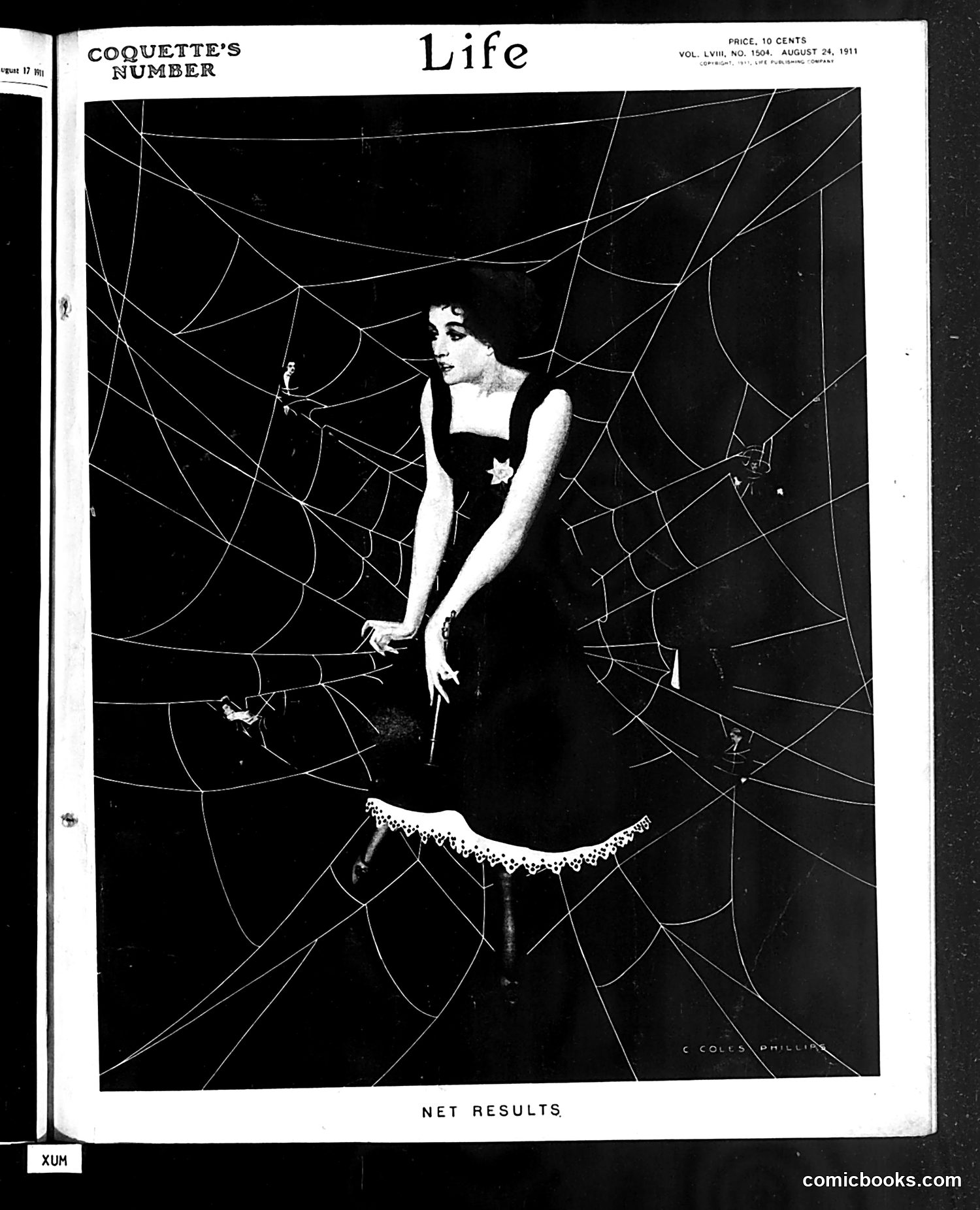
This satirical illustration depicts a woman caught in a giant spider's web, surrounded by several spiders. The title "Net Results" is a double entendre—playing on both fishing nets and spider webs as "traps." The cartoon appears to be social commentary on marriage or romantic entanglement, a common theme in early 20th-century humor magazines. The woman, dressed formally with lace trim, represents either a bride or eligible woman, while the spiders likely represent suitors or male predators. The elaborate web suggests she's become ensnared—possibly commenting on the dangers women faced in courtship or the "trapping" nature of marriage expectations. The black-and-white illustration style and composition are characteristic of Life magazine's satirical art from this era.
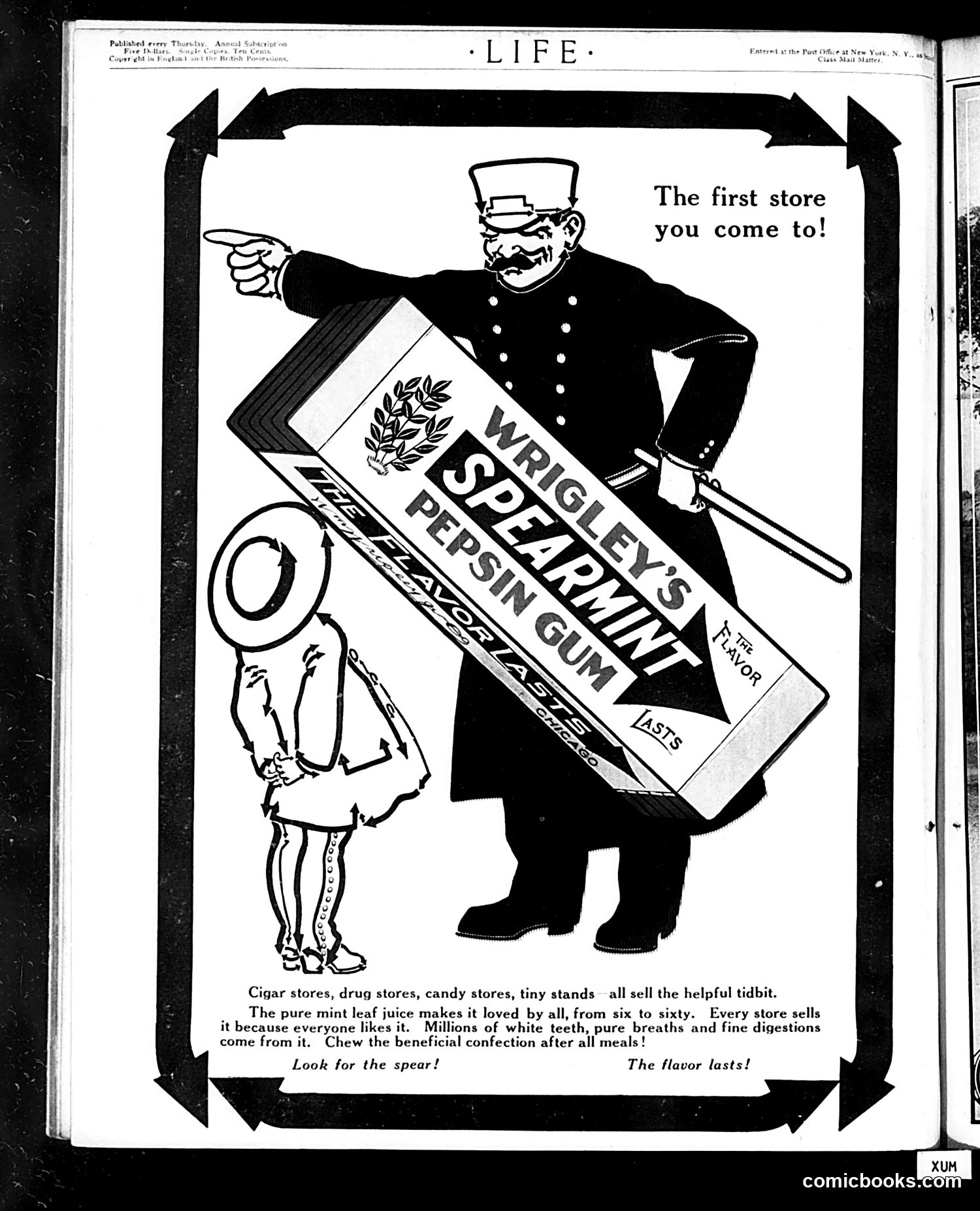
This is a **commercial advertisement**, not political satire. It promotes Wrigley's Spearmint gum using a uniformed doorman or bellhop figure pointing to direct a small child customer toward the product. The ad's messaging emphasizes that the gum is universally available ("the first store you come to") and sold everywhere—cigar stores, drugstores, candy shops, and small stands. It claims health benefits typical of early 20th-century advertising: pure mint leaf, white teeth, pure breath, and improved digestion. The "spear" logo reference and tagline "The flavor lasts!" were Wrigley's standard marketing. This represents typical American consumer advertising from the early 1900s, before modern regulations restricted health claims on candy products.
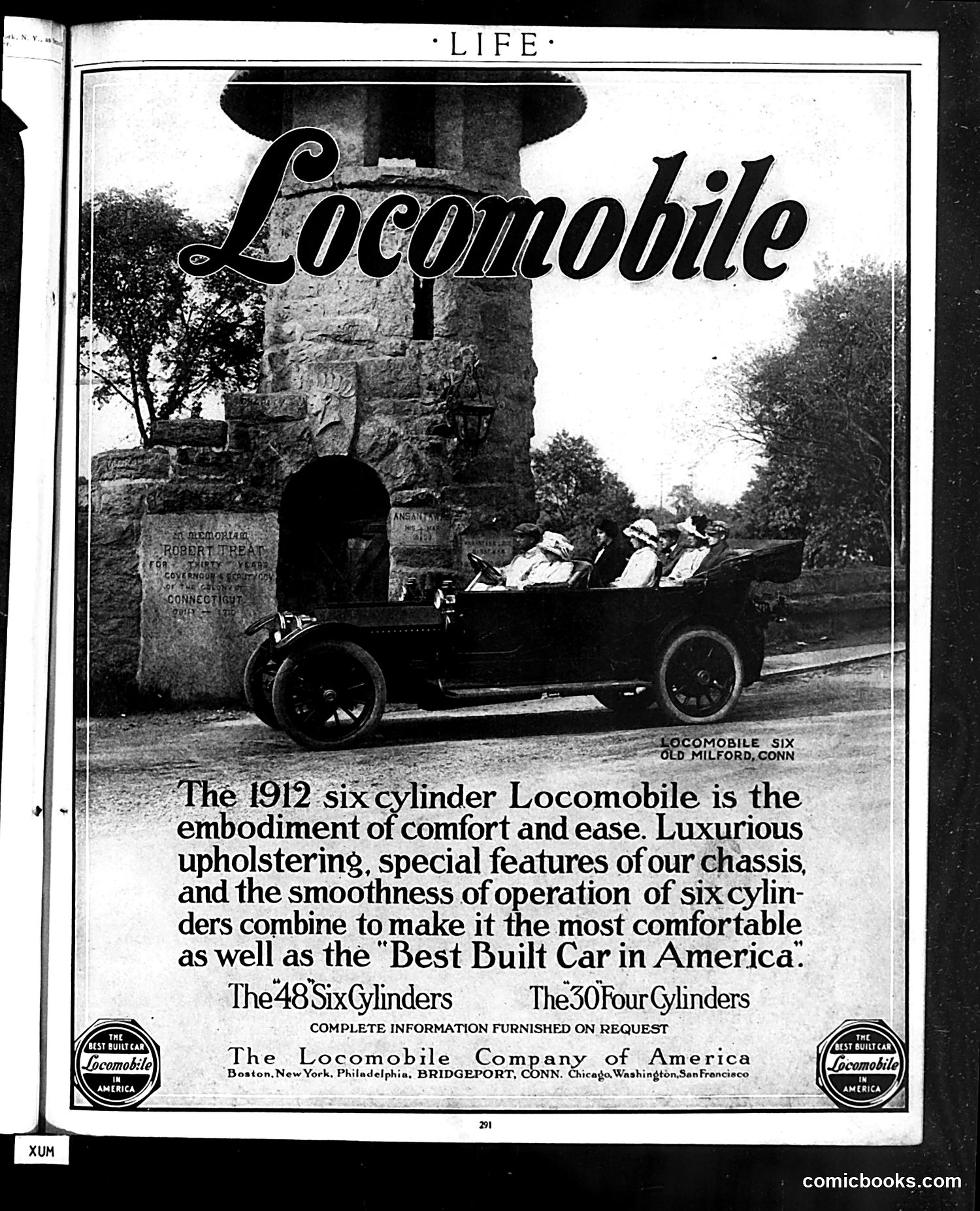
This page is **not a cartoon or satirical content** — it's a straightforward **automobile advertisement** from Life magazine, circa 1912. The image shows a Locomobile Six car with passengers near what appears to be a historic stone tower in Old Milford, Connecticut. The advertisement makes no satirical or political points. Instead, it promotes the 1912 Locomobile as "the embodiment of comfort and ease" and "the Best Built Car in America," emphasizing its six-cylinder engine and smooth operation. The Locomobile Company of America lists multiple office locations (Boston, New York, Philadelphia, Bridgeport, Chicago, Washington, San Francisco), indicating this was a significant American automobile manufacturer of the era. This is purely commercial content, not satire.
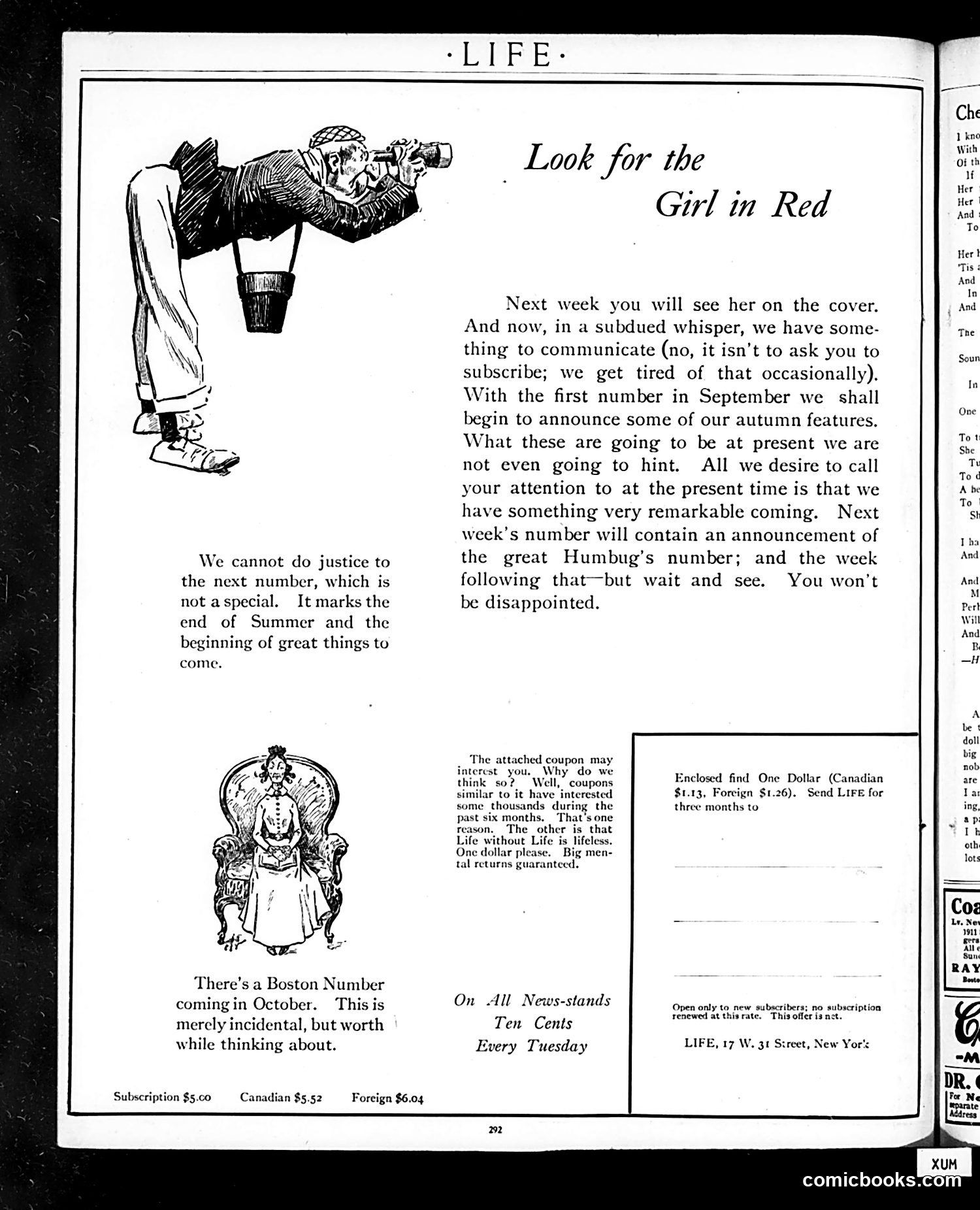
This page primarily consists of **promotional content** for Life magazine itself, not political satire. The main illustration shows a photographer or journalist looking through a telescope or similar viewing device—a visual metaphor for Life's promise to reveal hidden stories and expose truths to readers. The "Girl in Red" headline announces upcoming cover features and teases "something very remarkable coming," likely referring to a story about "the great Humbug's number." The text emphasizes Life's role in communicating important information and offering exclusive content. A secondary illustration depicts a crowned female figure, possibly representing royalty or authority. The page functions primarily as **subscription promotion** rather than political commentary, advertising Life at various price points ($5.60 domestic, $5.52 Canadian, $6.04 foreign).
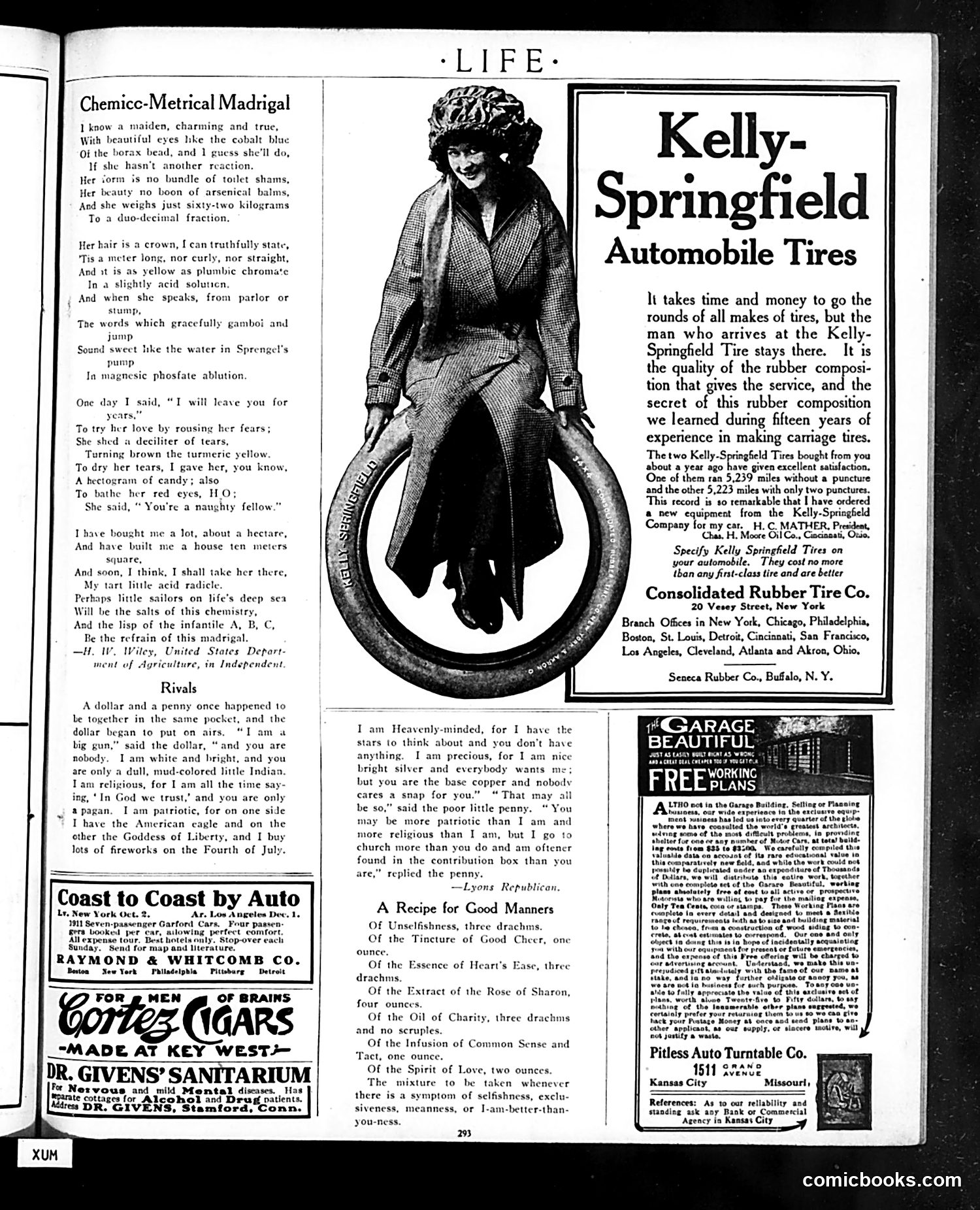
This page is primarily **advertising and light verse** rather than political satire. The main content includes: - **"Chemico-Metrical Madrigal"**: A whimsical poem describing a maiden's physical attributes using pseudo-scientific language—a gentle satire of overwrought Romantic poetry and the affectation of using technical jargon in verse. - **"Rivals"**: A humorous short story about coins debating their worth and patriotic value—mild social commentary on materialism and national pride. - **Advertisements**: Multiple ads for automobiles, tires, cigars, and real estate dominate the page, typical of Life's commercial content. The overall tone is lighthearted rather than sharp political commentary. The satire targets literary conventions and human vanity rather than pressing political issues. This reflects Life's role as a general-interest humor magazine of the early 20th century.
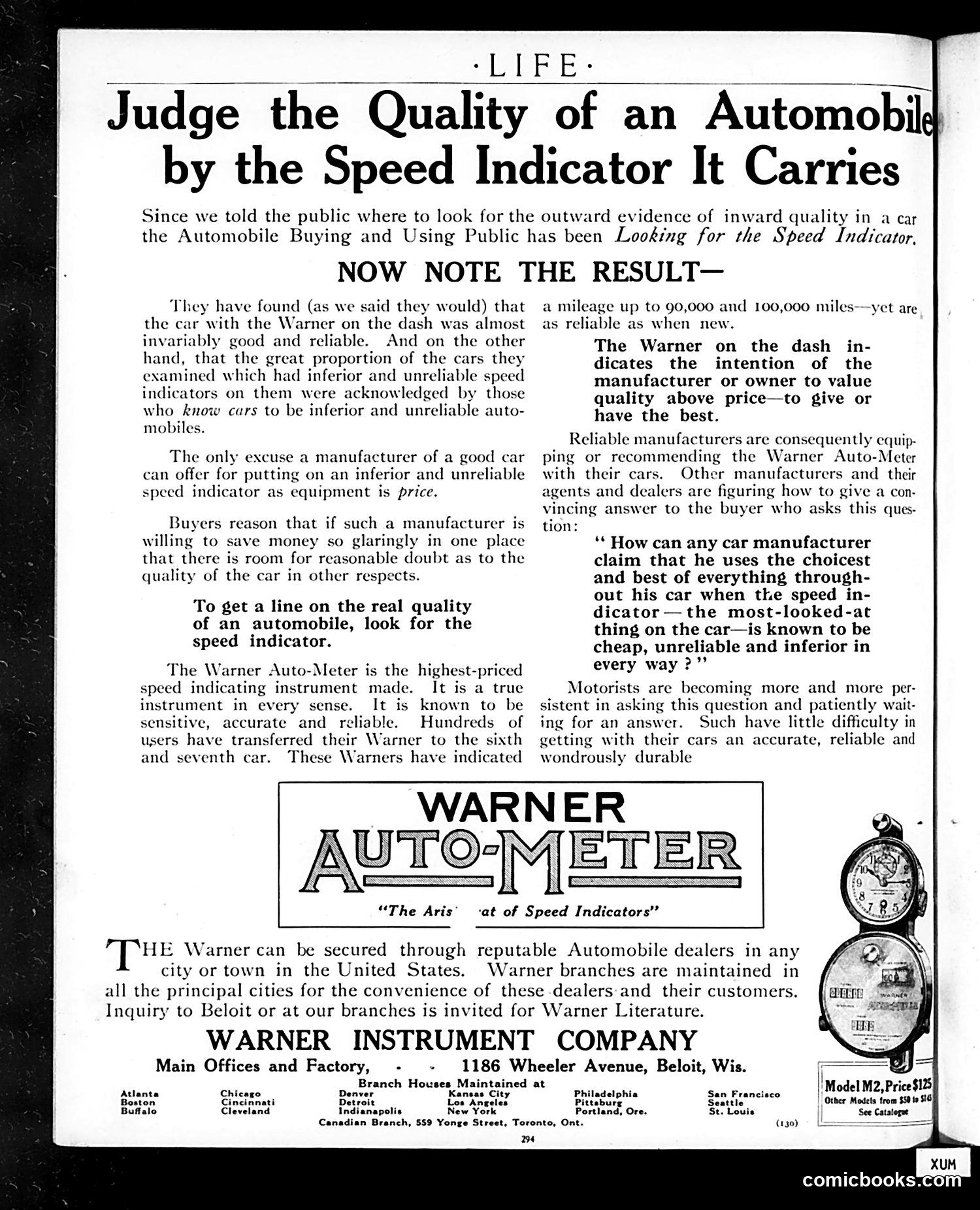
This is primarily a **paid advertisement**, not editorial satire. The Warner Instrument Company promotes their "Auto-Meter" speedometer as a quality indicator for automobiles. The ad's argument: a manufacturer willing to use cheap, inferior speed indicators suggests corners are cut elsewhere—so buyers should judge car quality by whether it has a reliable Warner speedometer. The piece includes testimonials that hundreds of owners have transferred their Warner meters to successive vehicles. The "point" is commercial rather than satirical: positioning the speedometer as evidence of manufacturer integrity. While it uses rhetorical appeals about quality standards, this is straightforward product advertising dressed in the language of consumer education, typical of early automotive advertisements in *Life* magazine.
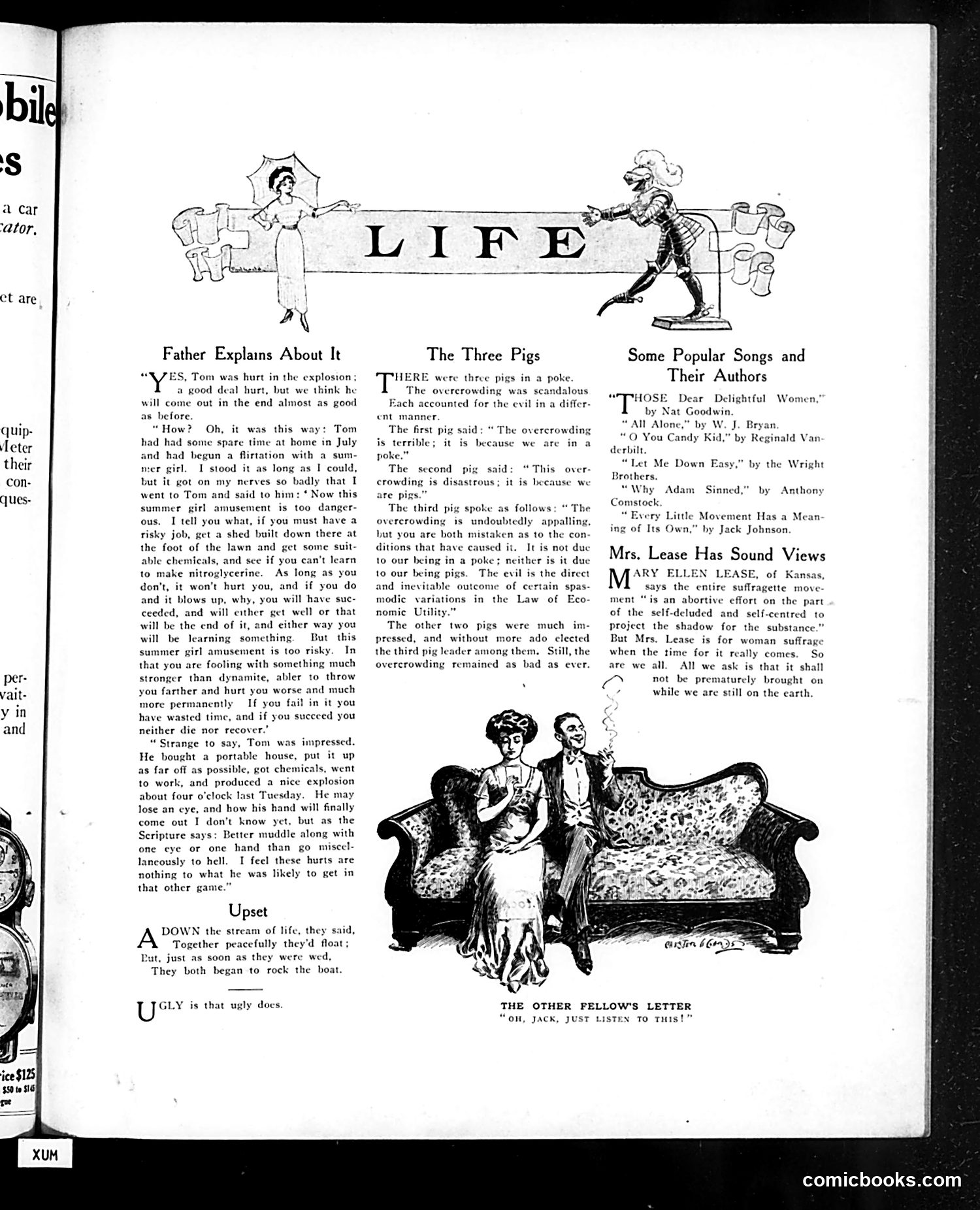
This page from *Life* magazine contains several satirical pieces about social issues: **"Father Explains About It"** mocks parental anxiety about modern dangers. A father warns his son Tom about summer risks—explosions, chemicals, amusement parks—concluding it's safer to stay home. The satire targets overprotective parenting and exaggerated fear-mongering about contemporary hazards. **"The Three Pigs"** retells the fairy tale as social commentary, with each pig explaining their overcrowding differently. This appears to satirize disagreements about urban housing problems and how different groups blame different causes. **"The Other Fellow's Letter"** cartoon (bottom) depicts a woman listening to gossip from two men on a couch, likely mocking social pretension or domestic drama. The page includes song listings and a piece on women's suffrage activism by Mary Ellen Lease.
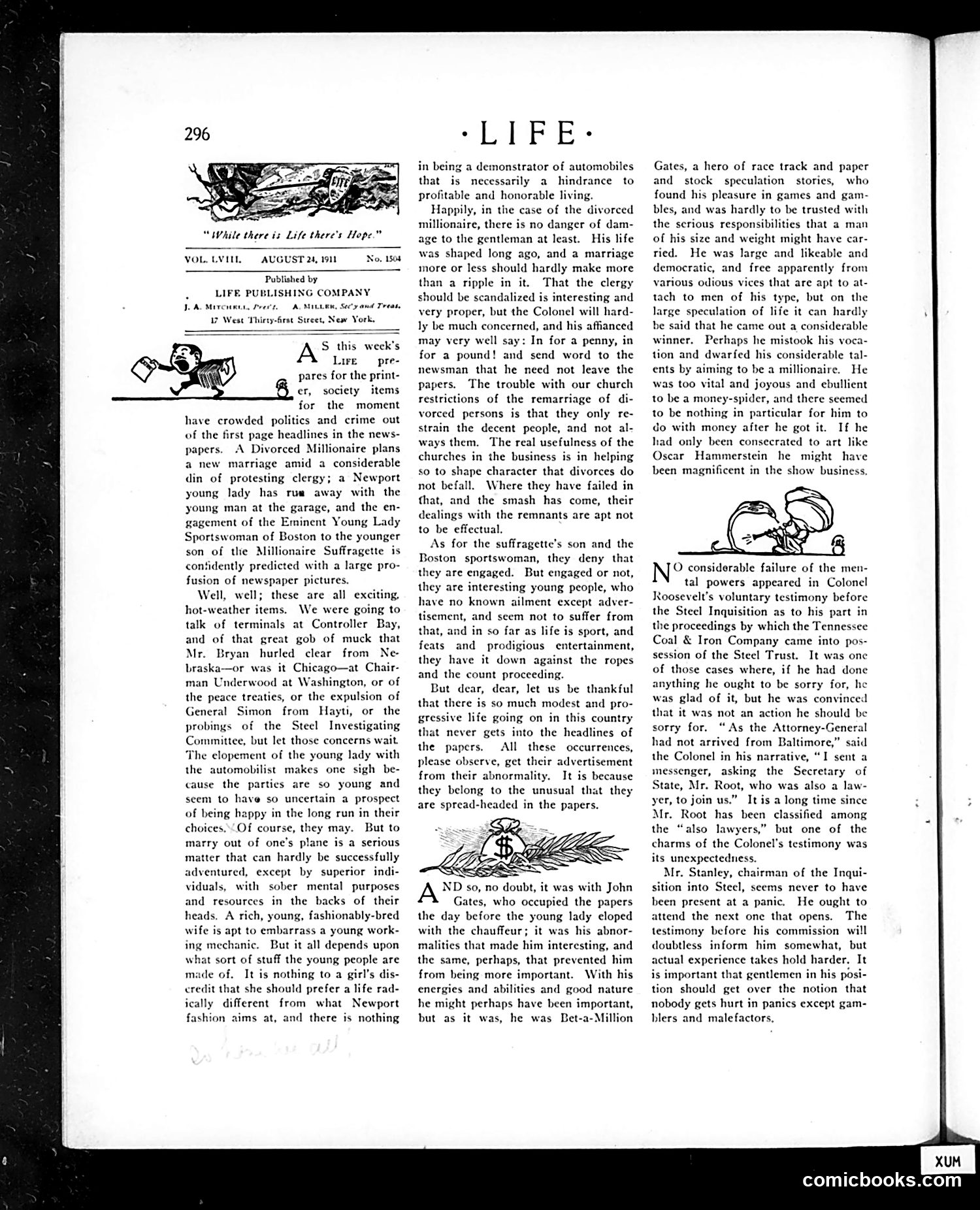
This page contains editorial commentary on contemporary scandals. The text discusses several sensational news stories: a divorced millionaire's remarriage (criticized for its impropriety), a young woman eloping with a chauffeur, and Colonel Roosevelt's testimony before the Steel Trust investigation. The small illustration shows a dollar sign with wings—a visual metaphor for money's ability to escape or fly away, likely commenting on financial malfeasance or corruption being investigated. The editorial adopts a mock-moralistic tone, expressing relief that such scandals aren't *always* front-page news, while simultaneously discussing them at length. This reflects Life's role as satirical commentary on wealthy people's scandals and their social consequences in the Progressive Era.
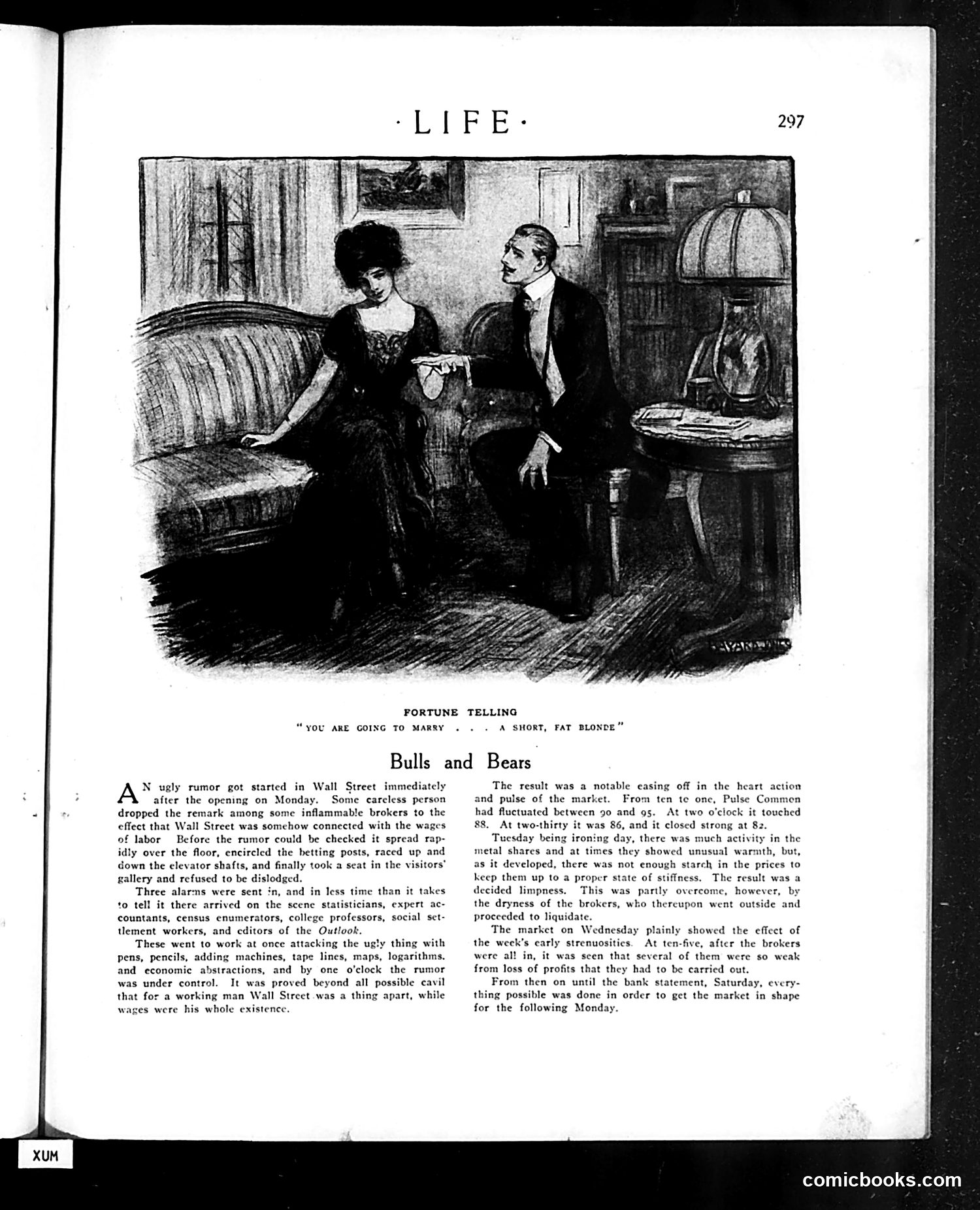
**The Image:** A fortune teller predicts to a woman client: "You are going to marry... a short, fat blonde." **The Context:** This is a joke about Wall Street's volatile market conditions during what appears to be an economic crisis. The accompanying article describes how rumors spread rapidly among brokers, causing market panic. Brokers lost money and became emotionally drained. **The Satire:** The cartoon sardonically suggests that amid financial chaos, a woman's romantic prospects are equally uncertain and ridiculous—the fortune teller's absurd prediction (marrying "a short, fat blonde") mirrors the irrational panic driving market decisions. Both fortune-telling and speculative investing are implicitly compared as equally unreliable ways to predict the future.
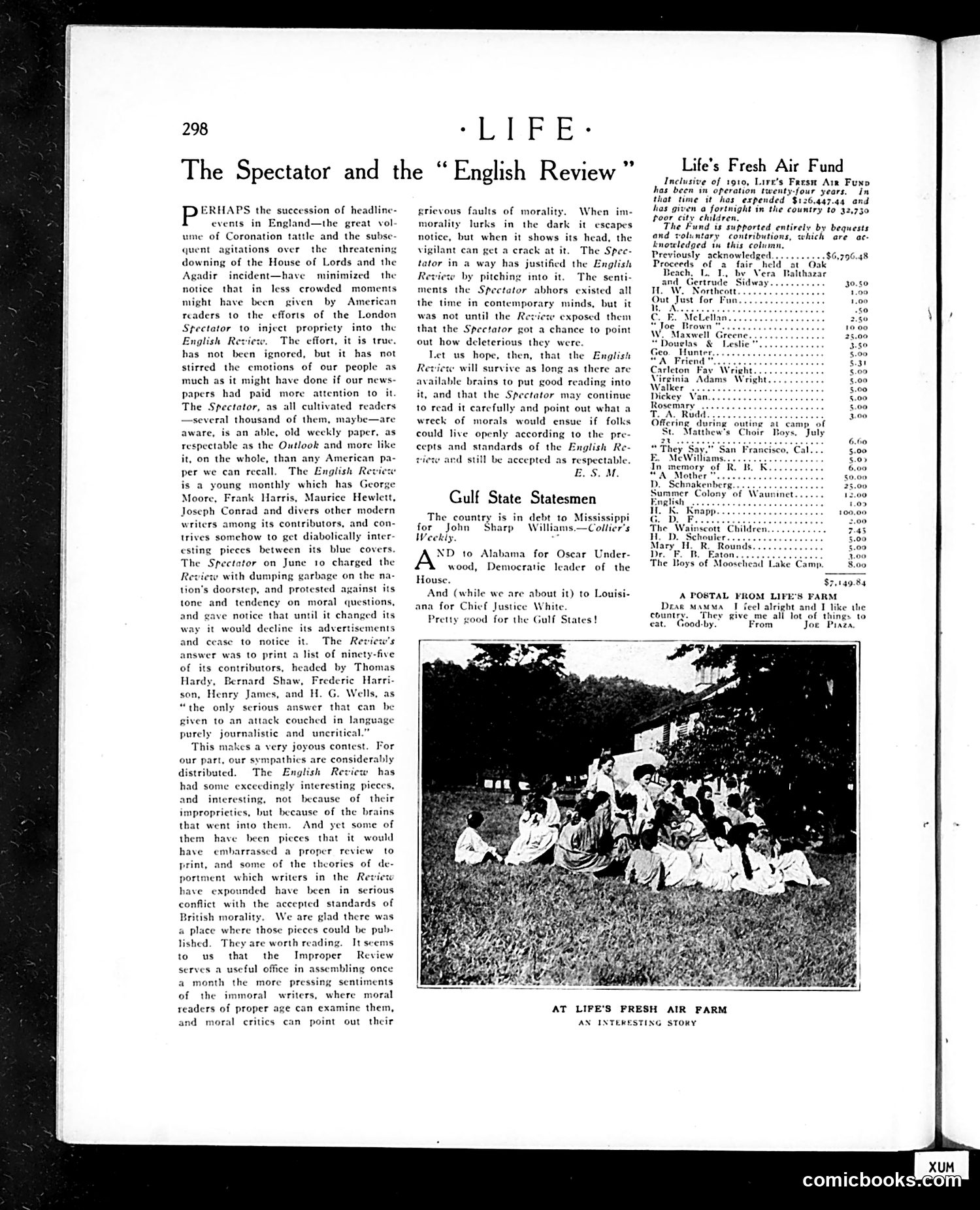
This page from *Life* magazine (page 298) contains two sections: 1. **"The Spectator and the 'English Review'"** - An editorial discussing the *English Review* publication's moral standards. The text defends the *Spectator*'s role in critiquing questionable content, referencing a dispute over whether immoral pieces should be published. 2. **"Gulf State Statesmen"** - A brief satirical section mocking Democratic politicians from Mississippi, Alabama, and Louisiana, including references to Oscar Underwood and Chief Justice White, with the closing jab "Pretty good for the Gulf States!" 3. **"A Postal from Life's Farm"** - A photograph captioned "At Life's Fresh Air Farm: An Interesting Story" showing a group gathering outdoors. The page primarily features editorial commentary and social satire rather than cartoons.
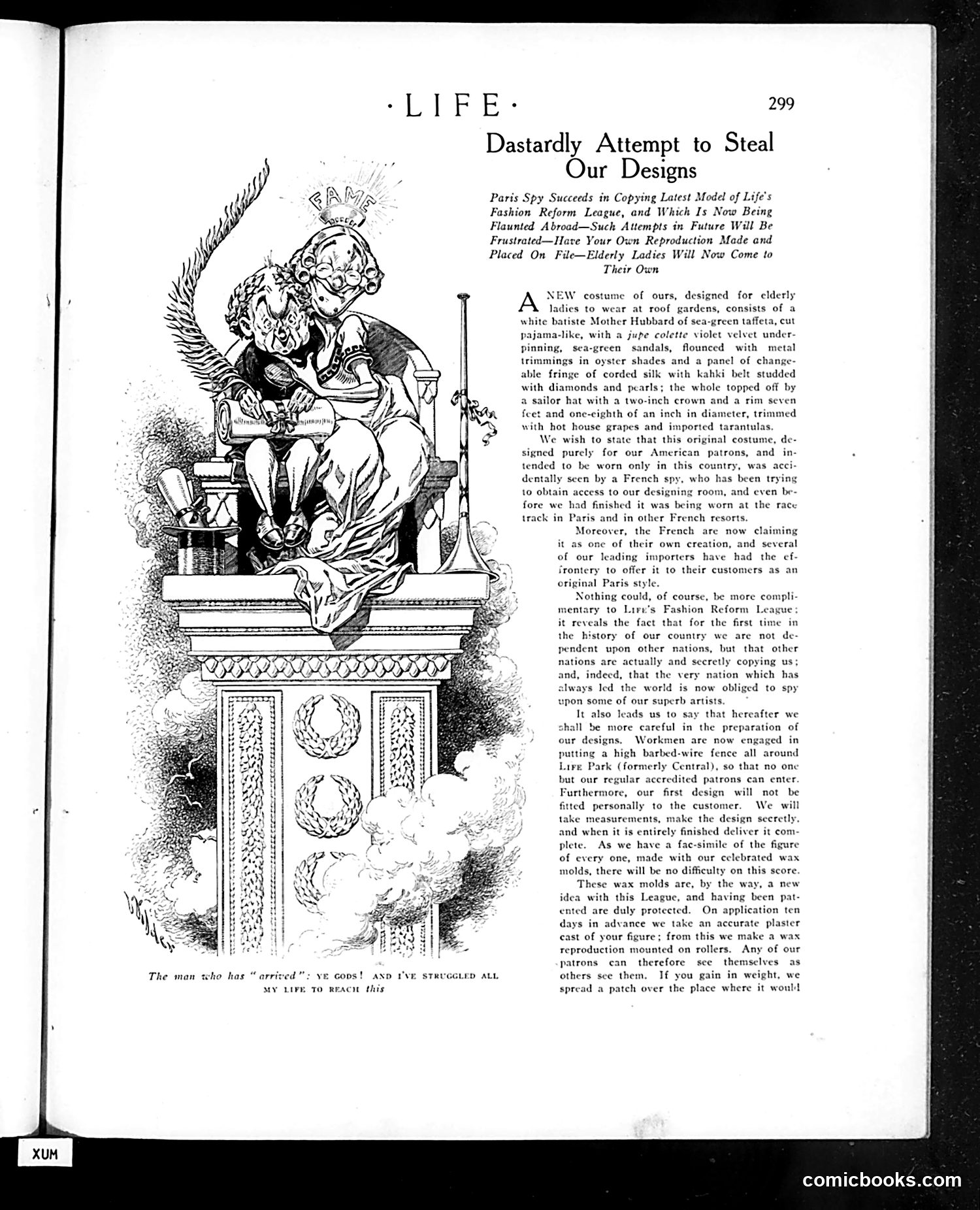
This satirical article mocks French fashion designers for copying Life magazine's exclusive costume designs. The illustration shows a caricatured figure (appears to be a French spy or designer) stealing from an ornate pedestal labeled "LIFE." The text claims that Life designed an original costume for elderly women featuring a "white batiste Mother Hubbard" and elaborate details. A French spy allegedly saw it before publication and began copying it for Parisian fashion houses. The satire ridicules the irony that France—traditionally the world's fashion leader—now depends on stealing American designs. Life boasts that their Fashion Reform League will protect future designs through strict security measures and wax molds, preventing imitation. The piece humorously presents American fashion innovation as worthy of industrial espionage.
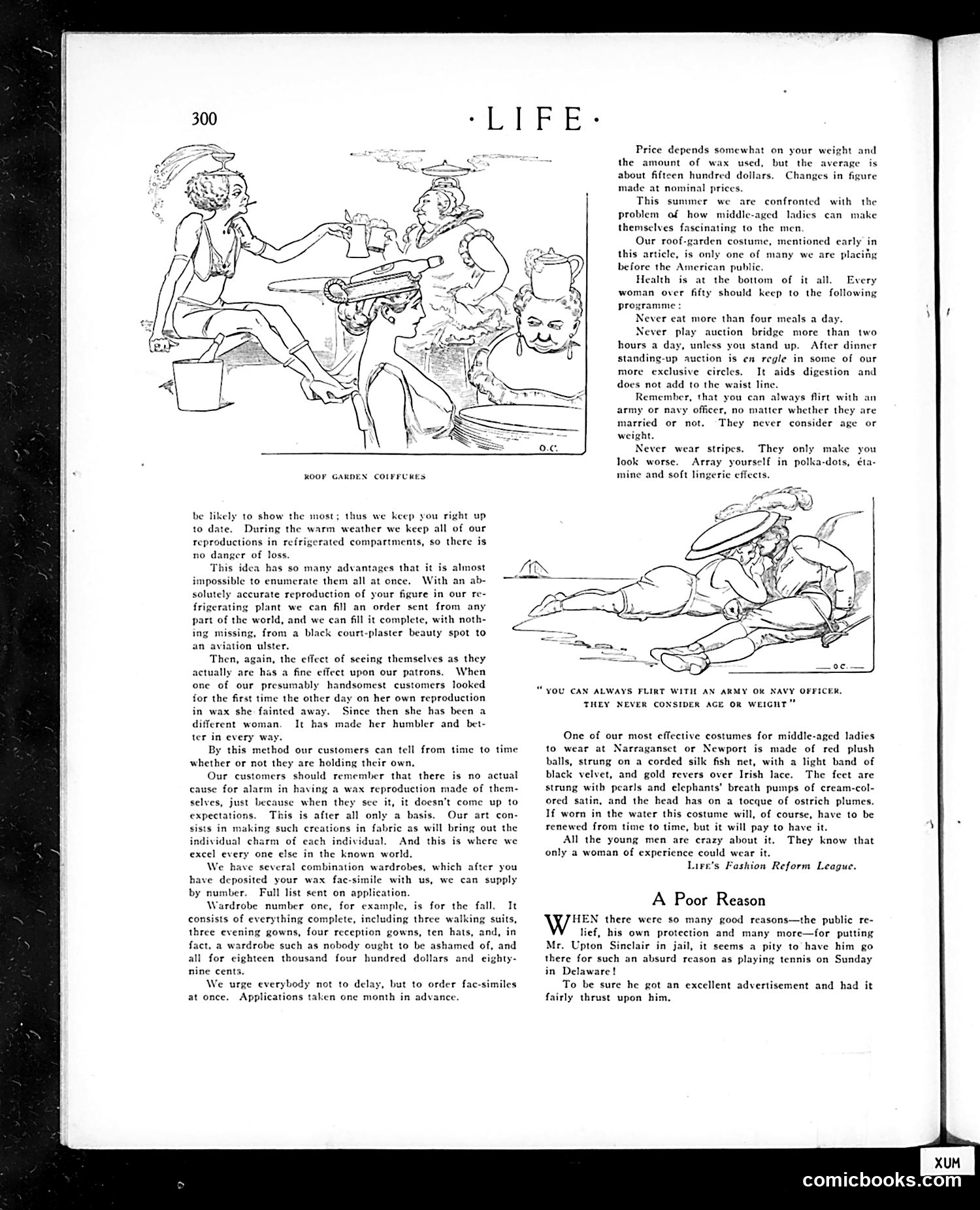
This cartoon satirizes women's fashions and behavior at upscale roof gardens—popular summer entertainment venues in early 20th-century cities. The sketch depicts women in elaborate hats and clothing, engaged in flirtation and socializing. The accompanying text offers tongue-in-cheek advice to women: maintain your figure through diet ("never eat more than four meals a day"), avoid stripes in clothing, and remember that military and navy officers don't judge women by age or weight. The satire targets middle-class women's fashion obsessions and their pursuit of romantic attention from servicemen. The second illustration reinforces this theme, captioning that officers "never consider age or weight"—mocking women's anxieties about appearance and their social ambitions.
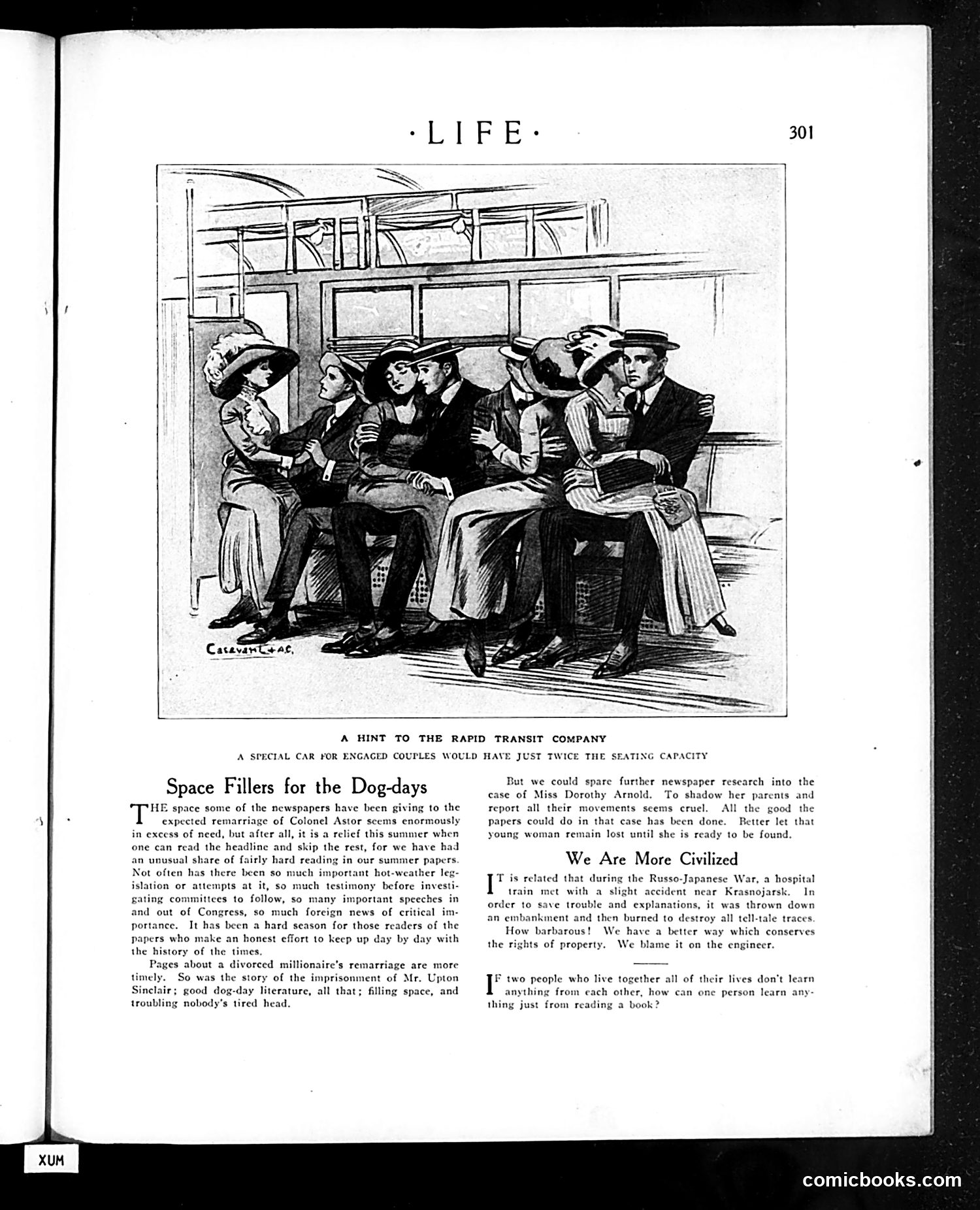
**The Cartoon:** The top illustration shows several people crowded onto a public transit car bench, with the caption "A Hint to the Rapid Transit Company: A Special Car for Engaged Couples Would Have Just Twice the Seating Capacity." The satire mocks engaged couples for excessive public displays of affection on crowded streetcars. The joke suggests that if engaged couples sat properly (side-by-side) rather than intertwined, a car would accommodate twice as many passengers. It's social commentary on courtship behavior and transit efficiency. **The Articles Below:** "Space Fillers for the Dog-Days" and other pieces appear to be humorous filler content typical of summer issues. "We Are More Civilized" discusses a Russian railway anecdote about property conservation. The content suggests these are satirical observations on contemporary manners and social conduct.
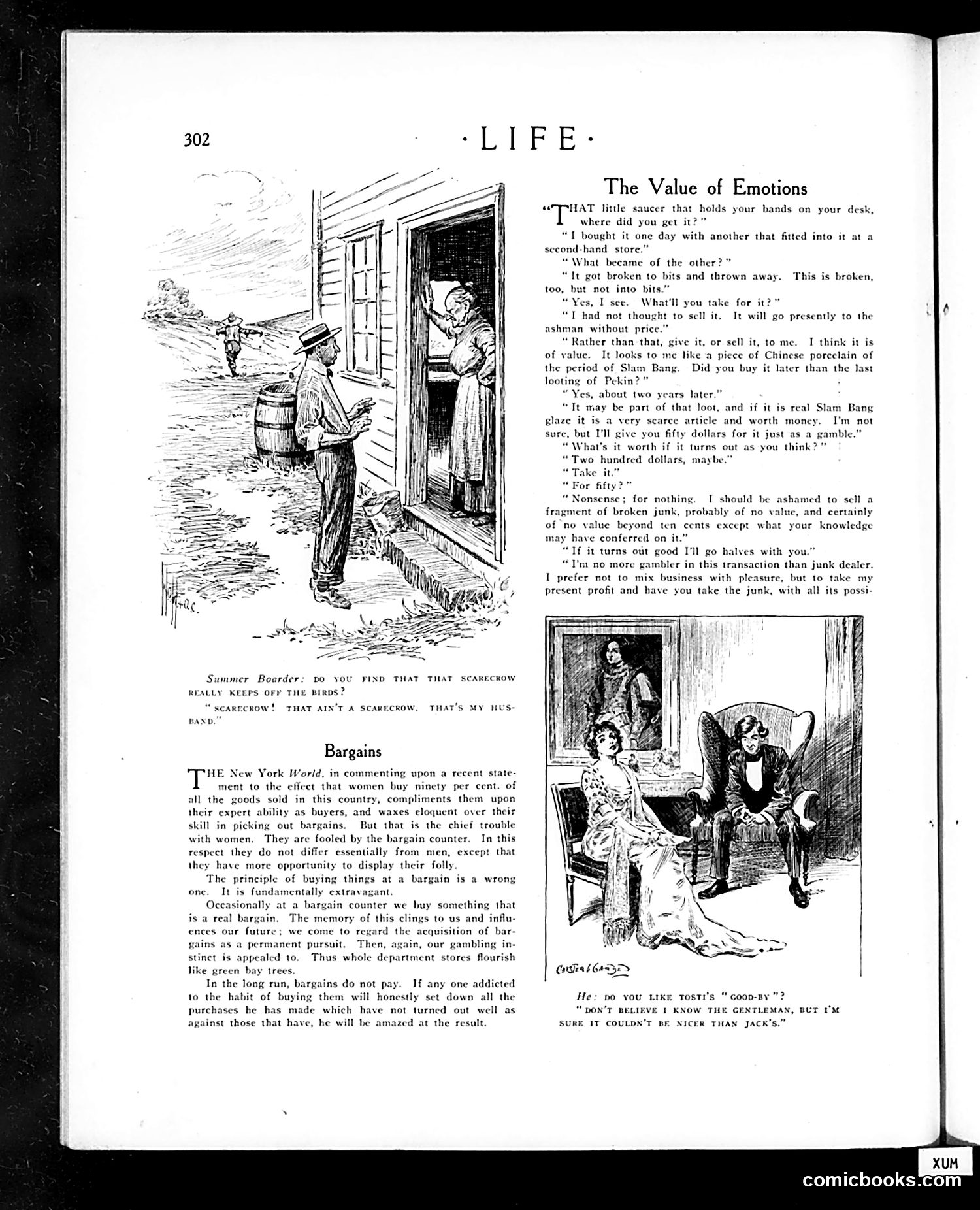
This page contains two distinct pieces: **"The Value of Emotions"** (top): A dialogue between a Summer Boarder and what appears to be a homeowner about a broken Chinese porcelain saucer. The boarder wants to buy it cheaply as "junk," while the homeowner argues it has sentimental and artistic value. The satire critiques American consumerism and utilitarian attitudes—treating culturally valuable objects as mere commodities rather than treasures worth preserving for their intrinsic merit. **"Bargains"** (bottom): An article criticizing women's obsessive bargain-hunting. It argues that while women are praised as smart shoppers, their compulsive buying of discounted items—regardless of actual need—reflects poor financial judgment. The piece suggests this "gambling instinct" for deals ultimately costs money rather than saving it, satirizing the false economy of bargain culture. Both pieces critique American consumer behavior through humor.
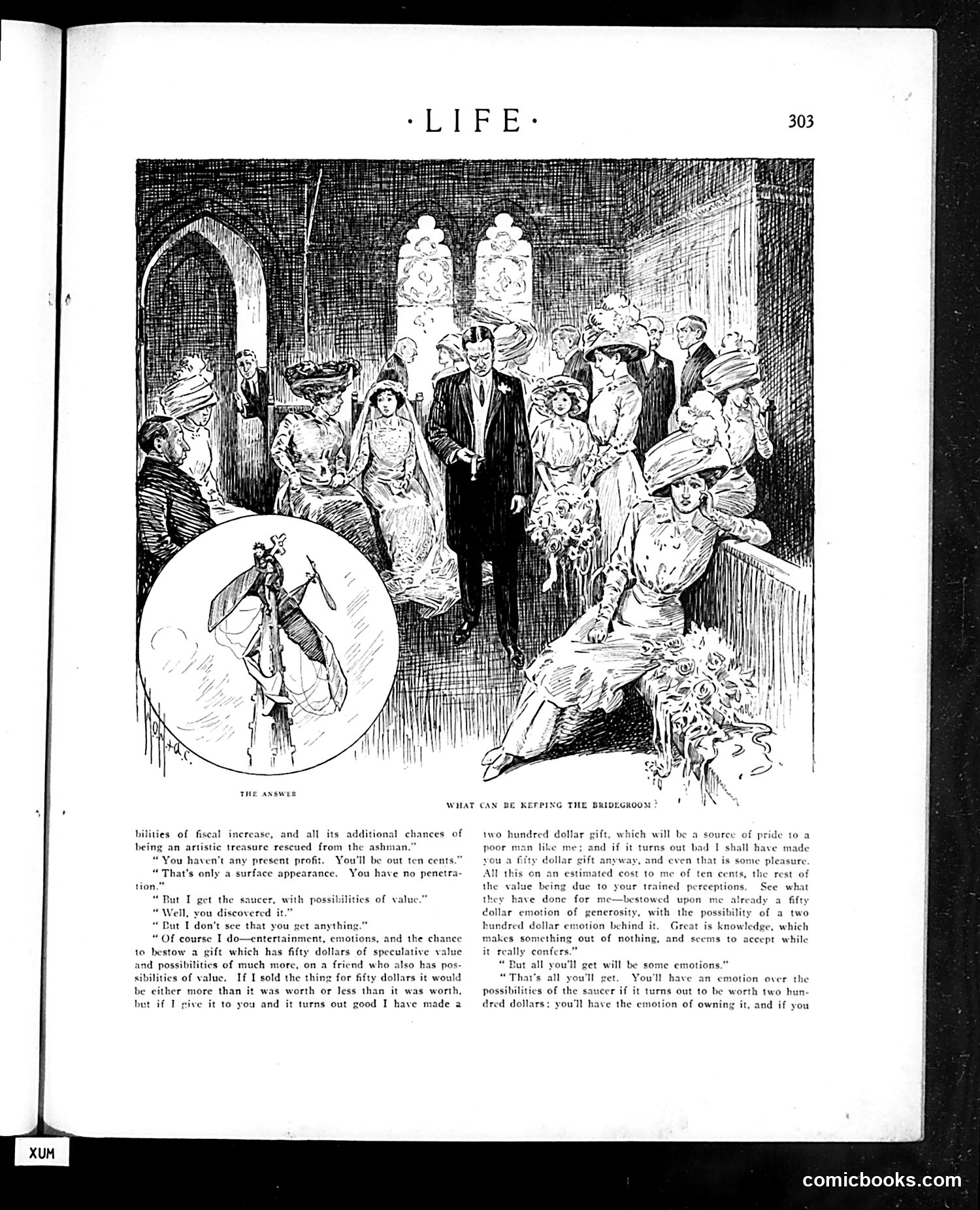
This page shows a satirical cartoon about gift-giving and speculative value. Two figures debate the merits of giving a fifty-cent saucer as a wedding gift, framed as having potential worth of two hundred dollars. The satire targets upper-class self-deception: one character justifies a cheap gift by emphasizing its *possible* future value and the emotional pleasure of *seeming* generous, while dismissing the actual cost. The other character points out this is mere rationalization—the giver gets "emotions" while the recipient gets a worthless object. The cartoon mocks the tendency of wealthy people to reframe stingy behavior as refined philosophy, substituting sentimental language about "knowledge" and "generosity" for actual material generosity. The title's reference to a delayed bridegroom suggests this inadequate gift is particularly insulting at a wedding.
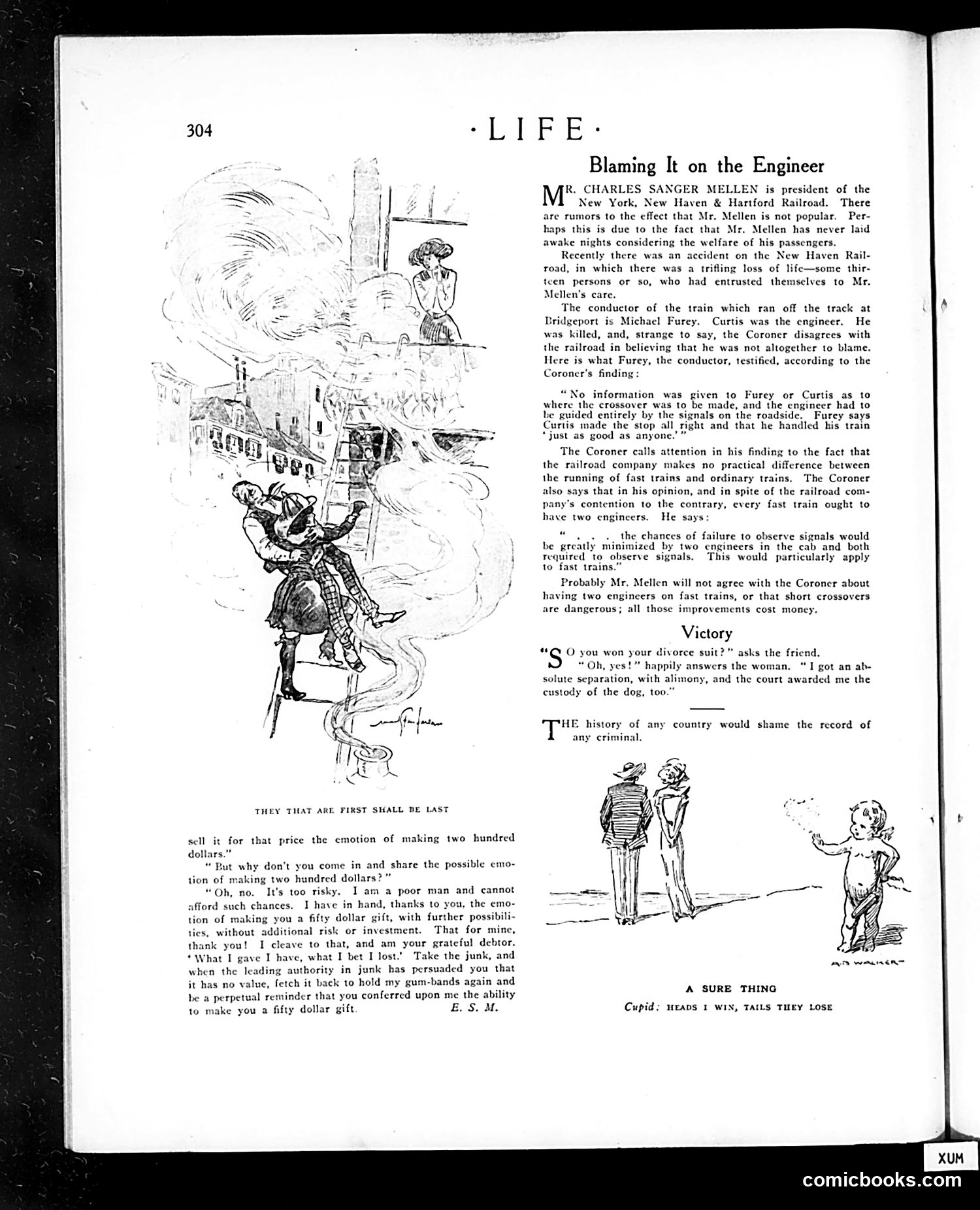
**"Blaming It on the Engineer"** critiques railroad president Charles Sanger Mellen's safety negligence. After a train derailment near Bridgeport killed thirteen passengers, the railroad blamed engineer Curtis. However, the Coroner's inquest contradicted this, finding Curtis operated correctly but lacked critical information about track crossovers. The Coroner's report recommends two engineers on fast trains to prevent signal failures—a safety measure Mellen likely won't implement because it costs money. The satire attacks Mellen's indifference to passenger welfare and his company's habit of scapegoating workers rather than addressing systemic safety failures. **"Victory"** jokes about divorce settlements. A woman celebrates winning her suit, listing her gains: absolute separation, alimony payments, and—notably—custody of the dog. The humor lies in the modern assumption that custody battles prioritize children; here, the dog's custody appears equally or more significant than spousal arrangements, satirizing contemporary divorce culture's absurdities. The page's title, "They That Are First Shall Be Last," appears to reference the preceding article about financial scheming.
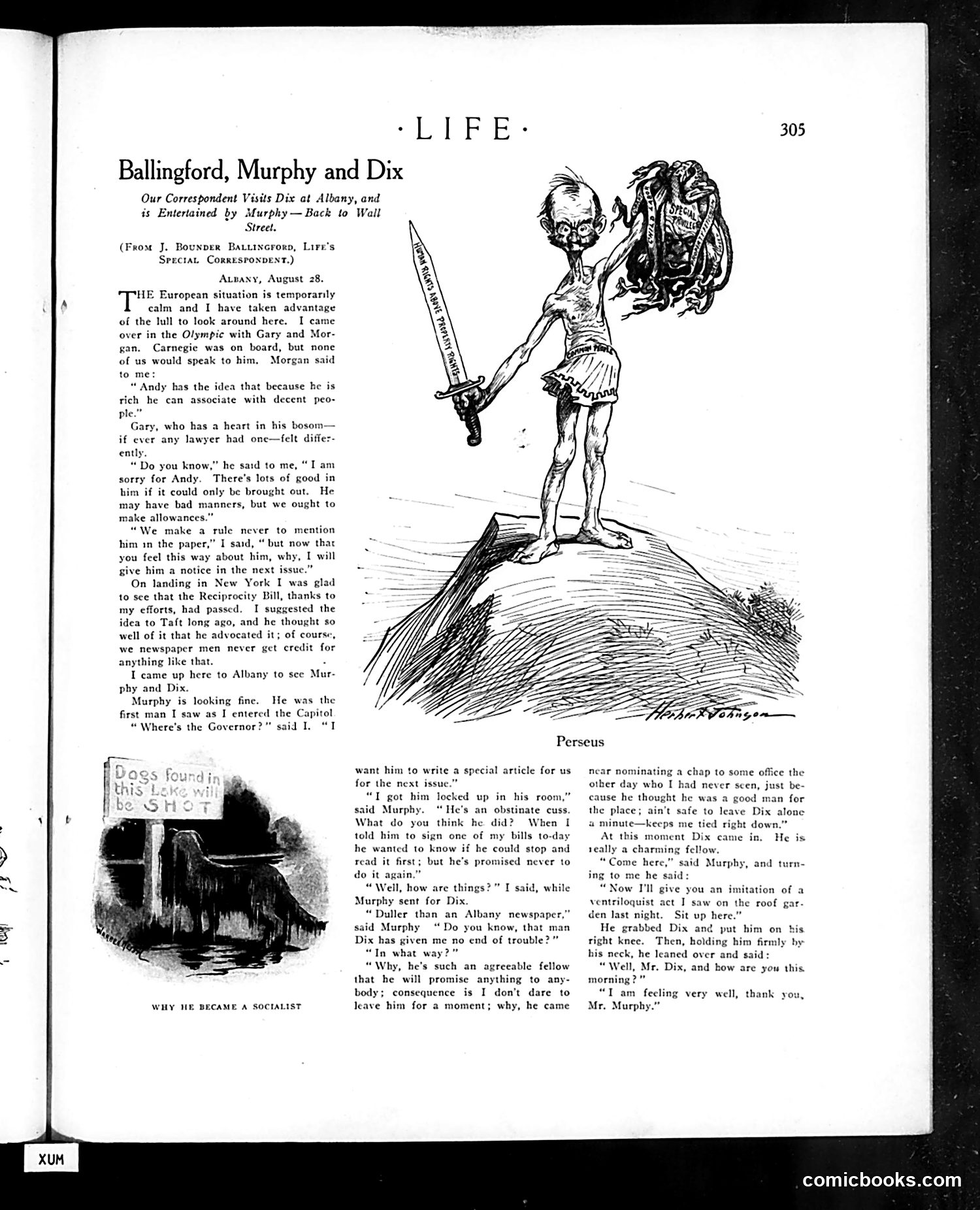
This satirical piece mocks political corruption in early 20th-century New York. The cartoon depicts **Perseus** (mythological hero) holding the head of Medusa, likely representing the correspondent's inflated self-importance. The text satirizes three figures: **Carnegie** (industrialist Andrew Carnegie, portrayed as socially unacceptable despite wealth), **Murphy** (likely Charles Francis Murphy, Tammany Hall boss), and **Dix** (Governor John Alden Dix of New York). The satire's point: Murphy literally controls Governor Dix like a ventriloquist's dummy—the governor is so eager to please that Murphy must physically restrain him from making independent decisions. The correspondent boasts about his own influence on national policy (the Reciprocity Bill), exemplifying the era's cynical view that newspaper men, politicians, and industrialists secretly ran government through backroom dealing. The humor targets machine politics, where governors served machine bosses rather than the public interest.
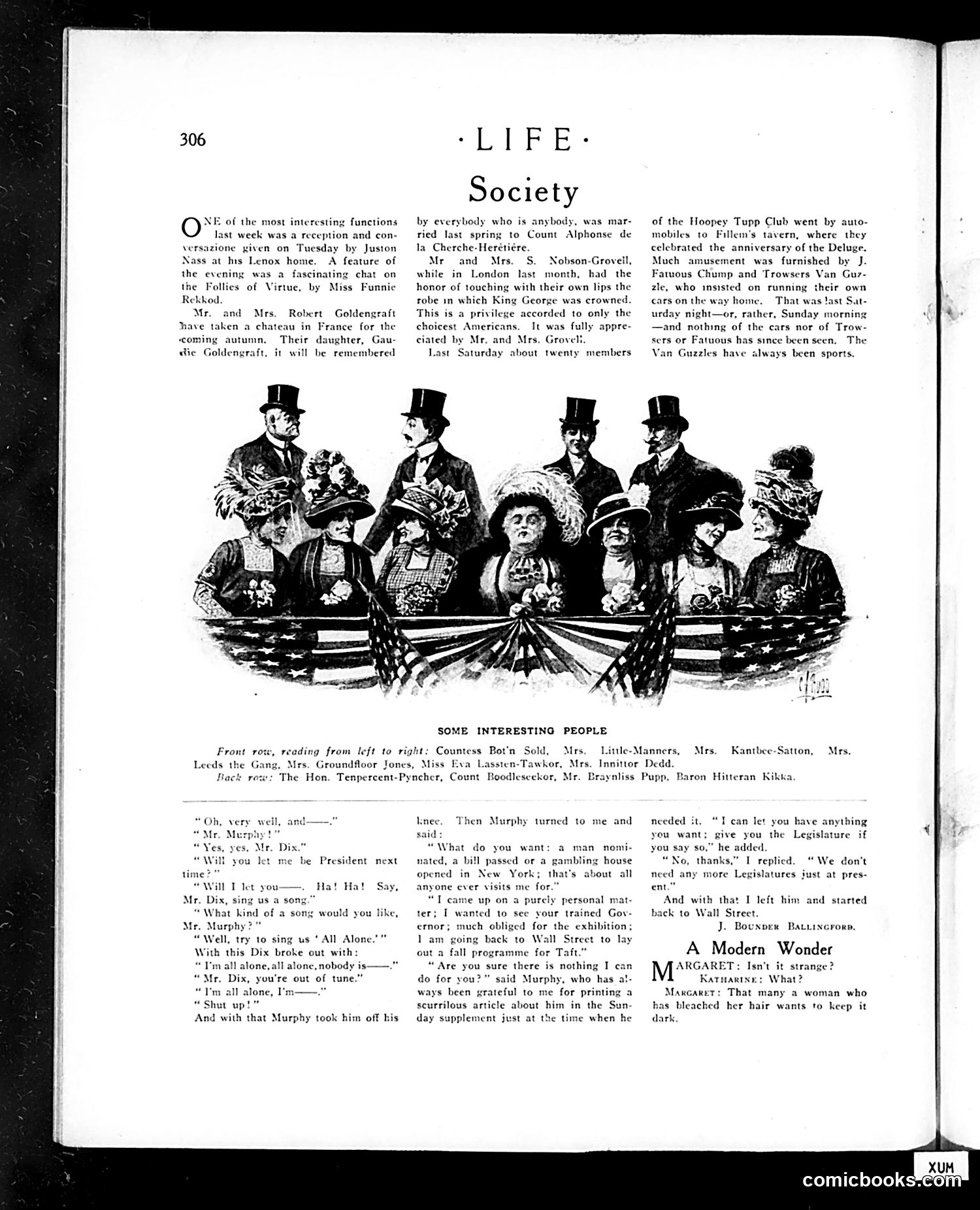
This is a satirical society gossip column mocking the wealthy elite through invented ridiculous names: "Countess Bot'n Sold," "Nobson-Groveil," "Tenpercent-Pyncher," and "Count Boodlescekor." The exaggerated nomenclature—playing on greed ("Tenpercent"), pretension, and corruption—ridicules the social register's obsession with titles and wealth. The illustration depicts fashionably dressed socialites, emphasizing the era's ornate formal wear. The dialogue snippet between Murphy and Dix, where Murphy—apparently a political boss—offers to provide "a man nominated, a bill passed," satirizes machine politics and corruption infiltrating high society. The column suggests wealthy Americans paid for access to political power and social climbing. The final "Modern Wonder" joke about bleaching hair mocks women's vanity. Overall, the page ridicules both the nouveau riche's social pretensions and the deeper corruption linking politics to society's elite circles.
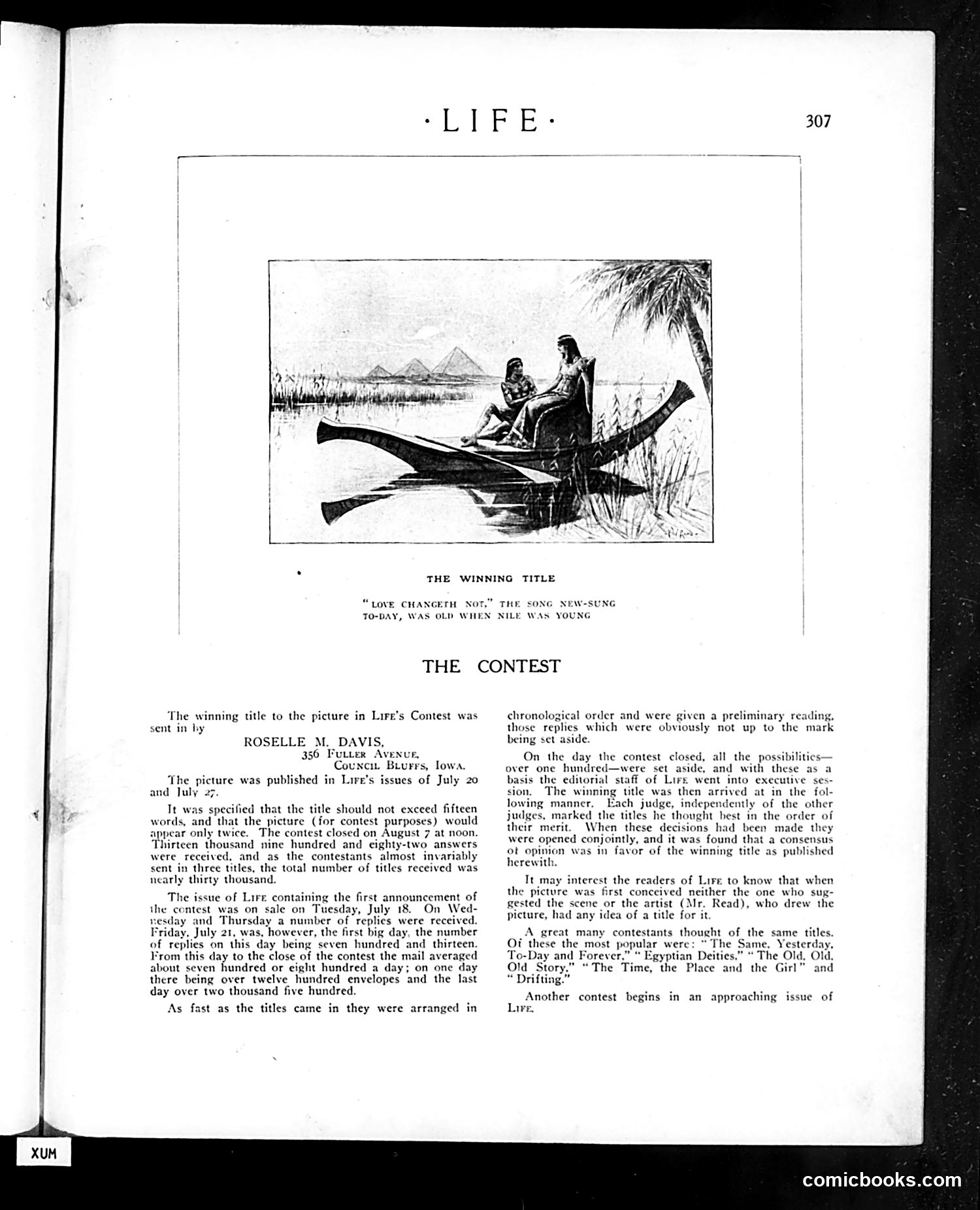
This page documents *Life* magazine's picture-titling contest. Readers submitted titles for an illustration (shown: two figures in a boat on the Nile, with pyramids visible) depicting timeless romance. The winning title, submitted by Roselle M. Davis of Council Bluffs, Iowa, was "Love Changeth Not; the song new-sung to-day, was old when Nile was young"—suggesting romantic love is eternally unchanged. The contest generated nearly 30,000 submissions across approximately 13,982 entries. The editorial process involved judges independently ranking candidates, then reaching consensus on the winner. Popular alternative titles included "The Same, Yesterday, To-Day and Forever" and "The Old, Old Story," emphasizing similar themes of timelessness and constancy. This reflects *Life's* early 20th-century appeal: combining visual art with reader participation, celebrating sentimental, classical themes about human nature and emotion.
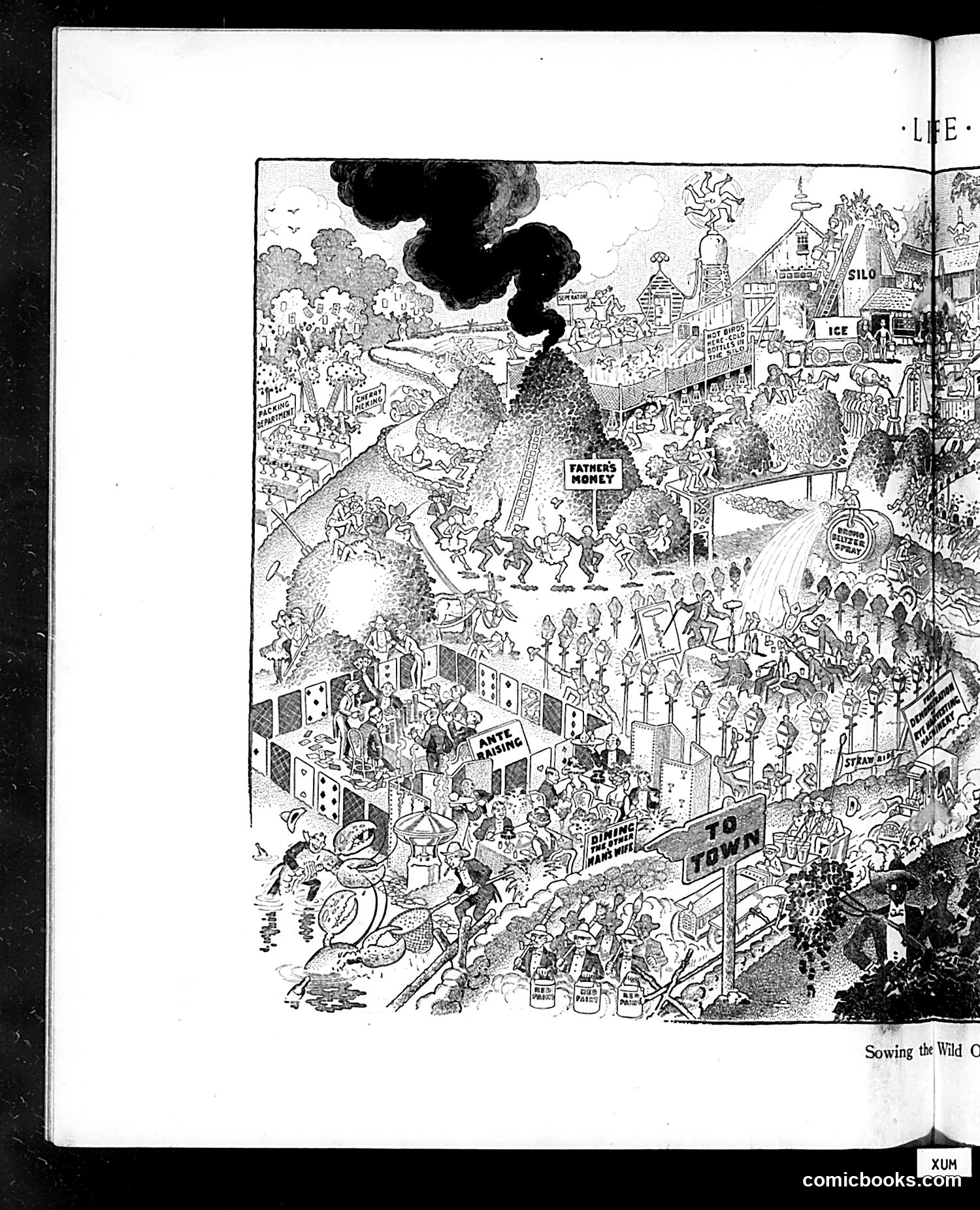
This is a dense, detailed satirical illustration depicting a chaotic carnival or fair scene labeled "Father's Money" and "Ant Theatre." The caption "Sowing the Wild Oats" suggests the cartoon criticizes youth wastefully spending parental money on frivolous pleasures. The crowded composition shows numerous figures engaged in various entertainments and vices—gambling, drinking, dancing, and other indulgences. The sign "Road to Town" indicates this represents a place where young people go to squander resources. The satire likely targets Gilded Age or Jazz Age concerns about moral decay and financial irresponsibility among the younger generation, with the visual chaos emphasizing the disorder and excess associated with such behavior. The scale and detail invite viewers to identify specific activities and moral failings.
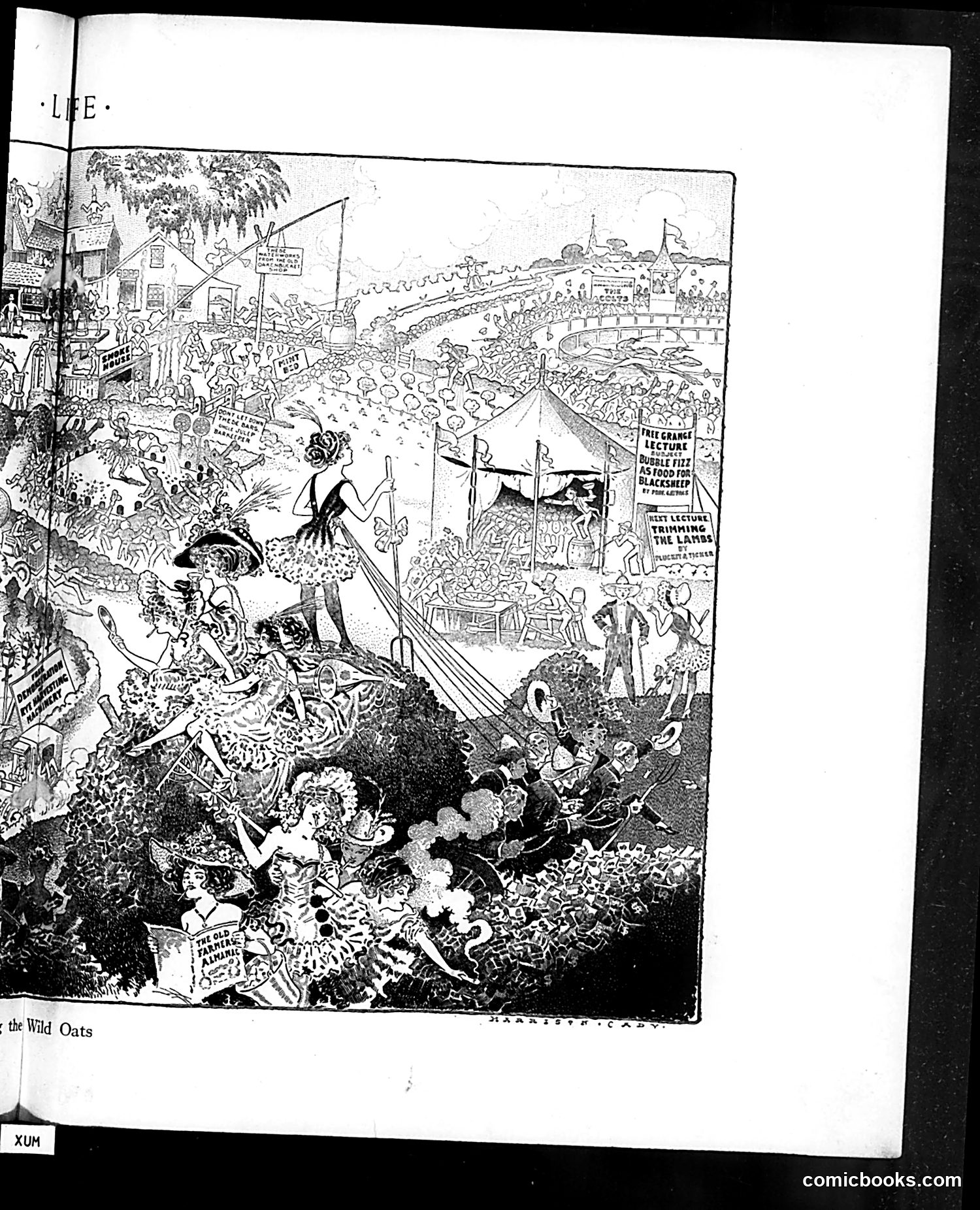
This is a densely detailed satirical illustration depicting what appears to be a carnival or fair scene. The artwork is characteristic of early-to-mid 20th century Life magazine's visual satire style. The image shows a crowded gathering with various attractions and performers. Visible text on signs references entertainment acts, including what appears to be lectures and performances. The composition uses the magazine's typical approach of packing multiple social commentary elements into one busy scene. The title "the Wild Oats" suggests the cartoon critiques youthful excess or frivolous entertainment culture. However, without clearer legibility of all signage and specific dated context, I cannot definitively identify particular political figures or events being satirized. The satire appears aimed at commercialized entertainment and crowd behavior rather than specific political targets.
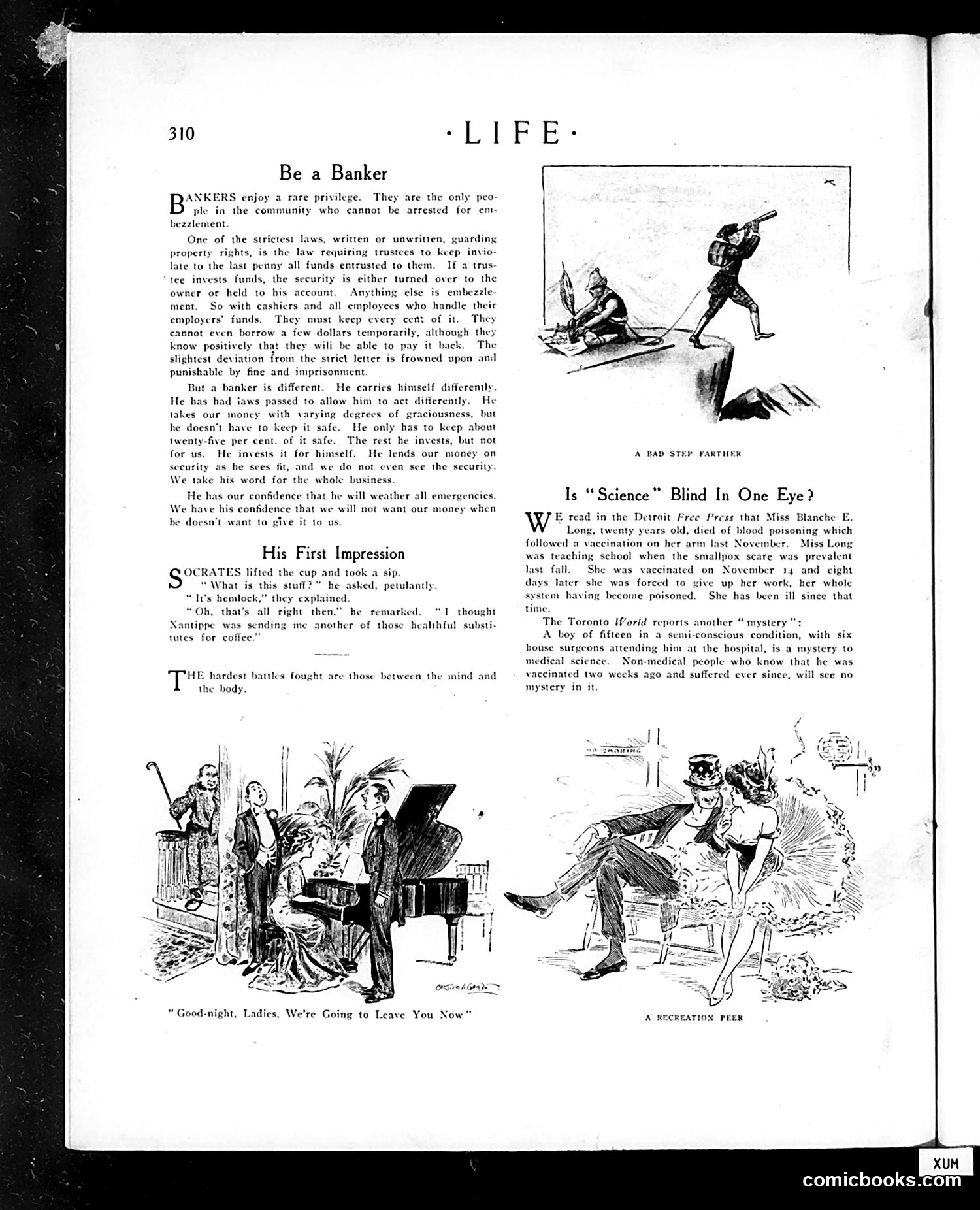
This page contains satirical commentary on two topics: **"Be a Banker"** criticizes banking practices and legal privileges. The text argues that bankers operate under different rules than ordinary citizens—while employees face criminal punishment for mishandling even small amounts of employer funds, bankers are legally permitted to invest deposited customer money for their own profit, keeping only about 25% in reserve. The satire highlights the hypocrisy: bankers demand trust while having no legal obligation to keep deposits secure, a stark contrast to the strict fiduciary duties imposed on cashiers and other employees. **"Is 'Science' Blind In One Eye?"** questions vaccination safety by citing two cases where individuals suffered severe illness or death following vaccinations during a smallpox scare. The article suggests medical authorities dismiss obvious vaccine complications as "mysteries," implying deliberate blindness to vaccination dangers. Both pieces employ ironic titles to expose what the editors viewed as systemic unfairness and institutional negligence benefiting the privileged while harming ordinary people.
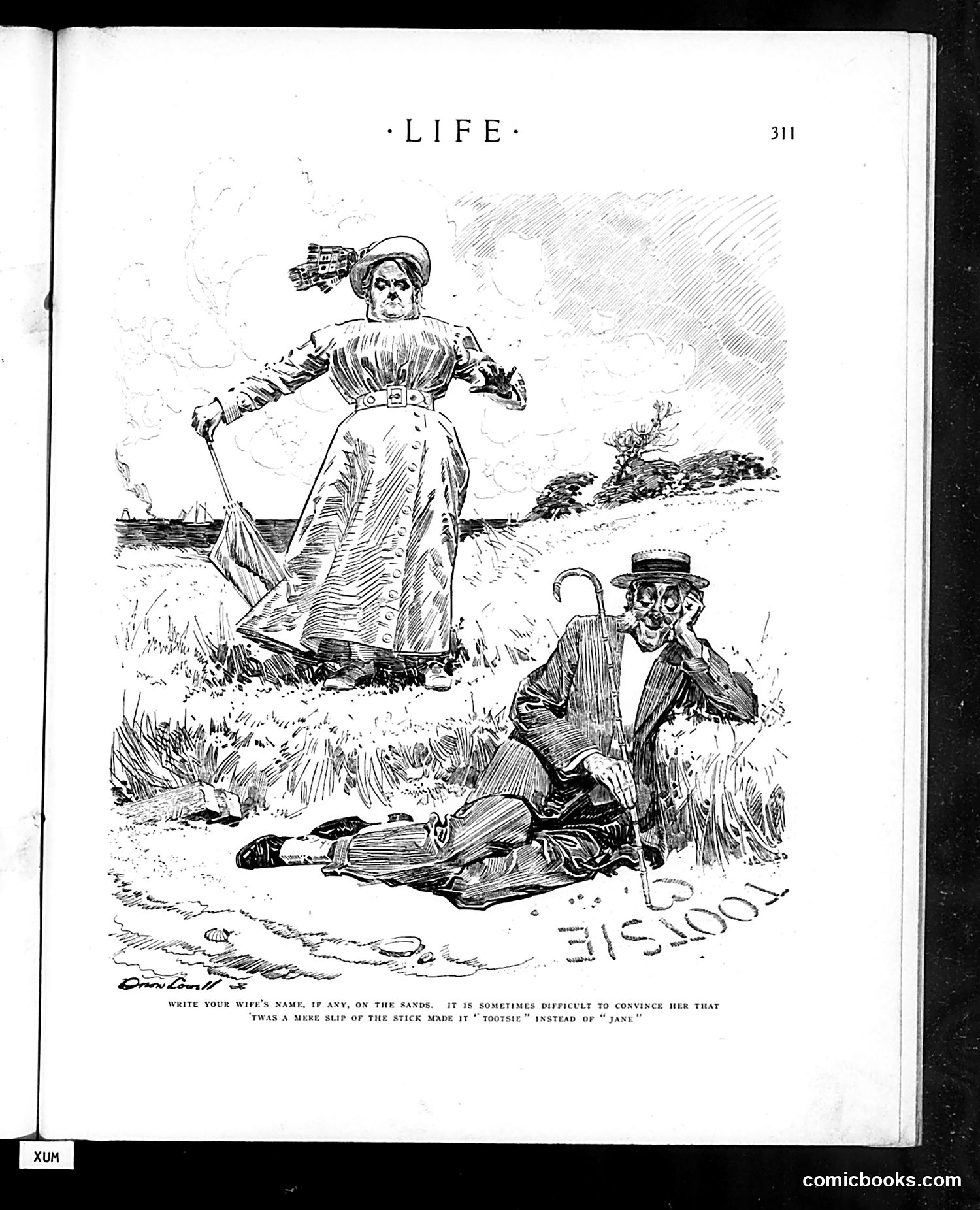
This cartoon satirizes infidelity and beach vacation behavior. A man sits on the beach writing a woman's name in the sand while his wife stands nearby watching disapprovingly. The caption suggests he's written "Tootsie" (a flirtatious nickname for an attractive woman) instead of his wife's name "Jane." The joke targets married men who flirt with or become distracted by other women while on vacation with their wives. The man's excuse—that it was merely "a slip of the stick" (an accidental marking in the sand)—is transparently dishonest. The wife's stern expression indicates she's unconvinced by this obvious lie. This reflects early 20th-century *Life* magazine's frequent satire of male infidelity, marital tension, and the gap between men's excuses and reality.
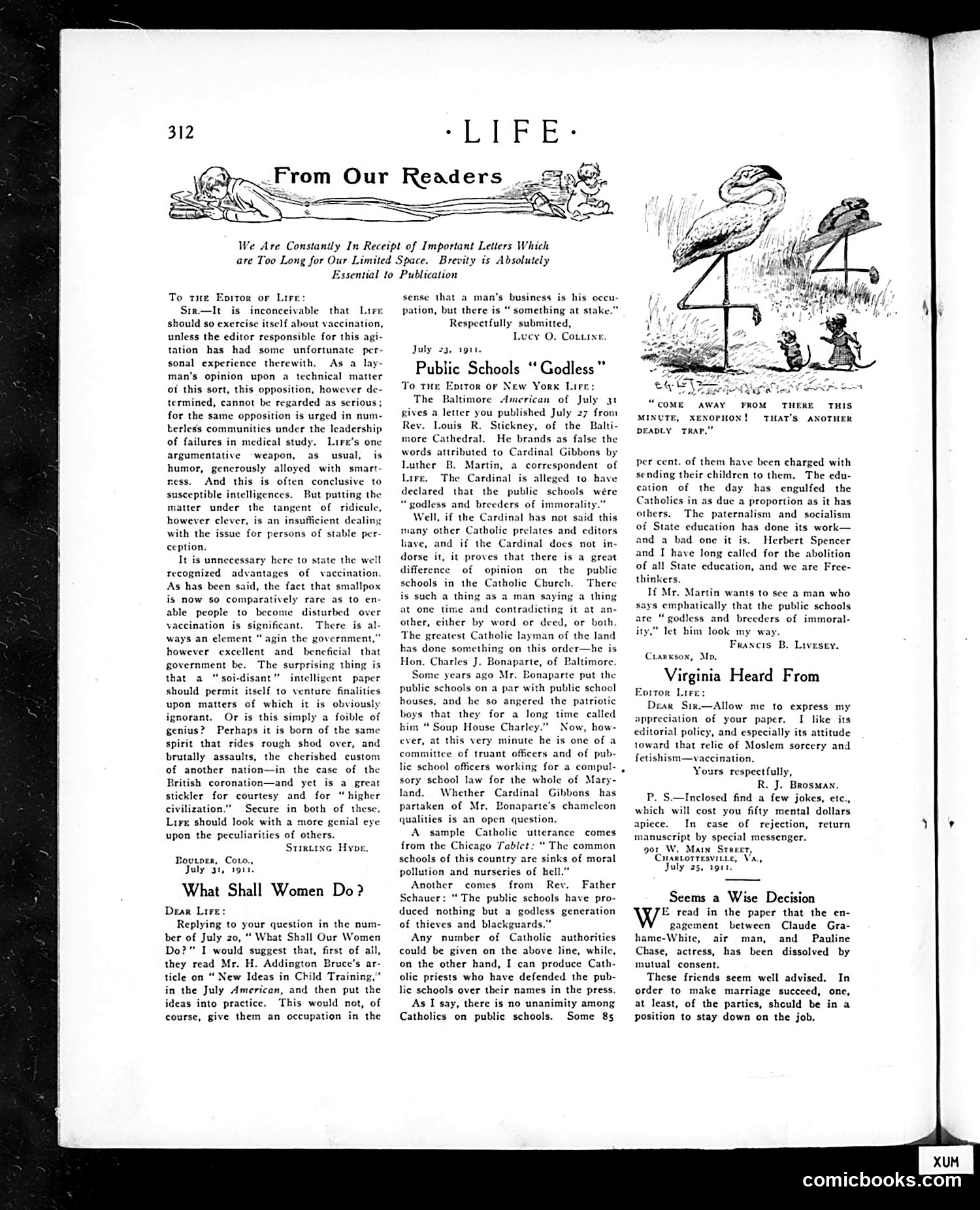
This page from Life magazine (July 1911) features readers' letters debating three social issues: 1. **Vaccination debate**: A Colorado reader defends vaccination against Life's editorial ridicule, arguing the magazine uses humor inappropriately on technical medical matters. 2. **Women's occupations**: A reader suggests women follow child-training advice from *The American* magazine rather than seeking formal paid work. 3. **"Godless schools"**: The main controversy concerns whether Cardinal Gibbons called public schools "godless and breeders of immorality." A Catholic correspondent disputes this attribution, while noting that Charles Bonaparte—a prominent Catholic layman—once opposed public schools but now supports compulsory education laws. The cartoon above depicts birds on branches, likely representing the competing voices and perspectives in these debates. These letters reflect Progressive Era tensions: religious institutions versus public education, women's emerging role changes, and vaccine hesitancy—issues that remain surprisingly contemporary.
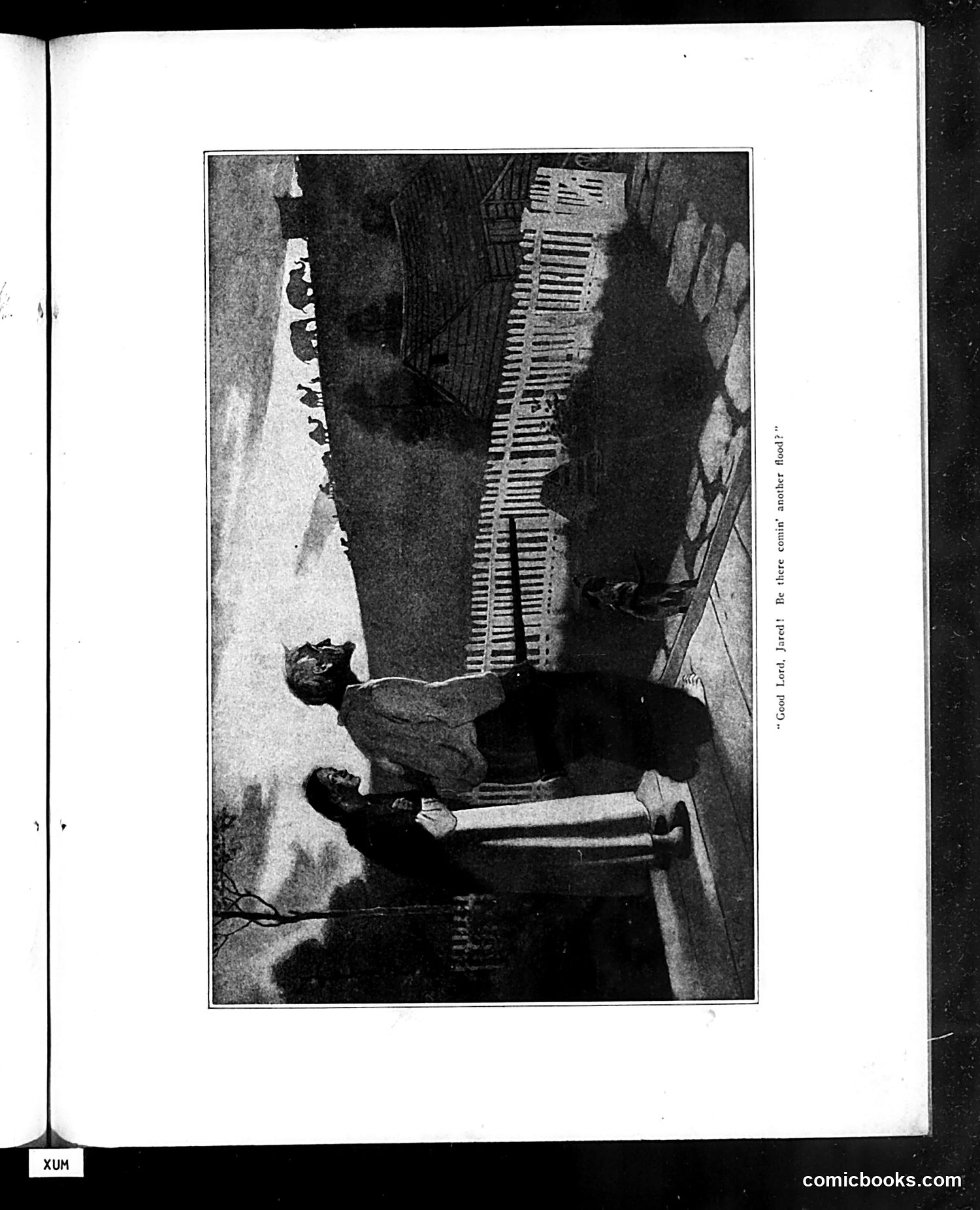
I can see this is a black and white photograph rather than a cartoon or satirical illustration. The image appears to be rotated 90 degrees and shows two figures in what looks like an industrial or architectural setting with metal framework or scaffolding visible. The OCR text is largely illegible, appearing corrupted or inverted. Without clear text or visual elements identifying specific political figures or social commentary, I cannot reliably explain what satire or point this image makes. To properly analyze this as political satire for a modern reader, I would need either: legible caption text, clearer image orientation, or visible identifying marks of the subjects or context. I cannot responsibly speculate about meaning without these supporting details.
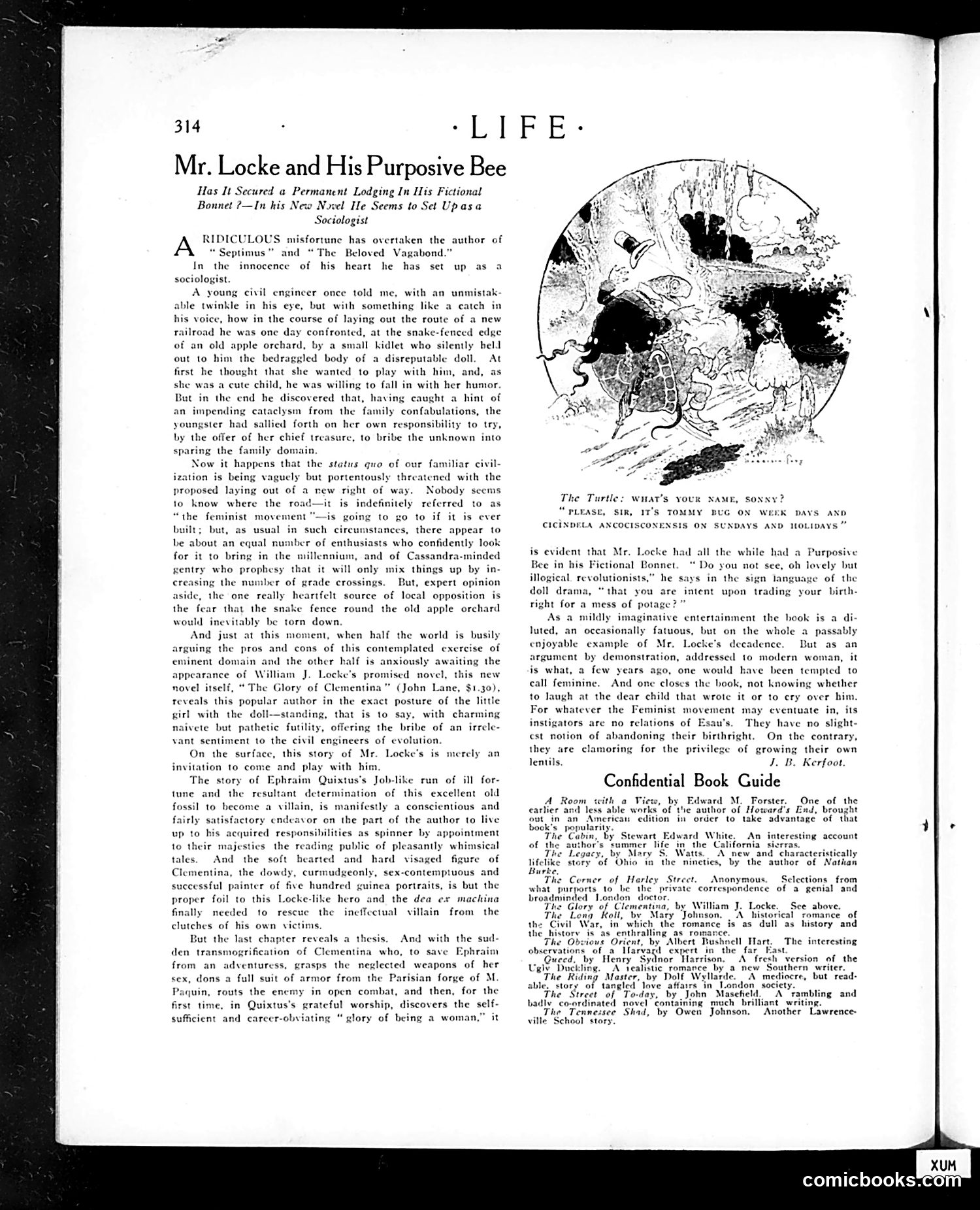
This satirical review criticizes novelist W.J. Locke's new book *The Glory of Clementina* for attempting to be a serious sociological commentary while remaining merely whimsical fiction. The reviewer uses an extended metaphor: Locke resembles a child offering a broken doll to bribe away progress—here, the "feminist movement" (the "snake fence" protecting tradition). The "Purposive Bee" in the title likely refers to Locke's stated social purpose. The complaint is that Locke tries simultaneously to entertain readers with charming characters (Ephraim Quixtus, the dowdy painter Clementina) and to argue a feminist thesis—that women find fulfillment in "the glory of being a woman" through romantic self-sacrifice rather than independence. The reviewer finds this approach artistically failed and intellectually dishonest: using sentiment to defend traditional gender roles against the advancing women's movement, rather than genuinely engaging with social change.
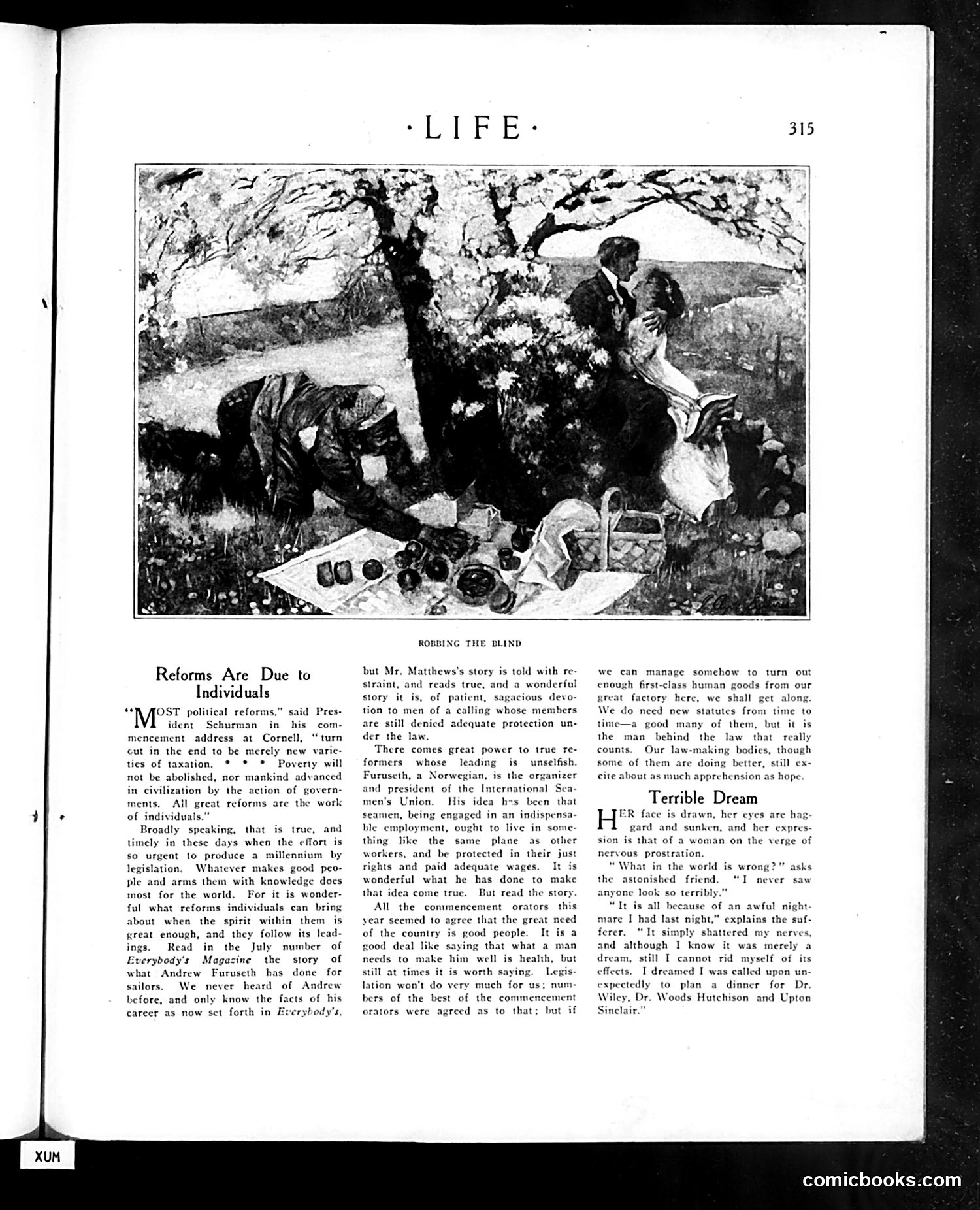
This page contains two distinct pieces of satire: **"Reforms Are Due to Individuals"** discusses Andrew Furuseth, a Norwegian labor organizer who improved conditions for merchant seamen through the International Seamen's Union. The article argues that individual moral action, not legislation alone, drives social progress—a common Progressive Era debate. **"Robbing the Blind"** (the illustration) appears to show a picnic scene where someone is being tricked or robbed while distracted. **"Terrible Dream"** is a joke about a woman terrified after dreaming she had to plan dinner for three famous figures: Dr. Harvey Wiley (pure food advocate), Dr. Woods Hutchison (health expert), and Upton Sinclair (muckraking author who exposed the meat industry). The joke is that these three men—all associated with food safety and health reform—would be impossibly demanding dinner guests, reflecting contemporary anxiety about Progressive reformers' strict standards.
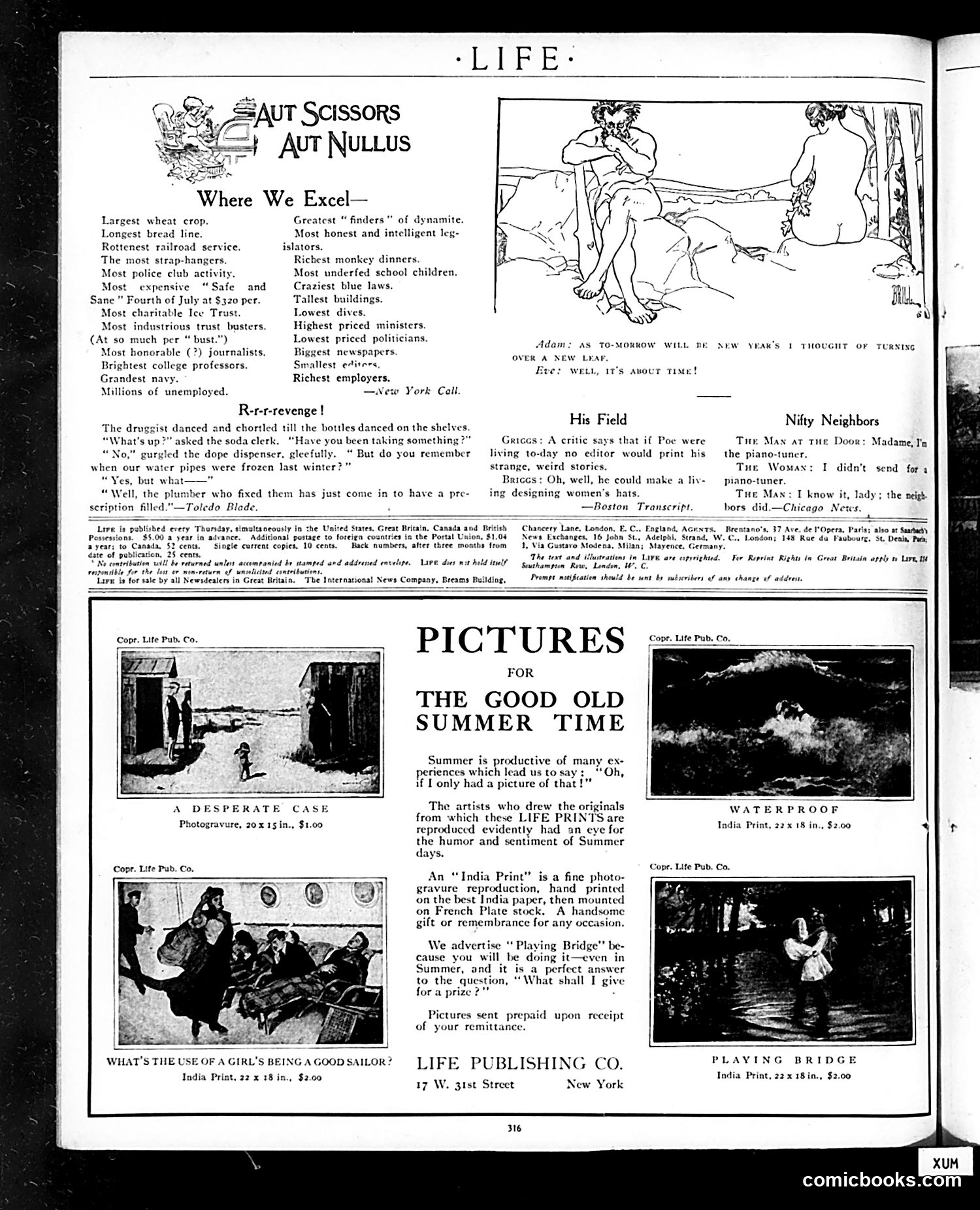
This page is primarily **advertising and product promotion** rather than political satire, though the top section contains social commentary. ## "Aut Scissors Aut Nullus" Section The opening list satirizes American contradictions circa 1910s, juxtaposing achievements with failures: "Largest wheat crop" paired with "Longest bread line" highlights economic inequality. References to "Most police club activity," "Millions of unemployed," and "Greatest 'finders' of dynamite" suggest labor unrest and industrial violence of the Progressive Era. The "R-r-r-revenge!" anecdote mocks Prohibition-era hypocrisy (frozen water pipes forcing people to use dope/alcohol). ## Main Content The majority of the page advertises **Life Publishing Company's art prints**—photogravure reproductions for summer decoration. Three small cartoons ("His Field," "Nifty Neighbors," "What's the Use of a Girl's Being a Good Sailor?") are humorous domestic sketches promoting the prints. **Bottom line:** This is a commerce-focused magazine page using light satire and humor primarily to sell merchandise rather than deliver serious political critique.
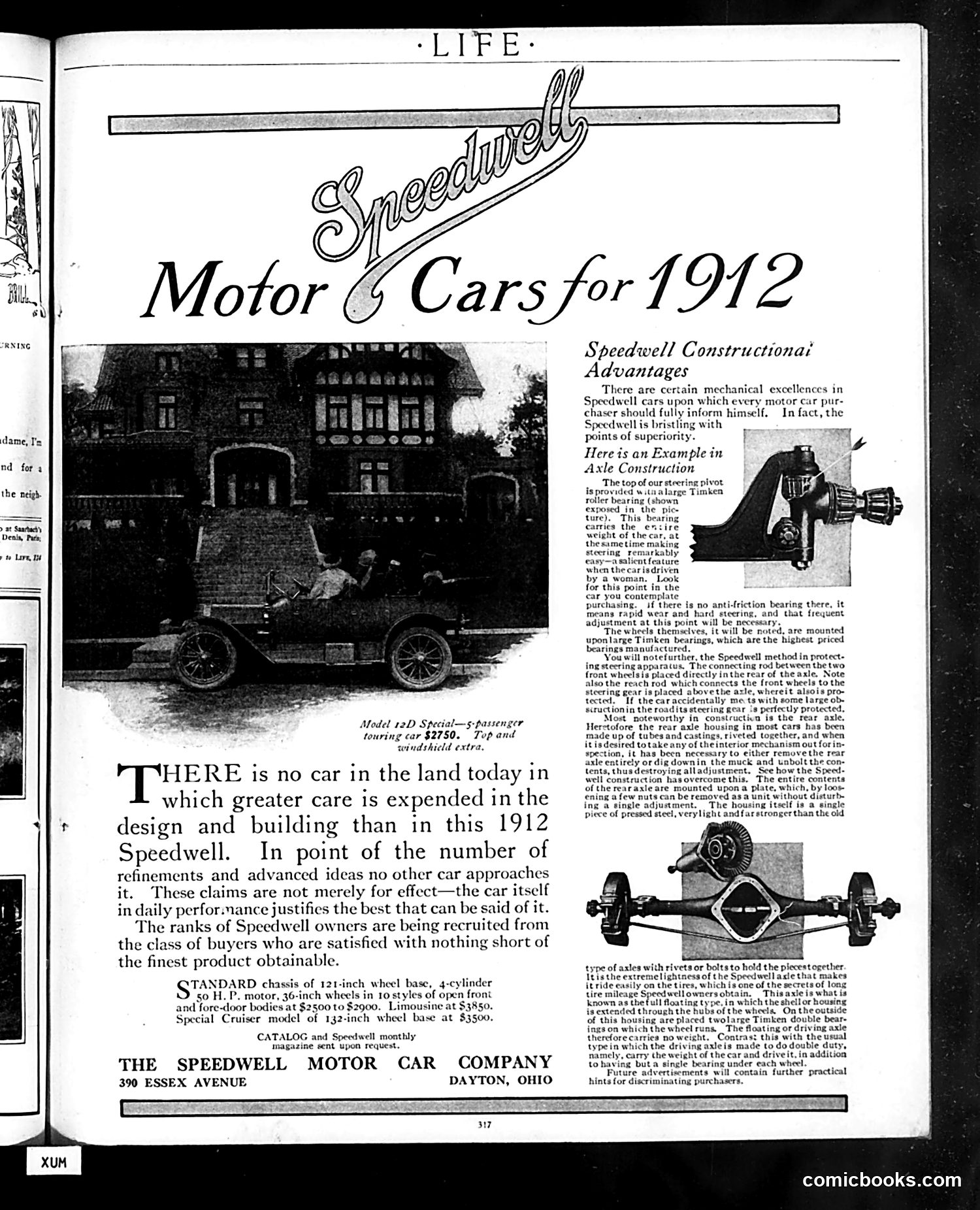
This is **not a political cartoon or satire**, but rather a **straightforward automobile advertisement** from *Life* magazine's 1912 issue. The page promotes the Speedwell Motor Car Company of Dayton, Ohio, showcasing their 1912 models with prices ranging from $2,500 to $3,850. The advertisement emphasizes engineering innovations—specifically their steering pivot bearings, axle construction, and rear-axle design using Timken roller bearings. The left side features a photograph of the Model 12D Special touring car positioned in front of a mansion, implying luxury and affluence. Technical diagrams on the right illustrate mechanical advantages to appeal to educated buyers concerned with quality. The tone is promotional pride in American manufacturing superiority. No satire or caricature is present—this reflects the era's marketing strategy of appealing to wealthy consumers through technical specification and aspirational imagery rather than humor.
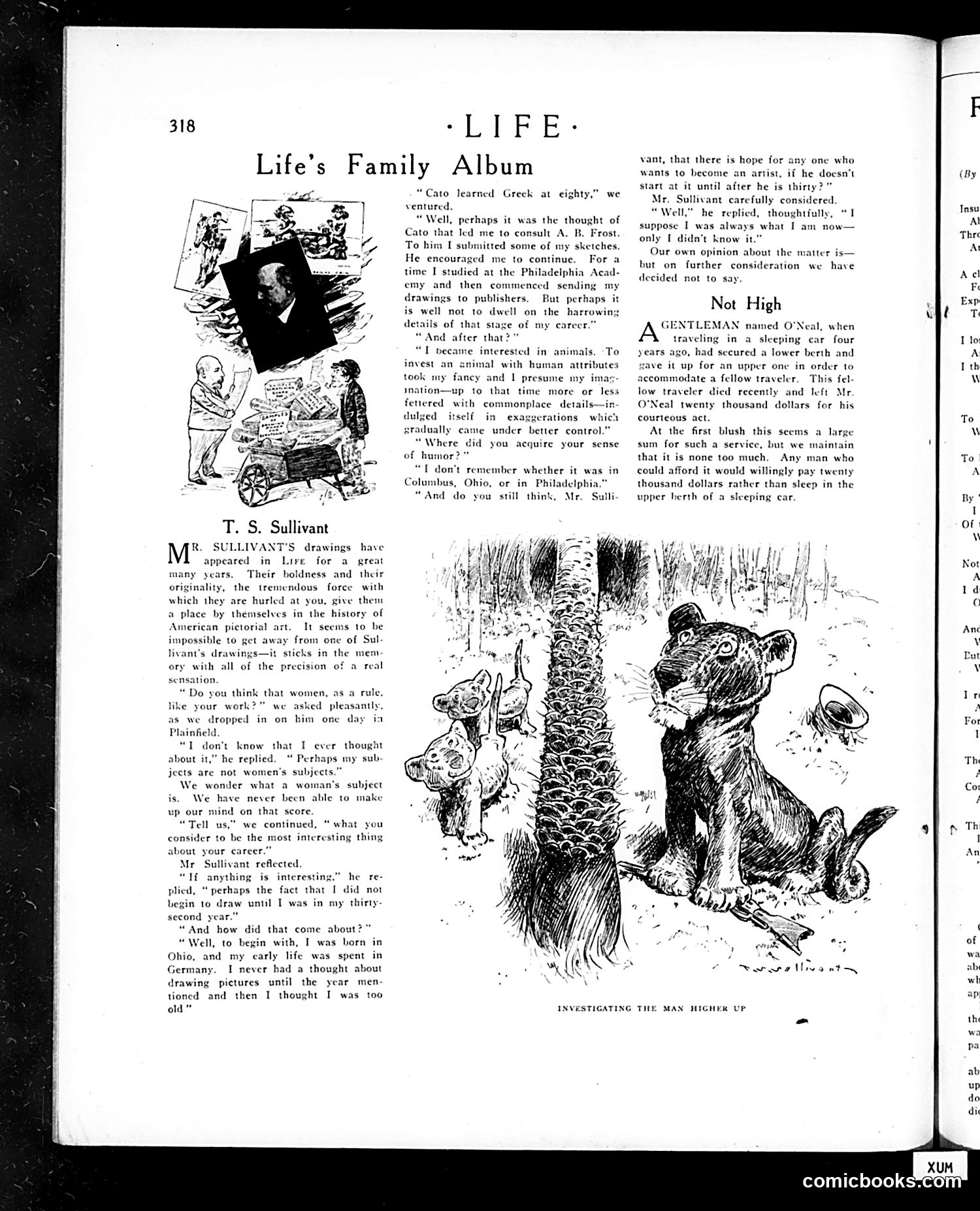
This page profiles cartoonist T.S. Sullivant, known for his bold animal drawings in *Life* magazine. The text records an interview where Sullivant recounts starting his artistic career late (age 32) and developing his distinctive style of giving animals human characteristics with exaggerated features. The cartoon labeled "Investigating the Man Higher Up" depicts animals (appears to be dogs or similar creatures) examining a palm tree trunk. The phrase "the man higher up" was period slang for someone in authority or a superior figure—here used as wordplay, literally showing animals investigating an actual "higher up" (the upper portion of a tree). This plays on Sullivant's signature technique of anthropomorphizing animals while maintaining his satirical edge about authority and hierarchy. The O'Neal anecdote below humorously suggests that paying $20,000 to avoid sleeping in an upper berth is a bargain—poking fun at the discomfort of train travel.
This page contains **literary reviews and advertisements** rather than political cartoons. The left column reviews William Carleton's book "One Way Out"—a rags-to-riches narrative poem about a clerk who escapes poverty by emigrating, working manual labor, and eventually becoming a successful contractor. The satire mocks middle-class aspiration and social climbing through the protagonist's journey from clerk to "Opulent Contractor." Below that, a brief item attacks **Charles Sumner** (19th-century politician/abolitionist), quoting Grant's quip that Sumner rejects the Bible because he didn't write it—mocking Sumner's legendary egotism. The right side contains **two magazine advertisements** promoting articles in *Ladies' Home Journal* and *Life* itself: one about a mother whose daughter ends up in jail (likely a morality tale about parental supervision), and another about theatrical producer David Belasco's clever trick of training a cat to stretch nightly on stage. The page reflects early 20th-century American preoccupations with social mobility, morality, and entertainment spectacle.
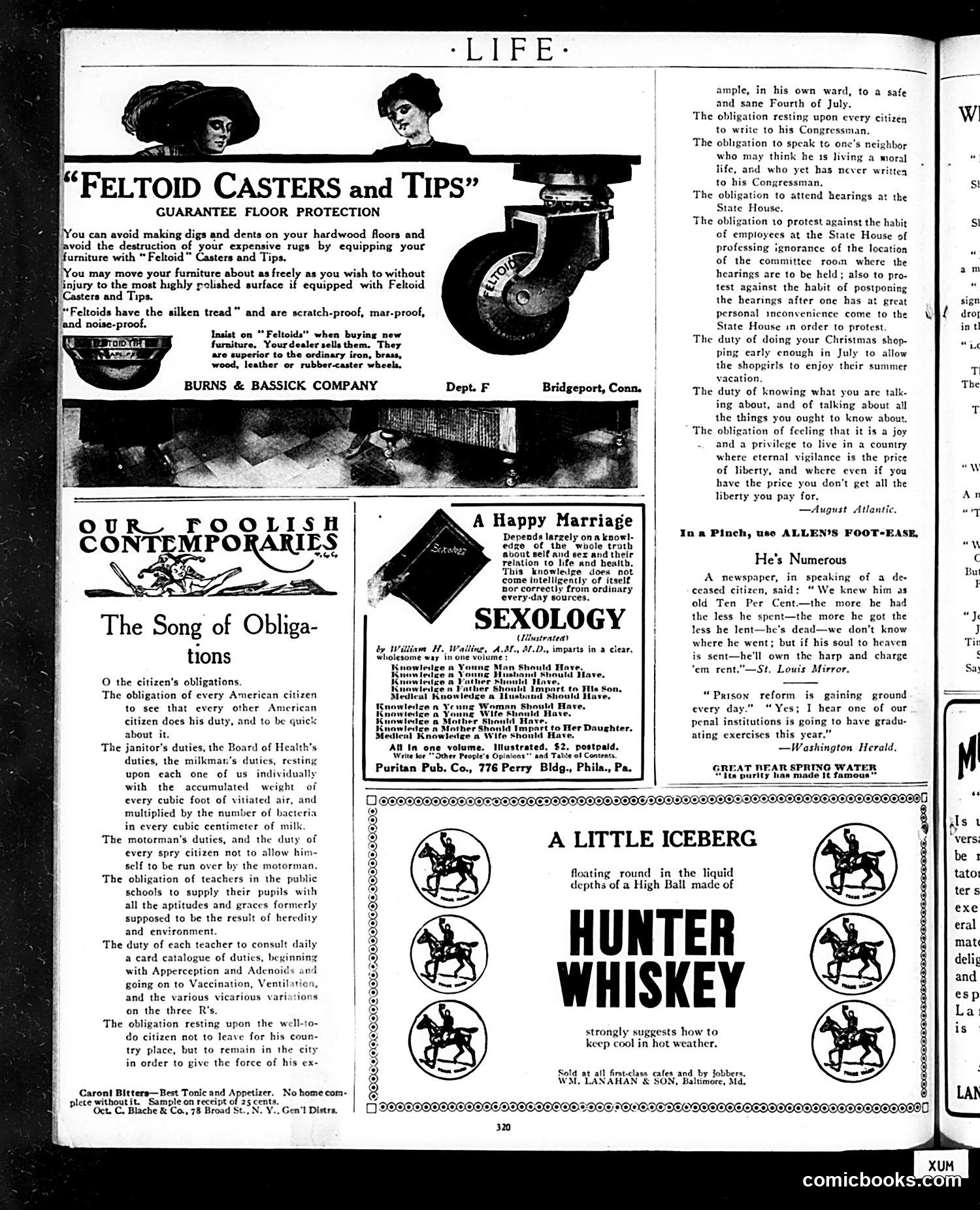
This page is primarily **advertising and humor columns**, not political satire in the traditional sense. The main content includes: 1. **"Feltoid Casters and Tips"** — A furniture hardware ad promising floor protection. 2. **"The Song of Obligations"** — A satirical civics essay listing citizens' duties, from attending state hearings to writing congressmen to doing Christmas shopping early (so shopgirls can vacation). It's gentle social satire about civic responsibility and consideration for others. 3. **"Sexology" advertisement** — A book promoting sex education as necessary knowledge for healthy marriage, unusual for the era. 4. **Humorous anecdotes** — Brief jokes about a deceased miser and prison reform. 5. **"A Little Iceberg/Hunter Whiskey"** — An ad using an iceberg metaphor to suggest keeping cool with alcohol. The page reflects early 20th-century concerns: civic duty, emerging openness about sex education, and consumer culture. The humor is gentle and moralistic rather than sharply political.
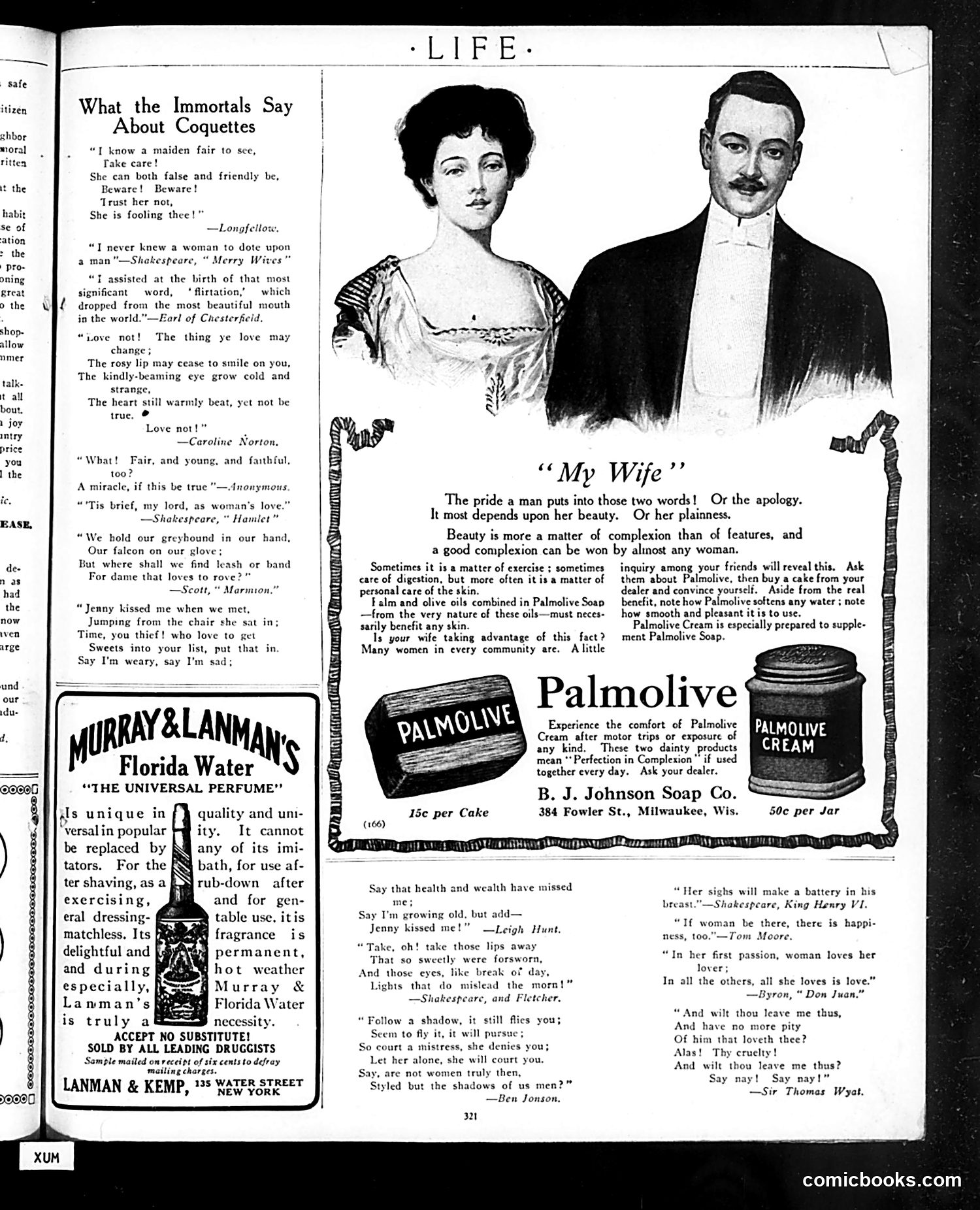
This Life magazine page mixes literary content with advertising. The left side features a column titled "What the Immortals Say About Coquettes"—a collection of classical literary quotations about flirtatious women, drawn from Shakespeare, Longfellow, and other canonical authors. The quotes express skepticism about women's faithfulness and warn men against trusting female affection. The right side presents an advertisement for Palmolive products built around an illustration labeled "My Wife" showing a married couple. The ad's text sardonically notes that a man's pride in marriage depends entirely on his wife's beauty and complexion—positioning skincare as essential to marital success. The juxtaposition is revealing: the "immortals" provide literary warnings about unreliable women, while the advertisement transforms that anxiety into a consumer problem solvable through beauty products. Together, the page reflects early-20th-century attitudes that reduced women's value to appearance and questioned their emotional constancy—anxieties that could be monetized through marketing.
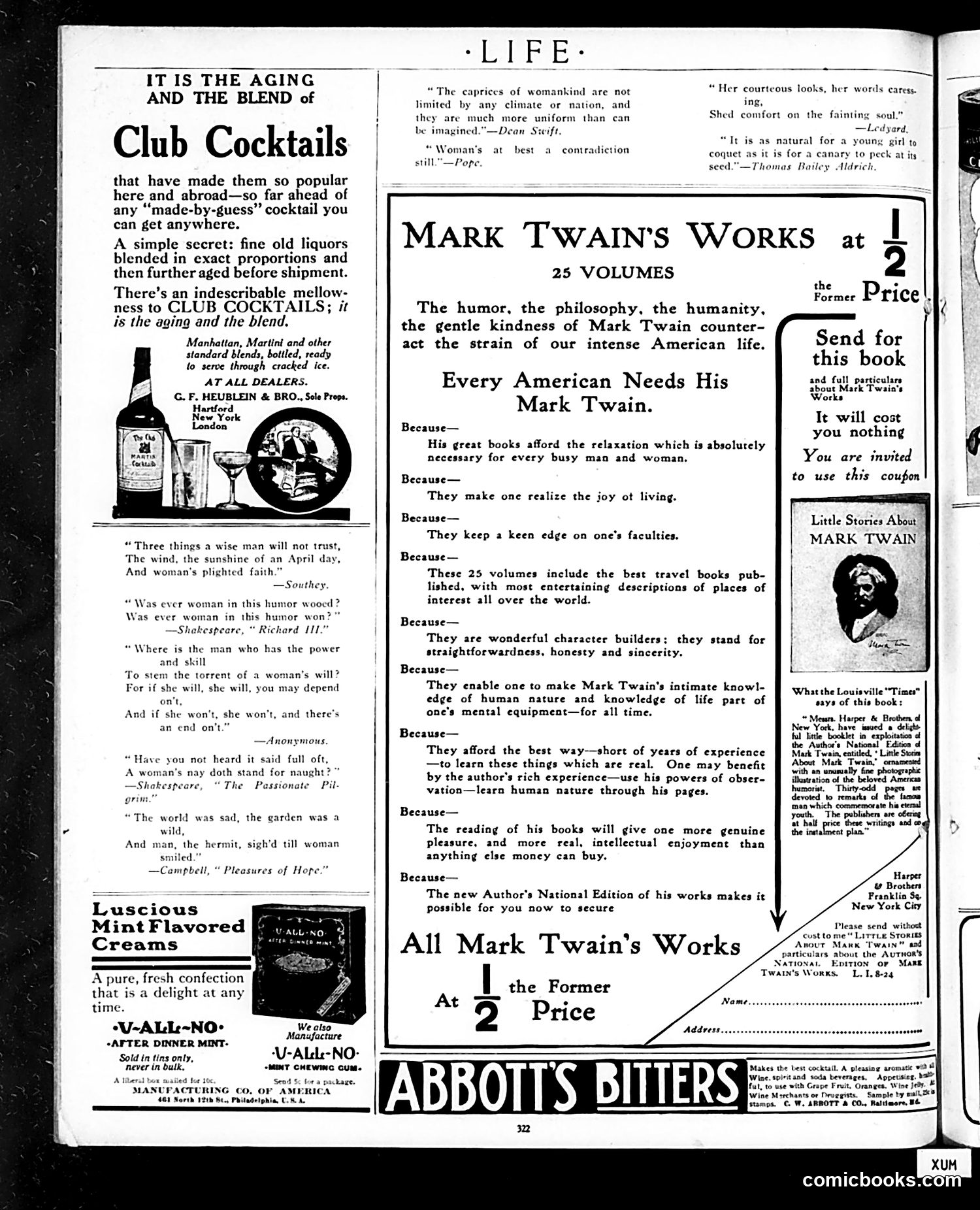
This page is primarily **advertising**, not satire. The main content comprises three advertisements: 1. **Club Cocktails** (top left): Promotes aged spirits from Heublein & Bro., claiming superior quality through proper aging and blending—a straightforward luxury product pitch during Prohibition's end or the pre-Prohibition era. 2. **Mark Twain's Works** (center): The dominant advertisement offers a 25-volume collection of Twain's writings at half the "former price," marketed to busy Americans as essential stress relief and moral/intellectual instruction. 3. **U-All-No Mints** (bottom left): A confection advertisement. **Surrounding the ads** are Victorian-era literary quotations about women—cynical observations attributed to Shakespeare, Pope, and others—serving as generic filler common in magazines of this period. There is **no political cartoon or satire** on this page. The quotations about women's nature reflect period attitudes but aren't presented satirically. This is a straightforward commercial magazine page from approximately the 1910s-1920s.
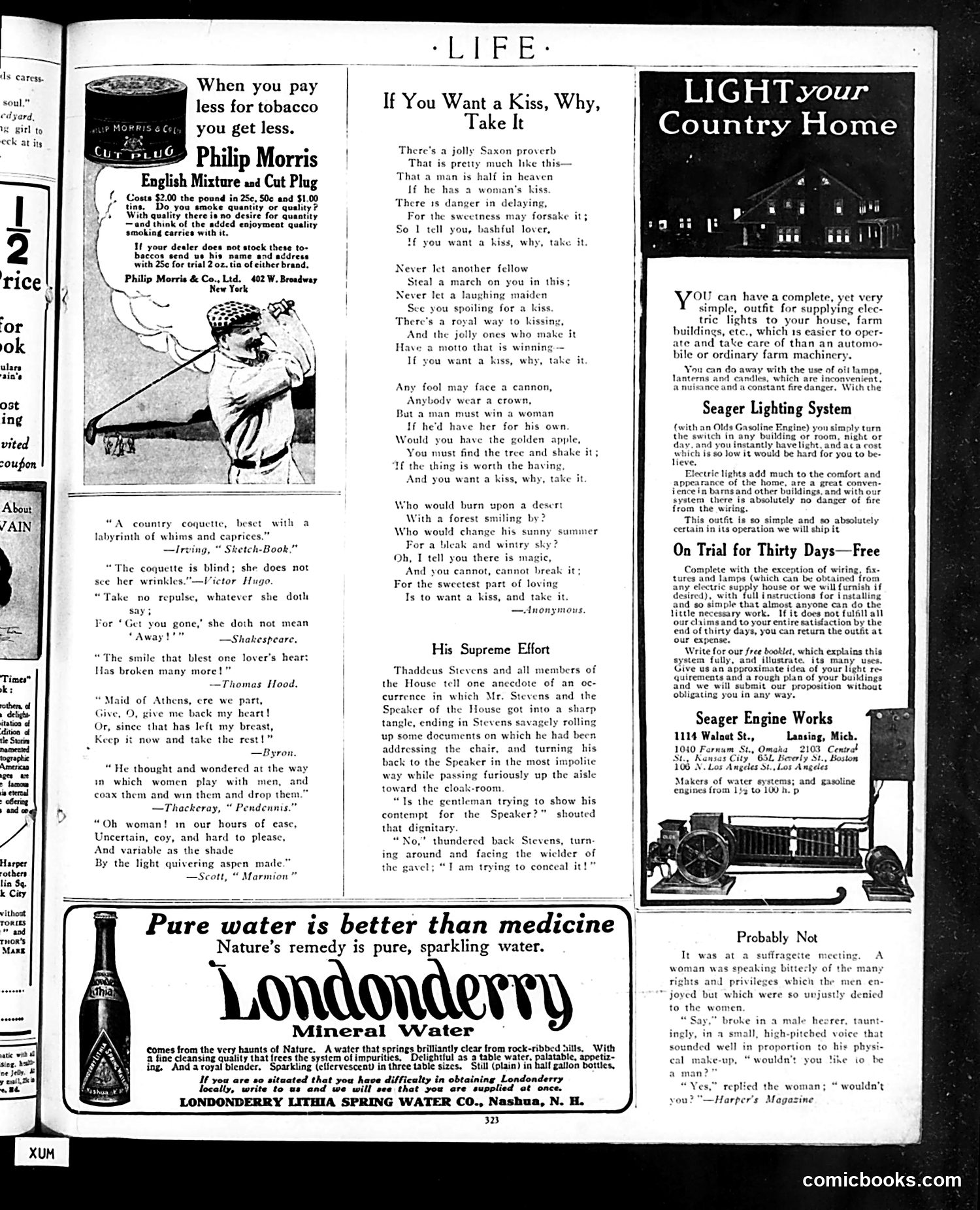
This page contains primarily **advertising and light verse**, not political cartoons. The main content is a romantic poem titled "If You Want a Kiss, Why, Take It"—a lighthearted piece encouraging male suitors not to hesitate in pursuing women's affection. It uses Victorian-era romantic language and includes literary epigraphs about female coquetry from authors like Irving, Byron, and Scott. The small anecdote "His Supreme Effort" describes **Thaddeus Stevens** (a real 19th-century Congressman) getting into a heated confrontation with the House Speaker, rolling up documents and turning his back—a comic account of parliamentary indignation. The page is otherwise dominated by **product advertisements**: Philip Morris tobacco, Londonderry mineral water, Seager electric lighting systems, and farm machinery. There is no identifiable political satire or social commentary beyond the typical period advertising tone.
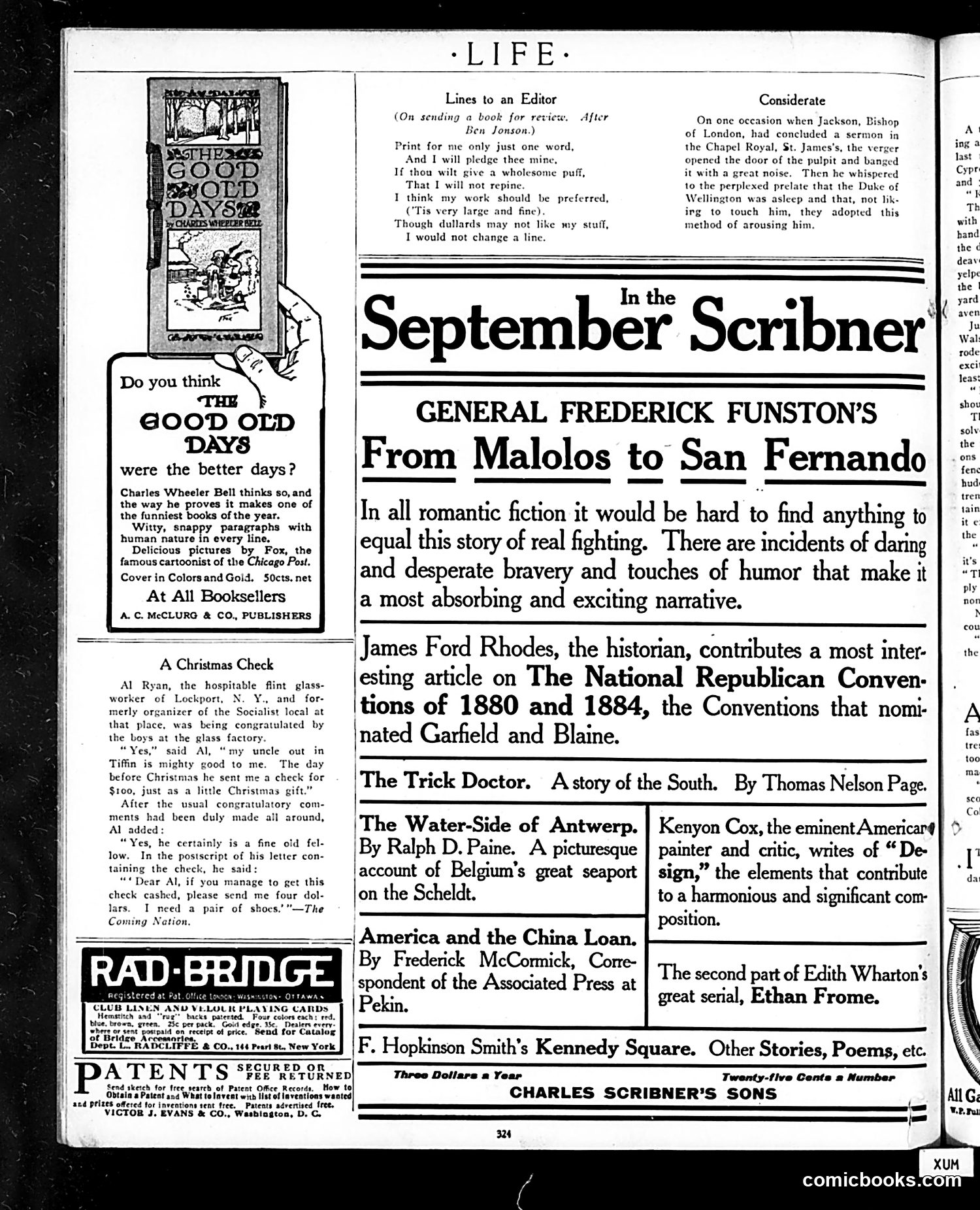
This page is primarily advertising for *Life* magazine and Scribner's magazine's September issue, with some short humor pieces. The visual advertisements include a book promotion for "The Good Old Days" by Charles Wheeler Bell (with cartoonist Fox illustrations) and a patent law advertisement. The humor section contains jokes about Christmas charity and an anecdote about Bishop Jackson's sermon interruption at St. James's Chapel. The main feature advertises General Frederick Funston's military narrative "From Malolos to San Fernando" (referencing Philippine-American War fighting) alongside historical and literary content including James Ford Rhodes on 1880-84 Republican conventions, Thomas Nelson Page, and Edith Wharton's "Ethan Frome." Kenyon Cox contributes on design principles. The satire is light: the Christmas joke mocks gift-giving hypocrisy (the uncle sends $100 but asks for $4 back), while the Bishop anecdote humorously depicts the irreverent solution to an awkward moment. This is primarily a magazine contents page rather than satirical cartooning.
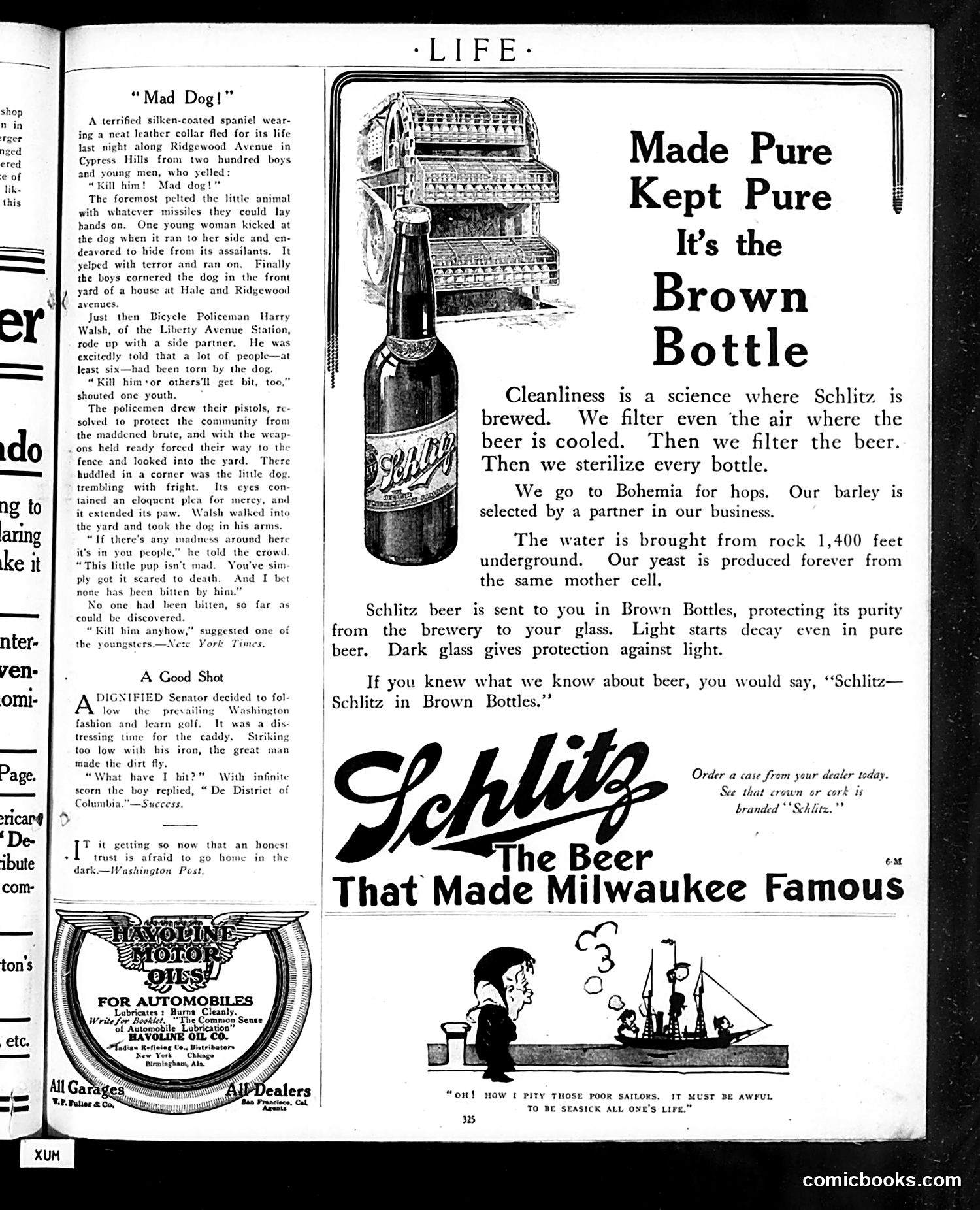
This page contains two distinct elements: **"Mad Dog!" News Story**: A satirical account of mob hysteria in Brooklyn where a frightened spaniel wearing a collar is chased by 200 people and youths shouting "Kill him!" Police arrive ready to shoot, but Officer Walsh recognizes the dog isn't rabid—it's simply terrified. When he asks if anyone was actually bitten, none had been. The satire targets mass panic and mob mentality: people's irrational fear overtaking reason and compassion, with the crowd still demanding the harmless dog be killed anyway. **"A Good Shot" Anecdote**: A brief joke about a dignified Senator learning golf, striking dirt instead of the ball, then asking "What have I bit?" The caddy sarcastically replies he's hit "De District of Columbia"—satirizing the Senator's incompetence and perhaps corruption affecting the nation's capital. **Schlitz Beer Advertisement**: Dominates the right side, emphasizing "cleanliness" and purity through brown bottle protection. A small cartoon shows someone joking about seasick sailors—appears unrelated padding.
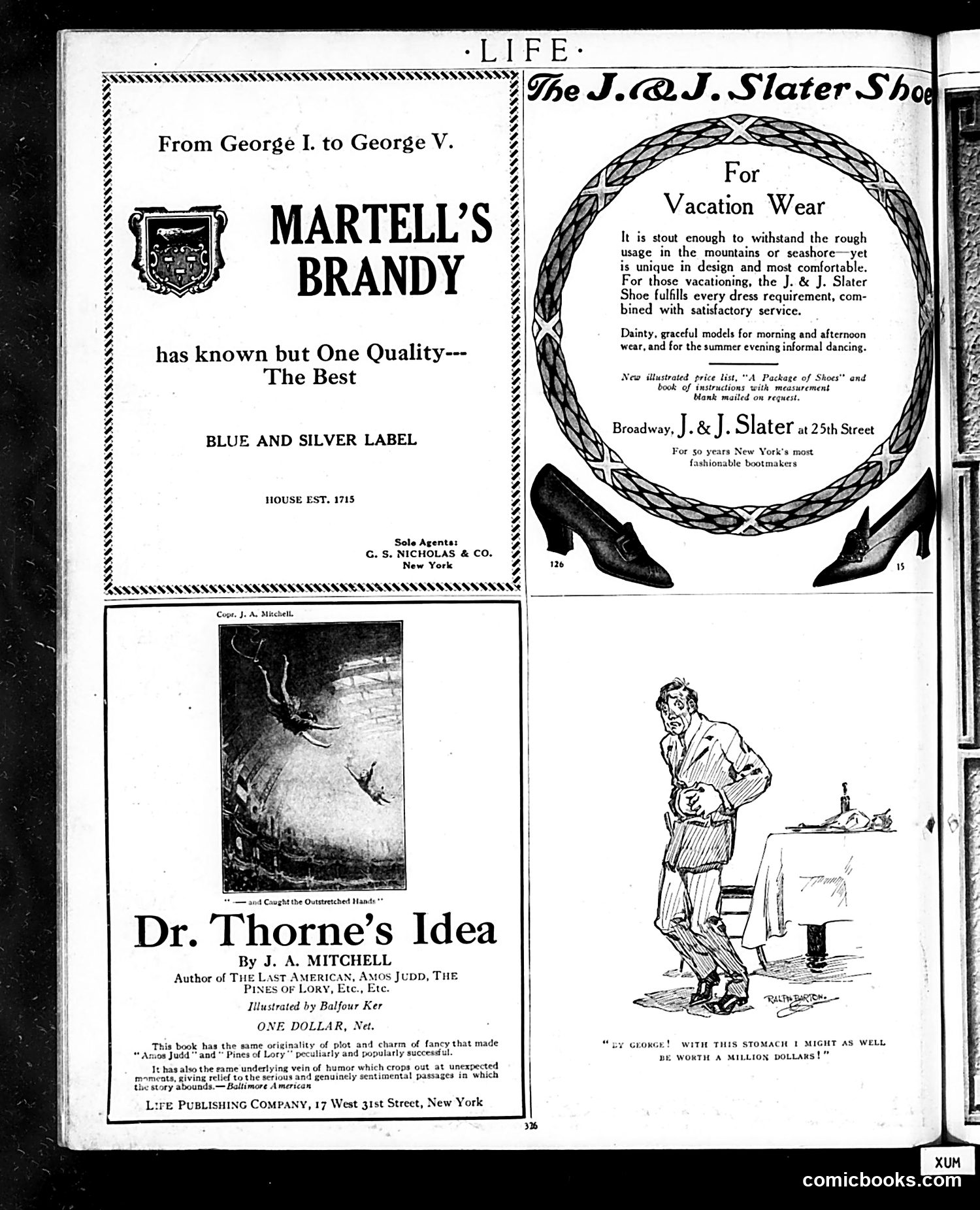
This page is primarily **advertising**, not political satire. It contains four commercial advertisements from what appears to be an early 20th-century *Life* magazine: 1. **Martell's Brandy** — a French cognac advertisement emphasizing quality continuity from "George I to George V" (British monarchs), suggesting the product's long prestige. 2. **J. & J. Slater Shoe** — promotes vacation footwear as durable yet stylish for mountain and seaside wear. 3. **Dr. Thorne's Idea** — advertises a novel by J.A. Mitchell, touting its originality and humor in the style of his previous successful works. 4. **A cartoon illustration** (bottom right) showing a man at a desk with the caption "With this stomach I might as well be worth a million dollars!" — likely satirizing the idea that wealth means nothing without good health, promoting some digestive remedy or health product (text partially unclear). The page reflects period advertising conventions: emphasis on quality heritage, leisure/vacation lifestyle, and humorous health commentary.
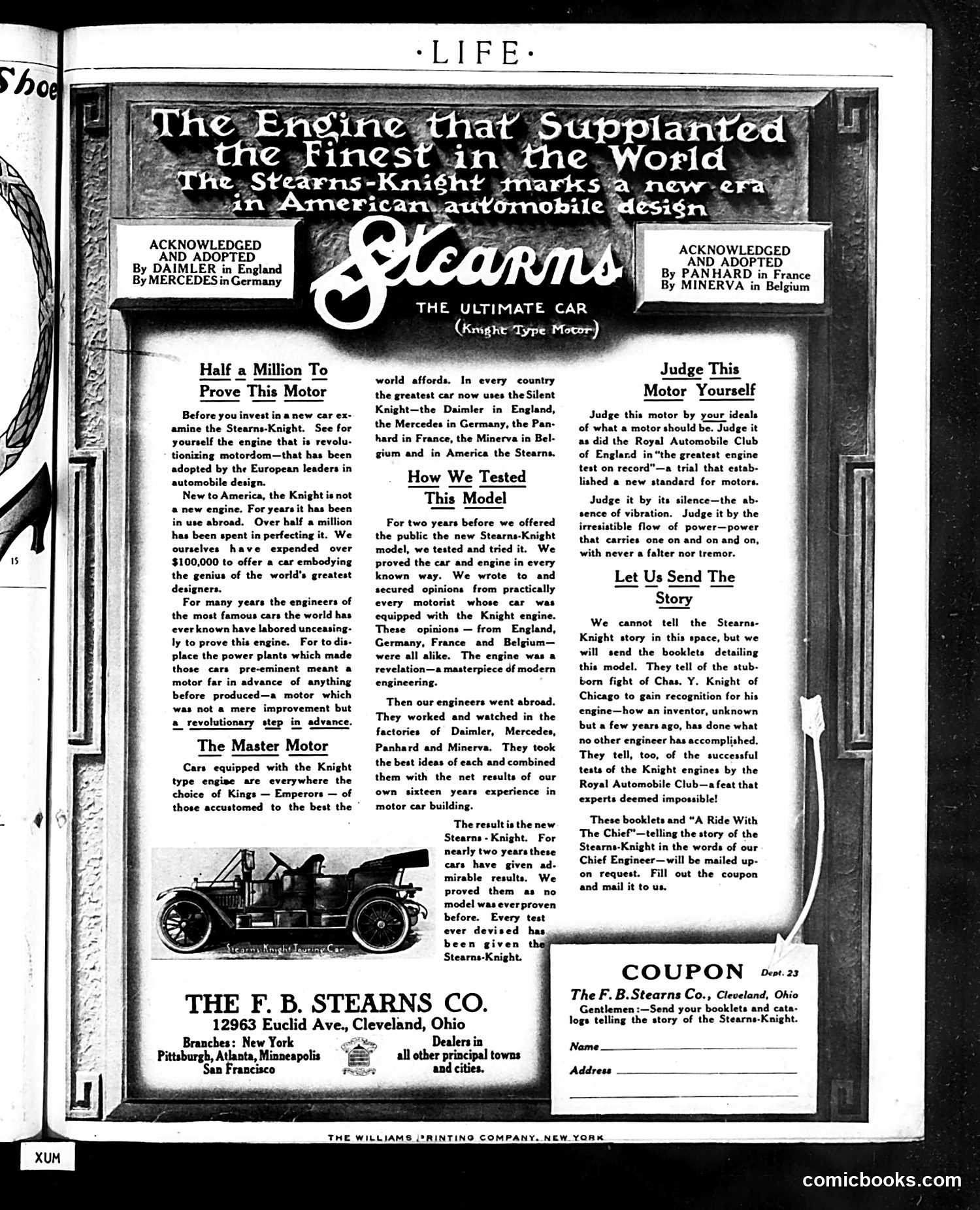
This is **not a cartoon or satirical content**—it's a full-page advertisement for the Stearns-Knight automobile, published in *Life* magazine. The ad promotes the "Silent Knight" engine, a sleeve-valve motor developed by inventor C.Y. Knight of Chicago. The advertisement claims this engine has been adopted by Europe's most prestigious car manufacturers (Daimler, Mercedes, Panhard, Minerva) and is now available in America through the F.B. Stearns Company of Cleveland, Ohio. The marketing strategy emphasizes the engine's refinement, power, and silence—positioning it as technology validated by European luxury brands and the Royal Automobile Club's testing. The ad invites readers to request promotional booklets and includes a coupon for interested buyers. This reflects early-1900s automobile marketing: technical innovation presented as prestigious international endorsement.
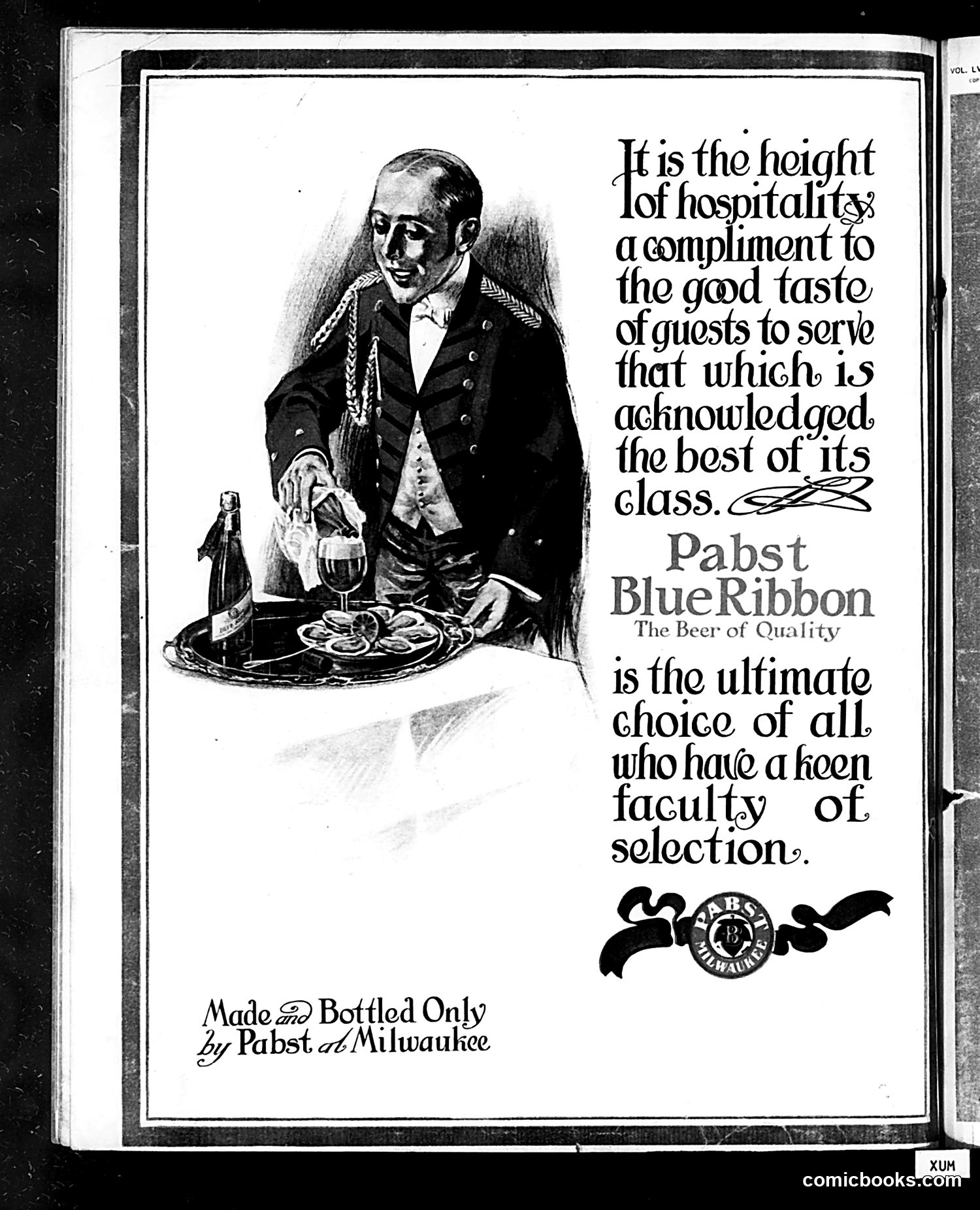
This is a **beer advertisement**, not political satire. It depicts a well-dressed gentleman—appearing to be a refined host or butler—serving Pabst Blue Ribbon beer alongside food on an elegant table. The ad appeals to early 20th-century notions of class and sophistication, positioning the beer as a mark of refined taste and hospitality. By associating the product with a dignified, formally-dressed figure and the concept of "good taste," Pabst marketed their beer to aspirational middle and upper-class consumers. The tagline emphasizes that serving Pabst demonstrates the host's discernment and social standing—a common advertising strategy of the era that linked consumer goods to social status and respectability. This reflects pre-Prohibition or early post-Prohibition marketing (Pabst at Milwaukee indicates production location).