
Life, 1911-08-24 · page 14 of 40
Life — August 24, 1911 — page 14: what you’re looking at
What you’re looking at
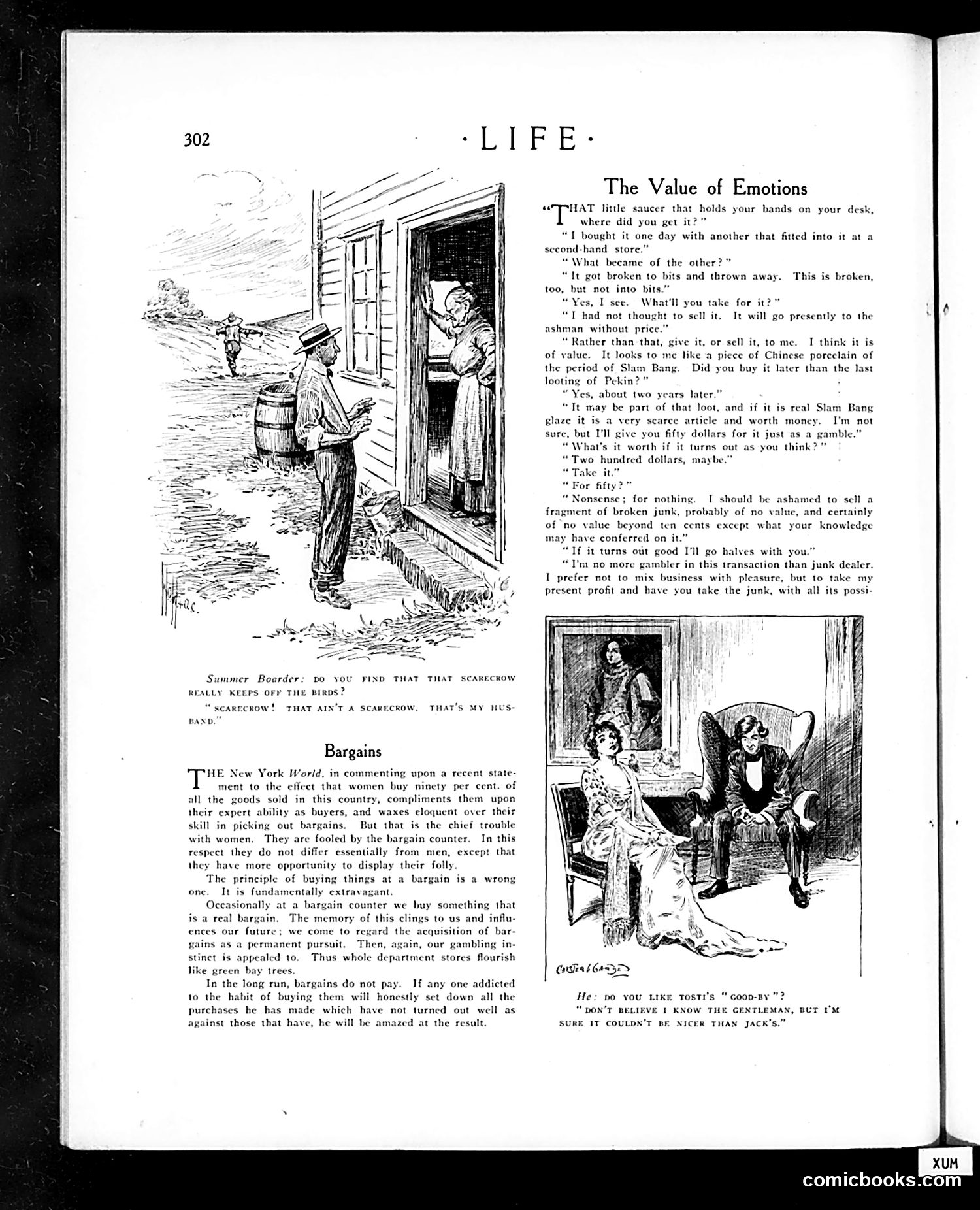
This page contains two distinct pieces: **"The Value of Emotions"** (top): A dialogue between a Summer Boarder and what appears to be a homeowner about a broken Chinese porcelain saucer. The boarder wants to buy it cheaply as "junk," while the homeowner argues it has sentimental and artistic value. The satire critiques American consumerism and utilitarian attitudes—treating culturally valuable objects as mere commodities rather than treasures worth preserving for their intrinsic merit. **"Bargains"** (bottom): An article criticizing women's obsessive bargain-hunting. It argues that while women are praised as smart shoppers, their compulsive buying of discounted items—regardless of actual need—reflects poor financial judgment. The piece suggests this "gambling instinct" for deals ultimately costs money rather than saving it, satirizing the false economy of bargain culture. Both pieces critique American consumer behavior through humor.
📄 Transcribed text from this page (OCR, searchable)
Machine-transcribed from the original scan — historical spelling and the odd misread are preserved.
The Value of Emotions “TPHAT little saucer that holds your bands on your desk, where did you get it?” “I bought it one day with another that fitted into it at a sccond-hand store.” “What became of the other?” “It got broken to bits and thrown away. This is broken, too, but not into bits.” “Yes, I see. What'll you take for it?” I had not thought to sell it, It will go presently to the in without price Rather than that, give it, or sell it, tome. I think it is of value. It looks to me like a picce of Chinese porcelain of the period of Slam Bang. Did you buy it later than the last looting of Pekin?” Yes, about two years later.” It may be part of that loot, and if it is real Slam Bang glaze it is a very scarce article and worth moncy. I'm not sure, but I'll give you fifty dollars for it just as a gamble.” “What's it worth if it turns out as you think?” Two hundred dollars, maybe “Take it “For fifty Nonsense; for nothing. I should be ashamed to sell a fragment of broken junk, probably of no valuc, and certainly of ‘no value beyond ten cents except what your knowledge may have conferred on it.” “If it turns out good I'll go halves with you.” “I'm no more gambler in this transaction than junk dealer. I prefer not to mix business with pleasure, but to take my present profit and have you take the junk, with all its possi- Summer Boarder: po you FIND THAT THAT SCARECROW REALLY KEEPS OFF TIE BIRDS? “scarecrow! THAT AIN'T A SCARECROW. THAT'S MY HUS- BAND.” Bargains TH New York World, in commenting upon a recent state- ent to the effect that women buy ninety per cent. of all the goods sold in this country, compliments them upon their expert ability as buyers, and waxes eloquent over their skill in picking out bargains. But that is the chici trouble with women. They are fooled by the bargain counter. In this respect they do not differ essentially from men, except that they have more opportunity to display their folly. The principle of buying things at a bargain is a wrong one. It is fundamentally extravagant Occasionally at a bargain counter we buy something that is a real bargain. The memory of this clings to us and influ- ences our future; we come to regard the acquisition of bar- gains as a permanent pursuit. Then, again, our gambling in- stinct is appealed to. Thus whole department stores flourish like green bay trees. CHS b GADD In the long run, bargains do not pay. If any one addicted to the habit of buying them will honestly set down all the He: po you Like Tostt's “ Goop-ny "? purchases he has made which have not turned out well as “DON’T BELIEVE I KNOW THE GENTLEMAN, BUT I'M against those that have, he will be amazed at the result. SURE IT COULDN'T ME NICER THAN JACK’S.” comicbooks.co