
Life, 1911-08-24 · page 17 of 40
Life — August 24, 1911 — page 17: what you’re looking at
What you’re looking at
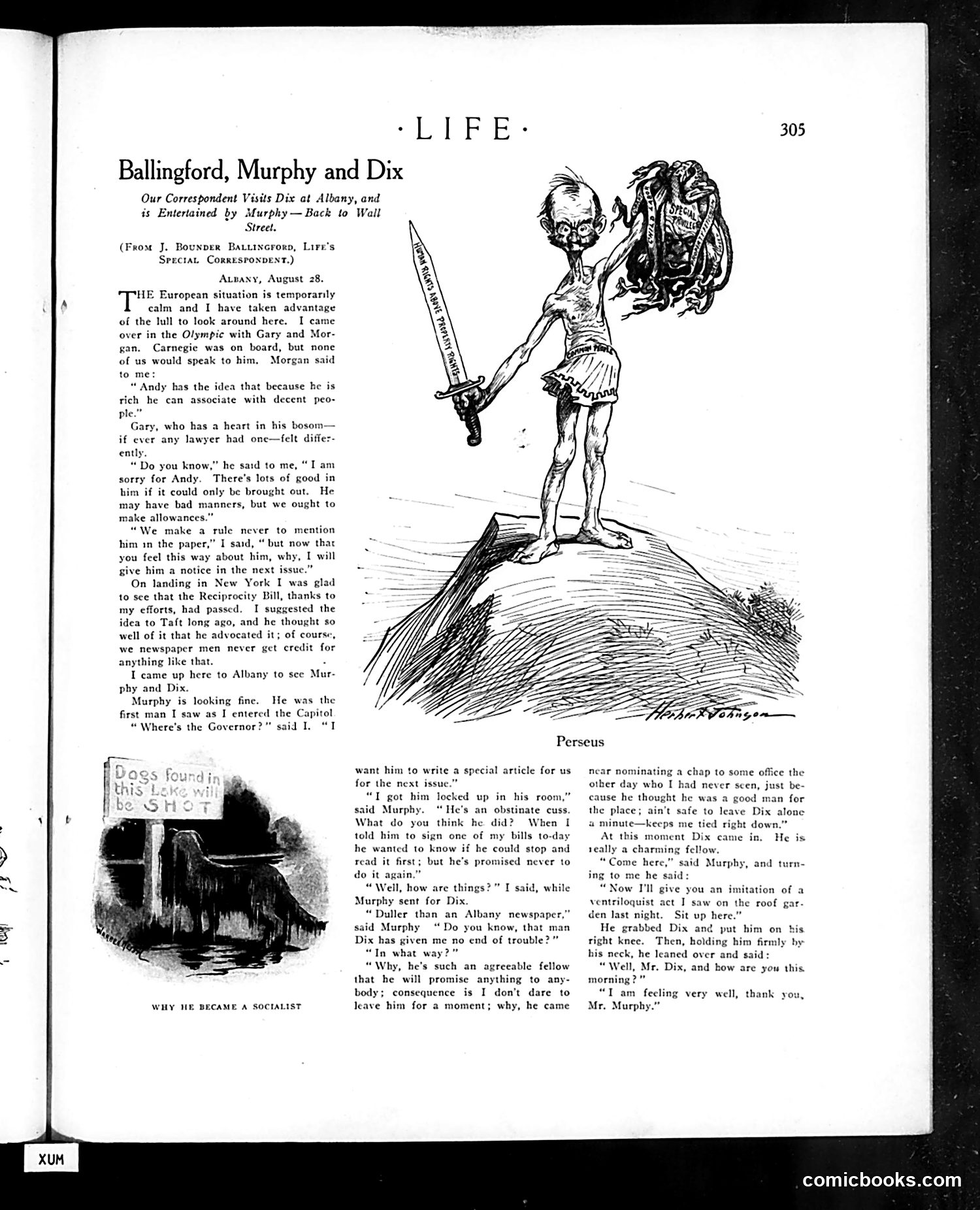
This satirical piece mocks political corruption in early 20th-century New York. The cartoon depicts **Perseus** (mythological hero) holding the head of Medusa, likely representing the correspondent's inflated self-importance. The text satirizes three figures: **Carnegie** (industrialist Andrew Carnegie, portrayed as socially unacceptable despite wealth), **Murphy** (likely Charles Francis Murphy, Tammany Hall boss), and **Dix** (Governor John Alden Dix of New York). The satire's point: Murphy literally controls Governor Dix like a ventriloquist's dummy—the governor is so eager to please that Murphy must physically restrain him from making independent decisions. The correspondent boasts about his own influence on national policy (the Reciprocity Bill), exemplifying the era's cynical view that newspaper men, politicians, and industrialists secretly ran government through backroom dealing. The humor targets machine politics, where governors served machine bosses rather than the public interest.
📄 Transcribed text from this page (OCR, searchable)
Machine-transcribed from the original scan — historical spelling and the odd misread are preserved.
~LIFE: Ballingford, Murphy and Dix Our Correspondent Visits Dix at Albany, and is Entertained by Murphy —Back to Wall Street. (From J. Bouxper Battincroro, Lirr’s Spectat. Corresroxpent.) Atvaxy, August 28. HE European situation is temporarily calm and I have taken advantage of the lull to look around here. I came over in the Olympic with Gary and Mor- gan, Carnegie was on board, but none of us would speak to him, Morgan said to me: “ Andy has the idea that because he is rich he can associate with decent peo- ple.” . who has a heart in his bosom— if ever any lawyer had one—felt diff ently. “Do you know,” he said to me, “I am sorry for Andy. There's lots of good in him if it could only be brought out. He may have bad manners, but we ought to make allowances.” “We make a rule never to mention him in the paper,” I said, “ but now thar you feel this way about him, why, I will give him a notice in the next issue.” On landing in New York I was glad to sce that the Reciprocity Bill, thanks to my efforts, had passed. I suggested the idea to Taft long ago, and he thought so well of it that he advocated it; of course, we newspaper men never get credit for anything like that. : I came up here to Albany to see Mur- phy and Dix. Murphy is looking fine. first man I saw as I entered the Capitol “Where's the Governor?" said I. “T He was the WHY ME BECAME A SOCIALIST want him to write a special article for us for the next issue. “T got him locked up in his room,” said Murphy. “He's an obstinate cuss. What do you think he did? When I told him to sign one of my bills to-day he wanted to know if he could stop and read it first; but he’s promised never to do it again “Well, how are things?” I’ said, while Murphy sent for Dix “Duller than an Murphy “Do you know, that man Dix has given me no end of trouble?” “In what way?” “Why, he’s such an agreeable fellow that he will promise anything to any- body; consequence is I don’t dare to leave him for a moment; why, he came bany newspaper,” near nominating a chap to some office the other day who I had never scen, just be- cause he thought he was a good man for the place; ain't safe to leave Dix alone au minute—keeps me tied right down.” At this moment Dix came in, really a charming fellow. ‘ome here,” said Murphy, and ty to me he said: “Now I'll give you an imitation of a ventriloquist act I saw on the roof gar- den last night. Sit up here.” He grabbed Dix and put him on his right knee. Then, holding him firmly by his neck, he leaned over and sai “Well, Mr. Dix, and how are you this morning? “Tam feeling very well, thank you, Mr. Murphy.” He is comicbooks.com