
Life, 1911-08-24 · page 26 of 40
Life — August 24, 1911 — page 26: what you’re looking at
What you’re looking at
This satirical review criticizes novelist W.J. Locke's new book *The Glory of Clementina* for attempting to be a serious sociological commentary while remaining merely whimsical fiction. The reviewer uses an extended metaphor: Locke resembles a child offering a broken doll to bribe away progress—here, the "feminist movement" (the "snake fence" protecting tradition). The "Purposive Bee" in the title likely refers to Locke's stated social purpose. The complaint is that Locke tries simultaneously to entertain readers with charming characters (Ephraim Quixtus, the dowdy painter Clementina) and to argue a feminist thesis—that women find fulfillment in "the glory of being a woman" through romantic self-sacrifice rather than independence. The reviewer finds this approach artistically failed and intellectually dishonest: using sentiment to defend traditional gender roles against the advancing women's movement, rather than genuinely engaging with social change.
📄 Transcribed text from this page (OCR, searchable)
Machine-transcribed from the original scan — historical spelling and the odd misread are preserved.
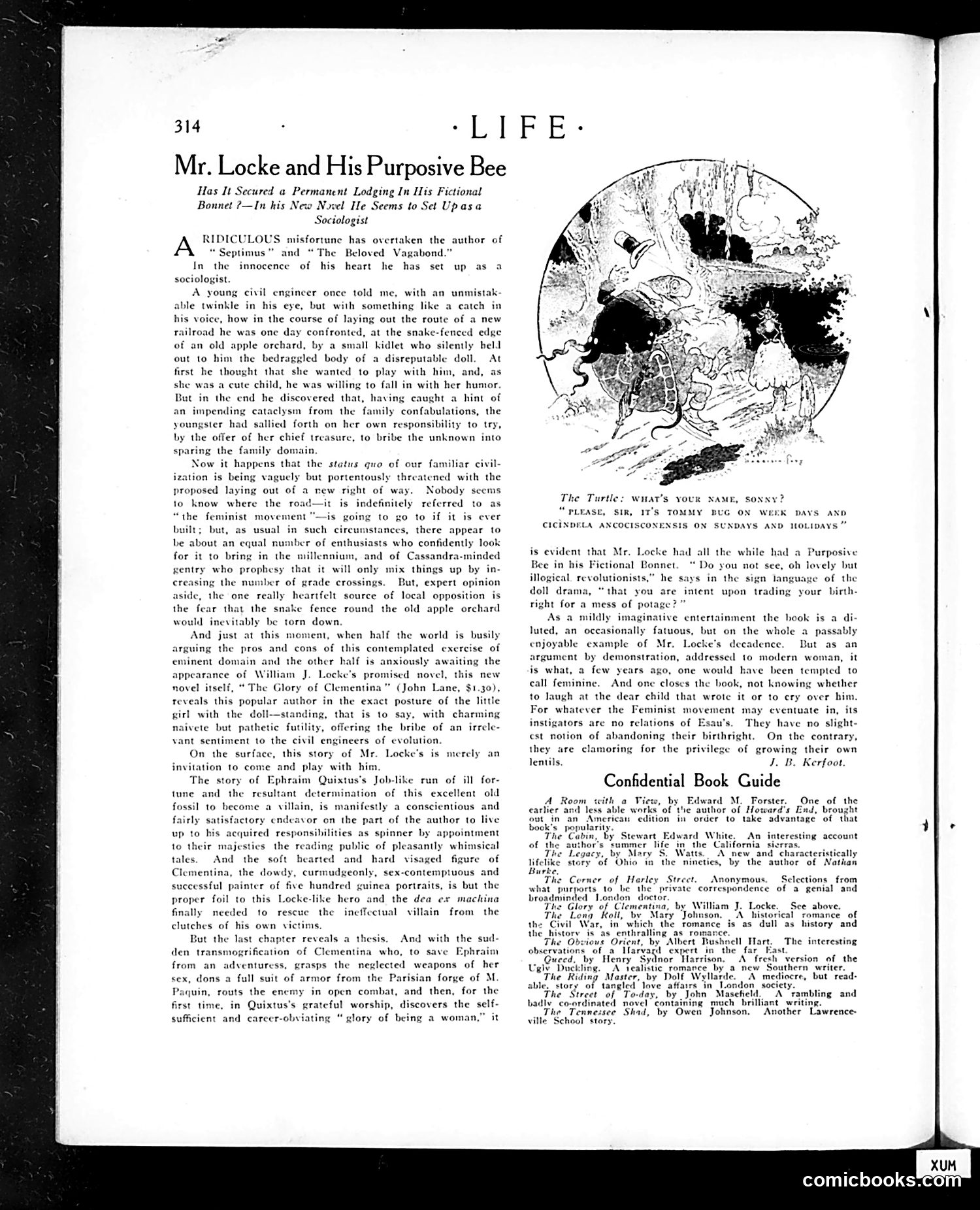
314 -LIFE- Mr. Locke and His Purposive Bee Has It Secured a Permanent Lodging In His Fictional Bonnet ?—In his New Novel He Seems to Set Up asa Sociologist RIDICULOUS misfortune has overtaken the author of “Septimus” and “The Beloved Vagabond.” In the innocence of his heart he has set up sociologist. A young civil engincer once told me, with an unmistak able twinkle in his eye, but with something like a catch in his voice, how in the course of laying out the route of a new railroad he was one day confronted, at the snake-fenced edge of an old apple orchard, by a small kidlet who silently beld out to him the bedraggled body of a disreputable doll. At first he thought that she wanted to play with him, and, as she was a cute child, he was willing to fall in with her humor. But in the end he discovered that, having caught a hint of an impending cataclysm from the family confabulations, the youngster had sallied forth on her own responsibility to try, by the offer of her chief treasure, to bribe the unknown into ring the fami Now it happens that the status quo of our familiar civil- ization is being vaguely but portentously threatened with the proposed laying out of a new right of way. Nobody seems to know where the road—it is indefinitely referred to as “the feminist movement "—is going to go to if it is ever built; but, as usual in such circumstances, there appear to be about an equal number of enthusiasts who confidently look for it to bring in the millennium, and of Cassandra-minded gentry who prophesy that it will only mix things up by in- creasing the number of grade crossings. But, expert opinion aside, the one really heartfelt source of local opposition is the fear that the snake fence round the old apple orchard would inevitably be torn down, And just at this moment, when half the world is. busily arguing the pros and cons of this contemplated exercise of eminent domain and the other half is anxiously awaiting the appearance of Wil J. Locke's promised novel, this new novel itself, “The Glory of Clementina” (John Lane, $1.30), reveals this popular author in the exact posture of the little girl with the doll—standing, that is to say, with charming naivete but pathetic futility, offering the bribe of an irrele- t sentiment to the civil engineers of evolution On the surface, this story of Mr. Locke's is merely an invitation to come and play with him, The story of Ephraim Quixtus's Job-like run of ill for- tune and the resultant determination of this excellent old fossil to become a villain, is manifestly a conscientious and fairly satisfactory endeavor on the part of the author to live up to his acquired responsibilities as spinner by appointment to their majesties the reading public of pleasantly whimsical tales. And the soft hearted and hard visaged figure of Clementina, the dowdy, curmudgeonly, sex-contemptuous and successful painter of five hundred guinea portraits, is but the proper foil to this Locke-like hero and the dea ex machina finally needed to rescue the ineffectual villain from the clutches of his own . But the last chapter reveals a thesis. And with the sud- den transmogrification of Clementina who, to save Ephraim from an adventuress, grasps the neglected weapons of her sex, dons a full suit of armor from the Parisian forge of M Paquin, routs the encmy in opcn combat, and then, for the first time, in Quixtus's grateful worship, discovers the self- sufficient and carecr-obviating “glory of being a woman, The Turtle: wuat’s your Xame, SONNY? “PLEASE, SIR, IT'S TOMMY BUG ON WEEK DAYS AND CICINDELA ANCOCISCONENSIS ON SUNDAYS AND MOLIDAYS” is evident that Mr. Locke had all the while had a Purposive Bee in his Fictional Bonnet. “Do you not see, oh lovely but iogical revolutionists,” he says in the sign Jar © of the doll drama, “that you are intent upon trading your birth t for a mess of potage As a mildly imaginative entertainment the hook is a di- luted, an occasionally fatuous, but on the whole a passably enjoyable example of Mr, Locke's decadence. But as an argument by demonstration, addressed to modern woman, it is what, a few years ago, one would have been tempted to call feminine. And one closes the book, not knowing whether to laugh at the dear child that wrote it or to cry over him, eventuate in, its instigators are no relations of Esau's. They have no slight- For whatever the Feminist movement n cst notion of abandoning their birthright. On the contrary, they are clamoring for the privilege of growing their own lentils. J. B. Kerfoot Confidential Book Guide A Room «with a View, by Edward M. Forster. One of the earlier and less able works’ of the author of Howard's End, brought out in an American edition in order to take advantage of that book's popuiarit The Cabin, by Stewart Edward White, An interesting account of t hor’s summer life in the California sivrras. The Legacy, by Mary S. Watts. A new and characteristically lifelike story of Ohio in the nineties, by the author of Nathan Burke, Corner of Harley Stre Anonymous. Selections _ from urports to be the’ private correspondence of a genial and broadminded London doctor. The Glory of Clementina, by William J. Locke. Sce above. The Long Koll, by Mary Johnson. “A historical romance of the Civil’ War, in’ which the tomance is as dull as history and the history is as enthralling as romance. The Obvious Orient, by Albert Bushnell Hart, The interesting observations of a Marva, tin the far East Queed, by Henry Sy A fresh version of the Ugle Duckling. A tealistic romance by a new Southern writer. The Riding Master, by Dolf Wyllarde. A mediocre, but read- able, story of tangled’ love affairs in London. society. The Street of To-day, by John Maseheld. A rambling and badly ‘co-ordinated novel containing much brilliant writing. The Tennessee Shad, by Owen Johnson. Another Lawrence- ville School story comicbooks -com