
A complete issue · 40 pages · 1911
Life — July 20, 1911
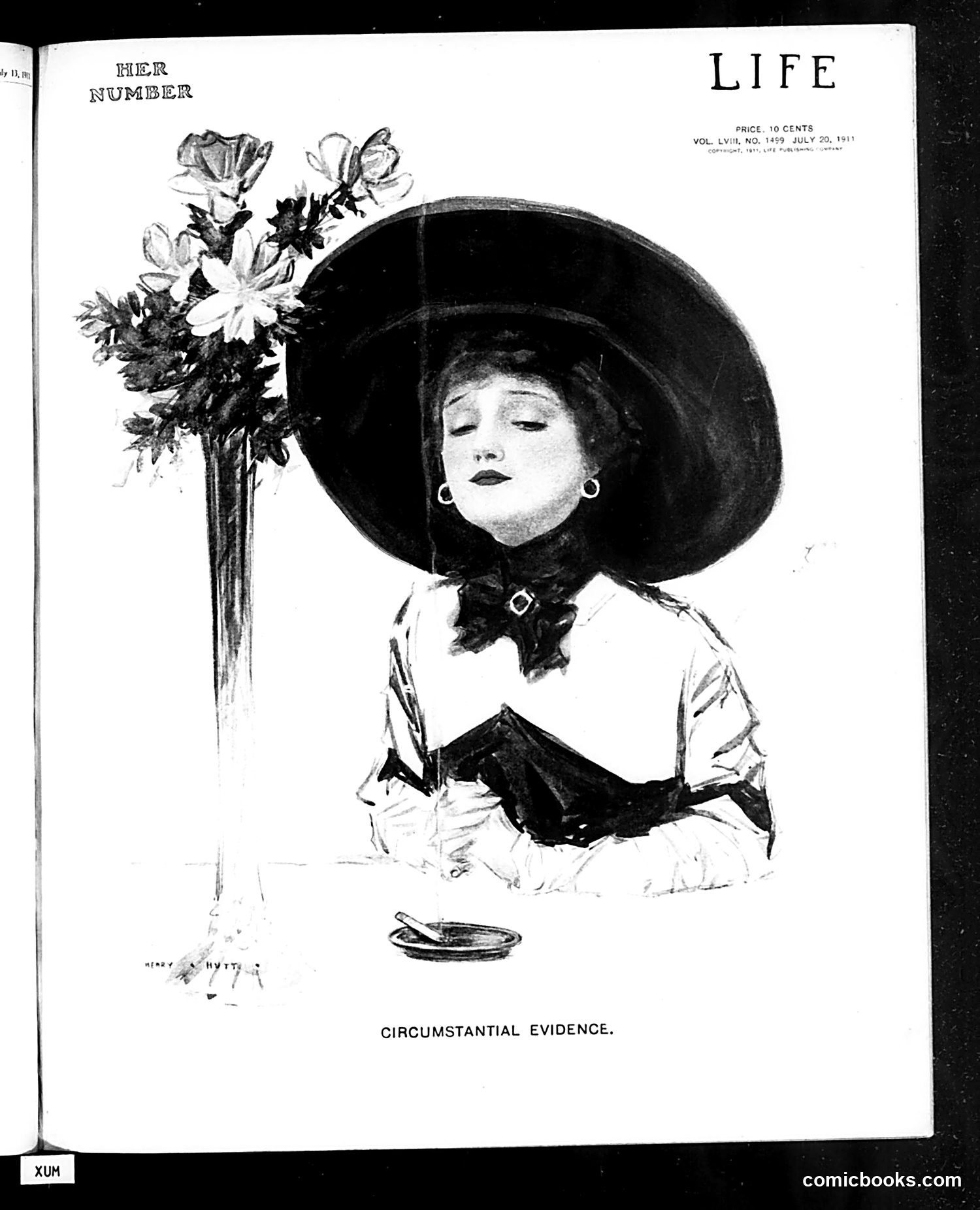
This satirical illustration depicts a fashionably dressed woman wearing an elaborate wide-brimmed hat and formal attire, gazing downward demurely. She holds what appears to be a small dish or plate. The title "Circumstantial Evidence" suggests the cartoon is making a joke about women and courtship or marriage prospects. The woman's refined appearance, flowers, and the ambiguous object she holds likely contain a double meaning—the "circumstantial evidence" being visual clues about a woman's marriageability, social status, or romantic intentions based on her appearance and accessories. This reflects early 20th-century satirical commentary on gender, social conventions, and how women were judged by superficial markers of respectability and desirability.
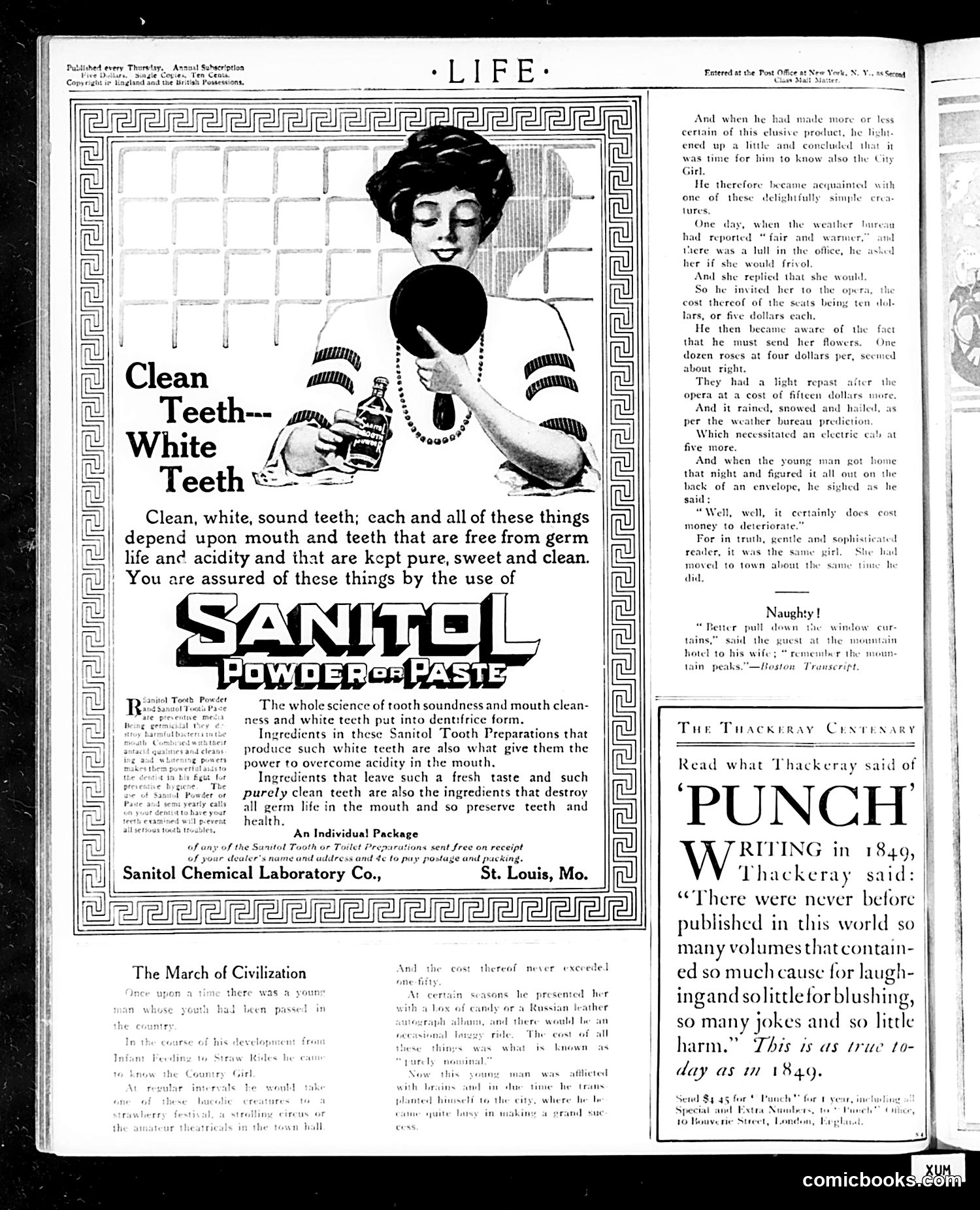
This page is primarily a **product advertisement** rather than political satire. The large left panel promotes Sanito-L Tooth Powder and Paste, featuring an illustration of a woman with clean teeth holding the product. The advertisement emphasizes dental hygiene and germ-killing properties, claiming the product prevents acidity and keeps teeth "pure, sweet and clean." The accompanying text explains the science behind tooth soundness. The right side contains an unrelated story titled "The March of Civilization" and a separate item about Thackeray's centenary, quoting his 1849 remarks about *Punch* magazine. **This is essentially a commercial page with minimal satirical content**—the humor, if any, is limited to standard product marketing copy rather than political commentary.
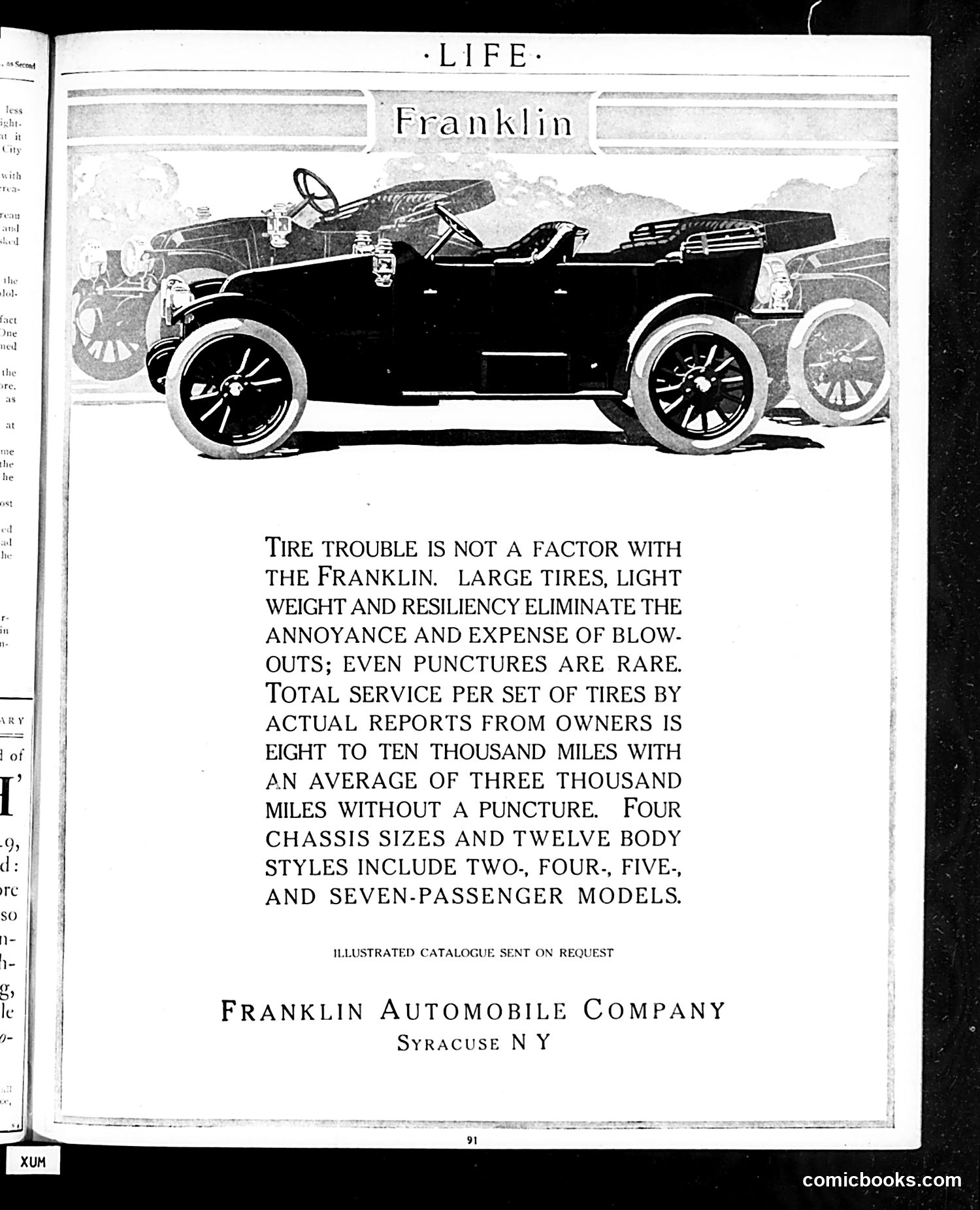
This page is **not a cartoon or satire** — it's a straightforward advertisement for the Franklin Automobile Company of Syracuse, New York, published in *Life* magazine. The ad promotes the Franklin automobile's tire durability as a key selling point. According to the text, Franklin tires were exceptionally reliable: owners reported 8,000-10,000 miles of service per set, averaging 3,000 miles without punctures — remarkable claims for the early automotive era when tire trouble was common. The ad highlights the vehicle's engineering advantages: large tires, light weight, and resilience that supposedly eliminated blow-outs. It notes four chassis sizes and twelve body styles, offering two- through seven-passenger models. This is period marketing emphasizing mechanical reliability to potential buyers skeptical of automobile durability.
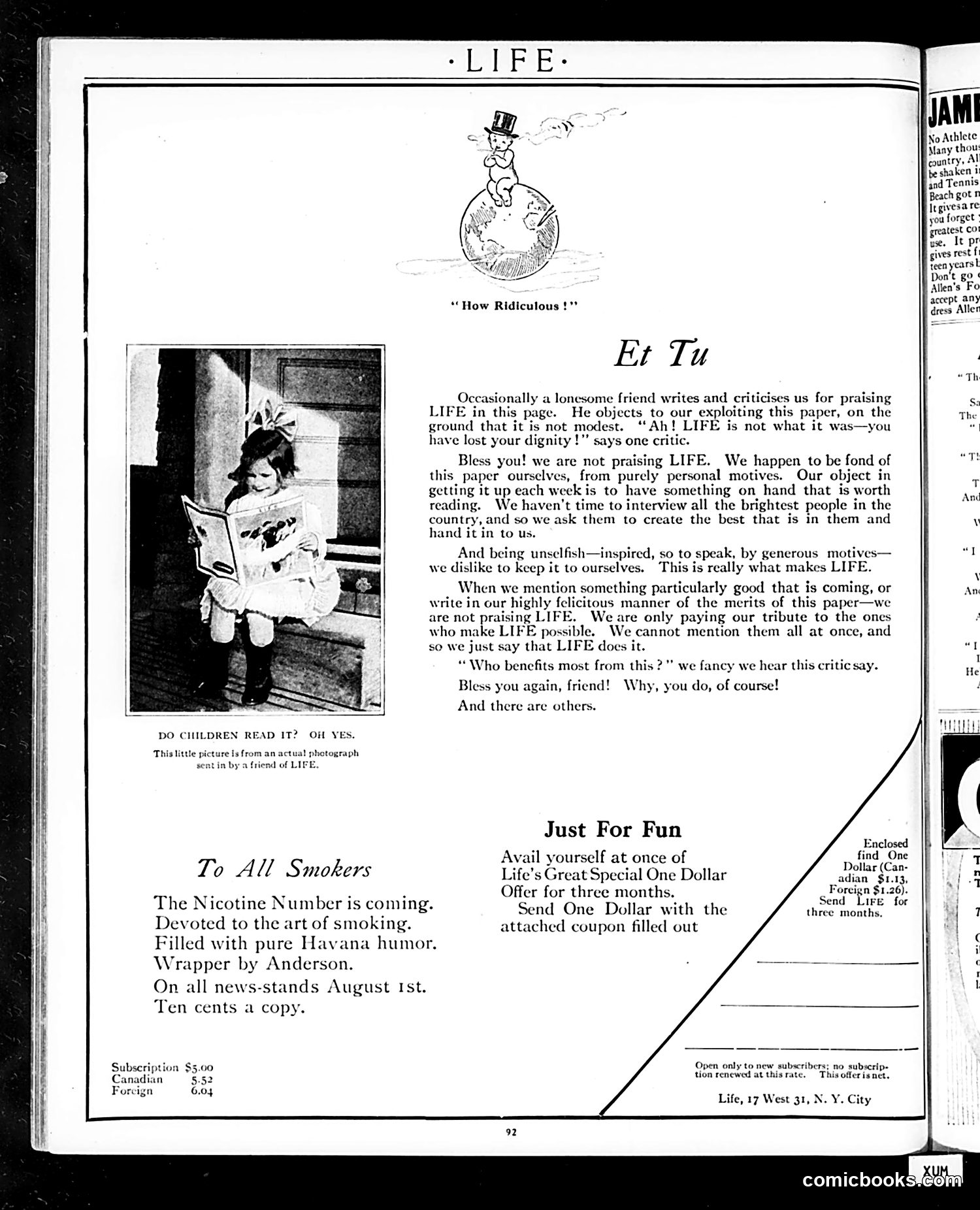
**The Main Cartoon:** A figure in a top hat sits atop a globe, appearing smug or self-satisfied. The caption "How Ridiculous!" suggests mockery of inflated self-importance or arrogance—likely satirizing a political or public figure of the era whose grandiose claims or behavior the magazine found absurd. **"Et Tu" Section:** Life's editors respond to criticism that they praise themselves too much. They defend their editorial choices as reflecting genuine enthusiasm for quality content, not self-promotion. The Latin phrase "Et Tu" (from Caesar's assassination) hints at feeling betrayed by the critic. **Supporting Content:** The page also advertises a coming "Nicotine Number" issue and promotes a special subscription offer. The overall tone reflects Life's satirical mission and editorial defensiveness.
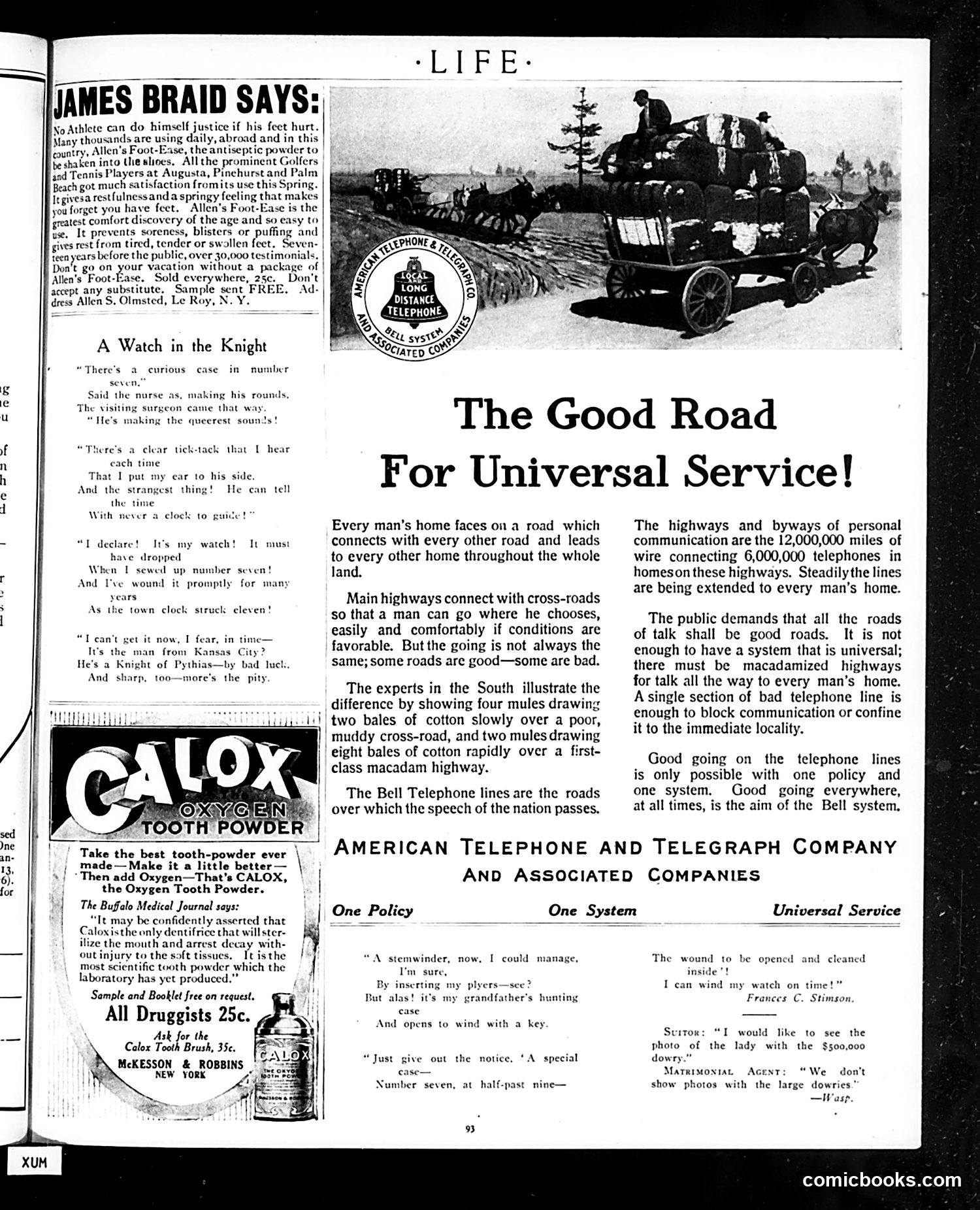
This page is primarily **advertising**, not satire or political commentary. The main content is a large Bell Telephone advertisement ("The Good Road For Universal Service!") that uses infrastructure metaphor: telephone lines are compared to roads connecting homes across America. The ad argues for standardized, universal telephone service—that poor service in one area disrupts communication everywhere, just as a bad road section blocks travel. The smaller items are unrelated advertisements: James Braid promotes "Allen's Foot-Ease" powder; a poem titled "A Watch in the Knight" appears to be humorous verse; and Calox tooth powder is advertised at bottom left. There is **no political cartoon** on this page. The content reflects early 20th-century commercial messaging about infrastructure and consumer products.
This page is **not a cartoon or satirical content**—it is a straightforward advertisement for Columbia automobiles. The ad announces Columbia's acquisition of American manufacturing rights for the "Silent Knight Motor," a high-powered gasoline engine technology. Columbia claims this motor offers superior "Power, Flexibility and Silence" and notes its adoption by prestigious European car manufacturers (English-Daimler, Minerva, Panhard-Levassor, Mercedes). The company, based in New York, presents this as a major achievement: securing exclusive American license to build Columbia cars equipped with this prestigious foreign technology. This reflects early 1900s automotive marketing, where European engineering credentials were highly valued for American consumers seeking quality and sophistication.
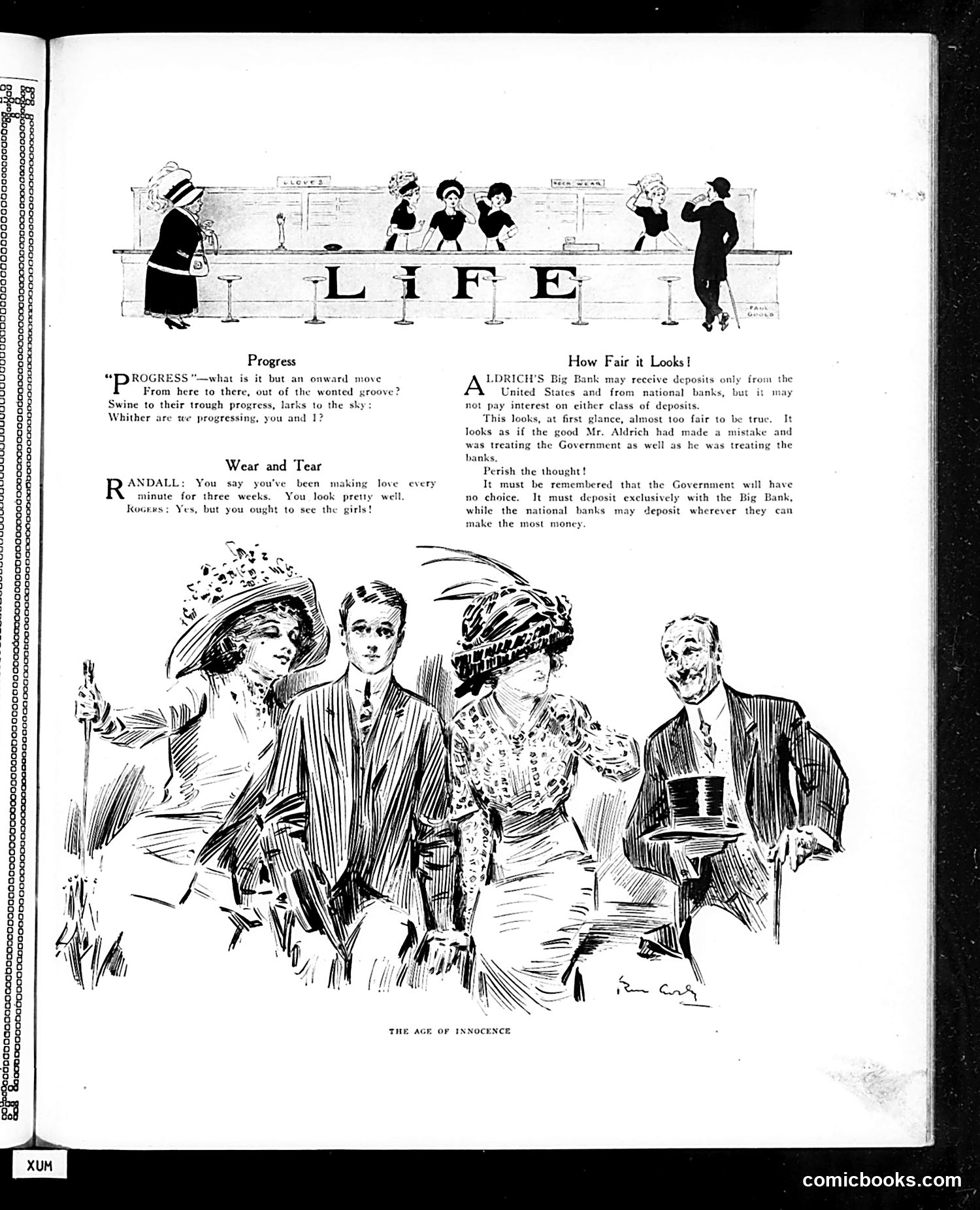
**Top Cartoon ("Progress"):** This shows figures walking across a bar labeled "LIFE," discussing whether progress exists. The dialogue questions whether society is genuinely advancing or merely moving in circles ("out of the wanted groove"). **Bottom Cartoon ("Wear and Tear" / "The Age of Innocence"):** Two men discuss romance—one claims he's been "making love" for three weeks, and the other sarcastically suggests he should "see the girls," implying visible wear from romantic pursuits. **Right Section ("How Fair it Looks!"):** This critiques Aldrich's Big Bank, questioning whether government deposit guarantees are truly fair. It suggests the government will monopolize large bank deposits while smaller national banks struggle, satirizing banking policy inequities of the era. The page uses satirical dialogue and social commentary typical of Life magazine's early-20th-century humor.
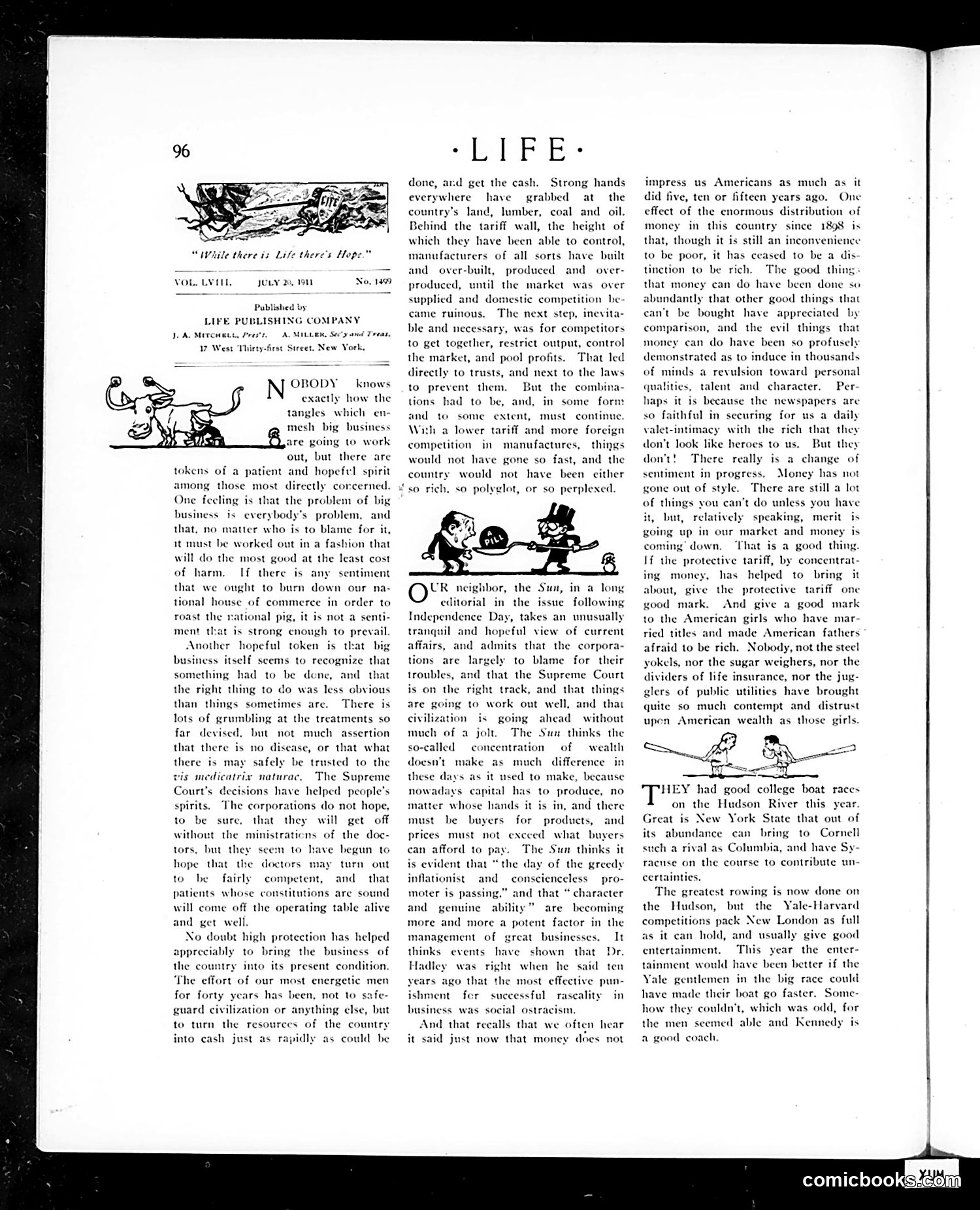
This editorial page discusses American business and wealth concentration. The cartoons illustrate the article's themes: **First cartoon** (top left): Shows figures labeled "Wait there is Life there's Hope" — appears to reference business competition and market dynamics. **Second cartoon** (middle): Depicts what appears to be a confrontation between two figures over money/resources, likely satirizing corporate disputes or labor-capital conflicts. **Third cartoon** (bottom): Shows rowing figures competing on water, referenced in the text as college boat races between Yale and Harvard, used as metaphor for American competition and entertainment during economic hardship. The overall piece criticizes wealth concentration while noting that Supreme Court decisions and business practices have affected ordinary Americans' financial security and prospects.
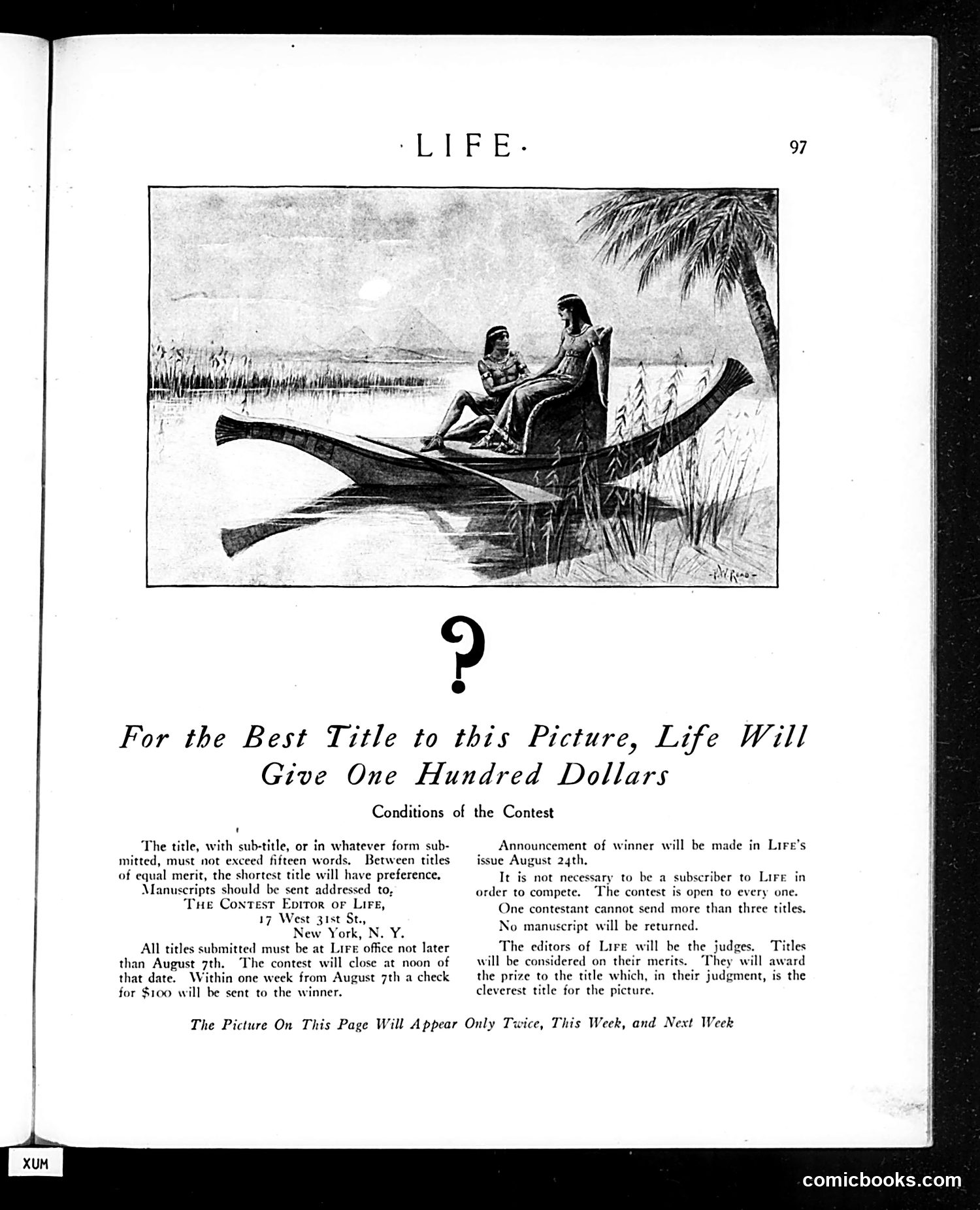
This is primarily a **contest announcement**, not a political cartoon. Life magazine is running a $100 prize competition asking readers to submit titles for the illustration shown—a sketch of two figures in a boat on a tropical waterway with palm trees and reeds. The contest rules specify: - Submissions due by August 7th - Winner announced August 24th - Open to all (subscription not required) - Limited to three entries per person - Judges will select the "cleverest title" The illustration itself appears to depict a romantic or leisurely scene, though without knowing the original context or intended meaning, the specific satirical point—if any—remains unclear. This functions as reader engagement rather than editorial commentary.
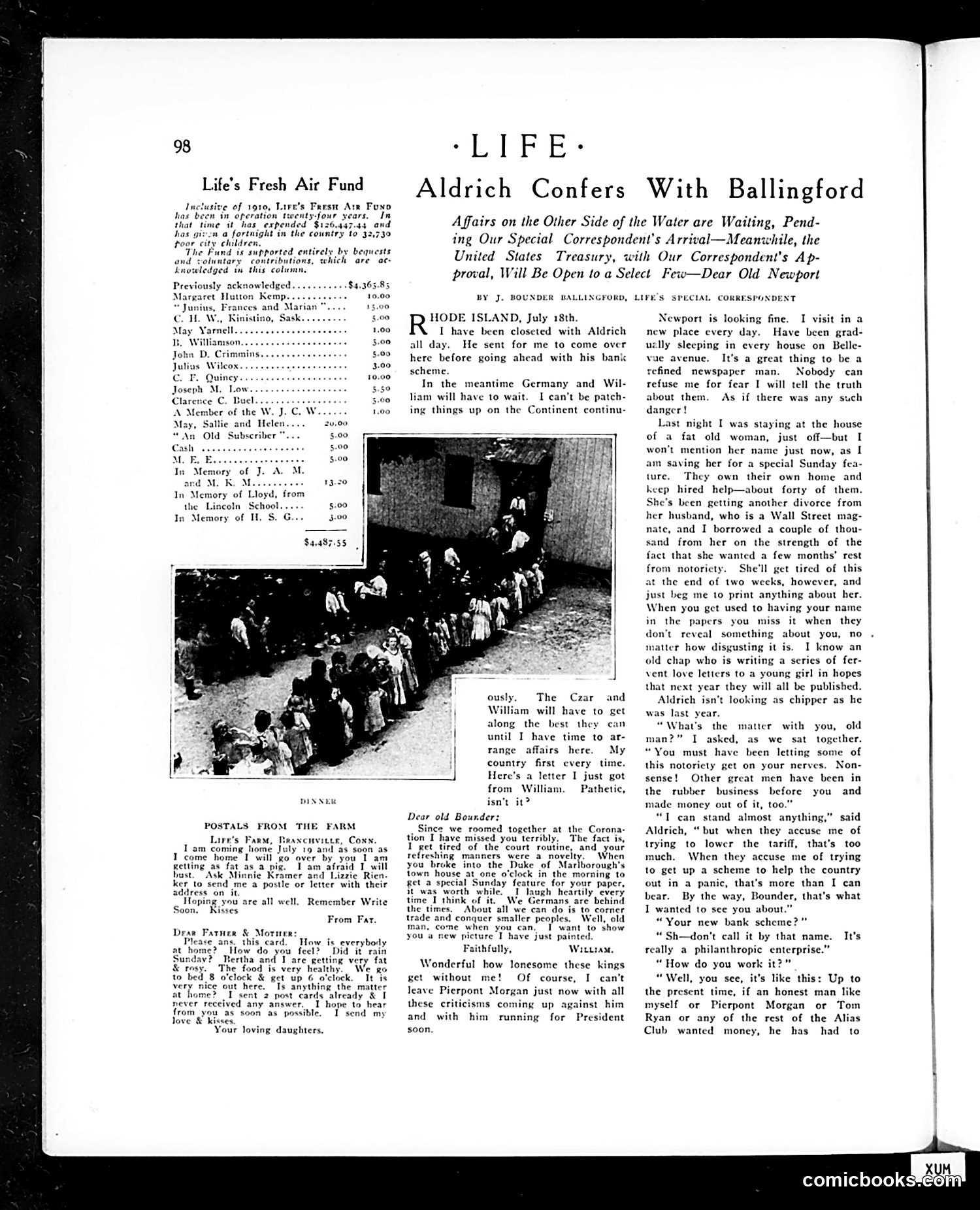
This page contains correspondence rather than political cartoons. The main image shows a large group of people gathered outdoors, labeled "DINNER" and captioned "POSTALS FROM THE FARM." The text consists of reader letters to Life magazine, including correspondence about a "Fresh Air Fund" (visible in the left column listing donations) and personal updates from readers. One letter mentions "William" and references Germany and Continental affairs, suggesting this was written during a period of international tension, likely the 1930s-40s era. The content is primarily personal correspondence and fundraising acknowledgments rather than satirical political commentary. Without clearer identification of specific figures or events in the photograph, the exact historical context remains unclear beyond being wartime or interwar period material.
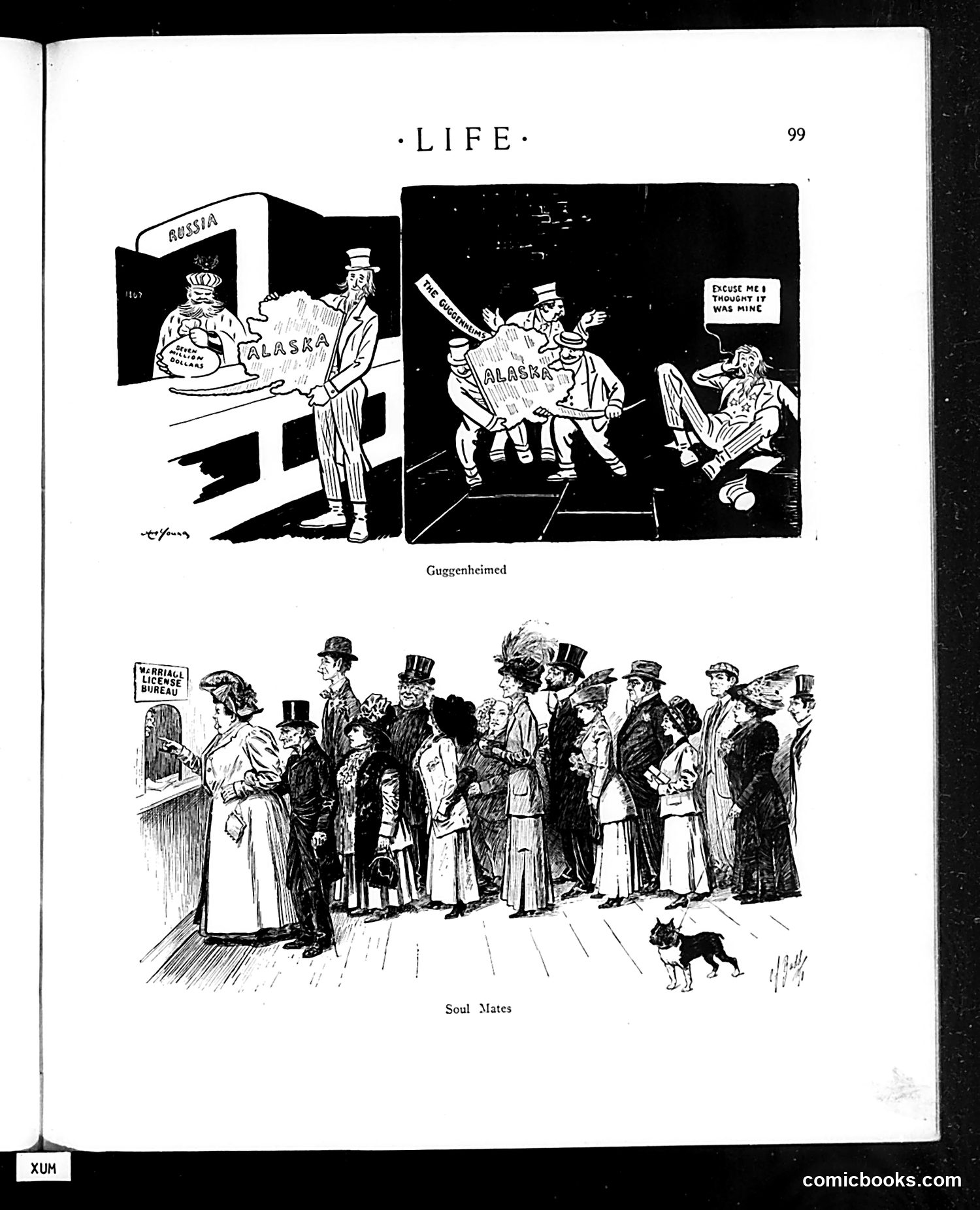
This page contains two political cartoons satirizing early 20th-century American imperialism. **"Guggenheim"** (top): Shows Russia selling Alaska to Uncle Sam (the tall American figure). The Russian official holds a bag labeled "Alaska" while an American businessman examines the purchase. The joke references the historical 1867 Alaska Purchase, but appears to mock either contemporary business dealings or territorial ambitions involving the Guggenheim family, prominent industrialists. **"Soul States"** (bottom): A queue of well-dressed figures waits at a window marked "Statehood License Bureau." The satire suggests that American statehood had become a commercialized commodity—states were being admitted based on business interests rather than genuine readiness or democratic principles. A small dog observes the scene. Both cartoons critique American expansionism and corporate influence on government policy.
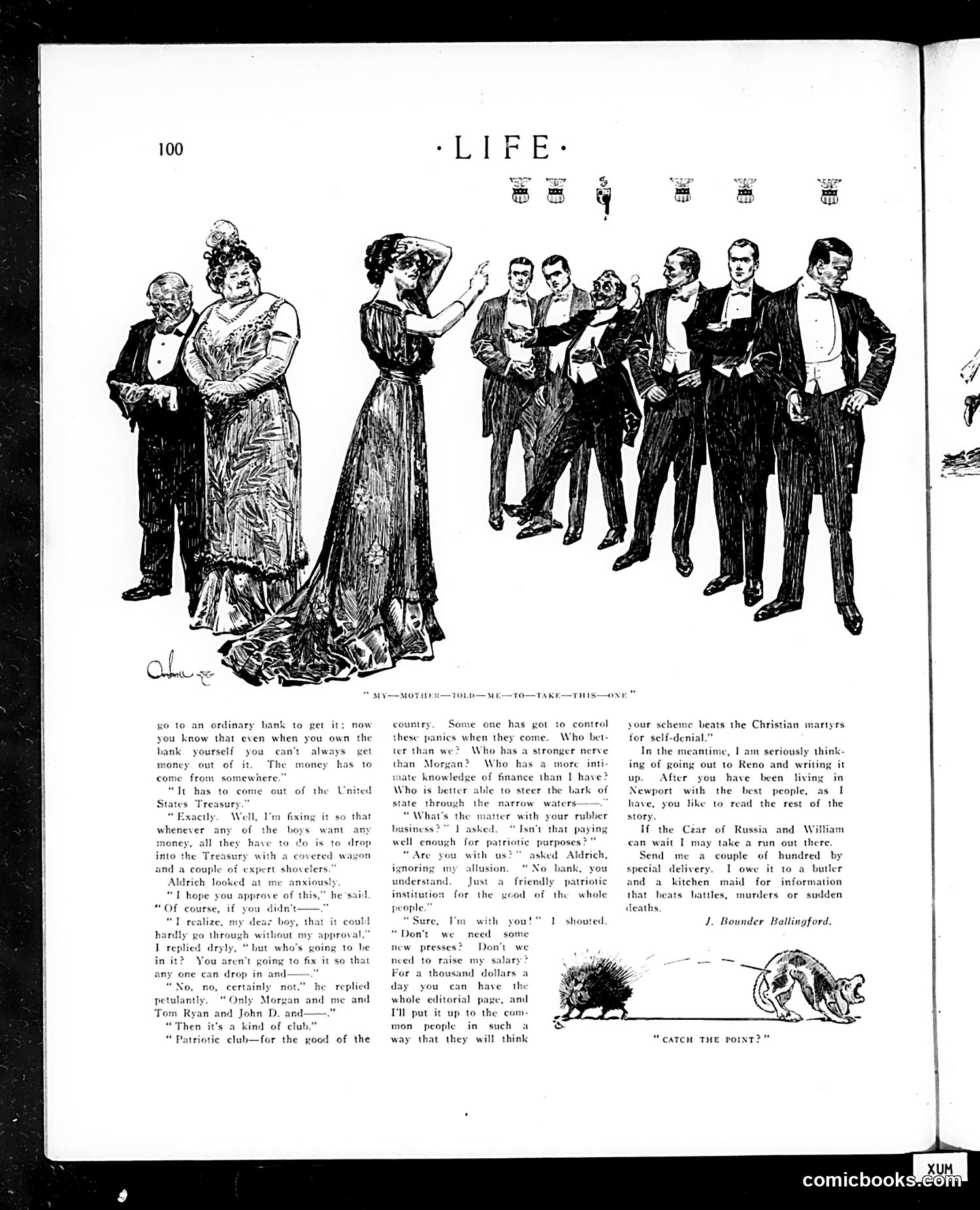
This satirical page depicts a social scene where a woman addresses a group of formally-dressed men at what appears to be a high-society gathering. The illustration is titled "MY—MOTHER—TOLD—ME—TO—TAKE—THIS—ONE." The accompanying text reveals the satire: a discussion about acquiring money for patriotic purposes, with references to Morgan, Ryan, and Aldrich—likely wealthy financiers of the era. The conversation mocks how wealthy individuals rationalize financial schemes as "patriotic clubs" for the public good, while actually enriching themselves. The cartoon critiques Gilded Age plutocrats who dressed their self-interested financial maneuvers in patriotic language. The woman's resigned posture suggests she's reluctantly participating in this social theater where money laundering is disguised as civic virtue. The small cartoon below ("CATCH THE POINT?") featuring animals reinforces the satirical message about deception.
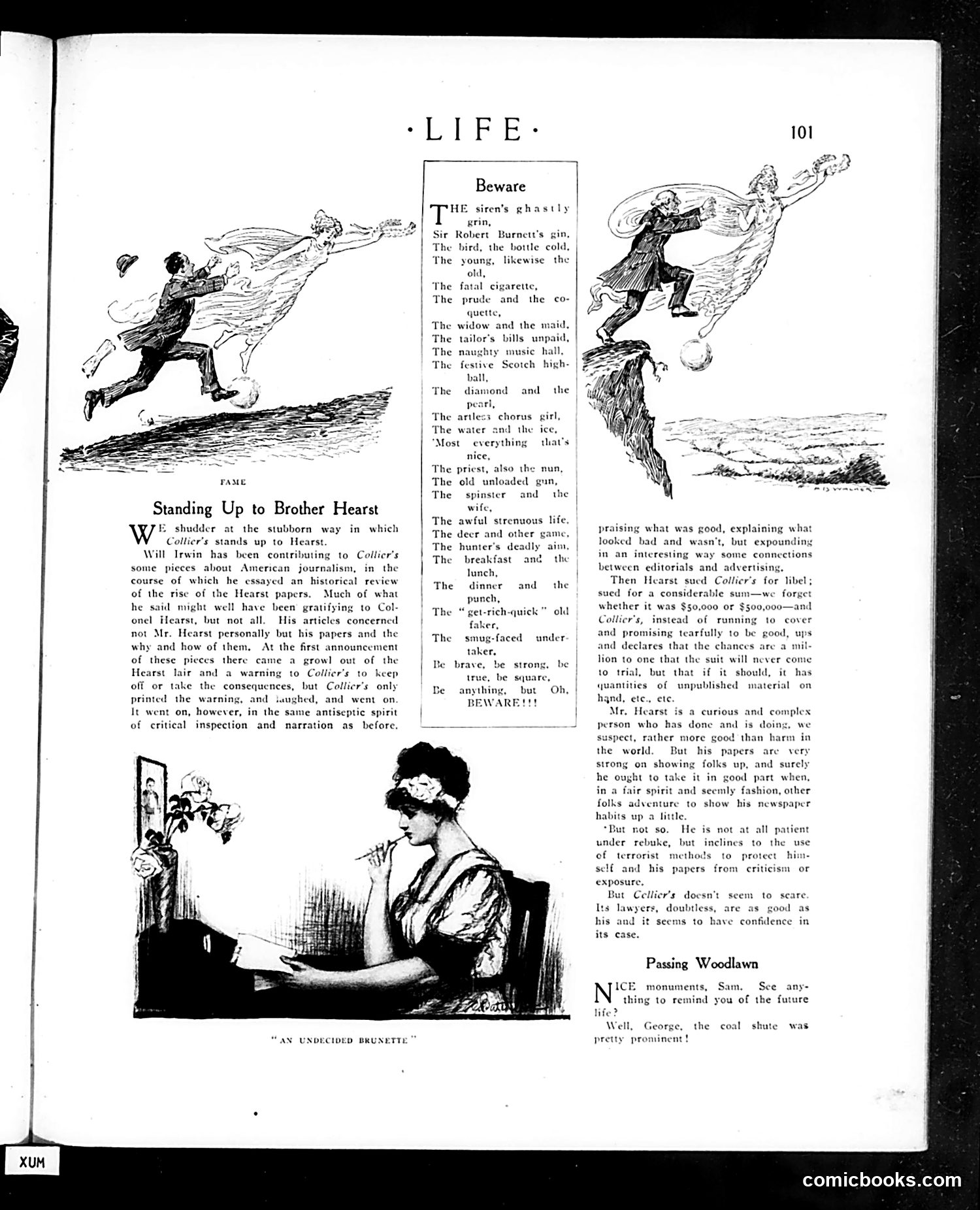
This page satirizes William Randolph Hearst, the powerful newspaper magnate. The top illustrations show figures being swept up by forces labeled "FAME," depicting Hearst's rise through journalism. The main article, "Standing Up to Brother Hearst," critiques Hearst's journalistic practices and his influence over the Hearst newspaper empire. The text notes that while Hearst achieved much in journalism, he also engaged in sensationalism and questionable tactics. The "Beware" poem parodies warnings about various societal dangers (cigarettes, Scottish balls, etc.), with Hearst himself positioned as a comparable threat worthy of caution. The lower illustration, "An Undecided Brunette," appears unrelated to the Hearst critique—likely a separate comedic or social commentary piece typical of Life's varied content.
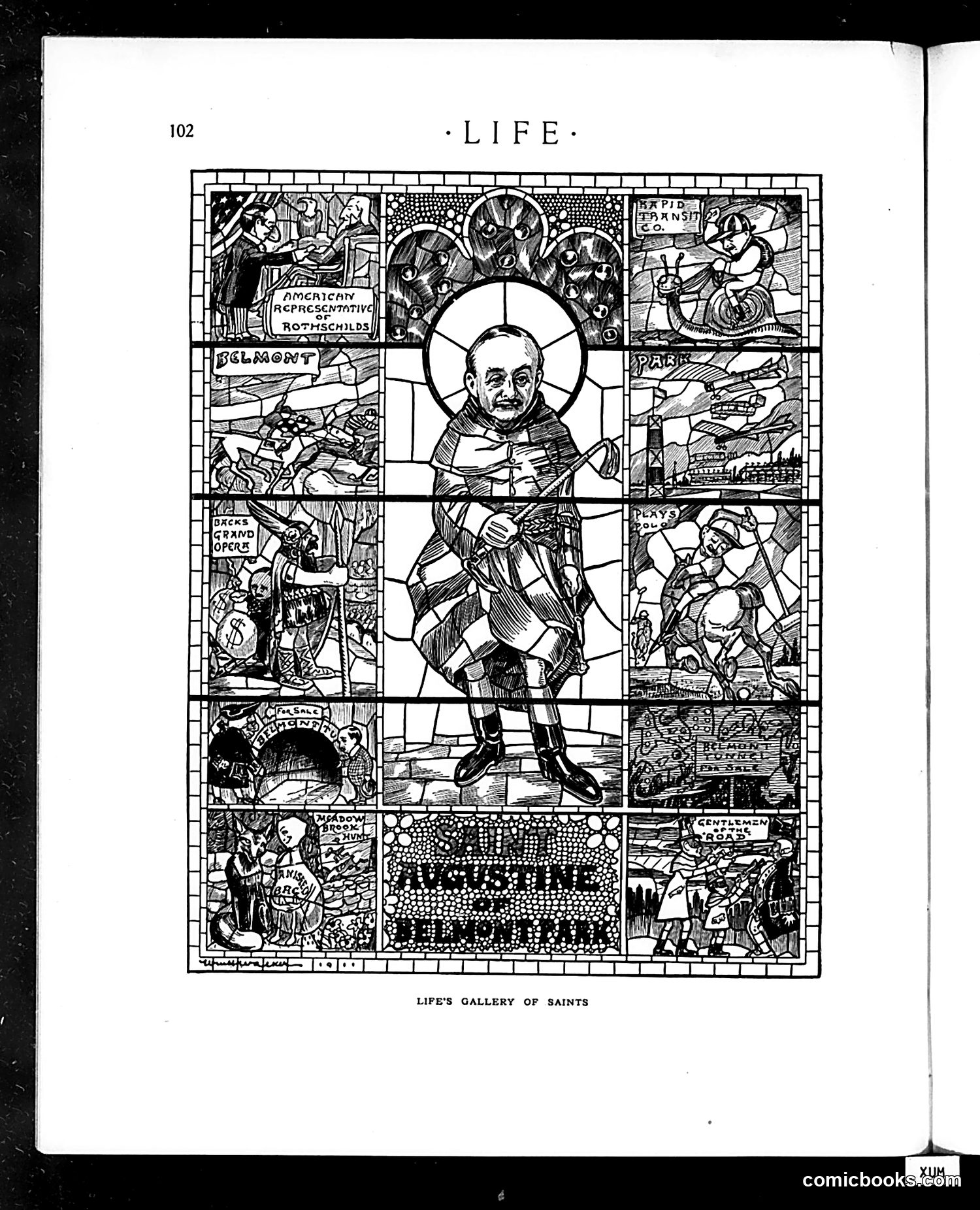
This is a satirical stained-glass window design titled "Life's Gallery of Saints," presenting a central figure with a halo surrounded by smaller panels depicting various scenes. The central figure appears to be a businessman or industrialist, depicted with sanctified imagery—the halo and formal pose mimicking religious iconography. The surrounding panels show various industrial and commercial activities: factories, railroads, ships, and business operations. The satire mocks American industrial magnates by treating them as "saints," inverting religious veneration to critique the era's reverence for wealthy industrialists and their enterprises. The visual language—stained glass, halo, formal composition—deliberately parodies religious art to comment on how American culture had elevated business leaders to near-religious status during the Gilded Age.
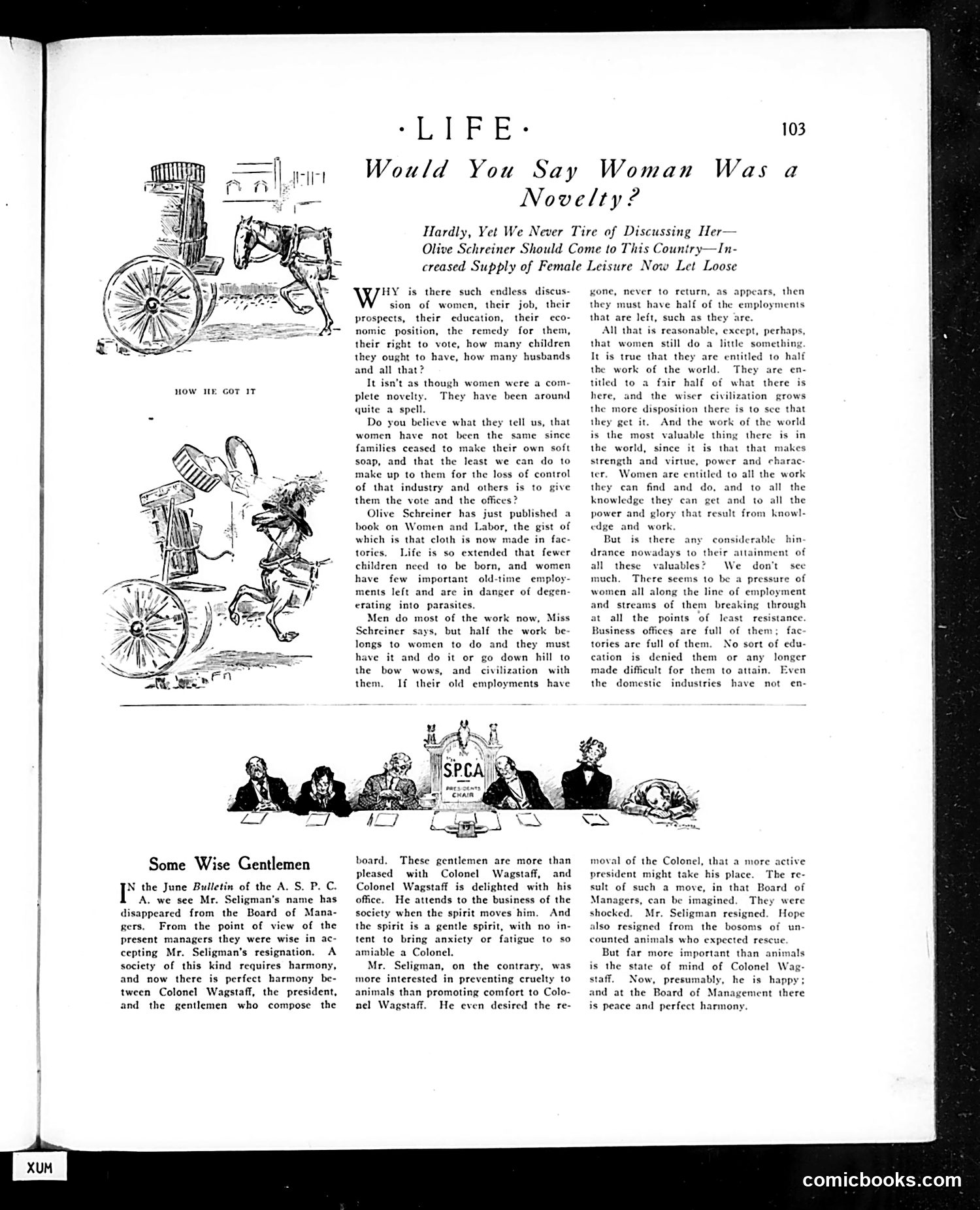
This piece mocks the American Society for the Prevention of Cruelty to Animals (A.S.P.C.A.) board. Mr. Seligman, apparently an activist manager genuinely concerned with animal welfare, has resigned after disagreement with Colonel Wagstaff, the organization's president. The satire suggests Wagstaff prioritizes comfort and harmony over the society's actual mission—preventing cruelty to animals. Seligman's departure represents a victory for complacency: the board is now "pleased" because there's "perfect harmony," but this harmony comes at the cost of the organization's moral purpose. The cartoon mocks how institutional leadership can become more interested in maintaining pleasant collegial relations than pursuing their stated mission. The adjacent article discusses women's labor rights, contrasting Schreiner's arguments about women's employment opportunities with the author's observation that these opportunities already exist substantially.
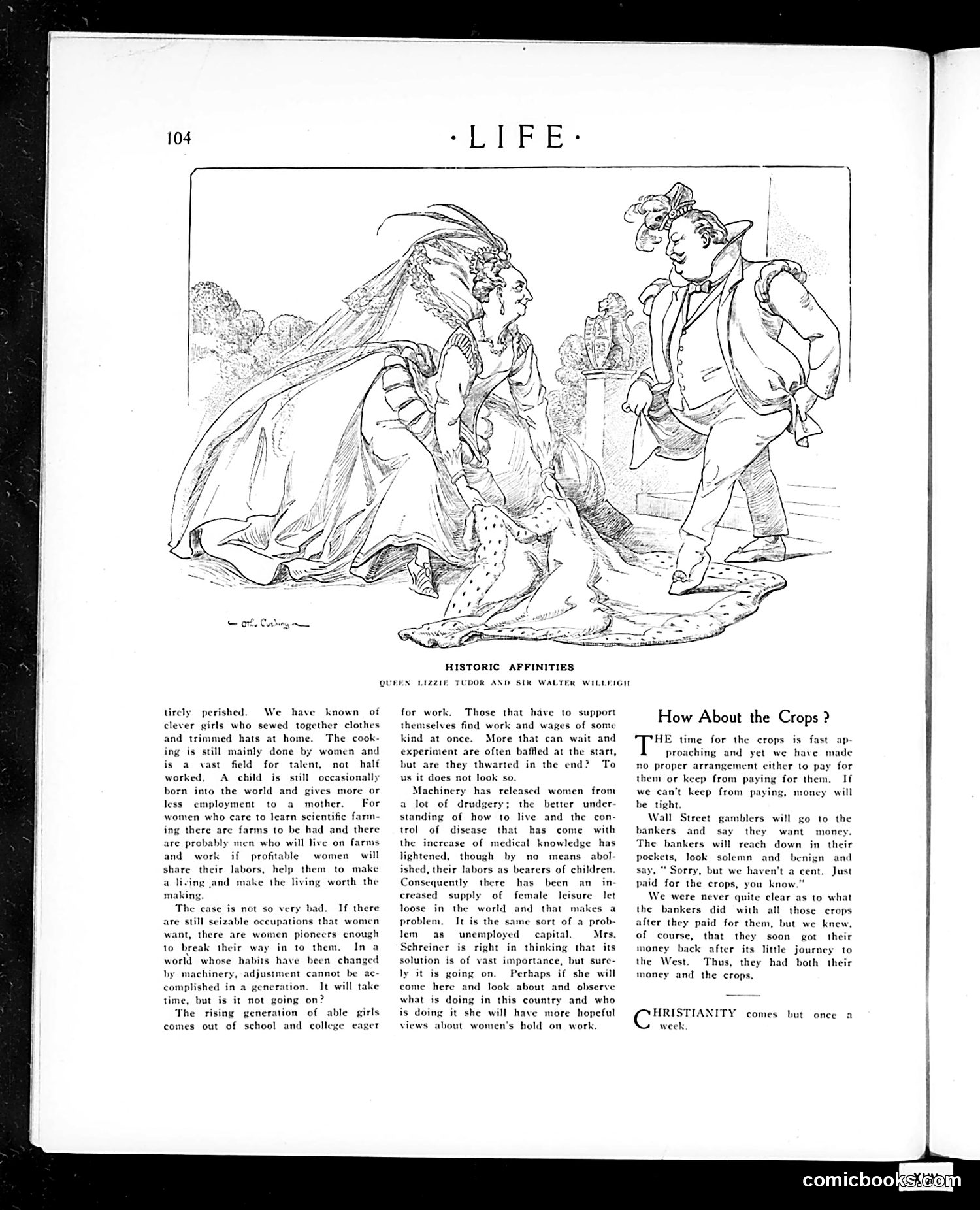
The top illustration, titled "Historic Affinities," depicts **Queen Elizabeth I** (left, in elaborate Tudor dress with veil) alongside **Sir Walter Raleigh** (right), referencing the legendary historical relationship between the Virgin Queen and her favored courtier. The satire appears to mock romantic or idealized historical narratives by presenting them in exaggerated, comedic form. The accompanying text discusses **women's employment and education**—a progressive topic for the era. It argues women have found work opportunities and that machinery has freed them from drudgery, though "increased supply of female leisure" creates new social problems. The "How About the Crops?" section is economic satire about **agricultural financing**. It mocks Wall Street bankers who lend money for crops, then profit when farmers repay with interest—the bankers thus gain both the money *and* benefit from the crops' success. The critique targets financial exploitation of agricultural workers during what appears to be an economic crisis period.
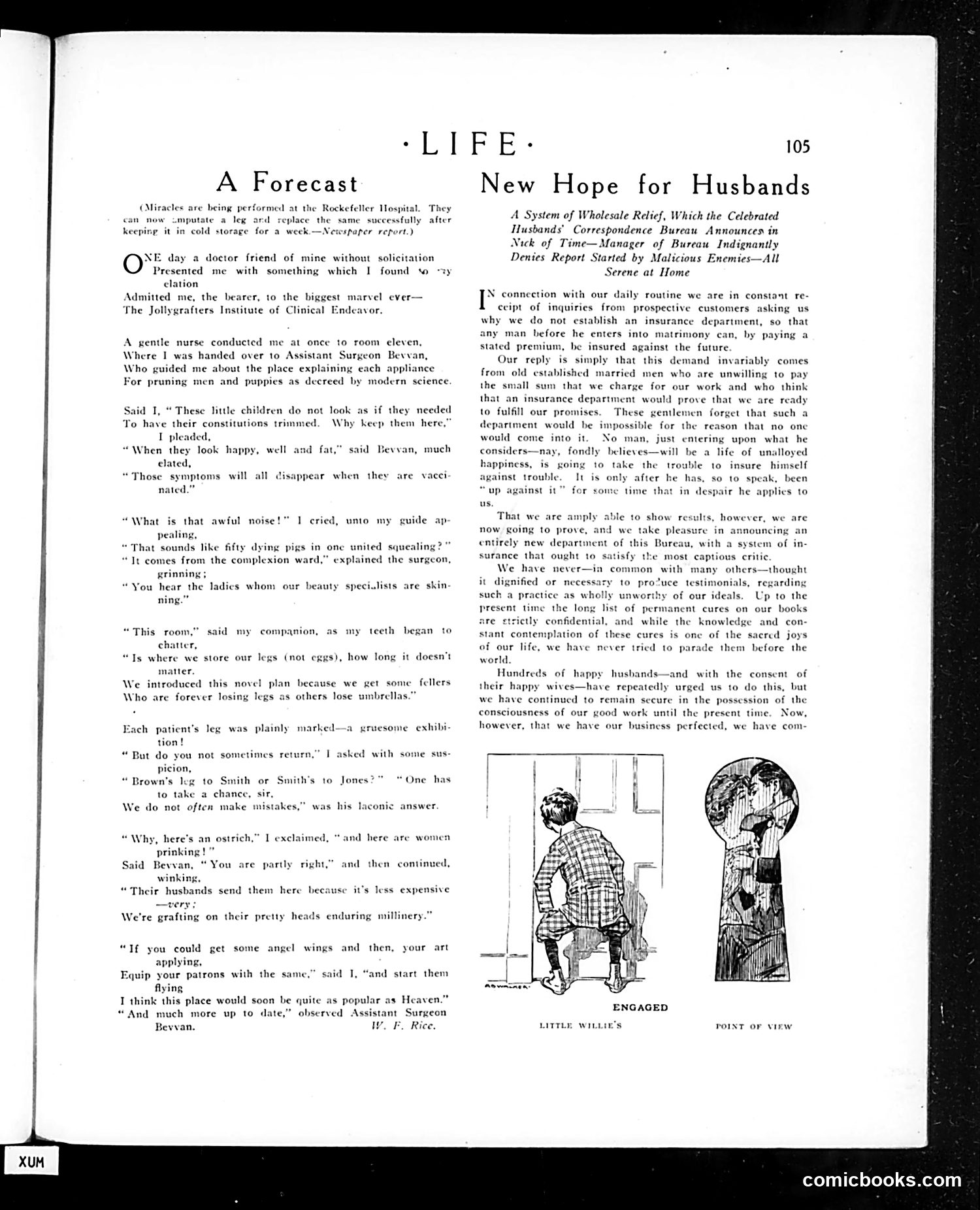
This page contains two satirical pieces from *Life* magazine (likely early 20th century): **"A Forecast"** (left): A humorous fantasy tour of a medical institute that performs radical surgical procedures. The joke satirizes modern medical ambition—the narrator encounters doctors grafting legs from storage, performing cosmetic "skinning," and removing children's healthy organs. The punchline: a woman should be grafted with ostrich feathers and angel wings to make her "fashionable." The satire mocks both extreme medical hubris and absurd beauty standards for women. **"New Hope for Husbands"** (right): A deadpan announcement from a "Husbands' Correspondence Bureau" defending why it won't offer marriage insurance. The satire lies in the unstated implication: husbands need insurance *against their wives*—implying marriage itself is a financial/personal disaster men must endure. The cartoon below shows "Little Willie's Point of View," suggesting even children recognize marriage as something to dread. Both pieces satirize contemporary anxieties about technology, medical science, beauty culture, and marriage through exaggerated scenarios.
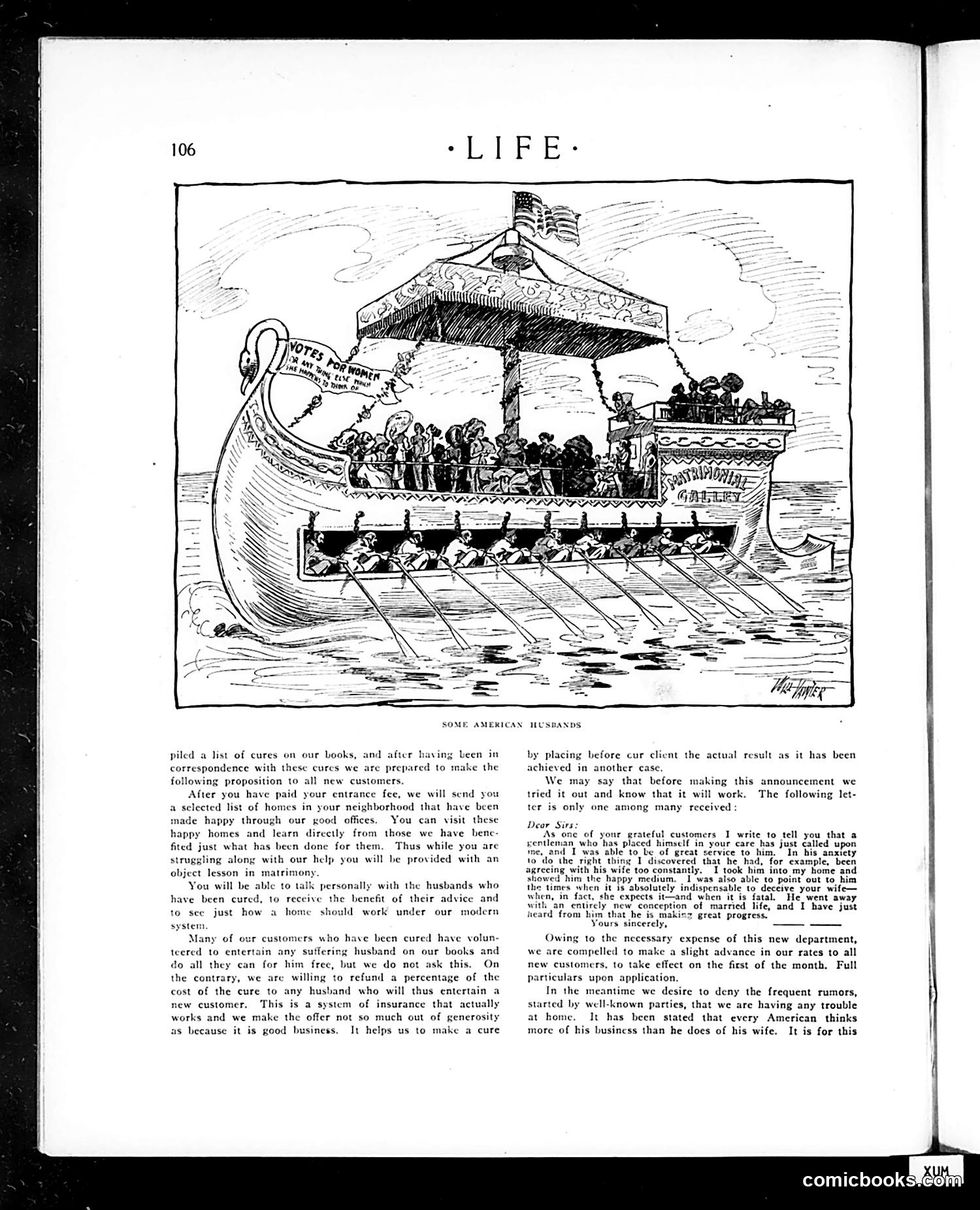
This cartoon mocks a fictional "marriage cure" service for troubled husbands. The illustration depicts a boat labeled "Great Matrimonial" ferrying couples, satirizing the absurdity of commercializing marital advice. The accompanying text presents a tongue-in-cheek "business proposition" offering unhappy husbands a list of "cured" homes to visit and learn from. The satire deepens with a testimonial letter describing advice like "agreeing with his wife too constantly" and knowing "when it is absolutely indispensable to deceive your wife." The piece ridicules early 20th-century American marriage dynamics and gender relations—particularly the notion that wives needed "managing" and that deception was acceptable. It also lampoons the commercialization of personal problems and the era's self-help culture. The final denial about "trouble at home" and the claim that men prioritize business over wives underscores the satire: Life is mocking both the service's absurdity and contemporary attitudes about husbands' disengagement from family life.
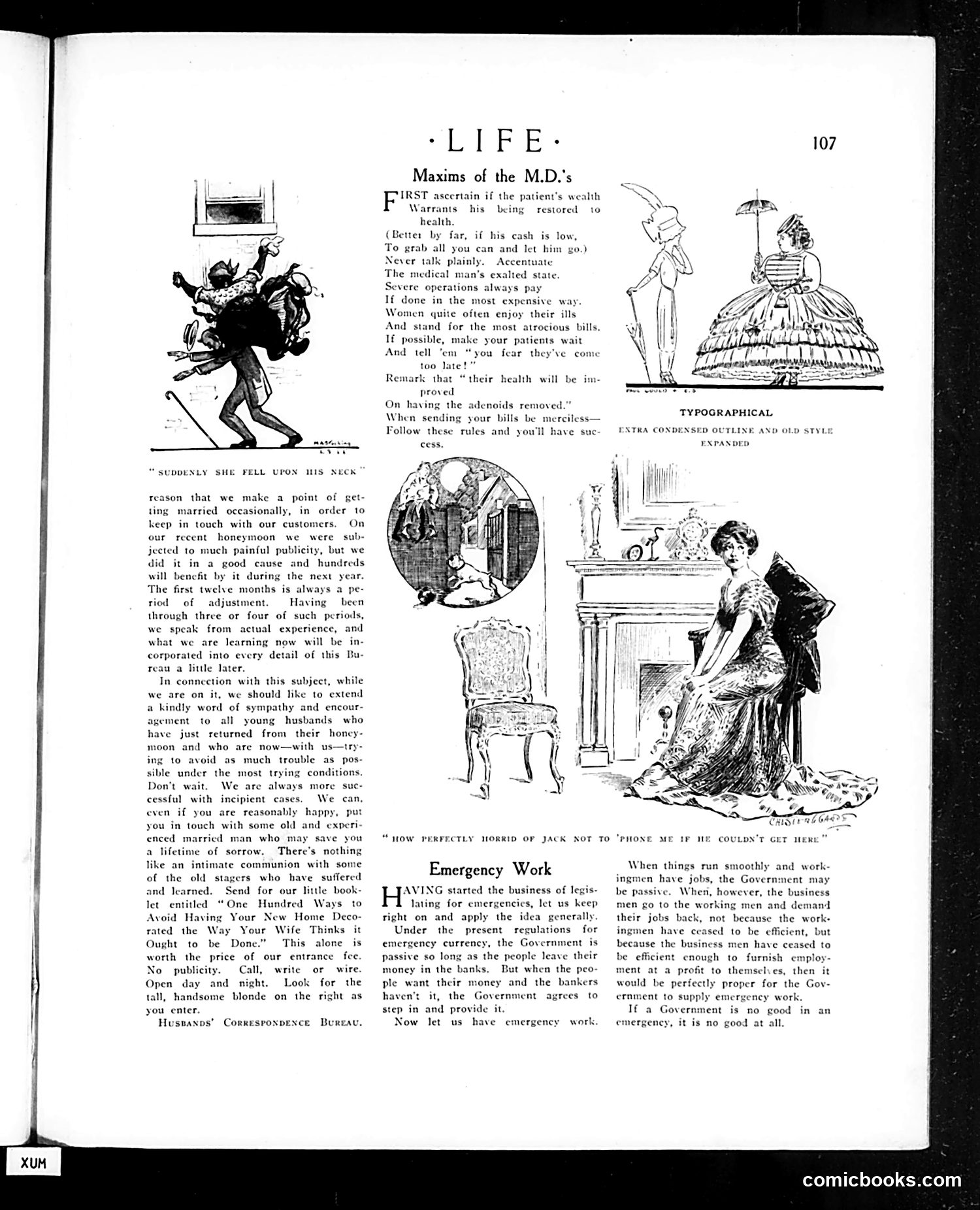
This page contains **satirical commentary on three topics**: **1. "Maxims of the M.D.'s"** — A cynical list of medical ethics violations mocking unscrupulous doctors who prioritize patient wealth over health, perform unnecessary expensive procedures, and overcharge without explanation. The satire targets profit-driven medicine. **2. The cartoon "Suddenly She Fell Upon His Neck"** illustrates a humorous marriage-counseling service advertisement. The joke plays on newlyweds seeking help after honeymoons, with tongue-in-cheek advice about marriage adjustment. **3. "Emergency Work"** — Political commentary on government's proper role during economic crises. The author argues the Government should remain passive when business is profitable but should provide emergency employment when businessmen fail and demand workers accept job cuts. The satire criticizes businessmen who blame workers for unemployment while themselves proving "inefficient." All three pieces use humor to critique institutional hypocrisy and inequality — in medicine, marriage, and economics — reflecting Progressive-Era skepticism of unchecked business power.
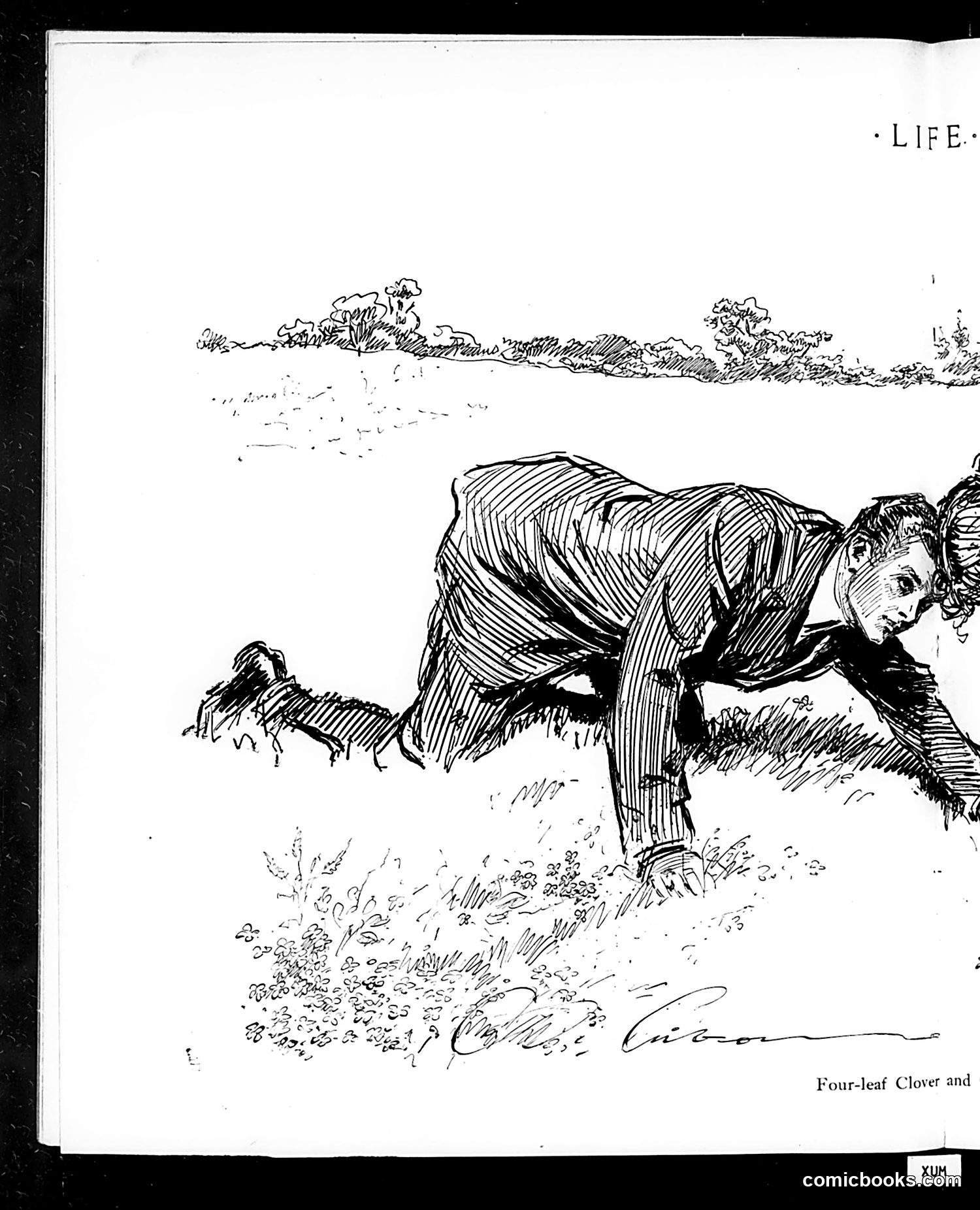
This page from *Life* magazine shows a single illustration: a man in a business suit, bent over and searching intently through grass and soil, apparently hunting for a four-leaf clover. The caption reads "Four-leaf Clover and" (the second part appears cut off). The satire likely mocks either business culture's obsession with luck or superstition, or perhaps commentary on someone desperately seeking good fortune during uncertain times. The formal businessman reduced to crawling through dirt searching for a lucky charm presents an ironic contrast—suggesting that despite professional status or rational pursuits, people resort to superstition when facing difficulties. Without the complete caption or publication date visible, the specific target remains unclear, though the general satirical point about human nature and desperation is evident.
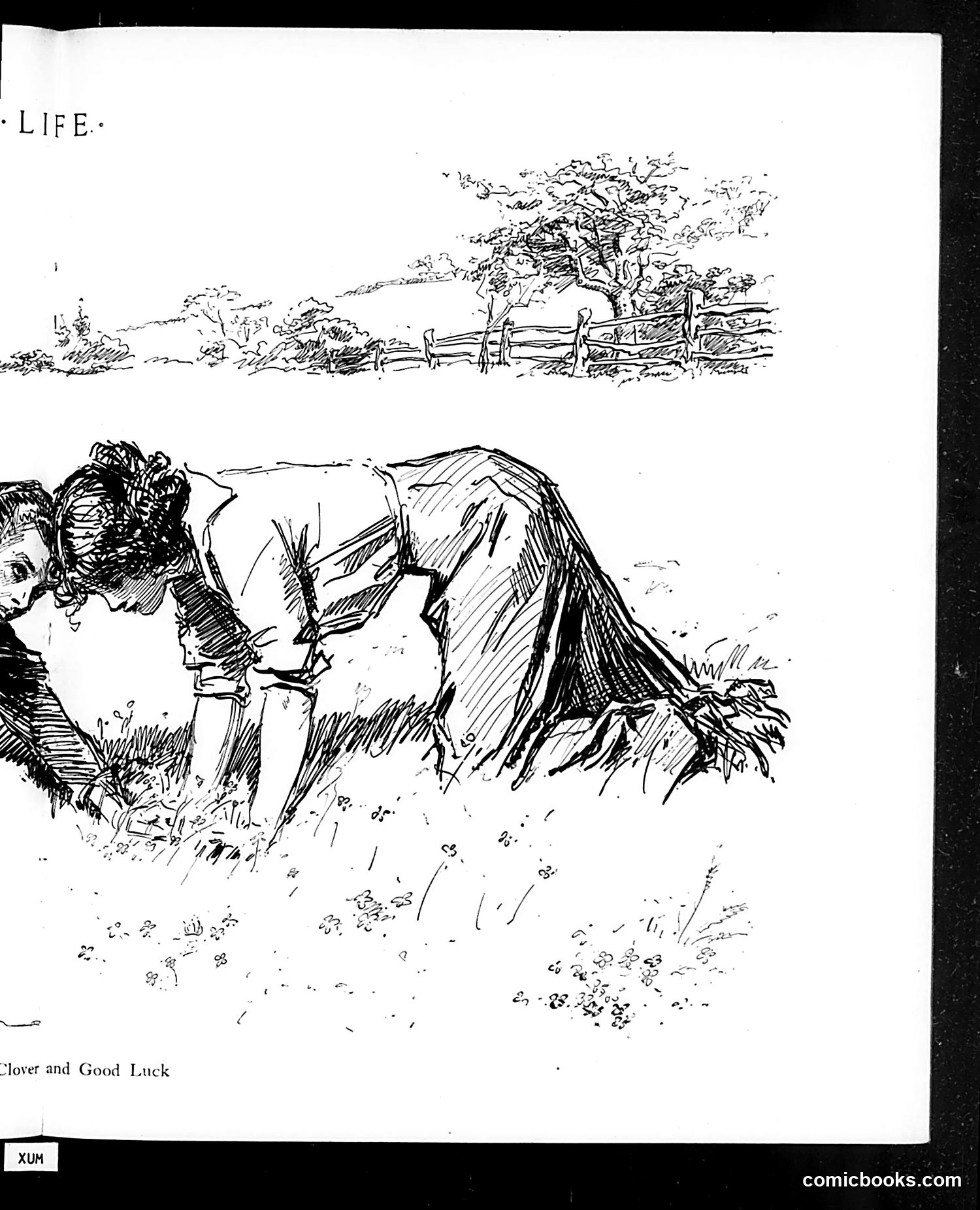
This page from *Life* magazine features a sketch titled "Clover and Good Luck." The drawing depicts a figure bent over in a field, apparently searching through or examining grass and clover. The image appears to reference the folk superstition of searching for a four-leaf clover as a symbol of good luck. The satirical point likely plays on the juxtaposition between human effort and fortune—the figure's earnest, laborious searching contrasts with the randomness of finding lucky clovers. This may mock the human tendency to seek supernatural aid or rely on superstition rather than practical action. The rural setting and the figure's posture emphasize the futility of the search.
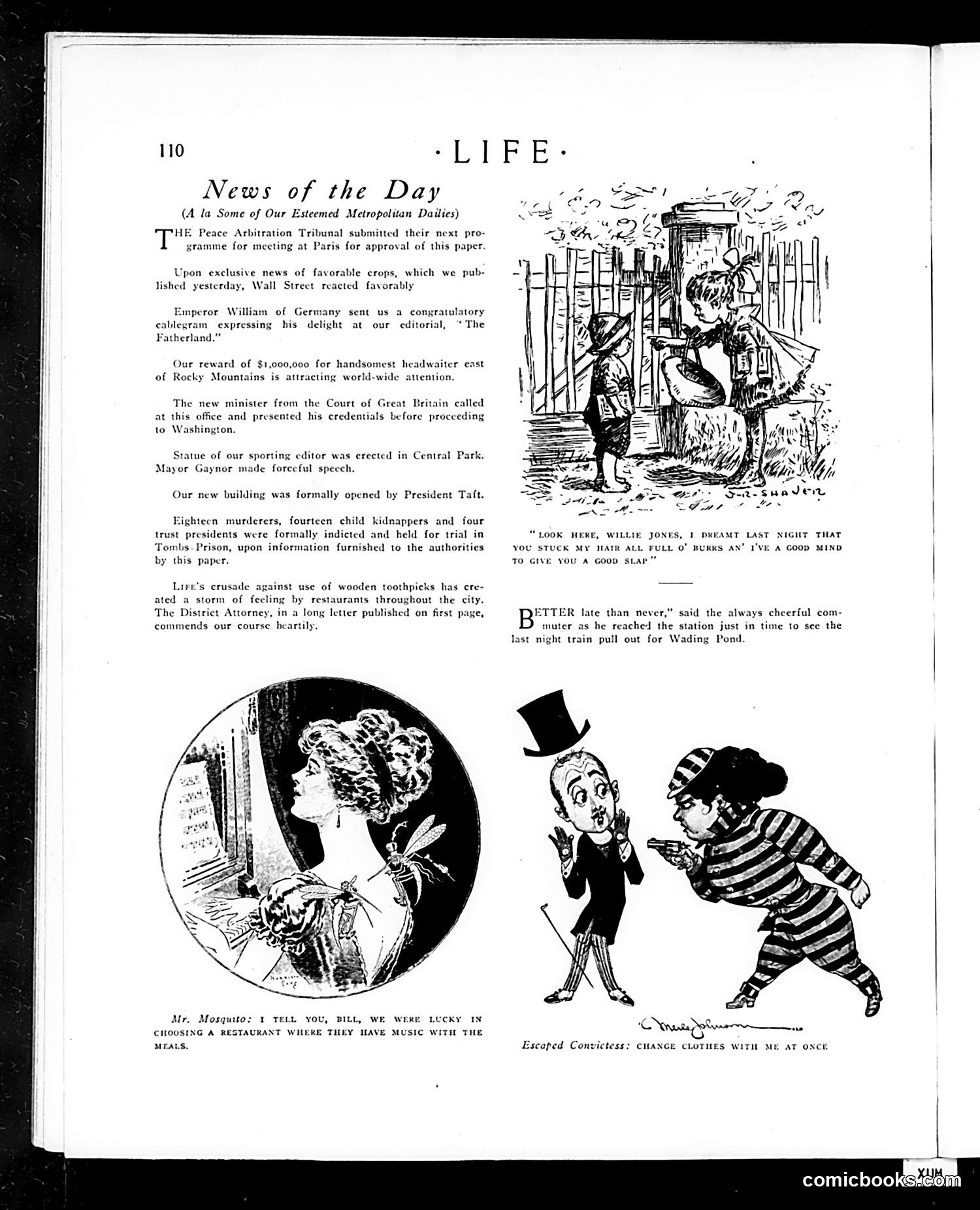
This page satirizes sensationalist newspapers' self-aggrandizing coverage. The "News" section mocks how papers exaggerate their own importance—claiming credit for influencing Wall Street, receiving congratulations from foreign leaders (Emperor William), and solving crimes through their reporting. The cartoons illustrate absurd social situations: 1. **Top right**: A child threatens to slap Willie Jones over pulled hair—trivial domestic drama treated seriously. 2. **Bottom left**: A mosquito and companion discuss a restaurant's music, suggesting even pests enjoy refined dining. 3. **Bottom right**: An "Escaped Convictess" demands a stranger change clothes with her—illustrating the era's sensational crime reporting. The satire targets both newspapers' self-promotion and the public's appetite for melodramatic stories. Life mocks the pretension of treating minor incidents and crimes as major news.
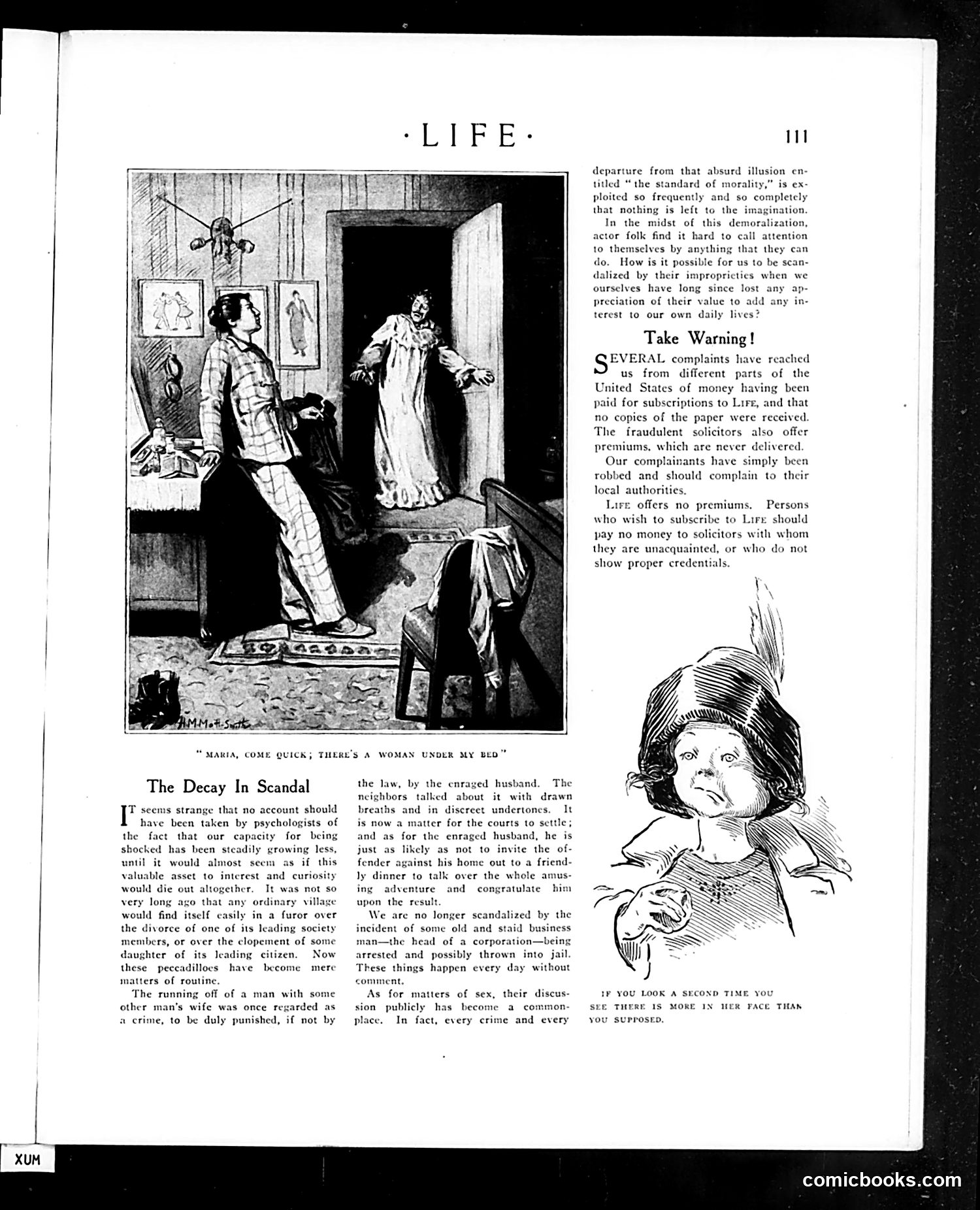
This satirical piece argues that American society has become desensitized to moral transgressions. The accompanying cartoon illustrates the point: a man discovers a woman hiding under his bed—traditionally a scandalous, shocking scenario—yet his reaction appears mundane rather than outraged. The article's thesis is that infidelity, divorce, and sexual impropriety were once genuinely shocking events that scandalized entire communities. Now, the author laments, such things happen "every day without comment." Even actors—traditionally held to higher moral standards—struggle to generate public outrage through their indiscretions. The piece also includes a practical warning: Life magazine is alerting readers to fraudulent subscription solicitors collecting money without delivering papers or promised premiums. Readers should only subscribe through authorized representatives. The overall message reflects early 20th-century anxiety about eroding social morality and decorum, framed as both cultural commentary and consumer protection.
This story satirizes the marriage prospects and romantic vulnerabilities of wealthy young women in early 20th-century America. The narrator—a worldly man who once knew Rev. Panfield during dissolute travels in Europe—observes two women, Margy and Eunice, pursuing the clergyman as a potential husband. The satire targets several targets: Margy's naïveté and susceptibility despite her $50,000 inheritance; the hypocrisy of respectable clergymen (Panfield frantically signals the narrator to keep silent about their shared past); and the marriage market itself, where wealthy, sentimental women become prey for charming men. The narrator's casual cynicism—jokingly suggesting they "draw lots" for the minister or divorce him if unsatisfactory—mocks both the commercialization of marriage and society's moral pretense. The "saving" in the title likely refers to rescuing Margy from her own romantic poor judgment through worldly intervention.
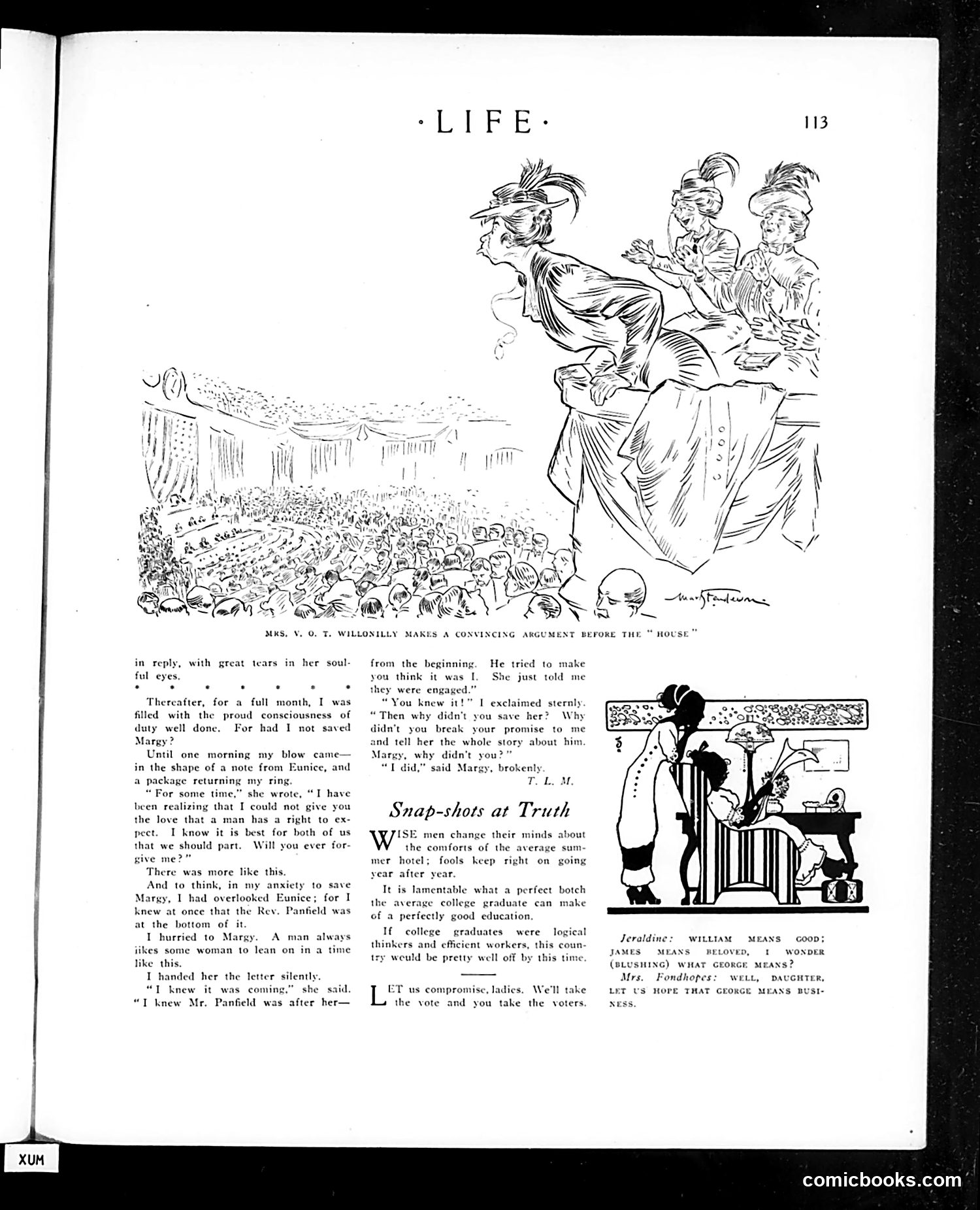
This page contains two distinct satirical pieces: **Top Cartoon & Story**: A romantic comedy about a man who intervenes in a woman's (Margy's) relationship to "save" her from an unsuitable suitor (Rev. Panfield), only to discover his own fiancée (Eunice) has left him—manipulated by the very reverend he was trying to thwart. The satire mocks male presumption and interference in women's romantic choices. **"Snap-shots at Truth" Section**: Three brief cynical observations about American life: that people irrationally repeat summer hotel visits, college graduates waste their education, and—most pointedly—a political joke suggesting men should "take the vote" while women "take the voters," implying women manipulate male voters. This likely references early 20th-century suffrage debates, satirizing both male political anxiety about female voting power and women's actual political agency. The overall tone is light mockery of gender relations and social pretension typical of Life's satirical style.
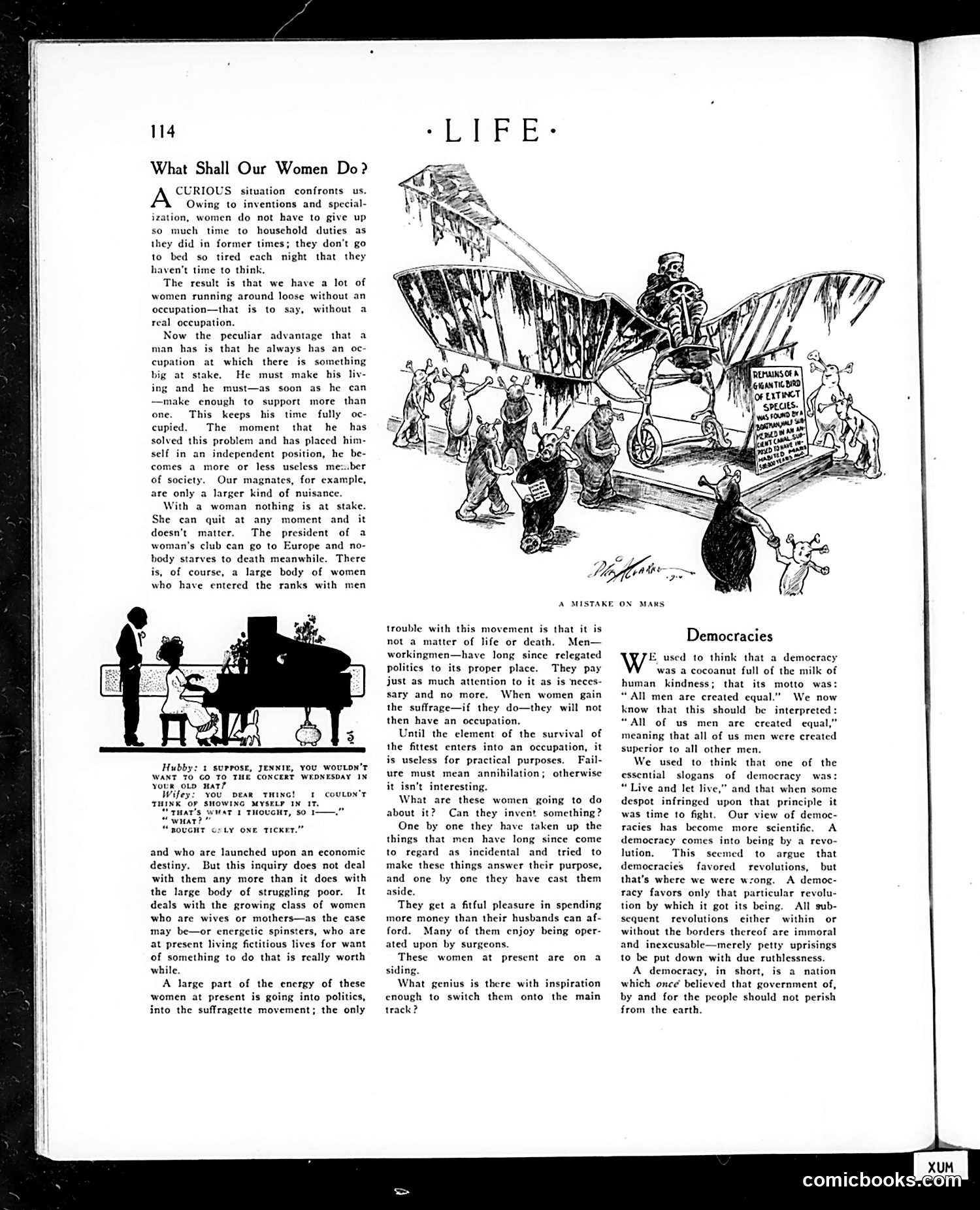
This page contains two distinct satirical pieces: **"What Shall Our Women Do?"** critiques educated, middle-class women with leisure time. The article argues that modern inventions have freed women from household labor, leaving them "running around loose without an occupation." The author contends that unlike men, who must earn livings with real consequences ("something big at stake"), women lack meaningful purpose—they can quit activities without serious repercussions. The accompanying cartoon shows a couple at a piano, with the husband sarcastically remarking he'll buy only one concert ticket, implying his wife's activities are frivolous. The piece dismissively mentions the suffragette movement, claiming voting rights won't solve women's "real" problem: lack of meaningful work with genuine stakes. **"Democracies"** begins a separate article (continued on next page) questioning idealistic notions of democracy and equality. It suggests democracies actually favor only certain groups, contradicting the "all men are created equal" principle. Both pieces reflect early 20th-century attitudes: skepticism toward women's ambitions and cynicism about democratic ideals.
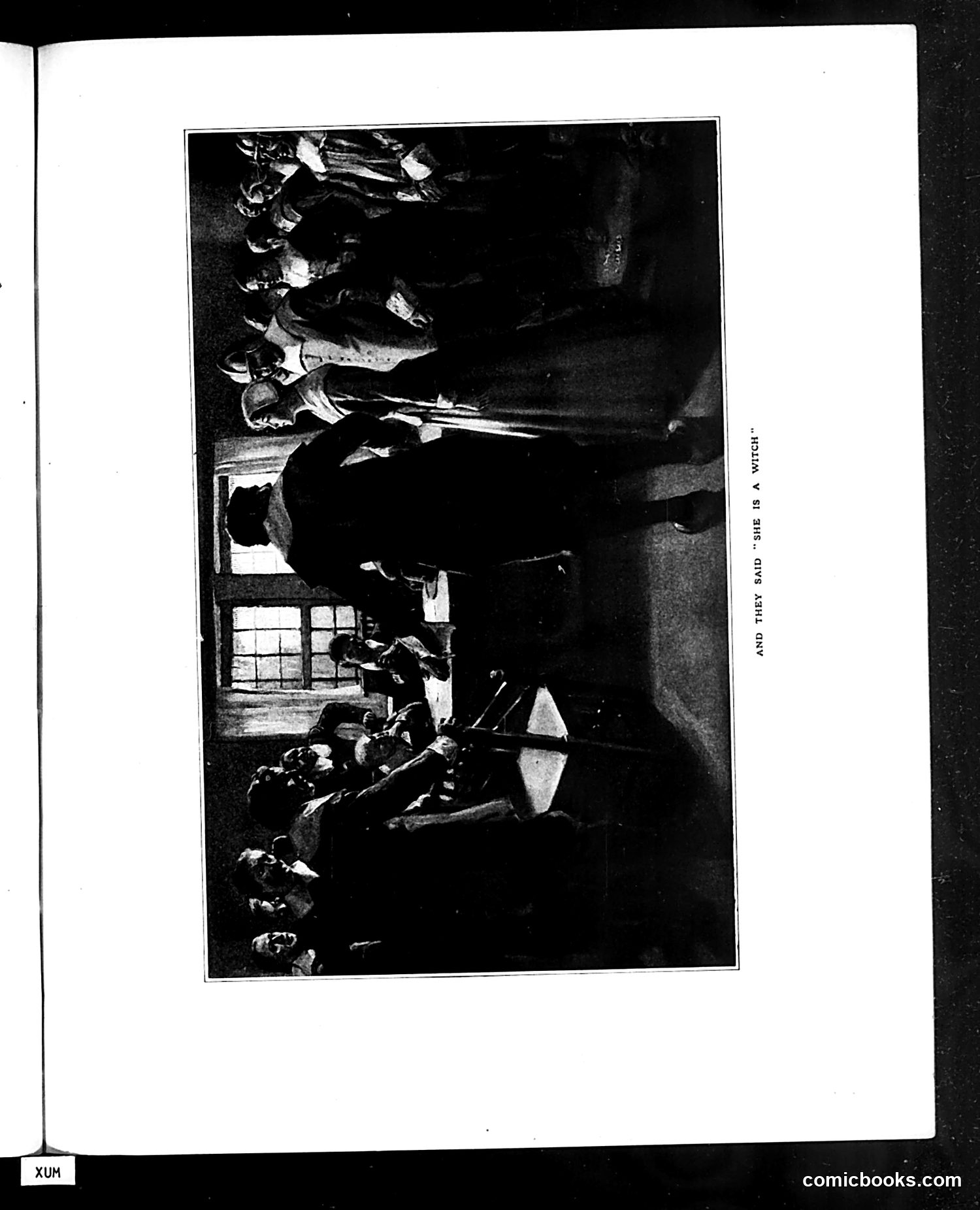
I can see this is a black and white photograph printed on a page from Life magazine, but the image is quite dark and difficult to read clearly. The OCR text appears garbled and doesn't provide coherent information. From what's visible, this appears to be a documentary or candid photograph rather than a political cartoon. The image shows several figures in an indoor setting with what looks like a window in the background, but the details are obscured by the dark exposure and image quality. Without legible text or clearer visual details, I cannot reliably identify the specific figures, historical context, or satirical point being made. To provide accurate analysis, I would need either a clearer image or accurate caption text.
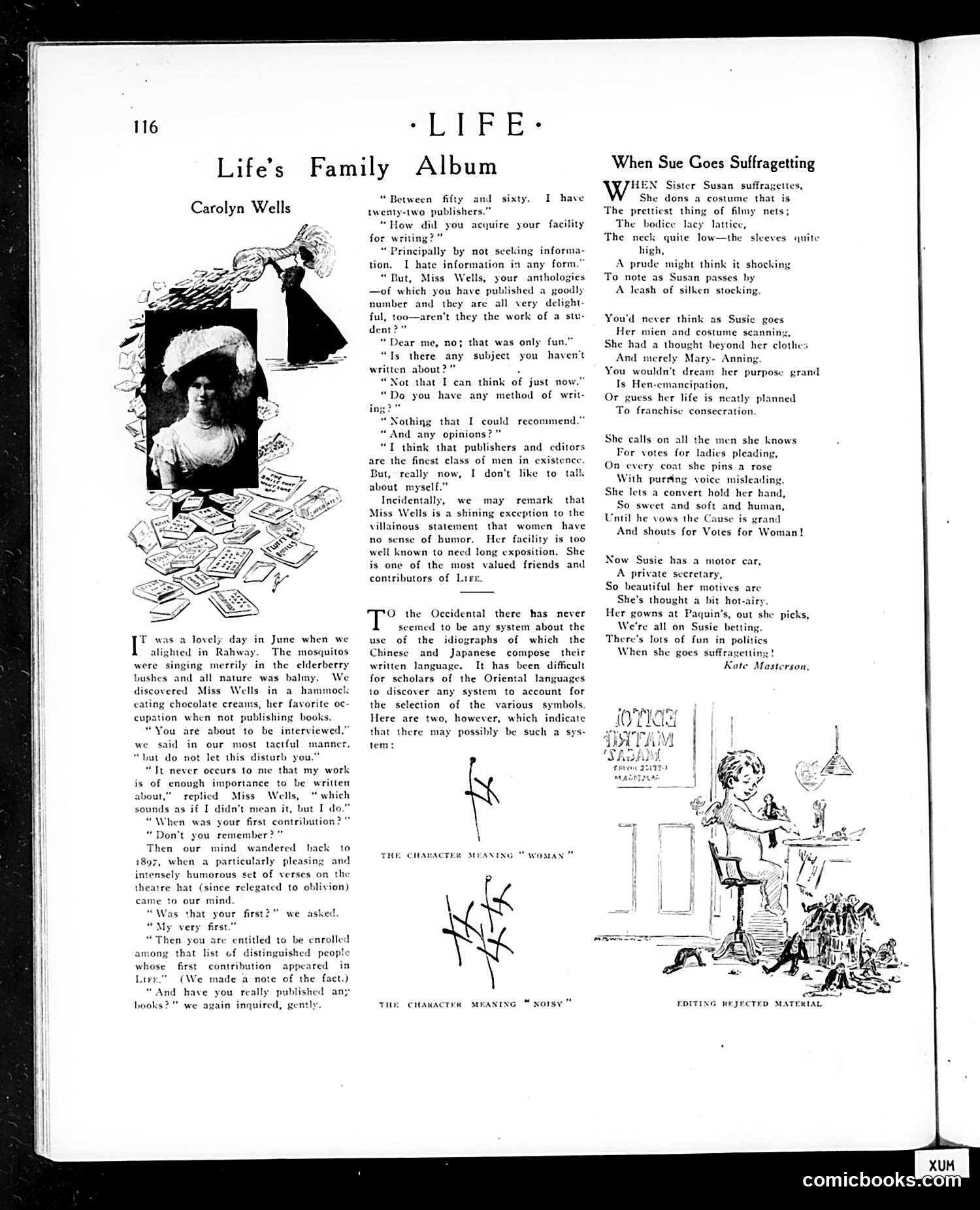
This page contains two distinct pieces: **Left side: "Life's Family Album"** — An interview with Carolyn Wells, a prolific American author and humorist (mentioned publishing 50-60 books with 22 different publishers). The humor lies in Wells's deadpan responses: she claims to hate acquiring information yet writes anthologies, insists her work isn't important while being a major contributor to *Life* magazine itself. The piece celebrates her as an exception to the period stereotype that women lack humor. **Right side: "When Sue Goes Suffragetting"** — A satirical poem mocking women's suffrage activists. "Sue" is portrayed as a suffragette who uses feminine charm (pretty clothes, motor car, secretary) to manipulate men into supporting women's voting rights, implying her activism is superficial vanity rather than genuine political conviction. The satire targets the perceived hypocrisy of suffragettes using traditionally feminine wiles to advance feminist causes. The **Chinese character illustrations** at bottom appear unrelated—demonstrating written language systems.
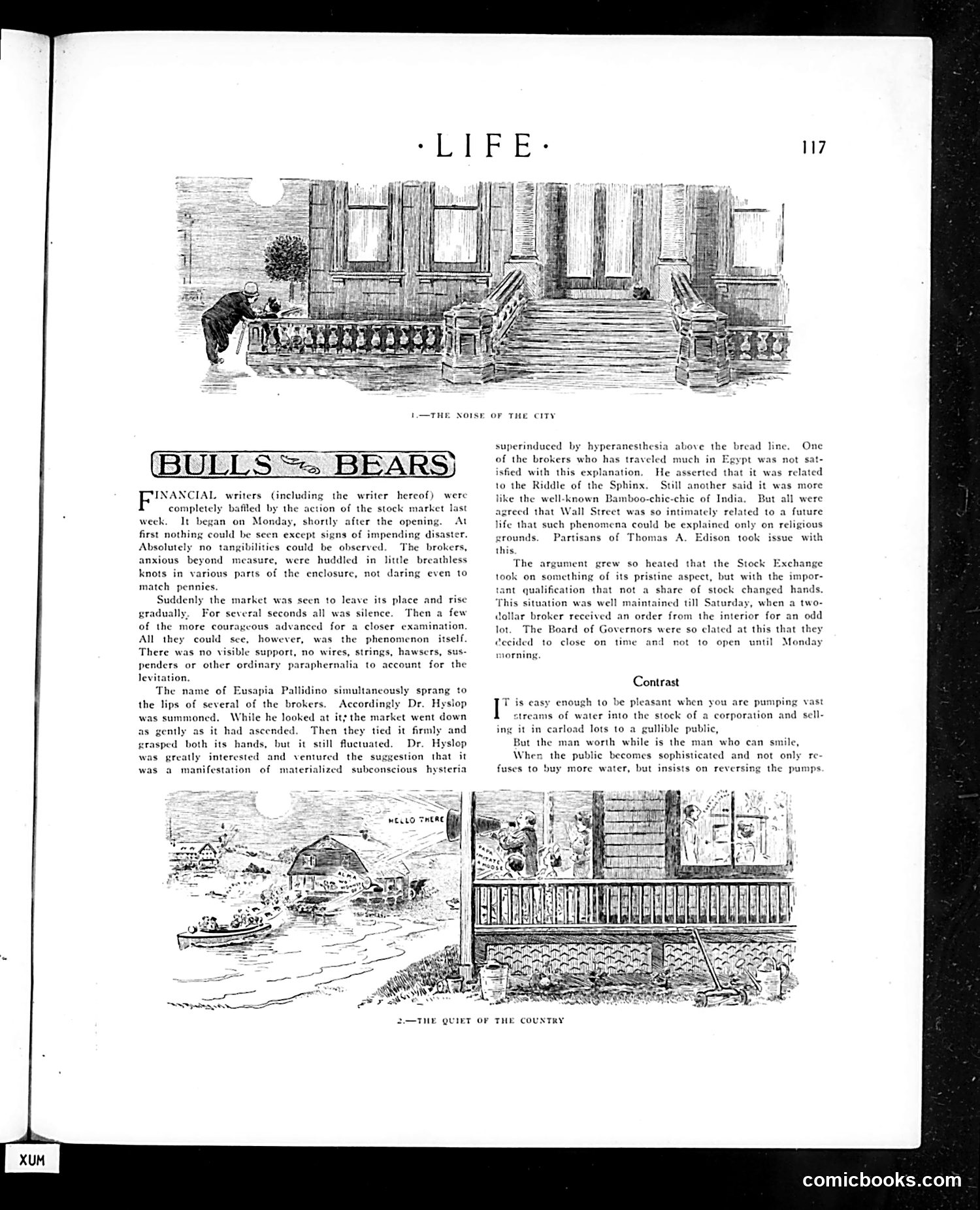
This satirical piece mocks financial brokers and stock market speculation during a market crash. The text humorously describes brokers witnessing inexplicable market movements—comparing the phenomenon to spiritualist medium Eusapia Palladino and invoking occultism to explain stock behavior rather than admitting to manipulation or fraud. The joke: brokers attribute market fluctuations to supernatural forces instead of acknowledging their own speculative schemes. References to spiritualist Dr. Hyslop and Edison's followers suggest brokers are intellectually desperate and absurd. The "Contrast" section mocks promoters who profitably pump worthless stock ("water") into gullible investors, but lose nerve when sophisticated investors demand refunds—reversing the scheme. The illustrations show urban financial chaos above and rural calm below, contrasting city greed with country virtue—a common Progressive Era theme critiquing Wall Street excess.
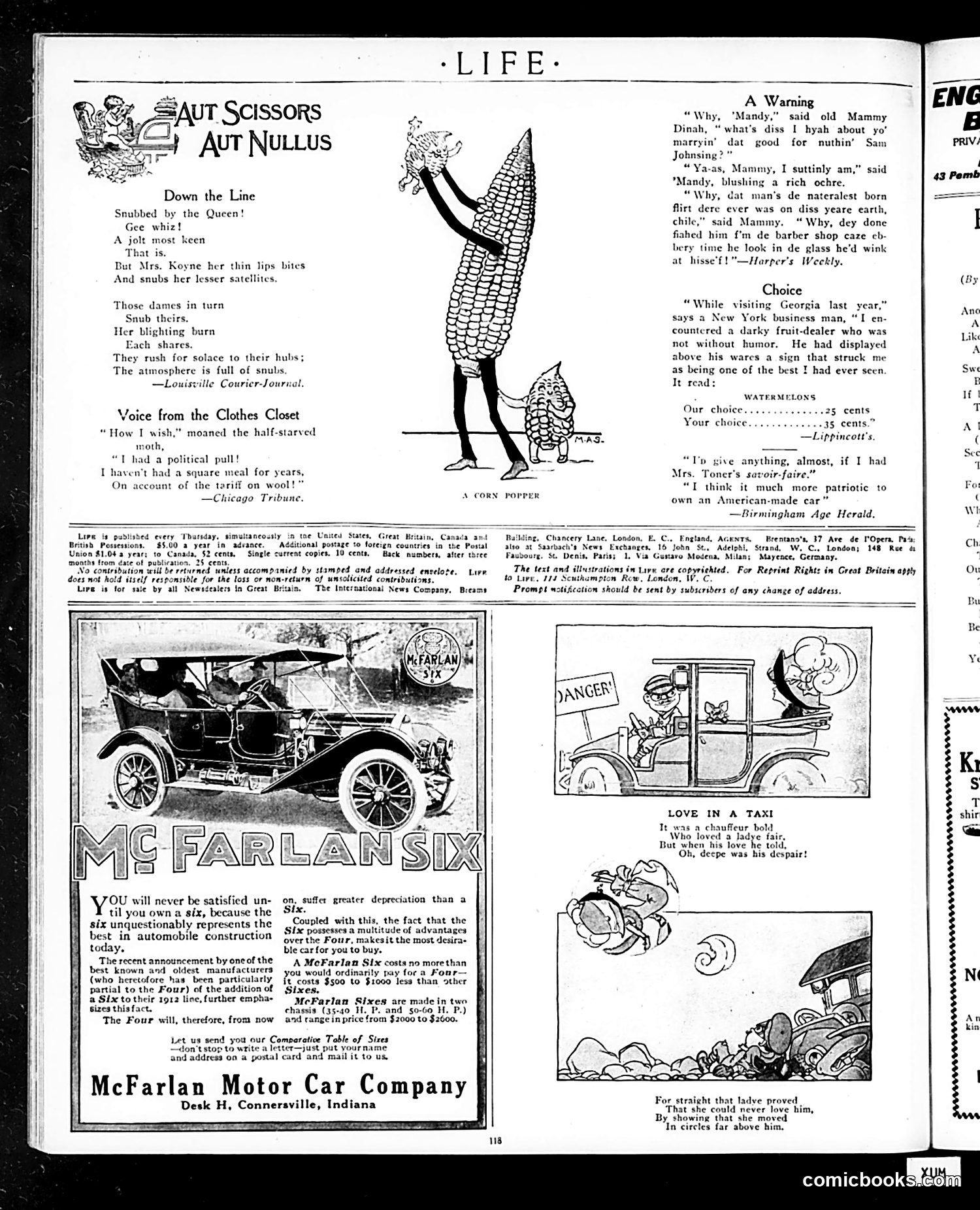
This page from *Life* magazine mixes humorous social commentary with automobile advertising. The main satirical content includes: **"A Warning"** presents a racist dialect joke about an African American woman marrying a flirtatious man—typical of the era's problematic humor. **"Voice from the Clothes Closet"** satirizes a moth complaining about tariff protections on wool, mocking labor issues and trade policy through anthropomorphization. **"Love in a Taxi"** is a brief comic about a chauffeur's unrequited love, playing on emerging automobile culture and class differences. The page is dominated by the **McFarlan Motor Car Company advertisement**, promoting their new six-cylinder automobile as superior to four-cylinder models. This reflects early 1910s auto industry competition and consumer anxieties about vehicle depreciation. The racial caricatures and dialect humor reflect *Life*'s period sensibilities, now widely recognized as offensive. The tariff joke references genuine economic debates of the era.
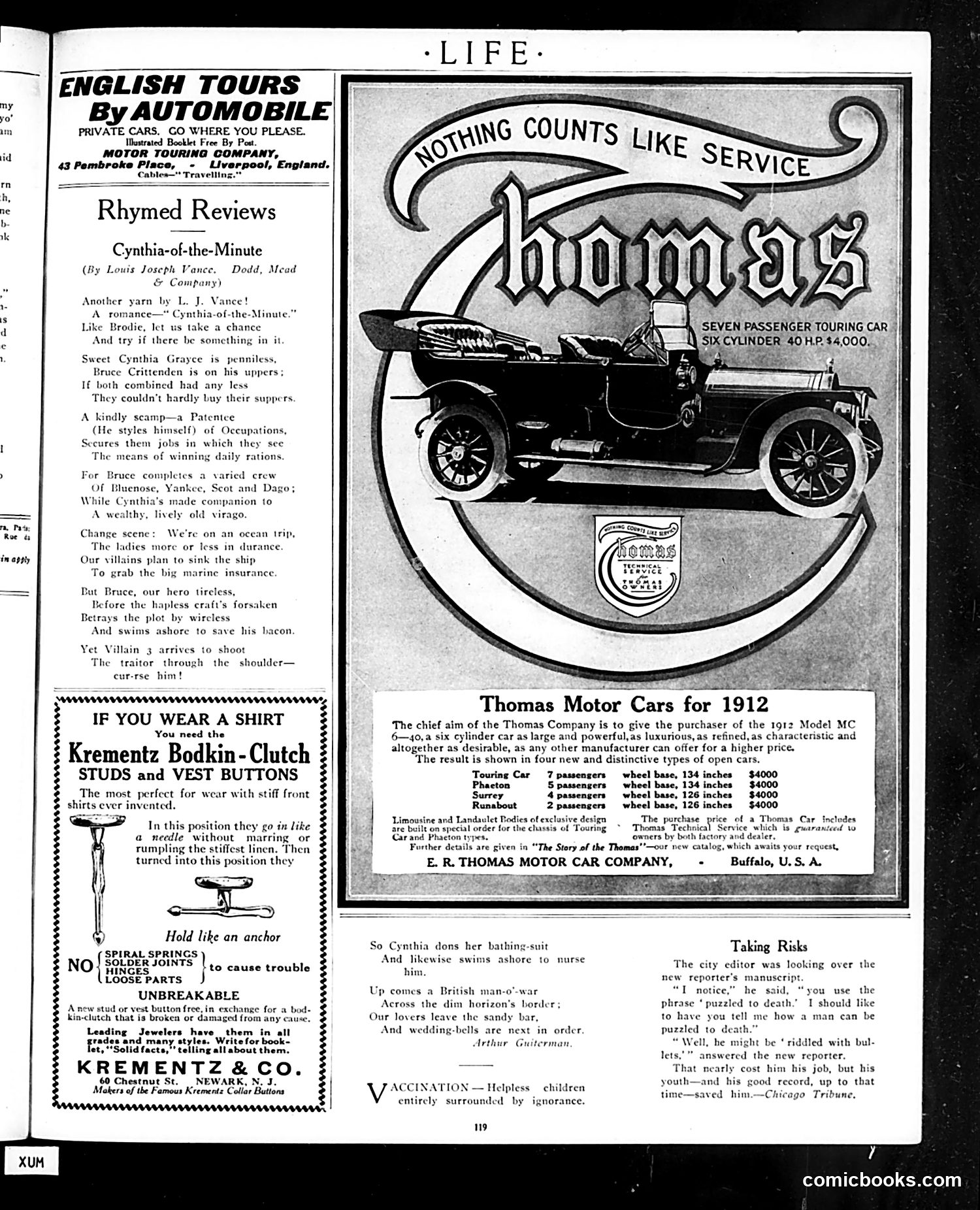
This page is primarily **advertising and light entertainment** rather than political satire. It contains: 1. **"Cynthia-of-the-Minute"** — a humorous serialized romance poem by Louis Joseph Vance about a poor couple (Cynthia and Bruce) who survive various melodramatic perils (villains, a sinking ship, gunfire) and ultimately marry. The satire gently mocks overwrought romantic adventure fiction popular at the time. 2. **Thomas Motor Cars advertisement** — promoting the 1912 Model MC-6, a high-end touring automobile ($4,000, substantial money then). The tagline "Nothing Counts Like Service" emphasizes reliability. 3. **Krementz shirt studs advertisement** — promoting durable clothing fasteners for formal wear. 4. **"Taking Risks"** — a brief anecdote about a newspaper editor correcting a reporter's awkward phrasing ("riddled with bullets" instead of "puzzled to death"). The page reflects early 1910s consumer culture, automotive advancement, and genteel humor. There is **no significant political cartoon or social commentary** present.
This page contains reader letters responding to Life's "Coronation Number"—an issue mocking Britain's royal coronation ceremony. **Main Letter - Political Critique:** A Canadian reader (H.J. MacLeay) defends the British monarchy against American ridicule, arguing Americans have no moral ground to mock. He contends that: - Britain's common people elect MPs to Parliament (true power) - American workers are equally exploited by corporations and trusts - The U.S. has no equivalent democratic representation - The American system, riddled with corruption (he names Senator Lorimer), will collapse before the British monarchy **The Satire's Point:** Life's original coronation mockery attacked royal extravagance. This rebuttal flips the argument: American democracy isn't morally superior when it's controlled by wealthy interests and corrupt senators. It's a sharp indictment of Gilded Age plutocracy masquerading as democracy. **Secondary Content:** The "Tribute" letter is humorous fan mail thanking Life for inspiring the writer's personal transformation.
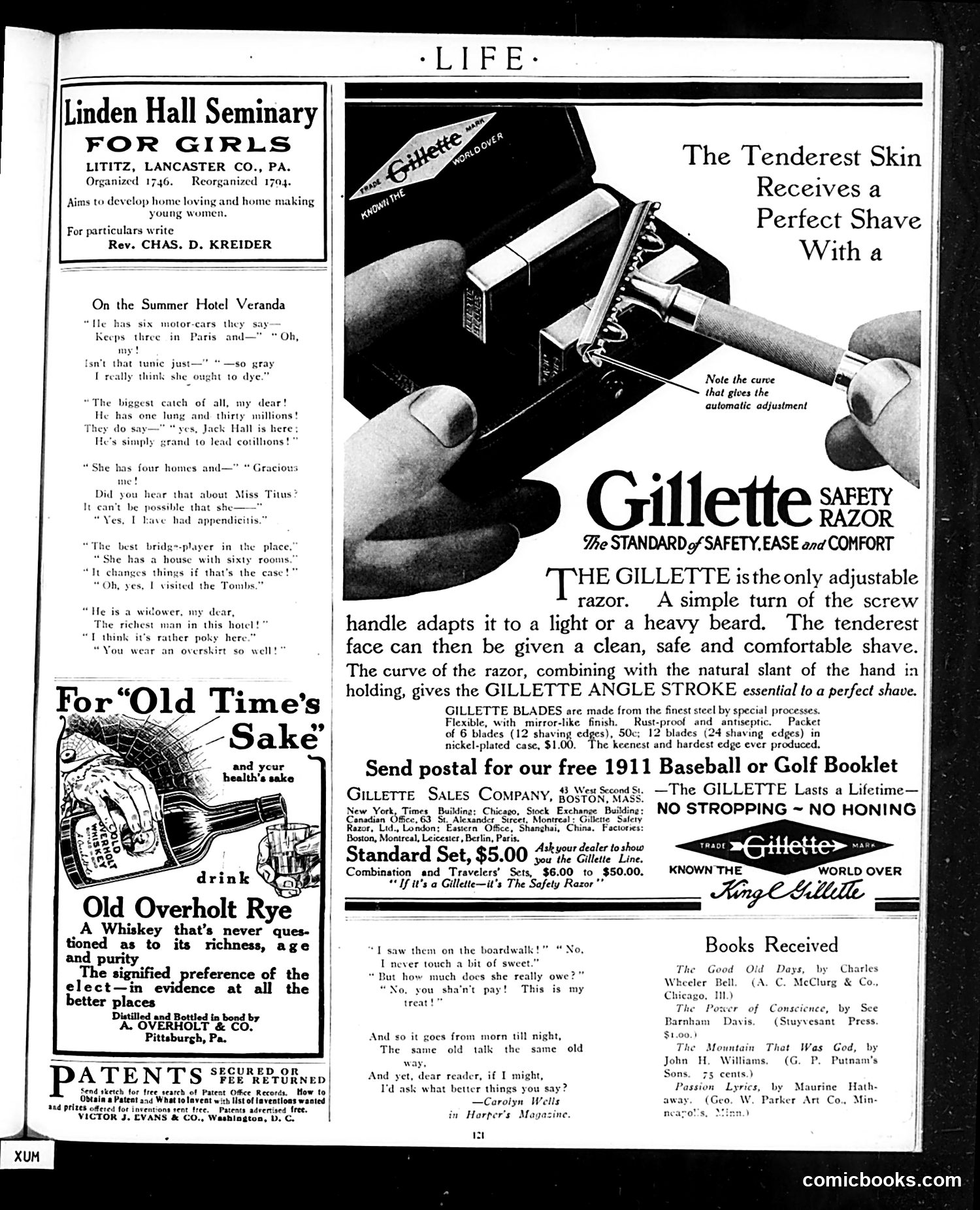
This page is primarily **advertising** with minimal satirical content. The main feature is a Gillette Safety Razor advertisement (center-right), which dominates the layout with product photography and promotional copy emphasizing the razor's adjustable mechanism for different beard types. The small **cartoon element** (top-left) depicts upper-class women on a hotel veranda gossiping about wealthy acquaintances—their multiple homes, servants, and social status. The satire is gentle and targets the **leisure class's superficial preoccupations**: women discussing whether someone should dye gray hair, bragging about motor cars in Paris, and obsessing over wealth and social rank. The humor relies on readers recognizing the familiar trope of vapid high-society chatter. There's no complex political message—it's straightforward social observation about the idle rich. The page also includes advertisements for Linden Hall Seminary (a girls' school) and Old Overholt Rye whiskey, plus a "Books Received" section listing recent publications, making this a typical early-1911 Life magazine page mixing advertising, light social satire, and literary notices.
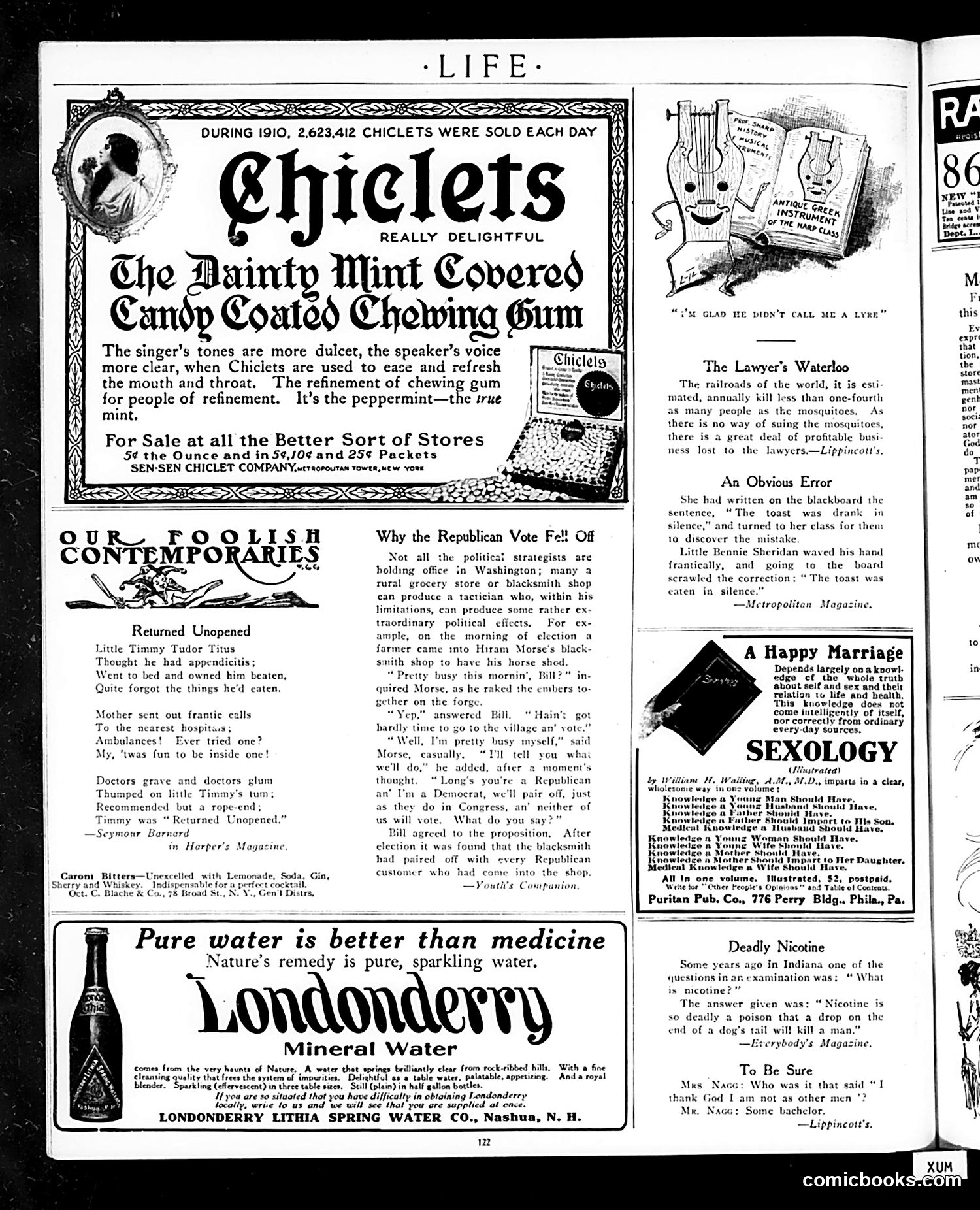
This page consists primarily of **advertisements and humor filler content**, typical of early 1910s magazines. The main items are: **"Our Foolish Contemporaries"** — A humor section featuring brief satirical anecdotes. "Why the Republican Vote Fell Off" mocks political deal-making: a blacksmith and farmer agree not to vote, each canceling the other's ballot, yet the blacksmith ends up "pairing off" with every Republican customer anyway—satirizing the ineffectiveness of such schemes and perhaps politicians' inability to honor agreements. **Other humor pieces** include "Returned Unopened" (about a boy who faked appendicitis) and grammar jokes about common errors. The page is dominated by **product advertisements**: Chiclets gum, Londonderry mineral water, and a "Sexology" mail-order book promising knowledge about sex and marriage. There are no major political cartoons or caricatures requiring identification. The satire is gentle, domestic humor rather than pointed political commentary.
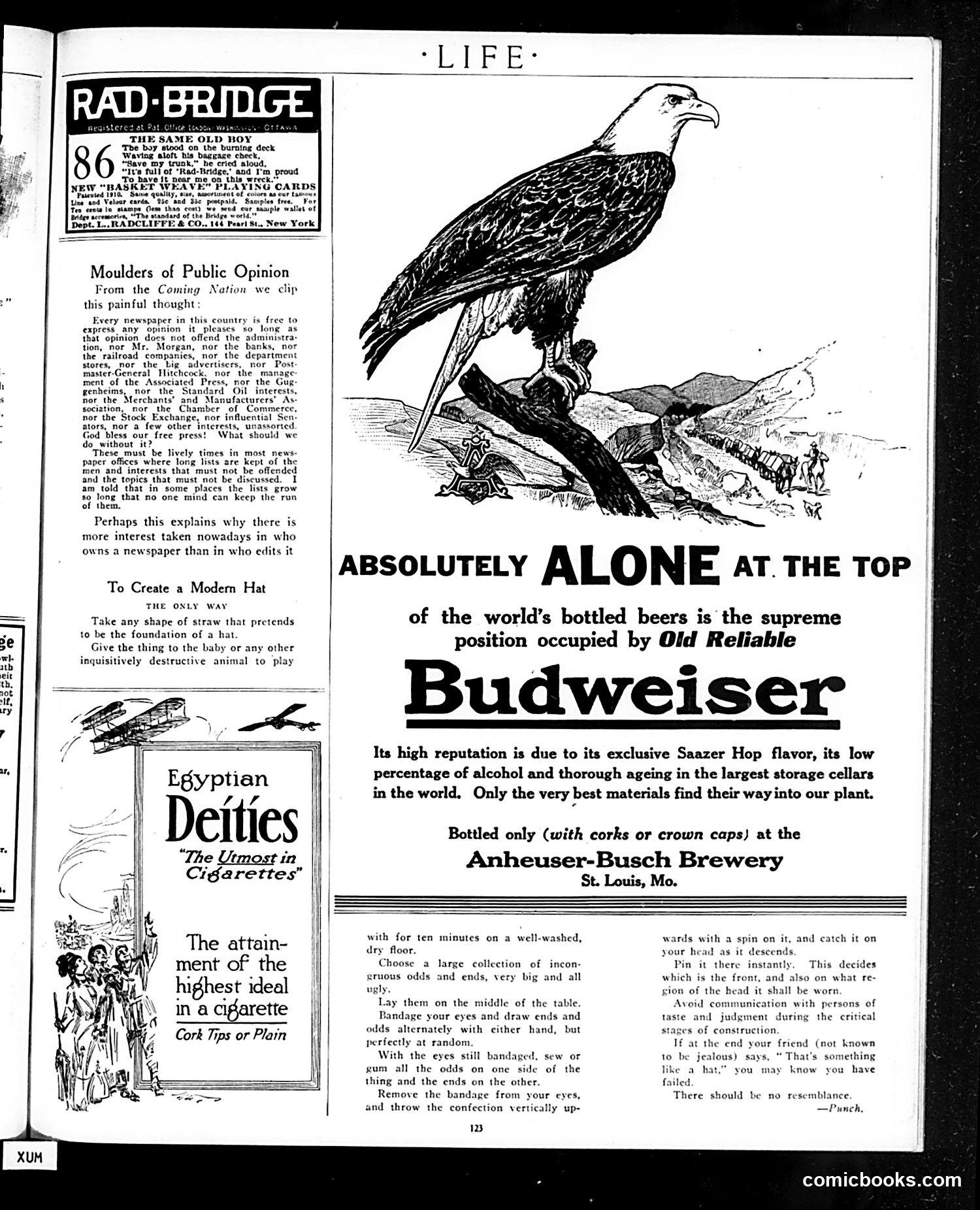
This page primarily contains **advertisements and satirical commentary** rather than political cartoons. The main editorial content is "Moulders of Public Opinion," a cutting satire attacking American press freedom as illusory. The piece sarcastically lists the powerful interests that newspapers cannot offend—the government, banks, railroads, Standard Oil, the Associated Press, and wealthy industrialists—concluding that editors must maintain secret lists of forbidden topics. The joke is dark: despite constitutional press freedom, newspapers are actually controlled by corporate and political elites, making ownership more interesting than editorial independence. Secondary content includes humor pieces on hat-making and cigarette advertisements (Egyptian Deities brand), plus a large **Budweiser beer advertisement** featuring an eagle, claiming it occupies "absolutely alone at the top" of bottled beers. The page reflects Progressive Era skepticism about corporate power and media manipulation—concerns that remain relevant today.
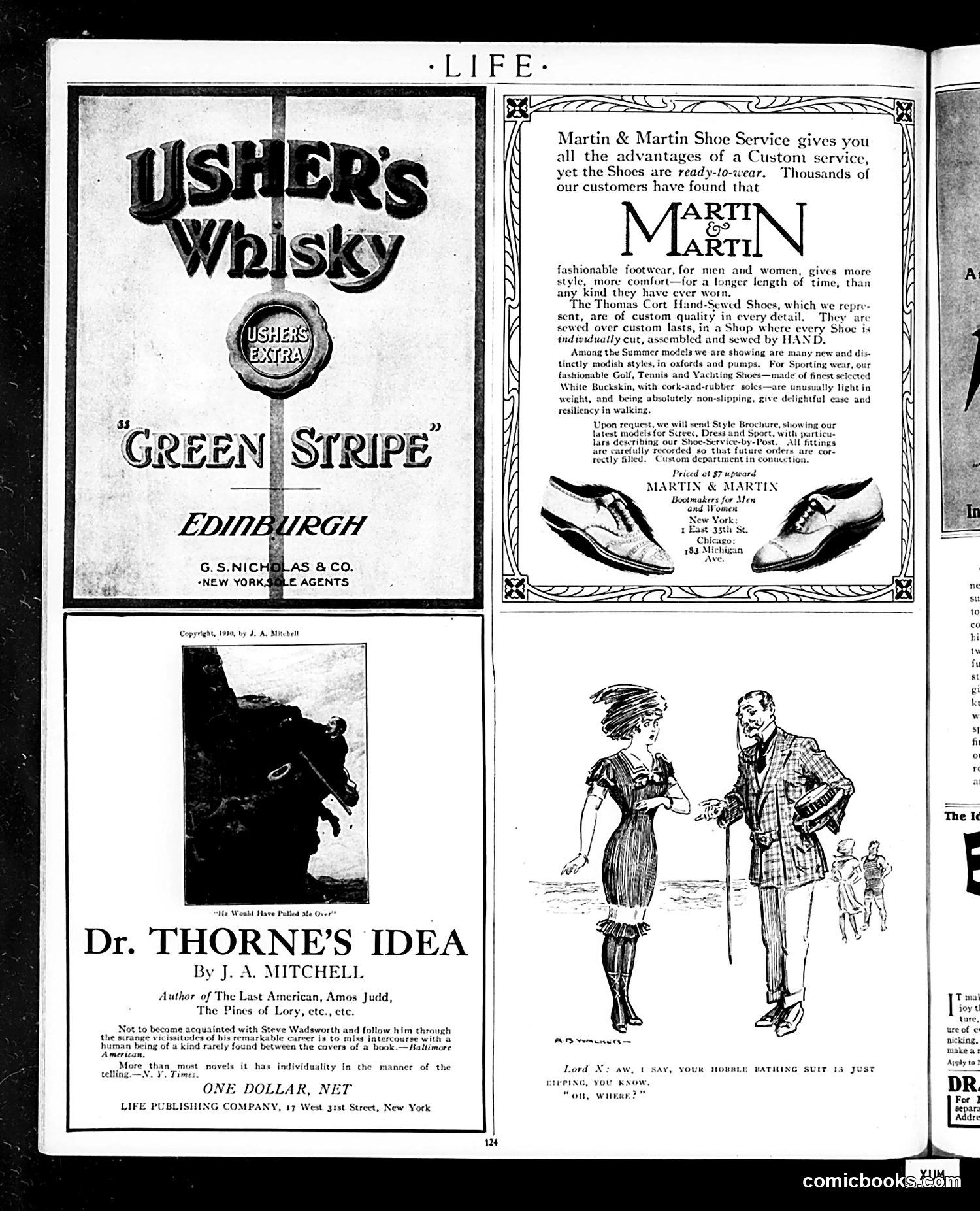
This page contains primarily **advertisements and serialized fiction**, not political satire. **Left side:** Advertisement for Usher's Whisky ("Green Stripe") from Edinburgh, and a book advertisement for J.A. Mitchell's serial novel "Dr. Thorne's Idea" (priced at one dollar). The copyright indicates 1910. **Right side:** Advertisement for Martin & Martin Shoe Service, promoting custom-made ready-to-wear footwear for men and women, with specific mention of summer sporting shoes (golf, tennis, yachting). **Bottom illustration:** A sketch showing two figures—a woman in a bathing suit and an older man—with dialogue: "Lord X: 'Aw, I say, your hobble bathing suit is just ripping, you know.' 'Oh, where?'" This is a **mild social joke** about the "hobble skirt," a contemporary women's fashion that severely restricted leg movement. The humor plays on the double meaning of "ripping" (British slang for "excellent") and the awkwardness of the garment's design—the punchline suggesting the suit has literally ripped or split.
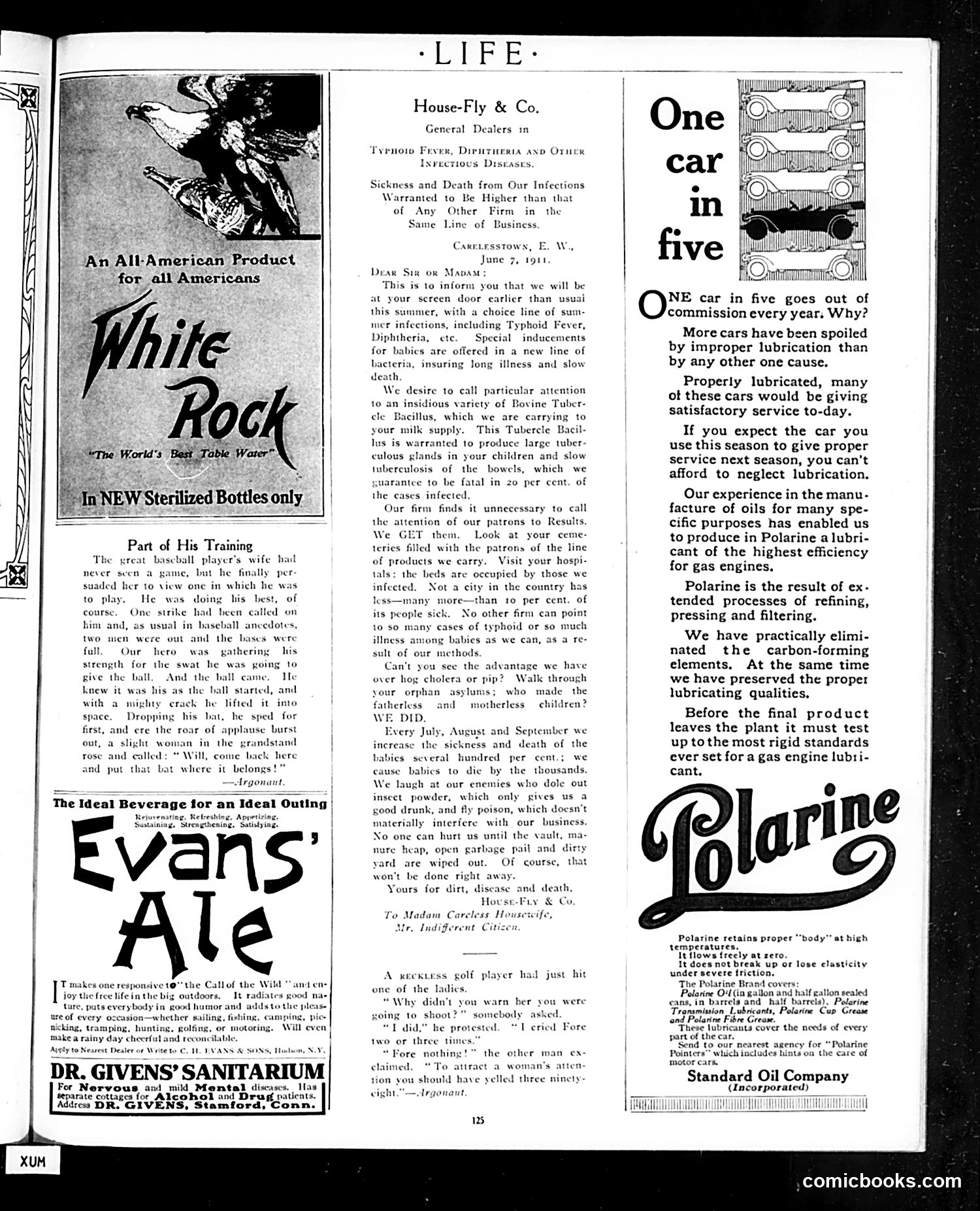
This page contains primarily **advertisements and satirical content** typical of Life magazine's early 1900s format. The main satirical piece is a mock business letter from "House-Fly & Co.," a darkly humorous advertisement personifying disease-carrying houseflies as a commercial enterprise. The satire attacks public health negligence by presenting flies as businessmen boasting about spreading typhoid, dipheria, and tuberculosis—especially to children and infants. The joke exposes how preventable these diseases were if people simply maintained sanitation (sealed garbage, proper waste disposal). This reflects genuine Progressive Era concerns about urban filth and disease mortality. Other content includes brief humorous anecdotes about baseball and golf, plus earnest product advertisements for "White Rock" table water (emphasizing purity), Evans' Ale, Polarine motor oil, and Dr. Givens' Sanitarium for alcoholism treatment. The "House-Fly" piece is the page's substantive satire—using exaggeration to shame readers into better sanitary practices during a period of genuine public health crisis.
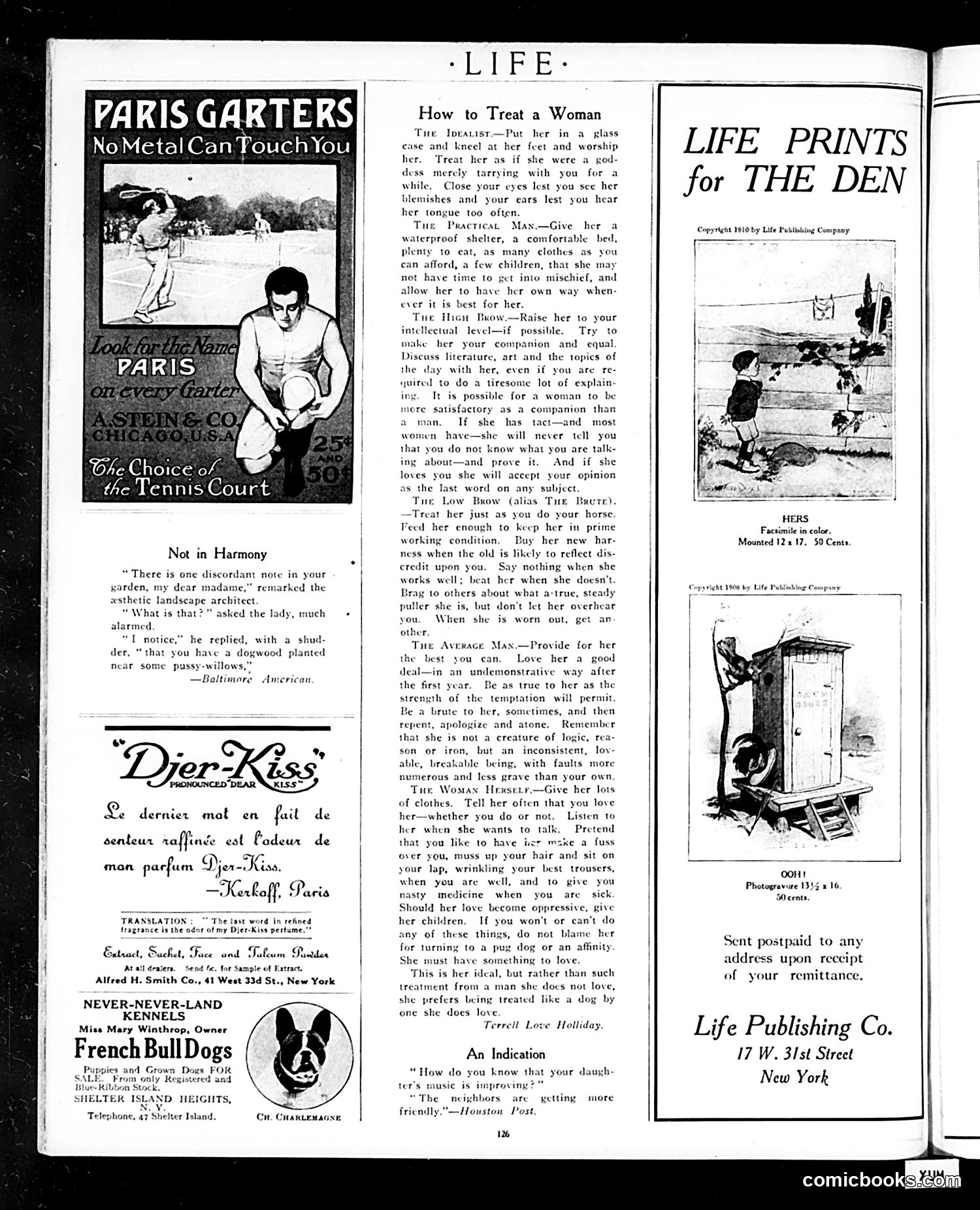
This Life magazine page mixes advertisements with satirical social commentary typical of the era. The main text, "How to Treat a Woman," presents five male archetypes and their approaches to women—from the idealistic "Idealist" who worships her, to the brutal "Low Brow" who treats women like horses, to the "Average Man" who balances love with occasional cruelty. The satire targets contemporary gender attitudes: the piece acknowledges women as inconsistent and illogical ("not a creature of logic") while simultaneously mocking men's various failure modes in relationships. The "Woman Herself" section ironically suggests she needs constant reassurance and material goods or will turn to "a pug dog or an affinity" (affair). The brief joke at bottom—neighbors becoming friendlier when a daughter's music improves—lampoons amateur musicianship as universally unpleasant. The advertisements (Paris Garters, Dyer-Kiss perfume, French Bulldogs) are period marketing, unrelated to the editorial content.
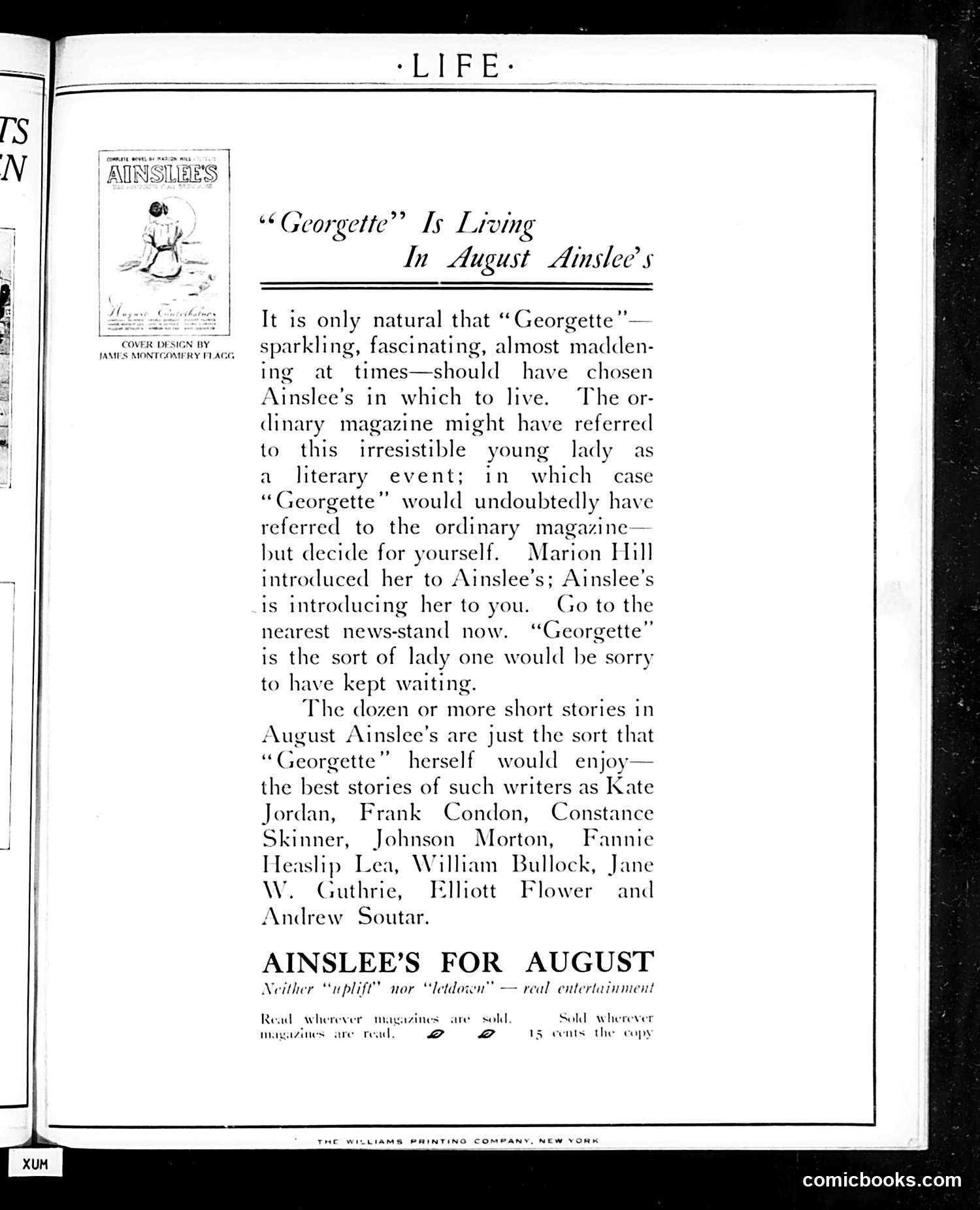
This is a **magazine advertisement**, not a political cartoon. It promotes *Ainslee's* magazine for August, featuring a fictional character called "Georgette." The ad uses a common marketing technique: creating a glamorous, alluring female persona ("sparkling, fascinating, almost maddening") to entice readers. "Georgette" is presented as so compelling that the magazine itself becomes secondary—readers should want the magazine because it contains her story. The copy lists established short-story writers of the era (Kate Jordan, Frank Condon, etc.) to establish literary credibility. The final tagline—"Neither 'uplift' nor 'letdown'—real entertainment"—suggests *Ainslee's* positioned itself as middle-brow entertainment: not pretentious literature nor cheap sensationalism, but accessible quality fiction. There is no political satire here. This reflects early 20th-century magazine marketing that relied on creating appealing fictional characters and celebrity to drive newsstand sales. The cover design by James Montgomery Flagg (noted at top) helped establish the visual brand.
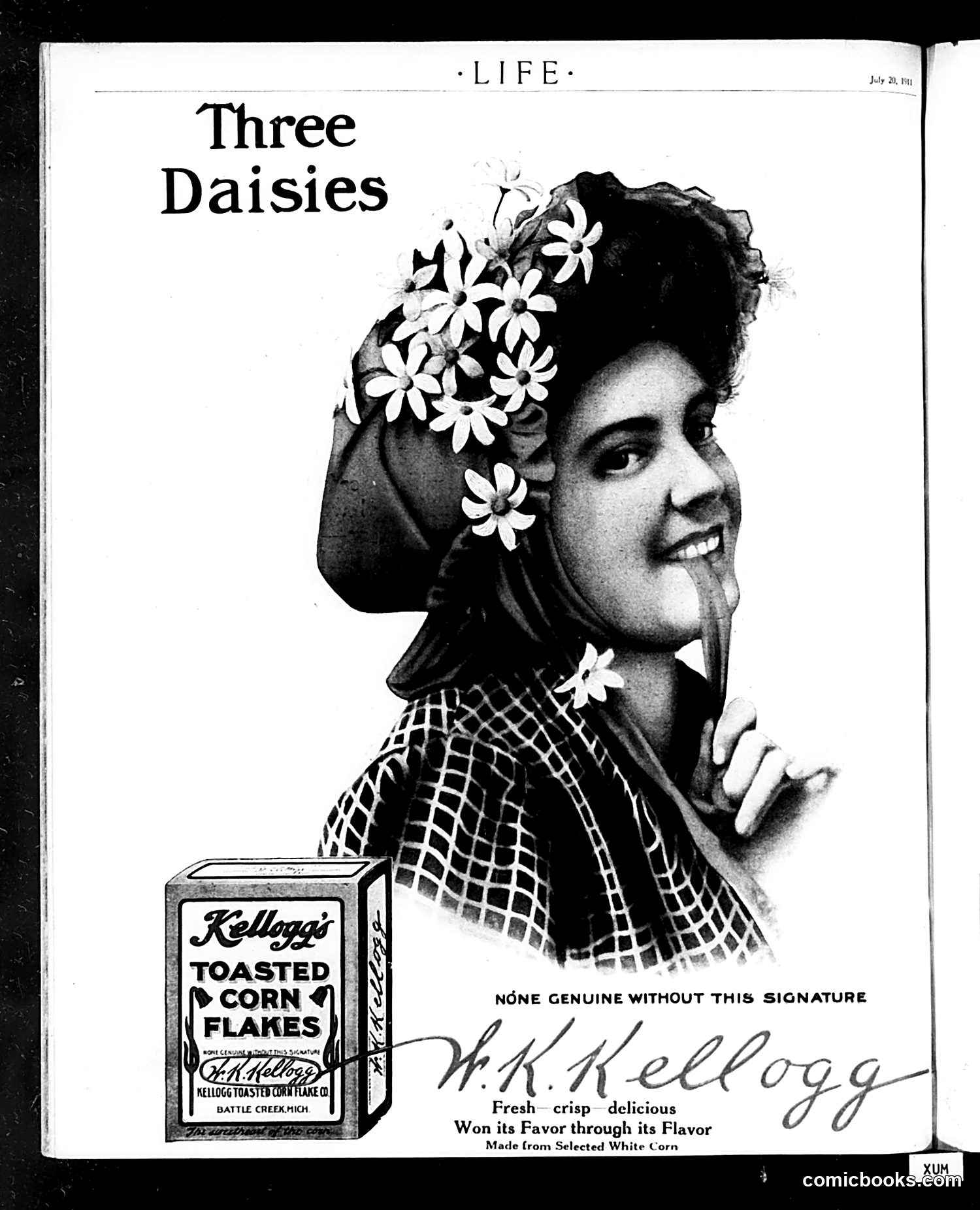
This is primarily a **Kellogg's Toasted Corn Flakes advertisement**, not political satire. The page shows a smiling woman wearing daisies in her hair and clothing, positioned next to a cereal box. The ad's tagline—"Fresh—crisp—delicious / Won its Favor through its Flavor"—uses the woman as an endorsement figure. The phrase "None Genuine Without This Signature" references W.K. Kellogg's signature on the box as a guarantee of authenticity, a common advertising practice of the era. The title "Three Daisies" likely references the flowers adorning the model, connecting the natural imagery of daisies to the "fresh" quality claimed for the cereal. This was typical early 20th-century advertising strategy: associating products with nature, wholesomeness, and femininity to appeal to consumers.