
Life, 1911-07-20 · page 26 of 40
Life — July 20, 1911 — page 26: what you’re looking at
What you’re looking at
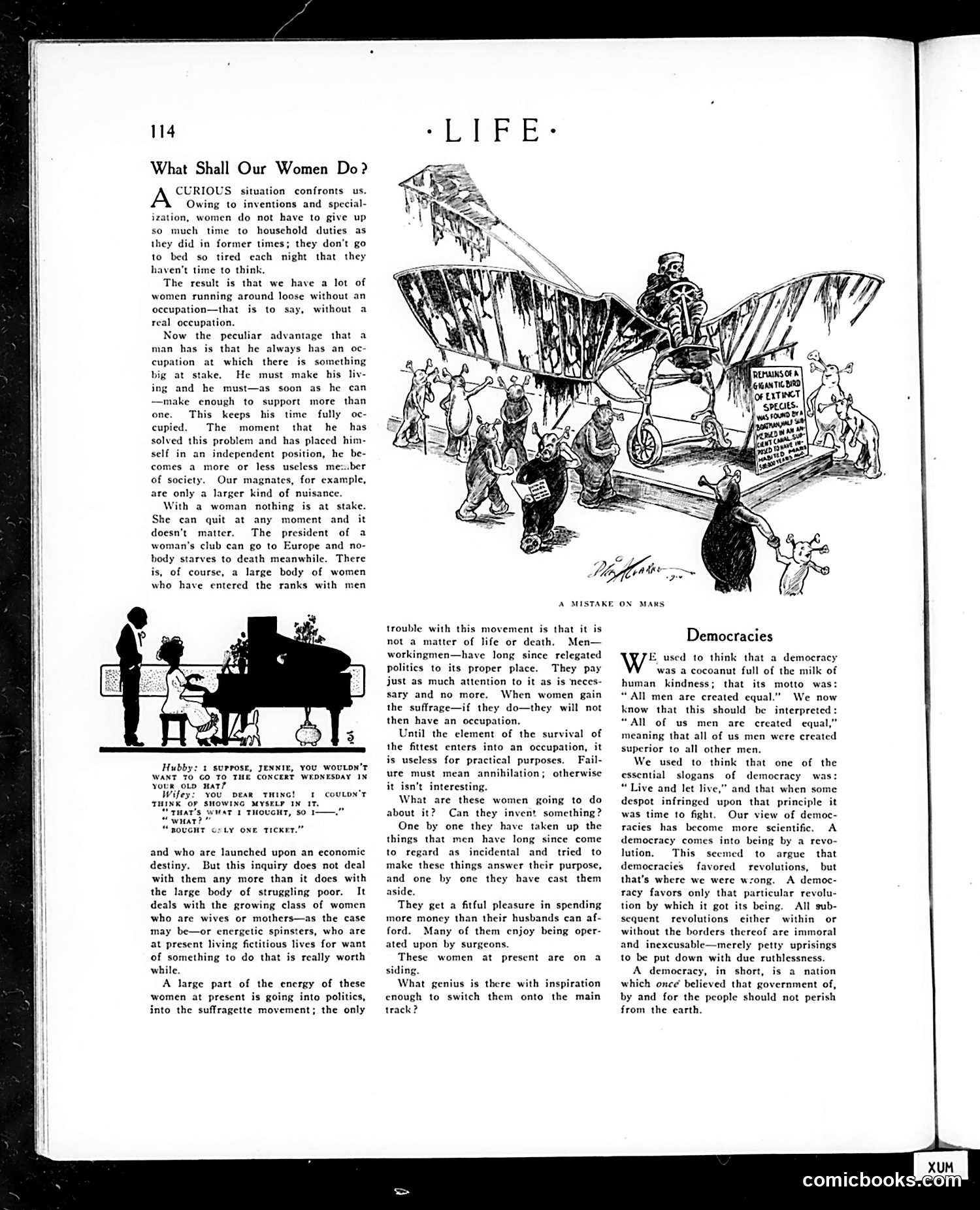
This page contains two distinct satirical pieces: **"What Shall Our Women Do?"** critiques educated, middle-class women with leisure time. The article argues that modern inventions have freed women from household labor, leaving them "running around loose without an occupation." The author contends that unlike men, who must earn livings with real consequences ("something big at stake"), women lack meaningful purpose—they can quit activities without serious repercussions. The accompanying cartoon shows a couple at a piano, with the husband sarcastically remarking he'll buy only one concert ticket, implying his wife's activities are frivolous. The piece dismissively mentions the suffragette movement, claiming voting rights won't solve women's "real" problem: lack of meaningful work with genuine stakes. **"Democracies"** begins a separate article (continued on next page) questioning idealistic notions of democracy and equality. It suggests democracies actually favor only certain groups, contradicting the "all men are created equal" principle. Both pieces reflect early 20th-century attitudes: skepticism toward women's ambitions and cynicism about democratic ideals.
📄 Transcribed text from this page (OCR, searchable)
Machine-transcribed from the original scan — historical spelling and the odd misread are preserved.
114 What Shall Our Women Do? CURIOUS situation confronts us. Owing to inventions and special- ization, women do not have to give up so much time to household duties as they did in former times; they don’t go to bed so tired cach night that they haven't time to think. The result is that we have a lot of women running around loose without an occupation—that is to say, without a real occupation. Now the peculiar advantage that man has is that he always has an oc- cupation at which there is something big at stake. He must make his liv- ing and he must—as soon as he can ke enough to support more than one. This keeps his time fully oc- cupied. The moment that he has solved this problem and has placed him- self in an independent position, he be- comes a more or less useless meziber of society. Our magnates, for example, are only a larger kind of nuisance. With a woman nothing is at stak She can quit at any moment and it doesn’t matter. The president of a woman's club can go to Europe and no- body starves to death meanwhile. There is, of course, a large body of women who have entered the ranks with men Hubby: 1 supose, JENNIE, You WoULoN’T WANT TO GO TO THE CONCERT WEDNESDAY IN YOUR OLD WaT? Wifey: YoU Dear tiiNc! 1 CouLDN’T NK OF SNOWING MYSELF IN 17. THAT'S WMAT 1 THOUGHT, $0 I—. wat?” RouGH ™ Go Ly ONE TICKET.” and who are launched upon an economic destiny. But this inquiry does not deal with them any more than it docs with the large body of struggling poor. It deals with the growing class of women who are wives or mothers—as the case may be—or energetic spinsters, who are at present living fictitious lives for want of something to do that is really worth while. A large part of the energy of these women at present is going into politics, into the suffragette movement; the only A MISTAKE ON MARS trouble with this movement is that it is not a matter of life or death. Men— workingmen—have long since relegated politics to its proper place. They pay just as much attention to it as is neces sary and no more. When women gain the suffrage—if they do—they will not then have an occupation. Until the element of the survival of the fittest enters into an occupation, it is useless for practical purposes. Fail- ure must mean annihilation; otherwise it isn’t interesting. What are these women going to do about it? Can they invent something? One by one they have taken up the things that men have long since come to regard as incidental and tried to make these things answer their purpose, and one by one they have cast them aside. They get a fitful pleasure in spending more money than their husbands can af- ford. Many of them enjoy being oper- ated upon by surgeons. These women at present are on a siding. What genius is there with inspiration enough to switch them onto the main track? Democracies W used to think that a democracy was a cocoanut full of the milk of human kindness; that its motto was: “All men are created equal.” We now know that this should be interpreted: “All of us men are created equal,” meaning that all of us men were created superior to all other men. We used to think that one of the essential slogans of democracy was: * Live and let live,” and that when some despot infringed upon that principle it was time to fight. Our view of democ- racies has become more scientific. A democracy comes into being by a revo- lution. This secmed to argue that democracies favored revolutions, but that’s where we were wrong. A democ- racy favors only that particular revolu- tion by which it got its being. All sub- sequent revolutions either within or without the borders thereof are immoral and inexcusable—merely petty uprisings to be put down with due ruthlessness. A democracy, in short, is a nation which once believed that government of, by and for the pcople should not perish from the earth. comicbookMeunl