
Life, 1911-07-20 · page 16 of 40
Life — July 20, 1911 — page 16: what you’re looking at
What you’re looking at
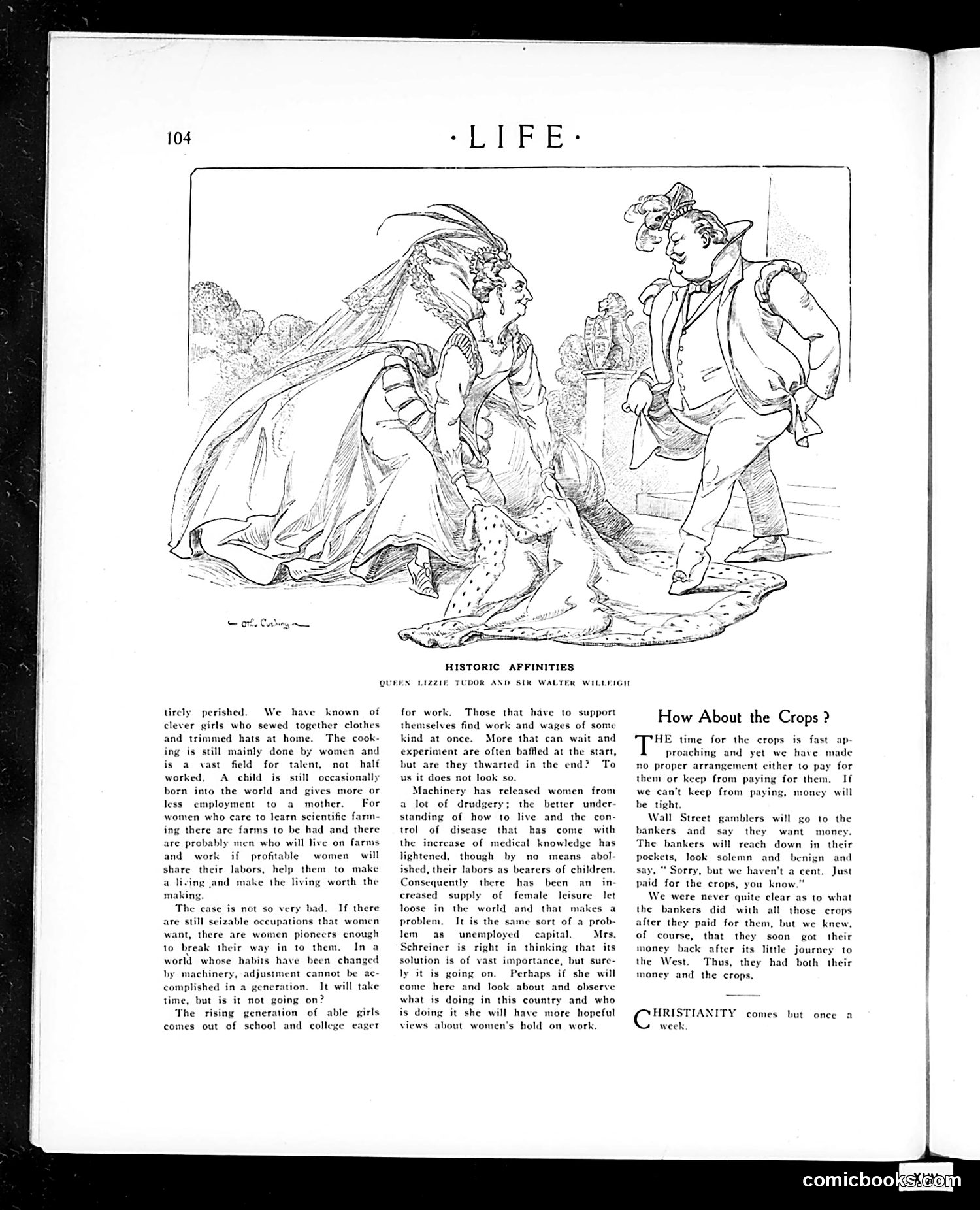
The top illustration, titled "Historic Affinities," depicts **Queen Elizabeth I** (left, in elaborate Tudor dress with veil) alongside **Sir Walter Raleigh** (right), referencing the legendary historical relationship between the Virgin Queen and her favored courtier. The satire appears to mock romantic or idealized historical narratives by presenting them in exaggerated, comedic form. The accompanying text discusses **women's employment and education**—a progressive topic for the era. It argues women have found work opportunities and that machinery has freed them from drudgery, though "increased supply of female leisure" creates new social problems. The "How About the Crops?" section is economic satire about **agricultural financing**. It mocks Wall Street bankers who lend money for crops, then profit when farmers repay with interest—the bankers thus gain both the money *and* benefit from the crops' success. The critique targets financial exploitation of agricultural workers during what appears to be an economic crisis period.
📄 Transcribed text from this page (OCR, searchable)
Machine-transcribed from the original scan — historical spelling and the odd misread are preserved.
QUEEN Lizzie tirely perished. We have known of clever girls who sewed together clothes and trimmed hats at home. The cook- ing is still mainly done by women and is a vast field for talent, not half worked, A child is still occasionally born into the world and gives more or less employment to a mother. For women who care to learn scientific farm- ing there are farms to be had and there are probably men who will live on farms and work if profitable women will share their labors, help them to make a living and make the living worth the making. The case is not so very bad. If there are still seizable occupations that women want, there are women pioneers cnough to break their way in to them, In a world whose habits have been changed by machinery, adjustment cannot be ac- complished in a gene’ It will take time, but is it not going on? The rising generation of able girls comes out of school and college eager ation HISTORIC AFFINITIES TUDOR AND Stk WALTER WILLEIGH for work. Those that have to support themselves find work and wages of some kind at once. More that can wait and experiment are often bafiled at the start, but are they thwarted in the end? To us it does not look so. Machinery has released women from a lot of drudgery; the better under- standing of how to live and the con- trol of disease that has come with the increase of medical knowledge has lightened, though by no abol- ished, their labors as bearers of children. Consequently there has been an in- creased supply of female leisure let loose in the world and that makes a problem. It is the same sort of a prob- lem as unemployed capital. Mrs, Schreiner is right in thinking that its solution is of vast importance, but sure- ly it is going on. Perhaps if she will come here and look about and observe what is doing in this country and who is doing it she will have more hopeful views about women's hold on work. means, How About the Crops ? HE time for the crops is fast ap- proaching and yet we have made no proper arrangement cither to pay for them or keep from paying for them. If we can’t keep from paying, money will ht. Wall Street ¢: bankers blers will go to the y they want mone: nkers will reach down in their look solemn and benign Sorry, but we haven't a cent id for the crops, you know.” We were never quite clear as to what the bankers did with all after they paid for them, but we knew, of course, that they soon got their money back after its little journey to the West. Thus, they had both their money and the crops, ands: and Just those crops HRISTIANITY week, comes but once a comicbookeeon