
Life, 1911-07-20 · page 8 of 40
Life — July 20, 1911 — page 8: what you’re looking at
What you’re looking at
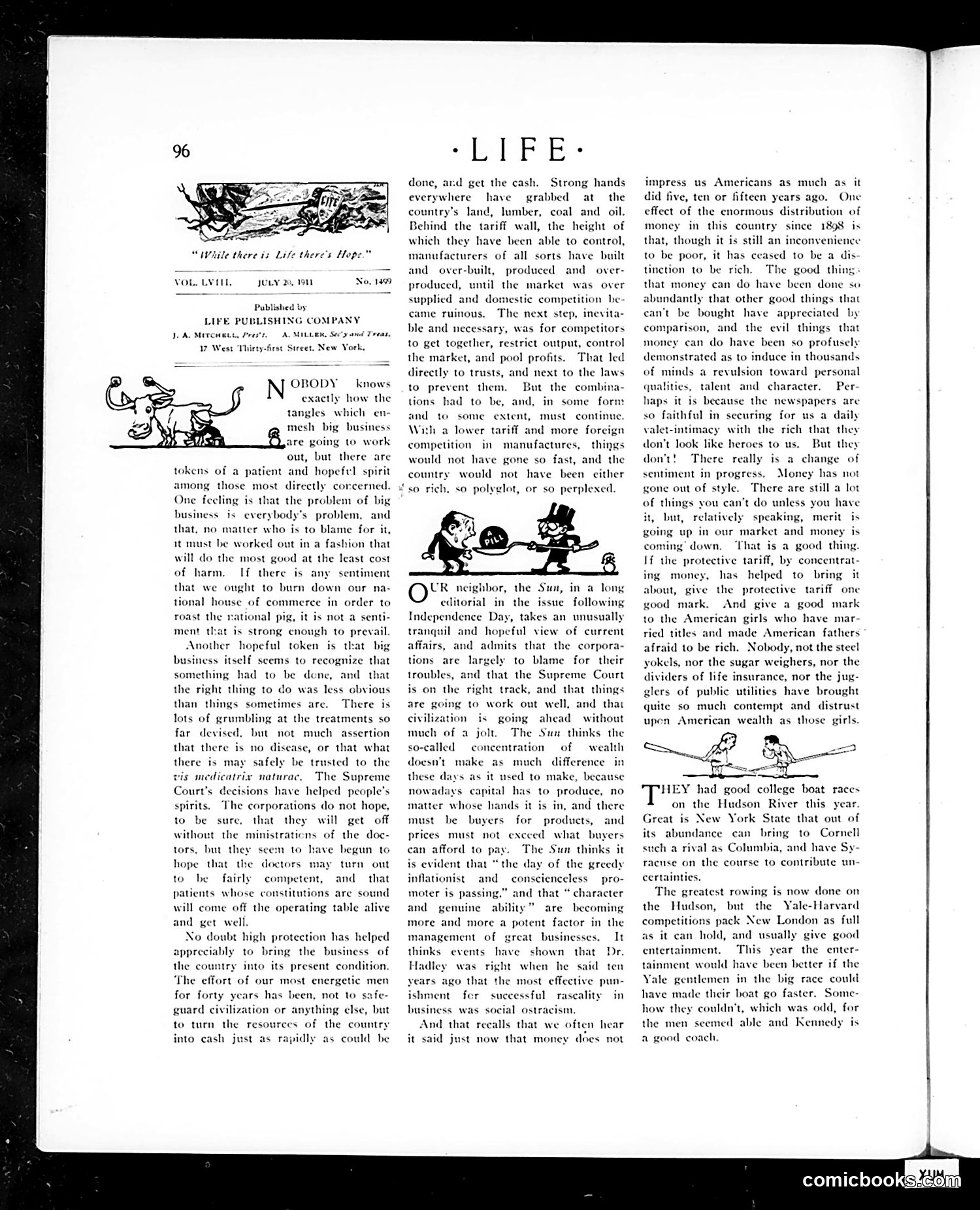
This editorial page discusses American business and wealth concentration. The cartoons illustrate the article's themes: **First cartoon** (top left): Shows figures labeled "Wait there is Life there's Hope" — appears to reference business competition and market dynamics. **Second cartoon** (middle): Depicts what appears to be a confrontation between two figures over money/resources, likely satirizing corporate disputes or labor-capital conflicts. **Third cartoon** (bottom): Shows rowing figures competing on water, referenced in the text as college boat races between Yale and Harvard, used as metaphor for American competition and entertainment during economic hardship. The overall piece criticizes wealth concentration while noting that Supreme Court decisions and business practices have affected ordinary Americans' financial security and prospects.
📄 Transcribed text from this page (OCR, searchable)
Machine-transcribed from the original scan — historical spelling and the odd misread are preserved.
“While there iz Life there's He JULY 20, 1911 Vou, LVI Published & IFE PUBLISHING COMPANY JAD MUTCHELE, Pret AL MILLEN, See“ ana Treas, A West Thirty-first Steet. New York, N OBODY — knows exactly how the tangles which en- mesh big business are going to work out, but there are tokens of a patient and hopeftl spirit among those most directly concerned. One feeling is that the problem of big business is everybody's problem, and that, no matter who is to blame for it, it must be worked out in a fashion that will do the most good at the least cost of harm. If there is any sentiment that we ought to burn down our na- tional house of commerce in order to roast the national pig, it is not a senti- ment t is strong cnough to prevail. Another hopeful token is that big business itself scems to recognize that something had to be done, and that the right thing to do was less obvious than things sometimes are. There is lots of grumbling at the treatments so far devised. but not much assertion that there is no disease, or that what there is may safely be trusted to the vis medicatrix naturac, The Supreme Court’s decisions have helped people’s spirits. The corporations do not hope, to be sure, that they will get off without the ministraticns of the doc: tors, but they scem to have begun to hope that the doctors may turn out to be fairly competent, and that patients whose constitutions are sound will come off the operating table alive and get well. No doubt high protection has helped appreciably to bring the business of the country into its present condition. ‘The effort of our most energetic men for forty years has been, not to safe- guard civilization or anything else, but to turn the resources of the country into cash j as could be AICP. « done, and get the cash. Strong hands everywhere have grabbed at the country’s land, lumber, coal and oil. Behind the tariff wall, the height of which they have been able to control, nufacturers of all sorts have built nd over-built, produced, until the market was over supplied and domestic competition be came ruinous. The next step, inevita- ble and necessary, was for competitors to get together, restrict output, control the market, and pool profits. That led directly to trusts, and next to the laws to prevent them. But the combina tions had to be, and, in some forn: produced and over- and to some ey Wish a lower tariff and more foreign ent, must continue, competition in manufactures, things would not have gone so fast, and the country would not have been cither ‘so rich, so polyglot, or so perplexed ighbor, the Sun, in a long editorial in the issue following Independence Day, takes an unusually tranquil and hopeful view of current affairs, and admits that the corpora- tions are largely to blame for their troubles, and that the Supreme Court is on the right track, and that things are going to work out well, and that civilization is going ahead without much of a jolt. The Sut thinks the so-called concentration of — wealth doesn’t make as much difference in these days as it used to make, because apital has to produce, no matter whose hands it is in, and there must be buyers for products, and prices must not execed what buyers can afford to pay. The Sun thinks it is evident that “the day of the greedy inflationist. and conscienecless — pro- moter is passing.” and that “ character and genuine ability” are becoming more and more a potent factor in the management of great businesses, It thinks events have shown that Dr. nowadays Hadley was right when he said ten years ago that the most effective pun- ishment fer successful rascality in business was social ostracism. And that recalls that we often hear it said just now that money does not impress us Americans as much as it did five, ten or fifteen years ago. One effect of the enormous distribution of money in this country since 1898 is that, though it is still an inconvenience to be poor, it has ceased to be a dis tinction to be rich. The good thin that money can do have been done so abundantly that other good things that n't be bought have appreciated by comparison, and the evil things that money can do have been so profusely demonstrated as to induce in thousands of minds a revulsion toward personal qualities, talent’ and character. Per haps it is because the newspapers are so faithful in securing for us a daily valet-intimacy with the rich that they don’t look like heroes to us. But they don't! There really is a change of sentiment in progress. Money has not gone out of style. There are still a lot of things you can’t do unless you have it, but, relatively speaking, merit is going up in our market and money is coming’ down, ‘That is a good thing If the protective tariff, by concentrat- ing money, has helped to bring it bout, give the protective tariff one good mark. And give a good mark to the American girls who have mar- ried titles and made American fathers afraid to be rich, Nobody, not the yokels, nor the sugar weighers, nor the dividers of life insurance, nor the jug- glers of public utilities have brought quite so much contempt and distrust upon American wealth as those girls. HEY had good college boat races on the Hudson River this year. Great is New York State that out of its abundance can bring to Cornell such a rival as Columbia, and have Sy- racuse on the course to contribute un- certainties. The greatest rowing is now done on the Hudson, but the Yale-Harvard competitions pack New London as full as it can hold, and usually give good entertainment. This year the enter- inment would have been better if the Yale gentlemen in the big race could have made their boat go faster. Some- how they couldn't, which was odd, for the men seemed able and Kennedy is a good coach. comicboo! ee nm