
A complete issue · 41 pages · 1910
Life — June 30, 1910
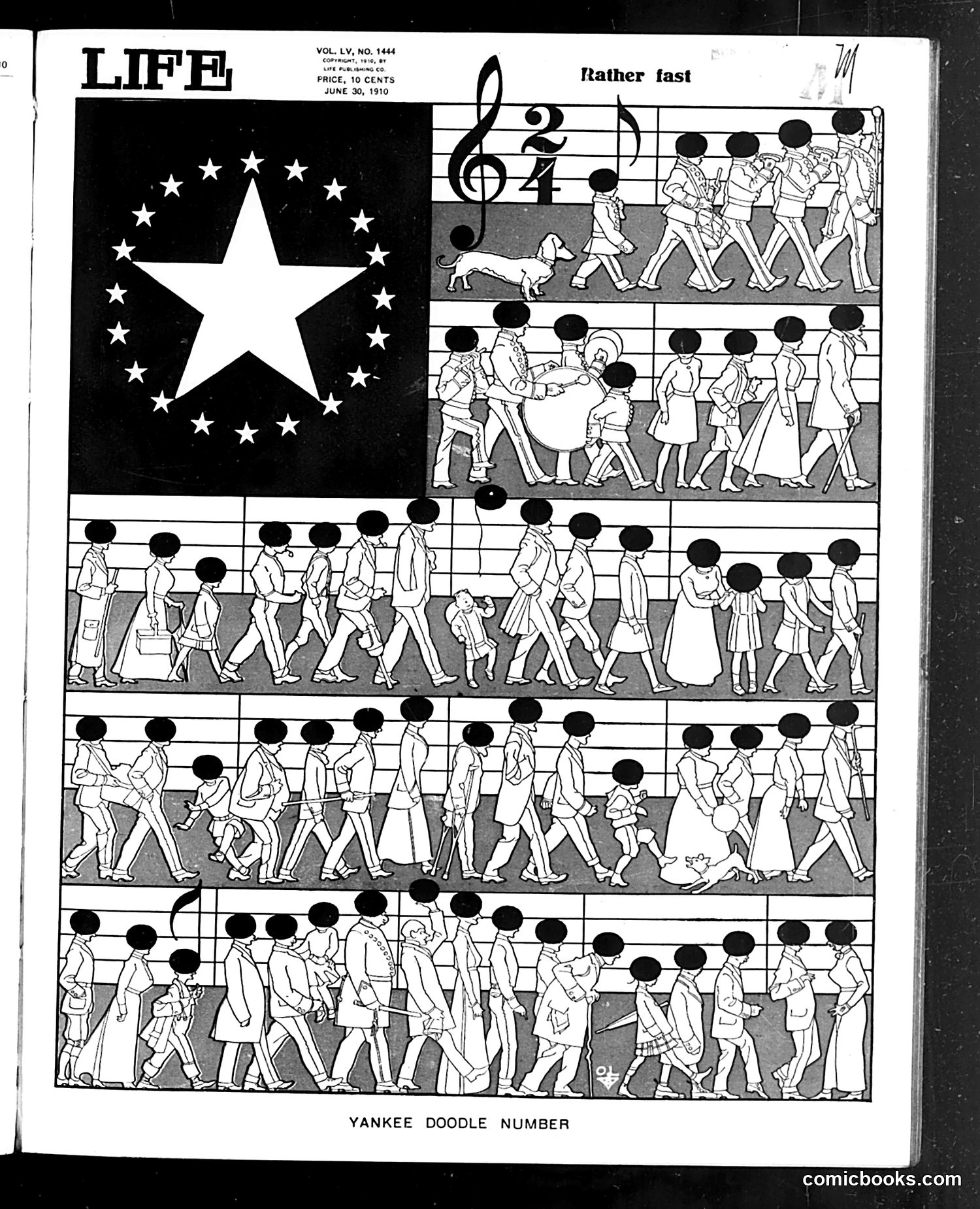
This is a musical arrangement of "Yankee Doodle" visualized as a marching procession. The sheet music (marked "Rather fast" in 2/4 time) appears above, with each musical note represented by figures in the rows below—people of various ages and appearances marching in formation, some carrying instruments or drums. The title references the patriotic American song "Yankee Doodle," and the star-surrounded emblem on the left suggests Fourth of July or American nationalism. This appears to be a clever visual pun: converting the familiar patriotic tune into a literal "parade" where human figures serve as the notes themselves, creating both humor and a comment on American popular culture during the Progressive Era.
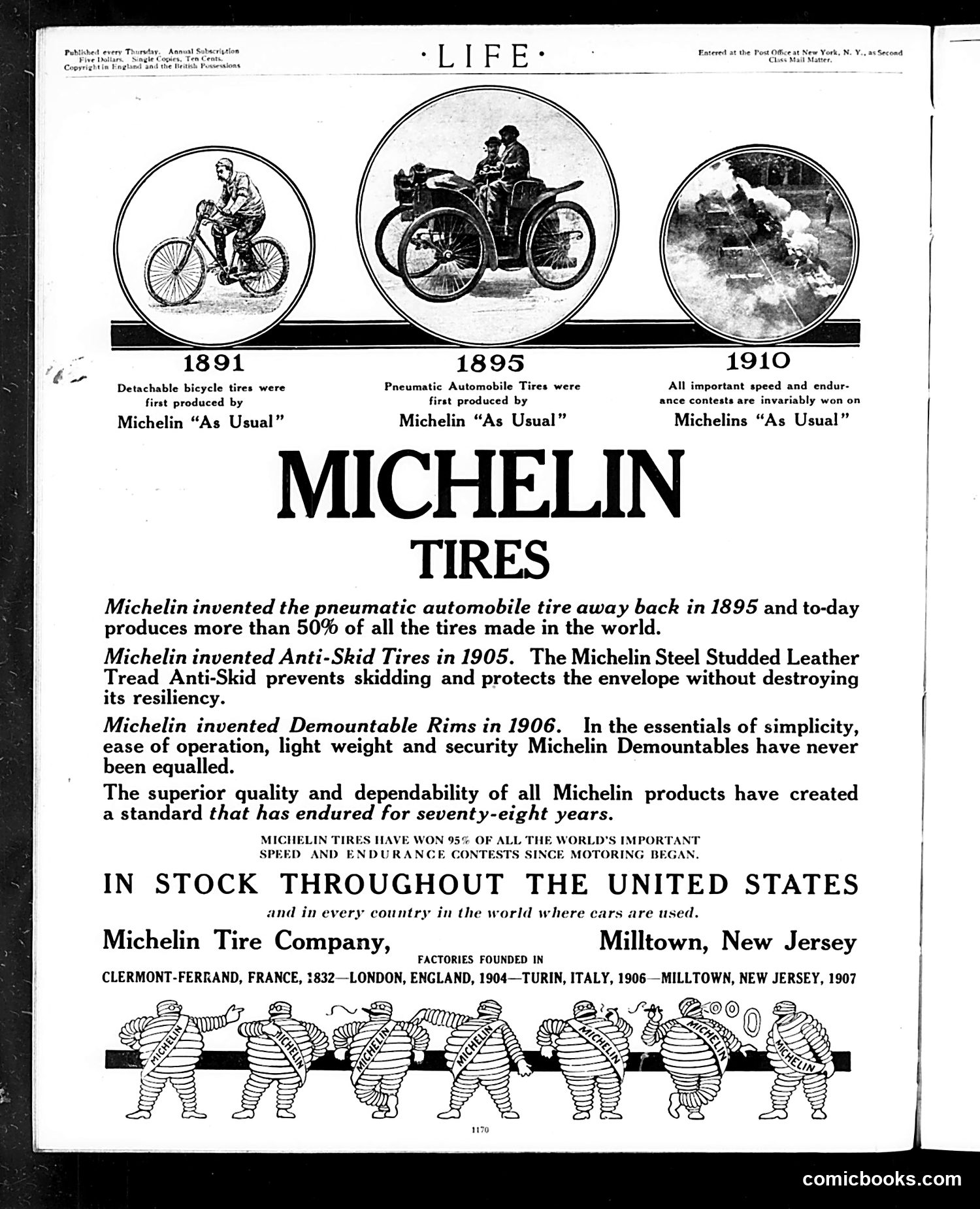
This is **not a political cartoon or satire**—it's a straightforward advertisement for Michelin Tires, published in *Life* magazine. The page presents three circular panels showing the evolution of Michelin products across nineteen years: detachable bicycle tires (1891), pneumatic automobile tires (1895), and racing vehicles (1910). The ad emphasizes Michelin's innovations and market dominance, claiming they produce over 50% of world tire production and have won 95% of speed and endurance contests. The famous Michelin Man mascot (the character made of stacked tires) appears at the bottom. The advertisement highlights manufacturing facilities across France, England, Italy, and New Jersey, positioning the company as a global leader in emerging automotive technology.
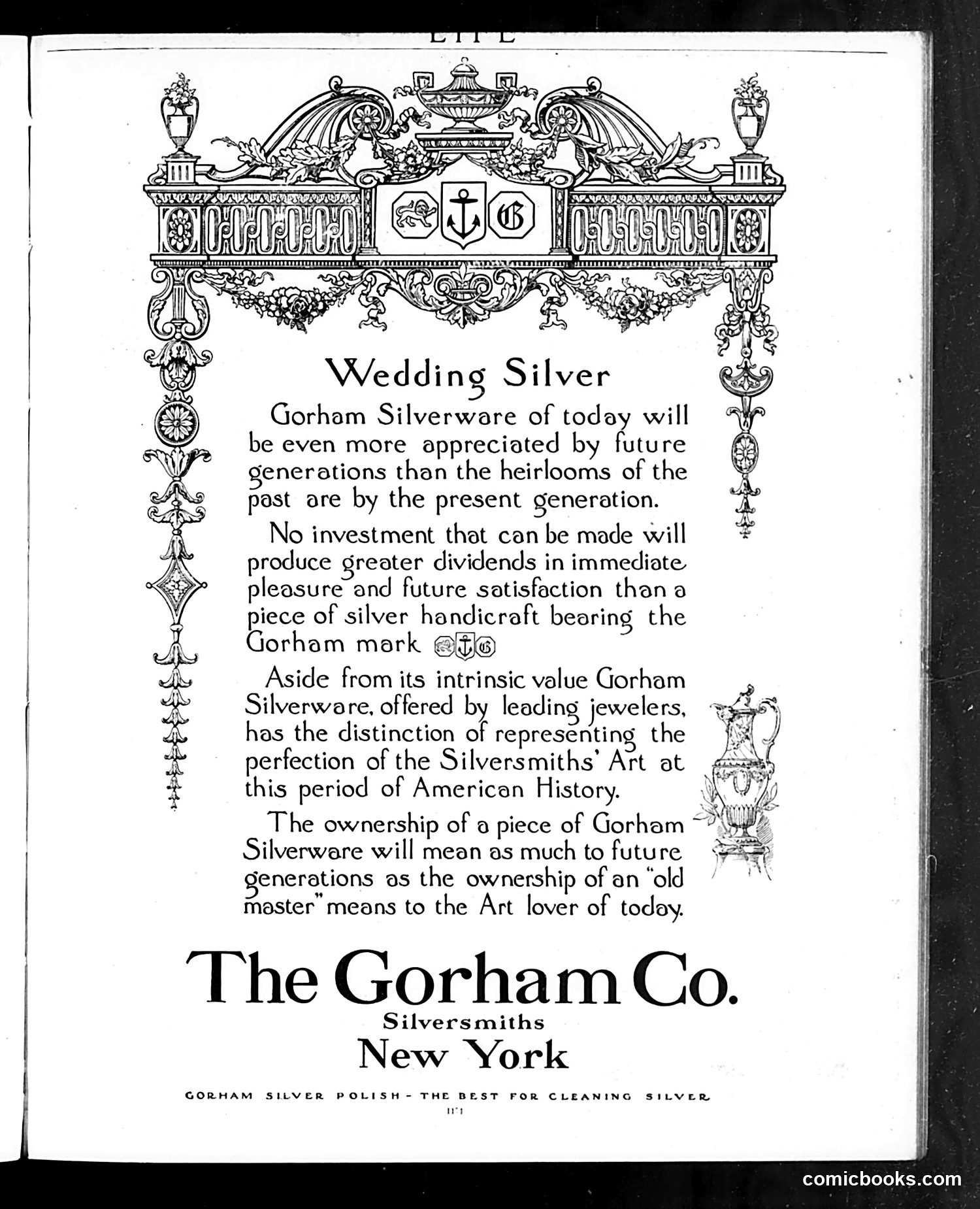
This page is primarily a **vintage advertisement**, not satire or political commentary. It's a full-page ad for The Gorham Co., silversmiths based in New York, promoting their silverware as wedding gifts. The ad uses ornamental decorative borders and imagery typical of early 20th-century luxury marketing. The text argues that Gorham silverware represents an investment in both immediate pleasure and lasting value—comparing ownership of their pieces to owning Old Master artworks. The appeal is to aspirational consumers seeking to signal refinement and good taste. The ad emphasizes craftsmanship and the Gorham brand's reputation as representing "the perfection of the Silversmiths' Art at this period of American History." There is no political satire present on this page.
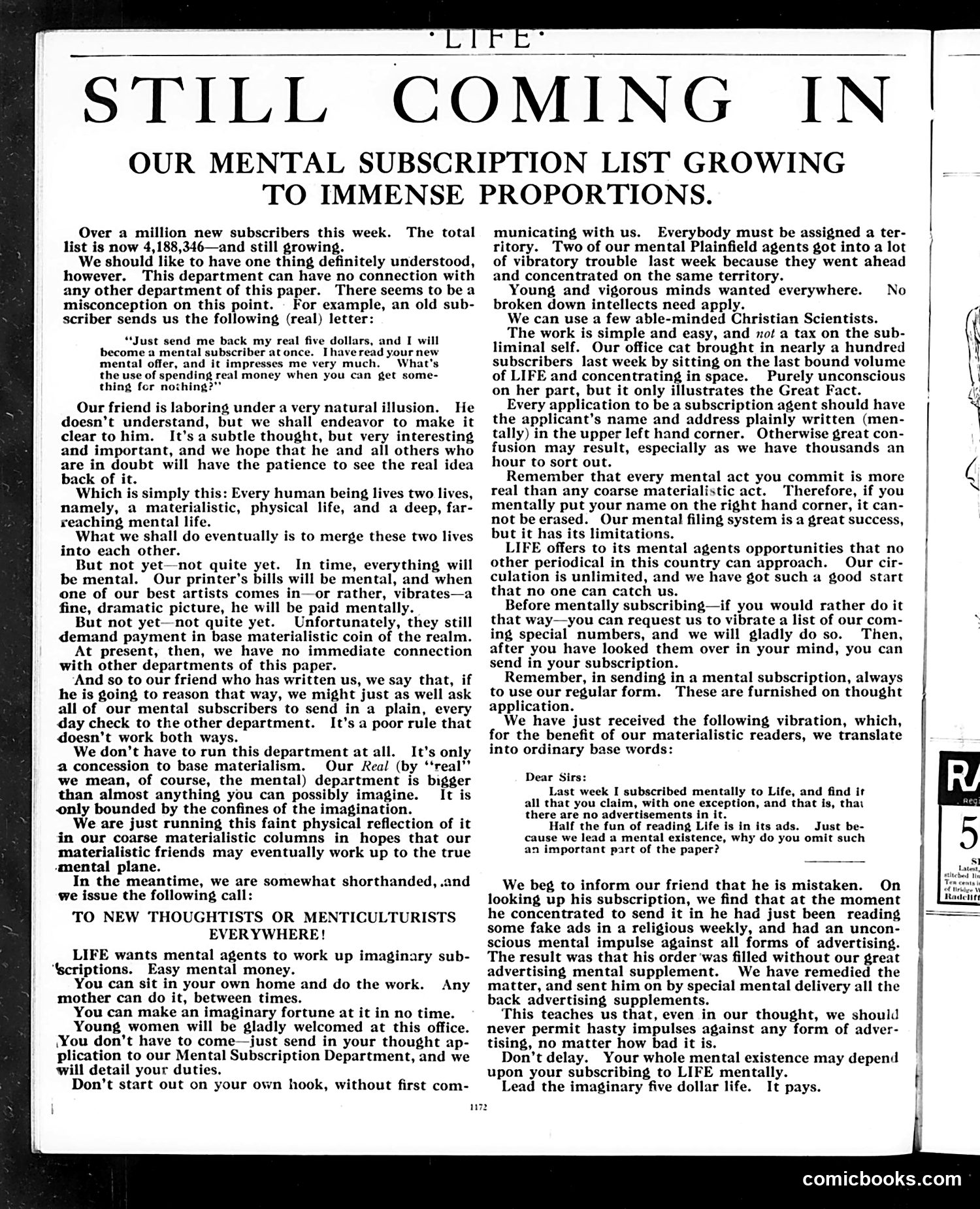
This page from *Life* magazine is satirical editorial content, not a cartoon. It mocks the magazine's own "Mental Subscription" department—a fictional service offering imaginary subscriptions sold through thought alone. The satire targets New Thought and mentalist movements popular in early 20th-century America, which claimed consciousness could materially alter reality. *Life* absurdly promotes "mental agents" who can establish subscriptions purely through visualization and "vibratory" mental acts, requiring no physical payment. The joke satirizes both the gullibility of subscribers believing in such pseudoscience and the magazine's own commercial desperation. The self-aware humor—admitting the scheme doesn't work but promoting it anyway—critiques the era's credulity toward mental-power fads while poking fun at magazine marketing tactics.
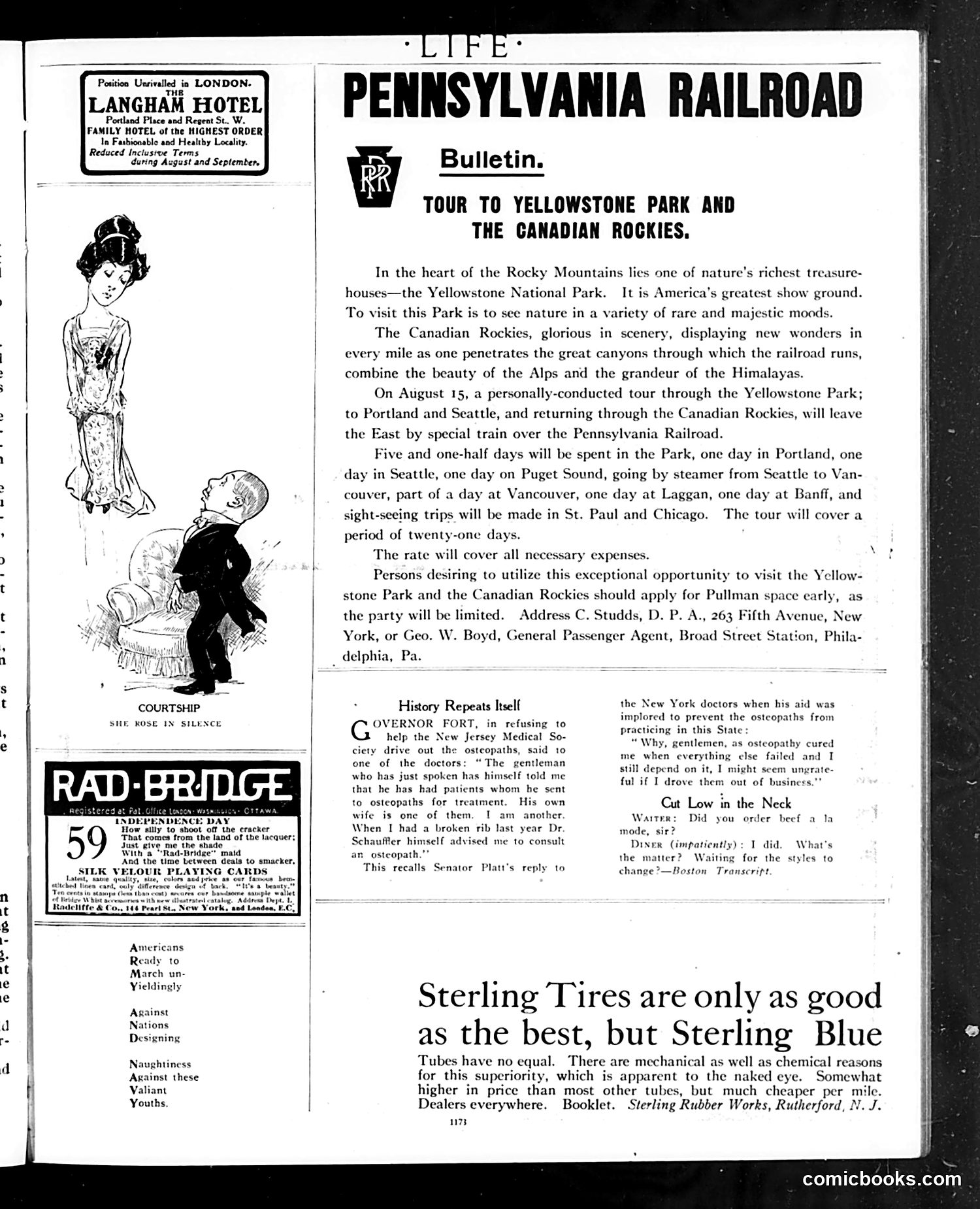
This cartoon depicts a romantic scene: a woman in an elegant dress stands while a man in dark clothing kneels before her. The caption "She Rose in Silence" plays on a double meaning—she literally rises/stands up, yet the phrase suggests emotional restraint or perhaps reluctance, implying the proposal isn't entirely welcome or she's uncertain about responding. The satire appears to mock the formality and awkwardness of Victorian-era courtship rituals, where both parties maintain composed silence despite significant emotional stakes. The woman's blank expression and the man's dramatic pose suggest the performative nature of such moments. The page contains primarily advertisements (Pennsylvania Railroad tour, Rad-Bridge playing cards, Sterling Tires), making this cartoon one of few editorial illustrations.
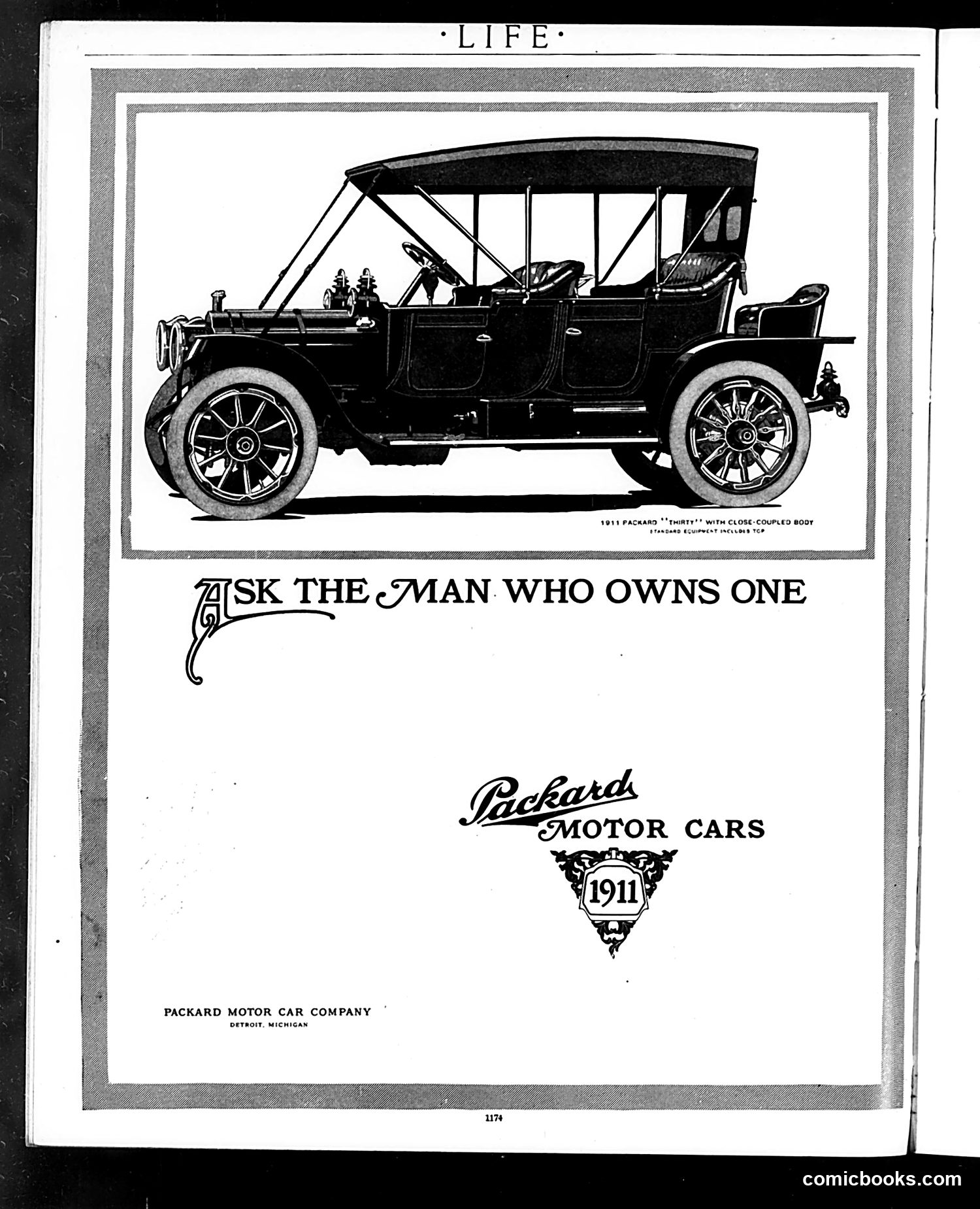
This is a **Packard Motor Car advertisement**, not satire or political commentary. The page shows a 1911 Packard "Thirty" automobile with an enclosed body and features the slogan "Ask the Man Who Owns One." There is no cartoon or political content to analyze. The advertisement uses a straightforward appeal to potential customers, relying on the car's reputation among existing owners as a selling point. The elegant illustration and formal layout are typical of early 20th-century luxury automobile marketing, targeting wealthy consumers who could afford premium vehicles like the Packard. This represents commercial advertising from Life magazine's advertising section, not editorial or satirical content.
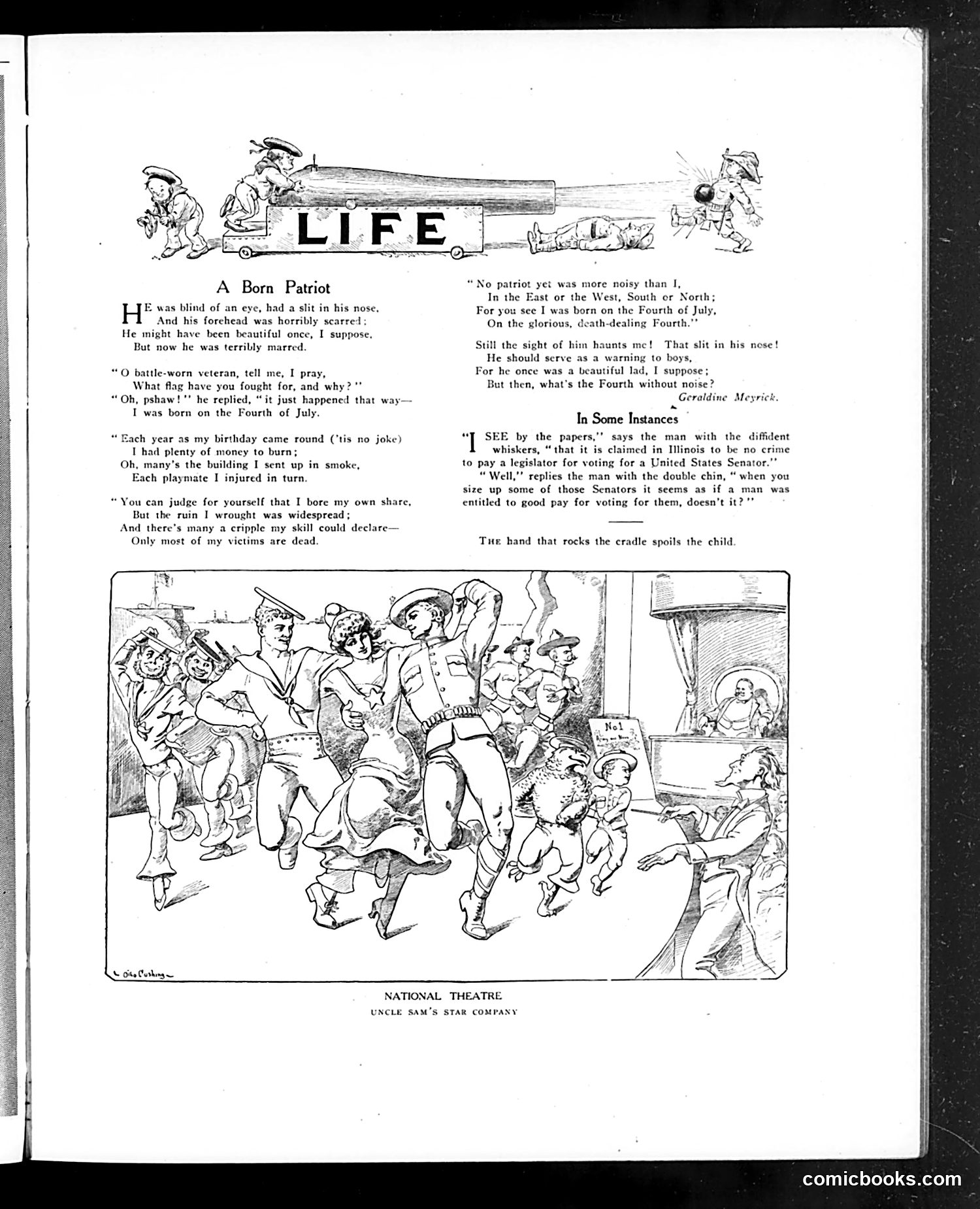
This page satirizes American patriotism and political corruption. The poem "A Born Patriot" mocks a man born on July 4th who boasts of patriotic credentials but is actually a corrupt politician—he caused financial ruin and loss of life through his misdeeds. The section "In Some Instances" lampoons voting fraud and bribery in Illinois politics, where legislators apparently accepted payment for voting a certain way in Senate elections. The illustration depicts Uncle Sam's theatrical company performing for crowds, suggesting politicians are performative actors rather than genuine servants. The cartoon implies American patriotism is often theatrical posturing masking actual corruption and self-interest—a critique of politicians who wrap themselves in the flag while enriching themselves.
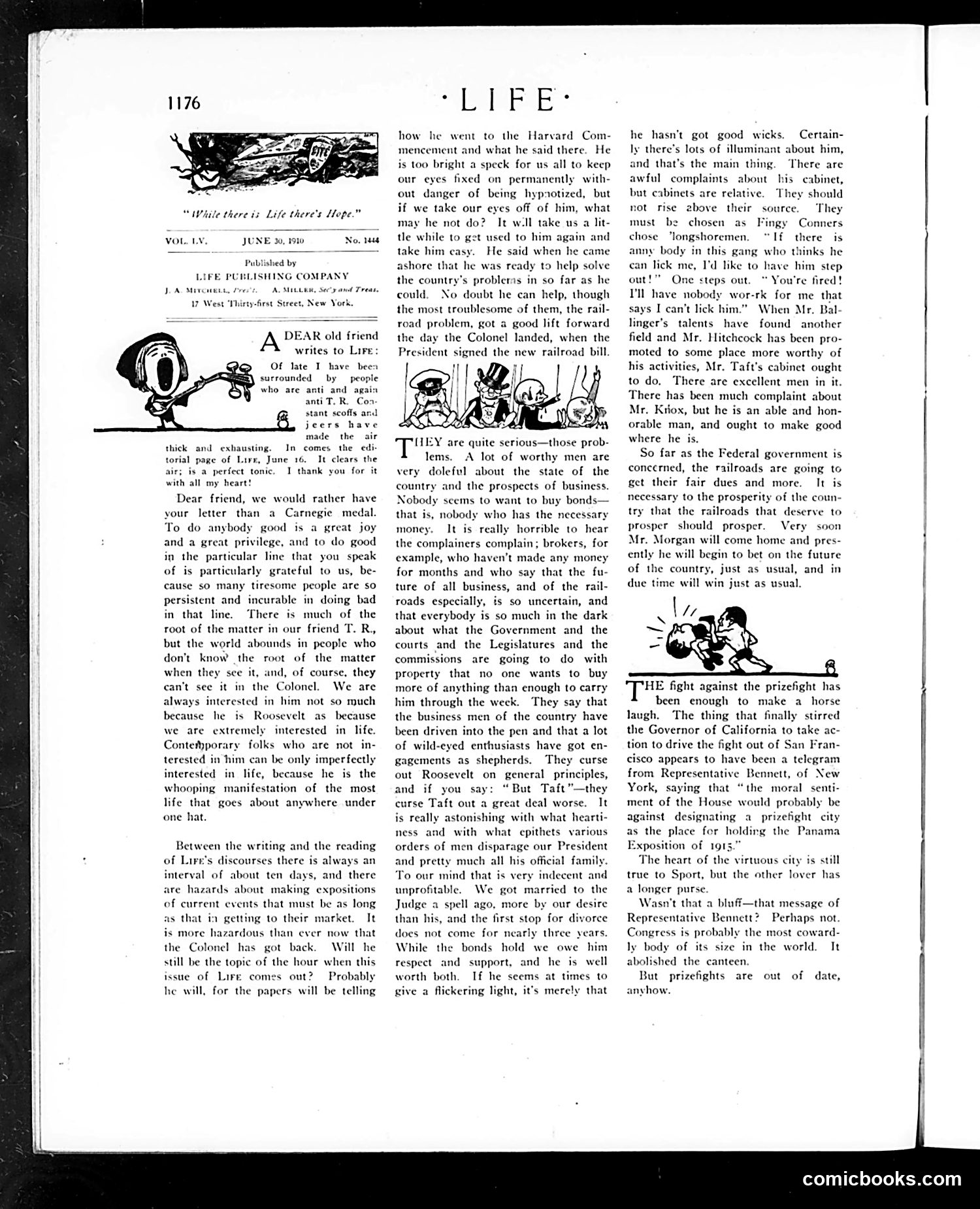
This page contains editorial commentary on contemporary political and business concerns rather than cartoons. The main illustration shows three figures in what appears to be a satirical scene about government and business relations. The text criticizes President Theodore Roosevelt's policies and cabinet, mentioning complaints about his administrators (particularly referencing "Fingy" Connors and "Longshoresmen"). It discusses anxieties about railroad regulation, the Federal government's role in business, and uncertainty in the economy. A secondary piece mocks prizefighting and references the Governor of California's efforts to ban a fight at the Panama-Pacific Exposition, suggesting the moral debate around boxing was a significant contemporary issue. The overall tone reflects Progressive Era skepticism toward both big business and government intervention.
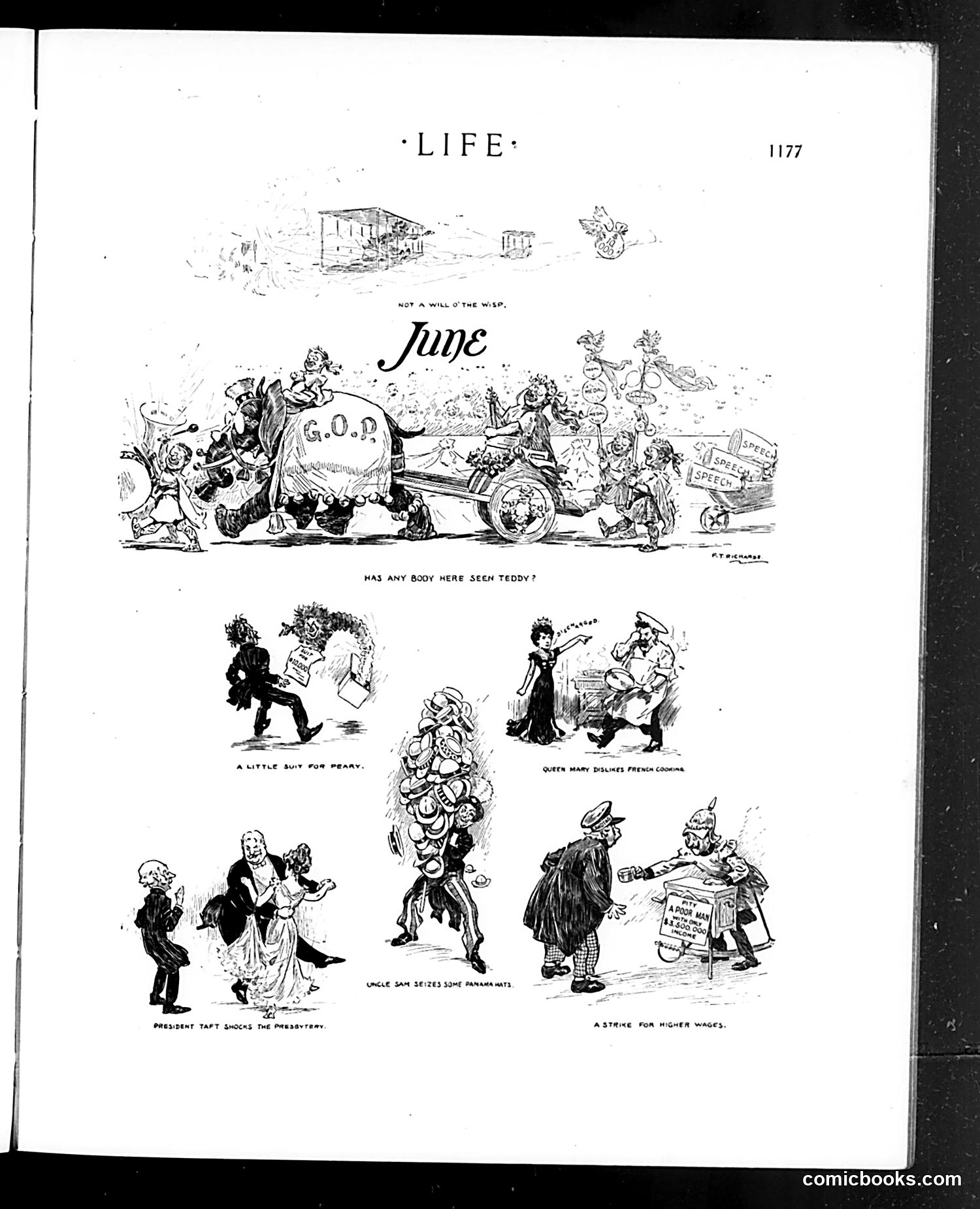
This is a June-themed satirical page from *Life* magazine featuring several political and social commentary cartoons. The top illustration labeled "Not a Will o' the Wisp" depicts a large figure labeled "G.O.P." (Republican Party) being pulled by various characters, suggesting party chaos or conflicting directions. Below are six smaller cartoons addressing contemporary issues: - "A Little Suit for Piracy" and "President Taft Shocks the Presidency" appear to reference Theodore Roosevelt and William Howard Taft's political tensions - "Queen Mary Dislikes French Cooking" references British royal matters - "Uncle Sam Secures Some Armor-Plats" and "A Strike for Higher Wages" address military preparedness and labor disputes The satire targets political leadership, international relations, and economic tensions of the early 1910s era.
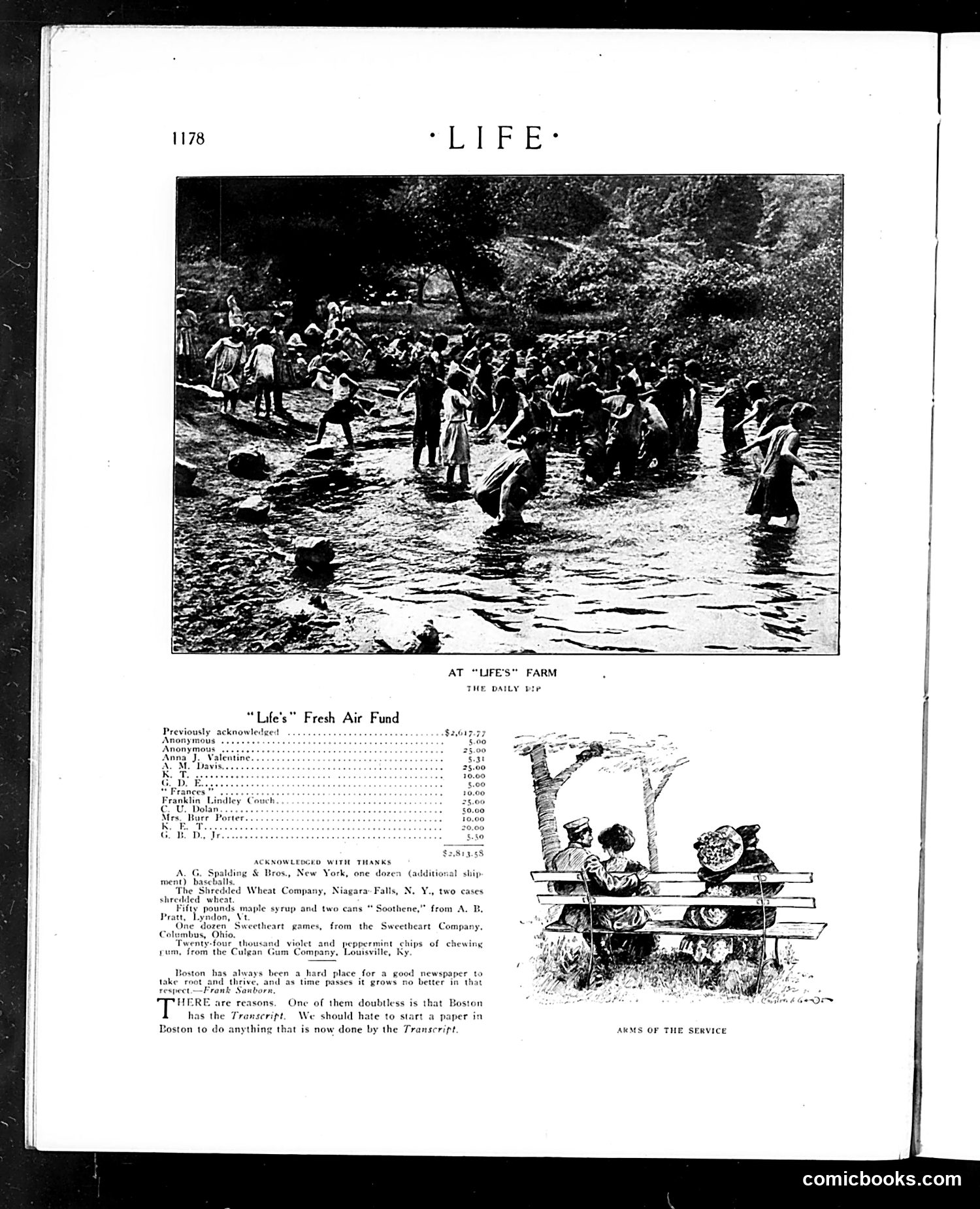
This Life magazine page (1178) documents the "Life's Fresh Air Fund," a charitable initiative providing outdoor recreation for urban children. The top photograph shows children and adults at a swimming hole or creek at "Life's Farm," illustrating the fund's work. The page lists donors and contributions totaling $7,813.38, acknowledging supporters like A.G. Spalding & Bros. and various individuals. The illustration captioned "Arms of the Service" depicts two figures in a cart or wagon, likely representing the practical work of delivering aid or transporting children to these recreational facilities. This appears to be a straightforward charitable fundraising and acknowledgment page rather than political satire. It reflects early 20th-century Progressive Era concern for urban children's welfare and access to nature.
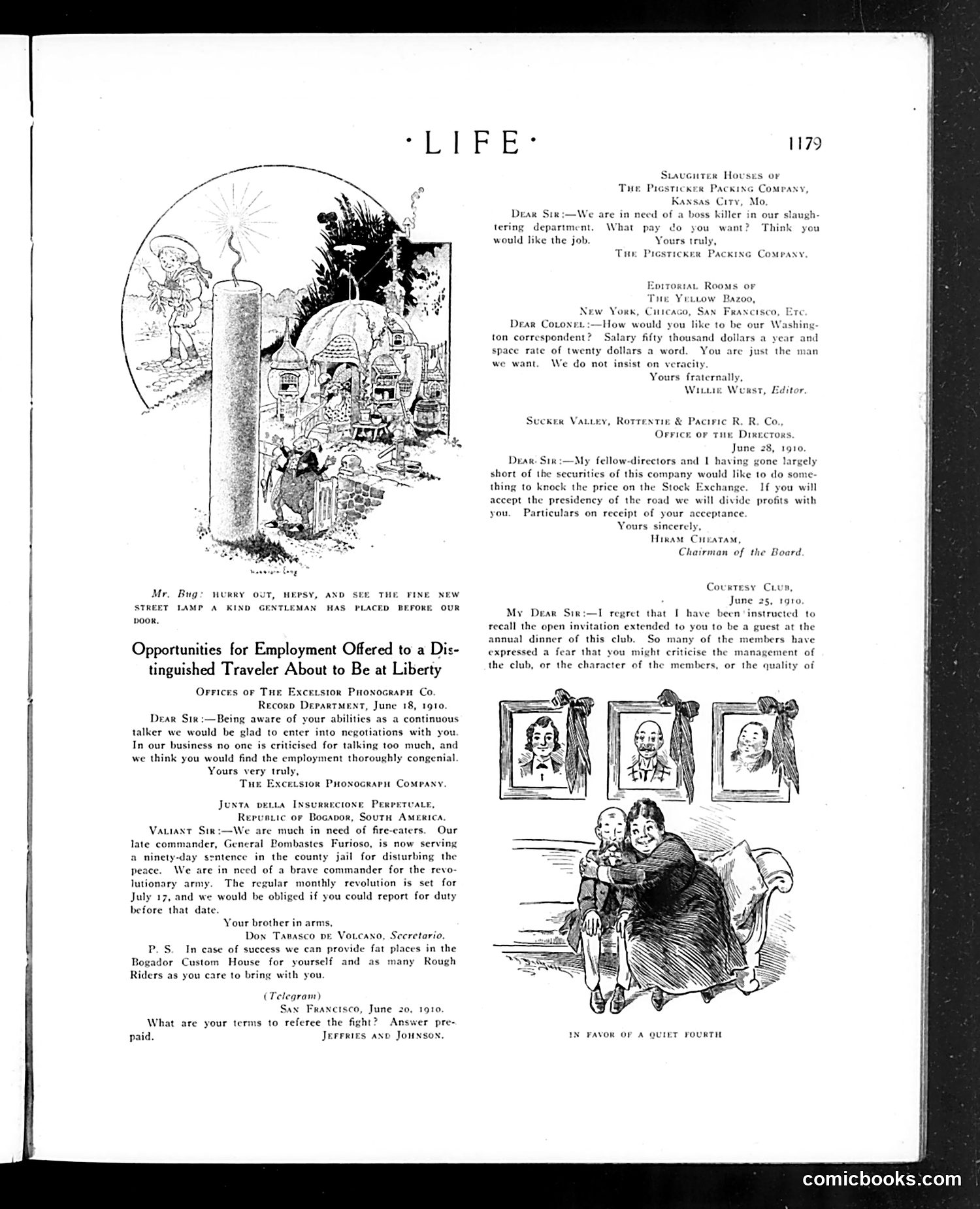
This page contains satirical employment "opportunity" letters, a common Life magazine feature mocking absurd job offers and requests. The main cartoon illustrates the concept of a "distinguished traveler" receiving ridiculous employment proposals. The letters parody real correspondence, including: - A meatpacking company seeking a "boss killer" - A South American revolutionary group requesting a military commander - A boxing promotion requesting referee services The humor derives from the absurdity of these offers—treating serious or violent occupations as casual employment opportunities for a random "distinguished traveler." The accompanying illustration shows a bewildered gentleman overwhelmed by impossible job proposals, satirizing both the desperation of job-seekers during this period and the equally absurd nature of some actual employment advertisements.
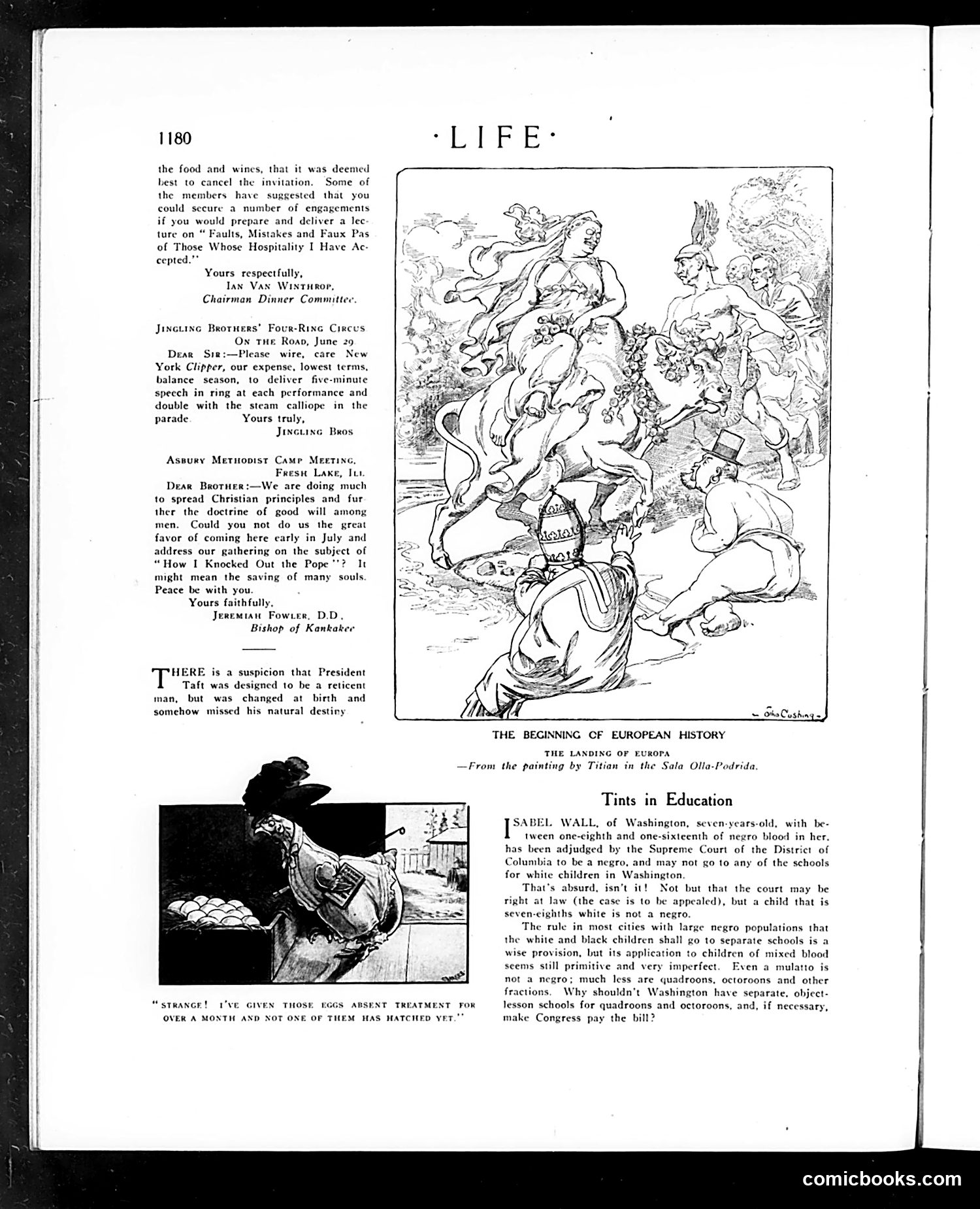
This page contains three distinct sections: **Top letters**: Correspondence about circus expenses, Methodist camp meetings, and a comment on President Taft being "changed at birth." **Main illustration**: Titled "The Beginning of European History," this is a classical/mythological scene attributed to Titian showing cherubs and figures in an allegorical composition—likely satirizing grandiose historical narratives or artistic pretension. **Lower cartoon & article**: Shows a figure (unclear who) with the caption about eggs and absent treatment. The accompanying article "Tints in Education" discusses a Supreme Court case regarding Isabel Wall, a seven-year-old of mixed race in Washington, D.C., who was barred from white schools. The commentary critiques the ruling and advocates for integrated or separate-but-equal education rather than exclusion based on racial classifications.
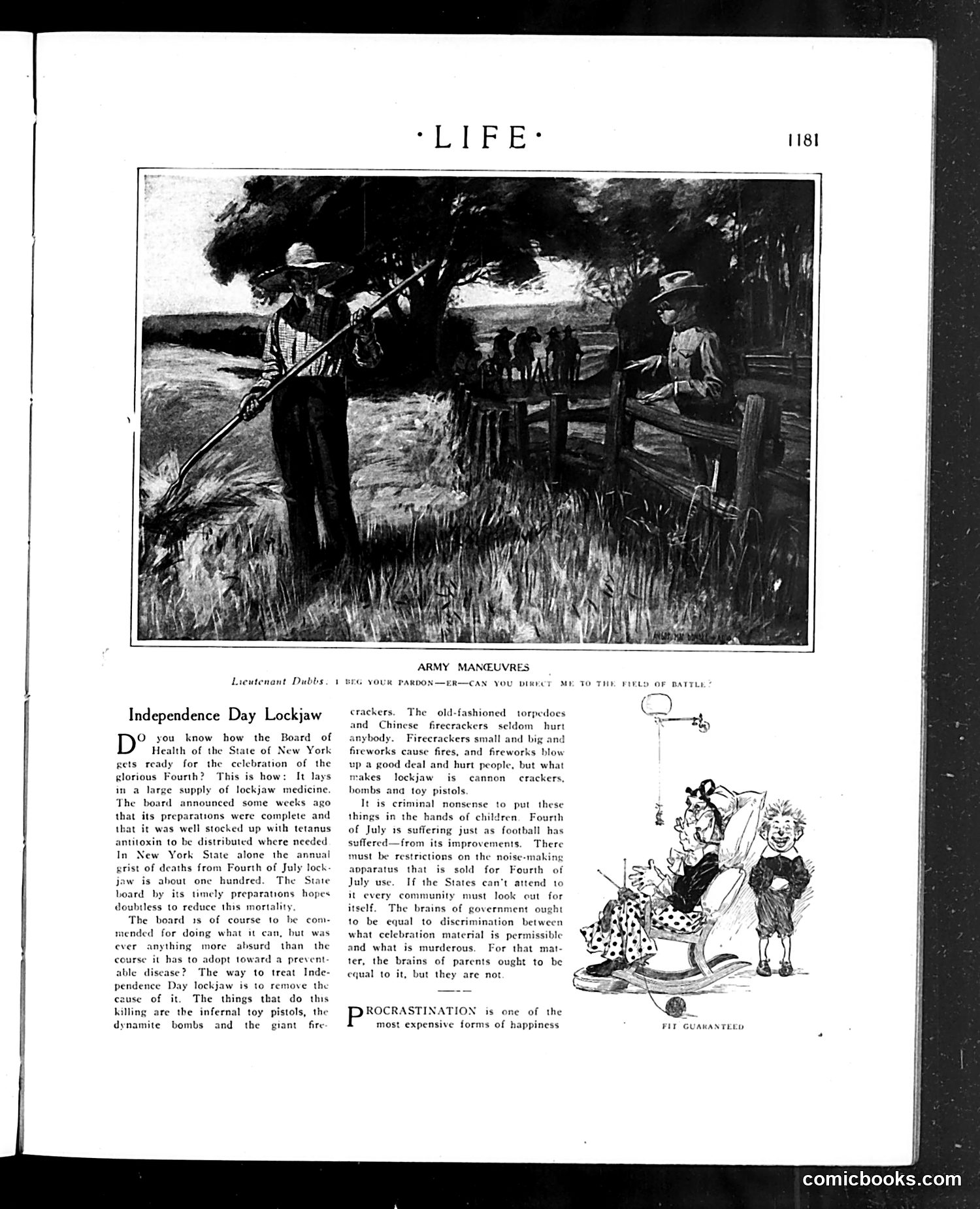
The page contains two distinct elements: **Top image**: "Army Manoeuvres" depicts a military officer addressing soldiers in a field, captioned with dialogue about pardons and battle conditions. This appears to be satirizing military hierarchy or wartime command decisions. **Main article**: "Independence Day Lockjaw" critiques the Board of Health's approach to Fourth of July celebrations. The text argues that lockjaw (tetanus) mortality from fireworks requires stricter regulations on firecrackers, bombs, and toy pistols sold to children. The satire targets government inconsistency: they ban dangerous items yet allow their sale annually, resulting in preventable deaths. **Right cartoon**: Shows a child with a dog, captioned "Fit Guaranteed"—likely sarcastically commenting on the risks to children from unregulated fireworks. The page advocates for public health safety measures during Independence Day festivities, a recurring early-20th-century concern.
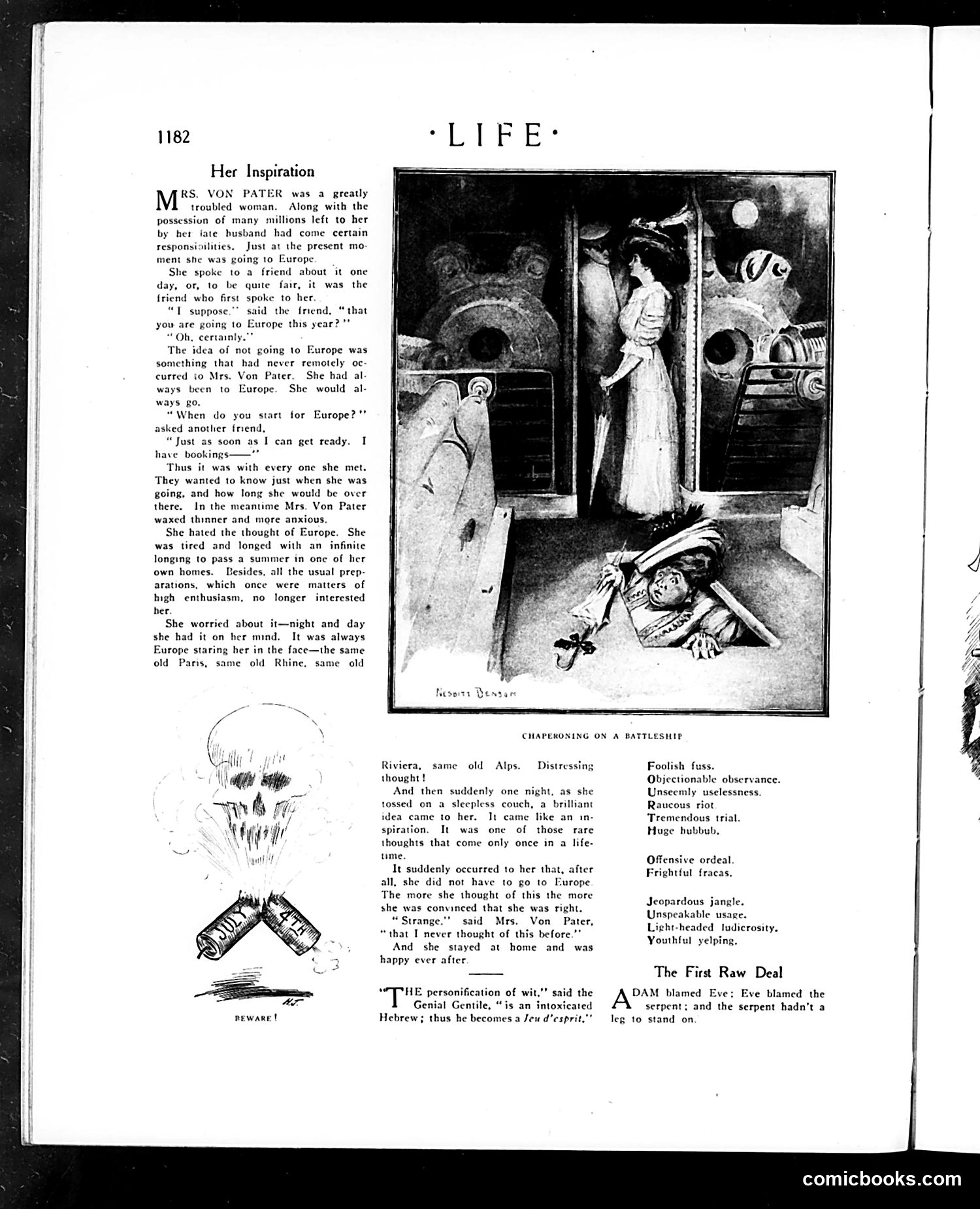
This satirical piece mocks wealthy American society's obsession with European travel as mandatory social performance. **The Main Story ("Her Inspiration"):** Mrs. Von Pater, a wealthy widow, feels obligated to make her annual European pilgrimage—visiting Paris, the Rhine, and the Riviera—because it's what wealthy people "do." She dreads it but can't admit this to her friends, who badger her with questions about her travel dates. The satire's punch line: she suddenly realizes she *doesn't* have to go and stays home happy instead. The joke targets upper-class conformity and the hollow performance of sophistication. **The Illustrations:** The top image labeled "Chaperoning on a Battleship" and the accompanying word list (mocking descriptions like "Offensive ordeal," "Frightful fracas," "Light-headed ludicrosity") suggest commentary on women's constrained roles in society—they must participate in tiresome social obligations. **"The First Raw Deal":** A brief quip blaming Eve for humanity's troubles, playing on the Adam-and-Eve origin story with wordplay ("Jeu d'esprit"—a witty remark). The overall message critiques vapid upper-class conformity.
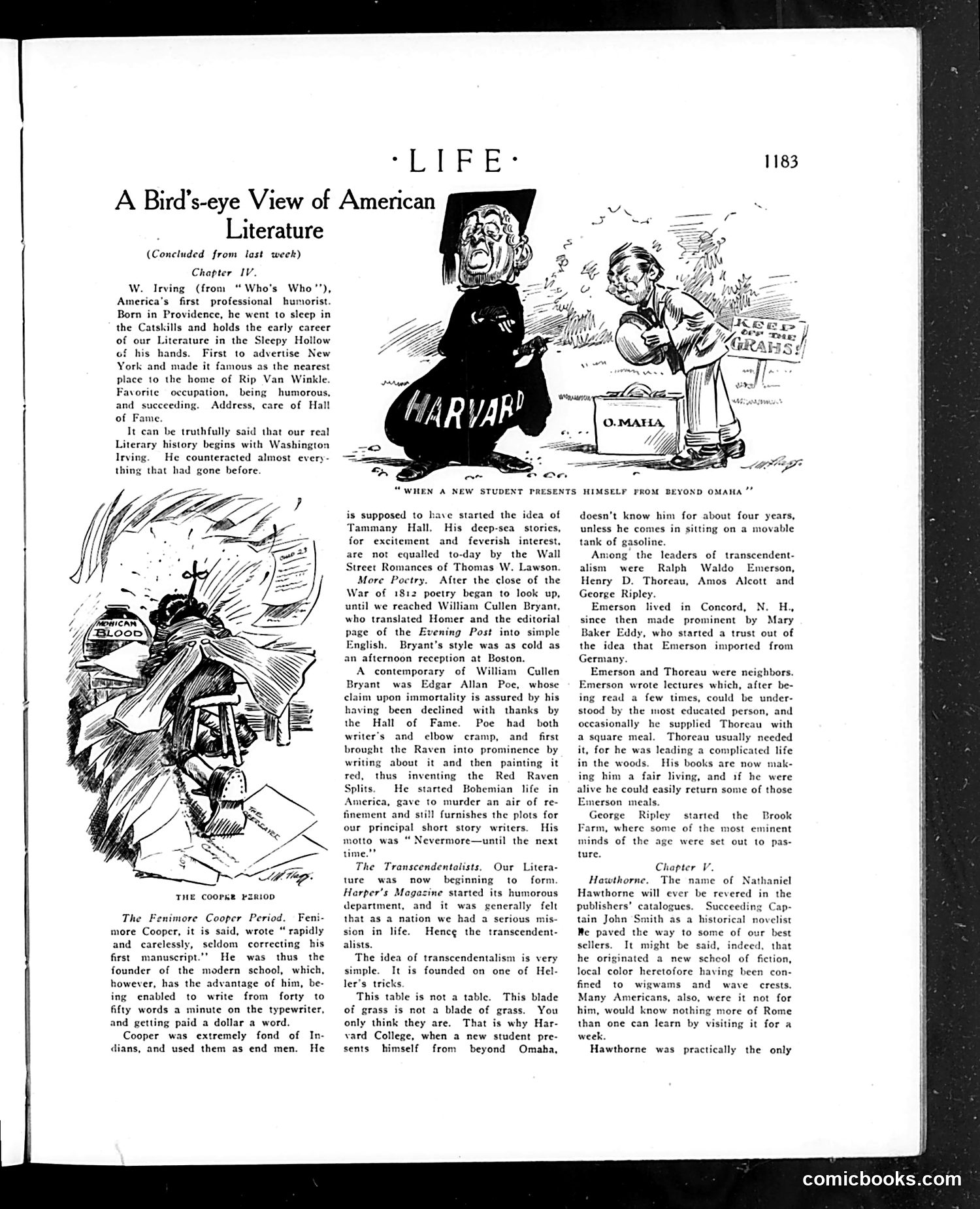
This page satirizes American literary history through mock-serious commentary. The main cartoon depicts **Harvard College** personified as a stern academic figure confronting a naive student "from beyond Omaha"—satirizing the intellectual pretension and obscurity of transcendentalist philosophy taught there. The text mocks transcendentalism's core concept: that everyday objects aren't what they seem ("This table is not a table"). The joke is that Harvard students from the Midwest cannot understand this philosophy for four years—unless arriving "sitting on a movable tank of gasoline" (implying they need external assistance). The satire targets **intellectual elitism** and the gap between practical American life (represented by "Omaha," the frontier) and East Coast academic snobbery. Life magazine, known for irreverent humor, uses exaggeration and absurdist logic to deflate the pretensions of transcendentalist literature and Harvard's role in promoting it. The accompanying literary sketches continue this theme of mocking America's self-important literary figures.
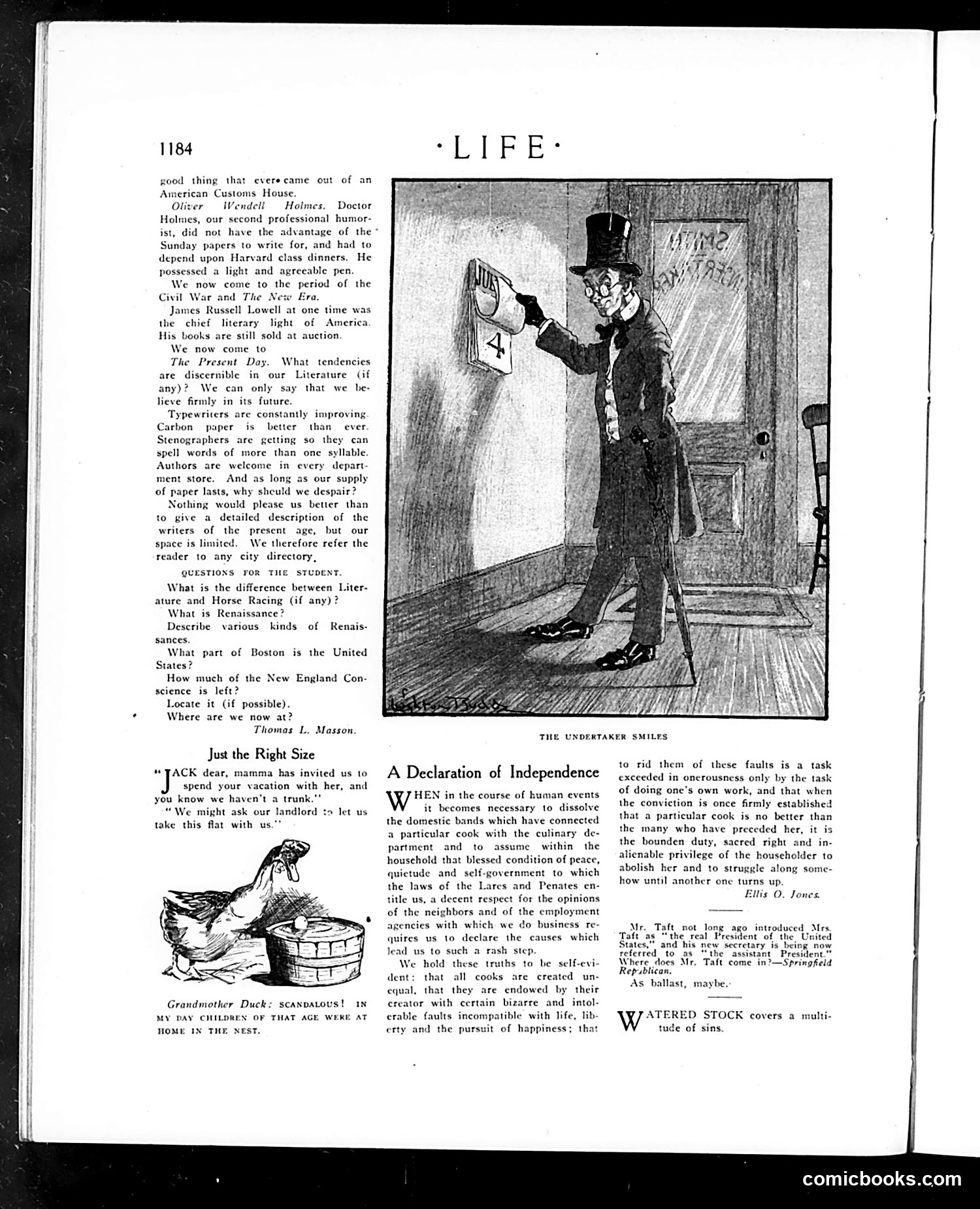
This Life magazine page contains satirical pieces mocking domestic life and American pretensions: **"The Undertaker Smiles"** (cartoon): Shows a figure posting a notice—likely evicting or removing a cook from employment. The satire targets the casual cruelty of firing domestic servants, with the "undertaker" metaphor suggesting the cook's social death. **"A Declaration of Independence"** (text): Parodies the actual Declaration of Independence, but instead of colonial grievances, it comically lists reasons for firing one's cook. The satire mocks both household servants' incompetence and employers' dramatic self-justification for firing them. The reference to "Lares and Penates" (Roman household gods) adds mock-heroic pomposity. **"Just the Right Size"** (joke): A couple considers taking their rented apartment with them on vacation rather than buy luggage—mocking either poverty or absurd practicality. The "Grandmother Duck" response satirizes nostalgia for simpler times. The page satirizes class relations, domestic help, and American life's petty concerns. The tone assumes readers recognize themselves in these portraits of household management anxiety.
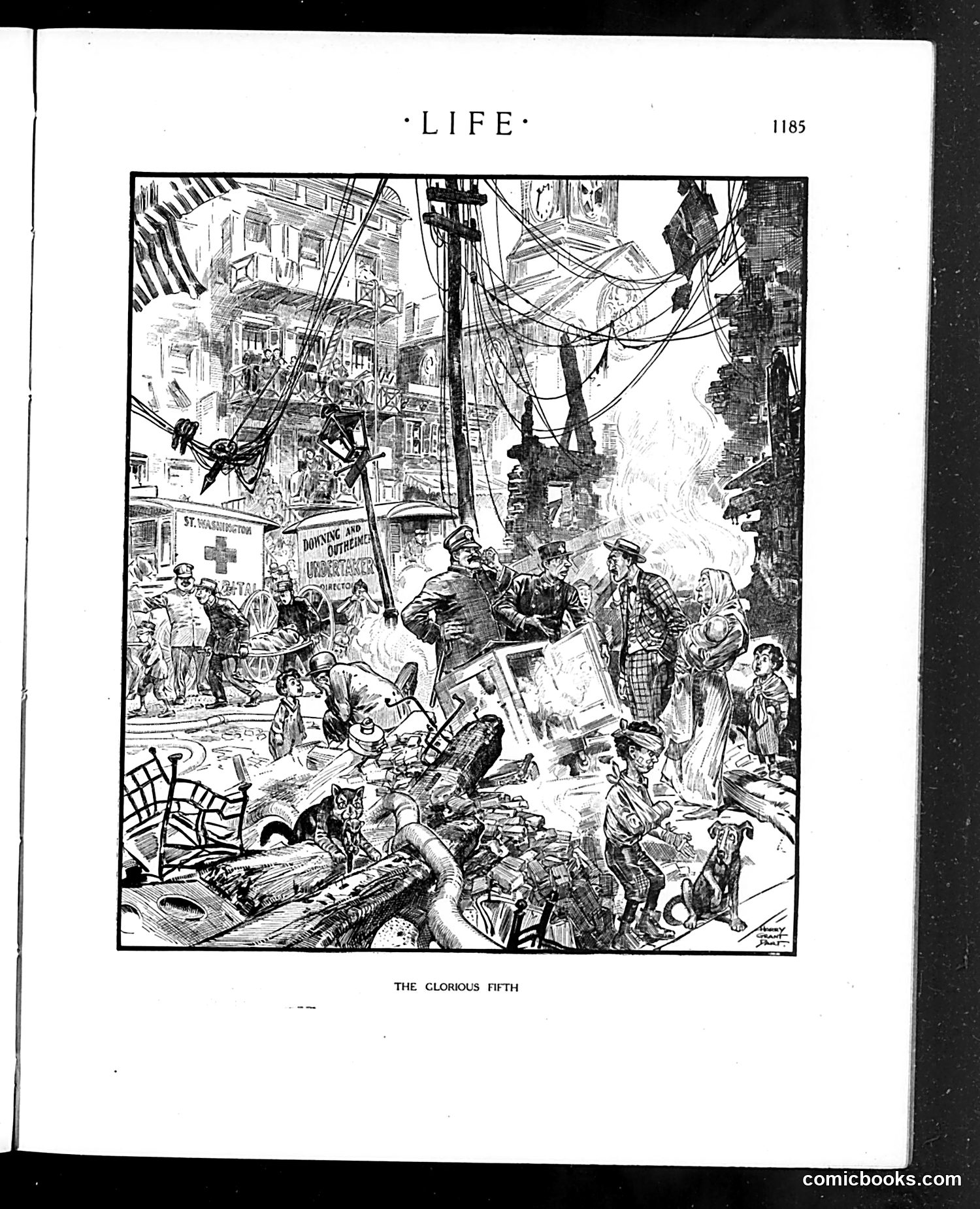
This is a satirical illustration depicting what appears to be a chaotic street scene in an urban tenement district. The cartoon shows numerous figures—working-class people, children, and what appear to be officials or authority figures—amid debris, laundry lines, and cramped buildings. The title "The Glorious Fifth" likely refers to the Fifth Ward or a similar urban district known for poverty and overcrowding. The satire appears to critique urban living conditions, possibly commenting on tenement housing, sanitation, or municipal mismanagement in early 20th-century America. The crowded, cluttered composition emphasizes the disorder and difficulty of life in such neighborhoods. Without additional context from the magazine's date or accompanying text, the specific political target remains unclear, though the work evidently mocks idealized descriptions of such impoverished areas.
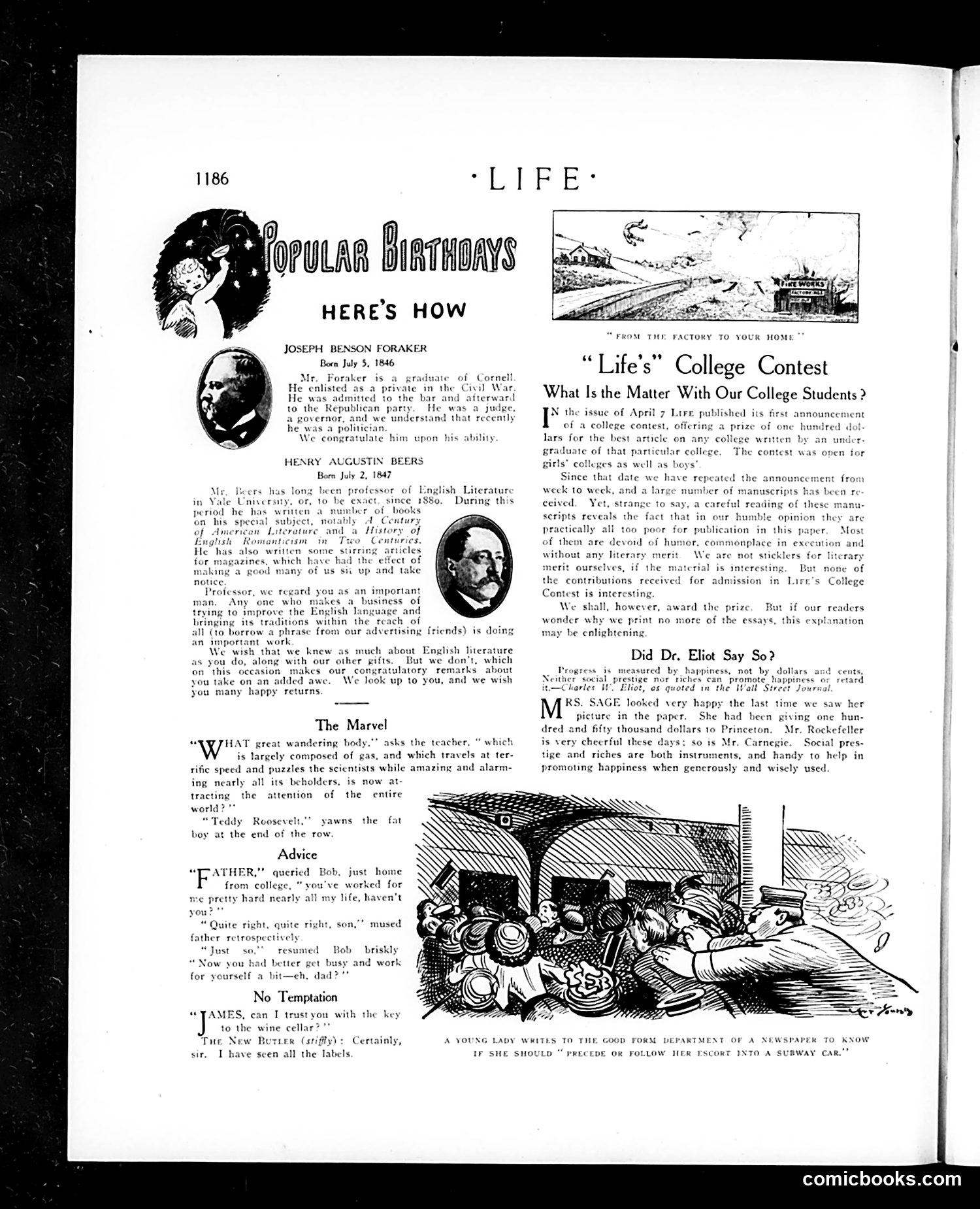
This page combines satirical biographical sketches with humor pieces typical of Life magazine's format. **"Popular Birthdays"** features Joseph Benson Foraker (born July 3, 1846) and Henry Augustin Beers (July 2, 1847)—notable American public figures whose accomplishments Life briefly celebrates, though with tongue-in-cheek tone ("We congratulate him upon his ability"). **"The Marvel"** cartoon satirizes Theodore Roosevelt's popularity. A teacher asks what "great wandering body" travels at tremendous speed and mystifies scientists. A bored student answers "Teddy Roosevelt"—mocking Roosevelt's frenetic activity and public obsession with him during his presidency. **Other humor pieces** include gentle domestic comedy ("Advice," "No Temptation") and an etiquette question about subway car protocol for young women—reflecting early-1900s anxieties about modern social situations and propriety. The **college contest** section discusses submissions about college life, noting their mediocrity. Overall, this reflects Life's role as sophisticated humor for educated readers commenting on contemporary politics, literature, and social change.
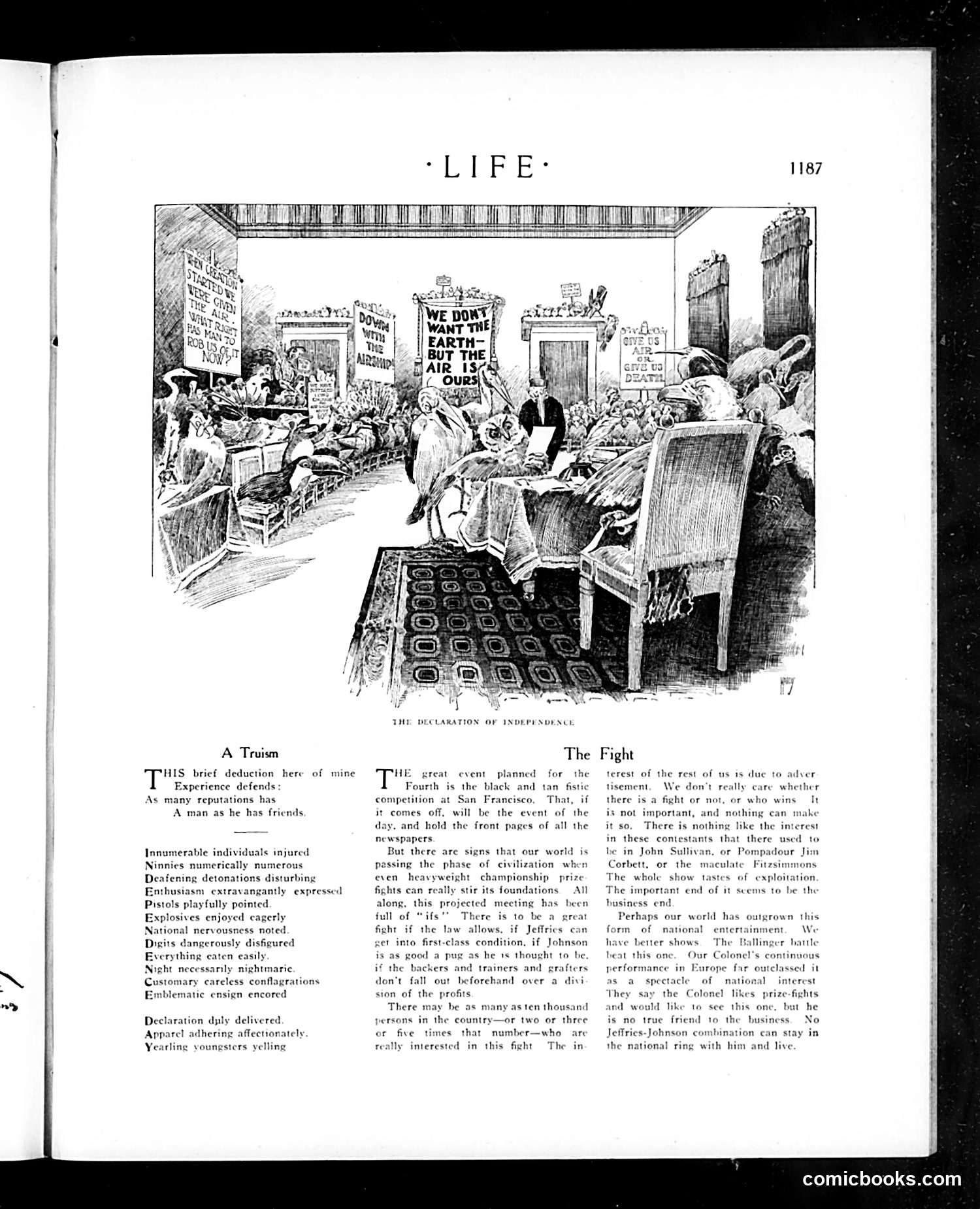
This satirical cartoon depicts a crowded indoor meeting where citizens hold protest signs demanding "We don't want the earth—but the air is ours!" The scene mocks public anxiety about air pollution and environmental quality during an era of industrial expansion. The left column lists grievances in mock-formal language ("Declaration duly delivered / Apparel adhering affectedly"), parodying the original Declaration of Independence's structure to criticize contemporary social complaints. The accompanying article discusses a boxing match between Jeffries and Johnson, suggesting this page contrasts serious civic concerns with sensational entertainment. The satire suggests Americans prioritize spectacle over substantive environmental and social issues, a critique that remains relevant today.
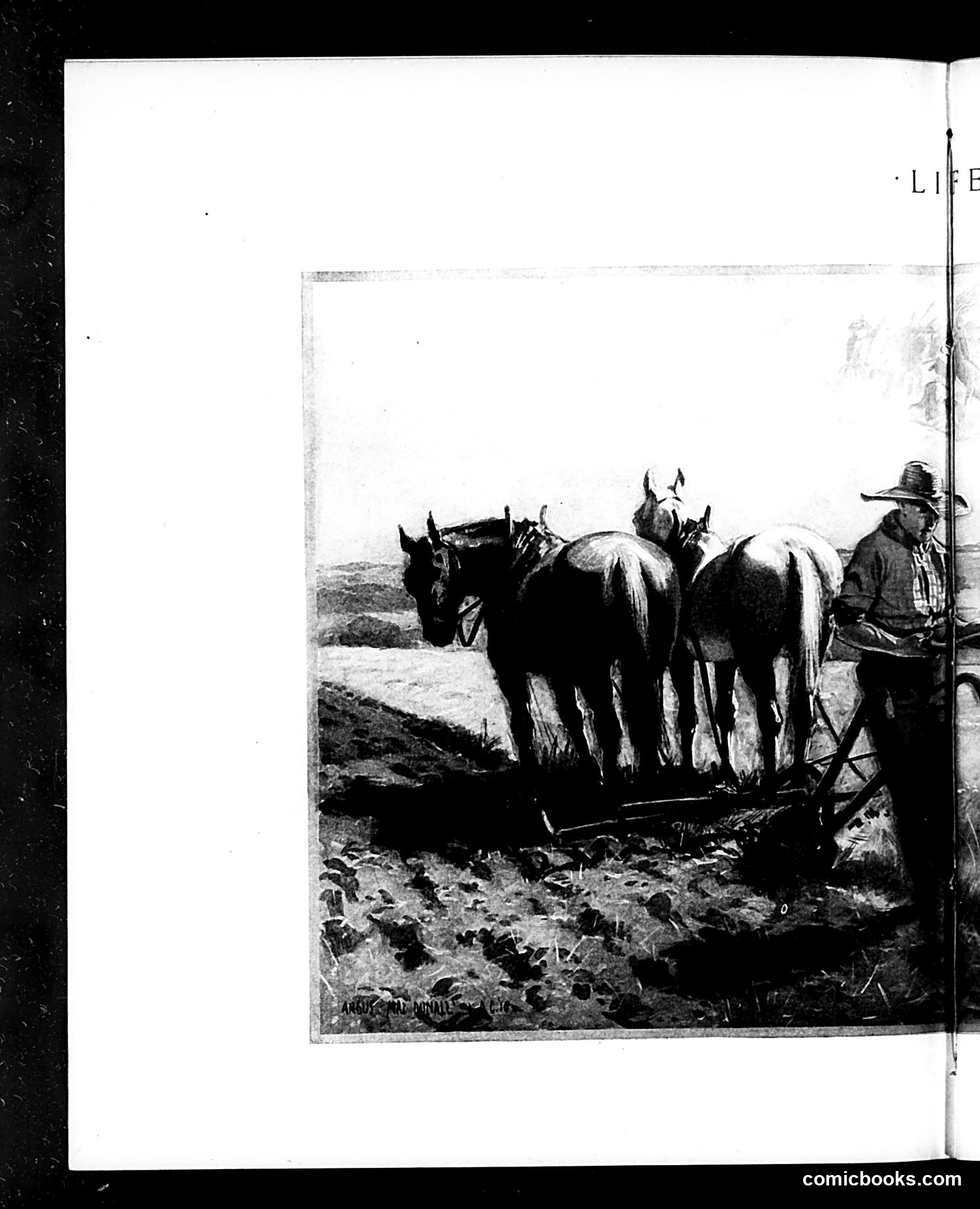
This page from *Life* magazine shows a photograph rather than a cartoon—depicting a man in a hat and work clothes standing with a team of mules or horses hitched to farming equipment. The image appears to document agricultural labor, likely from the early-to-mid 20th century based on the photographic style and clothing. Without additional visible text or captions on this particular page, I cannot definitively identify the specific political or social commentary intended. The image may illustrate farming conditions, labor practices, or rural American life of its era, but the satirical point or specific reference—if one exists—is unclear from what's visible here. More context from surrounding pages would be needed for accurate interpretation.
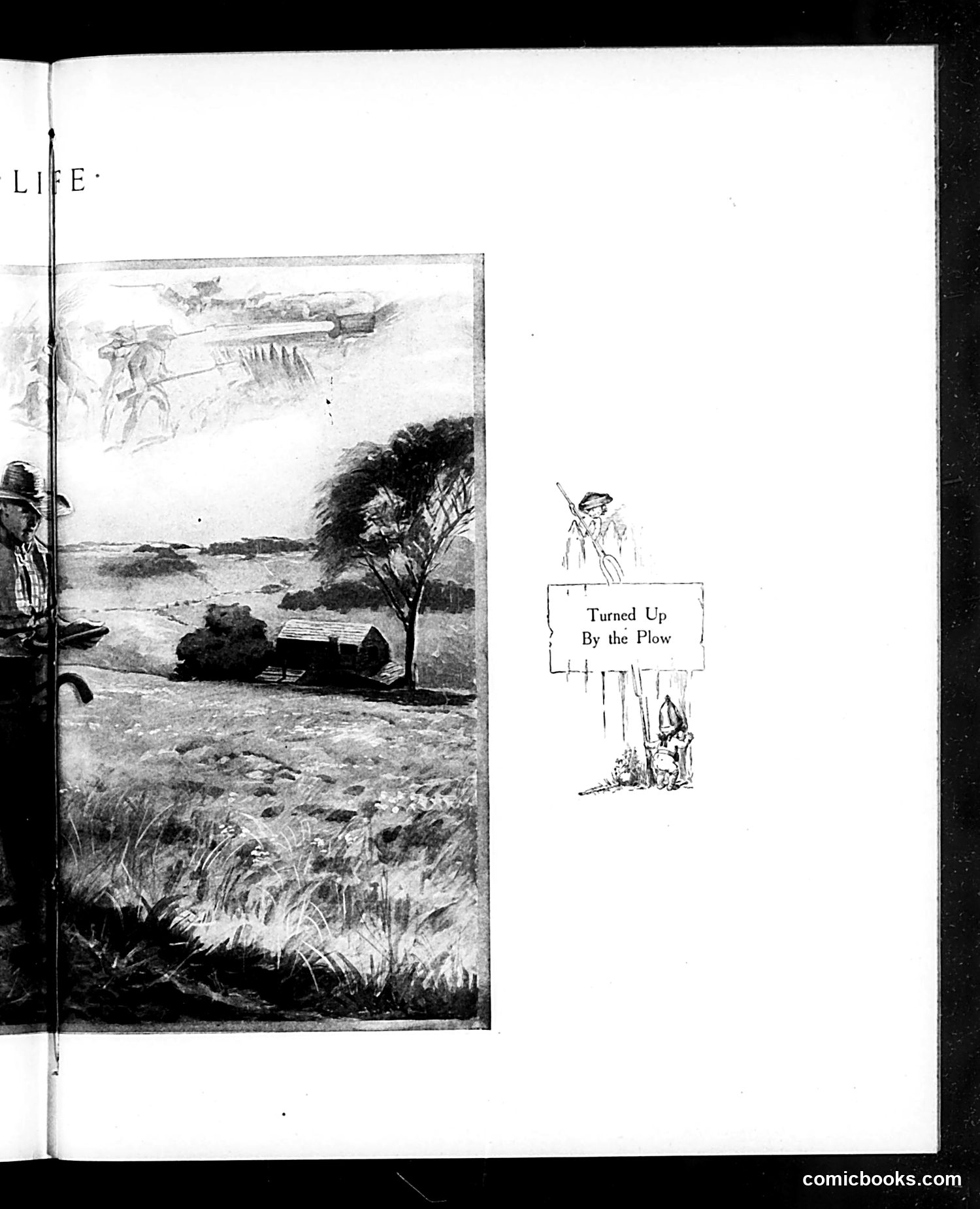
This page contains a two-part illustration about agricultural discovery. On the left is a photograph or detailed drawing of a rural landscape with a farmhouse, tree, and plowed fields. On the right, titled "Turned Up By the Plow," is a sketch showing what appears to be an artifact or object unearthed during plowing—likely depicting an archaeological find exposed by farming activity. The piece seems to satirize either the surprise discoveries that farming can yield, or possibly makes a social commentary about civilization and progress being literally buried beneath the soil. Without additional context about the specific issue of Life magazine, the exact satirical target remains unclear, though the contrast between rural labor and historical artifacts suggests commentary on American progress or modernization.
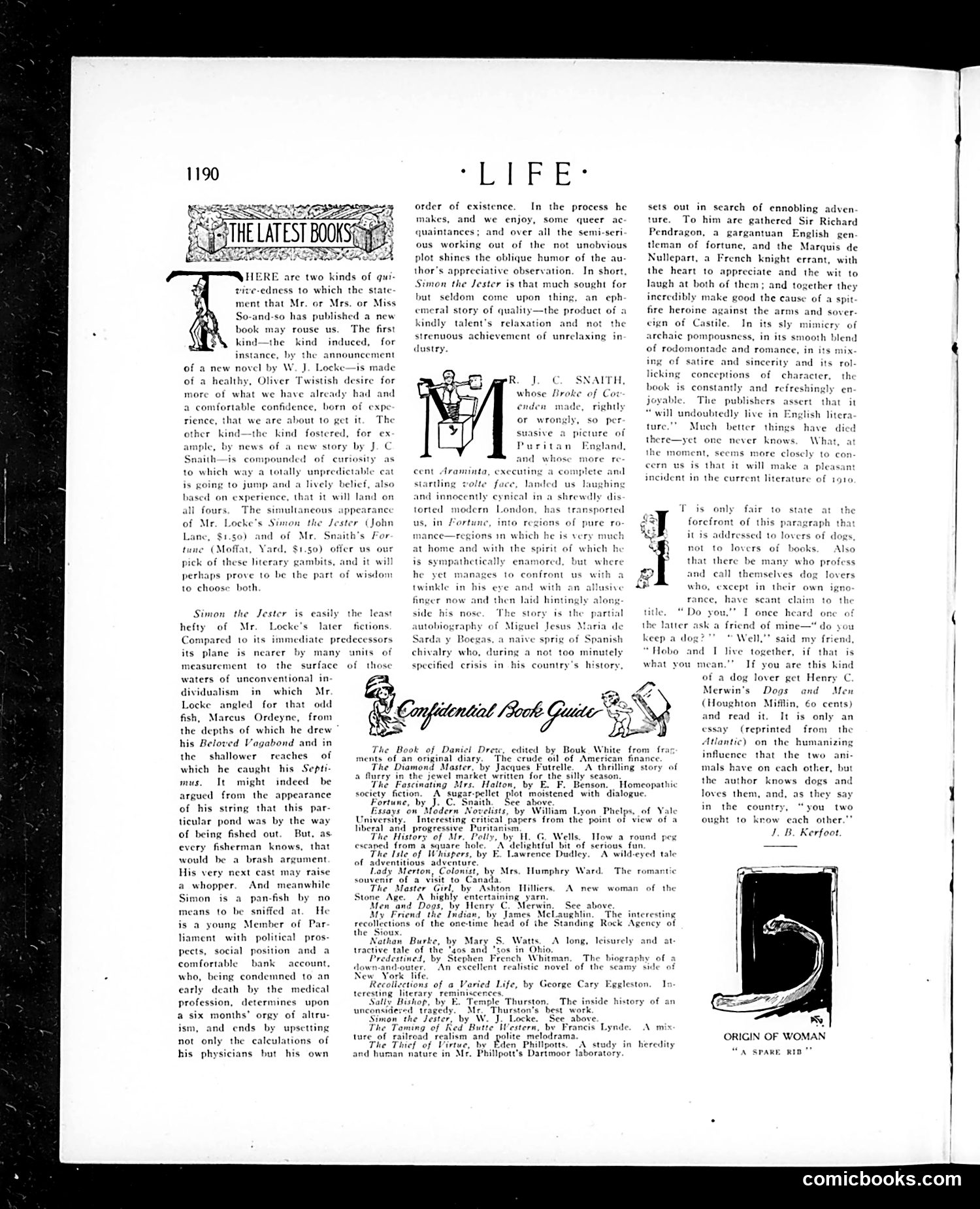
This page reviews two new novels: W. J. Locke's *Simon the Jester* and J. C. Snaith's *Fortune*. The text uses extended fishing metaphors to praise Locke's work as part of a successful literary career ("his string"), while the review employs characteristic satirical wit about how readers anticipate new books—either comfortably expecting more of the same, or excitedly unpredictable about what an author might produce next ("which way a totally unpredictable cat is going to jump"). The small illustration at bottom right, captioned "Origin of Woman: A Spare Rib," appears to be a classical or mythological reference, likely Adam's rib—a visual joke accompanying literary discussion. The page exemplifies Life's blend of serious literary criticism with irreverent humor typical of early 20th-century American satire.
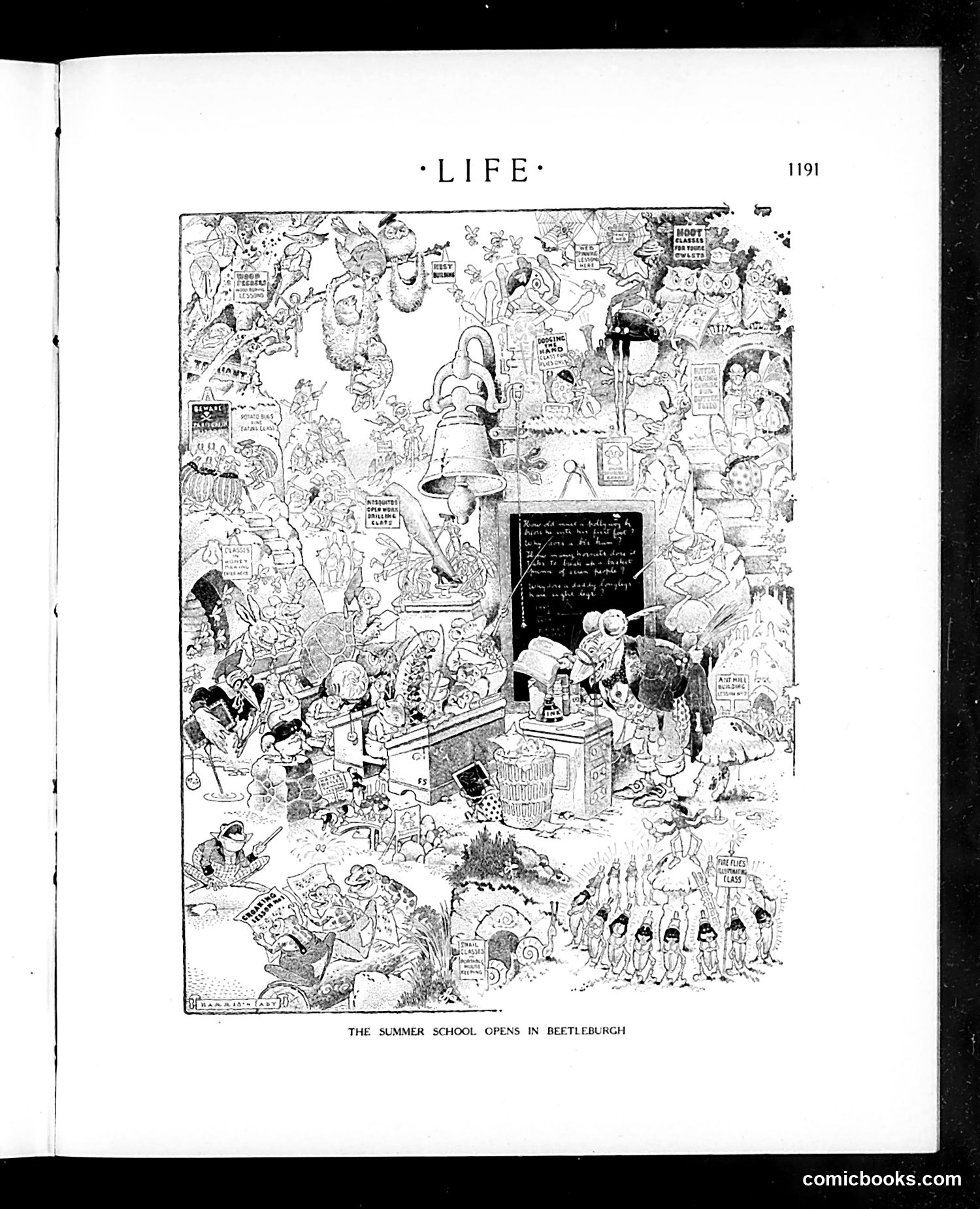
This is a densely detailed satirical illustration depicting chaos at a summer school opening in a fictional town called "Beetleburgh." The cartoon appears to mock the disorder and confusion of institutional education. The scene shows a large bell as a central focal point, with numerous children and adults in chaotic activity throughout—children running, playing, studying, and generally creating mayhem. Various signs and labels (though mostly illegible at this resolution) suggest different school activities and administrative confusion. The satire likely targets the bureaucratic inefficiency and lack of control in American public education systems. The sheer visual complexity and crowding conveys that summer schools were overwhelming, disorganized institutions rather than orderly educational environments. The exaggerated, frenzied activity style is typical of Life magazine's humorous social commentary from this era.
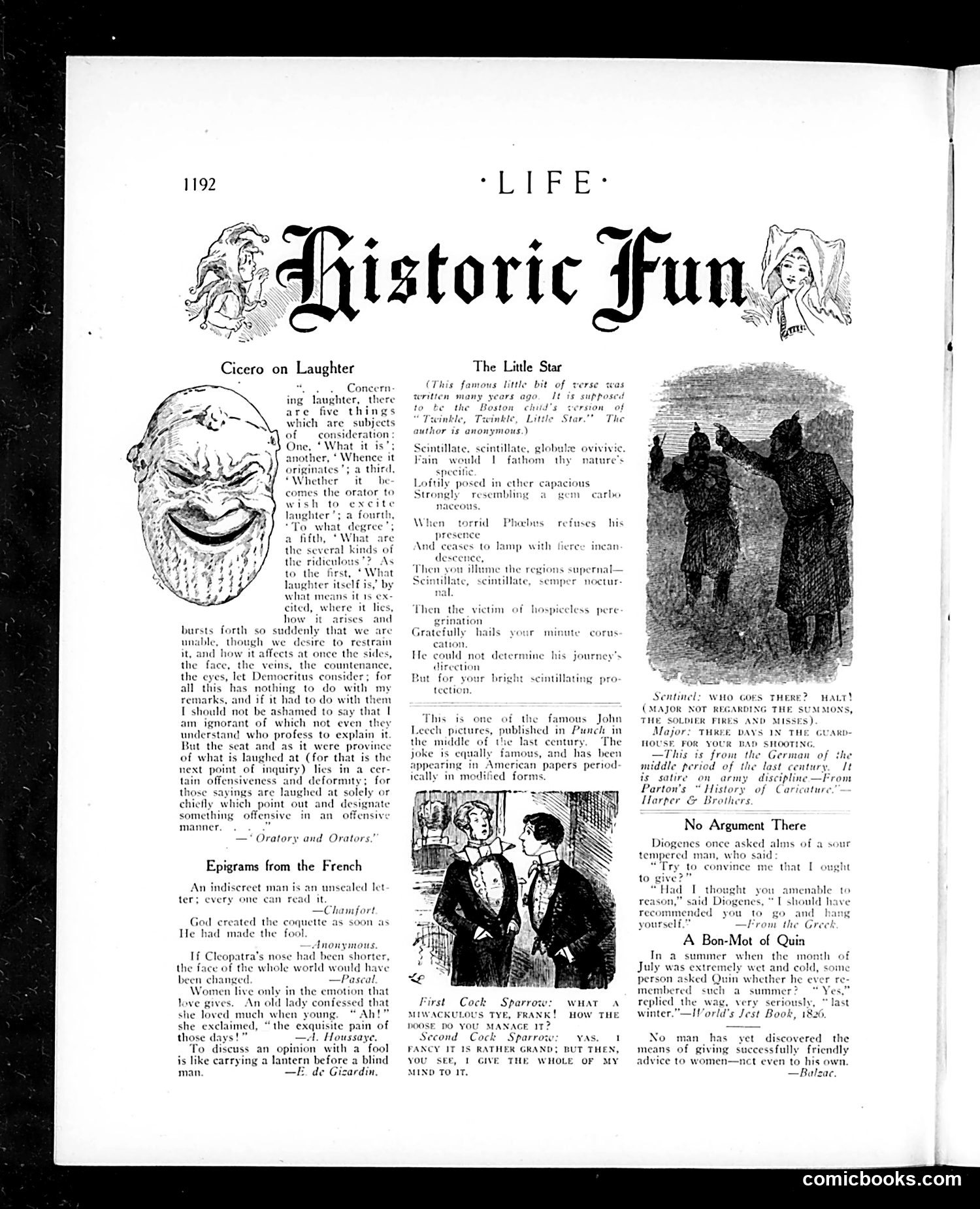
This page from *Life* magazine collects various humorous anecdotes, literary excerpts, and satirical illustrations typical of 19th-century wit. The content includes classical philosophy (Cicero on laughter), French epigrams poking fun at human folly, and reprinted Victorian-era cartoons—notably John Leech's famous "Cock Sparrow" illustrations from *Punch* magazine, mocking vanity and military incompetence through animal characters. The page also features a "Little Star" poem, apparently a Boston child's elaborate, pretentious rewrite of "Twinkle, Twinkle, Little Star," satirizing overwrought language and social pretension. Additional anecdotes mock stubbornness, vanity, and gender relations (the closing joke about women rejecting men's advice). The satire targets universal human weaknesses—pride, foolishness, and social affectation—rather than specific contemporary political figures or events.
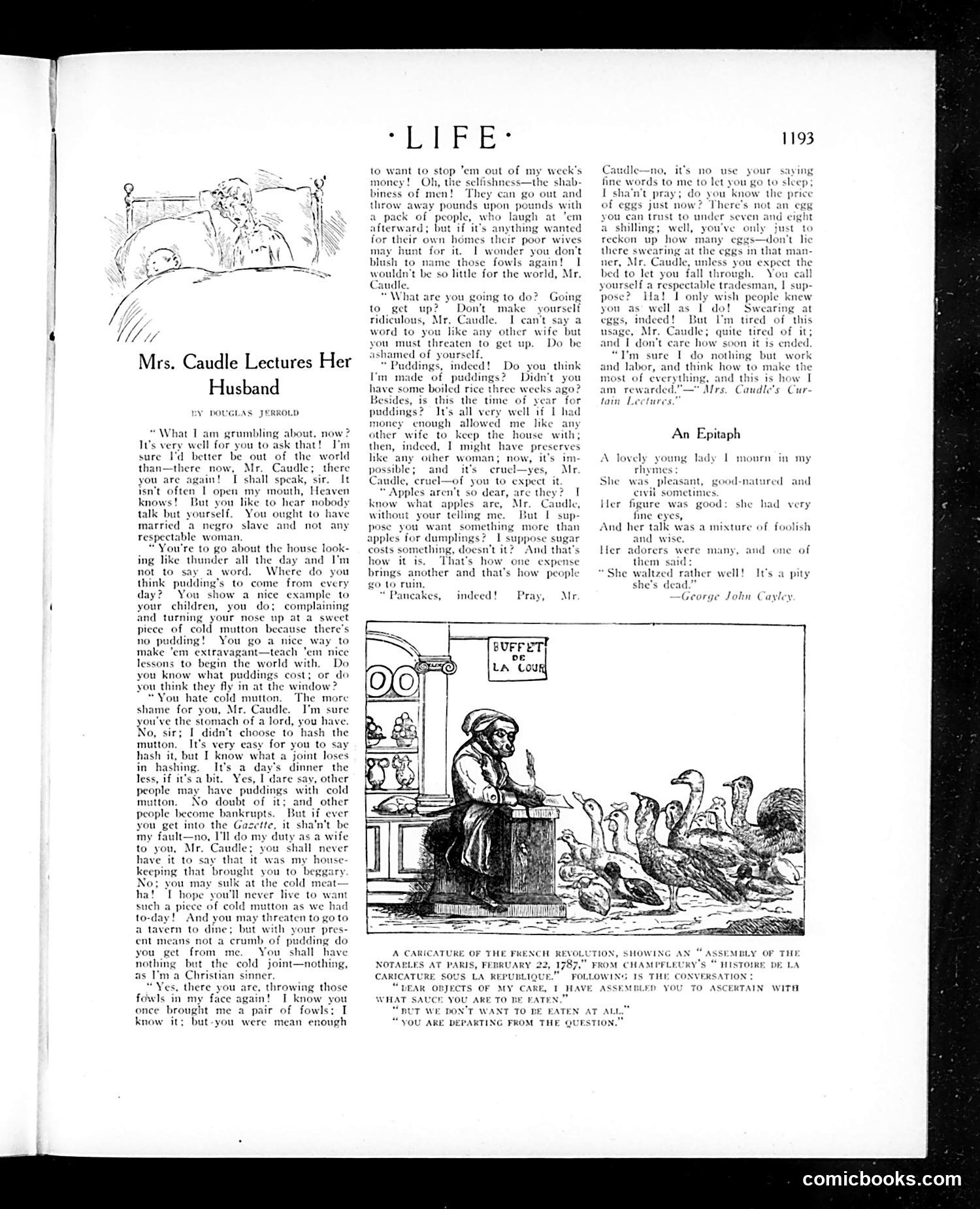
This is a humorous domestic sketch by Douglas Jerrold featuring **Mrs. Caudle lecturing her husband in bed**—a popular Victorian-era comedy premise about nagging wives. The satire targets **working-class household economics and marital dynamics**. Mrs. Caudle complains about her husband's ingratitude for meals, specifically cold mutton and lack of puddings, while she manages meager finances. She lectures him on waste—he spends money freely outside the home but objects to food costs. She threatens bankruptcy if he's extravagant, contrasts his behavior unfavorably to other men, and uses emotional manipulation (comparing herself to enslaved people, invoking Christian morality). The **caricature** is of a domineering, penny-pinching wife whose constant complaints and moral scolding are presented as comic rather than sympathetic. The separate cartoon below shows a French Revolution scene—unrelated political commentary. The humor relies on mid-19th-century gender stereotypes about wives as both financial controllers and emotional nags, a dynamic now recognized as depicting relationship dysfunction rather than comedy.
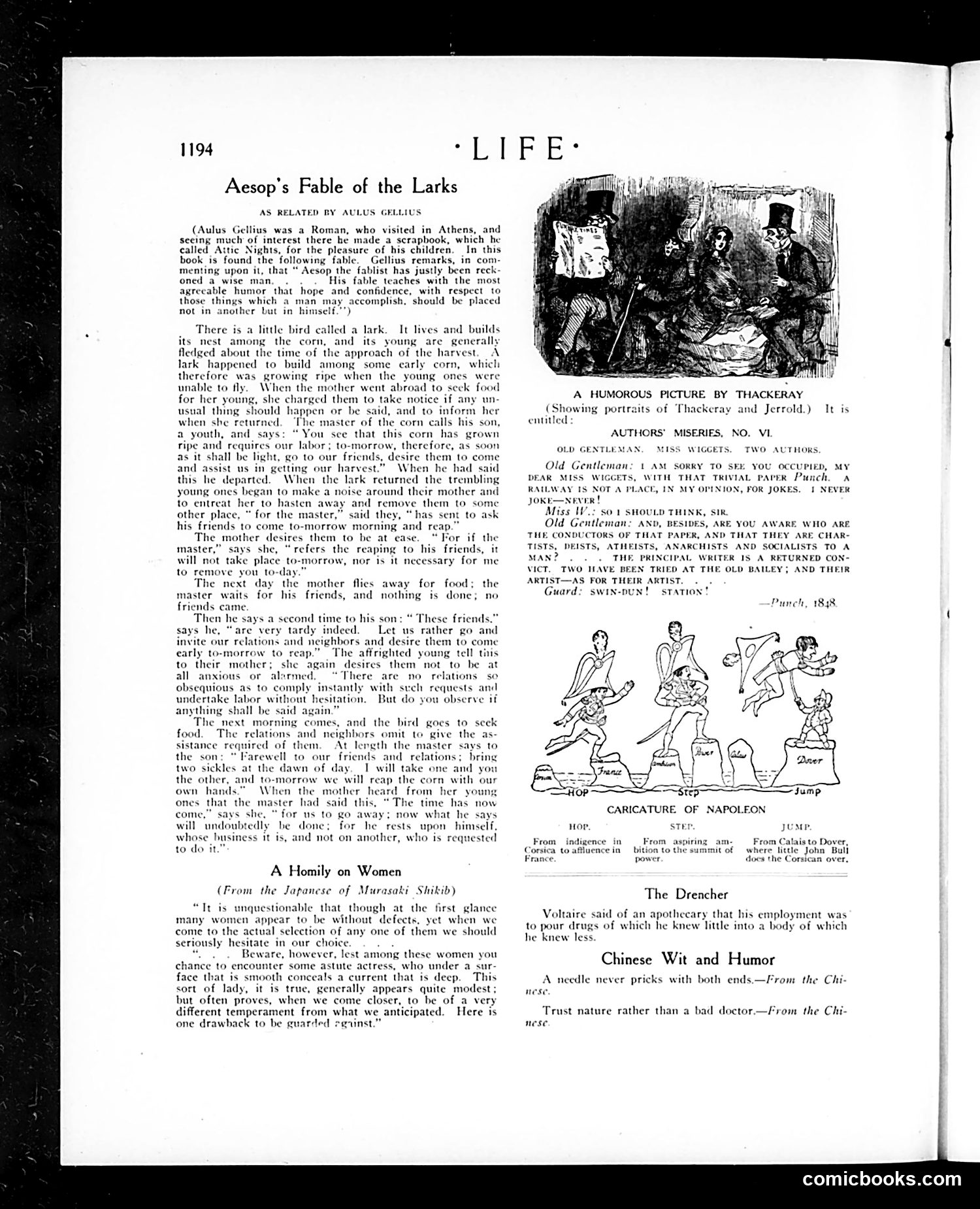
This page from *Life* magazine features a satirical cartoon titled "Caricature of Napoleon," depicting the French military leader in an exaggerated, humorous style. The illustration shows Napoleon in various poses—hopping, stepping, and jumping across labeled positions (Hop, Step, Jump, etc.)—arranged as if charting his military movements or territorial advances. The satire mocks Napoleon's ambitions and military campaigns through physical comedy, reducing his grand conquests to childish playground movements. The cartoon likely dates from the Napoleonic Wars era, when such caricatures were popular in English satirical publications to ridicule the French leader's expansionist behavior and contrast his inflated reputation with undignified physical comedy.
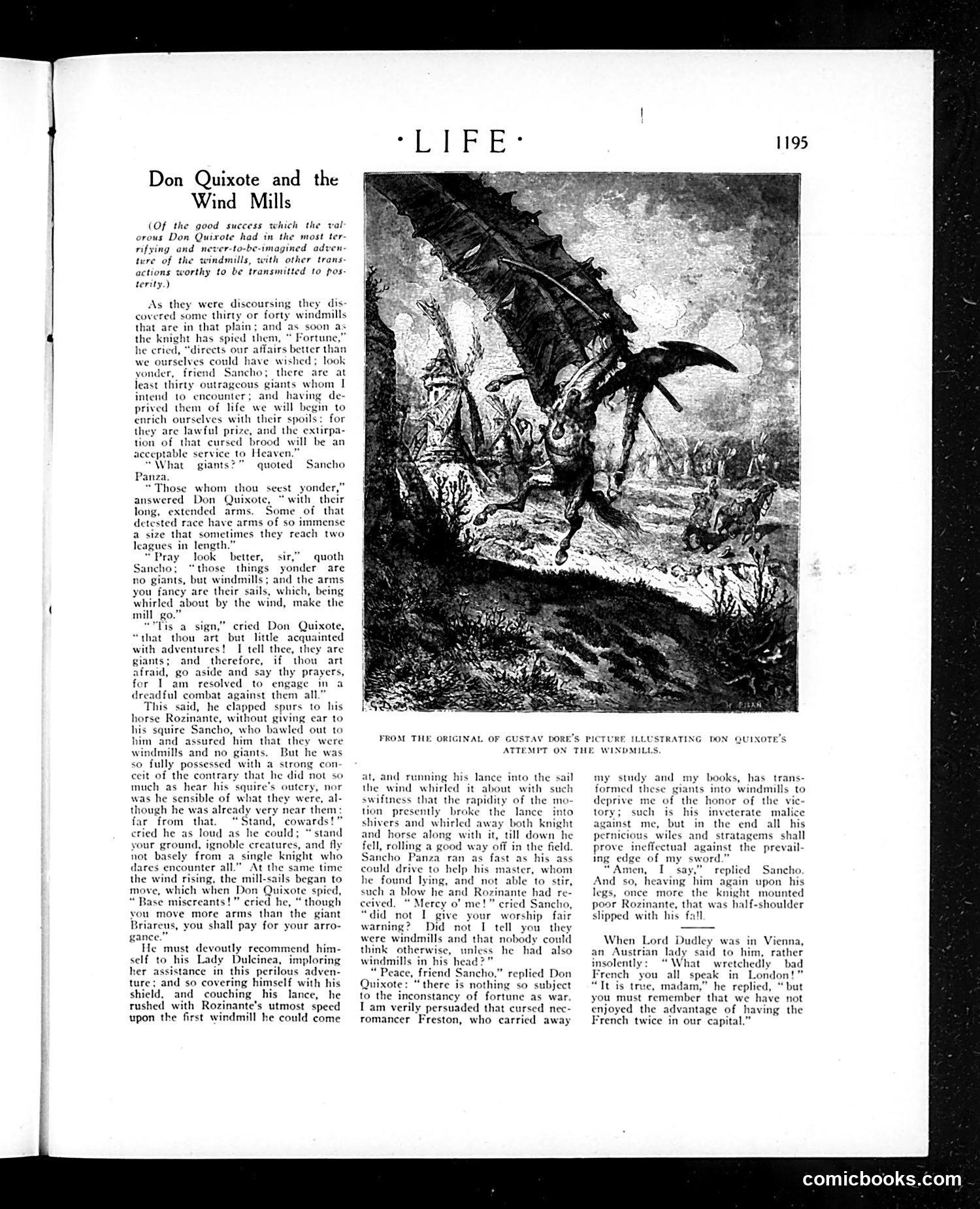
This page reproduces a famous episode from Cervantes' *Don Quixote*—the delusional knight's attack on windmills he mistakes for giants. The accompanying engraving (credited to Gustave Doré) illustrates the moment of impact. The satire works through Don Quixote's fundamental disconnect from reality: he sees windmills but *insists* they are giants requiring combat. His squire Sancho repeatedly corrects him, but Don Quixote dismisses reality as magic—a necromancer has "transformed" the giants. Even after being knocked down by a windmill sail, he rationalizes the failure rather than accepting what he plainly witnessed. For modern readers, this remains the archetypal image of pursuing an imaginary enemy while ignoring obvious truth. The episode satirizes romantic delusion, stubborn ideology, and the human tendency to reshape reality to match one's beliefs rather than adapting beliefs to reality. It's fundamentally about the danger of living in fantasy.
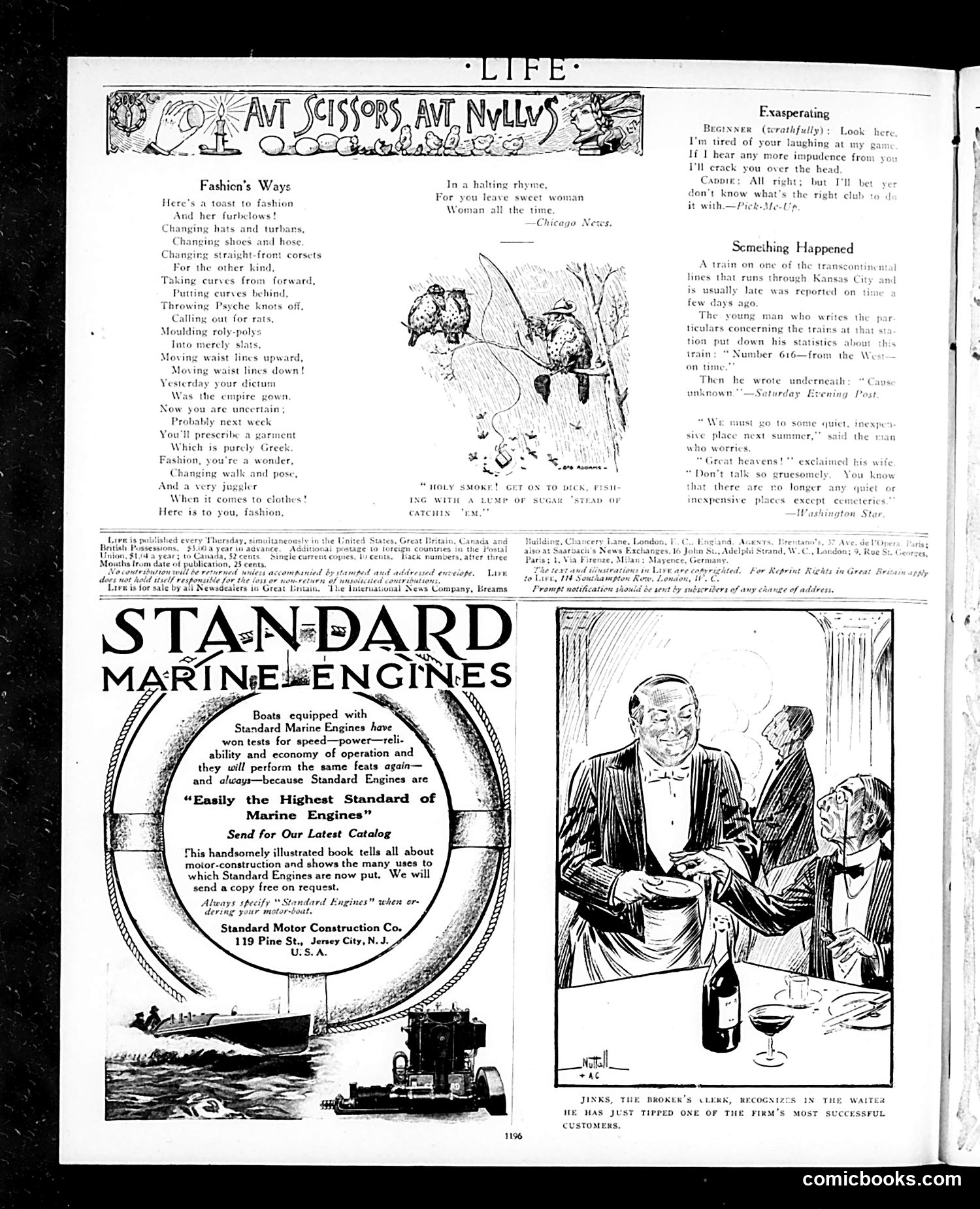
This page contains three separate humor pieces typical of Life magazine's satirical content: **"Fashion's Ways"** — A poem mocking women's fashion trends of the era, satirizing the constantly changing silhouettes, corsets, and styling that required women to repeatedly purchase new wardrobes. The joke is fashion's arbitrary nature and wastefulness. **"Exasperating" and "Something Happened"** — Brief comic anecdotes: the first depicts a man threatening violence over a woman's laughter; the second is a domestic humor piece about a husband worried there are no quiet, inexpensive vacation spots left. **"Jinks, the Broker's Clerk"** — A cartoon showing a waiter recognizing his employer's most successful client. The humor lies in the ironic social reversal—the clerk now serves his boss's important customer. The **Standard Marine Engines advertisement** occupies the lower half, typical of period magazine monetization. The page reflects early 20th-century attitudes: consumer culture criticism, casual domestic conflict, and workplace hierarchy humor that modern readers would find dated or offensive.
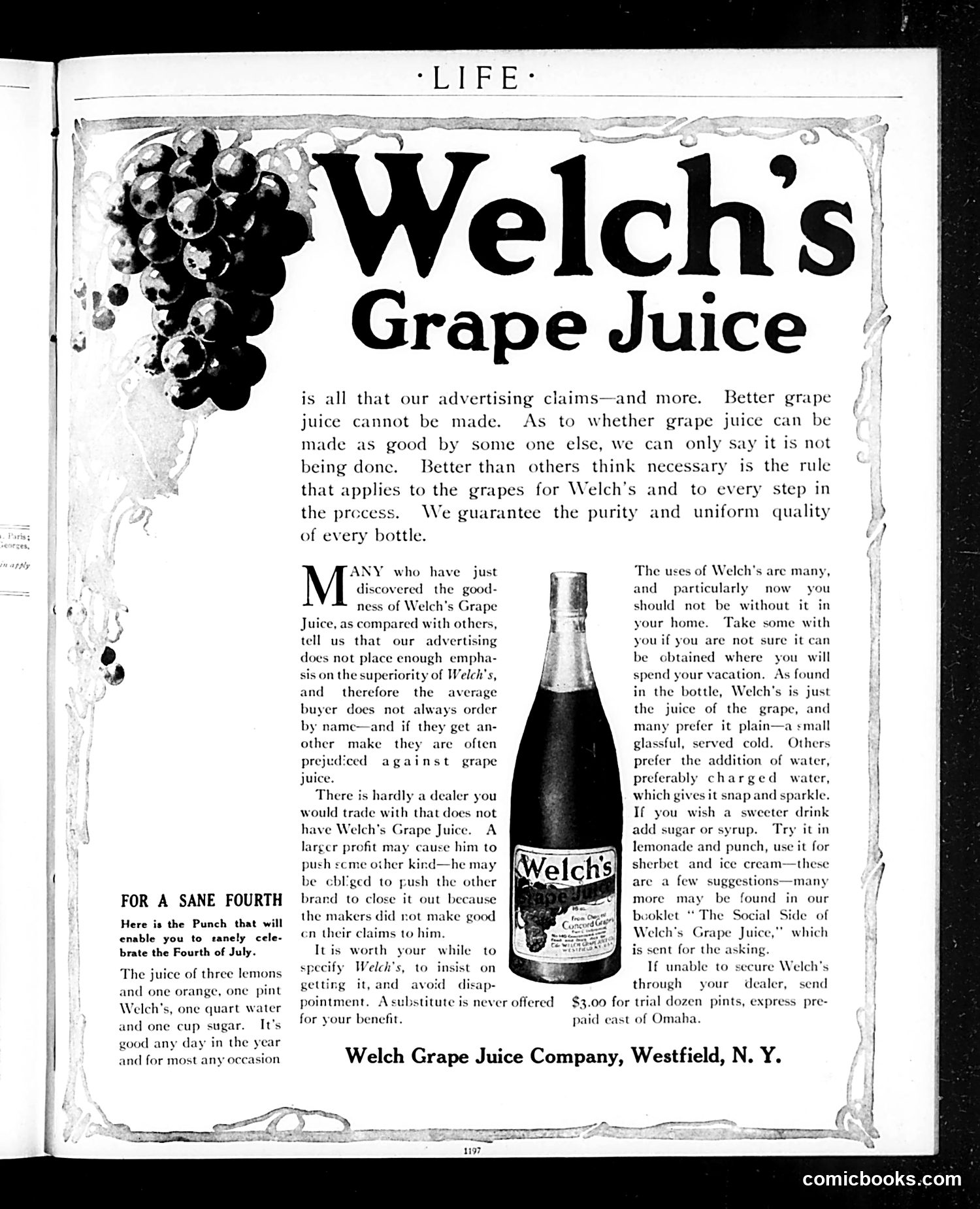
This is primarily a **Welch's Grape Juice advertisement**, not a political cartoon. The "satire" is modest and commercial rather than biting. The heading "FOR A SANE FOURTH" references early 20th-century safety campaigns promoting safer, less dangerous Fourth of July celebrations—a real social concern when fireworks injuries and alcohol-fueled accidents were common. Welch's capitalizes on this by positioning grape juice as a wholesome, family-friendly alternative to harder beverages for holiday drinking. The ad emphasizes product superiority and purity, addresses dealer practices (some retailers pushed inferior brands for profit), and suggests multiple uses: plain, with water, in punches and lemonades. The modest "joke" is that responsible patriotic celebration means serving Welch's instead of alcohol. This reflects Progressive Era values (early 1900s) around temperance and safe public behavior, not political satire. It's essentially a branded lifestyle pitch disguised as civic-minded advice.
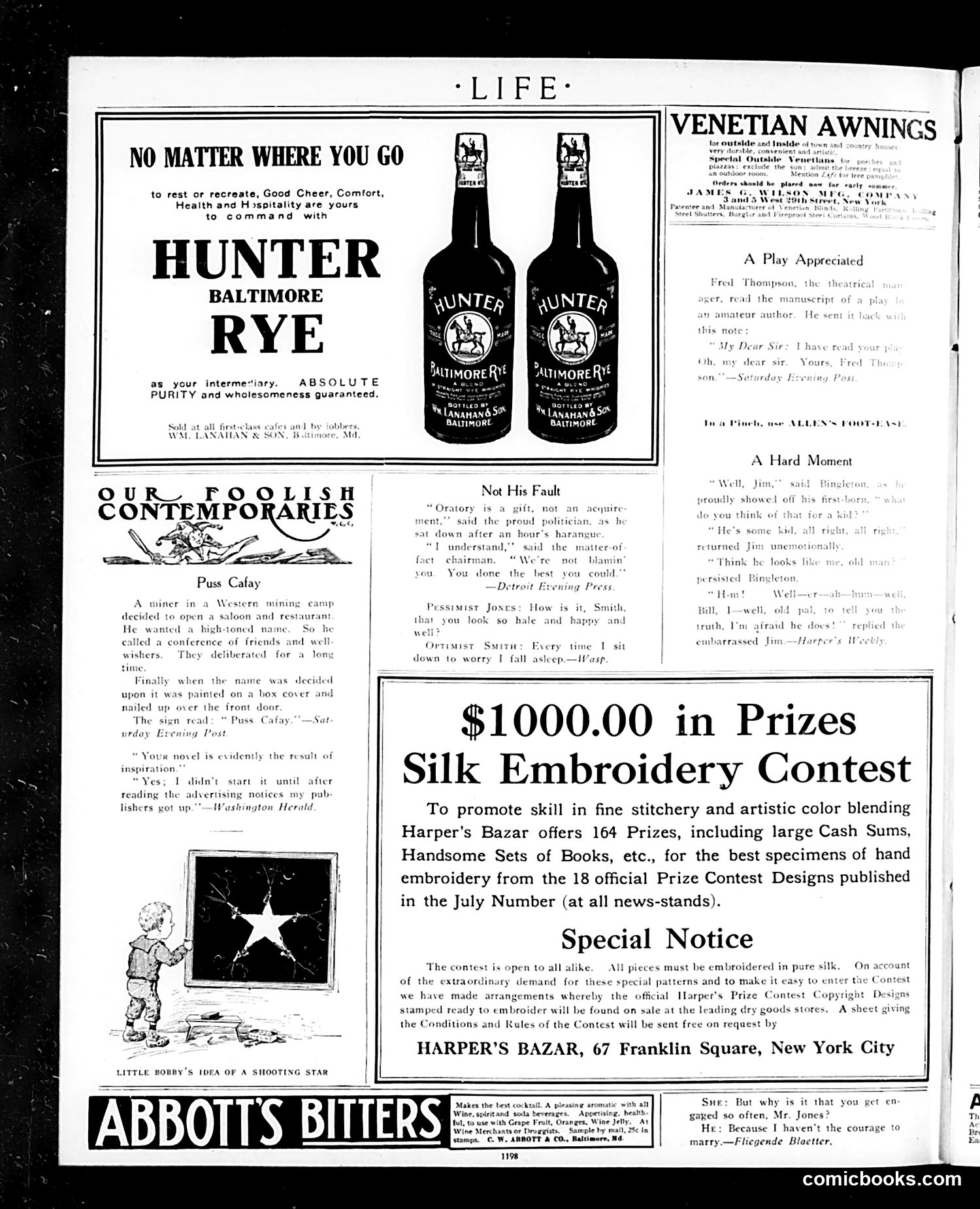
This page is primarily **advertising and humor content** rather than political satire. The main elements are: **Advertisements:** - Hunter Baltimore Rye whiskey (top left) — promising health and hospitality - Abbott's Bitters (bottom) — a patent medicine/cocktail ingredient - Venetian Awnings (top right) - Harper's Bazar Silk Embroidery Contest ($1,000 in prizes) **Humorous Content:** The page includes several brief joke columns and a cartoon titled "Little Bobby's Idea of a Shooting Star" showing a child pointing at a star. The jokes are light domestic humor typical of early 20th-century magazines—exchanges between optimists/pessimists and married couples about everyday life. **Historical Context:** This reflects an era when patent medicines and alcohol were freely advertised in mainstream magazines, and women's domestic skills (embroidery) were actively promoted through contests. The overall tone is lighthearted rather than satirical or politically pointed.
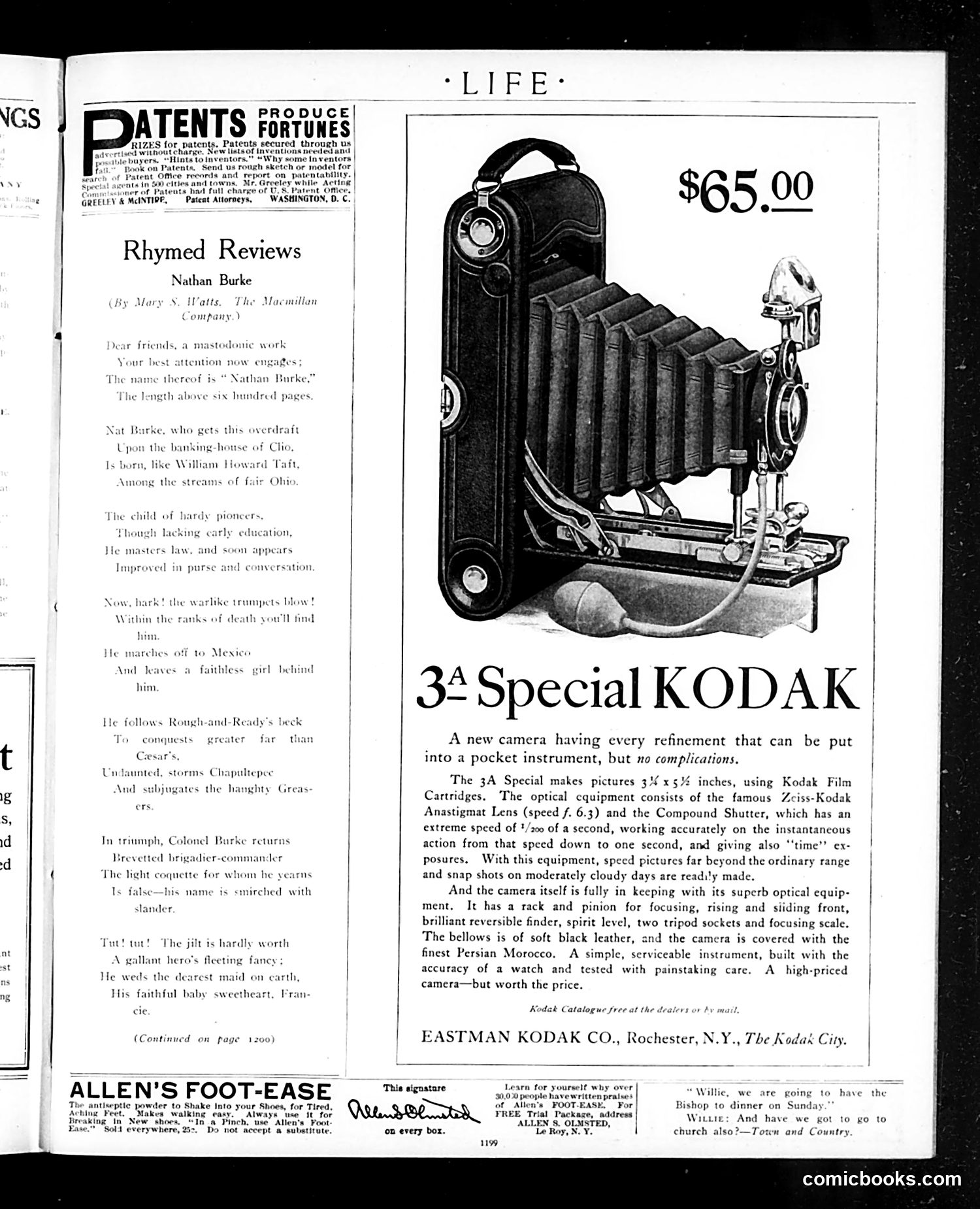
This page is primarily **advertising and literary content** rather than political satire. **"Rhymed Reviews"** is a poem by Nathan Burke reviewing a book of the same name (published by Macmillan). The verse humorously summarizes a melodramatic plot: a pioneer's son named Nat Burke becomes successful, marches off to the Mexican War, leaves behind a faithless lover, conquers territory, returns to find his beloved disloyal, then marries his childhood sweetheart instead. The tone is gently mocking of overwrought Victorian romance narratives. The rest consists of **period advertisements**: a patent attorney service, Allen's Foot-Ease powder for shoe comfort, and a Kodak 3A Special camera ($65.00) emphasizing its quality optics and leather craftsmanship. A small column at bottom appears to be a domestic humor snippet from "Town and Country." The page contains **no political cartoons or satire**—it's a typical early 20th-century magazine layout mixing literary content with consumer advertising.
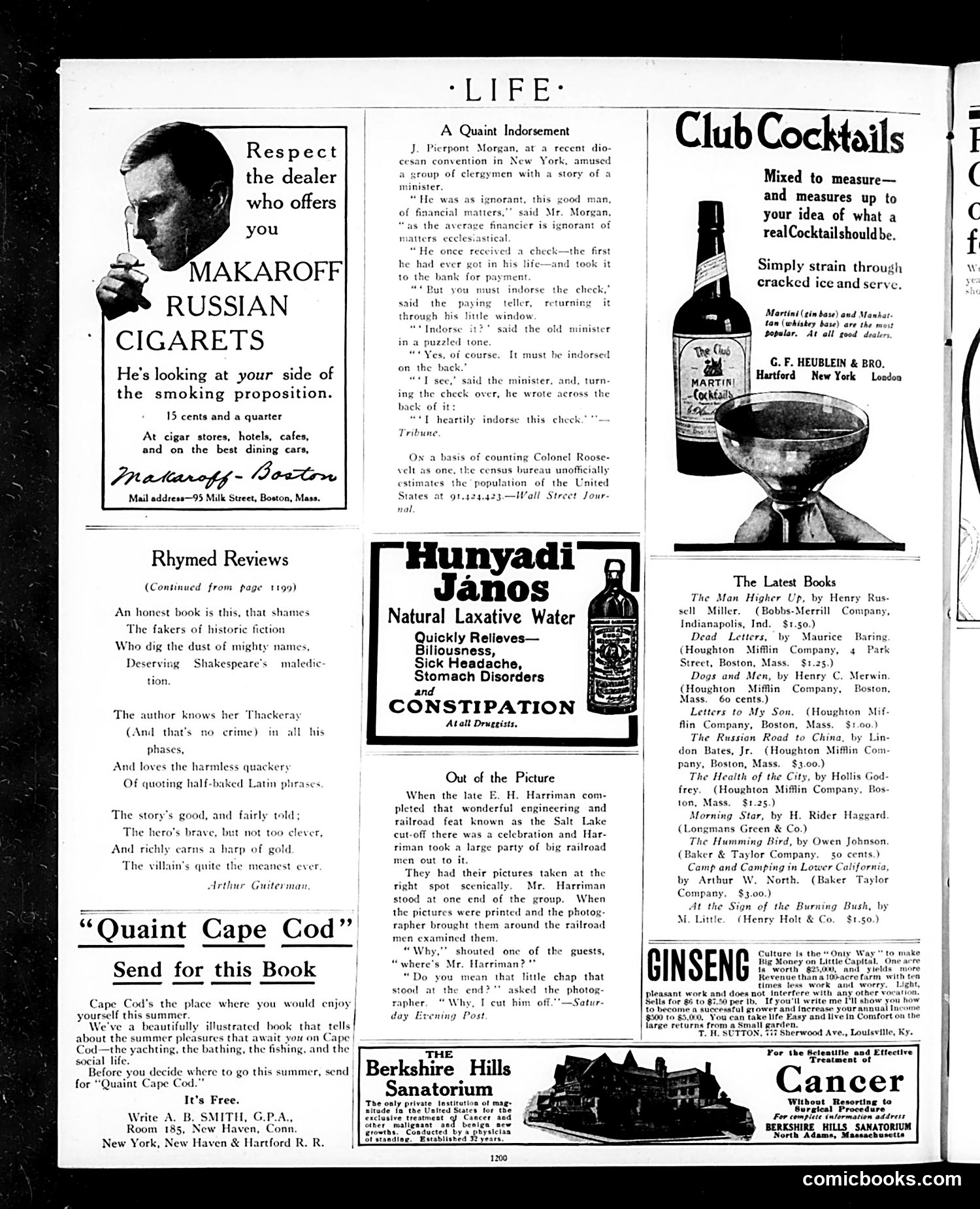
This page is primarily **advertising and book reviews** with little political satire. The main content includes: **Advertisements:** - **Makaroff Russian Cigarets**: Appeals to dignity and status ("Respect the dealer"), linking cigar purchases to sophistication - **Hunyadi Janos**: Patent medicine claiming to cure constipation, biliousness, and headaches - **Club Cocktails**: Branded spirits marketed as properly mixed - **Cape Cod tourism**: Promotional book encouraging summer travel - **Berkshire Hills Sanatorium**: A private health facility (unclear what specific ailment it treats) **Articles:** - **"A Quaint Indorsement"**: Anecdote about J.P. Morgan allegedly finding humor in an unsophisticated minister's literal check endorsement - **"Out of the Picture"**: Brief story about railroad magnate E.H. Harriman being accidentally cropped from a commemorative photograph The page reflects early 1900s concerns: health tonics, luxury consumption, social status, and industrial progress.
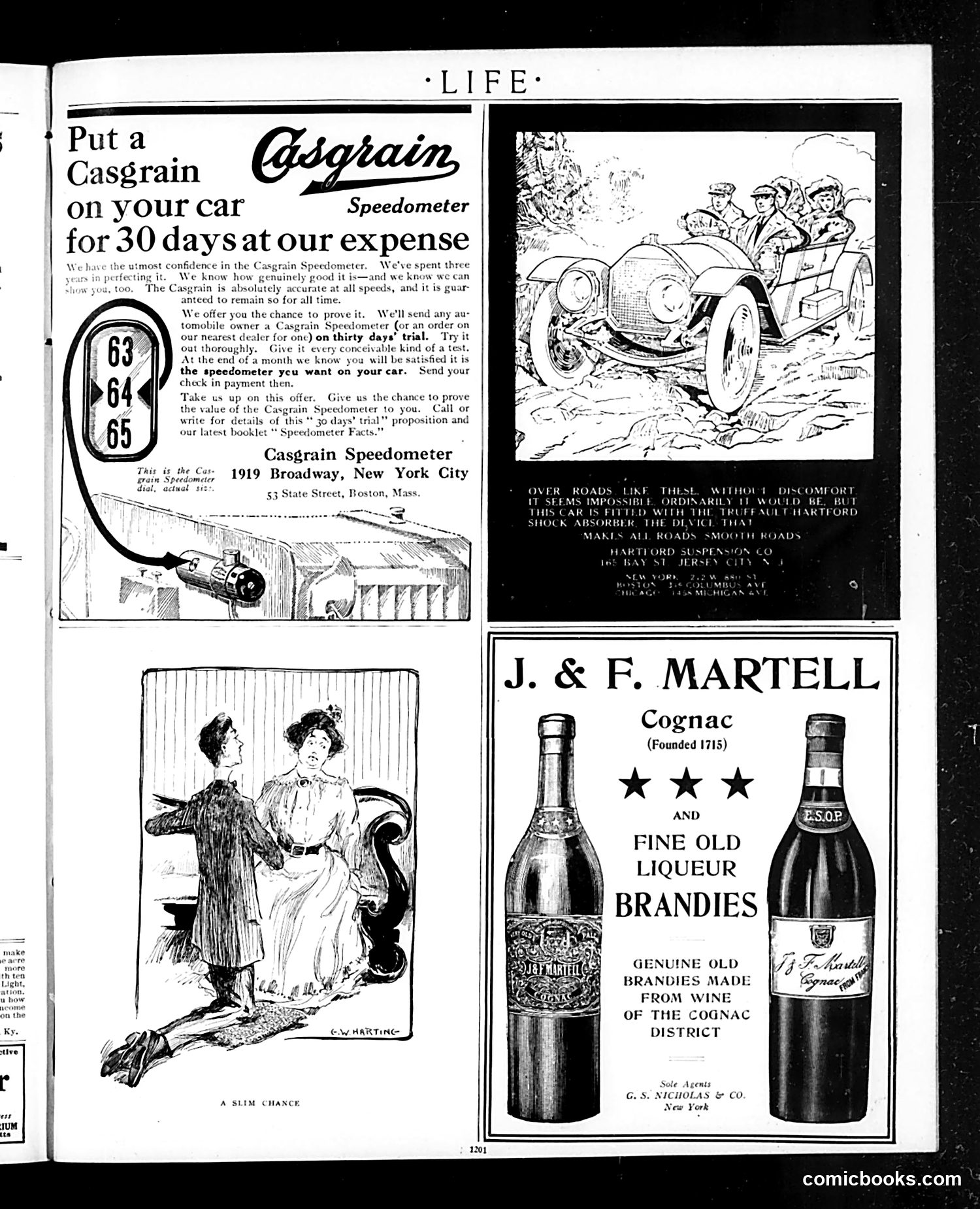
This page contains three advertisements typical of early 1920s marketing: 1. **Casgrain Speedometer** (top left): An automotive accessory ad offering a 30-day free trial to prove the speedometer's accuracy. The appeal targets car owners concerned about reliable speed measurement. 2. **Hartford Shock Absorber** (top right): Features an illustration of passengers in a car traversing rough terrain, advertising the suspension system that made bumpy roads comfortable. This speaks to early automotive comfort innovations. 3. **"A Slim Chance"** (bottom left): A cartoon by E.W. Harding showing a flirting couple—likely satirizing romance or courtship, though the specific joke's context is unclear without additional caption details. 4. **J. & F. Martell Cognac** (bottom right): A liquor advertisement emphasizing the brand's 1715 founding and authentic Cognac production. Notably, this ad ran during Prohibition (1920-1933), suggesting either pre-Prohibition publication or the magazine's flouting of alcohol restrictions. The page primarily showcases period advertising rather than editorial satire.
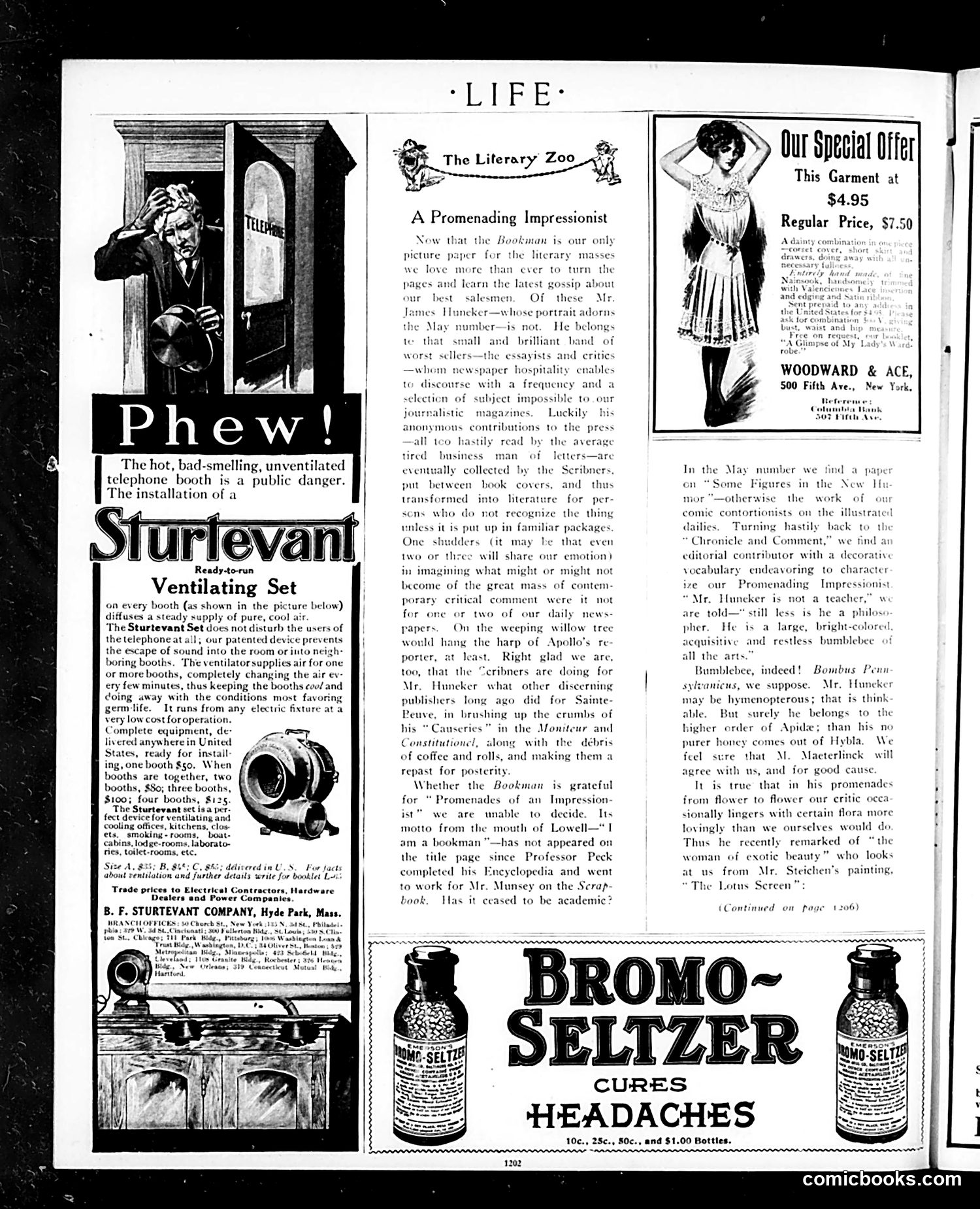
This page is primarily **advertising** rather than political satire. The main cartoon shows a man in a telephone booth labeled "Phew!" — illustrating the joke that unventilated phone booths were hot, smelly public nuisances. The **Sturtevant Ventilating Set** advertisement promotes an installation to solve this problem, priced at $50 per booth. The page also features a literary essay ("The Literary Zoo") about critic James Hunecker, using extended insect metaphors (comparing him to a bumblebee) — typical of Life magazine's intellectual humor. A separate advertisement offers a women's garment at discount ($4.95, regularly $7.50) from Woodward & Ace. The **Bromo-Seltzer** ad at bottom promotes the headache remedy. The satire here is mild and domestic rather than political — poking fun at everyday inconveniences and contemporary literary figures rather than addressing major social issues.
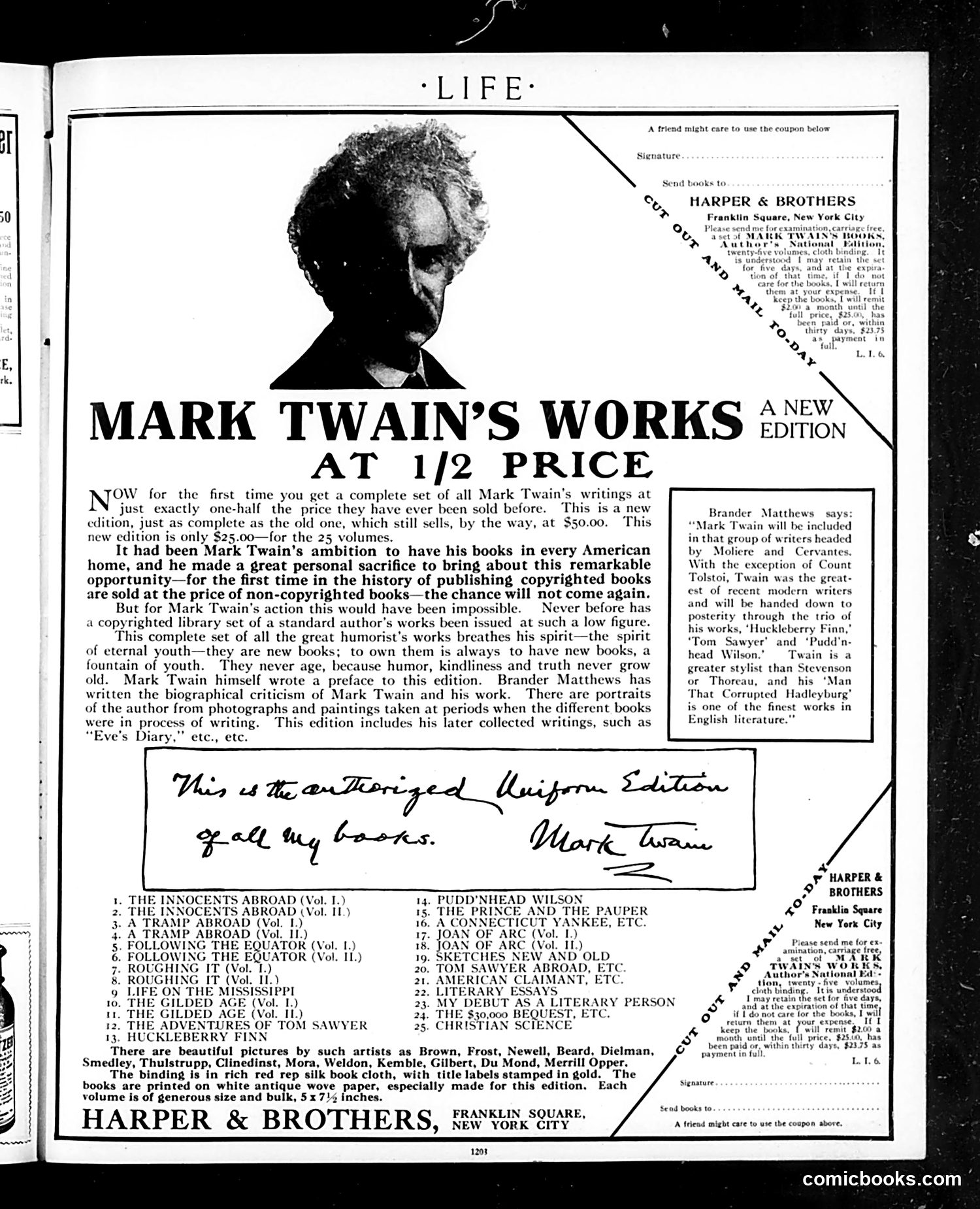
This is primarily a **book advertisement**, not a political cartoon. The page announces Harper & Brothers' new affordable edition of Mark Twain's complete works—25 volumes for $25 (half the previous $50 price). The key appeal: Twain himself made this "great personal sacrifice" to fulfill his ambition of placing his books "in every American home." This was historically significant because copyrighted books had never before been sold at non-copyrighted prices. The page includes endorsements from literary critic Brander Matthews, positioning Twain alongside Molière and Cervantes as a canonical writer. The edition features portraits and illustrations by prominent artists, printed on quality paper in silk cloth binding. The marketing emphasizes Twain's works as timeless ("breathes his spirit—the spirit of eternal youth") and includes a facsimile of Twain's own signature authorizing this edition. Coupons allow readers to order directly from the publisher at Franklin Square, New York City.
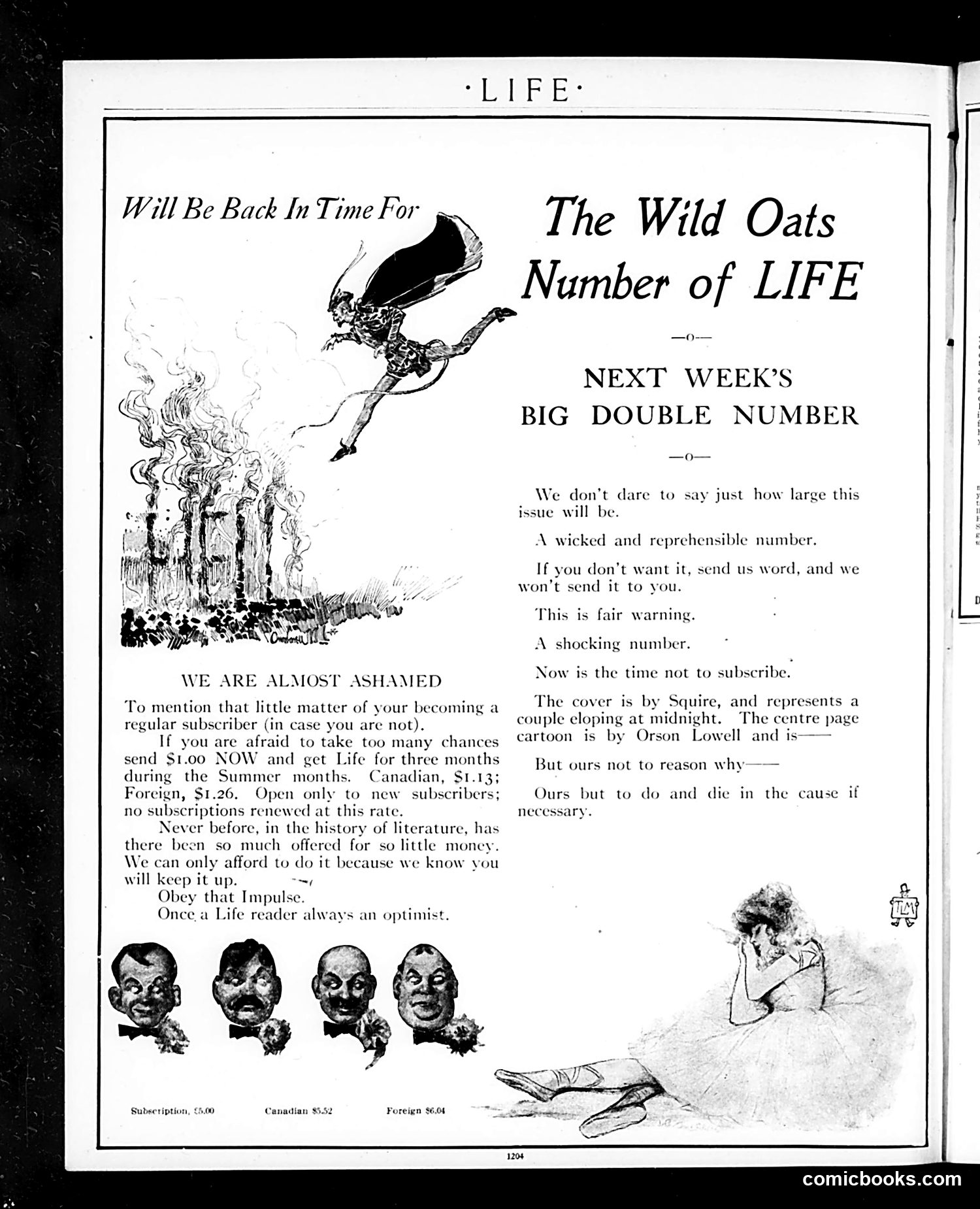
This is primarily a **subscription promotion page**, not a political cartoon. Life magazine is advertising its summer subscription rates ($1.00 for three months) with playful, tongue-in-cheek language. The humor lies in the **self-aware marketing**: Life admits it's "almost ashamed" to ask for subscriptions, then jokingly warns readers that next week's "Big Double Number" will be "wicked and reprehensible" and "shocking"—sarcastically discouraging subscriptions while promoting the issue. The illustration of a figure fleeing a fire (captioned "Will Be Back In Time For") appears to reference *The Wild Oats*, likely a serialized story or feature in the magazine. The four male head illustrations at bottom show different subscription rate tiers. The tone is characteristic of Life's satirical, irreverent house style—mocking both the magazine itself and advertising conventions while actually trying to convert readers into paying subscribers.
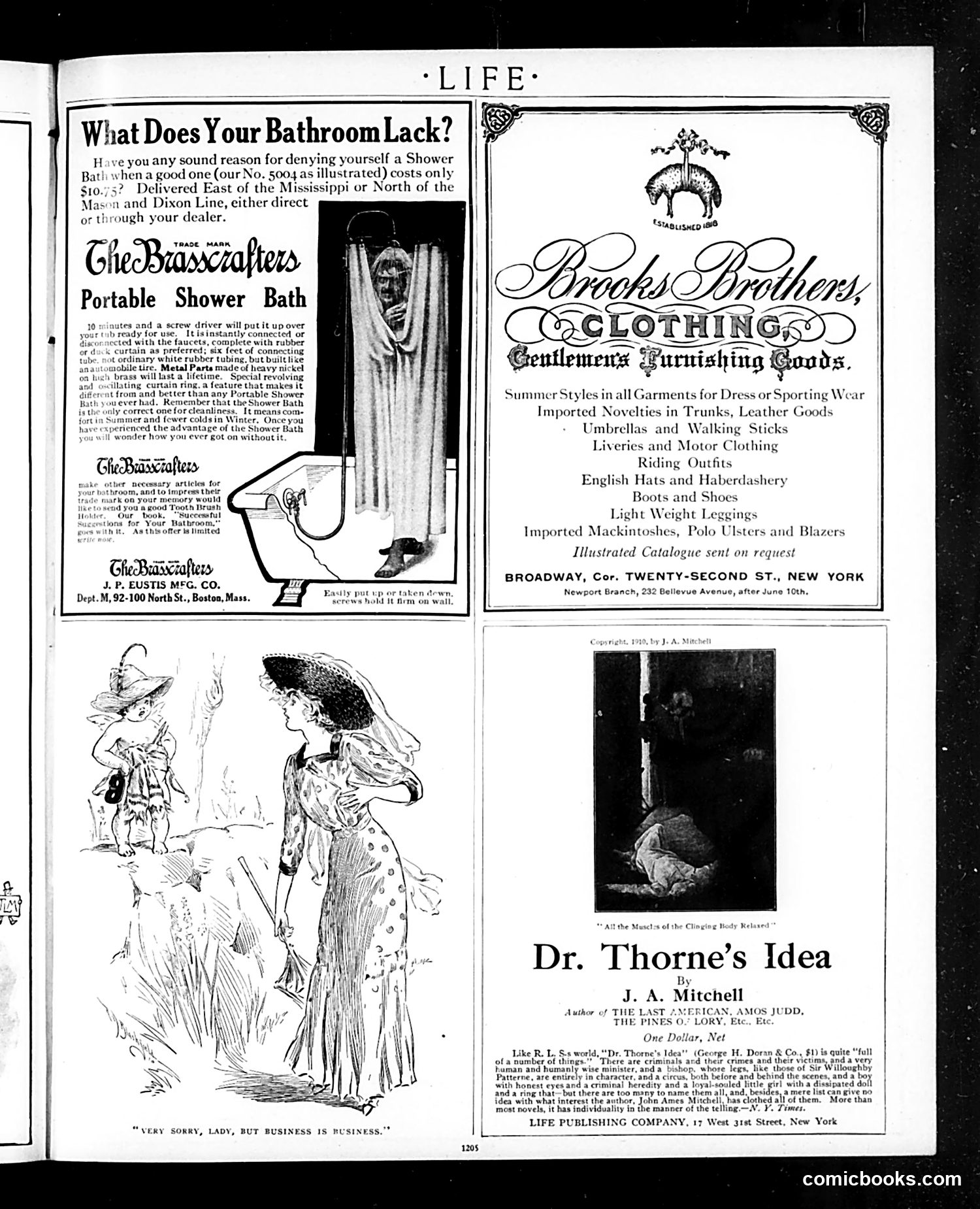
This page is primarily **advertising** with one small cartoon. The cartoon (lower left, captioned "Very Sorry, Lady, But Business is Business") depicts a businessman dismissing a woman—likely a wife or companion—with an apologetic gesture. The joke satirizes how businessmen of the era prioritized commercial obligations over personal relationships and social courtesies. The woman appears stylishly dressed, suggesting this is about upper-class social expectations being sacrificed to business demands—a critique of how the newly dominant corporate culture was reshaping American priorities and manners. The rest of the page features ads for luxury goods (a portable shower bath, Brooks Brothers clothing, and a serialized novel "Dr. Thorne's Idea"), typical of Life's affluent readership around 1910. The shower bath ad itself humorously asks "What Does Your Bathroom Lack?"—marketing modern convenience to wealthy Americans.
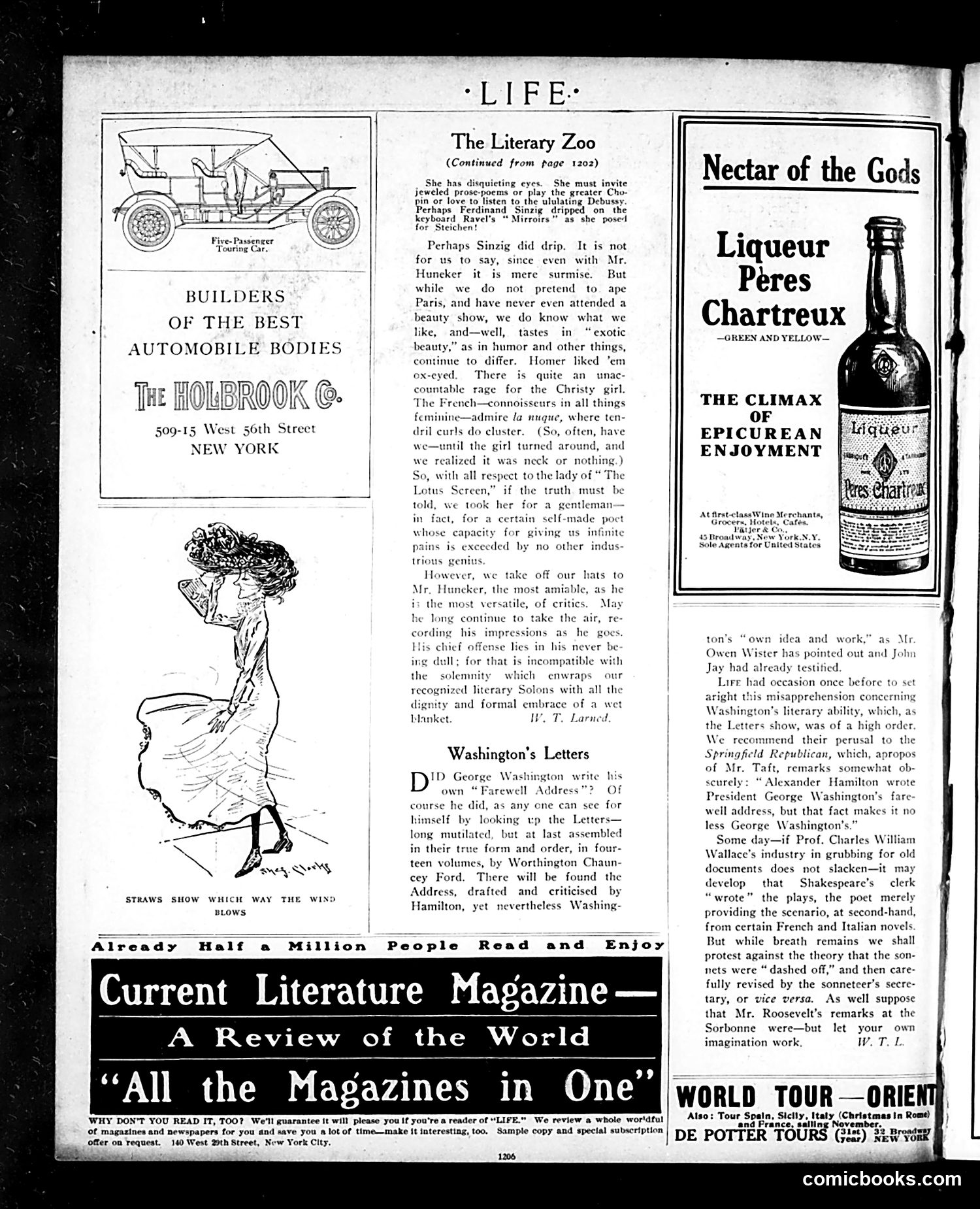
This page from *Life* magazine contains a satirical essay about literary figures and criticism, focused on art critic James Huneker and the nature of artistic taste. The main cartoon shows a fashionable woman in profile—"Straws Show Which Way the Wind Blows"—apparently mocking pretentious aesthetic preferences among society women who adopt exotic tastes in art and music (Debussy, Ravel) without genuine understanding. The essay ridicules how literary and artistic judgments are fashioned by social convention rather than merit. It references specific figures: Huneker (celebrated but whimsical critic), and discusses whether George Washington actually wrote his own "Farewell Address" (he didn't—Hamilton helped substantially), using this as an example of how authorship gets misattributed. The satire suggests that both society women and serious critics often adopt positions based on fashion rather than authentic appreciation or knowledge.
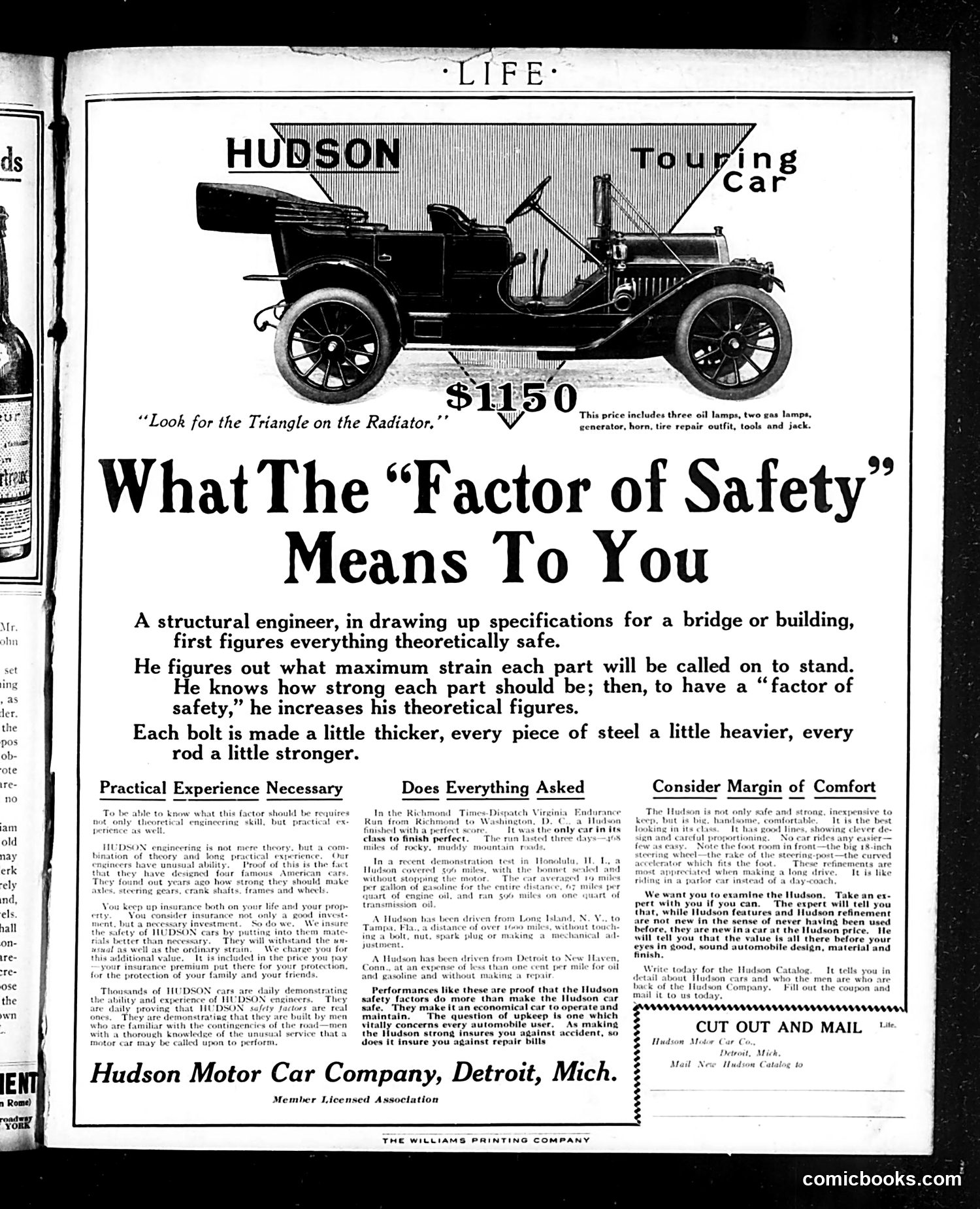
This is primarily a **automobile advertisement**, not a political cartoon. It appears in Life magazine promoting the Hudson Touring Car at $1150. The ad uses an engineering metaphor to explain the "factor of safety"—a structural design principle where components are built stronger than theoretically necessary. The advertisement applies this concept to Hudson automobiles, arguing that the car's robust construction provides reliability beyond minimum safety requirements. The three-column text section ("Practical Experience Necessary," "Does Everything Asked," "Consider Margin of Comfort") addresses buyer concerns about durability and repair costs, claiming Hudson's over-engineered design protects against both accidents and expensive maintenance. The advertisement includes a coupon to request a Hudson catalog, a standard early-20th-century marketing technique. **No satire or political commentary is present**—this is straightforward commercial messaging using technical language to build consumer confidence in the product's quality and value.
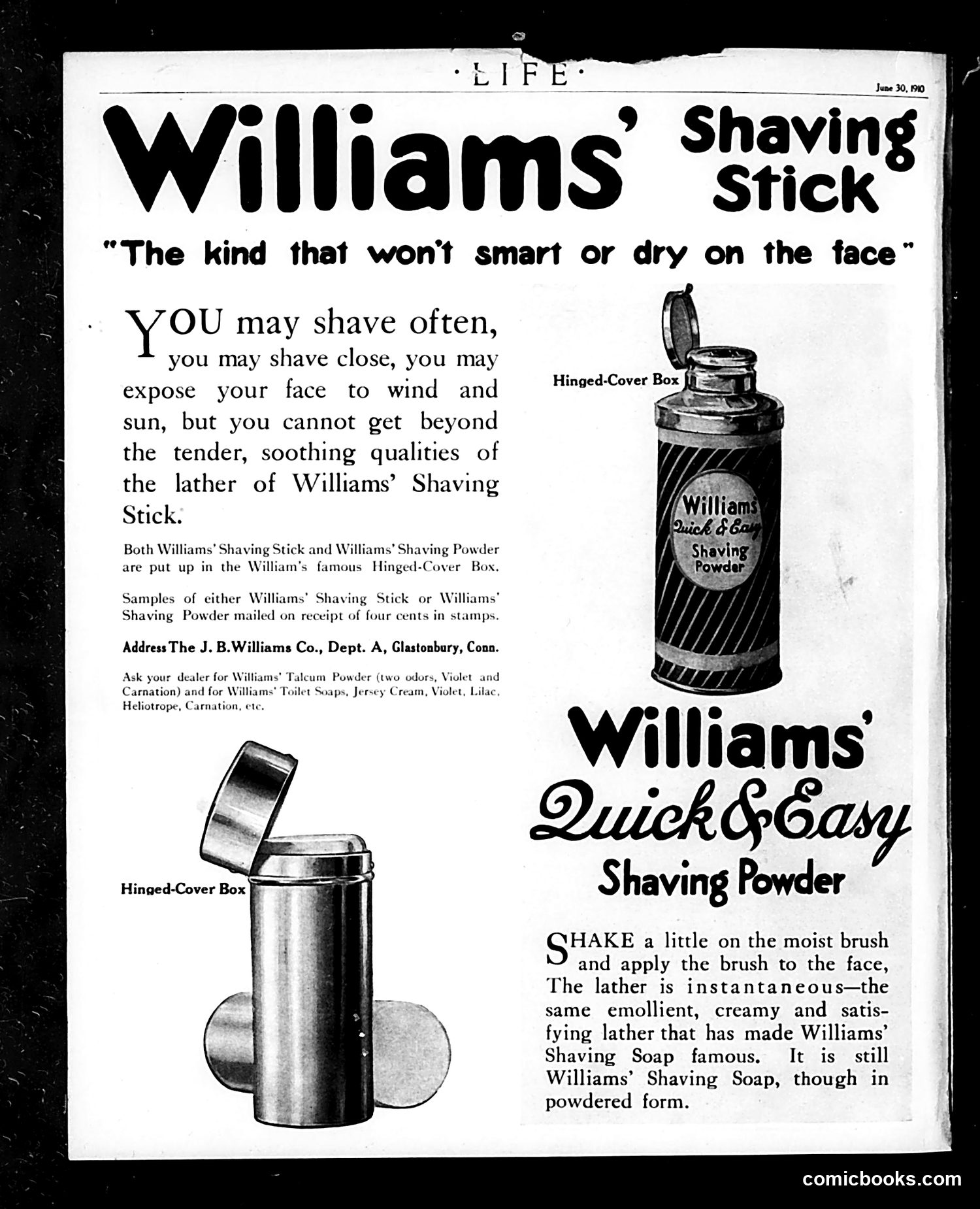
This is a straightforward **advertisement**, not political satire. It appears in *Life* magazine from June 30, 1910, promoting two Williams shaving products: a shaving stick and a shaving powder. The ad makes product claims typical of early 20th-century marketing: the shaving stick won't "smart or dry on the face," and the powder produces an "instantaneous" lather comparable to their soap. Both products come in distinctive hinged-cover boxes shown in illustrations. The page includes a mail-in offer for samples (four cents in stamps) and lists other Williams products—talcum powder and toilet soaps in various scents. There is no cartoon, political reference, or satire present; this is purely commercial advertising designed to promote personal grooming products to male readers during the Edwardian era.
I appreciate your detailed instructions, but I must be honest: this image is almost entirely black or extremely dark, making it impossible to discern any cartoon content, text details, or visual elements beyond a small white area on the left edge and the "comicbooks.com" watermark at the bottom right. Without being able to see the actual cartoon(s) or read the OCR text clearly in the image itself, I cannot identify figures, political references, or explain the satire as requested. The image appears to be either severely underexposed, improperly scanned, or corrupted. To provide the analysis you're seeking, I would need a clearer, properly-exposed version of this Life magazine page.