
Life, 1910-06-30 · page 27 of 41
Life — June 30, 1910 — page 27: what you’re looking at
What you’re looking at
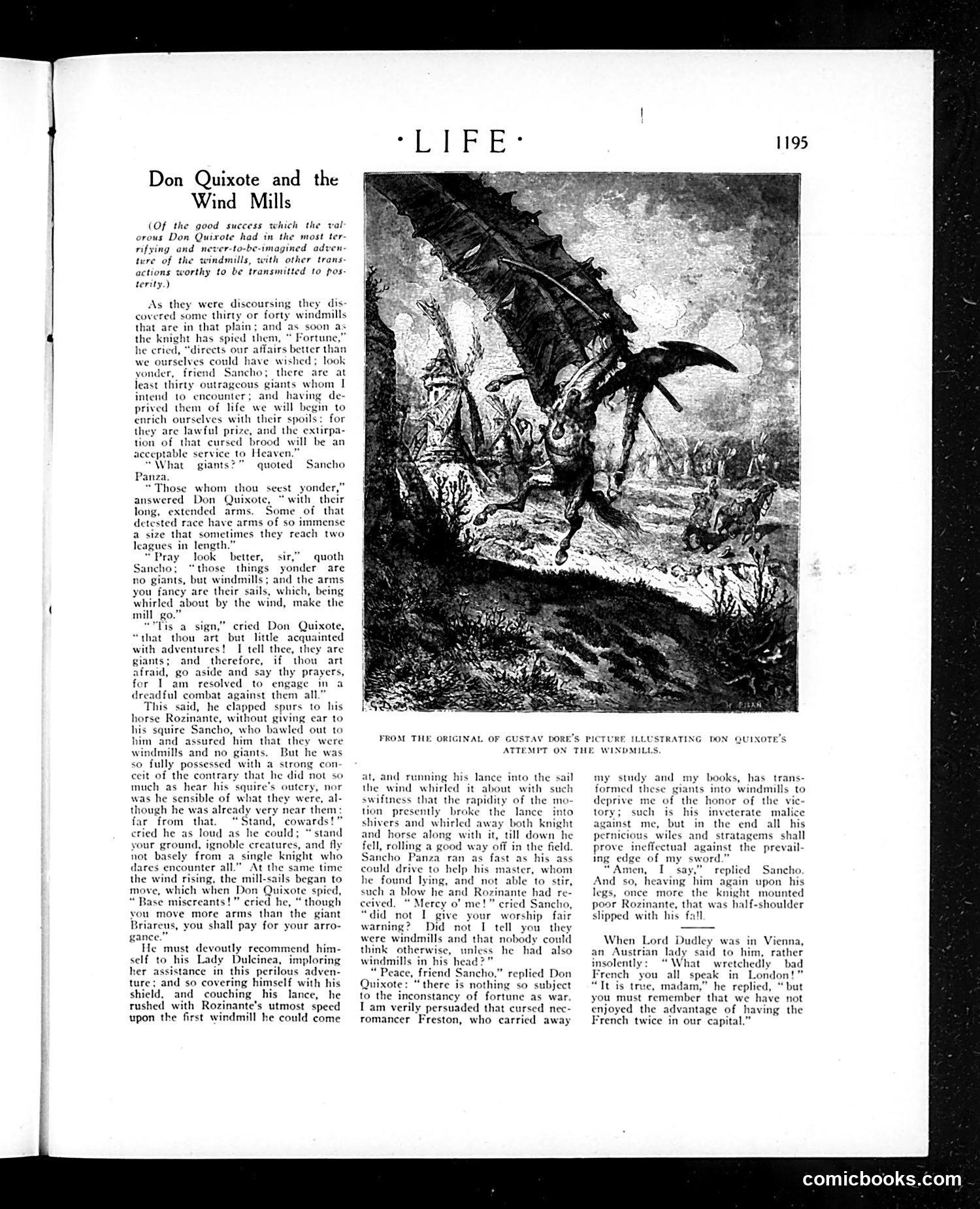
This page reproduces a famous episode from Cervantes' *Don Quixote*—the delusional knight's attack on windmills he mistakes for giants. The accompanying engraving (credited to Gustave Doré) illustrates the moment of impact. The satire works through Don Quixote's fundamental disconnect from reality: he sees windmills but *insists* they are giants requiring combat. His squire Sancho repeatedly corrects him, but Don Quixote dismisses reality as magic—a necromancer has "transformed" the giants. Even after being knocked down by a windmill sail, he rationalizes the failure rather than accepting what he plainly witnessed. For modern readers, this remains the archetypal image of pursuing an imaginary enemy while ignoring obvious truth. The episode satirizes romantic delusion, stubborn ideology, and the human tendency to reshape reality to match one's beliefs rather than adapting beliefs to reality. It's fundamentally about the danger of living in fantasy.
📄 Transcribed text from this page (OCR, searchable)
Machine-transcribed from the original scan — historical spelling and the odd misread are preserved.
Don Quixote and the Wind Mills (Of the good success which the val orous Don Quixote had in the most ter- rifying and never-to-be-imagined adven- ture of the windmills, with other trans- actions worthy to be transmitted to pos- terity.) As they were discoursing they dis- ed some thirty or forty windmills in that plain; and as soon as the knight has spied them, “ Fortune,” he cried, “directs our affairs better than we ourselves could have wished ; look yonder, friend Sancho; there are at least thirty outragcous giants whom | intend to encounter; and having de- prived them of life we will begin to enrich ourselves with their spoils: for they are lawful prize, and the extirp tion of that cursed brood will be acceptable service to Heaven.” What giants?” quoted anza. Those whom thou seest yonder,” answered Don Quixote, “with. their long, extended arms. Some of that detested race have arms of so immense a size that sometimes they reach two in Sancho leagues in length.” Pray look better, sir,” quoth Sancho; “those things yonder are no giants, but windmills; and the arms you fancy are their sails, which, being whirled about by the wind, make the mill go.” “Tis a sigr “that thou art cried Don Quixote, but little acquainted with adventures! I tell thee, they are giants; and therefore, if thou art raid, go aside and say thy prayers, for I am resolved to engage im a dreadful combat against them all.” This said, he clapped spurs to his horse Rozinante, without giving ear to his squire Sancho, who bawled out to him and assured him that they were windmills and no giants. But he was so fully possessed with a strong con ceit of the contrary that he did not so much as hear his ‘squire's outcry, nor was he sensible of what they were, al- though he was already very near them: far from. that. Stand, cowards cried he as loud as he could; “stand your ground, ignoble creatures, and fly not basely from a single knight who dares encounter all.” At the same time the wind rising, the mill-sails began to move, which when Don Quixote spied, “Base miscreants!” cried he, “ though you move more arms than the giant Briareus, you shall pay for your arro- gance,” He must devoutly recommend him- self to his Lady Dulcinea, imploring her assistance in this perilous adver ture; and so covering himself with his shield, and couching his lance, he rushed with Rozinante’s utmost speed upon the first windmill he could come FROM THE ORIGINAL OF G ATTEMPT ON THE at, and running his lan into the s. the wind whirled it about with su swiftness that the rapidity of the mo- tion presently broke the lance into shivers and whirled away both knight and horse along with it, till down he fell, rolling a good way off in the field Sancho Panza ran as fast as his ass could drive to help his master, whom he found lying, and not able ‘to. stir, such a blow he'and Rozinante had re- ceived, “ Mercy 0’ me!” cried Sancho, “did not I give your worship. fair warning? Did not I tell. you they were windmills and that nobody could think otherwise, unless he had also windmills in head?” “ Peace, friend Sancho,” replied Don Quixote: there is nothing so subject to the inconstancy of fortune as war. Iam verily persuaded that cursed nec- romancer Freston, who carried away STAV DORE’S PICTURE ILLUSTRATING DON QUIXOTE’S WINDMILLS. study and my book trans- ormed these giants into windmills to deprive me of the honor of the vic- tory; such is his inveterate malic: against me, but in the end all his pernicious wiles and stratagems shall prove ineffectual against the prevail- ing edge of my sword “Amen, I say,” replied cho. And so, heaving him again upon his legs, once more the knight mounted poor Rozinante, that was half-shoulder slipped with his fa'l When Lord Dudley was in Vienna, an Austrian lady said to him, rather insolently: “What wretchedly — bad French you all speak in London!” “Tt is true, madam,” he replied, “but you must remember that we have not enjoyed the advantage of having the French twice in our capital.” comicbooks.com