
Life, 1910-06-30 · page 26 of 41
Life — June 30, 1910 — page 26: what you’re looking at
What you’re looking at
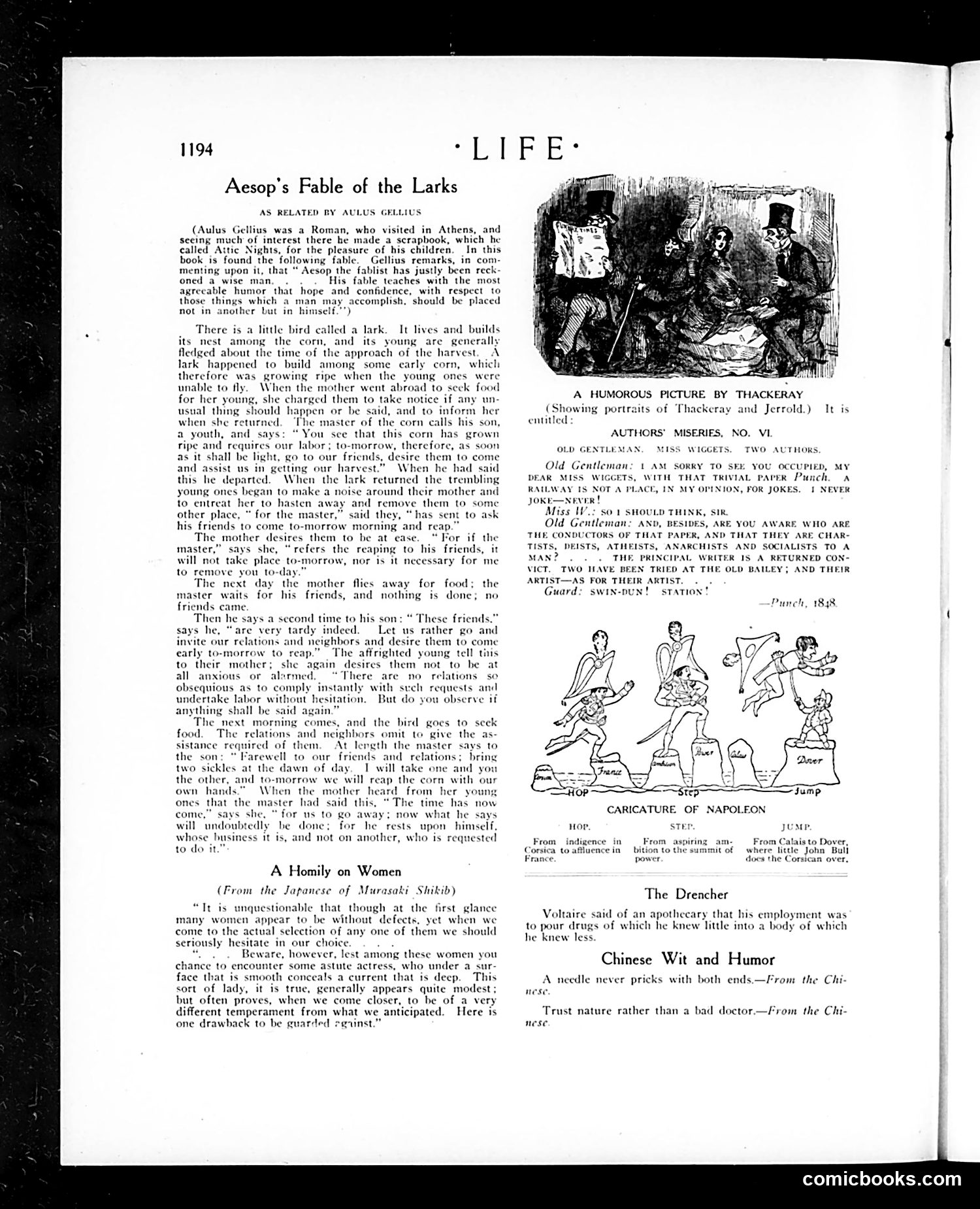
This page from *Life* magazine features a satirical cartoon titled "Caricature of Napoleon," depicting the French military leader in an exaggerated, humorous style. The illustration shows Napoleon in various poses—hopping, stepping, and jumping across labeled positions (Hop, Step, Jump, etc.)—arranged as if charting his military movements or territorial advances. The satire mocks Napoleon's ambitions and military campaigns through physical comedy, reducing his grand conquests to childish playground movements. The cartoon likely dates from the Napoleonic Wars era, when such caricatures were popular in English satirical publications to ridicule the French leader's expansionist behavior and contrast his inflated reputation with undignified physical comedy.
📄 Transcribed text from this page (OCR, searchable)
Machine-transcribed from the original scan — historical spelling and the odd misread are preserved.
1194 Aesop's Fable of the Larks AS RELATED BY AULUS GELLIUS Mlius was a Roman, who visited in Athens, and seeing much of interest there he made a scrapbook, which he called Attic Nights, for the pleasure of his children. In this book is found the following fable. Gellius remarks, in com- menting upon it, that “ Aesop the fablist has justly been reck- oned a wise man. His fable teaches with the most agreeable humor that hope and confidence, with respect to those things which a man may accomplish, ‘should be placed not in another but in himself."*) (Aulus here is a little bird called a lark. It lives and builds its nest among the corn, and its young are generally fledged about the time of the approach of the harvest. A lark happened to build among some carly corn, wh! therefore was growing ripe when the young ones were unable to fy. When the mother went abroad to seck food for her young, she charged them to take notice if any un- usual thing should happen or be said, and to inform her when she returned. ‘The master of the corn calls his son, a youth, and says: “You sce that this corn has grown ripe and requires our labor; to-morrow, therefore, as soon as it shall be light, go to our friends, desire them to come and assist us in getting our harvest.” When he had said this he departed. When the lark returned the trembling young ones began to make a noise around their mother and to entreat her to hasten away and remove them to some other place, “ for the master,” said they, “has sent to ask his friends to come to-morrow morning and reap. The mother desires them to be at ease. For if the master,” says she, “refers the reaping to his friends, it will not take place to-morrow, nor is it necessary for me to remove you to-da The next the mother flies away for food; the master waits for his friends, and nothing is done; no friends came. Then he says a second time to his son: says he, “are very tardy indeed. Let us rather go and invite our relations and neighbors and desire them to come early to-morrow to reap.” The affrighted young tell t to their mother; she again desires them not to be at all anxious or armed, There are no relations so obsequious as to comply instantly with such requests and undertake labor without hesitation. But do you observe if anything shall be said again.” The next morning comes, and the bird goes to seek food. The relati and neighbors omit to give the as- sistance required of them. At length the master says to the son: * Farewell our friends and relations; bring two sickles at the dawn of day. I will take one and y the other, and to-morrow we will reap the corn with our own hands.” When the mother heard from her young ones at the master had said this, * The time now come,” says she, “for us to go away; now what he says will undoubtedly be done; for he rests upon himself, whose business it is, and not on another, who is requested to do it.” hese friend A Homily on Women (From the Japanese of Murasaki Shikib) is unquestionable that though at the first glance many women appear to be without defects, yet when we come to the actual selection of any one of them we should seriously hesitate in our choic ao: Beware, however, lest among these women you chance to encounter some astute actress, who under a sur- face that is smooth conceals a current that is deep. This sort of lady, it is true, generally appears quite modest ; but often proves, when’ we come closer, to be of a very different temperament from what we anticipated, Here is one drawback to be guarded srinst.” A HUMOROUS PICTURE BY THACKERAY (Showing portraits of Thackeray and Jerrold.) It is entitled AUTHORS’ MISERIES, NO. VIL. OLD GENTLEMAN, MISS WIGGETS, TWO AUTHORS. Old Gentleman: 1 aM sorry TO sex You occuPIED, MY DEAR MISS WIGGETS, WITH THAT TRIVIAL PAPER Punch. A RAILWAY IS NOT A PLACE, IN MY OPINION, FOR JOKES. 1 NEVER JOKE—NEVER! Miss W.: so.1 SHOULD THINK, SIR Old Gentleman: AND, BESIDES, ARE YOU AWARE WHO ARE THE CONDUCTORS OF THAT PAPER, AND THAT THEY ARE CHAR- TISTS, DEISTS, ATHEISTS, ANARCHISTS AND SOCIALISTS MAN? . THE PRINCIPAL WRITER IS A RETUR VICT. TWO HAVE BEEN TRIED AT THE OLD BAILE ARTIST—AS FOR THEIR ARTIST. Guard: swix-puN! STATION! CARICATURE OF NAPOLEON Hor. ster. JUMP, From indigence in From Calais to Dover, ace in bition to the sum € where litte John Bull power does the Corsican over, The Drencher Voltaire said of an apothecary that his employment was to pour drugs of which he knew little into a body of which he knew less. Chinese Wit and Humor A needle never pricks with both ends.—From the Chi- nese. Trust nature rather than a bad doctor.—From the Chi- nese. comicbooks.com