
Life, 1910-06-30 · page 8 of 41
Life — June 30, 1910 — page 8: what you’re looking at
What you’re looking at
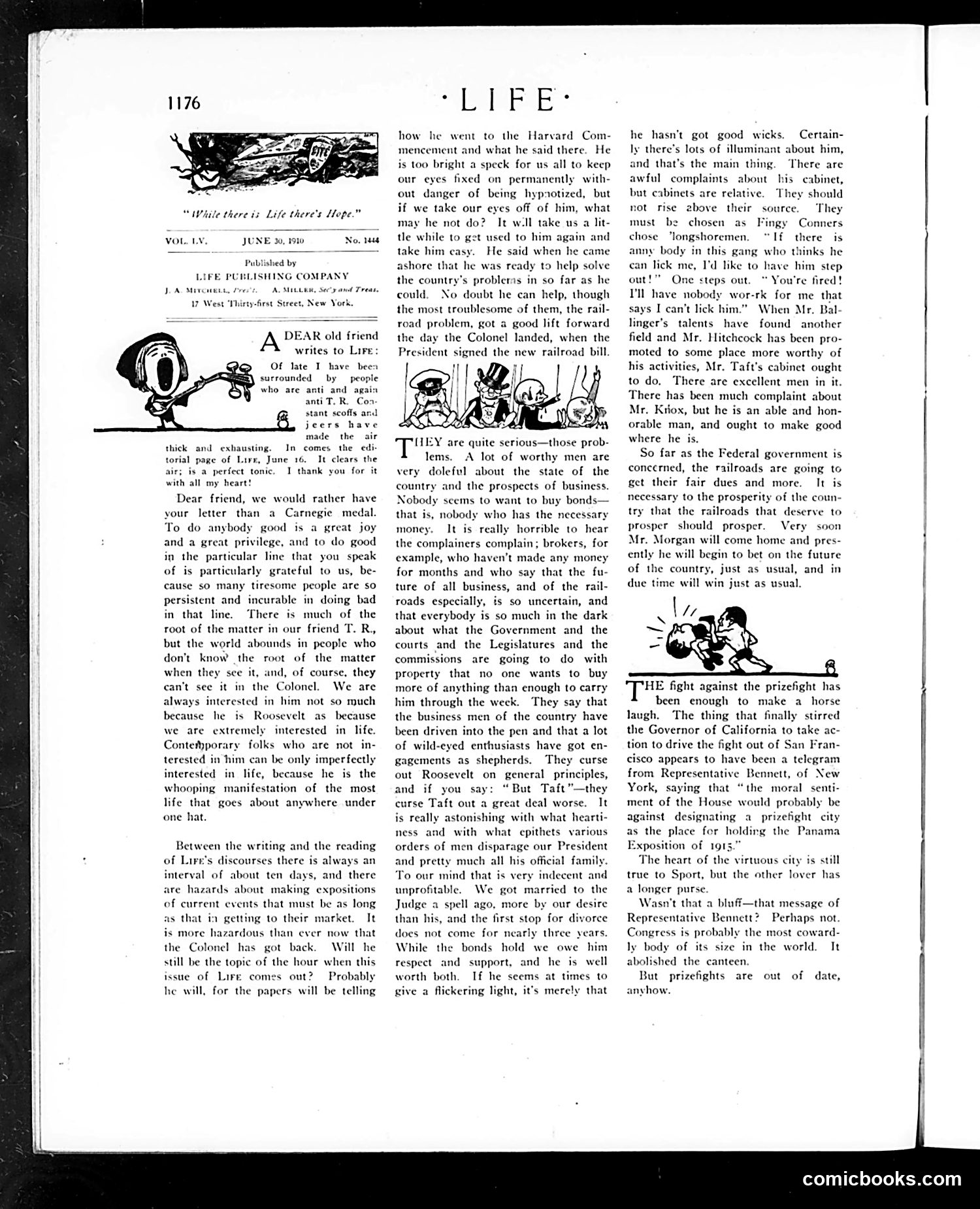
This page contains editorial commentary on contemporary political and business concerns rather than cartoons. The main illustration shows three figures in what appears to be a satirical scene about government and business relations. The text criticizes President Theodore Roosevelt's policies and cabinet, mentioning complaints about his administrators (particularly referencing "Fingy" Connors and "Longshoresmen"). It discusses anxieties about railroad regulation, the Federal government's role in business, and uncertainty in the economy. A secondary piece mocks prizefighting and references the Governor of California's efforts to ban a fight at the Panama-Pacific Exposition, suggesting the moral debate around boxing was a significant contemporary issue. The overall tone reflects Progressive Era skepticism toward both big business and government intervention.
📄 Transcribed text from this page (OCR, searchable)
Machine-transcribed from the original scan — historical spelling and the odd misread are preserved.
Vou. LY, JUNE 30, 1910 No. 14s Published by LIFE PUBLISHING COMPANY JA. Meronent, Pree 17 West ‘Thirty AL MILLEM, Sec'y and Treas. rst Street, New York. AR old friend DE. writes to Lire: Of late I have been surrounded by people who are anti and again anti T. R. Con stant scoffs and jeers ha made the air thick and exhausting. In comes the edi- torial page of Lirr, June 16. It clears the air; is a perfect tonic, I thank you for it with all my heart! Dear friend, we would rather have vour letter than a Carnegie medal. To do anybody good is a great joy and a great privilege, and to do good in the particular line that you speak of is particularly grateful to us, be- cause so many tiresome people are so persistent and incurable in doing bad in that line. There is much of the root of the matter in our friend T. R., but the world abounds in people who don’t know the root of the matter when they sce it, and, of course, they can't see it in the Colonel. We are always interested in him not so much because he is Roosevelt as because we are extremely interested in life. Contemporary folks who are not in- terested in him can be only imperfectly interested in life, because he is the whooping manifestation of the most life that goes about anywhere under one hat. Between the writing and the reading of Lire’s discourses there is alw: interval of about ten days, and there are hazards about making expositions of current events that must be as long as that in getting to their market, It is more hazardous than ever now that the Colonel got b: Will he still be the topic of the hour when this issue of Lire comes out? Probably he will, for the papers will be telling ys an “EEE * how he went to the Harvard Com- mencement and what he said there. He is too bright a speck for us all to keep our eyes fixed on permanently with- out danger of being hypnotized, but if we take our eyes off of him, what may he not do? It wall take us a lit- tle while to get used to him again and take him easy. He said when he came ashore that he was ready to help solve the country’s problems in so far as he could, No doubt he can help, though the most troublesome of them, the rail- road problem, got a good lift forward the day the Colonel landed, when the resident signed the new railroad bill. are quite serious—those prob- lems. A lot of worthy men are very dolefvl about the state of the country and the prospects of business. Nobody seems to want to buy bonds— that is, nobody who has the necessary money, It is really horrible to hear the complainers complain; brokers, for example, who haven’t made any money for months and who say that the fu- ture of all business, and of the rail- roads especially, is so uncertain, and that everybody is so much in the dark about what the Government and the courts and the Legislatures and the commissions are going to do with property that no one wants to buy more of anything than enough to carry him through the week. They say that the business men of the country have been driven into the pen and that a lot of wild-eyed enthusiasts have got en- gagements as shepherds. They curse out Roosevelt on general principles, and if you say: “But Taft”—they curse Taft out a great deal wo} Tt is really astonishing with what hearti- ness and with what epithets various orders of men disparage our President and pretty much all his official family. To our mind that is very indecent and unprofitable. We got married to the Judge a spell ago, more by our desire than his, and the first stop for divorce does not come for nearly three years. While the bonds hold we owe him respect and support, and he is well worth both. If he seems at times to give a flickering light, it’s merely that he hasn't got good wicks. Certain- ly there’s lots of illuminant about him, and that’s the main thing. There are awful complaints about his cabinet, but cabinets are relative. They should not rise 2bove their soure They must be chosen as Fingy Conners chose "longshoremen. “If there is anny body in this gang who thinks he can lick me, I'd like to have him step out!” One steps out. “You're fired! I'll have nobody wor-rk for me that says I can’t lick him.” When Mr. Bal- linger’s talents have found another field and Mr. Hitchcock has been pro- moted to some place more worthy of his activities, Mr. Taft's cabinet ought to do. There are excellent men in it. There has been much complaint about Mr. Kriox, but he is an able and hon- orable man, and ought to make good where he is. So far as the Federal government is concerned, the railroads are going to get their fair dues and more. It is necessary to the prosperity of the coun- try that the railroads that deserve t prosper should prosper. Very soon Mr. Morgan will come home and pres- ently he will begin to bet on the future of the country, just as usual, and in due time will win just as usual. Vly ~ ne fight against the prizefight has been enough to make a horse laugh. The thing that finally stirred the Governor of California to take ac- tion to drive the fight out of San Fran- cisco appears to have been a telegram from Representative Bennett, of New York, saying that “the moral senti- ment of the House would probably be against designating a prizefight city as the place for holding the Panama Exposition of 1913.” The heart of the virtuous city is still true to Sport, but the other lover has a longer purse. Wasn't that a bluff—that message of Representative Bennett? Perhaps not. Congress is probably the most coward- ly body of its size in the world. It abolished the canteen. But prizefights are out of date, anyhow. comicbooks.com 2S