
Life, 1910-06-30 · page 15 of 41
Life — June 30, 1910 — page 15: what you’re looking at
What you’re looking at
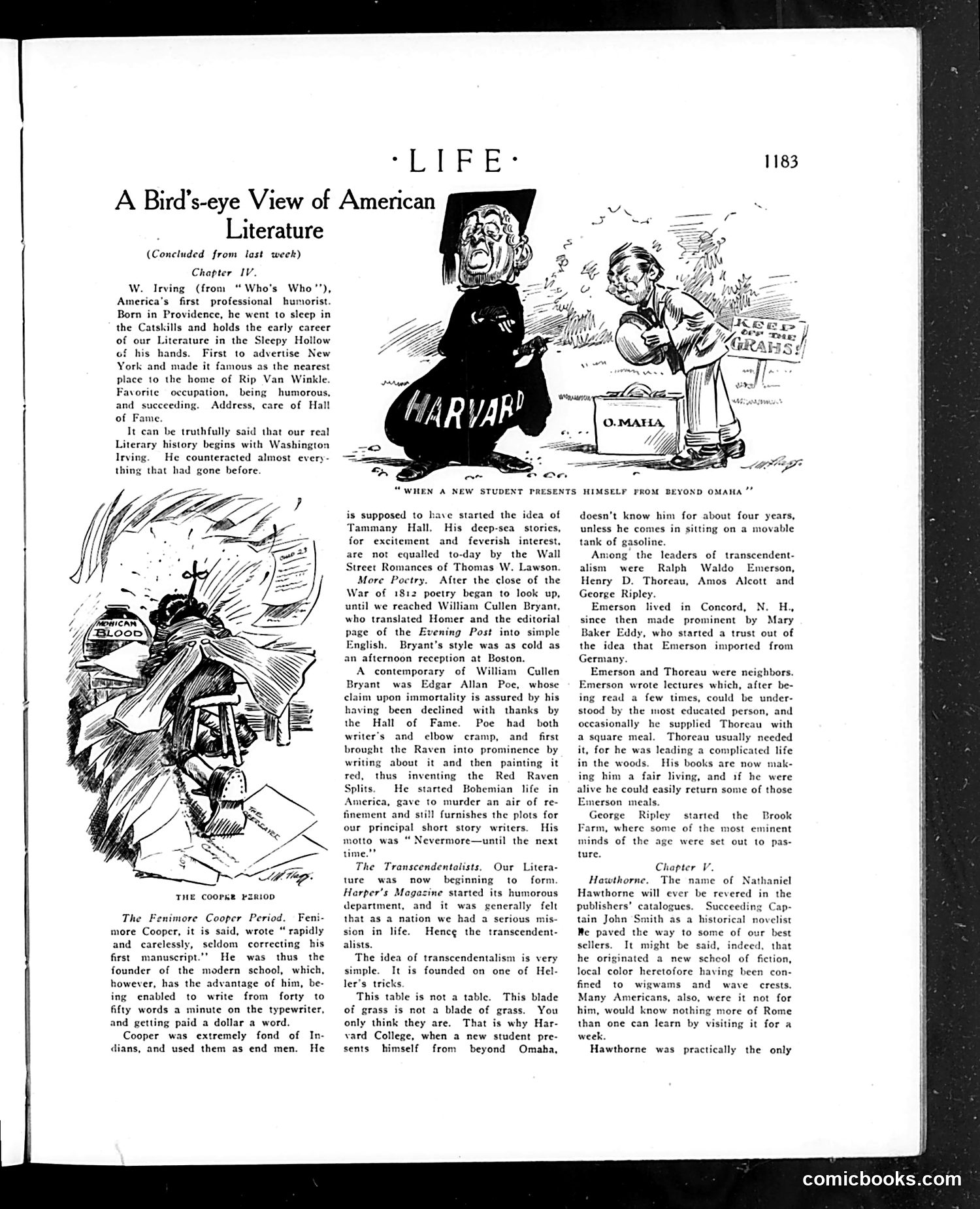
This page satirizes American literary history through mock-serious commentary. The main cartoon depicts **Harvard College** personified as a stern academic figure confronting a naive student "from beyond Omaha"—satirizing the intellectual pretension and obscurity of transcendentalist philosophy taught there. The text mocks transcendentalism's core concept: that everyday objects aren't what they seem ("This table is not a table"). The joke is that Harvard students from the Midwest cannot understand this philosophy for four years—unless arriving "sitting on a movable tank of gasoline" (implying they need external assistance). The satire targets **intellectual elitism** and the gap between practical American life (represented by "Omaha," the frontier) and East Coast academic snobbery. Life magazine, known for irreverent humor, uses exaggeration and absurdist logic to deflate the pretensions of transcendentalist literature and Harvard's role in promoting it. The accompanying literary sketches continue this theme of mocking America's self-important literary figures.
📄 Transcribed text from this page (OCR, searchable)
Machine-transcribed from the original scan — historical spelling and the odd misread are preserved.
~ A Bird’s-eye View of American Literature (Concluded from last week) Chapter IV. W. Irving (from “Who's Who America’s first professional humorist. Born in Providence, he went to sleep in the Catskills and holds the early career of our Literature in the Sleepy Hollow of his hands. First to advertise New York and made it famous as the nearest place to the home of Rip Van Winkle. Favorite occupation, being humorous, and succeeding. Address, care of Hall of Fame. It can be truthfully said that our real Literary history begins with Washington Irving. He counteracted almost every- thing that had gone before. THE CoorKE FZRI0D The Fenimore Cooper Period. Feni- more Cooper, it is said, wrote “ rapidly and carelessly, seldom correcting his first. manuscript." He was thus the founder of the modern school, which, however, has the advantage of him, be- ing enabled to write from forty to fifty words a minute on the typewriter, and getting paid a dollar a word. Cooper was extremely fond of In- dians, and used them as end men. He ‘LIF E+ “WHEN A NEW STUDENT PRESENTS HIMSELP FROM BEYOND OMAHA’? is supposed to have started the idea of Tammany Hall. His deep-sea stories, for excitement and feverish interest, are not equalled to-day by the Wall Street Romances of Thomas W. Lawson. More Poctry. After the close of the War of 1812 poetry began to look up, until we reached William Cullen Bryant, who translated Homer and the editorial page of the Evening Post into simple English. Bryant’s style was as cold as an afternoon reception at Boston. A contemporary of William Cullen Bryant was Edgar Allan Poe, whose claim upon immortality is assured by his having been declined with thanks by the Hall of Fame. Poe had both writer's and elbow cramp, and first brought the Raven into prominence by writing about it and then painting it red, thus inventing the Red Raven Splits. He started Bohemian life in America, gave to murder an air of re- finement and still furnishes the plots for our principal short story writers. His motto was “ Nevermore—until the next time.”” The Transcendentalists. Our Litera- ture was now beginning to form. Harper's Magazine started its humorous department, and it was generally felt that as a nation we had a serious mis- sion in life. Hencg the transcendent- alists. The idea of transcendentalism is very simple. It is founded on one of Hel- ler's tricks This table is not a table. This blade of grass is not a blade of grass. You only think they are. That is why Har- vard College, when a new student pre- sents himself from beyond Omaha, doesn't know him for about four years, unless he comes in sitting on a movable tank of gasoline. Among’ the leaders of transcendent. alism were Ralph Waldo Emerson, Henry D. Thoreau, Amos Alcott and George Ripley. Emerson lived in Concord, N. H since then made prominent by Mary Baker Eddy, who started a trust out of the idea that Emerson imported from Germany. Emerson and Thoreau were neighbors. Emerson wrote lectures which, after be- ing read a few times, could be under- stood by the most educated person, and occasionally be supplied Thoreau with a square meal. Thoreau usually needed it, for he was leading a complicated life in the woods. His books are now mak- ing him a fair living, and of he were alive he could easily return some of those Emerson meals. George Ripley started the Brook Farm, where some of the most eminent minds of the age were set out to pas- ture. Chapter V. Hawthorne, The name of Nathaniel Hawthorne will ever be revered in the publishers’ catalogues. Succeeding Cap- tain John Smith as a historical novelist Me paved the way to some of our best sellers, It might be said, indeed, that he originated a new school of fiction, local color heretofore having been con- fined to wigwams and wave crests. Many Americans, also, were it not for him, would know nothing more of Rome than one can learn by visiting it for a week. Hawthorne was practically the only comicbooks.com