
A complete issue · 44 pages · 1910
Life — February 17, 1910
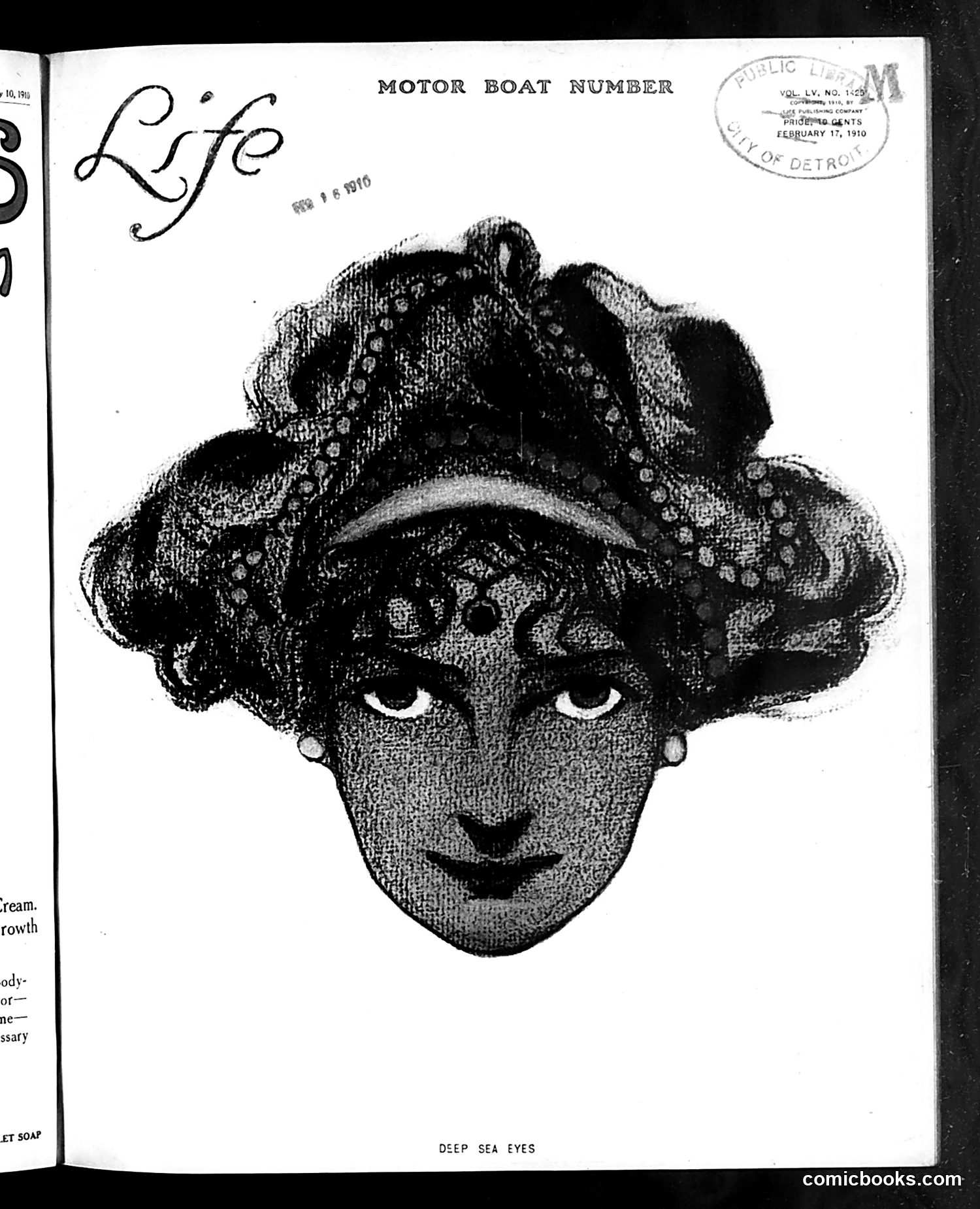
This is a cover from *Life* magazine (dated February 17, 1910, per the library stamp). The illustration shows a woman's face with an elaborate, voluminous hat and the caption "DEEP SEA EYES." The satire targets early 1910s women's fashion, specifically the enormous decorative hats that were fashionable at the time. The phrase "deep sea eyes" is a humorous reference to how a woman's eyes appear tiny and recessed—almost invisible—when framed by such a massive hat. The "motorboat number" in the headline suggests the hat resembles a boat in size and shape. This mocks the absurdity of contemporary haute couture, where practical concerns were sacrificed entirely for dramatic, oversized accessories that literally obscured the wearer's face. It's social satire about fashion excess.
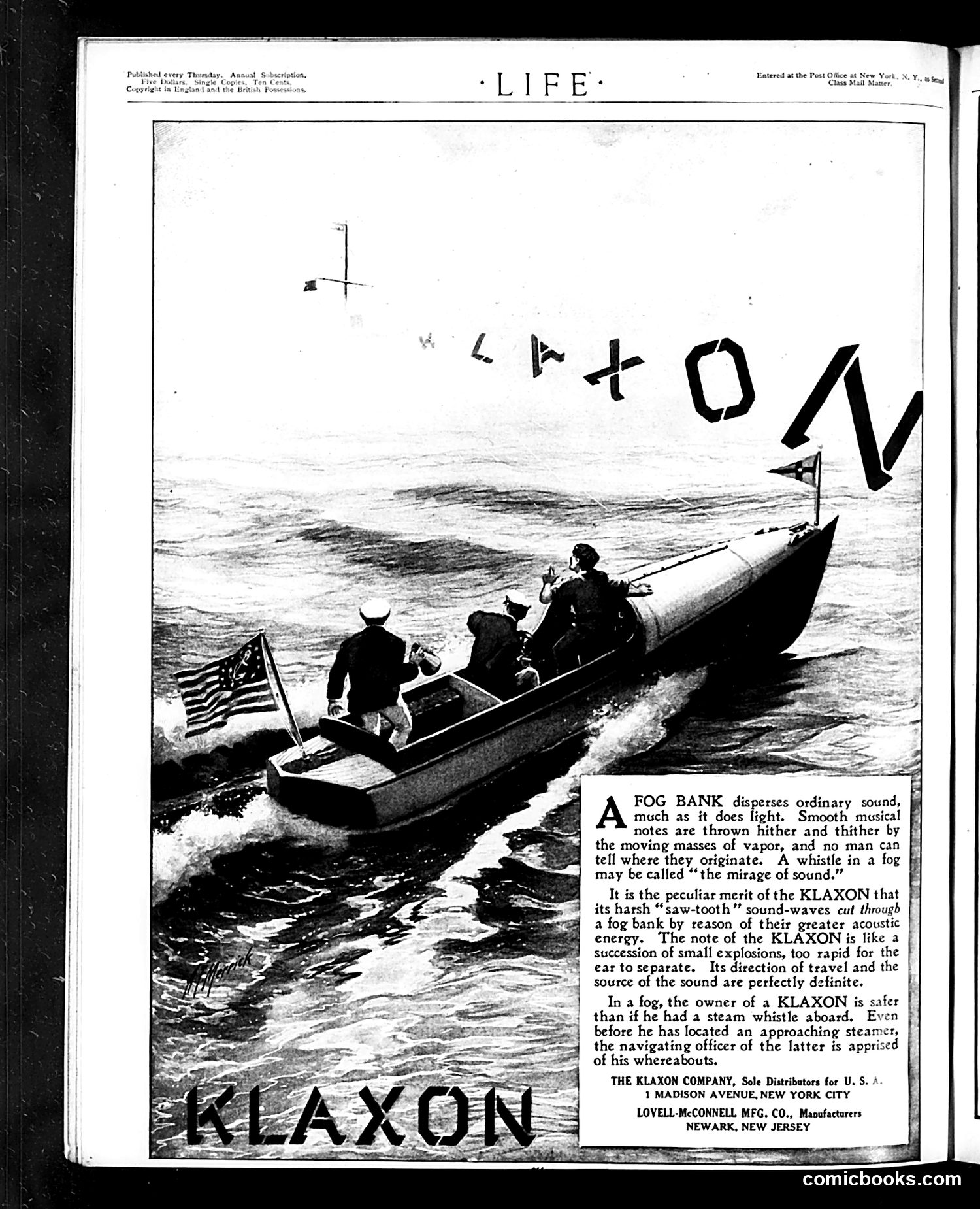
This page is primarily an **advertisement**, not editorial content or satire. It promotes the Klaxon, an automobile horn manufactured by the Klaxon Company (New York City) and Lovell-McConnell Mfg. Co. (Newark, New Jersey). The ad uses a maritime safety angle: a small boat in foggy conditions with an American flag. The copy explains that fog disperses sound unpredictably, but the Klaxon's "saw-tooth" sound waves can cut through fog better than ordinary horns. The pitch is that car owners with a Klaxon are "safer" than those with steam whistles. This is straightforward product marketing exploiting contemporary anxieties about automotive safety and navigation in poor visibility—not political satire or social commentary.
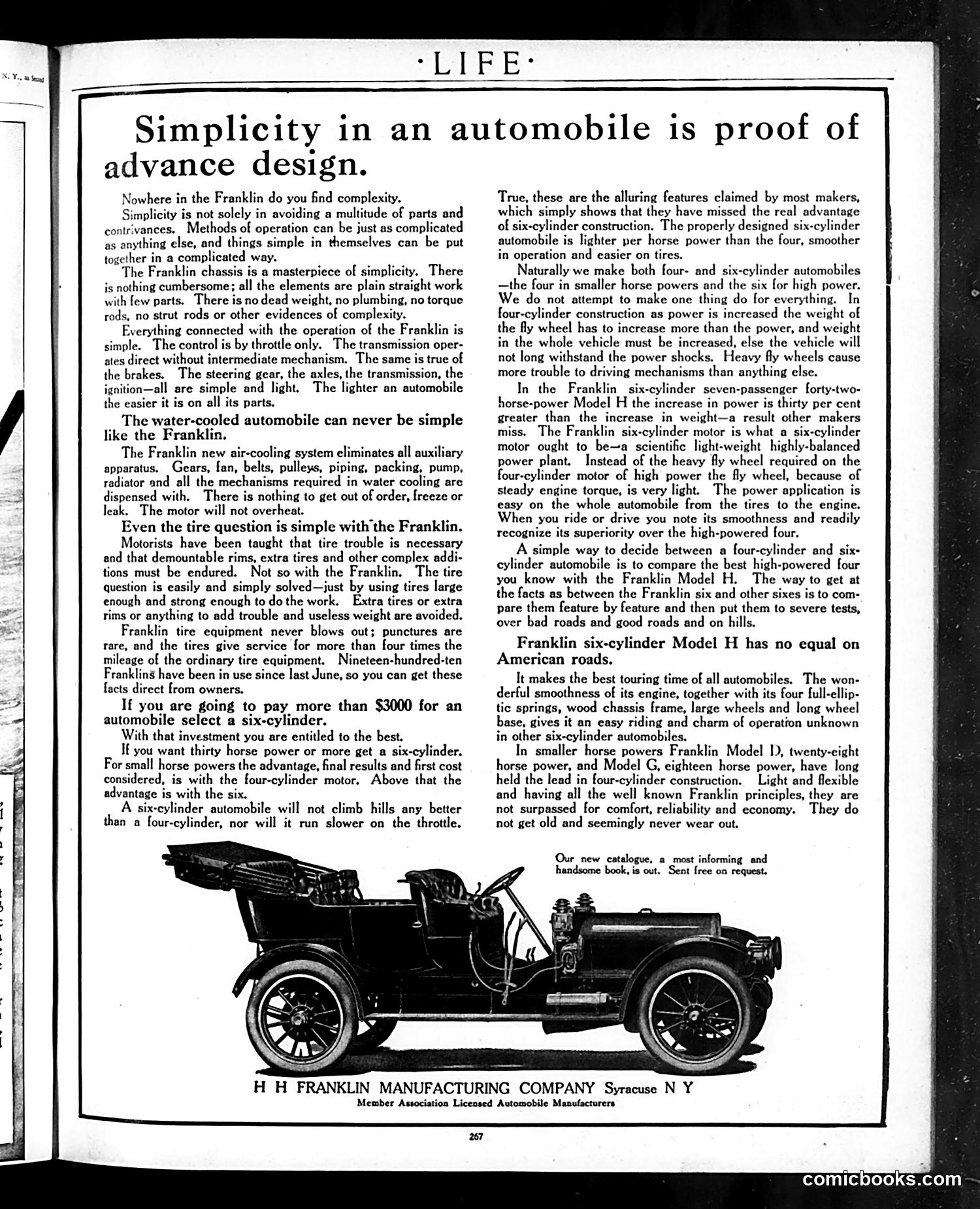
This is **not a political cartoon or satire**—it's a straightforward advertisement for the Franklin automobile, published in *Life* magazine (which carried both humor and ads). The page argues that the Franklin's **simplicity proves advanced design**. Key claims include: - The six-cylinder engine is superior to four-cylinder competitors - Air-cooling (eliminating water systems) demonstrates engineering sophistication - Large tires and simple controls reduce maintenance - The Model H outperforms "high-powered fours" on hills and rough roads The accompanying illustration shows a Franklin touring car in profile. The ad targets affluent buyers ($3,000+ investment) by positioning mechanical simplicity as a sign of superiority rather than cheapness—a marketing strategy common in early automotive advertising when features and reliability varied wildly among manufacturers.
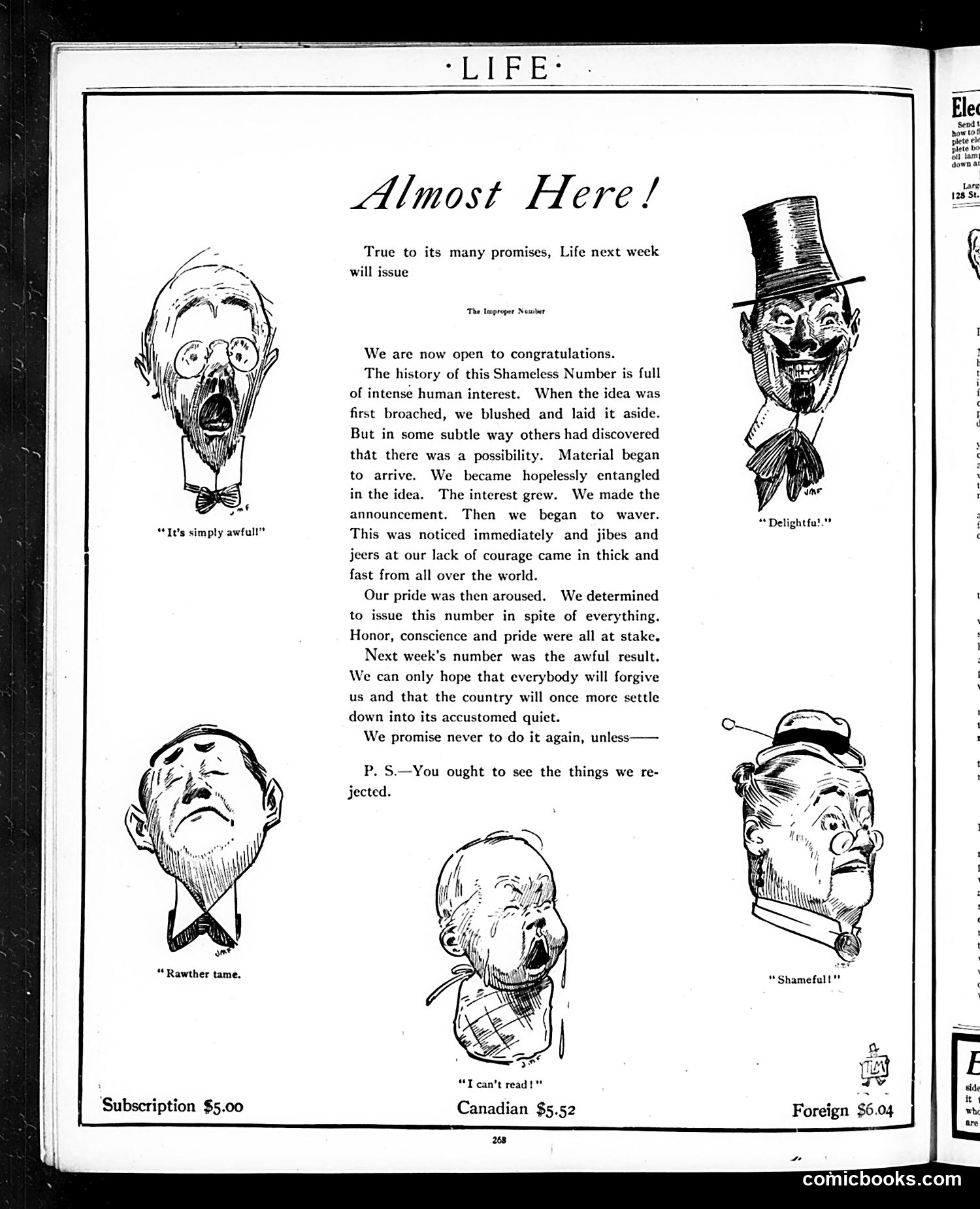
This is a self-referential editorial from *Life* magazine apologizing for a delayed or problematic "Shameless Number" issue. The text explains they announced a daring issue but faced public ridicule and pressure ("jibes and jeers...from all over the world"), causing them to waver. The five caricatured heads represent editorial responses to the controversy: shock ("It's simply awful!"), false cheerfulness ("Delightful!"), resigned acceptance ("Rather tame"), distress ("I can't read!"), and shame ("Shameful!"). The magazine ultimately published the controversial issue anyway, claiming it was a matter of "honor, conscience and pride," though they apologize for its quality ("awful result") and promise never to repeat it—a humorous, self-deprecating acknowledgment that they caved to pressure but published anyway.
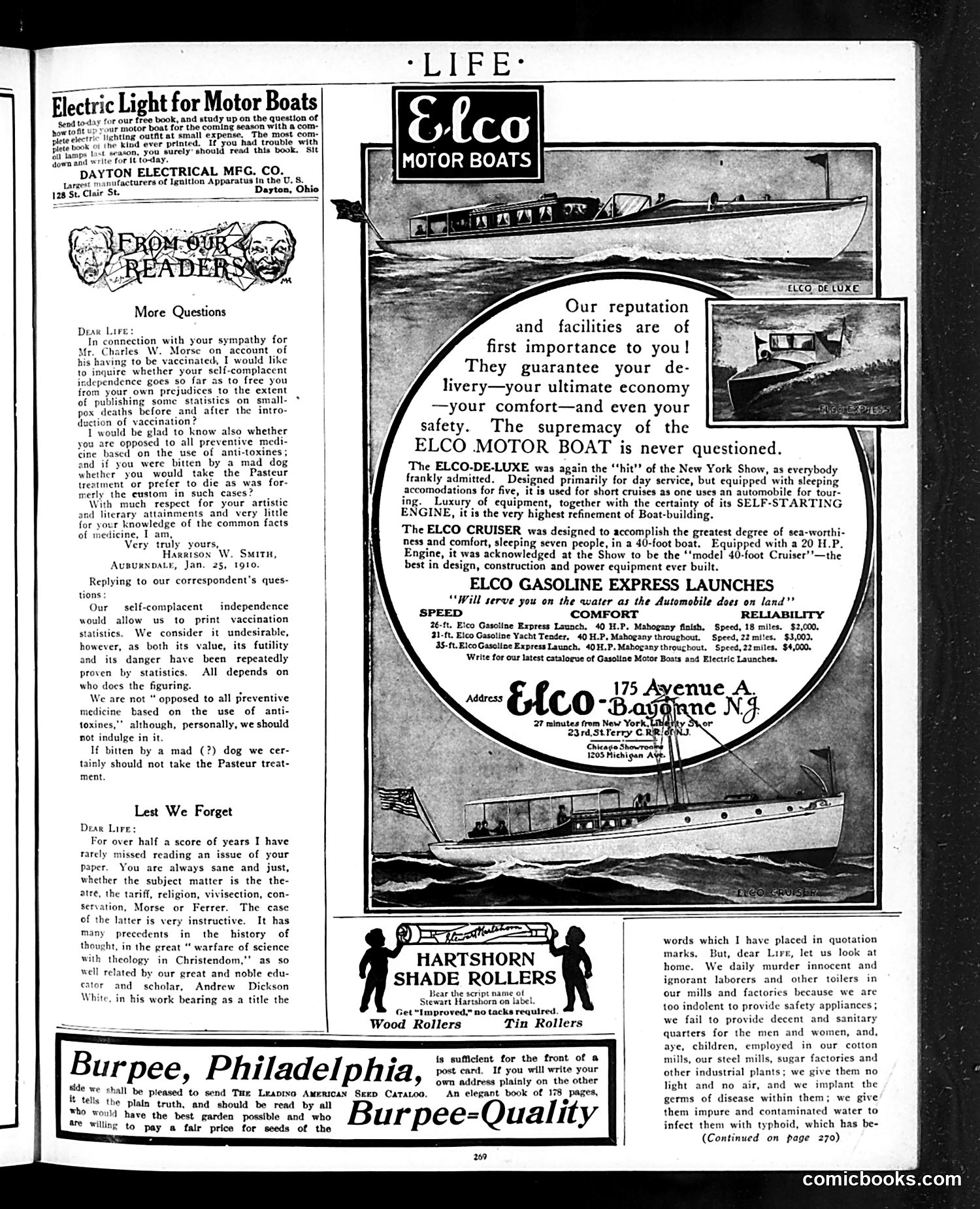
This page is primarily **advertising rather than political satire**. The main content consists of: 1. **Elco Motor Boats advertisement** (center/right): Promotes luxury motorboats with images and detailed specifications, emphasizing their reputation, design, and self-starting gasoline engines. 2. **Left column**: Reader letters addressing medical questions (antitoxins, rabies treatment, vivisection) and one nostalgic letter about missing Life magazine during travel. 3. **Bottom advertisements**: Hartshorn Shade Rollers and Burpee seeds. The only illustrated element with potential satirical intent is a small "From Our Readers" header with two illustrated faces, but this appears merely decorative for the letters section, not political commentary. The page reflects early 20th-century magazine content mixing reader correspondence with luxury consumer goods advertising.
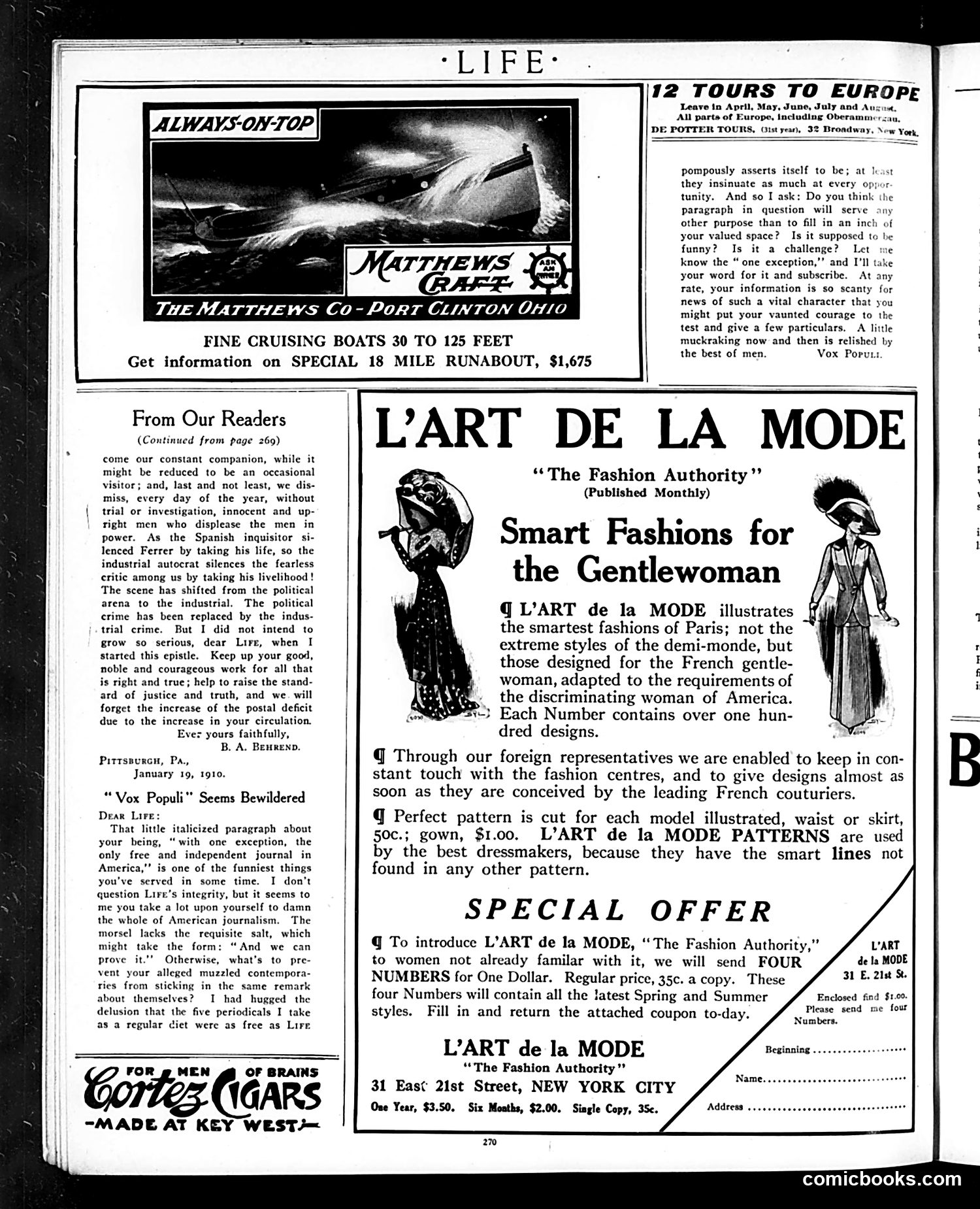
This page is primarily **advertising and fashion content** rather than satirical cartoons. The dominant feature is a full-page advertisement for "L'ART de la MODE," a French fashion magazine for women, promoting patterns and dress designs. The "From Our Readers" section contains letters critiquing Life itself—one accusing the magazine of lacking "salt" and independent spirit, another sarcastically calling Life "bewildered" about American values. These appear to be reader complaints about the magazine's editorial direction, though the specific political context is unclear without broader issue context. The Matthews boat advertisement and Cortes Cigars ad are standard period commercial content. Overall, this is a typical early-20th-century magazine page mixing reader feedback with commercial promotions.
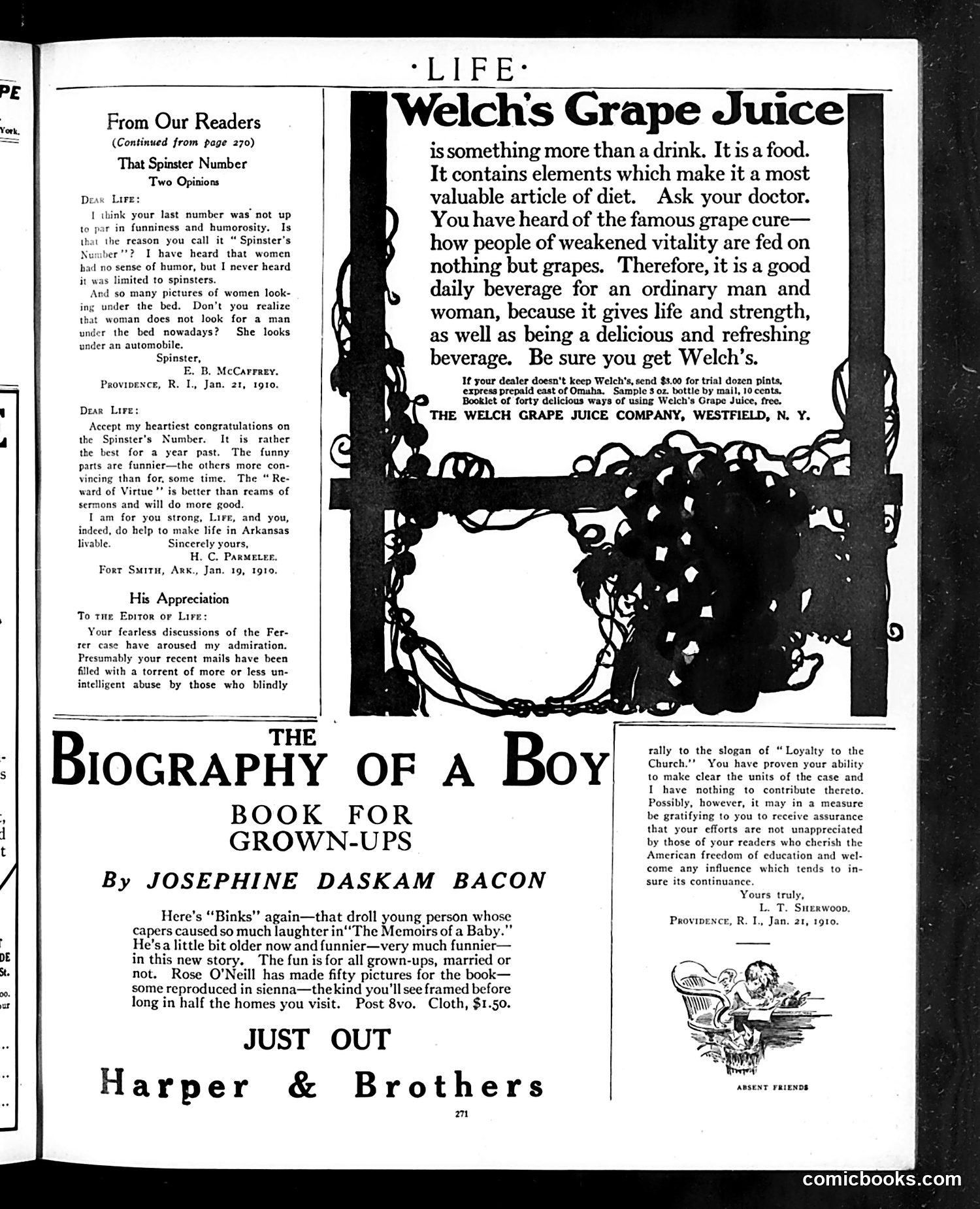
This page is primarily **advertising and book promotion** rather than political satire. The main content includes: 1. **Welch's Grape Juice ad** (top right): A health-focused advertisement claiming grape juice is "something more than a drink" and "a food," referencing the "famous grape cure" for health and vitality. This reflects early 20th-century marketing of patent medicines and health tonics. 2. **"The Biography of a Boy" book promotion** (lower left): Advertising a humorous book by Josephine Daskam Bacon featuring a character named "Binks," published by Harper & Brothers. 3. **Reader letters** (left column): Routine correspondence responding to previous magazine content. The page reflects 1910s consumer culture and book publishing rather than containing political commentary or satirical cartoons.
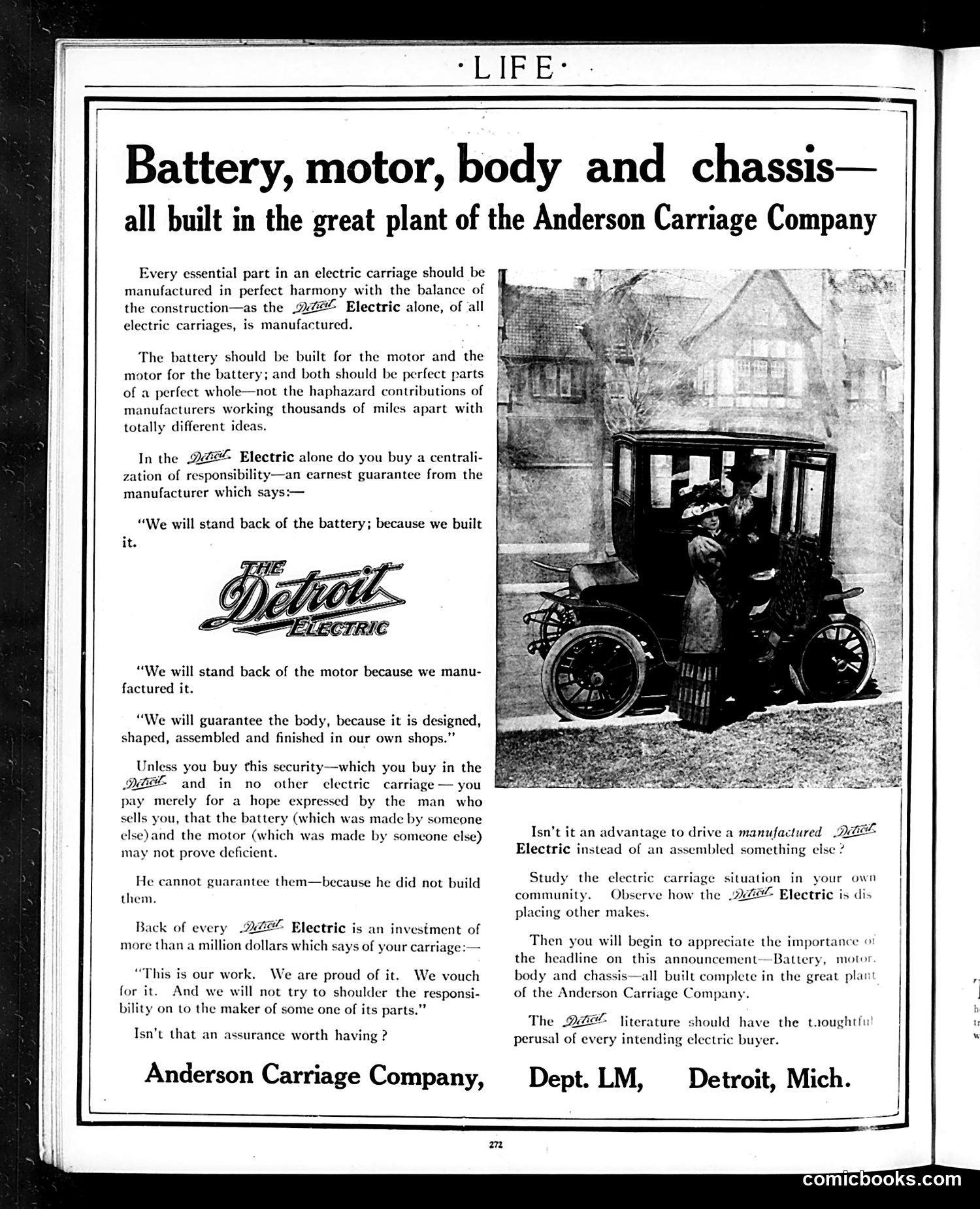
This is a **Detroit Electric automobile advertisement**, not political satire or a cartoon. The page promotes the Anderson Carriage Company's electric vehicles by emphasizing manufacturing integration and quality control. The key argument: unlike competitors who assemble parts from various suppliers, Detroit Electric manufactures all components (battery, motor, body, chassis) in-house. This allows them to guarantee the entire vehicle and "stand back" of every part. The accompanying photograph shows an elegant electric car with well-dressed passengers, reflecting the luxury market these vehicles occupied in the early 1900s. The sales pitch targets affluent buyers concerned with reliability, positioning Detroit Electric as superior to assembled alternatives where no single manufacturer accepts full responsibility.
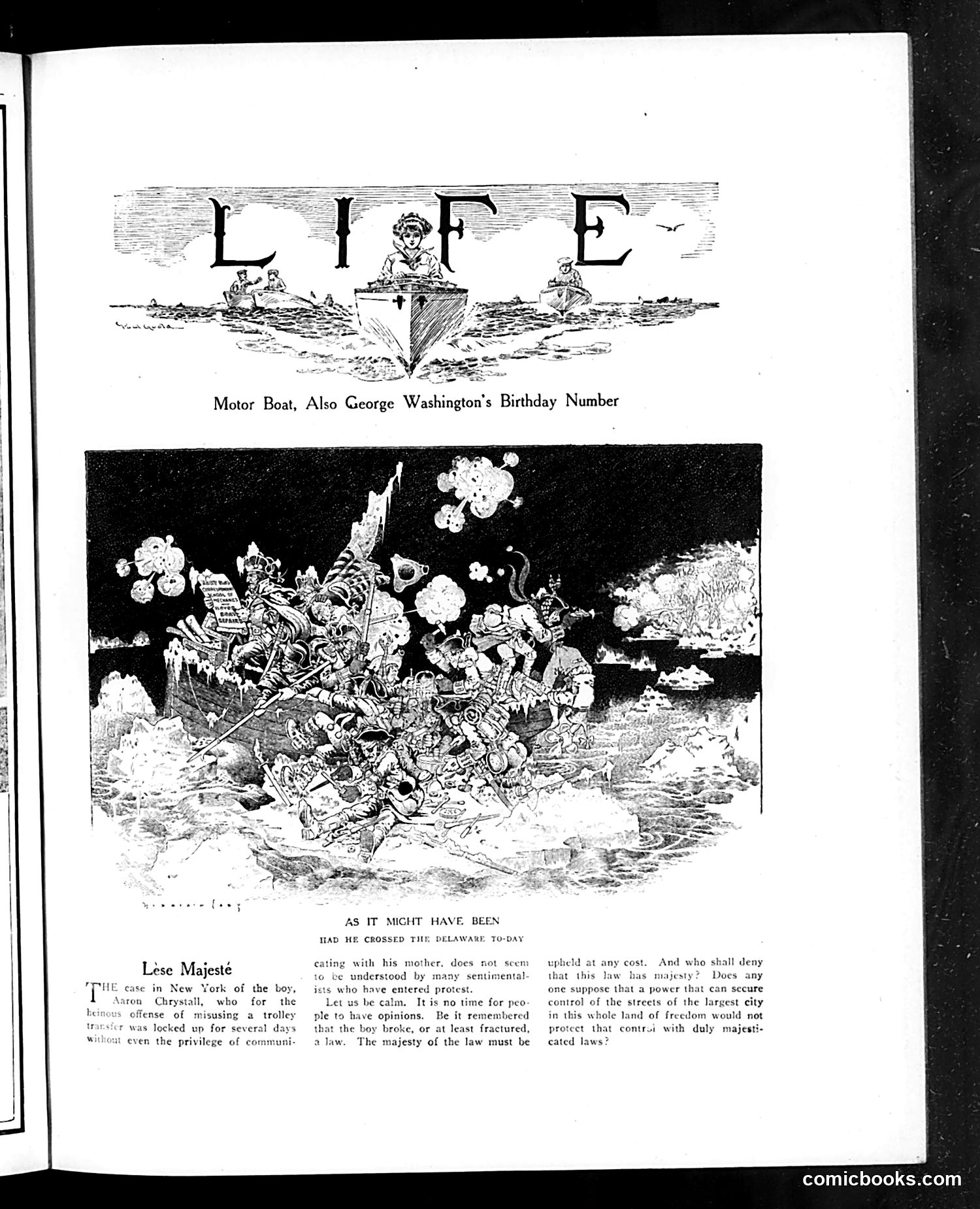
This page from *Life* magazine contains two satirical illustrations about legal authority and civil disobedience. The top header "LIFE" depicts a motorboat scene, subtitled "Motor Boat, Also George Washington's Birthday Number." The main cartoon below, titled "Lèse Majesté" ("injured majesty"), illustrates a chaotic street scene with figures in apparent conflict. The accompanying text discusses a New York case involving a boy named Aaron Chrystal arrested for the "heinous offense of missing a trolley transfer"—satirizing overly strict enforcement of minor infractions. The satire criticizes how authorities rigidly apply laws without regard for context or justice. The text argues that those who enter protest against such enforcement shouldn't be silenced, and questions whether "a poser that can secure control of the streets of the largest city in this whole land of freedom would not protect that control with duly majesticated laws?" The cartoon mocks excessive governmental control masquerading as law and order.
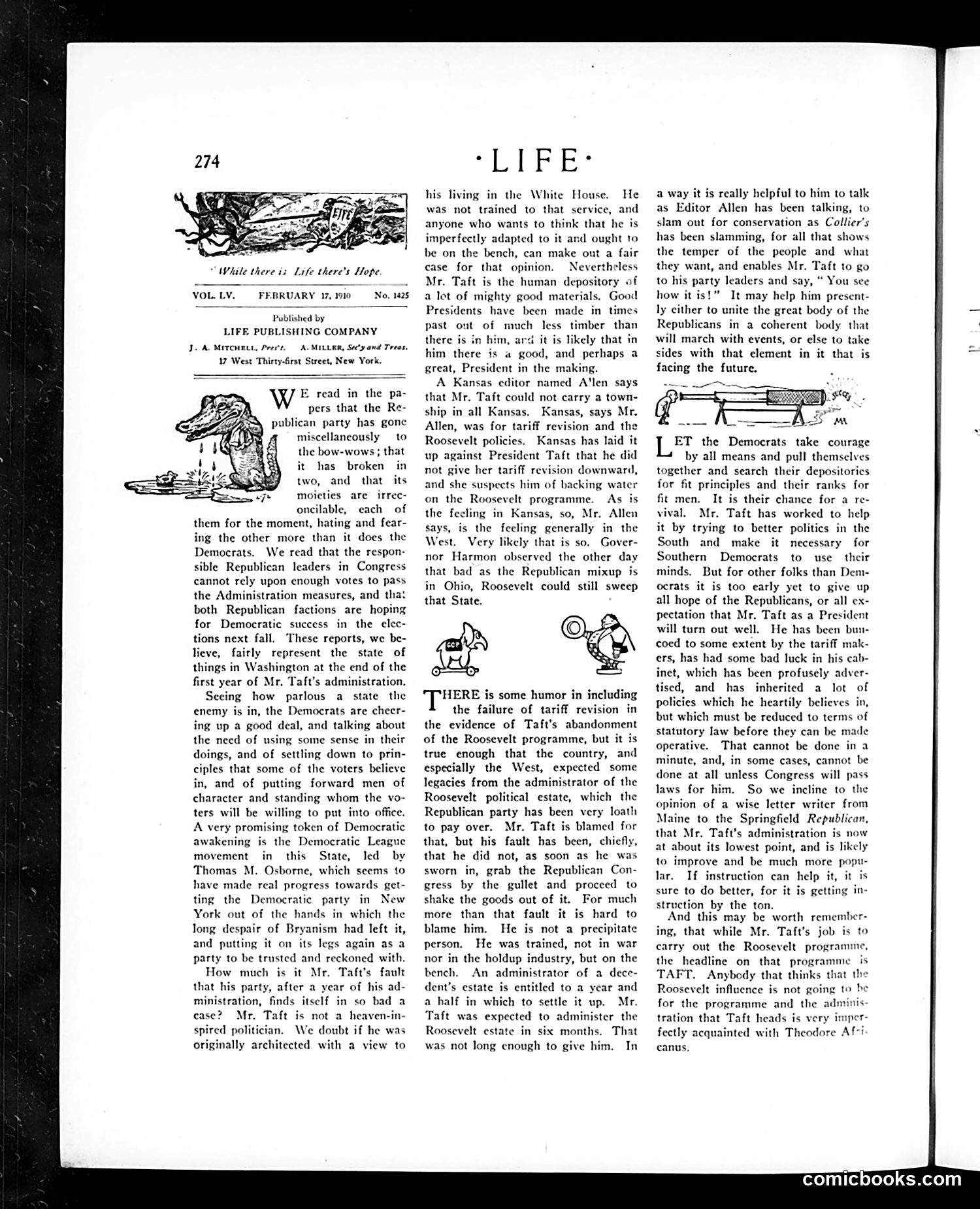
This *Life* magazine page critiques President William Howard Taft's administration. The text discusses Democratic Party strategy and Taft's struggles, particularly regarding: **Main Points:** - Taft's failure to deliver tariff revision (a key campaign promise) - Western discontent with his policies, especially in Kansas - The Republican Party's internal fracturing **The Cartoons:** Two small illustrations appear to depict donkeys—likely representing the Democratic Party—suggesting Democrats should capitalize on Republican divisions. The text implies Taft, originally positioned as Roosevelt's successor, has disappointed conservatives and progressives alike. The overall message: Democrats have an opportunity to gain power by letting Republicans self-destruct rather than aggressive campaigning. This reflects pre-1912 Republican Party tensions that would split the party.
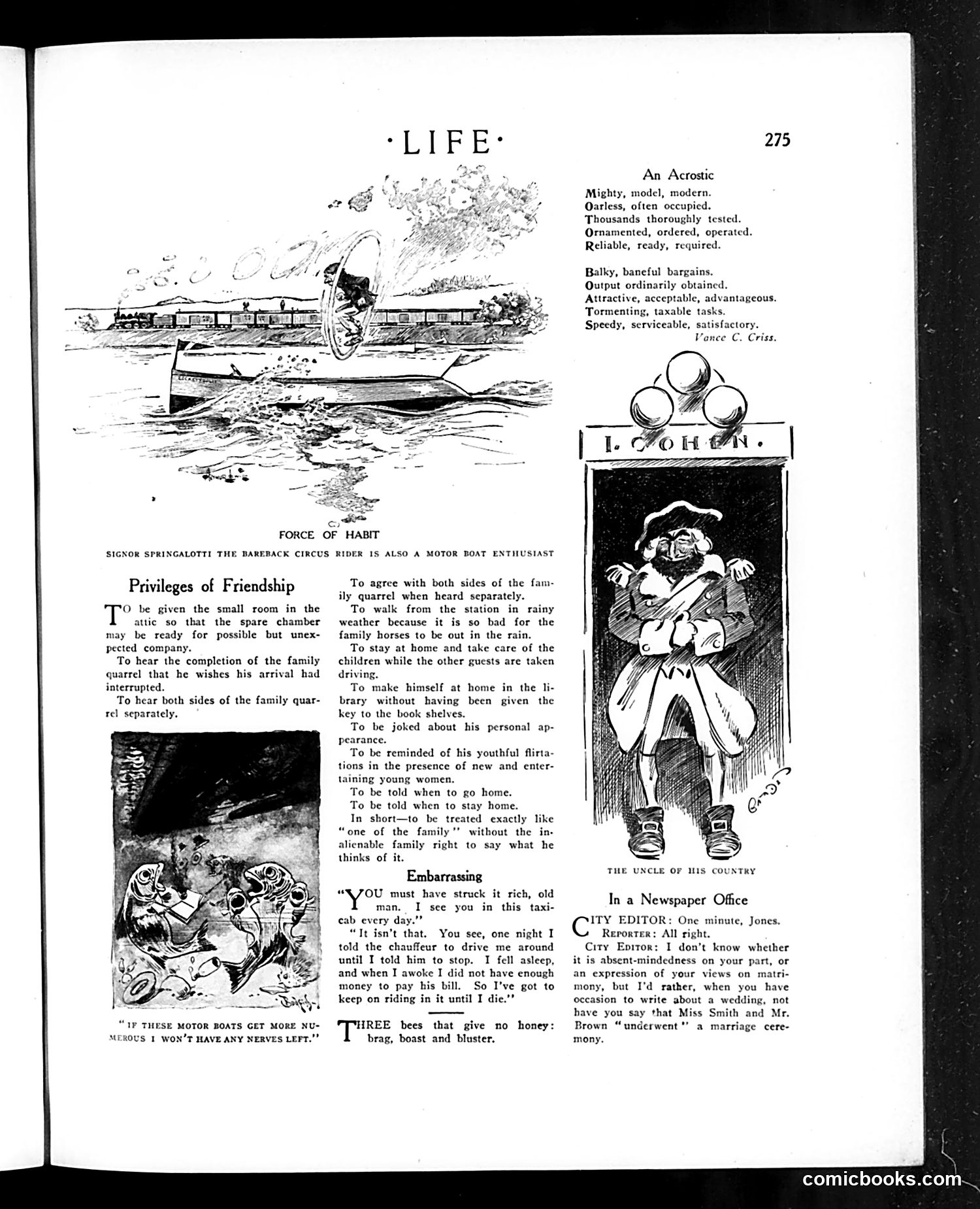
This page contains humorous sketches about social etiquette and modern inconveniences circa early 1900s. **"Force of Habit"** depicts a bareback circus rider on a motor boat—satirizing how new automobile technology seemed as unfamiliar and precarious as exotic circus acts. **"Privileges of Friendship"** lists petty annoyances guests inflict on hosts: arriving unannounced, appropriating private spaces, sleeping in the library without permission, and being rude about hosts' possessions. The accompanying illustration shows a taxi driver's complaint about unpaid fares. **"The Uncle of His Country"** features a rotund figure—a visual pun on patriotic rhetoric, depicting someone claiming familial authority over national affairs. **"In a Newspaper Office"** satirizes journalistic ethics, with a city editor dismissing a reporter's moral objections to covering a wedding scandal as mere prudishness. The humor targets social friction points and emerging technologies of the era.
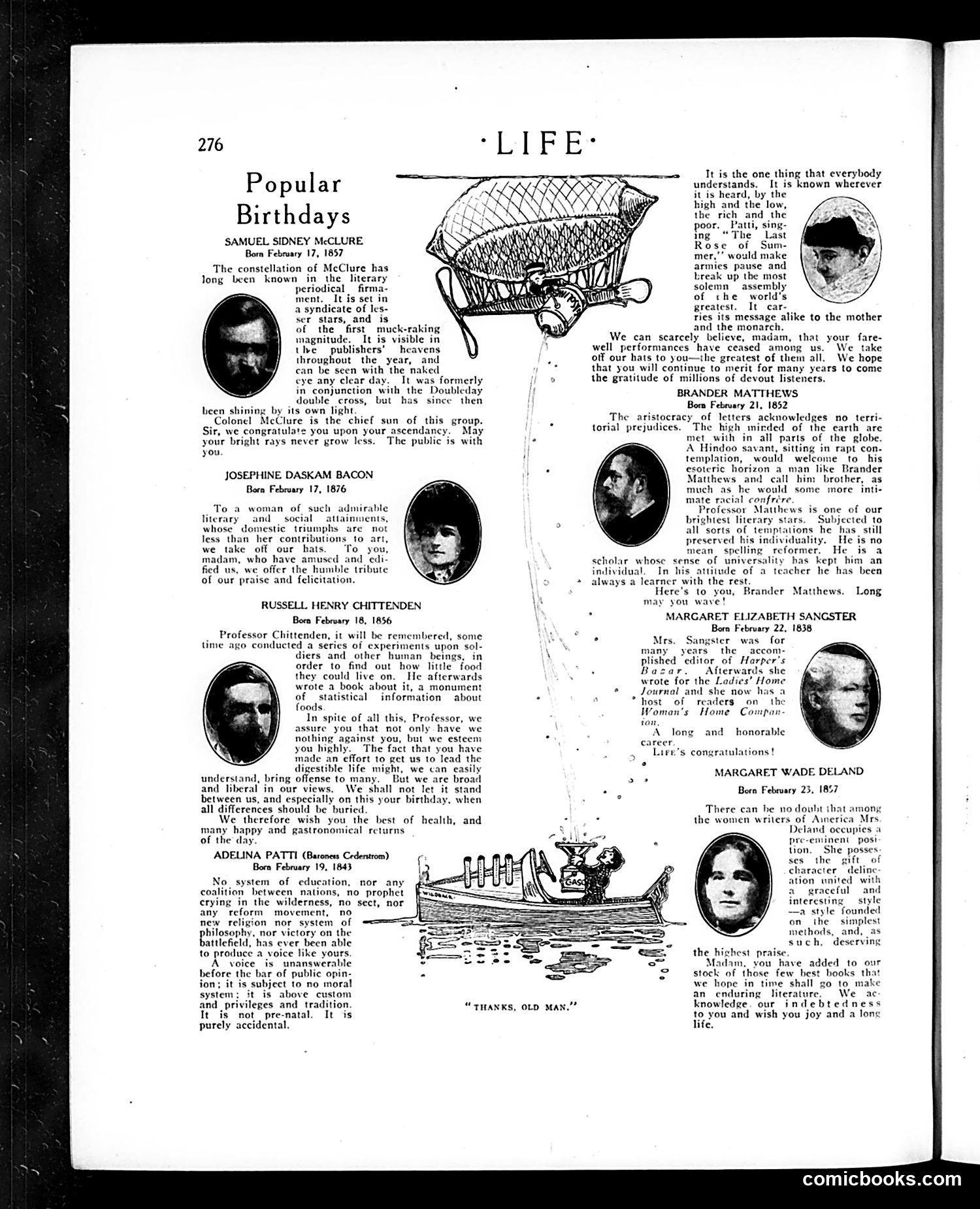
This is a "Popular Birthdays" feature celebrating notable figures born in February, with biographical tributes and portrait photographs. The page includes entries for Samuel Sidney McClure (publisher), Josephine Daskam Bacon (writer), Russell Henry Chittenden (professor), Adelina Patti (opera singer), Brander Matthews (literary figure), Margaret Elizabeth Sangster (editor), and Margaret Wade Deland (novelist). The central illustration depicts a gondola with "THANKS, OLD MAN" caption—likely a classical reference to Charon ferrying souls, though its specific satirical target is unclear without additional context. The page celebrates American literary and cultural figures of the late 19th/early 20th century through respectful biographical sketches rather than political satire. It functioned as both entertainment and cultural commentary in *Life* magazine.
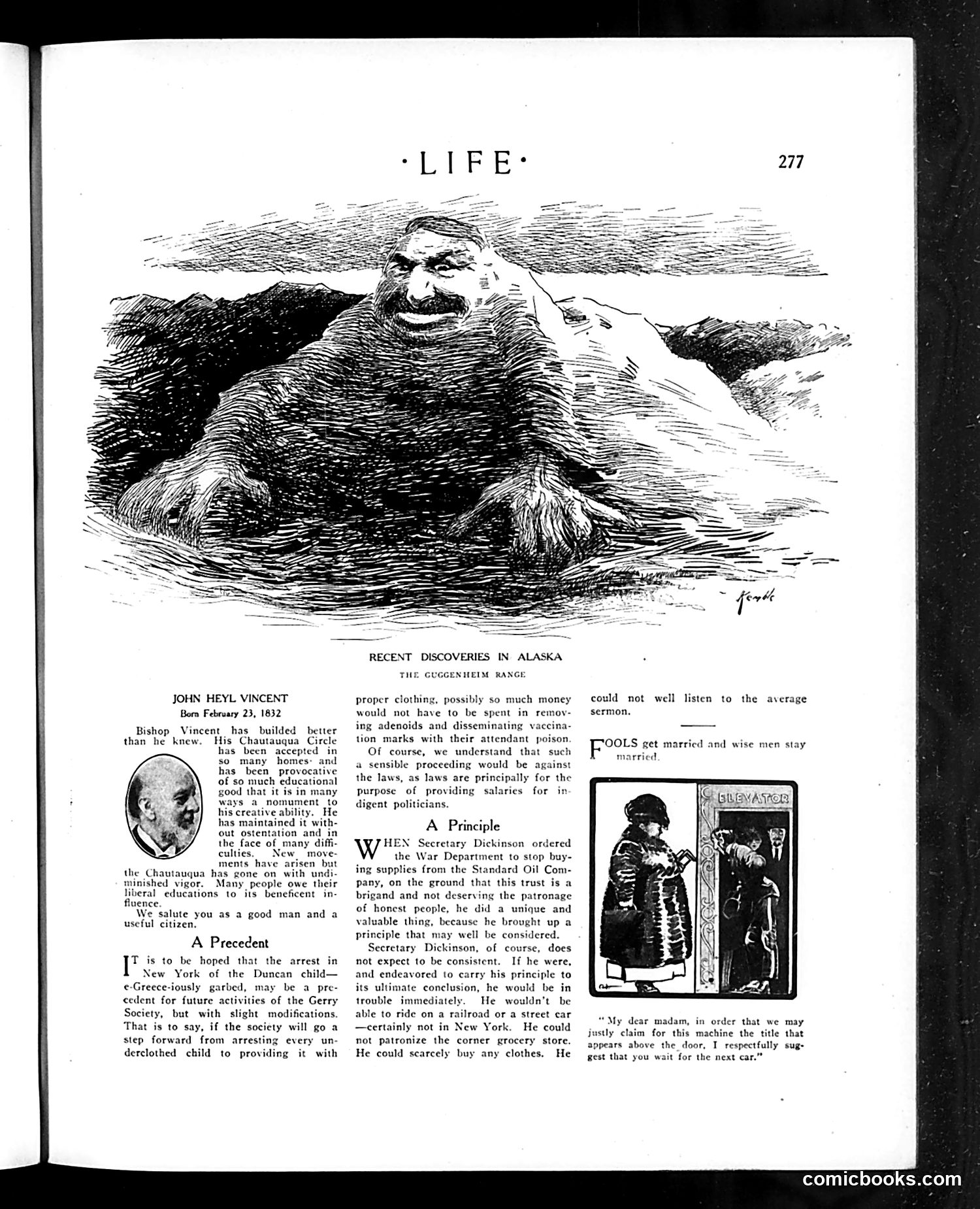
This page from *Life* magazine contains two distinct elements: **Top illustration**: A satirical cartoon titled "Recent Discoveries in Alaska: The Guggenheim Range" depicts a large, brutish figure emerging from Alaska's landscape. This appears to reference the Guggenheim mining interests' controversial operations in Alaska, caricaturing them as exploitative and domineering. **Text sections**: Articles discuss Bishop John Heyl Vincent and a "Principle" piece by Secretary Dickinson regarding the War Department stopping the Standard Oil Company from laying supplies—framing this as either principled action against monopolistic trusts or selective enforcement. **Bottom comic**: A small cartoon shows someone asking a woman to wait for "the next car," likely satirizing class attitudes or social pretension. The overall page critiques corporate power and government inconsistency in regulating big business during the Progressive Era.
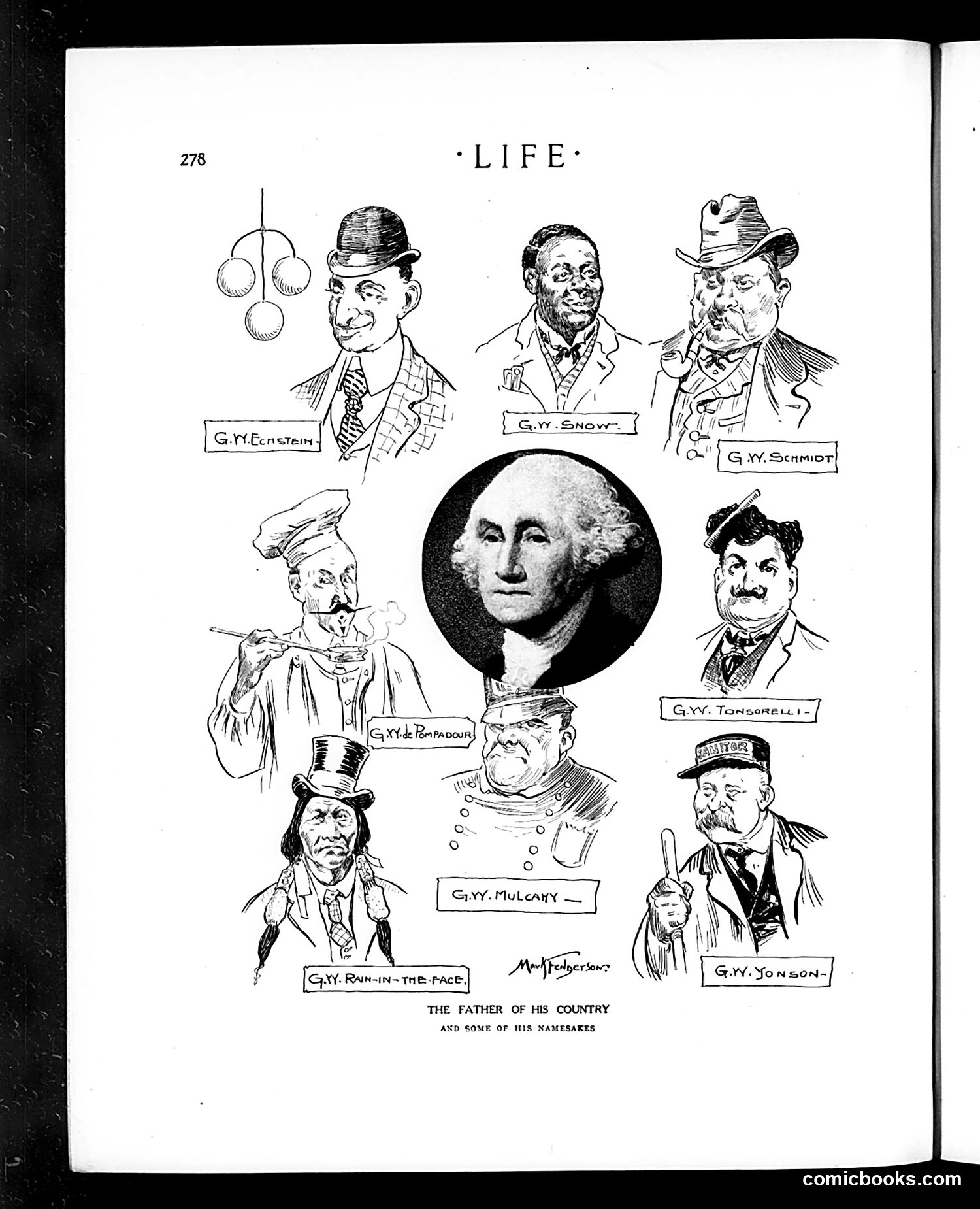
This satirical page presents a central portrait—likely George Washington, "Father of His Country"—surrounded by caricatured figures sharing his name or initials ("G.W."). The labeled namesakes include G.W. Eckstein, G.W. Snow, G.W. Schmidt, G.W. Tomsorelli, G.W. Mulcahy, G.W. Run-in-the-Face, and G.W. Jonson. The satire appears to mock the contrast between Washington's dignified legacy and ordinary men who happen to share his name. Each caricature exaggerates distinctive features—clothing, expressions, or occupation—suggesting these are common citizens of humble or questionable status. The humor relies on the incongruity: while Washington represents national ideals, his namesakes represent everyday or disreputable types. This likely comments on how a great name becomes diluted when shared by the masses.
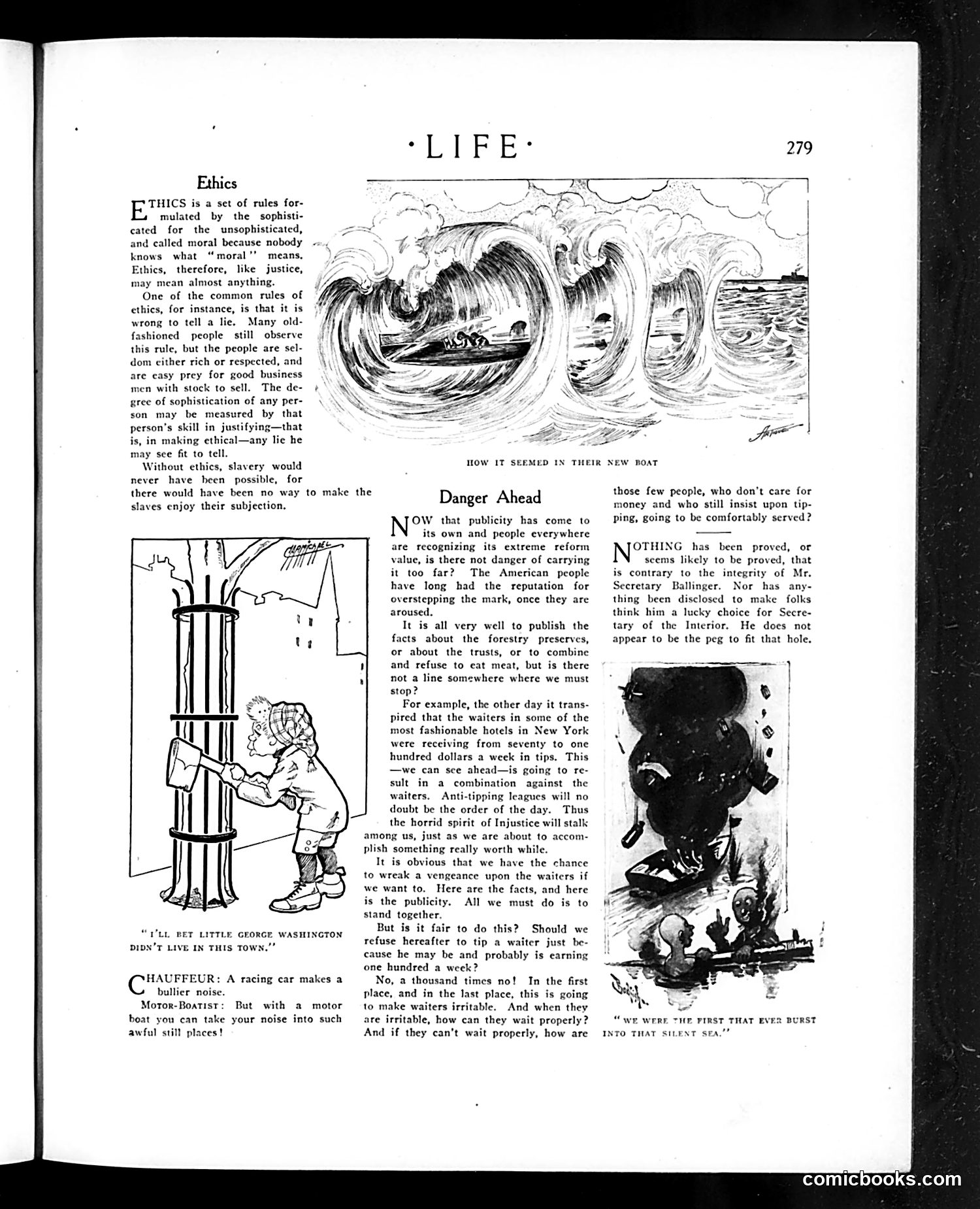
This page satirizes American hypocrisy regarding "ethics" and reform movements circa 1909-1911. **"Ethics" essay**: The opening column defines ethics cynically—as rules the sophisticated use to manipulate the unsophisticated. It argues that without ethical justifications, slavery would've been impossible. The accompanying small cartoon shows a child chained to a post, likely illustrating how "ethics" rationalize exploitation. **"Danger Ahead"**: The main article mocks reformers' crusade against tipping, claiming publicizing that NYC hotel waiters earn $70-100/week in tips will spark "anti-tipping leagues." The satire suggests this well-intentioned reform will backfire: irritable waiters will serve poorly, harming the few generous tippers. It's a jab at reform movements that ignore practical consequences. **Ballinger reference**: A brief mention questioning Secretary of Interior Ballinger's integrity—likely referencing the 1909-1910 Ballinger-Pinchot controversy over conservation policy. The page's broader message: America's "reform" impulses are self-righteous, impractical, and often hypocritical.
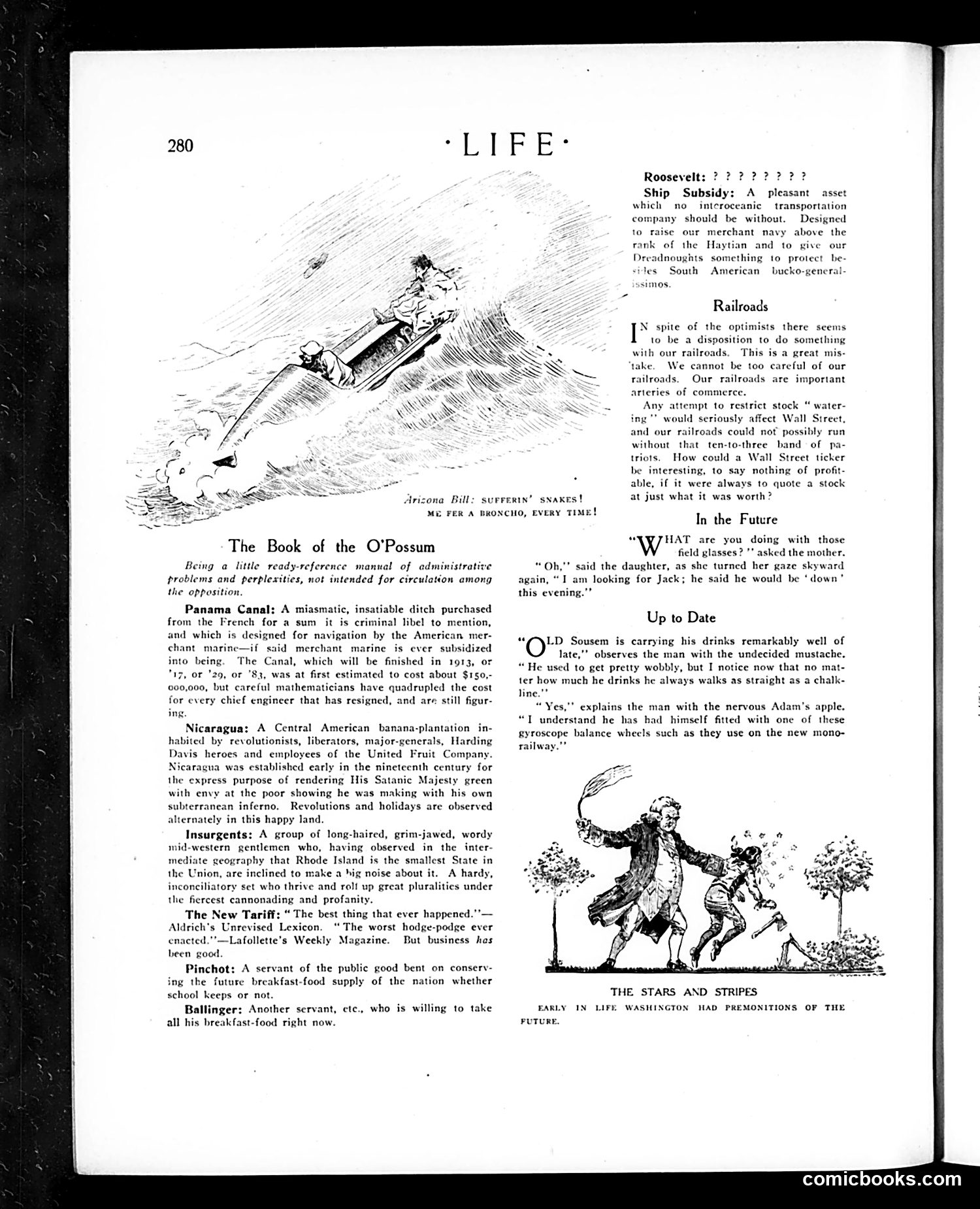
This page satirizes early-20th-century American political and economic issues through mock dictionary entries. "The Book of the O'Possum" uses humorous definitions to critique government policies and politicians. **Key targets include:** - **Panama Canal**: Mocked for massive cost overruns and delays (estimated completion keeps shifting: 1913, '17, '29, or '83) - **Nicaragua**: Satirized as perpetually unstable, controlled by fruit companies and revolutionists - **Ship Subsidy**: Criticized as unnecessary corporate welfare - **Railroads**: Attacked for stock manipulation and "watering" (artificially inflating share value) on Wall Street - **Pinchot vs. Ballinger**: References a real conservation scandal where these officials disagreed on resource protection The cartoon "Arizona Bill" appears to comment on frontier attitudes. Lower cartoons depict social absurdities: a woman using field glasses to spot her boyfriend, and a drunk man mysteriously walking straight despite heavy drinking. The satire targets government incompetence, corporate corruption, and the gap between official rhetoric and actual practice.
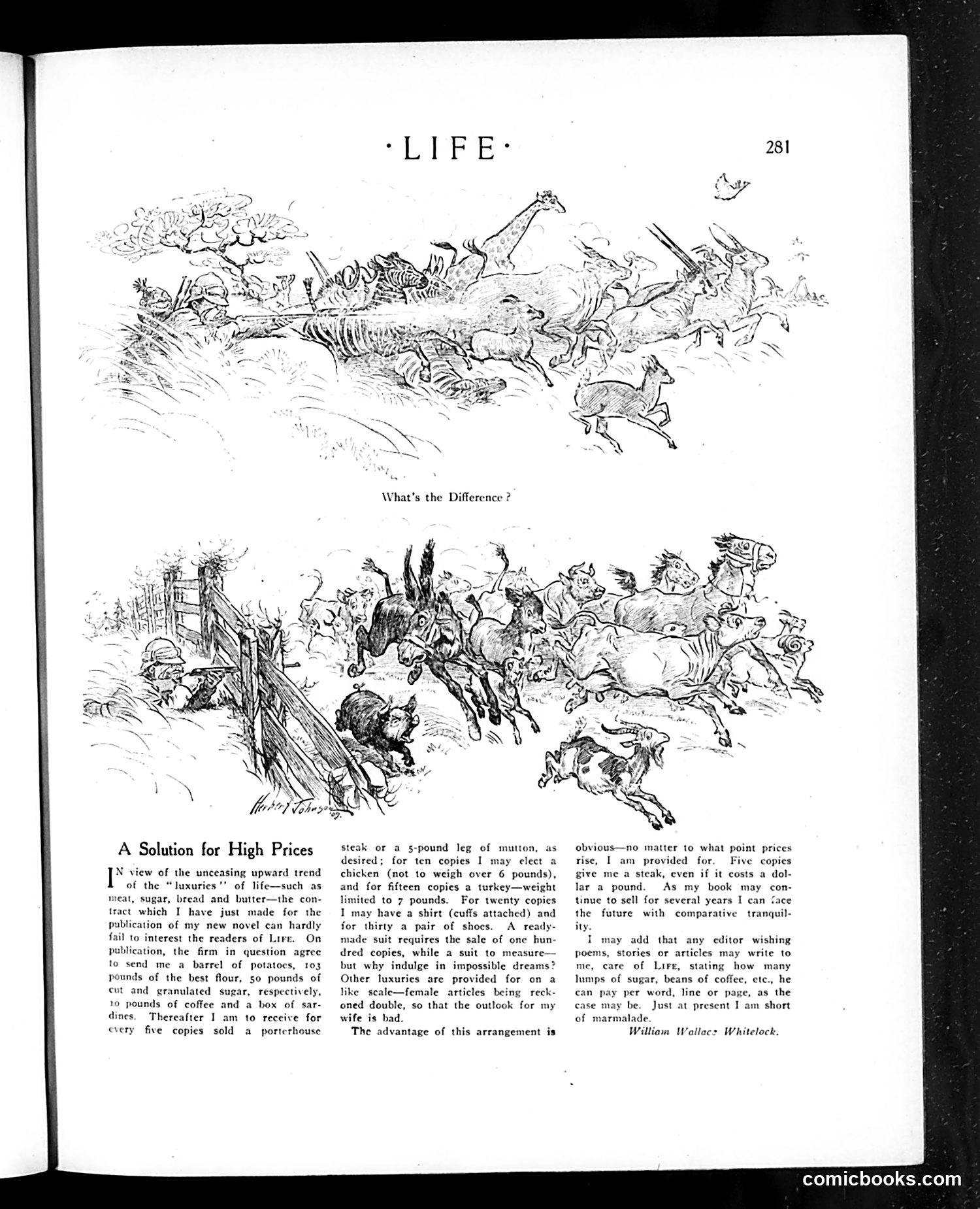
This is a humorous satirical piece by William Wallace Whitelock about post-WWI inflation. The cartoons illustrate the absurdity described in the text. **The Joke:** Rather than receiving money for publishing his novel, the author proposes being paid entirely in food and goods—steak for 5 copies sold, chicken for 10, turkey for 15, and eventually clothing for larger sales. His wife fares worse ("the outlook for my wife is bad") because female articles are valued at double cost. **The Context:** This reflects genuine economic anxiety from severe price inflation affecting meat, sugar, bread, and butter—luxuries becoming unaffordable. By proposing barter instead of currency, Whitelock satirizes how worthless money has become and how impractical modern commerce feels. The escalating absurdity (eventually demanding "marmalade" as payment) mocks both the inflation crisis and desperate attempts to cope with it. **The Cartoons:** Show contrasting animal abundance (top) versus humans scrambling for resources (bottom), visualizing the ironic "What's the Difference?"—perhaps suggesting animals live better than struggling people.
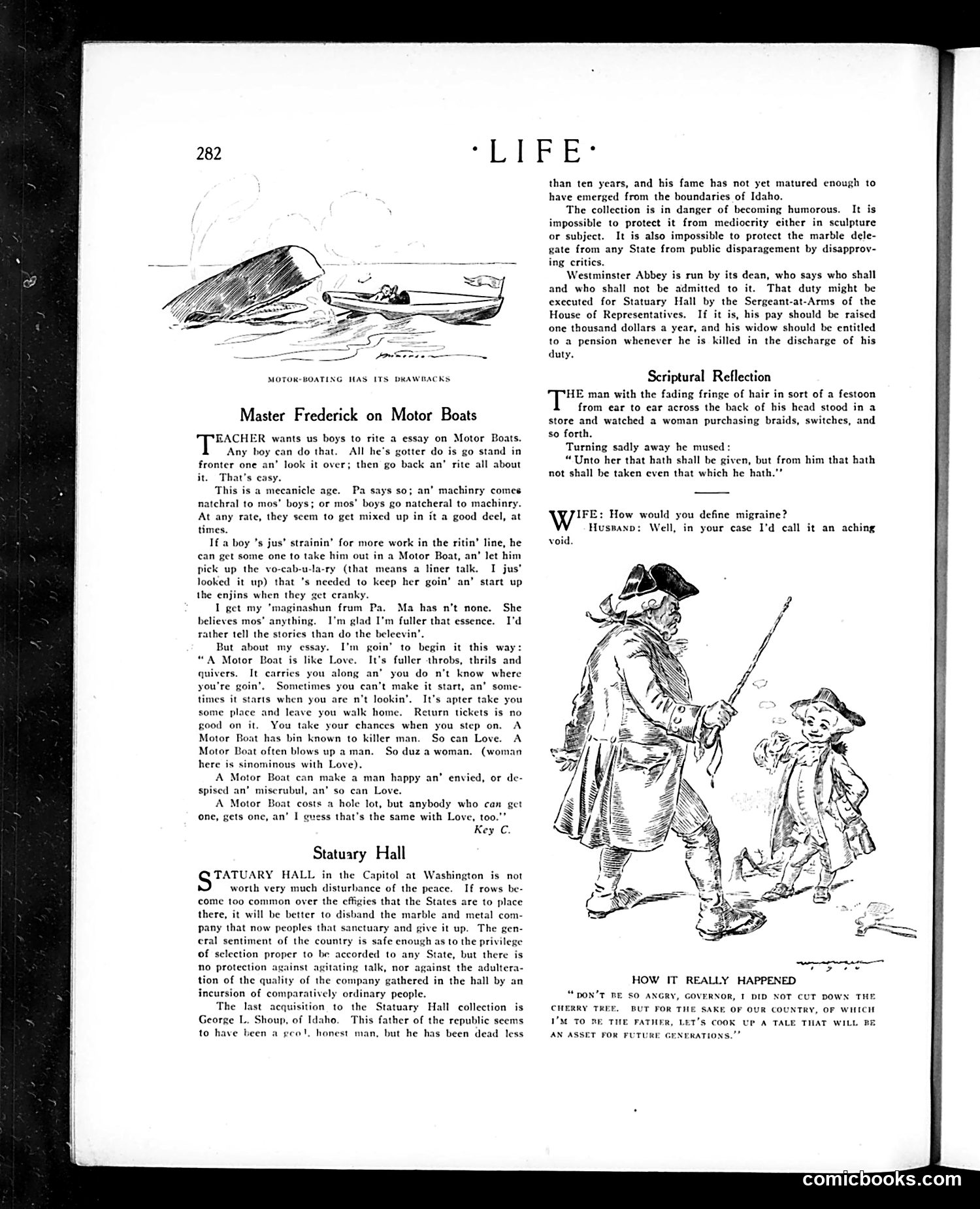
**"Master Frederick on Motor Boats"** is a humorous essay supposedly written by a schoolboy comparing motor boats to love. The joke lies in the boy's malapropisms ("vo-cab-u-la-ry," "sinominous") and crude but oddly apt observations—both motor boats and romantic love are unpredictable, expensive, potentially dangerous, and leave you stranded. The satire gently mocks adolescent attempts at sophistication. **"Statuary Hall"** critiques the Capitol's practice of accepting mediocre marble statues from states. The recent addition of Idaho politician George L. Shoup—dead less than ten years—exemplifies the problem: his fame hasn't matured beyond Idaho's borders. The piece argues the collection risks becoming laughable unless someone (perhaps a Sergeant-at-Arms with hazard pay) prevents inferior sculptures and subjects from entering. **"Scriptural Reflection"** is a brief, sardonic observation about a balding man watching a woman buy hair extensions, then reflecting on Matthew's gospel about the rich getting richer—the irony being his own hair loss.
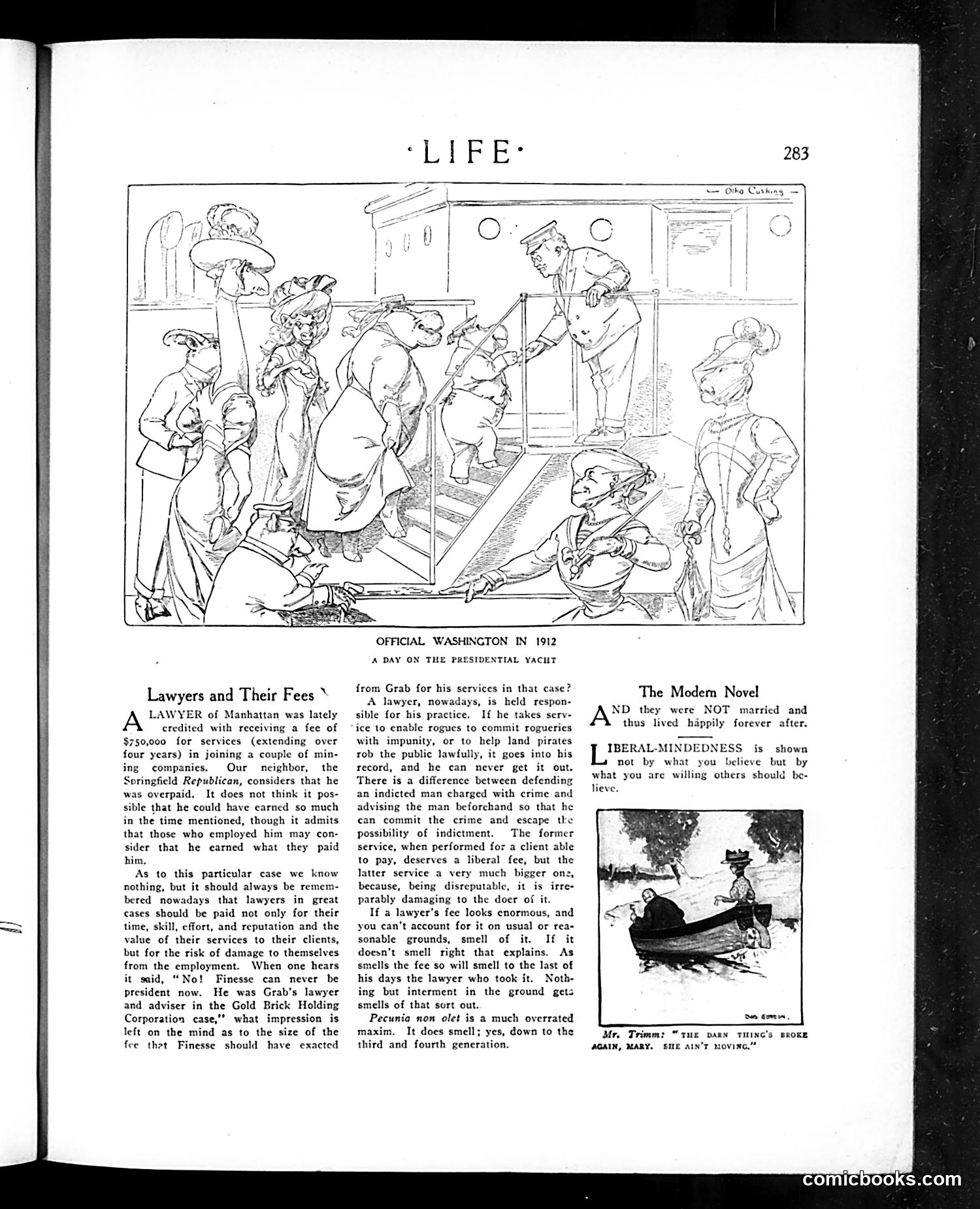
## Top Cartoon: "Official Washington in 1912" The large illustration depicts a crowded presidential yacht with well-dressed officials and what appear to be wealthy visitors being shown around. The satire likely mocks the formal, somewhat absurd pageantry of presidential entertainment and the mingling of political figures with the wealthy elite during the Taft administration (1912 is specified). ## Left Article: "Lawyers and Their Fees" Discusses a Manhattan lawyer's $750,000 fee for corporate merger work. The piece argues lawyers deserve premium compensation not just for time and skill, but for reputational risk—especially when advising on morally questionable dealings. A lawyer who facilitates crime or corporate malfeasance damages his professional reputation "down to the third and fourth generation." The Latin phrase "Pecunia non olet" (money doesn't stink) is challenged; the article argues ill-gotten fees *do* stink. ## Right Section: Brief satire on modern novels and a comic strip scene A quip about liberal-mindedness, and a domestic scene ("The Darn Thing's Broke Again, Mary") depicting working-class life.
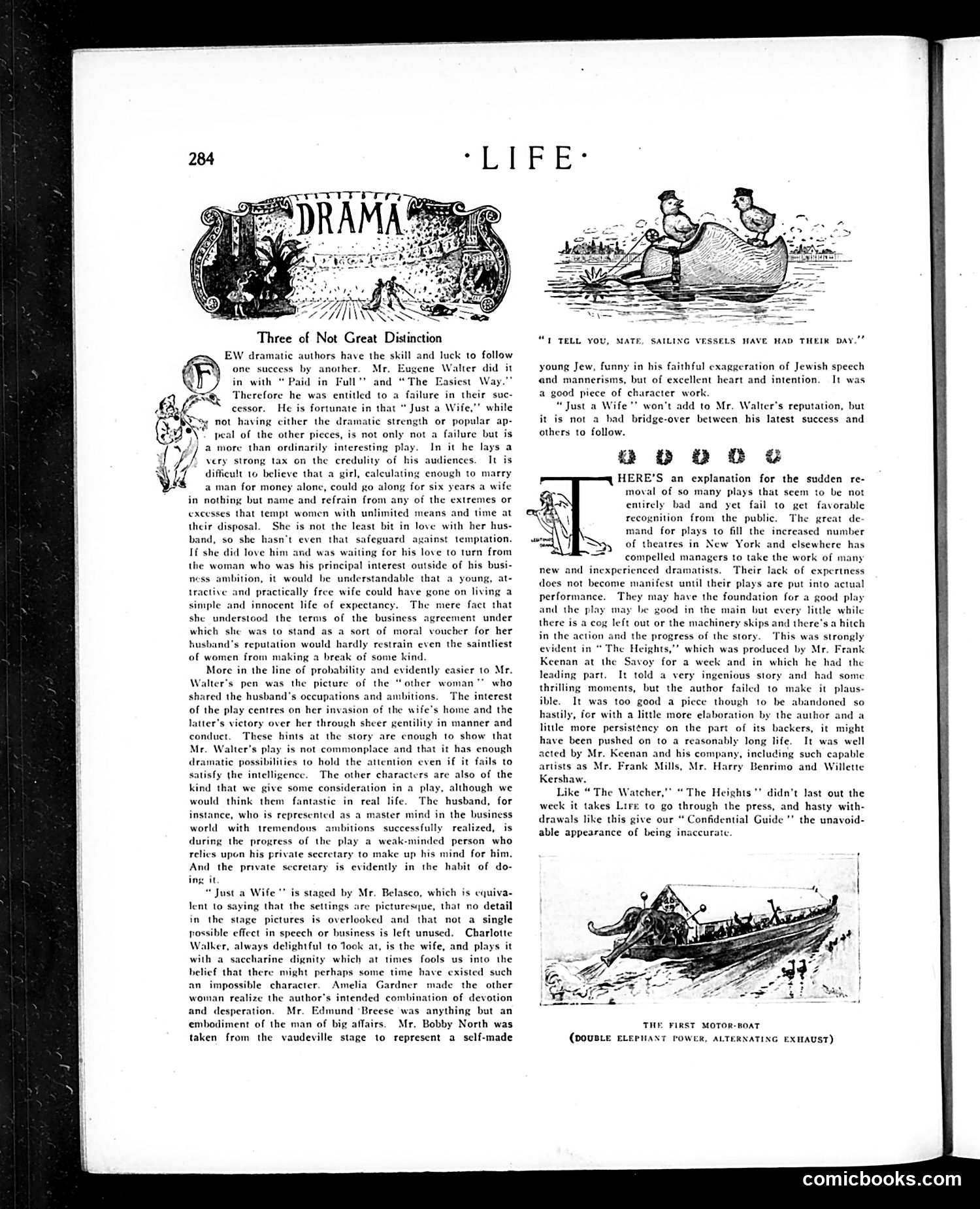
This page contains a theater review of Eugene Walter's play "Just a Wife," staged by producer David Belasco, starring Charlotte Walker. The critic analyzes the plot: a woman marries for money alone and remains faithfully married in name only for six years—a premise the reviewer finds implausibly virtuous, yet acknowledges the play succeeds through Belasco's meticulous staging. The review praises Walker's performance and supporting actors, including Bobby North as a young Jewish character, noted for "faithful exaggeration of Jewish speech and mannerisms." This reflects early 20th-century theatrical conventions where ethnic stereotyping was standard practice. The illustrations show period vignettes unrelated to the review's text. The page demonstrates Life's dual focus: satirical commentary on contemporary drama and society. No specific political content appears here—primarily cultural criticism of theatrical merit and character authenticity.
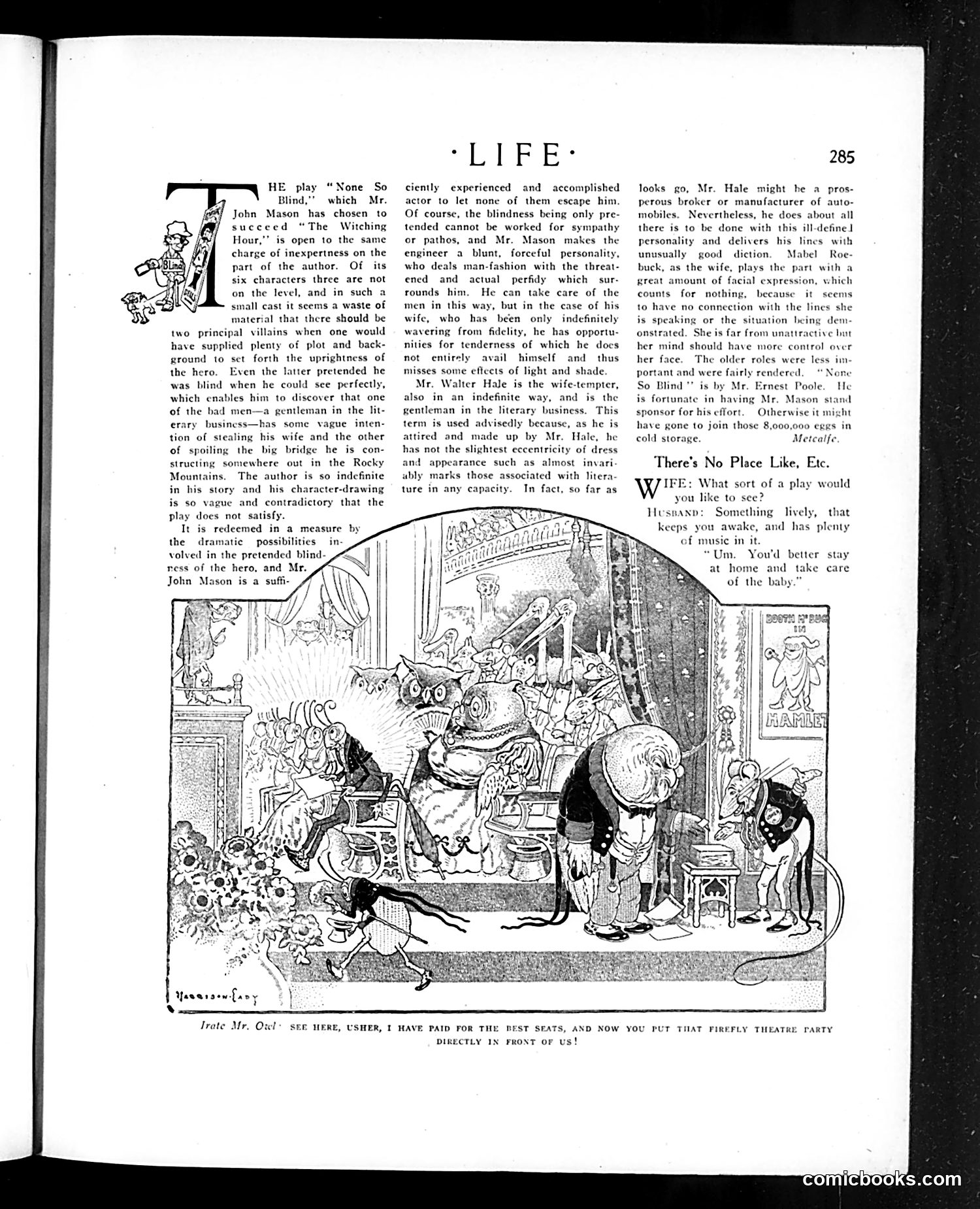
This page contains a **theatre review** of the play "None So Blind" starring John Mason, alongside a **single-panel cartoon** about domestic life. ## The Main Cartoon The cartoon depicts a husband and wife discussing theatre preferences. The wife wants an engaging play with music; the husband retorts she should stay home caring for the baby instead. This satirizes the **gender expectations of the era**—women's domestic duties superseding their entertainment desires, and the dismissive attitude toward wives seeking leisure activities outside the home. ## The Theatre Review The text critiques Mason's production as poorly written, with vague characterization and unmotivated plot elements (two villains where one would suffice). However, it praises actor John Mason's skilled performance in the leading role. The review notes that Walter Hale, playing a literary businessman, looks like a prosperous broker—seemingly a jab at how unconventional artists were stereotyped versus how they actually appeared. The overall tone is moderately negative about the play's quality, though respectful of its cast's talents.
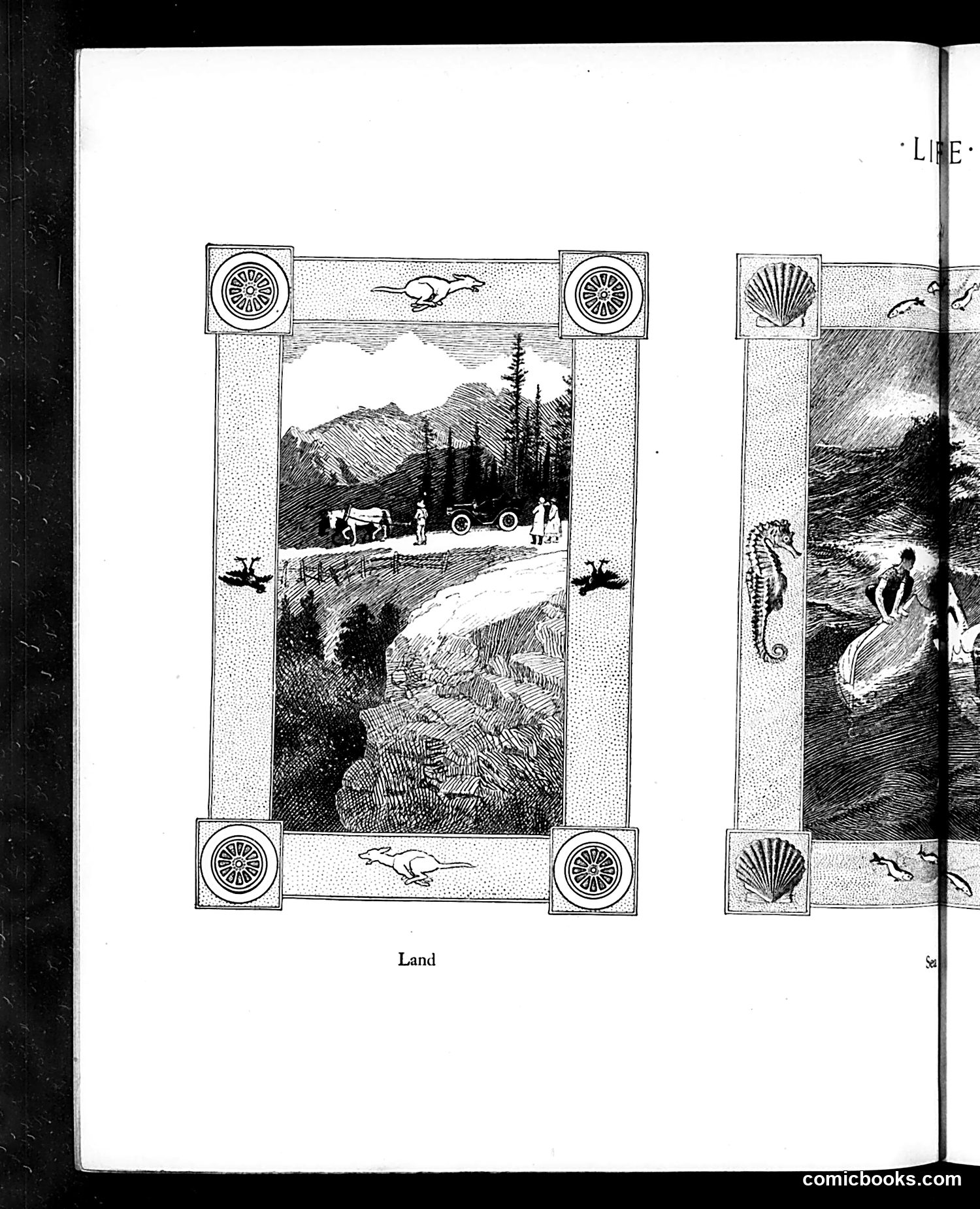
This page presents two framed illustrations labeled "Land" and what appears to be "Sea" (partially visible on the right). The left panel depicts a pastoral landscape scene with mountains, evergreen trees, a winding road, and people with an early automobile—representing terrestrial/domestic American life and development. The right panel shows an ocean scene with swimmers, boats, and a seahorse—representing marine/coastal themes. The decorative frames feature wheels (suggesting transportation/progress) and marine creatures (shells, seahorses, fish), reinforcing the Land/Sea thematic division. Without full text visible, this appears to be a comparative illustration exploring two American environments or economic sectors. The ornamental borders suggest this may be from an early 20th-century Life magazine feature contrasting different aspects of American life or industry, though the specific satirical point remains unclear from this image alone.
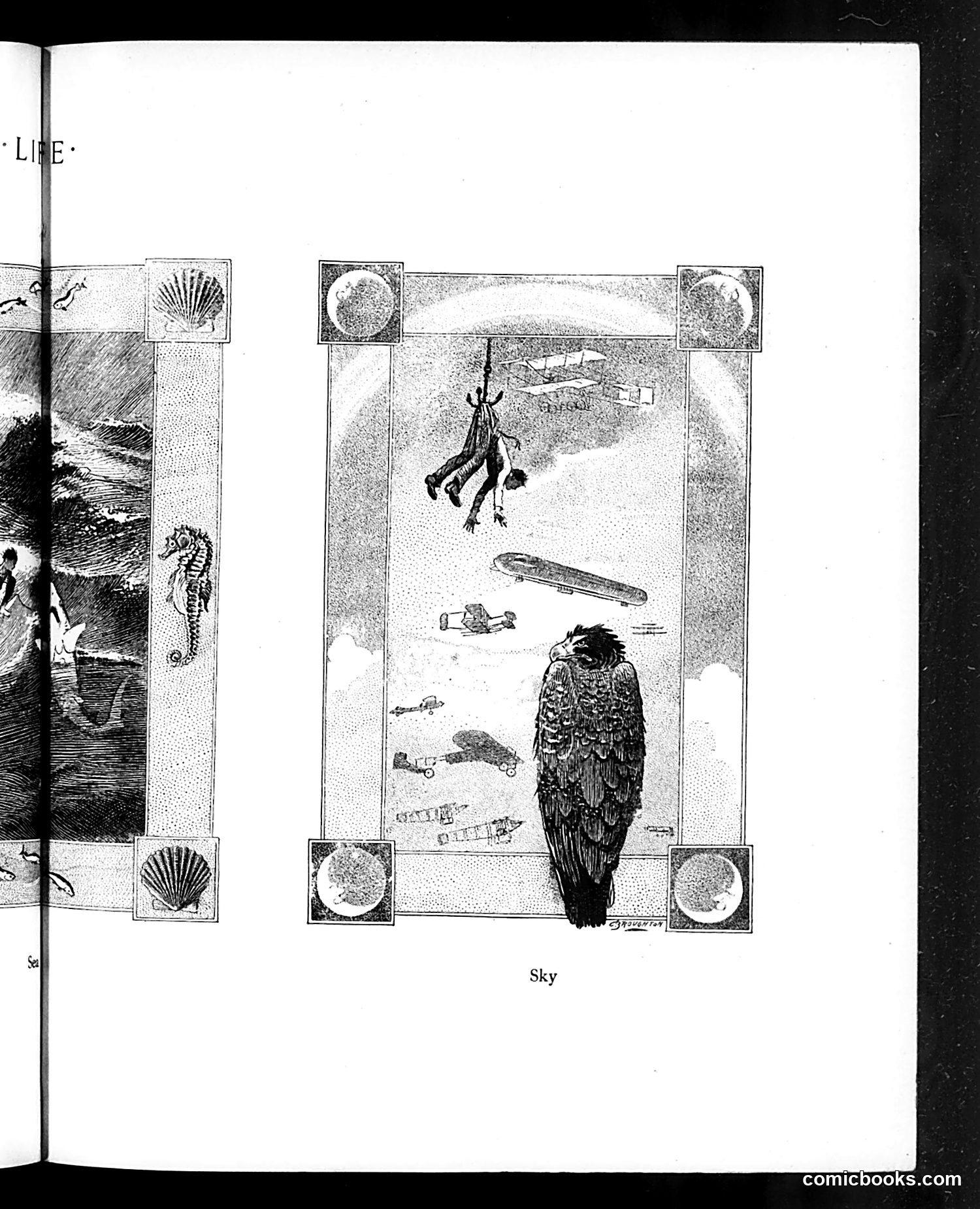
This appears to be a surreal illustration titled "Sky" depicting an underwater or dreamlike scene. The central image shows a large bird (possibly an eagle or vulture) standing upright among scattered debris and a human figure suspended above. The composition is framed by decorative borders containing shells and celestial bodies (moons or planets). The work uses stark black-and-white contrast typical of early 20th-century satirical art. Without clearer context about the publication date or accompanying text, the specific political or social commentary remains uncertain. The juxtaposition of natural elements (bird, shells, celestial objects) with human figures and wreckage suggests themes of mortality, nature's dominance, or post-catastrophic imagery—but the exact satirical target is unclear from this image alone.
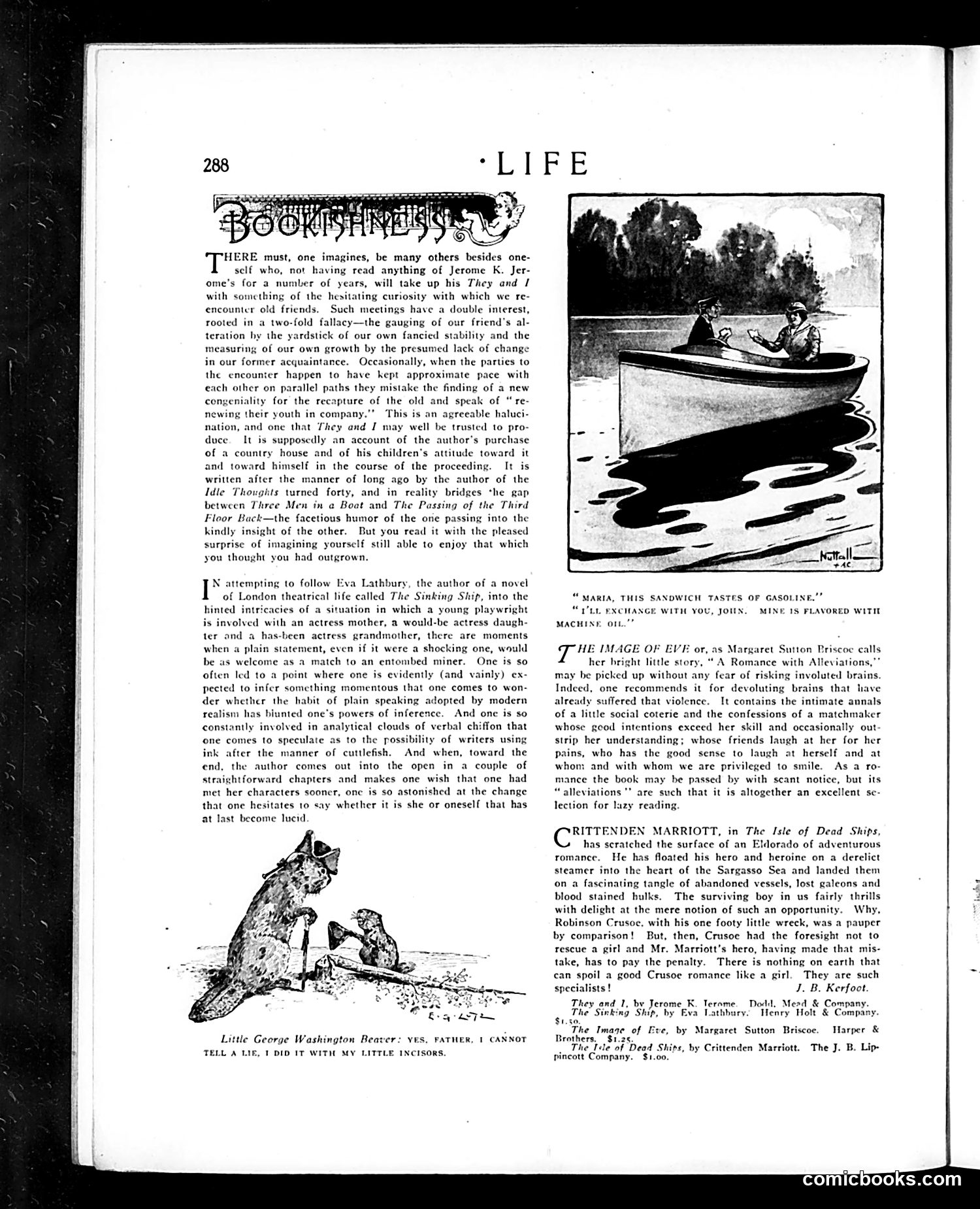
This page contains **book reviews** from Life magazine, with two cartoon illustrations offering satirical commentary. **The cartoons:** 1. **"Little George Washington Beaver"** (bottom left): A visual pun playing on the famous story of young George Washington confessing to chopping down his father's cherry tree. Here, a beaver claims responsibility using its teeth ("incisors") instead—a joke about beavers' well-known wood-gnawing behavior. The humor lies in the absurdist substitution of animal for human moral tale. 2. **Top right, captioned "Maria, this sandwich tastes of gasoline"**: Depicts two figures exchanging sandwiches at what appears to be a picnic. One has gasoline-flavored food, the other machine-oil flavored. This is **satirical commentary on early automotive culture**—likely mocking how the new prominence of cars and industrial products was contaminating even leisurely activities like picnics. The joke critiques modern life's intrusion into pastoral simplicity. Both cartoons use absurdist humor typical of Life's satirical approach to contemporary culture and social change.
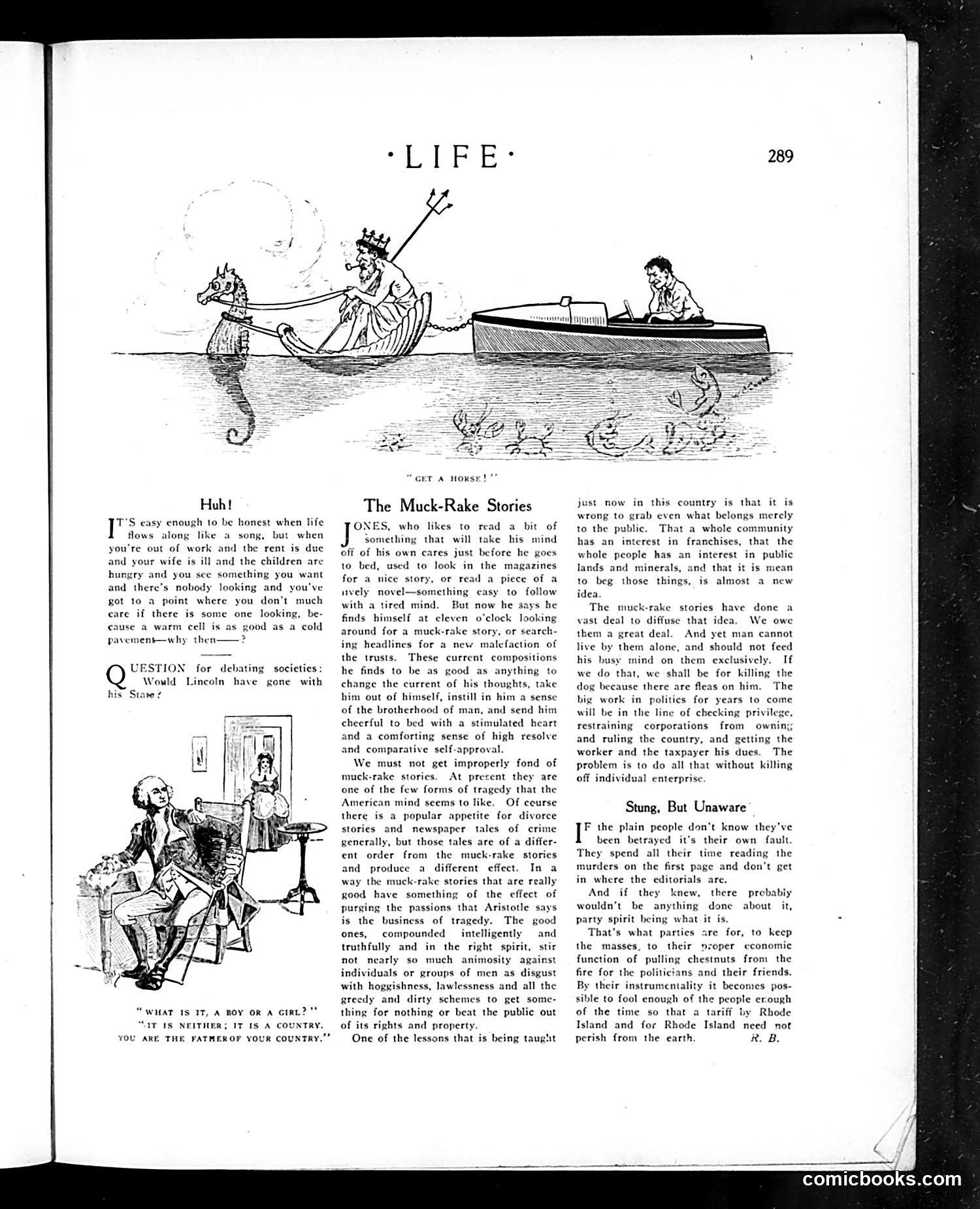
This page contains three distinct pieces of political and social commentary: **Top cartoon**: Depicts Neptune (god of the sea) in a boat being towed by a seahorse, with the caption "GET A HORSE!" This mocks someone's outdated methods—likely referencing the early automobile era's dismissal of horse-drawn transport. **Main article "The Muck-Rake Stories"**: Discusses the contemporary popularity of investigative journalism exposés about corporate and political corruption. The piece advocates for these "muck-rake" stories as morally necessary for exposing public betrayals (franchise grabs, resource theft) while cautioning against becoming obsessed with them at the expense of other concerns. It references Aristotle's tragic catharsis theory. **Lower cartoon**: A parent tells a child "What is it, a boy or a girl? It is neither; it is a country. You are the father of your country"—suggesting civic responsibility. **"Stung, But Unaware" section**: Cynically notes that ordinary people don't read editorials where truth appears, and that political parties exploit public ignorance to maintain control—a critique of political manipulation and voter apathy.
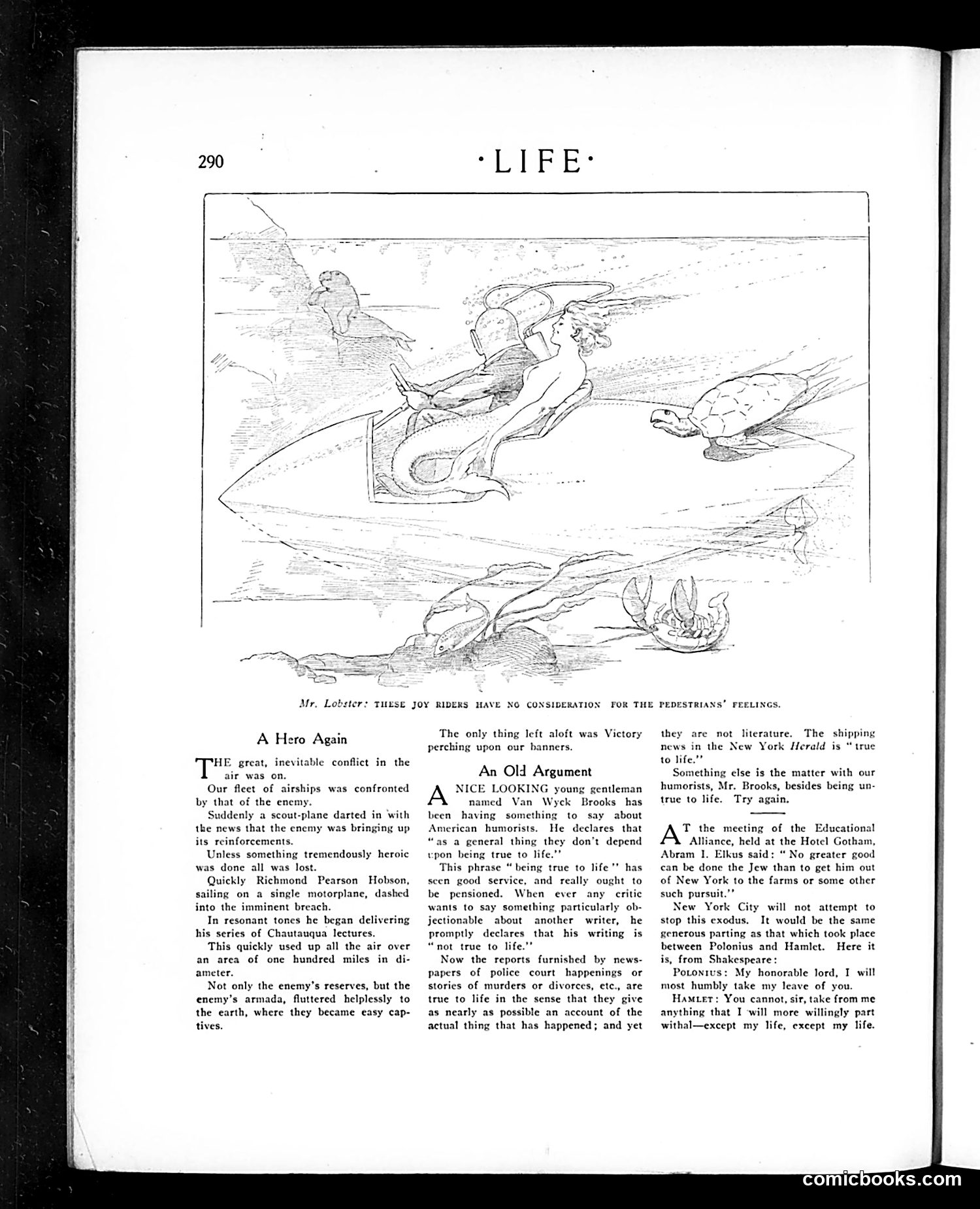
**The Main Cartoon:** Depicts "joy riders" (reckless motorists) on what appears to be a water vehicle, operating with no regard for pedestrians' safety. The satire critiques dangerous drivers' carelessness toward public welfare. **"A Hero Again":** Mocks Richmond Pearson Hobson (a real Spanish-American War hero known for Chautauqua lectures—popular educational tours). The joke: Hobson single-handedly defeats an enemy air fleet simply by delivering his notoriously verbose lectures, which consume all available air. This satirizes his reputation as a tedious, long-winded speaker. **"An Old Argument":** Defends American humorists against Van Wyck Brooks's criticism that they aren't "true to life." The writer argues that merely reporting facts (like newspaper crime stories or shipping news) doesn't constitute literature—the phrase "true to life" is an overused critical cliché. The Hamlet quote reinforces the point through irony about unwanted departures.
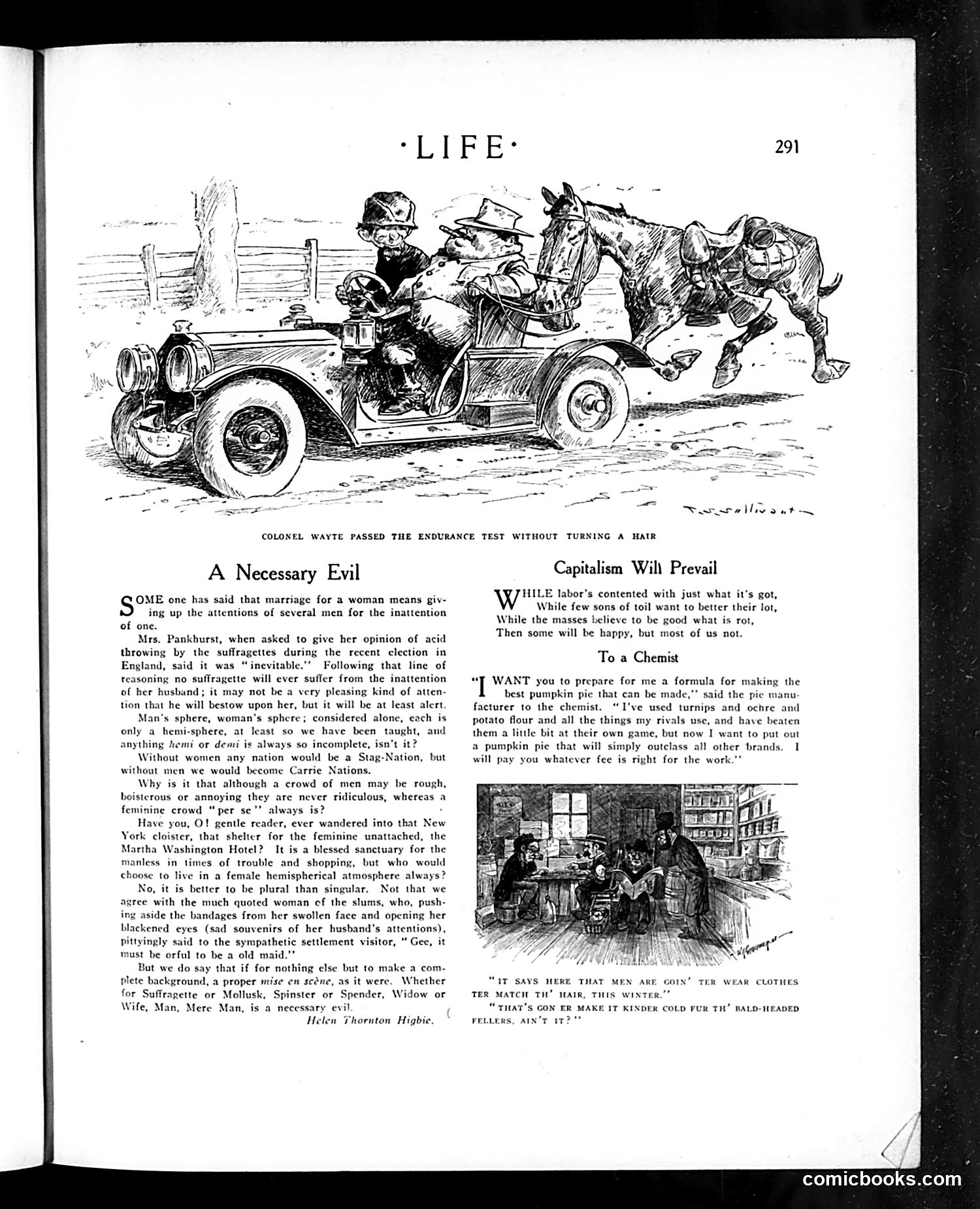
**The Cartoon:** The top illustration depicts "Colonel Wayte" in an automobile passing an "endurance test" while a horse-drawn vehicle struggles beside it—satirizing early automotive reliability versus traditional transportation. **"A Necessary Evil"** (left column): This essay mocks marriage as women's inevitable lot, referencing Mrs. Pankhurst and English suffragettes who committed acid attacks during elections. The author argues that despite women's mistreatment by husbands, marriage remains preferable to spinsterhoood because men provide necessary "completion" to women's incomplete existence. The piece drips with sarcasm—praising marriage as a "necessary evil" while describing domestic violence ("blackened eyes") as inevitable. **"Capitalism Will Prevail"** (right): A brief poem lamenting workers' acceptance of exploitation and false consciousness. **"To a Chemist"**: A businessman seeks a formula to cut corners on pumpkin pie ingredients—satirizing capitalist corner-cutting and fraud. **The lower cartoon** jokes about bald men facing cold weather if men must match women's hair fashions—trivial gendered humor. The page reflects pre-1920s anxieties about women's suffrage, labor, and modernity.
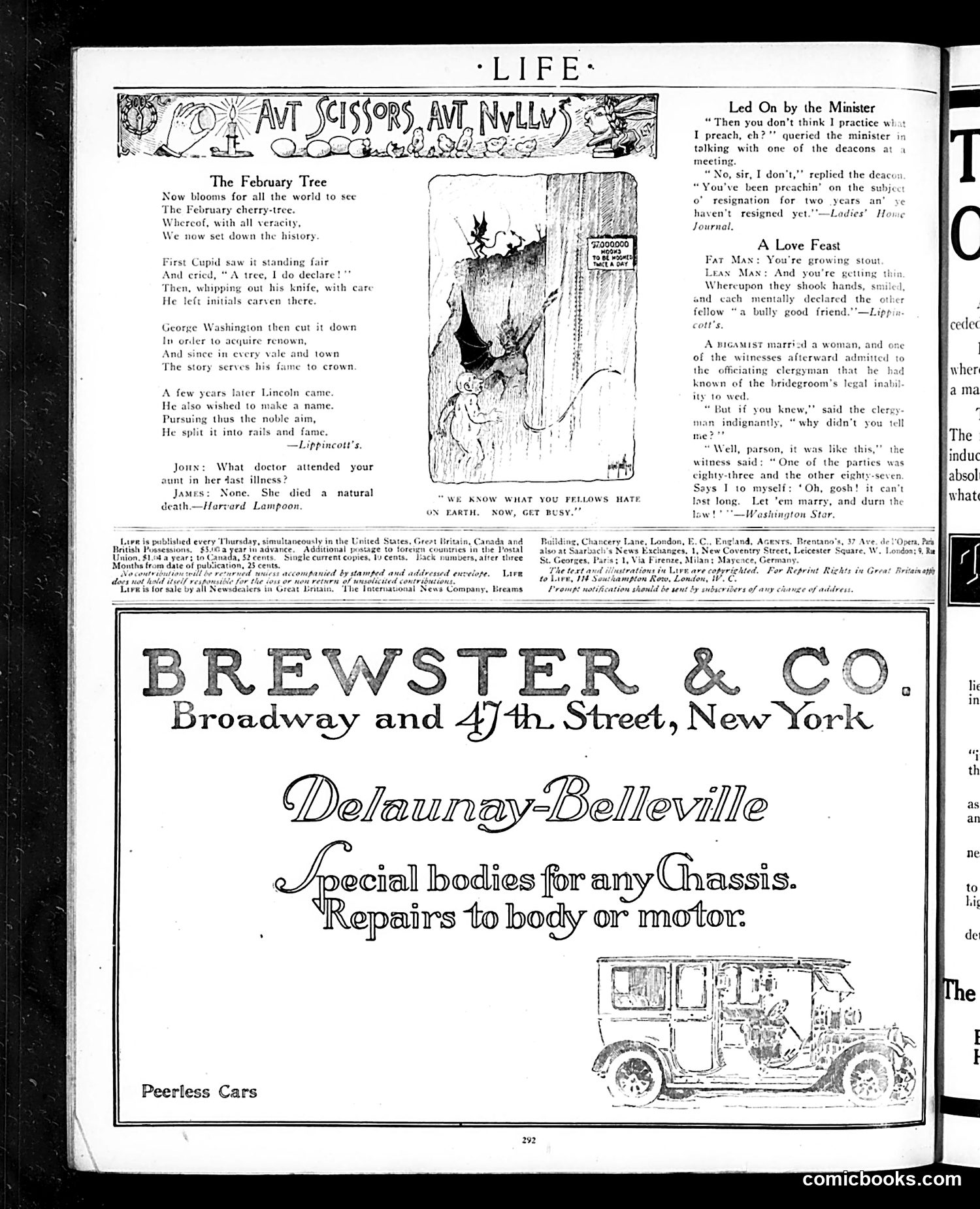
This page from *Life* magazine contains several brief satirical jokes rather than a single cartoon. **"The February Tree"** is a humorous poem mocking the cherry tree legend associated with George Washington (the story that young Washington cut down his father's cherry tree and admitted it). The joke suggests this tale has been recycled and reinterpreted by multiple historical figures—Cupid, Washington, and Lincoln—each using it to their advantage. It's satire about how myths get repurposed for personal glory. **The remaining jokes** are short, punchy pieces typical of early 20th-century humor magazines: - A doctor joke playing on "natural death" - "Led On by the Minister" mocking a hypocritical preacher who preaches resignation but doesn't practice it - "A Love Feast" with crude physical humor about aging - A wedding witness joke about not questioning elderly couples' legality to marry The page is primarily filler content and advertisements (Brewster & Co. automobiles), characteristic of *Life*'s format mixing satire with commercial content.
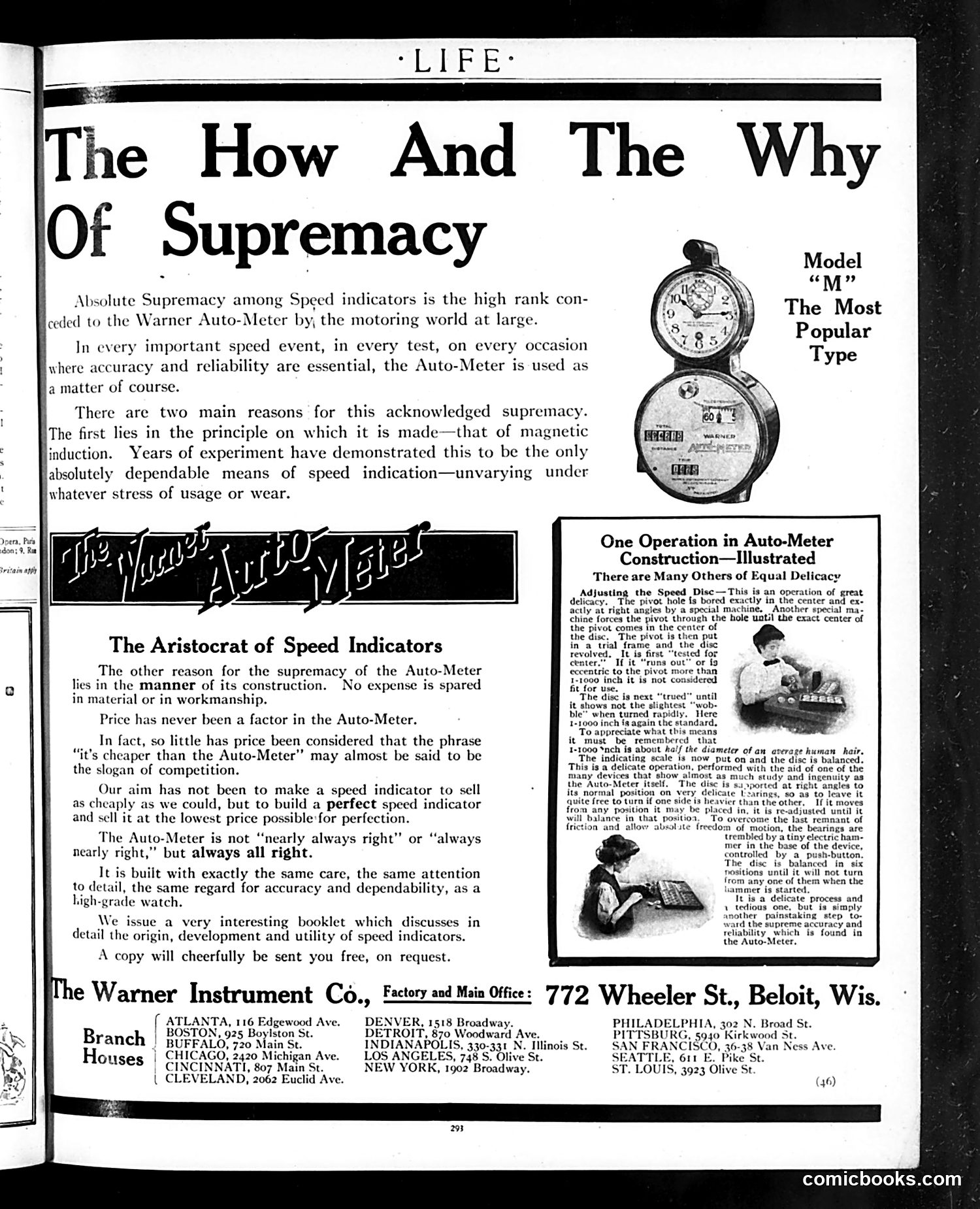
This is **not a political cartoon or satire**—it's a straightforward advertisement for the Warner Auto-Meter, a speedometer for automobiles. The page promotes the Auto-Meter's supremacy among speed indicators by emphasizing two claims: its reliability (based on magnetic induction technology) and its superior craftsmanship. The accompanying photographs illustrate manufacturing precision—showing workers adjusting the speed disc with tolerances as fine as 1/1000th of an inch (compared to human hair width). The "Aristocrat of Speed Indicators" headline uses aspirational language typical of early 20th-century advertising, positioning the product as premium despite competitive claims that it's "cheaper than the Auto-Meter." The detailed technical description and free booklet offer appeal to motorists concerned with accuracy. This represents consumer advertising from the automobile era, before speedometers were standard equipment, targeting buyers who valued precision instrumentation.
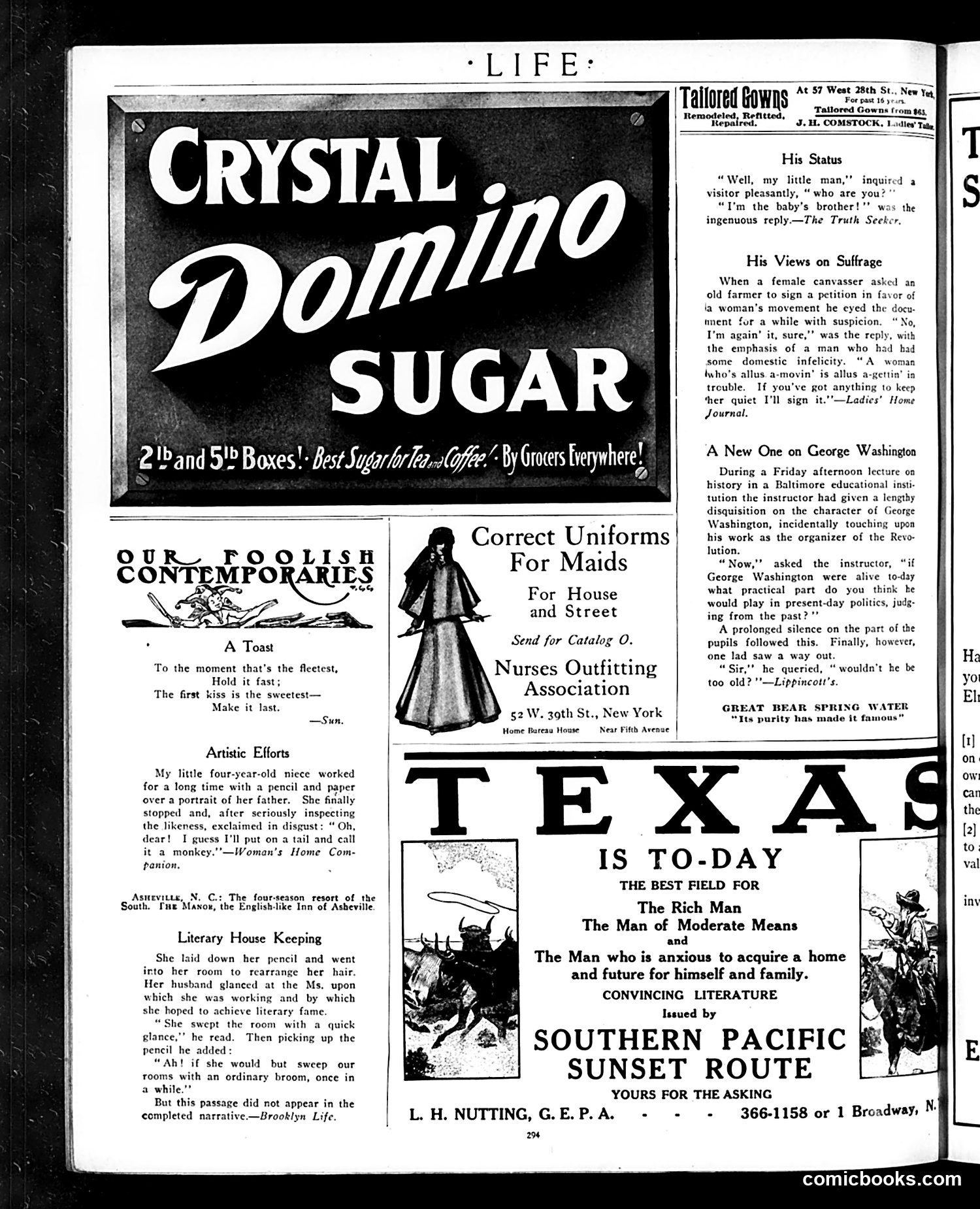
This page from *Life* magazine (a satirical publication) contains mostly **short humorous anecdotes and advertisements** rather than political cartoons. The humor pieces mock everyday social attitudes: - **"His Views on Suffrage"**: An old farmer opposes women's suffrage, complaining that women "who's allus a-movin' is allus a-gettin' in trouble"—satirizing anti-suffrage arguments as rooted in domestic control rather than principle. - **"A New One on George Washington"**: A student, asked what role Washington would play in modern politics, suggests he'd be "too old"—gentle satire on either generational dismissal of historical figures or on contemporary political discourse. - **"Literary House Keeping"**: A husband edits his wife's manuscript passage about sweeping a room to sarcastically add that she should actually sweep their rooms—satirizing the gap between women's literary ambitions and domestic expectations. The remaining content is **advertisements** for sugar, tailored gowns, Texas real estate, and other products typical of the era.
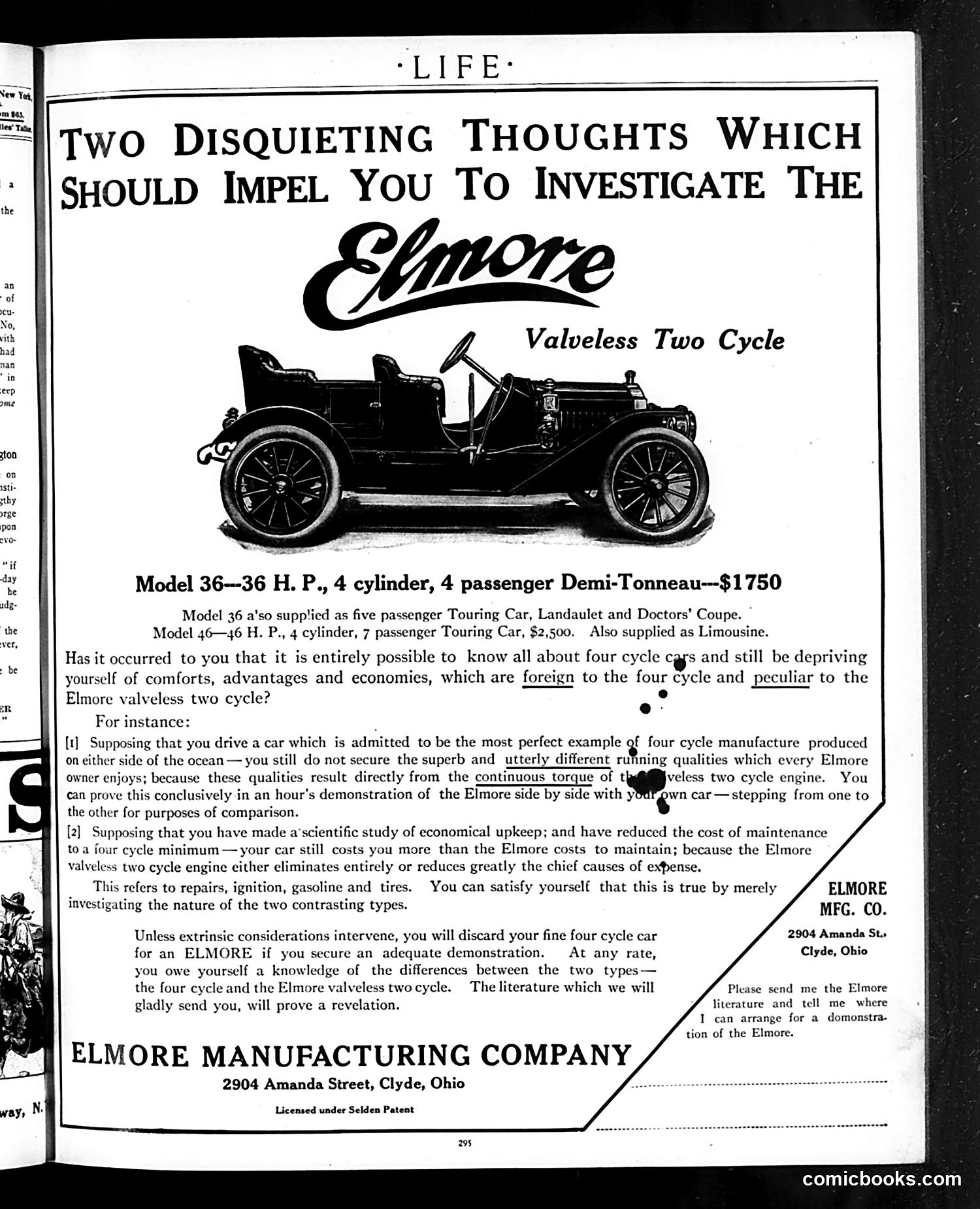
This is **not a cartoon or satire**, but rather a straightforward automobile advertisement from *Life* magazine's advertising section. The Elmore Manufacturing Company promotes their "Valveless Two Cycle" automobile against competing four-cycle engines. The ad uses rhetorical questions to challenge potential buyers: haven't you considered that a superior four-cycle car might still lack the unique benefits of a two-cycle engine? The two main selling points are: (1) superior "running qualities" and continuous torque demonstrable in side-by-side comparison, and (2) lower maintenance costs due to fewer moving parts (no valves, simplified ignition and gasoline systems). The Model 36 costs $1,750; the larger Model 46 costs $2,500. The company promises to send literature and arrange demonstrations. This reflects early automotive competition (circa 1910s) when engine technology wasn't yet standardized—two-cycle engines were genuine competitors to the four-cycle design that eventually dominated. The ad's confident tone suggests Elmore believed their technology superior.
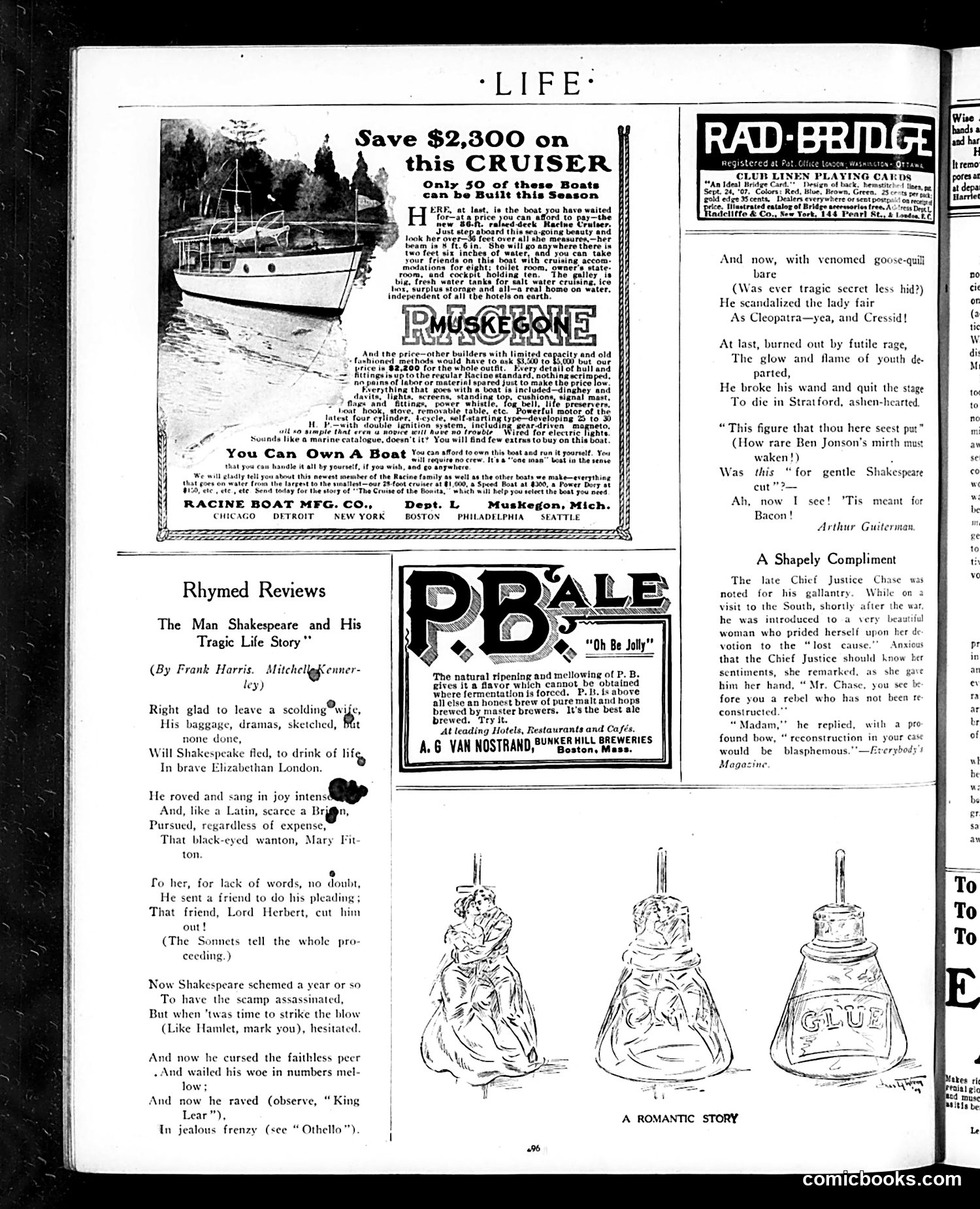
This page contains **primarily advertisements and literary content rather than political cartoons**. The main substantive content is **"Rhymed Reviews: The Man Shakespeare and His Tragic Life Story"** by Frank Harris, which presents a satirical, fictionalized account of Shakespeare's romantic misadventures. The poem references Mary Fitton (described as "that black-eyed wanton") and Lord Herbert, treating Shakespeare's legendary love life as melodrama—complete with unrequited love, betrayal, and comic hesitation modeled on Hamlet. The advertisements include a Racine Boat cruiser and P.B. ale. There's also a brief anecdote titled "A Shapely Compliment" about Chief Justice Chase deflecting a Southern woman's political statement with flattery. **For modern readers**: The content reflects early 20th-century literary irreverence toward Shakespeare's biography, treating historical speculation as humorous verse. The tone is lighthearted satire about romantic entanglement rather than political commentary.
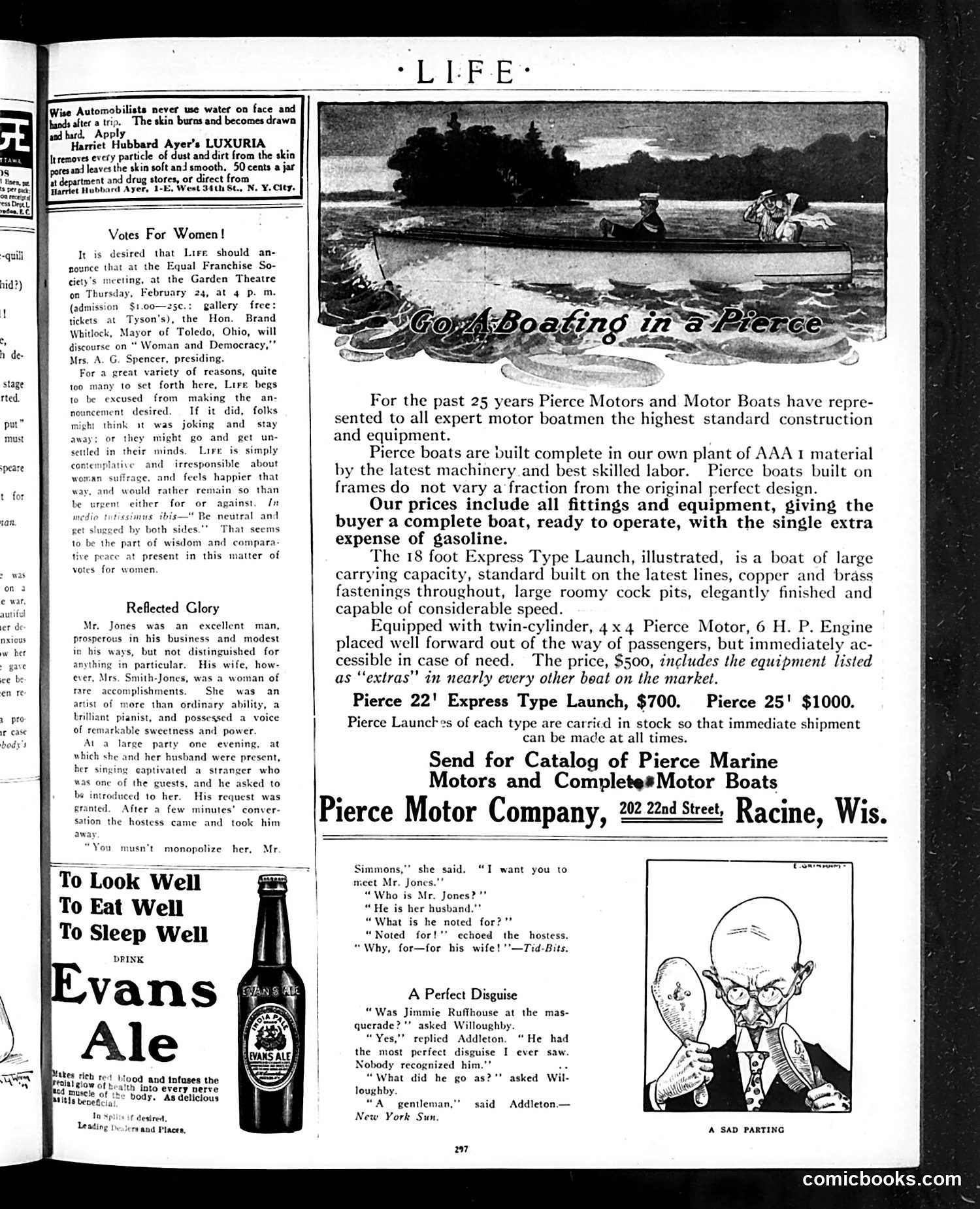
This page contains primarily **advertisements** (Pierce Motor Boats, Evans Ale) interspersed with brief satirical pieces typical of Life magazine's humor. The main cartoon labeled "A SAD PARTING" (lower right) depicts a grotesque caricature of a bald man with exaggerated features holding a balloon—likely satirizing a contemporary figure, though the specific identity is unclear from the image alone. The text snippets mock social pretension: "Reflected Glory" ridicules a wife whose accomplishments overshadow her unremarkable husband at parties. "A Perfect Disguise" jokes that a man's best disguise at a masquerade was simply being unrecognized—implying he's ordinarily forgettable. The "Votes For Women!" section humorously declines to promote a suffrage lecture, claiming neutrality while admitting Life prefers not to take sides on women's voting rights—itself a satirical commentary on the magazine's supposed impartiality on contemporary political debates. The humor relies on social observation about marriage dynamics, class consciousness, and gender politics of the era.
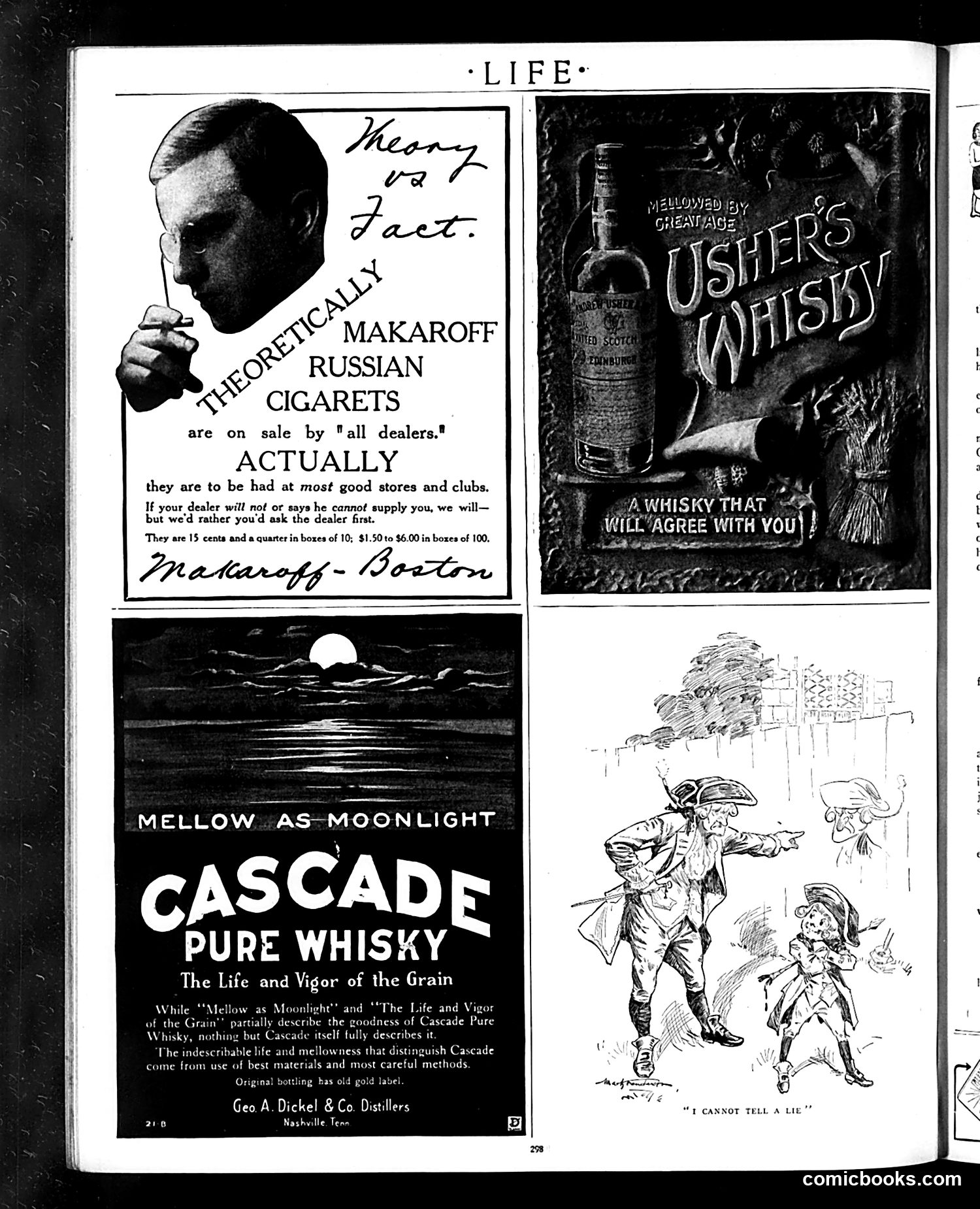
This page contains three advertisements from the early 20th century: **Makaroff Russian Cigarettes**: A man's profile endorses these cigarettes with the tagline "Theory vs Fact." The ad humorously acknowledges that while cigarettes claim to be sold "by all dealers," they're actually only available at "most good stores and clubs"—a tongue-in-cheek admission of limited distribution. **Usher's Whisky**: A standard product advertisement emphasizing quality Scottish whisky. **Cascade Pure Whisky**: Features poetic language ("Mellow as Moonlight," "Life and Vigor of the Grain") alongside a cartoon showing what appears to be a Revolutionary War-era figure telling the truth, captioned "I Cannot Tell a Lie"—likely evoking the George Washington/cherry tree legend to suggest the whisky's honest quality. The page is primarily **advertising rather than political satire**. The Makaroff ad contains mild self-aware humor about marketing claims, but these are straightforward product promotions typical of early 20th-century magazines.
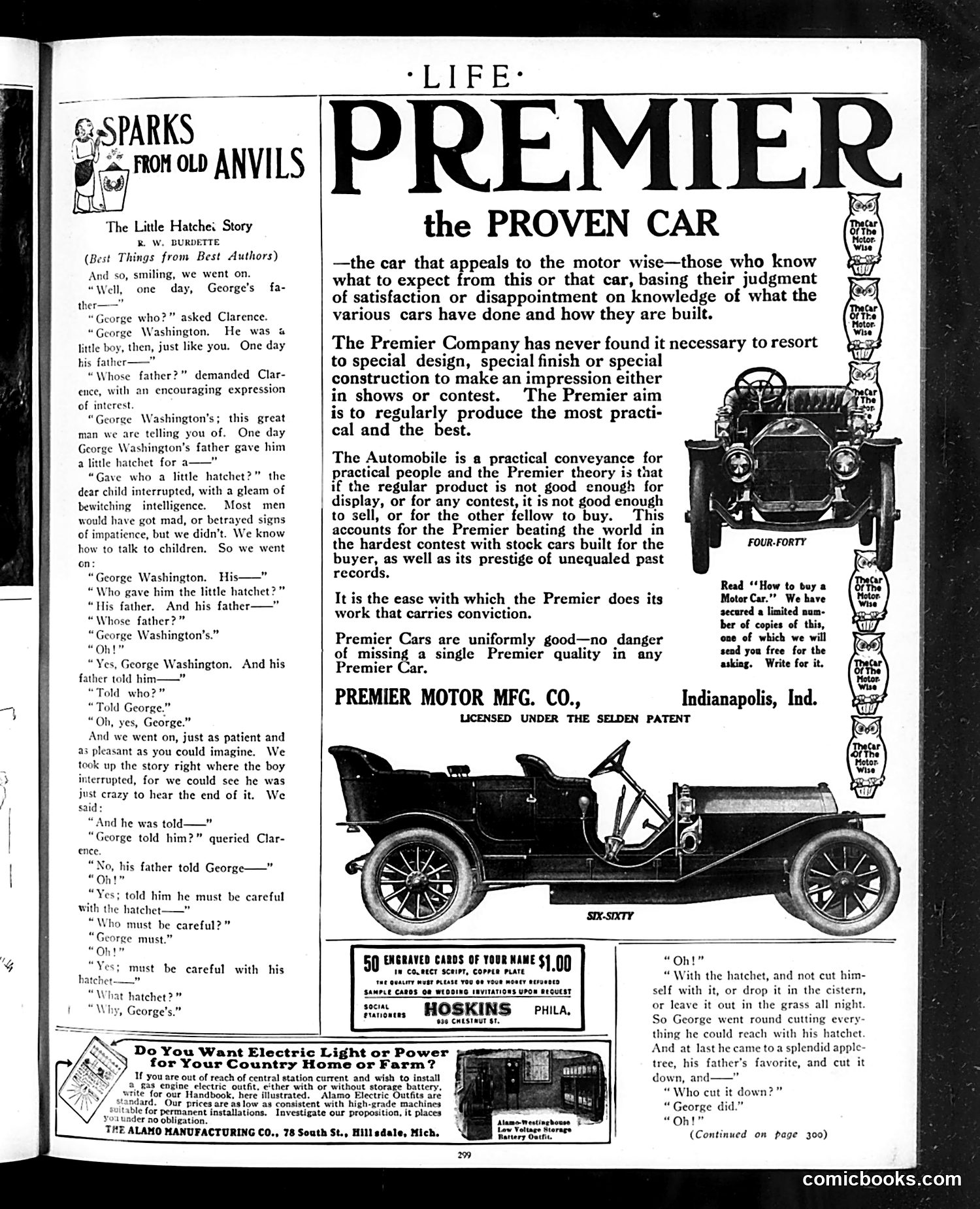
This page contains two distinct elements: **Left side ("Sparks from Old Anvils"):** A humorous short story by R.W. Burdette parodying the famous (apocryphal) George Washington cherry tree legend. The joke satirizes both the tiresome moral tale and a child's relentless, pedantic questioning that reduces the narrative to absurdity. Each clarification prompts another "who?" — mocking both sentimental American mythology and childhood interrogation. **Right side:** A full-page advertisement for Premier automobiles, emphasizing reliability and practical design over flashy competition wins. The ad positions the Premier as the "proven car" for discerning buyers, contrasting substance with style. **Context for modern readers:** The Washington anecdote was a 19th-century staple taught to American children to illustrate honesty (young George admits cutting down the tree). Burdette's deconstruction through relentless questioning is satire of didactic children's literature itself. The page juxtaposes literary mockery with earnest commercial persuasion.
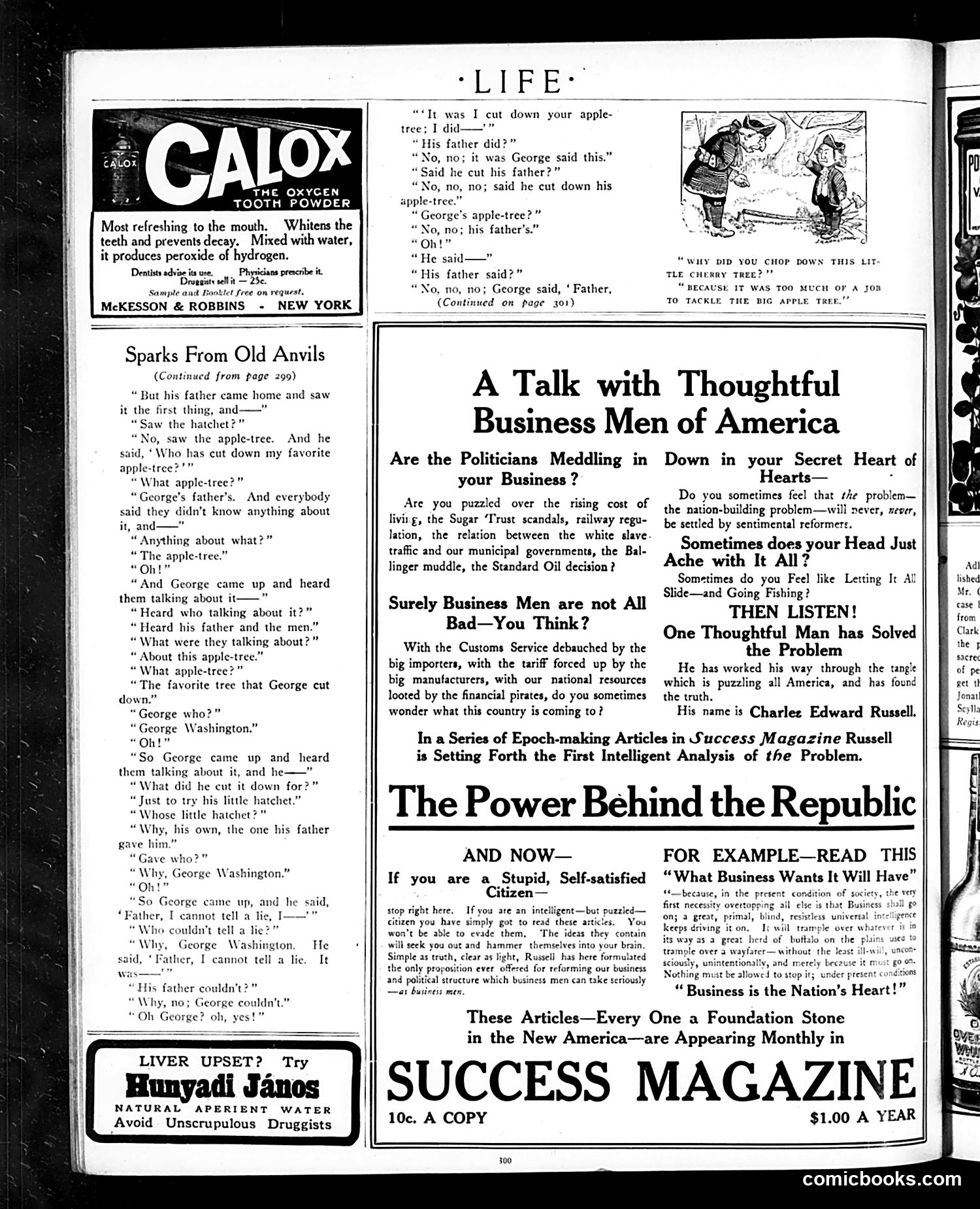
This page contains advertisements and satirical content from an early 1900s *Life* magazine. The main cartoon humorously deconstructs the famous (fabricated) anecdote of young George Washington confessing to chopping down his father's cherry tree—a myth used to teach honesty. The joke mocks how the story gets muddled in retelling, with characters confused about whose tree was cut and by whom. The larger feature advertises Charles Edward Russell's articles in *Success Magazine*, pitching them to businessmen frustrated by political interference: tariff manipulation by manufacturers, Standard Oil monopoly concerns, the Ballinger scandal, and labor/vice issues. Russell apparently offered business-friendly solutions to Progressive Era problems. The advertisement's tone is somewhat patronizing, dismissing "stupid" citizens while appealing to "intelligent" ones who feel overwhelmed by corruption. This reflects early 1900s concerns about corporate influence and reform, before major antitrust action.
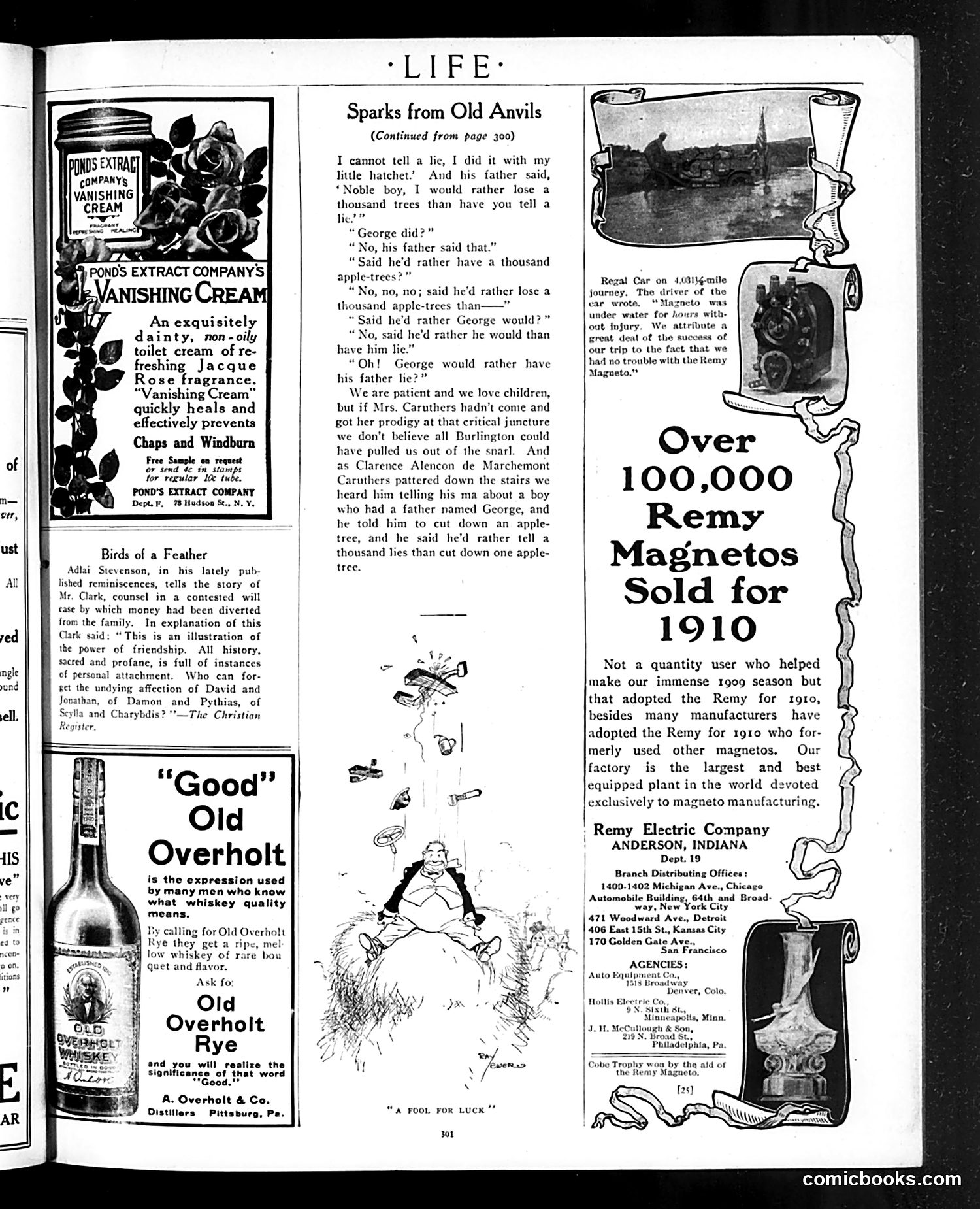
This page combines advertisements with satirical content typical of early 1900s Life magazine. **"A Fool for Luck"** (center cartoon): The illustration depicts a man in a car that has been submerged in water, humorously captioned to suggest the driver attributes survival to luck rather than mechanical reliability. The accompanying Remy Magnetos advertisement uses this anecdote to promote their product's durability—claiming the magneto functioned despite extended water exposure, positioning this as engineering excellence rather than chance. **"Sparks from Old Anvils"** (top): A humorous anecdote about a child misunderstanding the George Washington cherry-tree fable. Rather than grasping the moral about honesty, the child inverts it, concluding George would rather tell lies than cut down trees. The satire targets both children's logic and adults' patience with youth. The remaining content consists of period advertisements for Pond's Vanishing Cream, Old Overholt whiskey, and the Remy magneto company—typical commercial content filling Life's pages alongside editorial humor.
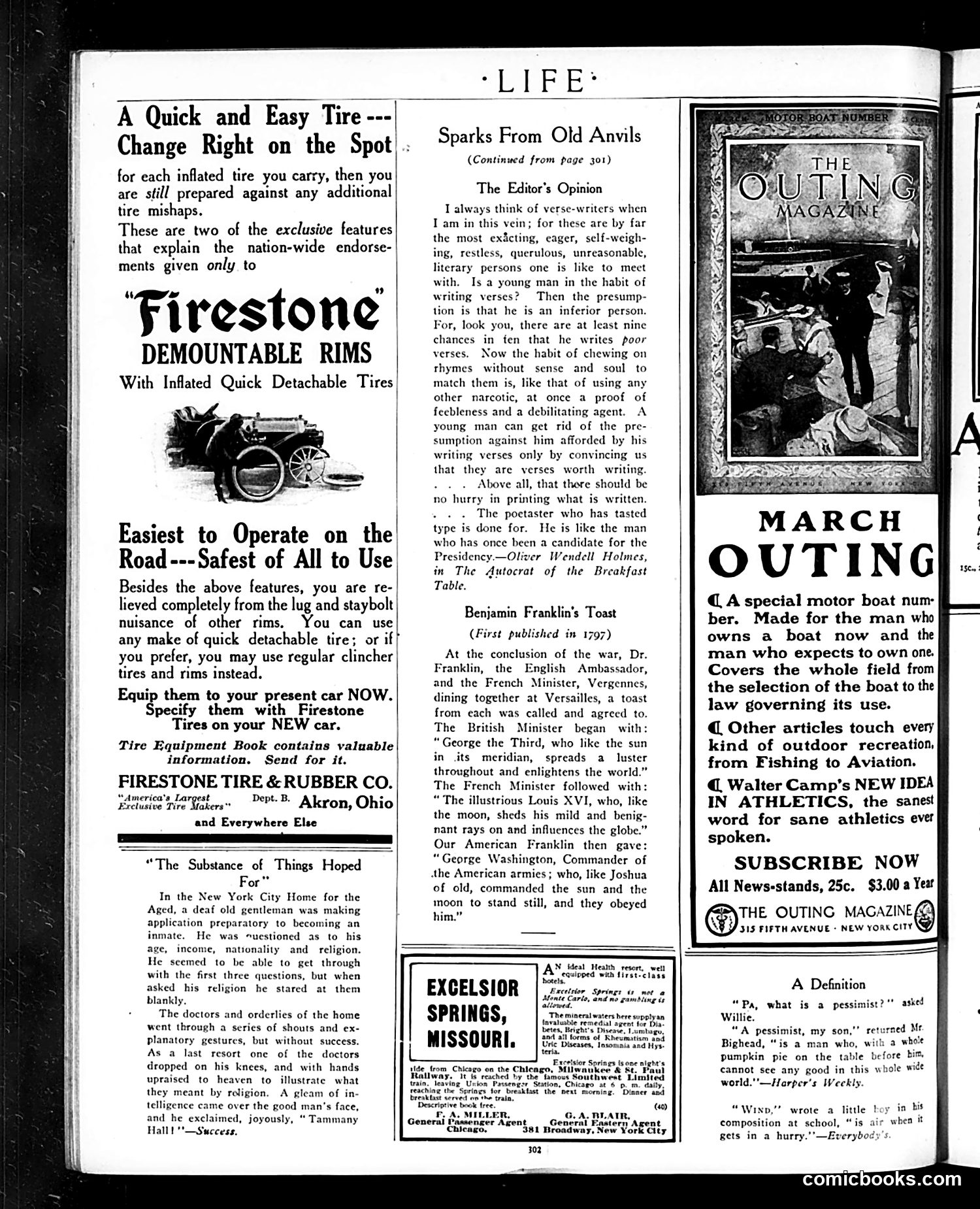
This page is primarily **advertising and editorial content** rather than political satire. The main illustrated content is a Firestone tire advertisement featuring a car diagram—product marketing, not satire. The editorial section includes **Benjamin Franklin's Toast**, a historical anecdote from 1797 where Franklin, the English Ambassador, and the French Minister each offer toasts at Versailles. Franklin's cleverness lies in his witty response: while the British praised their king's brightness and the French praised Louis XVI's gentle influence, Franklin compared George Washington to Joshua, saying he commanded even "the sun and the moon to stand still"—a biblical reference implying Washington's extraordinary power. This is humor through clever comparison rather than political cartoon satire. The page also contains a human-interest story about an elderly deaf man in a New York home and various magazine advertisements. There are no political cartoons present.
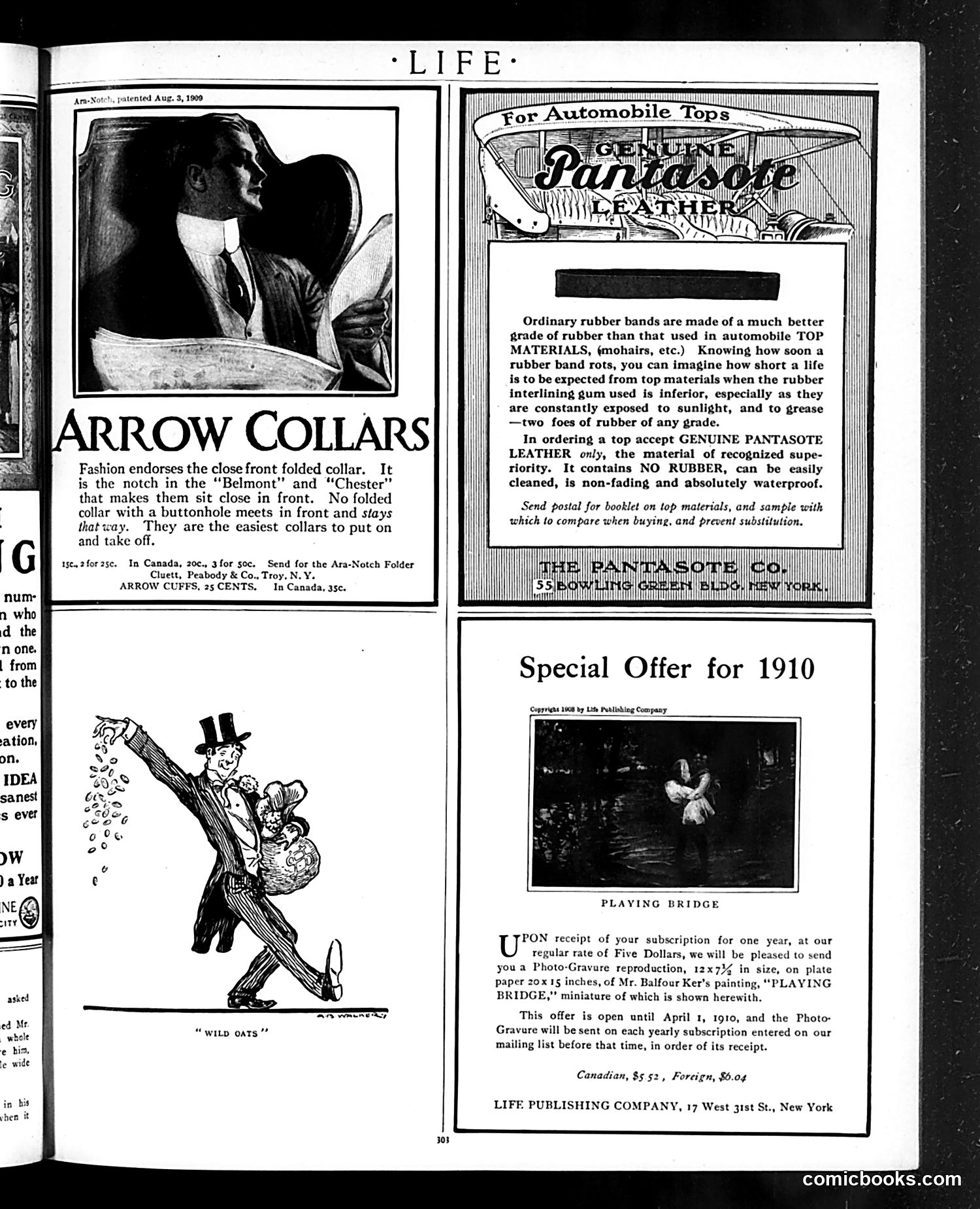
This page contains primarily **advertisements and promotional offers** rather than political satire or editorial cartoons. The main content includes: 1. **Arrow Collars ad**: Promotes a men's fashion item—the close-front folded collar style endorsed by "fashion," emphasizing it's easy to put on and take off. 2. **Pantasote Leather ad**: A technical advertisement for automobile top materials, arguing that genuine Pantasote leather (containing no rubber) is superior to rubber-lined alternatives that deteriorate quickly under sun and grease exposure. 3. **"Wild Oats" cartoon**: A small, whimsical illustration of a well-dressed man throwing money around—likely a generic joke about reckless spending rather than political commentary. 4. **Life Publishing's Special Offer for 1910**: A subscription promotion offering a photogravure reproduction of a painting titled "Playing Bridge" by Balfour Ker for five dollars annually. The page is essentially a commercial space typical of early 20th-century magazine publishing, mixing fashion and product advertising with light entertainment.
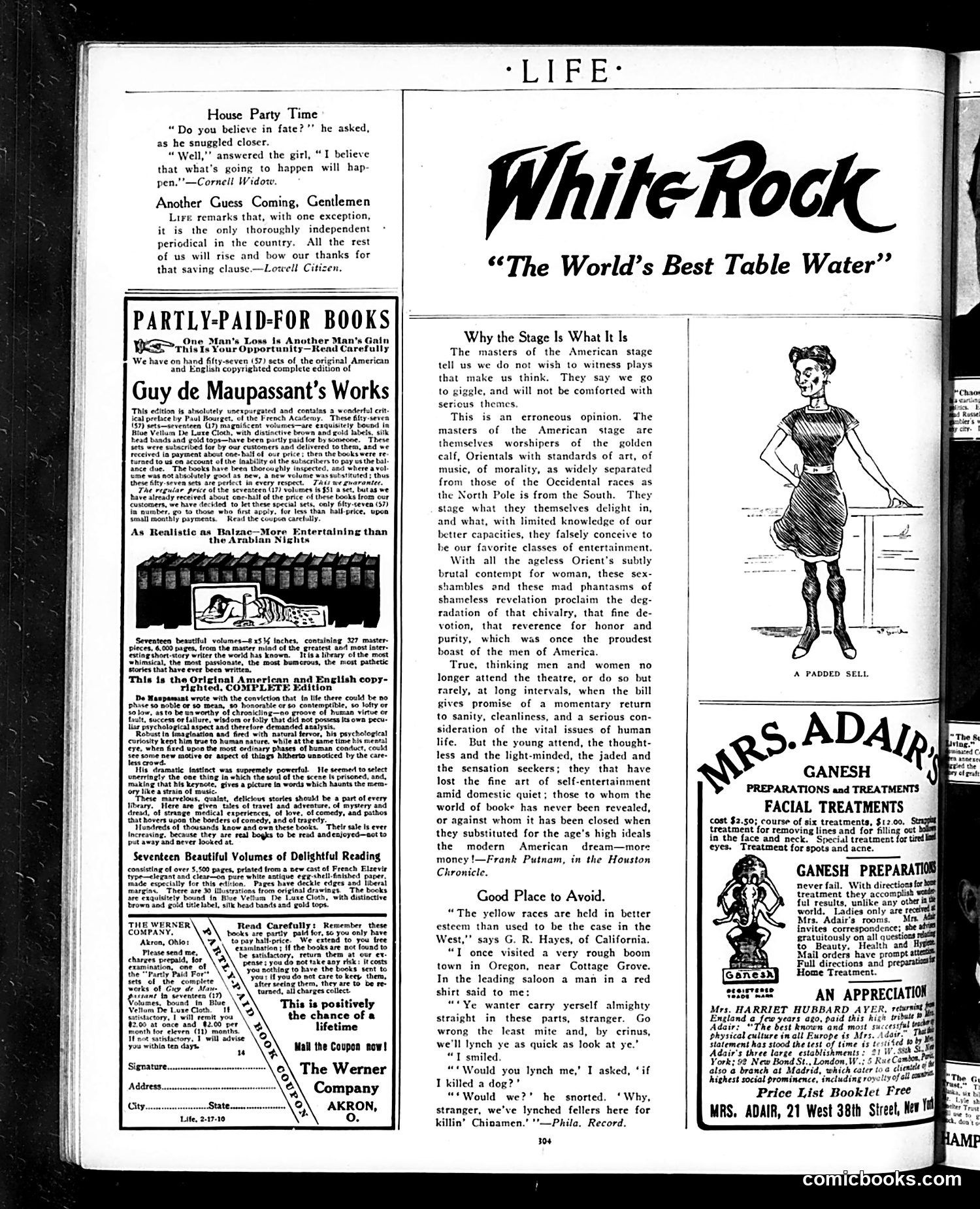
This is primarily an **advertising and editorial commentary page** from Life magazine, not a political cartoon. The main content consists of: 1. **Two brief humorous anecdotes** at the top—conventional jokes about romance and magazine independence, typical of Life's satirical style. 2. **A large book advertisement** for a 57-set remainder inventory of Guy de Maupassant's complete works, offered at half-price due to customers' inability to pay. This reflects post-WWI economic hardship. 3. **Product advertisements** including White Rock water, a "Padded Sell" illustration (unclear purpose), and Mrs. Adair's medical preparations—typical period advertising. The page demonstrates Life's dual function: mixing light social satire with revenue-generating advertisements. The Maupassant ad's honest explanation of why books are being liquidated inadvertently comments on American economic distress of the era.
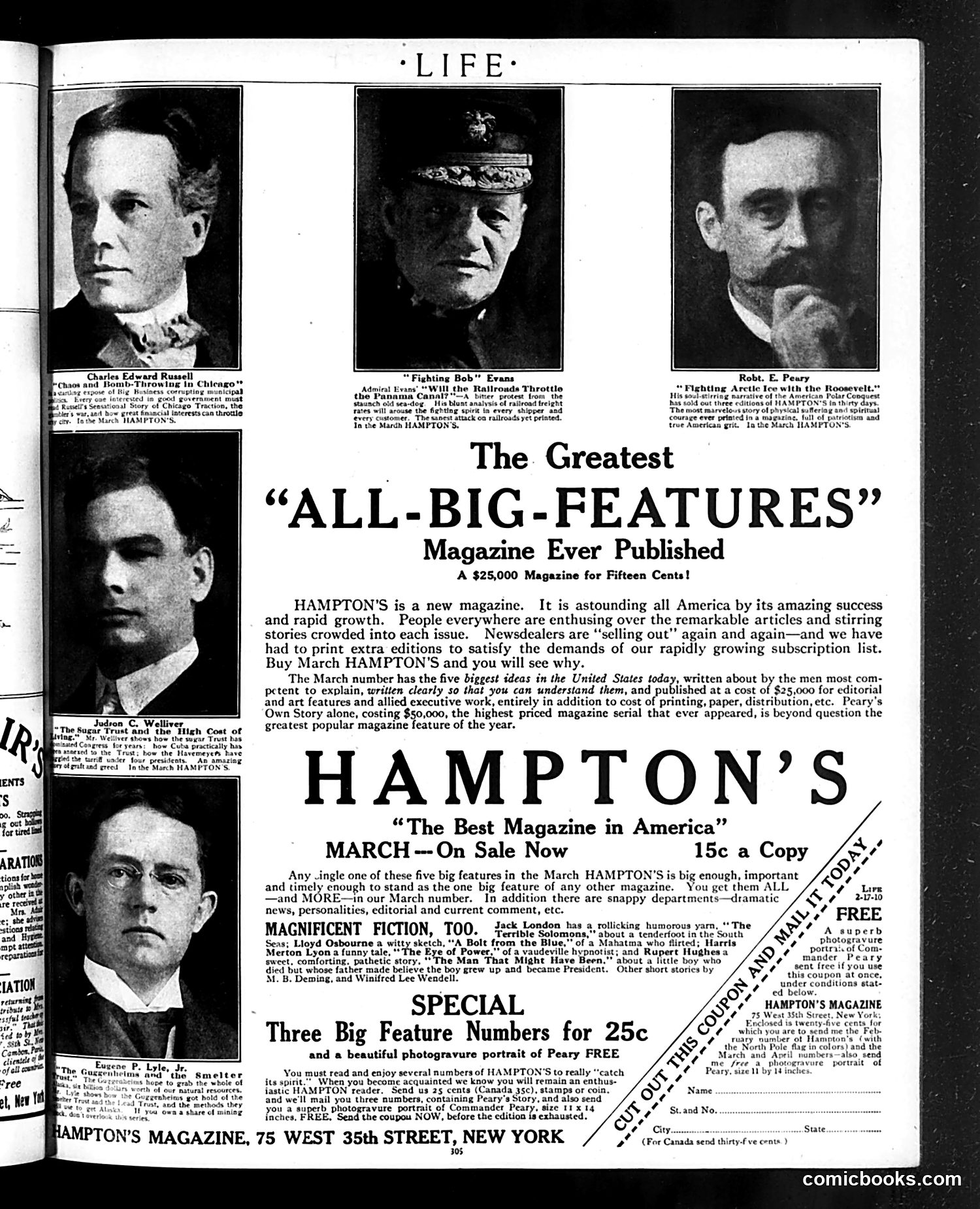
This is primarily a full-page advertisement for *Hampton's* magazine's March issue, not a political cartoon. The page features five portrait photographs of men identified as: - Charles Edward Russell (Chicago) - "Fighting Bob" Evans (Admiral, Panama Canal) - Robert E. Peary (Arctic explorer) - Judson C. Walllinger (appears to reference trusts/high costs) - George P. Lyle (unclear reference) The ad emphasizes that this $25,000-budget issue costs only 15¢, featuring Peary's personal account of reaching the North Pole as the marquee attraction. It promotes *Hampton's* as crusading journalism—the men pictured appear to represent contemporary reformers or notable figures addressing "the five biggest ideas in the United States today." The coupon offers three issues plus a free Peary photogravure portrait. This reflects early 20th-century muckraking magazine culture emphasizing investigative reporting and prominent personalities.
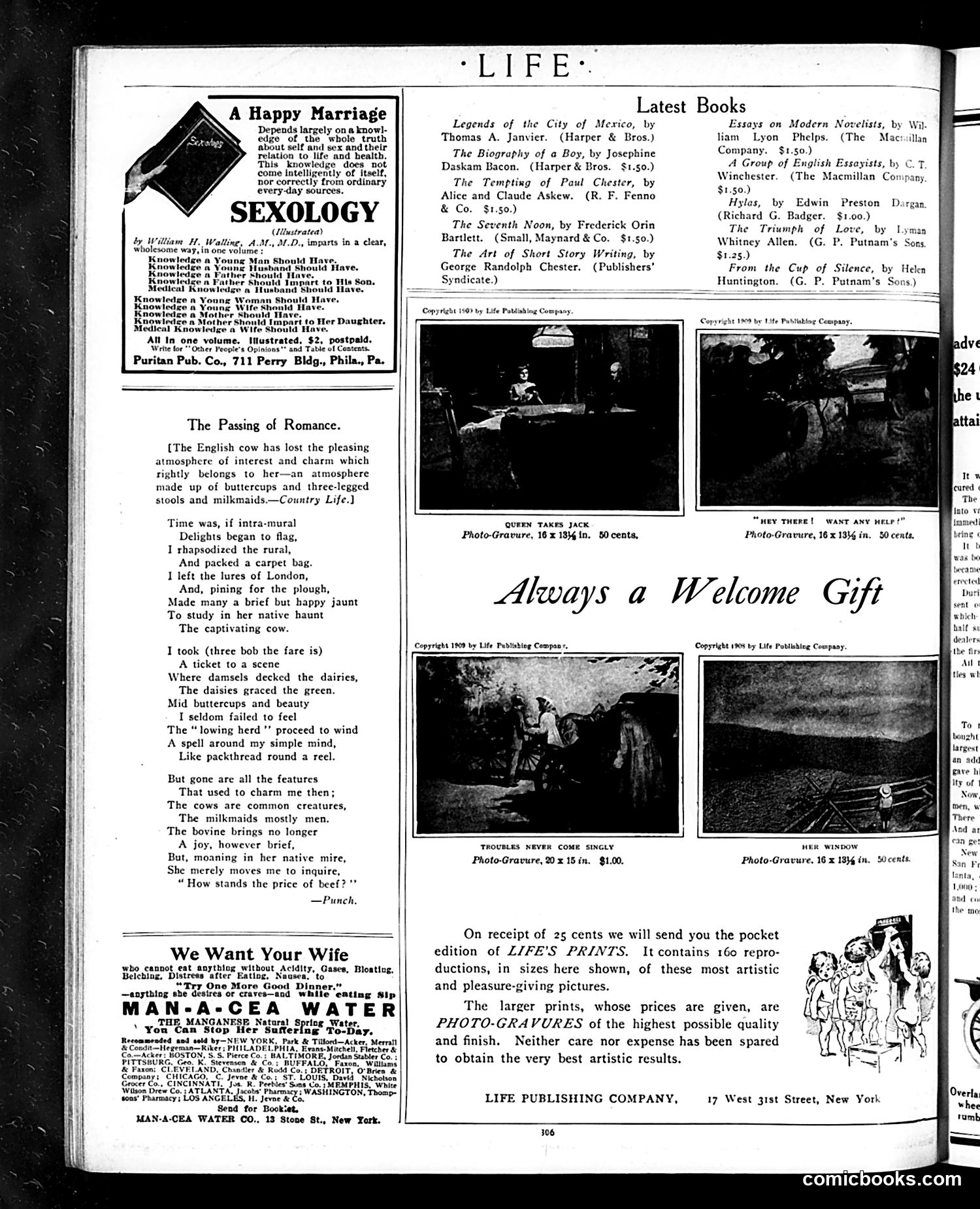
This page's main satirical poem (attributed to *Punch*) mocks romantic idealization of English countryside life. The speaker recalls nostalgic train trips to the dairy farms, where he romanticized pastoral scenes: pretty milkmaids, buttercups, and "the captivating cow." The joke: this fantasy has died. Modern reality disappoints—cows are now "common creatures," and the milkmaids are "mostly men." Rather than poetry, the speaker now asks only practical questions: "How stands the price of beef?" **The satire targets** sentimental Victorians who fetishized rural life as charming and restorative, contrasting it with modern industrial malaise. By the poem's end, even the cow has become merely economic—a commodity rather than inspiration. The titled excerpt from *Country Life* magazine sets up this critique, lamenting that English cows have lost their "charm." The surrounding advertisements (including one for digestive tonic "Man-a-cea Water") reinforce the page's theme: modern life causes constant dissatisfaction and physical ailment, even when we seek escape.
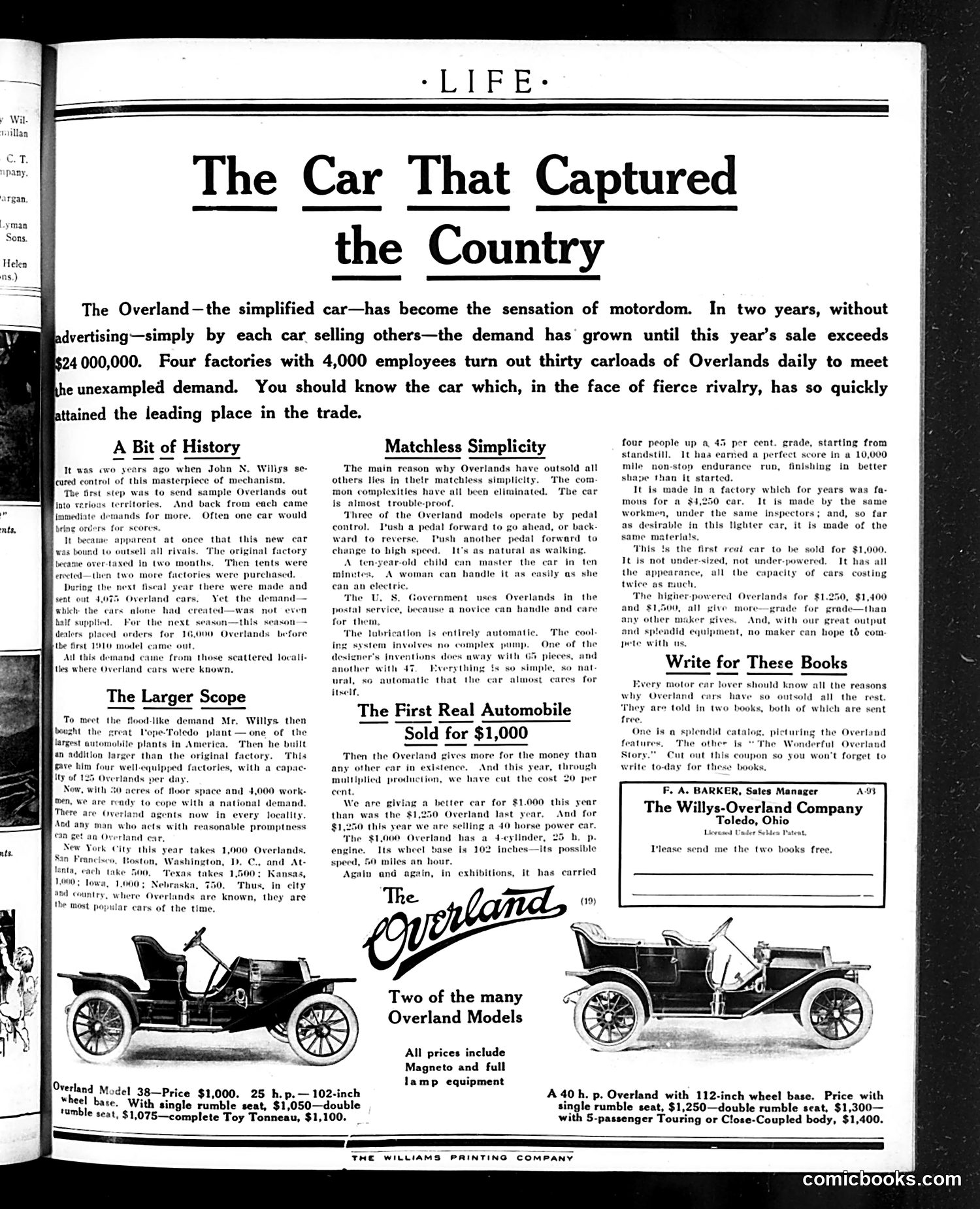
This is primarily **advertising content**, not satirical editorial material. The page promotes the Overland automobile, a car that had achieved remarkable commercial success—$24 million in sales within two years through word-of-mouth alone. The article celebrates the Overland as "the car that captured the country" by emphasizing its **revolutionary simplicity and affordability**. Key selling points include: it's the first real automobile sold for $1,000; it requires minimal mechanical knowledge (a ten-year-old can operate it); the U.S. Government uses them; and it's made with quality materials and workmanship despite the low price. Two car illustrations show different Overland models. The text contrasts this simplified, democratized vehicle against "fierce rivalry"—implying competitors offered complex, expensive alternatives only wealthy buyers could manage or afford. There is **no political satire here**. This represents early automotive industry marketing during the pre-Model T era, celebrating mass-market accessibility as a commercial and social achievement. The tone is earnest promotion, not mockery.
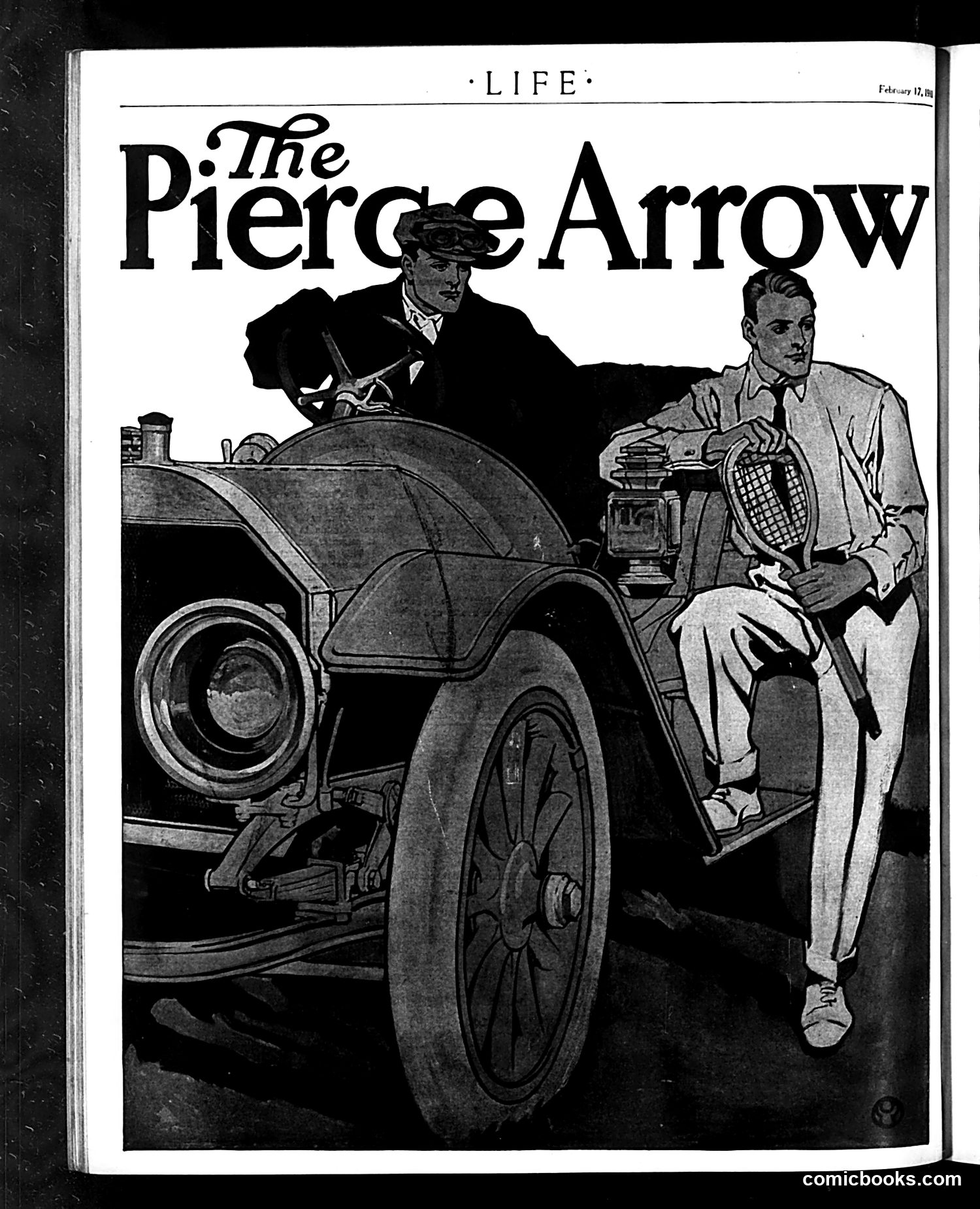
This is a Life magazine cover featuring an advertisement for the Pierce-Arrow automobile. The image shows two well-dressed men with a luxury car—one seated in the vehicle wearing formal attire (dark coat and hat), the other standing beside it in casual sportswear holding a tennis racket. The composition emphasizes the car's elegance and association with leisure and affluence. The "Pierce Arrow" was a prestigious American automobile brand of the early 20th century, marketed to wealthy consumers. The juxtaposition of formal and casual dress suggests the vehicle's versatility for both serious business and recreational pursuits, appealing to the aspirational middle and upper classes. The detailed rendering of the automobile highlights its sophisticated engineering and desirable status symbol appeal.